OSCAR BIE (continued 3)
E. E. (Ernest Edward) Kellett translation
If we take a striking liveliness as the characteristic of the Partiten, we indeed find a feature in which they are distinguished from the French Suites, but which is far from exhausting their qualities. Solid melodies, humorous capriccios, enchanting dances, tuneful airs, everything is included in these works. In their pages we realise how the spirit of Bach strives to utter the very utmost of which it feels itself capable. And in these introductory preludes, toccatas, or symphonies, in these flowing allemandes, gliding correntes, heavy sarabands, filigree-worked gigues, in those numerous intermezzo movements, such as burlesques, rondos, airs, minuets, and passepieds, there are turns of genius, the form of which is impressed for ever on the mind. I think of the sweet running movements of the astonishing B flat major Gigue; of the brilliant structure of the C minor Capriccio, which concludes the Partita in place of a Gigue; of the D major aria, in which breathes the whole grace of the eighteenth century; of the bold and rhapsodical Saraband in D major; of the rich colouring of the introductory E minor Toccata; the rocking melody of the allemande, the sombre glow of the saraband, the wayward syncopations of the gigue.
The six English Suites, which we may certainly assume to have been put into juxtaposition by Bach himself, stand between the six printed Partiten and the six French Suites, whose combination was only probably, not certainly, due to Bach. They would seem to have been called “English” suites, because they were arranged for some Englishman; the original title was apparently “suites avec prélude.” For the English suites, like the Partiten, have each a fairly long introduction, fugal in style, but not conforming to the strictest laws of the fugue. The intermezzi, also, are as numerous as in the case of the Partiten. But that extreme intellectual severity is wanting; they are more graceful and polite. This character is especially noticeable in the introductory fugal movements and the intermediate dance pieces; and one who seeks rather a play of tone than grandeur of soul will perhaps find here a richer yield than in the Partiten. Neat, volkslied-like sarabands, ravishing bourrées, rococo gavottes, ornamental minuets, the exquisitely delicate passepied in E minor—these all lie so thick one on another, that one cannot recall a more sparkling album of dainty dances in the whole eighteenth century. It is true that in the Vienna school (as in the case of the younger[79] Muffat and others) there is in this class of dances a gentle soothing quality, which gives us the first hint of the coming beautiful Viennese dance-music; but they are, like those of Handel, too short in duration and too featureless for us to be able to return to them with the extraordinary affection with which we return to those of Bach. These are so rich in invention that they cannot in many centuries lose their flavour. The dancing underpart of the D major gavotte in the D minor suite, the multiform air of the D minor, E minor, and A minor sarabands, the filigree-counterpoint of the E minor Passepied, the extreme daring of the A minor bourrée, the transport of the A minor prelude, which even grows into a roundelay,—what a depth of originality is there in all these pieces, in which the repetitions so wonderfully satisfy the laws of the mind without becoming mechanical!
How the French Suites came by their name is hard to say. More French than the English suites they are certainly not, for they are quite as Bach-like as the latter. Without Preludes and without too many Intermezzi or “Doubles” (repetitions with variations), they are of astonishing variety. The Allemandes especially, as first movements in every suite, display such a manifoldness of form, that in fact nothing is left in common to them but the four-time beat. The song in the Saraband and the dance in the Intermezzi appear to the same effect as in the English suites, and a light tone runs through the whole. But the tone is lightest of all in the E major suite, which with its rolling allemande and courante, its singing saraband, its stiff and formal gavotte, its characteristic polonaise, its tricksy bourrée, and its cheerful gigue, is a perfect paradise of dainty devices. The flowing courante in it strikes our fancy; for it is precisely in the courantes of these suites with their heavy old-fashioned movements that we shall most often hit on the rare occasions on which we must regard Bach as already obsolete. The ornamentations tend to appear less befitting to us, scattered so profusely as they are in these movements. But to Bach, little as he could as yet succeed in emancipating himself from ornamentations, they were no longer such a matter of course as with the old French clavecinists. If we compare the different manuscripts of his works, we see the uncertainties and alterations. Bischoff, in his excellent critical edition of Bach’s clavier-music (Steingräber) has therefore only engraved large those ornamentations which were without doubt always played by Bach. Taste will fill them in in certain places on grounds of symmetry and “thematic”; but they are no longer bewildering in their profusion.
Among the suites which do not belong to these collections, we recollect with great pleasure the dainty dances and intermezzi—for example in the E flat major suite, and especially that in B minor with overture in French style (Largo—Fuga—Largo) which appeared in the second part of the Klavierübung as a piece for two manuals. It presents, among the many intermezzi, a gavotte in the style of the orchestral Partiten, which links itself with the choicest dances, in graceful style, of the preceding century. From the clavier-suites we pass to the clavier-sonatas, which, still in the style of Italian art, mingled with dances, offer free combinations of different movements. The melodious andante of the D minor sonata, and its final allegro-movement rattling off almost in one part, are perfect pearls. A step further we reach the fantasias with fugues; especially the polyphonic one in A minor, the recitatival “Chromatische” and the concerto-like C minor, fugally treated, but still not a fugue. These three fantasia-pieces were Bach’s direct bequests to the future. In the polyphony of the brilliantly rushing fantasia in A minor, rising with endlessly delicate melody, we are reminded of the “Meistersinger”; in the chromatic fantasia, with its broad narration and grandiose concluding pedal point, the clavier seems to us to speak with the freedom of a drama; in the significantly constructed C minor fantasia rests the whole formal talent of the instrumental composers of the expiring eighteenth century.
The three “brilliant” fantasias incline naturally to the concerto style, which partly abandoned counterpoint in favour of a mere accompaniment, and partly subordinated it to the careful elaboration of a single voice-part. The problem of committing a whole concerto to the clavier alone, Bach has solved in his famous “Italian Concerto”—Italian in the conception of the style of execution proper to concertos, which in Italy developed itself specially on the violin—Italian in the form of a slow movement enclosed by two quicker movements, which had emerged as the most practical method for the violin (half in rivalry with the Tutti, half in the interest of solo virtuosity). Bach has in the Italian concerto perfectly attained the object of writing in several movements a clavier piece fit for execution. The grand sonatas of a later time have been able to add nothing essential to it. The first movement is an ingenious combination of pregnant motives, which reminds us of tutti-effects, of running semiquaver figures, and melodious passages on moving quaver accompaniment, which correspond to the second lyrical theme of sonatas. The slow movement is a great recitative song with a berceuse-like accompaniment, of a structure so delicate that we are irresistibly reminded of the contours of old primitive pictures. It has the dainty grace of archaic outline, just like that in the two-part interwoven arioso[80] of the B minor Prelude, or in the crisp melody of the E flat Prelude (Wohltemperiertes Klavier I.). The third movement, which is quicker, unravels the whole into the cheerful linked play of floating parts, unsurpassed in elegant construction by any of the great formalists. Floating passages run up and down among chords, falling like drops of rain, and the voices combine in pleasant unity.
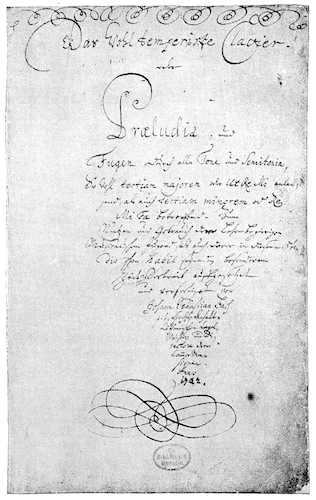
Facsimile of Title-page of Bach’s Manuscript of the Wohltemperiertes Klavier. In the Royal Musikbibliothek, Berlin.
The entire multiformity of music at the beginning of the eighteenth century is expressed in the clavier-works of Bach. As yet the sonata-form with its two themes, and its “free” section in the middle of the movement, has not become the consecrated scheme;[81] and all the forces which had gradually worked towards this form exert themselves unfettered, in order to make themselves effective now in this, now in that combination of movements and parts of movements. “Thematic” is not neglected. To a series of suite-movements similar commencing motives are given, and the motives of earlier parts are taken up in the later. But this tendency to unity does not act as a restraint upon form, and does not reduce everything to one stiff mould. There is a fugue with a prelude, by Bach, that in E flat major (Wohltemp. Kl. i.), which offers perhaps the most delicate example of this unrestrained unity of motive. The Prelude, which is much longer than the fugue, begins with semiquaver figures, whose characteristic is melodious sustained passages advancing by sixths and sevenths; after this introduction, begins in toccata-fashion a kind of slow fugue, which unfolds the just heard motive in a terser form; and finally, in a third part, mingles itself with the former semiquaver figure. The fourth part is so to speak moulded in the fugue form, which in its “subject” makes use of the characteristic leap of a seventh, found in the Prelude, as a main feature, and brings the play to a conclusion in a busy and lively manner. The relations of motive are only to be felt, not seen; but they are there, and give to the formal freedom of this piece a vigour of its own. Thus, in many of Bach’s pieces, apart from the direct thematic motives, we shall find this indirect assonance, which, springing from a general feeling of unity, is, in fact, a more dainty framework for the piece than any unity that could be impressed on it from outside.
So also is it with the construction of the pieces. We find everywhere traces of the later sonata-style; and not less in the dance-forms than in free movements. It was too natural to repeat the beginning of the piece at the end, then to transpose a second theme into the main key, and in the centre to work out the main motive in a kind of free fantasia. But so long as the author held fast to the binary form of the piece, and to the Da capo of each half, as was the case at this time, so long did the parts of the “developments” and repetitions fail to concentrate themselves so completely as not to leave a rich field of varied forms in which fancy could move at ease. Bach’s imagination was keen enough to give to every one of these forms, as they developed themselves each moment, a natural and elemental strength. A toccata by him, although they are all very various in form, or a fantasia, like the C minor, which is of sonata-character, is built up so firmly and self-evidently that the later uniformity of the sonata seems rather to betray a weakening than a strengthening of style.
[That the severe forms of Prelude and Fugue are abundantly capable of expressing poetical ideas is easily shown. Turn only to the D minor Prelude and Fugue in the second part of the Wohltemperiertes Klavier. Although the casual reader perceives in the one movement merely an exercise in two parts, in the other, one in three parts, it requires only a slight exercise of imagination to see that the work really pictures some such feelings as the following: In the Prelude, a man suddenly realises himself in the true “out-of-doors” of this life, with the rain and hail of difficulties and troubles sensibly battering him. Bravely, but ineffectually, he tries to push through the tempest, and sinks wearily into half-sleep, is awakened by a renewed riot of the elements around, tries harder than before, and longer too, to impress himself on his circumstances, and be master of things, and succeeds in a sorrowful kind of way, for the storm passes, sighs itself out, and he at last can rest. In the Fugue, he tries to begin his work in the world. His efforts are strong in their intention, but die down as weakly as the devil himself could wish, one after another. But though these messengers of his will return to him empty again and again, he still goes on. “It is the best I can do, and something may come of it in the end,” he seems to say. And there is in the final bars, where the subject occurs for the last time, a certain expression of savage pleasure at the thought of not having given in, mingled with the abiding knowledge of an abundant measure of continual failure, such as is no imagination to any man who cares about his work, and has arrived at the sorrowful conviction that most of his walking must be done in the dark.][82]
Perhaps the Bach Preludes show this freedom on the most liberal scale. For the Prelude is not so much a kind of form, like the Toccata, but a mere Piece before a Piece; it lays down the lines to be followed, but in itself is uncertain, unfixed in form. The Prelude may be a Toccata or a Sonata, a Symphony or an Invention; it can let its upper part, in arioso style, wander over the continuo, or it may burst forth in fullest polyphony. It may have the rhythm and regularity of beat of the dances, or may speak with the freedom of recitative without thought of a repetition. The abundance of possibilities which Bach found at his disposal in the working out of themes, construction, and style, are mirrored in the Preludes, from the real fugue to the playful method of the court-musicians.[83] Anyone who undertakes the pleasant task of simply running through the Preludes of the “Wohltemperiertes Klavier” (vol. ii.), will be able to appreciate the full spring-like freshness in which the free music of this time, so rich in promise for the future, lived out its life. And, like the discriminating observer of nature, he will admire, in just these yet unspoilt forms, the great harmony and natural unity which is exhibited by the young life of the creation. The Prelude in E major will always seem to me a blossom of this spring-time (“Wohlt. Kl.” i.)—one of the daintiest pieces ever written for the clavier. In an easy 12/8 time the poem begins with an allegretto theme, ingeniously invented, and playful in style. It is supported by two voices; but they soon take part canonically in the delightful movement. We have, in the play of cheerful thought, come to the dominant of the dominant[84] (F sharp), and from this F sharp we rest, in a humorous change, a moment on D, and even G, till, just as rapidly, we emerge through a chromatic maze at B natural once more (Bar 8). The repose of the succeeding dominant passage is gently stirred by ravishing transient modulations, on which the very spirit of happiness seems to rest. A beautiful chain of syncopations leads us through F sharp minor, and a jubilant run of semiquavers, built on a dominant chord on E, brings us to the recapitulation of the opening subject in the key of A (Bar 15), starting from which the movement repeats itself accurately (for eight bars) in its eternal cheerfulness, the piece closing with a couple of bars in Schumann’s ingenious manner, still sweetly suggesting the spring-song of its earlier strains.
We find, then, that nothing essentially new in “form” has been used by later artists, of which the germ did not already exist in Bach. Nay, even in programme-music (supposed by many to be an invention of modern times) for the clavier, which Kuhnau so quaintly worked out in his Biblical Stories,[85] Bach has entered the field in a youthful composition. He is singing the departure of his brother. The first adagio movement in anapæstic rhythms represents the flattery of the friends, who are trying to dissuade the traveller from his journey. It is time for the fugue, and this is the picture of various misfortunes which may befall him in foreign parts. A mournful arioso passage on a ground bass,[86] chromatic in character, is a universal lament of his friends. In a full-chorded Intermezzo they come and bid him good-bye, seeing that it cannot be otherwise. Now the postillion sings his air, broken with octave passages, representing the smacks of his whip; and since a fugue is the end of all good things, we hear one in four parts raise itself above the post-horn, with whip episodes to increase the realism. The young Bach did not go as far as Frohberger, who represented the assaults of robbers, crossings of the Rhine, and even forcible ejectments with violence, on the clavier; or as Kuhnau, who had given the cheating of Laban in “deceptive” cadences,[87] and Hezekiah’s doubtings in the rehearsal of a choral; yet this kind of programme-music declined in the eighteenth century precisely as it has grown up again in the nineteenth.
If we believe Spitta, Bach also left behind him one of those anagram-pieces which were so in the taste of his time—the fugue on the letters B A C H. But the composition seems too leathern and insipid for us to be able to express a decided opinion. There is in literary criticism a well-known false method—the wish utterly to deny insipidity to the great. But since Bach’s authorship of the “B A C H” fugue is not vouched for, and since he never elsewhere put together so many dull pages, we are not compelled to load his memory with its weight.
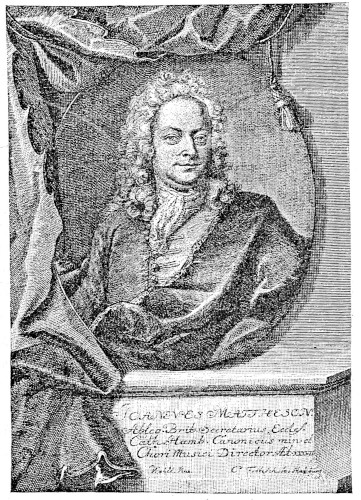
John Mattheson, at the age of 37.
As we find in Bach the possibilities of all the great forms of the succeeding centuries, so we find in him also all the germs of future expression, rhythm, harmony, and melody. Nothing is more perverse than to regard this music as academic and expressionless. Expression is never absent from counterpoint except when it sacrifices impressionism to the mere display of technical mastery. We shall even to-day seek in vain for piano compositions more full of expression than some of the preludes contained in the Wohltemperiertes Klavier. In the remarkably decadent C sharp minor, in the B minor, so full of gentle mournfulness, in the E flat minor with its grandiose solemnity, in the B flat minor with its organ-like seriousness, or in the F major with its Meister-singer melody[88] (in Part II. Wohlt. Kl.), there is an unsurpassed depth of expression. Nowhere is there a greater variety of characters than would be presented by a comparison of the fugal themes in this work. Merely to turn over a few of its pages is to see before us an abundance of content which no other music-book would easily conceal in so narrow a space. It is in the service of expression that the motives for the architecture of the fugues are unfolded; in the service of expression the rhythms are developed, whose skilful planning is only clearly seen in a piece like the G major Prelude (Wohlt. Kl. i.); in the service of expression are formed the harmonies, from their simple successions, as in the C major Prelude (W. Kl. i.) or of the C sharp major Prelude (W. Kl. ii.) to the complicated retardations and tied notes of the B flat minor Prelude (Wohl. Kl. i.), or in the B minor fugue (W. Kl. i.) on a theme so wonderfully sad that no bolder chords can be found in the days of the most furious chords of the seventh. In Bach, says Marpurg, the different talents of a hundred other musicians were united.
Bach played very quietly. In his time technique began to change its principles. The hand was no longer to be held out flat, but curved, so as to provide a series of hammers rather than levers. The passing of the fingers over each other, as practised by Mattheson, a player of distinction almost equal to Bach and Handel, gave way to a systematic under-passing; and the thumb, which Bach had seen applied by former generations only to wide stretches, began its important part as the “linking” finger. The remains of Bach’s finger-exercises, and the directions which stand in the lesson-book of his son Philip Emanuel, have been usefully compared[89] by Spitta, who has drawn a picture of the technique of John Sebastian, which in its grandeur well fits with his work. “It was a system of under-moving fingers, worked out by unparalleled practice and talent, applying not merely to the thumb but to the middle fingers, and usually so arranged that only a longer finger can pass over a shorter.[90] This produced a technique which, like Bach’s work, united past and future in one classic method. Our thumb-technique, which in essentials goes back to Philip Emanuel, is a mere fragment of Bach’s method, just as the whole succeeding art was, compared with Bach, but a fragment on a large scale.” But it is hard to be clear on these matters. Before the time of “schools” technique was a matter of personality; and reconstruction to us of a later age is utterly out of the question.
Should a diligent scholar try to reconstruct from Bach’s pieces his technique, so far as it had influenced musical form, he would soon be brought to a pause. For when we examine this literature, we see that to the master everything was possible, and that he never gave form to a conception for the sake of technique. He is a stupendous genius who does not write for everybody, and therefore his compositions are often difficult; but the difficulties are never against the genius of the clavier, and can be conquered by anything but idleness. He has, again, written some taking show-pieces, like the Prelude and Fugues in A minor (Steingräber, vii. 29), which, as “paying” salon pieces, sound much harder than they are; and, alongside of these again, are pieces which spring from the very joy in the abundance of possible techniques and of new conceptions. To this class belongs, if genuine, the Fantasia in A minor (Steingräber, vii. 8), in which pure technical fireworks are let off, of short scale passages for both hands, swinging chords and octaves, running motives with astonishing passage effects, passages of sixths with over and under accompaniments, and melodious phrases with embellishing harmonies. But here the first rank is taken by the famous “Goldberg” variations, already printed by Bach, partly set for two manuals, an album of thirty technical conceptions, in which everything possible in tone-material is contained, from arioso to canon, from grave to presto; everything, in fact, which Bach ever adopted for the setting of his ideas. The twenty-ninth variation, which can also be played on one manual, brings before us chords and passages of interwoven beauty which prepare beforehand the way for Liszt. Even in technique, then, the genius of Bach stretches over centuries.
It cannot be exactly maintained that Bach treated the clavier wholly individually, but he nevertheless has helped to individualise it. At the beginning of last century, when the clavier was still for the most part an accompanying instrument, when it sustained in the orchestra the foundation-harmonies, even if at the same time another clavier entered in concerto-wise, genius itself could not release the instrument from this corporate conception without running against the whole spirit of the time. It is remarkable how Bach left it the character of a thorough-bass instrument, and yet allowed it so much independence. It has at one time the divided nature of the unifying organ, as organ-pieces were then regarded still as practically ready for the clavier; at another the pizzicato and running character of the lute. Bach could entitle his formally interesting E flat major piece, Prelude, Fugue, and Allegro (Steingräber, vii. 30) as Prélude pour le luth ò çembal.[91] From the traditions of the lute and organ the peculiar nature of the clavier comes into existence, and it was in the maintenance of the via media between these less delicately expressive extremes that its future lay. How individually Bach regarded the clavier is seen in the pieces in which it is combined with flute and viol da gamba or violin, or in the concertos with one, two, three, or even four claviers. Among these the C major and D minor concertos with three claviers, now combined, now isolated, represent the highest points of this older form of the concerto, as yet not adapted for solo-virtuosity. But yet plainer is his insight in the direct transcriptions which he has made of violin pieces for the clavier. He interpolates in the freest fashion middle voices, which are kept together by “pedals;” ornamentations which draw out the air of the melody in clavier-style; or rapid vibrating over-parts which make up for the loss of the long-drawn violin tones. And by this insight into the peculiar character of the clavier, he makes it more capable not only of speaking with its own voice, but also of spreading over wider circles the literature of other instruments by means of suitable and self-intelligible transcriptions. Bach’s extreme love of this instrument, which so often gave him the means of expression for his musical conceptions, contributed not the least to such an interpretative mission. Slowly the world accustomed itself to understand music, not per chorum, but per instrumentum.
It is at this point that the great need is felt. A mechanical advance is required to bring the expressive capacity of the clavier into a line with the demands of genius upon it. The rivalry between the clavicymbal and the clavichord[92] was not yet quite decided. In Romance lands the former was the favourite; in Germany the latter. On the former great effects could be better produced; on the latter the more soulful tone, and the unique embellishment called “Bebung.” Bach wrote much, including the Wohltemperiertes Klavier, for the clavichord, which even his son Philip Emanuel still preferred to the clavicymbal. But he was so unable to disguise from himself the counter advantages of the fuller and broader quill-instrument, that he published pieces for “Kiel-flügel”[93], with two manuals and registers for forte and piano. These registers were the only means for giving light and shade to the monotonous note of the “cymbal”; to give light and shade by turns, as in the organ, so that on the upper manual a melody could be played loud, and on the lower the accompaniment could be played soft. In Kuhnau we see the forte and piano, which he aimed at by simply striking on the clavichord, used as a means of expression. In the Biblical Stories Jacob has just been cheated by Laban, in receiving Leah for Rachel. “The bridegroom is contented,” as a minuet shows us; but “his heart prophesies misfortune,” and the measure rushes on, becomes piano and più-piano; suddenly Jacob takes heart again—forte; after a bar or two he goes to sleep—piano; he wakes—forte; falls into deep slumber—piano. In his “Italian Concerto” Bach had made a much more specialised use of this by the register. He had mingled loud and soft parts, and each hand alternately is marked forte or piano. In these, and similarly in the echo-movement of the suite with “Ouverture à la manière française,” we are led to think of a splendid clavicymbal, such as the one preserved ostensibly as Bach’s in the Berlin Museum of Instruments. In that, every one of the combinations of four strings can be altered by pulling a register: the manuals admit of coupling, and a soft lute-stop is provided.
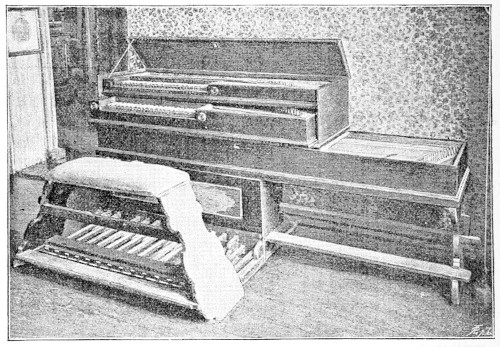
Pedal-clavichord. Consisting of two manual clavichords, with two strings to each note, of (8 ft. and) 4 ft. tone, and a pedal-clavichord with four strings to each note, two 16 ft. and two 8 ft. Inscribed “Johann David Herstenberg, Organ-builder at Geringswald, made us, 1760.” De Wit collection.
We know of a hundred attempts to improve the sound of the clavier, and make it more expressive. Here, too, the eighteenth century is the experimental preparation for the happy successes of the nineteenth. Now the string-choruses were tuned in octaves, now pedals were added for low notes, now the sound-boards were strengthened, now the lower strings were made of copper, and the higher of steel; and throughout a rich experience was acquired as to the best way of constructing the separate parts. Leather plectrums appear everywhere in order to make the tone softer and less metallic. The clavier, in fact, was made to imitate all possible orchestral instruments, and even such natural phenomena as thunder and lightning, by means of register-stops. Or, the forte and piano stops were combined, ever more artistically, into as many as two hundred and fifty permutations, so that an endless number of shades was possible.
The solution of the problem was the modern hammer-clavier or pianoforte, in which the strings are no longer plucked but struck with hammers, so that every nuance of touch depends on the fingers. The story of the pianoforte is the usual Story of Inventions. While people were labouring to solve the problem by theoretical calculation, it had long lain solved in an unsuspected fashion before them, and those who were slowly working at the practical realisation were personally forgotten, until a positively sufficient experience made the new invention popular. The beginnings of the pianoforte are therefore, as usual, obscure. The striking of the strings with hammers had long been the method employed in the dulcimer. At the beginning of the last century an artist named Pantaleon Hebenstreit was much talked of, who played the dulcimer so perfectly, that everyone was astounded at the new sound-effects. It is possible that his success gave the impulse: in any case, in the year 1711 there emerges in Italy an instrument called the pianoforte—because it could be played piano as well as forte—elaborated by a certain Bartolommeo Cristofori, who was soon forgotten. This instrument is clearly pictured in writings recently recovered as a hammer-clavier; Cristofori, as curator to Ferdinand de’ Medici, had a splendid collection of Belgian, French, and Italian Flügel-instruments to look after, the study of which, without doubt, aided him in his invention. His pianoforte, which at first shows a still more primitive technique, gradually draws sensibly nearer to the modern system; yet, on account of its unaccustomed tone and touch, it was unable to gain any appreciable results in the following decades. Cristofori could not have dreamt that an Italian society of our time would build a monument to him as inventor of the world-charming pianoforte, in the national sanctuary, the Santa Croce of Florence.
Whether Hebenstreit built on Cristofori, Cristofori on the French, or the French on the Germans, is unknown. Possibly the pianoforte was invented thrice over, in Italy, France, and Germany. In France appears Marius in the year 1716 as the inventor; in Germany it would seem that a certain Schröter, incited by the success of Hebenstreit, invented it in 1717; at least he himself says so in a writing first published in Freiberg in 1763, ten years after the death of the instrument-maker, Silbermann. But Silbermann had in any case the merit of having, at a more fortunate time than Cristofori, worked so hard at the perfecting of the pianoforte, that from him its increasing spread and the gradual displacement of the clavicymbal and clavichord may be dated. Yet this very Gottlieb Silbermann had constructed a “cimbal d’amour,” which by a cleverly devised mechanism heightened the tone of the clavichord—so “lonesome, melancholy, and inexpressibly sweet.” But his later renown rests on his exquisitely manipulated pianoforte. He had a good master in this difficult work—John Sebastian Bach. When he brought his first model to Bach the latter found it too weak in the treble and too hard to play. Silbermann was first vexed, then stimulated by this censure. He then sold no more, and went on making improvements in it until the old Bach, as Agricola[94] says, gave him unmixed commendation.
If we play Bach to-day on our extremely refined pianofortes, we are inclined to imagine that his fine effects are solely due to the perfection of the instrument. And this opinion is not wholly false. Though in the cembalo there sounded in his ear something of the accustomed solemnity of the organ, there is yet in his music a cry for a subtle and expressive instrument which he as little possessed as Beethoven possessed an orchestra suited to his ideas. In every great tone-creator lives a superabundance of imaginative form which the instruments of the time cannot embody, and to which the instruments instantly strive to become equal. Because Berlioz was, the modern orchestra is. Because Bach was, the pianoforte is, which knows how to express with justice the subtleties of his soul-music. I think for example of the never-to-be-forgotten theme of the C sharp minor prelude in the first volume of the Wohltemperiertes Klavier. The clavichord could only give this theme in a thin lament; the spinet in a rigid and unmanageable form. But what features does not the motive show as the piece runs on! Now it has the slow-breathing rhythm of a noble aspiration, now the opening eyes of an expectant Cecilia, now the heavy oppression of a martyr soul, now the holy rage of a last noble complaint, now the sweet weariness of Christian humility. And with these various tints the piece builds itself up into a broad picture, which leads from renunciations through pain to renunciations; with these tints every line, every note of the theme is given an active life, as it pursues its course. Composition like this demanded an instrument which should be capable of a new expression in every touch. All that Bach dreamed of, the pianoforte gave, awakening the gentle soul of the clavichord to an unthought-of fulness of existence, and changing the mechanical force of the clavicymbal to a sudden consciousness of personality. The voices of a fugue-passage would now be personally separated from each other; every line in the great lacework could be brought out at the moment according to the feelings of the performer. What, under the sacred laws of Bach’s music, slumbered in the depth of the breast, found in the new instrument its unreserved interpretation.
[95]It seems at first sight almost tragic that Bach himself can never have realised these effects, which are so familiar to us in connection with his music as it is nowadays interpreted on the pianoforte. But perhaps it is the wisdom of Fate to ordain that the cup of the artist should ever be dashed by a certain bitterness, the conscious falling short of attainment as it appears in complete idea before his mind.
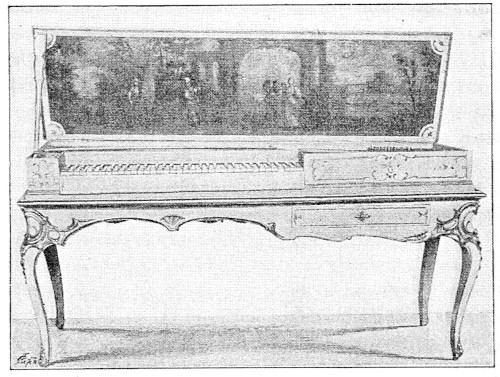
“Bundfrei” Clavichord (i.e. with a separate string to each key), by Chr. G. Hubert, Bayreuth, 1772. De Wit collection.
When an artistic form reaches perfection, its active life is over, and it is a subject of contemplation, no longer a tool to be used.
And just so, when the instrument necessary to the full interpretation of Bach’s clavier-music, the pianoforte, had arrived within measurable distance of perfection, then did Bach’s own Art reach its highest formal expression, then once more did the fashion of things suffer a change, and his work began to take its place as a colossal monument pointing on the road towards the House Beautiful.
Bach is, as it were, the priest of modern music. His congregation sit at his feet daily. Wherever a pianoforte is found, there is his temple. But though the priest cannot utterly control the worship of his hearers (nay, many will bow the knee to Rimmon in the house of the God), still his voice is strong, his words are true, and they may hear if they will.] This is the significance of Bach, and the longer we live, the more we shall believe it.
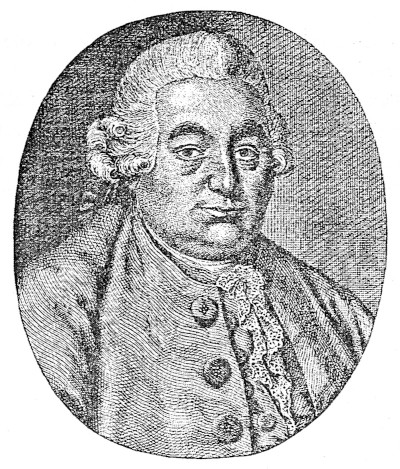
Philip Emanuel Bach, as he was in his Hamburg period.
The “Galant” School
When Bach died, the musical centre of gravity tended to Germany; but it was doubtful what precise line would be followed. On Bach anything could be built. A great period of counterpoint might rise in which voices might go through a new series of harmonic complexities, similar to, and yet so different from those of the Middle Ages. Or there might come a period of great suites in which the simple dance-forms might grow in many-sided development. A high pathetic style might be introduced, or the details of expression might attract the attention of the amateur. The forms of the various compositions might alter in either direction, of new freedom or new restraint. Counterpoint might be deserted, concerted playing might be improved in the direction of increased grace.
For all or any of these possibilities Bach laid a foundation, and it only remained for the taste of the time to decide on the choice that should be made.
The taste of the time, leaving on one side both the pathetic and the scholarly, went off into the domain of the graceful. The experience of music was similar to that of architecture, which had already gone through the epoch of the “baroque” and “rococo,”[96] by which designers had sought to give variety to the lines of their work. Compared with the energy and manly swing of the Italian Concerto, a sonata of Philip Emanuel Bach is fairly characterised as “rococo.” In place of the sober delight in bold outline appears the “galant” appreciation of eccentricities and wayward curvings. Passion is ashamed of confessing itself openly, and offers the amusing spectacle of a natural emotion wilfully covering itself with an incongruous vesture of conventional form.
The newly formed tendency towards simple sensuousness does not obtrude itself; it merely smiles in the graceful oscillations of subtle harmonies.
Caprice is the true ruler, and in improvised outpourings, speaking pauses, piquant leaps, stupefying enharmonic changes, purposed perverseness of motive, she places the same material under the hands of the fair performers, which, a short time before, had taken such a scholarly form.
Where strict canons of the voices used to be carried honestly through, we now observe a pleasant trifling with imitation which becomes coquettish, and the pedantic old Dux and Comes[97] put up very well with the change in their conditions of service. Counterpoint turns into mere accompaniment, and daintiness with humorous ornament is the object of the composer.
The new auditor is the delicate dilettante who listens no longer so much to the inner parts, the ancient severity of which vanishes and is replaced by chord music. Now we listen to the melody, to the over-part, and we unfold its whole charm, revealing a hundred secrets of melodic pleasure, and disentangling them at ease. And in all this capricious enlivening of music there remains the same delightful contradiction as in the paintings and buildings of the time—the contradiction between inner freedom and the aim at a fixed form. The external form is to replace what was offered by the inner; and yet, from these new free figures, the intention is primarily to gain this form. The aim is not at collections of suites, but at the type of the free movement, of the piece, of the sonata. It is the same spectacle as when we see Hogarth and Greuze expressing a definite moral lesson in their pictures, or architectural principles conveyed in the play of childhood. In music, however, that exclusive predominance of form, which the French Revolution caused to prevail in the representative art, has never been quite attained. It is important to notice that this was only possible since music had emancipated itself from French influence. It was only in Germany that a Beethoven could arise.
The distinction between “professional” and “amateur” is one to which our attention is always more and more drawn. “Tablatures” and apparatus for the scholar vanish gradually, and titles meant to attract the amateur become more frequent. Bach’s inscription—“for the delight of amateurs”—over suites and concertos, appears on more than one title-page. We read “Cecilia playing on the clavier and satisfying the hearing,” or “Manipulus musices, a Handful of Pastime at the Clavier,” or again, “the Busy Muse Clio,” or even “Clavier-practice for the delight of mind and ear, in six easy galanterie parties adapted to modern taste, composed chiefly for young ladies.” A certain Tischer has put it very shortly on some suites—“The Contented Ear and the Quickened Soul.” As the most complete refiner of this taste, relying on the public at large, appears Philip Emanuel Bach, who inscribes his sonatas “easy” or “for ladies,” and thus openly confessed, much as he was censured therefor by the pedants, that he had systematically introduced the light genre as a music for the future.
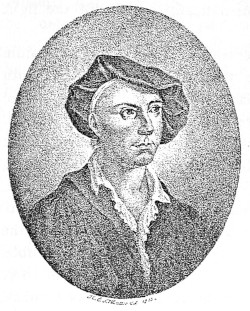
F. W. Marpurg, Theoretician and Clavier Teacher. 1718-1795.
Like the princes in the seventeenth century, or the middle classes in the nineteenth, it was the nobles in the eighteenth who played the part of Maecenas; and under their patronage appears, for the first time, a precisely marked musical society. Here too, in music, the nobility became an invaluable link between the artistic court and that public interest in art which, it would seem, is the necessary condition of all future advance. Even in the didactic musical romance which old Kuhnau wrote in 1700 under the title of “The Musical Quack,” we miss the type of the amateur Maecenas. In the background, invisible, stands the prince who keeps the chapel; in the foreground there are only musicians and quacks. The amateur who is not a quack, the genuine dilettante, first attains importance in the beginning of the century; but very shortly the concerts which are given in the salons of the Fürnbergs, Esterhazys, and Schwarzenbergs, do more for the beneficial advancement of art than even the devotion of a keenly musical court such as that of Frederick the Great at first was. The greater courts, like Dresden and Munich, begin somewhat to decline, while the smaller advance, and in England, Italy, and elsewhere, the nobility, who are not unlike small sovereign princes, aid the spread and development of music. The nobility are soon followed by the gentry; but it was not till the Revolution had shattered the nobles that the bourgeois Maecenas steps upon the scene. In this displacement of old relations it was inevitable that the clavier should play its important part; in accordance with its social nature it advanced more and more from an accompanying or supplementary instrument into an independent centre of drawing-room existence, as well as of bourgeois evening parties. Thus, in the attractive and successful pieces of the generation from 1750 to 1800, its popularity was for the first time established. Old Bach had as yet been the most serious professional musician who had yielded to “galant” impulses; and his concessions to the popular taste were only by the way. The distinction between public improvisation on set themes, and public interpretation of written works, was not yet sharply defined. The player was at his highest when he extemporised variations or fugues on a given subject. Such had been the improvisations of Sebastian Bach; but the spirit of improvisation, as it lives in the works of Philip Emanuel, is something quite different. In him the hand directly follows the inner feeling, constructs easily and simply, and plays for the sake of the playing, not for the sake of the art. Before the clavier had become a social instrument, this division of labour between composers and players had become imperative; reproduction was bound to diverge into a separate branch. The amateur, on whom more and more the art depends, is incapable of composing, but he will, on his clavier, hear the works of the masters, which are now so numerous, or even play them himself. He desires to have acts of operas, arrangements of concertos, or many dainty short pieces. The old clavier-books, which we can trace from the Elizabethan Virginal Book to the volumes of Bach’s children, now gradually disappear. Instead of copying with its personal character, the press is more and more in requisition, and the musical treasury is more and more thrown open to the public. The engraving of notes, during the eighteenth century, rapidly improves, and the clefs and types become more simple. The ornamental devices become constantly more fixed, and the player has less and less liberty in his use of them. And whereas, in earlier times, the instruction-books did not always distinguish between composition and playing, now, since Couperin’s time, the instruction-book of pure playing became constantly more common; while Philip Emanuel, to whom, perhaps with justice, we trace the systematisation of the principles of modern clavier-playing, wrote a book on playing, and then waited eight years before publishing a second part on the thorough bass.
The extension of musical interest led further to such a multitude of musical magazines as even to-day is not to be found. For the most part they disappear after a few years, but we have, as a matter of fact, in a year’s issue of such a paper, a very fair picture of musical tendencies. I have before me a volume of the last of these, published in 1762, by George Ludewig Winter, in Berlin. It is well printed, with dainty rococo borders. Very amusing and characteristic is the sanguine Preface, in which also is to be discerned the inability of the German tongue to restrain itself while talking of our classics. “Music,” says the publisher, “serves either to delight with its mere art the professor, whether he be such by nature or by cultivation—as a well-built house, or a well-laid out garden, satisfies the connoisseur; or, on the other hand, it is the language of emotion. Then roar forth tones teeming with revenge, sorrow glides over the strings, passion frantically beats the air, joy revels in the blue æther, friendship and love sigh forth on the delicate notes, praise and thankfulness well from a full heart on the vigorous melody, or rise, cleaving the clouds on the tongues of men, to the very throne of the Almighty.”
The good man, with his fearful fluency, declares that he is going to bring forward much of the lighter kind—meaning what we call the dilettante class of music. The numbers appeared week by week, and the continuation was always postponed for the next, often at the most thrilling passages—in the approved style of the clever magazine. The authors’ names are only given when they are very well known. Among these distinguished men are many whose names have not remained in the memory of history—fashionable composers, such as every epoch has in plenty. But there are also Philip Emanuel Bach, Kirnberger, and many others of the great Bach School. Most of it is clavier-music. Operatic airs, which occasionally appear, are so arranged that the voice part, under which the words are printed, is played by the right hand, and the completing orchestral notes are written small in the upper staves. There are also popular songs in abundance. A French spirit breathes through these pages; a fashionable spirit of enjoyment. The short character-pieces, which the French loved so dearly to introduce with significant titles, are mingled plentifully with sonatas and rondos, arranged in the Italian manner. Under the character-pieces, in the appropriate places, as in the biblical stories of Kuhnau, the explanatory programme-text is printed. Thus in a piece called “La Spinoza,”[98] the developments are marked as being philosophic reflections on a certain theme. Two pieces, called “Wonderment” and “Youthful Joy,” easily explain themselves. In one piece entitled, “Two friends grumbling over their wine,” by the arrangement and form of the two voices, in right and left hands, is represented how they converse, console each other, gain courage, and wait for a friendly glance of fortune. The most humorous is a short clavier-piece, “A Compliment,” which, usually in two voices, exhibits the following spirited contents: “If you are well, I am charmed.” “Rather I am glad that I see you so well” (Repeated). “I have heard that you have been poorly: I am sorry to hear it.” “Heaven be praised I am recovered.” “But I am ashamed”—“allow me”——They quarrel who shall bring the chair, and finally sit down. “I recommend myself”—“and I recommend myself”—“to your friendship.”
It was precisely at this period, when the clavier first became truly popular, that its construction was rapidly and constantly improved. It was then that the separation of the two systems of mechanism—the so-called English, and the Viennese—took place. The names mean nothing, for both systems alike arose in Germany proper. The distinction lies in the fact that in the English the hammer rests on a separate bracket from which the key strikes it, while in the Viennese the hammer rests directly, though loose, on the end of the key-lever.[99]
Although Germany was so partial to the clavichord with its intimate intellectuality—a quality which even to-day we can only reproduce in its fulness by reproducing the clavichord—yet it was the German pianoforte which for a long time took the lead. It was one of the first triumphs of German manufacture, and perhaps precisely because so little manufacture lay in it. In Italy the invention of Cristofori had vanished without leaving a trace. So utterly indeed was it forgotten, that when Italy decided, though very tardily, to replace the Gravicembalo by the pianoforte, instruments of this construction were preferably brought out there with the notice, “built in the Prussian manner.” Alongside of the Silbermann pianofortes, those of Friederici of Gera—which were known as “Fort Bien” and were still built largely on the clavichord model—and those of Spath of Regensburg, enjoyed a great renown in the second half of the century. But soon, chiefly through emigration, the best manufactories were transported to foreign parts, and it is only in the latest advance of German industry, especially by the labours of Bechstein and Blüthner, that pianos built in Germany itself have again achieved a world-wide repute.
The great French, English, American, and Austrian piano-factories can almost all be traced back to Germans. The three great Parisian houses, those of Erard, Pleyel, and Pape, were founded by Germans. Steinway emigrated from Brunswick to build in America those pianos which are to-day regarded as the best. Johann Zumpe carried the hammer-clavier to England,[100] where it was played by German executants, and brought into repute. It was, however, English houses, with that of Broadwood at their head, that effected the improvements which have resulted in the appropriation of the name “English” to the mechanism of Silbermann.
Factories alone, however, would never have brought about the final victory of the piano if there had been no virtuosos to play them. Clementi in England, Mozart in Germany and Austria, were the workers who won the decisive triumph of the piano. Even Philip Emanuel Bach had much preferred the clavichord to the newer instrument. But Mozart, the first world-virtuoso, the idol of the concert hall, thinking solely of sound-effects in the great halls, never hesitated for a moment between clavicymbal and piano. In 1777, at the age of twenty-one, he made, at Augsburg, the acquaintance of Silbermann’s disciple, Stein, the inventor of the Viennese mechanism. This received the name of “Viennese” when Stein’s children came to Vienna, and there, along with Streicher, the well-known friend of Schiller, established the world-renowned business. Here in this family for the first time appears a new phenomenon in musical society. Round the king of clavier-builders and his musical wife, young Streicher and Nanette Stein, there moves a brisk circle of musical spirits. It is a type which in our time has further gained in importance. With the greater popularity of the art, the social standing of the piano manufacturer has risen; and nothing contributed more to the introduction of the piano into middle-class houses than the reputation of this much-envied Viennese coterie.
Old Stein and young Streicher are two clearly-marked types. The latter is a romantic spirit, raves over the just-played “Robbers” of his school-fellow Schiller, forms the plan of going to Hamburg to perfect himself in clavier-playing under Philip Emanuel Bach, but never gets there, since he spends all his time running from town to town with the restless Schiller. Then he gives music lessons; next he meets Nanette Stein, marries her, goes to Vienna, becomes manager of the factory, and makes the invention associated with his name, in which the hammers strike from above. Finally, he becomes a centre of Viennese musical life. What a contrast is this modern industrial prince to the old Stein, working like a mediæval crafts-master there in Augsburg at his claviers, and giving equal devotion to every single part! He has been sketched by Mozart in a well-known letter; and I reprint this picture of the last of the old patriarchal clavier-builders, because it is not less interesting as showing the type than as showing the condition of technique at that time.
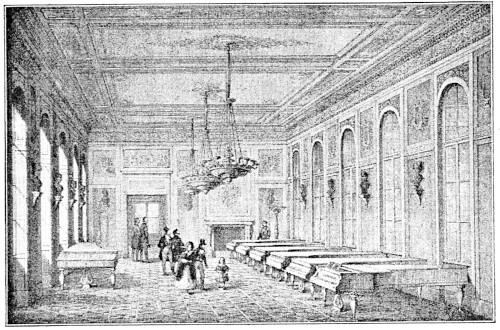
Streicher’s Pianoforte and Concert Saloon. After the lithograph of Lahn-Sandmann.
“I must now,” writes Mozart, “begin at once with Stein’s pianoforte. Before I saw anything of Stein’s work I liked Spath’s best; but now I must give the preference to Stein’s, for they damp much better than the Regensburg instruments. If I strike hard, whether I let the fingers lie on the keys or lift them up, the sound is over and done with the very instant I lift my hand. I may come down on the keys as I like, the tone will always be the same; it never hangs fire; it doesn’t get weaker, or grow stronger, or stay on; it’s just all one. It’s true you can’t get a pianoforte like that under three hundred florins, but the trouble and diligence he shows is not to be repaid. His instruments have this point that makes them better than others: they are made with an escapement which there isn’t a man in a thousand knows anything of; and without this it is just impossible for a pianoforte to help blocking or sounding again. His hammers, when the piano is played, fall back again the very moment they touch the strings, whether you hold the key down or let it go. When he has finished a piano, so he says, he sits down to it and tests all kinds of passages, runs and leaps, and works and scrapes until the piano’ll do anything; for he works only for the good of music, and not his own merely, or he would be done long before. He often says: ‘If I myself didn’t love music so passionately, or couldn’t do a little on the piano, I should long ago have lost all patience in my work; but I’m just a lover of instruments which don’t try the player and will last.’ His pianos do last, too. He guarantees that the sounding-board won’t warp or break. When he has got a sounding-board ready for a piano, he puts it in the air, rain, snow, sun, or any beastly thing, to warp it, and then he glues crossbars in until it is strong and firm. He’s quite glad when it warps, for you’re about certain nothing more can happen to it. He often cuts into it himself, and glues it again, and so makes it strong. He has three of these pianos ready, and I have played to-day on them for the first time.
“The machine which you move with the knee is also made better by him than by others. I scarcely touch it, when off it goes; and as soon as I take my knee the least bit away, you can’t hear the slightest after-sound.”
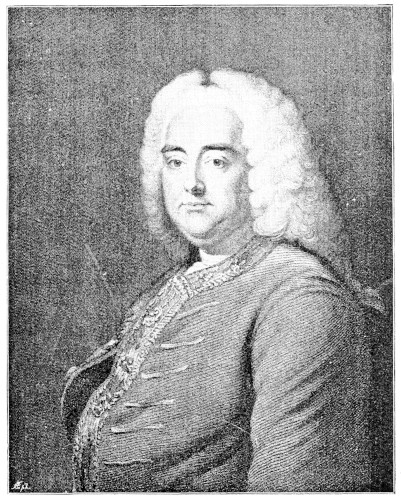
George Frederick Handel. Engraved by Thomson.
We see from this letter of Mozart’s that in 1777 the “escapement,” which lets the hammers fall back immediately after the strings are struck, was as yet by no means universal, but that the pedal, which was pressed at the side by the knee and raised the dampers, was already a usual feature. What numberless small modifications and improvements must have been introduced before the developed mechanism exhibited by the key-levers, the hammers, the dampers, the escapements, the pedals, the sounding-boards, could have advanced to the self-evident simplicity which made possible the meteoric splendours of piano-technique about the middle of this century! Prices for pianos were still fairly high. The younger Ruckers obtained three thousand francs for a clavier, but it had painted on it those rich pictures with which the spinet, when it began to take its place among household furniture, was so captivatingly adorned. We hear also that the Parisian pianos with leather-plectrums (jeu de buffle) fetched, in their finest specimens, as much as three thousand francs. A Wagner clavicymbal from Dresden, which was a so-called Deckenclavier, in which the tone could be softened or strengthened by fan-shaped dislocations of the inner lid, fetched six hundred and sixty thalers; and Frederick the Great actually gave seven hundred thalers to Silbermann for the first hammer-claviers. If Stein, with his three hundred florins, seems to fall off from this price, we must remember the difference in the purchasing power of money. But, to-day, two thousand marks for a good pianoforte is cheap in comparison with the prices of those days. It is only through the growth of popularity that the greater demand and the lower price have become possible.
I turn to the works themselves. Our step falls very heavy, and our judgment may easily be unduly harsh, when we have just parted with old Bach. This meeting with genius, which we celebrate in every bar—this earnest greatness which meets us at every turn, has made us very exacting in our demands for the higher beauty. In the first moment the “Galant” School seems to us a school of pigmies, until the sight has again adjusted itself, and the vision has again become awake to the miniature beauties of this smaller art. A good transition is provided by Handel, for, against Handel, Philip Emanuel Bach appears an astonishing genius.
The tendency of the public, to group celebrities in pairs, has brought not merely Goethe and Schiller, but Bach and Handel, into juxtaposition. How little the scholarly hermit had in common with the grandiose world-musician—who first followed the wise prescription, glory in Italy, gain in England—would be seen from a comparison of their clavier-writings, which are a fair average of their general work. Handel is the negation of the classic. He gets his results from materials close at hand; brings them into plastic clearness, and writes from the point of view of the vulgar herd; he is never troubled by an exacting inward conception, or overwhelmed by his own imagination, as are all true classic artists.[101]
Handel’s clavier-pieces are written in an extravagantly popular style. His suites, which moreover embrace not dance-forms only; his capriccios, variations and fantasias, flow like futile “water-music.” They are brilliant without being difficult, and entertaining without being suggestive. There is no colour on the sky of their landscapes; no tempest lashes their trees. We roll in our coaches on well-macadamised roads, the melody of the wheels reminding us meanwhile of this or that well-worn turn in the operas or oratorios. Seldom is a halt necessary in order to look at the view. Perhaps we may stop a moment longer than usual at those frequent singing sarabands in the popular style, at the charming salon-gigues (especially the long one in G minor), the genuine virtuoso’s Tarantella, or at the better F sharp minor suite with its short free prelude, staccato largo, insinuating fugue and dramatic gigue. Perhaps, also, the fugue with its three beats from the E minor Prelude may please us; but there is a something which the whole fails to give us. It is an acquaintance—not a personal intimacy.
Quite other is the impression produced by the “galant” music of Philip Emanuel Bach. While his elder brother Friedemann stands somewhat nearer to Sebastian in kind, and actually wrote pieces, like the C minor fugue, of which the old man need not have been ashamed, Philip Emanuel, with greater decision and also with greater significance, pursued a different path. It is as if fate had marked out this difference. Sebastian Bach held Friedemann as the cleverer musician; but he frittered his life away. Philip was first set to study jurisprudence, and out of the painstaking lawyer grew the sober and energetic composer. The life of Philip was as simple as his father’s. In 1740, at the age of twenty-six, he went to the court of Frederick the Great, where he worked as royal cembalist and accompanist. In 1767 he went to Hamburg, and died there in 1788. He does not seem to have been able to agree with the King; and it is likely enough that he felt and worked more freely in Hamburg. Berlin was always having trouble with its people. Had Philip Emanuel stayed there, Berlin would have been the greatest centre of piano-playing in Germany, and its walls would have been associated with lasting memories of the ancestors of modern musical forms. Had Mozart, in later years, accepted the offer of Frederick William II. of a position as chief Kapellmeister with the extraordinary salary of three thousand thalers, Berlin would have been enabled to absorb a little of the musical life of Vienna. Or, later still, if the Academy of Singing had been given to Mendelssohn (who was a candidate), rather than to Rungenhagen, the intoxicating glory of Leipzig, which lasted for a time, would have been transferred to the banks of the Spree. But the spirit of Zelter remained over Berlin.
In 1753 Philip Emanuel published at his own expense his “Essay on the true Method of playing the Clavier.” This was the most copious work on clavier technique that had yet appeared. It was at the same time the sufficient apology for the technique of the thumb, which has become the ground-work of our fingering. When the extreme importance of the thumb had at last been recognised, it was not hard to investigate systematically the places of its application. The main rules were necessarily that, in ascending, the thumb of the right hand is put after one or more black keys, and the thumb of the left hand in descending, and vice versa. The setting of the thumb on the black keys themselves must be avoided, and the passing over of one finger by another, which earlier had been the main feature in scale passages, was now abandoned. The whole art was built on the thumb, which passed under in the right place. This work of Philip Emanuel, which gives special attention to the legato, may be called a panegyric on the thumb. In this clear insight, as well as in the arrangement of his exercises, which begin with scales and chords, preferring the unison practice of the two hands, and advancing slowly to easy pieces, his work is still one of our most modern exercise-books. We might guess that in this diligent application of his thumb-technique to scales and broken chords, Philip Emanuel places in the forefront of his exercises certain scale figures which to-day could not correspond to the most pressing necessities of the piano-player. We should expect them to be a mere training of the hand, and no preparation for the real difficulties which appear in actual literature. A glance at the works of any great master will show us, however, that such is not the case. These very scales, chain-passages, and broken chords, which are the material of teaching, are also the figures of free composition. Some fashionable composers may have employed them extravagantly, because they were at the fingers’ ends of the players, but the most independent writers must use them, because they are, from the very nature of the clavier, the most fruitful in effect and most harmonious in sound. The old disruption of musical material into short passages of four or five notes was now antiquated. Performers practised the whole scale and the chord. And since Philip Emanuel carried through this natural training with methodical clearness, his teaching has been fruitful, and has not run merely alongside of the literature. In his book we can clearly see how the clavier has contributed not least to the formation of modern secular musical perception. In this its equal temperament, which was so urgently necessary, and its complete presentation of the tone-material, which so to speak we have only to read off, have largely aided.
The case is dissimilar with his treatment of the “manieren.”[102] On their employment he writes as follows: “No man, assuredly, hath doubted concerning the necessity of ‘manieren.’ We can observe it herefrom, that we meet them everywhere in great abundance. Everywhere are they indispensable, if one considers their use. They hang the notes together, and give them life; they give them, if it be necessary, a particular energy and weight; they make them pleasing and therefore awaken a peculiar attention; they assist to make clear what is their meaning, which may be sorrowful or glad or otherwise disposed, as it pleaseth, yet do they contribute of their own thereto; they give a notable part of opportunity and material to the true execution; a moderate composition can by them be aided, as without them the best air is empty and monotonous, and the plainest meaning must appear throughout obscure.” This is a judgment which surprises us in a man so intelligent and advanced as Philip Emanuel. He has not yet perceived that ornamentations were in his time only the relics of an earlier style. An appoggiatura, which takes away half or two-thirds of its note, and thus becomes a mere melodious retardation, or a double-shake which completely disintegrates its note, and requires to be expressed by an antiquated stenographic mark, is already a mere fossil in a period which gives such independence to the melody. It is not the notes which then appear which are fossil, but their arrangement as decorations. What had originally been truly decoration, in the heyday of figuration, had, in the course of the eighteenth century, long become an emancipated melodic phrase. The idea of the retardation, which earlier veiled itself under the name of appoggiatura with suspended main-note, was not allowed to step in openly; and the doppelschlag[103] or the trill could say plainly what they were, without masquerading as modest satellites of some main-note or other. Had Philip Emanuel but had the courage to discard the old signs, and to hear the customary ornamentations as independent music, he would have been able to spare himself much dead weight, to avoid much confusion, and to get rid of the trammels of many dead traditions, which have come down even to our day. He has in his book exhibited a stirring knowledge and an individual treatment of the “manners”; yet he was forced to maintain an arbitrary distinction between the “manners” and the other figurations, although between the turn and any other melodious line-curve there is no longer any essential difference whatever. He has not been able to introduce any system into the relation of the appoggiatura with its note; and, because he saw that the effect of the appoggiatura could be produced equally well without the little note, he has been obliged to take refuge in the sentence: “The appoggiaturas are partly written like other notes and thrown into the bar, and partly specially indicated by small notes; while the larger ones keep their full value to the eye, although in practice they lose something of it.” At this point he should have been able to see that a system of “manieren” as such was no longer possible.
From indications given by Philip Emanuel, it would seem that in these matters he was deliberately behind his time. He bemoans that the well-known marks in clavier-pieces were already beginning to be strange, and points to the careful way in which the French had always put in their marks. He delights as a rule in setting up the French as the masters of the clavier-exercise, and is vexed that people had an “evil prejudice” against their pieces, “which yet,” he says, “have always been a good school for clavier-players, forasmuch as this nation, by the smoothness and neatness of its playing, hath marked itself off specially from others.” Philip Emanuel’s love for the French is a very important point to keep in mind in appraising his works. Not only did he find in them the only great precedents for his “galant” style; he has also expressly continued the method of Couperin and Rameau by transcriptions, in the French manner and the French language. Nay, his endeavour, in his sonatas and rondos, to construct stiffer forms with reprises, appears as a mere continuation of the French rondo; and, however Italian the musical form may be, in more than one of his pieces, we inevitably think of the “Cyclopes” of Rameau. Possibly his whole book was suggested by Couperin’s “L’Art de toucher le clavecin,” and respect for this French tradition has hindered him from revolutionising the “manieren,” which still had their justification in France, so thoroughly as he did revolutionise the finger-exercise. It is thus very amusing to see how he himself challenges comparison with Couperin. He calls him “a teacher formerly so profound,” referring of course to the “manieren.” The “formerly,” of course, implies that Couperin had not yet learnt the thumb method, and had been too fond of changing the fingers on one note. In point of ornamentation it was he that was conventional; and in point of fingering—why, old Sebastian, lately dead, stood between him and Couperin.
“Fantasia-making without strict tempo,” says Philip Emanuel in one place of the Essay, “seems in the main to be specially adapted for the expression of the emotions, because every kind of barring brings with it a certain constraint.” In this verdict and in its application lies for us to-day, viewed externally, the greatest surprise which Philip Emanuel offers us. He has, as a matter of fact, written many fantasias which are almost designed without bars, and thus very logically give expression to the character of improvisation which they bear. They are great recitatives full of reflective melodies, of linked staccati, of sounding broken chords, which the player, when moved, knows how to unfold. They were the last free specimens of the unfettered forms of the older time.
Not only in these fantasias, but as a rule in his whole creative energy, especially in the Hamburg period, Philip Emanuel exhibits that extempore humour and freedom, which has at all times given to clavier-pieces their greatest charm. He has sufficient invention to be rarely at a loss; and the pieces from his earlier “Württemberger Sonaten,” which are still more contrapuntal than the later, or from the later six volumes “Für Kenner und Liebhaber,”[104] have all that variety and multiplicity in unity which was also a feature of the collections of John Sebastian. But the desire for caprice works in him more strongly than the fulness of invention. He is untiring in pulling a melody humorously to pieces, in surprises of pause or in remarkable transitions. Occasionally his language positively dances, and it is hard to be certain whether it is intentional distortion—a cloak for poverty—or the genuine caprice of the moment which leads him after the charms of eccentricity. In any case he belongs to those rare and subtle natures which in a moment give us the genuine artistic touch of brotherhood.
Even in his harmonies his freedom is clearly noticeable. He does not object to write separate movements in different keys, which he often connects by direct transitions. The third Sonata in the “Kenner und Liebhaber” stands in the first movement in B minor, in the second in G minor, and in the third in B minor once more. The fifth Sonata, which is set in F major, begins quietly with a phrase in C minor. In the first Rondo of volume V. we find the chord of the seventh (G, E, B, C sharp), set at the key-deciding place, in B minor; a chord at which some of our best memories of Wagner are revived. For such things he was severely censured by his comrades in the profession.
As to his melody, it is as delightful as is to be expected from “galant” music, and from that only. At one time it shows a charming sentimentalism, in which the stronger use of retardations has its share, now it is frisky and playful, toying with itself; in both cases anticipating Mozart. Specially characteristic of the author are numerous melodic phrases, the like of which have played an important part down to our own time. Philip Emanuel used them with the greatest depth and penetration in the F sharp minor movement of the A major sonata (No. IV. in Kenner und Liebhaber, vol. i). In all these points he manifests his independence; and in spite of his study of the French, it is but seldom that, as in the “Siciliana” of one of his sonatas in the “Musikalisches Allerley,” we catch an echo of a phrase from Couperin.
Like all the “galants,” he wrote much. A considerable number of his works were printed in his own time in the magazines or separately. Among these the sonatas to Frederick the Great to Charles Eugene of Württemberg, to Amalie of Prussia, and the “Kenner und Liebhaber,” take the first place. But yet more remained unprinted. Prosniz has counted four hundred and twenty of his clavier pieces, of which two hundred and fifty were printed. There is no modern comprehensive edition of his works, but the “Kenner und Liebhaber” has been very beautifully reissued by Krebs in the Berlin Academy collection of original editions. Apart from the first volume these are written exclusively for pianoforte.
The name of Philip Emanuel generally rises to our lips when we speak of the origins of the modern forms of chamber-music and symphony. This is correct enough if we are content to establish his claims as an agent in the crystallisation of the two main forms of classical composition—the Sonata and the Rondo. But the creator of these forms he was not; he found them very far advanced in France and Italy, and on the other hand he handles them so freely that their regulation cannot be said to have been completed till the days of Haydn and Mozart. Thus he is in these points also but an intermediary.
The strict sonata introduces first a main subject, then in an allied key an allied subject; next the middle section[105] in which these subjects are developed and completed; and lastly it repeats the exposition, transposing the subordinate subject, however, with a view to the finale, into the main key.
In the Rondo, on the contrary, there is one main theme and many subordinate motives. The main theme is chiefly melodious; the by-themes alternate in all kinds of forms among the repetitions of the melodic strophe.
To the Sonata and the Rondo all older dance and fantasia forms gradually gravitated. The Sonata is the more dramatic, the Rondo the more lyrical. The Rondo, considered as to logical content, is the more organic; but advance and climax are wanting to it. The Sonata on the other hand, is, because of its reprises, less intellectual than architectural; but it has the sobriety of greatness. Usually, in thinking of the forms of this musical age, our thoughts dwell on the Sonata—in which form as a rule the first movement was cast. But the Rondo was equally important, and is equally often used in the second or last movement. Purer dance-forms were always in use as intermezzos between the movements.
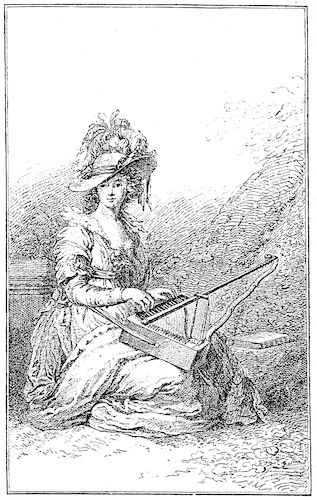
Mary Coswey with the Orphica, a portable clavier, which at the beginning of this century had a certain vogue.
In Philip Emanuel, then, we see a preference for the types of the sonata and the rondo which prepares the way for their sole supremacy. He only needed to proceed eclectically. Not only the French Rondo but the Italian Sonata had led to the reprise form. Philip Emanuel did not advance far beyond these models. A second theme is not universal in his works; and only the modulation of the keys within the first half, to the dominant or relative major, is strongly stamped on them. The Sonata movement with him still admits of all tempi. In the third of the “Kenner und Liebhaber” Sonatas the peculiar sonata-form is not on the whole adhered to, but allegretto, andante, cantabile, follow each other in free fashion. On the other hand, in the following piece, the first and the last movements both show the sonata-form; but in the first of the “Württembergers” only the last movement has the stricter sonata-style. The third sonata of Volume II. of the “Kenner und Liebhaber” is actually written in a single movement. On the other hand the second Württemberger begins with a genuine sonata with double subject; and in the Kenner und Liebhaber, Vol. III. No. 2, the type of the modern sonata appears in full development. We see then from these examples that while Philip Emanuel uses the reprise of the first part almost universally, he is yet far removed from the classical model of the sonata. In a word, we shall find in him nothing that is not already to be found in Rameau, Scarlatti, or above all, his great father.
The Rondo was more in accordance with his genius. Here, where he had fully developed French models, it cannot be denied that with all his freedom in detail he has brought the form appreciably nearer to the classic type. Even Beethoven was often unable to improve on his alternations of intermediate movements, or the grace with which he returns to the air and makes his theme gently rock to and fro. He loves those simple popular rondo airs, which, as we listen, we all seem to have heard before. As couplets[106] he prefers to use technically brilliant figures, which in their turn offer a good contrast to the air. He is untiring in toying with the theme. He makes it now break off in the middle, now become sentimental; now it becomes questioning. As time goes on he develops his whole power of expression, so that he is far removed from a stiff alternation of theme with couplet. In a fantasia (K. and L. v.; last piece), which is perhaps his most charming composition, he blends the rondo-form most skilfully with the free style of an improvisation, and thus shows himself on his best side. Hardly less delightful is the last piece in Volume VI., a Fantasia-Rondo whose main theme is a kind of hunting-call. In this movement the hunt is interrupted by a beautiful romantic andante, then by emotional reveries in larghetto sostenuto, and in the conclusion the reflective style gains the upper hand.
The Rondo was so attractive to him because by its means he was able the more easily to bring his beloved “affettuoso” into expression. And his inner genius was not so much formal as lyrical. In his music there is even to-day a strong spiritual charm, to which the slight archaism adds a pleasant flavour. In his Rondos he comes very near to us, and not less in those little characteristic pieces which, written in dance-form, followed French models in the very style of the inscriptions. He uses for titles proper names, such as Hermann, Buchholz, Böhmer, Stahl; and such more general appellations as La Xenophone, La Sibylle, La Complaisante, La Capricieuse, L’Irrésolue, La Journalière, and Les Langueurs Tendres—names, it will be remembered, used also by Couperin. La Sibylle has a wonderfully beautiful melody; and Les Langueurs Tendres is such an unsurpassable air in two mournful voices, that it bears endless repetition. Nothing has ever been written to surpass this tender clavichord-sadness.
The great counterpoint of Bach is now forgotten with extraordinary rapidity. The ancestor of the following generation is Philip Emanuel. Wherever we look, to the London Bach, Johann Christian, to the Austrians—anywhere—we find the work influenced by his style. “He is the father and we the boys,” said Mozart.
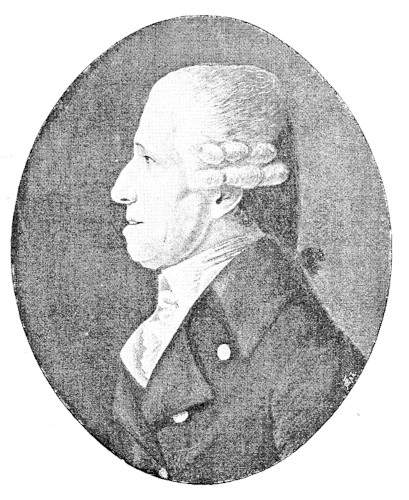
Joseph Haydn. Engraved by Quenedey.
Haydn knew well what he owed to Philip Emanuel, and was as little chary to acknowledge it as Mozart. In actual essentials Haydn made no advance in clavier-music. The stream is perhaps a little clouded, and it is not till Mozart’s time that it again becomes clear. Haydn’s genius lay in composing for the orchestra, not for the piano. He has of course written clavier sonatas—they number thirty-five—and other pieces in which the clavier takes part; as numerous and light as the works of all these “galant” musicians. But his trios are to be preferred to the sonatas for piano only; there is more depth in them; and the ideas are lit up more brightly by the instrumental combination. Only in the sonatas after 1790, as in the first in E flat major (Br. and H.) does something more noteworthy emerge—but by that time Haydn had studied Mozart.
Still further, in his pieces, Haydn is no great virtuoso. In his Trios he knows well how to make the most of the character of the clavier, by contrasting it with the strings, by means of arpeggios, all kinds of passages, full chords, and the beloved octave-melodies. But a more interesting virtuoso performance, such as that in the F minor variations, appears very rarely. The ornamental work is still extensive, but within limits; and much of it is written out in full, just as the cadenzas, which used to appear in small notes, are now preferably printed in the usual type. At the end of the century everything was taken away from the caprice of the player, except the great cadenzas at the conclusion of the concerto-movements. Philip Emanuel had taken a last important step, when, in his Sonata dedicated to the Prussian Princess Amalie, he wrote out exactly for the second time the ornamentations and alterations in the frequent repetitions of musical phrases of a few bars, instead of leaving them to the pleasure of the players. To judge by his preface, caprice in these matters must have flourished like a green bay-tree; and he takes great credit to himself for having been the first to offer accurately formulated “alternative reprises,” which run no risk of spoiling the whole aim and meaning of the piece. His point of view is interesting. It is, he says, not possible to avoid altering a musical phrase in repeating it. This conception is endorsed by all his contemporaries and successors in style, in their works: Haydn and Mozart cannot be conceived apart from this mannerism of altering a musical idea in repetition by slight turns and adornments. This method is the fixed law of movement of their musical ideas, and dictates their progress through long stretches in advance. Deep founded in the general delight in variation so characteristic of the time, it enables us to understand that great development which forms a whole branch of musical history—the development, namely, of improvised “manieren” into strict and firm melodies.
As far as form is concerned, the work already begun is continued by Haydn. The Sonata-form tends to limit itself more and more to the first movement; more and more clearly does the “second theme” crystallise itself; slow-drawn movements are preferred more and more in the second place, and graceful rondo-like movements in the third—without, however, any appearance of compulsion. The only relic of the traditional “suite” of dances, which Haydn retains in his sonatas or symphonies, is the “Minuet” which he is so fond of using as an intermezzo.[107] The old dance-forms, as dances, were so speedily forgotten, that in a certain trio a delicate slow waltz is marked as “allemande”—whereas the old allemande is not even written in the time of a waltz, apart from the difference in style.[108]
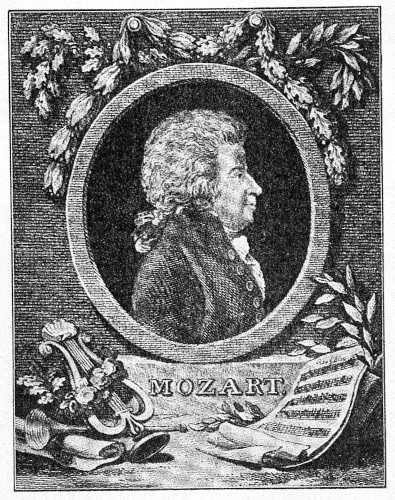
W. A. Mozart. Engraved in 1793 by C. Kohl (1754-1807).
Haydn received more from the clavier than he gave to it. He transferred to the orchestra the clavier-forms of the time, and thus pointed out to it the path to the symphony. Without doubt the modern symphony, in the first instance, is to be traced to the clavier pieces of Philip Emanuel Bach; and Haydn, to whom fell the task of the intermediary, was the first to put the rich development of this chamber-music to practical use. Clavier and orchestra always advance in mutual rivalry, treading on each other’s heels. In Haydn it was the clavier that aided the orchestra; in Beethoven the orchestra aided the clavier; Mozart, standing between, gives to each its own.
Thus it is that Mozart has given much, and much of its special character, to the clavier. This equilibrium—and Mozart is always the very personification of equilibrium—is most striking in his piano-concertos, which justly enjoy the renown of having created an epoch in this class. Especially remarkable is the C minor concerto, in which the piano experienced one of its chief emancipations. On one side stood the orchestra, on the other the instrument, and yet neither of these two great rivals loses anything of its essential nature; rather, they owe to this very rivalry many of their best effects. When clavier and orchestra address and answer each other; when the clavier intertwines itself with the strings and the wood, and they in turn blend with the clavier; when in the running strife each sounds in its own style and gives birth to a natural variation of phrases and to delicate alterations of the constituent forms; all proceeds in accordance with that self-evident logic which, at such critical points in artistic history, naturally dispenses with internal laws.
Mozart is the great virtuoso who, even as a boy, was the astonishment of Europe. It is not to be expected that he should content himself with the intimate reflectiveness of the pianoforte; he drags it out into the great world; he needs the concerto-form just as he needs great concert halls. The new pianoforte, with its fuller and more subtly expressive tones, is precisely adapted to his aims, and he is the first to launch the pianoforte on its decisive career. With his triumphal progresses the popularity of the new instrument was not likely to decline. The great enchanter leaves the tiny victories of the spinet far behind; his public recitals in hired halls, which henceforward become more and more popular, demand new feats. He has to work on bold lines; he has to bring into use the special features of the instrument he adopted; the rippling scale-passage, the variety of tone, the forte, the pianissimo, the hundred gradations between these extremes, the altogether new possibilities of sentimental expression which were now at the disposal of the public performer. But amid all the intoxication of the concert hall, the virtuoso remains an artist; the idol of the hour retains his deeper feeling. As he was only truly himself when, after the furore of publicity, he touched the notes in solitude or before a few friends, so in his concertos, behind the external glitter, a romantic soul lies hidden. In the beautiful Romance in the D minor Concerto, for example, the soul looks out on us with a wonderful and never-to-be-forgotten intensity.
In almost all his pieces Mozart composes according to the bidding of the moment. He is an “occasional” composer. In the concertos the occasion was his own appearance on the stage. In the duets and double pianoforte pieces he found the occasion in his association with his sister. From this species of performance he drew new effects. The D major sonata for two pianos stands alone in the skilful and effective blending of the two instruments. His four-handed sonatas are astonishingly successful in the individualisation of the hands, and started a numerous class of clavier-pieces which have been too often misused. We shall not appreciate such duets, if we take the clavier as a diminutive orchestra.[109] But here again Mozart has been unwilling utterly to sacrifice combined effects to individual demands.
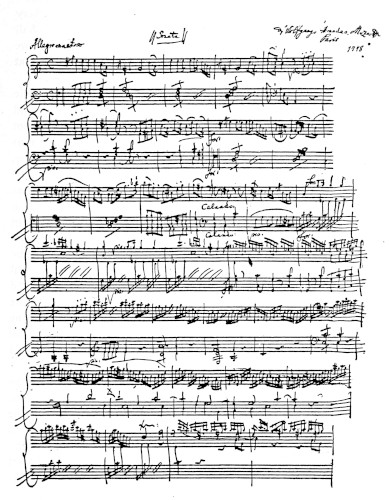
Beginning of Mozart’s A minor Sonata. Royal Musikbibliothek, Berlin.
Through the ravishing chamber-music in which, especially in the quintett for oboe, clarinet, horn, fagotto and pianoforte, the splendid treatment of the pianoforte with regard to the wind deserves notice; through all the melodious pieces for piano and violin, the trios, the quartetts; to the numerous smaller clavier-pieces, the fashionable variations, the relics of the suites, the scattered fugues, the fantasies so rich in variety; we follow Mozart to the eighteen pure piano sonatas, which are the very miniature mirror of his unfailing musical invention. We shall treat them in chronological order, for here for the first time we perceive a distinct development which renders such treatment the most natural and advantageous.
At first we meet the daring harmonies and enharmonic changes by which every innovator makes himself notorious, and which draw on him the first severe criticisms. But there is not yet the concentration of later works. A light counterpoint runs through the whole, a conscientious treatment of the themes, which bears witness to sound training. A striking feature is the unforced inventiveness in motives, which succeed one another in unfailing profusion. Intellectual themes, as for example in the B flat major, remind us of Philip Emanuel. The form becomes more distinct, the rules of sonata-arrangement more rigid. But it is not till we reach the A minor (1778) that the full brilliancy of form is seen. This piece has all that wonderful proportion and balance even in the smallest parts, which was, and remained, Mozart’s most peculiar characteristic. Proportion in the well-balanced opposition of themes in all three divisions, in the liveliness of the piquant semiquaver runs, which already leave Scarlatti far behind, in the brilliant and yet simple execution of the last movement—proportion, indeed, is everywhere.
After 1778 our impressions deepen. The D major is the creation of Mozart’s indestructible caprice. The motives become ever more tuneful, more speaking: in the C major we hear the phrases as though sung; we seem to hear words with pauses for breath, as from a distant exquisite opera. The melodies run after each other, and—what is so typical a feature of Mozart—it is by this that our attention is held rather than by any inner development of the themes.
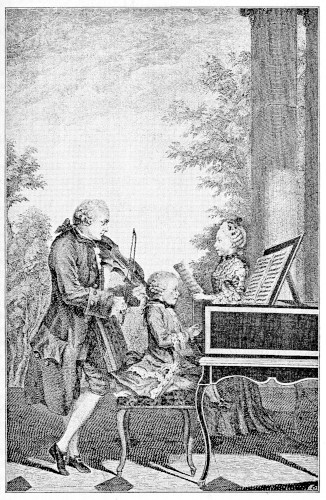
Mozart at the age of seven, with his Father and Sister. Engraved 1764, by J. B. Delafosse (b. 1721) after L. C. de Carmontelle (? about 1790).
The A major sonata is an excellent example of this melodic regularity. Its contours are of an unimagined loveliness, and its airs of a magic delicacy. The Turkish March stands out in variegated national colours, far removed from every triviality—if only we give to the Janissary rhythm its full due.
The airs become broader, the piquancies more daring, until the allegretto of the B flat major with its jubilant sevenths stands before us as a new peak of Philip Emanuel’s Rondo forms. Here is that bright laughter, which from Mozart’s lips has the most delightful of sounds.
This was in 1779. In 1784 Mozart has entered upon the second half of his life, the unhappy half, and the C minor sonata appears. New tones now strike upon our ear, harsh, strong, broad, intense. But all is still in proportion. The hand is freer, rushing more boldly from the heights of the piano to its depths; bolder also are the episodes which are the pivots of the thoughts. In all is the sweet intoxication in the bewildering sound of the pianoforte, and the air so full of soul, growing richer in retardations, and more and more taking the lines which Mozart decisively fixed for the beautifully-formed melody. A strange reserve, the reserve of maturity, characterises the last movement, otherwise so flowing; its expressive raggedness forbodes new things, the victory of matter over form—in a word, Beethoven; and then, in this period of Figaro and Don Giovanni, we meet the F major, the most sombre in content of all his writings (1788). With its two movements we are accustomed, not improperly, to connect the Rondo written in 1786. Counterpoint has slowly advanced to its old position—the sign of the mature man, who is seeking his fixed abode. This it is which stiffens the weft into what at times is a solidity worthy of Bach. The dominion over the world of tone is now absolute, the melodies sing heavenward, as for example in the theme of this andante, which came spontaneously from his soul.
We have reached the limit of the “galant,” over whose fields dark clouds are already gathering. But we are also at its highest point. In Mozart the ideal of popular music was more fully realised than its father, Philip Emanuel, could ever have dreamed. Mozart’s well-balanced nature preserved the clavier from superficiality; and he himself was saved by an early death from sacrificing this balance to the sombre thought of a new time. His sense for form brought the sonata into more typical shape, but the endless melody and the free intelligence of his music took all sharpness from the forms. No music can be less easily described in words than his; and therefore, as a great beautiful sound, it was the best content which the forms of the galant popular epoch could find. It is not till we have left youth behind that we see proportion and equilibrium in this repose; and it is then, as Otto Jahn says, that we are amazed at the wonderful wealth of this art and at ourselves for being so slow to feel it.
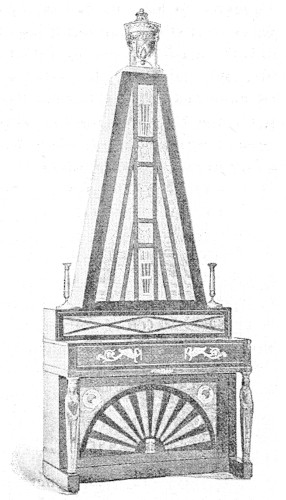
Upright Hammer-clavier (pianoforte), about 1800, called the “Giraffe.” Mahogany and bronze, with open work in green moiré. Three pedals, forte, piano, and “fagotto.” By Joseph Wachtl, Vienna. De Wit collection.
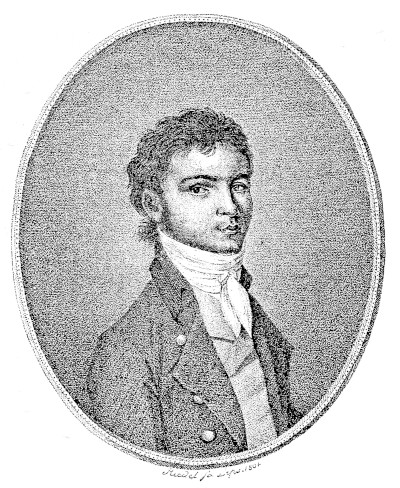
Beethoven at age of 31.
Beethoven
When a great scheme was started in Berlin for a common monument to Haydn, Mozart, and Beethoven, it was plain to see that the artists felt themselves in the presence of a very mixed task; but it was not so clear where the incongruity lay. They stood under the influence of the popular opinion, which binds these three heroes under a single yoke, and they were the victims of this influence. Nations have an instinct of symmetry in the classification of their great men. The ancients had their seven sages; to-day we are content with two or three; but even so the combinations are none the less strained. The false ideas due to the pairing of Bach and Handel, or of Goethe and Schiller, are hardly to be numbered. The triumvirate of Haydn, Mozart, and Beethoven, is the very acme of perversity. Haydn and Mozart, though two fundamentally different natures, have yet in common the similar features of the age. But Beethoven is as little like them as Goethe is like Racine. We have only to glance round a salon in the Vienna of the last century. The old Haydn and the old Salieri sit smiling and friendly on a sofa; they move in the stilted fashion of the eighteenth century; they retain in their carriage all the features of the “Zopf und Schopf”[110] period; and in every judgment, in every gesture, they show their antagonism to unrestrained emotion. Over against them a young man is leaning on the piano. His demeanour is modish though untidy, and smacks of the Rhine; his movements natural but wooden; his hair is loose and disordered; his compliments are few; he accepts strangers only on compulsion; his playing is perhaps too vigorous, too full of feeling; and the ideas which he incorporates in his works are in their originality half revolutionary, half romantic. This new-comer is Beethoven, a man so different from the settled type, from the old “composers of the Empire,” as he himself calls them, that it is easy to anticipate the future which he himself is conjuring up. He is the first of the Titans, the first of the great fragmentary natures, the first tone-artist who breaks the forms of music to pieces on the iron of his emotions. A strange Providence closes his outward ears, and thus gaining a clearer vision, he receives from Nature herself unheard-of inspirations. How this strange new man, this romantic raver, could be coupled with Haydn and Mozart is a wonder; but popular opinion accounts for it. Beethoven came to Vienna just as Mozart began to be missed. The world gave him the honour of attaching him to the classic school. But it is a mere blunder to treat him as the end of an epoch—he is the beginning of a new one.