Volume 2 / Part 1 — Part II—The Worldlings (continued 3)
Henri Van Laun translation
A second talent, perhaps the first in carnival time, is the art of saying broad things, and the Restoration was a carnival, about as delicate as a bargee's ball. There are strange songs and rather shameless prologues in Dryden's plays. His "Marriage à la Mode" opens with these verses sung by a married woman:
"Why should a foolish marriage vow, Which long ago was made, Oblige us to each other now, When passion is decay'd? We loved, and we loved as long as we could, 'Till our love was loved out in us both. But our marriage is dead when the pleasure is fled; 'Twas pleasure first made it an oath."[447]
The reader may read the rest for himself in Dryden's plays; it cannot be quoted. Besides, Dryden does not succeed well; his mind is on too solid a basis; his mood is too serious, even reserved, taciturn. As Sir Walter Scott justly said, "his indelicacy was like the forced impudence of a bashful man."[448] He wished to wear the fine exterior of a Sedley or a Rochester, made himself petulant of set purpose, and squatted clumsily in the filth in which others simply sported. Nothing is more sickening than studied lewdness, and Dryden studies everything, even pleasantry and politeness. He wrote to Dennis, who had praised him: "They (the commendations) are no more mine when I receive them than the light of the moon can be allowed to be her own, who shines but by the reflection of her brother."[449] He wrote to his cousin, in a diverting narration, these details of a fat woman, with whom he had travelled: "Her weight made the horses travel very heavily; but, to give them a breathing time, she would often stop us,... and tell us we were all flesh and no blood."[450] It seems that these were the sort of jokes which would then amuse a lady. His letters are made up of heavy official civilities, vigorously hewn compliments, mathematical salutes; his badinage is a dissertation, he props up his trifles with periods. I have found in his works some beautiful passages, but never agreeable ones; he cannot even argue with taste. The characters in his "Essay of Dramatic Poesy" think themselves still at college, learnedly quote Paterculus, and in Latin too, opposing the definition of the other side, and observing "that it was only à genere et fine, and so not altogether perfect."[451] In one of his prefaces he says in a professorial tone: "It is charged upon me that I make debauched persons my protagonists, or the chief persons of the drama; and that I make them happy in the conclusion of my play; against the law of comedy, which is to reward virtue, and punish vice."[452] Elsewhere he declares: "It is not that I would explode the use of metaphors from passion, for Longinus thinks them necessary to raise it." His great "Essay on Satire" swarms with useless or long protracted passages, with the inquiries and comparisons of a commentator. He cannot get rid of the scholar, the logician, the rhetorician, and show the plain downright man.
But his true manliness was often apparent; in spite of several falls and many slips, he shows a mind constantly upright, bending rather from conventionality than from nature, possessing enthusiasm and afflatus, occupied with grave thoughts, and subjecting his conduct to his convictions. He was converted loyally and by conviction to the Roman Catholic creed, persevered in it after the fall of James II, lost his post of historiographer and poet-laureate, and though poor, burdened with a family, and infirm, refused to dedicate his "Vergil" to King William. He wrote to his sons: "Dissembling, though lawful in some cases, is not my talent: yet, for your sake, I will struggle with the plain openness of my nature.... In the mean time, I flatter not myself with any manner of hopes, but do my duty, and suffer for God's sake.... You know the profits (of 'Vergil') might have been more; but neither my conscience nor my honor would suffer me to take them; but I can never repent of my constancy, since I am thoroughly persuaded of the justice of the cause for which I suffer."[453] One of his sons having been expelled from school, he wrote to the master, Dr. Busby, his own former teacher, with extreme gravity and nobleness, asking without humiliation, disagreeing without giving offence, in a sustained and proud style, which is calculated to please, seeking again his favor, if not as a debt to the father, at least as a gift to the son, and concluding, "I have done something, so far to conquer my own spirit as to ask it." He was a good father to his children, as well as liberal, and sometimes even generous, to the tenant of his little estate.[454] He says: "More libels have been written against me than almost any man now living.... I have seldom answered any scurrilous lampoon,... and, being naturally vindictive, have suffered in silence, and possessed my soul in quiet."[455] Insulted by Collier as a corrupter of morals, he endured this coarse reproof, and nobly confessed the faults of his youth: "I shall say the less of Mr. Collier, because in many things he has taxed me justly; and I have pleaded guilty to all thoughts and expressions of mine which can be truly argued obscenity, profaneness, or immorality, and retract them. If he be my enemy, let him triumph; if he be my friend, as I have given him no personal occasion to be otherwise, he will be glad of my repentance."[456] There is some wit in what follows: "He (Collier) is too much given to horseplay in his raillery, and comes to battle like a dictator from the plough. I will not say 'the zeal of God's house has eaten him up,' but I am sure it has devoured some part of his good manners and civility."[457] Such a repentance raises a man; when he humbles himself thus, he must be a great man. He was so in mind and in heart, full of solid arguments and individual opinions, above the petty mannerism of rhetoric and affectations of style, a master of verse, a slave to his idea, with that abundance of thought which is the sign of true genius: "Thoughts such as they are, come crowding in so fast upon me, that my only difficulty is to choose or to reject, to run them into verses, or to give them the other harmony of prose: I have so long studied and practised both, that they are grown into a habit, and become familiar to me."[458] With these powers he entered upon his second career; the English constitution and genius opened it to him.
Section VII.—How Literature in England is Occupied with Politics and Religion
"A man," says La Bruyère, "born a Frenchman and a Christian finds himself constrained in satire; great subjects are forbidden to him; he essays them sometimes, and then turns aside to small things, which he elevates by the beauty of his genius and his style." It was not so in England. Great subjects were given up to vehement discussion; politics and religion, like two arenas, invited every talent and every passion to boldness and to battle. The king, at first popular, had roused opposition by his vices and errors, and bent before public discontent as before the intrigue of parties. It was known that he had sold the interests of England to France; it was believed that he would deliver up the consciences of Protestants to the Papists. The lies of Oates, the murder of the magistrate Godfrey, his corpse solemnly paraded in the streets of London, had inflamed the imagination and prejudices of the people; the judges, blind or intimidated, sent innocent Roman Catholics to the scaffold, and the mob received with insults and curses their protestations of innocence. The king's brother had been dismissed from his offices, and it was proposed to exclude him from the throne. The pulpit, the theatre, the press, the hustings, resounded with discussions and recriminations. The names of Whigs and Tories arose, and the loftiest debates of political philosophy were carried on, enlivened by the feeling of present and practical interests, embittered by the rancor of old and wounded passions. Dryden plunged in; and his poem of "Absalom and Achitophel" was a political pamphlet. "They who can criticise so weakly," he says in the preface, "as to imagine that I have done my worst, may be convinced at their own cost that I can write severely with more ease than I can gently." A Biblical allegory, suited to the taste of the time, hardly concealed the names, and did not hide the men. He describes the tranquil old age and incontestable right of King David;[459] the charm, pliant humor, popularity of his natural son Absalom;[460] the genius and treachery of Achitophel,[461] who stirs up the son against the father, unites the clashing ambitions, and reanimates the conquered factions. There is hardly any wit here; there is no time to be witty in such contests; think of the roused people who listened, men in prison or exile who are waiting: fortune, liberty, life was at stake. The thing is to strike the nail on the head, hard, not gracefully. The public must recognize the characters, shout their names as they recognize the portraits, applaud the attacks which are made upon them, rail at them, hurl them from the high rank which they covet. Dryden passes them all in review:
"In the first rank of these did Zimri[462] stand, A man so various that he seemed to be Not one, but all mankind's epitome: Stiff in opinions, always in the wrong, Was everything by starts and nothing long; But in the course of one revolving moon Was chymist, fiddler, statesman, and buffoon; Then all for women, painting, rhyming, drinking, Besides ten thousand freaks that died in thinking. Blest madman, who could every hour employ With something new to wish or to enjoy! Railing and praising were his usual themes; And both, to show his judgment, in extremes: So over-violent, or over-civil, That every man with him was God or devil. In squandering wealth was his peculiar art; Nothing went unrewarded but desert. Beggared by fools whom still he found too late, He had his jest, and they had his estate. He laugh'd himself from Court; then sought relief By forming parties, but could ne'er be chief: For spite of him, the weight of business fell On Absalom and wise Achitophel; Thus wicked but in will, of means bereft, He left not faction, but of that was left.... "Shimei,[463] whose youth did early promise bring Of zeal to God and hatred to his King; Did wisely from expensive sins refrain And never broke the Sabbath but for gain: Nor ever was he known an oath to vent, Or curse, unless against the government."
Against these attacks their chief, Shaftesbury, made a stand; when accused of high treason he was declared not guilty by the grand jury, in spite of all the efforts of the court, amidst the applause of a great crowd; and his partisans caused a medal to be struck, bearing his face, and boldly showing on the reverse London Bridge and the Tower, with the sun rising and shining through a cloud. Dryden replied by his poem of the "Medal," and the violent diatribe overwhelmed the open provocation:
"Oh, could the style that copied every grace And plow'd such furrows for an eunuch face, Could it have formed his ever-changing will, The various piece had tired the graver's skill! A martial hero first, with early care, Blown like a pigmy by the winds, to war; A beardless chief, a rebel ere a man, So young his hatred to his Prince began. Next this (how wildly will ambition steer!) A vermin wriggling in the usurper's ear; Bartering his venal wit for sums of gold, He cast himself into the saint-like mould, Groaned, sighed, and prayed, while godliness was gain, The loudest bag-pipe of the squeaking train."
The same bitterness envenomed religious controversy. Disputes on dogma, for a moment cast into the shade by debauched and sceptical manners, had broken out again, inflamed by the bigoted Roman Catholicism of the prince, and by the just fears of the nation. The poet who in "Religio Laici" was still an Anglican, though lukewarm and hesitating, drawn on gradually by his absolutist inclinations, had become a convert to Romanism, and in his poem of "The Hind and the Panther" fought for his new creed. "The nation," he says in the preface, "is in too high a ferment for me to expect either fair war or even so much as fair quarter from a reader of the opposite party." And then, making use of mediaeval allegories, he represents all the heretical sects as beasts of prey, worrying a white hind of heavenly origin; he spares neither coarse comparisons, gross sarcasms, nor open objurgations. The argument is close and theological throughout. His hearers were not wits, who cared to see how a dry subject could be adorned; they were not theologians, only by accident and for a moment, animated by mistrustful and cautious feelings, like Boileau in his "Amour de Dieu." They were oppressed men, barely recovered from a secular persecution, attached to their faith by their sufferings, ill at ease under the visible menaces and ominous hatred of their restrained foes. Their poet must be a dialectician and a schoolman; he needs all the sternness of logic; he is immeshed in it, like a recent convert, saturated with the proofs which have separated him from the national faith, and which support him against public reprobation, fertile in distinctions, pointing with his finger at the weaknesses of an argument, subdividing replies, bringing back his adversary to the question, thorny and unpleasing to a modern reader, but the more praised and loved in his own time. In all English minds there is a basis of gravity and vehemence; hate rises tragic, with a gloomy outbreak, like the breakers of the North Sea. In the midst of his public strife Dryden attacks a private enemy, Shadwell, and overwhelms him with immortal scorn.[464] A great epic style and solemn rhyme gave weight to his sarcasm, and the unlucky rhymester was drawn in a ridiculous triumph on the poetic car, whereon the muse sets the heroes and the gods. Dryden represented the Irishman Mac Flecknoe, an old king of folly, deliberating on the choice of a worthy successor, and choosing Shadwell as an heir to his gabble, a propagator of nonsense, a boastful conqueror of common sense. From all sides, through the streets littered with paper, the nations assembled to look upon the young hero, standing near the throne of his father, his brow surrounded with thick fogs, the vacant smile of satisfied imbecility floating over his countenance:
"The hoary prince in majesty appear'd, High on a throne of his own labours rear'd. At his right hand our young Ascanius sate, Rome's other hope, and pillar of the state; His brows thick fogs instead of glories grace, And lambent dulness play'd around his face. As Hannibal did to the altars come, Sworn by his sire, a mortal foe to Rome; So Shadwell swore, nor should his vow be vain, That he, till death, true dulness would maintain; And, in his father's right and realm's defence, Ne'er to have peace with wit nor truce with sense. The king himself the sacred unction made, As king by office and as priest by trade. In his sinister hand, instead of ball, He placed a mighty mug of potent ale."
His father blesses him:
"'Heavens bless my son! from Ireland let him reign To far Barbadoes on the western main; Of his dominion may no end be known, And greater than his father's be his throne; Beyond Love's Kingdom let him stretch his pen! He paused, and all the people cried Amen. Then thus continued he: 'My son, advance Still in new impudence, new ignorance. Success let others teach, learn thou from me. Pangs without birth and fruitless industry. Let Virtuosos in five years be writ; Yet not one thought accuse thy toil of wit.... Let them be all by thy own model made Of dulness and desire no foreign aid, That they to future ages may be known, Not copies drawn, but issue of thy own: Nay, let thy men of wit too be the same, All full of thee and differing but in name.... Like mine thy gentle numbers feebly creep; Thy tragic Muse gives smiles, thy comic sleep. With whate'er gall thou setst thyself to write, Thy inoffensive satires never bite; In thy felonious heart though venom lies, It does but touch thy Irish pen, and dies. Thy genius calls thee not to purchase fame In keen Iambics, but mild Anagram. Leave writing plays, and choose for thy command Some peaceful province in Acrostic land. There thou may'st wings display, and altars raise, And torture one poor word ten thousand ways; Or, if thou wouldst thy different talents suit, Set thy own songs, and sing them to thy lute.' He said, but his last words were scarcely heard. For Bruce and Longville had a trap prepared, And down they set the yet declaiming bard. Sinking he left his drugget robe behind, Borne upwards by a subterranean wind. The mantle fell to the young prophet's part, With double portion of his father's art."[465]
Thus the insulting masquerade goes on, not studied and polished like Boileau's "Lutrin," but rude and pompous, inspired by a coarse poetical afflatus, as you may see a great ship enter the muddy Thames, with spread canvas, cleaving the waters.
Section VIII.—Development of the Art of Writing
In these three poems, the art of writing, the mark and the source of classical literature, appeared for the first time. A new spirit was born and renewed this art, like everything else; thenceforth, and for a century to come, ideas sprang up and fell into their place after another law than that which had hitherto shaped them. Under Spenser and Shakespeare, living words, like cries or music, betrayed the internal imagination which gave them forth. A kind of vision possessed the artist; landscapes and events were unfolded in his mind as in nature; he concentrated in a glance all the details and all the forces which make up a being, and this image acted and was developed within him like the external object; he imitated his characters; he heard their words; he found it easier to represent them with every pulsation than to relate or explain their feelings; he did not judge, he saw; he was an involuntary actor and mimic; drama was his natural work, because in it the characters speak, and not the author. Then this complex and imitative conception changes color and is decomposed: man sees things no more at a glance, but in detail; he walks leisurely round them, turning his light upon all their parts in succession. The fire which revealed them by a single illumination is extinguished; he observes qualities, marks aspects, classifies groups of actions, judges and reasons. Words, before animated, and as it were swelling with sap, are withered and dried up; they become abstractions; they cease to produce in him figures and landscapes; they only set in motion the relics of enfeebled passion; they barely shed a few flickering beams on the uniform texture of his dulled conception; they become exact, almost scientific, like numbers, and like numbers they are arranged in a series, allied by their analogies—the first, more simple, leading up to the next, more composite—all in the same order, so that the mind which enters upon a track, finds it level, and is never obliged to quit it. Thenceforth a new career is opened; man has the whole world resubjected to his thought; the change in his thoughts has changed all aspects, and everything assumes a new form in his metamorphosed mind. His task is to explain and to prove; this, in short, is the classical style, and this is the style of Dryden.
He develops, defines, concludes; he declares his thought, then takes it up again, that his reader may receive it prepared, and having received, may retain it. He bounds it with exact terms justified by the dictionary, with simple constructions justified by grammar, that the reader may have at every step a method of verification and a source of clearness. He contrasts ideas with ideas, phrases with phrases, so that the reader, guided by the contrast, may not deviate from the route marked out for him. You may imagine the possible beauty of such a work. This poesy is but a stronger prose. Closer ideas, more marked contrasts, bolder images, only add weight to the argument. Metre and rhyme transform the judgments into sentences. The mind, held on the stretch by the rhythm, studies itself more, and by means of reflection arrives at a noble conclusion. The judgments are enshrined in abbreviative images, or symmetrical lines, which give them the solidity and popular form of a dogma. General truths acquire the definite form which transmits them to posterity, and propagates them in the human race. Such is the merit of these poems; they please by their good expressions.[466] In a full and solid web stand out cleverly connected or sparkling threads. Here Dryden has gathered in one line a long argument; there a happy metaphor has opened up a new perspective under the principal idea;[467] further on, two similar words, united together, have struck the mind with an unforeseen and cogent proof;[468] elsewhere a hidden comparison has thrown a tinge of glory or shame on the person who least expected it. These are all artifices or successes of a calculated style, which chains the attention, and leaves the mind persuaded or convinced.
Section IX.—Dryden's Translations and Adaptations.—His Occasional Soul—Stirring Verses
In truth, there is scarcely any other literary merit. If Dryden is a skilled politician, a trained controversialist, well armed with arguments, knowing all the ins and outs of discussion, versed in the history of men and parties, this pamphleteering aptitude, practical and English, confines him to the low region of everyday and personal controversies, far from the lofty philosophy and speculative freedom which give endurance and greatness to the classical style of his French contemporaries. In the main, in this age, in England, all discussion was fundamentally narrow. Except the terrible Hobbes, they all lack grand originality. Dryden, like the rest, is confined to the arguments and insults of sect and fashion. Their ideas were as small as their hatred was strong; no general doctrine opened up a poetical vista beyond the tumult of the strife; texts, traditions, a sad train of rigid reasoning, such were their arms; the same prejudices and passions exist in both parties. This is why the subject-matter fell below the art of writing. Dryden had no personal philosophy to develop; he does but versify themes given to him by others. In this sterility art soon is reduced to the clothing of foreign ideas, and the writer becomes an antiquarian or a translator. In reality, the greatest part of Dryden's poems are imitations, adaptations, or copies. He translated Persius and Vergil, with parts of Horace, Theocritus, Juvenal, Lucretius, and Homer, and put into modern English several tales of Boccaccio and Chaucer. These translations then appeared to be as great works as original compositions. When he took the Æneid in hand, the nation, as Johnson tells us, appeared to think its honor interested in the issue. Addison furnished him with the arguments of every book, and an essay on the Georgies; others supplied him with editions and notes; great lords vied with one another in offering him hospitality; subscriptions flowed in. They said that the English Vergil was to give England the Vergil of Rome. This work was long considered his highest glory. Even so at Rome, under Cicero, in the early dearth of national poetry, the translators of Greek works were as highly praised as the original authors.
This sterility of invention alters or depresses the taste. For taste is an instinctive system, and leads us by internal maxims, which we ignore. The mind, guided by it, perceives connections, shuns discordances, enjoys or suffers, chooses or rejects, according to general conceptions which master it, but are not visible. These removed, we see the tact, which they engendered, disappear; the writer is clumsy, because philosophy fails him. Such is the imperfection of the stories handled by Dryden, from Boccaccio and Chaucer. Dryden does not see that fairy tales or tales of chivalry only suit a poetry in its infancy; that ingenuous subjects require an artless style; that the talk of Reynard and Chanticleer, the adventures of Palamon and Arcite, the transformations, tournaments, apparitions, need the astonished carelessness and the graceful gossip of old Chaucer. Vigorous periods, reflective antitheses, here oppress these amiable ghosts; classical phrases embarrass them in their too stringent embrace; they are lost to our sight; to find them again, we must go to their first parent, quit the too harsh light of a learned and manly age; we cannot pursue them fairly except in their first style in the dawn of credulous thought, under the mist which plays about their vague forms, with all the blushes and smiles of morning. Moreover, when Dryden comes on the scene, he crushes the delicacies of his master, hauling in tirades or reasonings, blotting out sincere and self-abandoning tenderness. What a difference between his account of Arcite's death and Chaucer's! How wretched are all his fine literary words, his gallantry, his symmetrical phrases, his cold regrets, compared to the cries of sorrow, the true outpouring, the deep love in Chaucer! But the worst fault is that almost everywhere he is a copyist, and retains the faults like a literal translator, with eyes glued on the work, powerless to comprehend and recast it, more a rhymester than a poet. When La Fontaine put Æsop or Boccaccio into verse, he breathed a new spirit into them; he took their matter only: the new soul, which constitutes the value of his work, is his, and only his; and this soul befits the work. In place of the Ciceronian periods of Boccaccio, we find slim, little lines, full of delicate raillery, dainty voluptuousness, feigned artlessness, which relish the forbidden fruit because it is fruit, and because it is forbidden. The tragic departs, the relics of the Middle Ages are a thousand leagues away; there remains nothing but the invidious gayety, Gallic and racy, as of a critic and an epicurean. In Dryden, incongruities abound; and our author is so little shocked by them that he imports them elsewhere, in his theological poems, representing the Roman Catholic Church, for instance, as a hind, and the heresies by various animals, who dispute at as great length and as learnedly as Oxford graduates.[469] I like him no better in his Epistles; as a rule, they are but flatteries, almost always awkward, often mythological, interspersed with somewhat commonplace sentences. "I have studied Horace," he says, "and hope the style of his Epistles is not ill imitated here."[470] But don't believe him. Horace's Epistles, though in verse, are genuine letters, brisk, unequal in movement, always unstudied, natural. Nothing is further from Dryden than this original and thorough man of the world, philosophical and lewd,[471] this most refined and most nervous of epicureans, this kinsman (at eighteen centuries' distance) of Alfred de Musset and Voltaire. Like Horace, an author must be a thinker and a man of the world to write agreeable morality, and Dryden was no more than his contemporaries either a man of the world or a thinker.
But other characteristics, as eminently English, sustain him. Suddenly, in the midst of the yawns which these Epistles occasioned, our eyes are arrested. A true accent, new ideas, are brought out. Dryden, writing to his cousin, a country gentleman, has lighted on an English original subject. He depicts the life of a rural squire, the referee of his neighbors, who shuns lawsuits and town doctors, who keeps himself in health by hunting and exercise. Here is his portrait:
How bless'd is he, who leads a country life, Unvex'd with anxious cares, and void of strife!... With crowds attended of your ancient race, You seek the champaign sports, or sylvan chase; With well-breathed beagles you surround the wood, Even then industrious of the common good; And often have you brought the wily fox To suffer for the firstlings of the flocks; Chased even amid the folds, and made to bleed, Like felons, where they did the murderous deed. This fiery game your active youth maintain'd; Not yet by years extinguish'd though restrain'd:... "A patriot both the king and country serves; Prerogative and privilege preserves: Of each our laws the certain limit shows; One must not ebb, nor t'other overflow; Betwixt the prince and parliament we stand, The barriers of the state on either hand; May neither overflow, for then they drown the land When both are full, they feed our bless'd abode; Like those that water'd once the paradise of God. Some overpoise of sway, by turns, they share; In peace the people, and the prince in war: Consuls of moderate power in calms were made; When the Gauls came, one sole dictator sway'd. Patriots, in peace, assert the people's right, With noble stubbornness resisting might; No lawless mandates from the court receive, Nor lend by force, but in a body give."[472]
This serious converse shows a political mind, fed on the spectacle of affairs, having in the matter of public and practical debates the superiority which the French have in speculative discussions and social conversation. So, amidst the dryness of polemics break forth sudden splendors, a poetic fount, a prayer from the heart's depths; the English well of concentrated passion is on a sudden opened again with a flow and a spirit which Dryden does not elsewhere exhibit:
"Dim as the borrow'd beams of moon and stars To lonely, weary, wand'ring travellers, Is reason to the soul: and as on high Those rolling fires discover but the sky, Not light us here; so Reason's glimm'ring ray Was lent, not to assure our doubtful way, But guide us upward to a better day. And as those nightly tapers disappear When day's bright lord ascends our hemisphere, So pale grows Reason at Religion's sight, So dies, and so dissolves in supernatural light."[473] "But, gracious God! how well dost thou provide For erring judgments an unerring guide! Thy throne is darkness in th' abyss of light, A blaze of glory that forbids the sight. O teach me to believe Thee thus conceal'd, And search no farther than Thyself reveal'd; But her alone for my director take, Whom Thou hast promised never to forsake! My thoughtless youth was wing'd with vain desires; My manhood, long misled by wandering fires, Follow'd false lights; and when their glimpse was gone, My pride struck out new sparkles of her own. Such was I, such by nature still I am; Be Thine the glory and be mine the shame! Good life be now my task; my doubts are done."[474]
Such is the poetry of these serious minds. After having strayed in the debaucheries and pomps of the Restoration, Dryden found his way to the grave emotions of the inner life; though a Romanist, he felt like a Protestant the wretchedness of man and the presence of grace: he was capable of enthusiasm. Here and there a manly and soul-stirring verse discloses, in the midst of his reasonings, the power of conception and the inspiration of desire. When the tragic is met with, he takes to it as to his own domain; at need, he deals in the horrible. He has described the infernal chase, and the torture of the young girl worried by dogs, with the savage energy of Milton.[475] As a contrast, he loved nature: this taste always endures in England; the sombre, reflective passions are unstrung in the grand peace and harmony of the fields. Landscapes are to be met with amidst theological disputation:
"New blossoms flourish and new flowers arise, As God had been abroad, and walking there Had left his footsteps and reformed the year. The sunny hills from far were seen to glow With glittering beams, and in the meads below The burnished brooks appeared with liquid gold to flow. As last they heard the foolish Cuckoo sing, Whose note proclaimed the holy day of spring."[476]
Under his regular versification the artist's soul is brought to light;[477] though contracted by habits of classical argument, though stiffened by controversy and polemics, though unable to create souls or depict artless and delicate sentiments, he is a genuine poet: he is troubled, raised by beautiful sounds and forms; he writes boldly under the pressure of vehement ideas; he surrounds himself willingly with splendid images; he is moved by the buzzing of their swarms, the glitter of their splendors; he is, when he wishes it, a musician and a painter; he writes stirring airs, which shake all the senses, even if they do not sink deep into the heart. Such is his "Alexander's Feast," an ode in honor of St. Cecilia's day, an admirable trumpet-blast, in which metre and sound impress upon the nerves the emotions of the mind, a masterpiece of rapture and of art, which Victor Hugo alone has come up to.[478] Alexander is on his throne in the palace of Persepolis; the lovely Thais sat by his side; before him, in a vast hall, his glorious captains. And Timotheus sings:
"The praise of Bacchus, then, the sweet musician sung; Of Bacchus ever fair, and ever young. The jolly God in triumph comes; Sound the trumpets, beat the drums; Flush'd with a purple grace, He shews his honest face. Now, give the hautboys breath; he comes, he comes, Bacchus ever fair and young, Drinking joys did first ordain; Bacchus' blessings are a treasure, Drinking is the soldier's pleasure: Rich the treasure, Sweet the pleasure; Sweet is pleasure after pain."
And at the stirring sounds the king is troubled; his cheeks are glowing; his battles return to his memory; he defies heaven and earth. Then a sad song depresses him. Timotheus mourns the death of the betrayed Darius. Then a tender song softens him; Timotheus lauds the dazzling beauty of Thais. Suddenly he strikes the lyre again:
"A louder yet, and yet a louder strain. Break his bands of sleep asunder, And rouse him, like a rattling peal of thunder. Hark, hark! the horrid sound Has raised up his head; As awaked from the dead, And amazed, he stares around. Revenge, revenge! Timotheus cries, See the furies arise; See the snakes, that they rear, How they hiss in their hair! And the sparkles that flash from their eyes! Behold a ghastly band, Each a torch in his hand! Those are Grecian ghosts, that in battle were slain, And unburied remain Inglorious on the plain: Give the vengeance due To the valiant crew. Behold how they toss their torches on high, How they point to the Persian abodes, And glittering temples of their hostile gods.— The princes applaud, with a furious joy. And the king seized a flambeau with zeal to destroy; Thais led the way, To light him to his prey, And, like another Helen, fired another Troy."[479]
Thus formerly music softened, exalted, mastered men; Dryden's verses acquire again their power in describing it.
Section X.—Misfortunes of Dryden's Old Age
This was one of his last works;[480] brilliant and poetical, it was born amidst the greatest sadness. The king for whom he had written was deposed and in exile; the religion which he had embraced was despised and oppressed; a Roman Catholic and a royalist, he was bound to a conquered party, which the nation resentfully and distrustfully considered as the natural enemy of liberty and reason. He had lost the two places which were his support; he lived wretchedly, burdened with a family, obliged to support his sons abroad; treated as a hireling by a coarse publisher, forced to ask him for money to pay for a watch which he could not get on credit, beseeching Lord Bolingbroke to protect him against Tonson's insults, rated by this shopkeeper when the promised page was not finished on the stated day. His enemies persecuted him with pamphlets; the severe Collier lashed his comedies unfeelingly; he was damned without pity, but conscientiously. He had long been in ill health, crippled, constrained to write much, reduced to exaggerate flattery in order to earn from the great the indispensable money which the publishers would not give him:[481] "What Vergil wrote in the vigor of his age, in plenty and at ease, I have undertaken to translate in my declining years; struggling with wants, oppressed with sickness, curbed in my genius, liable to be misconstrued in all I write; and my judges, if they are not very equitable, already prejudiced against me, by the lying character which has been given them of my morals."[482] Although he looked at his conduct from the most favorable point of view, he knew that it had not always been worthy, and that all his writings would not endure. Born between two epochs, he had oscillated between two forms of life and two forms of thought, having reached the perfection of neither, having kept the faults of both; having discovered in surrounding manners no support worthy of his character, and in surrounding ideas no subject worthy of his talent. If he had founded criticism and good style, this criticism had only its scope in pedantic treatises or unconnected prefaces; this good style continued out of the track in inflated tragedies, dispersed over multiplied translations, scattered in occasional pieces, in odes written to order, in party poems, meeting only here and there an afflatus capable of employing it, and a subject capable of sustaining it. What gigantic efforts to end in such a moderate result! This is the natural condition of man. The end of everything is pain and agony. For a long time gravel and gout left him no peace; erysipelas seized one of his legs. In April, 1700, he tried to go out; "a slight inflammation in one of his toes became, from neglect, a gangrene;" the doctor would have tried amputation, but Dryden decided that what remained to him of health and happiness was not worth the pain. He died at the age of sixty-nine.
CHAPTER THIRD
The Revolution
Section I.—The Moral Revolution
With the constitution of 1688 a new spirit appears in England. Slowly, gradually, the moral revolution accompanies the social: man changes with the state, in the same sense and for the same causes; character moulds itself to the situation; and little by little, in manners and in literature, we see spring up a serious, reflective, moral spirit, capable of discipline and independence, which can alone maintain and give effect to a constitution.
Section II.—Brutality of the People.—Private Morals.—Chesterfield and Gay
This was not achieved without difficulty, and at first sight it seems as though England had gained nothing by this revolution of which she is so proud. The aspect of things under William, Anne, and the first two Georges, is repulsive. We are tempted to agree with Swift in his judgment, to say that if he has depicted a Yahoo, it is because he has seen him; naked or drawn in his carriage, the Yahoo is not beautiful. We see but corruption in high places, brutality in low, a band of intriguers leading a mob of brutes. The human beast, inflamed by political passions, gives vent to cries and violence, burns Admiral Byng in effigy, demands his death, would destroy his house and park, sways in turns from party to party, seems with its blind force ready to annihilate civil society. When Dr. Sachevevell was tried, the butcher boys, crossing-sweepers, chimney-sweepers, costermongers, drabs, the entire scum, conceiving the Church to be in danger, follow him with yells of rage and enthusiasm, and in the evening set to work to burn and pillage the dissenters' chapels. When Lord Bute, in defiance of public opinion, was set up in Pitt's place, he was assailed with stones, and was obliged to surround his carriage with a strong guard. At every political crisis was heard a riotous growl, were seen disorder, blows, broken heads. It was worse when the people's own interests were at stake. Gin had been discovered in 1684, and about half a century later England consumed seven millions of gallons.[483] The tavernkeepers on their signboards invited people to come in and get drunk for a penny; for twopence they might get dead drunk; no charge for straw; the landlord dragged those who succumbed into a cellar, where they slept off their carouse. A man could not walk London streets without meeting wretches, incapable of motion or thought, lying in the kennel, whom the care of the passers-by alone could prevent from being smothered in mud, or run over by carriage wheels. A tax was imposed to stop this madness: it was in vain; the judges dared not condemn, the informers were assassinated. The House gave way, and Walpole, finding himself threatened with a riot, withdrew his law.[484] All these bewigged and ermined lawyers, these bishops in lace, these embroidered and gold-bedizened lords, this fine government so cleverly balanced, was carried on the back of a huge and formidable brute, which as a rule would tramp peacefully though growlingly on, but which on a sudden, for a mere whim, could shake and crush it. This was clearly seen in 1780, during the riots of Lord George Gordon. Without reason or guidance at the cry of No Popery the excited mob demolished the prisons, let loose the criminals, abused the Peers, and was for three days master of London, burning, pillaging, and glutting itself. Barrels of gin were staved in and made rivers in the streets. Children and women on their knees drank themselves to death. Some became mad, others fell down besotted, and the burning and falling houses killed them, and buried them under their ruins. Eleven years later, at Birmingham, the people sacked and gutted the houses of the Liberals and Dissenters, and were found next day in heaps, dead drunk, in the roads and ditches. When instinct rebels in this over-strong and well-fed race it becomes perilous. John Bull dashed headlong at the first red rag which he thought he saw.
The higher ranks were even less estimable than the lower. If there has been no more beneficial revolution than that of 1688, there has been none that was launched or supported by dirtier means. Treachery was everywhere, not simple, but double and triple. Under William and Anne, admirals, ministers, members of the Privy Council, favorites of the antechamber, corresponded and conspired with the same Stuarts whom they had sold, only to sell them again, with a complication of bargains, each destroying the last, and a complication of perjuries, each surpassing the last, until in the end no one knew who had bought him, or to what party he belonged. The greatest general of the age, the Duke of Marlborough, is one of the basest rogues in history, supported by his mistresses, a niggard user of the pay which he received from them, systematically plundering his soldiers, trafficking on political secrets, a traitor to James II, to William, to England, betraying to James the intended plan of attacking Brest, and even, when old and infirm, walking from the public rooms in Bath to his lodgings, on a cold and dark night, to save sixpence in chair-hire. Next to him we may place Bolingbroke, a sceptic and cynic, minister in turn to Queen and Pretender, disloyal alike to both, a trafficker in consciences, marriages, and promises, who had squandered his talents in debauch and intrigue, to end in disgrace, impotence, and scorn.[485] Walpole, who used to boast that "every man had his price,"[486] was compelled to resign, after having been prime minister for twenty years. Montesquieu wrote in 1729:[487] "There are Scotch members who have only two hundred pounds for their vote, and sell it at this price. Englishmen are no longer worthy of their liberty. They sell it to the king; and if the king should sell it back to them, they would sell it him again." We read in Bubb Doddington's Diary the candid fashion and pretty contrivances of this great traffic. So Dr. King states: "He (Walpole) wanted to carry a question in the House of Commons, to which he knew there would be great opposition.... As he was passing through the Court of Requests, he met a member of the contrary party, whose avarice, he imagined, would not reject a large bribe. He took him aside and said, 'Such a question comes on this day; give me your vote, and here is a bank-bill of two thousand pounds,' which he put into his hands. The member made him this answer: 'Sir Robert, you have lately served some of my particular friends; and when my wife was last at court, the King was very gracious to her, which must have happened at your instance. I should therefore think myself very ungrateful (putting the bank-bill into his pocket) if I were to refuse the favor you are now pleased to ask me.'"[488] This is how a man of the world did business. Corruption was so firmly established in public manners and in politics, that after the fall of Walpole, Lord Bute, who had denounced him, was obliged to practise and increase it. His colleague Henry Fox, the first Lord Holland, changed the pay-office into a market, haggled about their price with hundreds of members, distributed in one morning twenty-five thousand pounds. Votes were only to be had for cash down, and yet at an important crisis these mercenaries threatened to go over to the enemy, struck for wages, and demanded more. Nor did the leaders miss their own share. They sold themselves for, or paid themselves with, titles, dignities, sinecures. In order to get a place vacant, they gave the holder a pension of two, three, five, and even seven thousand a year. Pitt, the most upright of politicians, the leader of those who were called patriots, gave and broke his word, attacked or defended Walpole, proposed war or peace, all to become or to continue a minister. Fox, his rival, was a sort of shameless sink. The Duke of Newcastle, "whose name was perfidy, a living, moving, talking caricature," the most clumsy, ignorant, ridiculed and despised of the aristocracy, was in the Cabinet for thirty years and premier for ten years, by virtue of his connections, his wealth, of the elections which he managed, and the places in his gift. The fall of the Stuarts put the government into the hands of a few great families which, by means of rotten boroughs, bought members and high-sounding speeches, oppressed the king, moulded the passions of the mob, intrigued, lied, wrangled, and tried to swindle each other out of power.
Private manners were as lovely as public. As a rule, the reigning king detested his son; this son got into debt, asked Parliament for an increased allowance, allied himself with his father's enemies. George I kept his wife in prison thirty-two years, and got drunk every night with his two ugly mistresses. George II, who loved his wife, took mistresses to keep up appearances, rejoiced at his son's death, upset his father's will. His eldest son cheated at cards,[489] and one day at Kensington, having borrowed five thousand pounds from Bubb Doddington, said, when he saw him from the window: "That man is reckoned one of the most sensible men in England, yet with all his parts I have just nicked him out of five thousand pounds."[490] George IV was a sort of coachman, gamester, scandalous roisterer, unprincipled betting-man, whose proceedings all but got him excluded from the Jockey Club. The only upright man was George III, a poor half-witted dullard, who went mad, and whom his mother had kept locked up in his youth as though in a cloister. She gave as her reason the universal corruption of men of quality. "The young men," she said, "were all rakes; the young women made love, instead of waiting till it was made to them." In fact, vice was in fashion, not delicate vice as in France. "Money," wrote Montesquieu, "is here esteemed above everything, honor and virtue not much. An Englishman must have a good dinner, a woman, and money. As he does not go much into society, and limits himself to this, so, as soon as his fortune is gone, and he can no longer have these things, he commits suicide or turns robber." The young men had a superabundance of coarse energy, which made them mistake brutality for pleasure. The most celebrated called themselves Mohocks, and tyrannized over London by night. They stopped people, and made them dance by pricking their legs with their swords; sometimes they would put a woman in a tub, and set her rolling down a hill; others would place her on her head, with her feet in the air; some would flatten the nose of the wretch whom they had caught, and press his eyes out of their sockets. Swift, the comic writers, the novelists, have painted the baseness of this gross debauchery, craving for riot, living in drunkenness, revelling in obscenity, issuing in cruelty, ending by irreligion and atheism.[491] This violent and excessive mood requires to occupy itself proudly and daringly in the destruction of what men respect, and what institutions protect. These men attack the clergy by the same instinct which leads them to beat the watch. Collins, Tindal, Bolingbroke, are their teachers; the corruption of manners, the frequent practice of treason, the warring amongst sects, the freedom of speech, the progress of science, and the fermentation of ideas, seemed as if they would dissolve Christianity. "There is no religion in England," said Montesquieu. "Four or five in the House of Commons go to prayers or to the parliamentary sermon.... If anyone speaks of religion, everybody begins to laugh. A man happening to say, 'I believe this like an article of faith,' everybody burst out laughing." In fact, the phrase was provincial, and smacked of antiquity. The main thing was to be fashionable, and it is amusing to see from Lord Chesterfield in what this fashion consisted. Of justice and honor he only speaks transiently, and for form's sake. Before all, he says to his son, "have manners, good breeding, and the graces." He insists upon it in every letter, with a fulness and force of illustration which form an odd contrast: "Mon cher ami, comment vont les graces, les manières, les agréments, et tous ces petits riens si nécessaires pour rendre un homme aimable? Les prenez-vous? y faites-vous des progrès?... A propos, on m'assure que Madame de Blot sans avoir des traits, est jolie comme un cœur, et que nonobstant cela, elle s'en est tenue jusqu'ici scrupuleusement à son mari, quoiqu'il y ait déjà plus d'un an qu'elle est mariée. Elle n'y pense pas."[492]... "It seems ridiculous to tell you, but it is most certainly true, that your dancing-master is at this time the man in all Europe of the greatest importance to you."[493]... "In your person you must be accurately clean; and your teeth, hands, and nails' should be superlatively so.... Upon no account whatever put your fingers in your nose or ears.[494] What says Madame Dupin to you? For an attachment I should prefer her to la petite Blot.[495]... Pleasing women may in time be of service to you. They often please and govern others."[496] And he quotes to him as examples, Bolingbroke and Marlborough, the two worst roués of the age. Thus speaks a serious man, once Lord-Lieutenant of Ireland, and ambassador and plenipotentiary, and finally a Secretary of State, an authority in matters of education and taste.[497] He wishes to polish his son, to give to him a French air, to add to solid diplomatic knowledge and large views of ambition an engaging, lively, and frivolous manner. This outward polish, which at Paris is of the true color, is here but a shocking veneer. This transplanted politeness is a lie, this vivacity is want of sense, this worldly education seems fitted only to make actors and rogues.
So thought Gay in his "Beggars' Opera," and the polished society applauded with furore the portrait which he drew of it. Sixty-three consecutive nights the piece ran amidst a tempest oft laughter; the ladies had the songs written on their fans, and the principal actress married a duke. What a satire! Thieves infested London, so that in 1728 the queen herself was almost robbed; they formed bands, with officers, a treasury, a commander-in-chief, and multiplied, though every six weeks they were sent by the cartload to the gallows. Such was the society which Gay put on the stage. In his opinion, it was as good as the higher society; it was hard to discriminate between them; the manners, wit, conduct, morality in both were alike. "Through the whole piece you may observe such a similitude of manners in high and low life, that it is difficult to determine whether (in the fashionable vices) the fine gentlemen imitate the gentlemen of the road, or the gentlemen of the road the fine gentlemen."[498]
Wherein, for example, is Peachum different from a great minister? Like him, he is a leader of a gang of thieves; like him, he has a register for thefts; like him, he receives money with both hands; like him, he contrives to have his friends caught and hanged when they trouble him; he uses, like him, parliamentary language and classical comparisons; he has, like him, gravity, steadiness, and is eloquently indignant when his honor is suspected. It is true that Peachum quarrels with a comrade about the plunder, and takes him by the throat. But lately, Sir Robert Walpole and Lord Townsend had fought with each other on a similar question. Listen to what Mrs. Peachum says of her daughter: "Love him! (Macheath), worse and worse! I thought the girl had been better bred."[499] The daughter observes: "A woman knows how to be mercenary though she has never been in a court or at an assembly."[500] And the father remarks: "My daughter to me should be, like a court lady to a minister of stale, a key to the whole gang."[501] As to Macheath, he is a fit son-in-law for such a politician. If less brilliant in council than in action, that only suits his age. Point out a young and noble officer who has a better address, or performs finer actions. He is a highwayman, that is his bravery; he shares his booty with his friends, that is his generosity: "You see, gentlemen, I am not a mere court-friend, who professes everything and will do nothing.... But we, gentlemen, have still honour enough to break through the corruptions of the world."[502] For the rest he is gallant; he has half à dozen wives, a dozen children; he frequents stews, he is amiable towards the beauties whom he meets, he is easy in manners, he makes elegant bows to everyone, he pays compliments to all: "Mistress Slemmekin! as careless and genteel as ever! all you fine ladies, who know your own beauty affect undress.... If any of the ladies chuse gin, I hope they will be so free as to call for it. Indeed, sir, I never drink strong waters, but when I have the colic.—Just the excuse of the fine ladies! why, a lady of quality is never without the colic."[503] Is this not the genuine tone of good society? And does anyone doubt that Macheath is a man of quality when we learn that he has deserved to be hanged, and is not? Everything yields to such a proof. If, however, we wish for another, he would add that, "As to conscience and musty morals, I have as few drawbacks upon my pleasures as any man of quality in England; in those I am not at least vulgar."[504] After such a speech a man must give in. Do not bring up the foulness of these manners; we see that there is nothing repulsive in them, because fashionable society likes them. These interiors of prisons and stews, these gambling-houses, this whiff of gin, this pander-traffic, and these pickpockets' calculations, by no means disgust the ladies, who applaud from the boxes. They sing the songs of Polly; their nerves shrink from no details; they have already inhaled the filthy odors from the highly polished pastorals of the amiable poet.[505] They laugh to see Lucy show her pregnancy to Machoath, and give Polly "rat-bane." They are familiar with all the refinements of the gallows, and all the niceties of medicine. Mistress Trapes expounds her trade before them, and complains of having "eleven fine customers now down under the surgeon's hands." Mr. Filch, a prison-prop, uses words which cannot even be quoted. A cruel keenness, sharpened by a stinging irony, flows through the work, like one of those London streams whose corrosive smells Swift and Gay have described; more than a hundred years later it still proclaims the dishonour of the society which is bespattered and befouled with its mire.
Section III.—Principles of Civilization in France and England
These were but the externals; and close observers, like Voltaire, did not misinterpret them. Betwixt the slime at the bottom and the scum on the surface rolled the great national river, which, purified by its own motion, already at intervals gave signs of its true color, soon to display the powerful regularity of its course and the wholesome limpidity of its waters. It advanced in its native bed; every nation has one of its own, which flows down its proper slope. It is this slope which gives to each civilization its degree and form, and it is this which we must endeavor to describe and measure.
To this end we have only to follow the travellers from the two countries who at this time crossed the channel. Never did England regard and imitate France more, nor France England. To see the distinct current in which each nation flowed, we have but to open our eyes. Lord Chesterfield writes to his son:
"It must be owned, that the polite conversation of the men and Women at Paris, though not always very deep, is much less futile and frivolous than ours here. It turns at least upon some subject, something of taste, some point of history, criticism, and even philosophy, which, though probably not quite so solid as Mr. Locke's, is however better, and more becoming rational beings, than our frivolous dissertations upon the weather or upon whist."[506]
In fact, the French became civilized by conversation; not so the English. As soon as the Frenchman quits mechanical labor and coarse material life, even before he quits it, he converses: this is his goal and his pleasure.[507] Barely has he escaped from religious wars and feudal isolation, when he makes his bow and has his way. With the Hôtel de Rambouillet we get the fine drawing-room talk, which is to last two centuries: Germans, English, all Europe, either novices or dullards, listen to France open-mouthed, and from time to time clumsily attempt an imitation. How amiable are French talkers! What discrimination! What innate tact! With what grace and dexterity they can persuade, interest, amuse, stroke down sickly vanity, rivet the diverted attention, insinuate dangerous truth, ever soaring a hundred feet above the tedium-point where their rivals are floundering with all their native heaviness. But, above all, how sharp they soon have become! Instinctively and without effort they light upon easy gesture, fluent speech, sustained elegance, a characteristic piquancy, a perfect clearness. Their phrases, still formal under Guez de Balzac, are looser, lighter, launch out, move speedily, and under Voltaire find their wings. Did any man ever see such a desire, such an art of pleasing? Pedantic sciences, political economy, theology, the sullen denizens of the Academy and the Sorbonne, speak but in epigrams. Montesquieu's "Esprit des Lois" is also "Esprit sur les lois." Rousseau's periods, which begat a revolution, were balanced, turned, polished for eighteen hours in his head. Voltaire's philosophy breaks out into a million sparks. Every idea must blossom into a witticism; people only have flashes of thought; all truth, the most intricate and the most sacred, becomes a pleasant drawing-room conceit, thrown backward and forward, like a gilded shuttlecock, by delicate women's hands, without sullying the lace sleeves from which their slim arms emerge, or the garlands which the rosy Cupids unfold on the wainscoting. Everything must glitter, sparkle, or smile. The passions are deadened, love is rendered insipid, the proprieties are multiplied, good manners are exaggerated. The fine man becomes "sensitive." From his wadded taffeta dressing-gown he keeps plucking his worked handkerchief to whisk away the moist omen of a tear; he lays his hand on his heart, he grows tender; he has become so delicate and correct, that an Englishman knows not whether to take him for a hysterical young woman or a dancing-master.[508] Take a near view of this beribboned puppy, in his light-green dress, lisping out the songs of Florian. The genius of society which has led him to these fooleries has also led him elsewhere; for conversation, in France at least, is a chase after ideas. To this day, in spite of modern distrust and sadness, it is at table, after dinner, over the coffee especially, that deep politics and the loftiest philosophy crop up. To think, above all to think rapidly, is a recreation. The mind finds in it a sort of ball; think how eagerly it hastens thither. This is the source of all French culture. At the dawn of the century, the ladies, between a couple of bows, produced studied portraits and subtle dissertations; they understand Descartes, appreciate Nicole, approve Bossuet. Presently little suppers are introduced, and during the dessert they discuss the existence of God. Are not theology, morality, set forth in a noble or piquant style, pleasures for the drawing-room and adornments of luxury? Fancy finds place amongst them, floats about and sparkles like a light flame over all the subjects on which it feeds. How lofty a flight did intelligence take during this eighteenth century! Was society ever more anxious for sublime truths, more bold in their search, more quick to discover, more ardent in embracing them? These perfumed marquises, these laced coxcombs, all these pretty, well-dressed, gallant, frivolous people, crowd to hear philosophy discussed, as they go to hear an opera. The origin of animated beings, the eels of Needham,[509] the adventures of Jacques the Fatalist,[510] and the question of free-will, the principles of political economy, and the calculations of the "Man with Forty Crowns"[511]—all is to them a matter for paradoxes and discoveries. All the heavy rocks, which the men who have made it their business, were hewing and undermining laboriously in solitude, being carried along and polished in the public torrent, roll in myriads, mingled together with a joyous clatter, hurried onwards with an ever-increasing rapidity. There was no bar, no collision; they were not checked by the practicability of their plans: they thought for thinking's sake; theories could be expanded at ease. In fact, this is how in France men have always conversed. They play with general truths; they glean one nimbly from the heap of facts in which it lay concealed, and develop it, they hover above observation in reason and rhetoric; they find themselves uncomfortable and commonplace when they are not in the region of pure ideas. And in this respect the eighteenth century continues the seventeenth. The philosophers had described good breeding, flattery, misanthropy, avarice; they now instituted inquiries into liberty, tyranny, religion; they had studied man in himself; they now study him in the abstract. Religious and monarchical writers are of the same school as impious and revolutionary writers; Boileau leads up to Rousseau, Racine to Robespierre. Oratorical reasoning formed the regular theatre and classical preaching; it also produced the Declaration of Rights and the "Contrat Social." They form for themselves a certain idea of man, of his inclinations, faculties, duties; a mutilated idea, but the more clear as it was the more reduced. From being aristocratic it becomes popular; instead of being an amusement, it is a laith; from delicate and sceptical hands it passes to coarse and enthusiastic hands. From the lustre of the drawing-room they make a brand and a torch. Such is the current on which the French mind floated for two centuries, caressed by the refinements of an exquisite politeness, amused by a swarm of brilliant ideas, charmed by the promises of golden theories, until, thinking that it touched the cloud-palace, made bright by the future, it suddenly lost its footing and fell in the storm of the Revolution.
Altogether different is the path which English civilization has taken. It is not the spirit of society which has made it, but moral sense; and the reason is that in England man is not as he is in France. The Frenchmen who became acquainted with England at this period were struck by it. "In France," says Montesquieu, "I become friendly with everybody; in England with nobody. You must do here as the English do, live for yourself, care for no one, love no one, rely on no one." Englishmen were of a singular genius, yet "solitary and sad. They are reserved, live much in themselves, and think alone. Most of them having wit, are tormented by their very wit. Scorning or disgusted with all things, they are unhappy amid so many reasons why they should not be so." And Voltaire, like Montesquieu, continually alludes to the sombre energy of the English character. He says that in London there are days when the wind is in the east, when it is customary for people to hang themselves; he relates shudderingly how a young girl cut her throat, and how her lover without a word redeemed the knife. He is surprised to see "so many Timons, so many splenetic, misanthropes." Whither will they go? There was one path which grew daily wider. The Englishman, naturally serious, meditative, and sad, did not regard life as a game or a pleasure; his eyes were habitually turned, not outward to smiling nature, but inward to the life of the soul; he examines himself, ever descends within himself, confines himself to the moral world, and at last sees no other beauty but that which shines there; he enthrones justice as the sole and absolute queen of humanity, and conceives the plan of disposing all his actions according to a rigid code. He has no lack of force in this; for his pride comes to assist his conscience. Having chosen himself and by himself the route, he would blush to quit it; he rejects temptations as his enemies; he feels that he is fighting and conquering,[512] that he is doing a difficult thing, that he is worthy of admiration, that he is a man. Moreover, he rescues himself from his capital foe, tedium, and satisfies his craving for action; understanding his duties, he employs his faculties and he has a purpose in life, and this gives rise to associations, endowments, preachings; and finding more steadfast souls, and nerves more tightly strung, it sends them forth, without causing them too much suffering, too long strife, through ridicule and danger. The reflective character of the man has given a moral rule; the militant character now gives moral force. The mind, thus directed, is more apt than any other to comprehend duty; the will, thus armed, is more capable than any other of performing its duty. This is the fundamental faculty which is found in all parts of public life, concealed but present, like one of those deep primeval rocks, which, lying far inland, give to all undulations of the soil a basis and a support.
Section IV.—Religion
This faculty gives first a basis and a support to Protestantism, and it is from this structure of mind that the Englishman is religious. Let us find our way through the knotty and uninviting bark. Voltaire laughs at it, and jests about the ranting of the preachers and the austerity of the faithful. "There is no opera, no comedy, no concert on a Sunday in London; cards even are expressly forbidden, so that only persons of quality, and those who are called respectable people, play on that day." He amuses himself at the expense of the Anglicans, "so scrupulous in collecting their tithes"; the Presbyterians, "who look as if they were angry, and preach with a strong nasal accent"; the Quakers, "who go to church and wait for inspiration with their hats on their heads." But is there nothing to be observed but these externals? And do we suppose that we are acquainted with a religion because we know the details of formulary and vestment? There is a common faith beneath all these sectarian differences: whatever be the form of Protestantism, its object and result are the culture of the moral sense; that is why it is popular in England: principles and dogmas all make it suitable to the instincts of the nation. The sentiment which in the Protestant is the source of everything, is qualms of conscience; he pictures perfect justice, and feels that his uprightness, however great, cannot stand before that. He thinks of the Day of Judgment, and tells himself that he will be damned. He is troubled, and prostrates himself; he prays God to pardon his sins and renew his heart. He sees that neither by his desires, nor his deeds, nor by any ceremony or institution, nor by himself, nor by any creature, can he deserve the one or obtain the other. He betakes himself to Christ, the one Mediator; he prays to him, he feels his presence, he finds himself justified by his grace, elect, healed, transformed, predestinated. Thus understood, religion is a moral revolution; thus simplified, religion is only a moral revolution. Before this deep emotion, metaphysics and theology, ceremonies and discipline, all is blotted out or subordinate, and Christianity is simply the purification of the heart. Look now at these men, dressed in sombre colors, speaking through the nose on Sundays, in a box of dark wood, whilst a man in bands, "with the air of a Cato," reads a psalm. Is there nothing in their heart but theological "trash" or mechanical phrases? There is a deep sentiment—veneration. This bare Dissenters' meeting-house, this simple service and church of the Anglicans, leave them open to the impression of what they read and hear. For they do hear, and they do read; prayer in the vulgar tongue, psalms translated into the vulgar tongue, can penetrate through their senses to their souls. They do penetrate; and this is why they have such a collected mien. For the race is by its very nature capable of deep emotions, disposed by the vehemence of its imagination to comprehend the grand and tragic; and the Bible, which is to them the very word of eternal God, provides it. I know that to Voltaire it is only emphatic, unconnected, ridiculous; the sentiments with which it is filled are out of harmony with French sentiments. In England the hearers are on the level of its energy and harshness. The cries of anguish or admiration of the solitary Hebrew, the transports, the sudden outbursts of sublime passion, the desire for justice, the growling of the thunder and the judgments of God, shake, across thirty centuries, these Biblical souls. Their other books assist it. The Prayer Book, which is handed down as an heirloom with the old family Bible, speaks to all, to the dullest peasant, or the miner, the solemn accent of true prayer. The new-born poetry, the reviving religion of the sixteenth century, have impressed their magnificent gravity upon it; and we feel in it, as in Milton himself, the pulse of the twofold inspiration which then lifted a man out of himself and raised him to heaven. Their knees bend when they listen to it. That Confession of Faith, these collects for the sick, for the dying, in case of public misfortune or private grief, these lofty sentences of impassioned and sustained eloquence, transport a man to some unknown and august world. Let the fine gentlemen yawn, mock, and succeed in not understanding: I am sure that, of the others, many are moved. The idea of dark death and of the limitless ocean, to which the poor weak soul must descend, the thought of this, invisible justice, everywhere present, ever foreseeing, on which the changing show of visible things depends, enlighten them with unexpected flashes. The physical world and its laws seem to them but a phantom, and a figure; they see nothing more real than justice; it is the sum of humanity, as of nature. This is the deep sentiment which on Sunday closes the theatre, discourages pleasures, fills the churches; this it is which pierces the breastplate of the positive spirit and of corporeal dulness. This shopkeeper, who all the week has been counting his bales or drawing up columns of figures; this cattle-breeding squire, who can only bawl, drink, jump a fence; these yeomen, these cottagers, who in order to amuse themselves draw blood whilst boxing, or vie with each other in grinning through a horse-collar—all these uncultivated souls, immersed in material life, receive thus from their religion a moral life. They love it; we hear it in the yells of a mob, rising like a thunderstorm, when a rash hand touches or seems to touch the Church. We see it in the sale of Protestant devotional books; the "Pilgrim's Progress" and "The Whole Duty of Man" are alone able to force their way to the window-ledge of the yeoman and squire, where four volumes, their whole library, rest amid the fishing-tackle. We can only move the men of this race by moral reflections and religious emotions. The cooled Puritan spirit still broods underground, and is drawn in the only direction where fuel, air, fire, and action are to be found.
We obtain a glimpse of it when we look at the sects. In France, Jansenists and Jesuits seem to be puppets of another century, fighting for the amusement of this age. Here Quakers, Independents, Baptists exist, serious, honored, recognized by the State, distinguished by their able writers, their deep scholars, their men of worth, their founders of nations.[513] Their piety causes their disputes; it is because they will believe that they differ in belief: the only men without religion are those who do not care for religion. A motionless faith is soon a dead faith; and when a man becomes a sectarian, it is because he is fervent. This Christianity lives because it is developed; we see the sap, always flowing from the Protestant inquiry and faith, re-enter the old dogmas, dried up for fifteen hundred years. Voltaire, when he came to England, was surprised to find Arians, and amongst them the first thinkers in England—Clarke, Newton himself. Not only dogma, but feeling, is renewed; beyond the speculative Arians were the practical Methodists; behind Newton and Clarke came Whitefield and Wesley.
No history more deeply illustrates the English character than that of these two men. In spite of Hume and Voltaire, they founded a monastical and convulsionary sect, and triumph through austerity, and exaggeration, which would have ruined them in France. Wesley was a scholar, an Oxford student, and he believed in the devil; he attributes to him sickness, nightmare, storms, earthquakes. His family heard supernatural noises; his father had been thrice pushed by a ghost; he himself saw the hand of God in the commonest events of life. One day at Birmingham, overtaken by a hailstorm, he felt that he received this warning, because at table he had not sufficiently exhorted the people who dined with him; when he had to determine on anything, he opened the Bible at random for a text, in order to decide. At Oxford he fasted and wearied himself until he spat blood and almost died; at sea, when he departed for America, he only ate bread, and slept on deck; he lived the life of an apostle, giving away all that he earned, travelling and preaching all the year, and every year, till the age of eighty-eight;[514] it has been reckoned that he gave away thirty thousand pounds, travelled about a hundred thousand miles, and preached forty thousand sermons. What could such a man have done in France in the eighteenth century? Here he was listened to and followed, at his death he had eighty thousand disciples; now he has a million. The qualms of conscience, which forced him in this direction, compelled others to follow in his footsteps. Nothing is more striking than the confessions of his preachers, mostly low-born and laymen. George Story had the spleen, dreamed and mused gloomily; took to slandering himself and the occupations of men. Mark Bond thought himself damned, because when a boy he had once uttered a blasphemy; he read and prayed unceasingly and in vain, and at last in despair he enlisted, with the hope of being killed. John Haime had visions, howled, and thought he saw the devil. Another, a baker, had scruples because his master continued to bake on Sunday, wasted away with anxiety, and soon was nothing but a skeleton. Such are the timorous and impassioned souls which become religious and enthusiastic. They are numerous in this land, and on them doctrine took hold. Wesley declares that "A string of opinions is no more Christian faith than a string of beads is Christian holiness. It is not an assent to any opinion, or any number of opinions. This justifying faith implies not only the personal revelation, the inward evidence of Christianity, but likewise a sure and firm confidence in the individual believer that Christ died for his sin, loved him, and gave his life for him."[515] "By a Christian, I mean one who so believes in Christ, as that sin hath no more dominion over him."[516]
The faithful feels in himself the touch of a superior hand, and the birth of an unknown being. The old man has disappeared, the new man has taken his place, pardoned, purified, transfigured, steeped in joy and confidence, inclined to good as strongly as he was once drawn to evil. A miracle has been wrought, and it can be wrought at any moment, suddenly, under any circumstances, without warning. Some sinner, the oldest and most hardened, without wishing it, without having dreamed of it, falls down weeping, his heart melted by grace. The hidden thoughts, which fermented long in these gloomy imaginations, break out suddenly into storms, and the dull brutal mood is shaken by nervous fits which it had not known before. Wesley, Whitefield, and their preachers went all over England preaching to the poor, the peasants, the workmen in the open air, sometimes to a congregation of twenty thousand people. "The fire is kindled in the country." There was sobbing and crying. At Kingswood, Whitefield, having collected the miners, a savage race, "saw the white gutters made by the tears which plentifully fell down from their black cheeks, black as they came out from their coal-pits."[517] Some trembled and fell; others had transports of joy, ecstasies. Southey writes thus of Thomas Olivers: "His heart was broken, nor could he express the strong desires which he felt for righteousness.... He describes his feelings during a Te Deum at the cathedral, as if he had done with earth, and was praising God before His throne."[518] The god and the brute, which each man carries in himself, were let loose; the physical machine was upset; emotion was turned into madness, and the madness became contagious. An eye-witness says:
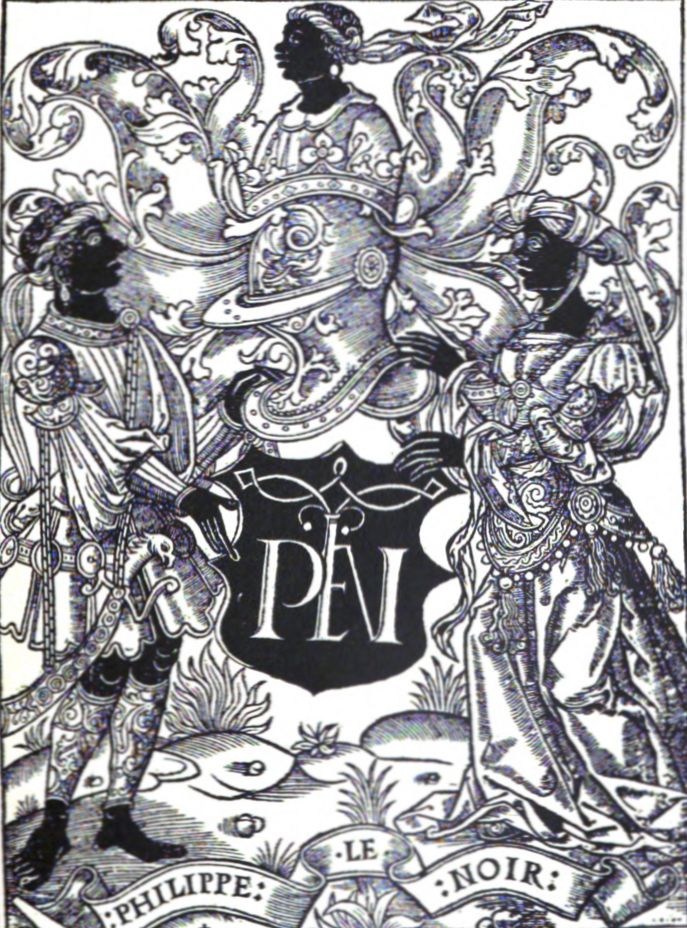
CHOICE EXAMPLES OF EARLY PRINTING AND ENGRAVING. Fac-similes from Rare and Curious Books.
PRINTER'S MARK OF PHILIPPE LE NOIR.
The early printers, in order to distinguish their work, used a special mark or plate which, as in the case before us, sometimes took the form of a sort of rebus, or punning device. The negroes who support the initial shield in this mark are gorgeous and Oriental in attire, and the design, as a whole, is one of the most picturesque examples of this kind of composition.
"At Everton some were shrieking, some roaring aloud.... The most general was a loud breathing, like that of people half strangled and gasping for life; and, indeed, almost all the cries were like those of human creatures dying in bitter anguish. Great numbers wept without any noise; others fell down as dead.... I stood upon the pew-seat, as did a young man in the opposite pew, an able-bodied, fresh, healthy countryman, but in a moment, when he seemed to think of nothing else, down he dropt, with a violence inconceivable.... I heard the stamping of his feet, ready to break the boards, as he lay in strong convulsions at the bottom of the pew.... I saw a sturdy boy, about eight years old, who roared above his fellows; ... his face was red as scarlet; and almost all on whom God laid his hand, turned either very red or almost black."[519]
Elsewhere, a woman, disgusted with this madness, wished to leave, but had only gone a few steps when she fell into as violent fits as others. Conversions followed these transports; the converted paid their debts, foreswore drunkenness, read the Bible, prayed, and went about exhorting others. Wesley collected them into societies, formed "classes" for mutual examination and edification, submitted spiritual life to a methodic discipline, built chapels, chose preachers, founded schools, organized enthusiasm. To this day his disciples spend very large sums every year in missions to all parts of the world, and on the banks of the Mississippi and the Ohio their shoutings repeat the violent enthusiasm and the conversions of primitive inspiration. The same instinct is still revealed by the same signs; the doctrine of grace survives in uninterrupted energy, and the race, as in the sixteenth century, puts its poetry into the exaltation of the moral sense.
Section V.—The Pulpit
A sort of theological smoke covers and hides this glowing hearth which burns in silence. A stranger who, at this time, had visited the country, would see in this religion only a choking vapor of arguments, controversies, and sermons. All those celebrated divines and preachers, Barrow, Tillotson, South, Stillingfleet, Sherlock, Burnet, Baxter, Barclay, preached, says Addison, like automatons, monotonously, without moving their arms. For a Frenchman, for Voltaire, who did read them, as he read everything, what a strange reading! Here is Tillotson first, the most authoritative of all, a kind of father of the Church, so much admired that Dryden tells us that he learned from him the art of writing well, and that his sermons, the only property which he left his widow, were bought by a publisher for two thousand five hundred guineas. This work has, in fact, some weight; there are three folio volumes, each of seven hundred pages. To open them, a man must be a critic by profession, or be possessed by an absolute desire to be saved. And now let us open them. "The Wisdom of being Religious"—such is his first sermon, much celebrated in his time, and the foundation of his success:
"These words consist of two propositions, which are not distinct in sense;... So that they differ only as cause and effect, which by a metonymy, used in all sorts of authors, are frequently put one for another."[520]
This opening makes us uneasy. Is this great orator a teacher of grammar?
"Having thus explained the words, I come now to consider the proposition contained in them, which is this:
That religion is the best knowledge and wisdom.
"This I shall endeavour to make good these three ways:—
"1st. By a direct proof of it;
"2d. By shewing on the contrary the folly and ignorance of irreligion and wickedness;
"3d. By vindicating religion from those common imputations which seem to charge it with ignorance or imprudence. I begin with the direct proof of this...."[521]
Thereupon he gives his divisions. What a heavy demonstrator! We are tempted to turn over the leaves only, and not to read them. Let us examine his forty-second sermon: "Against Evil-speaking:"
"Firstly: I shall consider the nature of this vice, and wherein it consists.
"Secondly: I shall consider the due extent of this prohibition, To speak evil of no man.
"Thirdly: I shall show the evil of this practice, both in the causes and effects of it.
"Fourthly: I shall add some further considerations to dissuade men from it.
"Fifthly: I shall give some rules and directions for the prevention and cure of it."[522]
What a style! and it is the same throughout. There is nothing lifelike; it is a skeleton, with all its joints coarsely displayed. All the ideas are ticketed and numbered. The schoolmen were not worse. Neither rapture nor vehemence; no wit, no imagination, no original and brilliant idea, no philosophy; nothing but quotations of mere scholarship, and enumerations from a handbook. The dull argumentative reason comes with its pigeon-holed classifications upon a great truth of the heart or an impassioned word from the Bible, examines it "positively and negatively," draws thence "a lesson and an encouragement," arranges each part under its heading, patiently, indefatigably, so that sometimes three whole sermons are needed to complete the division and the proof, and each of them contains in its exordium the methodical abstract of all the points treated and the arguments supplied. Just so were the discussions of the Sorbonne carried on. At the court of Louis XIV Tillotson would have been taken for a man who had run away from a seminary. Voltaire would have called him a village curé. He has all that is necessary to shock men of the world, nothing to attract them. For he does not address men of the world, but Christians; his hearers neither need nor desire to be goaded or amused; they do not ask for analytical refinements, novelties in matter of feeling. They come to have Scripture explained to them, and morality demonstrated. The force of their zeal is only manifested by the gravity of their attention. Let others have a text as a mere pretext; as for them, they cling to it: it is the very word of God, they cannot dwell on it too much. They must have the sense of every word hunted out, the passage interpreted phrase by phrase, in itself, by the context, by parallel passages, by the whole doctrine. They are willing to have the different readings, translations, interpretations expounded; they like to see the orator become a grammarian, a Hellenist, a scholiast. They are not repelled by all this dust of scholarship, which rises from the folios to settle upon their countenance. And the precept being laid down, they demand an enumeration of all the reasons which support it; they wish to be convinced, carry away in their heads a provision of good approved motives to last the week. They came there seriously, as to their counting-house or their field, not to amuse themselves, but to do some work, to toil and dig conscientiously in theology and logic, to amend and better themselves. They would be angry at being dazzled. Their great sense, their ordinary common-sense, is much better pleased with cold discussions; they want inquiries and methodical reports of morality, as if it was a subject of export and import duties, and treat conscience as port wine or herrings.
In this Tillotson is admirable. Doubtless he is pedantic, as Voltaire called him; he has all "the bad manners learned at the university"; he has not been "polished by association with women"; he is not like the French preachers, academicians, elegant discoursers, who by a courtly air, a well-delivered Advent sermon, the refinements of a purified style, earn the first vacant bishopric and the favor of good society. But he writes like a perfectly honest man; we can see that he is not aiming in any way at the glory of an orator; he wishes to persuade soundly, nothing more. We enjoy this clearness, this naturalness, this preciseness, this entire loyalty. In one of his sermons he says:
"Truth and reality have all the advantages of appearance and many more. If the show of anything be good for anything, I am sure sincerity is better; for why does any man dissemble, or seem to be that which he is not, but because he thinks it good to have such a quality as he pretends to? For to counterfeit and dissemble, is to put on the appearance of some real excellency. Now, the best way in the world for a man to seem to be anything, is really to be what he would seem to be. Besides, that it is many times as troublesome to make good the pretence of a good quality, as to have it; and if a man have it not, it is ten to one but he is discovered to want it, and then all his pains and labour to seem to have it are lost. There is something unnatural in painting, which a skilful eye will easily discern from native beauty and complexion.
"It is hard to personate and act a part long; for where truth is not at the bottom, nature will always be endeavouring to return, and will peep out and betray herself one time or other. Therefore, if a man think it convenient to seem good, let him be so indeed, and then his goodness will appear to everybody's satisfaction;... so that, upon all accounts, sincerity is true wisdom."[523]
We are led to believe a man who speaks thus; we say to ourselves, "This is true, he is right, we must do as he says." The impression received is moral, not literary; the sermon is efficacious, not rhetorical; it does not please, it leads to action.
In this great manufactory of morality, where every loom goes on as regularly as its neighbor, with a monotonous noise, we distinguish two which sound louder and better than the rest—Barrow and South. Not that they were free from dulness. Barrow had all the air of a college pedant, and dressed so badly that one day in London, before an audience who did not know him, he saw almost the whole congregation at once leave the church. He explained the word εύχαριστέΐν in the pulpit with all the charm of a dictionary, commenting, translating, dividing, subdividing like the most formidable of scholiasts,[524] caring no more for the public than for himself; so that once, when he had spoken for three hours and a half before the Lord Mayor, he replied to those who asked him if he was not tired, "I did, in fact, begin to be weary of standing so long." But the heart and mind were so full and so rich, that his faults became a power. He had a geometrical method and clearness,[525] an inexhaustible fertility, extraordinary impetuosity and tenacity of logic, writing the same sermon three or four times over, insatiable in his craving to explain and prove, obstinately confined to his already overflowing thoughts, with a minuteness of division, an exactness of connection, a superfluity of explanation, so astonishing that the attention of the hearer at last gives way; and yet the mind turns with the vast engine, carried away and doubled up as by the rolling weight of a flattening-machine.
Let us listen to his sermon, "Of the Love of God." Never was a more copious and forcible analysis seen in England, so penetrating and unwearying a decomposition of an idea into all its parts, a more powerful logic, more rigorously collecting into one network all the threads of a subject:
"Although no such benefit or advantage can accrue to God, which may increase his essential and indefectible happiness; no harm or damage can arrive that may impair it (for he can be neither really more or less rich, or glorious, or joyful than he is; neither have our desire or our fear, our delight or our grief, our designs or our endeavours any object, any ground in those respects); yet hath he declared, that there be certain interests and concernments, which, out of his abundant goodness and condescension, he doth tender and prosecute as his own; as if he did really receive advantage by the good, and prejudice by the bad success, respectively belonging to them; that he earnestly desires and is greatly delighted with some things, very much dislikes and is grievously displeased with other things: for instance, that he bears a fatherly affection towards his creatures, and earnestly desires their welfare; and delights to see them enjoy the good he designed them; as also dislikes the contrary events; doth commiserate and condole their misery; that he is consequently well pleased when piety and justice, peace and order (the chief means conducing to our welfare) do flourish; and displeased, when impiety and iniquity, dissension and disorder (those certain sources of mischief to us) do prevail; that he is well satisfied with our rendering to him that obedience, honour, and respect, which are due to him; and highly offended with our injurious and disrespectful behaviour toward him, in the commission of sin and violation of his most just and holy commandments; so that there wants not sufficient matter of our exercising good-will both in affection and action toward God; we are capable both of wishing and (in a manner, as he will interpret and accept it) of doing good to him, by our concurrence with him in promoting those things which he approves and delights in, and in removing the contrary."[526]
This entanglement wearies us, but what a force and dash is there in this well-considered and complete thought! Truth thus supported on all its foundations can never be shaken. Rhetoric is absent. There is no art here; the whole oratorical art consists in the desire thoroughly to explain and prove what he has to say. He is even unstudied and artless; and it is just this ingenuousness which raises him to the antique level. We may meet with an image in his writings which seems to belong to the finest period of Latin simplicity and dignity:
"The middle, we may observe, and the safest, and the fairest, and the most conspicuous places in cities are usually deputed for the erections of statues and monuments dedicated to the memory of worthy men, who have nobly deserved of their countries. In like manner should we in the heart and centre of our soul, in the best and highest apartments thereof, in the places most exposed to ordinary observation, and most secure from the invasions of worldly care, erect lively representations of, and lasting memorials unto, the divine bounty."[527]
There is here a sort of effusion of gratitude; and at the end of the sermon, when we think him exhausted, the expansion becomes more copious by the enumeration of the unlimited blessings amidst which we move like fishes in the sea, not perceiving them, because we are surrounded and submerged by them. During ten pages the idea overflows in a continuous and similar phrase, without fear of crowding or monotony, in spite of all rules, so loaded are the heart and imagination, and so satisfied are they to bring and collect all nature as a single offering:
"To him, the excellent quality, the noble end, the most obliging manner of whose beneficence doth surpass the matter thereof, and hugely augment the benefits: who, not compelled by any necessity, not obliged by any law (or previous compact), not induced by any extrinsic arguments, not inclined by our merits, not wearied with our importunities, not instigated by troublesome passions of pity, shame, or fear (as we are wont to be), not flattered with promises of recompense, nor bribed with expectation of emolument, thence to accrue unto himself; but being absolute master of his own actions, only both lawgiver and counsellor to himself, all-sufficient, and incapable of admitting any accession to his perfect blissfulness; most willingly and freely, out of pure bounty and good-will, is our Friend and Benefactor; preventing not only our desires, but our knowledge; surpassing not our deserts only, but our wishes, yea, even our conceits, in the dispensation of his inestimable and unrequitable benefits; having no other drift in the collation of them, beside our real good and welfare, our profit and advantage, our pleasure and content."[528]