Volume 2 / Part 1 — Part II—The Worldlings (continued 6)
Henri Van Laun translation
"It may perhaps be neither safe nor prudent, to argue against the abolishing of Christianity, at a juncture, when all parties appear so unanimously determined upon the point.... However, I know not how, whether from the affectation of singularity, or the perverseness of human nature, but so it unhappily falls out, that I cannot be entirely of this opinion. Nay, though I were sure an order were issued for my immediate prosecution by the attorney-general, I should still confess, that in the present posture of our affairs, at home or abroad, I do not yet see the absolute necessity of extirpating the Christian religion from among us. This perhaps may appear too great a paradox, even for our wise and paradoxical age to endure; therefore I shall handle it with all tenderness, and with the utmost deference to that great and profound majority, which is of another sentiment.... I hope no reader imagines me so weak to stand up in the defence of real Christianity, such as used, in primitive times (if we may believe the authors of those ages), to have an influence upon men's belief and actions; to offer at the restoring of that, would indeed be a wild project; it would be to dig up foundations; to destroy at one blow all the wit, and half the learning of the kingdom.... Every candid reader will easily understand my discourse to be intended only in defence of nominal Christianity; the other having been for some time wholly laid aside by general consent, as utterly inconsistent with our present schemes of wealth and power."[684]
Let us then examine the advantages which this abolition of the title and name of Christian might have:
"It is likewise urged, that there are, by computation, in this kingdom above ten thousand parsons, whose revenues, added to those of my lords the bishops, would suffice to maintain at least two hundred young gentlemen of wit and pleasure, and free-thinking, enemies to priestcraft, narrow principles, pedantry, and prejudices, who might be an ornament to the court and town."[685]
"It is likewise proposed as a great advantage to the public that if we once discard the system of the gospel, all religion will of course be banished for ever; and consequently along with it, those grievous prejudices of education, which under the names of virtue, conscience, honour, justice, and the like, are so apt to disturb the peace of human minds, and the notions whereof are so hard to be eradicated, by right reason, or free-thinking."[686]
Then he concludes by doubling the insult:
"I am very sensible how much the gentlemen of wit and pleasure are apt to murmur, and be choked at the sight of so many daggled-tail parsons, who happen to fall in their way, and offend their eyes; but at the same time, these wise reformers do not consider what an advantage and felicity it is for great wits to be always provided with objects of scorn and contempt, in order to exercise and improve their talents, and divert their spleen from falling on each other, or on themselves; especially when all this may be done, without the least imaginable danger to their persons. And to urge another argument of a parallel nature: if Christianity were once abolished, how could the free-thinkers, the strong reasoners, and the men of profound learning, be able to find another subject, so calculated in all points whereon to display their abilities? what wonderful productions of wit should we be deprived of, from those, whose genius, by continual practice, has been wholly turned upon raillery and invectives, against religion, and would, therefore, never be able to shine or distinguish themselves upon any other subject! we are daily complaining of the great decline of wit among us, and would we take away the greatest, perhaps the only topic we have left?"[687]
"I do very much apprehend, that in six months time after the act is passed for the extirpation of the gospel, the Bank and East India Stock may fall at least one per cent. And since that is fifty times more, than ever the wisdom of our age thought fit to venture, for the preservation of Christianity, there is no reason we should be at so great a loss, merely for the sake of destroying it."[688]
Swift is only a combatant, I admit; but when we glance at this common-sense and this pride, this empire over the passions of others, and this empire over himself; this force and this employment of hatred, we judge that there have rarely been such combatants. He is a pamphleteer as Hannibal was a condottiere.
Section IV.—Swift as a Humorist.—As a Poet
On the night after the battle we usually unbend; we sport, we make fun, we talk in prose and verse; but with Swift this night is a continuation of the day, and the mind which leaves its trace in matters of business leaves also its trace in amusements.
What is gayer than Voltaire's soirées? He rails; but do we find any murderous intention in his railleries? He gets angry; but do we perceive a malignant or evil character in his passions? In him all is amiable. In an instant, through the necessity of action, he strikes, caresses, changes a hundred times his tone, his face, with abrupt movements, impetuous sallies, sometimes as a child, always as a man of the world, of taste and conversation. He wishes to entertain us; he conducts us at once through a thousand ideas, without effort, to amuse himself, to amuse us. What an agreeable host is this Voltaire, who desires to please and who knows how to please, who only dreads ennui, who does not distrust us, who is not constrained, who is always himself, who is brimful of ideas, naturalness, liveliness! If we were with him, and he rallied us, we should not be angry; we should adopt his style, we should laugh at ourselves, we should feel that he only wished to pass an agreeable hour, that he was not angry with us, that he treated us as equals and guests, that he broke out into pleasantries as a winter fire into sparks, and that he was none the less pleasant, wholesome, amusing.
Heaven grant that Swift may never jest at our expense. The positive mind is too solid and too cold to be gay and amiable. When such mind takes to ridicule, it does not sport with it superficially, but studies it, goes into it gravely, masters it, knows all its subdivisions and its proofs. This profound knowledge can only produce a withering pleasantry. Swift's, at bottom, is but a reductio ad absurdum, altogether scientific. For instance, "The Art of Political Lying"[689] is a didactic treatise, whose plan might serve for a model. "In the first chapter of this excellent treatise he (the author) reasons philosophically concerning the nature of the soul of man, and those qualities which render it susceptible of lies. He supposes the soul to be of the nature of a piano-cylindrical speculum, or looking-glass.... The plane side represents objects just as they are; and the cylindrical side, by the rules of catoptrics, must needs represent true objects false, and false objects true. In his second chapter he treats of the nature of political lying; in the third of the lawfulness of political lying. The fourth chapter is wholly employed in this question, 'Whether the right of coinage of political lies be wholly in the government.'" Again, nothing could be stranger, more worthy of an archaeological society, than the argument in which he proves that a humorous piece of Pope's[690] is an insidious pamphlet against the religion of the state. His "Art of Sinking in Poetry"[[691] has all the appearance of good rhetoric; the principles are laid down, the divisions justified; the examples chosen with extraordinary precision and method; it is perfect reason employed in the service of folly.
His passions, like his mind, were too strong. If he wishes to scratch, he tears; his pleasantry is gloomy; by way of a joke, he drags his reader through all the disgusting details of sickness and death. Partridge, formerly a shoemaker, had turned astrologer, Swift, imperturbably cool, assumes an astrologer's title, writes maxims on the duties of the profession, and to inspire confidence, begins to predict:
"My first prediction is but a trifle; yet I will mention it to show how ignorant those sottish pretenders to astrology are in their own concerns: it relates to Partridge the almanack-maker; I have consulted the star of his nativity by my own rules, and find he will infallibly die upon the 29th of March next, about eleven at night, of a raging fever; therefore I advise him to consider of it, and settle his affairs in time."[692]
The twenty-ninth of March being past, he relates how the undertaker came to hang Partridge's rooms "in close mourning"; then Ned, the sexton, asking "whether the grave is to be plain or bricked"; then Mr. White, the carpenter, to screw down the coffin; then the stone-cutter with his monument. Lastly, a successor comes and sets up in the neighborhood, saying in his printed directions, "that he lives in the house of the late ingenious Mr. John Partridge, an eminent practitioner in leather, physic, and astrology."[693] We can tell beforehand the protestations of poor Partridge. Swift in his reply proves that he is dead, and is astonished at his hard words:
"To call a man a fool and villain, an impudent fellow, only for differing from him in a point merely speculative, is, in my humble opinion, a very improper style for a person of his education.... I will appeal to Mr. Partridge himself, whether it be probable I could have been so indiscreet, to begin my predictions, with the only falsehood that ever was pretended to be in them? and this in an affair at home, where I had so many opportunities to be exact."[694]
Mr. Partridge is mistaken, or deceives the public, or would cheat his heirs.
This gloomy pleasantry becomes elsewhere still more gloomy. Swift pretends that his enemy, the bookseller Curll, has just been poisoned, and relates his agony. A house-surgeon of a hospital would not write a more repulsive diary more coldly. The details, worked out with the completeness of a Hogarth, are admirably minute, but disgusting. We laugh, or rather we grin, as before the vagaries of a madman in an asylum, but in reality we feel sick at heart. Swift in his gayety is always tragical; nothing unbends him; even when he serves, he pains you. In his "Journal to Stella" there is a sort of imperious austerity; his condescension is that of a master to a child. The charm and happiness of a young girl of sixteen cannot soften him. She has just married him, and he tells her that love is a "ridiculous passion, which has no being but in playbooks and romances"; then he adds, with perfect brutality:
"I never yet knew a tolerable woman to be fond of her sex;... your sex employ more thought, memory, and application to be fools than would serve to make them wise and useful.... When I reflect on this, I cannot conceive you to be human creatures, but a sort of species hardly a degree above a monkey; who has more diverting tricks than any of you, is an animal less mischievous and expensive, might in time be a tolerable critic in velvet and brocade, and, for aught I know, would equally become them."[695]
Will poetry calm such a mind? Here, as elsewhere, he is most unfortunate. He is excluded from great transports of imagination, as well as from the lively digressions of conversation. He can attain neither the sublime nor the agreeable; he has neither the artist's rapture, nor the entertainment of the man of the world. Two similar sounds at the end of two equal lines have always consoled the greatest troubles: the old muse, after three thousand years, is a young and divine nurse; and her song lulls the sickly nations whom she still visits, as well as the young, flourishing races amongst whom she has appeared. The involuntary music, in which thought wraps itself, hides ugliness and unveils beauty. Feverish man, after the labors of the evening and the anguish of the night, sees at morning the beaming whiteness of the opening heaven; he gets rid of himself, and the joy of nature from all sides enters with oblivion into his heart. If misery pursues him, the poetic afflatus, unable to wipe it out, transforms it; it becomes ennobled, he loves it, and thenceforth he bears it; for the only thing to which he cannot resign himself is littleness. Neither Faust nor Manfred have exhausted human grief; they drank from the cruel cup a generous wine, they did not reach the dregs. They enjoyed themselves, and nature; they tasted the greatness which was in them, and the beauty of creation; they pressed with their bruised hands all the thorns with which necessity has made our way thorny, but they saw them blossom with roses, fostered by the purest of their noble blood. There is nothing of the sort in Swift: what is wanting most in his verses is poetry. The positive mind can neither love nor understand it; it sees therein only a kind of mechanism or a fashion, and employs it only for vanity and conventionality. When in his youth Swift attempted Pindaric odes, he failed lamentably. I cannot remember a line of his which indicates a genuine sentiment of nature: he saw in the forests only logs of wood, and in the fields only sacks of corn. He employed mythology, as we put on a wig, ill-timed, wearily and scornfully. His best piece, "Cadenus and Vanessa,"[696] is a poor, threadbare allegory. To praise Vanessa, he supposes that the nymphs and shepherds pleaded before Venus, the first against men, the second against women; and that Venus, wishing to end the debates, made in Vanesso a model of perfection. What can such a conception furnish but flat apostrophes and pedantic comparisons? Swift, who elsewhere gives a recipe for an epic poem, is here the first to make use of it. And even his rude prosaic freaks tear this Greek frippery at every turn. He puts a legal procedure into heaven; he makes Venus use all kinds of technical terms. He introduces witnesses, "questions on the fact, bill with costs dismissed," etc. They talk so loud that the goddess fears to lose her influence, to be driven from Olympus, or else
"Shut out from heaven and earth, Fly to the sea, my place of birth: There live with daggled mermaids pent, And keep on fish perpetual Lent."[697]
When he relates the touching history of "Baucis and Philemon," he degrades it by a travesty. He does not love the ancient nobleness and beauty; the two gods become in his hands begging friars, Philemon and Baucis Kentish peasants. For a recompense, their house becomes a church, and Philemon a parson:
"His talk was now of tithes and dues; He smoked his pipe and read the news.... Against dissenters would repine, And stood up firm for 'right divine.'"[698]
Wit luxuriates, incisive, in little compact verses, vigorously coined, of extreme conciseness, facility, precision; but compared to La Fontaine, it is wine turned into vinegar. Even when he comes to the charming Vanessa, his vein is still the same: to praise her childhood, he puts her name first on the list, as a little model girl, just like a schoolmaster:
"And all their conduct would be tried By her, as an unerring guide: Offending daughters oft would hear Vanessa's praise rung in their ear: Miss Betty, when she does a fault, Lets fall her knife, or spills the salt, Will thus be by her mother chid: 'Tis what Vanessa never did!'"[699]
A strange way of admiring Vanessa, and of proving his admiration for her. He calls her a nymph, and treats her like a schoolgirl! Cadenus "now could praise, esteem, approve, but understood not what was love!" Nothing could be truer, and Stella felt it, like others. The verses' which he writes every year on her birthday, are a pedagogue's censures and praises; if he gives her any good marks, it is with restrictions. Once he inflicts on her a little sermon on want of patience; again, by way of compliment, he concocts this delicate warning:
"Stella, this day is thirty-four (We shan't dispute a year or more). However, Stella, be not troubled, Although thy size and years are doubled Since first I saw thee at sixteen, The brightest virgin on the green; So little is thy form declin'd, Made up so largely in thy mind."
And he insists with exquisite taste:
"O, would it please the gods to split Thy beauty, size, and years, and wit! No age could furnish out a pair Of nymphs so graceful, wise, and fair."[700]
Decidedly this man is an artisan, strong of arm, terrible at his work and in a fray, but narrow of soul, treating a woman as if she were a log of wood. Rhyme and rhythm are only businesslike tools, which have served him to press and launch his thought; he has put nothing but prose into them: poetry was too fine to be grasped by those coarse hands.
But in prosaic subjects, what truth and force! How this masculine nakedness crushes the affected elegance and artificial poetry of Addison and Pope! There are no epithets; he leaves his thought as he conceived it, valuing it for and by itself, needing neither ornaments, nor preparation, nor extension; above the tricks of the profession, scholastic conventionalisms, the vanity of the rhymester, the difficulties of the art; master of his subject and of himself. This simplicity and naturalness astonish us in verse. Here, as elsewhere, his originality is entire, and his genius creative; he surpasses his classical and timid age; he tyrannizes over form, breaks it, dare utter anything, spares himself no strong word. Acknowledge the greatness of this invention and audacity; he alone is a superior being, who finds everything and copies nothing. What a biting comicality in the "Grand Question Debated "! He has to represent the entrance of a captain into a castle, his airs, his insolence, his folly, and the admiration caused by these qualities! The lady serves him first; the servants stare at him:
"The parsons for envy are ready to burst; The servants amazed are scarce ever able To keep off their eyes, as they wait at the table; And Molly and I have thrust in our nose To peep at the captain in all his fine clo'es. Dear madam, be sure he's a fine spoken man, Do but hear on the clergy how glib his tongue ran: 'And madam,' says he, 'if such dinners you give, You'll ne'er want for parsons as long as you live. I ne'er knew a parson without a good nose: But the devil's as welcome wherever he goes; G—d—n me! they bid us reform and repent, But, z—s! by their looks they never keep Lent: Mister curate, for all your grave looks, I'm afraid You cast a sheep's eye on her ladyship's maid: I wish she would lend you her pretty white hand In mending your cassock, and smoothing your band' (For the dean was so shabby, and look'd like a ninny, That the captain suppos'd he was curate to Jinny). Whenever you see a cassock and gown, A hundred to one but it covers a clown. Observe how a parson comes into a room, G—d—n me, he hobbles as bad as my groom; A scholard, when just from his college broke loose, Can hardly tell how to cry bo to a goose; Your Noveds and Bluturks and Omurs,[701] and stuff, By G—, they don't signify this pinch of snuff; To give a young gentleman right education, The army's the only good school in the nation."[702]
This has been seen, and herein lies the beauty of Swift's verses: they are personal; they are not developed themes, but impressions felt and observations collected. Read "The Journal of a Modern Lady, The Furniture of a Woman's Mind," and other pieces by the dozen: they are dialogues transcribed or opinions put on paper after quitting a drawing-room. "The Progress of Marriage" represents a dean of fifty-two married to a young worldly coquette; do we not see in this title alone all the fears of the bachelor of St. Patrick's? What diary is more familiar and more pungent than his verses on his own death?
"'He hardly breathes. The Dean is dead.' Before the passing bell begun, The news through half the town has run; 'O may we all for death prepare! What has he left? and who's his heir?' 'I know no more than what the news is; 'Tis all bequeathed to public uses.' 'To public uses! there's a whim! What had the public done for him? Mere envy, avarice, and pride: He gave it all—but first he died. And had the Dean in all the nation No worthy friend, no poor relation? So ready to do strangers good, Forgetting his own flesh and blood!'... Poor Pope will grieve a month, and Gay A week, and Arbuthnot a day.... My female friends, whose tender hearts Have better learn'd to act their parts, Receive the news in doleful dumps: The Dean is dead (pray what is trumps?) Then, Lord, have mercy on his soul! (Ladies, I'll venture for the vole.) Six Deans, they say, must bear the pall. (I wish I knew what king to call.) Madam, your husband will attend The funeral of so good a friend? No, madam, 'tis a shocking sight, And he's engaged to-morrow night: My Lady Club will take it ill, If he should fail her at quadrille. He lov'd the Dean—(I lead a heart), But dearest friends they say must part. His time was come: he ran his race; We hope he's in a better place."[703]
Such is the inventory of human friendships. All poetry exalts the mind, but this depresses it; instead of concealing reality, it unveils it; instead of creating illusions, it removes them. When he wishes to give a description of the morning,[704] he shows us the street-sweepers, the "watchful bailiffs," and imitates the different street cries. When he wishes to paint the rain,[705] he describes "filth of all hues and odors," the "swelling kennels," the "dead cats, turnip-tops, stinking sprats," which "come tumbling down the flood." His long verses whirl all this filth in their eddies. We smile to see poetry degraded to this use; we seem to be at a masquerade; it is a queen travestied into a rough country girl. We stop, we look on, with the sort of pleasure we feel in drinking a bitter draught. Truth is always good to know, and in the splendid piece which artists show us we need a manager to tell us the number of the hired applauders and of the supernumeraries. It would be well if he only drew up such a list! Numbers look ugly, but they only affect the mind; other things, the oil of the lamps, the odors of the side scenes, all that we cannot name, remains to be told. I cannot do more than hint at the length to which Swift carries us; but this I must do, for these extremes are the supreme effort of his despair and his genius: we must touch upon them in order to measure and know him. He drags poetry not only through the mud, but into the filth; he rolls in it like a raging madman, he enthrones himself in it, and bespatters all passers-by. Compared with his, all foul words are decent and agreeable. In Aretin and Brantôme, in La Fontaine and Voltaire, there is a soupçon of pleasure. With the first, unchecked sensuality, with the others, malicious gayety, are excuses; we are scandalized, not disgusted; we do not like to see in a man a bull's fury or an ape's buffoonery; but the bull is so eager and strong, the ape so funny and smart, that we end by looking on or being amused. Then, again, however coarse their pictures may be, they speak of the accompaniments of love: Swift touches only upon the results of digestion, and that merely with disgust and revenge; he pours them out with horror and sneering at the wretches whom he describes. He must not in this be compared to Rabelais; that good giant, that drunken doctor, rolls himself joyously about on his dunghill, thinking no evil; the dunghill is warm, convenient, a fine place to philosophize and sleep off one's wine. Raised to this enormity, and enjoyed with this heedlessness, the bodily functions become poetical. When the casks are emptied down the giant's throat, and the viands are gorged, we sympathize with so much bodily comfort; in the heavings of this colossal belly and the laughter of this Homeric mouth, we see as through a mist, the relics of bacchanal religions, the fecundity, the monstrous joy of nature; these are the splendors and disorders of its first births. The cruel positive mind, on the contrary, clings only to vileness; it will only see what is behind things; armed with sorrow and boldness, it spares no ignoble detail, no obscene word. Swift enters the dressing-room,[706] relates the disenchantments of love,[707] dishonors it by a medley of drugs and physic,[708] describes the cosmetics and a great many more things.[709] He takes his evening walk by solitary walls,[710] and in these pitiable pryings has his microscope ever in his hand. Judge what he sees and suffers; this is his ideal beauty and his jesting conversation, and we may fancy that he has for philosophy, as for poetry and politics, execration and disgust.
Section V.—Swift as a Narrator and Philosopher
Swift wrote the "Tale of a Tub" at Sir William Templet, amidst all kind of reading, as an abstract of truth and science. Hence this tale is the satire of all science and all truth.
Of religion first. He seems here to defend the Church of England; but what church and what creed are not involved in his attack? To enliven his subject, he profanes and reduces questions of dogma to a question of clothes. A father had three sons, Peter, Martin, and Jack; he left each of them a coat at his death,[711] warning them to wear it clean and brush it often. The three brothers obeyed for some time and travelled sensibly, slaying "a reasonable quantity of giants and dragons."[712] Unfortunately, having come up to town, they adopted its manners, fell in love with several fashionable ladies, the Duchess d'Argent, Mme de Grands Titres, and the Countess d'Orgueil,[713] and to gain their favors began to live as gallants, taking snuff, swearing, rhyming, and contracting debts, keeping horses, fighting duels, whoring, killing bailiffs. A sect was established who
"Held the universe to be a large suit of clothes, which invests everything: that the earth is invested by the air; the air is invested by the stars, and the stars are invested by the primum mobile.... What is that which some call land, but a fine coat faced with green? or the sea, but a waistcoat of water-tabby?... You will find how curious journeyman Nature has been, to trim up the vegetable beaux: observe how sparkish a periwig adorns the head of a beech, and what a fine doublet of white sattin is worn by the birch.... Is not religion a cloak; honesty a pair of shoes worn out in the dirt; self-love a surtout; vanity a shirt; and conscience a pair of breeches; which, though a cover for lewdness as well as nastiness, is easily slipt down for the service of both?... If certain ermines and furs be placed in a certain position, we style them a judge; and so an apt conjunction of lawn and black sattin, we entitle a bishop."[714]
Others held also "that the soul was the outward, and the body the inward clothing.... This last they proved by Scripture, because in them we live, and move, and have our being." Thus our three brothers, having only very simple clothes, were embarrassed. For instance, the fashion at this time was for shoulder-knots,[715] and their father's will expressly forbade them to "add to or diminish from their coats one thread":
"In this unhappy case they went immediately to consult their father's will, read it over and over, but not a word of the Shoulder-knot.... After much thought, one of the brothers, who happened to be more book-learned than the other two, said, he had found an expedient. 'It is true,' said he, 'there is nothing in this will, totidem verbis, making mention of Shoulder-Knots; but I dare conjecture, we may find them inclusive, or totidem syllabis.' This distinction was immediately approved by all; and so they fell again to examine;[716] but their evil star had so directed the matter, that the first syllable was not to be found in the whole writings. Upon which disappointment, he, who found the former evasion, took heart and said: 'Brothers, there are yet hopes, for though we cannot find them totidem verbis, nor totidem syllabis, I dare engage we shall make them out tertio modo or totidem litteris.' This discovery was also highly commended; upon which they fell once more to the scrutiny, and picked out S, H, O, U, L, D, E, R, when the same planet, enemy to their repose, had wonderfully contrived that a K was not to be found. Here was a weighty difficulty; but the distinguishing brother... now his hand was in, proved by a very good argument, that K was a modern illegitimate letter, unknown to the learned ages, nor anywhere to be found in ancient manuscripts.... Upon this all farther difficulty vanished; shoulder-knots were made clearly out to be jure paterno, and our three gentlemen swaggered with as large and flaunting ones as the best."[717]
Other interpretations admitted gold lace, and a codicil authorized flame colored satin linings:[718]
"Next winter a player, hired for the purpose by the corporation of fringe-makers, acted his part in a new comedy, all covered with silver fringe, and according to the laudable custom gave rise to that fashion. Upon which the brothers consulting their father's will, to their great astonishment found these words: 'Item, I charge and command my said three sons to wear no sort of silver fringe upon or about their said coats,' etc.... However, after some pause, the brother so often mentioned for his erudition, who was well skilled in criticisms, had found in a certain author, which he said should be nameless, that the same word, which in the will is called fringe, does also signify a broomstick: and doubtless ought to have the same interpretation in this paragraph. This another of the brothers disliked, because of that epithet silver, which could not, he humbly conceived, in propriety of speech, be reasonably applied to a broomstick; but it was replied upon him that this epithet was understood in a mythological and allegorical sense. However, he objected again, why their father should forbid them to wear a broomstick on their coats, a caution that seemed unnatural and impertinent; upon which he was taken up short, as one who spoke irreverently of a mystery, which doubtless was very useful and significant, but ought not to be over-curiously pried into, or nicely reasoned upon."[719]
In the end the scholastic brother grew weary of searching further "evasions," locked up the old will in a strong box,[720] authorized by tradition the fashions which became him, and having contrived to be left a legacy, styled himself My Lord Peter. His brothers, treated like servants, were discarded from his house; they reopened the will of their father, and began to understand it. Martin (Luther), to reduce his clothes to the primitive simplicity, brought off a large handful of points, stripped away ten dozen yards of fringe, rid his coat of a huge quantity of gold-lace, but kept a few embroideries, which could not "be got away without damaging the cloth." Jack (Calvin) tore off all in his enthusiasm, and was found in tatters, besides being envious of Martin, and half mad. He then joined the Æolists, or inspired admirers of the wind, who pretend that the spirit, or breath, or wind, is heavenly, and contains all knowledge:
"First, it is generally affirmed or confessed that learning puffeth men up; and secondly they proved it by the following syllogism: words are but wind; and learning is nothing but words; ergo learning is nothing but wind.... This, when blown up to its perfection, ought not to be covetously hoarded up, stifled, or hid under a bushel, but freely communicated to mankind. Upon these reasons, and others of equal weight, the wise Æolists affirm the gift of belching to be the noblest act of a rational creature.... At certain seasons of the year, you might behold the priests among them in vast number... linked together in a circular chain, with every man a pair of bellows applied to his neighbour's breech, by which they blew each other to the shape and size of a tun; and for that reason with great propriety of speech, did usually call their bodies their vessels."[721]
After this explanation of theology, religious quarrels, and mystical inspirations, what is left, even of the Anglican Church? She is a sensible, useful, political cloak, but what else? Like a stiff brush used with too strong a hand, the buffoonery has carried away the cloth as well as the stain. Swift has put out a fire, I allow; but, like Gulliver at Liliput, the people saved by him must hold their nose, to admire the right application of the liquid, and the energy of the engine that saves them.
Religion being drowned, Swift turns against science; for the digressions with which he interrupts his story to imitate and mock the modern sages are most closely connected with his tale. The book opens with introductions, prefaces, dedications, and other appendices generally applied to swell books—violent caricatures heaped up against the vanity and prolixity of authors. He professes himself one of them, and announces their discoveries. Admirable discoveries! The first of their commentaries will be on
"'Tom Thumb,' whose author was a Pythagorean philosopher. This dark treatise contains the whole scheme of the Metempsychosis, deducing the progress of the soul through all her stages. 'Whittington and his Cat' is the work of that mysterious rabbi Jehuda Hannasi, containing a defence of the gemara of the Jerusalem misna, and its just preference to that of Babylon, contrary to the vulgar opinion."[722]
He himself announces that he is going to publish "A Panegyrical Essay upon the Number Three"; a "General History of Ears"; a "Modest Defence of the Proceedings of the Rabble in all Ages"; an "Essay on the Art of Canting, Philosophically, Physically, and Musically Considered"; and he engages his readers to try by their entreaties to get from him these treatises, which will change the appearance of the world. Then, turning against the philosophers and the critics, sifters of texts, he proves to them, according to their own fashion, that the ancients mentioned them. Can we find anywhere a more biting parody on forced interpretations:
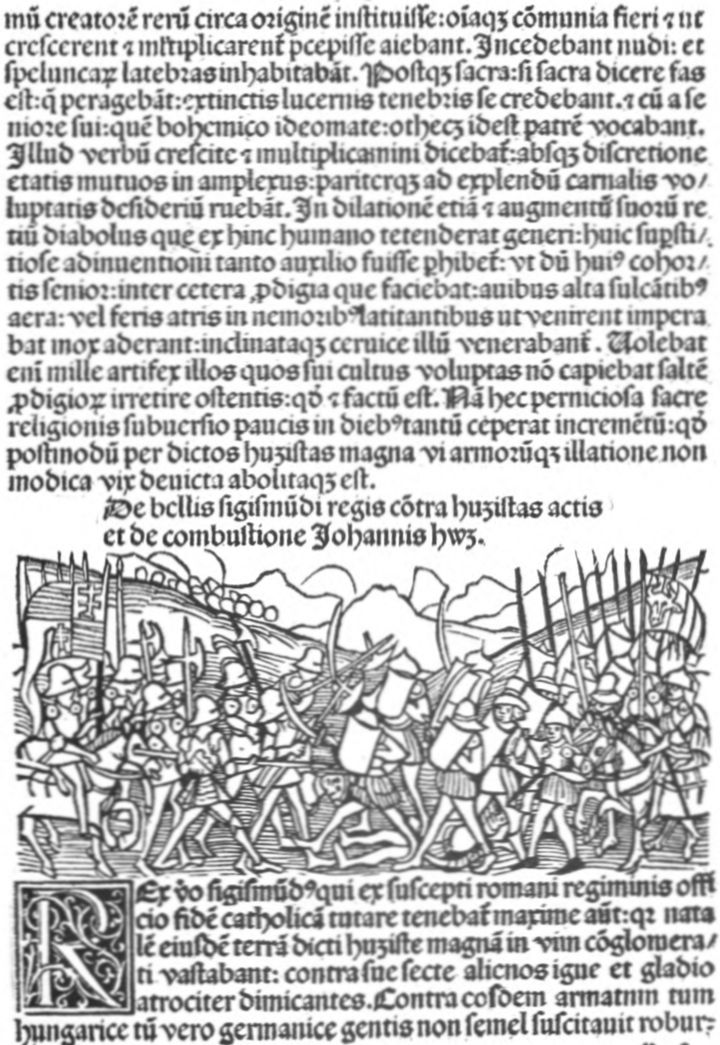
CHOICE EXAMPLES OF EARLY PRINTING AND ENGRAVING. Fac-similes from Rare and Curious Books. PAGE FROM THE CHRONICLES OF HUNGARY.
This fine work was printed by Ratdolt after his return from Venice to his native Augsburg in 1488. The page before us is not only beautiful, but highly original in conception. The infantry fight, which is the subject of the illustration, shows how a master's hand can, by the simplest means, produce an effect full of life and expression. The form of the type is bold and clear. Our illustration is from the unique copy in the British Museum.
"The types are so apposite and the applications so necessary and natural, that it is not easy to conceive how any reader of a modern eye or taste could overlook them.... For first; Pausanias is of opinion, that the perfection of writing correct was entirely owing to the institution of critics; and, that he can possibly mean no other than the true critic, is, I think, manifest enough from the following description. He says, they were a race of men, who delighted to nibble at the superfluities and excrescences of books; which the learned at length observing, took warning, of their own accord, to lop the luxuriant, the rotten, the dead, the sapless, and the overgrown branches from their works. But now, all this he cunningly shades under the following allegory; that the Nauplians in Argos learned the art of pruning their vines, by observing that when an ass had browsed upon one of them, it thrived the better and bore fairer fruits. But Herodotus, holding the very same hieroglyph, speaks much plainer, and almost in terminis. He has been so bold as to tax the true critics of ignorance and malice; telling us openly, for I think nothing can be plainer, that in the western part of Libya there were asses with horns."[723]
Then follow a multitude of pitiless sarcasms. Swift has the genius of insult; he is an inventor of irony, as Shakespeare of poetry; and as beseems an extreme force, he goes to extremes in his thought and art. He lashes reason after science, and leaves nothing of the whole human mind. With a medical seriousness he establishes that vapors are exhaled from the whole body, which, "getting possession of the brain," leave it healthy if they are not abundant, but excite it if they are; that in the first case they make peaceful individuals, in the second great politicians, founders of religions, and deep philosophers, that is, madmen, so that madness is the source of all human genius and all the institutions of the universe. This is why it is very wrong to keep men shut up in Bedlam, and a commission appointed to examine them would find in this academy many imprisoned geniuses "which might produce admirable instruments for the several offices in a state ecclesiastical, civil, and military."
"Is any student tearing his straw in piece-meal, swearing and blaspheming, biting his grate, foaming at the mouth?... let the right worshipful commissioners of inspection give him a regiment of dragoons, and send him into Flanders among the rest.... You will find a third gravely taking the dimensions of his kennel; a person of foresight and insight, though kept quite in the dark.... He walks duly in one pace... talks much of hard times and taxes and the whore of Babylon; bars up the wooden window of his cell constantly at eight o'clock, dreams of fire.... Now what a figure would all those acquirements amount to if the owner were sent into the city among his brethren?... Now is it not amazing to think the society of Warwick-lane should have no more concern for the recovery of so useful a member?... I shall not descend so minutely, as to insist upon the vast number of beaux, fiddlers, poets, and politicians that the world might recover by such a reformation.... Even I myself, the author of these momentous truths, am a person whose imaginations are hard-mouthed, and exceedingly disposed to run away with his reason, which I have observed, from long experience, to be a very light rider, and easily shaken off; upon which account my friends will never trust me alone, without a solemn promise to vent my speculations in this, or the like manner, for the universal benefit of mankind."[724]
What a wretched man is he who knows himself and mocks himself! What madman's laughter, and what a sob in this hoarse gayety! What remains for him but to slaughter the remainder of human invention? Who does not see here the despair from which sprang the academy of Lagado? Is there not here a foretaste of madness in this intense meditation of absurdity? His mathematician, who, to teach geometry, makes his pupils swallow wafers on which he writes his theorems; his moralist, who, to reconcile political parties, proposes to saw off the occiputs and brain of each "opposite party-man," and "to let the occiputs thus cut off be interchanged"; his economist again, who tries "to reduce human excrement to its original food." Swift is akin to these, and is the most wretched of all, because he nourishes his mind, like them, on filth and folly, and because he possesses what they have not, knowledge and disgust.
It is sad to exhibit human folly, it is sadder to exhibit human perversity: the heart is more a part of ourselves than reason: we suffer less in seeing extravagance and folly than wickedness or baseness, and I find Swift more agreeable in his "Tale of a Tub" than in "Gulliver."
All his talent and all his passions are assembled in this book; the positive mind has impressed upon it its form and force. There is nothing agreeable in the fiction or the style. It is the diary of an ordinary man, a surgeon, then a captain, who describes coolly and sensibly the events and objects which he has just seen, but who has no feeling for the beautiful, no appearance of admiration or passion, no delivery. Sir Joseph Banks and Captain Cook relate thus. Swift only seeks the natural, and he attains it. His art consists in taking an absurd supposition, and deducing seriously the effects which it produces. It is the logical and technical mind of a mechanician, who, imagining the decrease or increase in a wheelwork, perceives the result of the changes, and writes down the record. His whole pleasure is in seeing these results clearly, and by a solid reasoning. He marks the dimensions, and so forth, like a good engineer and a statistician, omitting no trivial and positive detail, explaining cookery, stabling, politics: in this he has no equal but De Foe. The lodestone machine which sustains the flying island, the entrance of Gulliver into Liliput, and the inventory of his property, his arrival and maintenance among the Yahoos, carry us with them; no mind knew better the ordinary laws of nature and human life; no mind shut itself up, more strictly in this knowledge; none was ever more exact or more limited.
But what a vehemence underneath this aridity! How ridiculous our interests and passions seem, degraded to the littleness of Liliput, or compared to the vastness of Brobdignag? What is beauty, when the handsomest body, seen with piercing eyes, seems horrible? What is our power, when an insect, king of an ant-hill, can be called, like our princes, "sublime majesty, delight and terror of the universe"? What is our homage worth, when a pygmy "is taller, by almost the breadth of a nail, than any of his court, which alone is enough to strike an awe into his beholders"? Three-fourths of our sentiment are follies, and the weakness of our organs is the only cause of our veneration or love.
Society repels us still more than man. At Laputa, at Liliput, amongst the horses and giants, Swift rages against it, and is never tired of abusing and reviling it. In his eyes, "ignorance, idleness, and vice are the proper ingredients for qualifying a legislator; laws are best explained, interpreted, and applied by those whose interest and abilities lie in perverting, confounding, and eluding them."[725] A noble is a wretch, corrupted body and soul, "combining in himself all the diseases and vices transmitted by ten generations of rakes and rascals. A lawyer is a hired liar, wont by twenty years of roguery to pervert the truth if he is an advocate, and to sell it if he is a judge. A minister of state is a go-between, who, having disposed of his wife," or brawled for the public good, is master of all offices; and who, in order better to rob the money of the nation, buys members of the House of Commons with the same money. A king is a practiser of all the vices, unable to employ or love an honest man, persuaded that "the royal throne could not be supported without corruption, because that positive, confident, restive temper, which virtue infused into a man, was a perpetual clog to public business."[726] At Liliput the king chooses as his ministers those who dance best upon the tight-rope. At Luggnagg he compels all those, who are presented to him, to crawl on their bellies and lick the dust.
"When the king has a mind to put any of his nobles to death in a gentle, indulgent manner, he commands the floor to be strewed with a certain brown powder of a deadly composition, which, being licked up, infallibly kills him in twenty-four hours. But in justice to this prince's great clemency, and the care he has of his subjects' lives (wherein it were much to be wished that the monarchs of Europe would imitate him), it must be mentioned for his honour, that strict orders are given to have the infected parts of the floor well washed after every such execution.... I myself heard him give directions that one of his pages should be whipped, whose turn it was to give notice about washing the floor after an execution, but maliciously had omitted it; by which neglect, a young lord of great hopes coming to an audience, was unfortunately poisoned, although the King at that time had no design against his life. But this good prince was so gracious as to forgive the poor page his whipping, upon promise that he would do so no more, without special orders."[727]
All these fictions of giants, pygmies, flying islands, are means for depriving human nature of the veils with which habit and imagination cover it, to display it in its truth and its ugliness. There is still one cloak to remove, the most deceitful and familiar. Swift must take away that appearance of reason in which we deck ourselves. He must suppress the sciences, arts, combinations of society, inventions of industries, whose brightness dazzles us. He must discover the Yahoo in man. What a spectacle!
"At last I beheld several animals in a field, and one or two of the same kind sitting in trees. Their shape was very singular and deformed.... Their heads and breasts were covered with a thick hair, some frizzled, and others lank; they had beards like goats, and a long ridge of hair down their backs, and the forepart of their legs and feet; but the rest of their bodies was bare, so that I might see their skins, which were of a brown buff colour.... They climbed high trees as nimbly as a squirrel, for they had strong extended claws before and behind, terminating in sharp points and hooked.... The females... had long lank hair on their head, but none on their faces, nor anything more than a sort of down on the rest of their bodies. ... Upon the whole I never beheld in all my travels so disagreeable an animal, or one against which I naturally conceived so great an antipathy."[728]
According to Swift, such are our brothers. He finds in them all our instincts. They hate each other, tear each other with their talons, with hideous contortions and yells! such is the source of our quarrels. If they find a dead cow, although they are but five, and there is enough for fifty, they strangle and wound each other: such is a picture of our greed and our wars. They dig up precious stones and hide them in their kennels, and watch them "with great caution," pining and howling when robbed: such is the origin of our love of gold. They devour indifferently "herbs, berries, roots, the corrupted flesh of animals," preferring "what they could get by rapine or stealth," gorging themselves till they vomit or burst: such is the portrait of our gluttony and injustice. They have a kind of juicy and unwholesome root, which they "would suck with great delight," till they "howl, and grin, and chatter," embracing or scratching each other, then reeling, hiccoughing, wallowing in the mud: such is a picture of our drunkenness.
"In most herds there was a sort of ruling Yahoo, who was always more deformed in body, and mischievous in disposition, than any of the rest: that this leader had usually a favourite as like himself as he could get, whose employment was to lick his master's feet,... and drive the female Yahoos to his kennel; for which he was now and then rewarded with a piece of ass's flesh.... He usually continues in office till a worse can be found."[729]
Such is an abstract of our government. And yet he gives preference to the Yahoos over men, saying that our wretched reason has aggravated and multiplied these vices, and concluding with the king of Brobdignag that our species is "the most pernicious race of little odious vermin that nature ever suffered to crawl upon the surface of the earth."[730]
Five years after this treatise on man, he wrote in favor of unhappy Ireland a pamphlet which is like the last effort of his despair and his genius.[731] I give it almost whole; it deserves it. I know nothing like it in any literature:
"It is a melancholy object to those who walk through this great town, or travel in the country, when they see the streets, the roads, and cabin-doors crowded with beggars of the female sex, followed by three, four, or six children, all in rags, and importuning every passenger for an alms.... I think it is agreed by all parties that this prodigious number of children... is, in the present deplorable state of the kingdom, a very great additional grievance; and therefore, whoever could find out a fair, cheap, and easy method of making these children sound, useful members of the Commonwealth, would deserve so well of the public, as to have his statue set up for a preserver of the nation. . . I shall now, therefore, humbly propose my own thoughts, which I hope will not be liable to the least objection."[732]
When we know Swift, such a beginning frightens us:
"I have been assured by a very knowing American of my acquaintance in London, that a young healthy child, well nursed, is, at a year old, a most delicious, nourishing, and wholesome food, whether stewed, roasted, baked, or boiled; and I make no doubt that it will equally serve in a fricassee or a ragout.
"I do therefore humbly offer it to public consideration, that of the hundred and twenty thousand children already computed, twenty thousand may be reserved for breed, whereof only one-fourth part to be males;... that the remaining hundred thousand may, at a year old, be offered in sale to the persons of quality and fortune through the kingdom; always advising the mother to let them suck plentifully in the last month, so as to render them plump and fat for a good table. A child will make two dishes at an entertainment for friends, and when the family dines alone, the fore or hind quarter will make a reasonable dish, and seasoned with a little pepper or salt, will be very good boiled on the fourth day, especially in winter."
I have reckoned, upon a medium, that a child just born will weigh twelve pounds, and in a solar year, if tolerably nursed, will increase to twenty-eight pounds.
"I have already computed the charge of nursing a beggar's child (in which list I reckon all cottagers, labourers, and four-fifths of the farmers), to be about two shillings per annum, rags included; and I believe no gentleman would repine to give ten shillings for the carcass of a good fat child, which, as I have said, will make four dishes of excellent nutritive meat.
"Those who are more thrifty (as I must confess the times require), may flay the carcass; the skin of which, artificially dressed, will make admirable gloves for ladies, and summer boots for fine gentlemen.
"As to our city of Dublin, shambles may be appointed for this purpose in the most convenient parts of it; and butchers we may be assured will not be wanting; although I rather recommend buying the children alive, than dressing them hot from the knife, as we do roasting pigs....
"I think the advantages by the proposal which I have made, are obvious and many, as well as of the highest importance. For first, as I have already observed, it would greatly lessen the number of Papists, with whom we are yearly overrun, being the principal breeders of the nation, as well as our most dangerous enemies.... Thirdly, whereas the maintenance of a hundred thousand children, from two years old and upward, cannot be computed at less than ten shillings a piece per annum, the nation's stock will be thereby increased fifty thousand pounds per annum, beside the profit of a new dish introduced to the tables of all gentlemen of fortune in the kingdom, who have any refinement in taste. And the money will circulate among ourselves, the goods being entirely of our own growth and manufacture.... Sixthly, this would be a great inducement to marriage, which all wise nations have either encouraged by rewards, or enforced by laws and penalties. It would increase the care and tenderness of mothers toward their children, when they were sure of a settlement for life to the poor babes, provided in some sort by the public, to their annual profit or expense. ... Many other advantages might be enumerated, for instance, the addition of some thousand carcasses in our exportation of barrelled beef; the propagation of swine's flesh, and the improvement in the art of making good bacon.... But this, and many others, I omit, being studious of brevity.
"Some persons of desponding spirit are in great concern about that vast number of poor people who are aged, diseased, or maimed; and I have been desired to employ my thoughts, what course may be taken to ease the nation of so grievous an encumbrance. But I am not in the least pain upon that matter; because it is very well known, that they are every day dying and rotting, by cold and famine, and filth and vermin, as fast as can be reasonably expected. And as to the young labourers, they are now in almost as hopeful a condition; they cannot get work, and consequently pine away for want of nourishment, to a degree, that, if at any time they are accidentally hired to common labour, they have not strength to perform it; and thus the country and themselves are happily delivered from the evils to come."[733]
Swift ends with the following ironic lines, worthy of a cannibal:
"I profess, in the sincerity of my heart that I have not the least personal interest in endeavouring to promote this necessary work, having no other motive than the public good of my country, by advancing our trade, providing for infants, relieving the poor, and giving some pleasure to the rich. I have no children by which I can propose to get a single penny; the youngest being nine years old and my wife past child-bearing."[734]
Much has been said of unhappy great men, Pascal, for instance. I think that his cries and his anguish are faint compared to this calm treatise.
Such was this great and unhappy genius, the greatest of the classical age, the most unhappy in history, English throughout, whom the excess of his English qualities inspired and consumed, having this intensity of desires, which is the main feature of the race, the enormity of pride which the habit of liberty, command, and success has impressed upon the nation, the solidity of the positive mind which habits of business have established in the country; precluded from power and action by his unchecked passions and his intractable pride; excluded from poetry and philosophy by the clear-sightedness and narrowness of his common-sense; deprived of the consolations offered by contemplative life, and the occupation furnished by practical life; too superior to embrace heartily a religious sect or a political party, too narrow-minded to rest in the lofty doctrines which conciliate all beliefs, or in the wide sympathies which embrace all parties; condemned by his nature and surroundings to fight without loving a cause, to write without taking a liking to literature, to think without feeling the truth of any dogma, warring as a condottiere against all parties, a misanthrope disliking all men, a sceptic denying all beauty and truth. But these very surroundings, and this very nature, which expelled him from happiness, love, power, and science, raised him, in this age of French imitation and classical moderation, to a wonderful height, where, by the originality and power of his inventions, he is the equal of Byron, Milton, and Shakespeare, and shows pre-eminently the character and mind of his nation. Sensibility, a positive mind, and pride, forged for him a unique style, of terrible vehemence, withering calmness, practical effectiveness, hardened by scorn, truth and hatred, a weapon of vengeance and war which made his enemies cry out and die under its point and its poison. A pamphleteer against opposition and government, he tore or crushed his adversaries with his irony or his sentences, with the tone of a judge, a sovereign, and a hangman. A man of the world and a poet, he invented a cruel pleasantry, funereal laughter, a convulsive gayety of bitter contrasts; and whilst dragging the mythological trappings, as if it were rags he was obliged to wear, he created a personal poetry by painting the crude details of trivial life, by the energy of a painful grotesqueness, by the merciless revelation of the filth we conceal. A philosopher against all philosophy, he created a realistic poem, a grave parody, deduced like geometry, absurd as a dream, credible as a law report, attractive as a tale, degrading as a dishclout placed like a crown on the head of a divinity. These were his miseries and his strength: we quit such a spectacle with a sad heart, but full of admiration; and we say that a palace is beautiful even when it is on fire. Artists will add: especially when it is on fire.
CHAPTER SIXTH
The Novelists
Section I.—The Anti-Romantic Novel
Amidst these finished and perfect writings a new kind makes its appearance, suited to the public tendencies and circumstances of the time, the anti-romantic novel, the work and the reading of positive minds, observers and moralists, not intended to exalt and amuse the imagination, like the novels of Spain and the Middle Ages, not to reproduce or embellish conversation, like the novels of France and the seventeenth century, but to depict real life, to describe characters, to suggest plans of conduct, and judge motives of action. It was a strange apparition, and like the voice of a people buried underground, when, amidst the splendid corruption of high life, this severe emanation of the middle class welled up, and when the obscenities of Mrs Aphra Behn, still the diversion of ladies of fashion, were found on the same table with De Foe's "Robinson Crusoe."
Section II.—Daniel De Foe
De Foe, a dissenter, a pamphleteer, a journalist, a novel-writer, successively a hosier, a tile-maker, an accountant, was one of those indefatigable laborers and obstinate combatants, who, ill-treated, calumniated, imprisoned, succeeded by their uprightness, common-sense, and energy, in gaining England over to their side. At twenty-three, having taken arms for Monmouth, he was fortunate in not being hung or sent out of the country. Seven years later he was ruined and obliged to hide. In 1702, for a pamphlet not rightly understood, he was condemned to pay a fine, was set in the pillory, imprisoned two years in Newgate, and only the charity of Godolphin prevented his wife and six children from dying of hunger. Being released and sent as a commissioner to Scotland to treat about the union of the two countries, he narrowly escaped being stoned. Another pamphlet, which was again misconstrued, sent him to prison, compelled him to pay a fine of eight hundred pounds, and only just in time he received the Queen's pardon. His works were copied, he was robbed, and slandered. He was obliged to protest against the plagiarists, who printed and altered his works for their benefit; against the neglect of the Whigs, who did not find him tractable enough; against the animosity of the Tories, who saw in him the chief champion of the Whigs. In the midst of his self-defence he was struck with apoplexy, and continued to defend himself from his bed. Yet he lived on, but with great difficulty; poor and burdened with a family, he turned, at fifty-five, to fiction, and wrote successively "Moll Flanders," "Captain Singleton, Duncan Campbell, Colonel Jack," the "History of the Great Plague in London," and many others. This vein exhausted, he diverged and tried another—the "Complete English Tradesman, A Tour through Great Britain." Death came; poverty remained. In vain had he written in prose, in verse, on all subjects political and religious, accidental or moral, satires and novels, histories and poems, travels and pamphlets, commercial essays and statistical information, in all two hundred and ten works, not of verbiage, but of arguments, documents, and facts crowded and piled one upon another with such prodigality, that the memory, thought, and application of one man seemed too small for such a labor; he died penniless, in debt. However we regard his life, we see only prolonged efforts and persecutions. Joy seems to be wanting; the idea of the beautiful never enters. When he comes to fiction, it is like a Presbyterian and a plebeian, with low subjects and moral aims, to treat of the adventures, and reform the conduct of thieves and prostitutes, workmen and sailors. His whole delight was to think that he had a service to perform and that he was performing it: "He that opposes his own judgment against the current of the times ought to be backed with unanswerable truth; and he that has truth on his side is a fool as well as a coward if he is afraid to own it, because of the multitude of other men's opinions. 'Tis hard for a man to say, all the world is mistaken but himself. But if it be so, who can help it?" Nobody can help it, but then a man must walk straight ahead, and alone, amidst blows and throwing of mud. De Foe is like one of those brave, obscure, and useful soldiers who, with empty belly and burdened shoulders, go through their duties with their feet in the mud, pocket blows, receive the whole day long the fire of the enemy, and sometimes that of their friends into the bargain, and die sergeants, happy if it has been their good fortune to get hold of the Legion of Honor.
De Foe had the kind of mind suitable to such a hard service, solid, exact, entirely destitute of refinement, enthusiasm, agreeableness.[735] His imagination was that of a man of business, not of an artist, crammed and, as it were, jammed down with facts. He tells them as they come to him, without arrangement or style, like a conversation, without dreaming of producing an effect, or composing a phrase, employing technical terms and vulgar forms, repeating himself at need, using the same thing two or three times, not seeming to imagine that there are methods of amusing, touching, engrossing, or pleasing, with no desire but to pour out on paper the fulness of the information with which he is charged. Even in fiction his information is as precise as in history. He gives dates, year, month, and day; notes the wind, north-east, south-west, north-west; he writes a logbook, an invoice, attorneys' and shopkeepers' bills, the number of moidores, interest, specie payments, payments in kind, cost and sale prices, the share of the king, of religious houses, partners, brokers, net totals, statistics, the geography and hydrography of the island, so that the reader is tempted to take an atlas and draw for himself a little map of the place, to enter into all the details of the history, and to see the objects as clearly and fully as the author. It seems as though our author had performed all Crusoe's labors, so exactly does he describe them, with numbers, quantities, dimensions, like a carpenter, potter, or an old tar. Never was such a sense of the real before or since. Our realists of to-day, painters, anatomists, who enter deliberately on their business, are very far from this naturalness; art and calculation crop out amidst their too minute descriptions. De Foe creates illusion; for it is not the eye which deceives us, but the mind, and that literally: his account of the great plague has more than once passed for true; and Lord Chatham mistook his "Memoirs of a Cavalier" for an authentic narrative. This was his aim. In the preface to the old edition of "Robinson Crusoe" it is said: "The story is told... to the instruction of others by this example, and to justify and honour the wisdom of Providence. The editor believes the thing to be a just history of facts; neither is there any appearance of fiction in it." All his talents lie in this, and thus even his imperfections aid him; his lack of art becomes a profound art; his negligence, repetitions, prolixity, contribute to the illusion: we cannot imagine that such and such a detail, so minute, so dull, is invented; an inventor would have suppressed it; it is too tedious to have been put in on purpose; art chooses, embellishes, interests; art, therefore, cannot have piled up this heap of dull and vulgar accidents; it is the truth.
Read, for instance, "A True Relation of the Apparition of one Mrs Veal, the next Day after her Death, to one Mrs Bargrave, at Canterbury, the 8th of September 1705; which Apparition recommends the perusal of Drelincourt's Book of Consolation against the Fear of Death."[736] The old little chap books, read by aged needlewomen, are not more monotonous. There is such an array of circumstantial and guaranteed details, such a file of witnesses quoted, referred to, registered, compared, such a perfect appearance of tradesman-like honesty, plain, vulgar common-sense, that a man would take the author for an honest retired hosier, with too little brains to invent a story; no writer careful of his reputation would have printed such nonsense. In fact, it was not his reputation that De Foe cared for; he had other motives in his head; we literary men of the present time cannot guess them, being literary men only. But he wanted to sell a pious book of Drelincourt, which would not sell of itself, and in addition, to confirm people in their religious belief by advocating the appearance of ghosts. It was the grand proof then brought to bear on sceptics. Grave Dr Johnson himself tried to see a ghost, and no event of that time was more suited to the belief of the middle class. Here, as elsewhere, De Foe, like Swift, is a man of action; effect, not noise touches him; he composed "Robinson Crusoe" to warn the impious, as Swift wrote the life of the last man hung to inspire thieves with terror! In that positive and religious age, amidst these political and puritanic citizens, practice was of such importance as to reduce art to the condition of its tool.
Never was art the tool of a more moral or more thoroughly English work. Robinson Crusoe is quite a man of his race, and might instruct it even in the present day. He has that force of will, inner enthusiasm, hidden ferment of a violent imagination; which formerly produced the sea-kings, and now produces emigrants and squatters. The misfortunes of his two brothers, the tears of his relatives, the advice of his friends, the remonstrances of his reason, the remorse of his conscience, are all unable to restrain him: there was "a something fatal in his nature"; he had conceived the idea, he must go to sea. To no purpose is he seized with repentance during the first storm; he drowns in punch these "fits" of conscience. To no purpose is he warned by shipwreck and a narrow escape from death; he is hardened, and grows obstinate. To no purpose captivity among the Moors and the possession of a fruitful plantation invite repose; the indomitable instinct returns; he was born to be his own destroyer, and embarks again. The ship goes down; he is cast alone on a desert island; then his native energy found its vent and its employment; like his descendants, the pioneers of Australia and America, he must recreate and remaster one by one the inventions and acquisitions of human industry; one by one he does so. Nothing represses his effort; neither possession nor weariness:
"I had the biggest magazine of all kinds now that ever was laid up, I believe, for one man; but I was not satisfied still; for, while the ship sat upright in that posture, I thought I ought to get everything out of her that I could.... I got most of the pieces of cable ashore, and some of the iron, though with infinite labour; for I was fain to dip for it into the water; a work which fatigued me very much.... I believe, verily, had the calm weather held, I should have brought away the whole ship, piece by piece."[737]
In his eyes, work is natural. When, in order "to barricade himself, he goes to cut the piles in the woods, and drives them into the earth, which cost a great deal of time and labour," he says:
"A very laborious and tedious work. But what need I have been concerned at the tediousness of anything I had to do, seeing I had time enough to do it in?... My time or labor was little worth, and so it was as well employed one way as another."[738] Application and fatigue of head and arms give occupation to his superfluous activity and force; the mill-stone must find grist to grind, without which, turning round empty, it would wear itself away. He works, therefore, all day and night, at once carpenter, oarsman, porter, hunter, tiller of the ground, potter, tailor, milkman, basketmaker, grinder, baker, invincible in difficulties, disappointments, expenditure of time and toil. Having but a hatchet and an adze, it took him forty-two days to make a board. He occupied two months in making his first two jars; five months in making his first boat; then, "by dint of hard labour," he levelled the ground from his timber-yard to the sea, then, not being able to bring his boat to the sea, he tried to bring the sea up to his boat, and began to dig a canal; then, reckoning that he would require ten or twelve years to finish the task, he builds another boat at another place, with another canal half a mile long, four feet deep, six wide. He spends two years over it; "I bore with this.... I went through that by dint of hard labour.... Many a weary stroke it had cost.... This will testify that I was not idle.... As I had learned not to despair of anything I never grudged my labour." These strong expressions of indomitable patience are ever recurring. These stout-hearted men are framed for labor, as their sheep are for slaughter and their horses for racing. Even now we may hear their mighty hatchet and pickaxe sounding in the claims of Melbourne and in the log-houses of the Salt Lake. The reason of their success is the same there as here; they do everything with calculation and method; they rationalize their energy, which is like a torrent they make a canal for. Crusoe sets to work only after deliberate calculation and reflection. When he seeks a spot for his tent, he enumerates the four conditions of the place he requires. When he wishes to escape despair, he draws up impartially, "like debtor and creditor," the list of his advantages and disadvantages, putting them in two columns, active and passive, item for item, so that the balance is in his favor. His courage is only the servant of his common-sense: "By stating and squaring everything by reason, and by making the most rational judgment of things, every man may be in time master of every mechanic art. I had never handled a tool in my life, and yet in time, by labour, application, and contrivance, I found at last that I wanted nothing but I could have made, especially if I had had tools."[739] There is a grave and deep pleasure in this painful success, and in this personal acquisition. The squatter, like Crusoe, takes pleasure in things, not only because they are useful, but because they are his work. He feels himself a man, whilst finding everywhere about him the sign of his labor and thought; he is pleased: "I had everything so ready at my hand, that it was a great pleasure to me to see all my goods in such order, and especially to find my stock of all necessaries so great."[740] He returns to his home willingly, because he is there a master and creator of all the comforts he has around him; he takes his meals there gravely and "like a king."
Such are the pleasures of home. A guest enters there to fortify these natural inclinations by the ascendancy of duty. Religion appears, as it must, in emotions and visions: for this is not a calm soul; imagination breaks out into it at the least shock, and carries it to the threshold of madness. On the day when Robinson Crusoe saw the "print of a man's naked foot on the shore," he stood "like one thunderstruck," and fled "like a hare to cover"; his ideas are in a whirl, he is no longer master of them; though he is hidden and barricaded, he thinks himself discovered; he intends "to throw down the enclosures, turn all the tame cattle wild into the woods, dig up the corn-fields." He has all kinds of fancies; he asks himself if it is not the devil who has left this footmark; and reasons upon it:
"I considered that the devil might have found out abundance of other ways to have terrified me;... that, as I lived quite on the other side of the island, he would never have been so simple to leave a mark in a place, where it was ten thousand to one whether I should ever see it or not, and in the sand too, which the first surge of the sea upon a high wind would have defaced entirely. All this seemed inconsistent with the thing itself, and with all notions we usually entertain of the subtlety of the devil."[741]
In this impassioned and uncultivated mind, which for eight years had continued without a thought, and as it were stupid, engrossed in manual labor and bodily wants, belief took root, fostered by anxiety and solitude. Amidst the risks of all-powerful nature, in this great uncertain upheaving, a Frenchman, a man bred as we are, would cross his arms gloomily, like a Stoic, or would wait like an Epicurean for the return of physical cheerfulness. As for Crusoe, at the sight of the ears of barley which have suddenly made their appearance, he weeps, and thinks at first "that God had miraculously caused this grain to grow." Another day he has a terrible vision: in a fever of excitement he repents of his sins; he opens the Bible, and finds these words, which "were very apt to his case": "Call upon me in the day of trouble; I will deliver thee, and thou shalt glorify me."[742]] Prayer then rises to his lips, true prayer, the converse of the heart with a God who answers, and to whom we listen. He also read the words: "I will never leave thee nor forsake thee."[743] "Immediately it occurred that these words were to me. Why else should they be directed in such a manner, just at the moment when I was mourning over my condition, as one forsaken of God and man?"[744] Thenceforth spiritual life begins for him. To reach its very foundation, the squatter needs only his Bible; with it he carries about his faith, his theology, his worship; every evening he finds in it some application to his present condition: he is no longer alone: God speaks to him, and provides for his energy matter for a second labor to sustain and complete the first. For he now undertakes against his heart the combat which he has maintained against nature; he wants to conquer, transform, ameliorate, pacify the one as he has done with the other. Robinson Crusoe fasts, observes the Sabbath, three times a day he reads the Scripture, and says: "I gave humble and hearty thanks... that he (God) could fully make up to me the deficiencies of my solitary state, and the want of human society by his presence, and the communication of his grace to my soul, supporting, comforting, and encouraging me to depend upon his providence, and hope for his eternal presence hereafter."[745] In this disposition of mind there is nothing a man cannot endure or do; heart and hand come to the assistance of the arms; religion consecrates labor, piety feeds patience; and man, supported on one side by his instincts, on the other by his belief, finds himself able to clear the land, to people, to organize and civilize continents.
Section III—The Evolution of the Eighteenth Century Novel
It was by chance that De Foe, like Cervantes, lighted on a novel of character: as a rule, like Cervantes, he only wrote novels of adventure; he knew life better than the soul, and the general course of the world better than the idiosyncrasies of an individual. But the impulse was given, nevertheless, and now the rest followed. Chivalrous manners had been blotted out, carrying with them the poetical and picturesque drama. Monarchical manners had been blotted out, carrying with them the witty and licentious drama. Citizen manners had been established, bringing with them domestic and practical reading. Like society, literature changed its course. Books were needed to read by the fireside, in the country, amongst the family: invention and genius turn to this kind of writing. The sap of human thought, abandoning the old dried-up branches, flowed into the unseen boughs, which it suddenly made to grow and turn green, and the fruits which it produced bear witness at the same time to the surrounding temperature and the native stock. Two features are common and proper to them. All these novels are character novels. Englishmen, more reflective than others, more inclined to the melancholy pleasure of concentrated attention and inner examination, find around them human medals more vigorously struck, less worn by friction with the world, whose uninjured face is more visible than that of others. All these novels are works of observation, and spring from a moral design. The men of this time, having fallen away from lofty imagination, and being immersed in active life, desire to cull from books solid instruction, just examples, powerful emotions, feelings of practical admiration, and motives of action.
We have but to look around; the same inclination begins on all sides the same task. The novel springs up everywhere, and shows the same spirit under all forms. At this time[746] appear the "Tatler, Spectator, Guardian," and all those agreeable and serious essays which, like the novel, look for readers at home, to supply them with examples and provide them with counsels; which, like the novel, describe manners, paint characters, and try to correct the public which, finally, like the novel, turn spontaneously to fiction and portraiture. Addison, like a delicate amateur of moral curiosities, complacently follows the amiable oddities of his darling Sir Roger de Coverley, smiles, and with discreet hand guides the excellent knight through all the awkward predicaments which may bring out his rural prejudices and his innate generosity; whilst by his side the unhappy Swift, degrading man to the instincts of the beast of prey and beast of burden, tortures humanity by forcing it to recognize itself in the execrable portrait of the Yahoo. Although they differ, both authors are working at the same task. They only employ imagination in order to study characters, and to suggest plans of conduct. They bring down philosophy to observation and application. They only dream of reforming or chastising vice. They are only moralists and psychologists. They both confine themselves to the consideration of vice and virtue; the one with calm benevolence, the other with savage indignation. The same point of view produces the graceful portraits of Addison and the slanderous pictures of Swift. Their successors do the like, and all diversities of mood and talent do not hinder their works from acknowledging a similar source, and concurring in the same effect.
Two principal ideas can rule, and have ruled, morality in England. Now it is conscience which is accepted as a sovereign; now it is instinct which is taken for a guide. Now they have recourse to grace; now they rely on nature. Now they wholly enslave everything to rule; now they give everything up to liberty. The two opinions have successively reigned in England; and the human frame, at once too vigorous and too unyielding, successively justifies their ruin and their success. Some, alarmed by the fire of an over-fed temperament, and by the energy of unsocial passions, have regarded nature as a dangerous beast, and placed conscience with all its auxiliaries, religion, law, education, proprieties, as so many armed sentinels to repress its least outbreaks. Others, repelled by the harshness of an incessant constraint, and by the minuteness of a morose discipline, have overturned guards and barriers, and let loose captive nature to enjoy the free air and sun, deprived of which it was being choked. Both by their excesses have deserved their defeats and raised up their adversaries. From Shakespeare to the Puritans, from Milton to Wycherley, from Congreve to De Foe, from Sheridan to Burke, from Wilberforce to Lord Byron, irregularity has provoked constraint and tyranny revolt. This great contest of rule and nature is developed again in the writings of Fielding and Richardson.
Section IV.—Samuel Richardson
"Pamela, or Virtue Rewarded: in a series of familiar letters from a beautiful young damsel to her parents, published in order to cultivate the principles of virtue and religion in the minds of the youth of both sexes; a narrative which has its foundation in truth and at the same time that it agreeably entertains by a variety of curious and affecting incidents, is entirely divested of all those images which, in too many pieces calculated for amusement only, tend to inflame the minds they should instruct."[747] We can make no mistake, the title is clear. The preachers rejoiced to see assistance coming to them from the very spot where there was danger; and Dr. Sherlock, from his pulpit, recommended the book. Men inquired about the author. He was a printer and bookseller, a joiner's son, who, at the age of fifty, and in his leisure moments, wrote in his shop parlor: a laborious man, who, by work and good conduct, had raised himself to a competency and had educated himself; delicate moreover, gentle, nervous, often ill, with a taste for the society of women, accustomed to correspond for and with them, of reserved and retired habits, whose only fault was a timid vanity. He was severe in principles, and had acquired perspicacity by his rigor. In reality, conscience is a lamp; a moralist is a psychologist; Christian casuistry is a sort of natural history of the soul. He who through anxiety of conscience busies himself in drawing out the good or evil motives of his manifest actions, who sees vices and virtues at their birth, who follows the gradual progress of culpable thoughts, and the secret confirmation of good resolves, who can mark the force, nature, and moment of temptation and resistance, 'holds in his hand almost all the moving strings of humanity, and has only to make them vibrate regularly to draw from them the most powerful harmonies. In this consists the art of Richardson; he combines whilst he observes; his meditation develops the ideas of the moralist. No one in this age has equalled him in these detailed and comprehensive conceptions, which, grouping to a single end the passions of thirty characters, twine and color the innumerable threads of the whole canvas, to bring out a figure, an action, or a lesson.
This first novel is a flower—one of those flowers which only bloom in a virgin imagination, at the dawn of original invention, whose charm and freshness surpass all that the maturity of art and genius can afterwards cultivate or arrange. Pamela is a child of fifteen, brought up by an old lady, half servant and half favorite, who, after the death of her mistress, finds herself exposed to the growing seductions and persecutions of the young master of the house. She is a genuine child, frank and artless as Goethe's Margaret, and of the same family. After twenty pages, we involuntarily see this fresh rosy face, always blushing, and her laughing eyes, so ready with tears. At the smallest kindness she is confused; she knows not what to say; she changes color, casts down her eyes, as she makes a curtsy; the poor innocent heart is troubled or melts.[748] No trace of the bold vivacity, the nervous coolness, which are the elements of the French girl. She is "a lambkin," loved, loving, without pride, vanity, bitterness; timid, always humble. When her master tries forcibly to kiss her, she is astonished; she will not believe that the world is so wicked. "This gentleman has degraded himself to offer freedoms to his poor servant."[749] She is afraid of being too free with him; reproaches herself, when she writes to her relatives, with saying too often he and him instead of His Honor; "but it is his fault if I do, for why did he lose all his dignity with me?"[750] No outrage exhausts her submissiveness: he has kissed her, and took hold of her arm so rudely that it was "black and blue"; he has tried worse, he has behaved like a ruffian and a knave. To cap all, he slanders her circumstantially before the servants; he insults her repeatedly, and provokes her to speak; she does not speak, will not fail in her duty to her master. "It is for you, sir, to say what you please, and for me only to say, God bless your honor!"[751] She falls on her knees, and thanks him for sending her away. But in so much submission what resistance! Everything is against her; he is her master; he is a justice of the peace, secure against all intervention—a sort of divinity to her, with all the superiority and authority of a feudal prince. Moreover, he has the brutality of the times; he rates her, speaks to her like a slave, and yet thinks himself very kind. He shuts her up alone for several months, with "a wicked creature," his housekeeper, who beats and threatens her. He tries on her influence of fear, loneliness, surprise, money, gentleness. And what is more terrible, her own heart is against her: she loves him secretly; her virtues injure her; she dare not lie, when she most needs it;[752] and piety keeps her from suicide, when that seems her only resource. One by one the issues close around her, so that she loses hope, and the readers of her adventures think her lost and ruined. But this native innocence has been strengthened by Puritanic faith. She sees temptations in her weaknesses; she knows that "Lucifer always is ready to promote his own work and workmen";[753] she is penetrated by the great Christian idea, which makes all souls equal before the common salvation and the final judgment. She says: "My soul is of equal importance to the soul of a princess, though my quality is inferior to that of the meanest slave."[754] Wounded, stricken, abandoned, betrayed, still the knowledge and thought of a happy or unhappy eternity are two defences which no assault can carry. She knows it well; she has no other means of explaining vice than to suppose them absent. She considers that wicked Mrs Jewkes is an atheist. Belief in God, the heart's belief—not the wording of the catechism, but the inner feeling, the habit of picturing justice as ever living and ever present—this is the fresh blood which the Reformation caused to flow into the veins of the old world, and which alone could give it a new life and a new youth.
She is, as it were, animated by this feeling; in the most perilous as in the sweetest moments, this grand sentiment returns to her, so much is it entwined with all the rest, so much has it multiplied its tendrils and buried its roots in the innermost folds of her heart. Her young master thinks of marrying her now, and wishes to be sure that she loves him. She dares not say so, being afraid to give him a hold upon her. She is greatly troubled by his kindness, and yet she must answer. Religion comes to veil love in a sublime half-confession: "I fear not, sir, the grace of God supporting me, that any acts of kindness would make me forget what I owe to my virtue; but... my nature is too frank and open to make me wish to be ungrateful; and if I should be taught a lesson I never yet learnt, with what regret should I descend to the grave, to think that I could not hate my undoer; and that, at the last great day, I must stand up as an accuser of the poor unhappy soul, that I could wish it in my power to save!"[755] He is softened and vanquished, descends from that vast height where aristocratic customs placed him, and thenceforth, day by day, the letters of the happy child record the preparations for their marriage. Amidst this triumph and happiness she continues humble, devoted, and tender; her heart is full, and gratitude fills it from every source: "This foolish girl must be, after twelve o'clock this day, as much his wife as if he were to marry a duchess."[756] She "had the boldness to kiss his hand."[757] "My heart is so wholly yours, that I am afraid of nothing but that I may be forwarder than you wish."[758] Shall the marriage take place Monday, or Tuesday, or Wednesday? She dare not say yes; she blushes and trembles: there is a delightful charm in this timid modesty, these restrained effusions. For a wedding present she obtains the pardon of the wicked creatures who have ill-treated her: "I clasped my arms about his neck, and was not ashamed to kiss him once, and twice, and three times, once for each forgiven person."[759] Then they talk over their plans: she shall remain at home; she will not frequent grand parties; she is not fond of cards; she will keep the "family accounts," and distribute her husband's charities; she will help the housekeeper in "the making jellies, comfits, sweetmeats, marmalades, cordials, and to pot, and candy, and preserve,"[760] to get up the linen; she will look after the breakfast and dinner, especially when there are guests; she knows how to carve; she will wait for her husband, who perhaps will be so good as now and then to give her an hour or two of his "agreeable conversation," "and will be indulgent to the impertinent overflowings of my grateful heart."[761] In his absence she will read—"that will help to polish my mind, and make me worthier of your company and conversation";[762] and she will pray to God, she says, in order "that I may be enabled to discharge my duty to my husband."[763] Richardson has sketched here the portrait of the English wife—a good housekeeper and sedentary, studious and obedient, loving and pious—and Fielding will finish it in his "Amelia."
Pamela's adventures describe a contest: the novel of Clarissa Harlowe represents one still greater. Virtue, like force of every kind, is proportioned according to its power of resistance; and we have only to subject it to more violent tests, to give it its greatest prominence. Let us look in passions of the English for foes capable of assailing virtue, calling it forth, and strengthening it. The evil and the good of the English character is a too strong will.[764] When tenderness and lofty reason fail, the native energy becomes sternness, obstinacy, inflexible tyranny, and the heart a den of malevolent passions, eager to rave and tear each other. Against a family, having such passions, Clarissa Harlowe has to struggle. Her father never would be "controlled, nor yet persuaded."[765] He never "did give up one point he thought he had a right to carry."[766] He has broken down the will of his wife, and degraded her to the part of a dumb servant: he wishes to break down the will of his daughter, and to give her for a husband a coarse and heartless fool. He is the head of the family, master of all his people, despotic and ambitious as a Roman patrician, and he wishes to found a house. He is stern in these two harsh resolves, and inveighs against the rebellious daughter. Above the outbursts of his voice we hear the loud wrath of his son, a sort of plethoric, over-fed bull-dog, excited by his greed, his youth, his fiery temper, and his premature authority; the shrill outcry of the eldest daughter, a coarse, plain-looking girl, with "a plump, high-fed face," exactingly jealous, prone to hate, who, being neglected by Lovelace, revenges herself on her beautiful sister; the churlish growling of the two uncles, narrow-minded old bachelors, vulgar, pigheaded, through their notions of male authority; the grievous importunities of the mother, the aunt, the old nurse, poor timid slaves, reduced one by one to become instruments of persecution. The whole family have bound themselves to favor Mr. Solmes's proposal to marry Clarissa. They do not reason, they simply express their will. By dint of repetition, only one idea has fixed itself in their brain, and they become furious when anyone endeavors to oppose it. "Who at the long run must submit?" asks her mother; "all of us to you, or you to all of us?"[767] Clarissa offers to remain single, never to marry at all; she consents to give up her property. But her family answered: "They had a right to her obedience upon their own terms; her proposal was an artifice, only to gain time; nothing but marrying Mr. Solmes should do;... they should not be at rest till it was done."[768] It must be done, they have promised it; it is a point of honor with them. A girl, a young, inexperienced, insignificant girl, to resist men, old men, people of position and consideration, nay, her whole family—monstrous! So they persist, like brutes as they are, blindly, putting on the screw with all their stupid hands together, not seeing that at every turn they bring the child nearer to madness, dishonor, or death. She begs them, implores them, one by one, with every argument and prayer; racks herself to discover concessions, goes on her knees, faints, makes them weep. It is all useless. The indomitable, crushing will oppresses her with its daily increasing mass. There is no example of such a varied moral torture, so incessant, so obstinate. They persist in it, as if it were a task, and are vexed to find that she makes their task so long. They refuse to see her, forbid her to write, are afraid of her tears. Her sister Arabella, with the venomous bitterness of an offended, ugly woman, tries to make her insults more stinging: