Volume 2 / Part 2 / Book 2 — BOOK II.—THE RENAISSANCE (Continued) (continued 3)
Henri Van Laun translation
Section V.—Milton as a Prose Writer
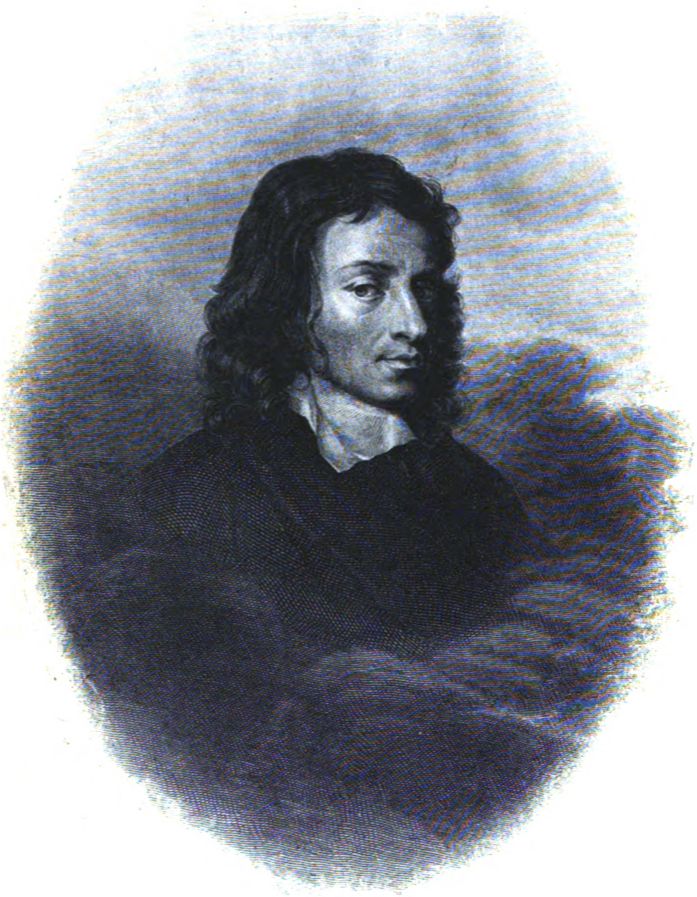
JOHN MILTON. Photogravure from an etching.
This picture of Milton, representing the great poet in the prime of his intellect, is one of the finest of him extant. Traces are still visible of that earlier beauty which at Oxford had caused him to be nicknamed the "Maiden," but the impress of serious thought has given to his face a dignity which is greater than the mere physical charm of youth. The contour of the head is noble, and the expressive, finely shaped eyes show poetic sensibility and imagination. His flowing chestnut curls are the only reminder of the gay cavalier period in which he lived, for his dress, in conformity with his sympathies, is strictly Puritan.
I have before me the formidable volume in which, some time after Milton's death, his prose works were collected.[127] What a book! The chairs creak when you place it upon them, and a man who had turned its leaves over for an hour, would have less pain in his head than in his arm. As the book, so were the men; from the mere outsides we might gather some notion of the controversialists and theologians whose doctrines they contain. Yet we must conclude that the author was eminently learned, elegant, travelled, philosophic, and a man of the world for his age. We think involuntarily of the portraits of the theologians of those days, severe faces engraved on metal by the hard artist's tool, whose square brows and steady eyes stand out in startling prominence against a dark, oak panel. We compare them to modern countenances, in which the delicate and complex features seem to quiver at the varied contact of hardly begun sensations and innumerable ideas. We try to imagine the heavy classical education, the physical exercises, the rude treatment, the rare ideas, the imposed dogmas, which formerly occupied, oppressed, fortified, and hardened the young; and we might fancy ourselves looking at an anatomy of megatheria and mastodons, reconstructed by Cuvier.
The race of living men is changed. Our mind fails us nowadays at the idea of this greatness and this barbarism; but we discover that the barbarism was then the cause of the greatness. As in other times we might have seen, in the primitive slime and among the colossal ferns, ponderous monsters slowly wind their scaly backs, and tear the flesh from one another's sides with their misshapen talons; so now, at a distance, from the height of our calm civilization, we see the battles of the theologians, who, armed with syllogisms, bristling with text, covered one another with filth, and labored to devour each others.
Milton fought in the front rank, preordained to barbarism and greatness by his individual nature and the manners of the time, capable of displaying in high prominence the logic, style, and spirit of his age. It is drawing-room life which trims men into shape: the society of ladies, the lack of serious interests, idleness, vanity, security, are needed to bring men to elegance, urbanity, fine and light humor, to teach the desire to please, the fear to become wearisome, a perfect clearness, a finished precision, the art of gradual transitions and delicate tact, a taste for suitable images, continual ease, and choice diversity. Seek nothing like this in Milton. The old scholastic system was not far off; it still weighed on those who were destroying it. Under this secular armor discussion proceeded pedantically, with measured steps. The first thing was to propound a thesis; and Milton writes, in large characters, at the head of his "Treatise on Divorce, that indisposition, unfitness, or contrariety of mind, arising from a cause in nature unchangeable, hindering, and ever likely to hinder the main benefits of conjugal society, which are solace and peace, is a greater reason of divorce than natural frigidity, especially if there be no children, and that there be mutual consent." And then follow, legion after legion, the disciplined army of the arguments. Battalion after battalion they pass by, numbered very distinctly. There is a dozen of them together, each with its title in clear characters, and the little brigade of subdivisions which it commands. Sacred texts hold the post of honor. Every word of them is discussed, the substantive after the adjective, the verb after the substantive, the preposition after the verb; interpretations, authorities, illustrations, are summoned up, and ranged between palisades of new divisions. And yet there is a lack of order, the question is not reduced to a single idea; we cannot see our way; proofs succeed proofs without logical sequence; we are rather tired out than convinced. We remember that the author speaks to Oxford men, lay or cleric, trained in pretended discussions, capable of obstinate attention, accustomed to digest indigestible books. They are at home in this thorny thicket of scholastic brambles; they beat a path through, somewhat at hazard, hardened against the hurts which repulse us, and not having the smallest idea of the daylight which we require everywhere now.
With such ponderous reasoners, you must not look for wit. Wit is the nimbleness of victorious reason; here, because everything it powerful, all is heavy. When Milton wishes to joke, he looks like one of Cromwell's pikemen, who, entering a room to dance, should fall upon the floor, and that with the extra weight of his armor. Few things could be more stupid than his "Animadversions upon the Remonstrants' Defence." At the end of an argument his adversary concludes with this specimen of theological wit: "In the meanwhile see, brethren, how you have with Simon fished all night, and caught nothing." And Milton boastfully replies: "If, we, fishing with Simon the apostle, can catch nothing; see what you can catch with Simon Magus; for all his hooks and fishing implements he bequeathed among you." Here a great savage laugh would break out. The spectators saw a charm in this way of insinuating that his adversary was simoniacal. A little before, the latter says: "Tell me, is this liturgy good or evil?" Answer: "It is evil: repair the acheloian horn of your dilemma, how you can, against the next push." The doctors wondered at the fine mythological simile and rejoiced to see the adversary so neatly compared to an ox, a beaten ox, a pagan ox. On the next page the Remonstrant said, by way of a spiritual and mocking reproach: "Truly, brethren, you have not well taken the height of the pole." Answer: "No marvel; there be many more that do not take well the height of your pole, but will take better the declination of your altitude." Three quips of the same savor follow one upon the other; all this looked pretty. Elsewhere, Salmasius exclaiming "that the sun itself never beheld a more outrageous action" than the murder of the king, Milton cleverly answers, "The sun has beheld many things that blind Bernard never saw. But we are content you should mention the sun over and over. And it will be a piece of prudence in you so to do. For though our wickedness does not require it, the coldness of the defence that you are making does."[128] The marvellous heaviness of these conceits betrays minds yet entangled in the swaddling-clothes of learning. The Reformation was the inauguration of free thought, but only the inauguration. Criticism was yet unborn; authority still presses with a full half of its weight upon the freest and boldest minds. Milton, to prove that it was lawful to put a king to death, quotes Orestes, the laws of Publicola, and the death of Nero. His "History of Britain" is a farrago of all the traditions and fables. Under every circumstance he adduces a text of Scripture for proof; his boldness consists in showing himself a bold grammarian, a valorous commentator. He is blindly Protestant as others were blindly Catholic. He leaves in its bondage the higher reason, the mother of principles; he has but emancipated a subordinate reason, an interpreter of texts. Like the vast half shapeless creatures, the birth of early times, he is yet but half man and half mud.
Can we expect urbanity here? Urbanity is the elegant dignity which answers insult by calm irony, and respects man whilst piercing a dogma. Milton coarsely knocks his adversary down. A bristling pedant, born from a Greek lexicon and a Syriac grammar, Salmasius had disgorged upon the English people a vocabulary of insults and a folio of quotations. Milton replies to him in the same style; calling him a buffoon, a mountebank "professor triobolaris," a hired pedant, a nobody, a rogue, a heartless being, a wretch, an idiot, sacrilegious, a slave worthy of rods and a pitchfork. A dictionary of big Latin words passed between them. "You, who know so many tongues, who read so many books, who write so much about them, you are yet but an ass." Finding the epithet good, he repeats and sanctifies it. "Oh, most drivelling of asses, you come ridden by a woman, with the cured heads of bishops whom you had wounded, a little image of the great beast of the Apocalypse!" He ends by calling him savage beast, apostate, and devil. "Doubt not that you are reserved for the same end as Judas, and that, driven by despair rather than repentance, self-disgusted, you must one day hang yourself, and like your rival, burst asunder in your belly."[129] We fancy we are listening to the bellowing of two bulls.
They had all a bull's ferocity. Milton was a good hater. He fought with his pen, as the Ironsides with the sword, inch by inch, with a concentrated rancor and a fierce obstinacy. The bishops and the king then suffered for eleven years of despotism. Each man recalled the banishments, confiscations, punishments, the law violated systematically and relentlessly, the liberty of the subject attacked by a well-laid plot, Episcopal idolatry imposed on Christian consciences, the faithful preachers driven into the wilds of America, or given up to the executioner and the stocks.[130] Such reminiscences arising in powerful minds, stamped them with inexpiable hatred, and the writings of Milton bear witness to a rancor which is now unknown. The impression left by his "Eikonoklastes"[131] is oppressive. Phrase by phrase, harshly, bitterly, the king is refuted and accused to the last, without a minute's respite of accusation, the accused being credited with not the slightest good intention, the slightest excuse, the least show of justice, the accuser never for an instant digressing to or resting upon a general idea. It is a hand-to-hand fight, where every word takes effect, prolonged, obstinate, without dash and without weakness, full of a harsh and fixed hostility, where the only thought is how to wound most severely and to kill surely. Against the bishops, who were alive and powerful, his hatred flowed more violently still, and the fierceness of his envenomed metaphors hardly suffices to express it. Milton points to them "basking in the sunny warmth of wealth and promotion," like a brood of foul reptiles. "The sour leaven of human traditions, mixed in one putrified mass with the poisonous dregs of hypocrisie in the hearts of Prelates,... is the serpent's egg that will hatch an Anti-christ wheresoever, and ingender the same monster as big or little as the lump is which breeds him."[132]
So much coarseness and dulness was an outer breastplate, the mark and the protection of the superabundant force and life which coursed in those athletic limbs and chests. Nowadays, the mind, being more refined, has become feebler; convictions, being less stern, have become less strong. Attention, freed from the heavy scholastic logic and scriptural tyranny, has become more inert. Belief and the will, dissolved by universal tolerance and by the thousand opposing shocks of multiplied ideas, have engendered an exact and refined style, an instrument of conversation and pleasure, and have expelled the poetic and rude style, a weapon of war and enthusiasm. If we have effaced ferocity and dulness, we have diminished force and greatness.
Force and greatness are manifested in Milton, displayed in his opinions and his style, the sources of his belief and his talent. This proud reason aspired to unfold itself without shackles; it demanded that reason might unfold itself without shackles. It claimed for humanity what is coveted for itself, and championed every liberty in his every word. From the first he attacked the corpulent bishops, scholastic upstarts, persecutors of free discussion, pensioned tyrants of Christian conscience.[133] Above the clamor of the Protestant Revolution, his voice was heard thundering against tradition and obedience. He sourly railed at the pedantic theologians, devoted worshippers of old texts, who mistook a mouldy martyrology for a solid argument, and answered a demonstration with a quotation. He declared that most of the fathers were turbulent and babbling intriguers, that they were not worth more collectively than individually, that their councils were but a pack of underhand intrigues and vain disputes; he rejected their authority and their example, and set up logic as the only interpreter of Scripture.[134] A Puritan as against bishops, an Independent as against Presbyterians, he was always master of his thought and the inventor of his own faith. No one better loved, practised, and praised the free and bold use of reason. He exercised it even rashly and scandalously. He revolted against custom, the illegitimate queen of human belief, the born and relentless enemy of truth, raised his hand against marriage, and demanded divorce in the case of incompatibility of temper. He declared that "error supports custom, custom countenances error; and these two between them,... with the numerous and vulgar train of their followers,... envy and cry down the industry of free reasoning, under the terms of humour and innovation."[135] He showed that truth "never comes into the world, but like a bastard, to the ignominy of him that brought her forth; till Time, the mid-wife rather than the mother of truth, have washed and salted the infant, declared her legitimate."[136] He stood out in three or four writings against the flood of insults and anathemas, and dared even more; he attacked the censorship before Parliament, though its own work; he spoke as a man who is wounded and oppressed, for whom a public prohibition is a personal outrage, who is himself fettered by the fetters of the nation. He does not want the pen of a paid "licenser" to insult by its approval the first page of his book. He hates this ignorant and imperious hand, and claims liberty of writing on the same grounds as he claims liberty of thought:
"What advantage is it to be a man, over it is to be a boy at school, if we have only escaped the ferula, to come under the fescue of an imprimatur? If serious and elaborate writings, as if they were no more than the theme of a grammar-lad under his pedagogue, must not be uttered without the cursory eyes of a temporizing and extemporizing licenser? He who is not trusted with his own actions, his drift not being known to be evil, and standing to the hazard of law and penalty, has no great argument to think himself reputed in the commonwealth wherein he was born for other than a fool or a foreigner. When a man writes to the world, he summons up all his reason and deliberation to assist him; he searches, meditates, is industrious, and likely consults and confers with his judicious friends; after all which done, he takes himself to be informed in what he writes, as well as any that wrote before him; if in this, the most consummate act of his fidelity and ripeness, no years, no industry, no former proof of his abilities, can bring him to that state of maturity, as not to be still mistrusted and suspected, unless he carry all his considerate diligence, all his midnight watchings, and expense of Palladian oil, to the hasty view of an unleisured licenser, perhaps much his younger, perhaps far his inferior in judgment, perhaps one who never knew the labour of book writing; and if he be not repulsed, or slighted, must appear in print like a puny with his guardian, and his censor's hand on the back of his title to be his bail and surety, that he is no idiot or seducer; it cannot be but a dishonour and derogation to the author, to the book, to the privilege and dignity of learning."[137]
Throw open, then, all the doors; let there be light; let every man think, and bring his thoughts to the light. Dread not any diversities of opinion, rejoice in this great work; why insult the laborers by the name of schismatics and sectaries?
"Yet these are the men cried out against for schismatics and sectaries, as if, while the temple of the Lord was building, some cutting, some squaring the marble, others hewing the cedars, there should be a sort of irrational men, who could not consider there must be many schisms and many dissections made in the quarry and in the timber ere the house of God can be built. And when every stone is laid artfully together, it cannot be united into a continuity, it cannot but be contiguous in this world: neither can every piece of the building be of one form; nay, rather the perfection consists in this, that out of many moderate varieties and brotherly dissimilitudes that are not vastly disproportional, arises the goodly and the graceful symmetry that commends the whole pile and structure."[138]
Milton triumphs here through sympathy; he breaks forth into magnificent images, he displays in his style the force which he perceives around him and in himself. He lauds the revolution, and his praises seem like the blast of a trumpet, to come from a brazen throat:
"Behold now this vast city, a city of refuge, the mansion-house of liberty, encompassed and surrounded with his protection; the shop of war has not there more anvils and hammers working, to fashion out the plates and instruments of armed justice in defence of beleagured truth, than there be pens and heads there, sitting by their studious lamps, musing, searching, revolving new notions and ideas wherewith to present, as with their homage and their feality, the approaching reformation.... What could a man require more from a nation so pliant, and so prone to seek after knowledge? What wants there to such a towardly and pregnant soil, but wise and faithful labourers, to make a knowing people, a nation of prophets, of sages, and of worthies?[139]... Methinks I see in my mind a noble and puissant nation rousing herself like a strong man after sleep, and shaking her invincible locks: methinks I see her as an eagle mewing her mighty youth, and kindling her undazzled eyes at the full midday beam; purging and unsealing her long-abused sight at the fountain itself of heavenly radiance; while the whole noise of timorous and flocking birds, with those also that love the twilight, flutter about, amazed at what she means, and in their envious gabble would prognosticate a year of sects and schisms."[140]
It is Milton who speaks, and it is Milton whom he unwittingly describes.
With a sincere writer, doctrines foretell the style. The sentiments and needs which form and govern his beliefs, construct and color his phrases. The same genius leaves once and again the same impress, in the thought and in the form. The power of logic and enthusiasm which explains the opinions of Milton, explains his genius. The sectary and the writer are one man, and we shall find the faculties of the sectary in the talent of the writer.
When an idea is planted in a logical mind, it grows and fructifies there in a multitude of accessory and explanatory ideas which surround it, entangled among themselves, and form a thicket and a forest. The sentences in Milton are immense; page-long periods are necessary to enclose the train of so many linked arguments, and so many metaphors accumulated around the governing thought. In this great travail, heart and imagination are shaken; Milton exults while he reasons, and the words come as from a catapult, doubling the force of their flight by their heavy weight. I dare not place before a modern reader the gigantic periods which commence the treatise "Of Reformation in England." We no longer possess the power of breath; we only understand little short phrases; we cannot fix our attention on the same point for a page at a time. We require manageable ideas; we have given up the big two-handed sword of our fathers, and we only carry a light foil. I doubt, however, if the piercing phraseology of Voltaire be more mortal than the cleaving of this iron mace:
"If in less noble and almost mechanick arts he is not esteemed to deserve the name of a compleat architect, an excellent painter, or the like, that bears not a generous mind above the peasantly regard of wages and hire; much more must we think him a most imperfect and incompleat Divine, who is so far from being a contemner of filthy lucre; that his whole divinity is moulded and bred up in the beggarly and brutish hopes of a fat prebendary, deanery, or bishoprick."[141]
If Michael Angelo's prophets could speak, it would be in this style; and twenty times while reading it, we may discern the sculptor.
The powerful logic which lengthens the periods sustains the images. If Shakespeare and the nervous poets embrace a picture in the compass of a fleeting expression, break upon their metaphors with new ones, and exhibit successively in the same phrase the same idea in five or six different forms, the abrupt motion of their winged imagination authorizes or explains these varied colors and these mingling flashes. More connected and more master of himself, Milton develops to the end the threads which these poets break. All his images display themselves in little poems, a sort of solid allegory, of which all the interdependent parts concentrate their light on the single idea which they are intended to embellish or demonstrate:
"In this manner the prelates,... coming from a mean and plebeian life on a sudden to be lords of stately palaces, rich furniture, delicious fare, and princely attendance, thought the plain and homespun verity of Christ's gospel unfit any longer to hold their lordships' acquaintance, unless the poor threadbare matron were put into better clothes: her chaste and modest veil surrounded with celestial beams, they overlaid with wanton tresses, and in a flaring tire bespeckled her with all the gaudy allurements of a whore."[142]
Politicians reply that this gaudy church supports royalty.
"What greater debasement can there be to royal dignity, whose towering and steadfast height rests upon the unmovable foundations of justice, and heroic virtue, than to chain it in a dependence of subsisting, or ruining, to the painted battlements and gaudy rottenness of prelatry, which want but one puff of the king's to blow them down like a pasteboard house built of court-cards?"[143]
Metaphors thus sustained receive a singular breadth, pomp, and majesty. They are spread forth without clashing together, like the wide folds of a scarlet cloak, bathed in light and fringed with gold.
Do not take these metaphors for an accident. Milton lavishes them, like a priest who in his worship exhibits splendors and wins the eye, to gain the heart. He has been nourished by the reading of Spenser, Drayton, Shakespeare, Beaumont, all the most sparkling poets and the golden flow of the preceding age, though impoverished all around him and slackened within himself, has become enlarged like a lake through being dammed up in his heart. Like Shakespeare, he imagines at every turn, and even out of turn, and scandalizes the classical and French taste.
"... As if they could make God earthly and fleshly, because they could not make themselves heavenly and spiritual; they began to draw down all the divine intercourse betwixt God and the soul, yea, the very shape of God himself, into an exterior and bodily form;.... they hallowed it, they fumed up, they sprinkled it, they bedecked it, not in robes of pure innocency, but of pure linen, with other deformed and fantastic dresses, in palls and mitres, and gewgaws fetched from Aaron's old wardrobe, or the flaming vestry: then was the priest set to con his motions and his postures, his liturgies and his lurries, till the soul by this means, of overbodying herself, given up justly to fleshly delights, bated her wing apace downward; and finding the ease she had from her visible and sensuous colleague the body, in performance of religious duties, her pinions now broken, and flagging, shifted off from herself the labour of high soaring any more, forgot her heavenly flight, and left the dull and droiling carcase to plod on in the old road, and drudging trade of outward conformity."[144]
If we did not discern here the traces of theological coarseness, we might fancy we were reading an imitator of the "Phædo" and under the fanatical anger recognize the images of Plato. There is one phrase which for manly beauty and enthusiasm recalls the tone of the "Republic": "I cannot praise a fugitive and cloistered virtue unexercised and unbreathed, that never sallies out and sees her adversary, but slinks out of the race where that immortal garland is to be run for, not without dust and heat."[145] But Milton is only Platonic by his richness and exaltation. For the rest, he is a man of the Renaissance, pedantic and harsh; he insults the Pope, who, after the gift of Pepin le Bref, "never ceased baiting and goring the successors of his best Lord Constantine, what by his barking curses and excommunications";[146] he is mythological in his defence of the press, showing that formerly "no envious Juno sat cross-legged over the nativity of any man's intellectual offspring."[147] It matters little: these learned, familiar, grand images, whatever they be, are powerful and natural. Superabundance, like crudity, here only manifests the vigor and lyric dash which Milton's character had foretold.
Passion follows naturally; exaltation brings it with the images. Bold expressions, exaggeration of style, cause us to hear the vibrating voice of the suffering man, indignant and determined.
"For books are not absolutely dead things, but do contain a potency of life in them to be as active as that soul was whose progeny they are; nay, they do preserve as in a vial the purest efficacy and extraction of that living intellect that bred them. I know they are as lively, and as vigorously productive, as those fabulous dragon's teeth: and being sown up and down, may chance to spring up armed men. And yet, on the other hand, unless wariness be used, as good almost kill a man as kill a good book; who kills a man kills a reasonable creature, God's image; but he who destroys a good book, kills reason itself, kills the image of God, as it were, in the eye. Many a man lives a burden to the earth; but a good book is the precious life-blood of a master-spirit, embalmed and treasured up on purpose to a life beyond life. It is true, no age can restore a life, whereof, perhaps, there is no great loss; and revolutions of ages do not oft recover the loss of a rejected truth, for the want of which whole nations fare the worse. We should be wary, therefore, what persecution we raise against the living labours of public men, how we spill that seasoned life of man, preserved and stored up in books; since we see a kind of homicide may be thus committed, sometimes a martyrdom; and if it extend to the whole impression, a kind of massacre, whereof the execution ends not in the slaying of an elemental life, but strikes at the ethereal and fifth essence, the breath of reason itself; slays an immortality rather than a life."[148]
This energy is sublime; the man is equal to the cause, and never did a loftier eloquence match a loftier truth. Terrible expressions overwhelm the book-tyrants, the profaners of thought, the assassins of liberty. "The council of Trent and the Spanish inquisition, engendering together, brought forth or perfected those catalogues and expurging indexes, that rake through the entrails of many an old good author, with a violation worse than any that could be offered to his tomb."[149] Similar expressions lash the carnal minds which believe without thinking, and make their servility into a religion. There is a passage which, by its bitter familiarity recalls Swift, and surpasses him in all loftiness of imagination and genius:
"A man may be an heretic in the truth, and if he believes things only because his pastor says so,... the very truth he holds becomes his heresy.... A wealthy man, addicted to his pleasure and to his profits, finds religion to be a traffic so entangled, and of so many piddling accounts, that of all mysteries he cannot skill to keep a stock going upon that trade.... What does he therefore, but resolves to give over toiling, and to find himself out some factor, to whose care and credit he may commit the whole managing of his religious affairs; some divine of note and estimation that must be. To him he adheres, resigns the whole warehouse of his religion, with all the locks and keys, into his custody; and indeed makes the very person of that man his religion.... So that a man may say his religion is now no more within himself, but is become a dividual movable, and goes and comes near him, according as that good man frequents the house. He entertains him, gives him gifts, feasts him, lodges him; his religion comes home at night, prays, is liberally supped, and sumptuously laid to sleep; rises, is saluted, and after the malmsey, or some well-spiced bruage,... his religion walks abroad at eight, and leaves his kind entertainer in the shop trading all day without his religion."[150]
He condescended to mock for an instant, with what piercing irony we have seen. But irony, piercing as it may be, seems to him weak.[151] Hear him when he comes to himself, when he returns to open and serious invective, when after the carnal believer he overwhelms the carnal prelate:
"The table of communion, now become a table of separation, stands like an exalted platform upon the brow of the quire, fortified with bulwark and barricado, to keep off the profane touch of the laics, whilst the obscene and surfeited priest scruples not to paw and mammoc the sacramental bread, as familiarly as his tavern biscuit."[152]
He triumphs in believing that all these profanations are to be avenged. The horrible doctrine of Calvin has once more fixed men's gaze on the dogma of reprobation and everlasting damnation. Hell in hand, Milton menaces; he is drunk with justice and vengeance amid the abysses which he opens, and the brands which he wields:
"They shall be thrown downe eternally into the darkest and deepest Gulfe of Hell, where, under the despightfull controule, the trample and spurne of all the other Damned, that in the anguish of their Torture shall have no other ease than to exercise a Raving and Bestiall Tyranny over them as their Slaves and Negro's, they shall remaine in that plight for ever, the basest, the lowermost, the most dejected, most underfoot, and downetrodden Vassals of Perdition."[153]
Fury here mounts to the sublime, and Michael Angelo's Christ is not more inexorable and vengeful.
Let us fill the measure; let us add, as he does, the prospects of heaven to the visions of darkness; the pamphlet becomes a hymn:
"When I recall to mind at last, after so many dark ages, wherein the huge overshadowing train of error had almost swept all the stars out of the firmament of the church; how the bright and blissful Reformation (by divine power) struck through the black and settled night of ignorance and anti-christian tyranny, methinks a sovereign and reviving joy must needs rush into the bosom of him that reads or hears; and the sweet odour of the returning gospel imbathe his soul with the fragrancy of heaven."[154]
Overloaded with ornaments, infinitely prolonged, these periods are triumphant choruses of angelic alleluias sung by deep voices to the accompaniment of ten thousand harps of gold. In the midst of his syllogisms, Milton prays, sustained by the accent of the prophets, surrounded by memories of the Bible, ravished with the splendors of the Apocalypse, but checked on the brink of hallucination by science and logic, on the summit of the calm clear atmosphere, without rising to the burning tracts where ecstasy dissolves reason, with a majesty of eloquence and a solemn grandeur never surpassed, whose perfection proves that he has entered his domain, and gives promise of the poet beyond the prose-writer:
"Thou, therefore, that sittest in light and glory unapproachable, parent of angels and men! next, thee I implore, omnipotent King, Redeemer of that lost remnant whose nature thou didst assume, ineffable and everlasting Love! and thou, the third subsistence of divine infinitude, illumining Spirit, the joy and solace of created things! one Tri-personal Godhead! look upon this thy poor and almost spent and expiring church.... O let them not bring about their damned designs,... to reinvolve us in that pitchy cloud of infernal darkness, where we shall never more see the sun of thy truth again, never hope for the cheerful dawn, never more hear the bird of morning sing."[155]
"O Thou the ever-begotten Light and perfect Image of the Father. ... Who is there that cannot trace thee now in thy beamy walk through the midst of thy sanctuary, amidst those golden candlesticks, which have long suffered a dimness amongst us through the violence of those that had seized them, and were more taken with the mention of their gold than of their starry light?... Come therefore, O thou that hast the seven stars in thy right hand, appoint thy chosen priests according to their orders and courses of old, to minister before thee, and duly to press and pour out the consecrated oil into thy holy and ever-burning lamps. Thou hast sent out the spirit of prayer upon thy servants over all the land to this effect, and stirred up their vows as the sound of many waters about thy throne.... O perfect and accomplish thy glorious acts!... Come forth out of thy royal chambers, O Prince of all kings of the earth! put on the visible robes of thy imperial majesty, take up that unlimited sceptre which thy Almighty Father hath bequeathed thee; for now the voice of thy bride calls thee, and all creatures sigh to be renewed."[156]
This song of supplication and joy is an outpouring of splendors; and if we search all literature, we will hardly find a poet equal to this writer of prose.
Is he truly a prose-writer? Entangled dialectics, a heavy and awkward mind, fanatical and ferocious rusticity, an epic grandeur of sustained and superabundant images, the blast and the recklessness of implacable and all-powerful passion, the sublimity of religious and lyric exaltation; we do not recognize in these features a man born to explain, persuade, and prove. The scholasticism and coarseness of the time have blunted or rusted his logic. Imagination and enthusiasm carried him away and enchained him in metaphor. Thus dazzled or marred, he could not produce a perfect work; he did but write useful tracts, called forth by practical interests and actual hate, and fine isolated morsels, inspired by collision with a grand idea, and by the sudden burst of genius. Yet, in all these abandoned fragments, the man shows in his entirety. The systematic and lyric spirit is manifested in the pamphlet as well as in the poem; the faculty of embracing general effects, and of being shaken by them, remains the same in Milton's two careers, and we will see in the "Paradise" and "Cornus" what we have met with in the treatise "Of Reformation," and in the "Animadversions on the Remonstrant."
Section VI.—Milton as a Poet
"Milton has acknowledged to me," writes Dryden, "that Spenser was his original." In fact, by the purity and elevation of their morals, by the fulness and connection of their style, by the noble chivalric sentiments, and their fine classical arrangement, they are brothers. But Milton had yet other masters—Beaumont, Fletcher, Burton, Drummond, Ben Jonson, Shakespeare, the whole splendid English Renaissance, and behind it the Italian poesy, Latin antiquity, the fine Greek literature, and all the sources whence the English Renaissance sprang. He continued the great current, but in a manner of his own. He took their mythology, their allegories, sometimes their conceits,[157] and discovered anew their rich coloring, their magnificent sentiment of living nature, their inexhaustible admiration of forms and colors. But, at the same time, he transformed their diction, and employed poetry in a new service. He wrote, not by impulse, and at the mere contact with things, but like a man of letters, a classic, in a scholarlike manner, with the assistance of books, seeing objects as much through previous writings as in themselves, adding to his images the images of others, borrowing and recasting their inventions, as an artist who unites and multiplies the bosses and driven gold, already entwined on a diadem by twenty workmen. He made thus for himself a composite and brilliant style, less natural than that of his precursors, less fit for effusions, less akin to the lively first glow of sensation, but more solid, more regular, more capable of concentrating in one large patch of light all their sparkle and splendor. He brings together like Æschylus, words of "six cubits," plumed and decked in purple, and makes them pass like a royal train before his idea to exalt and announce it. He introduces to us
"The breathing roses of the wood, Fair silver-buskin'd nymphs;"[158]
And tells how
"The gray-hooded Even, Like a sad votarist in palmer's weed. Rose from the hindmost wheels of Phoebus' wain;"[159]
And speaks of
"All the sea-girt isles, That, like to rich and various gems, inlay The unadorned bosom of the deep;"[160]
And
"That undisturbed song of pure concent, Aye sung before the sapphire-colour'd throne, To Him that sits thereon, With saintly shout, and solemn jubilee; Where the bright Seraphim, in burning row, Their loud-uplifted angel-trumpets blow."[161]
He gathered into full nosegays the flowers scattered through the other poets:
"Ye valleys low, where the mild whispers use Of shades, and wanton winds, and gushing brooks, On whose fresh lap the swart-star sparely looks; Throw hither all your quaint enamell'd eyes, That on the green turf suck the honied showers, And purple all the ground with vernal flowers. Bring the rathe primrose that forsaken dies, The tufted crow-toe, and pale jessamine, The white pink, and the pansy freak'd with jet, The glowing violet, The musk-rose, and the well-attired woodbine, With cowslips wan that hang the pensive head, And every flower that sad embroidery wears; Bid amaranthus all his beauty shed, And daffadillies fill their cups with tears, To strew the laureat herse where Lycid lies."[162]
When still quite young, on his quitting Cambridge, he inclined to the magnificent and grand; he wanted a great flowing verse, an ample and sounding strophe, vast periods of fourteen and four-and-twenty lines. He did not face objects on a level, as a mortal, but from on high, like those archangels of Goethe,[163] who embrace at a glance the whole ocean lashing its coasts and the earth rolling on, wrapped in the harmony of the fraternal stars. It was not life that he felt, like the masters of the Renaissance, but grandeur, like Æschylus, and the Hebrew seers,[164] manly and lyric spirits like his own, who, nourished like him in religious emotions and continuous enthusiasm, like him displayed sacerdotal pomp and majesty. To express such a sentiment, images, and poetry addressed only to the eyes, were not enough; sounds also were requisite, and that more introspective poetry which, purged from corporeal shows, could reach the soul. Milton was a musician; his hymns rolled with the slowness of a measured song and the gravity of a declamation; and he seems himself to be describing his art in these incomparable verses, which are evolved like the solemn harmony of an anthem:
"But else, in deep of night, when drowsiness Hath lock'd up mortal sense, then listen I To the celestial sirens' harmony, That sit upon the nine infolded spheres, And sing to those that hold the vital shears, And turn the adamantine spindle round, On which the fate of Gods and men is wound. Such sweet compulsion doth in musick lie, To lull the daughters of Necessity, And keep unsteady Nature to her law, And the low world in measured motion draw After the heavenly tune, which none can hear Of human mould, with gross unpurged ear."[165]
With his style, his subjects differed; he compacted and ennobled the poet's domain as well as his language, and consecrated his thoughts as well as his words. He who knows the true nature of poetry soon finds, as Milton said a little later, what despicable creatures "libidinous and ignorant poetasters" are, and to what religious, glorious, splendid use poetry can be put in things divine and human. "These abilities, wheresoever they be found, are the inspired gift of God, rarely bestowed, but yet to some (though most abuse) in every nation; and are of power, beside the office of a pulpit, to imbreed and cherish in a great people the seeds of virtue and public civility, to allay the perturbations of the mind, and set the affections in right tune; to celebrate in glorious and lofty hymns the throne and equipage of God's almightiness, and what he works, and what he suffers to be wrought with high providence in his church; to sing the victorious agonies of martyrs and saints, the deeds and triumphs of just and pious nations, doing valiantly through faith against the enemies of Christ."[166]
In fact, from the first, at St. Paul's School and at Cambridge, he had written paraphrases of the Psalms, then composed odes on the Nativity, Circumcision, and the Passion. Presently appeared sad poems on the "Death of a Fair Infant, An Epitaph on the Marchioness of Winchester"; then grave and noble verses "On Time, At a solemn Musick"; a sonnet "On his being arrived to the Age of Twenty-three, his late spring which no bud or blossom shew'th." At last we have him in the country with his father, and the hopes, dreams, first enchantments of youth, rise from his heart like the morning breath of a summer's day. But what a distance between these calm and bright contemplations and the warm youth, the voluptuous "Adonis" of Shakespeare! He walked, used his eyes, listened; there his joys ended; they are but the poetic joys of the soul:
"To hear the lark begin his flight, And singing, startle the dull night, From his watch-tower in the skies, Till the dapple dawn doth rise;... While the plowman, near at hand, Whistles o'er the furrow'd land, And the milk-maid singeth blithe, And the mower whets his sithe, And every shepherd tells his tale Under the hawthorn in the dale."[167]
To see the village dances and gayety; to look upon the "high triumphs" and the "busy hum of men" in the "tower'd cities" above all, to abandon himself to melody, to the divine roll of sweet verse, and the charming dreams which they spread before us in a golden light; this is all; and presently, as if he had gone too far, to counterbalance this eulogy of visible joys, he summons Melancholy:
"Come, pensive Nun, devout and pure, Sober, stedfast, and demure, All in a robe of darkest grain, Flowing with majestick train, And sable stole of Cypress lawn Over thy decent shoulders drawn. Come, but keep thy wonted state, With even step, and musing gait; And looks commercing with the skies, Thy rapt soul sitting in thine eyes."[168]
With her he wanders amidst grave thoughts and grave sights, which recall a man to his condition, and prepare him for his duties, now amongst the lofty colonnades of primeval trees, whose "high-embowed roof" retains the silence and the twilight under their shade; now in
"The studious cloysters pale,... With antick pillars massy proof, And storied windows richly dight, Casting a dim religious light;"[169]
Now again in the retirement of the study, where the cricket chirps, where the lamp of labor shines, where the mind, alone with the noble minds of the past, may
"Unsphere The spirit of Plato, to unfold What worlds or what vast regions hold The immortal mind, that hath forsook Her mansion in this fleshly nook."[170]
He was filled with this lofty philosophy. Whatever the language he used, English, Italian, or Latin, whatever the kind of verse, sonnets, hymns, stanzas, tragedy or epic, he always returned to it. He praised everywhere chaste love, piety, generosity, heroic force. It was not from scruple, but it was innate in him; his chief need and faculty led him to noble conceptions. He took a delight in admiring, as Shakespeare in creating, as Swift in destroying, as Byron in combating, as Spenser in dreaming. Even on ornamental poems, which were only employed to exhibit costumes and introduce fairy-tales, in Masques, like those of Ben Jonson, he impressed his own character. They were amusements for the castle; he made out of them lectures on magnanimity and constancy: one of them, "Cornus," well worked out, with a complete originality and extraordinary elevation of style, is perhaps his masterpiece, and is simply the eulogy of virtue.
Here at the beginning we are in the heavens. A spirit, descended in the midst of wild woods, repeats this ode:
"Before the starry threshold of Jove's court My mansion is, where those immortal shapes Of bright aerial spirits live insphered In regions mild of calm and serene air, Above the smoke and stir of this dim spot, Which men call earth; and, with low-thoughted care Confined, and pester'd in this pinfold here, Strive to keep up a frail and feverish being, Unmindful of the crown that Virtue gives, After this mortal change, to her true servants, Amongst the enthron'd Gods on sainted seats."[171]
Such characters cannot speak: they sing. The drama is an antique opera, composed like the "Prometheus," of solemn hymns. The spectator is transported beyond the real world. He does not listen to men, but to sentiments. He hears a concert, as in Shakespeare; the "Cornus" continues the "Midsummer Night's Dream," as a choir of deep men's voices continues the glowing and sad symphony of the instruments:
"Through the perplex'd paths of this drear wood, The nodding horror of whose shady brows Threats the forlorn and wandering passenger,"[172]
strays a noble lady, separated from her two brothers, troubled by the "sound of riot and ill-managed merriment" which she hears from afar. The son of Circe the enchantress, sensual Cornus enters with a charming rod in one hand, his glass in the other, amid the clamor of men and women, with torches in their hands, "headed like sundry sorts of wild beasts"; it is the hour when
"The sounds and seas, with all their finny drove, Now to the moon in wavering morrice move; And, on the tawny sands and shelves Trip the pert faeries and the dapper elves."[173]
The lady is terrified, and sinks on her knees; and in the misty forms which float above in the pale light, perceives the mysterious and heavenly guardians who watch over her life and honor:
"O, welcome, pure-eyed Faith; white-handed Hope, Thou hovering angel, girt with golden wings; And thou, unblemish'd form of Chastity, I see ye visibly, and now believe That He, the Supreme good, t' whom all things ill Are but as slavish officers of vengeance, Would send a glistering guardian, if need were, To keep my life and honour unassail'd. Was I deceived, or did a sable cloud Turn forth her silver lining on the night? I did not err; there does a sable cloud Turn forth her silver lining on the night, And casts a gleam over this tufted grove."[174]
She calls her brothers in "a soft and solemn-breathing sound," which "rose like a stream of rich distill'd perfumes, and stole upon the air,"[175] across the "violet-embroider'd vale," to the dissolute god whom she enchants. He comes disguised as a "gentle shepherd," and says:
"Can any mortal mixture of earth's mould Breathe such divine, enchanting ravishment? Sure something holy lodges in that breast, And with these raptures moves the vocal air To testify his hidden residence. How sweetly did they float upon the wings Of silence, through the empty-vaulted night, At every fall smoothing the raven down Of darkness, till it smiled! I have oft heard My mother Circe with the syrens three, Amidst the flowery-kirtled Naiades, Culling their potent herbs and baleful drugs; Who, as they sung, would take the prison'd soul, And lap it in Elysium: Scylla wept, And chid her barking waves into attention.... But such a sacred and home-felt delight, Such sober certainty of waking bliss, I never heard till now."[176]
They were heavenly songs which Cornus heard; Milton describes, and at the same time imitates them; he makes us understand the saying of his master Plato, that virtuous melodies teach virtue.
Circe's son has by deceit carried off the noble lady, and seats her, with "nerves all chained up," in a sumptuous palace before a table spread with all dainties. She accuses him, resists, insults him, and the style assumes an air of heroical indignation, to scorn the offer of the tempter.
"When lust, By unchaste looks, loose gestures, and foul talk, But most by lewd and lavish act of sin, Lets in defilement to the inward parts; The soul grows clotted by contagion, Imbodies and imbrutes, till she quite lose The divine property of her first being. Such are those thick and gloomy shadows damp, Oft seen in charnel vaults and sepulchres Lingering, and sitting by a new-made grave, As loth to leave the body that it loved."[177]
"A cold shuddering dew dips all o'er" Cornus; he presents a cup of wine; at the same instant the brothers, led by the attendant Spirit, rush upon him with swords drawn. He flees, carrying off his magic wand. To free the exchanted lady, they summon Sabrina, the benevolent naiad, who sits
"Under the glassy, cool, translucent wave, In twisted braids of lilies knitting The loose train of thy (her) amber-dropping hair."[178]
The "goddess of the silver lake" rises lightly from her "coral-paven bed," and her chariot "of turkis blue and emerald-green" sets her down
"By the rushy-fringed bank, Where grows the willow, and the osier dank."[179]
Sprinkled by this cool and chaste hand, the lady leaves the "venom'd seat" which held her spell-bound; the brothers, with their sister, reign peacefully in their father's palace; and the Spirit, who has conducted all, pronounces this ode, in which poetry leads up to philosophy; the voluptuous light of an Oriental legend beams on the Elysium of the good, and all the splendors of nature assemble to render virtue more seductive.
"To the ocean now I fly, And those happy climes that lie Where day never shuts his eye Up in the broad fields of the sky: There I suck the liquid air All amidst the gardens fair Of Hesperus, and his daughters three That sing about the golden tree: Along the crisped shades and bowers Revels the spruce and jocund spring; The Graces, and the rosy-bosom'd Hours, Thither all their bounties bring; There eternal Summer dwells, And west winds, with musky wing, About the cedar'n alleys fling Nard and cassia's balmy smells. Iris there with humid bow Waters the odorous banks, that blow Flowers of more mingled hew Than her purfled scarf can shew; And drenches with Elysian dew (List, mortals, if your ears be true) Beds of hyacinth and roses, Where young Adonis oft reposes, Waxing well of his deep wound In slumber soft; and on the ground Sadly sits the Assyrian queen: But far above in spangled sheen Celestial Cupid, her famed son, advanced Holds his dear Psyche sweet entranced After her wandering labours long, Till free consent the gods among Make her his eternal bride. And from her fair unspotted side Two blissful twins are to be born, Youth and Joy; so Jove hath sworn. But now my task is smoothly done, I can fly, or I can run Quickly to the green earth's end, Where the bow'd welkin slow doth bend: And from thence can soar as soon To the corners of the moon. Mortals, that would follow me, Love Virtue, she alone is free: She can teach ye how to climb Higher than the sphery chime; Or, if Virtue feeble were, Heaven itself would stoop to her."[180]
Ought I to have pointed Out the awkwardnesses, strangenesses, exaggerated expressions, the inheritance of the Renaissance, a philosophical quarrel, the work of a reasoner and a Platonist? I did not perceive these faults. All was effaced before the spectacle of the bright Renaissance, transformed by austere philosophy, and of sublimity worshipped upon an altar of flowers.
That, I think, was his last profane poem. Already, in the one which followed, "Lycidas," celebrating in the style of Vergil the death of a beloved friend,[181] he suffers Puritan wrath and pre-possessions to shine through, inveighs against the bad teaching and tyranny of the bishops, and speaks of "that two-handed engine at the door, ready to smite (but) once, and smite no more." On his return from Italy, controversy and action carried him away; prose begins, poetry is arrested. From time to time a patriotic or religious sonnet breaks the long silence; now to praise the chief Puritans, Cromwell, Vane, Fairfax; now to celebrate the death of a pious lady, or the life of a "virtuous young lady"; once to pray God "to avenge his slaughter'd saints," the unhappy Protestants of Piedmont, "whose bones lie scatter'd on the Alpine mountains cold"; again, on his second wife, dead a year after their marriage, his well-beloved "saint"—"brought to me like Alcestis, from the grave,... came, vested all in white, pure as her mind"; loyal friendships, sorrows bowed to or subdued, aspirations generous or stoical, which reverses did but purify. Old age came; cut off from power, action, even hope, he returned to the grand dreams of his youth. As of old, he went out of this lower world in search of the sublime; for the actual is petty, and the familiar seems dull. He selects his new characters on the verge of sacred antiquity, as he selected his old ones on the verge of fabulous antiquity, because distance adds to their stature; and habit, ceasing to measure, ceases also to depreciate them. Just now we had creatures of fancy: Joy, daughter of Zephyr and Aurora; Melancholy, daughter of Vesta and Saturn; Cornus, son of Circe, ivy-crowned, god of echoing woods and turbulent excess. Now we have Samson, the despiser of giants, the elect of Israel's God, the destroyer of idolaters, Satan and his peers, Christ and his angels; they come and rise before our eyes like superhuman statues; and their far removal, rendering vain our curious hands, preserves our admiration and their majesty. We rise further and higher, to the origin of things, amongst eternal beings, to the commencement of thought and life, to the battles of God, in this unknown world where sentiments and existences, raised above the ken of man, elude his judgment and criticism to command his veneration and awe; the sustained song of solemn verse unfolds the actions of these shadowy figures; and then we experience the same emotion as in a cathedral, while the music of the organ rolls along among the arches, and amidst the brilliant light of the taper clouds of incense hide from our view the colossal columns.
But if the heart remains unchanged, the genius has become transformed. Manliness has supplanted youth. The richness has decreased, the severity has increased. Seventeen years of fighting and misfortune have steeped his soul in religious ideas. Mythology has yielded to theology; the habit of discussion has ended by subduing the lyric flight; accumulated learning by choking the original genius. The poet no more sings sublime verse, he relates or harangues, in grave verse. He no longer invents a personal style; he imitates antique tragedy or epic. In "Samson Agonistes" he hits upon a cold and lofty tragedy, in "Paradise Regained" on a cold and noble epic; he composes an imperfect and sublime poem in "Paradise Lost."
Would to Heaven he could have written it as he tried, in the shape of a drama, or better, as the "Prometheus" of Æschylus, as a lyric opera! A peculiar kind of subject demands a peculiar kind of style; if you resist, you destroy your work, too happy if, in the deformed medley, chance produces and preserves a few beautiful fragments. To bring the supernatural upon the scene, you must not continue in your every-day mood; if you do, you look as if you did not believe in it. Vision reveals it, and the style of vision must express it. When Spenser writes, he dreams. We listen to the happy concerts of his aërial music, and the varying train of his fanciful apparitions unfolds like a vapor before our accommodating and dazzled gaze. When Dante writes, he is rapt; and his cries of anguish, his transports, the incoherent succession of his infernal or mystical phantoms, carry us with him into the invisible world which he describes. Ecstasy alone renders visible and credible the objects of ecstasy. If you tell us of the exploits of the Deity as you tell us of Cromwell's, in a grave and lofty tone, we do not see God; and as He constitutes the whole of your poem, we do not see anything. We conclude that you have accepted a tradition, that you adorn it with the fictions of your mind, that you are a preacher, not a prophet, a decorator, not a poet. We find that you sing of God as the vulgar pray to him, after a formula learnt, not from spontaneous emotion. Change your style, or, rather if you can, change your emotion. Try and discover in yourself the ancient fervor of psalmists and apostles, to recreate the divine legend, to experience the sublime agitations by which the inspired and disturbed mind perceives God; then the grand lyric verse will roll on, laden with splendors. Thus roused, we shall not have to examine whether it be Adam or Messiah who speaks; we shall not have to demand that they shall be real, and constructed by the hand of a psychologist; we shall not trouble ourselves with their puerile or unlooked-for actions; we shall be carried away, we shall share in your creative madness; we shall be drawn onward by the flow of bold images, or raised by the combination of gigantic metaphors; we shall be moved like Æschylus, when his thunder-stricken Prometheus hears the universal concert of rivers, seas, forests, and created beings, lament with him,[182] as David before Jehovah, for whom a thousand years are but as yesterday, who "carriest them away as with a flood; in the morning they are like grass which groweth up."[183]
But the age of metaphysical inspiration, long gone by, had not yet reappeared. Far in the past Dante was fading away; far in the future Goethe lay unrevealed. People saw not yet the pantheistic Faust, and that incomprehensible nature which absorbs all varying existence in her deep bosom; they saw no longer the mystic paradise and immortal Love, whose ideal light envelops souls redeemed. Protestantism had neither altered nor renewed the divine nature; the guardian of an accepted creed and ancient tradition, it had only transformed ecclesiastical discipline and the doctrine of grace. It had only called the Christian to personal salvation and freedom from priestly rule. It had only remodelled man, it had not recreated the Deity. It could not produce a divine epic, but a human epic. It could not sing the battles and works of God, but the temptations and salvation of the soul. At the time of Christ came the poems of cosmogony; at the time of Milton, the confessions of psychology. At the time of Christ each imagination produced a hierarchy of supernatural beings, and a history of the world; at the time of Milton, every heart recorded the series of its upliftings, and the history of grace. Learning and reflection led Milton to a metaphysical poem which was not the natural offspring of the age, whilst inspiration and ignorance revealed to Bunyan the psychological narrative which suited the age, and the great man's genius was feebler than the tinker's simplicity.
And why? Because Milton's poem, whilst it suppresses lyrical illusion, admits critical inquiry. Free from enthusiasm we judge his characters; we demand that they shall be living, real, complete, harmonious, like those of a novel or a drama. No longer hearing odes, we would see objects and souls: we ask that Adam and Eve should act in conformity with their primitive nature; that God, Satan, and Messiah should act and feel in conformity with their superhuman nature. Shakespeare would scarcely have been equal to the task; Milton, the logician and reasoner, failed in it. He gives us correct solemn discourse, and gives us nothing more; his characters are speeches, and in their sentiments we find only heaps of puerilities and contradictions.
Adam and Eve, the first pair! I approach, and it seems as though! discovered the Adam and Eve of Raphael Sanzio, imitated by Milton, so his biographers tell us, glorious, strong, voluptuous children, naked in the light of heaven, motionless and absorbed before grand landscapes, with bright vacant eyes, with no more thought than the bull or the horse on the grass beside them. I listen, and I hear an English household, two reasoners of the period—Colonel Hutchinson and his wife. Good Heavens! dress them at once. People with so much culture should have invented before all a pair of trousers and modesty. What dialogues! Dissertations capped by politeness, mutual sermons concluded by bows. What bows! Philosophical compliments and moral smiles. I yielded, says Eve,
"And from that time see How beauty is excell'd by manly grace And wisdom, which alone is truly fair."[184]
Dear learned poet, you would have been better pleased if one of your three wives, as an apt pupil, had uttered to you by way of conclusion the above solid theoretical maxim. They did utter it to you; this is a scene from your own household:
"So spake our general mother; and, with eyes Of conjugal attraction unreproved And meek surrender, half-embracing lean'd On our first father; half her swelling breast Naked met his, under the flowing gold Of her loose tresses hid; he, in delight Both of her beauty and submissive charms, Smiled with superiour love,... and press'd her matron lip With kisses pure."[185]
This Adam entered Paradise via England. In that country he learned respectability, and studied moral speechifying. Let us hear this man before he has tasted of the tree of knowledge. A bachelor of arts, in his inaugural address, could not utter more fitly and nobly a greater number of pithless sentences:
"Fair consort, the hour Of night, and all things now retired to rest, Mind us like repose; since God hath set Labour and rest, as day and night, to men Successive; and the timely dew of sleep, Now falling with soft slumbrous weight, inclines Our eyelids; other creatures all day long Rove idle, unemploy'd, and less need rest: Man hath his daily work of body or mind Appointed, which declares his dignity, And the regard of Heaven on all his ways; While other animals unactive range, And of their doings God takes no account."[186]
A very useful and excellent Puritanical exhortation! This is English virtue and morality; and at evening, in every family, it can be read to the children like the Bible. Adam is your true paterfamilias, with a vote, an M.P., an old Oxford man, consulted at need by his wife, dealing out to her with prudent measure the scientific explanations which she requires. This night, for instance, the poor lady had a bad dream, and Adam, in his trencher-cap, administers this learned psychological draught:[187]
"Know, that in the soul Are many lesser faculties that serve Reason as chief; among these Fancy next Her office holds; of all external things, Which the five watchful senses represent, She forms imaginations, aery shapes Which Reason, joining or disjoining, frames All what we affirm or what deny, and call Our knowledge on opinion.... Oft in her absence mimic fancy wakes To imitate her; but, misjoining shapes, Wild work produces oft, and most in dreams; Ill matching words and deeds long past or late."[188]
Here was something to send Eve off to sleep again. Her husband noting the effect, adds like an accredited casuist:
"Yet be not sad: Evil into the mind of God or man May come and go, so unapproved; and leave No spot or blame behind."[189]
We recognize the Protestant husband, his wife's confessor. Next day comes an angel on a visit. Adam tells Eve:
"Go with speed, And, what thy stores contain, bring forth, and pour Abundance, fit to honour and receive Our heavenly stranger."[190]
She, like a good housewife, talks about the menu, and rather proud of her kitchen garden, says:
"He Beholding shall confess, that here on earth God hath dispensed his bounties as in heaven."[191]
Mark this becoming zeal of a hospitable lady. She goes "with dispatchful looks, in haste":
"What choice to choose for delicacy best; What order, so contrived as not to mix Tastes, not well join'd, inelegant; but bring Taste after taste upheld with kindliest change."[192]
She makes sweet wine, perry, creams; scatters flowers and leaves under the table. What an excellent housewife! What a great many votes she will gain among the country squires, when Adam stands for Parliament. Adam belongs to the Opposition, is a Whig, a Puritan.
He "walks forth; without more train Accompanied than with his own complete Perfections: in himself was all his state, More solemn than the tedious pomp that waits On princes, when their rich retinue long Of horses led, and grooms besmeared with gold, Dazzles the crowd."[193]
The epic is changed into a political poem, and we have just heard an epigram against power. The preliminary ceremonies are somewhat long; fortunately, the dishes being uncooked, "no fear lest dinner cool." The angel, though ethereal, eats like a Lincolnshire farmer:
"Nor seemingly The angel, nor in mist, the common gloss Of theologians; but with keen dispatch Of real hunger, and concoctive heat To transubstantiate: what redounds, transpires Through spirits with ease."[194]
At table. Eve listens to the angel's stories, then discreetly rises at dessert, when they are getting into politics. English ladies may learn by her example to perceive from their lord's faces when they are "entering on studious thoughts abstruse." The sex does not mount so high. A wise lady prefers her husband's talk to that of strangers. "Her husband the relater she prefered." Now Adam hears a little treatise on astronomy. He concludes, like a practical Englishman:
"But to know That which before us lies in daily life, Is the prime wisdom: what is more, is fume, Or emptiness, or fond impertinence; And renders us, in things that most concern, Unpracticed, unprepared, and still to seek."[195]
The angel gone, Eve, dissatisfied with her garden, wishes to have it improved, and proposes to her husband to work in it, she on one side, he on the other. He says, with an approving smile:
"Nothing lovelier can be found In woman, than to study household good, And good works in her husband to promote."[196]
But he fears for her, and would keep her at his side. She rebels with a little prick of proud vanity, like a young lady who mayn't go out by herself. She has her way, goes alone and eats the apple. Here interminable speeches come down on the reader, as numerous and cold as winter showers. The speeches of Parliament after Pride's Purge were hardly heavier. The serpent seduces Eve by a collection of arguments worthy of the punctilious Chillingworth, and then the syllogistic mist enters her poor brain:
"His forbidding Commends thee more, while it infers the good By thee communicated, and our want: For good unknown sure is not had; or, had And yet unknown, is as not had at all.... Such prohibitions bind not."[197]
Eve is from Oxford too, has also learned law in the inns about the Temple, and wears, like her husband, the doctor's trencher-cap.
The flow of dissertations never ceases, from Paradise it gets into heaven: neither heaven nor earth, nor hell itself, would swamp it.
Of all characters which man could bring upon the scene, God is the finest. The cosmogonies of peoples are sublime poems, and the artist's genius does not attain perfection until it is sustained by such conceptions. The Hindoo sacred poems, the Biblical prophecies, the Edda, the Olympus of Hesiod and Homer, the visions of Dante, are glowing flowers from which a whole civilization blooms, and every emotion vanishes before the terrible feeling through which they have leaped from the bottom of our heart. Nothing then can be more depressing than the degradation of these noble ideas, settling into the regularity of formulas, and under the discipline of a popular worship. What is smaller than a god sunk to the level of a king and a man, what more repulsive than the Hebrew Jehovah, defined by theological pedantry, governed in his actions by the last manual of doctrine, petrified by literal interpretation?
Milton's Jehovah is a grave king, who maintains a suitable state, something like Charles I. When we meet him for the first time, in Book III., he is holding council, and setting forth a matter of business. From the style we see his grand furred cloak, his pointed Vandyke beard, his velvet-covered throne and golden dais. The business concerns a law which does not act well, and respecting which he desires to justify his rule. Adam is about to eat the apple: why have exposed Adam to the temptation? The royal orator discusses the question, and shows the reason:
"I made him just and right, Sufficient to have stood, though free to fall. Such I created all the ethereal powers And spirits, both them who stood and them who fail'd.... Not free, what proof could they have given sincere Of true allegiance, constant faith, or love? Where only, what they needs must do, appear'd, Not what they would: what praise could they receive? What pleasure I from such obedience paid? When will and reason (reason also is choice), Useless and vain, of freedom both despoil'd, Made passive both, had served necessity, Not me. They therefore, as to right belong'd, So were created, nor can justly accuse Their Maker, or their making, or their fate; As if predestination over-ruled Their will, disposed by absolute decree Or high foreknowledge: they themselves decreed Their own revolt, not I: if I foreknew, Foreknowledge had ho influence on their fault, Which had no less proved certain unforeknown. So without least impulse or shadow of fate, Or aught by me immutably foreseen, They trespass, authors to themselves in all, Both what they judge and what they choose."[198]
The modern reader is not so patient as the Thrones, Seraphim, and Dominations; this is why I stop half-way in the royal speech. We perceive that Milton's Jehovah is connected with the theologian James I, versed in the arguments of Arminians and Gomarists, very clever at the distinguo, and, before all, incomparably tedious. He must pay his councillors of state very well if he wishes them to listen to such tirades. His son answers him respectfully in the same style. Goethe's God, half abstraction, half legend, source of calm oracles, a vision just beheld after a pyramid of ecstatic strophes,[199]greatly excels this Miltonic God, a business man, a schoolmaster, an ostentatious man! I honor him too much in giving him these titles. He deserves a worse name, when he sends Raphael to warn Adam that Satan intends him some mischief:
"This let him know, Lest, wilfully transgressing, he pretend Surprisal, unadmonish'd, unforewarn'd."[200]
This Miltonic Deity is only a schoolmaster, who, foreseeing the fault of his pupil, tells him beforehand the grammar rule, so as to have the pleasure of scolding him without discussion. Moreover, like a good politician, he had a second motive, just as with his angels, "For state, as Sovran King; and to inure our prompt obedience." The word is out; we see what Milton's heaven is: a Whitehall filled with bedizened footmen. The angels are the choristers, whose business is to sing cantatas about the king and before the king, keeping their places as long as they obey, alternating all night long to sing "melodious hymns about the sovran throne." What a life for this poor king! and what a cruel condition, to hear eternally his own praises![201] To amuse himself, Milton's Deity decides to crown his son king—partner-king, if you prefer it. Read the passage, and say if it be not a ceremony of his time that the poet describes:
"Ten thousand thousand ensigns high advanced, Standards and gonfalons 'twixt van and rear Stream in the air, and for distinction serve Of hierarchies, of orders, and degrees: Or in their glittering tissues bear imblazed Holy memorials, acts of zeal and love Recorded eminent;"[202]
doubtless the capture of a Dutch vessel, the defeat of the Spaniards in the Downs. The king brings forward his son, "anoints" him, declares him "his great vicegerent":
"To him shall bow All knees in heaven.... Him who disobeys, Me disobeys;"[203]
and such were, in fact, expelled from heaven the same day. "All seem'd well pleased; all seem'd, but were not all." Yet
"That day, as other solemn days, they spent In song and dance about the sacred hill.... Forthwith from dance to sweet repast they turn Desirous."[204]
Milton describes the tables, the dishes, the wine, the vessels. It is a popular festival; I miss the fireworks, the bell-ringing, as in London, and I can fancy that all would drink to the health of the new king. Then Satan revolts; he takes his troops to the other end of the country, like Lambert or Monk, toward "the quarters of the north," Scotland perhaps, passing through well-governed districts, "empires," with their sheriffs and lord lieutenants. Heaven is partitioned off like a good map. Satan holds forth before his officers against royalty, opposes in a word-combat the god royalist Abdiel, who refutes his "blasphemous, false, and proud" arguments, and quits him to rejoin his prince at Oxford. Well armed, the rebel marches with his pikemen and artillery to attack the fortress.[205] The two parties slash each other with the sword, mow each other down with cannon, knock each other down with political arguments. These sorry angels have their mind as well disciplined as their limbs; they have passed their youth in a class of logic and in a drill school. Satan holds forth like a preacher:
"What heaven's Lord had powerfulest to send Against us from about his throne, and judged, Sufficient to subdue us to his will, But proves not so: then fallible, it seems. Of future we may deem him, though till now Omniscient thought."[206]
He also talks like a drill sergeant. "Vanguard, to right and left the front unfold." He makes quips as clumsy as those of Harrison, the former butcher turned officer. What a heaven! It is enough to disgust a man with Paradise; anyone would rather enter Charles I's troop of lackeys, or Cromwell's Ironsides. We have orders of the day, a hierarchy, exact submission, extra-duties, disputes, regulated ceremonials, prostrations, etiquette, furbished arms, arsenals, depots of chariots and ammunition. Was it worth while leaving earth to find in heaven carriage-works, buildings, artillery, a manual of tactics, the art of salutations, and the Almanach de Gotha? Are these the things which "eye hath not seen, nor ear heard, nor hath entered into the heart to conceive"? What a gap between this monarchical frippery[207] and the visions of Dante, the souls floating like stars amid the harmonies, the mingled splendors, the mystic roses radiating and vanishing in the azure, the impalpable world in which all the laws of earthly life are dissolved, the unfathomable abyss traversed by fleeting visions, like golden bees gliding in the rays of the deep central sun! Is it not a sign of extinguished imagination, of the inroad of prose, of the birth of practical genius, replacing metaphysics by morality? What a fall! To measure it, read a true Christian poem, the Apocalypse. I copy half a dozen verses; think what it has become in the hands of the imitator:
"And I turned to see the voice that spake with me. And being turned, I saw seven golden candlesticks;
"And in the midst of the seven candlesticks, one like unto the Son of man, clothed with a garment down to the foot, and girt about the paps with a golden girdle.
"His head and his hairs were white like wool, as white as snow; and his eyes were as a flame of fire;
"And his feet like unto fine brass, as if they burned in a furnace; and his voice as the sound of many waters.
"And he had in his right hand seven stars: and out of his mouth went a sharp two-edged sword: and his countenance was as the sun shineth in his strength.
"And when I saw him, I fell at his feet as dead."[208]
When Milton was arranging his celestial show, he did not fall as dead.
But if the innate and inveterate habits of logical argument, joined with the literal theology of the time, prevented him from attaining to lyrical illusion or from creating living souls, the splendor of his grand imagination, combined with the passions of Puritanism, furnished him with a heroic character, several sublime hymns; and scenery which no one has surpassed. The finest thing in connection with this Paradise is hell; and in this history of God, the chief part is taken by the devil. The ridiculous devil of the Middle Ages, a horned enchanter, a dirty jester, a petty and mischievous ape, band-leader to a rabble of old women, has become a giant and a hero. Like a conquered and banished Cromwell, he remains admired and obeyed by those whom he has drawn into the abyss. If he continues master, it is because he deserves it; firmer, more enterprising, more scheming than the rest, it is always from him that deep counsels, unlooked-for resources, courageous deeds, proceed. It was he who invented "deep-throated engines... disgorging,... chained thunderbolts, and hail of iron globes," and won the second day's victory; he who in hell roused his dejected troops, and planned the ruin of man; he who, passing the guarded gates and the boundless chaos, amid so many dangers, and across so many obstacles, made man revolt against God, and gained for hell the whole posterity of the new-born. Though defeated, he prevails, since he has won from the monarch on high the third part of his angels, and almost all the sons of his Adam. Though wounded, he triumphs, for the thunder which smote his head left his heart invincible. Though feebler in force, he remains superior in nobility, since he prefers suffering independence to happy servility, and welcomes his defeat and his torments as a glory, a liberty, and a joy. These are the proud and sombre political passions of the constant though oppressed Puritans; Milton had felt them in the vicissitudes of war, and the emigrants who had taken refuge amongst the wild beasts and savages of America, found them strong and energetic in the depths of their hearts.
"Is this the region, this the soil, the clime, Said then the lost Archangel, this the seat That we must change for heaven? this mournful gloom For that celestial light? Be it so, since he, Who now is Sovran, can dispose and bid What shall be right: farthest from him is best, Whom reason has equall'd, force hath made supreme Above his equals. Farewell, happy fields, Where joy forever dwells! Hail, horrors; hail, Infernal world! and thou, profoundest hell, Receive thy new possessor; one who brings A mind not to be changed by place or time. The mind is its own place, and in itself Can make a heaven of hell, a hell of heaven. What matter where, if I be still the same, And what I should be; all but less than he Whom thunder hath made greater? Here at least We shall be free; the Almighty hath not built Here for his envy; will not drive us hence: Here we may reign secure; and in my choice To reign is worth ambition, though in hell: Better to reign in hell, than serve in heaven."[209]
This sombre heroism, this harsh obstinacy, this biting irony, these proud stiff arms which clasp grief as a mistress, this concentration of invincible courage which, cast on its own resources, finds everything in itself, this power of passion and sway over passion,
"The unconquerable will, And study of revenge, immortal hate, And courage never to submit or yield, And what is else not to be overcome,"[210]
are features proper to the English character and to English literature, and you will find them later on in Byron's Lara and Conrad.
Around the fallen angel, as within him, all is great. Dante's hell is but a hall of tortures, whose cells, one below another, descend to the deepest wells. Milton's hell is vast and vague.
"A dungeon horrible on all sides round As one great furnace flamed, yet from those flames No light, but rather darkness visible Served only to discover sights of woe. Regions of sorrow, doleful shades...[211] "Beyond this flood a frozen continent Lies dark and wild, beat with perpetual storms Of whirlwind and dire hail, which on firm land Thaws not, but gathers heap, and ruin seems Of ancient pile."[212]
The angels gather, innumerable legions:
"As when heaven's fire Hath scathed the forest oaks or mountain pines, With singed top their stately growth, though bare, Stands on the blasted heath."[213]
Milton needs the grand and infinite; he lavishes them. His eyes are only content in limitless space, and he produces colossal figures to fill it. Such is Satan wallowing on the surges of the livid sea:
"In bulk as huge... as... that sea-beast Leviathan, which God of all his works Created hugest that swim the ocean stream: Him, haply, slumbering on the Norway foam, The pilot of some small night-founder'd skiff, Deeming some island, oft, as seamen tell, With fixed anchor in his scaly rind Moors by his side under the lee, while night Invests the sea, and wished morn delays."[214]
Spenser has discovered images just as fine, but he has not the tragic gravity which the idea of hell impresses on a Protestant. No poetic creation equals in horror and grandeur the spectacle that greeted Satan on leaving his dungeon:
"At last appear Hell bounds, high reaching to the horrid roof, And thrice threefold the gates; three folds were brass; Three iron, three of adamantine rock, Impenetrable, impaled with circling fire, Yet unconsumed. Before the gates there sat On either side a formidable shape; The one seem'd woman to the waist, and fair, But ended foul in many a scaly fold Voluminous and vast, a serpent arm'd With mortal sting: about her middle round A cry of hell-hounds never ceasing bark'd With wide Cerberean mouths full loud, and rung A hideous peal: yet, when they list, would creep, If aught disturb'd their noise, into her womb, And kennel there; yet there still bark'd and howl'd Within unseen.... The other shape, If shape it might be call'd, that shape had none Distinguishable in member, joint, or limb, Or substance might be call'd that shadow seem'd, For each seem'd either: black it stood as night, Fierce as ten furies, terrible as hell, And shook a dreadful dart; what seem'd his head The likeness of a kingly crown had on. Satan was now at hand, and from his seat The monster moving onward came as fast, With horrid strides; hell trembled as he strode. The undaunted fiend what this might be admired, Admired, not fear'd."[215]
The heroic glow of the old soldier of the Civil Wars animates the infernal battle; and if anyone were to ask why Milton creates things greater than other men, I should answer, because he has a greater heart.
Hence the sublimity of his scenery. If I did not fear the paradox, I should say that this scenery was a school of virtue. Spenser is a smooth glass, which fills us with calm images. Shakespeare is a burning mirror, which overpowers us, repeatedly, with multiplied and dazzling visions. The one distracts, the other disturbs us. Milton raises our mind. The force of the objects which he describes passes into us; we become great by sympathy with their greatness. Such is the effect of his description of the Creation. The calm and creative command of the Messiah leaves its trace in the heart which listens to it, and we feel more vigor and moral health at the sight of this great work of wisdom and will:
"On heavenly ground they stood; and from the shore They view'd the vast immeasurable abyss Outrageous as a sea, dark, wasteful, wild, Up from the bottom turn'd by furious winds And surging waves, as mountains, to assault Heaven's highth, and with the centre mix the pole. 'Silence, ye troubled waves, and thou deep, peace,' Said then the omnific Word: 'Your discord end!'... Let there be light, said God; and forthwith light Ethereal, first of things, quintessence pure, Sprung from the deep; and from her native east To journey through the aery gloom began, Sphered in a radiant cloud.... The earth was form'd; but in the womb as yet Of waters, embryon immature involved, Appear'd not: over all the face of earth Main ocean flow'd, not idle, but, with warm Prolific humour softening all her globe, Fermented the great mother to conceive, Satiate with genial moisture, when God said, 'Be gather'd now, ye waters under heaven, Into one place, and let dry land appear.' Immediately the mountains huge appear Emergent, and their broad bare backs upheave Into the clouds, their tops ascend the sky: So high as heaved the tumid hills, so low Down sunk a hollow bottom broad and deep, Capacious bed of waters: thither they Hasted with glad precipitance, uproll'd, As drops on dust conglobing from the dry."[216]
This is primitive scenery; immense bare seas and mountains, as Raphael Sanzio outlines them in the background of his biblical paintings. Milton embraces the general effects, and handles the whole as easily as his Jehovah.
Let us quit superhuman and fanciful spectacles. A simple sunset equals them. Milton peoples it with solemn allegories and regal figures, and the sublime is born in the poet, as just before it was born from the subject:
"The sun, now fallen... Arraying with reflected purple and gold The clouds that on his western throne attend: Now came still evening on, and twilight gray Had in her sober livery all things clad; Silence accompanied, for beast and bird, They to their grassy couch, these to their nests, Were slunk, all but the wakeful nightingale; She all night long her amorous descant sung; Silence was pleased: now glowed the firmament With living sapphires: Hesperus, that led The starry host, rode brightest, till the moon, Rising in clouded majesty, at length, Apparent queen, unveiled her peerless light, And o'er the dark her silver mantle threw."[217]
The changes of the light become here a religious procession of vague beings who fill the soul with veneration. So sanctified, the poet prays. Standing by the "inmost bower" of Adam and Eve, he says:
"Hail wedded love, mysterious law, true source Of human offspring, sole propriety In Paradise of all things common else! By thee adulterous lust was driven from men Among the bestial herds to range by thee, Founded in reason, loyal, just, and pure, Relations dear, and all the charities Of father, son, and brother, first were known."[218]
He justifies it by the example of saints and patriarchs. He immolates before it "the bought smile" and "court-armours, mix'd dance, or wanton mask, or midnight ball, or serenate." We are a thousand miles from Shakespeare; and in this Protestant eulogy of the family tie, of lawful love, of "domestic sweets," of orderly piety and of home, we perceive a new literature and an altered time.
A strange great man, and a strange spectacle! He was born with the instinct of noble things; and this instinct, strengthened in him by solitary meditation, by accumulated knowledge, by stern logic, becomes changed into a body of maxims and beliefs which no temptation could dissolve, and no reverse shake. Thus fortified, he passes life as a combatant, as a poet, with courageous deeds and splendid dreams, heroic and rude, chimerical and impassioned, generous and calm, like every self-contained reasoner, like every enthusiast, insensible to experience and enamored of the beautiful. Thrown by the chance of a revolution into politics and theology, he demands for others the liberty which his powerful reason requires, and Strikes at the public fetters which impede his personal energy. By the force of his intellect, he is more capable than anyone of accumulating science; by the force of his enthusiasm, he is more capable than any of experiencing hatred. Thus armed, he throws himself into controversy with all the clumsiness and barbarism of the time; but this proud logic displays its arguments with a marvellous breadth, and sustains its images with an unwonted majesty: this lofty imagination, after having spread over his prose an array of magnificent figures, carries him into a torrent of passion even to the height of the sublime or excited ode—a sort of archangel's song of adoration or vengeance. The chance of a throne preserved, then re-established, led him, before the revolution took place, into pagan and moral poetry, after the revolution into Christian and moral verse. In both he aims at the sublime, and inspires admiration; because the sublime is the work of enthusiastic reason, and admiration is the enthusiasm of reason. In both, he arrives at his point by the accumulation of splendors, by the sustained fulness of poetic song, by the greatness of his allegories, the loftiness of his sentiments, the description of infinite objects and heroic emotions. In the first, a lyrist and a philosopher, with a wider poetic freedom, and the creator of a stronger poetic illusion, he produces almost perfect odes and choruses. In the second, an epic writer and a Protestant, enslaved by a strict theology, robbed of the style which makes the supernatural visible, deprived of the dramatic sensibility which creates varied and living souls, he accumulates cold dissertations, transforms man and God into orthodox and vulgar machines, and only regains his genius in endowing Satan with his republican soul, in multiplying grand landscapes and colossal apparitions, in consecrating his poetry to the praise of religion and duty.
Placed, as it happened, between two ages, he participates in their two characters, as a stream which, flowing between two different soils, is tinged by both their hues. A poet and a Protestant, he receives from the closing age the free poetic afflatus, and from the opening age the severe political religion. He employed the one in the service of the other, and displayed the old inspiration in new subjects. In his works we recognize two Englands: one, impassioned for the beautiful, devoted to the emotions of an unshackled sensibility and the fancies of pure imagination, with no law but the natural feelings, and no religion but natural belief; willingly pagan, often immoral; such as it is exhibited by Ben Jonson, Beaumont, Fletcher, Shakespeare, Spenser, and the superb harvest of poets which covered the ground for a space of fifty years; the other fortified by a practical religion, void of metaphysical invention, altogether political, worshipping rule, attached to measured, sensible, useful, narrow opinions, praising the virtues of the family, armed and stiffened by a rigid morality, driven into prose, raised to the highest degree of power, wealth, and liberty. In this sense, this style and these ideas are monuments of history; they concentrate, recall, or anticipate the past and the future; and in the limits of a single work are found the events and the feelings of several centuries and of a whole nation.