HENLEY’S BOOK OF RECIPES (continued 34)
Reading edition
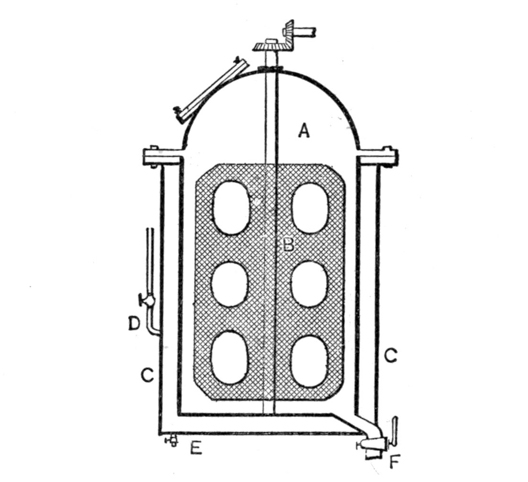
Fig. 4
After the rubber is dissolved, about 12 to 24 per cent of sulphur is added, and thoroughly incorporated with the solution. The sulphur may be in the form of chloride of sulphur, or as sulphur pure and simple. A very small quantity of sulphur is required to give the necessary result, 2 to 3 per cent being sufficient to effect vulcanization; but a large quantity is always added to hasten the operation.
Even after prolonged treatment with the two solvents, a solution of uniform consistency is never obtained: clots of a thicker nature will be found floating in the solution, and the next operation is to knead it up so as to obtain equal {745} density throughout. Fig. 5 will give an idea of how this mixing is done.
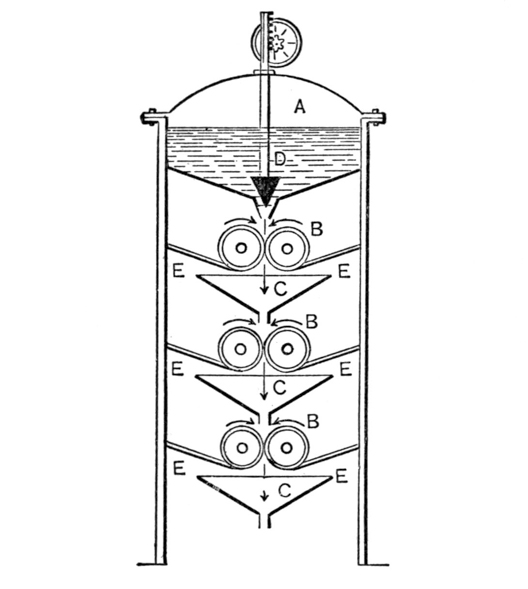
Fig. 5
At the top of a closed wooden chamber is a covered reservoir, A, containing the solution of rubber. A long slit at the base of this reservoir allows the solution to fall between sets of metal rollers, BBB below. Neighboring rollers are revolving in opposite directions, and at different speeds, so that, after passing all three sets of rollers, and emerging at the bottom, the solution should be of uniform consistency. CCC are the guiding funnels, and EE are scrapers to clear the solution from the rollers. D is a wedge-shaped plug worked by a rack and pinion, and regulates the flow of the solution.
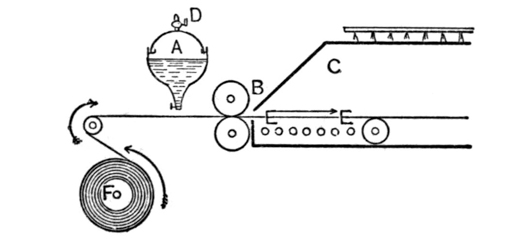
Fig. 6
It now remains to apply the rubber to the fabric and vulcanize it. Up to this stage the sulphur has only been mechanically mixed with the rubber; the aid of heat is now required to bring about chemical combination between the two. This process, which is known as “burning,” consists in subjecting the rubber-covered fabric to a temperature of about 248° F. Sulphur itself melts at 239° F., and the temperature at which combination takes place must be above this. Fig. 6 shows one of the methods of spreading the rubber on the cloth. A is the tank containing the solution with an outlet at the bottom arranged so as to regulate the flow of solution. The fabric passes slowly underneath this, receiving as it travels a thin coating of the waterproofing. The two rollers at B press the solution into the fabric and distribute the proofing evenly over the entire surface.
After leaving the two squeezing rollers, the cloth travels slowly through a covered chamber, C, having a series of steam pipes, EE, underneath, to evaporate the solvent; this condenses on the upper portion of the chamber, which is kept cooled, and flows down the sides into suitable receptacles. After this the proofed cloth is vulcanized by passing round metal cylinders heated to the necessary temperature, or by passing through a heated chamber. Fig. 7 shows the spreading of rubber between two fabrics. The two cloths are wound evenly on the rollers, BB; from this they are drawn conjointly through the rollers, D, the stream of proofing solution flowing down between the rollers, which then press the two fabrics together with the rubber inside. The lower rollers marked CC are heated to the necessary degree, and cause the rubber and sulphur to combine in chemical union.
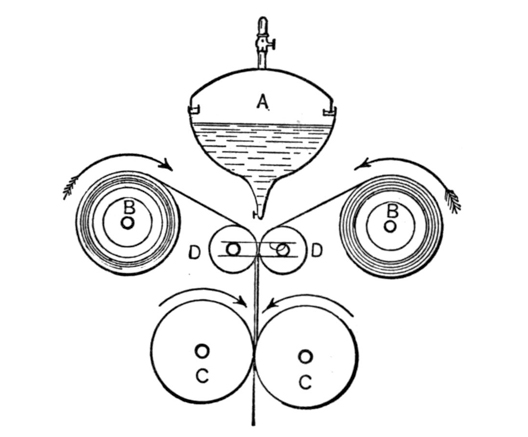
Fig. 7
So far the operation of proofing has been described as though pure rubber only was used; in practice the rubber forms only a small percentage of the proofing material, its place being taken by cheaper bodies. One of the common ingredients of proofing mixtures is boiled linseed oil, together with a small quantity of litharge; this dries very quickly, and forms a glassy flexible film. Coal tar, shellac, colophony, etc., are all used, together with India-rubber varnish, to make {746} different waterproof compositions. Oil of turpentine and benzol form good solvents for rubber, but it is absolutely essential that both rubber and solvent be perfectly anhydrous before mixing. Oil of turpentine, alcohol, etc., can be best deprived of water by mixing with either sulphuric acid or dehydrated copper sulphate, and allowing to stand. The acid or the copper salt will absorb the water and sink to the bottom, leaving a supernatant layer of dehydrated turpentine or whatever solvent is used. All the sulphur in a rubber-proofed cloth is not in combination with the rubber; it is frequently found that, after a lapse of time, rubber-proofed material shows an efflorescence of sulphur on the surface, due to excess of sulphur, and occasionally the fabric becomes stiff and the proofing scales off. Whenever a large proportion of sulphur is present, there is always the danger of the rubbers forming slowly into the hard vulcanite state, as the substance commonly called vulcanite consists only of ordinary vulcanized rubber carried a stage further by more sulphur being used and extra heat applied. If after vulcanizing, rubber is treated with caustic soda, all this superfluous sulphur can be extracted; if it is then well washed the rubber will retain its elasticity for a long period. With the old methods of proofing, a sheet of vulcanized rubber was cemented to a fabric with rubber varnish, and frequently this desulphurizing was performed before cementing together. The result was a flexible and durable cloth, but of great weight and thickness, and expensive to produce.
The chemistry of rubber is very little understood; as mentioned previously, rubber is a highly complex body, liable to go through many changes. These changes are likely to be greater in rubber varnish, consisting of half a dozen or more ingredients, than in the case of rubber alone. The action of sunlight has a powerful effect on rubber, much to its detriment, and appears to increase its tendency to oxidize. Vulcanized rubber keeps its properties better under water than when exposed to the air, and changes more slowly if kept away from the light. It appears as though a slight decomposition always takes place even with pure rubber; but the presence of so many differently constituted substances as sometimes occur in rubber solutions no doubt makes things worse. Whenever a number of different bodies with varying properties are consolidated together by heat, as in the case of rubber compositions, it is only reasonable to expect there will be some molecular rearrangement going on in the mass; and this can be assigned as the reason why some proofings last as long again as others. Some metallic salts have a very injurious action on rubber, one of the worst being copper sulphate. Dyers are frequently warned that goods for rubber-proofing must be free from this metal, as its action on rubber is very powerful, though but little understood. As is generally known, grease in any form is exceedingly destructive to rubber, and it should never be allowed in contact in the smallest proportion. Some compositions are made up by dissolving rubber in turpentine and coal tar; but in this case some of the rubber’s most valuable properties are destroyed, and it is doubtful if it can be properly vulcanized. Owing to rubber being a bad conductor of heat, it requires considerable care to vulcanize it in any thickness. A high degree of heat applied during a short period would tend to form a layer of hard vulcanite on the surface, while that immediately below would be softer and would gradually merge into raw rubber in the center.
The different brands of rubber vary so much, especially with regard to solubility, that it is always advisable to treat each brand by itself, and not to make a solution of two or more kinds. Oilskins and tarpaulins, etc., are mostly proofed by boiled linseed oil, with or without thickening bodies added. They are not of sufficient interest to enlarge upon in this article, so the second, or “water-repellent,” class has now to be dealt with.
All the shower-proof fabrics come under this heading, as well as every cloth which is pervious to air and repulsive to water. The most time-honored recipe for proofing woollen goods is a mixture of sugar of lead and alum, and dates back hundreds of years. The system of using this is as follows: The two ingredients are dissolved separately, and the solutions mixed together. A mutual decomposition results, the base of the lead salt uniting with the sulphuric acid out of the alum to form lead sulphate, which precipitates to the bottom. The clear solution contains alumina in the form of acetate, and this supplies the proofing quality to the fabric. It is applied in a form of machine shown in Fig. 8, which will be seen to consist of a trough containing the proofing solution, C, with a pair of squeezing rollers, A, over the top. The fabric is drawn down through the solution and up through the squeezers in the direction of the arrows. At the {747} back of the machine the cloth automatically winds itself onto a roll, B, and then only requires drying to develop the water-resisting power. D is a weight acting on a lever which presses the two rollers, A, together. The water-repelling property is gained as follows:
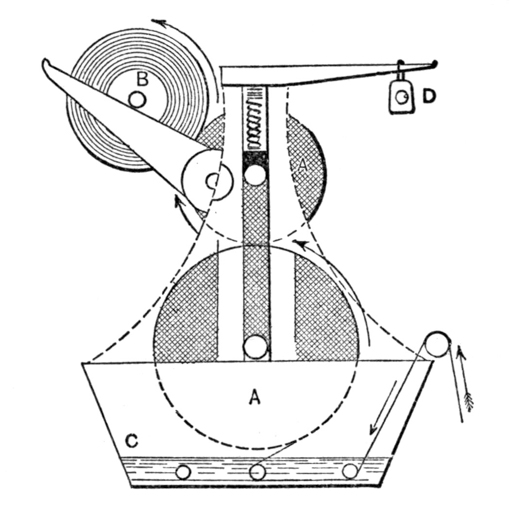
Fig. 8
Drying the fabric, which is impregnated with acetate of alumina, drives off some of the volatile acetic acid, leaving a film of basic acetate of alumina on each wool fiber. This basic salt is very difficult to wet, and has so little attraction for moisture that in a shower of rain the drops remain in a spheroidal state, and fall off. In a strong wind, or under pressure, water eventually penetrates through fabrics proofed in this manner; but they will effectually resist a sharp shower. Unfortunately, shower-proofed goods, with wear, gradually lose this property of repelling water. The equation representing the change between alum and sugar of lead is given below. In the case of common alum there would, of course, be potassium acetate in solution besides the alumina.
Alum.
Al2K2(SO4)4 +
Sugar of lead.
4 Pb(C2H3O2)2 =
Lead sulphate.
4 PbSO4 +
Potassium acetate.
2 KC2H3O2 +
Aluminum acetate.
Al2(C2H3O2)6
Now that sulphate of alumina is in common use, alum need not be used, as the potash in it serves no purpose in proofing.
There are many compositions conferring water resisting powers upon textiles, but unfortunately they either affect the general handle of the material and make it stiff, or they stain and discolor it, which is equally bad. A large range of waterproof compositions can be got by using stearates of the metals; these, in nearly every case, are insoluble bodies, and when deposited in the interior of a fabric form a water-resisting “filling” which is very effective. As a rule these stearates are deposited on the material by means of double baths; for example, by passing the fabric through (say) a bath of aluminum acetate, and then, after squeezing out the excess of liquid, passing it through a bath of soap. The aluminum salt on the fabric decomposes the soap, resulting in a deposit of insoluble stearate of alumina. This system of proofing in two baths is cleaner and more economical than adding all the ingredients together, as the stearate formed is just where it is required “on the fibers,” and not at the bottom of the bath.
One of the most important patents now worked for waterproofing purposes is on the lines of the old alumina process. In this case the factor used is rosin, dissolved in a very large bulk of petroleum spirit. The fabrics to be proofed (usually dress materials) are passed through a bath of this solution, and carefully dried to drive off the solvent. Following this, the goods are treated by pressing with hot polished metal rollers. This last process melts the small quantity of rosin, which is deposited on the cloth, and leaves each single fiber with an exceedingly thin film of rosin on it. It will be understood that only a very attenuated solution of rosin is permissible, so that the fibers of the threads and not the threads themselves are coated with it. If the solution contains too much rosin the fabric is stiffened, and the threads cemented together; whereas if used at the correct strength (or, rather, weakness) neither fabric nor dye suffers, and there is no evidence of stickiness of any description.
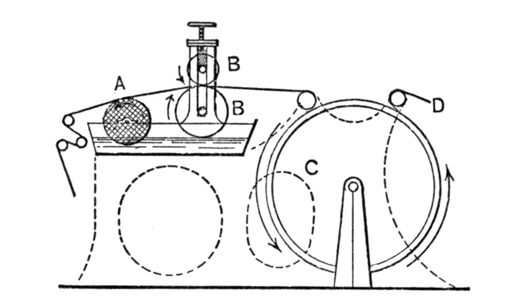
Fig. 9
Fig. 9 shows a machine used for spreading a coat of either proofing or any other fluid on one side of the fabric. {748} This is done by means of a roller, A, running in the proofing solution, the material to be coated traveling slowly over the top and just in contact with the roller, A, which transfers the proofing to it. Should the solution used be of a thick nature, then a smooth metal roller will transfer sufficient to the fabric. If the reverse is the case, and the liquid used is very thin, then the roller is covered with felt, which very materially adds to its carrying power. As shown in Fig. 9, after leaving the two squeezing rollers, BB, the fabric passes slowly round a large steam-heated cylinder, C, with the coated side uppermost. This dries the proofing and fastens it, and the cloth is taken off at D.
Besides stearates of the metals, glues and gelatins have been used for proofing purposes, but owing to their stiffening effect, they are only of use in some few isolated cases. With glue and gelatin the fixing agent is either tannic acid or some metallic salt. Tannic acid converts gelatin into an insoluble leather-like body; this can be deposited in the interstices of the fabric by passing the latter through a gelatin bath first, and then squeezing and passing through the tannic acid. Bichromate of potash also possesses the property of fixing the proteid bodies and rendering them insoluble.
The following are special processes used to advantage in the manufacture of waterproof fabrics:
I.—Ordinary Fabrics, Dressing Apparel, etc.—Immerse in a vat of acetate of alumina (5° Bé.) for 12 hours, lift, dry, and let evaporate at a temperature of from 140° to 149° F.
II.—Sailcloth, Awnings, Thick Blankets, etc.—Soak in a 7 per cent solution of gelatin at 104° F., dry, pass through a 4 per cent solution of alum, dry again, rinse in water, and dry.
III.—Fabrics of Cotton, Linen, Jute, and Hemp.—Put into a bath of ammoniacal cupric sulphate of 10° Bé. at a temperature of 87° F.; let steep thoroughly, then put in a bath of caustic soda (20° Bé.) and dry. To increase the impermeability, a bath of sulphate of alumina may be substituted for the caustic-soda bath.
IV.—Saturate the fabrics with the following odorless compound, subjecting them several times to a brushing machine having several rollers, where the warp threads will be well smoothed, and a waterproof product of fine sheen and scarcely fading will be the result. The compound is made with 30 parts, by weight, of Japan wax, 22 1/2 parts, by weight, of paraffine, 12 parts, by weight, of rosin soap, 35 parts, by weight, of starch, and 5 parts, by weight, of a 5 per cent solution of alum. Fabrics thus prepared are particularly adapted to the manufacture of haversacks, shoes, etc.
V.—White or Light Fabrics.—Pass first through a bath of acetate of alumina of 4° to 5° Bé. at a temperature of 104° F., then through the rollers to rid of all liquid; put into a warm solution of soap (5 parts, by weight, of olive-oil soap to 100 parts, by weight, of fresh water) and finally pass through a 2 per cent solution of alum, dry for 2 or 3 days on the dropping horse, and brush off all particles of soap.
VI.—Dissolve 1 1/2 parts, by weight, of gelatin in 50 parts, by weight, of boiling water, add 1 1/2 parts, by weight, of scraped tallow soap and 2 1/2 parts, by weight, of alum, the latter being put in gradually; lower the temperature of the bath to 122° F., lift out the fabric, dry, and calender.
VII.—Tent Cloth.—Soak in a warm solution of 1 part, by weight, of gelatin, 1 part, by weight, of glycerine, and 1 part, by weight, of tannin in 12 parts, by weight, of wood vinegar (pyroligneous acid) of 12° Bé. The whole is melted in a kettle and carefully mixed. The mass is poured into the receiver of the brushing machine, care being taken to keep it liquid. For a piece of 500 feet in length and 20 inches in width, 50 to 80 parts, by weight, of this compound are needed.
VIII.—To freshen worn waterproof material, cover with the following: Fifty-five thousand parts, by weight, of gelatin; 100 parts, by weight, of bichromate of potash; 100 parts, by weight, of acetic acid (to keep glue from congealing), and from 3,000 to 5,000 parts, by weight, of water; to this add 500 parts, by weight, of peroxide of ammoniacal copper, 100° Bé. This compound is put on the fabric with a brush and then exposed to air and light.
IX.—Soft Hats.—The hats are stiffened as usual, then put through the following three baths: Dissolve 1/2 part, by weight, of tallow soap in from 40 to 50 parts, by weight, of warm water (140° F.). Put 3 to 4 dozen hats into this solution, leave them in it for half an hour, then take out and put them as they are into another bath prepared with 40 to 50 parts, by weight, of water and 1/2 part, by weight, of alum and heated to 86° to 104° F. After {749} having been left in the second bath for 1/4 or 1/2 hour, take out as before, put into the third bath of 40 to 50 parts, by weight, of water, 1/2 part, by weight, of alum, and about 13 parts, by weight, of fish glue. In this cold bath the hats are left for another 1/2 hour or more until they are completely saturated with the liquid, then dried and the other operations continued.
X.—Woolen cloth may be soaked in a vat filled with aluminum acetate, of 5° Bé., for 12 hours, then removed, dried, and dried again at a temperature of 140° F.
XI.—Wagon covers, awnings, and sails are saturated with a 7 per cent gelatin solution, at a temperature of 104° F., dried in the air, put through a 4 per cent solution of alum, dried again in the air, carried through water, and dried a third time.
XII.—Cotton, linen, jute, and hemp fabrics are first thoroughly saturated in a bath of ammonio-cupric sulphate, of 10° Bé., at a temperature of 77° F., then put into a solution of caustic soda, 2° Bé., and dried. They may be made still more impervious to water by substituting a solution of aluminum sulphate for the caustic soda.
XIII.—White and light-colored fabrics are first put into a bath of aluminum acetate, 4° to 5° Bé., at a temperature of 102° F., the superfluous liquid being removed from the fabric by press rollers. The fabric is put into a soap solution (5 parts of good Marseilles soap in 100 parts of soft water). Finally it is put through a 2 per cent alum solution, and left to dry for 2 or 3 days on racks. The adhering particles of soap are removed by brushing with machinery.
XIV.—Dissolve 1.5 parts of gelatin in 50 parts of boiling water, add 1.5 parts of shavings of tallow grain soap, and gradually, 2.5 parts of alum. Let this cool to 122° F., draw the fabric through it, dry and calender.
XV.—Cellular tissues are made waterproof by impregnating them with a warm solution of 1 part, by weight, of gelatin, 1 part, by weight, of glycerine, and 1 part, by weight, of tannin, in 12 parts, by weight, of wood vinegar, 12° Bé.
XVI.—Linen, hemp, jute, cotton, and other fabrics can be given a good odorless waterproof finish by impregnating them, and afterwards subjecting them to the action of several mechanical brush rollers. By this process the fabric is brushed dry, the fibers are laid smooth, the threads of the warp brought out, and a glossy, odorless, unfading waterproof stuff results. Fabrics manufactured in the usual way from rough and colored yarns are put through a bath of this waterproof finish, whose composition is as follows: Thirty parts, by weight, of Japanese wax; 22.5 parts, by weight, of paraffine; 15 parts, by weight, of rosin soap; 35 parts, by weight, of starch, and 5 parts, by weight, of a 5 per cent alum solution. The first three components are melted in a kettle, the starch and, lastly, the alum added, and the whole stirred vigorously.
XVII.—One hundred parts, by weight, of castor oil are heated to nearly 204° F., with 50 parts, by weight, of caustic potash, of 50° Bé., to which 50 parts, by weight, of water have previously been added. Forty parts, by weight, of cooler water are then added slowly, care being taken to keep the temperature of the mixture constant. As soon as the liquor begins to rise, 40 parts, by weight, of cooler water are again added, with the same precaution to keep the temperature from falling below 204° F. At the same time care must be taken to prevent the liquor boiling, as this would produce too great saponification. By the prolonged action of heat below the boiling point, the oil absorbs water and caustic potash without being changed, and the whole finally forms a perfectly limpid, nearly black liquid. This is diluted with 5 times its weight of hot or cold water, and is then ready for use without any further preparation. Other vegetable oils may be employed besides castor oil, and the quantity of unsaponified oil present may be increased by stirring the prepared liquid with a fresh quantity of castor or other vegetable oil. The product is slightly alkaline, but wool fiber is not injured, as the oiling may be done in the cold. The solution is clear and limpid, and will not separate out on standing like an emulsion. This product in spinning gives a 10 per cent better utilization of the raw material owing to the greater evenness and regularity with which the fibers are oiled; in weaving less oiling is required.
The product can be completely removed by water, preferably by cold water, and scouring of the goods subsequently with soap, soda, or fuller’s earth can thus be dispensed with.
XVIII.—Cloth may be rendered waterproof by rubbing the under side with a lump of beeswax until the surface presents a uniform white or grayish appearance. This method it is said renders the cloth {750} practically waterproof, although still leaving it porous to air.
XIX.—Coating the under side of the cloth with a solution of isinglass and then applying an infusion of galls is another method, a compound being thus formed which is a variety of leather.
XX.—An easy method is the formation of aluminum stearate in the fiber of the cloth, which may readily be done by immersing it in a solution of aluminum sulphate in water (1 in 10) and without allowing it to dry passing through a solution of soap made from soda and tallow or similar fat, in hot water. Reaction between the aluminum sulphate and the soap produces aluminum stearate and sodium sulphate. The former is insoluble and remains in the fiber; the latter is removed by subsequently rinsing the fabric in water.
XXI.—A favorite method for cloth is as follows: Dissolve in a receptacle, preferably of copper, over a bright coal fire, 1 liter (1.76 pints) of pure linseed oil, 1 liter (1.76 pints) of petroleum, 1/2 liter (0.88 pints) of oil turpentine, and 125 grams (4.37 ounces) of yellow wax, the last named in small bits. As there is danger of fire, boiling of this mass should be avoided. With this hot solution removed from the fire, of course the felt material is impregnated; next it is hung up in a warm, dry room or spread out, but in such a manner that the uniform temperature can act upon all parts.
Waterproofing Leather.—I.—Tenning’s process is as follows: Melt together equal parts of zinc and linseed oil, at a temperature not above 225° F. Put the leather in the molten mixture and let it remain until saturated. The “zinc soap” is made by dissolving 6 parts of white soap in 16 parts of water, and stirring into the solution 6 parts of zinc sulphate. To make sure of a homogeneous mixture remelt the whole and stir until it begins to cool. The process, including the saturation of the leather, requires about 48 hours. Instead of zinc sulphate, copper or iron sulphate may be used. The philosophy of the process is that the moisture and air contained in the pores of the leather are driven out by the heat of the soap mixture, and their place is taken, on cooling, by the mixture. The surface of the leather is scraped after cooling, and the article is dried, either by heating over an open fire or by hanging in a drying room, strongly heated.
II.—Prideaux’ process consists in submitting the leather to treatment with a solution of caoutchouc until it is thoroughly saturated with the liquid. The latter consists of 30 parts of caoutchouc in 500 parts of oil of turpentine. Complete impregnation of the leather requires several days, during which the solution must be frequently applied to the surface of the leather and rubbed in.
III.—Villon’s process consists in applying a soap solution to the leather, about as follows: The leather is first treated to a solution of 62 parts of soap, 124 parts of glue, and 2,000 parts of water. When it has become saturated with the solution, it is treated to rubbing with a mixture of 460 parts of common salt and 400 parts of alum, in sufficient water to dissolve the same. After this it is washed with tepid water and dried. This process is much the quickest. The application of the soap requires about 2 hours, and the subsequent treatment about as much more, or 4 or 5 hours in all.
Oilskins.—The art of painting over textile fabrics with oily preparations to make them waterproof is probably nearly as old as textile manufacture itself, an industry of prehistoric, nay, geologic, origin. It is certainly more ancient than the craft of the artistic painter in oils, whose canvases are nothing more nor less than art oilskins, and when out of their frames, have served the usual purpose of those things in protecting goods or the human body before now. The art of waterproofing has been extended beyond the domain of the oilskin by chemical processes, especially those in which alum or lead salts, or tannin, are used, as well as by the discovery of India rubber and gutta percha. These two have revolutionized the waterproofing industry in quite a special manner, and the oilskin manufacture, although it still exists and is in a fairly flourishing condition, has found its products to a very large extent replaced by rubber goods. The natural result has been that the processes used in the former industry have remained now unchanged for a good many years. They had already been brought to a very perfect state when the rubber-waterproofing business sprang up, so that improvements were even then difficult to hit upon in oilskin making, and the check put upon the trade by India rubber made people less willing to spend time and money in experimenting with a view to improving what many years had already made it difficult to better. Hence the three cardinal defects of the oilskin: its weight, its stiffness, and the liability of {751} its folds to stick together when it is wrapped up, or in the other extreme to crack, still remains. The weight, of course, is inevitable. An oilskin must be heavy, comparatively, from the very essence of the process by which it is made, but there seems no reason why it should not in time be made much more pliable (an old-time oilskin coat could often stand up on end when empty) and free from the danger of cracking or being compacted into a solid block when it has been stored folded on a shelf.
Probably the best oilskins ever made are those prepared by combining Dr. Stenhouse’s process (patented in 1864) with the ordinary method, which consists in the main of painting over the fabric with two or more coats of boiled linseed oil, allowing each coat to dry before the next is applied. This, with a few variations in detail, is the whole method of making oilskins. Dr. Stenhouse’s waterproofing method is to impregnate the fabric with a mixture of hard paraffine and boiled oil in proportions varying according to circumstances from 95 per cent of paraffine and 5 of oil to 70 per cent of the former and 30 of the latter. The most usual percentages are 80 and 20. The mixture is made with the aid of heat, and is then cast into blocks for storage. It is applied to the cloth stretched on a hot plate by rubbing the fabric thoroughly all over with a block of the composition, which may be applied on one or both sides as may be wished. The saturation is then made complete, and excess of composition is removed by passing the cloth between hot rollers. When the cloth is quite cold the process is complete. The paraffine and the drying oil combine their waterproofing powers, and the paraffine prevents the oil from exerting any injurious action upon the material. Drying oil, partly on account of the metallic compounds in it, and partly on account of its absorbing oxygen from the atmosphere, has a decided slow weakening effect upon textile fibers. Dr. Stenhouse points out that the inflammability of oilskins may be much lessened by the use of the ordinary fireproofing salts, such as tungstate of soda, or alum, either before or after the waterproofing process is carried out.
The following are some of the best recommended recipes for making oilskins:
I.—Dissolve 1 ounce of yellow soap in 1 1/2 pints of boiling water. Then stir in 1 quart of boiled oil. When cold, add 1/4 pint of gold size.
II.—Take fine twilled calico. Soak it in bullock’s blood and dry it. Then give it 2 or 3 coats of boiled oil, mixed with a little litharge, or with an ounce of gold size to every pint of the oil.
III.—Make ordinary paint ready to be applied thin with a strong solution of soap.
IV.—Make 96 pounds of ocher to a thin paste with boiled oil, and then add 16 pounds of ordinary black paint mixed ready for use. Apply the first coat of this with soap, the subsequent coats without soap.
V.—Dissolve rosin in hot boiled oil till it begins to thicken.
VI.—Mix chalk or pipe clay in the finest powder, and in the purest state obtainable to a thin paste with boiled oil.
VII.—Melt together boiled oil, 1 pint; beeswax and rosin, each, 2 ounces.
VIII.—Dissolve soft soap in hot water and add solution of protosulphate of iron till no further precipitate is produced. Filter off, wash, and dry, and form the mass into a thin paste with boiled oil.
All these compositions are painted on with an ordinary painter’s brush. The fabric should be slightly stretched, both to avoid folds and to facilitate the penetration of the waterproofing mixture. To aid the penetration still further, the mixture should be applied hot. It is of the greatest importance that the fabric should not be damp when the composition is applied to it. It is best to have it warm as well as the composition. If more than one coat is applied, which is practically always the case, three being the usual number, it is essential that the last coat should be perfectly dry before the next is applied. Neglect of this precaution is the chief cause of stickiness, which frequently results in serious damage to the oilskins when they have to be unfolded. In fact, it is advisable to avoid folding an oilskin when it can be avoided. They should be hung up when not in use, whenever practicable, and be allowed plenty of room. It goes without saying that no attempt should be made to sell or use the oilskin, whether garment or tarpaulin, until the final coat of composition is perfectly dry and set. It is unadvisable to use artificial heat in the drying at any stage in the manufacture.
Waterproofing Paper.
—Any convenient and appropriate machinery or apparatus may be employed; but the best method for waterproofing paper is as follows: The treatment may be applied
{752}
while the pulp is being formed into paper, or the finished paper may be treated. If the material is to be treated while being formed into paper, then the better method is to begin the treatment when the web of pulpy material leaves the Foudrinier wire or the cylinders, it then being in a damp condition, but with the larger percentage of moisture removed. From this point the treatment of the paper is the same whether it be pulp in a sheet, as above stated, or finished paper.
The treatment consists, first, in saturating the paper with glutinous material, preferably animal glue, and by preference the bath of glutinous material should be hot, to effect the more rapid absorption and more perfect permeation, impregnation, and deposit of the glutinous material within all the microscopic interstices throughout the body of the paper being treated. By preference a suitable tank is provided in which the glutinous material is deposited, and in which it may be kept heated to a constant temperature, the paper being passed through the tank and saturated during its passage. The material being treated should pass in a continuous sheet—that is, be fed from a roll and the finished product be wound in a roll after final treatment. This saves time and the patentee finds that the requisite permeation or incorporation of glutinous matter in the fiber will with some papers—for instance, lightly sized manila hemp—require but a few seconds. As the paper passes from the glutin tank the surplus of the glutinous matter is removed from the surface by mechanical means, as contradistinguished from simply allowing it to pass off by gravity, and in most instances it is preferred to pass the paper between suitable pressure rolls to remove such surplus. The strength and consistency of the glutinous bath may be varied, depending upon the material being treated and the uses for which such material is designed. It may, however, be stated that, in a majority of cases, a hot solution of about 1 part of animal glue to about 10 parts of water, by weight, gives the best results. After leaving the bath of glutinous material and having the surplus adhering to the surfaces removed, the paper before drying is passed into or through a solution of formaldehyde and water to “set” the glutinous material. The strength of this solution may also be variable, depending, as heretofore stated, upon the paper and uses for which it is designed. In the majority of cases, however, a solution of 1 part of formaldehyde (35 per cent solution) to 5 parts of water, by weight, gives good results, and the best result is attained if this bath is cold instead of hot, though any particular temperature is not essentially necessary. The effect of the formaldehyde solution upon the glutin-saturated paper is to precipitate the glutinous matter and render it insoluble.
As the material comes from the formaldehyde bath, the surplus adhering to the surfaces is removed by mechanical means, pressure rolls being probably most convenient. The paper is then dried in any convenient manner. The best result in drying is attained by the air-blast, i. e., projecting blasts of air against both surfaces of the paper. This drying removes all the watery constituents and leaves the paper in a toughened or greatly strengthened condition, but not in practical condition for commercial uses, as it is brittle, horny, and stiff, and has an objectionable odor and taste on account of the presence of the aldehydes, paraldehydes, formic acid, and other products, the result of oxidation. Hence it needs to be “tempered.” Now while the glutinous material is rendered insoluble—that is, it is so acted upon by formaldehyde and the chemical action which takes place while the united solutions are giving off their watery constituents that it will not fully dissolve—it is, however, in a condition to be acted on by moisture, as it will swell and absorb, or take up permanently by either chemical or mechanical action a percentage of water, and will also become improved in many respects, so that to temper and render the paper soft and pliable and adapt it for most commercial uses it is subjected to moisture, which penetrates the paper, causing a welling in all directions, filling the interstices perfectly and resulting in “hydration” throughout the entire cellular structure. Two actions, mechanical and chemical, appear to take place, the mechanical action being the temporary absorption of water analogous to the absorption of water by a dry sponge, the chemical action being the permanent union of water with the treated paper, analogous to the union of water and tapioca, causing swelling, or like the chemical combination of water with lime or cement. For this purpose it is preferred to pass the paper into a bath of hot water, saturated steam or equivalent heat-and-moisture medium, thus causing the fibers and the non-soluble glutinous material filling the interstices to expand in all directions and forcing {753} the glutinous material into all the microscopic pores or openings and into the masses of fiber, causing a commingling or thorough incorporation of the fibers and the glutinous compound. At the same time, as heretofore indicated, a change (hydration) takes place, whereby the hardened mass of fiber, glutinous material, and formaldehyde become tempered and softened and the strength imparted by the previous treatment increased. To heighten the tempering and softening effect, glycerine may, in some instances, be introduced in the tempering bath, and in most cases one two-hundredths in volume of glycerine gives the best results.
The paper may be dried in any convenient manner and is in condition for most commercial uses, it being greatly strengthened, more flexible, more impervious to moisture, acids, grease, or alkalies, and is suitable for the manufacture of binding-twine, carpets, and many novelties, for dry wrappings and lining packing cases, etc., but is liable to have a disagreeable taste and may carry traces of acids, rendering it impracticable for some uses—for instance, wrapping butter, meats, cheese, etc., after receiving the alkali treatment. The paper is also valuable as a packing for joints in steam, water, and other pipes or connections. For the purpose, therefore, of rendering the material absolutely free from all traces of acidity and all taste and odors and, in fact, to render it absolutely hygienic, it is passed through a bath of water and a volatile alkali (ammonium hydrate), the proportion by preference in a majority of cases being one-hundredth of ammonium hydrate to ninety-nine one-hundredths of water by volume. A small percentage of wood alcohol may be added. This bath is preferably cool, but a variation in its temperature will not interfere to a serious extent with the results. The effect of this bath followed by drying is to complete the chemical reaction and destroy all taste or odor, removing all traces of acids and rendering the paper hygienic in all respects. The material may be calendered or cut and used for any of the purposes desired. If the material is to be subjected to the volatile alkali bath, it is not necessary to dry it between the tempering and volatile alkali baths.
The paper made in accordance with the foregoing will, it is claimed, be found to be greatly strengthened, some materials being increased in strength from 100 to 700 per cent. It will be nonabsorbent to acids, greases, and alkalies, and substantially waterproof, and owing to its component integrate structure will be practically non-conductive to electricity, adapting it as a superior insulating material. It may with perfect safety be employed for wrapping butter, meats, spices, groceries, and all materials, whether unctuous or otherwise.
The term “hydration” means the subjecting of the material (after treatment with glutinous material and formaldehyde and drying) to moisture, whereby the action described takes place.
A sheet or web of paper can be treated by the process as rapidly as it is manufactured, as the time for exposure to the action of the glutinous material need not be longer than the time required for it to become saturated, this, of course, varying with different thicknesses and densities, and the length of time of exposure may be fixed without checking the speed by making the tank of such length that the requisite time will elapse while the sheet is passing through it and the guides so arranged as to maintain the sheet in position to be acted on by such solution the requisite length of time. Four seconds’ exposure to the action of formaldehyde is found sufficient in most cases.
Waterproof Ropes.
—For making ropes and lines impervious to weather, the process of tarring is recommended, which can be done either in the separate strands or after the rope is twisted. An addition of tallow gives greater pliability.
Waterproof Wood.
—I.—Soak in a mixture of boracic acid, 6 parts; ammonium chloride, 5 parts; sodium borate, 3 parts, and water, 100 parts.
II.—Saturate in a solution of zinc chloride.
WAX
Adulteration Of Wax.
—Wax is adulterated with the following among other substances: Rosins, pitch, flowers of sulphur, starch, fecula, stearine, paraffine, tallow, palm oil, calcined bones, yellow ocher, water, and wood sawdust.
Rosins are detected by cold alcohol, which dissolves all rosinous substances and exercises no action on the wax. The rosins having been extracted from the alcoholic solution by the evaporation of the alcohol, the various kinds may be distinguished by the odors disengaged by burning the mass several times on a plate of heated iron.
All earthy substances may be readily {754} separated from wax by means of oil of turpentine, which dissolves the wax, while the earthy matters form a residue.
Oil of turpentine also completely separates wax from starchy substances, which, like earthy matters, do not dissolve, but form a residue. A simpler method consists in heating the wax with boiling water; the gelatinous consistency assumed by the water, and the blue coloration in presence of iodine, indicate that the wax contains starchy substances. Adulteration by means of starch and fecula is quite frequent. These substances are sometimes added to the wax in a proportion of nearly 60 per cent. To separate either, the suspected product is treated hot with very dilute sulphuric acid (2 parts of acid per 100 parts of water). All amylaceous substances, converted into dextrin, remain dissolved in the liquid, while the wax, in cooling, forms a crust on the surface. It is taken off and weighed; the difference between its weight and that of the product analyzed will give the quantity of the amylaceous substances.
Flowers of sulphur are recognized readily from the odor of sulphurous acid during combustion on red-hot iron.
Tallow may be detected by the taste and odor. Pure wax has an aromatic, agreeable taste, while that mixed with tallow is repulsive both in taste and smell. Pure wax, worked between the fingers, grows soft, preserving a certain cohesion in all parts. It divides into lumps, which adhere to the fingers, if it is mixed with tallow. The adulteration may also be detected by the thick and nauseating fumes produced when it is burned on heated iron.
Stearic acid may be recognized by means of boiling alcohol, which dissolves it in nearly all proportions and causes it to deposit crystals on cooling, while it is without action on the wax. Blue litmus paper, immersed in alcohol solution, reddens on drying in air, and thus serves for detecting the presence of stearic acid.
Ocher is found by treating the wax with boiling water. A lemon-yellow deposit results, which, taken up with chlorhydric acid, yields with ammonia a lemon-yellow precipitate of ferric oxide.
The powder of burnt bones separates and forms a residue, when the wax is heated with oil of turpentine.
Artificial Beeswax.
—This is obtained by mixing the following substances, in approximately the proportions stated: Paraffine, 45 parts, by weight; white Japan vegetable wax, 30 parts, by weight; rosins, or colophonies, 10 parts, by weight; white pitch, 10 parts, by weight; tallow, 5 parts, by weight; ceresine, colorant, 0.030 parts, by weight; wax perfume, 0.100 parts, by weight. If desired, the paraffine may be replaced with ozokerite, or by a mixture of vaseline and ozokerite, for the purpose of varying the fusing temperature, or rendering it more advantageous for the various applications designed. The following is the method of preparation: Melt on the boiling water bath, shaking constantly, the paraffine, the Japan wax, the rosins, the pitch, and the tallow. When the fusion is complete, add the colorant and the perfume. When these products are perfectly mingled, remove from the fire, allow the mixture to cool, and run it into suitable molds. The wax thus obtained may be employed specially for encaustics for furniture and floors, or for purposes where varnish is employed.
Waxes For Floors, Furniture, Etc.—
I.— White beeswax 16 parts
Colophony 4 parts
Venice turpentine 1 part
Melt the articles together over a gentle fire, and when completely melted and homogeneous, pour into a sizable earthenware vessel, and stir in, while still warm, 6 parts of the best French turpentine. Cool for 24 hours, by which time the mass has acquired the consistence of soft butter, and is ready for use. Its method of use is very simple. It is smeared, in small quantities, on woolen cloths, and with these is rubbed into the wood.
This is the best preparation, but one in which the beeswax is merely dissolved in the turpentine in such a way as to have the consistence of a not too thin oil color, will answer. The wood is treated with this, taking care that the surface is evenly covered with the mixture, and that it does not sink too deeply in the ornaments, corners, etc., of the woodwork. This is best achieved by taking care to scrape off from the cloths all excess of the wax.
If, in the course of 24 hours, the surface is hard, then with a stiff brush go over it, much after the way of polishing a boot. For the corners and angles smaller brushes are used; when necessary, stiff pencils may be employed. Finally, the whole is polished with plush, or velvet rags, in order not to injure the original polish. Give the article a good coat of linseed oil or a washing with petroleum before beginning work.
II.—Articles that are always exposed to the water, floors, doors, especially of oak, should, from time to time, be {755} saturated with oil or wax. A house door, plentifully decorated with wood carving, will not shrink or warp, even where the sun shines hottest on it, when it is frequently treated to saturation with wax and oil. Here a plain dosage with linseed oil is sufficient. Varnish, without the addition of turpentine, should never be used, or if used it should be followed by a coat of wax.
III.—A good floor wax is composed of 2 parts of wax and 3 parts of Venice turpentine, melted on the water bath, and the mixture applied while still hot, using a pencil, or brush, for the application, and when it has become solid and dry, diligently rubbed, or polished down with a woolen cloth, or with a floor brush, especially made for the purpose.
IV.—An emulsion of 5 parts of yellow wax, 2 parts of crude potassium carbonate, and 12 parts of water, boiled together until they assume a milky color and the solids are dissolved, used cold, makes an excellent composition for floors. Any desired color may be given this dressing by stirring in the powdered coloring matter. Use it exactly as described for the first mass.
Gilders’ Wax.
—For the production of various colorings of gold in fire gilding, the respective places are frequently covered with so-called gilders’ wax. These consist of mixtures of various chemicals which have an etching action in the red heat upon the bronze mass, thus causing roughness of unequal depth, as well as through the fact that the composition of the bronze is changed somewhat on the surface, a relief of the gold color being effected in consequence of these two circumstances. The gilding wax is prepared by melting together the finely powdered chemicals with wax according to the following recipes:
I II III IV V
Yellow wax 32 32 32 96 36
Red chalk 3 24 18 48 18
Verdigris 2 4 18 32 18
Burnt alum 2 4 — — —
Burnt borax — — 2 1 3
Copper ash — 4 6 20 8
Zinc vitriol — — — 32 18
Green vitriol — — — 1 6
Grafting Wax.—
I.— Beeswax 7 parts
Purified rosin 12 parts
Turpentine 3 parts
Rape oil 1 part
Venice turpentine 2.5 parts
Zinc white 2.5 parts
Color yellow with turmeric.
II.— Japan wax 1 part
Yellow wax 3 parts
Rosin 8 parts
Turpentine 4 parts
Hard paraffine 1 part
Suet 3 parts
Venice turpentine 6 parts
Harness Wax.—
Oil of turpentine 90 parts
Wax, yellow 9 parts
Prussian blue 1 part
Indigo 0.5 parts
Bone black 5 parts
Dissolve the wax in the oil by aid of a low heat, on a water bath. Mix the remaining ingredients, which must be well powdered, and work up with a portion of the solution of wax. Finally, add the mixture to the solution, and mix thoroughly on the bath. When a homogeneous liquid is obtained, pour into earthen boxes.
Modeling Wax.
—I.—Yellow wax, 1,000 parts; Venice turpentine, 130 parts; lard, 65 parts; bole, 725 parts. The mixture when still liquid is poured into tepid water and kneaded until a plastic mass is obtained.
II.—Summer Modeling Wax.—White wax, 20 parts; ordinary turpentine, 4 parts; sesame oil, 1 part; vermilion, 2 parts.
III.—Winter Modeling Wax.—White wax, 20 parts; ordinary turpentine, 6 parts; sesame oil, 2 parts; vermilion, 2 parts. Preparation same as for Formula I.
Sealing Waxes.
—The following formulas may be followed for making sealing wax: Take 4 pounds of shellac, 1 pound of Venice turpentine, and 3 pounds of vermilion. Melt the lac in a copper pan suspended over a clear charcoal fire, then add the turpentine slowly to it, and soon afterwards add the vermilion, stirring briskly all the time with a rod in either hand. In forming the round sticks of sealing wax, a certain portion of the mass should be weighed while it is ductile, divided into the desired number of pieces, and then rolled out upon a warm marble slab by means of a smooth wooden block like that used by apothecaries for rolling a mass of pills.
The oval and square sticks of sealing wax are cast in molds, with the above compound, in a state of fusion. The marks of the lines of junction of the mold box may be afterwards removed by holding the sticks over a clear fire, or passing them over a blue gas flame. Marbled sealing wax is made by mixing {756} two, three, or more colored kinds together while they are in a semi-fluid state. From the viscidity of the several portions their incorporation is left incomplete, so as to produce the appearance of marbling. Gold sealing wax is made simply by adding gold chrome instead of vermilion into the melted rosins. Wax may be scented by introducing a little essential oil, essence of musk, or other perfume. If 1 part of balsam of Peru be melted along with 99 parts of the sealing-wax composition, an agreeable fragrance will be exhaled in the act of sealing with it. Either lampblack or ivory black serves for the coloring matter of black wax. Sealing wax is often adulterated with rosin, in which case it runs into thin drops at the flame of a candle.
The following mistakes are sometimes made in the manufacture of sealing wax:
I.—Use of filling agents which are too coarsely ground.
II.—Excessive use of filling agents.
III.—Insufficient binding of the pigments and fillings with a suitable adhesive agent, which causes these bodies to absorb the adhesive power of the gums.
IV.—Excessive heating of the mass, caused by improper melting or faulty admixture of the gummy bodies. Turpentine and rosin must be heated before entering the shellac. If this rule is inverted, as is often the case, the shellac sticks to the bottom and burns partly.
Great care must be taken to mix the coloring matter to a paste with spirit or oil of turpentine before adding to the other ingredients. Unless this is done the wax will not be of a regular tint.
Dark Blue Wax.—Three ounces Venetian turpentine, 4 ounces shellac, 1 ounce rosin, 1 ounce Prussian blue, 1/2 ounce magnesia.
Green Wax.—Two ounces Venetian turpentine, 4 ounces shellac, 1 1/4 ounces rosin, 1/2 ounce chrome yellow, 1/4 ounce Prussian blue, 1 ounce magnesia.
Carmine Red Wax.—One ounce Venetian turpentine, 4 ounces shellac, 1 ounce rosin, colophony, 1 1/4 ounces Chinese red, 1 drachm magnesia, with oil of turpentine.
Gold Wax.—Four ounces Venetian turpentine, 8 ounces shellac, 14 sheets of genuine leaf gold, 1/2 ounce bronze, 1/2 ounce magnesia, with oil of turpentine.
White Wax.—I.—The wax is bleached by exposing to moist air and to the sun, but it must first be prepared in thin sheets or ribbons or in grains. For this purpose it is first washed, to free it from the honey which may adhere, melted, and poured into a tin vessel, whose bottom is perforated with narrow slits. The melted wax falls in a thin stream on a wooden cylinder arranged below and half immersed in cold water. This cylinder is turned, and the wax, rolling round in thin leaves, afterwards falls into the water. To melt it in grains, a vessel is made use of, perforated with small openings, which can be rotated. The wax is projected in grains into the cold water. It is spread on frames of muslin, moistened with water several times a day, and exposed to the sun until the wax assumes a fine white. This whiteness, however, is not perfect. The operation of melting and separating into ribbons or grains must be renewed. Finally, it is melted and flowed into molds. The duration of the bleaching may be abridged by adding to the wax, treated as above, from 1.25 to 1.75 per cent of rectified oil of turpentine, free from rosin. In 6 or 8 days a result will be secured which would otherwise require 5 or 6 weeks.
II.— Bleached shellac 28 parts
Venetian turpentine 13 parts
Plaster of Paris 30 parts
WAX FOR BOTTLES: See Photography.
WAX, BURNING, TRICK: See Pyrotechnics.
WAXES, DECOMPOSITION OF: See Oil.
WAX FOR IRONING: See Laundry Preparations.
WAX FOR LINOLEUM: See Linoleum.
WEATHER FORECASTERS
(See also Hygrometers and Hygroscopes.)
I.—It is known that a leaf of blotting paper or a strip of fabric made to change color according to the hygrometric state of the atmosphere has been employed for weather indications in place of a barometer. The following compound is recommended for this purpose: One part of cobalt chloride, 75 parts of nickel oxide, 20 parts of gelatin, and 200 parts of water. A strip of calico, soaked in this solution, will appear green in fine weather, but when moisture intervenes the color disappears. {757}
II.— Copper chloride 1 part
Gelatin 10 parts
Water 100 parts
III.—This is a method of making old-fashioned weather glasses containing a liquid that clouds or solidifies under certain atmospheric conditions:
Camphor 2 1/2 drachms
Alcohol 11 drachms
Water 9 drachms
Saltpeter 38 grains
Sal ammoniac 38 grains
Dissolve the camphor in the alcohol and the salts in the water and mix the solutions together. Pour in test tubes, cover with wax after corking and make a hole through the cork with a red-hot needle, or draw out the tube until only a pin hole remains. When the camphor, etc., appear soft and powdery, and almost filling the tube, rain with south or southwest winds may be expected; when crystalline, north, northeast, or northwest winds, with fine weather, may be expected; when a portion crystallizes on one side of the tube, wind may be expected from that direction. Fine weather: The substance remains entirely at bottom of tube and the liquid perfectly clear. Coming rain: Substance will rise gradually, liquid will be very clear, with a small star in motion. A coming storm or very high wind: Substance partly at top of tube, and of a leaflike form, liquid very heavy and in a fermenting state. These effects are noticeable 24 hours before the change sets in. In winter: Generally the substance lies higher in the tube. Snow or white frost: Substance very white and small stars in motion. Summer weather: The substance will lie quite low. The substance will lie closer to the tube on the opposite side to the quarter from which the storm is coming. The instrument is nothing more than a scientific toy.
WEATHERPROOFING: See Paints.
WEED KILLERS: See Disinfectants.
WEIGHTS AND MEASURES
International Atomic Weights.
The International Committee on Atomic Weights have presented this table as corrected:
O=16 H=1
Aluminum Al 27.1 26.9
Antimony Sb 120.2 119.3
Argon A 39.9 39.6
Arsenic As 75 74.4
Barium Ba 137.4 136.4
Bismuth Bi 208.5 206.9
Boron B 11 10.9
Bromine Br 79.96 79.36
Cadmium Cd 112.4 111.6
Cæsium Cs 132.9 131.9
Calcium Ca 40.1 39.7
Carbon C 12 11.91
Cerium Ce 140.25 139.2
Chlorine Cl 35.45 35.18
Chromium Cr 52.1 51.7
Cobalt Co 59 58.55
Columbium Cb 94 93.3
Copper Cu 63.6 63.1
Erbium Er 166 164.8
Fluorine F 19 18.9
Gadolinium Gd 156 154.8
Gallium Ga 70 69.5
Germanium Ge 72.5 72
Glucinum Gl 9.1 9.03
Gold Au 197.2 195.7
Helium He 4 4
Hydrogen H 1.008 1
Indium In 115 114.1
Iodine I 126.97 126.01
Iridium Ir 193 191.5
Iron Fe 55.9 55.5
Krypton Kr 81.8 81.2
Lanthanum La 138.9 137.9
Lead Pb 206.9 205.35
Lithium Li 7.03 6.98
Magnesium Mg 24.36 24.18
Manganese Mn 55 54.6
Mercury Hg 200 198.5
Molybdenum Mo 96 95.3
Neodymium Nd 143.6 142.5
Neon Ne 20 19.9
Nickel Ni 58.7 58.3
Nitrogen N 14.04 13.93
Osmium Os 191 189.6
Oxygen O 16 15.88
Palladium Pd 106.5 105.7
Phosphorus P 31 30.77
Platinum Pt 194.8 193.3
Potassium K 39.15 38.85
Praseodymium Pr 140.5 139.4
Radium Ra 225 223.3
Rhodium Rh 103 102.2
Rubidium Rb 85.5 84.9
Ruthenium Ru 101.7 100.9
Samarium Sm 150.3 149.2
Scandium Sc 44.1 43.8
Selenium Se 79.2 78.6
Silicon Si 28.4 28.2
Silver Ag 107.93 107.11
Sodium Na 23.05 22.88
Strontium Sr 87.6 86.94
Sulphur S 32.06 31.82
Tantalum Ta 183 181.6
Tellurium Te 127.6 126.6
Terbium Th 160 158.8
Thallium Tl 204.1 202.6
Thorium Th 232.5 230.8
Thulium Tm 171 169.7
Tin Sn 119 118.1
Titanium Ti 48.1 47.7
Tungsten W 184 182.6
Uranium U 238.5 236.7
Vanadium V 51.2 50.8
Xenon Xe 128 127
Ytterbium Yb 173 171.7
Yttrium Yt 89 88.3
Zinc Zn 65.4 64.9
Zirconium Zr 90.6 89.9
United States Weights And Measures
(According to existing standards)
Lineal
Inches. Feet. Yards. Rods. Fur’s. Mile.
12 inches = 1 foot. 12 = 1
3 feet = 1 yard. 36 = 3 = 1
5.5 yards = 1 rod. 198 = 16.5 = 5.5 = 1
40 rods = 1 furlong. 7,920 = 660 = 220 = 40 = 1
8 furlongs = 1 mile. 63,360 = 5,280 = 1,760 = 320 = 8 = 1
Surface—land
144 sq. inches = 1 square foot. Feet. Yards. Rods. Roods. Acres.
9 square feet = 1 square yard. 9 = 1
30.25 square yards = 1 square rod. 272.25 = 30.25 = 1
40 square rods = 1 square rood. 10,890 = 1,210 = 40 = 1
4 square roods = 1 acre. 43,560 = 4,840 = 160 = 4 = 1
640 acres = 1 square mile. 27,878,400 = 3,097,600 = 102,400 = 2,560 = 640
Volume—liquid
4 gills = 1 pint. Gills. Pints. Gallon. Cub. In.
2 pints = 1 quart. 32 = 8 = 1 = 231
4 quarts = 1 gallon.
Fluid Measure
Gallon. Pints. Ounces. Drachms. Minims. Cubic Centimeters.
1 = 8 = 128 = 1,024 = 61,440 = 3,785.435
1 = 16 = 128 = 7,680 = 473.179
1 = 8 = 480 = 29.574
1 = 60 = 3.697
16 ounces, or a pint, is sometimes called a fluidpound.
Troy Weight
Pound. Ounces. Pennyweights. Grains. Grams.
1 = 12 = 240 = 5,760 = 373.24
1 = 20 = 480 = 31.10
1 = 24 = 1.56
Apothecaries’ Weight
Pound. Ounces. Drachms. Scruples gr. Grains. Grams.


1 = 12 = 96 = 288 = 5,760 = 373.24
1 = 8 = 24 = 480 = 31.10
1 = 3 = 60 = 3.89
1 = 20 = 1.30
1 = .06
The pound, ounce, and grain are the same as in Troy weight.
Avoirdupois Weight
Pound. Ounces. Drachms. Grains (Troy). Grams.
1 = 16 = 256 = 7,000 = 453.60
1 = 16 = 437.5 = 28.35
1 = 27.34 = 1.77
English Weights And Measures
Apothecaries’ Weight
20 grains = 1 scruple = 20 grains
3 scruples = 1 drachm = 60 grains
8 drachms = 1 ounce = 480 grains
12 ounces = 1 pound = 5,760 grains
Fluid Measure
60 minims = 1 fluidrachm
8 drachms = 1 fluidounce
20 ounces = 1 pint
8 pints = 1 gallon
The above weights are usually adopted in formulas.
All chemicals are usually sold by
Avoirdupois Weight
27 11/32 grains = 1 drachm = 27 11/32 grains
16 drachms = 1 ounce = 437 1/2 grains
16 ounces = 1 pound = 7,000 grains
Precious metals are usually sold by
Troy Weight
24 grains = 1 pennyweight = 24 grains
20 pennyweights = 1 ounce = 480 grains
12 ounces = 1 pound = 5,760 grains
NOTE.—An ounce of metallic silver contains 480 grains, but an ounce of nitrate of silver contains only 437 1/2 grains. {759}
Metric System Of Weights And Measures
Measures Of Length
DENOMINATIONS AND VALUES. EQUIVALENTS IN USE.
Myriameter 10,000 meters 6.2137 miles
Kilometer 1,000 meters .62137 miles, or 3,280 feet, 10 inches
Hectometer 100 meters 328 feet and 1 inch
Dekameter 10 meters 393.7 inches
Meter 1 meter 39.37 inches
Decimeter 1-10th of a meter 3.937 inches
Centimeter 1-100th of a meter .3937 inches
Millimeter 1-1,000th of a meter .0394 inches
Measures Of Surface
DENOMINATIONS AND VALUES. EQUIVALENTS IN USE.
Hectare 10,000 square meters 2.471 acres
Are 100 square meters 119.6 square yards
Centare 1 square meter 1,550 square inches
Measures Of Volume
DENOMINATIONS AND VALUES. EQUIVALENTS IN USE.
NAMES. NO. OF LITERS. CUBIC MEASURES. DRY MEASURE. WINE MEASURE.
Kiloliter or stere 1,000 1 cubic meter 1.308 cubic yards 264.17 gallons
Hectoliter 100 1-10th cubic meter 2 bushels and 3.35 pecks 26.417 gallons
Dekaliter 10 10 cubic decimeters 9.08 quarts 2.6417 gallons
Liter 1 1 cubic decimeter .908 quarts 1.0567 quarts
Deciliter 1-10 1-10th cubic decimeter 6.1023 cubic inches .845 gills
Centiliter 1-100 10 cubic centimeters .6102 cubic inches .338 fluidounces
Milliliter 1-1,000 1 cubic centimeter .061 cubic inches .27 fluidrachms
Weights
DENOMINATIONS AND VALUES. EQUIVALENTS IN USE.
NAMES. NUMBER OF GRAMS. WEIGHT OF VOLUME OF WATER AT ITS MAXIMUM DENSITY. AVOIRDUPOIS WEIGHT.
Millier or Tonneau 1,000,000 1 cubic meter 2,204.6 pounds
Quintal 100,000 1 hectoliter 220.46 pounds
Myriagram 10,000 10 liters 22.046 pounds
Kilogram or Kilo 1,000 1 liter 2.2046 pounds
Hectogram 100 1 deciliter 3.5274 ounces
Dekagram 10 10 cubic centimeters .3527 ounces
Gram 1 1 cubic centimeter 15.432 grains
Decigram 1-10 1-10th of a cubic centimeter 1.5432 grains
Centigram 1-100 10 cubic millimeters .1543 grains
Milligram 1-1,000 1 cubic millimeter .0154 grains
For measuring surfaces, the square dekameter is used under the term of ARE; the hectare, or 100 ares, is equal to about 2 1/2 acres. The unit of capacity is the cubic decimeter or LITER, and the series of measures is formed in the same way as in the case of the table of lengths. The cubic meter is the unit of measure for solid bodies, and is termed STERE. The unit of weight is the GRAM, which is the weight of one cubic centimeter of pure water weighed in a vacuum at the temperature of 4° C. or 39.2° F., which is about its temperature of maximum density. In practice, the term cubic centimeter, abbreviated c.c., is generally used instead of milliliter, and cubic meter instead of kiloliter. {760}
The Conversion Of Metric Into English Weight
The following table, which contains no error greater than one-tenth of a grain, will suffice for most practical purposes:
1 gram = 15 2/5 grains
2 grams = 30 4/5 grains
3 grams = 46 1/5 grains
4 grams = 61 4/5 grains, or 1 drachm, 1 4/5 grains
5 grams = 77 1/5 grains, or 1 drachm, 17 1/5 grains
6 grams = 92 3/5 grains, or 1 drachm, 32 3/5 grains
7 grams = 108 grains, or 1 drachm, 48 grains
8 grams = 123 2/5 grains, or 2 drachms, 3 2/5 grains
9 grams = 138 4/5 grains, or 2 drachms, 18 4/5 grains
10 grams = 154 2/5 grains, or 2 drachms, 34 2/5 grains
11 grams = 169 4/5 grains, or 2 drachms, 49 4/5 grains
12 grams = 185 1/5 grains, or 3 drachms, 20 1/5 grains
13 grams = 200 3/5 grains, or 3 drachms, 20 3/5 grains
14 grams = 216 grains, or 3 drachms, 36 grains
15 grams = 231 2/5 grains, or 3 drachms, 51 2/5 grains
16 grams = 247 grains, or 4 drachms, 7 grains
17 grams = 262 2/5 grains, or 4 drachms, 22 2/5 grains
18 grams = 277 4/5 grains, or 4 drachms, 37 4/5 grains
19 grams = 293 1/5 grains, or 4 drachms, 53 1/5 grains
20 grams = 308 3/5 grains, or 5 drachms, 8 3/5 grains
30 grams = 463 grains, or 7 drachms, 43 grains
40 grams = 617 1/5 grains, or 10 drachms, 17 1/5 grains
50 grams = 771 3/5 grains, or 12 drachms, 51 3/5 grains
60 grams = 926 grains, or 15 drachms, 26 grains
70 grams = 1,080 1/5 grains, or 18 drachms, 0 1/5 grains
80 grams = 1,234 3/5 grains, or 20 drachms, 34 3/5 grains
90 grams = 1,389 grains, or 23 drachms, 9 grains
100 grams = 1,543 1/5 grains, or 25 drachms, 43 1/5 grains
1,000 grams = 1 kilogram = 32 ounces, 1 drachm, 12 2/5 grains
The Conversion Of Metric Into English Measure
1 cubic centimeter = 17 minims
2 cubic centimeters = 34 minims
3 cubic centimeters = 51 minims
4 cubic centimeters = 68 minims, or 1 drachm, 8 minims
5 cubic centimeters = 85 minims, or 1 drachm, 25 minims
6 cubic centimeters = 101 minims, or 1 drachm, 41 minims
7 cubic centimeters = 118 minims, or 1 drachm, 58 minims
8 cubic centimeters = 135 minims, or 1 drachms, 15 minims
9 cubic centimeters = 152 minims, or 2 drachms, 32 minims
10 cubic centimeters = 169 minims, or 2 drachms, 49 minims
20 cubic centimeters = 338 minims, or 5 drachms, 38 minims
30 cubic centimeters = 507 minims, or 1 ounce, 0 drachm, 27 minims
40 cubic centimeters = 676 minims, or 1 ounce, 3 drachms, 16 minims
50 cubic centimeters = 845 minims, or 1 ounce, 6 drachms, 5 minims
60 cubic centimeters = 1,014 minims, or 2 ounces, 0 drachms, 54 minims
70 cubic centimeters = 1,183 minims, or 2 ounces, 3 drachms, 43 minims
80 cubic centimeters = 1,352 minims, or 2 ounces, 6 drachms, 32 minims
90 cubic centimeters = 1,521 minims, or 3 ounces, 1 drachm, 21 minims
100 cubic centimeters = 1,690 minims, or 3 ounces, 4 drachms, 10 minims
1,000 cubic centimeters = 1 liter = 34 fluidounces nearly, or 2 1/8 pints.
{761}
WELDING POWDERS.
See also Steel.
Powder To Weld Wrought Iron At Pale-red Heat With Wrought Iron.
—I.—Borax, 1 part (by weight); sal ammoniac,
1
/
2
part; water,
1
/
2
part. These ingredients are boiled with constant stirring until the mass is stiff; then it is allowed to harden over the fire. Upon cooling, the mass is rubbed up into a powder and mixed with one-third wrought-iron filings free from rust. When the iron has reached red heat, this powder is sprinkled on the parts to be welded, and after it has liquefied, a few blows are sufficient to unite the pieces.
II.—Borax, 2 parts; wrought-iron filings, free from rust, 2 parts; sal ammoniac, 1 part. These pulverized parts are moistened with copaiba balsam and made into a paste, then slowly dried over a fire and again powdered. The application is the same as for Formula I.
Welding Powder To Weld Steel On Wrought Iron At Pale-red Heat.
—Borax, 3 parts; potassium cyanide, 2 parts; Berlin blue, 1–100 part. These substances are powdered well, moistened with water; next they are boiled with constant stirring until stiff; then dry over a fire. Upon cooling, the mass is finely pulverized and mixed with 1 part of wrought-iron filings, free from rust. This powder is sprinkled repeatedly upon the hot pieces, and after it has burned in the welding is taken in hand.
WHEEL GREASE: See Lubricants.
WHETSTONES.
To make artificial whetstones, take gelatin of good quality, dissolve it in equal weight of water, operating in almost complete darkness, and add 1 1/2 per cent of bichromate of potash, previously dissolved. Next take about 9 times the weight of the gelatin employed of very fine emery or fine powdered gun stone, which is mixed intimately with the gelatinized solution. The paste thus obtained is molded into the desired shape, taking care to exercise an energetic pressure in order to consolidate the mass. Finally dry by exposure to the sun.
WHITING:
To Form Masses Of Whiting.
—Mix the whiting into a stiff paste with water, and the mass will retain its coherence when dry.
WHITEWASH
(See also Paint.)
Wash the ceiling by wetting it twice with water, laying on as much as can well be floated on, then rub the old color up with a stumpy brush and wipe off with a large sponge. Stop all cracks with whiting and plaster of Paris. When dry, claricole with size and a little of the whitewash when this is dry. If very much stained, paint those parts with turps, color, and, if necessary, claricole again. To make the whitewash, take a dozen pounds of whiting (in large balls), break them up in a pail, and cover with water to soak. During this time melt over a slow fire 4 pounds common size, and at the same time, with a palette knife or small trowel, rub up fine about a dessertspoonful of blue-black with water to a fine paste; then pour the water off the top of the whiting and with a stick stir in the black; when well mixed, stir in the melted size and strain. When cold, it is fit for use. If the jelly is too stiff for use, beat it up well and add a little cold water. Commence whitewashing over the window and so work from the light. Distemper color of any tint may be made by using any other color instead of the blue-black—as ocher, chrome, Dutch pink, raw sienna for yellows and buff; Venetian red, burnt sienna, Indian red or purple brown for reds; celestial blue, ultramarine, indigo for blues; red and blue for purple, gray or lavender; red lead and chrome for orange; Brunswick green for greens.
Ox blood in lime paint is an excellent binding agent for the lime, as it is chiefly composed of albumin, which, like casein or milk, is capable of transforming the lime into casein paint. But the ox blood must be mixed in the lime paint; to use it separately is useless, if not harmful. Whitewashing rough mortar-plastering to saturation is very practical, as it closes all the pores and small holes.
A formula used by the United States Government in making whitewash for light-houses and other public buildings is as follows:
Unslaked lime 2 pecks
Common salt 1 peck
Rice flour 3 pounds
Spanish whiting 1/2 pound
Glue (clean and white) 1 pound
Water, a sufficient quantity.
Slake the lime in a vessel of about 10 gallons capacity; cover it, strain, and add {762} the salt previously dissolved in warm water. Boil the rice flour in water; soak the glue in water and dissolve on a water bath, and add both, together with the whiting and 5 gallons of hot water to the mixture, stirring all well together. Cover to protect from dirt, and let it stand for a few days, when it will be ready for use. It is to be applied hot, and for that reason should be used from a kettle over a portable furnace.
To Soften Old Whitewash.
—Wet the whitewash thoroughly with a wash made of 1 pound of potash dissolved in 10 quarts of water.
WHITEWASH, TO REMOVE: See Cleaning Preparations and Methods.
WHITE METAL: See Alloys.
WINDOW-CLEANING COMPOUND: See Cleaning Compounds.
WINDOW DISPLAY:
See also Sponges.
An attractive window display for stores can be prepared as follows:
In a wide-mouth jar put some sand, say, about 6 inches in depth. Make a mixture of equal parts of aluminum sulphate, copper sulphate, and iron sulphate, coarsely powdered, and strew it over the surface of the sand. Over this layer gently pour a solution of sodium silicate, dissolved in 3 parts of hot water, taking care not to disturb the layer of sulphates. In about a week or 10 days the surface will be covered with crystals of different colors, being silicates of different metals employed. Now take some pure water and let it run into the vessel by a small tube, using a little more of it than you used of the water-glass solution. This will displace the water-glass solution, and a fresh crop of crystals will come in the silicates, and makes, when properly done, a pretty scene. Take care in pouring in the water to let the point of the tube be so arranged as not to disturb the crop of silicates.
WINDOW PERFUME.
In Paris an apparatus has been introduced consisting of a small tube which is attached lengthwise on the exterior of the shop windows. Through numerous little holes a warm, lightly perfumed current of air is passed, which pleasantly tickles the olfactory nerves of the looker-on and at the same time keeps the panes clear and clean, so that the goods exhibited present the best possible appearance.
WINDOW POLISHES: See Polishes.
WINDOWS, FROSTED: See Glass.
WINDOWS, TO PREVENT DIMMING OF: See Glass.
WINES AND LIQUORS
Bitters.
Bitters, as the name indicates, are merely tinctures of bitter roots and barks, with the addition of spices to flavor, and depend for their effect upon their tonic action on the stomach. Taken too frequently, however, they may do harm, by overstimulating the digestive organs.
The recipes for some of these preparations run to great lengths, one for Angostura bitters containing no fewer than 28 ingredients. A very good article, however, may be made without all this elaboration. The following, for instance, make a very good preparation:
Gentian root (sliced) 12 ounces
Cinnamon bark 10 ounces
Caraway seeds 10 ounces
Juniper berries 2 ounces
Cloves 1 ounce
Alcohol, 90 per cent 7 pints
Macerate for a week; strain, press out, and filter, then add
Capillaire 1 1/4 pints
Water to make up 2 1/2 gallons
Strength about 45 u. p.
Still another formula calls for Angostura bark, 2 1/2 ounces; gentian root, 1 ounce; cardamom seeds, 1/2 ounce; Turkey rhubarb, 1/2 ounce; orange peel, 4 ounces; caraways, 1/2 ounce; cinnamon bark, 1/2 ounce; cloves, 1/4 ounce.
Brandy Bitters.—
Sliced gentian root 3 pounds
Dried orange peel 2 pounds
Cardamom seed 1 pound
Bruised cinnamon 1/2 pound
Cochineal 2 ounces
Brandy 10 pints
Macerate for 14 days and strain.
Hostetter’s Bitters.—
Calamus root 1 pound
Orange peel 1 pound
Peruvian bark 1 pound
Gentian root 1 pound {763}
Calumba root 1 pound
Rhubarb root 4 ounces
Cinnamon bark 2 ounces
Cloves 1 ounce
Diluted alcohol 2 gallons
Water 1 gallon
Sugar 1 pound
Macerate together for 2 weeks.
Cordials.
Cordials, according to the Spatula, are flavored liquors containing from 40 to 50 per cent of alcohol (from 52 to 64 fluidounces to each gallon) and from 20 to 25 per cent of sugar (from 25 to 32 ounces avoirdupois to each gallon).
Cordials, while used in this country to some degree, have their greatest consumption in foreign lands, especially in France and Germany.
Usually such mixtures as these are clarified or “fined” only with considerable difficulty, as the finally divided particles of oil pass easily through the pores of the filter paper. Purified talcum will be found to be an excellent clarifying medium; it should be agitated with the liquid and the liquid then passed through a thoroughly wetted filter. The filtrate should be returned again and again to the filter until it filters perfectly bright. Purified talcum being chemically inert is superior to magnesium carbonate and other substances which are recommended for this purpose.
When the filtering process is completed the liquids should at once be put into suitable bottles which should be filled and tightly corked and sealed. Wrap the bottles in paper and store away, laying the bottles on their sides in a moderately warm place. A shelf near the ceiling is a good place. Warmth and age improve the beverages, as it appears to more perfectly blend the flavors, so that the older the liquor becomes the better it is. These liquids must never be kept in a cold place, as the cold might cause the volatile oils to separate.
The following formulas are for the production of cordials of the best quality, and therefore only the very best of materials should be used; the essential oils should be of unquestionable quality and strictly fresh, while the alcohol must be free from fusel oil, the water distilled, and the sugar white, free from bluing, and if liquors of any kind should be called for in any formula only the very best should be used. The oils and other flavoring substances should be dissolved in the alcohol and the sugar in the water. Then mix the two solutions and filter clear.
Alkermes Cordial.—
Mace 1 1/2 avoirdupois ounces
Ceylon cinnamon 1 1/8 avoirdupois ounces
Cloves 3/4 avoirdupois ounce
Rose water (best) 6 fluidounces
Sugar 28 avoirdupois ounces
Deodorized alcohol 52 fluidounces
Distilled water, q. s. 1 gallon
Reduce the mace, cinnamon, and cloves to a coarse powder macerate with the alcohol for several days, agitating occasionally, then add the remaining ingredients, and filter clear.
Anise Cordial.—
Anethol 7 fluidrachms
Oil of fennel seed 80 minims
Oil of bitter almonds 16 drops
Deodorized alcohol 8 pints
Simple syrup 5 pints
Distilled water, q. s. 16 pints
Mix the oils and anethol with the alcohol and the syrup with the water; mix the two and filter clear, as directed.
Blackberry Cordial.—This beverage is usually misnamed “blackberry brandy” or “blackberry wine.” This latter belongs only to wines obtained by the fermentation of the blackberry juice. When this is distilled then a true blackberry brandy is obtained, just as ordinary brandy is obtained by distilling ordinary wines.
The name is frequently applied to a preparation containing blackberry root often combined with other astringents, but the true blackberry cordial is made according to the formulas given herewith. Most of these mention brandy, and this article should be good and fusel free, or it may be replaced by good whisky, or even by diluted alcohol, depending on whether a high-priced or cheap cordial is desired.
I.—Fresh blackberry juice, 3 pints; sugar, 7 1/2 ounces; water, 30 fluidounces; brandy, 7 1/2 pints; oil of cloves, 3 drops; oil of cinnamon, 3 drops; alcohol, 6 fluidrachms. Dissolve the sugar in the water and juice, then add the liquor. Dissolve the oils in the alcohol and add 1/2 to the first solution, and if not sufficiently flavored add more of the second solution. Then filter.
II.—Fresh blackberry juice, 4 pints; powdered nutmeg (fresh), 1 ounce; powdered cinnamon (fresh), 1 ounce; powdered pimento (fresh), 1/2 ounce; powdered cloves {764} (fresh), 1/2 ounce; brandy, 2 1/2 pints; sugar, 2 1/2 pounds. Macerate the spices in the brandy for several days. Dissolve the sugar in the juice and mix and filter clear.
Cherry Cordials.—
I.— Oil of bitter almonds 8 drops
Oil of cinnamon 1 drop
Oil of cloves 1 drop
Acetic ether 12 drops
Ceuanthic ether 1 drop
Vanilla extract 1 drachm
Alcohol 3 pints
Sugar 3 pounds
Cherry juice 20 ounces
Distilled water, q. s. 1 gallon
The oils, ethers, and extracts must be dissolved in the alcohol, the sugar in part of the water, then mix, add the juice and filter clear. When the juice is not sufficiently sour, add a small amount of solution of citric acid. To color, use caramel.
II.— Vanilla extract 10 drops
Oil of cinnamon 10 drops
Oil of bitter almonds 10 drops
Oil of cloves 3 drops
Oil of nutmeg 3 drops
Alcohol 2 1/2 pints
Cherry juice 2 1/2 pints
Simple syrup 3 pints
Dissolve the oils in the alcohol, then add the other ingredients and filter clear. It is better to make this cordial during the cherry season so as to obtain the fresh expressed juice of the cherry.
Curacoa Cordials.—
I.— Curacoa orange peel 6 ounces
Cinnamon 3/4 ounce
Mace 2 1/2 drachms
Alcohol 3 1/2 pints
Water 4 1/2 pints
Sugar 12 ounces
Mix the first three ingredients and reduce them to a coarse powder, then mix with the alcohol and 4 pints of water and macerate for 8 days with an occasional agitation, express, add the sugar and enough water to make a gallon of finished product. Filter clear.
II.— Curacoa or bitter orange peel 2 ounces
Cloves 80 grains
Cinnamon 80 grains
Cochineal 60 grains
Oil of orange (best) 1 drachm
Orange-flower water 1/2 pint
Holland gin 1 pint
Alcohol 2 pints
Sugar 3 pints
Water, q. s. 1 gallon
Reduce the solids to a coarse powder, add the alcohol and macerate 3 days. Then add the oil, gin, and 3 pints of water and continue the maceration for 8 days more, agitating once a day, strain and add sugar dissolved in balance of the water. Then add the orange-flower water and filter.
Kola Cordial.—
Kola nuts, roasted and powdered 7 ounces
Cochineal powder 30 grains
Extract of vanilla 3 drachms
Arrac 3 ounces
Sugar 7 pounds
Alcohol 6 pints
Water, distilled 6 pints
Macerate kola and cochineal with alcohol for 10 days, agitate daily, add arrac, vanilla, and sugar dissolved in water. Filter.
Kümmel Cordials.—
I.— Oil of caraway 30 drops
Oil of peppermint 3 drops
Oil of lemon 3 drops
Acetic ether 30 drops
Spirit of nitrous ether 30 drops
Sugar 72 ounces
Alcohol 96 ounces
Water 96 ounces
Dissolve the oils and ethers in the alcohol, and the sugar in the water. Mix and filter.
II.— Oil of caraway 20 drops
Oil of sweet fennel 2 drops
Oil of cinnamon 1 drop
Sugar 14 ounces
Alcohol 2 pints
Water 4 pints
Prepare as in Formula I.
Orange Cordials.—Many of the preparations sold under this name are not really orange cordials, but are varying mixtures of uncertain composition, possibly flavored with orange. The following are made by the use of oranges:
I.— Sugar 8 avoirdupois pounds
Water 2 3/4 gallons
Oranges 15
Dissolve the sugar in the water by the aid of a gentle heat, express the oranges, add the juice and rinds to the syrup, put the mixture into a cask, keep the whole in a warm place for 3 or 4 days, stirring frequently, then close the cask, set aside in a cool cellar and draw off the clear liquid.
II.—Express the juice from sweet oranges, add water equal to the volume {765} of juice obtained, and macerate the expressed oranges with the juice and water for about 12 hours. For each gallon of juice, add 1 pound of granulated sugar, grape sugar, or glucose, put the whole into a suitable vessel, covering to exclude the dust, place in a warm location until fermentation is completed, draw off the clear liquid, and preserve in well-stoppered stout bottles in a cool place.
III.—Orange wine suitable for “soda” purposes may be prepared by mixing 3 fluidounces of orange essence with 13 fluidounces of sweet Catawba or other mild wine. Some syrup may be added to this if desired.
Rose Cordial.—
Oil of rose, very best 3 drops
Palmarosa oil 3 drops
Sugar 28 ounces
Alcohol 52 ounces
Distilled water, q. s. 8 pints
Dissolve the sugar in the water and the oils in the alcohol; mix the solutions, color a rose tint, and filter clear.
Spearmint Cordial.—
Oil of spearmint 30 drops
Sugar 28 ounces
Alcohol 52 ounces
Distilled water, q. s. 8 pints
Dissolve the sugar in the water and the oil in the alcohol; mix the two solutions, color green, and filter clear.
Absinthe.—
I.— Oil of wormwood 96 drops
Oil of star anise 72 drops
Oil of aniseed 48 drops
Oil of coriander 48 drops
Oil of fennel, pure 48 drops
Oil of angelica root 24 drops
Oil of thyme 24 drops
Alcohol (pure) 162 fluidounces
Distilled water 30 fluidounces
Dissolve the oils in the alcohol, add the water, color green, and filter clear.
II.— Oil of wormwood 36 drops
Oil of orange peel 30 drops
Oil of star anise 12 drops
Oil of neroli petate 5 drops
Fresh oil of lemon 9 drops
Acetic ether 24 drops
Sugar 30 avoirdupois ounces
Alcohol, deodorized 90 fluidounces
Distilled water 78 fluidounces
Dissolve the oils and ether in the alcohol and the sugar in the water; then mix thoroughly, color green, and filter clear.
Detannating Wine.
According to Caspari, the presence of appreciable quantities of tannin in wine is decidedly objectionable if the wine is to be used in connection with iron and other metallic salts; moreover, tannin is incompatible with alkaloids, and hence wine not deprived of its tannin should never be used as a menstruum for alkaloidal drugs. The process of freeing wines from tannin is termed detannation, and is a very simple operation. The easiest plan is to add 1/2 ounce of gelatin in number 40 or number 60 powder to 1 gallon of the wine, to agitate occasionally during 24 or 48 hours, and then to filter. The operation is preferably carried out during cold weather or in a cold apartment, as heat will cause the gelatin to dissolve, and the maceration must be continued until a small portion of the wine mixed with a few drops of ferric chloride solution shows no darkening of color. Gelatin in large pieces is not suitable, especially with wines containing much tannin, since the newly formed tannate of gelatin will be deposited on the surface and prevent further intimate contact of the gelatin with the wine. Formerly freshly prepared ferric hydroxide was much employed for detannating wine, but the chief objection to its use was due to the fact that some iron invariably was taken up by the acid present in the wine; moreover, the process was more tedious than in the case of gelatin. As the removal of tannin from wine in no way interferes with its quality—alcoholic strength and aroma remaining the same, and only coloring matter being lost—a supply of detannated wine should be kept on hand, for it requires very little more labor to detannate a gallon than a pint.
If ferric hydroxide is to be used, it must be freshly prepared, and a convenient quantity then be added to the wine—about 8 ounces of the expressed, but moist, precipitate to a gallon.
Prevention Of Fermentation.
Fermentation may be prevented in either of two ways:
(1) By chemical methods, which consist in the addition of germ poisons or antiseptics, which either kill the germs or prevent their growth. Of these the principal ones used are salicylic, sulphurous, boracic, and benzoic acids, formalin, fluorides, and saccharine. As these substances are generally regarded as adulterants and injurious, their use is not recommended.
(2) The germs are either removed by {766} some mechanical means such as a filtering or a centrifugal apparatus, or they are destroyed by heat or electricity. Heat has so far been found the most practical.
When a liquid is heated to a sufficiently high temperature all organisms in it are killed. The degree of heat required, however, differs not only with the particular kind of organism, but also with the liquid in which it is held. Time is also a factor. An organism may not be killed if heated to a high temperature and quickly cooled. If, however, the temperature is kept at the same high degree for some time, it will be killed. It must also be borne in mind that fungi, including yeasts, exist in the growing and the resting states, the latter being much more resistant than the former. One characteristic of the fungi and their spores is their great resistance to heat when dry. In this state they can be heated to 212° F. without being killed. The spores of the common mold are even more resistant. This should be well considered in sterilizing bottles and corks, which should be steamed to 240° F. for at least 15 minutes.
Practical tests so far made indicate that grape juice can be safely sterilized at from 165° to 176° F. At this temperature the flavor is hardly changed, while at a temperature much above 200° F. it is. This is an important point, as the flavor and quality of the product depend on it.
Use only clean, sound, well-ripened, but not over-ripe grapes. If an ordinary cider mill is at hand, it may be used for crushing and pressing, or the grapes may be crushed and pressed with the hands. If a light-colored juice is desired, put the crushed grapes in a cleanly washed cloth sack and tie up. Then either hang up securely and twist it or let two persons take hold, one on each end of the sack and twist until the greater part of the juice is expressed. Next gradually heat the juice in a double boiler or a large stone jar in a pan of hot water, so that the juice does not come in direct contact with the fire at a temperature of 180° to 200° F., never above 200° F. It is best to use a thermometer, but if there be none at hand heat the juice until it steams, but do not allow it to boil. Put it in a glass or enameled vessel to settle for 24 hours; carefully drain the juice from the sediment, and run it through several thicknesses of clean flannel, or a conic filter made from woolen cloth or felt may be used. This filter is fixed to a hoop of iron, which can be suspended wherever necessary. After this fill into clean bottles. Do not fill entirely, but leave room for the liquid to expand when again heated. Fit a thin board over the bottom of an ordinary wash boiler, set the filled bottles (ordinary glass fruit jars are just as good) in it, fill in with water around the bottles to within about an inch of the tops, and gradually heat until it is about to simmer. Then take the bottles out and cork or seal immediately. It is a good idea to take the further precaution of sealing the corks over with sealing wax or paraffine to prevent mold germs from entering through the corks. Should it be desired to make red juice, heat the crushed grapes to not above 200° F., strain through a clean cloth or drip bag (no pressure should be used), set away to cool and settle, and proceed the same as with light-colored juice. Many people do not even go to the trouble of letting the juice settle after straining it, but reheat and seal it up immediately, simply setting the vessel away in a cool place in an upright position where they will be undisturbed. The juice is thus allowed to settle, and when wanted for use the clear juice is simply taken off the sediment. Any person familiar with the process of canning fruit can also preserve grape juice, for the principles involved are identical.
One of the leading defects so far found in unfermented juice is that much of it is not clear, a condition which very much detracts from its otherwise attractive appearance, and due to two causes already alluded to. Either the final sterilization in bottles has been at a higher temperature than the preceding one, or the juice has not been properly filtered or has not been filtered at all. In other cases the juice has been sterilized at such a high temperature that it has a disagreeable scorched taste. It should be remembered that attempts to sterilize at a temperature above 195° F. are dangerous so far as the flavor of the finished product is concerned.
Another serious mistake is sometimes made by putting the juice into bottles so large that much of it becomes spoiled before it is used after the bottles are opened. Unfermented grape juice properly made and bottled will keep indefinitely, if it is not exposed to the atmosphere or mold germs; but when a bottle is once opened it should, like canned goods, be used as soon as possible to keep from spoiling.
Another method of making unfermented grape juice, which is often {767} resorted to where a sufficiently large quantity is made at one time, consists in this:
Take a clean keg or barrel (one that has previously been made sweet). Lay this upon a skid consisting of two scantlings or pieces of timber of perhaps 20 feet long, in such a manner as to make a runway. Then take a sulphur match, made by dipping strips of clean muslin about 1 inch wide and 10 inches long into melted brimstone, cool it and attach it to a piece of wire fastened in the lower end of a bung and bent over at the end, so as to form a hook. Light the match and by means of the wire suspend it in the barrel, bung the barrel up tight, and allow it to burn as long as it will. Repeat this until fresh sulphur matches will no longer burn in the barrel.
Then take enough fresh grape juice to fill the barrel one-third full, bung up tight, roll and agitate violently on the skid for a few minutes. Next burn more sulphur matches in it until no more will burn, fill in more juice until the barrel is about two-thirds full; agitate and roll again. Repeat the burning process as before, after which fill the barrel completely with grape juice and roll. The barrel should then be bunged tightly and stored in a cool place with the bung up, and so secured that the package cannot be shaken. In the course of a few weeks the juice will have become clear and can then be racked off and filled into bottles or jars direct, sterilized, and corked or sealed up ready for use. By this method, however, unless skillfully handled, the juice is apt to have a slight taste of the sulphur.