HENLEY’S BOOK OF RECIPES (continued 25)
Reading edition
The modifying operation may be done at once, where the exposure has been long enough to admit it, but generally, and especially when it has been such as to admit of the best result, the image is too soft, too easily washed off to make it safe. But after having been dried and again moistened by immersion in water, the desired modification may be made with safety.
The moistened print is now placed on a sheet of glass, the lower end of which rests on the bottom of the developing tray, and supported by the left hand at a suitable angle; or, better still, in some other way so as to leave both hands free. In this position, and with water at various temperatures, camel’s-hair brushes of various sizes, and a rubber syringe, it is possible to do practically anything.
Tables And Scales:
Comparative Exposures of Various Subjects.—
Seconds
Open panorama, with fields and trees 1
Snow, ice, marine views 1
Panorama, with houses, etc. 2
Banks of rivers 3
Groups and portraits in open air (diffused light) 6
Underneath open trees 6
Groups under cover 10
Beneath dense trees 10
Ravines, excavations 10
Portraits in light interiors 10
Portraits taken 4 feet from a window, indoors, diffused light 30
{548}
Table Showing Displacement On Ground Glass Of Objects In Motion
By Henry L. Tolman
From the Photographic Times
Lens 6-inch Equivalent Focus, Ground Glass at Principal Focus of Lens
Miles per Hour. Feet per Second. Distance on Ground Glass in inches, with Object 30 Feet away. Same with Object 60 Feet away. Same with Object 120 Feet away.
1 1 1/2 .29 .15 .073
2 3 .59 .29 .147
3 4 1/2 .88 .41 .220
4 6 1.17 .59 .293
5 7 1/2 1.47 .73 .367
6 9 1.76 .88 .440
7 10 1/2 2.05 1.03 .513
8 12 2.35 1.17 .587
9 13 2.64 1.32 .660
10 14 1/2 2.93 1.47 .733
11 16 3.23 1.61 .807
12 17 1/2 3.52 1.76 .880
13 19 3.81 1.91 .953
14 20 1/2 4.11 2.05 1.027
15 22 4.40 2.20 1.100
20 29 5.87 2.93 1.467
25 37 7.33 3.67 1.833
30 44 8.80 4.40 2.200
35 51 10.27 5.13 2.567
40 59 11.73 5.97 2.933
W. D. Kilbey, in the American Annual of Photography, gives still another table for the exposure that should be given to objects in motion.
According to his method the table is made out for a distance from the camera 100 times that of the focus of the lens; that is, for a 6-inch focus lens at 50 feet, a 7-inch at 58 feet, an 8-inch at 67 feet, a 9-inch at 75 feet, or a 12-inch at 100 feet.
Toward the Camera. sec. At Right Angles to the Camera. sec.
Man walking slowly, street scenes 1/15 1/45
Cattle grazing 1/15 1/45
Boating 1/20 1/60
Man walking, children playing, etc. 1/40 1/120
Pony and trap, trotting 1/100 1/300
Cycling, ordinary 1/100 1/300
Man running a race and jumping 1/150 1/450
Cycle racing 1/200 1/600
Horses galloping 1/200 1/600
If the object is twice the distance, the length of allowable exposure is doubled, and vice versa.
To Reduce Photographs.—When one wishes to copy a drawing or photograph he is usually at a loss to know how high the plate will be when any particular base is selected. A plan which has the merit of being simple and reliable has been in use in engravers’ offices for years.
Here are the details:
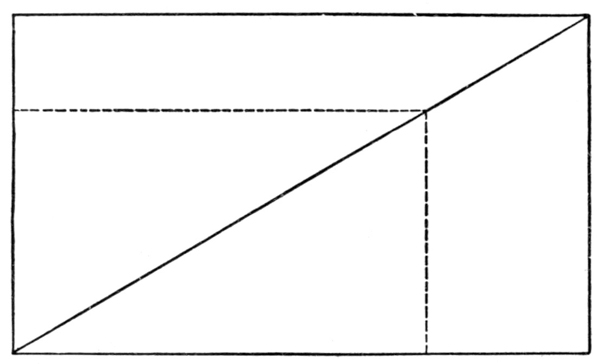
Reducing Scale for Copying Photographs.
Turn the drawing face down and rule a diagonal line from the left bottom to the right top corner. Then measure from the left, on the bottom line, the width required. Rule a vertical line from that point until it meets the diagonal. Rule from that point to the left, and the resulting figure will have the exact proportions of the reduction. If the depth wanted is known, and the width is required, the former should be measured on the left upright line, carried to the diagonal, and thence to the lower horizon. The accompanying diagram explains the matter simply.
Color Photography:
A Three-color Process.—Prepare 7 solutions, 4 of which are used for color screens, the remaining 3 serving as dyes for the plates.
A.—Screen Solutions.—
Blue violet.
By weight
Methylene blue 5 parts
Tetraethyldiamidooxytriphenyl carbinol 2 parts
Or:
Methyl violet 5 parts
Alcohol 200 parts
Water, distilled 300 parts
Green.
By weight
Malachite green 10 parts
Alcohol 200 parts
Water, distilled 300 parts
{549}
Yellow.
By weight
Acridin yellow N. O. 10 parts
Alcohol 200 parts
Water, distilled 300 parts
Red.
By weight
Congo rubin 10 parts
Alcohol 200 parts
Water, distilled 300 parts
B.—Dyes (Stock Solutions).—
By weight
I.— Acridin yellow or acridin orange, N. O. 1 part
Alcohol 100 parts
Water, distilled 400 parts
II.— Congo rubin 1 part
Alcohol 100 parts
Water, distilled 400 parts
III.— Tetraethyldiamidooxytriphenyl carbinol 1 part
Alcohol 100 parts
Water, distilled 400 parts
The screen solutions, after being filtered through paper filters into clean dishes, are utilized to bathe 6 clean glass plates previously coated with 2 per cent raw collodion; we require 1 plate for blue violet, 2 plates for red, 2 plates for yellow, and 1 plate for green, which in order to obtain the screens are combined in the following way: Yellow and red plate, yellow and green plate. For special purposes the other red plate may be combined with the blue violet. Another method of preparing the screens is to add the saturated solutions drop by drop to a mixture of Canada balsam and 2 per cent castor oil and cement the glasses together. Those who consider the screens by the first method too transparent, coat the glass plates with a mixture of 2 to 3 per cent raw collodion and 1 per cent color solution. Others prefer gelatin screens, using
By weight
Hard gelatin (Nelson’s) 8 parts
Water 100 parts
Absolute alcohol 10 parts
Pigment 1 part
This is poured over the carefully leveled and heated plate after having been filtered through flannel.
The collodion screens are cemented together by moistening the edges with Canada balsam (containing castor oil) and pressing the plates together in a printing frame, sometimes also binding the edges with strips of Japanese paper.
On the evening before the day of work, good dry plates of about 18° to 24° W. are dyed in the following solution:
By weight
Stock solution, No. 1 16 parts
Distilled water 100 parts
Alcohol 5 parts
Nitrate of silver (1.500) 50 parts
Ammonia 1–2 parts
This bath sensitizes almost uninterruptedly to line A. The total sensitiveness is high, and the plate develops cleanly and fine. Blue sensitiveness is very much reduced, and the blue screen is used for exposure. As far as the author’s recollection goes, the plate for the yellow color has never been color-sensitized, many operators using the commercial Vogel-Obernetter eosin silver plates made by Perutz, of Munich; others again only use ordinary dry plates with a blue-violet screen. This is, however, a decided mistake, necessitating an immense amount of retouching, as otherwise it produces a green shade on differently colored objects of the print.
For the red color plate the dry plate is dyed in
By weight
Stock solution, No. 2 10 parts
Distilled water 100 parts
Nitrate of silver (1.500) 100 parts
Ammonia 2 parts
The resulting absorption band is closed until E, reaching from violet to red (over C). This red pigment was examined by Eder, who obtained very good results, using ammonia in the solution.
The corresponding screen is a combination of malachite green with acridin yellow or acridin orange N. 0.
For the blue color plate the dye is made up as follows:
By weight
Stock solution, No. 3 0.5–1 part
Distilled water 100 parts
Nitrate of silver (1.500) 100 parts
Ammonia 1–2 parts
This dye yields a strong band, commencing at B, reaching to C 3/4 D; since the orange screen used herewith necessitates a long exposure, the action seems to extend into the infra-red (beyond A).
As a rule, cyanine is used instead of the tetraethyldiamidooxytriphenyl carbinol {550} (HCl salt), but the former is apt to produce fogged plates. Methyl violet or crystal violet has also been suggested.
Exposures should be made in direct sunlight or with artificial pure white light (acetylene); electric light is too variable.
The most suitable methods of reproduction are half-tone, and the prototype methods; also Turati’s Isotypie. The greatest difficulty in 3-color printing nowadays is presented by the want of accurate printing. We must use the proper paper and pure fast colors; the inking rollers should be smooth, not too soft, and free from pores or weals. The blocks must be firmly fixed typehigh, otherwise they take color irregularly. A good printing machine is, of course, most essential.
To supplement the above working directions: After having kept the plates for 2 or 3 minutes (constantly moving the dish) in the dyes, they are removed into a dish containing filtered alcohol, which extracts the superfluous pigment. Plates thus treated dry much more rapidly, develop cleaner, and show no fogging.
Most of the above dyes may be obtained from the “Berliner Actiengesellschaft für Anilinfabrikation,” the acridin only from the “Farbwerk Mühlheim, a/Main, vorm. A. Leonhard & Company.”
Solution For Preparing Color Sensitive Plates.—H. Vollenbruch maintains that plates sensitized with erythrosin silver citrate are not only more sensitive to color impressions, but also have better keeping qualities than ordinary erythrosin bathed plates.
For depression of the over-active blue rays he recommends the addition of picric acid to the coloring solution. The picric acid erythrosin silver citrate ammonia solution is prepared as follows:
Solution I
Citrate of potassa 1 gram
Distilled water 10 cubic centimeters
Solution II
Silver nitrate 1 gram
Distilled water 10 cubic centimeters
Both solutions are mixed and a white precipitate is formed which is allowed to subside. The clear supernatant liquid is poured off carefully, precipitate washed with water, allowed again to subside, and the wash water again decanted. This process is repeated two or three times. Finally a large bulk of water (20 cubic centimeters) is added to the precipitate and well shaken; 5 cubic centimeters of this is reserved, the remainder is treated to ammonia, drop by drop, until the precipitate is redissolved. Now add the 5 cubic centimeters of reserved solution and shake the whole until every particle is dissolved. Then make up the solution to 50 cubic centimeters and filter; this forms Solution III.
Solution IV
Distilled water 300 cubic centimeters
Pure erythrosin 1 grain
Under lamplight the 50 cubic centimeters of Solution III are poured slowly with repeated shaking in Solution IV, by which the originally beautiful red is converted into a dirty turbid bluish red somewhat viscid fluid; add—
Solution V
Picric acid 4 grams
Absolute alcohol 30 cubic centimeters
Shake well, and add to the whole 33 cubic centimeters ammonia (specific gravity, 0.91), wherewith the beautiful red color is restored.
After the filtration call this Solution VI. This solution keeps well. The slight deposit formed is redissolved on shaking.
The plates are sensitized as follows: The plate to be sensitized is first laid in a tray of distilled water for 2 or 3 minutes, then bathed in a mixture of 1 cubic centimeter ammonia for 1 minute and finally for 2 minutes in a bath composed of the following:
Color Solution VI 10 cubic centimeters
Distilled water 300 cubic centimeters
The plate is well drained and dried in a perfectly dark room. These plates keep well for several months.
Microphotographs.
The instruments used are an objective of very short focus and a small camera with a movable holder. This camera and the original negative to be reduced are fastened to the opposite ends of a long, heavy board, similar to the arrangement in use for the making of lantern slides. The camera must be movable in the direction of the objective axis, and the negative must be fastened to a vertically stationary stand. It is then uniformly lighted from the reversed side by either daylight or artificial light. Some difficulty is experienced in getting a sharp focus of the picture. The ordinary ground glass cannot be used, not {551} being fine enough, and the best medium for this purpose is a perfectly plain piece of glass, coated with pretty strongly iodized collodion, and sensitized in the silver bath, the same way as in the wet process. The focusing is done with a small lens or even with a microscope. The plate intended for the picture has, of course, to lie in exactly the same plane as the plate used for focusing. To be certain on this point, it is best to focus upon the picture plate, inserting for this purpose a yellow glass between objective and plate. If satisfactory sharpness has been obtained, the apparatus is once for all in order for these distances. Bromide of silver gelatin plates, on account of their comparatively coarse grain, are not suitable for these small pictures, and the collodion process has to come to the rescue.
Dagron, in Paris, a prominent specialist in this branch, gives the following directions: A glass plate is well rubbed on both sides with a mixture of 1,000 parts of water, 50 parts powdered chalk, and 200 parts of alcohol, applied with a cotton tuft, after which it is gone over with a dry cotton tuft, and thereafter cleaned with a fine chamois leather. The side used for taking the picture is then finally cleaned with old collodion. The collodion must be a little thinner than ordinarily used for wet plates. Dissolve
Ether 400 parts
Alcohol 100 parts
Collodion cotton 3 parts
Iodide ammonia 4 parts
Bromide ammonia 1 part
The plate coated herewith is silvered in a silver bath of 7 or 8 per cent. From 12 to 15 seconds are sufficient for this.
The plate is then washed in a tray or under a faucet with distilled water, to liberate it from the free nitrate of silver and is afterwards placed upon blotting paper to drip off. The still moist plate is then coated with the albumen mixture:
Albumen 150 cubic centimeters
Add
Water 15 cubic centimeters
Iodide potassium 3 grams
Ammonia 5 grams
White sugar 2 grams
Iodine, a small cake.
With a wooden quirl this is beaten to snow (foam) for about 10 minutes, after which it must stand for 14 hours to settle. The albumen is poured on to the plate the same as collodion, and the surplus filtered back. After drying, the plate is laid for 15 seconds in a silver bath, consisting of 100 parts of water, 10 parts nitrate of silver, and 10 cubic centimeters of acetic acid. The plate is then carefully washed and left to dry. If carefully kept, it will retain its properties for years. To the second silver bath, when it assumes a dirty coloration, is added 25 parts kaolin to each 100 parts, by shaking the same well, and the bath is then filtered, after which a little nitrate of silver and acetic acid is added.
After each exposure the plate holder is moved a certain length, so that 10 or more reproductions are obtained upon one and the same plate. The time of exposure depends upon the density of the negative and differs according to light. It varies between a second and a minute.
The developer is composed as follows:
Water 100 parts
Gallic acid 0.3 parts
Pyro 0.1 part
Alcohol 2.5 parts
The exposed plate is immersed in this bath, and after 10 to 20 seconds, from 1 to 2 drops of a 2 per cent nitrate of silver solution are added to each 100 cubic centimeters of the solution, whereby the picture becomes visible. To follow the process exactly, the plate has to be laid—in yellow light—under a weakly enlarging microscope, and only a few drops of the developer are put upon the same. As soon as the picture has reached the desired strength, it is rinsed and fixed in a fixing soda solution, 1 to 5. Ten to 15 seconds are sufficient generally. Finally it is washed well.
After the drying of the plate, the several small pictures are cut with a diamond and fastened to the small enlarging lenses. For this purpose, the latter are laid upon a metal plate heated from underneath, a drop of Canada balsam is put to one end of the same, and, after it has become soft, the small diapositive is taken up with a pair of fine pincers, and is gradually put in contact with the fastener. Both glasses are then allowed to lie until the fastener has become hard. If bubbles appear, the whole method of fastening the picture has to be repeated.
Photographs On Brooches.—These may be produced by means of a paper (celuidin paper) whose upper layer after exposure by means of ordinary negative can be detached in lukewarm water. The picture copied on this paper is first laid in tepid water. After a few minutes it is taken out and placed on the article in question, naturally with the face upon it. The enamel surface upon which the {552} picture is laid is previously coated with gelatin solution to insure a safe adhesion. When dry, the article is placed in water in which the paper is loosened and the photographic image now adheres firmly to the object. It may now be colored further and finally is coated with a good varnish.
Flashlight Powders And Apparatus.
Flash powders to be ignited by simply applying the flame of a match or laying on an oiled paper and igniting that, may be made by the following formulas:
I.— Magnesium 6 parts
Potassium chlorate 12 parts
II.— Aluminum 4 parts
Potassium chlorate 10 parts
Sugar 1 part
The ingredients in each case are to be powdered separately, and then lightly mixed with a wooden spatula, as the compound may be ignited by friction and burn with explosive violence.
It is best to make only such quantity as may be needed for use at the time, which is 10 or 15 grains.
To Prevent Smoke From Flashlight.—Support over the point where the ignition is to take place a large flat pad of damp wool lint. This may be done by tacking the lint to the underside of a board supported on legs. When ignition takes place the products of combustion for the most part will become absorbed by the wool.
A Flashlight Apparatus With Smoke Trap.—A light box, not too large to be conveniently carried out into the open air, is the first essential, and to the open front of this grooves must be fitted, in which grooves a lid will slide very easily, a large sheet of millboard being convenient as a sliding lid. The box being so placed that the sliding lid can be drawn out upward, a thread is attached to the lower edge of the lid, after which the thread is passed over a pulley fixed inside the box near the top, when the end is attached to the bottom of the box, so that the thread holds the sliding lid up. The lid will then slide down the grooves quickly, and close the box, if the thread is severed, the thread being cut at the right instant by placing the lower part across the spot where the flash is to be produced. So small is the cloud of smoke at the first instant that practically the whole of it can be caught in a drop trap of the above-mentioned kind. If the apparatus is not required again for immediate use, the smoke may be allowed to settle down in the box; but in other cases the box may be taken out into the open air, and the smoke buffeted out with a cloth. In the event of several exposures being required in immediate succession, the required number of apparatus might be set up, as each need not cost much to construct.
Intensifiers And Reducers:
Intensifier (Mercuric) With Sodium Sulphite, For Gelatin Dry Plates.—Whiten the negative in the saturated solution of mercuric chloride, wash and blacken with a solution of sulphite of sodium, 1 in 5. Wash well.
The reduction is perfect, with a positive black tone.
Intensifier With Iodide Of Mercury.—Dissolve 1 drachm of bichloride of mercury in 7 ounces of water and 3 drachms of iodide of potassium in 3 ounces of water, and pour the iodide solution into the mercury till the red precipitate formed is completely dissolved.
For use, dilute with water, flow over the negative till the proper density is reached, and wash, when the deposit will turn yellow. Remove the yellow color by flowing a 5 per cent solution of hypo over the plate, and give it the final washing.
Agfa Intensifier.—One part of agfa solution in 9 parts water (10 per cent solution). Immerse negative from 4 to 6 minutes.
Intensifying Negatives Without Mercury.—Dissolve 1 part of iodine and 2 parts of potassium iodide in 10 parts of water. When required for use, dilute 1 part of this solution with 100 parts of water. Wash the negative well and place in this bath, allowing it to remain until it has become entirely yellow, and the image appears purely dark yellow on a light-yellow ground. The negative should then be washed in water until the latter runs off clearly, when it is floated with the following solution until the whole of the image has become uniformly brown:
Schlippe’s salt 60 grains
Water 1 ounce
Caustic soda solution, 10 per cent 6 drops
Finally the negative is again thoroughly washed and dried. The addition of the small quantity of caustic soda is to prevent surface crystallization. It is claimed that with this intensifier the operation may be carried out to a greater {553} extent than with bichloride of mercury; that it gives clear shadows, and that it possesses the special advantage of removing entirely any yellow stain the negative may have acquired during development and fixing. Furthermore, with this intensifying method it is not necessary to wash the negative, even after fixing, as carefully as in the case of the intensifying processes with mercury, because small traces of hypo which may have been left in the film will be rendered innocuous by the free iodine. The iodine solution may be employed repeatedly if its strength is kept up by the addition of concentrated stock solution.
Uranium Intensifier.—
Potassium ferricyanide (washed) 48 grains
Uranium nitrate 48 grains
Sodium acetate 48 grains
Glacial acetic acid 1 ounce
Distilled water to 10 ounces.
Label: Poison. Immerse the well-washed negative till the desired intensification is reached, rinse for 5 minutes and dry. This intensifier acts very strongly and should not therefore be allowed to act too long.
Miscellaneous Formulas:
Renovating A Camera.—The following formula should be applied to the mahogany of the camera by means of a soft rag, rubbing it well in, finally polishing lightly with a clean soft cloth:
Raw linseed oil 6 ounces
White wine vinegar 3 ounces
Methylated spirit 3 ounces
Butter of antimony 1/2 ounce
Mix the oil with vinegar by degrees, shaking well to prevent separation after each addition, then add the spirit and antimony, and mix thoroughly. Shake before using.
Exclusion Of Air From Solutions.—Water is free from air only when it has been maintained for several minutes in bubbling ebullition. In order to keep out the air from the bottle, when using the contents, the air-pressure contrivances are very convenient; one glass tube reaching through the rubber stopper into the bottle to the bottom, while the second tube, provided with a rubber pressing-ball, only runs into the flask above. If the long bent tube is fitted with a rubber tube, a single pressure suffices to draw off the desired quantity of the developer. It is still more convenient to pour a thin layer of good sweet oil on top of the developer besides. The developer is not injured thereby, and the exclusion of air is perfect.
Bottle Wax.—Many ready-prepared solutions, such as developers and other preparations from which light has to be excluded, should be packed in bottles whose neck, after complete drying of the stopper, is dipped in a pot with molten sealing wax. A good recipe is the following, pigments being added if desired: For black take: Colophony, 6 parts; paraffine, 3 parts. Melt together and add 20 parts of black. For yellow, only 7 parts of chrome yellow. For blue, 7 parts of ultramarine.
Bleaching Photographic Prints White.—To make a salt print, ink over it with waterproof ink, then bleach out white all but the black lines. Sensitize Clemon’s mat surface paper on a 40-grain bath of nitrate of silver. After fuming and printing, the print is thoroughly fixed in hyposulphite of soda solution, and washed in running water until every trace of the hypo is out of the print. On this the permanency of the bleaching operation depends. The bleaching bath is:
Bichloride of mercury 1 ounce
Water 5 ounces
Alcohol 1 ounce
Hydrochloric acid 1 drachm
If the drawing has been made with non-waterproof ink, then alcohol is substituted for the water in the formula. For safety, use an alcoholic solution of mercury. The bleaching solution is poured on and off the drawing, and, when the print is bleached white, the mercury is washed off the drawing by holding it for a few moments under running water. Photographs bleached in this way will keep white for years.
To Render Negatives Permanent.—A fine negative, one that we would like to preserve, may be rendered permanent by placing it, after it has been fixed, in a 10 per cent solution of alum, and letting it remain a few minutes. This makes the plate wonderfully clear and clean, and absolutely unalterable. The alum acts upon the gelatin, rendering it insoluble.
Stripping Photograph Films.—This is generally done by immersing the plate in formaldehyde solution until the film has become almost insoluble and impermeable. Then it is placed in a solution of sodium carbonate until the gelatin has absorbed a sufficient quantity of it. When the negative is immersed in weak hydrochloric acid, carbon {554} dioxide is liberated, and the little bubbles of gas which lodge themselves between the film and the glass cause a separation of the two, so that the film may be stripped off. After having hardened the film with formaldehyde, it is a lengthy process to get it saturated with sodium carbonate. It is advisable to use a combined bath of 1 part of carbonate, 3 of 40 per cent formaldehyde, and 20 of water; its tanning action is enhanced by the alkaline reaction, and two operations are superseded by one. After 10 minutes’ soaking, the surface of the film must be wiped and the plate dried. A sharp knife is then used to cut all around the film a slight distance from the edge, and when this is done the negative is put into a 5 per cent solution of hydrochloric acid, when the film will probably float off unaided; but, if necessary, may be assisted by gently raising one corner.
Phosphorescent Photographs.—The necessary chemicals belong to the class of phosphorescent bodies, among others, calcium sulphite, strontium sulphite, barium sulphide, calcareous spar, fluorspar. These placed in the magnesium light or sunlight, acquire the property of giving forth, for a shorter or longer time, a light of their own. The best examples of these substances are the well-known “Balmains light colors,” which yield a very clear and strong light after exposure. They consist of calcium sulphide, 10,000 parts; bismuth oxide, 13 parts; sodium hyposulphite, 1,000 parts.
According to Professor Schnauss, plates for phosphorographs are prepared as follows: Dissolve 10 parts of pure gelatin in 50 parts of hot water, add and dissolve 30 parts of “light” color (as above), and 1 part of glycerine.
If a plate or a paper, prepared as above detailed, be placed under a diapositive, in a copying apparatus, and submitted to the action of sunlight for a few minutes, when taken out in a dark room a phosphorescent picture of the diapositive will be found. It is also a known fact that duplicate negatives or positives may be made with this phosphorograph by simply bringing the latter in contact in a copying apparatus, with the ordinary silver bromide plate for 30 seconds, in the dark room, and then developing the same.
Printing Names On Photographs.—The name or other matter to be printed on the photograph is set up in type, and printed on cardboard; from this make an exposure on a transparency plate, developing it strongly. After the print has been made from the regular printing negative, it is placed under the dense transparency of the regular negative, and the name printed in. The only precaution necessary is to time the transparency negative properly, and develop strongly, so as to get good contrast. Photographers will find this a much easier and quicker method than the old one of printing on tissue paper and fastening the paper to the negative by means of varnish; moreover, the result is black instead of white, usually much more pleasing.
Spots On Photographic Plates.—Spots on photographic plates may be caused by dust or by minute bubbles in the emulsion, both of which are easily preventable, but some spots cannot be ascribed to either of these causes. On investigating this trouble, Mumford found that it is due to the presence on the surface of the film of small colonies of microorganisms which, under conditions favorable to their growth, are capable of producing large mold colonies, from which the organisms can easily be separated. Experiments were instituted in order to find whether these growths can be produced on the plate by artificial means, by inoculating the surface with a fluid culture of one of these organisms, with affirmative results, but with one slight difference, namely, that in the inoculated film, on microscopic examination, no dust particle was visible in the center of each spot, which had formerly been the case. As these microorganisms do not exist in the air as isolated units, but travel upon small or large dust particles in the case under consideration, the carrying medium most probably is the fine impalpable dust from which it is practically impossible to free the air of a building. In order that these organisms may grow into colonies of sufficient size to cause spots, they must be able to grow rapidly, there being only about 12 hours before the plate is dry in which they can grow; and they must also be capable of growing at the rather high temperature of 70° F. On testing some of the organisms causing the spots it was found that they grew best under exactly such conditions. A bacteriological examination of some of the gelatin used in the manufacture of plates, both in the raw state and in the form of emulsion, also revealed the fact that there were numerous organisms present. No means for the prevention of this troublesome defect is suggested; {555} most dry-plate manufacturers use the precaution to add a small quantity of a chemical antiseptic to the emulsion, but it is not possible to employ a sufficient quantity to destroy any organisms that may be present without damaging the plate for photographic purposes.
To Remove Pyro Stains From The Fingers.—Make a strong solution of chlorinated lime; dip the fingers which are stained in this, and rub the stains with a large crystal of citric acid. Apply the lime solution and acid alternately until the stain is removed; then rinse with water.
To Remove Pyro Stain From Negatives.—Immerse in a clearing bath as follows:
Protosulphate of iron 3 ounces
Alum 1 ounce
Citric acid 1 ounce
Water 20 ounces
Prevention is better than cure, however; therefore immerse the negatives in the above directly they are taken from the fixing bath. After clearing the negatives, they should be well washed.
PHOTOGRAPHY WITHOUT LIGHT: See Catatypy.
PIANO POLISHES: See Polishes.
PICKLE FOR BRASS: See Brass and Plating.
PICKLE FOR BRONZE: See Bronze Coloring.
PICKLE FOR COPPER: See Copper and Plating.
PICKLE VINEGAR: See Vinegar.
PICKLING OF GERMAN-SILVER ARTICLES: See Plating.
PICKLING IRON SCRAP BEFORE ENAMELING: See Enameling.
PICRIC ACID STAINS, TO REMOVE: See Cleaning Preparations and Methods.
PICTURE COPYING: See Copying.
PICTURE FRAMES, REPAIRING: See Adhesives and Lutes.
PICTURE POSTAL CARDS: See Photography.
PIGMENTS
(See also Paints.)
Nature, Source, And Manufacture Of Pigments.
—A pigment is a dry earthy or clayey substance that, when mixed with oil, water, etc., forms a paint. Most pigments are of mineral origin, but there are vegetable pigments, as logwood, and animal pigments, as cochineal. In modern practice the colors are produced mainly by dyeing certain clays, which excel in a large percentage of silicic acid, with aniline dyestuffs. The coloring matters best adapted for this purpose are those of a basic character. The colors obtained in this manner excel in a vivid hue, and fastness to light and water.
Following is a general outline of their manufacture: One hundred parts, by weight, of washed clay in paste form are finely suspended in 6 to 8 times the volume of water and acidulated with about 1 1/2 parts, by volume, of 5 per cent hydrochloric or acetic acid, and heated by means of steam almost to the boiling temperature. There is next introduced, according to the shade desired, 1 to 2 parts, by weight, of the dyestuff, such as auramin, diamond green, Victoria blue, etc., with simultaneous stirring and heating, for 1 to 2 hours, or until a sample filtered off from the liquor shows no dyestuff. Next the clay dyed in this manner is isolated by filtration and washed with hot water and dried. The colors thus obtained may be used as substitutes for mineral colors of all description.
The method of manufacture varies greatly. According to the Bennett and Mastin English patent the procedure is as follows: Grind together to a paste in water, substances of a clayey, stony, earthy, or vitreous nature, and certain metallic oxides, or “prepared oxides,” such as are commonly used in the pottery trades; dry and powder the paste, and subject the powder to the heat of a furnace, of such a temperature that the requisite color is obtained, and for such length of time that the color strikes through the whole substance. For example, 8 parts of black oxide of cobalt, 12 parts of oxide of zinc, and 36 parts of alumina, when incorporated with 20 times their combined bulk of clay and treated as described, yield a rich blue pigment in the case of a white clay, and a rich green in the case of a yellow clay. Long-continued firing in this case improves the color.
Many minerals included in formulas for pigments have little or no coloring power in themselves; nevertheless they {556} are required in producing the most beautiful shades of color when blended one with another, the color being brought out by calcination.
Mixing Oil Colors And Tints.
—It must not be expected that the formulas given will produce the exact effect desired, because the strength of the various brands of colors vary to a great extent, and therefore the painter must exercise his own judgment. The table simply gives an idea of what can be produced by following the formulas given, when chemically pure material is employed in the mixing. It is also recommended that the parts mentioned be weighed out in paste form, and the white or black and each color separately thinned and strained before mixing them together, because the arriving at the proper hue of color or depth and tone of tint will be simplified by using that precaution. By thinning it is not meant that they should be quite ready for application, but of such consistency that they will pass an ordinary strainer with the aid of a brush.
Unless otherwise indicated, the materials are understood to be ground fine in paste form.
NOTE.—The majority of the following are by Joseph Griggs, in the Painters’ Magazine:
Grounds For Graining Colors:
Ash Ground.—Four hundred parts white lead; 4 parts French ocher; 1 part raw Turkey umber.
Ash.—Raw umber; raw sienna; and a little black or Vandyke brown.
Hungarian Ash.—Raw sienna and raw and burnt umber.
Bun Ash.—Raw sienna; burnt umber; and Vandyke brown.
Cherry Ground.—One hundred parts white lead; 5 parts burnt sienna; 1 part raw sienna.
Natural Cherry.—Raw and burnt sienna and raw umber.
Stained Cherry.—Burnt sienna; burnt umber; and Vandyke brown.
Chestnut.—Raw sienna; burnt umber; Vandyke brown; and a little burnt sienna.
Maple.—Raw sienna and raw umber.
Silver Maple.—Ivory black over a nearly white ground.
Light Maple Ground.—One hundred parts white lead; 1 part French ocher.
Dark Maple Ground.—One hundred parts white lead; 1 part dark golden ocher.
Oak.—Raw sienna; burnt umber; a little black.
Pollard Oak.—Raw and burnt sienna, or burnt umber and Vandyke brown.
Light Oak Ground.—Fifty parts white lead; 1 part French ocher.
Dark Oak Ground.—Fifty parts white lead; 1 part dark golden ocher.
Satinwood.—Add a little ivory black to maple color.
Mahogany.—Burnt sienna; burnt umber; and Vandyke brown.
Mahogany Ground.—Ten parts white lead; 5 parts orange chrome; and 1 part burnt sienna.
Rosewood.—Vandyke brown and a little ivory black.
Rosewood Ground.—Drop black.
Walnut Ground.—Fifty parts white lead; 3 parts dark golden ocher; 1 part dark Venetian red; and 1 part drop black.
Black Walnut.—Burnt umber with a little Vandyke brown for dark parts.
French Burl Walnut.—Same as black walnut.
Hard Pine.—Raw and burnt sienna; add a little burnt umber.
Cypress.—Raw and burnt sienna and burnt umber.
Whitewood.—Ground same as for light ash; graining color, yellow ocher, adding raw umber and black for dark streaks.
Positive Colors:
Blue.—Twelve parts borate of lime; 6 parts oxide of zinc; 10 parts litharge; 9 parts feldspar; 4 parts oxide of cobalt.
Blue Black A.—Nine parts lampblack; 1 part Chinese or Prussian blue.
Blue Black B.—Nineteen parts drop black; 1 part Prussian blue.
Bright Mineral.—Nine parts light Venetian red; 1 part red lead.
Brilliant Green.—Nine parts Paris green; 1 part C. C. chrome green, light.
Bronze Green, Light.—Three parts raw Turkey umber; 1 part medium chrome yellow.
Bronze Green, Medium.—Five parts medium chrome yellow; 3 parts burnt Turkey umber; 1 part lampblack.
Bronze Green, Dark.—Twenty parts drop black; 2 parts medium chrome yellow; and 1 part dark orange chrome. {557}
Bottle Green.—Five parts commercial chrome green, medium, and 1 part drop black.
Brown.—Ten parts crude antimony; 12 parts litharge; 2 parts manganese; 1 part oxide of iron.
Brown Stone.—Eighteen parts burnt umber; 2 parts dark golden ocher; and 1 part burnt sienna.
Cherry Red.—Equal parts of best imitation vermilion and No. 40 carmine.
Citron A.—Three parts medium chrome yellow and 2 parts raw umber.
Citron B.—Six parts commercial chrome green, light, and 1 part medium chrome yellow.
Coffee Brown.—Six parts burnt Turkey umber; 2 parts French ocher; and 1 part burnt sienna.
Emerald Green.—Use Paris green.
Green.—Twenty parts litharge; 12 parts flint; 2 parts oxide of copper; 2 1/2 parts ground glass; 2 1/2 parts whiting; 1 1/2 parts oxide of chrome.
Flesh Color.—Nineteen parts French ocher; 1 part deep English vermilion.
Fern Green.—Five parts lemon chrome yellow and 1 part each of light chrome green and drop black.
Foliage Green.—Three parts medium chrome yellow and 1 part of ivory or drop black.
Foliage Brown.—Equal parts of Vandyke brown and orange chrome yellow.
Golden Ocher.—Fourteen parts French yellow ocher and 1 part medium chrome yellow for the light shade, and 9 parts Oxford ocher and 1 part orange chrome yellow for the dark shade.
Gold Russet.—Five parts lemon chrome yellow and 1 part light Venetian red.
Gold Orange.—Equal parts of dry orange mineral and light golden ocher in oil.
Indian Brown.—Equal parts of light Indian red, French ocher, and lamp black
Mahogany, Cheap.—Three parts dark golden ocher and 1 part of dark Venetian red.
Maroon, Light.—Five parts dark Venetian red; 1 part drop black.
Maroon, Dark.—Nine parts dark Indian red; 1 part lampblack.
Olive Green.—Seven parts light golden ocher; 1 part drop black.
Ochrous Olive.—Nine parts French ocher; 1 part raw umber.
Orange-Brown.—Equal parts burnt sienna and orange chrome yellow.
Oriental Red.—Two parts Indian red, light, in oil; 1 part dry red lead.
Purple A.—Eight parts crocus martis; 2 parts red hematite; 1 part oxide of iron.
Purple B.—Two parts rose pink; 1 part ultramarine blue.
Purple Black.—Three parts lampblack and 1 part rose pink, or 9 parts drop black and 1 part rose pink.
Purple Brown.—Five parts Indian red, dark, and 1 part each of ultramarine blue and lampblack.
Roman Ocher.—Twenty-three parts French ocher and 1 part each burnt sienna and burnt umber.
Royal Blue, Dark.—Eighteen parts ultramarine blue and 2 parts Prussian blue. To lighten use as much white lead or zinc white as is required.
Royal Purple.—Two parts ultramarine blue; 1 part No. 40 carmine or carmine lake.
Russet.—Fourteen parts orange chrome yellow and 1 part C. P. chrome green, medium.
Seal Brown.—Ten parts burnt umber; 2 parts golden ocher, light; 1 part burnt sienna.
Snuff Brown.—Equal parts burnt umber and golden ocher, light.
Terra Cotta.—Two parts white lead; 1 part burnt sienna; also 2 parts French ocher to 1 part Venetian red.
Turkey Red.—Strong Venetian red or red oxide.
Tuscan Red. Ordinary.—Nine parts Indian red to 1 part rose pink.
Brilliant.—Four parts Indian red to 1 part red madder lake.
Violet.—Three parts ultramarine blue; 2 parts rose lake; 1 part best ivory black.
Yellow.—Four and one-half parts tin ashes; 1 part crude antimony; 1 part litharge; and 1 part red ocher.
Yellow, Amber.—Ten parts medium chrome yellow; 7 parts burnt umber; 3 parts burnt sienna.
Yellow, Canary.—Five parts white lead; 2 parts permanent yellow; 1 part lemon chrome yellow.
Yellow, Golden.—Ten parts lemon chrome yellow; 3 parts orange chrome, dark; 5 parts white lead.
Yellow, Brimstone.—Three parts white lead; 1 part lemon chrome yellow; 1 part permanent yellow. {558}
Azure Blue.—Fifty parts white lead; 1 part ultramarine blue.
Blue Gray.—One hundred parts white lead; 3 parts Prussian blue; 1 part lampblack.
Bright Blue.—Twenty parts zinc white; 1 part imitation cobalt blue.
Blue Grass.—Seven parts white lead; 2 parts Paris green; 1 part Prussian blue.
Deep Blue.—Fifteen parts white lead; 1 part Prussian blue or Antwerp blue.
French Blue.—Five parts imitation cobalt blue; 2 parts French zinc white.
Green Blue.—One hundred parts white lead; 5 parts lemon chrome yellow; 3 parts ultramarine blue.
Hazy Blue.—Sixty parts white lead; 16 parts ultramarine blue; 1 part burnt sienna.
Mineral Blue.—Five parts white lead; 4 parts imitation cobalt blue; 2 parts red madder lake; 1 part best ivory or drop black.
Orient Blue.—Twenty-five parts white lead; 2 parts Prussian blue; 1 part lemon chrome yellow.
Royal Blue.—Thirty-four parts white lead; 19 parts ultramarine blue; 2 parts Prussian blue; 1 part rose madder or rose lake.
Sapphire Blue.—Two parts French zinc white and 1 part best Chinese blue.
Sky Blue.—One hundred parts white lead; 1 part Prussian blue.
Solid Blue.—Five parts white lead; 1 part ultramarine blue.
Turquoise Blue.—Twenty parts white lead; 3 parts ultramarine blue; 1 part lemon chrome yellow.
Red Tints:
Cardinal Red.—Equal parts of white lead and scarlet lake.
Carnation Red.—Fifteen parts white lead; 1 part scarlet lake.
Claret.—Twenty-one parts oxide of zinc; 4 parts crocus martis; 4 parts oxide of chrome; 3 parts red lead; 3 parts boracic acid.
Coral Pink.—Fifteen parts white lead; 2 parts bright vermilion; 1 part deep orange chrome.
Deep Rose.—Ten parts white lead; 1 part red lake.
Deep Purple.—Five parts white lead; 1 part ultramarine blue; 1 part rose pink.
Deep Scarlet.—Fifteen parts bright vermilion; 2 parts red lake; 5 parts white lead.
Flesh Pink.—One hundred parts white lead; 1 part orange chrome yellow; 1 part red lake.
Indian Pink.—One hundred parts white lead; 1 part light Indian red.
Lavender.—Fifty parts white lead; 2 parts ultramarine blue; 1 part red lake.
Light Pink.—Fifty parts white lead; 1 part bright vermilion.
Lilac.—Fifty parts white lead; 1 part best rose pink.
Mauve.—Fifteen parts white lead; 2 parts ultramarine blue; 1 part carmine lake or red lake.
Orange Pink.—Two parts white lead; 1 part dark orange chrome or American vermilion.
Purple.—Five parts white lead; 2 parts ultramarine blue; 1 part red madder lake.
Royal Pink.—Five parts white lead; 1 part carmine lake or red madder lake.
Royal Rose.—Twenty parts white lead; 1 part rich rose lake.
Red Brick.—Ten parts white lead; 3 parts light Venetian red; 1 part yellow ocher.
Reddish Terra Cotta.—Two parts white lead; 1 part rich burnt sienna.
Salmon.—Fifty parts white lead; 5 parts deep orange chrome.
Shell Pink.—Fifty parts white lead; 2 parts bright vermilion; 1 part orange chrome; 1 part burnt sienna.
Violet.—Fifteen parts white lead; 4 parts ultramarine blue; 3 parts rose lake; 1 part drop black.
Green Tints:
Apple Green.—Fifty parts white lead; 1 part chrome green, light or medium shade.
Citrine Green.—One hundred parts white lead; 2 parts medium chrome yellow; 1 part drop black.
Citron Green.—One hundred parts white lead; 3 parts medium chrome yellow; 1 part lampblack.
Emerald Green.—Ten parts white lead; 1 part Paris (emerald) green.
Grass Green A.—Five parts white lead; 7 parts Paris green.
Grass Green B.—Ten parts oxide of chrome; 2 parts tin ashes; 5 parts whiting; 1 part crocus martis; 1 part bichromate potash.
Gray Green.—Five parts white lead; 1 part Verona green. {559}
Marine Green.—Ten parts white lead; 1 part ultramarine green.
Nile Green.—Fifty parts white lead; 6 parts medium chrome green; 1 part Prussian blue.
Olive Green.—Fifty parts white lead; 2 parts medium chrome yellow; 3 parts raw umber; 1 part drop black.
Olive Drab.—Fifty parts white lead; 8 parts raw umber; 5 parts medium chrome green; 1 part drop black.
Pea Green.—Fifty parts white lead; 1 part light chrome green.
Satin Green.—Three parts white lead; 1 part Milori green.
Sage Green.—One hundred parts white lead; 3 parts medium chrome green; 1 part raw umber.
Sea Green.—Fifty parts white lead; 1 part dark chrome green.
Stone Green.—Twenty-five parts white lead; 2 parts dark chrome green; 3 parts raw umber.
Velvet Green.—Twenty parts white lead; 7 parts medium chrome green; 2 parts burnt sienna.
Water Green.—Fifteen parts white lead; 10 parts French ocher; 1 part dark chrome green.
Brown Tints:
Chocolate.—Twenty-five parts white lead; 3 parts burnt umber.
Cocoanut.—Equal parts white lead and burnt umber.
Cinnamon.—Ten parts white lead; 2 parts burnt sienna; 1 part French ocher.
Dark Drab.—Forty parts white lead; 1 part burnt umber.
Dark Stone.—Twenty parts white lead; 1 part raw umber.
Fawn.—Fifty parts white lead; 3 parts burnt umber; 2 parts French ocher.
Golden Brown.—Twenty-five parts white lead; 4 parts French ocher; 1 part burnt sienna.
Hazel Nut Brown.—Twenty parts white lead; 5 parts burnt umber; 1 part medium chrome yellow.
Mulberry.—Ten parts manganese; 2 parts cobalt blue; 2 parts saltpeter.
Purple Brown.—Fifty parts white lead; 6 parts Indian red; 2 parts ultramarine blue; 1 part lampblack.
Red Brown.—Twelve parts hematite ore; 3 parts manganese; 7 parts litharge; 2 parts yellow ocher.
Seal Brown.—Thirty parts white lead; 5 parts burnt umber; 1 part medium chrome yellow.
Snuff Brown.—Twenty-five parts white lead; 1 part burnt umber; 1 part Oxford ocher.
Gray Tints:
Ash Gray.—Thirty parts white lead; 2 parts ultramarine blue; 1 part burnt sienna.
Cold Gray.—Five hundred parts white lead; 6 parts lampblack; 1 part Antwerp blue.
Dove Color.—Twelve parts manganese; 5 parts steel filings; 3 parts whiting; 1 part oxide of cobalt.
Dove Gray.—Two hundred parts white lead; 5 parts ultramarine blue; 2 parts drop black.
French Gray.—One hundred and fifty parts white lead; 2 parts lampblack; 1 part orange chrome yellow; 1 part chrome red (American vermilion).
Lead Color.—Fifty parts white lead; 1 part lampblack (increase proportion of white lead for light tints).
Lustrous Gray.—Ten parts white lead; 1 part graphite (plumbago).
Olive Gray.—Two hundred parts white lead; 2 parts lampblack; 1 part medium chrome green.
Pure Gray.—One hundred parts white lead; 1 part drop black.
Pearl Gray.—One hundred parts white lead; 1 part ultramarine blue; 1 part drop black.
Silver Gray.—One hundred and fifty parts white lead; 2 parts lampblack; 3 parts Oxford ocher.
Warm Gray.—One hundred parts white lead; 3 parts drop black; 2 parts French ocher; 1 part light Venetian red.
NOTE.—For inside work and whenever desirable, the white lead may be replaced by zinc white or a mixture of the two white pigments may be used. Be it also remembered that pure colors, as a rule, will produce the cleanest tints and that fineness of grinding is an important factor. It will not be amiss to call attention to the fact that the excessive use of driers, especially of dark japans or liquid driers, with delicate tints is bad practice, and liable to ruin otherwise good effects in tints or delicate solid colors.
Color Testing.
Expense and trouble deter many a painter from having a color examined, {560} although such an examination is often very necessary. For the practical man it is less important to know what percentage of foreign matter a paint contains, but whether substances are contained therein, which may act injuriously in some way or other.
If a pigment is to be tested for arsenic, pour purified hydrochloric acid into a test tube or a U-shaped glass vessel which withstands heat, add a little of the pigment or the colored fabric, wall paper, etc. (of pigment take only enough to strongly color the hydrochloric acid simply in the first moment), and finally a small quantity of stannous chloride. Now heat the test tube with its contents moderately over a common spirit lamp. If the liquid or mass has assumed a brown or brownish color after being heated, arsenic is present in the pigment or fabric, etc.
An effective but simple test for the durability of a color is to paint strips of thick paper and nail them on the wall in the strongest light possible. A strip of paper should then be nailed over one-half of the samples of color so as to protect them from the light. On removing this the difference in shade between the exposed and unexposed portions will be very apparent. Some colors, such as the vermilionettes, will show a marked difference after even a few weeks.
Testing Body Colors For Gritty Admixtures.—The fineness of the powdered pigment is not a guarantee of the absence of gritty admixtures. The latter differ from the pigment proper in their specific gravity. If consisting of metallic oxides or metallic sulphides the sandy admixtures are lighter than the pigments and rise to the surface upon a systematic shaking of the sample. In the case of other pigments, e. g., aluminas and iron varnish colors, they collect at the bottom. For carrying out the test, a smoothly bored metallic tube about 1/2 to 3/4 inch in diameter and 6 to 7 inches long is used. Both ends are closed with screw caps and at one side of the tube some holes about 1/6 of an inch in diameter are bored, closed by pieces of a rubber hose pushed on. The tube is filled with the pigment powder, screwed up and feebly shaken for some time in a vertical position (the length of time varying according to the fineness of the powder). Samples may now be taken from all parts of the tube. Perhaps glass tubes would be preferable, but lateral apertures cannot be so readily made. After the necessary samples have been collected in this manner, they must be prepared with a standard sample, which is accomplished either by feeling the powder between the fingers or by inspecting it under a microscope, or else by means of the scratching test, which last named is the usual way. The requisites for these scratch tests consist of two soft, well-polished glass plates (2 1/2 x 2 1/4 inches) which are fixed by means of cement in two stronger plates of hard wood suitably hollowed out. The surface of the glass must project about 1/2 inch over the wooden frame. If a sample of the pigment powder is placed on such a glass plate, another plate is laid on top and both are rubbed slowly together; this motion will retain a soft, velvety character in case the pigment is free from gritty admixtures; if otherwise, the glass is injured and a corresponding sound becomes audible. Next the powder is removed from the plate, rubbing the latter with a soft rag, and examining the surface with a microscope. From the nature of the scratches on the plate the kind of gritty ingredients can be readily determined. The human finger is sufficiently sensitive to detect the presence of gritty substances, yet it is not capable of distinguishing whether they consist of imperfectly reduced or badly sifted grains of pigment or real gritty admixtures.
To Determine The Covering Power Of Pigments.—To determine the covering power of white lead, or any other pigment, take equal quantities of several varieties of white lead and mix them with a darker pigment, black, blue, etc., the latter also in equal proportions. The white lead which retains the lightest color is naturally the most opaque. In a similar manner, on the other hand, the mixing power of the dark pigments can be ascertained. If experiments are made with a variety of white lead or zinc white, by the admixture of dark pigments, the color which tints the white lead or zinc white most, also possesses the greatest covering or mixing power.
To Detect The Presence Of Aniline In A Pigment.—Lay a little of the color upon letter paper and pour a drop of spirit on it. If it is mixed with aniline the paper is colored right through thereby, while a pure pigment does not alter the shade of the paper and will never penetrate it.
Vehicle For Oil Colors.—Petroleum, 20 to 30 pounds; tallow, 3 to 5 pounds; cotton-seed oil, 5 to 7 pounds; colophony, 5 to 7 pounds. The pigments {561} having been ground up with this mixture, the mixed paint can be made still better by adding to it about a sixth of its weight of the following mixture: Vegetable oil, 8 to 20 pounds; saponified rosin, 6 to 16 pounds; turpentine, 4 to 30 ounces.
Frankfort Black.—Frankfort black, also known as German black, is a name applied to a superior grade of lampblack. In some districts of Germany it is said to be made by calcining wine lees and tartar. The material is heated in large cylindrical vessels having a vent in the cover for the escape of smoke and vapors that are evolved during the process. When no more smoke is observed, the operation is finished. The residuum in the vessels is then washed several times in boiling water to extract the salts contained therein and finally is reduced to the proper degree of fineness by grinding on a porphyry.
Paris Green.—Emerald or Paris green is rather permanent to light, but must not be mixed with pigments containing sulphur, because of the tendency to blacken when so mixed. It will not resist acids, ammonia, and caustics.
PIGMENT PAPER: See Photography.
PILE OINTMENTS.
I.— “Extract” witch-hazel 2 fluidounces
Lanum 2 ounces
Petrolatum 6 ounces
Glycerine 4 fluidounces
Tannic acid 1 drachm
Powdered opium 1 drachm
II.— Tannic acid 20 grains
Bismuth subnitrate 1 drachm
Powdered opium 10 grains
Lanum 3 drachms
Petrolatum 5 drachms
PINE SYRUP: See Essences and Extracts.
PINEAPPLE ESSENCE: See Essences and Extracts.
PINEAPPLE LEMONADE: See Beverages.
PING PONG FRAPPÉ: See Beverages, under Lemonades.
PINS OF WATCHES: See Watchmakers’ Formulas.
PINION ALLOY: See Watchmakers’ Formulas.
PINK SALVE: See Ointments.
PINKEYE: See Veterinary Formulas.
PIPE-JOINT CEMENT: See Cement.
PIPE LEAKS: See Leaks.
PIPES, RUST-PREVENTIVE FOR: See Rust Preventives.
PISTACHIO ESSENCE: See Essences and Extracts.
PLANTS:
Temperature Of Water For Watering Plants.
—Experiments were made several years ago at the Wisconsin Agricultural Experiment Station to determine whether cold water was detrimental to plants. Plants were grown under glass and in the open field, and in all cases the results were similar. Thus, coleus planted in lots of equal size and vigor were watered with water at 35°, 50°, 65°, and 86° F. At the end of 60 days it was impossible to note any difference, and when the experiment was repeated with water at 32°, 40°, 70°, and 100° F., the result was the same. Beans watered with water at 32°, 40°, 70°, and 100° F., were equally vigorous; in fact, water at 32° and 40° F. gave the best results. Lettuce watered with water at 32° F. yielded slightly more than the other lots. From these experiments it was concluded that for vegetable and flowering plants commonly grown under glass, ordinary well or spring water may be used freely at any time of the year without warming.
PLANT PRESERVATIVES: See Flowers.
PLASTER
(See also Gypsum.)
Therapeutic Grouping Of Medicinal Plasters.
—The vehicle for medicated plasters requires some other attribute than simply adhesiveness. From a study of the therapy of plasters they may be put in three groups, similarly to the ointments with reference to their general therapeutic uses, which also governs the selection of the respective vehicles.
1.—Epidermatic: Supportive, protective, antiseptic, counter-irritant, vesicant. Vehicle: Rubber or any suitable {562} adhesive. Official plasters: Emp. adhesivum, E. capsici.
2.—Endermatic: Anodyne, astringent, alterative, resolvent, sedative, stimulant. Vehicle: Oleates or lead plaster, sometimes with rosins or gum rosins. Official plasters: Emp. Belladonnæ, E. opii, E. plumbi, E. saponis.
3.—Diadermatic: For constitutional or systemic effects. Vehicle: Lanolin or plaster-mull. Official plasters: Emp. hydrargyri.
Methods Of Preparing Rubber Plasters.—mechanic Roller Pressure Method.
—This method of incorporating the rubber with certain substances to give it the necessary body to serve as a vehicle is at present the only one employed. But since it requires the use of the heaviest machinery—some of the apparatus weighing many tons—and enormous steam power, its application for pharmaceutical purposes is out of the question.
As is well known, the process consists in: 1. Purification of the rubber by mascerating and pressing it and removing foreign impurities by elutriating it with water. 2. Forming a homogeneous mass of the dried purified rubber by working it on heated revolving rollers and incorporating sufficient quantities of orris powder and oleoresins. 3. Incorporating the medicinal agent, i. e., belladonna extract, with the rubber mass by working it on warmed revolving rollers. 4. Spreading the prepared piaster.
Solution in Volatile Solvents.—This process has been recommended from time to time, the principal objection being the use of so relatively large quantities of inflammable solvents.
The German Pharmacopœia Method.
—The following is the formula of “Arzneibuch fur das Deutsche Reich,” 1900: Emplastrum adhesivum: Lead plaster, waterfree, 40 parts; petrolatum, 2.5 parts; liquid petrolatum, 2.5 parts, are melted together, and to the mixture add rosin, 35 parts; dammar, 10 parts, previously melted. To the warm mixture is added caoutchouc, 10 parts; dissolved in benzine, 75 parts, and the mixture stirred on the water-bath until all the benzine is lost by evaporation.
The Coleplastrum adhesivum of the Austrian Society is still more complex, the formula containing the following: Rosin oil, empyreumatic, 150 parts; copaiba, 100 parts; rosin, 100 parts; lard, 50 parts; wax, 30 parts; dissolved in ether, 1,200 parts, in which caoutchouc, 250 parts, has been previously dissolved; to this is then added orris powder, 220 parts; sandarac, 50 parts; ether, 400 parts. The mixture, when uniform, is spread on cloth.
Solution Of Rubber In Fixed Solvent: Petrolatum And Incorporation With Lead Acetate.
—India rubber dissolves, though with difficulty, in petrolatum. The heat required to melt the rubber being comparatively high, usually considerably more than 212° F., as stated in the U. S. P., it is necessary to melt the rubber first and then add the petrolatum, in order to avoid subjecting the latter to the higher temperature. The mixture of equal parts of rubber and petrolatum is of a soft jelly consistence, not especially adhesive, but when incorporated with the lead oleate furnishes a very adhesive plaster. While at first 5 per cent of each rubber and petrolatum was used, it has been found that the petrolatum would melt and exude around the edges of the plaster when applied to the skin, and the quantity was therefore reduced to 2 per cent of each. This mass affords a plaster which is readily adhesive to the body, does not run nor become too soft. Plasters spread on cloth have been kept for months exposed to the sun in the summer weather without losing their stability or permanency.
The lead oleate made by the interaction of hot solution of soap and lead acetate, thoroughly washed with hot water, and freed from water by working the precipitated oleate on a hot tile, is much to be preferred to the lead plaster made by the present official process. The time-honored method of boiling litharge, olive oil, and water is for the requirements of the pharmacists most tedious and unsatisfactory. Since in the beginning of the process, at least, a temperature higher than that of 212° F. is required, the water bath cannot be employed, and in the absence of this limiting device the product is usually “scorched.” When the steam bath under pressure can be used this objection does not apply. But the boiling process requires from 3 to 4 hours, with more or less attention, while the precipitation method does not take over half an hour. Besides, true litharge is difficult to obtain, and any other kind will produce unsatisfactory results.
The following is the process employed:
Lead oleate (Emplastrum plumbi):
Soap, granular and dried 100 parts
Lead acetate 60 parts
Distilled water, a sufficient quantity.
{563}
Dissolve the soap in 350 parts hot distilled water and strain the solution. Dissolve the lead acetate in 250 parts hot distilled water and filter the solution while hot into the warm soap solution, stirring constantly. When the precipitate which has formed has separated, decant the liquid and wash the precipitate thoroughly with hot water. Remove the precipitate, let it drain, free from water completely by kneading it on a warm slab, form it into rolls, wrap in paraffine paper, and preserve in tightly closed containers.
Emplastrum adhesivum:
Rubber, cut in small pieces 20 parts
Petrolatum 20 parts
Lead plaster 960 parts
Melt the rubber at a temperature not exceeding 302° F., add the petrolatum, and continue the heat until the rubber is dissolved. Add the lead plaster to the hot mixture, continue the heat until it becomes liquid; then let it cool and stir until it stiffens.
Court Plaster Or Sticking Plaster.
—I.—Brush silk over with a solution of isinglass, in spirits or warm water, dry and repeat several times. For the last application apply several coats of balsam of Peru. This is used to close cuts or wounds, by warming and applying it. It does not wash off until the skin partially heals.
II.—Isinglass, 1 part; water, 10 parts; dissolve, strain the solution, and gradually add to it of tincture of benzoin, 2 parts; apply this mixture gently warmed, by means of a camel’s-hair brush, to the surface of silk or sarcenet, stretched on a frame, and allow each coating to dry before applying the next one, the application being repeated as often as necessary; lastly, give the prepared surface a coating of tincture of benzoin or tincture of balsam of Peru. Some manufacturers apply this to the unprepared side of the plaster, and others add to the tincture a few drops of essence of ambergris or essence of musk.
III. (Deschamps).—A piece of fine muslin, linen, or silk is fastened to a flat board, and a thin coating of smooth, strained flour paste is given to it; over this, when dry, two coats of colorless gelatin, made into size with water, quantity sufficient, are applied warm. Said to be superior to the ordinary court plaster.
Coloring Of Modeling Plaster.
—I.—If burnt gypsum is stirred up with water containing formaldehyde and with a little alkali, and the quantity of water necessary for the induration of the plaster containing in solution a reducible metallic salt is added thereto, a plaster mass of perfectly uniform coloring is obtained. The hardening of the plaster is not affected thereby. According to the concentration of the metallic salt solutions and the choice of the salts, the most varying shades of color, as black, red, brown, violet, pearl gray, and bronze may be produced. The color effect may be enhanced by the addition of certain colors. For the production of a gray-colored gypsum mass, for example, the mode of procedure is as follows: Stir 15 drachms of plaster with one-fourth its weight of water, containing a few drops of formaldehyde and a little soda lye and add 10 drops of a one-tenth normal silver solution, which has previously been mixed with the amount of water necessary for hardening the gypsum. The mass will immediately upon mixing assume a pearl-gray shade, uniform throughout. In order to produce red or copper-like, black or bronze-like shades, gold salts, copper salts or silver salts, bismuth salts or lead salts, singly or mixed, are used. Naturally, these colorings admit of a large number of modifications. In lieu of formaldehyde other reducing agents may be employed, such as solutions of sulphurous acid or hydrogen peroxide with a little alkali. Metals in the elementary state may likewise be made use of, e. g., iron, which, stirred with a little copper solution and plaster, produces a brown mass excelling in special hardness, etc. This process of coloring plaster is distinguished from the former methods in that the coloration is caused by metals in the nascent state and that a very fine division is obtained. The advantage of the dyeing method consists in that colorings can be produced with slight quantities of a salt; besides, the fine contours of the figures are in no way affected by this manner of coloring, and another notable advantage lies in the mass being colored throughout, whereby a great durability of the color against outside actions is assured. Thus a peeling off of the color or other way of becoming detached, such as by rubbing off, is entirely excluded.
II.—Frequently, in order to obtain colored plaster objects, ocher or powdered colors are mixed with the plaster. This method leaves much to be desired, because the mixture is not always perfect, and instead of the expected uniform color, blotches appear. Here is a more {564} certain recipe: Boil brazil wood, logwood, or yellow wood, in water, according to the desired color, or use extracts of the woods. When the dye is cold mix it with the plaster. The dye must be passed through a cloth before use. One may also immerse the plaster articles, medals, etc., in this dye, but in this case they must be left for some time and the operation repeated several times.
Treatment Of Fresh Plaster.
—Freshly plastered cement surfaces on walls may be treated as follows:
The freshly plastered surface first remains without any coating for about 14 days; then it is coated with a mixture of 50 parts water and 10 parts ammonia carbonate dissolved in hot water; leave this coat alone for a day, paint it again and wait until the cement has taken on a uniform gray color, which takes place as a rule in 12 to 14 days. Then prime the surface thus obtained with pure varnish and finish the coating, after drying, with ordinary varnish paint or turpentine paint.
Plaster For Foundry Models.
—Gum lac, 1 part; wood spirit, 2 parts; lampblack in sufficient quantity to dye.
Plaster from Spent Gas Lime.—Spent lime from gas purifiers, in which the sulphur has been converted into calcium sulphate, by exposure to weather, if necessary, is mixed with clay rich in alumina. The mixture is powdered, formed into balls or blocks with water, and calcined at a temperature below that at which the setting qualities of calcium sulphate are destroyed. Slaked lime, clay, and sand are added to the calcined product, and the whole is finely powdered.
Plaster Mold.
—Nearly all fine grades of metals can be cast in plaster molds, provided only a few pieces of the castings are wanted. Dental plaster should be used, with about one-half of short asbestos. Mix the two well together, and when the mold is complete let it dry in a warm place for several days, or until all the moisture is excluded. If the mold is of considerable thickness it will answer the purpose better. When ready for casting, the plaster mold should be warmed, and smoked over a gas light; then the metal should be poured in, in as cool a state as it will run.
Cleaning Of Statuettes And Other Plaster Objects.
—Nothing takes the dust more freely than plaster objects, more or less artistic, which are the modest ornaments of our dwellings. They rapidly contract a yellow-gray color, of unpleasant appearance. Here is a practical method for restoring the whiteness: Take finely powdered starch, quite white, and make a thick paste with hot water. Apply, when still hot, with a flexible spatula or a brush on the plaster object. The layer should be quite thick. Let it dry slowly. On drying, the starch will split and scale off. All the soiled parts of the plaster will adhere, and be drawn off with the scales. This method of cleaning does not detract from the fineness of the model.
Hardening And Toughening Plaster Of Paris.
—I.—Plaster of Paris at times sets too rapidly; therefore the following recipe for toughening and delaying drying will be useful. To calcined plaster of Paris add 4 per cent of its weight of powdered marshmallow root, which will keep it from setting for about an hour, and augment its hardness when set, or double the quantity of marshmallow root powder, and the plaster will become very firm, and may be worked 2 or 3 hours after mixing, and may be carved and polished when hard. It is essential that these powders, which are of different densities and specific gravities, should be thoroughly mixed, and the plaster of Paris be quite fresh, and it must be passed through fine hair sieves to ensure its being an impalpable powder. To ensure thorough mixing, pass the combined powders through the hair sieve three times. Make up with water sufficient for the required model or models. Should any of the powder be left over it may be kept by being put in an air-tight box and placed in a warm room.
The marshmallow root powder may be replaced by dextrin, gum arabic, or glue. The material treated is suitable while yet in a soft state, for rolling, glass-tube developing, making plates, etc.
II.—Plaster of Paris may be caused to set more quickly if some alum be dissolved in the water used for rendering it plastic. If the gypsum is first moistened with a solution of alum and then again burned, the resulting compound sets very quickly and becomes as hard as marble. Borax may be similarly employed. The objects may also be be treated with a solution of caustic baryta. But it has been found that no matter how deep this penetrates, the baryta is again drawn toward the surface when the water evaporates, a portion efflorescing on the outside, and only a thin layer remaining in the outer shell, where it is converted into carbonate. This at the same time {565} stops up the pores, rendering it impossible to repeat the operation. It was later found that the whole mass of the cast might be hardened by applying to it with a brush made of glass bristles, a hot solution of baryta. To prevent separation of the crystallized baryta at the surface, the object must be raised to a temperature of 140° to 175° F. To produce good results, however, it is necessary to add to the plaster before casting certain substances with which the baryta can combine. These are silicic acid in some form, or the sulphates of zinc, magnesium, copper, iron, aluminum, etc. With some of these the resulting object may be colored. As it is, however, difficult to insure the production of uniform tint, it is better when employing salts producing color, to mix the plaster with about 5 per cent of quicklime, or, better, to render it plastic with milk of lime, and then to soak the object in a solution of metallic sulphate.
Preservation Of Plaster Casts.
—Upon complete drying, small objects are laid for a short while in celluloid varnish of 4 per cent, while large articles are painted with it, from the top downward, using a soft brush. Articles set up outside and exposed to the weather are not protected by this treatment, while others can be readily washed off and cleaned with water. To cover 100 square feet of surface, 1
3
/
4
pints of celluloid varnish are required.
To Arrest The Setting Of Plaster Of Paris.
—Citric acid will delay the setting of plaster of Paris for several hours. One ounce of acid, at a cost of about 5 cents, will be sufficient to delay the setting of 100 pounds of plaster of Paris for 2 or 3 hours. Dissolve the acid in the water before mixing the plaster.
Weatherproofing Casts.
—I.—Brethauer’s method of preparing plaster of Paris casts for resisting the action of the weather is as follows: Slake 1 part of finely pulverized lime to a paste, then mix gypsum with limewater and intimately mix both. From the compound thus prepared the figures are cast. When perfectly dry they are painted with hot linseed oil, repeating the operation several times, then with linseed-oil varnish, and finally with white oil paint. Statues, etc., prepared in this way have been constantly exposed to the action of the weather for 4 years without suffering any change.
II.—Jacobsen prepares casts which retain no dust, and can be washed with lukewarm soap water by immersing them or throwing upon them in a fine spray a hot solution of a soap prepared from stearic acid and soda lye in ten times its quantity, by weight, of hot water.
Reproduction Of Plaster Originals.
—This new process consists in making a plaster mold over the original in the usual manner. After the solidification of the plaster the mass of the original is removed, as usual, by cutting out and rinsing out. The casting mold thus obtained is next filled out with a ceramic mass consisting of gypsum, 1 part; powdered porcelain, 5 parts; and flux, 1 part. After the mass has hardened it is baked in the mold. This renders the latter brittle and it falls apart on moistening with water while the infusion remains as a firm body, which presents all the details of the original in a true manner.
PLASTER ARTICLES, REPAIRING OF: See Adhesives and Lutes.
PLASTER GREASE: See Lubricants.
PLASTER, PAINTS FOR: See Paints.
PLASTER OF PARIS, MOLDS FOR CASTING: See Casting.
PLASTIC COMPOSITIONS: See Celluloid and Matrix Mass.
PLASTER, IRRITATING: See Ointments.
PLATES, CARE OF PHOTOGRAPHIC: See Photography.
PLATINA, BIRMINGHAM: See Alloys, under Brass.
PLATING
The plating of metal surfaces is accomplished in four different ways: (1) By oxidation, usually involving dipping in an acid bath; (2) by electrodeposition, involving suspension in a metallic solution, through which an electric current is passed; (3) by applying a paste that is fixed, as by burning in; (4) by pouring on molten plating metal and rolling. For convenience the methods of plating are arbitrarily classified below under the following headings:
1. Bronzing.
2. Coloring of Metals.
3. Electrodeposition Processes.
4. Gilding and Gold-Plating. {566}
5. Oxidizing Processes.
6. Patina Oxidizing Processes.
7. Platinizing.
8. Silvering and Silver-Plating.
9. Tinned Lead-Plating.
10. Various Recipes.
Bronzing:
Art Bronzes.—These are bronzes of different tints, showing a great variety according to the taste and fancy of the operator.
I.—After imparting to an object a coating of vert antique, it is brushed to remove the verdigris, and another coat is applied with the following mixture: Vinegar, 1,000 parts, by weight; powdered bloodstone, 125 parts, by weight; plumbago, 25 parts, by weight. Finish with a waxed brush and a coat of white varnish.
II.—Cover the object with a mixture of vinegar, 1,000 parts, by weight; powdered bloodstone, 125 parts, by weight; plumbago, 25 parts, by weight; sal ammoniac, 32 parts, by weight; ammonia, 32 parts, by weight; sea salt, 32 parts, by weight. Finish as above.
Antique Bronzes.—In order to give new bronze castings the appearance and patina of old bronze, various compositions are employed, of which the following are the principal ones:
I.—Vert Antique: Vinegar, 1,000 parts, by weight; copper sulphate, 16 parts, by weight; sea salt, 32 parts, by weight; sal ammoniac, 32 parts, by weight; mountain green (Sanders green), 70 parts, by weight; chrome yellow, 30 parts, by weight; ammonia, 32 parts, by weight.
II.—Vert Antique: Vinegar, 1,000 parts, by weight; copper sulphate, 16 parts, by weight; sea salt, 32 parts, by weight; sal ammoniac, 32 parts, by weight; mountain green, 70 parts, by weight; ammonia, 32 parts, by weight.
III.—Dark Vert Antique: To obtain darker vert antique, add a little plumbago to the preceding mixtures.
IV.—Vinegar, 1,000 parts, by weight; sal ammoniac, 8 parts, by weight; potassium bioxalate, 1 part, by weight.
Brass Bronzing.—I.—Immerse the articles, freed from dirt and grease, into a cold solution of 10 parts of potassium permanganate, 50 parts of iron sulphate, 5 parts of hydrochloric acid, in 1,000 parts of water. Let remain 30 seconds; then withdraw, rinse off, and dry in fine, soft sawdust. If the articles have become too dark, or if a reddish-brown color be desired, immerse for about 1 minute into a warm (60° C. or 140° F.) solution of chromic acid, 10 parts; hydrochloric acid, 10 parts; potassium permanganate, 10 parts; iron sulphate, 50 parts; water, 1,000 parts. Treat as before. If the latter solution alone be used the product will be a brighter dark yellow or reddish-brown color. By heating in a drying oven the tone of the colors is improved.
II.—Rouge, with a little chloride of platinum and water, will form a chocolate brown of considerable depth of tone and is exceedingly applicable to brass surfaces which are to resemble a copper bronze.
Copper Bronzing.—I.—After cleaning the pieces, a mixture made as follows is passed over them with a brush: Castor oil, 20 parts; alcohol, 80 parts; soft soap, 40 parts; water, 40 parts. The day after application, the piece has become bronzed; and if the time is prolonged, the tint will change. Thus, an affinity of shades agreeable to the eye can be procured. The piece is dried in hot sawdust, and colorless varnish with large addition of alcohol is passed over it. This formula for bronzing galvanic apparatus imparts any shade desired, from Barbodienne bronze to antique green, provided the liquid remains for some time in contact with the copper.
II.—Acetate of copper, 6 parts; sal ammoniac, 7 parts; acetic acid, 1 part; distilled water, 100 parts. Dissolve all in water in an earthen or porcelain vessel. Place on the fire and heat slightly; next, with a brush give the objects to be bronzed 2 or 3 coats, according to the shade desired. It is necessary that each coat be thoroughly dry before applying another.
Bronzing Of Gas Fixtures.—Gas fixtures which have become dirty or tarnished from use may be improved in appearance by painting with bronze paint and then, if a still better finish is required, varnishing after the paint is thoroughly dry with some light-colored varnish that will give a hard and brilliant coating.
If the bronze paint is made up with ordinary varnish it is liable to become discolored from acid which may be present in the varnish. One method proposed for obviating this is to mix the varnish with about 5 times its volume of spirit of turpentine, add to the mixture dried slaked lime in the proportion of about 40 grains to the pint, agitate well, {567} repeating the agitation several times, and finally allowing the suspended matter to settle and decanting the clear liquid. The object of this is, of course, to neutralize any acid which may be present. To determine how effectively this has been done, the varnish may be chemically tested.
Iron Bronzing.—I.—The surface of a casting previously cleaned and polished is evenly painted with a vegetable oil, e. g., olive oil, and then well heated, care being taken that the temperature does not rise to a point at which the oil will burn. The cast iron absorbs oxygen at the moment when the decomposition of the oil begins, and a brown layer of oxide is formed which adheres firmly to the surface and which may be vigorously polished, giving a bronze-like appearance to the surface of the iron.
II.—To give polished iron the appearance of bronze commence by cleaning the objects, then subject them for about 5 minutes to the vapor of a mixture of concentrated hydrochloric and nitric acids; then smear them with Vaseline and heat them until the vaseline begins to decompose. The result is a fine bronzing.
Liquid For Bronze Powder.—Take 2 ounces gum animi and dissolve in 1/2 pint linseed oil by adding gradually while the oil is being heated. Boil, strain, and dilute with turpentine.
Bronzing Metals.—I.—The following composition is recommended for bronzing metal objects exposed to the air: Mix about equal parts of siccative, rectified oil of turpentine, caoutchouc oil, and dammar varnish, and apply this composition on the objects, using a brush. This bronze has been found to resist the influences of the weather.
II.—Cover the objects with a light layer of linseed oil, and then heat over a coal fire, prolonging the heat until the desired shade is reached.
III.—Expose the objects to be bronzed for about 5 minutes to the vapors of a bath composed of 50 parts of nitric acid and 50 parts of concentrated hydrochloric acid. Then rub the articles with vaseline and heat until the vaseline is decomposed. The objects to be bronzed must always be perfectly polished.
IV.—To bronze iron articles they should be laid in highly heated coal dust; the articles must be covered up in the glowing dust, and the heat must be the same throughout. The iron turns at first yellow, then blue, and finally rather black. Withdraw the objects when they have attained the blue shade or the black color; then while they are still hot, rub them with a wad charged with tallow.
V.—For electrolytic bronzing of metals the baths employed differ from the brass baths only in that they contain tin in solution instead of zinc. According to Elsner, dissolve 70 parts, by weight, of cupric sulphate in 1,000 parts of water and add a solution of 8 parts of stannic chloride in caustic lye. For a positive pole plate put in a bronze plate. The bath works at ordinary temperature.
VI.—A good bath consists of 10 parts of potash, 2 parts of cupric chloride, 1 part of tin salt, 1 part of cyanide of potassium dissolved in 100 parts of water.
VII.—Mix a solution of 32 parts of copper sulphate in 500 parts of water with 64 parts of cyanide of potassium. After the solution has become clear, add 4 to 5 parts of stannic chloride dissolved in potash lye.
VIII.—Precipitate all soda from a solution of blue vitriol by phosphate of sodium, wash the precipitate well, and dissolve in a concentrated solution of pyrophosphate of copper. Also, saturate a solution of the same salt with tin salt. Of both solutions add enough in such proportion to a solution of 50 parts, by weight, of pyrophosphate of sodium in 1,000 parts of water until the solution appears clear and of the desired color. A cast bronze plate serves as an anode. From time to time a little soda, or if the precipitate turns out too pale, copper solution should be added.
Tin Bronzing.—The pieces are well washed and all grease removed; next plunged into a solution of copperas (green vitriol), 1 part; sulphate, 1 part; water, 20 parts. When dry they are plunged again into a bath composed of verdigris, 4 parts; dissolved in distilled wine vinegar, 11 parts. Wash, dry, and polish with English red.
Zinc Bronzing.—The zinc article must be first electro-coppered before proceeding to the bronzing. The process used is always the same; the different shades are, however, too numerous to cover all of them in one explanation. The bronzing of zinc clocks is most frequently done on a brown ground, by mixing graphite, lampblack, and sanguine stirred in water in which a little Flanders Dutch glue is dissolved. The application is made by means of a brush. When it is dry a {568} spirit varnish is applied; next, before the varnish is perfectly dry, a little powdered bronze or sanguine or powdered bronze mixed with sanguine or with graphite, according to the desired shades. For green bronze, mix green sanders with chrome yellow stirred with spirit in which a little varnish is put. When the bronzing is dry, put on the varnish and the powdered bronze as above described. After all has dried, pass the brush over a piece of wax, then over the bronzed article, being careful to charge the brush frequently with wax.
Coloring Of Metals:
Direct Coloration Of Iron And Steel By Cupric Selenite.—Iron precipitates copper and selenium from their salts. Immersed in a solution of cupric selenite, acidulated with a few drops of nitric acid, it precipitates these two metals on its surface in the form of a dull black deposit, but slightly adherent. But, if the object is washed with water, then with alcohol, and rapidly dried over a gas burner, the deposit becomes adherent. If rubbed with a cloth, this deposit turns a blue black or a brilliant black, according to the composition of the bath.
The selenite of copper is a greenish salt insoluble in water, and but slightly soluble in water acidulated with nitric or sulphuric acid. It is preferable to mix a solution of cupric sulphate with a solution of selenious acid, and to acidulate with nitric acid, in order to prevent the precipitation of the selenite of copper.
This process, originated by Paul Malherbe, is quite convenient for blackening or bluing small objects of iron or steel, such as metallic pens or other small pieces. It does not succeed so well for objects of cast iron; and the selenious acid is costly, which is an obstacle to its employment on large metallic surfaces.
The baths are quickly impoverished, for insoluble yellow selenite of iron is deposited.
Brilliant Black Coloration.—Selenious acid, 6 parts; cupric sulphate, 10 parts; water, 1,000 parts; nitric acid, 4 to 6 parts.
Blue-Black Coloration.—Selenious acid, 10 parts; cupric sulphate, 10 parts; water, 1,000 parts; nitric acid, 4 to 6 parts.
By immersing the object for a short time the surface of the metal can be colored in succession yellow, rose, purple, violet and blue.
Coloration Of Copper And Brass With Cupric Selenite.—When an object of copper or brass is immersed in a solution of selenite of copper acidulated with nitric acid, the following colors are obtained, according to the time of the immersion: Yellow, orange, rose, purple, violet, and blue, which is the last color which can be obtained. In general, the solution should be slightly acid; otherwise the color is fugacious and punctate.
a. b.
Selenious acid 6.5 2.9 parts
Sulphate of copper 12.5 20.0 parts
Nitric acid 2.0 2.5 parts
Water 1,000.0 1,000.0 parts
Production Of Rainbow Colors On Metals (iron, copper, brass, zinc, etc.)—I.—The following process of irisation is due to Puscher. It allows of covering the metals with a thick layer of metallic sulphide, similar to that met with in nature—in galena, for example.
These compounds are quite solid and are not attacked by concentrated acids and alkalies, while dilute reagents are without action. In 5 minutes thousands of objects of brass can be colored with the brightest hues. If they have been previously cleaned chemically, the colors deposited on the surface adhere with such strength that they can be worked with the burnisher.
Forty-five parts of sodium hyposulphite are dissolved in 500 parts of water; a solution of 15 parts of neutral acetate of lead in 500 parts of water is poured in. The clear mixture, which is composed of a double salt of hyposulphite of lead and of sodium, possesses, when heated to 212° F., the property of decomposing slowly and of depositing brown flakes of lead sulphide. If an article of gold, silver, copper, brass, tombac, iron, or zinc is put into this bath while the precipitation is taking place, the object will be covered with a film of lead sulphide, which will give varied and brilliant colors, according to its thickness. For a uniform coloration, it is necessary that the pieces should be heated quite uniformly. However, iron assumes under this treatment only a blue color, and zinc a bronze color. On articles of copper the first gold color which appears is defective. Lead and tin are not colored.
By substituting for the neutral acetate of lead an equal quantity of cupric sulphate and proceeding in a similar way, brass or imitation gold is covered with a very beautiful red, succeeded by an imperfect green, and finally a magnificent brown, with iridescent points of greenish red. The latter coating is fairly permanent.
Zinc is not colored in this solution, and {569} precipitates in it a quantity of flakes of greenish brown (cupric sulphide), but if about one-third of the preceding solution of lead acetate is added, a solid black color is developed, which, when covered with a light coating of wax, gains much in intensity and solidity. It is also useful to apply a slight coating of wax to the other colors.
II.—Beautiful designs may be obtained, imitating marble, with sheets of copper plunged into a solution of lead, thickened by the addition of gum tragacanth, and heated to 212° F. Afterwards they are treated with the ordinary lead solution. The compounds of antimony, for example the tartrate of antimony and potash, afford similar colorations, but require a longer time for their development. The solutions mentioned do not change, even after a long period, and may be employed several times.
III.—By mixing a solution of cupric sulphate with a solution of sodium hyposulphite, a double hyposulphite of sodium and of copper is obtained.
If in the solution of this double salt an article of nickel or of copper, cleaned with nitric acid, then with soda, is immersed, the following colors will appear in a few seconds: Brilliant red, green, rose, blue, and violet. To isolate a color, it is sufficient to take out the object and wash it with water. The colors obtained on nickel present a moiré appearance, similar to that of silk fabrics.
IV.—Tin sulphate affords with sodium hyposulphite a double salt, which is reduced by heat, with production of tin sulphide. The action of this double salt on metallic surfaces is the same as that of the double salts of copper and lead. Mixed with a solution of cupric sulphate, all the colors of the spectrum will be readily obtained.
V.—Coloration of Silver.—The objects of copper or brass are first covered with a layer of silver, when they are dipped in the following solution at the temperature of 205° to 212° F.: Water, 3,000 parts; sodium hyposulphite, 300 parts; lead acetate, 100 parts.
VI.—Iron precipitates bismuth from its chlorhydric solution. On heating this deposit, the colors of the rainbow are obtained.
Coloration By Electrolysis.—I.—Colored Rings by Electrolysis (Nobili, Becquerel).—In order to obtain the Nobili rings it is necessary to concentrate the current coming from one of the poles of the battery through a platinum wire, whose point alone is immersed in the liquid to be decomposed, while the other pole is connected with a plate of metal in the same liquid. This plate is placed perpendicularly to the direction of the wire, and at about 0.04 inches from the point.
Solutions of sulphate of copper, sulphate of zinc, sulphate of manganese, acetate of lead, acetate of copper, acetate of potassium, tartrate of antimony and potash, phosphoric acid, oxalic acid, carbonate of soda, chloride of manganese, and manganous acetate, may be employed.
II.—A process, due to M. O. Mathey, allows of coloring metals by precipitating on their surface a transparent metallic peroxide. The phenomenon of electro-chemical coloration on metals is the same as that which takes place when an object of polished steel is exposed to heat. It first assumes a yellow color, from a very thin coating of ferric oxide formed on its surface. By continuing the heating, this coating of oxide increases in thickness, and appears red, then violet, then blue. Here, the coloration is due to the increase in the thickness of a thin coating of a metallic oxide precipitated by an alkaline solution.
The oxides of lead, tin, zinc, chromium, aluminum, molybdenum, tungsten, etc., dissolved in potash, may be employed; also protoxide of iron, zinc, cadmium, cobalt, dissolved in ammonia.
Lead Solution.—Potash, 400 parts; litharge or massicot, 125 parts. Boil 10 minutes, filter, dilute until the solution marks 25° Bé.
Iron Solution.—Dissolve ferrous sulphate in boiling water, and preserve sheltered from air. When desired for use, pour a quantity into a vessel and add ammonia until the precipitate is redissolved. This solution, oxidizing rapidly in the air, cannot be used for more than an hour.
III.—Electro-chemical coloration succeeds very well on metals which are not oxidizable, such as gold and platinum, but not well on silver. This process is employed for coloring watch hands and screws. The object is placed at the positive pole, under a thickness of 1 1/4 inches of the liquid, and the negative electrode is brought to the surface of the bath. In a few seconds all the colors possible are obtained. Generally, a ruby-red tint is sought for.
IV.—Coloration of Nickel.—The nickel piece is placed at the positive pole in a solution of lead acetate. A netting {570} of copper wires is arranged at the negative pole according to the contours of the design, and at a short distance from the object. The coloration obtained is uniform if the distance of the copper wires from the object is equal at all points.
Coloring Of Brass.—I.—(a) Brown bronze: Acid solution of nitrate of silver and bismuth or nitric acid. (b) Light bronze: Acid solution of nitrate of silver and of copper, (c) Black: Solution of nitrate of copper. In all cases, however, the brass is colored black, if after having been treated with the acid solution, it is placed for a very short time in a solution of potassium sulphide, of ammonium sulphydrate, or of hydrogen sulphide.
II.—The brass is immersed in a dilute solution of mercurous nitrate; the layer of mercury formed on the brass is converted into black sulphide, if washed several times in potassium sulphide. By substituting for the potassium sulphide the sulphide of antimony or that of arsenic, beautiful bronze colors are obtained, varying from light brown to dark brown.
III.—Clean the brass perfectly. Afterwards rub with sal ammoniac dissolved in vinegar. Strong vinegar, 1,000 parts; sal ammoniac, 30 parts; alum, 15 parts; arsenious anhydride, 8 parts.
IV.—A solution of chloride of platinum is employed, which leaves a very light coating of platinum on the metal, and the surface is bronzed. A steel tint or gray color is obtained, of which the shade depends on the metal. If this is burnished, it takes a blue or steel gray shade, which varies with the duration of the chemical action, the concentration, and the temperature of the bath. A dilute solution of platinum is prepared thus: Chloride of platinum, 1 part; water, 5,000 parts.
Another solution, more concentrated at the temperature of 104° F., is kept ready. The objects to be bronzed are attached to a copper wire and immersed for a few seconds in a hot solution of tartar, 30 parts to 5,000 parts of water. On coming from this bath they are washed 2 or 3 times with ordinary water, and a last time with distilled water, and then put in the solution of platinum chloride, stirring them from time to time. When a suitable change of color has been secured, the objects are passed to the concentrated solution of platinum chloride (40°). They are stirred, and taken out when the wished-for color has been reached. They are then washed 2 or 3 times, and dried in wood sawdust.