HENLEY’S BOOK OF RECIPES (continued 18)
Reading edition
IV.— Yellow sulphide ammonium 2 drachms
Solution of ammonia 1 drachm
Distilled water 1 ounce
Black Hair Dye without Silver.—
V.— Pyrogallic acid 3.5 parts
Citric acid 0.3 parts
Boro-glycerine 11 parts
Water 100 parts
If the dye does not impart the desired intensity of color, the amount of pyrogallic acid may be increased. The wash is applied evenings, followed in the morning by a weak ammoniacal wash.
One Bottle Preparation.—
VI.— Nitrate of copper 360 grains
Nitrate of silver 7 ounces
Distilled water 60 ounces
Water of ammonia, a sufficiency.
Dissolve the salts in the water and add the water of ammonia carefully until the precipitate is all redissolved. This solution, properly applied, is said to produce a very black color; a lighter shade is secured by diluting the solution. Copper sulphate may be used instead of the nitrate.
Brown Hair Dyes.—A large excess of ammonia tends to produce a brownish dye. Various shades of brown may be produced by increasing the amount of water in the silver solution. It should be remembered that the hair must, previously to treatment, be washed with warm water containing sodium carbonate, well rinsed with clear water, and dried.
I.— Silver nitrate 480 grains
Copper nitrate 90 grains
Distilled water 8 fluidounces
Ammonia water, sufficient.
Dissolve the two salts in the distilled water and add the ammonia water until the liquid becomes a clear fluid.
In using apply to the hair carefully {391} with a tooth-brush, after thoroughly cleansing the hair, and expose the latter to the rays of the sun.
II.— Silver nitrate 30 parts
Copper sulphate, crystals 20 parts
Citric acid 20 parts
Distilled water 950 parts
Ammonia water, quantity sufficient to dissolve the precipitate first formed.
Various shades of brown may be produced by properly diluting the solution before it be applied.
Bismuth subnitrate 200 grains
Water 2 fluidounces
Nitric acid, sufficient to dissolve, or about 420 grains
Use heat to effect solution. Also:
Tartaric acid 150 grains
Sodium bicarbonate 168 grains
Water 32 fluidounces
When effervescence of the latter has ceased, mix the cold liquids by pouring the latter into the former with constant stirring. Allow the precipitate to subside; transfer it to a filter or strainer, and wash with water until free from the sodium nitrate formed.
Chestnut Hair Dye.—
Bismuth nitrate 230 grains
Tartaric acid 75 grains
Water 100 minims
Dissolve the acid in the water, and to the solution add the bismuth nitrate and stir until dissolved. Pour the resulting solution into 1 pint of water and collect the magma on a filter. Remove all traces of acid from the magma by repeated washings with water; then dissolve it in:
Ammonia water 2 fluidrachms
And add:
Glycerine 20 minims
Sodium hyposulphite 75 grains
Water, enough to make 4 fluidounces.
Hair Restorers And Tonics:
Falling Of The Hair.—After the scalp has been thoroughly cleansed by the shampoo, the following formula is to be used:
Salicylic acid 1 part
Precipitate of sulphur 2 1/2 parts
Rose water 25 parts
The patient is directed to part the hair, and then to rub in a small portion of the ointment along the part, working it well into the scalp. Then another part is made parallel to the first, and more ointment rubbed in. Thus a series of first, longitudinal, and then transverse parts are made, until the whole scalp has been well anointed. Done in this way, it is not necessary to smear up the whole shaft of the hair, but only to reach the hair roots and the sebaceous glands, where the trouble is located. This process is thoroughly performed for six successive nights, and the seventh night another shampoo is taken. The eighth night the inunctions are commenced again, and this is continued for six weeks. In almost every case the production of dandruff is checked completely after six weeks’ treatment, and the hair, which may have been falling out rapidly before, begins to take firmer root. To be sure, many hairs which are on the point of falling when treatment is begun will fall anyway, and it may even seem for a time as if the treatment were increasing the hair-fall, on account of the mechanical dislodgment of such hairs, but this need never alarm one.
After six weeks of such treatment the shampoo may be taken less frequently.
Next to dandruff, perhaps, the most common cause of early loss of hair is heredity. In some families all of the male members, or all who resemble one particular ancestor, lose their hair early. Dark-haired families and races, as a rule, become bald earlier than those with light hair. At first thought it would seem as though nothing could be done to prevent premature baldness when heredity is the cause, but this is a mistake. Careful hygiene of the scalp will often counterbalance hereditary predisposition for a number of years, and even after the hair has actually begun to fall proper stimulation will, to a certain extent, and for a limited time, often restore to the hair its pristine thickness and strength. Any of the rubefacients may be prescribed for this purpose for daily use, such as croton oil, 1 1/2 per cent; tincture of cantharides, 15 per cent; oil of cinnamon, 40 per cent; tincture of capsicum, 15 per cent; oil of mustard, 1 per cent; or any one of a dozen others. Tincture of capsicum is one of the best, and for a routine prescription the following has served well:
Resorcin 5 parts
Tincture capsicum 15 parts
Castor oil 10 parts
Alcohol 100 parts
Oil of roses, sufficient.
{392}
It is to be recommended that the stimulant be changed from time to time, so as not to rely on any one to the exclusion of others. Jaborandi, oxygen gas, quinine, and other agents have enjoyed a great reputation as hair-producers for a time, and have then taken their proper position as aids, but not specifics, in restoring the hair.
It is well known that after many fevers, especially those accompanied by great depression, such as pneumonia, typhoid, puerperal, or scarlet fever, the hair is liable to fall out. This is brought about in a variety of ways: In scarlatina, the hair papilla shares in the general desquamation; in typhoid and the other fevers the baldness may be the result either of the excessive seborrhea, which often accompanies these diseases, or may be caused by the general lowering of nutrition of the body. Unless the hair-fall be accompanied by considerable dandruff (in which case the above-mentioned treatment should be vigorously employed), the ordinary hygiene of the scalp will result in a restoration of the hair in most cases, but the employment of moderate local stimulation, with the use of good general tonics, will hasten this end. It seems unwise to cut the hair of women short in these cases, because the baldness is practically never complete, and a certain proportion of the hairs will retain firm root. These may be augmented by a switch made of the hair which has fallen out, until the new hair shall have grown long enough to do up well. In this way all of that oftentimes most annoying short-hair period is avoided.
For Falling Hair.—
I.— Hydrochloric acid 75 parts
Alcohol 2,250 parts
The lotion is to be applied to the scalp every evening at bedtime.
II.— Tincture of cinchona 1 part
Tincture of rosemary 1 part
Tincture of jaborandi 1 part
Castor oil 2 parts
Rum 10 parts
Mix.
Jaborandi Scalp Waters for Increasing the Growth of Hair.—First prepare a jaborandi tincture from jaborandi leaves, 200 parts; spirit, 95 per cent, 700 parts; and water, 300 parts. After digesting for a week, squeeze out the leaves and filter the liquid. The hair wash is now prepared as follows:
I.—Jaborandi tincture, 1,000 parts: spirit, 95 per cent, 700 parts; water, 300 parts; glycerine, 150 parts; scent essence, 100 parts; color with sugar color.
II.—Jaborandi tincture, 1,000 parts: spirit, 95 per cent, 1,500 parts; quinine tannate, 4 parts; Peru balsam, 20 parts; essence heliotrope, 50 parts. Dissolve the quinine and the Peru balsam in the spirit and then add the jaborandi tincture and the heliotrope essence. Filter after a week. Rub into the scalp twice a week before retiring.
Pomades:
I.—Cinchona Pomade.—
Ox marrow 100 drachms
Lard 70 drachms
Sweet almond oil 17 drachms
Peru balsam 1 drachm
Quinine sulphate 1 drachm
Clover oil 2 drachms
Rose essence 25 drops
II.—Cantharides Pomade.—
Ox marrow 300 drachms
White wax 30 drachms
Mace oil 1 drachm
Clove oil 1 drachm
Rose essence or geranium oil 25 drops
Tincture of cantharides 8 drachms
Pinaud Eau de Quinine.—The composition of this nostrum is not known. Dr. Tsheppe failed to find in it any constituent of cinchona bark. The absence of quinine from the mixture probably would not hurt it, as the “tonic” effect of quinine on the hair is generally regarded as a myth.
On the other hand, it has been stated that this preparation contains:
Quinine sulphate 2 parts
Tincture of krameria 4 parts
Tincture of cantharides 2 parts
Spirit of lavender 10 parts
Glycerine 15 parts
Alcohol 100 parts
Shampoos:
A Hair Shampoo is usually a tincture of odorless soft soap. It is mostly perfumed with lavender and colored with green aniline. Prepared the same as tr. sapon. virid. (U. S. P.), using an inexpensive soft soap, that is a good foam producer. Directions: Wet the hair well in warm water and rub in a few teaspoonfuls of the following formulas. No. I is considered the best: {393}
I II III IV
Parts used
Cottonseed oil — 24 26 14
Linseed oil 20 — — —
Malaga olive oil 20 — — —
Caustic potash 9 1/2 8 6 3
Alcohol 5 4 1/2 5 2
Water 30 26 34 16 1/2
Warm the mixed oils on a large water bath, then the potash and water in another vessel, heating both to 158° F., and adding the latter hot solution to the hot oil while stirring briskly. Now add and thoroughly mix the alcohol. Stop stirring, keeping the heat at 158° F., until the mass becomes clear and a small quantity dissolves in boiling water without globules of oil separating. If stirred after the alcohol has been mixed the soap will be opaque. Set aside for a few days in a warm place before using to make liquid shampoo.
Liquid Shampoos.—
I.— Fluid extract of soap-bark 10 parts
Glycerine 5 parts
Cologne water 10 parts
Alcohol 20 parts
Rose water 30 parts
II.— Soft soap 24 parts
Potassium carbonate 5 parts
Alcohol 48 parts
Water enough to make 400 parts
Shampoo Pastes.—
I.— White castile soap, in shavings 2 ounces
Ammonia water 2 fluidounces
Bay rum, or cologne water 1 fluidounce
Glycerine 1 fluidounce
Water 12 fluidounces
Dissolve the soap in the water by means of heat; when nearly cold stir in the other ingredients.
II.— Castile soap, white 4 ounces
Potassium carbonate 1 ounce
Water 6 fluidounces
Glycerine 2 fluidounces
Oil of lavender flowers 5 drops
Oil of bergamot 10 drops
To the water add the soap, in shavings, and the potassium carbonate, and heat on a water bath until thoroughly softened; add the glycerine and oils. If necessary to reduce to proper consistency, more water may be added.
Egg Shampoo.—
Whites of 2 eggs
Water 5 fluidounces
Water of ammonia 3 fluidounces
Cologne water 1/3 fluidounce
Alcohol 4 fluidounces
Beat the egg whites to a froth, and add the other ingredients in the order in which they are named, with a thorough mixing after each addition.
Imitation Egg Shampoos.—Many of the egg shampoos are so called from their appearance. They usually contain no egg and are merely preparations of perfumed soft soap. Here are some formulas:
I.— White castile soap 4 ounces
Powdered curd soap 2 ounces
Potassium carbonate 1 ounce
Honey 1 ounce
Make a homogeneous paste by heating with water.
II.—Melt 3 1/2 pounds of lard over a salt-water bath and run into it a lye formed by dissolving 8 ounces of caustic potassa in 1 1/2 pints of water. Stir well until saponification is effected and perfume as desired.
HAIR REMOVERS: See Depilatories.
HAMBURG BITTERS: See Wines and Liquors.
HAMMER HARDENING: See Steel.
HAND CREAMS: See Cosmetics.
HANDS, TO REMOVE STAINS FROM THE: See Cleaning Preparations.
HARE-LIP OPERATION, ANTISEPTIC PASTE FOR: See Antiseptics.
HARNESS DRESSINGS AND PREPARATIONS: See Leather Dressings.
HARNESS WAX: See Waxes.
HAT-CLEANING COMPOUNDS: See Cleaning Compounds.
HAT WATERPROOFING: See Waterproofing. {394}
HATS:
Dyeing Straw Hats.
—The plan generally followed is that of coating the hats with a solution of varnish in which a suitable aniline dye has dissolved. The following preparations are in use:
I.—For dark varnishes prepare a basis consisting of orange shellac, 900 parts; sandarac, 225 parts; Manila copal, 225 parts; castor oil, 55 parts; and wood-spirit, 9,000 parts. To color, add to the foregoing amount alcohol-soluble, coal-tar dyes as follows: Black, 55 parts of soluble ivory-black (modified by blue or green). Olive-brown, 15 parts of brilliant-green, 55 parts of Bismarck brown R, 8 parts of spirit blue. Olive-green, 28 parts of brilliant-green, 28 parts of Bismarck-brown R. Walnut, 55 parts of Bismarck-brown R, 15 parts of nigrosin. Mahogany, 28 parts of Bismarck-brown R, which may be deepened by a little nigrosin.
II.—For light colors prepare a varnish as follows: Sandarac, 1,350 parts; elemi, 450 parts; rosin, 450 parts; castor oil, 110 parts; wood-spirit, 9,000 parts. For this amount use dyes as follows: Gold, 55 parts of chrysoidin, 55 parts of aniline-yellow. Light green, 55 parts of brilliant-green, 7 parts of aniline-yellow. Blue, 55 parts of spirit blue. Deep blue, 55 parts of spirit blue, 55 parts of indulin. Violet, 28 parts of methyl-violet, 3 B. Crimson, 55 parts of safranin. Chestnut, 55 parts of safranin, 15 parts of indulin.
III.— Shellac 4 ounces
Sandarac 1 ounce
Gum thus 1 ounce
Methyl spirit 1 pint
In this dissolve aniline dyes of the requisite color, and apply. For white straw, white shellac must be used.
To Extract Shellac From Fur Hats.—
Use the common solvents, as carbon bisulphide, benzine, wood alcohol, turpentine, and so forth, reclaiming the spirit and shellac by a suitable still.
HEADACHE REMEDIES:
See also Pain Killers.
Headache Cologne.
—As a mitigant of headache, cologne water of the farina type is refreshing.
Oil of neroli 6 drachms
Oil of rosemary 3 drachms
Oil of bergamot 3 drachms
Oil of cedrat 7 drachms
Oil of orange peel 7 drachms
Deodorized alcohol 1 gallon
To secure a satisfactory product from the foregoing formula it is necessary to look carefully to the quality of the oils. Oil of cedrat is prone to change, and oil of orange peel, if exposed to the atmosphere for a short time, becomes worthless, and will spoil the other materials.
A delightful combination of the acetic odor with that of cologne water may be had by adding to a pint of the foregoing, 2 drachms of glacial acetic acid. The odor so produced may be more grateful to some invalids than the neroli and lemon bouquet.
Still another striking variation of the cologne odor, suitable for the use indicated, may be made by adding to a pint of cologne water an ounce of ammoniated alcohol.
Liquid Headache Remedies.—
Acetanilid 60 grains
Alcohol 4 fluidrachms
Ammonium carbonate 30 grains
Water 2 fluidrachms
Simple elixir to make 2 fluidounces
Dissolve the acetanilid in the alcohol, the ammonium carbonate in the water, mix each solution with a portion of the simple elixir, and mix the whole together.
HEAT-INDICATING PAINT: See Paint.
HEAT INSULATION: See Insulation.
HEAT, PRICKLY: See Household Formulas.
HEAT-RESISTANT LACQUERS: See Lacquers.
HEAVES: See Veterinary Formulas.
HEDGE MUSTARD.
Hedge mustard (erysimum) was at one time a popular remedy in France for hoarseness, and is still used in country districts, but is not often prescribed.
Liquid ammonia 10 drops
Syrup of erysimum 1 1/2 ounces
Infusion of lime flowers 3 ounces
To be taken at one dose.
HERBARIUM SPECIMENS, MOUNTING.
A matter of first importance, after drying the herbarium specimens, is to poison them, to prevent the attacks of insects. This is done by brushing them over on both sides, using a camel’s-hair pencil, with a solution of 2 grains of {395} corrosive sublimate to an ounce of methylated spirit. In tropical climates the solution is generally used of twice this strength. There are several methods of mounting them. Leaves with a waxy surface and coriaceous texture are best stitched through the middle after they have been fastened on with an adhesive mixture. Twigs of leguminous trees will often throw off their leaflets in drying. This may, in some measure, be prevented by dipping them in boiling water before drying, or if the leaves are not very rigid, by using strong pressure at first, without the use of hot water. If the specimens have to be frequently handled, the most satisfactory preparation is Lepage’s fish glue, but a mixture of glue and paste, with carbolic acid added, is used in some large herbaria. The disadvantage of using glue, gum, or paste is that it is necessary to have some of the leaves turned over so as to show the under surface of the leaf, and some of the flowers and seeds placed loose in envelopes on the same sheet for purposes of comparison or microscopic examination. Another plan is to use narrow slips of gummed stiff but thin paper, such as very thin parchment paper. These strips are either gummed over the stems, etc., and pinched in round the stem with forceps, or passed through slits made in the sheet and fastened at the back. If the specimens are mounted on cards and protected in glass frames, stitching in the principal parts with gray thread produces a very satisfactory appearance.
HECTOGRAPH PADS AND INKS
The hectograph is a gelatin pad used for duplicating letters, etc., by transfer. The pad should have a tough elastic consistency, similar to that of a printer’s roller. The letter or sketch to be duplicated is written or traced on a sheet of heavy paper with an aniline ink (which has great tinctorial qualities). When dry this is laid, inked side down, on the pad and subjected to moderate and uniform pressure for a few minutes. It may then be removed, when a copy of the original will be found on the pad which has absorbed a large quantity of the ink. The blank sheets are laid one by one on the pad, subjected to moderate pressure over the whole surface with a wooden or rubber roller, or with the hand, and lifted off by taking hold of the corners and stripping them gently with an even movement. If this is done too quickly the composition may be torn. Each succeeding copy thus made will be a little fainter than its predecessor. From 40 to 60 legible copies may be made. When the operation is finished the surface of the pad should be gone over gently with a wet sponge and the remaining ink soaked out. The superfluous moisture is then carefully wiped off, when the pad will be ready for another operation.
The pad or hectograph is essentially a mixture of glue (gelatin) and glycerine. This mixture has the property of remaining soft yet firm for a long time and of absorbing and holding certain coloring matters in such a way as to give them up slowly or in layers, so to speak, on pressure.
Such a pad may be made by melting together 1 part of glue, 2 parts of water and 4 parts of glycerine (all by weight, of course), evaporating some of the water and tempering the mixture with more glue or glycerine if the season or climate require. The mass when of proper consistency, which can be ascertained by cooling a small portion, is poured into a shallow pan and allowed to set. Clean glue must be used or the mixture strained; and air bubbles should be removed by skimming the surface with a piece of card-board or similar appliance.
Variations of this formula have been proposed, some of which are appended:
I.— Glycerine 12 ounces
Gelatin 2 ounces
Water 7 1/2 ounces
Sugar 2 ounces
II.— Water 10 ounces
Dextrin 1 1/2 ounces
Sugar 2 ounces
Gelatin 15 ounces
Glycerine 15 ounces
Zinc oxide 1 1/2 ounces
III.— Gelatin 10 ounces
Water 40 ounces
Glycerine 120 ounces
Barium sulphate 8 ounces
The Tokacs patent composition, besides the usual ingredients, such as gelatin, glycerine, sugar, and gum, contains soap, and can therefore be washed off much easier for new use. The smoothness of the surface is also increased, without showing more sticking capacity with the first impressions.
Hectograph Inks
(see also Inks).—The writing to be copied by means of the hectograph is done on good paper with an aniline ink. Formulas for suitable ones are appended. It is said that more copies can be obtained from writing with the purple ink than with other kinds:
{396}
Purple.—
I.— Methyl violet 2 parts
Alcohol 2 parts
Sugar 1 part
Glycerine 4 parts
Water 24 parts
Dissolve the violet in the alcohol mixed with the glycerine; dissolve the sugar in the water; mix both solutions.
II.—A good purple hectograph ink is made as follows: Dissolve 1 part methyl violet in 8 parts of water and add 1 part of glycerine. Gently warm the solution for an hour, and add, when cool, 1/4 part alcohol. Or take methyl violet, 1 part; water, 7 parts; and glycerine, 2 parts.
Black.—
Methyl violet 10 parts
Nigrosin 20 parts
Glycerine 30 parts
Gum arabic 5 parts
Alcohol 60 parts
Blue.—
Resorcin blue M 10 parts
Dilute acetic acid 1 part
Water 85 parts
Glycerine 4 parts
Alcohol 10 parts
Dissolve by heat.
Red.—
Fuchsin 10 parts
Alcohol 10 parts
Glycerine 10 parts
Water 50 parts
Green.—
Aniline green, water soluble 15 parts
Glycerine 10 parts
Water 50 parts
Alcohol 10 parts
Repairing Hectographs.
—Instead of remelting the hectograph composition, which is not always successful, it is recommended to pour alcohol over the surface of the cleaned mass and to light it. After solidifying, the surface will be again ready for use.
HEMORRHOIDS: See Piles.
HERB VINEGAR: See Vinegar.
HIDES: See Leather.
HIDE BOUND: See Veterinary Formulas.
HIDE-CLEANING PROCESSES: See Cleaning Preparations and Methods.
HOARHOUND CANDY: See Confectionery.
HOARSENESS, CREAM BON-BONS FOR: See Confectionery.
HOARSENESS, REMEDY FOR: See Cough and Cold Mixtures and Turpentine.
Honey:
Honey Clarifier.
—For 3,000 parts of fresh honey, take 875 parts of water, 150 parts of washed, dried, and pulverized charcoal, 70 parts of powdered chalk, and the whites of 3 eggs beaten in 90 parts of water. Put the honey and the chalk in a vessel capable of containing
1
/
3
more than the mixture and boil for 3 minutes; then introduce the charcoal and stir up the whole. Add the whites of the eggs while continuing to stir, and boil again for 3 minutes. Take from the fire, and after allowing the liquid to cool for a quarter of an hour, filter, and to secure a perfectly clear liquid refilter on flannel.
Detecting Dyed Honey.
—For the detection of artificial yellow dyestuff in honey, treat the aqueous yellow solution with hydrochloric acid, as well as with ammonia; also extract the dyestuff from the acid or ammoniacal solution by solvents, such as alcohol or ether, or conduct the Arata wool test in the following manner: Dissolve 10 parts of honey in 50 parts of water, mix with 10 parts of a 10 per cent potassium-bisulphate solution and boil the woolen thread in this liquid for 10 minutes.
HONEY WINE: See Mead.
HONING: See Whetstones.
HOOF SORES: See Veterinary Formulas.
HOP BITTER BEER: See Beverages.
HOP SYRUP: See Essences and Extracts.
HORN:
Artificial Horn.
—To prepare artificial horn from compounds of nitro-cellulose and casein, by hardening them and removing their odor of camphor, the compounds are steeped in formaldehyde from several hours to as many days,
{397}
according to the thickness of the object treated. When the formaldehyde has penetrated through the mass and dissolved the camphor, the object is taken out of the liquid and dried. Both the camphor extracted and the formaldehyde used can be recovered by distillation, and used over again, thus cheapening the operation.
Dehorners Or Horn Destroyers.
—The following are recommended by the Board of Agriculture of Great Britain:
Clip the hair from the top of the horn when the calf is from 2 to 5 days old. Slightly moisten the end of a stick of caustic potash with water or saliva (or moisten the top of the horn bud) and rub the tip of each horn firmly with the potash for about a quarter of a minute, or until a slight impression has been made on the center of the horn. The horns should be treated in this way from 2 to 4 times at intervals of 5 minutes. If, during the interval of 5 minutes after one or more applications, a little blood appears in the center of the horn, it will then only be necessary to give another very slight rubbing with the potash.
The following directions should be carefully observed: The operation is best performed when the calf is under 5 days old, and should not be attempted after the ninth day. When not in use the caustic potash should be kept in a stoppered glass bottle in a dry place, as it rapidly deteriorates when exposed to the air. One man should hold the calf while an assistant uses the caustic. Roll a piece of tin foil or brown paper round the end of the stick of caustic potash, which is held by the fingers, so as not to injure the hand of the operator. Do not moisten the stick too much, or the caustic may spread to the skin around the horn and destroy the flesh. For the same reason keep the calf from getting wet for some days after the operation. Be careful to rub on the center of the horn and not around the side of it.
Staining Horns.
—A brown stain is given to horns by covering them first with an aqueous solution of potassium ferrocyanide, drying them, and then treating with a hot dilute solution of copper sulphate. A black stain can be produced in the following manner:
After having finely sandpapered the horns, dissolve 50 to 60 grains of nitrate of silver in 1 ounce of distilled water. It will be colorless. Dip a small brush in, and paint the horns where they are to be black. When dry, put them where the sun can shine on them, and you will find that they will turn jet black, and may then be polished.
To Soften Horn.
—Lay the horn for 10 days in a solution of water, 1 part; nitric acid, 3 parts; wood vinegar, 2 parts; tannin, 5 parts; tartar, 2 parts; and zinc vitriol, 2.5 parts.
HORN BLEACHES: See Bone and Ivory.
HORN, UNITING GLASS WITH: See Adhesives.
HORSES, THE TREATMENT OF THEIR DISEASES: See Veterinary Formulas.
HOUSEHOLD FORMULAS
How To Lay Galvanized Iron Roofing.
—The use of galvanized iron for general roofing work has increased greatly during the past few years. It has many features which commend it as a roofing material, but difficulties have been experienced by beginners as to the proper method of applying it to the roof. The weight of material used is rather heavy to permit of double seaming, but a method has been evolved that is satisfactory. Galvanized iron roofing can be put on at low cost, so as to be water-tight and free from buckling at the joints. The method does away with double seaming, and is considered more suitable than the latter for roofing purposes wherever it can be laid on a roof steeper than 1 to 12.
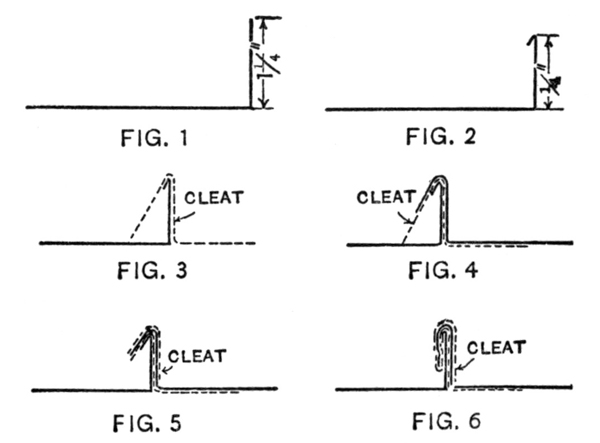
Figs. 1, 2, 3, 4, 5, 6
Galvanized iron of No. 28 and heavier gauges is used, the sheets being lap-seamed and soldered together in strips in the shop the proper length to apply to the roof. After the sheets are fastened together a 1 1/4-inch edge is turned up the entire length of one side of the sheet, as indicated in Fig. 1. This operation is done with tongs having gauge pins set at the proper point. The second {398} operation consists in turning a strip 1/4 inch wide toward the sheet, as shown in Fig. 2. This sheet is then laid on the roof, and a cleat about 8 inches long and 1 inch wide, made of galvanized iron, is nailed to the roof close to the sheet and bent over it, as shown in Fig. 3.
A second sheet having 1 1/2 inches turned up is now brought against the first sheet and bent over both sheet and cleat, as shown in Fig. 4. The cleat is then bent backward over the second sheet and cut off close to the roof, as in Fig. 5, after which the seams are drawn together by double seaming tools, as the occasion demands, and slightly hammered with a wooden mallet. The finished seam is shown in Fig. 6. It will be seen that the second sheet of galvanized iron, cut 1/4 inch longer than the first, laps over the former, making a sort of bead which prevents water from driving in. Cleats hold both sheets firmly to the roof and are nailed about 12 inches apart. Roofs of this character, when laid with No. 28 gauge iron, cost very little more than the cheaper grades of tin, and do not have to be painted.
Applications For Prickly Heat.
—Many applications for this extremely annoying form of urticaria have been suggested and their efficacy strongly urged by the various correspondents of the medical press who propose them, but none of them seem to be generally efficacious. Thus, sodium bicarbonate in strong, aqueous solution, has long been a domestic remedy in general use, but it fails probably as often as it succeeds. A weak solution of copper sulphate has also been highly extolled, only to disappoint a very large proportion of those who resort to it. And so we might go on citing remedies which may sometimes give relief, but fail in the large proportion of cases. In this trouble, as in almost every other, the idiosyncrasies of the patient play a great part in the effects produced by any remedy. It is caused, primarily by congestion of the capillary vessels of the skin, and anything that tends to relieve this congestion will give relief, at least temporarily. Among the newer suggestions are the following:
Alcohol 333 parts
Ether 333 parts
Chloroform 333 parts
Menthol 1 part
Mix. Directions: Apply occasionally with a sponge.
Among those things which at least assist one in bearing the affliction is frequent change of underwear. The undergarments worn during the day should never be worn at night. Scratching or rubbing should be avoided where possible. Avoid stimulating food and drinks, especially alcohol, and by all means keep the bowels in a soluble condition.
Cleaning And Polishing Linoleum.
—Wash the linoleum with a mixture of equal parts of milk and water, wipe dry, and rub in the following mixture by means of a cloth rag: Yellow wax, 5 parts; turpentine oil, 11 parts; varnish, 5 parts. As a glazing agent, a solution of a little yellow wax in turpentine oil is also recommended. Other polishing agents are:
I.—Palm oil, 1 part; paraffine, 18; kerosene, 4.
II.—Yellow wax, 1 part; carnauba wax, 2; turpentine oil, 10; benzine, 5.
Lavatory Deodorant.—
Sodium bicarbonate 5 ounces
Alum 5 1/2 ounces
Potassium bromide 4 ounces
Hydrochloric acid enough
Water enough to make 4 pints.
To 3 parts of boiling water add the alum and then the bicarbonate. Introduce enough hydrochloric acid to dissolve the precipitate of aluminum hydrate which forms and then add the potassium bromide. Add enough water to bring the measure of the finished product up to 4 pints.
Removal Of Odors From Wooden Boxes, Chests, Drawers, Etc.
—This is done by varnishing them with a solution of shellac, after the following manner: Make a solution of shellac, 1,000 parts; alcohol, 90 per cent to 95 per cent, 1,000 parts; boric acid, 50 parts; castor oil, 50 parts. The shellac is first dissolved in the alcohol and the acid and oil added afterwards. For the first coating use 1 part of the solution cut with from 1 to 2 parts of alcohol, according to the porosity of the wood—the more porous the less necessity for cutting. When the first coat is absorbed and dried in, repeat the application, if the wood is very porous, with the diluted shellac, but if of hard, dense wood, the final coating may be now put on, using the solution without addition of alcohol. If desired, the solution may be colored with any of the alcohol soluble aniline colors. The shellac solution, by the way, may be applied to the outside of chests, etc., and finished off after the fashion of “French polish.”
{399}
When used this way, a prior application of 2 coats of linseed oil is advisable.
Stencil Marking Ink That Will Wash Out.
—Triturate together 1 part of fine soot and 2 parts of Prussian blue, with a little glycerine; then add 3 parts of gum arabic and enough glycerine to form a thin paste.
Washing Fluid.
—Take 1 pound sal soda,
1
/
2
pound good stone lime, and 5 quarts of water; boil a short time, let it settle, and pour off the clear fluid into a stone jug, and cork for use; soak the white clothes overnight in simple water, wring out and soap wristbands, collars, and dirty or stained places. Have the boiler half filled with water just beginning to boil, then put in 1 common teacupful of fluid, stir and put in your clothes, and boil for half an hour, then rub lightly through one suds only, and all is complete.
Starch Luster.
—A portion of stearine, the size of an old-fashioned cent, added to starch,
1
/
2
pound, and boiled with it for 2 or 3 minutes, will add greatly to the beauty of linen, to which it may be applied.
To Make Loose Nails In Walls Rigid.
—As soon as a nail driven in the wall becomes loose and the plastering begins to break, it can be made solid and firm by the following process: Saturate a bit of wadding with thick dextrin or glue; wrap as much of it around the nail as possible and reinsert the latter in the hole, pressing it home as strongly as possible. Remove the excess of glue or dextrin, wiping it cleanly off with a rag dipped in clean water; then let dry. The nail will then be firmly fastened in place. If the loose plastering be touched with the glue and replaced, it will adhere and remain firm.
How To Keep Lamp Burners In Order.
—In the combustion of coal oil a carbonaceous residue is left, which attaches itself very firmly to the metal along the edge of the burner next the flame. This is especially true of round burners, where the heat of the flame is more intense than in flat ones, and the deposit of carbon, where not frequently removed, soon gets sufficiently heavy to interfere seriously with the movement of the wick up or down. The deposit may be scraped off with a knife blade, but a much more satisfactory process of getting rid of it is as follows: Dissolve sodium carbonate, 1 part, in 5 or 6 parts of water, and in this boil the burner for 5 minutes or so. When taken out the burner will look like a new one, and acts like one, provided that the apparatus for raising and lowering the wick has not previously been bent and twisted by attempting to force the wick past rough deposits.
To Remove The Odor From Pasteboard.
—Draw the pasteboard through a 3 per cent solution of viscose in water. The pasteboard must be calendered after drying.
To Remove Woody Odor.
—To get rid of that frequently disagreeable smell in old chests, drawers, etc., paint the surface over with the following mixture:
Acetic ether 100 parts
Formaldehyde 6 parts
Acid, carbolic 4 parts
Tincture of eucalyptus leaves 60 parts
Mix. After applying the mixture expose the article to the open air in the sunlight.
To Keep Flies Out Of A House.
—Never allow a speck of food to remain uncovered in dining room or pantry any length of time after meals. Never leave remnants of food exposed that you intend for cat or hens. Feed at once or cover their food up a distance from the house. Let nothing decay near the house. Keep your dining room and pantry windows open a few inches most of the time. Darken your room and pantry when not in use. If there should be any flies they will go to the window when the room is darkened, where they are easily caught, killed, or brushed out.
An Easy Way To Wash A Heavy Comfortable.
—Examine the comfortable, and if you find soiled spots soap them and scrub with a small brush. Hang the comfortable on a strong line and turn the hose on. When one side is washed turn and wash the other. The water forces its way through cotton and covering, making the comfortable as light and fluffy as when new. Squeeze the corners and ends as dry as possible.
Preservation Of Carpets.
—Lay sheets of brown paper under the carpet. This gives a soft feeling to the foot, and by diminishing the wear adds longer life to the carpet; at the same time it tends to keep away the air and renders the apartments warm.
To Do Away With Wiping Dishes.
—Make a rack by putting a shelf over the kitchen sink, slanting it so that the water
{400}
will drain off into the sink. Put a lattice railing about 6 inches high at the front and ends of the shelf so that dishes can be set against it on their edges without falling out. Have 2 pans of hot water. Wash the dishes in one and rinse them in the other. Set them on edge in the rack and leave until dry.
A Convenient Table.—
Ten common-sized eggs weigh 1 pound.
Soft butter, the size of an egg, weighs 1 ounce.
One pint of coffee and of sugar weighs 12 ounces.
One quart of sifted flour (well heaped) weighs 1 pound.
One pint of best brown sugar weighs 12 ounces.
How To Make A Cellar Waterproof.
—The old wall surface should be roughened and perfectly cleaned before plastering is commenced. It may be advisable to put the first coat on not thicker than
1
/
4
inch, and after this has set it may be cut and roughened by a pointing trowel. Then apply a second
1
/
4
-inch coat and finish this to an even and smooth surface. Proportion of plaster: One-half part slaked lime, 1 part Portland cement, part fine, sharp sand, to be mixed well and applied instantly.
Removing Old Wall Paper.
—Some paper hangers remove old paper from walls by first dampening it with water in which a little baking soda has been dissolved, the surface being then gone over with a “scraper” or other tool. However, the principle object of any method is to soften the old paste. This may be readily accomplished by first wetting a section of the old paper with cold or tepid water, using a brush, repeating the wetting until the paper and paste are soaked through, when the paper may easily be pulled off, or, if too tender, may be scraped with any instrument of a chisel form shoved between the paper and the wall. The wall should then be washed with clean water, this operation being materially assisted by wetting the wall ahead of the washing.
Stained Ceilings.
—Take unslaked white lime, dilute with alcohol, and paint the spots with it. When the spots are dry—which will be soon, as the alcohol evaporates and the lime forms a sort of insulating layer—one can proceed painting with size color, and the spots will not show through again.
To Overcome Odors In Freshly Papered Rooms.
—After the windows and doors of such rooms have been closed, bring in red-hot coal and strew on this several handfuls of juniper berries. About 12 hours later open all windows and doors, so as to admit fresh air, and it will be found that the bad smell has entirely disappeared.
Treatment Of Damp Walls.
—I.—A good and simple remedy to obviate this evil is caoutchouc glue, which is prepared from rubber hose. The walls to be laid dry are first to be thoroughly cleaned by brushing and rubbing off; then the caoutchouc size, which has been previously made liquid by heating, is applied with a broad brush in a uniform layer—about 8 to 12 inches higher than the wall appears damp—and finally paper is pasted over the glue when the latter is still sticky. The paper will at once adhere very firmly. Or else, apply the liquefied glue in a uniform layer upon paper (wall paper, caoutchouc paper, etc.). Upon this, size paint may be applied, or it may be covered with wall paper or plaster.
If the caoutchouc size is put on with the necessary care—i. e., if all damp spots are covered with it—the wall is laid dry for the future, and no peeling off of the paint or the wall paper needs to be apprehended. In cellars, protection from dampness can be had in a like manner, as the caoutchouc glue adheres equally well to all surfaces, whether stone, glass, metal, or wood.
II.—The walls must be well cleaned before painting. If the plaster should be worn and permeated with saltpeter in places it should be renewed and smoothed. These clean surfaces are coated twice with a water-glass solution, 1.1, using a brush and allowed to dry well. Then they are painted 3 times with the following mixture: Dissolve 100 parts, by weight, of mastic in 10 parts of absolute alcohol; pour 1,000 parts of water over 200 parts of isinglass; allow to soak for 6 hours; heat to solution and add 100 parts of alcohol (50 per cent). Into this mixture pour a hot solution of 50 parts of ammonia in 250 parts of alcohol (50 per cent), stir well, and subsequently add the mastic solution and stand aside warm, stirring diligently. After 5 minutes take away from the fire and painting may be commenced. Before a fresh application, however, the solution should be removed.
When this coating has dried completely it is covered with oil or varnish paint, preferably the latter. In the same manner the exudation of so-called saltpeter {401} in fresh masonry or on the exterior of façades, etc., may be prevented, size paint or lime paint being employed instead of the oil-varnish paint. New walls which are to be painted will give off no more saltpeter after 2 or 3 applications of the isinglass solution, so that the colors of the wall paper will not be injured either. Stains caused by smoke, soot, etc., on ceilings of rooms, kitchens, or corridors which are difficult to cover up with size paint, may also be completely isolated by applying the warm isinglass solution 2 or 3 times. The size paint is, of course, put on only after complete drying of the ceilings.
To Protect Papered Walls From Vermin.
—It is not infrequent that when the wall paper becomes defective or loose in papered rooms, vermin, bed bugs, ants, etc., will breed behind it. In order to prevent this evil a little colocynth powder should be added to the paste used for hanging the paper, in the proportion of 50 or 60 parts for 3,000 parts.
Care Of Refrigerators.
—See that the sides or walls of all refrigerators are occasionally scoured with soap, or soap and slaked lime.
Dust Preventers.
—Against the beneficial effects to be observed in the use of most preparations we must place the following bad effects: The great smoothness and slipperiness of the boards during the first few days after every application of the dressing, which forbids the use of the latter on steps, floors of gymnasia, dancing floors, etc. The fact that the oil or grease penetrates the soles of the boots or shoes, the hems of ladies’ dresses, and things accidentally falling to the floor are soiled and spotted. Besides these there is, especially during the first few days after application, the dirty dark coloration which the boards take on after protracted use of the oils. Finally, there is the considerable cost of any process, especially for smaller rooms and apartments. In schoolrooms and railroad waiting rooms and other places much frequented by children and others wearing shoes set with iron, the boards soon become smooth from wear, and for such places the process is not suited.
According to other sources of information, these evil tendencies of the application vanish altogether, or are reduced to a minimum, if (1) entirely fresh, or at least, not rancid oils be used; (2) if, after each oiling, a few days be allowed to elapse before using the chamber or hall, and finally (3), if resort is not had to costly foreign special preparations, but German goods, procurable at wholesale in any quantity, and at very low figures.
The last advice (to use low-priced preparations) seems sensible since according to recent experiments, none of the oils experimented upon possess any especial advantages over the others.
An overwhelming majority of the laboratories for examination have given a verdict in favor of oil as a dust-suppressing application for floors, and have expressed a desire to see it in universal use. The following is a suggestion put forth for the use of various preparations:
This dust-absorbing agent has for its object to take up the dust in sweeping floors, etc., and to prevent its development. The production is as follows: Mix in an intimate manner 12 parts, by weight, of mineral sperm oil with 88 parts, by weight, of Roman or Portland cement, adding a few drops of mirbane oil. Upon stirring a uniform paste forms at first, which then passes into a greasy, sandy mass. This mass is sprinkled upon the surface to be swept and cleaned of dust, next going over it with a broom or similar object in the customary manner, at which operation the dust will mix with the mass. The preparation can be used repeatedly.
HUNYADI WATER: See Water.
HYDROCHINON DEVELOPER: See Photography.
HYDROGEN, AMALGAMS AS A SOURCE OF NASCENT: See Amalgams.
HYDROGEN PEROXIDE AS A PRESERVATIVE: See Preserving.
HYDROMETER AND ITS USE.
Fill the tall cylinder or test glass with the spirit to be tested and see that it is of the proper temperature (60° F.). Should the thermometer indicate a higher temperature wrap the cylinder in cloths which have been dipped in cold water until the temperature falls to the required degree. If too low a temperature is indicated, reverse the process, using warm instead of cold applications. When 60° is reached note the specific gravity on the floating hydrometer. Have the cylinder filled to the top and look across the top of the liquid at the mark on the hydrometer. This is to preclude an {402} incorrect reading by possible refraction in the glass cylinder.
HYGROMETERS AND HYGROSCOPES:
Paper Hygrometers.
—Paper hygrometers are made by saturating white blotting paper with the following liquid and then hanging up to dry:
Cobalt chloride 1 ounce
Sodium chloride 1/2 ounce
Calcium chloride 75 grains
Acacia 1/4 ounce
Water 3 ounces
The amount of moisture in the atmosphere is roughly indicated by the changing color of the papers, as follows:
Rose red rain
Pale red very moist
Bluish red moist
Lavender blue nearly dry
Blue very dry
Colored Hygroscopes.
—These instruments are often composed of a flower or a figure, of light muslin or paper, immersed in one of the following solutions:
I.— Cobalt chloride 1 part
Gelatin 10 parts
Water 100 parts
The normal coloring is pink; this color changes into violet in medium humid weather and into blue in very dry weather.
II.— Cupric chloride 1 part
Gelatin 10 parts
Water 100 parts
The color is yellow in dry weather.
III.— Cobalt chloride 1 part
Gelatin 20 parts
Nickel oxide 75 parts
Cupric chloride 25 parts
Water 200 parts
The color is green in dry weather.
HYOSCYAMUS, ANTIDOTE TO: See Atropine.
ICE:
See also Refrigeration.
Measuring The Weight Of Ice.
—A close estimate of the weight of ice can be reached by multiplying together the length, breadth, and thickness of the block in inches, and dividing the product by 30. This will be very closely the weight in pounds. Thus, if a block is 10 x 10 x 9, the product is 900, and this divided by 30 gives 30 pounds as correct weight. A block 10 x 10 x 6 weighs 20 pounds. This simple method can be easily applied, and it may serve to remove unjust suspicions, or to detect short weight.
To Keep Ice In Small Quantities.
—To keep ice from melting, attention is called to an old preserving method. The ice is cracked with a hammer between 2 layers of a strong cloth. Tie over a common unglazed flower-pot, holding about 2 to 4 quarts and placed upon a porcelain dish, a piece of white flannel in such a manner that it is turned down funnel-like into the interior of the pot without touching the bottom. Placed in this flannel funnel the cracked ice keeps for days.
Ice Flowers.
Make a 2 per cent solution of the best clear gelatin in distilled water, filter, and flood the filtrate over any surface which it is desired to ornament. Drain off slightly, and if the weather is sufficiently cold, put the plate, as nearly level as possible, out into the cold air to freeze. In freezing, water is abstracted from the colloidal portion, which latter then assumes an efflorescent form, little flowers, with exuberant, graceful curves of crystals, showing up as foliage, from all over the surface. To preserve in permanent form all that is necessary is to flood them with absolute alcohol. This treatment removes the ice, thus leaving a lasting framework of gelatin which may be preserved indefinitely. In order to do this, as soon as the gelatin has become quite dry it should be either varnished, flowed with an alcoholic solution of clear shellac, or the gelatin may be rendered insoluble by contact, for a few moments, with a solution of potassium bichromate, and subsequent exposure to sunlight.
IMOGEN DEVELOPER: See Photography.
INCENSE: See Fumigants.
INCRUSTATION, PREVENTION OF: See Boiler Compounds.
INDIGO: See Dyes.
INFANT FOODS: See Foods.
INFLUENZA IN CATTLE: See Veterinary Formulas. {403}
INK ERADICATORS: See Cleaning Preparations and Methods.
IGNITING COMPOSITION.
Eight parts of powdered manganese, 10 parts of amorphous phosphorus, and 5 parts of glue. The glue is soaked in water, dissolved in the heat, and the manganese and the phosphorus stirred in, so that a thinly liquid paste results, which is applied by means of a brush. Allow to dry well. This, being free from sulphur, can be applied on match-boxes.
INKS
Blueprint Inks.
I.—For red-writing fluids for blueprints, take a piece of common washing soda the size of an ordinary bean, and dissolve it in 4 tablespoonfuls of ordinary red-writing ink, to make a red fluid. To keep it from spreading too much, use a fine pen to apply it with, and write fast so as not to allow too much of the fluid to get on the paper, for it will continue eating until it is dry.
II.—For red and white solutions for writing on blueprints, dissolve a crystal of oxalate of potash about the size of a pea in an ink-bottle full of water. This will give white lines on blueprints; other potash solutions are yellowish. If this shows a tendency to run, owing to too great strength, add more water and thicken slightly with mucilage. Mix this with red or any other colored ink about half and half, and writing may be done on the blueprints in colors corresponding to the inks used.
III.—Add to a small bottle of water enough washing soda to make a clear white line, then add enough gum arabic to it to prevent spreading and making ragged lines. To make red lines dip the pen in red ink and then add a little of the solution by means of the quill.
IV.—For white ink, grind zinc oxide fine on marble and incorporate with it a mucilage made with gum tragacanth. Thin a little for use. Add a little oil of cloves to prevent mold, and shake from time to time.
V.—A fluid which is as good as any for writing white on blueprints is made of equal parts of sal soda and water.
VI.—Mix equal parts of borax and water.
Both these fluids, V and VI, must be used with a fine-pointed pen; a pen with a blunt point will not work well.
Drawing Inks:
Blue Ruling Ink.—Good vitriol, 4 ounces; indigo, 1 ounce. Pulverize the indigo, add it to the vitriol, and let it stand exposed to the air for 6 days, or until dissolved; then fill the pots with chalk, add fresh gall, 1/2 gill, boiling it before use.
Black Ruling Ink.—Take good black ink, and add gall as for blue. Do not cork it, as this prevents it from turning black.
Carbon Ink.—Dissolve real India ink in common black ink, or add a small quantity of lampblack previously heated to redness, and ground perfectly smooth, with a small portion of the ink.
Carmine.—The ordinary solution of carmine in ammonia water, after a short time in contact with steel, becomes blackish red, but an ink may be made that will retain its brilliant carmine color to the last by the following process, given by Dingler: Triturate 1 part of pure carmine with 15 parts of acetate of ammonia solution, with an equal quantity of distilled water in a porcelain mortar, and allow the whole to stand for some time. In this way, a portion of the alumina, which is combined with the carmine dye, is taken up by the acetic acid of the ammonia salt, and separates as a precipitate, while the pure pigment of the cochineal remains dissolved in the half-saturated ammonia. It is now filtered and a few drops of pure white sugar syrup added to thicken it. A solution of gum arabic cannot be used to thicken it, since the ink still contains some acetic acid, which would coagulate the bassorine, one of the constituents of the gum.
Liquid Indelible Drawing Ink.—Dissolve, by boiling, 2 parts of blond (golden yellow) shellac in 1.6 parts, by weight, of sal ammoniac, 16°, with 10 parts, by weight, of distilled water, and filter the solution through a woolen cloth. Now dissolve or grind 0.5 parts, by weight, of shellac solution with 0.01 part, by weight, of carbon black. Also dissolve .03 parts of nigrosin in 0.4 parts of distilled water and pour both solutions together. The mixture is allowed to settle for 2 days and the ready ink is drawn off from the sediment.
Glass, Celluloid, And Metal Inks:
See also Etching.
Most inks for glass will also write on celluloid and the metals. The following {404} I and II are the most widely known recipes:
I.—In 500 parts of water dissolve 36 parts of sodium fluoride and 7 parts of sodium sulphate. In another vessel dissolve in the same amount of water 14 parts of zinc chloride and to the solution add 56 parts of concentrated hydrochloric acid. To use, mix equal volumes of the two solutions and add a little India ink; or, in the absence of this, rub up a little lampblack with it. It is scarcely necessary to say that the mixture should not be put in glass containers, unless they are well coated internally with paraffine, wax, gutta-percha, or some similar material. To avoid the inconvenience of keeping the solutions in separate bottles, mix them and preserve in a rubber bottle. A quill pen is best to use in writing with this preparation, but metallic pens may be used, if quite clean and new.
II.—In 150 parts of alcohol dissolve 20 parts of rosin, and add to this, drop by drop, stirring continuously, a solution of 35 parts of borax in 250 parts of water. This being accomplished, dissolve in the solution sufficient methylene blue to give it the desired tint.
Ink For Writing On Glazed Cardboard.—The following are especially recommended for use on celluloid:
I.—Dissolve 4 drachms of brown shellac in 4 ounces of alcohol. Dissolve 7 drachms of borax in 6 ounces of distilled water. Pour the first solution slowly into the second and carefully mix them, after which add 12 grains of aniline dye of the desired color. Violet, blue, green, red, yellow, orange, or black aniline dyes can be used.
Such inks may be used for writing on bottles, and the glass may be cleaned with water without the inscription being impaired.
II.— Ferric chloride 10 parts
Tannin 15 parts
Acetone 100 parts
Dissolve the ferric chloride in a portion of the acetone and the tannin in the residue, and mix the solutions.
III.—Dissolve a tar dyestuff of the desired color in anhydrous acetic acid.
Indelible Inks For Glass Or Metal.—Schobel recommends the following inks for marking articles of glass, glass slips for microscopy, reagent flasks, etc., in black:
I.— Sodium silicate 1 to 2 parts
Liquid India ink 1 part
For white:
II.— Sodium water glass 3 to 4 parts
Chinese white 1 part
Instead of Chinese white, a sufficient amount of the so-called permanent white (barium sulphate) may be used. The containers for these inks should be kept air-tight. The writing in either case is not attacked by any reagent used in microscopical technique but may be readily scraped away with a knife. The slips or other articles should be as near chemically clean as possible, before attempting to write on them.
According to Schuh, a mixture of a shellac solution and whiting or precipitated chalk answers very well for marking glass. Any color may be mixed with the chalk. If the glass is thoroughly cleaned with alcohol or ether, either a quill pen or a camel’s-hair pencil (or a fresh, clean steel pen) may be used.
Ink On Marble.—Ink marks on marble may be removed with a paste made by dissolving an ounce of oxalic acid and half an ounce of butter of antimony in a pint of rain water, and adding sufficient flour to form a thin paste. Apply this to the stains with a brush; allow it to remain on 3 or 4 days and then wash it off. Make a second application, if necessary.
Perpetual Ink.—I.—Pitch, 3 pounds; melt over the fire, and add of lampblack, 3/4 pound; mix well.
II.—Trinidad asphaltum and oil of turpentine, equal parts. Used in a melted state to fill in the letters on tombstones, marbles, etc. Without actual violence, it will endure as long as the stone itself.
Ink For Steel Tools.—Have a rubber stamp made with white letters on a black ground. Make up an ink to use with this stamp, as follows:
Ordinary rosin, 1/2 pound; lard oil, 1 tablespoonful; lampblack, 2 tablespoonfuls; turpentine, 2 tablespoonfuls. Melt the rosin, and stir in the other ingredients in the order given. When the ink is cold it should look like ordinary printers’ ink. Spread a little of this ink over the pad and ink the rubber stamp as usual, and press it on the clean steel—saw blade, for instance. Have a rope of soft putty, and make a border of putty around the stamped design as close up to the lettering as possible, so that no portion of the steel inside the ring of putty is exposed but the lettering. Then pour into the putty ring the etching mixture, composed of 1 ounce of nitric acid, 1 ounce of {405} muriatic acid, and 12 ounces of water. Allow it to rest for only a minute, draw off the acid with a glass or rubber syringe, and soak up the last trace of acid with a moist sponge. Take off the putty, and wipe off the design with potash solution first, and then with turpentine, and the job is done.
Writing On Ivory, Glass, Etc.—Nitrate of silver, 3 parts; gum arabic, 20 parts; distilled water, 30 parts. Dissolve the gum arabic in two-thirds of the water, and the nitrate of silver in the other third. Mix and add the desired color.
Writing On Zinc (see also Horticultural Inks).—Take 1 part sulphate of copper (copper vitriol), 1 part chloride of potassium, both dissolved in 35 parts water. With this blue liquid, writing or drawing may be done with a common steel pen upon zinc which has been polished bright with emery paper. After the writing is done the plates are put in water and left in it for some time, then taken out and dried. The writing will remain intact as long as the zinc. If the writing or drawing should be brown, 1 part sulphate of iron (green vitriol) is added to the above solution. The chemicals are dissolved in warm water and the latter must be cold before it can be used.
Gold Ink.
I.—The best gold ink is made by rubbing up gold leaf as thoroughly as possible with a little honey. The honey is then washed away with water, and the finely powdered gold leaf left is mixed to the consistency of a writing ink with weak gum water. Everything depends upon the fineness of the gold powder, i. e., upon the diligence with which it has been worked with the honey. Precipitated gold is finer than can be got by any rubbing, but its color is wrong, being dark brown. The above gold ink should be used with a quill pen.
II.—An imitation gold or bronze ink is composed by grinding 1,000 parts of powdered bronze of handsome color with a varnish prepared by boiling together 500 parts of nut oil, 200 parts of garlic, 500 parts of cocoanut oil, 100 parts of Naples yellow, and as much of sienna.
Horticultural Ink.
I.—Chlorate of platinum, 1/4 ounce; soft water, 1 pint. Dissolve and preserve it in glass. Used with a clean quill to write on zinc labels. It almost immediately turns black, and cannot be removed by washing. The addition of gum and lampblack, as recommended in certain books, is unnecessary, and even prejudicial to the quality of the ink.
II.—Verdigris and sal ammoniac, of each 1/2 ounce; levigated lampblack, 1/2 ounce; common vinegar, 1/4 pint; mix thoroughly. Used as the last, for either zinc, iron, or steel.
III.—Blue vitriol, 1 ounce; sal ammoniac, 1/2 ounce (both in powder); vinegar, 1/4 pint; dissolve. A little lampblack or vermilion may be added, but it is not necessary. Use No. I, for iron, tin, or steel plate.
Indelible Inks.
These are also frequently called waterproof, incorrodible, or indestructible inks. They are employed for writing labels on bottles containing strong acids and alkaline solutions. They may be employed with stamps, types or stencil plates, by which greater neatness will be secured than can be obtained with either a brush or pen.
The following is a superior preparation for laundry use:
Aniline oil 85 parts
Potassium chlorate 5 parts
Distilled water 44 parts
Hydrochloric acid, pure (specific gravity, 1.124) 68 parts
Copper chloride, pure 6 parts
Mix the aniline oil, potassium chlorate, and 26 parts of the water and heat in a capacious vessel, on the water bath, at a temperature of from 175° to 195° F., until the chlorate is entirely dissolved, then add one-half of the hydrochloric and continue the heat until the mixture begins to take on a darker color. Dissolve the copper chloride in the residue of the water, add the remaining hydrochloric acid to the solution, and add the whole to the liquid on the water bath, and heat the mixture until it acquires a fine red-violet color. Pour into a flask with a well-fitting ground-glass stopper, close tightly and set aside for several days, or until it ceases to throw down a precipitate. When this is the case, pour off the clear liquid into smaller (one drachm or a drachm and a half) containers.
This ink must be used with a quill pen, and is especially good for linen or cotton fabrics, but does not answer so well for silk or woolen goods. When first used, it appears as a pale red, but on washing with soap or alkalies, or on exposure to {406} the air, becomes a deep, dead black. The following is a modification of the foregoing:
Blue Indelible Ink.—This ink has the reputation of resisting not only water and oil, but alcohol, oxalic acid, alkalies, the chlorides, etc. It is prepared as follows: Dissolve 4 parts of gum lac in 36 parts of boiling water carrying 2 parts of borax. Filter and set aside. Now dissolve 2 parts of gum arabic in 4 parts of water and add the solution to the filtrate. Finally, after the solution is quite cold, add 2 parts of powdered indigo and dissolve by agitation. Let stand for several hours, then decant, and put in small bottles.
Red Indelible Inks.—By proceeding according to the following formula, an intense purple-red color may be produced on fabrics, which is indelible in the customary sense of the word:
1.— Sodium carbonate 3 drachms
Gum arabic 3 drachms
Water 12 drachms
2.— Platinic chloride 1 drachm
Distilled water 2 ounces
3.— Stannous chloride 1 drachm
Distilled water 4 drachms
Moisten the place to be written upon with No. 1 and rub a warm iron over it until dry; then write with No. 2, and, when dry, moisten with No. 3. An intense and beautiful purple-red color is produced in this way. A very rich purple color—the purple of Cassius—may be produced by substituting a solution of gold chloride for the platinic chloride in the above formula.
Crimson Indelible Ink.—
The following formula makes an indelible crimson ink:
Silver nitrate 50 parts
Sodium carbonate, crystal 75 parts
Tartaric acid 16 parts
Carmine 1 part
Ammonia water, strongest 288 parts
Sugar, white, crystallized 36 parts
Gum arabic, powdered 60 parts
Distilled water, quantity sufficient to make 400 parts
Dissolve the silver nitrate and the sodium carbonate separately, each in a portion of the distilled water, mix the solutions, collect the precipitate on a filter, wash, and put the washed precipitate, still moist, into a mortar. To this add the tartaric acid, and rub together until effervescence ceases. Now, dissolve the carmine in the ammonia water (which latter should be of specific gravity .882, or contain 34 per cent of ammonia), filter, and add the filtrate to the silver tartrate magma in the mortar. Add the sugar and gum arabic, rub up together, and add gradually, with constant agitation, sufficient distilled water to make 400 parts.
Gold Indelible Ink.—Make two solutions as follows:
1.— Chloride of gold and sodium 1 part
Water 10 parts
Gum 2 parts
2.— Oxalic acid 1 part
Water 5 parts
Gum 2 parts
The cloth or stuff to be written on should be moistened with liquid No. 2. Let dry, and then write upon the prepared place with liquid No. 1, using preferably a quill pen. Pass a hot iron over the mark, pressing heavily.
India, China, Or Japan Ink.
Ink by these names is based on lampblack, and prepared in various ways. Many makes flow less easily from the pen than other inks, and are less durable than ink that writes paler and afterwards turns black. The ink is usually unfitted for steel pens, but applies well with a brush.
I.—Lampblack (finest) is ground to a paste with very weak liquor of potassa, and this paste is then diffused through water slightly alkalized with potassa, after which it is collected, washed with clean water, and dried; the dry powder is next levigated to a smooth, stiff paste, with a strong filtered decoction of carrageen or Irish moss, or of quince seed, a few drops of essence of musk, and about half as much essence of ambergris being added, by way of perfume, toward the end of the process; the mass is, lastly, molded into cakes, which are ornamented with Chinese characters and devices, as soon as they are dry and hard.
II.—A weak solution of fine gelatin is boiled at a high temperature in a digester for 2 hours, and then in an open vessel for 1 hour more. The liquid is next filtered and evaporated to a proper consistency, either in a steam- or {407} salt-water bath. It is, lastly, made into a paste, as before, with lampblack which has been previously heated to dull redness in a well-closed crucible. Neither of the above gelatinizes in cold weather, like the ordinary imitations.
To Keep India Ink Liquid.—If one has to work with the ink for some time, a small piece should be dissolved in warm water and the tenth part of glycerine added, which mixes intimately with the ink after shaking for a short time. India ink thus prepared will keep very well in a corked bottle, and if a black jelly should form in the cold, it is quickly dissolved by heating. The ink flows well from the pen and does not wipe.
Ink Powders And Lozenges.
Any of these powders may, by the addition of mucilage of gum arabic, be made into lozenges or buttons—the “ink buttons” or “ink stones” in use abroad and much affected by travelers.
The following makes a good serviceable black ink, on macerating the powder in 100 times its weight of rain or distilled water for a few days:
I.— Powdered gallnuts 16 parts
Gum arabic 8 parts
Cloves 1 part
Iron sulphate 10 parts
Put into an earthenware or glass vessel, cover with 100 parts of rain or distilled water, and set aside for 10 days or 2 weeks, giving an occasional shake the first 3 or 4 days. Decant and bottle for use.
The following is ready for use instantly on being dissolved in water:
II.— Aleppo gallnuts 84 parts
Dutch Madder 6 parts
Powder, mix, moisten, and pack into the percolator. Extract with hot water, filter, and press out. To the filtrate add 4 parts of iron acetate (or pyroacetate) and 2 1/2 parts of tincture of indigo. Put into the water bath and evaporate to dryness and powder the dry residue.
Lithographic Inks.
These are for writing on lithographic stones or plates:
I.—Mastic (in tears), 8 ounces; shellac, 12 ounces; Venice turpentine, 1 ounce. Melt together, add wax, 1 pound; tallow, 6 ounces. When dissolved, add hard tallow soap (in shavings), 6 ounces; and when the whole is perfectly combined, add lampblack, 4 ounces. Mix well, cool a little, and then pour it into molds, or upon a slab, and when cold cut it into square pieces.
II. (Lasteyrie).—Dry tallow soap, mastic (in tears), and common soda (in fine powder), of each, 30 parts; shellac, 150 parts; lampblack, 12 parts. Mix as indicated in Formula I.
Marking Or Labeling Inks:
Black Marking Inks.—
I.— Borax 60 parts
Shellac 180 parts
Boiling water 1,000 parts
Lampblack, a sufficient quantity.
Dissolve the borax in the water, add the shellac to the solution and stir until dissolved. Rub up a little lampblack with sufficient of the liquid to form a paste, and add the rest of the solution a little at a time and with constant rubbing. Test, and if not black enough, repeat the operation. To get the best effect—a pure jet-black—the lampblack should be purified and freed from the calcium phosphate always present in the commercial article to the extent, frequently, of 85 to 87 per cent, by treating with hydrochloric acid and washing with water.
II.—An ink that nothing will bleach is made by mixing pyrogallic acid and sulphate of iron in equal parts. Particularly useful for marking labels on bottles containing acids. Varnish the label after the ink is dry so that moisture will not affect it.
Colored Marking Inks:
Eosine Red.—
Eosine B. 1 drachm
Solution of mercuric chloride 2 drachms
Mucilage of acacia 2 drachms
Rectified spirit 4 ounces
Oil of lavender 1 drop
Distilled water 8 ounces
Dissolve the eosine in the solution and 2 ounces of water, add the mucilage, and mix, then the oil dissolved in the spirit, and finally make up.
Orange.—
Aniline orange 1 drachm
Sugar 2 drachms
Distilled water to 4 ounces
Blue.—
I.— Resorcin blue 1 drachm
Distilled water 6 drachms
Mix and agitate occasionally for 2 hours, then add: {408}
Hot distilled water 24 ounces
Oxalic acid 10 grains
Sugar 1/2 ounce
Shake well. This and other aniline inks can be perfumed by rubbing up a drop of attar of rose with the sugar before dissolving it in the hot water.
II.—A solid blue ink, or marking paste, to be used with a brush for stenciling, is made as follows: Shellac, 2 ounces; borax, 2 ounces; water, 25 ounces; gum arabic, 2 ounces; and ultramarine, sufficient. Boil the borax and shellac in some of the water till they are dissolved, and withdraw from the fire. When the solution has become cold, add the rest of the 25 ounces of water, and the ultramarine. When it is to be used with the stencil, it must be made thicker than when it is to be applied with a marking brush.
III.—In a suitable kettle mix well, stirring constantly, 50 parts of liquid logwood extract (80 per cent) with 3 parts of spirit previously mingled with 1 part of hydrochloric acid, maintaining a temperature of 68° F. Dissolve 5 parts of potassium chromate in 15 parts of boiling water; to this add 10 parts of hydrochloric acid, and pour this mixture, after raising the temperature to about 86° F., very slowly and with constant stirring into the kettle. Then heat the whole to 185° F. This mass, which has now assumed the nature of an extract, is stirred a little longer, and next 15 parts of dextrin mixed with 10 parts of fine white earth (white bole) are added. The whole is well stirred throughout. Transfer the mass from the kettle into a crusher, where it is thoroughly worked through.
Printing Inks.
Black printing inks owe their color to finely divided carbon made from lampblack, pine-wood, rosin oil, etc., according to the quality of the ink desired. The finest inks are made from flame-lampblack. There are, however, certain requirements made of all printing inks alike, and these are as follows: The ink must be a thick and homogeneous liquid, it must contain no solid matter but finely divided carbon, and every drop when examined microscopically must appear as a clear liquid containing black grains uniformly distributed.
The consistency of a printing ink must be such that it passes on to the printing rollers at the proper rate. It will be obvious that various consistencies are demanded according to the nature of the machine used by the printer. For a rotary machine which prints many thousands of copies an hour a much thinner ink will be necessary than that required for art printing or for slow presses. As regards color, ordinary printing ink should be a pure black. For economy’s sake, however, newspaper printers often use an ink so diluted that it does not look deep black, but a grayish black, especially in large type.
The question of the time that the ink takes to dry on the paper is a very important one, especially with ink used for printing newspapers which are folded and piled at one operation. If then the ink does not dry very quickly, the whole impression smudges and “sets off” so much that it becomes illegible in places. Although it is essential to have a quick drying ink for this purpose, it is dangerous to go too far, for a too quickly drying ink would make the paper stick to the forms and tear it. A last condition which must be fulfilled by a good printing ink is that it must be easy of removal from the type, which has to be used again.
No one composition will answer every purpose and a number of different inks are required. Makers of printing inks are obliged, therefore, to work from definite recipes so as to be able to turn out exactly the same ink again and again. They make newspaper ink for rotary presses, book-printing inks, half-tone inks, art inks, etc. As the recipes have been attained only by long, laborious, and costly experiments, it is obvious that the makers are not disposed to communicate them, and the recipes that are offered and published must be looked upon with caution, as many of them are of little or no value. In the recipes given below for printing inks, the only intention is to give hints of the general composition, and the practical man will easily discover what, if any, alterations have to be made in the recipe for his special purpose.
Many different materials for this manufacture are given in recipes, so many, in fact, that it is impossible to discover what use they are in the ink. The following is a list of the articles commonly in use for the manufacture of printing ink:
Boiled linseed oil, boiled without driers.
Rosin oil from the dry distillation of rosin.
Rosin itself, especially American pine rosin. {409}
Soap, usually rosin-soap, but occasionally ordinary soap.
Lampblack and various other pigments.
By the most time-honored method, linseed oil was very slowly heated over an open fire until it ignited. It was allowed to burn for a time and then extinguished by putting a lid on the pot. In this way a liquid was obtained of a dark brown or black color with particles of carbon, and with a consistency varying with the period of heating, being thicker, the longer the heating was continued. If necessary, the liquid was then thinned with unboiled, or only very slightly boiled, linseed oil. Lampblack in the proper quantity was added and the mixture was finally rubbed up on a stone in small quantities at a time to make it uniform.
Boiling The Linseed Oil.—This process, although it goes by the name of boiling, is not so in the proper sense of the word, but a heating having for its object an initial oxidation of the oil, so that it will dry better. Linseed oil is a type of the drying oils, those which when exposed in thin coats to the air absorb large quantities of oxygen and are thereby converted into tough, solid sheets having properties very similar to those of soft India rubber. The process goes on much faster with the aid of heat than at the ordinary temperature, and the rate at which the boiled oil will dry in the ink can be exactly regulated by heating it for a longer or shorter time. Prolonged heating gives an oil which will dry very quickly on exposure in thin coats to the air, the shorter the heating the more slowly will the ink afterwards made with the oil dry.
Linseed oil must always be boiled in vessels where it has plenty of room, as the oil soon swells up and it begins to decompose so energetically at a particular temperature that there is considerable risk of its boiling over and catching fire. Various contrivances have been thought out for boiling large quantities of the oil with safety, such as pans with an outlet pipe in the side, through which the oil escapes when it rises too high instead of over the edge of the pan, and fires built on a trolley running on rails, so that they can at once be moved from under the pan if there is any probability of the latter boiling over. The best apparatus for preparing thickened linseed oil is undoubtedly one in which the oil offers a very large surface to the air, and on that account requires to be moderately heated only. The oil soon becomes very thick under these conditions and if necessary can be diluted to any required consistency with unboiled oil.
In boiling linseed oil down to the proper thickness by the old method there are two points demanding special attention. One is the liability of the oil to boil over, and the other consists in the development of large quantities of vapor, mostly of acroleine, which have a most powerful and disagreeable smell, and an intense action upon the eyes. The attendant must be protected from these fumes, and the boiling must therefore be done where there is a strong draught to take the fumes as fast as they are produced. There are various contrivances to cope with boiling over.
Savage’s Printing Ink.—Pure balsam of copaiba, 9 ounces; lampblack, 3 ounces; indigo and Prussian blue, each 5 drachms; Indian red, 3/4 ounce; yellow soap, 3 ounces. Mix, and grind to the utmost smoothness.
Toning Black Inks.—Printers’ inks consisting solely of purified lampblack and vehicle give, of course, impressions which are pure black. It is, however, well known that a black which has to a practiced eye a tinge of blue in it looks much better than a pure black. To make such an ink many makers mix the lampblack with a blue pigment, which is added in very fine powder before the first grinding. Prussian blue is the pigment usually chosen and gives very attractive results. Prussian blue is, however, not a remarkable stable substance, and is very apt to turn brown from the formation of ferric oxide. Hence an ink made with Prussian blue, although it may look very fine at first, often assumes a dull brown hue in the course of time. Excellent substitutes for Prussian blue are to be found in the Induline blues. These are very fast dyes, and inks tinted with them do not change color. As pure indigo is now made artificially and sold at a reasonable price, this extremely fast dye can also be used for tinting inks made with purified lampblack.
To Give Dark Inks a Bronze or Changeable Hue.—Dissolve 1 1/2 pounds gum shellac in 1 gallon 65 per cent alcohol or cologne spirits for 24 hours. Then add 14 ounces aniline red. Let it stand a few hours longer, when it will be ready for use. Add this to good blue, black, or other dark ink, as needed in quantities to suit, when if carefully done {410} they will be found to have a rich bronze or changeable hue.
Quick Dryer For Inks Used On Bookbinders’ Cases.—Beeswax, 1 ounce; gum arabic (dissolved in sufficient acetic acid to make a thin mucilage), 1/4 ounce; brown japan, 1/4 ounce. Incorporate with 1 pound of good cut ink.
Inks For Stamp Pads.
The ink used on vulcanized rubber stamps should be such that when applied to a suitable pad it remains sufficiently fluid to adhere to the stamp. At the same time the fluidity should cease by the time the stamp is pressed upon an absorbing surface such as paper. Formerly these inks were made by rubbing up pigments in fat to a paste. Such inks can hardly be prevented, however, from making impressions surrounded by a greasy mark caused by the fat spreading in the pores of the paper. Now, most stamping inks are made without grease and a properly prepared stamping ink contains nothing but glycerine and coal-tar dye. As nearly all these dyes dissolve in hot glycerine the process of manufacture is simple enough. The dye, fuchsine, methyl violet, water blue, emerald green, etc., is put into a thin porcelain dish over which concentrated glycerine is poured, and the whole is heated to nearly 212° F. with constant stirring. It is important to use no more glycerine than is necessary to keep the dye dissolved when the ink is cold. If the mass turns gritty on cooling it must be heated up with more glycerine till solution is perfect.
In dealing with coal-tar dyes insoluble in glycerine, or nearly so, dissolve them first in the least possible quantity of strong, hot alcohol. Then add the glycerine and heat till the spirit is evaporated.
To see whether the ink is properly made spread some of it on a strip of cloth and try it with a rubber stamp. On paper, the separate letters must be quite sharp and distinct. If they run at the edges there is too much glycerine in the ink and more dye must be added to it. If, on the contrary, the impression is indistinct and weak, the ink is too thick and must be diluted by carefully adding glycerine.
Aniline colors are usually employed as the tinting agents. The following is a typical formula, the product being a black ink:
I.— Nigrosin 3 parts
Water 15 parts
Alcohol 15 parts
Glycerine 70 parts
Dissolve the nigrosin in the alcohol, add the glycerine previously mixed with the water, and rub well together.
Nigrosin is a term applied to several compounds of the same series which differ in solubility. In the place of these compounds it is probable that a mixture would answer to produce black as suggested by Hans Wilder for making writing ink. His formula for the mixture is:
II.— Methyl violet 3 parts
Bengal green 5 parts
Bismarck green 4 parts
A quantity of this mixture should be taken equivalent to the amount of nigrosin directed. These colors are freely soluble in water, and yield a deep greenish-black solution.
The aniline compound known as brilliant green answers in place of Bengal green. As to the permanency of color of this or any aniline ink, no guarantee is offered. There are comparatively few coloring substances that can be considered permanent even in a qualified sense. Among these, charcoal takes a foremost place. Lampblack remains indefinitely unaltered. This, ground very finely with glycerine, would yield an ink which would perhaps prove serviceable in stamping; but it would be liable to rub off to a greater extent than soluble colors which penetrate the paper more or less. Perhaps castor oil would prove a better vehicle for insoluble coloring matters. Almost any aniline color may be substituted for nigrosin in the foregoing formula, and blue, green, red, purple, and other inks obtained. Insoluble pigments might also be made to answer as suggested for lampblack.
The following is said to be a cushion that will give color permanently. It consists of a box filled with an elastic composition, saturated with a suitable color. The cushion fulfils its purpose for years without being renewed, always contains sufficient moisture, which is drawn from the atmosphere, and continues to act as a color stamp cushion so long as a remnant of the mass or composition remains in the box or receptacle. This cushion or pad is too soft to be self-supporting, but should be held in a low, flat pan, and have a permanent cloth cover.
III.—The composition consists preferably of 1 part gelatin, 1 part water, 6 parts glycerine, and 6 parts coloring matter. A suitable black color can be {411} made from the following materials: One part gelatin glue, 3 parts lampblack, aniline black, or a suitable quantity of logwood extract, 10 parts of glycerine, 1 part absolute alcohol, 2 parts water, 1 part Venetian soap, 1/5 part salicylic acid. For red, blue, or violet: One part gelatin glue, 2 parts aniline of desired color, 1 part absolute alcohol, 10 parts glycerine, I part Venetian soap, and 1/5 part salicylic acid.
The following are additional recipes used for this purpose:
IV.—Mix and dissolve 2 to 4 drachms aniline violet, 15 ounces alcohol, 15 ounces glycerine. The solution is poured on the cushion and rubbed in with a brush. The general method of preparing the pad is to swell the gelatin with cold water, then boil and add the glycerine, etc.
V.—Mix well 16 pounds of hot linseed oil, 3 ounces of powdered indigo, or a like quantity of Berlin blue, and 8 pounds of lampblack. For ordinary sign-stamping an ink without the indigo might be used. By substituting ultramarine or Prussian blue for the lampblack, a blue “ink” or paint would result.
Inks For Hand Stamps.—As an excipient for oily inks, a mixture of castor oil and crude oleic acid, in parts varying according to the coloring material used, is admirable. The following are examples:
Black.—Oil soluble nigrosin and crude oleic acid in equal parts. Add 7 to 8 parts of castor oil.
Red.—Oil soluble aniline red, 2 parts; crude oleic acid, 3 parts; castor oil, from 30 to 60 parts, according to the intensity of color desired.
Red.—Dissolve 1/4 ounce of carmine in 2 ounces strong water of ammonia, and add 1 drachm of glycerine and 3/4 ounce dextrin.
Blue.—Rub 1 ounce Prussian blue with enough water to make a perfectly smooth paste; then add 1 ounce dextrin, incorporate it well, and finally add sufficient water to bring it to the proper consistency.
Blue.—Oil soluble aniline blue, 1 part; crude oleic acid, 2 parts; castor oil, 30 to 32 parts.
Violet.—Alcohol, 15 ounces; glycerine, 15 ounces; aniline violet, 2 to 4 drachms. Mix, dissolve, pour the solution on the cushion, and dab on with a brush.
Color Stamps For Rough Paper.—It has hitherto been impossible to get a satisfactory application for printing with rubber stamps on rough paper. Fatty vehicles are necessary for such paper, and they injure the India rubber. It is said, however, that if the rubber is first soaked in a solution of glue, and then in one of tannin, or bichromate of potash, it becomes impervious to the oils or fats. Gum arabic can be substituted for the glue.
Indelible Hand-stamp Ink.—
I.— Copper sulphate 20 parts
Aniline chlorate 20 parts
Rub up separately to a fine powder, then carefully mix, and add 10 parts of dextrin and incorporate. Add 5 parts of glycerine and rub up, adding water, a little at a time, until a homogeneous viscid mass is obtained. An aniline color is produced in the material, which boiling does not destroy.
II.— Sodium carbonate 22 parts
Glycerine 85 parts
Gum arabic, in powder 20 parts
Silver nitrate 11 parts
Ammonia water 20 parts
Venetian turpentine 10 parts
Triturate the carbonate of sodium, gum arabic, and glycerine together. In a separate flask dissolve the silver nitrate in the ammonia water, mix the solution with the triturate, and heat to boiling, when the turpentine is to be added, with constant stirring. After stamping, expose to the sunlight or use a hot iron. The quantity of glycerine may be varied to suit circumstances.
White Stamping Ink For Embroidery.—
Zinc white 2 drachms
Mucilage 1 drachm
Water 6 drachms
Triturate the zinc white with a small quantity of water till quite smooth, then add the mucilage and the remainder of the water.
Stencil Inks.
I.—Dissolve 1 ounce of gum arabic in 6 ounces water, and strain. This is the mucilage. For Black Color use drop black, powdered, and ground with the mucilage to extreme fineness; for Blue, ultramarine is used in the same manner; for Green, emerald green; for White, flake white; for Red, vermilion, lake, or carmine; for Yellow, chrome yellow. When ground too thick they are thinned {412} with a little water. Apply with a small brush.
II.—Triturate together 1 pint pine soot and 2 pints Prussian blue with a little glycerine, then add 3 pints gum arabic and sufficient glycerine to form a thin paste.
Blue Stencil Inks.—The basis of the stencil inks commonly used varies to some extent, some preferring a mixture of pigments with oils, and others a watery shellac basis. The basis:
I.— Shellac 2 ounces
Borax 1 1/2 ounces
Water 10 ounces
Boil together until 10 ounces of solution is obtained. The coloring:
Prussian blue 1 ounce
China clay 1/2 ounce
Powdered acacia 1/2 ounce
Mix thoroughly and gradually incorporate the shellac solution.
II.— Prussian blue 2 ounces
Lampblack 1 ounce
Gum arabic 3 ounces
Glycerine, sufficient.
Triturate together the dry powders and then make into a suitable paste with glycerine.
Indelible Stencil Inks.—I.—Varnish such as is used for ordinary printing ink, 1 pound; black sulphuret of mercury, 1 pound; nitrate of silver, 1 ounce; sulphate of iron, 1 ounce; lampblack, 2 tablespoonfuls. Grind all well together; thin with spirits turpentine as desired.
II.—Sulphate of manganese, 2 parts; lampblack, 1 part; sugar, 4 parts; all in fine powder and triturated to a paste in a little water.
III.—Nitrate of silver, 1/4 ounce; water, 3/4 ounce. Dissolve, add as much of the strongest liquor of ammonia as will dissolve the precipitate formed on its first addition. Then add of mucilage, 1 1/2 drachms, and a little sap green, syrup of buckthorn, or finely powdered indigo, to color. This turns black on being held near the fire, or touched with a hot iron.
Sympathetic Inks:
Table of Substances Used in Making Sympathetic Inks.—
For writing and for bringing out the writing:
Cobalt chloride, heat.
Cobalt acetate and a little saltpeter, heat.
Cobalt chloride and nickel chloride mixed, heat.
Nitric acid, heat.
Sulphuric acid, heat.
Sodium chloride, heat.
Saltpeter, heat.
Copper sulphate and ammonium chloride, heat.
Silver nitrate, sunlight.
Gold trichloride, sunlight.
Ferric sulphate, infusion of gallnuts or ferrocyanide of potassium.
Copper sulphate, ferrocyanide of potassium.
Lead vinegar, hydrogen sulphide.
Mercuric nitrate, hydrogen sulphide.
Starch water, tincture of iodine or iodine vapors.
Cobalt nitrate, oxalic acid.
Fowler’s solution, copper nitrate.
Soda lye or sodium carbonate, phenolphthaleine.
A sympathetic ink is one that is invisible when written, but which can be made visible by some treatment. Common milk can be used for writing, and exposure to strong heat will scorch and render the dried milk characters visible.
The following inks are developed by exposure to the action of reagents:
I.—Upon writing with a very clear solution of starch on paper that contains but little sizing, and submitting the dry characters to the vapor of iodine (or passing over them a weak solution of potassium iodide), the writing becomes blue, and disappears under the action of a solution of hyposulphite of soda (1 in 1,000).
II.—Characters written with a weak solution of the soluble chloride of platinum or iridium become black when the paper is submitted to mercurial vapor. This ink may be used for marking linen, as it is indelible.
III.—Sulphate of copper in very dilute solution will produce an invisible writing, which may be turned light blue by vapors of ammonia.
IV.—Soluble compounds of antimony will become red by hydrogen sulphide vapor.
V.—Soluble compounds of arsenic and of peroxide of tin will become yellow by the same vapor.
VI.—An acid solution of iron chloride is diluted until the writing is invisible when dry. This writing has the property of becoming red by sulphocyanide vapors (arising from the action of sulphuric acid on potassium sulphocyanide in a long-necked flask), and it disappears {413} by ammonia, and may alternately be made to appear and disappear by these two vapors.
VII.—Write with a solution of paraffine in benzol. When the solvent has evaporated, the paraffine is invisible, but becomes visible on being dusted with lampblack or powdered graphite or smoking over a candle flame.
VIII.—Dissolve 1 part of a lead salt, 0.1 part of uranium acetate, and the same quantity of bismuth citrate in 100 parts of water. Then add, drop by drop, a solution of sal ammoniac until the whole becomes transparent. Afterwards, mix with a few drops of gum arabic. To reveal the characters traced with this ink, expose them to the fumes of sulphuric acid, which turns them immediately to a dark brown. The characters fade away in a few minutes, but can be renewed by a slight washing with very dilute nitric acid.