TWO GOOD BOOKS.
Reading edition
TRACK ATHLETICS IN DETAIL.
Compiled by the Editor of "Interscholastic Sport" in Harper's Round Table. Illustrated from Instantaneous Photographs. 8vo, Cloth, Ornamental, $1.25. In "Harper's Round Table Library."
The young athlete who cannot secure instruction at the hands of a professional trainer will find this book invaluable. It gives in clear, terse sentences abundant directions for learning each event at present contested in intercollegiate and interscholastic meetings.—Boston Herald.
FOR KING OR COUNTRY.
A Story of the American Revolution. By James Barnes. Illustrated. Post 8vo, Cloth, Ornamental, $1.50.
A fascinating study. It is replete with those Homeric touches which delight the heart of the healthy boy.... It would be difficult to find a more fascinating book for the young.—Philadelphia Bulletin.
A capital story for boys, both young and old; full of adventure and movement, thoroughly patriotic in tone, throwing luminous sidelights upon the main events of the Revolution.—Brooklyn Standard-Union.
HARPER & BROTHERS, Publishers, New York.
THE ORIGINAL CANTILEVER.
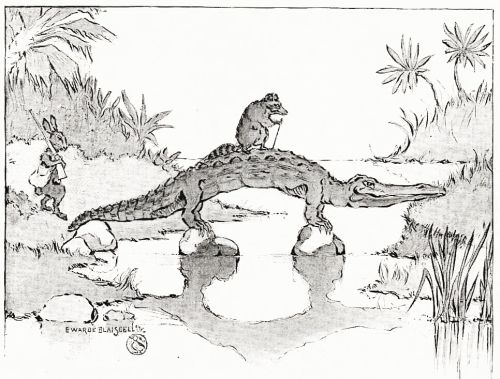
Some people are never at a loss for an answer, and the colored valet who got off the following is a good exponent of that class. It seems he was a lazy rascal, and his master one day remonstrated with him about his neglect of duty.
"But, massa, I's am not equal to de occasion as I once wuz."
"Why, George, what on earth is the matter with you now?"
"I's got a stitch in my side, sir, dat trubbles me a powerful lot, and I's not able to do as much as I hab been doin'."
"A stitch in your side! Oh, come, George, that won't do. Where did you get such a thing as a stitch in your side?"
"De oder day, sah. You see, I wuz hemmed in by a crowd."
Clara wanted very much to go out in the yard to play. Her big sister said to her:
"You mustn't go in the yard. Don't you see that moolly-cow out there? What do you suppose she would do with her horns if you went close to her?"
Clara answered, "I suppose she would blow them."
There are many little acts of heroism, displaying rare courage and presence of mind, performed around us daily that ofttimes pass unnoticed in a popular sense. It is not so long ago that a certain bright young fellow was the hero of a deed that escaped the newspapers and, consequently, the public. It happened in one of our largest cities; and to tell it as modestly as the hero did, it must be told briefly, so perhaps it would be best to use his own words.
"I am very fond of my bicycle," said he, "and ride whenever I chance to have an opportunity, and I am also very fond of practising all sorts of stunts on the wheel. I was riding down the avenue that evening, when I heard the clashing gong of a fire-engine coming through the side street ahead of me. I felt tempted to push ahead and cross the street before the engine reached the corner, and as I was momentarily figuring just what I would do I saw a little girl standing in the middle of the crossing, clapping her hands in childish glee at the approaching engine. The people on the sidewalk seemed paralyzed with fright, and stood, in a sort of fascination, gazing at the child's perilous position. All this I saw with my first startled look, and unconsciously I pushed the pedals down hard and rushed at the child. In a second I reached the crossing, and a few feet off were those three horses tearing along in their mad gallop, the driver doing his best to pull them in, with but little success. They were too close on the girl. As I passed the little one I seized her by the arm, throwing my weight over to the other side of the wheel as I did so. I felt a stinging sensation in my arm, and heard the child scream with fright and pain from the fierce grip with which I grasped her. The velocity with which I was moving, however, accomplished the purpose, for it dragged the child a number of feet before I came to a standstill—or rather before I fell off the bicycle. It was a narrow escape, for those engine horses were very close upon me, and it was lucky I never thought at the time of the danger of my position, for I should never have had the courage to carry out my purpose. Several people took the little one, and I hastened down the avenue before they got me too. You see stunt-practising comes in handy at times."
THE BEAR.
Carrie. "Isn't the bear's skin to keep him warm in winter?"
Mamma. "Yes, Carrie."
Carrie. "Then what does he have to keep him cool in summer?"
It is not very often that we hear of the Russian peasant equalling the Irish peasant in witty sayings, but doubtless those who read the following retort of a Russian will allow that sometimes they are fully equal to the Irish, regardless of the wonderful readiness of the Celtic tongue.
It seems a peasant, having accumulated a little money, took himself to town to purchase a new pair of boots. Returning homewards he espied a luxuriant spot for a siesta, and being tired, lay down for a quiet nap, which developed into a sound sleep. A conscienceless tramp passing along the road took note of the peasant's new boots, and also of his own very poor footgear, and decided an exchange would be beneficial; and accordingly he stripped the peasant of his new purchase and proceeded on his way. The driver of a passing wagon, seeing the peasant's legs stretched part way across the road, yelled for him to "take his legs out of the way."
"Legs?" inquired the half-awake peasant, "what legs?" and then rubbing his eyes, he stared stupidly at his lower limbs. "Drive on," said he; "those legs ain't mine. Mine had boots on."
A MUSICAL QUESTION.
Bobby. "Isn't that an ear-trumpet that man over there is using?"
Mamma. "It is."
Bobby. "And is he working it in connection with his ear-drum?"