$117.50 WORTH OF STAMPS FREE
Reading edition
to agents selling stamps from my 50% approval sheets. Send at once for circular and price-list giving full information.
C. W. Grevning, Morristown, N. J.

100 all dif. Venezuela, Bolivia, etc., only 10c., 200 all dif. Hayti, Hawaii, etc., only 50c. Ag'ts w't'd at 50% com. List FREE! C. A. Stegmann, 5941 Cote Brilliante Ave., St. Louis, Mo
1000 Mixed Foreign Stamps, San Marino, etc., 25c.; 101 all dif., China, etc., 10c.; 10 U.S. Revenues, 10c.; 20 U.S. Revenues, 25c. Ag'ts w'td at 50% com. Monthly Bulletin free. Shaw Stamp & Coin Co., Jackson, Mich.
STAMPS! 100 all dif. Bermuda, etc. Only 10c. Ag'ts w'td at 50% com. List free. L. Dover & Co., 1469 Hodiamont, St. Louis. Mo.
10 Rare Stamps free (postage 2c.). 5 Japan, all different, 8c. F. Jelke, 516 La Salle Ave., Chicago.
The Fatal Letter.
Here is a letter and a puzzle all in one:
There was once a detective who had followed a criminal long and far, and when he thought he had "run him to cover" he found the place empty and only an open letter lying on the floor. He was overcome with chagrin, for it had been said of him that "he had never failed to catch his man." In despair he caught up the letter and read it. On the first reading it seemed a mere succession of idle village gossip. He read it again, then sat down, and pondered over the peculiar sentences all the night long.
His vigil, however, was not in vain, for three hours after dawn the criminal was behind prison bars. Below is a copy of the "Fatal Letter." Can you discover the secret message contained therein, the solution of which led to the arrest of the criminal? Don't be discouraged because the detective spent a night over it. Perhaps you are even sharper than the detective. He had no clew. Neither can one be given to you. But this much may be said, the message is not a haphazard affair, but follows a distinct plan.
THE LETTER.
Beloved Sister,—Dwellers of this town have been much excited over a little affair of recent happening. A servant stole from a rich woman what she called a ewer; it was brought from over the ocean. It was of fine porcelain with heavy gilt edges and a calm summer scene painted on the sides. A man of this town will soon begin sheep-raising. If that old ewe is saleable send her on. It is the druggist who wants her; R. Jones is his name. He will marry soon a girl of this city; his wedding gift is a diamond necklace of elegant and chaste design. It must have cost every cent of a thousand dollars.
The man who lived next door is dead. He took a draught of poison and only lived two hours after. His wife was once the belle of the town. She keeps crying, "I'll take poison myself." Yet he was a poor provider; they had meat only once a month, and their table was always ill supplied. He was also as meddlesome as a flea and of very uncertain temper. Quite lately he quarrelled with me because of my statement concerning a lump of iron ore which he owned. Answer this soon and don't forget about the old ewe. Ah, another bit of news. The woman at the candy store has found a dye that has turned her gray tresses as black as a coal.
Brother Tom.
How We Interested Our Chapter.
A few weeks ago the Allen Chapter, 715, was on the verge of "breaking up." The writer, who is president and a Founder, thought long and at last found a way by which he could start an interest again. It was this. We began to publish a paper called the Allen Courier. Only one copy was made, and that was written. A circuit was started—i.e., a member, after keeping the paper a day, handed it to the next on the list. In this paper the writer, who is editor-in-chief, inserted stories written by the members, clippings, Chapter news, etc., and so started a fresh interest in the glorious old Allen. At the next meeting all were on hand.
Claude T. Reno. Allentown, Pa.
For the Natural History Club.
One day in July, in company with a friend, I crossed a lake near my home in search of interesting specimens. By chance we came upon the nesting-place of a colony of water turkeys. These birds are abundant here, but this is the first time I ever found their nests. The latter appeared to be several years old and were large structures, nearly flat on top. It was late for eggs, and young birds were everywhere. They were covered with white down, and presented a great contrast to the dark colors of the old birds.
When the boat approached a tree containing young birds they would tumble into the water, a distance of ten or more feet, where they would dive long distances to escape us. The nests were in cypress-trees growing in two or three feet of water. Sometimes as many as a dozen nests were in one small tree. Under these trees we shot two small alligators. Perhaps the alligators knew the birds' habit of falling into the water. We also found nests of the purple and Florida gallinule. I would like to belong to a press association or corresponding Chapter.
Ed. H. Clute. Lake City, Florida.
Puzzle to Draw.
Two angles acute; A triangle on rails; Two little serpents With twists in their tails; Two spikes with a bar; A tall headless tack; Two angles acute Which are placed back to back; A part of a circle Two straight lines to meet; Two thirds of a cross; A circle complete; And lastly two angles. And do you not find A character loyal, brave, noble, and kind? Washington.
Knights in a Far-away Land.
The Table has two devoted members in distant South Africa. Their names are George Uhlig and Ernest A. Chaplin. Writing under date of the middle of February, they say the fruit season is just ended, and that apples are being barrelled for winter, now coming on. Both attend Gill College, to which students come from all parts of the colony, and their favorite games are cricket and football; the former in summer and the latter in winter.
One of them remarks that from a perusal of the Round Table he thinks baseball must be a good game, and that he would like to see a game—the "New York's," for example. Both are fond of farm life, of hunting and fishing. The principal birds are the dove, sparrow, fink, day-breaker, laughing, and mouse birds. Both young men are stamp-collectors. Their address is Somerset East, Cape Colony, South Africa.
Washington State Salmon.
In the State of Washington the fish industry comprises a good share of the business. Salmon are the principal market fish, and are found in abundance in the waters of Puget Sound and Gray Harbor. The salmon-fishing season begins in September and closes the 1st of April.
In the first part of the season the "silver-side" salmon are alone caught, and the run is very large. In the latter part the "steel-head" salmon is the principal catch, the run being far less than in the former part. The canneries only run during the period of time when the silver-sides are running. Only Chinamen are employed in the canneries on Gray Harbor. In the cannery at Cosmopolis eighty-five Chinamen are employed.
In the process of canning, the heads of the fish are first cut off, and the salmon are dressed and washed until perfectly clean. They are next cut into small pieces by what might be termed a "gang-chopper," after which they are packed into cans. Every can has to be weighed. The salmon are put up in one and two pound cans. The average sliver-side will weigh thirteen pounds, for which the fishermen are paid thirteen cents apiece, large or small, by the canneries.
Reuel M. Nims, Cosmopolis, Washington.
A Glimpse of Newfoundland.
The chief fisheries in which the public of St. John's are interested are the cod, seal, salmon, and herring. These afford labor to the people of the principal city of Newfoundland. Quite a few people are engaged in the manufacture of the different kinds of gear used in taking fish, such as lines, twines, nets, and cordage, also boats and tackle. The cod season lasts longest. The seal fishery is the most valuable. Salmon and herring are not much caught. The principal merchants of St. John's are engaged in exporting fish. Times are very bad here.
B. Bowering. St. John's, Newfoundland.
This Department is conducted in the interest of Girls and Young Women, and the Editor will be pleased to answer any question on the subject so far as possible. Correspondents should address Editor.
The secret of being at ease wherever you are is a very simple one. It is only this—Do not think about yourself. Bashfulness, awkwardness, and clumsiness are caused by what we call self-consciousness, and as soon as we entirely forget ourselves these pass away. A girl who writes to me complains that she is so tall for her age that she cannot help being awkward. "The moment I enter a room," she says, "I look about to see if any other girl is as tall as I am, and I am always the tallest—a perfect bean-pole. Then I fancy that everybody is sorry for me, and I cannot fix my attention on anything which is going on. It makes me quite wretched. What shall I do?"
In the first place, my dear, your height, if you carry yourself well and hold your head up, is a great advantage. Far from being a thing to regret, it is something to be glad of.
Tall, or short, fat, and dumpy, or thin and pale, let the young girl never think of this when she meets her friends. Instead, let her try her very best to make the rest happy. If there is a girl in the room who is a stranger, or who seems not to be having a pleasant time, single her out and entertain her. Your hostess will be pleased with this sort of unobtrusive help, if it is kindly given.
A summer or two ago I happened to be paying a visit in a country house where there were a half-dozen young guests. Among them were several lovely girls from the South. I noticed that these girls had each some useful social accomplishment. One played very sweetly, and she was always ready to go to the piano and to play accompaniments for the violinist of the house party, as well as to give us her dreamy nocturnes and slow sonorous marches when we asked for them. Another sang, and she needed no urging when there was a wish to hear songs. Still another played chess, and lent herself to be partner to any one who wished that diversion. It was beautiful to watch the sweet unconscious way in which these girls entertained the rest, never putting themselves forward, but always to be depended on when it was a question of how to pass an evening delightfully.
These are the days of out-door enjoyment, and my girls are playing golf and tennis, and riding their wheels, and spending some portion of every day in healthful exercise. Perhaps some of you like work out-of-doors as well as play, and if there is a garden where you can dig and plant seeds and watch flowers grow, or you have a poultry-yard with chickens and hens, or your talent for the practical leads you to raise vegetables—radishes, pease, and lettuce which grow for you will taste as no common market vegetables can. Keep in the sunshine, girls. Sunshine means brightness and bloom for every one of you.

This Department is conducted in the interest of stamp and coin collectors, and the Editor will be pleased to answer any question on these subjects so far as possible. Correspondents should address Editor Stamp Department.
One mail brought me two letters suggesting the formation of an exchange society by the readers of the Round Table. Harold C. Day, Upland Farm, Harrison, Westchester Co., N. Y., and Willis H. Kerr, Bellevue, Neb., both say they would like to hear from any one interested. Other correspondents have suggested the same thing at other times, and asked my opinion on the plan. I regret to say it is not favorable. I have had some experience of exchange societies, and have come to the conclusion that it is feasible only when some capable man is at the head of the scheme who is willing to give his time and experience to the plan, and that all sales are for cash only. All the larger societies already have exchange circuits, and experience shows that common stamps are not exchanged, and that valuable stamps must always be sent by registered mail or by express, which is a considerable expense. The Dresden International Society sends out books of stamps every year worth many thousands of dollars; the leading society in New York has sent out five circuits this year, aggregating about $2000 on each circuit. The first circuit was completed a month ago. Stamps to the value of $1200 were taken. The second circuit will be about the same. Almost all other societies have similar plans.
Their method is quite simple. 1. All members who wish to contribute stamps for exchange purchase a small blank book from the manager (Price 10c.). 2. These books, filled with stamps, are sent to the manager, and when he has a sufficient number they are done up in a package and sent out to the first name on the circuit. 3. This person looks over the books, picks out what he wants, sends a list of what he has taken to the manager, with P.O. money-order for the amount. 4. He then sends the books to the second name on the list, etc. 5. After the books have gone through the entire list the last man returns them to the manager, who returns the unsold stamps to their owners, and sends the cash (less commission) to those members whose stamps were sold.
Some members buy very little and sell very much, others sell very little and buy much. Before the books are sent out the manager examines them, removes counterfeits, etc. Each man who takes out a stamp puts in its place a "control" stamp with his number on it. These control stamps are bought of the manager, and he only knows who has sold and who has bought.
It is expensive and troublesome. A much better plan is the old-fashioned one of "swapping" stamps with one's comrades and friends.
H. B.—Your piece is a "Hard Money" token, not a coin. It has no money value, but is very interesting.
L. K. Babcock.—See answer to H. B.
A. Ulmer.—The 6c. Hawaii, 1864 issue, is catalogued as worth 25c.
Philatus.

TO BICYCLISTS:
There is no better chain lubricant than Ivory Soap; it is a cleanly application and perfect for this use.
Copyrighted, 1896, by The Procter & Gamble Co., Cin'ti.
The coolness is refreshing; the roots and herbs invigorating; the two together animating. You get the right combination in HIRES Rootbeer.
Made only by The Charles E. Hires Co., Philadelphia.
A 25c. package makes 5 gallons. Sold everywhere.
THE
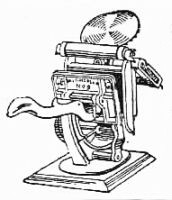
BALTIMOREAN PRINTING-PRESS
has earned more money for boys than all other presses in the market. Boys, don't idle away your time when you can buy a self-inking printing-press, type, and complete outfit for $5.00. Write for particulars, there is money in it for you.
THE J. F. W. DORMAN CO.,
Baltimore, Md., U.S.A.
