Harper's Catalogue,
Reading edition
Thoroughly revised, classified, and indexed, will be sent by mail to any address on receipt of ten cents.

This Department is conducted in the interest of Bicyclers, and the Editor will be pleased to answer any question on the subject. Our maps and tours contain many valuable data kindly supplied from the official maps and road-books of the League of American Wheelmen. Recognizing the value of the work being done by the L. A. W., the Editor will be pleased to furnish subscribers with membership blanks and information so far as possible.
Copyright, 1896, by Harper & Brothers.
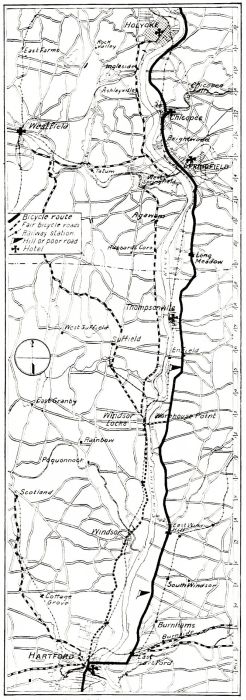
Continuing the journey from New Haven to Springfield, which was left last week at Hartford, the rider is advised to take what is called the East Connecticut River Road: that is, leave Hartford by Main Street, and four blocks from the City Hall—where, by-the-way, the United States Hotel gives L. A. W. rates—turn into Morgan Street to the right, and run over the bridge to East Hartford Street. On reaching East Hartford keep to the left, and take the long road that runs never more than a mile away from the Connecticut River. The road is in fairly good condition, and there are hardly any hills to speak of during the whole run. The rider, however, is of course advised to use side paths.
There is another route which may be taken along the west side of the Connecticut, and which is perhaps the better of the two. To take this, run out Main Street direct instead of turning right into Morgan Street, and keep on until Windsor is reached. At the latter town keep to the right and cross the Farmington River, crossing the railroad, and running along between it and the Connecticut River until Windsor Locks is reached. This town is fourteen miles from Hartford. At this point the Connecticut should be crossed, and starting from Warehouse Point, the rider should take the road already described, running up the east bank through Thompsonville towards Springfield. Crossing the Massachusetts-Connecticut line, he enters upon what is called Long Meadow Street, runs into Long Meadow, past Long Meadow station, and finally runs close upon the Connecticut River again at Pecowsic station. From Pecowsic the run into Springfield to the Massassoit House is easily found.
As has already been said in this Department, this is not what may be called the Springfield route from New York to Boston, and while the stretch of country from Springfield to Worcester is of course rideable, it is not a particularly good road, and the country is not to any great extent picturesque, so that unless the trip is a matter of making the journey—that is, if it is simply for pleasure—the rider is advised rather to turn westward than eastward, to ride a day or two in the Berkshire country, and then take a train or trains for Worcester, continuing from Worcester to Boston on his wheel. This trip from Worcester to Boston, and, in fact, from Springfield to Boston, will be given in the near future in this Department to complete that particular way of crossing Massachusetts from west to east.
Note.—Map of New York city asphalted streets in No. 809. Map of route from New York to Tarrytown in No. 810. New York to Stamford, Connecticut in No. 811. New York to Staten Island in No. 812. New Jersey from Hoboken to Pine Brook in No. 813. Brooklyn in No. 814. Brooklyn to Babylon in No. 815. Brooklyn to Northport in No. 816. Tarrytown to Poughkeepsie in No. 817. Poughkeepsie to Hudson in No. 818. Hudson to Albany in No. 819. Tottenville to Trenton in No. 820. Trenton to Philadelphia in No. 821. Philadelphia in No. 822. Philadelphia-Wissahickon Route in No. 823. Philadelphia to West Chester in No. 824. Philadelphia to Atlantic City—First Stage in No. 825; Second Stage in No. 826. Philadelphia to Vineland—First Stage in No. 827; Second Stage in No. 828. New York to Boston—Second Stage in No. 829; Third Stage in No. 830; Fourth Stage in No. 831; Fifth Stage in No. 832; Sixth Stage in No. 833. Boston to Concord in No. 834. Boston in No. 835. Boston to Gloucester in No. 836. Boston to Newburyport in No. 837. Boston to New Bedford in No. 838. Boston to South Framingham in No. 839. Boston to Nahant in No. 840. Boston to Lowell in No. 841. Boston to Nantasket Beach in No. 842. Boston Circuit Ride in No. 843. Philadelphia to Washington—First Stage in No. 844; Second Stage in No. 845; Third Stage in No. 846; Fourth Stage in No. 847; Fifth Stage in No. 848. City of Washington in No. 849. City of Albany in No 854; Albany to Fonda in No. 855; Fonda in Utica in No. 866; Utica to Syracuse in No. 857; Syracuse to Lyons in No. 858; Lyons to Rochester in No. 859; Rochester to Batavia in No. 860; Batavia to Buffalo in No. 861; Poughkeepsie to Newtown in No. 864; Newtown to Hartford in No. 865; New Haven to Hartford in No. 866.
Any questions in regard to photograph matters will be willingly answered by the Editor of this column, and we should be glad to hear from any of our club who can make helpful suggestions.
SIMPLE CHEMISTRY FOR AMATEUR PHOTOGRAPHERS.
In order to do good photographic work by method rather than by guess, it is necessary to understand something of the nature of the chemicals used and their effects. Even a slight knowledge of chemistry enables the amateur to work understandingly and with far better results. We are therefore going to give, for the benefit of our Camera Club, a few papers on chemistry as used in photography, and shall try to make them so plain and simple that even the youngest member will understand them.
Chemistry is that science which explains the composition of the substances which compose the crust of the earth, the atmosphere which surrounds it, and the water which occupies so much of the earth's surface. These substances are called chemical elements. A chemical element is a simple substance containing only one kind of matter, such as gold, silver, platinum, hydrogen, oxygen, etc. According to the last report of Mr. F. W. Clark, the chief chemist of the U.S. Geographical Survey, there are seventy-two known elements. About thirty of these elements are used in the different processes of photography.
Each element is represented by a symbol, this symbol being the first letter or letters of the name of the element. The symbol of hydrogen is "H"; of oxygen is "O"; of gold, "Au," the first two letters of the word "Aurum," the Latin name for gold. Each symbol also stands for the weight of one of its atoms. (An atom is supposed to be the smallest possible division of a substance.) Hydrogen is the lightest element known, and is taken as the standard of weight when comparing the weight of other atoms. The symbol "H" would therefore not only stand for the element hydrogen, but for its weight, 1, or a unit. An atom of oxygen is sixteen times as heavy as an atom of hydrogen, and an atom of gold is 196 times as heavy.
In making up chemical compounds the chemical elements are combined in different proportions, which, united, make a new substance. The way in which these elements combine is always in the same proportion. The smallest number of atoms which combine to form a new substance is called a molecule. Take water, for instance, which is composed of hydrogen and oxygen; it takes two atoms of hydrogen and one atom of oxygen to form a molecule of water. These chemical combinations are expressed or written by the symbols of the elements of which they are composed, called chemical formulas. If two or more atoms of an element are used to form a chemical compound, the number of atoms used is written directly after the symbol; thus, H2O is the chemical formula for water.
Two well-known developing agents, pyrogallol—commonly called pyro—and hydrochinon, are composed of the same chemical elements, carbon, oxygen, and hydrogen, the only difference in their composition being that a molecule of pyro contains one more atom of oxygen than the hydrochinon. The chemical formula for pyro is C6H6O3, and the chemical formula for hydrochinon is C6H6O2.
The chemical compounds employed in photography are used in the form of solutions. A solution is the liquid combination of a liquid and a solid. A simple solution is one in which the solid is entirely dissolved in the liquid, leaving the liquid transparent. A saturated solution is a liquid containing as much of the solid as can be dissolved in it and remain clear. In making saturated solutions, unless the exact proportions are known, add the solid to the liquid until there is a deposit of the solid at the bottom of the vessel containing the solution. The clear liquid can then be turned off carefully into a bottle.
A solid dissolves much more quickly if it is first powdered. If one has no mortar, put the solid inside a piece of muslin, lay it on a board or stone, and pound with a hammer. When powdered, put the cloth and powder both into a glass vessel, and turn the liquid over it. When the solid is dissolved, remove the cloth. Another way in which to dissolve a solid more rapidly than by mixing it with the liquid is to tie the powder in a cloth and suspend it in the liquid.
In making up a formula for developing or toning, etc., be exact in the measuring and weighing of the ingredients. Even a slight deviation from the rule sometimes changes the action of the chemicals.