THE FEAST OF KING RED COAT.
Reading edition
ONE OF THE OLD SAILOR'S YARNS.
BY W. J. HENDERSON,
Author of "Sea-Yarns for Boys," "Afloat with the Flag," etc.
It was a morning of yellow fog. The whole world appeared a sheet of shifting, silent ochre. Up beyond the bluff the sallow outlines of the houses faded upward into sinuous curves of restless mist. The sands of the beach looked like a reflection of the fog that wrapped the sea in its curtain of gold. The old pier jutted out an uncertain brown line with sparkles of silver along its wet columns, like the flashes of big guns seen through their own smoke. The swells loomed suddenly out of the yellow curtain with a quick flash of light along their crests, a curving of brown shadows in their hollows, and then a plunge into hissing fields of mellow foam. It was one of those blinding mornings of dead gold, when the fog hangs low over the earth, and the brilliant sun, shining in a clear sky above, forces its intolerable glory downward through the mist. The human eye is helpless on such a day, and seeks vainly for a moment's relief among the sombre shadows in the crannies of the ground. It was just the sort of a day to tempt the Old Sailor to sit on the end of the pier and try to look through the fog. So Henry and George walked down to the old meeting-place, and there they found him gazing into the water with a meditative countenance. As usual, he did not look up when he heard their footsteps, but broke into one of his silent laughs. The boys, without saying a word, sat down beside him, and presently he exclaimed:
"W'ich the same you is great navigators. 'Cos w'y, ye can steer straight fur this 'ere pier in thick weather without no obserwations wotsomever, relyin' on dead reckonin' an' general sagaciousness."
The boys held their peace; and presently their friend spoke again:
"But that are not so easy fur to do at sea. Leastways ef it was, Cap'n Philander Montgomery Boggs, of the Al Kamakh an' Kangaroo liner Queen O' Spades, wouldn't 'a' made Wakaufoo w'en he were a-steerin' fur Al Kamakh, w'ich the same are on the west coast o' Hindoostan, as any one can tell wot are bin there, an' this 'ere old sailor are him."
"Won't you please to tell us about that?" asked George.
"Wot d'ye s'pose I are a-doin'? Singin'?"
George looked so humble at this rebuke that the Old Sailor burst into another of his hearty, silent laughs, vainly tried to see through the fog once again, and then exclaimed:
"Pickle me in a tin box full o' oil fur a bloomin' sardine ef this here ain't the werry identical kind o' day wot it happened on. I were in Calcutter, w'ich the same it ain't no sort o' place at all. I landed there from a consid'able v'yage, an' had five hundred dollars a-comin' to me, an' I got 'em, too. So I laid out to have a good time in Calcutter. I staid there a month, an' at the end o' that interestin' period I didn't have nothin' left o' my five hundred 'cept a linen duster an' a black eye."
"Why, how was that?" exclaimed Henry.
"My son," said the Old Sailor, solemnly, "that 'ain't got nothin' to do with this 'ere yarn wot I'm a-tellin' of. An' also it ain't perlite fur to try fur to switch gentlemen off the course. Now where were I?"
"In Calcutta, sir," said George, with grave respect.
"An' not so werry good, too. Bein' as how I were on my beam ends, I made shift to see as how I could git afloat ag'in. So I walked down to the docks. Down in the big dry dock I see the Queen o' Spades jess ready to git out. I axed a few questions, an' I larned that she'd been undergoin' repairs an' were to sail fur Al Kamakh the next day, with a scratch crew. I'd bin in Al Kamakh oncet, an' I thort as how, not bein' a werry pertikler pusson, I'd jess as lief go there ag'in. So I went aboard the Queen o' Spades an' interjooced myself to Cap'n Philander Montgomery Boggs. An' he sez to me, sez he, 'Ye jess come right. My second mate he went ashore yistiddy, an' he never come back, an' now he can't come back nohow; an' you can have his berth ef you want it.' An' me wantin' putty much anythin', havin' nothin' to speak on 'ceptin' the linen duster an' the black eye aforesaid, I took that berth.
"The next day we got under way. The reg'lar run o' the Queen o' Spades were from Al Kamakh to Kangaroo, Australey, an' she'd bin a-repairin' at Calcutter 'cos there weren't no dock big 'nuff to hold her atwixt that an' London. She were called the Queen o' Spades 'cos she dug so many holes in the bottom o' Al Kamakh Bay a-goin' in an' out, she drawin' twenty-seven feet of water, an' the bay havin' only twenty-nine feet in the channel, an' it weren't much o' a channel at that. Fact is, the Al Kamakh an' Kangaroo line, owin' to the permisc'ousness o' their steamers about hittin' ground, were gin'rally knowed as the Overland Route. Howsumever that 'ain't got nothin' to do with this 'ere yarn wot I'm a-tellin' yer. Waal, we 'ain't got no such steamers here as them. W'y, the Queen o' Spades are six hundred and fifty feet long, an' are got four smoke-stacks, each one hundred feet high, an' big enough around fur to march a company o' soldiers through in full front. An' they don't carry only one mast jess fur signalling an' they make twenty-two knots an hour all the time, 'ceptin' goin' to harbors, w'en they sometimes don't make no knots at all; 'cos w'y, they're aground. An' the cabins is all full o' gold an' diamond fancy-work an' stained glass winders till ye'd think ye was in a palace. They has to have 'em like that 'cos the most passengers is Indian princes an' rajahs an' bunnias an' jampanis an' khitmatgars an' things goin' down to Australey to drink the waters for jungle fever; an' them fellers all has to have a floating palace, or else they go home an' start a new war with England, an' so Tommy Atkins has to git killed some more.
"Waal, we didn't have no heaven-borns aboard w'en we steamed out o' Calcutter, 'cos the ship'd bin a-repairin', an' were goin' back to Al Kamakh under a short crew—jess 'nuff to work her around—an' she were to git her reg'lar people w'en she got there. But she were all purwisioned, 'cos she were to sail right off from Al Kamakh. So we hustled her right out to sea an' turned her up to putty nigh twenty knots right off. Cap'n Philander Montgomery Boggs, sez he to me, sez he, 'We are a-goin' to make a werry fine passidge.' An' him bein' Cap'n o' the ship an' me second mate, I didn't say nothin', but I were putty pertickler sure that either him or the clouds in the nor'west was mistook. It turned out as how it were him. I've noticed that it gin'rally are that way. Clouds is seldom mistook. They gin'rally knows w'ether they be goin' fur to rain or blow, while sailor-men sometimes is out o' their course on that p'int.
"Waal, we hadn't bin to sea more'n a day w'en it come on to blow from the nor'west. I dun'no' but I've told ye that I bin to sea a good many years. Anyhow, I never seed it blow harder. It blowed so hard that the ship laid right over onto her side, an' then she slid off to leeward so fast that she couldn't be brought head to the seas. So the Cap'n decided that he'd have to let her run afore it, w'ich the same he done. An' w'en she was afore it, the wind would cut the tops off the seas astarn of her an' send 'em whizzin' over the deck in solid blocks o' flyin' water, an' they'd fall into the sea ahead o' her an' kick up back waves that rolled in over the bows jess as if we was a-takin' the seas head on. The water were three feet deep on deck all the time, an' the crew went about in the dingy. I 'ain't never seed nothin' like that in all my sper'ence at sea; but then ye can't most allus gin'rally tell wot'll happen in the Injun Ocean; 'cos w'y, it ain't no decent, ordinary ocean, but a sort o' heathen place, fit only fur razor-backs an' piccaroons.
"Howsumever, there we was a trollopin' off to the south-east at a rate o' speed that were puffickly disgustin'. The gale blowed itself out in about eighteen or twenty hours, an' the old man sez he to me, sez he, 'Now I reckon we'd better climb back to where we b'long.' So he puts her head due nothe. But bless ye! it went an' fell flat calm, an' then sot in with a yaller fog with sun behind it, jess like this here werry identical one this mornin'. The Cap'n he were putty mad, and he jess ordered full speed kep' up, 'coz he sez, sez he, 'I 'ain't got no more time fur to go buggaluggin' aroun' here,' jess like that, him bein' Cap'n Philander Montgomery Boggs o' the Queen o' Spades. Lookouts was doubled forrard, o' course, but we hadn't bin runnin' ahead fur more'n four hour w'en scrape, bump, biff! we was hard an' fast agroun'. The Cap'n he danced on one leg, an' talked Greek; but there we was. An hour later the fog lifted, an' wot d'ye think we saw?"
"Rocks and reefs all around you, with the sea breaking over them!" exclaimed Henry.
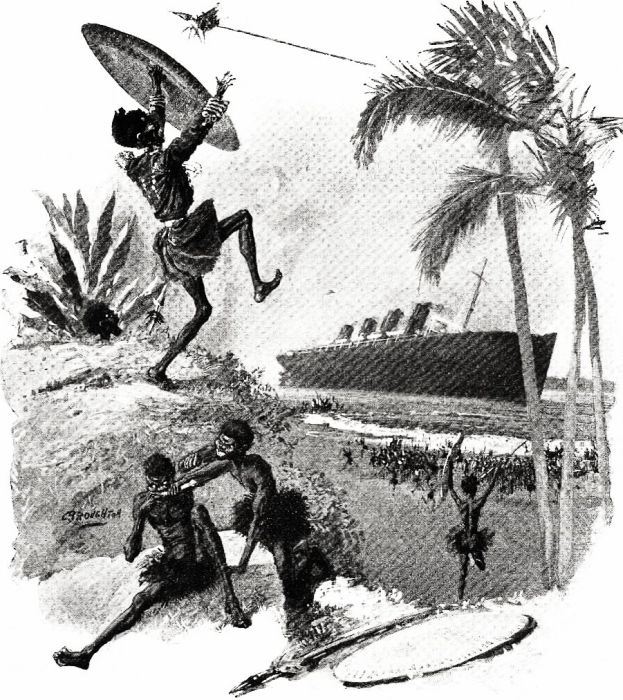
"Not so werry good," responded the Old Sailor. "The Queen o' Spades had run plumb straight into a small harbor, sort o' horseshoe shaped, with a long narrer p'int runnin' out on each side. There she were stuck fast in the sand, an' a werry consid'able number o' half-nakid savidges standin' on the shore a-grinnin' an' wavin' spears. Putty soon a big canoe started out from the shore an' come towards the ship. In the starn o' her there were a werry tall savidge wearin' a werry big red coat with one epaulet. Cap'n Philander Montgomery Boggs sez he to me, sez he: 'That are the chief, an' he are a-wearin' the coat o' some English ossifer wot's bin wracked here.' An' that bein' werry plain fur to see, I didn't say nothin' at all. Waal, w'en the canoe got close 'nuff we could see that them was the werry thinnest an' starvedest lookin' lot o' savidges ever knowed. W'y, their ribs stuck out so their sides looked like old-fashioned washboards, an' their faces looked like overgrowed English walnuts. They pulled up the canoe a few yards off an' made signs that they was hungry, an' they looked it. So the Cap'n, seein' that we was there thort as how we'd better make friends with 'em, an' he inwited the King—the feller in the red coat—to come aboard an' git some grub. The steward sot out a fine lunch in the first-cabin saloon, an' the Cap'n he showed the King aroun' while it were a-gettin' ready. We soon found out as how that there King could talk consid'able English, but he wouldn't tell where he larned it. Waal, I wish you could 'a' seed that there King eat. The steward put out a lunch for six, an' blow me fur pickles ef the bloomin' one-epauletted cannibal didn't eat it all, an' holler fur more.
"'Give poor savidge puddin',' sez he.
"'Look a-here, Kingsy,' sez the Cap'n, 'how long is it sence you filled your hold?'
"'Werry poor island dis,' sez the King—'werry poor. Eat nuts an' wild berries. Poor savidge werry hungry.'
"'Steward,' sez the Cap'n, 'fill him up solid. Give him some o' those doughnuts ye make fur the babbus in Al Kamakh.'
"Waal, byme-by the King got 'nuff, an' went ashore. He hadn't bin there an hour afore we seed a hull regiment o' savidges to work astarn o' the ship. They was drivin' logs down into the water, an' droppin' big rocks in an' shovellin' sand.
"'By the great hook block!' yells the Cap'n, 'they're a-buildin' a breakwater astarn o' us so's we can't git out o' this 'ere trap!'
"An' that were wot they was a-doin'. Nex' thing we knowed canoes commenced fur to come off ag'in, an' the hull of the King's court come aboard. There was Squilli Gee, keeper o' the Red Coat; Solo Primo, lord high berry-picker; Effie Tombi, nut-cracker to his Majesty; Toto Poto, lord high admiral o' the canoe fleet; an' Kala Poobi, secretary o' the palace. They was mostly joints, ribs, an' cheek-bones, them fellers, an' all they wanted was a square meal. Squilli Gee informed us most politely that ef we didn't feed 'em they would fill us full o' holes. So we fed 'em. Them fellers numbered jess thirty, an' they stowed away purwisions fur a dinner fur a hundred fust-cabin passingers. They went ashore, an' at six o'clock in the evenin' the King comes off ag'in, bringin' his wife an' fam'ly. There were jess eight o' his wife, an' the hull o' 'em weighed about 600 pounds. There was thirty-seven o' his fam'ly, all so thin that w'en they stood sideways ye couldn't see 'em. One o' 'em fell through a scupper into the sea, an' he were so thin he couldn't float; so he were drowned. An' wot d'ye s'pose the bloomin' King sez?"
"Why, what did he say?" asked George.
"'Let him go,' sez he; 'I got more on 'em now than I kin feed,' sez he, jess like that, him bein' a miseraceous savidge, with more ribs 'n a line-o'-battle ship. Waal, that there fam'ly o' the King's they could give the court p'ints on eatin'. Howsumever, the Cap'n he sez, sez he:
"'Steward, fill 'em all up full to the hatches. Byme-bye we'll get the hull island fed, an' then all on 'em'll go to sleep. Then we kin go an' knock over that there breakwater, an', ef the tide sarves, mebbe we kin git out o' this cussed trap.'
"That sounded all right, but it didn't work no more'n a tramp will. Them bloomin' savidges wouldn't go to sleep a bit. They kep' right on pilin' up stuff astarn o' us, an' we knowed that every rock they dumped in were a-makin' the channel wuss an' wuss. The nex' mornin', bright an' 'arly, off comes the King an' his blessed court fur breakfast. An' wot d'ye think?"
"What?" demanded both boys, eagerly.
"Them fellers was thinner than they was the day afore! Cap'n Philander Montgomery Boggs sez he to me, sez he, nothin'. 'Cos why, he were so knocked aback as he couldn't say any thin' 'ceptin' nothin', w'ich the same he said. An' I agreed as how there were nothin' else to be said.
"'Poor savidge werry hungry,' sez the King. 'Give poor savidge mutton-chop, beefsteak, veal-cutlet, ham an' egg, fried sausidge, liver an' bacon, quail on toast, poached egg, graham roll, and chocolate.'
"'Wee-ow-ow!' yelled the court, jumpin' up an' down an' lickin' its chops.
"'Look here, Kingsy,' sez the Cap'n, 'how long d'ye think this 'ere are a-goin' to last?'
"'Big ship; much grub; eat fur month,' sez the King, sez he.
"'An' wot'll ye do arter ye eat all we got aboard?' asked the Cap'n.
'Oh, poor savidge werry sorry then, werry sorry,' sez the King, sez he, lookin' fur all the world as ef he was a-goin' to cry; 'but have to eat sailor then.'
"'Wee-ow-ow!' sez the court, werry mournful.
"'May I never see blue water ag'in!" sez the Cap'n.
"'Werry likely you won't,' sez the King, an' with that he jess blubbered an' cried like a babby.
"Waal, them bloomin' beggars eat enough to sink a lighter, an' then they went ashore an' sent off the fam'ly. The steward he were jess about half crazy; an' the head cook he really were a ravin' lunatic, an' jess didn't do nothin' but dance around yellin' orders to cook things. Nex' day it were the same thing all over ag'in, and nex' day, too. All the time that one-epauletted King kept his gang a-workin' on that breakwater, an' inside o' a week it were puffickly certain the Queen o' Spades were shut up in that bloomin' little harbor fur to stay. Waal, to make sight o' land at the other side o' this 'ere yarn wot I'm a-tellin' ye, I'll say that this 'ere sort o' thing kep' a-goin' fur three weeks, an' then the steward he went to the Cap'n, an' he sez to he, sez he, 'There ain't more'n another three days' grub aboard.' An' the Cap'n, sez he, 'Arter dark to-night we'll put that into the boats an' go to sea, an' leave the Queen o' Spades here till we can send a gunboat arter her.' Half an hour later the King come aboard ag'in, an' he were so thin now that the red coat hung around him like a wet rag, w'ile his blessed court looked like a section o' picket-fence turned up on end. Them fellers was just wastin' away a-carryin' sich loads o' good grub. W'en the King see the Cap'n he went up to him with tears in his eyes, and sez he to he, sez he:
"'My dear, dear brother, poor savidge see man put food in boat. You go to go away at night. Don't. My canoes catch you, an' then we eat you all the sooner.'
"An' with those words the King commenced cryin' an' shakin' his head, an' the court set up another wee-ow-owin' like a convoy o' cats in a Noo Yawk aryway. Waal, we made up our minds we'd got to die, and yet none on us didn't want to die 'less he were obleeged to."
The Old Sailor paused as if overcome by his recollections, and George said, in a suppressed tone,
"But you didn't die, did you?"
"My son," answered the Old Sailor, "I ain't no ghost; I'm a peaceable, hard-workin' sailor-man. An' may I never live to see a four-horned grampus ag'in ef this 'ere ain't the circumstigious picooliarity o' our escape. The next mornin' the hull sea an' sky was a sickly green; the sun were a sort o' greenery-yaller; an' it were dead calm, with a big swell outside. The Cap'n sez he to me, sez he, 'We're a-goin' to have a fearful gale or a hearthquake or somethin'.' He hadn't more'n got them words out o' his mouth w'en we seed the hull island rockin' an' shakin', an' heerd a termenjous rumblin', like a freight train goin' past. 'Look! look!' yelled the quartermaster. An' lookin' w'ere he p'inted, we see astarn o' us a wave fifty feet high rollin' in from the sea. It come right on over old Kingsy's breakwater, an' pickin' the Queen o' Spades up as though she were a yaller chip, it carried her right over one o' the p'ints o' the harbor an' into the deep water outside.
"'Hooroar!' yells the Cap'n. 'Full speed ahead, an' we'll see w'ether his Royal Red Coat's canoes'll catch us now.'
"And off went the old Queen o' Spades at twenty knots an hour, and in two days we was in Al Kamakh."
"And well out of it," said Henry.
"I dun'no'," said the Old Sailor; "'cos why, the steam-ship company wanted to make Cap'n Philander Montgomery Boggs pay fur the grub he fed the savidges; an' w'en I left they was a-fightin' over it in the courts yet."