THE AMERICAN NIGHTS' ENTERTAINMENTS.
Reading edition
THE ROSE FESTIVAL.
BY EMMA J. GRAY
eneath a most capricious sky Mabel stood sedately wondering whether or not she could wear her white tulle frock this afternoon and not have it forever ruined, when all in a moment the sun disappeared, the leaves of the trees rustled, and Mabel's hitherto sedate face saddened dolefully. Had not her mother happened near there surely would have been a shower of tears, for she had counted so very much on going to the festival. But mothers know how to manage, and putting her arm around Mabel's shoulders, she caressingly said: "Don't cry, whatever you do; wait for that when you know you cannot go; perhaps this afternoon will just glisten with sunshine, and then think of all the tears you'll have wasted! Why, only look here; there are cobwebs in the grass"—and Mabel's mother stooped to examine, thus making herself quite sure she was not mistaken—"and you know, dear, what they say, 'that cobwebs in the grass is a sure sign of a clear day.'" And so it was that Mabel's tears never really got beyond her eyelashes, and her long doleful face changed into blushes of sudden delight.
When the afternoon came, the cobweb test was proved true, for the dew fogs stole away in line and column, the warm, rich, gladsome sunshine leaped over hill, lawn, and road, and gave a tint of amber, purple, or rich red rose, according to the way the trees leaned or their stately branches swayed and curved.
The country was the majestic Berkshire section; and Mabel, who had but just entered her teens, was with her mother visiting her Aunt Lucretia in her country home.
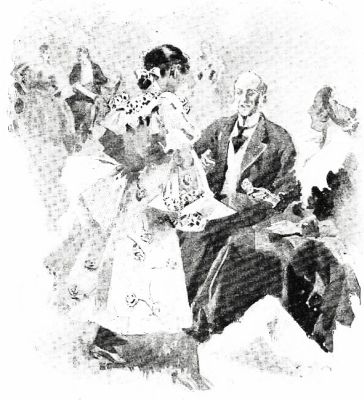
Aunt Lucretia had no children, and didn't understand them very well, and Mabel's visit thus far had been rather unsatisfactory. But about two weeks before she was thrown all in a flutter because of an invitation to a Rose Festival, given by the daughter of "the richest man in the place"—so Aunt Lucretia explained, and with a positive shaking of her head from side to side, continued, "It would be an elegant affair, she knew, and she was much flattered that her niece had been remembered," etc. Besides Mabel, her aunt, uncle, and mother had been invited, the only difference in the character of the invitations being that to hers were added the rather informal words, "All the young people will personate favorite roses." And as she would surely be considered among the young people, and as the Cornelia Cook rose was Mabel's favorite, it took not a little ingenuity on the part of her mother and aunt to indicate this rose in her costume. But it was deftly, as also simply, arranged at last by fastening a bunch of these rose-buds on the top of each sleeve, edging the waist close to the neck with rose-buds also, and dropping a few at uncertain distances over the skirt—"as though she'd been caught in a shower of roses," was her uncle's pleasant criticism. So that it was no wonder, in consideration of the so far disappointing visit, dainty apparel, and the prospect of a gay party, that Mabel's blue eyes had looked anxiously for sunshine through the cloudy sky of the early morning.
It was shortly after three o'clock when the impatient Mabel stepped into the landau that was to convey her aunt, uncle, mother, and herself to the festival; and the horses, feeling the exhilaration of the charmed atmosphere, pranced and cantered along so rapidly that the few miles that lapsed between were soon over, and Mabel was at once bewildered with beauty and gayety. Already several emptied carriages had their wheels rolling towards home, while others had gone back of the broadly grand and altogether captivating gray-stone house to accept the hospitality of the stables graciously offered to their owners.
Just as Mabel was ushered into the bower of roses, which was the lawn's substitute for a reception-room, she overheard some one saying to her hostess:
"Queen rose of the rose-bud garden of girls, Come hither, the dances are done. In gloss of satin and glimmer of pearls, Queen lily and rose in one. Shine out, little head, sunning over with curls, To the flowers, and be their sun. The Red Rose cries, 'She is near; she is near!' And the White Rose weeps, 'She is late!'"
"All right, papa, I'll come at once;" and then, with a bow, smile, and hand-clasp for Mabel, she added, "You come with me, for you are a stranger here, and we will lead the opening dance together." Then throwing her head back merrily, so that her curls touched her fathers arm, she laughingly continued: "What a papa—'the dances are done!' They haven't commenced; nor will they until I start them"; and with the gay raillery which her father so thoroughly understood, added, "I shall punish you by asking you to help mamma to receive, not only for yourself, but for me too."
And then, with a winning smile towards the incoming guests, following close one after the other, and seemingly a perfect prism of color—for so smart and catchy were their gowns, frocks, and parasols—she tripped off merrily, holding Mabel's hand tight meanwhile, to where the musicians were hidden behind the clump of tall snowball bushes, and a moment later the dances began.
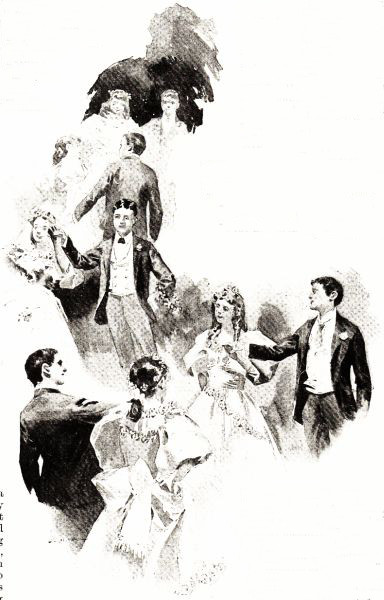
It was a rare sight, a revel of beauty. The older folks watched from garden chairs, and seats made softly comfortable with the abundance of mellow-tinted rugs and downy dainty-covered pillows. The boys could only represent roses by wearing their favorites as boutonnières, but the girls' frocks, sashes, and broad-brimmed hats were very suggestive, and marvels of exquisite color.
All the roses came to the festival—the Austrian in its brilliant yellow, Jacqueminot in its deep red; even the little Primrose came, though it was a question as to her right; however, we were not sorry to see her, for the delicious lilac-colored costume was a pleasing contrast and a set-off to the others. The hostess personated a Moss-rose Bud. Her frock was pink tulle over the palest of pink satin. She wore a girdle of rose-buds, rose-buds around her neck and arms, and her Leghorn hat was encircled with the same flower. This hat she sometimes wore, but oftener than otherwise it was suspended from her arm by its pink satin strings, and in this respect her guests would often copy her.
During the afternoon the hostess filled her hat full of rose-buds, and somehow she managed to keep it replenished, notwithstanding that she gave to each of her older guests a bouquet, repeating while doing so, as she rapidly walked from one to the other:
"Gather ye rose-buds while ye may; Old Time is still a-flying. And the same flower that smiles to-day To-morrow will be dying."
There was a succession of archways on the lawn, built about ten feet apart—the frames, twelve feet high and six broad at their widest, being temporary, and only strong enough to support the various vines, mosses, and rose climbers with which they were covered. Through these arches various games were given, among them,
NAMING THE ROSES.
The musicians played something between a march and a reel, and immediately each boy signalled out the girl that matched his rose, and keeping time to the music, they walked through the first arch, and so on to the second, thus in rotation going through all. It was quite a long procession, for each couple kept about two feet back of the other. When all had thus passed through the last arch, they joined hands, thus forming a circle, and commencing with the first couple, entered the ring two by two. Two only being in at a time, when they came out the two that followed them in the march went in, and so on. When in the circle the boy asked the girl, "Which rose are you?" she answered. "Tell me, and I'll tell you." Oftener than otherwise his answer was, "I don't know," though once in a while he made a correct guess. When his answer was right, he asked the girl the language of her rose; but if he had made a mistake, he was obliged to leave the girl in the ring and stand under one of the arches; if the girl could not answer his question, she had to stand under an arch. If the boy left the ring before inquiring the roses' language, those forming the ring put the same question, and if the girl did not properly reply, she had to pay the same penalty as when not replying to the boy. When both questions were answered correctly, the boy and girl again joined the hands of the others forming the circle. When each couple has left the ring the game was concluded.
Among the rose-buds and their meaning are: White rose-bud, girlhood; red rose-bud, loveliness; white and red together, unity.
Another game was,
FINDING THE HARE.
The hare was nothing more nor less than a box made in exact copy of a hare, about six inches long. When opened it was found to be full of rose-colored and rose-flavored confectionery.
The company were told that a hare was hidden between two arches, and whoever found it was the owner. It was a most bewitching sight to see the merry hunt—such laughing faces, half hidden at times with long fluffy curls or broad-brimmed hats.
The florist had taken up a piece of sod, and underneath it, wrapped in white waxed paper, he laid the hare. When he replaced the sod, the hare's head was the only part left out, and the grass blades were so thick and long that it took considerable patience and sharp eyes to discover it.
The games closed with a visit to
THE PROPHETIC ROSE.
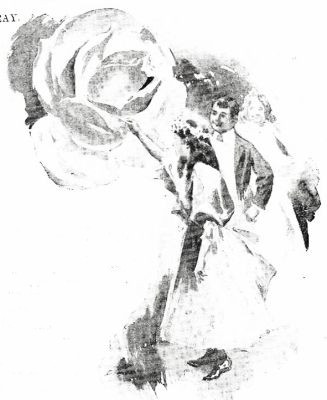
In the first archway was placed a huge rose made of tissue-paper of a deep red color, the petals being darker at the centre. The guests were told the darker petals belonged to the boys, and the girls should visit the rose first. Each girl in turn stepped towards the rose and broke off a petal. On the reverse side she read her fortune; for delicately pasted to the rose petal was a white one, and on this the girl's fortune was written. Everybody read their fortune aloud, for all were as interested to learn the future of their friends as their own. When the girls had finished, the boys followed in similar manner. Some of the fortunes were:
"Thou drawest a perfect lot."
"You will be wondrous happy."
"Mistress of the Manse."
"A curate—never slack in duty."
The last dance was the wreath quadrille, at which every one was presented with a wreath of moss-rose buds. The girls immediately bared their heads and put theirs on, while the boys hung theirs on their arms.
The games, dances, and all the merry play stopped at five o'clock, when under the trees was served a tempting and plentiful refreshment on tables but just large enough to seat from four to six people. The table covers were white satin damask bordered with natural roses, some with red roses, others with pink or yellow, while in the centre of each lay a solid triangle of roses, the same variety used for bordering.
Lemonade was served in rose-colored glasses; iced cakes were encircled with roses; some were left white, but others represented American Beauty or La France varieties, and the ice-cream and ices were in the prettiest of rose devices, one favorite being an overturned basket of Mermet roses.
When Mabel returned to Aunt Lucretia's she was very tired. "For, only to think of it, mamma, I was in everything. And wasn't you surprised to see me lead the dances?"
"I was glad, for Aunt Lucretia's sake. You were the stranger, and therefore had special honor."