JENSEN FALLS OVERBOARD.
Reading edition
BY OSCAR KING DAVIS.
he United States Revenue-cutter Corwin was taking the court officials from Sitka to Juneau to hold court. There was to be a term to deal with the seizures of seal-poachers that had been made by the patrol fleet in the Bering Sea that summer. They were in a hurry, and the Corwin was doing her best. It was perhaps 4 o'clock in the afternoon of a dismal dull November day that the revenue-cutter rounded a point in Chatham Straits, and came plump upon a sleek little Columbia River fishing-sloop beating down the channel. Something in her trim suggested smugglers to the officer of the deck. The Captain was below with some of the court officials when the messenger from the Lieutenant reported. When he got on deck a quartermaster was already standing by the flag halyards, ready to send aloft the signal to the sloop to stop, and a boat's crew stood ready to clear away the dingy. The Captain took in the situation at a glance, and almost with one breath ordered the signal flown and the boat cleared away. The men in the little sloop had been watching with eyes of experience, and as the signal-flags fluttered from her spanker-gaff they swung their boat up into the wind and dropped the jib.
On the cutter the men were lowering the dingy, and the Lieutenant stood by the rail ready to go the moment his boat caught the water. Three sailor-men were in the boat, two at the fall-ropes and one in the middle with the oars and cushions. Jensen, the man at the after fall-rope, was a fine big Swede, broad-shouldered and stalwart. A drizzling rain was driving down from the mountains that line the Straits, and all the men were in their oil-skins and sou'westers. Jensen had added a great pair of rubber boots with long tops that reached up to his hips. The fall-ropes had begun to slip through the sheaves, and the dingy had started toward the water, when the eye-bolt at the stern, to which the lower block of the fall-rope was hooked, broke with a snap like a pistol crack. Instantly the stern of the boat fell into the water, but quickly as it fell the sailor-men were quicker. As they heard the snap of the breaking bolt and felt the boat begin to go out from under their feet, all three threw up their hands and grasped the wire stay that stretches between the davits. Two caught it with both hands, but Jensen missed with his right. The lurch with which the dingy fell had given him a twisting motion, and as he clung to the stay with his left hand he swung around until his arm could be twisted no further, and then he let go.
Instantly there was a tumult on the cutter, but it was not the crew of the Corwin that made it. The court officials from Sitka and their wives had come on deck to see the fishing-sloop examined, and the instant they saw Jensen fall and heard the splash of the water as he struck, they set up a shout of "Man overboard!" Then they began to throw things over to the sailor-man, who was rapidly drifting astern. The first signal to the fishing-sloop had been accompanied by an order to the engine-room to stop and back, but the Corwin was still under good headway when Jensen fell. As the dingy struck the water it turned bottom up, and all the oars and cushions and movable gratings in the bottom fell out and floated astern with the sailor-man. Added to these things were a lot of deck-gratings and things slung over by the excited Sitkans. Half a dozen life-buoys that were thrown over at the first alarm promptly went to the bottom. They had been cleaned and painted so many times that not even the heavy salt water would float them.
At the cry of "Man overboard!" Captain Hooper's orders were short and sharp. In response to them a boat's crew leaped at the big whaleboat. Almost in the twinkling of an eye it was in the water, and eight sturdy fellows were responding with all their might to the bo's'n's exhortations to "give way." But at the same time another crew had cleared away the Captain's gig, and the young Lieutenant who was to have boarded the suspected sloop from the dingy was placidly going about his errand in the gig.
It takes a long time to tell it, almost as long, perhaps, as it seemed to Jensen, but all this really occupied a very few minutes. The people from Sitka, hanging over the taffrail and wondering if the cutter would never begin to go astern, saw Jensen go down, and held their breath with the instant's fear that he had given up. But presently he bobbed up again, and then one, with a glass, made out that he had taken off his heavy oil-skin coat. He had his big sou'wester in his teeth, and was treading water. As he stood up out of the water he lifted one side of the heavy coat. He caught the air under it, when he dropped the edge of it again, and the man with the glass could see the coat float by itself. Then Jensen disappeared under the water again. He was down what seemed an interminable time, and they thought that surely this time he was gone for good. But he came up again, and this time he had his long rubber boots in his left hand. He caught his sou'wester in his teeth again, and, swimming with his right hand and holding his boots in his left, and pushing his coat with his brawny chest, he struck out comfortably for the whaleboat that was rapidly bearing down on him.
Before it reached him, however, there floated by one of the gratings that had been flung over after him. They were half a mile or more astern of the revenue-cutter, and the thick day prevented the nervous watchers on the Corwin from seeing what happened. But the bo's'n in the whaleboat saw Jensen grasp one end of the grating with his right hand and try to crawl up on it. Its buoyancy wasn't enough to stand the weight of the burly Swede and his heavy boots. His end sank, and the other end rose out of the water further and further as Jensen scrambled up. At last, with a smash, it turned end for end, and cracked the plucky sailor-man a resounding whack on the head. He went down as if he had been lead, and even the bo's'n in the whaleboat thought it was all up with him. But Jensen apparently was not born to drown. He was up again almost as soon as the grating was, and as the whaleboat dashed alongside he flung his big boots in and crawled over its side, helped by half its crew.
Then the whaleboat started back for the Corwin, and as it went along it stopped at intervals, and picked up the oars and cushions and seats and gratings and things that had been spilled out of the dingy, or flung over for Jensen. The water was desperately cold. A glacial current sets down the coast through Chatham Straits, and it was this ice-water that Jensen had been in for what seemed half an hour, but was really not half so long. His teeth chattered when he got into the whaleboat, and he needed something to warm him up. When the whaleboat returned to the cutter the court officials and their wives crowded along the rail, expecting to see a half-drowned man lying in the bottom of the boat. They saw only the boat's crew, and one extra man, not Jensen, standing up in the stern sheets, beside the bo's'n.
"Why, where's Jensen?" some one asked Captain Hooper.
"There he is," said the Captain, "pulling the bow-oar."
That was Jensen's way of warming up. He scrambled up on deck in his wet clothes and in his stocking feet, with his coat and rubber boots under his arm, saluted the Captain, and stood at attention. There was an ugly cut on his face where the grating had hit him.
"How did you fall?" asked the Captain.
"The bolt broke, sir," said Jensen, "and she went down."
"Go forward and get some dry clothes," ordered the Captain; "and here, messenger," he added, to his boy, "tell the apothecary to give Jensen something to warm him up!"
The Captain turned to one of the Sitkans and said, "He goes overboard almost every other day just to get warmed up afterwards."
As the whaleboat was slung in the davits again, the gig came back from the fishing-sloop.
"She's apparently all right, sir," reported the Lieutenant. "They say they are examining the coast, looking for a place to found a colony."
There was a jingling of bells in the engine-room, and the Corwin steamed full speed ahead again, hurrying to Juneau.
BY GASTON V. DRAKE.
XIX.—FROM BOB TO JACK.
Genoa.
DEAR JACK,—-Maybe we haven't been travelling! My! Pop met a man in Geneva and he says going to Venice aren't you? Not much said Pop. New York's wet enough for me. Then you make a great big error said the man. It's fine this time of year and anybody that gets as far into Italy as Genoa without going a little further to see the most unicorn city in the world doesn't know as much as he thinks he does and wastes an elegant importunity. So Pop spoke to Ma about it and Ma said she'd sort of like it and as for Aunt Sarah she was so pleased she forgot all about the music-boxes and recovered her health right away, but it's kept us on the jump, and I've seen so many things I hardly know how to begin telling you about 'em. The first jump was to Luzerne where we only stayed all night though Pop was afraid we might have to stay there forever in order to get money enough to pay our bill. They had a band playing in the office of the hotel which seemed very nice until the bill came in the next morning and they'd charged us forty cents apiece, babies and all for it. Pop said it would have been cheaper for us to have bought an orchestrion and sat up with it in the Park all night. Next day we took the corkscrew train and bored our way right through the Alps, over the St. Gothard railway into Italy, landing at Milan late in the afternoon, where there isn't much for boys to see, though Jules says the cathedral collectors think it's bully; and then we went on to Venice and of all the places yet it's the best. Talk about going yachting, or sailing across the ocean in a great big ship—it's all nothing to living in a place like Venice where you can sit in your parlor at home and still be on the water, with no motion to make you seasick and no fear that a big wave will come up to engollop you in its midst. We stayed at a hotel that used to be a palace and it was palatial—that is, it was in front. All the parlors were fine, but the bedrooms in the rear wouldn't do for store-rooms home. These old Dukes that used to live there were great on parlors, salongs they called them, but when it came bed time most anything was good enough.
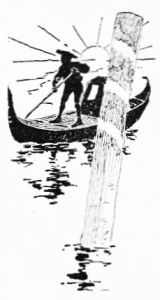
I suppose you know that Venice is built mostly on water—like American railroads Pop says, though I never saw one of them and I guess that's what Aunt Sarah calls one of Pops suttle political whimsies. The houses are held up by spiles that have been driven down into the mud, and when people want to go anywhere they hire a gondola and get paddled off to where they want to go. Of course they haven't any horses and Pop says the only driving they can do is spile driving. He told Jules to get a team of quiet gentle spiles that a lady could drive and let me try 'em, but Jules was so stupid he didn't understand—-though he pretended he did and promised to have 'em at the door at three o'clock, and when three o'clock came he told Pop he was very sorry but every one in town had been hired for the season. Jules is smart even if he can't understand American jokes.
Venice is a great many years old and used to be managed by men they called Dodges. They didn't have mares the way we do in our cities because horses couldn't get along there, but they whacksed very rich and built magnificent houses and churches and palaces. They have a great big public square called St. Marks where the bandolins play every night and it's full of pigeons.
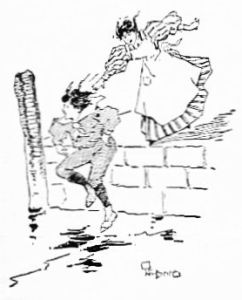
Pigeons are so sacred here that when they have 'em on the bills of fare at the hotels they call them squab for fear the populace would rise and tear them limb from limb for eating pigeons. They make glass in Venice too, smelling bottles and tumblers and chandeliers, but the best part of the whole thing is the canals. The water isn't very clean but it's clean enough and I tell you what a boy has a great advantage over a nurse in a place like Venice. One morning when Pop and I were getting gondoliered along the Grand Canal we heard a fearful shrieking in one of the palaces and in a minute we saw a boy being chased by his nurse. He was only about a foot ahead and she almost had him when he jumped off the front stoop into the canal and swam up and down just out of her reach and my, wasn't she mad! I don't know what she said because she spoke Italian, but I could guess generally what she meant. Just think of it for a minute. If you want to go swimming or fishing or boating you can do it all right in front of your own house. We'd be pretty rich in America if we could stand on our front door steps and catch all the dinner we needed.
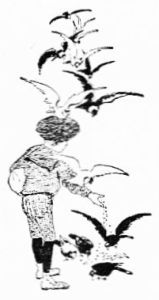
One great thing for children is to stand in the square and feed the pigeons I was telling you about. Pop bought me three bags of corn and the minute I dropped one little kernel of it on the walk about a hundred pigeons flew down. A lot of 'em roostered on my arms and one fellow sat on my hat, and then we went inside the cathedral which is magnificently furnished with things the Venetians used to steal from the heathen they went out to convert, but they're a little sore because Napoleon came down and stole a few things from them. People over here don't like to put the boot on the other leg any more than they do at home, which Aunt Sarah says shows that human nature is the same in Italian as it is in English.
Where they haven't got canals in Venice there are little narrow streets about three feet wide mostly and you'd have as hard a time finding your way about through them as Pop would trying to follow the lines of a sailor suit for a boy of seven through one of Ma's Bazar patterns. That's what Pop said. He said Venice must have been laid out after a Bazar pattern and he asked Ma to go up in a high tower they have there called the Campanini to get a bird's eye view of it and see whether it was a bicycle costume or a pignoir they had in mind when they laid it out. Ma said Pop was flippant and he said all right my dear, I'll let you find our way home and she tried it and in ten minutes she had us lost and she turned to Pop and said I guess you're right about the Bazar pattern, popper, this is the worst yet.
We all wanted to stay there a week but it wasn't possible. A birds eye view of it was all we had time for and so we left for Genoa after two days at Venice. To-morrow we sail for Hoboken on the Werra and my next letter will be from home, when I'll tell you all about Gibraltar, Genoa, and Hoboken.
Good-bye Bob.
P.S. The bandolins came and sang under our window at Venice the last night and it was very romantic Pop says even if the soprano did fall into the water reaching up for a ten cent piece Pop had.

W. M. ROBINSON, St. Paul's School.
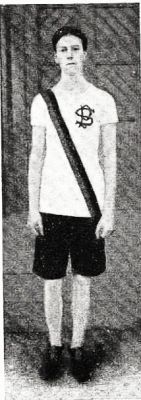
A notable event in interscholastic baseball was the defeat of Lawrenceville, May 27, on their own grounds, by the St. Paul's nine. The game was a hard one, and lasted for twelve innings, the final score being 3-2. As the score indicates, the teams were very evenly matched, but St. Paul's excelled slightly in team-work, and (Cadwalader being unavailable for Lawrenceville) was stronger in the box. Hall, the Garden City pitcher, is a better man than either Arrott or Blake. He showed himself to be especially strong when he had men on bases.
In batting, the teams were about equal, in spite of the fact that the tabulated score credits St. Paul's with ten hits to Lawrenceville's six. Arthur Robinson, the clever young sprinter who did such remarkable work at the Long Island Interscholastics, played short-stop in this Lawrenceville game without an error; he had five difficult chances, and accepted them all. The out-fielders on the St. Paul's team distinguished themselves not only in field-work, but also at the bat. This victory, coupled with the fact that the St. Paul's nine has not been defeated by any school team for two years, places the Garden City team in the front rank of scholastic ball-players.
The Columbia Interscholastic Tennis Tournament, which was played on the Oval at Williamsbridge, was won by J. M. L. Walton, of the Callisen School. He met R. D. Little, of Cutler's, in the final round, and took the match in three straight sets—6-1, 6-2, 6-1. His work was steady throughout the tournament, and he showed good head-work, especially in his contest with Little.
T. R. PELL, Winner of the N.Y.I.S.A.A. Tennis Tournament
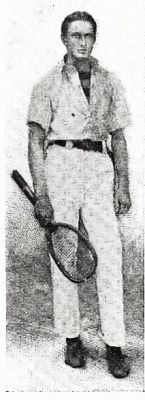
First place in the tournament for the tennis championship of the New York I.S.A.A. was taken by T. R. Pell, of Berkeley. This tourney was held on the Berkeley Oval, but no playing of a very high order developed. Pell won all his matches in straight sets, and defeated Wenman of Drisler's in the finals—6-3, 6-1, 6-1. In the semi-final round he met R. D. Little, who lost to Walton in the Columbia tournament, and disposed of him—6-4, 6-2.
The winning of the New York I.S.A.A. Tennis Tournament does not entitle Pell to play at Newport. Walton, however, as the winner of the Columbia-Interscholastic Championship, has the privilege of representing this district at the national event, and will no doubt be seen on the courts at Newport in August.
The Hotchkiss School baseball Team is rapidly getting into shape, and promises to be a stronger nine than that which represented the school last year. Five of the old men are back, and the new material is developing rapidly. The batting is considerable of an improvement over last season's. Warner, the catcher, makes a good back-stop, but is not reliable in his throwing to bases. He is weak too on high fouls, and somewhat slow; but he makes up for these deficiencies in his batting, and runs the bases well.
Cook, in the box, is a new man, and promises to develop into a strong pitcher. He is liable to be wild at times, but grows steadier at critical points of the game. He bats well and he runs well. Noyes, at first, is very strong on high throws, but muffs badly on grounders. His throwing is only fair, but he handles the stick pretty well. McKelvey, at second, is a veteran, and is keeping up to his old standard. He still retains his old fault, however, which is a very bad one, of stepping back from the ball when he is batting. This is a fatal weakness for a man who hopes to become a hard hitter. He slides well, but does not run quite fast enough around the bases.
Decrow, r.f. Cook, p. Noyes, 1 b. Coy, l.f. Fincke, s.s. Camp (Capt.), 3 b. Warner, c. McKelvey, 2 b. Parton, c.f. HOTCHKISS SCHOOL BASEBALL NINE.
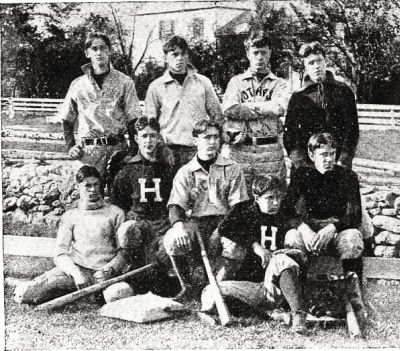
Fincke, at short-stop, is a good athlete, and comes from good athletic stock. He is a cousin of the quarter-back of last year's Yale team, and he has only recently made a record for himself by winning the Yale Interscholastic Tennis Tournament. This is his first year on the team. He throws and fields well, but bats only fairly. He is slow on the bases, but has the promise of an excellent ball-player. Captain Camp, at third, is steady both in fielding and in throwing. He bats well, but would have a better average if he were not constantly trying to make home runs. He is a good base-runner, but his responsibilities as captain have somewhat weakened his all-round work.
Coy, in left field, is another new man who has also done well on the tennis-court. He is sore on high flies, but unreliable on running catches. He does not throw well, and his batting is only fair, whereas his base-running is open to great improvement. Parton is also new to the team. He is not sure of line drives, and would be an excellent thrower if he could cultivate accuracy. He is good on the bases. Decrow is probably the best fielder on the team; he covers more ground than any of the others, and shows good judgment on flies. He throws better than he did last year, and his batting is improving, but he needs a good deal of coaching on base-running and sliding.
The Fourth Annual Interscholastic Meet of the Illinois high-schools was held at Champaign on May 16, and the banner went to Rockford H.-S. with 23 points, Englewood High, the favorite, coming second with 21 points. But as the bicycle-race was protested, and has gone to the L. A. W. for final decision, Englewood may yet attain the title of champion.
On account of heavy rains in the morning, the events were postponed until afternoon, and considering the heavy track, the performances were very creditable. A dark horse, Machin of Duquoin, took a good many points away from Englewood in the sprints, and proved a surprise to the knowing ones. These dashes and the mile run were the most interesting events of the day, although the quarter-mile afforded a spirited finish. The field events were fairly well contested, but the wet condition of the turf hindered the hammer-throwers considerably, and many fouled repeatedly.
The list of events is one of the most acrobatic and non-athletic that I have seen for a long time. It included such events as the high kick, which must have been an imposing event to watch on an athletic field, and a hop, step, and jump; the standing broad jump, a quarter-mile bicycle-race, and a 50-yard dash. Of course there is no special objection to the last two events in themselves, although they are not recognized as standards for interscholastic field days in this part of the country, or in any place where track sports have become thoroughly systematized. But there is an objection to them when they are put on the programme to the exclusion of such standard events as the hurdles.
Some of the performances in the standard events, however, were above the average. The mile was run in 4 min. 46-2/5 sec.; the 100-yards was taken by Machin in 10-2/5 sec.; the quarter went to Egbert in 53-1/5 sec.; Martin ran the 220 in 23-3/5 sec.; and Hutchinson cleared 20 ft. 3 in, in the broad jump. The score by points follows: Rockford, 23; Englewood, 21; Hyde Park, 11; Duquoin, 10; Chicago English High and Manual Training, 9; Peoria, 9; West Aurora, 8; Urbana, 8; Canton, 7; East Aurora, 6; Champaign, 6; Springfield, 5; Mattoon, 5; Chicago Manual Training, 5; Macomb, 5; Jacksonville, 5; Lake View, 4; Winnetka, 3; Tuscola, 3; Pekin, 1.
PHILADELPHIA I. A. L. GAMES, FRANKLIN FIELD, MAY 29, 1896.
Events.Winners.
100-yard dashMcClain, Haverford.10¾sec.
220-yard dashMcClain, Haverford.25½"
Half-mile runLittle, P. C.2m.12½"
One-mile runRoss, Haverford.5"46"
Half-mile walkEvans, P. C.3"53-1/5"
120-yard hurdlesMarshall, P. C.18-2/5"
220-yard hurdlesMarshall, P. C.30-1/5"
One-mile bicycleWhite, G. A.2"58-4/5"
Running high jumpNewbold, De Lancey.5ft.7in.
Running broad jumpMcClain, Haverford.20"6"
Standing broad jumpClaflin, Haverford.9"5¾"
Pole vaultHanson, P. C.9"6"
Putting 16-lb. shotSayers, Haverford.32"6½"
Points.1sts.2ds.3ds.Totals.
Penn Charter58756
Haverford Grammar School63342
De Lancey Academy12213
Germantown Academy1119
Cheltenham Academy1005
Episcopal Academy0011
————-
Total141414126
The Inter-Academic League of Philadelphia held its field meeting at Franklin Field on Friday afternoon, May 29, and three of the old records were lowered. Newbold of De Lancey jumped 5 ft. 7 in., the former record being 5 ft. 4½ in.; Hanson vaulted 9 ft. 6 in., which is 3½ in. better than the old figure; and Little of Penn Charter brought the half-mile figure down from 2 min. 13¼ sec. to 2 min. 12½ sec. Marshall of Penn Charter, the big football-player, took both the hurdle events, although in neither case was the time particularly good. But for a big man he is a clever hurdler.
After the games had been under way a short time the contest narrowed down to a duel between Penn Charter and the Haverford College Grammar-School. Penn Charter finally came out ahead by 56 points to 42. A full record of the day is given in the accompanying table.
Some of the semi-professional and mercenary athletes among the students of the New York schools have been talking a great deal in the public prints of late about how they think amateur athletics should be managed, and, in private, so far as I am able to find out, they have been doing all they can to interfere with the success of the National tournament scheduled for the 20th of this month. It looks now as if these young men with professional tendencies were going to have some success in weakening the team which will represent the New York Interscholastic Association, and if reports are correct, many of the winners of the recent games at the Berkeley Oval will not appear in the National tournament, either because they support the opinions that have lately been so freely expressed in some quarters, or because they are influenced by the clique above referred to.
It is amazing that there should be any young men who would condescend for a moment to support such opinions; and yet there seems to be a number, and they have the assurance to pose as amateurs! Some even intimate openly that they do not wish to go into the National games because there is not enough money in it for them. Of course they do not use the word "money," or "cash," or "dollars," because they know that the A. A. U. would get after them, but they are brazen enough to say that they do not think the medals which are to be offered on this occasion are of sufficient intrinsic value for them to compete for.
Perhaps the readers of this Department who do not live in this city, and do not know how near to professionalism some of our scholastic athletes here can go, will think that I am exaggerating when I say that many of them are apparently in sport largely for the intrinsic value of the medals. Whether it is to pawn them afterward or not I cannot say. But to show these readers in other cities that I am not exaggerating, let me quote from an interview published in the New York Sun of May 31. The Sun is so rarely inaccurate in quoting an individual that we may all depend upon its accuracy in this case.
The name of the young man who is quoted in the article is given as Rose Ambler Curran. He is said to attend the Drisler School. I do not know whether Mr. Curran has ever done anything himself in athletics; he certainly is not in any way prominent in interscholastic sport here, and I do not think that he represents a very large element of the school-boys of this city. He certainly does not represent the best element. What he is quoted as having said, and what I think every true amateur will consider most reprehensible, is this: "The medals which were offered at the last in-door games" (the games given by the New Manhattan A. C. at the Madison Square Garden last March) "were of such a poor character that many would not have competed had they seen them before. This is the main reason, as stated by the boys, for what might be termed their lack of interest in the meet" (the National Meet).
As a matter of fact, the medals given to the winners at the Madison Square Garden games were as handsome and appropriate as any I have ever seen. They were simple. They were laurel wreaths on ribbons—gold wreaths, silver wreaths, and bronze wreaths. The designs were not such as would appeal to a pawnbroker, but they were such as would appeal to any honest boy who takes a pride in his athletic achievements for their own sake.
There is nothing ambiguous about Mr. Curran's statement as quoted above. He says clearly that the money value of the medals at the winter games was not great enough for a certain class of New York school-boy athletes to contest for, and that these same individuals are not going to spend their valuable time and energy in running races for less than a certain weight of gold or silver. I do not see how much nearer to professionalism these boys can get without being thrown out body and baggage from the society of amateurs. It is well if they do keep away from the National Interscholastic meeting. Such medal-hunters are not wanted, and the sooner they can be detected by the officers of the Association and prevented from mingling with the true and sportsman like element among school-boy athletes, the better will it be for athletics in this city.
The New Manhattan Athletic Club, or rather its athletic directors, were considerably surprised, I know, at the attitude taken by this semi-professional element among the New York school-boys. It had been their intention to offer a valuable trophy in the form of a cup, to be contested for on this occasion, in addition to individual medals, and they had even gone so far as to consult with the President of the National Association concerning the order for this cup. But when they found that their interest in school-boy athletics was apparently unappreciated, they gave up the idea entirely.
Fortunately the success or failure of the National Meet does not depend upon the entries from the New York Association, and we may well rejoice if a lot of medal-hunters keep away. Strong teams will come down from Maine, Massachusetts, and Connecticut, and there will be representatives from New Jersey, and probably from other leagues, and the sport will be good and clean, and the races will not be run with the sole idea of getting money value in prizes at the end, but for the sake of the honor of winning on that day—of the glory of sport for sport's sake.
At the recent Olympian Games the prizes were olive wreaths—plain, ordinary vegetable growth; worth, say, ten cents a bushel, with perhaps fifty wreaths to the bushel. And yet those dried branches brought home from Greece by the American winners are worth more to them than any yellow metal they can get here. The young men who talk of remaining away from the National meet, because the weight of the medals is not great enough to suit their tastes, would do well to reflect on this: there is a greater object in life than the collecting of medals.
The New England Interscholastic baseball season is practically closed, although there are a number of games yet to be played. But Brookline has won the championship, having played all its scheduled matches, and having won each of them. In the last game Brookline defeated English High 6-0. Brookline played excellent ball both in the field and at the bat, but E.H.-S. was weak all around. Some of the features of the game were Nettleton's stop of Manning's hard hit in the fifth inning, Wise's clever throw from centre to third in the eighth, putting out Cronin, and the heavy hatting of Lewis and Parker. A review of the whole baseball season will be made in this Department as soon as space enough becomes available.
C. S. D., Bayonne, N.J.—Any interscholastic association composed of at least two schools may join the National Interscholastic Association upon applying for membership. The field meeting this year will be on June 20, and is the first one ever held by the Association, which was formed only last December.
The Graduate.
ILL-TEMPERED BABIES
are not desirable in any home. Insufficient nourishment produces ill temper. Guard against fretful children by feeding nutritious and digestible food. The Gail Borden Eagle Brand Condensed Milk is the most successful of all infant foods.—[Adv.]