THE MANUFACTURE OF GUNPOWDER.
Reading edition
BY FRANKLIN MATTHEWS.
here would be no sense in having powerful war-ships, enormous cannons, and hard, tough projectiles to use in them, if we did not have improved powder to make them all effective. The high-grade powder used in warfare in these days is known in this country as "brown powder," because of its color. In Europe such powder has a dozen or more names, generally called after the men who have invented each kind. There are only two places in this country where the powder used in our big guns is made. One of them is the works of the E. I. Du Pont de Nemours & Company's plant on the Brandywine Creek, near Wilmington, Delaware, and the other is the works of the California Powder Company, near Santa Cruz, California. In both of these places the process is secret, and no one except those employed about the works is supposed to know exactly how "brown powder" is made.
All powder, whether it is intended for blasting, hunting, rifle-shooting, or warfare purposes, is made in the same general way, and so, in telling of a visit I recently made to the Du Pont Works, near Wilmington, I shall reveal no secrets if I describe the various mills and processes which practically all powder goes through before it is finished. Ordinary powder is composed of three ingredients—saltpetre, sulphur, and charcoal, or nitrate of soda, sulphur, and charcoal. Powder intended for blasting is generally made with soda; powder intended for shooting is generally made with saltpetre. It takes a great deal more than these ingredients, however, to make powder. There must be a lot of small buildings, generally scattered about a ravine, through which a stream runs to furnish power to the mills. These mills are for the most part small, one-story structures, that look at first glance like tumble-down affairs, out in the woods. Closer examination shows that they are built for the most part of stone on three sides and wood on the fourth, and that they all have light wooden roofs. Still closer examination reveals that the floors are laid with big wooden pegs instead of nails, and that so far as possible all the machinery they contain is made of wood. All the shovels and other implements used by the workmen are of wood, and every man about the place wears shoes with wooden-pegged soles instead of shoes which have nails. Fancy these conditions in a beautiful wooded park, running for three miles along the picturesque Brandywine Creek, near Wilmington, and you can imagine something of the attractive external appearance of the Du Pont Works.
There is good reason for the use of wood instead of metal in the thirty or forty buildings which make up this plant. You may not know it, but, it is said to be a fact that there must be a spark to ignite powder. You may take a live coal, for example, and drop it into a dish of powder, and the result will be that the powder will simply burn rapidly. Strike a spark and let it come in contact with the powder, and there is an explosion. All powder-mill explosions, with their dreadful losses of life, are caused by sparks. It is to avoid sparks that wooden-pegged floors and shoes are required in the mills, and that wooden shovels and machinery are used. You can see how dangerous metal is about a powder-making plant when your guide takes a bunch of keys from his pocket to unlock a mill where the work is done for the day. He inserts the key in the padlock as slowly and as gently as if he were performing a most delicate surgical operation, one where life is at stake by the mere turn of the wrist. He turns the bolt as carefully as if the lock were made of an egg-shell, which he didn't want to break. Your life and his really are at stake, and neither he nor you can exercise too much care.
THE CHARCOAL-MILL.
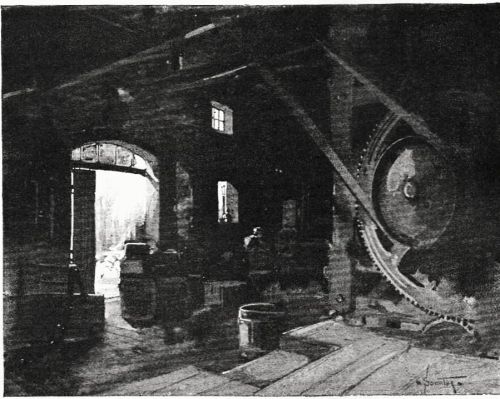
There are two distinct stages in powder-making. The one is the part that is not dangerous of itself, and the other is the part that is dangerous—so dangerous, in fact, that the life of no one engaged in the work is safe. Still, so thorough are the precautions taken that the percentage of loss of life at this work is really very small, and one sees about the Du Pont Works men who have been employed there for thirty and forty years. The part of the manufacture that is not dangerous consists of the preparation of the ingredients that compose the powder. In one of these mills the charcoal is made. For the higher grades of powder only willow wood is used in making the charcoal. For blasting-powder almost any wood of good grain is used. The willow is grown largely on the grounds of the beautiful park, and the smaller limbs of trees are taken. Willow has an especially fine grain and texture, and this makes it valuable for powder manufacture.
In another mill the saltpetre is refined by boiling. The refined product is dumped into vats, from which it is shovelled into barrels to be taken to the mixing-house. The saltpetre in the vats is so pure and white that one might fancy that the roof had opened and an old-fashioned snow-storm had fallen inside the building, and the men who are shovelling it up resemble snow-shovellers, except that they are not bundled up. The sulphur is prepared in another place, and then the ingredients are taken to the mixing-mill, where they are weighed and mixed, and there the part of the work that is not dangerous ends.
THE ROLLING-MILL.
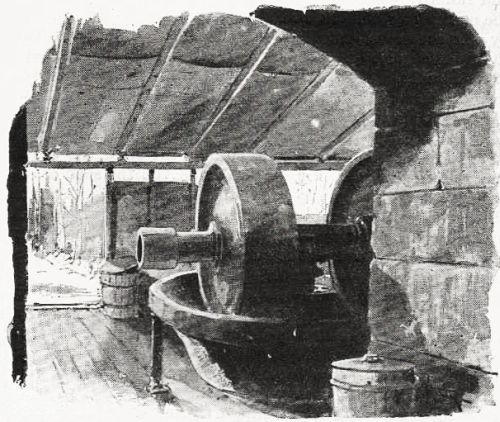
Near by the mixing-mill are the rolling-mills. Now we are close to danger. In the centre of this mill is a big iron saucer, probably six feet in diameter. The rim of the saucer is about eighteen inches high. Standing up in the saucer are two wheels. They seem to be about six feet in diameter also, and their rims about a foot broad. These wheels and this saucer do the rolling of the powder—that is, they grind the three substances that compose the powder into a new mixture. The wheels are swept around and around in the saucer, and they also turn on their own axes. It is as if they were kept rolling over and over, just as the wheels of a carriage roll, but also as if some power kept them turning about constantly in the small circle of this saucer. This mill is where wooden machinery cannot be used, and of course that makes it a very dangerous place.
The mixture of the ingredients of the powder is brought in and dumped carefully in the saucer. It is spread about smoothly by a workman, who, after this work is done, goes outside the mill, and does not come back until the powder is rolled thoroughly. The workman goes to a wheel a few feet away from the building and turns it very slowly. It starts the machinery that moves the wheels in the saucer. The greatest danger in rolling comes at this time. The rolling must be begun in the slowest possible way. The danger is that there may be a lump in the mixture in the saucer that will raise one of the wheels as it turns around and then drop it suddenly in the saucer, causing a spark. If this comes, away goes your mill and machinery, and possibly the workman's life with them. There are many of these rolling-mills in the Du Pont plant, because the owners act on the principle that it is not a good thing to carry all your eggs in one basket. Rarely is more than 150 pounds of powder rolled at one time, and it takes from three to eight hours to do the rolling, according to the grade of powder that is being made. The workman in charge will go to the door of the mill from time to time to look in, but he never steps inside until he has stopped the machinery and the rolling is done.
After the powder is rolled it is shovelled up and taken to a press-mill. It is put into a long wooden trough about two feet high and two feet broad, and packed between thin plates of aluminum. Pressure is applied by water-power to one end of the trough, and the powder is squeezed into thin slabs of hard dry cakes. After all the moisture is squeezed out, these cakes are removed, and one by one they are slipped down into a slot between some rollers, where each is broken up into bits that resemble the small stones that are used in making macadam roads. This breaking-up process makes a terrific noise, and when one thinks of the dangerous compound that is being handled, this noise is likely to cause a feeling of great fear in one who hears it for the first time. At this stage of the process it is difficult to restrain the impulse to take to one's heels and run out of hearing of the terrifying sound.
THE GRAINING-MILL.
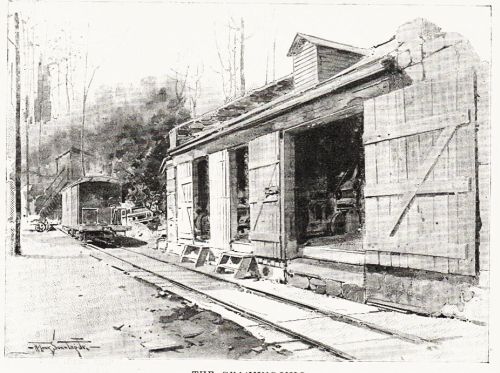
After the cakes have been broken up into these bits of rough, dirty stone, the powder is taken to a graining-mill. This is really the most dangerous part of all the work. One man runs each of these mills. He cannot start the machinery in motion and go away, like the man who has charge of a rolling-mill, but he must stay in the place all the time, and feed the stones to the machinery that crushes them into grains of various sizes. He shovels the powder into a large hopper, big wooden wheels go around and around, and the powder passes between zinc rolls and through sieves of various sizes. It is a grewsome place. The machinery reminds one of the pictures that we have all seen of some of the contrivances they used to have in the days of the Inquisition with which to torture people, and it is hard to keep back a shudder as one looks at this work. Sometimes there is as much as a ton of powder at one time in the big hopper of this machine. In one of these mills at the Du Pont Works you will notice that the stone wall is eight feet thick on one side. This is on the side next to a press-mill. One side of the place is entirely of wood. This is toward the creek. The idea is to save as much property as possible in case of an explosion.
After the powder is broken up into grains it is taken in bags to another mill. This is known as a glazing-mill. It is here that the powder is polished and made shiny. There are several sheet-iron hoppers that resemble enormous barrels in this place. The powder is dumped into them, and they are turned over and over. A certain quantity of lamp-black is put into each barrel, according to the amount of powder each contains, and the barrel is turned until every grain has received a polish. The polish simply gives the powder a nice appearance. It adds no strength to the product, but it helps to keep out moisture, and it prevents the powder from losing some of its strength in damp weather. Every one knows how much better a pair of shoes look when they are polished, and how desirable it is at all times to have one's shoes kept in this condition. It is for that same reason that a polish is put on the grains of powder.
When the powder is polished, and separated by means of sieves again into grains of various sizes, it is ready for packing. It is then run into tin or wooden kegs, and is ready for storage in a magazine in a remote part of the grounds. The kegs are made in another part of the grounds, and painted in various colors, each color indicating the kind of powder the keg contains. It is then ready for shipment to the places where it is used. The powder that goes into cartridges for shooting purposes goes to the factories where cartridges are made, the blasting powder goes to the men who sell it, and thus it is carted off the place, and the mills go on making a supply to take its place.
The government powder is made in a general way in the same manner that ordinary powder is made. The chemical ingredients are somewhat different, of course, but it may be said that powder for use in cannons is simply of a finer grade than ordinary powder. It is what is technically known as a "slow" powder. That is, it ignites slowly, and burns more slowly than ordinary powder. Of course to the eye it goes off in a flash, like ordinary powder, but really it is slow in its explosion compared with ordinary powder. The object of this is to secure the full force of the power in the powder, and also to start the projectiles in cannon very slowly in their terrible journey of destruction. By using a slow powder there is less strain on the cannons and less danger of their bursting. There must be as little shock as possible to the cannons, when they contain such a terrible power as an ordinary charge of powder, and it is desirable that all of the powder should be used. Hence the need for "slow" powder. The government powder is packed in small cakes or prisms, with a little hole through the centre. These prisms look like the nuts used on the hubs of big wagons. A lot of them are put together in a package and stowed away in the cannon behind the projectile, and a spark is used to set the charge off.
One soon gets used to danger, and in going through a powder plant it is interesting to watch the men go about their tasks with as little concern apparently as if they were employed in a flour-mill. It is healthy work, aside from its danger, and for that reason it would be difficult to find a sturdier lot of men than those employed at this task. The men saunter about the place as if they preferred that sort of life to any other. In their manner there is no indication that they are oppressed by the possibility that some day they may be blown into bits. Most of them seem to be what are known as fatalists. One must die sometime, and a powder explosion provides a speedy and painless exit. They can get no insurance on their lives, but doubtless they console themselves with the thought that the percentage of the loss of life is small, much smaller than in many other kinds of hazardous employment.
These men may count with reason upon a long life, and a physician is rarely needed by any of them. They live in comfortable homes in the park where they are employed, and seem most contented with their lot. The Du Pont people have fitted up a delightful club-house on the grounds for their employees, and these find existence in their lot in life so attractive that they remain in it year after year, a contented and prosperous set of men.