THE WORD OF THE GUNS.
Reading edition
BY EARLE TRACY.
The little Mystery was lying off the pier at Martinez's. Night had covered sail-boat and row-boat alike, and while all Potosi gathered towards the front celebrating Christmas eve with the rockets and the fire-crackers that are not once thought of on the Fourth of July, Mr. Martinez and Bascom were silently carrying bags of gold on board the Mystery. As the sails ran up in the snapping cold, the mournful cry of her ropes was the only sound on the Back Bay, and it smote Bascom; and Mr. Martinez's grasp and his whispered cautions to Captain Tony, and the solemn gold that he had carried, weighed upon his heart as they put out.
Everything had been arranged on the deck for mounting the one which was best preserved of the six mysterious old cannon that he had found the summer before sunk in Potomoc Bay. It had been left covered by tarpaulins in a row-boat off Captain Tony's point, where they could get it as they passed. They ran the schooner across from Mr. Martinez's to the point, and neither of them spoke along the way. When they reached the boat, Bascom sprang over into it and lifted off the tarpaulins. There was nothing underneath.
"The cannon's gone," he whispered. "What does it mean?"
"Somebody playin' a joke to spoil our fun," said the Captain, and the darkness hid the worried frown upon his face. "Yo' mus' go ashore an' look for it; bud doan' be long."
"Looks like it's too funny for a joke," said Bascom, "less'n it's one of ole Captain Aristide's. I never heard of his playin' one, only he was along here to-day when I was a-polishin' the gun, an' he seemed mighty interested. It kind o' shivered me, but I went on sweet an' innocent about our keepin' Christmas, firin' in the channel."
"Aristide?" repeated Captain Tony, and he crossed his arms on the tiller and pulled his hat down over his eyes, and thought, while Bascom rowed ashore. Captain Aristide Lorat was known by every one to be the craftiest man along the coast. His neighbors had never guessed that in his free and gallant youth he had been a pirate neither more nor less. He was too old now to enjoy the personal risk of such enterprises, and he gave his direct attention to a prosaic carrying trade; but his old preferences survived in the form of a few boats which did whatever smuggling or wrecking came in their way. They were seldom seen in Pontomoc Bay, and had never been recognized in their true character nor connected with Captain Lorat, and yet Captain Tony did not like to think that old Aristide had been nosing in their affairs. For it was something unusual that was taking the Mystery out on Christmas eve.
Mr. Martinez, the owner of the great canning-factory for which Captain Tony and Bascom sailed, was the chief of a quiet organization of Cubans who were wealthy enough to make their patriotism of substantial disadvantage to Spain. Just now, in one of the frequent insurrections, there had been an unexpected call on the society for aid. A Cuban boat was secretly coasting off Horn Island, waiting their messenger, for this was at a time when the United States was not much inclined towards sympathy. Martinez had two reasons for sending Captain Tony out to it. Tony was infallibly prudent and brave, and he was trustworthy, both from the integrity of character which made him dislike the mission, and from an indebtedness to his employer which forbade his refusing it. Mr. Martinez had given them the Mystery.
"They made a clean job," whispered Bascom, coming back. "They've taken that and the two next best out'n the shed where I was polishin' them. It must have been Captain Aristide. Has he any grudge agin us?"
"None dat I know of," the Captain said; "an' we can't stop an' study 'boud it now. It is of mo' impo'tance dat we do ouah wo'k dan dat we fire guns, even to say dat it is done." Captain Tony's regret at taking Bascom out on a holiday had suggested carrying the best cannon along and firing it, for Bascom had been putting all his savings into ammunition and fireworks for Christmas. Mr. Martinez approved, thinking a water celebration would help to explain their going, and they were to fire him a reassurance when they went through Potosi Channel on their way to the oyster-beds when their mission had been carried out.
The actual fact of the case was that Captain Lorat needed no more than the knowledge that a boat was going out. Other bits of knowledge gained from other sources only required this to piece them to a whole. He decided it would be better not to let Bascom have a gun on board, and while the Mystery was taking her cargo at Martinez's pier, he had all of them that looked as if they might be used loaded upon a schooner that had come into the bay since dark.
ONE OF THE MEN JUMPED ON BOARD AND GRAPPLED WITH THE CAPTAIN.
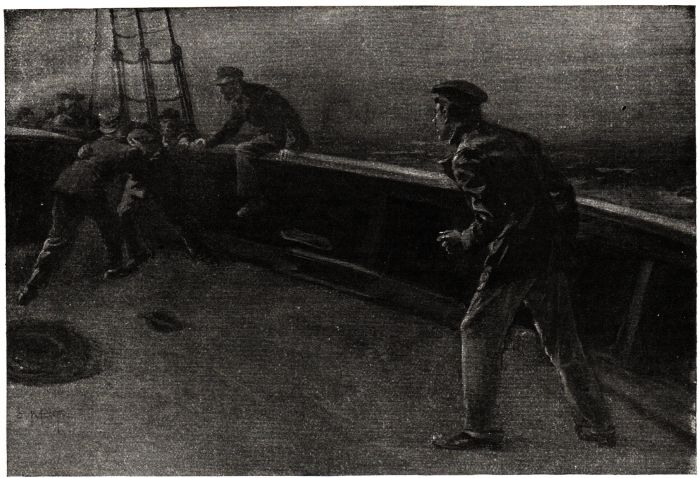
Toward three in the morning Bascom found his eyelids growing so heavy that he could scarcely keep from drowsing against the mast in the snug warm lee of the sail. The Mystery was just about to round the Horn when a row-boat load of men swished past her bows. Bascom drew himself together and sprang swiftly to the rail. One of the men was already climbing up the side, but he jumped on board and grappled with the Captain. There was a volley of shots, and the Captain dodged into the cabin, where the gold was stowed. The men swarmed up over the deck. For a moment Bascom had thought they were the Cubans, but now he caught up one of his rockets, lighted it, and held it steady while it rose. The Cuban boat must surely be waiting round the point of the island, and it would see the signal. A man leaped round the mast and knocked him down, but as Bascom rolled over to the rail he saw the rocket singing up to break in scintillating brightness through the night. He wriggled like a cat to the stern and dropped down the hatchway. He pulled the hatches shut, but there was a rush of feet along the deck, and the blade of the anchor came crashing through the cabin-top. Bascom threw himself into a bunk, and before the Captain, who was reloading in a corner, could close his revolver and lift it, the roof was torn from over them; three men poured in, seized the Captain and Bascom, bound them both, and carried off the gold. The lantern hung battered, but its light was not out, and the prisoners looked at each other in despair.
"Reckon I give it to dem better dan I got," he said, "bud I'm t'inkin' 'boud how we can catch dem again an' take ouah money back."
"I'm kind of expectin' comp'ny," said Bascom. "Them Cubans is dumber'n I take 'em for if they don't mosey up to see what my rocket meant. I fired one just as you dodged in the cabin."
"Dere is one question," Captain Tony said. "Get yo'se'f close an' tuhn a little so I can take a bite at dat rope. Yo' signal may have attrac' de government cruiser dat's lyin' off Ship Islan'."
"Oh!" said Bascom. "Well, we got a lot of time before they can steam over." He rolled himself against the Captain, who craned his neck forward and worked with his strong creole teeth at the knots. He was still pulling at them when feet were heard scrambling to the deck again, and two men looked in at the shattered hatch. They spoke to Captain Tony in Spanish, of which Bascom only recognized the pass-word that Mr. Martinez had given them.
"Dey come to yo' rocket," the Captain translated while the men unbound them, "an' dey was in time to see de boat put off from de Mystery, so de Cuban schooner has gone after dem, sendin' dese two men in a skiff here."
"Which way've the scalawags gone?" inquired Bascom, jumping to his feet.
"De way dey had to," answered the Captain, hurrying to the deck. "Dey reach deir schooner, an' as de Cubans was comin' from outside, dey had to put in. We'll be ovah-haulin' dem; dese men say de Cuban boat is as good at chasin' as she is at showing her heels. We goin' along too. Reckon yo' has to tek de tiller," he added, and he stood by, with his arm wrapped in a piece of canvas for a sling, and laid the course. Ahead of them they could just see the Cuban boat plying back and forth with a long tack and a short tack, and the Mystery turned eastward. The Cuban boat could not trust herself far inland where she did not know the channels, and the smugglers would take their first opportunity to make a sudden run east into one of the bayous; and Captain Tony determined that the Mystery should cut them off. It was a hare-and-hounds chase, and the hours passed among the stars while the three boats doubled and redoubled at top speed, gaining on one tack, losing on the next. Pale clouds began to drift across the sky, and there was a taste of morning in the wind. The Captain slapped Bascom on the back. "Yo' boy," he chuckled, "dat Cuban boat is de stuff! She's run dem down so fine dat dey's headin' 'cross de shoals, an' dey boun' to stay dere an' wait faw us, by my reckonin'."
Bascom giggled, but the Captain whistled in a new tone. "W'at in de name of reason!" he exclaimed; "dey tu'nin' back across de Cuban's course? Oh ho!"
A cloud of smoke went up, and there was a great rumbling hoarse report such as had not been heard in those waters since the war. "Dey firin'!" the Captain gasped. The sound vibrated among the waves and sank away, and the smoke cleared. The Cuban was not hurt. She turned like a girl courtesying, and a sharper shot came caracoling on the waves, this time from her.
"De mad folly!" shouted the Captain. "Dey wan' to raise de dead, let alone all de cruisers on de coas'!"
Bascom danced at the tiller. He was quivering with his first thrill of war—not only war between the Cubans and the smugglers, but soon with the United States. Over their shoulders he could see the faint line of a cruiser's smoke against the west. The Captain was looking very grave. "Dis'll be de darkes' day de Mystery seen yet," he said. "I 'ain't nevah liked dis job, me, bud it look like we couldn' refuse."
"One thing for the firing," said Bascom, "it's Christmas mornin'."
"Christmas gift," said the Captain, grimly. "Reckon de smugglers is sayin' it! Dey los' a mas' by dat las' shot."
"Christmas—" ejaculated Bascom, and stopped short as the whistle of the wind in the rigging was drowned again by a terrific explosion that shook the sea. As they peered out under the smoke, something dropped like a spent ball on the deck. The Captain picked it up, and after a moment's scrutiny passed it over to Bascom. It was an unmistakable fragment from the muzzle of one of Bascom's guns. The peculiar alloy that was neither brass nor bronze, and that had puzzled every one when the guns were raised, left no opening for doubt.
"Golly," said Bascom, "rather bust than shoot agin its frien's!" He stroked the powder-smelling piece against his cheek and almost kissed it for delight.
The Captain noted the growing trail of smoke in the west and spoke to the two Cubans. One of them pointed at the smugglers' schooner. She was settling fast, and the men on board of her were raising a white flag. The Mystery and the Cuban boat answered the signal, and the three Captains met on board the Mystery to make terms.
The smuggler Captain was a tall, pleasant-faced American of Scotch descent, with a wounded cheek and big fierce-looking mustaches. "I've got the best of myself so bad," he declared, "that you can say what you want, but it'll not be to your advantage to leave my schooner standing on the edge of the bar to tell tales; so what I propose is this: I'll give you back your scads without any more fuss if you'll tow what's left of her into Davis Bayou out of sight and give us permission to skip."
The Cuban Captain declined to do this, and it was finally decided that while the Mystery beat back and forth in the sound, the Cuban should tow the smugglers out of danger and then make good her own escape.
Bascom went across in the tender with the other skiffs to get his guns. "Your boss is grit, ain't he?" said the smuggler Captain as they pulled through the white foam on the bar. "I reckoned on an ordinary skeery creole, but the way things has turned out, it's good I reckoned wrong."
"It would have been gooder for you if you hadn't reckoned on my guns," said Bascom, getting aboard the wreck, among a demoralized crew, and laying his hand on the only piece he saw. "What's gone with the first one? How did you know about 'em, anyhow?"
The Captain preluded his answer with a fair volley of imprecations. "And I wish the fiends had taken 'em before they ever fouled my deck," he finished. "I didn't count on firin' 'em; I jus' took 'em to keep you from makin' a noise, but I brought along your ammunition for prudence an' knowin' it would come handy some day, an' when I was close put I jus' let 'em holler. First one broke loose an' jumped into the water, shootin' at kingdom come, an' the nex' busted an' busted us, so I wish you joy of firin' this third."
"Joy?" said Bascom; "well, I rather guess!" It was the one he had planned for from the first, and which had been stolen from the row-boat. "You wasn't allowing that guns what's seen enough of life to know what side they're on would turn agin their frien's, was you? Just you listen an' you'll hear this one speakin' calm and pleasant when she gets on board the Mystery. And I'll give you this pointer," he added, from the boat to which the gun had been lowered, "next time you want to borrow something of mine, jus' remember that my things mos'ly has peculiar workin's, an' I can manage 'em best."
Half or three-quarters of an hour later, when every trace of the wreck was out of sight, and the sails of the Cuban boat were flitting innocently between Horn Island and the shore on the way east, the United States cruiser shone near at hand, trim and slender and dauntless in the sunrise.
"Well," said Captain Tony, as they watched her despatch an officer towards them in a boat, "it's jus' to brass it out now. We've got to do it faw Mr. Martinez. He'll be in mighty bad troubl' if our tale don't satisfy dat young chap comin' dere. Bud if it do, it's good enough faw ev'ybody else—even ole Aristide, although it will disturb him mo' dan he will say—if what we t'ink is true. Dis insurrection an' secret-service business may be all hones' faw de peopl' dat belongs to it, bud it cost me an' yo' an' de little Mystery mo' in small feelin' dan it pay, an' I say dis is de las' time faw enemy or frien'."
"Me too," cried Bascom, "an' the old gun thinks the same. They was dead down on this from the start, an' I reckon that's the word what they've waited so patient to get a chance to say."
The ship's boat drew alongside, and the officer came aboard to inquire, with the commander's compliments, why a little battered schooner was idling among the shoals in a norther, firing cannon.
Bascom and the Captain saluted together. "Christmas gifts," they cried.
"Usses had dese curious ole gun," the Captain explained, "w'at we raised out of de water las' yeah, an' dis boy has been waitin' evah since faw Christmas mornin' to fire 'em. An' I t'ought me dat it would be mo' safe to come out heah an' try dem before firin' in Potosi Channel, as was his wish. An' indeed it has prove dat I was right, for one of dem stepped right off into de water dat it come from, an' de nex' it busted, as you see," and he pointed to the cabin-top and to the bits of cannon that Bascom had gathered for keep-sakes from the sinking boat.
"Usses has been havin' a reg'lar party," Bascom added. "You are our most 'ristocratic callers, but you isn't our first. They'll be takin' the word of the guns clear to Mobile an' as far as you go, whichever way that is."
"Then this is one of the forgotten guns that were raised in Pontomoc Bay last summer?" the Lieutenant said. "I've heard of them." He examined the piece like a toy. He was a young man with straightforward clear eyes that commanded the same frankness they expressed, and had been very uncomfortable to meet until this open subject was reached. The Lieutenant saw Bascom's face light up with responsive enthusiasm, and he ran on: "It may have belonged to one of the old discoverers. Why, I can just see the old chaps that manned it when the ship went down, standing on tiptoe round it, with their swords clanking and their queer old clothes flapping in this very wind perhaps! You know I believe they would like it if we had the old veteran fire a salute."
"Usses would like that too," the Captain said.
Bascom had no answer. He looked across to the ship where the stars and stripes that had fought their way from so much ancient bravery were riding high in the gold sun-light and the wind. He looked until his eyes grew dim and the figure of the Lieutenant priming the cannon became blurred so that all the shadowy old crew seemed to have marshalled themselves aboard the Mystery to man their gun. "Christmas gift," he murmured, and his heart came up into his throat. Then the voice of the gun rolled out, mellow and husky and peaceful after centuries of sleep.
The recoil went from stem to stern like a great thrill of joy. The smoke swept away on the wind, and the Lieutenant touched Bascom on the shoulder. There was an interval of silence, and then the man-of-war saluted the little Mystery.