LUCK THAT FELL FROM THE SKIES.
Reading edition
BY ALBERT LEE.
It was an unusually cold Christmas eve, and the keen wind that had come close after the heavy snow-storm was blowing little white drifts up into every corner, and howling around the eaves of the tall houses in a way that made people turn their collars up high about their necks and thrust their hands deep into pockets and muffs. Nevertheless the streets were full of shoppers, and every one seemed to be loaded with bundles and packages that were surely full of all sorts of good things for old people and young children for the celebration of the morrow.
Just around the corner from one of the busiest of the shopping streets stood three boys stamping their feet over an iron grating, through which arose the warm air from an eating-house kitchen in the cellar below, bringing occasionally an odor which, to them at least, was savory. The three boys were all of about the same age, and all were engaged in the same enterprise of selling newspapers—an enterprise which had not proved particularly remunerative on this particular day, as the wayfarers seemed to be engrossed in matters more important to them than the reading of news. One of the lads had red hair, and was known to his companions as "Ratsey" Finnigan. The names of the other two were similarly characteristic of newsboy cognomens—"Swipes" Molloy, and "Tag" McTaggart. The boys were discussing the probability of their getting a Christmas dinner—a prospect which was apparently not very bright.
"WELL, DEN," REMARKED SWIPES, "I GUESS WE'RE ALL TREE UP AGIN IT."
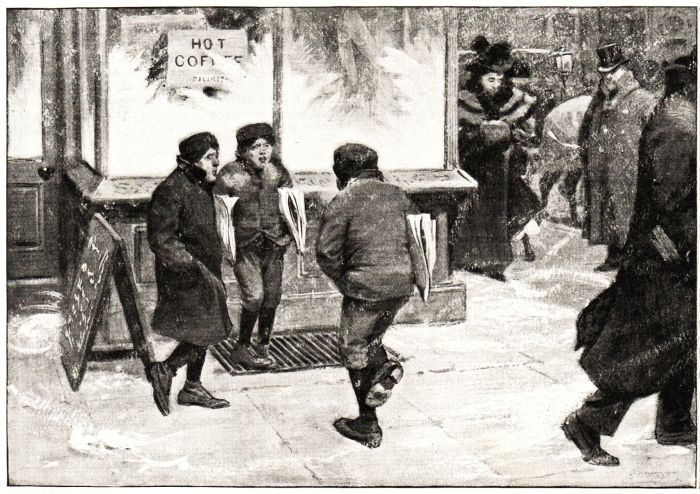
"Well, den," remarked Swipes, as he stood alternately on one foot, and then on the other, "I guess we're all t'ree up agin it."
"It looks dat way, sure," assented Ratsey; "except Tag goes to de mission."
"Ah-h, de mission!" exclaimed Tag, scornfully. "Don't youse fellers know dey won't let me into de mission no more?"
"Didn't youse go fer T'anksgivin'?" asked Ratsey.
"Sure, I did; an' didn't I get fired out?"
"What fer?" inquired the red-haired lad, eagerly.
"Scrappin'," was the laconic reply. And then, as his companions seemed to require fuller explanation, he continued: "Dat blue-faced Mike sat nex' to me at de table, an' he took me pie off o' me. So I handed him one in the face, and he yelled like he was hurted, but he was not hurted a bit, and he falls down on de table an' makes a big bluff—wid me pie in his pockut all de time. Well, Pink-whiskers, de super, he seen me hit Mike, and he rushes up ter me, and grabs me, and turns me out, and says as how I'll never come inside de mission to grub again." There was a brief silence, then Tag continued, "But I got square wid Mike de nex' day."
"Did youse do him?" asked Ratsey.
"Did I do him?" repeated Tag. "Have youse seen him?" Neither of his listeners had seen the unfortunate Mike. "Well," added Tag, "I guess his mudder 'ain't got t'rough pickin' up de pieces yet. I 'ain't been down to Hester Street to see, neider."
"Den, if youse is fruz outen de mission," said Swipes, "sure, we'll all have to hustle fer a Christmas feed."
"'Less it drops from der sky," put in the hopeful Ratsey; and then all three danced vigorously on the grating.
By the time they had reached this conclusion it had grown dark—or as dark as it ever gets in the shopping district of the great city, where the hundreds of electric lights blink and twinkle over the sidewalks. There seemed now to be a lull in the rush of people that had been surging up and down the thoroughfare all the afternoon, and when one of the boys looked up at a big clock a block away, he saw that it was past six o'clock.
"Let's go over to de dago's an' touch him," suggested Tag, when the hour had been announced; "we won't sell no more papes now till de late extrys is out."
"Dat's what," returned Swipes. "We touch de dago! If we gets grub ter-night, we calls it a Christmas-eve dinner!"
And so the three youngsters, with their hands deep in the pockets of their scant trousers, started off westward toward "the dago's." The "dago" was a good-hearted Italian who ran a cheap restaurant on Tenth Avenue, and he was always generous with what came away from the tables, especially to the newsboys. But it was not often that Tag and Swipes and Ratsey would call upon him, for their hunting-grounds were usually too far away; on this occasion, however, the boys had invaded the shopping district, hoping to dispose more rapidly of their wares.
They whistled as they trudged along the slippery sidewalks, but wasted few words in conversation. They crossed Sixth Avenue, and by the time they had reached Seventh Avenue they had left the Christmas shoppers behind them. Only an occasional woman passed them, hurrying homeward; and if she carried a bundle, it was a very small one. When they came to Ninth Avenue they turned up one block in order to come out nearer to the "dago's." The thoroughfare was dark and almost deserted, and the snow deadened every sound but the roaring of the elevated cars. As the three boys passed under the iron structure a train went tearing uptownward with a clatter that made Ratsey exclaim:
"Golly, dat's a express, sure! I wish't I was in it; de cars is warm!" He had hardly spoken these words, and the noise of the wheels was already lessening in the distance, when something struck him on the head with a soft thud, and rolled him headlong into the slush underfoot. "Gee!" he exclaimed, as he scrambled to his feet. But before he could say anything more Swipes and Tag had shouted, "Hi-yi!" and "Shut up!" and had turned to gather up what looked to Ratsey like a hundred bundles scattered about in the snow.
"Swipe 'em and run," whispered Tag; and Ratsey, with an inborn instinct to get all he could out of this world, grabbed all he saw, and started on a run after his two companions toward Tenth Avenue. A butcher who had seen the bundles fall from the elevated train as it rushed by came out of his shop and shouted at the boys, but they heeded no calls, and were well out of sight before the man had thought of pursuit.
As soon as they had reached a dark spot in the side street, they dodged into an area to see if they were being chased, and upon making certain that no one was after them, they set out again and made rapidly toward the "dago's." On the way they made up a story to tell to the Italian, and upon entering the place, Tag accounted for the large number of packages they had by announcing that they were delivering Christmas purchases. He also asked the "dago" if they might lay their bundles out on a table in his place, and go over them for easier distribution. There were few customers on hand, and the good-natured Italian let the boys into one of the dozen "parlors" that his restaurant consisted of—stalls, curtained off, and lighted with an oil-lamp that hung down from the ceiling. In some of the other stalls were Italian laborers eating and smoking and talking loud.
The boys drew their curtain carefully, and amid much excitement placed eleven bundles on the little table between them. These packages were from a number of different shops, but had evidently all been done up into one large bundle by the owner for convenience in carrying. The fall of the greater package, however, had reduced it again to its elements.
"Now we all opens one package at a time," whispered Swipes, eagerly, at the same time grabbing the largest of the lot. The other boys likewise seized two promising-looking parcels, and snapped the twine. Then followed exclamations, subdued "ohs!" and "ahs!"—and cries of delight were restrained with the greatest difficulty. The pangs of hunger were entirely forgotten. Tag's package proved to be a good-sized box full of Christmas-tree decorations—candles, globes, glass balls, tinsel, stars, cornucopias, miniature toys of various kinds, bells, and any number of other things. These were all taken out and passed around.
Swipes had drawn three dolls, and was somewhat disgusted (although he asked Tag what he thought they would "sell for"); but Ratsey was wild with delight, for he had opened a box of soldiers. This, of course, brought the others to his side at once, and the soldiers were taken out of the box and lined up on the table, and a battle was about to be inaugurated, when Tag suggested that all the other bundles be opened to see if there were not more troops available for the slaughter.
Then followed the breaking of every string and the unwrapping of every parcel on the table, but no more soldiers were forth-coming. There were a Noah's ark, and some picture-books, a train of cars, blocks, puzzles, a horn (which Ratsey almost blew before Tag throttled him), a box of writing-paper, a pocket-book, and a set of garden tools. When these treasures lay heaped upon the table, the boys very nearly had spasms, for such a wealth of playthings they had never seen before (having always been chased out of toy-shops by officious and unfeeling salesmen).
"Findin's is keepin's, I suppose," remarked Swipes, presently.
So engrossed had they all been in the examination of the toys that this feature of the situation had not entered the minds of Tag and Ratsey.
"Say, it's an awful lot to keep," began Tag, hesitatingly.
"We can give some uv it to oder kids," ventured Swipes.
"Really, dough," put in Ratsey, fondling one of the soldiers, "it ain't really ourn."
"Well, whose is it?" inquired Swipes.
This, of course, was a staggerer, and Ratsey had no reply to make.
"Sure, it's de bloke's what dropped it offen de train," said Tag, presently.
"An' who's he?" asked Swipes.
"Dun'no'."
"You'd 'a' found out if youse hadn't runned!" said Ratsey.
"Didn't youse run wid us?" retorted Swipes.
"Sure, I did," admitted Ratsey, "an' who wouldn't? But these ain't ourn, and we ought ter take 'em back. Dey's fer some rich kid's Christmas tree."
"How'll you find out what kid?" continued Swipes, who really harbored no evil intentions, but was extremely desirous of finding it impossible to make restitution. "Dere ain't no names on de papers."
Whereupon the three boys carefully examined every piece of wrapping-paper, but the name of a purchaser was to be found on none.
"If dere wasn't so much," stammered Tag, "I wouldn't mind. But dem t'ings must 'a' cost a hunnerd dollars!"
"Ah-h," sneered Swipes, "a hunnerd dollars! Youse never bought no toys; what d'ye know about it?" A remark which precipitated a lively discussion concerning the probable price of the toys; and when it finally ended, each boy had his own idea as to what money had been paid for them, and no two agreed. The investigation into the ownership was then resumed, but no clew was found until Ratsey opened the box of writing-paper, which had not interested the boys until then, and discovered an address engraved upon each sheet—144 West 134th Street. Whereupon he said:
"De people what lives in dat house would know about dese t'ings."
"A-hunnerd-and-t'irty-fourt' Street!" exclaimed Tag.
"Gee, dat must be goats livin' dere!" added Swipes.
Then there was another pause, during which Ratsey replaced the soldiers neatly in the box with his little grimy fingers, and wrapped the parcel again in the paper it had come in.
"What yer doin'?" asked Swipes.
"I dun'no' what youse two is agoin' to do," replied Ratsey, "but I'se goin' to take de bundles what I found, an' lug 'em up to A-hunnerd-and-t'irty-fourt' Street."
"Say," broke in Tag, "youse is on de square ter-night, Finnigan! But, by ginger, Swipes, de kid's right! Dese ain't ourn. I say we takes de hull swag up town—hey?"
"Perhaps dey'll give us a quarter apiece fer bringin' it back," cried Swipes. "Let's wrap up de stuff;" and they all set to work tying up the bundles they had undone. They made a sorry job of it, and the knots that held the gifts together were bewildering. As they worked they discussed the probable reward they would receive from the owner of the goods, and each boy announced what he would spend his money for, if he got any.
With the good resolutions to return the lost property came back the pangs of hunger that had originally led the trio into their adventure. Ratsey, as the smallest of the company, was deputed to go and beg something of the "dago," and in this mission he was successful, for he returned presently with a plate heaped with bread, cold potatoes, and assorted morsels of meat.
"But de dago says we must git out," announced Ratsey, with his mouth full of victuals. "He says we's been here a hour."
Indeed time had fled in the stall that had for a few moments been transformed into a very fairyland for those three boys; and it is probable that the Italian had forgotten their presence, so quiet had they been the while, or they would have been dislodged long before. It required but a few minutes to dispose of the booty Ratsey had brought in, and then the boys gathered up their sorry-looking packages, and, having presented their host with a set of evening papers, departed. The journey to 134th Street was a long one to look forward to, and as they trudged eastward toward Ninth Avenue, they debated as to how it should best be made. The simplest method seemed to be to steal rides on trucks as often as possible, and this scheme they adopted. In this manner they finally reached their destination, after an hour and a half of zigzagging from one side of town to the other on various wagons, the trip being enlivened by whip-slashes and hard words from more than one driver whose hospitality they had courted. So it was well on toward half past nine when they dropped from the step of an ice-cart and made their way through 134th Street toward No. 144.
This proved to be a large double house with the windows all lighted up and decorated with holly wreaths. The boys hesitated for some moments about ascending the broad brownstone steps, but finally rallied to the emergency, and Ratsey, for having suggested the return of the packages, was pressed into acting as the spokesman of the party.
The bell sounded with a loud twang in the basement, and a few moments later a maid, in spotless cap and apron, opened the heavy door. Her surprise at seeing the three urchins shivering in the cold on the snowy stoop was in no degree assumed, and she half closed the door again before Ratsey had found his voice.
"Please, m'm," he began, "is dis de place where de gent lives as dropped dese packages offen de elevated road?"
Instead of replying to the boy, the maid turned and pulled back the heavy curtain that hung between the hall and the front room. The boys caught a glimpse of a tall Christmas tree and heard the sound of many voices.
"Mrs. Raymond," said the maid, excitedly, "here are some little boys with Mr. Raymond's lost bundles!"
In a moment the hallway was full of people—or rather it seemed so to the boys—and a young man in his shirt sleeves, with his clothes and hair all covered with tinsel, was dragging them into the house. They huddled in a corner, and held firmly to their burdens.
"Where did you find those things, kids?" asked the young man, smiling.
"Dey fell on us in Nint' Av'noo," replied Ratsey, very much embarrassed. "Is dey yourn?"
"You bet they are," answered the young man, looking over the packages. "That is, they belong to the gentleman who lives in this house, and they are for his Christmas tree. He was standing on the crowded platform of a train, and the wind blew the package and his hat away from him."
"We 'ain't got de hat," put in Swipes—and everybody laughed.
"Poor papa!" said one of the ladies, "he's been tramping around for the last two hours trying to duplicate the things."
Just then there was the sound of a key in the lock of the front door, and when it was opened, there entered a fat gentleman loaded with packages. It is hardly necessary to state here what the fat gentleman said when the situation was explained to him, nor to repeat the marvellous account of the rescue of the toys as given by Ratsey. It seems enough to relate that the three boys were taken down into the kitchen and filled full of warm coffee and bread and butter, and eventually placed upon an elevated train and sent down to their own district, each with a silver half-dollar in his pocket. And furthermore, on the following night, Christmas, the same three boys were again in the basement of the big house—this time by invitation—and the tidy maid was furnishing them with such a dinner as they had never even dreamed of. And at the plate of each one was a present—out of the duplicates Mr. Raymond had purchased—Ratsey's being a brass horn of even greater proportions than the one he had found the previous evening. Tag and Swipes likewise received gifts, and the talking those three lads did that night would fill a thick book.
"Sure," said Ratsey, as they finally started down town again, "Harlem beats a mission all holler, eh, Tag?" And the other two agreed with him.