Chapter IX
Reading edition
A PRIVATEERSMAN.
No one was stirring in the inn except a sleepy, draggle-headed pot-boy, lazily sweeping out the tap-room. Although I was very hungry, I determined on a ramble along the water-front before breakfast, and I headed down the street.
I remembered very well where I had landed from the Minetta, and that upon the occasion of her entering the harbor I had been surprised at the number of vessels at the wharves; but now they seemed to be trebled. A maze of masts and rigging arose above the tree-tops, but the scene lacked the life and movement of loading and unloading.
The vessels appeared slovenly and unkempt, their yards at all angles, and their shrouds sagging. Close to me, with a long bowsprit extending almost into the front yard of one of the white houses that clustered at the southern bend of the harbor, was a great three-masted ship. Her cut was different from most of those that I had seen, but what held my eye was this: her foremast had been spliced neatly with wrappings of great rope, and three or four jagged breaks showed in her topsides and bulwarks. She was lying close to a great warehouse that prevented a view of the open bay, and I walked down the pier. The great vessel had quarter-galleries, like a man-of-war, and above her rudder-post I read the words, "Northumberland of Liverpool"; then I remembered hearing the night before that this vessel had come in under the lee of the Young Eagle, and had been one of the richest fruits of her first cruise.
When I reached the pier-head I walked out on the string-piece, and climbing on the top of a pile of lumber, I looked out across the smooth water. A quarter of a mile from shore lay the tidiest-looking craft that I ever clapped my eyes on. She was not very small, but sat low in the water. A backward rake to her masts gave her a jaunty appearance, and the tall spars that lifted high above her deck looked as slender as whipstocks. Her jib-boom was of tremendous length, but at that time I did not know enough either to criticise or to appreciate her altogether at a glance.
It was setting out to be a scorching day. The smell of sperm-oil and pine timber came from beneath and about me, and so still was it that the sound of a man rowing a dory over against the farther shore sounded plainly. I could hear every thump in the thole-pins. The clicking of a block and tackle broke out, and a musical high-toned bell hurriedly struck the hour from the little brig. That she was the Young Eagle I had no doubt, and it flashed across me that maybe I had gotten myself in somewhat of a predicament, and that maybe it would be better for me to find Captain Temple and inform him that, while I did know something of small arms, I was in truth nothing of a sailor.
I took the paper out of my pocket, and saw that there was no reference made to performing the duties of seamanship, but that I had been enlisted to instruct the crew in a branch with which I felt myself perfectly familiar.
My old friend Plummer had promised to help me learn the ropes, and so I determined to go ahead without any explaining.
Thinking that it would be best to report to my commander at the inn and await his orders, I turned my footsteps back into the town. And as I walked the path along the tree-lined street, why I should fall to thinking of Mary Tanner I do not know. I took a squint down at myself in my sailor finery, and rather admired the way the wide bell-shaped trousers flapped about my ankles. The wish grew upon me that Mary could see me as I was. Thus, with my head down, I hastened on, and did not perceive that an open gate swung across the way until I had run afoul of it, bows on.
As I leaned over to rub my shin I heard a laugh, and looking up, there, not ten feet from me, was the very person who had been in my mind—Mary Tanner herself! The power is given to women to control the expressions of their feelings in a manner that fails men altogether. At least I might say we are more clumsy at it. I was so astounded that I could not speak a word, and stood there on one leg like a startled sand-piper. She spoke first.
"Well, where did you come from?" she laughed, gathering up her apron in one hand. It had been filled with roses she had been clipping from a bush.
If the time had been longer since I had seen her, I think I might have been tempted to reply from China or some distant port, as her laughter galled me sharply. But as it was, I answered her somewhat falteringly, to be sure,
"From up there," pointing with my fingers toward the north.
"How did you get away from Gaston?" she asked.
At the mention of the old man's name I could not help but give a glance over my shoulder, at which Mary laughed and asked another question.
"Where did you get those outlandish clothes?"
"I'm a sailor," I replied, giving a hitch to my trousers.
"Oh no, you're not," said Mary, throwing back her head. "You're a boy."
"I wish you a good-morning, Mistress Tanner," I replied, making an effort to pull off the tight-fitting Portugee cap, and only succeeding in giving my hair a tweaking. "Good-morning, Mistress Tanner; time has not improved your manners."
I walked away, angry. It is no evidence of superior wisdom on my part to here make an observation; but six months of a town life will change a woman and teach her more than five years spent on a hill-side farm, and this is no falsehood. I had gone but a few rods when I heard my name called, and, looking back, I saw Mary leaning over the fence and beckoning to me with a rose in her fingers. Affecting a great deal of leisure, I retraced my steps.
"Are you really going to sea?" she asked.
Now although I could see how great the change had been that had come over her, this was spoken after the old manner; and despite the feeling that things were not exactly as they had been, I felt more at my ease.
"I'm one of the crew of the Young Eagle," I replied, and I must confess it, proudly.
"My!" was all Mary vouchsafed to this, but I noticed that her eyes brightened and that she flushed. The rose she had been holding fell from her hand, and I bent over and picked it up. As I offered to return it, she looked at me slyly.
"Why don't you keep it?" she asked.
"Because you have not given it to me."
"Then I will give you another."
As I took the flower she extended, an entirely new sensation thrilled me, and though this part of our short interview may be interesting or not, I am glad to set it down fully.
"Oh, I've got some news to tell," said Mary, looking at me archly.
"What is it?" I inquired. "Good news?"
"Yes; I may be rich some day, John."
"Rich!" I exclaimed. "How is that, pray tell me?"
"You see, my grandfather who lives in Canada was a Tory," Mary answered. "His name is Middleton—one of the Irish Middletons—and when he left New London my mother would not go with him, for my father was an American soldier. Now my grandfather wishes me to come to him."
"Oh, are you going?" I asked, with my heart beating loudly.
"Well, I won't go now," Mary replied. "You see, my father is very ill here at my uncle's." A shade of sadness came into her voice. "He wants me to go," she continued, "but I won't leave him for any grandfather, no matter how rich he is."
"If you went, perhaps I would never see you again," I said faintly.
"Why," she answered, opening her eyes wide, "you could come and see me."
"When?"
"When you got command of your own ship." She smiled as she spoke.
"I'll have one some day," I spoke up bravely. "And that is what I'll do."
But an interruption came to this little dialogue.
"Look up the street," cried Mary, suddenly pointing.
I did so, and my heart fell. Here came the frightful old Gaston, shambling along, with his arms dangling in front of him; his clothes and head-gear were fit to make a ghost grin. But as if he had been a schoolmaster and I a truant schoolboy, I dodged through the gate and hid behind the rose-bush. For years I could not think of this action without chagrin, but now I could laugh at it.
"You had better not let him catch you," Mary observed, joining me, and we peered about the corner of the rose-bush until after Gaston had passed. That he was in quest of me there was no doubt, and I cannot help thinking that my evident fear amused Mary Tanner, for she stood there smiling at me, and pulling at a green branch over her head (oh, I can well recall how she looked!); but the scene was interrupted by the approach of a slight, quick-stepping man, who rattled a walking-stick along the fence-pickets as he came nearer.
"Here's Captain Temple," I said, straightening up. "Now you'll see whether I'm a sailor or not."
When the Captain was opposite the gate I stepped from behind the rose-bush and saluted.
"Heigh, oh!" he exclaimed, looking longer at Mary than he did at me. (She was a tall girl, and appeared older than her years.) "Heigh, oh, I'm just in time to rescue you, my lad. 'Tis plain you're a prize to beauty! Ay, and would fly her colors too," he added, pointing to the rose, which I had thrust in my bosom. As he spoke the officer bowed gallantly, and Mary dropped him a courtesy.
"Sorry, lad," Captain Temple went on, "but I may have use for you. Can you read and write?"
"Ay, ay, sir; French and English, and Latin too," I answered.
"Ecod! a scholar, eh?" was the return. "Scholars make bad sailors. But Bullard has gone to New London, and I would have somebody come to McCulough's office and help me with the papers. So bid good-by to your sweetheart, and come along—come along. We'll get under way to-morrow mayhap, or the day after."
"GOOD-BY, MARY," I SAID, EXTENDING MY HAND, "DON'T FORGET ME."
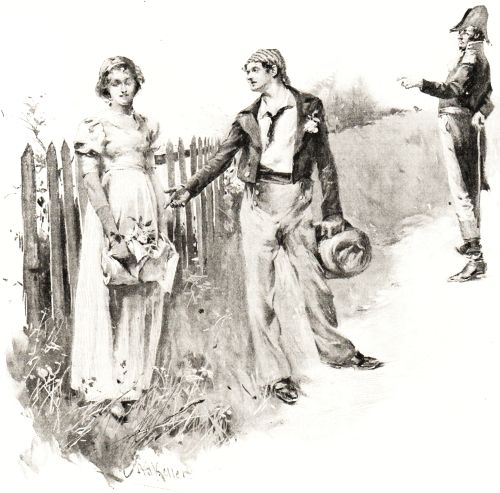
"Good-by, Mary," said I, extending my hand. "Don't forget me."
"Good-by," she said simply, and thus we parted.
I was filled with the idea, as we went down the street, that I would run across Gaston; but I determined that if this happened, I should not show the fear of him that I had a few moments since. But we met no one except some villagers driving their cows to pasture, and approaching the wharves once more, we entered one of the warehouses, and found awaiting there a crowd of seamen. They all touched their hats as Captain Temple and I came to the doorway. A red-faced man with a great bulbous nose and snuff-powdered coat greeted us.
"You're late, Captain," he grumbled; "and look at the gentry that have been awaiting you. There may be some seamen amongst them, but I'll wager we've got some hog-butchers and tailors here, at any rate."
He might properly have added pirates in his category, for some of the men were as rough-looking cut-throats as any one might wish to see.
"Here, act as shipping-clerk, lad," said Captain Temple, shoving a great ledger toward me. "And set things down right and ship-shape, too, in plain English. Never mind the spelling—just so one can read it."
Luckily it happened that the page before was but half filled, and I saw at a rapid glance the mode of procedure. I recognized also Bullard's handwriting. And now began the examination that to me was most interesting.
Temple looked at every man, as he presented himself, slowly from top to toe, and I noticed that many of them gave a shake to their shoulders when he lowered his eyes, as if a chill had passed over them. The questions were very simple, consisting in asking the man's name, age, previous occupation, and the vessel that he had last sailed in, and if satisfactory, he was told to get his dunnage and present himself at the pier some time before noon.
"We have no idlers on board this ship," said the Captain, addressing the crowd. "If you're not doing one thing, you're doing something else. I want both-handed men about me."
In about two hours the work was finished, and Captain Temple, looking over the ledger, paid me a compliment upon my writing, and expressed the opinion that evidently I was an old hand; in which I did not contradict him. Before noon arrived, however, I was almost famished, but I had found no time to search for anything to eat.
It had got noised about the lower part of the town that the remaining part of the crew of the Young Eagle were to debark at that hour, and quite a crowd had gathered along the shore to see them off. I had managed to run up to the inn and to secure my small bundle, and had hastened back again.
Already a boat-load had gone off to the ship, and as I clambered down the rough ladder, the crowd and those in the second boat were indulging in much rough playfulness. It was a very mixed assembly, and there appeared to be no deep feelings shown in any of the farewells. Just as we shoved off, I heard my name called—that is, my first name. "John! John!" said a voice, and looking up, I saw Mary Tanner standing at the edge of the pier. She waved her hand to me, and then, with a quick glance about her, kissed it.
My return to this, which I kept repeating for fully a minute, was not conspicuous, because half of the men gathered in the stern-sheets were doing the same thing and indulging in mock-lamentations. Three or four silent ones, perhaps, felt more deeply than the others.
As we came alongside the brig, I noticed that her free-board was not more than six feet amidships, but that her bulwarks were fully the height of a man's shoulder. Her sides shone as if they had been varnished, and the brass-work along her rails gleamed like gold. But when I set my foot on deck, it was then that I was astonished. I have seen many privateers and vessels of the regular navy since that day, but never have I seen such a clean sweep of deck and such fine planking in my life. All the loose running-gear was flemished down neatly, many of the belaying-pins were of brass, and her broadside of six guns was very heavy for her tonnage.
Amidships, carefully lashed and blocked, was a long twelve-pounder. The others were eighteen-pound carronades. Two brass swivels she carried besides these—one on her forecastle, and one forward of the wheel on the quarter-deck. She was built upon a plan different from most of the vessels of that time, but now become more adopted in America. Instead of having her greatest breadth well forward, it was farther aft, and she was cut away like a knife-blade. I have never seen her equal in going close-hauled; or, in fact, in any point of sailing.
Now, as I stood there with my bundle in my hand, I longed for some one to ask questions of, and then I remembered that if we sailed on the morrow, Plummer would be left behind. Most of the men coming off shore had carried their hammocks with them, and where I was to get mine I did not know. But as Captain Temple had been so kind to me on shore, I thought nothing of going to him, and considered that it would be the best way out of the difficulty, so I stepped up to where he was standing near the binnacle. He looked at me as if he had never seen me before; in fact, he appeared a totally different man.
"Well!" he said, sternly. "Coming aft in this fashion! If you wish to speak to me, wait at the mast."
"I have no hammock, sir," I began.
"Sleep on the deck, then," he returned. "Go forward."
He spoke to me much as one might address a dog, but there was nothing for me to do but to obey like one, and I went down the hatchway to the berth-deck. How so many men were going to sleep in that crowded space I could not see. They were so close that as they moved about they touched one another, and so low were the deck-beams that the tallest could not stand erect, and even I brought up against one with a tremendous whack that set starry skies before me. To my relief, I perceived that I was not the only greenhorn, and that there were a few others who knew even less than I did of what was expected of them.
A gawky country lad, who had been standing there gorming about open-mouthed, approached me.
"Tell me, please," he said, "where are our beds. Where are we going to sleep?"
I explained that the long bundles some of the men carried, and that they were taking up to stow in the nettings on the deck, were hammocks, and that he would probably have one served to him. He thanked me kindly, and probably looked upon me as being a very knowing, able seaman.
The men were joking and cursing roughly, and before we had been on board ten minutes a fight had started between two half-drunken sailors, which occasioned only merriment amongst the lookers-on, until a great, thick-set figure, that I afterwards learned was Edmundson, the third lieutenant, ran down the companion-ladder, and sent both of the fighters to the deck with two blows of his great fist.
"If you're after sore heads, you can get them!" he cried. "But avast this quarrelling." No one said a word; even the fighters stopped cursing.
I was mad for something to eat, for, as I have told, I had had nothing since the night before; but soon the word was passed through the forecastle that there would be no grub until the evening, at which there were many mutterings and more strange oaths. During the afternoon the crew was divided into watches, and the men were given their numbers and stations, but so far as I could see no provision was made for their comfort in any manner; no regular messes had been organized, and at six o'clock, when we were fed, we sat about in groups on the deck, and ate with our knives and fingers from the rough tubs; but the feed was wholesome, and there was plenty of it. I did full justice to a very healthy appetite.
Before dark Mr. Bullard came on board. As he walked forward I managed to catch his eye, and saluted.
"Ah, here's our sailor fencing-master," he half laughed.
"Might I have a word with you, sir?" I inquired.
"What is it?" he said, frowning.
"There are two country lads on board that have no hammocks; they know little of shipboard, but are willing. Can you not help them out, sir?"
I did not tell him that one of the country lads was myself. He muttered a curse, and here I found out that asking favors of ship's officers generally makes them cross. But he turned and spoke to an old seaman standing near by.
"Willmot, get two hammocks and give them to this lad," he ordered.
I followed the old sailor to the forward hold, and a few minutes afterwards presented a new hammock to the lank countryman, and kept the other myself; following the example of the other seamen, we marked our names on them in plain, black lettering.
The countryman, whose name was Amos Craig, and I found a hook forward and agreed to swing together. It was near the hatchway, but we took it because the air would be better, and it was already foul from much breathing. I did not turn in early, being in the first watch, which we kept as if we were at sea; but that night, as I looked out toward the lights of the town and realized how great a change the life before was from that I had been leading, I was half tempted to slip overboard and make a swim for it, for I felt that all this did not mean liberty. I had yet to learn that there is freedom in faithful and loyal service.
I had been much surprised by the difference in the manners shown by Captain Temple ashore from those on shipboard. This change, however, is the natural sequence of absolute authority, and the relief occasioned by being able to throw off responsibility. In after-years I felt it much the same with me, but in the writing of this tale, as I cannot claim that I have the power of adding adornment, I also intend to be as free from moralizing as I can. So, to return to what happened. As I leaned over the rail, I made up my mind to accept anything that came, and make the best of it, and to do my duty according to the best of my powers.
Half of the watch on deck were lying sprawled out and snoring against the bulwarks, keeping carefully out of the moonlight, for the reason, as I afterwards learned, that sleeping in the glare of the moon addles men's brains; but this may be mere superstition.
Up and down the quarter-deck a restless figure paced in quick, nervous strides. A sailor, with his heavy hair done in a long queue down his back, and two small gold rings in his ears, approached me and nudged me with his knee.
"Old Never-sleep is on the rampage," he said, directing his thumb over his shoulder. "We'll catch it to-morrow, you can wager on that, messmate. I've cruised with him, and I know his tricks!"
"Is he a good officer?"
"Ay, good for those who work for him, but he'll hound a shirker till you can see his bones. Some men on this 'ere craft will wish themselves overboard before this cruise is over. Jump when he speaks, that's my advice!"
Then the man went on to ask me questions. I dodged them as best I could by asking others, and as he liked to talk, I picked up not a little worth remembering. I found that Captain Temple had various nicknames that described his qualifications and characteristics to a nicety. Every skipper, no matter what his age, is called "old" on shipboard. Temple, I should judge, had not turned four-and-thirty, although he was slightly grizzled and his face was weather-seamed. "Anger-eyes" they called him on account of his keenness of vision. "Old Gimlet-ears," because it was rumored that he could hear in the cabin what went on in the forecastle. "Kill Devil," for the reason that he feared not to fight the powers of hell if they were arrayed against him. But chief of all, "Old Never-sleep," for a very evident reason. He apparently stood all watches when there was aught to be gained by vigilance.
The quartermaster on deck stepped aft as the sailor and I were talking, and spoke to Captain Temple.
"Make it so," were the words I caught from the Captain's lips.
Immediately the musical high-toned bell struck the hour. On the voyage of the Minetta I had learned to tell time after the manner at sea, and I knew that the other watch was coming on. In ten minutes I was below in my hammock.
So great a number of people composed the Young Eagle's company that the men were swinging double in the close-crowded space—that is, one hammock was underneath the other, the upper lashed high against the beams, and the lower sagging so that its occupant could touch the deck with his hand.
I had never heard such a chorus of snoring and muttering in my life, and it took me a few minutes to become accustomed to the reeking air. But at last I dozed off into a fitful rest of ever-changing dreams, and was awakened by the rolling of a drum and a confused sound of stirring, cursing, and piping. Now began a day in which I had to face some trials, I assure you, and call upon many resources that I did not know that I possessed.