Chapter III
Reading edition
THE WRECK ON THE BAR.
It was something tremendous for a young landsman to find himself away out at sea in a three-cornered boat. Captain Kroom noticed Sam's look and said:
"This 'ere isn't any mill-pond, eh? Well, my boy, all I'm afraid of is that it'll be a dead calm before we can get there and back again. What I hate is a calm. I got stuck in one once for more'n a month. It's next thing to being wrecked."
"She's a hard boat to row," said Pete; and he spoke of the Elephant.
Sam did not say anything, but it seemed to him that the face of the Atlantic might wear its pleasantest expression when it had no wrinkles at all. He would even have been willing to row a little. The Elephant thus far had wind enough in her sail for a boat of her size, and the stranded ship could be seen pretty well without any glass. So the Captain put the "binocular" back into its case and returned it to the valise. Before he did so, however, he had looked across the sea long and carefully, and he remarked:
"She's a-standing straight up, and the tugs are trying to pull her off. Guess she isn't going to break up."
Sam felt better the moment he could again take an interest in the wrecking business. After all, the ocean was reasonably good-tempered that morning, and the terrible lines of surf were now far behind him. He understood, too, that shallow water extended to a long distance out, and that the Elephant was in very good hands.
"He knows all about the weather," Pete told him; and the 'longshore boy appeared to feel altogether at home.
According to him, they were now in the very best cruising-ground for blue-fish, and even mackerel, but the Captain did not encourage trying their luck. Nearer, nearer sped the Elephant, and at last Sam ventured to remark:
"I guess it's just as you said. Is she on a rock?"
"Nary rock," growled the Captain. "But I'm worse puzzled than ever 'bout the valise. This isn't the Narragansett. This is the Goshawk, and she's from Liverpool. If we haven't come away out here for nothing! Anyhow, I'll hail her."
It occurred to Sam that it was not needful to go close to the ship to make them hear the trumpetlike voice with which the Captain demanded, "What ship is that?"
"Keep away! No loafers wanted!" came back loudly.
"Stuck in the mud, are ye?" thundered the Captain. "Some lubbers don't know how to handle a ship. I want to get some word of the Narragansett, Captain Silas Pickering, New Haven. Can any of you wreckers tell me—"
"Mate, hold on; it's old Captain Kroom."
"I say, Kroom," shouted another voice from the deck of the Goshawk, "Pickering's on board. The insurance men are in charge of this craft. That feller's nothing but her old mate. There's been more thieves—"
"Come aboard, Kroom," broke in the mate. "You're all right, but we've had the worst kind of luck."
"No, you haven't," returned Kroom, as the Elephant swept alongside the Goshawk. "I've been worse wrecked than you are. Why, you are going to save the hull and cargo!"
"That's so," said the mate, leaning over the rail; "but we lost all our sticks. Everything that was on deck. Pickering? We took him on at Liverpool. His ship had to be refixed, and the owners sold her, and he won't go aboard a steamer if he can help it."
"I guess there's the right stuff in him, then," said Captain Kroom, with energy; but the mate went on:
"He's awful, though. Some fellers came aboard soon after we struck, and they stole his kit, and there's lots of things missing. He's been sittin' 'round with a gun on his lap ever since, watching for thieves."
"Kroom," came loudly from behind the mate, "what do you want of me?"
The Captain said nothing, but he held up the valise, while Pete did the same with the trousers of the blue suit.
"Where'd you get 'em?" gasped the mate.
"Trolled for 'em," responded Kroom; but he added a pretty full explanation.
A very tall, gaunt old man was now leaning over the rail near the mate, and he did not interrupt, but when the Captain finished his account he took his hat off and held it out.
"Kroom," he said, "you can beat me spinning yarns. That stuff was on deck, and they pitched it overboard to get it away. I bought that tackle in London. Found the clothes below in my cabin, and rolled the tackle up in 'em. Don't know why. It was all stolen day before yesterday. My other luggage went in a tug this morning. Are you and the young chaps coming aboard?"
"Want to, boys?" asked Kroom. "There isn't anything worth seeing."
"Guess not," said Pete. "I'll hand him up the valise and things."
"I'd rather go home," said Sam.
"No, you needn't hand it up," said Captain Pickering. "I'm coming ashore with you. I won't be landed in a tug-boat if I can help it. I'd a'most rather swim."
"Just my thinking," rolled out at the stern of the Elephant. "I quit the sea on account of 'em—all sorts of steamers. I'm a sailor, I am. I don't want anything to do with steam."
"Fact!" whispered Pete to Sam. "He hates even a railroad. Everything but the old kind of ships."
THE START HOMEWARD FROM THE WRECK.
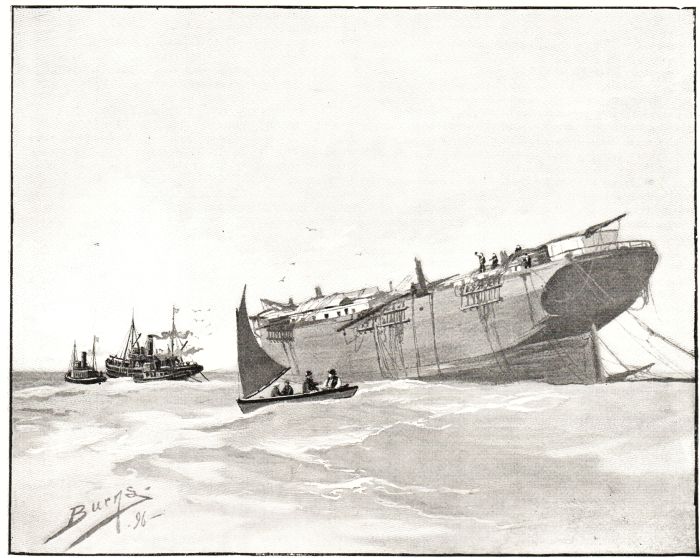
Captain Pickering did not bring any gun with him. Nothing but a small satchel. He came down over the side of the Goshawk by a rope, and Sam felt a little queer to perceive what an addition the tall, brawny old seaman made to the load to be carried by the Elephant. Hardly had he taken his seat in the middle of the boat before the wind was in her sail and her head was turned landward.
"It's comin' on a calm," said Pickering, "but we may get there first."
"Not across the bay," replied Kroom; "but we may get inside the bar. That was an old trick of the thieves with that spar for a buoy. No use to search their boat, you know. I've known it tried in all sorts of places."
"They reckoned on getting it again alongshore?" asked Pickering.
"Yes," replied Kroom; "but they didn't reckon on the tide through the inlet. Our bay-men pick up stuff all the while that came in that way. It's all right. Dry as a bone."
"Of course it is," said Pickering. "I say, boy, if that suit fits you, keep it. You and he can have some of the tackle."
That meant Pete and Sam, and they were ready to say "Thank you, sir"; but they were a great deal more ready to keep still while the two old sailors talked about the storm which had stranded the Goshawk, and about other storms they had known. It must have been quite a hurricane; but even before it was fully described, Captain Pickering had his valise open, and was slowly looking over some of its contents. Log-books, log-books, log-books. Sam knew what they were now, and he would have given something to know what was in them.
"That's one of the Narragansett's," said its owner, laying it down. "I sailed her for six years. One trip was 'round the world. Last ship I'll ever have. She was an old one. They're not buildin' many more of those prime clippers we used to have. It's all steam nowadays. I can't do anything with steam, Kroom. Can you?"
"I don't want any," replied the Captain. "It's taking the place of horses, too, on land. That and 'lectricity and these 'ere two-wheeled things they call cycles. I wouldn't any more ride one of 'em—"
"Did you ever ride a horse?" asked Pickering. "I did once; but I didn't know how to steer him, and we made a losin' voyage of it."
"Well," said the Captain, "I can drive. Kind o' drive. But I'd rather have some other feller navigate, as a rule. I'm most at home in a boat. Watch now. We'll be in the breakers in less'n five minutes."
"Good boat," remarked Captain Pickering. "But we're too many in her." Nevertheless, he talked right along about ships, as cool as a cucumber, even when the Elephant was making her dangerous way through the blind channel. "Glad you know where it is," he said to Kroom. "I'd ha' swamped her tryin' to find it. We're nigh half full o' water anyhow."
That was what had troubled Sam, for again and again the tossing waves of the channel had washed over in, and he and Pete had been baling their best. Not that Pete appeared to be troubled, and he had remarked to their passenger: "Captain Kroom knows every channel around this bay. He'll get through."
So he did, and they were now inside of the breakers, between them and the bar. Right ahead of them, moreover, was another cat-boat, twice as large as the Elephant, with four men in it.
"There they are!" exclaimed Pickering. "The very chaps that came aboard the Goshawk this morning. Reckon they'd been there before, too. Tell you what, Kroom, they're hunting for that spar-buoy, to get the things they hung to it."
"They won't get 'em," growled Kroom. "But every man of 'em belongs on the other side o' the bay. They are oyster and clam dredgers. Some of our fishermen are born wreckers, sure's you live. Anything they can take off a stranded ship is fair game to them."
"I guess so," said Pickering. "They thought they'd made a good find this time. That valise'd ha' been a fortune to 'em, chronometers and all. Glad you struck it."
"Sam hooked it," said Pete, "but it was Captain Kroom pulled it in. Sam thought he had the biggest kind of fish."
"Hullo, Captain!" came from the other boat. "Have ye had any luck?"
"Not any," responded Kroom. "But I want to get inside before it's calm."
"That there wreck out there's a Britisher," said the boatman. "They'll get her off. We haven't struck a fish to-day. We're goin' on in."
They were only out there fishing, all innocent, therefore, but they let the Elephant keep away a little, or they kept away from her.
"Wonder what they've picked up?" muttered Pickering.
"Look back," replied Kroom. "Don't you see something?"
"I do!" whispered Sam to Pete. "It's something white—"
"Right in the wake of their boat," said Kroom. "They must ha' let go of it just as we came out of the channel."
"That's it!" said Pickering. "That's where those life-preservers went to. One of 'em makes a better buoy-mark than any spar would."
"Captain," put in Pete, "that one isn't hitched to anything; it's running right along on the tide. It's loose."
"Fact!" exclaimed Kroom. "You've pretty good eyes, Pete. I saw 'em. They didn't pull up anything, but they tried to. It only broke loose, whatever it was."
"No, you don't!" said Pickering, sharply. "It's hitched on the bottom again. They saw us coming, and they let go. That's all."
"Get out your lines, boys," shouted Kroom. "We'll try for blue-fish, up and down here," and then he added, to the men in the other boat: "I won't go home empty-handed. Why don't you fellers throw a hook?"
"No use, Captain," came back. "We may get some weakfish in the inlet, but you'll only throw away time."
"We've got all the time there is," said Captain Kroom; but Sam and Pete were making haste, and when the Elephant tacked again their lines were out.
"Shouldn't wonder if they were kind o' mad," remarked Pickering. "But there was more'n one life-preserver on deck. They can hunt for the others."
"That's what they'll do," said Kroom; "but this one's follerin' us. Whatever is hitched to it'll anchor it in shoal water. Things have to go over the bar and into the bay at high tide. They know that, and they think they can wait."
The wide spread of water between the surf and the beach was now comparatively smooth, with long low waves playing lazily across it.
There might be fish there, but most likely not, the Captain said, and it ought not to arouse any suspicions of the wreckers that he wanted to try it.
They sailed ahead for the inlet, but Pete may have been correct when he told his shipmates, old and young:
"They're a-watching us. They mean to see if we're just after fish."
"There comes that thing!" exclaimed Sam; but Pickering caught his arm.
"Don't you point, boy! Don't anybody look at it! Fish away. I guess it isn't worth much, but they needn't see us get it."
The Elephant had not begun her remarkable voyage very early in the day, and more time had passed than her boy crew were aware of. Her commander, however, had kept track of the tides and the hours, like the sharp old fisherman that he was.
"We went out with the tide," he said to Pickering. "It's turned to run in now. Those chaps'll wait for that stuff at the other end of the inlet. I don't want 'em to guess that we know a thing about it; but it'll be good and dark before we get home."
"My folks know I went fishing," said Sam. "They won't care."
"Mine won't, if they learn that I'm with Captain Kroom," said Pete. "They know he doesn't come home early— Hullo! Blue-fish!"
He had struck one; he pulled it in rapidly, but, the moment it came within reach, Captain Kroom seized it and stood straight up in the boat, hailing the wreckers with:
"Luck! Four-pounder!"
"All right!" came faintly back over the water. "It's all you'll get."
"Guess not," grumbled Pickering. "But I wish I knew if they had anything from the Goshawk in their boat. There was another lot of chaps there, just like 'em."
"We can't help it if they have," said Kroom. "Do you know, they're not a bad kind of chap. Honest as the day on shore. Wouldn't cheat you in the weight of a fish. It was just so with the Cornish wreckers that plundered me once."
"Never was wrecked in my life," replied Pickering. "This Goshawk business wasn't mine. I wasn't in charge of the ship. It doesn't count."
"Well," said Kroom, "I wasn't ever wrecked after I got to be Captain. Most of mine came younger. I went to sea when I was a little feller. What I hate around a wreck is sharks."
If he was just about to tell a shark story, his chance for it was spoiled. He had a line of his own out now, and the next instant he exclaimed:
"Pete! Pickering! Take care of the boat while I get him in. 'Tisn't any blue-fish this time!"
The Elephant yawed and leaned over dangerously before Captain Pickering could get to the tiller, but Pete let the sail swing out like a tiptop young boatman.
"Just in time!" he said. "Sam, the Captain's got a big one!"
It was indeed a fish, but the flurry of excitement on board the Elephant had not escaped eyes that were watching her. One eye, the right eye of a pretty sharp pair, had been squinting through a pocket-telescope, such as coast-wise men of that sort are very apt to carry.
"Boys," exclaimed its owner, "old Kroom has found something. Come on!"
The next moment that cat-boat, with the four wreckers in it, was tacking as straight a course as it could make toward the Elephant.
"Meet 'em, Pickering," thundered Captain Kroom. "I'm bringing him in. They mustn't guess we are after anything but fish."
"They won't," said Pickering, "not if you can show 'em a prime sea-bass."
"That's what it is, Sam," said Pete. "I told you this was the place to get 'em. If he doesn't know all about fish!"
The Captain was putting out his strength as well as his knowledge just now. A less-experienced fisherman might have lost that splendid bass, hooking him with only blue-fish tackle. It was well, too, to have Pickering in charge of the Elephant, for she ran into rougher water while the fish-fight went on.
[to be continued.]
The All-Connecticut Interscholastic Football Team for 1896 is as follows:
J. B. Porter, New Britain High-Schoolend.
P. F. McDonough, New Britain High-Schooltackle.
Paul Thompson, Hillhouse H.-S.guard.
E. W. Smith, Hartford H.-S.centre.
R. B. Hixon, Hotchkiss Schoolguard.
T. L. Montague, Hotchkiss Schooltackle.
Norman Gillette, Hartford H.-S.end.
F. R. Sturtevant, Hart. H.-S.quarter-back.
E. A. Strong, Hartford H.-S.half-back.
H. C. Lane, Meriden H.-S.half-back.
Peter O'Donnell, New Brit. H.-S.full-back.
The substitutes are: J. R. Smith, Norwich Free Academy, end; T. F. Flannery, New Britain H.-S., tackle; F. A. Wheeler, Bridgeport H.-S., guard; Ernest Towers, New Britain H.-S., centre; J. E. Meehan, New Britain H.-S., quarter-back; Godfrey Brinley, New Britain H.-S., half-back; J. D. Lucas, Norwich Free Academy, full-back.
NORMAN GILLETTE, End.
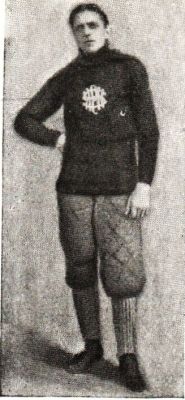
P. F. McDONOUGH, Tackle.
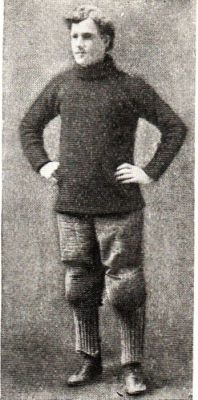
E. W. SMITH, Centre.
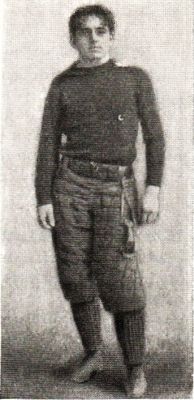
T. L. MONTAGUE, Tackle.
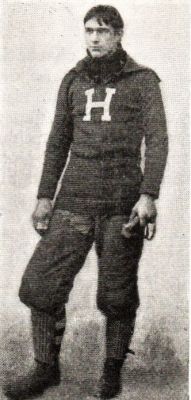
J. B. PORTER, End.
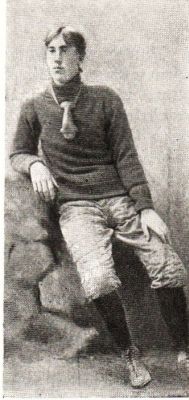
R. B. HIXON, Guard and Captain.
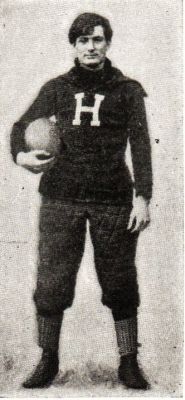
PAUL THOMPSON, Guard.
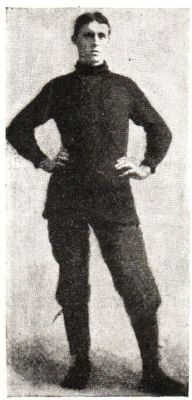
F. R. STURTEVANT, Quarter-back.
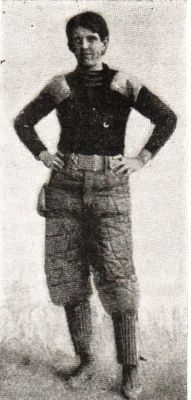
H. C. LANE, Half-back.
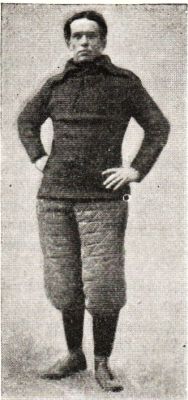
E. A. STRONG, Half-back.
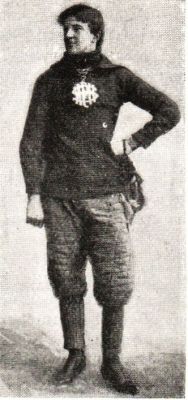
PETER O'DONNELL, Full-back.
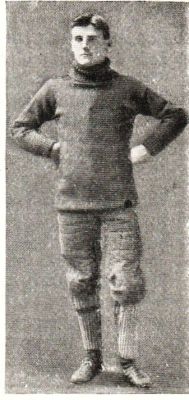
In selecting these players care has been taken to look over very carefully the work of the men on the weaker teams. The requirements of each man are "sand," experience, and physical endurance.
For centre, E. W. Smith, of Hartford, is undoubtedly the best man playing at that position among the schools of Connecticut. He plays a very fast game, is good at making holes, tackles well, and follows the ball every time. R. B. Hixon, of the Hotchkiss School, is beyond doubt the best guard of the schools. He has played every year since he has been in school. He understands the game thoroughly, and has a magnificent physique, which virtually makes him a "stone wall." Thompson of Hillhouse H.-S. is better than Wheeler of Bridgeport, because he is more strategic and quicker on his feet. He can get through the line very nearly every time, and gets in a great many tackles. He is also very good on the defence.
T. L. Montague, of Hotchkiss School, and P. F. McDonough, of New Britain, are easily chosen for tackles. Both run well with the ball, hold their man well, and are good in getting through and making tackles. Flannery of New Britain runs well with the ball and holds his man, but is not so good at tackling as either Montague or McDonough.
J. B. Porter, of New Britain, is beyond doubt the best among the ends. He is an almost sure tackler, and is down the field every time on a punt. Norman Gillette, of Hartford, has been chosen for the other end, because he breaks up interference well and gets hold of his man nearly every time. J. R. Smith is good, but too often lets his man go after making a tackle.
For quarter-back it is hard to choose between F. R. Sturtevant, of Hartford, and J. E. Meehan, of New Britain. Both play the game for all it is worth. In passing and tackling Sturtevant surpasses Meehan, but Meehan gets into the interference a great deal better than Sturtevant. On the whole, however, taking in the important points of strategy and command of men, Sturtevant may be ranked as the better player.
It is extremely difficult to pick out the half-backs. H. C. Lane, of Meriden, is one of the finest players that ever played in the League. He runs extremely hard and fast, and tackles superbly. The difficulty came in choosing the other half-back. For this position E. A. Strong, of Hartford, and Godfrey Brinley, of New Britain, are the best men. Brinley runs very fast around the end and displays a great deal of "sand," but he has always been assisted with first-class interference. Strong, on the other hand, has as much, if not more, "sand" as Brinley. He runs fast, and knows how to interfere with his hands, and if he had had such good interference as Brinley did, I think his runs would have been as long.
For full-back the choice lies between Peter O'Donnell, of New Britain, and J. D. Lucas, of Norwich. Lucas does not hit the line as hard as O'Donnell, but fully equals him in tackling and punting. O'Donnell has a better knowledge of the game.
For captain of this team R. B. Hixon, of Hotchkiss, should have the honor. The team he was captain of is one of the best teams playing football among the schools this year. He has plenty of experience, and a good control over his men.
The financial side of the Interscholastic football season in Connecticut seems to have been very successful this year, for the statement of receipts and expenditures as made out by the treasurer shows that there is $400 in the treasury. This does not include the total profit from all the games, as the managers of the Association hold back each year $100, for incidental expenses the next season.
The profits of this year—that is, the $400—are to be divided among the eight elevens that made up the membership of the Association, each school to receive $50. I have gone into this detail in order that I might introduce a rather startling quotation from the Meriden Journal. It is to be hoped that this paper does not represent the Connecticut idea of sportsmanship. At any rate, the Meriden Journal avers that the division of the spoils is not quite just. It argues that Meriden and New Britain, having played for the championship at New Haven, deserve to receive more money than the other teams of the League. It cannot understand why Suffield, who was only admitted to the Association this year, and forfeited its scheduled match against Norwich, should have the same amount of cash as any other team.
As a remedy for this state of affairs the Journal suggests that the two elevens which came together for the final championship contest divide fifty per cent. of the net receipts for the season, the elevens in the semi-finals thirty per cent., and the elevens which figured in the opening games only, twenty per cent. If this is not advocating the playing of football for money, and is not thus a direct propaganda of professionalism, I don't know what is. If the editor of the Meriden Journal believes that the schoolboys in his neighborhood are playing football for the prize-money to be divided at the end of the year I am sure he is very much mistaken in his men.
Nevertheless, any such statement as this, especially when given currency in the city of the team that stood second in the League, is exceedingly injurious not only to the reputation of that team and school but to the entire Connecticut Association. Many persons who read this, and who do not know that the Journal is discussing a subject in which its ignorance is made evident by what it says, will believe that interscholastic sport is being carried forward on a money basis.
Everybody knows, of course, that no enterprise, not even sport in the truest amateur spirit, can be carried on without the expenditure of some money. The railroads will not carry amateurs free of charge, nor will tailors furnish them with football suits for nothing. Therefore it is necessary that the Association have some revenue. This is usually obtained in one of two ways, either by subscriptions levied in the various schools or by charging admission-fees at the more important games. The latter is in many respects the better, because it distributes the taxation over a greater number of people.
If, however, at the end of the year it is found that the revenues are greater than the expenses, the treasurer of the Association should profit by this knowledge to do away with certain features of taxation the next year; for his endeavor should be to collect only just the amount of money that is needed to defray the legitimate expenses of the several football teams under his care.
The very fact of dividing up money at all savors of professionalism, but when you come to dispose of it in proportion to the success of the teams, the offence is made even worse. Any of these elevens in question that accepts a dividend makes itself liable to charges of professionalism, and a strict interpretation of the ethics of sport would find it guilty. It is to be hoped that the Connecticut Association will recognize this fact as soon as it is pointed out to them, and reconsider the proposition of sending $50 to each team. If the money were left in the treasury of the Association it would be a different affair entirely from dealing it out to the treasuries of the various schools that played in the League.
The simple fact that $100 is held by the Central Treasury for next year's expenses shows that the $400 is considered as a surplus or profit. Therefore any team that accepts such profit puts itself in a dangerous position, so far as its amateur standing is concerned. As I understand the case—and as it should be, if it is not—the treasurer of the Association defrays the expenses of the several teams upon requisition of the several managers. Therefore he alone should handle the moneys of the Association, and next year, when the expenses begin again, it is he who should provide what is necessary.
The $400 now standing to the account of the Connecticut Association should be devoted to the maintenance of that Association, and not to the benefit of the individuals who make up its membership. The fact that there is so much money on hand will make it very well possible for the games next year to be carried on without the charge of an admission-fee, or it will enable the managers to present this year a trophy of some kind to the winning team, or they might even go to the extravagance of presenting the eleven champions with some small souvenir, as is frequently done in the colleges, such as a gold football for a watch-charm.
The misunderstanding which has occurred in the New England Interscholastic Football League, and which was spoken of briefly in this Department last week, may be briefly stated as follows: The constitution of the Association as published in book form requires that fifteen days' notice of the eligibility of any player be given in writing to the secretary before the date of playing. At the beginning of the season the Boston Journal was voted the official organ of the Association, and on October 30 that paper published a part of the constitution, but omitted entirely any reference to the fifteen-day clause. The same article contained also the names of the various players for the schools, and was published on the first day of the games of the interscholastic series.
THE CAMBRIDGE MANUAL-TRAINING SCHOOL FOOTBALL TEAM.
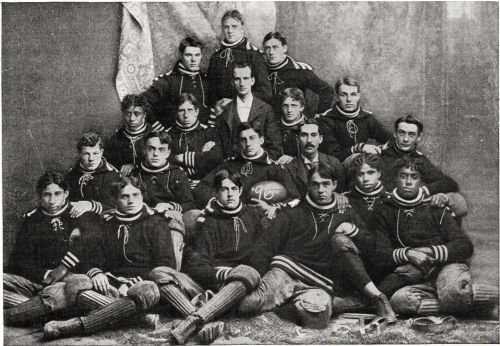
The Cambridge Manual-Training School acknowledges the rule in the constitution which requires a fifteen-day notice, but pleads ignorance for not having complied with it in the case of one of its players, urging its belief that the fifteen-day clause had been stricken out, since it did not appear in the constitution as published by the Boston Journal, the official organ of the Association, on October 30. The donors of the cup for which the teams contest have the power to change the constitution as they wish. C.M.-T.S. thought that the donors had availed themselves of this privilege when they saw the constitution printed in the Journal without the fifteen-day clause.
The player whose name was not submitted to the committee is S. S. Merrill, who played end on the Worcester Academy team last season. This year he has been a member of the Burdett Business College of Boston, playing end on its football team until he changed to Cambridge Manual-Training School. He entered Cambridge Manual-Training School October 26, and his name was sent to the Executive Committee November 9. On November 13 Merrill played against Hopkinson's, and the game was protested by the latter school inside the allotted time for protests. In the games with Boston Latin and English High, on November 17 and November 20 respectively, Merrill also played, and while these games were protested by the two schools their claims were on different grounds than those of Hopkinson's. Boston Latin's protest related to Merrill not being a member of Cambridge Manual fifteen days before playing, which was not sustained according to statistical proof from the principal of Cambridge Manual. English High's protest was on a question of fact, and an article of the constitution settled that.
While the consequences have been serious to the Cambridge Manual-Training School, it appears that the sentiment of the entire Association was for some reason so strong against C.M.-T.S. that the officers of the Association could not allow that school to violate even one letter of the constitution. The committee accepts the statement that there was no malicious intent, and says in its decision that it feels that "Cambridge Manual has not intentionally broken the constitution, and has acted in perfect good faith."
This is an unfortunate complication, and one greatly to be deplored. Cambridge Manual seems to have suffered a penalty out of all proportion to the offence committed, and while it is just that the committee of the Interscholastic Association should enforce the constitution to the very letter, and while it seems that in the present case they have not in any way exceeded their duties, still I believe that, so long as Merrill was a bona fide student at the school, every sportsman will consider C.M.-T.S. the virtual, if not actually the pennant-holding, champion of the Senior League of the New England Interscholastic Football Association.
In especial relation to these recent occurrences, it is good news that a conference of interscholastic football authorities will be held in the latter part of next month. It is proposed at that time to go over the constitution carefully, and to add or eradicate such clauses as the conditions in Boston may seem to require.
The protest of Trinity School against De La Salle was withdrawn at the last meeting of the New York Interscholastic Association's executive committee, and the championship has been awarded to De La Salle Institute. This makes one more unpleasant incident that is put away into the past without being dragged out to an unpleasant length; and no matter what Trinity's position may have been in the case, her athletic managers have done well to drop their protest.
In addition to in-door track athletics this winter the Brooklyn schools will have a handball league, and the schedule of games has already been laid out as follows:
January 16—Pratt Institute vs. Brooklyn High, and Poly. Prep vs. Brooklyn Latin.
January 23—Pratt vs. Brooklyn Latin, and Adelphi vs. Poly. Prep.
January 30—Brooklyn High vs. Brooklyn Latin, and Pratt vs. Adelphi.
February 6—Brooklyn Latin vs. Adelphi, and Poly. Prep. vs. Pratt.
February 20—Brooklyn High vs. Pratt.
February 27—Poly. Prep. vs. Brooklyn High.
Brooklyn Latin School and Poly. Prep, will probably have the strongest teams, from present appearances, and as the game has been played by both these institutions for some seasons past, some exciting contests should result.
Unless unforeseen contingencies arise to prevent, the All-New York and the All-Chicago Interscholastic Football Teams will be announced in the next issue of this Department.
"FOOTBALL FACTS AND FIGURES."—By Walter Camp.—Post 8vo, Paper, 75 Cents.
The Graduate.