LAWSON'S INVESTMENT
Reading edition
BY MAJOR G. B. DAVIS, U.S.A.
LAWSON ON THE WATCH.
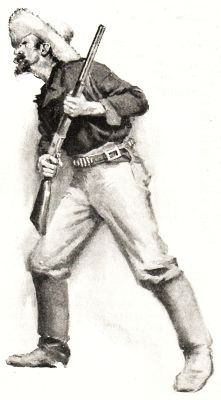
To begin with, it was not an investment of gold or silver, in land or bonds, or any of those things for which men vainly toil and strive, in constant peril of their souls. Of all that, I know nothing. I am simply to tell how Lawson, a volunteer soldier, defended the Cienega Ranch during the long hours of a summer day against a band of Mescalero Apaches, red-handed, thirsting for plunder, and bent upon his destruction.
I have said that Lawson was a volunteer soldier. If I rightly understood him, he was born in Ohio. At any rate, he served in the Ohio infantry, and enlisted for the war, with a thousand others, in the early fall of 1861. By rights he ought to have been drilled and properly set up and disciplined in some sort of camp of instruction in Kentucky or southern Ohio, but there was not thought to be time for that, so great was the need for men, and so he had to acquire his manual of arms and other military fundamentals in the field from day to day as he went along. Now this is not the best way nor the way laid down in the books, but it was the only way for Lawson, and whatever may be said against it, it is thorough and to the last degree effective.
In the raw early spring of 1862, Lawson's regiment, still rusty in its ployments and facings, and having as yet no abiding knowledge of the goose step, began its campaigning in West Tennessee. He was at Donelson and Shiloh, and later got his first lessons in digging and the use of the head-log at the siege of Corinth. After that was over, he marched about, hither and yon, as his Generals wished—but somewhat aimlessly as he thought—in northern Mississippi. This sort of thing was kept up all through the fall and winter until the spring came, and the Army of the Tennessee set out to do something at Vicksburg. He did his share of digging and fighting in the hot trenches there, and then, just as the cool fall breezes were beginning to blow, he betook himself with Sherman to the relief of his beleaguered comrades at Chattanooga, arriving just in time to share in Corse's gallant but unfruitful assault upon the north end of Missionary Ridge. Always a private, he missed none of the marching or fighting or digging of the Atlanta campaign, and closed the year '64 with the long sweet-potato walk to Savannah and the sea. Then he waded and toiled up through the miry Carolinas, adding not a little to his military stature and to his stock of technical war knowledge in the way of corduroying and trestle bridges, and at Bentonville finished, as he had begun, a private, full of dearly bought experience, fuller still of malaria, an expert in all the arts of defence, a resolute and resourceful soldier, who had been tried on many an emergent occasion, and who had stood shoulder to shoulder with the boys whenever they lined up at the sound of the long-roll or rushed to the parapet to repel the assaults of the enemy.
At last, when the whole thing was over, and he had been paid off and discharged, and had spent the greater part of the little that was coming to him in seeing the great world that lay between Pittsburg and Columbus, Lawson fared back to the peaceful Maumee Valley, with his chills and fever and his slender resources, only to find himself a sort of living vacancy in the body-politic. Look where he would, there seemed to be no place open for an old soldier like him in the changed order of things that somehow seemed to prevail in the little community which he called his home. He was in no sense a "hustler," he had no trade but war, no capital save his strong arms and an honest heart, and no powerful friends to push him in any direction, and so, after many disappointments, it came about that he drifted down to Cincinnati, and there enlisted in the regular army. He had served side by side with the regulars for four long years, and they were now the only folk with whose goings and comings he was familiar; and for the first time since his discharge he felt at home among the lean infantrymen as he ate his bacon and beans in the company kitchen, and took his turn at guard, as he had been used to do, or discussed the characters of his Generals with the old men who had served under them when they were Lieutenants in Mexico, in the hazy days before the war, when men's minds were at peace and soldiering a trade worth thinking of.
The days rolled into weeks and months. There was little to do, there were many to do it, and he was content, ay, happy—happier than he had been at any time, that he could remember, since the winter quarters at Chattanooga, after the blockade was broken and fresh beef and soft bread were issued every day. But this was altogether too good a thing to last, and the end came one day when a big detachment of ex-deserters and bounty-jumpers were assigned to the Fourteenth, and the good times were gone forever. To Lawson it was an enigma, and he gave it up, but it came about in this way: When the great volunteer armies were disbanded and sent to their homes, there remained on hand a residuum of deserters and men without souls, who had been bought with a price, but who belonged to no regiment, and so were kept in pay when the rest were mustered out and discharged. Of a sudden it occurred to the powers that this unpromising material might be put to some use in filling the depleted ranks of the regular army.
But fire and water will not mix, and if honest dough-boys be shaken together with such sons of Belial the regimental traditions will suffer, and discipline will surely come to naught. And so it happened that the old Fourteeth had to undergo all the pangs of dyspepsia before it could make way with the indigestible mass that had thus been cast upon it. There is no telling what dire happening would have come to the regiment had this state of things been allowed to continue indefinitely. A period was put to it at last, however, by a telegram, which came to the commanding officer at dead of night, transferring the Fourteenth to Arizona. Then it was that the deserters and bounty-jumpers held council of the situation, and being of one mind as to the unpleasing outlook, took wing and troubled the service no more, and the old Fourteenth, weaker in numbers but stronger in men than it had been since Fredericksburg, was landed at Yuma, where it was appointed to garrison the abandoned posts and protect the overland mail from the depredations of the Apaches, who had been working their will of late upon the unprotected settlements in southeastern Arizona. Here, taking his chances with the rest, and doing his full share of escort and fatigue, Lawson served "honestly and faithfully," as it ran in his discharge papers, until his term expired and he was a free man again. And then it was that he went up to keep the mail station at the Cienega.
The Cienega, or, to give the place its fall name, the Cienega de las Pimas, was a low-lying, swampy valley through which a small stream ran, alternately rising and sinking after the manner of creeks and rivers in Arizona. To the west, twenty-eight miles away, was the pueblo of Tucson, a cathedral town, once the capital of the territory. To the east, twenty-two miles distant, was the middle crossing of the San Pedro. To the north there was nothing; while to the south were the Whetstone Mountains, then old Camp Wallen, the Patagonia Mine, and Old Mexico. The Cienega itself was flat, infested with all manner of poisonous vermin, submerged in the rainy season, and miry and impassable, in a military sense, at all times. It was also malarial, and to the last degree unlovely to the eye. A few dead cottonwood-trees, upon which the owls creaked at sunset, rose stiffly here and there out of the general dead level of sacaton grass and chaparral, while the tarantula and centipede and the ubiquitous rattlesnake reserved to their unhallowed uses the moist, impenetrable depths below. The station had been located just where it was because it broke into two fairly equal parts the long fifty-mile drive from Tucson to the crossings of the San Pedro. Wagon trains and occasional parties of prospectors or travellers camped at the Cienega on their way to the White Mountains, or to the Apache Pass and New Mexico, and from their small needs in the way of refreshment for man and beast Lawson and his partner eked out an extremely moderate existence. At very rare intervals a troop of regular cavalry passed that way, and the ranchmen ministered to its needs in the way of long forage to the extent of twenty dollars or more. These were red-letter days for Lawson—a very gold-mine, indeed—and led him to hope that, sometime in the uncertain future, he might be able to leave the Cienega forever, and go back to Ohio, where green grass and tall trees grew, where churches and kindred were, and where he might, perhaps, take a new start in life in a land beyond the dim eastern mountains, where pistols were not, and where civilization flourished throughout the year. This was a dream that came to Lawson in the night when a big escort camped at the Cienega and he could eat and sleep in peace.
No one who knows Arizona need be told that the Apaches were particularly bad in the early seventies. No place outside the towns or beyond the lines of the garrisoned forts was safe from their incursions. Depredations were of daily occurrence, and were only desisted from when there were no white men left to kill and no horses or cattle to steal and carry away. A single traveller journeyed south of the Gila and east of the Santa Cruz, not simply at his peril, but to certain, inevitable death. It was the same with two, or three; if four travelled together, one had a running chance to escape if the marauding party was less than ten, or if the attack came within an hour of darkness. On the whole, the best local judgment, both civil and military, was that five persons, alert, fully armed, and, above all, judiciously scattered along the trail, were the smallest company that could venture into the country ranged over by the Mescalero or Chiricahui Indians with any chance of getting out alive. The roads were dotted with the graves of those who had paid, with their lives, the awful penalty of being too venturesome, and the isolated ranches were heavily barred and otherwise defended against the common enemy. The Cienega was no exception to the rule; indeed, on account of its perilous situation, it had one or two defensive features which less-exposed ranches lacked, and which I shall presently describe. Partly because it was located near the junction of several large north and south Indian trails, and partly because of the ease with which it could be approached from the dense chaparral, it was always surrounded by hostile Apaches, and its occupants went in and out under their constant observation.
The ranch building proper, for there was but one, stood on the east bank of the muddy creek, just above where the old overland stage-road had managed to find a practicable crossing. As the trail left the ford, it wound sharply up the slope and passed between the ranch building and a huge outcrop of volcanic rocks which stood directly opposite the main entrance to the inner court, or corral. This pile of rocks had been regarded as having some defensive value when the ranch was built, apparently with the idea that, in the event of an attack, it might serve as a kind of outwork which could be defended for several hours before the garrison would be compelled to fall back to the shelter of the ranch proper. It was also so situated that, in case of siege, a small party could sally out of the main building and find cover behind the rocks long enough to enable its defenders to get a supply of water from the creek.
The enclosure, which was rectangular in plan, measured about sixty feet on each front or side. The middle of the front wall, facing the north, was pierced by a sally-port, or entranceway, about fifteen feet in width, which was closed by a heavy oaken gate. In conformity to the style of domestic architecture prevailing in all Spanish-American countries, where life and property are less safe than they are in the lands more favored of Heaven where the Anglo-Saxon dwells, this gateway was the only means by which an entrance could be effected, as the other walls were without openings of any kind save those which looked upon the inner court. The rudely constructed interior can be quickly described. On the east side of the entrance was a large living-room some twenty feet square; on the west were several smaller rooms for horse-gear and the storage of grain. The other three sides were roofed, but not otherwise enclosed, and were used as stables.
At the southeast corner, opposite the living-room, Lawson had built a circular flanking tower, which projected a little more than three feet beyond the outer walls, and from this corner tower, which was loopholed, the east and south sides of the enclosure could be raked or flanked. It was a novel construction, and Mexican cargadors, wrapped in their serapes of manta, sat squat on their haunches and soberly regarded it for hours, wondering at the Gringo's strange conceit in building. Curious travellers casually observed it in passing, and thought it a spring-house, or perhaps a place where whiskey and other precious valuables could be safely deposited; but none, even the most inquisitive, suspected its real purpose or gave it a moment's serious thought. We shall presently see, however, how useful it proved to be.
The living-room was simple and plain to the last degree. In the first place, there was a fireplace of adobe, at which all the cooking was done; there were two rude bunks, in which Lawson and his partner slept, and there was a rough table, made out of a discarded hardtack box, which stood under the window overlooking the interior court. These, with a half-dozen stout chairs with rawhide seats, completed the scanty array of furniture. Each man wore a pistol and a thimble-belt always, and was never far from a repeating Winchester rifle. At the head of each bed, ready for instant use, stood a perfect arsenal of weapons of all dates and calibres. Some were modern, and likely to be of service in an emergency, the rest were antiquated and obsolete, mere bric-à-brac indeed, and were kept because, as Lawson put it, "they might come in handy sometime."
So, as the matter stood, the garrison—that is, Lawson and his partner Green, an ex-Confederate from the Army of Northern Virginia—had thought the thing all over, and settled in their minds that, in the event of an attack, they would proceed in about this wise. If the attack came from the north, which was by all odds the most exposed and dangerous quarter, they would first hold the rock outwork to the last extremity. It was agreed between them that their principal danger would consist in an attempt on the part of the Indians to scale the walls, either to make a lodgement on the roof or to set it on fire. Now if such an attempt happened to be made on the east or south side, which was commanded by the flanking tower, the garrison would be heard from, and serious injury might be inflicted upon the assailants—enough, perhaps, to hold them in check until the mail-drivers, who passed daily in either direction, could carry the alarm to the regular cavalry posts at Tucson and the Apache Pass. It should be said, however, that so much of the partners' ingenious plan of defence as depended upon the arrival of a mail-rider was, at best, a feeble reliance, as they were more likely to be killed than not in the event of an attack; but feeble as it was, it was all that seemed to stand between the occupants of the ranch and a lingering death by torture, should the Apaches conclude to make a descent in force upon the Cienega; and thus matters stood there just before sunrise on the morning of the 21st of July, 1870.
AS GREEN SPED THROUGH HE FELT THE HOT BREATH OF HIS PARTNER'S WINCHESTER.
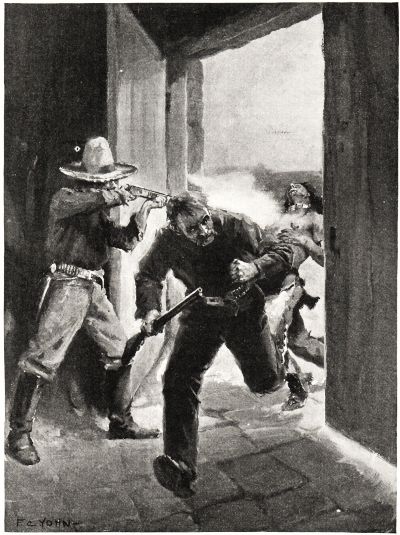
The attack came about in this way: At the gray of dawn, Green, who was astir feeding the animals, as was his custom, fancied that he heard some suspicious noises among the hogs who were hunting young rattlesnakes in the big rock pile in front of the main door. Seizing his rifle, he unfastened the gate and stole cautiously out across the road, and pushed up, under cover of the bowlders, to a point of vantage from which he could overlook the swamp lying to the northward. He had hardly reached shelter when two sharp reports rang out in the still morning air, not from the swamp in front, but from the road at his right and rear! Green's soldierly instinct told him what this meant, and before the reports had ceased to echo he plunged back across the road, and shot through the big gate in safety. As Green sped through the storm of bullets, closely followed by an athletic warrior, he felt the hot breath of a rifle-ball from his partner's Winchester, which brought down his pursuer stone-dead well within the entrance-gate. The long-looked-for attack had come, and the first brief passage at arms was over. Save that their skins were whole, the partners had but little to congratulate themselves upon. The first step in their carefully elaborated plan of defence had utterly miscarried. Green had been compelled by a flank attack to abandon the outwork without even an attempt at resistance. Lawson had tried to shut the gate, but had failed, and it was now too late to undertake so dangerous a task under the rifles of a score or more of Apache warriors, who, from their perches in the rocks, now fully commanded every approach to the building from the north.
So the partners fell back towards the south wall of the enclosure, and established themselves among the kicking-posts, in a position from which they could still command the half-open gateway. It would now seem as if the Indians had it in their power to carry the building by a single bold rush through the entrance-gate; and that is precisely what would have happened had the attacking party been composed of white men, or of Sioux Indians or Cheyennes—or Nez Percés, for that matter—but the Apache is a brutal coward, and doesn't do things that way. With him the taking of human life is always a means to an end. His first object is plunder, and he kills whatever stands between him and the object of his unholy desire. But he does nothing blindly or without carefully calculating all the chances, so as to eliminate or reduce to a minimum the risk of losing his own worthless life or those of his companions in iniquity. A marauding party will spend hours in planning the murder of a mail-rider, and will arrange every detail with such devilish cunning as to leave their victim absolutely no loophole of escape.
And this, strangely enough, was Lawson's present salvation. The Indians did not know how many men there were in the ranch, or how they were posted. Until they had gained this information, the partners could count upon it that there would be no assault by way of the half-closed gate, as it shut out from view more than half of the interior of the court. A thorough knowledge of their wily enemies, however, served to determine the next step in their scheme of defence. It is a dogma of the Apache's crude and grewsome religious belief that some dire happening will befall the band that leaves its dead in the hands of an enemy. Now Green's pursuer, carried forward by the tremendous pace at which he was running, had fallen, as we have seen, well within the gateway, and his dead body was stretched out in full view of the partners from their station in the corral. It was certain as anything in Apache warfare could be that the next move of the enemy would be to recover the body of the dead Indian; the only question was as to whether, in making the attempt, they would charge in considerable force or intrust the difficult task to the prowess of a single warrior.
The garrison had not long to wait. There was a hurried conference among the rocks, a scratching of moccasined feet on the hard clay without the gate, and then the notes of the death-song rose on the morning breeze as a lusty warrior made a dash for the body of his comrade. As he bent to lift his ghastly burden, he fell under the sight of Lawson's rifle and dropped across the lifeless body of his companion. There were now two dead Apaches in the gateway under control of the partners' rifles, and to Lawson's mind the next move of the enemy was perfectly clear. For their souls' peace, the bodies of the dead must be gotten back at all hazards. The attempt was only a question of time, and of a short time at that. The only hope in the situation for the partners was that the rush, when it came, would be for the sole purpose of recovering the bodies, and that the Indians would not succeed at the same time in gaining a view of the defenceless interior. And so, as matters stood, if the partners could in some way manage to delay the recovery of the bodies, there would be so much time gained, and they would increase to that extent their slender chance of relief. It must be confessed that the outlook was far from cheerful. The cloudless sky glared over them, and the stifling heat reflected from the white clay floor penetrated every corner of the enclosure as the morning hours slowly burned themselves away. An ominous silence reigned without everywhere, and neither sight nor sound came from the enemy to relieve the consuming anxiety of the beleaguered garrison.
Through the partly open gate nothing could be seen of what was happening outside, for a chopping-log intervened in such a way as to shut out from their view the narrow opening under the gate, between its lower rail and the ground. As the sun rose higher and began to light up the dark passageway leading out of the enclosure, it occurred to Green that by moving down a stall or two nearer the front it would be just possible for him to see out, under the gate, from beyond the end of the chopping-log, and thus, perhaps, get some notion of the movements of the enemy. And so, quietly communicating his intention to his comrade, he cautiously pulled himself along by the hay-racks to gain his point of view.
Just as he was straining his neck to get sight of the opening under the gate, he was brought to his feet by a shot from his partner's Winchester, only to find that his manœuvre was too late—the bodies of the Indians were gone. Lawson, who was standing erect, had seen the bodies begin to move, and had fired somewhat at random, in the hope of preventing their recovery. He was not successful, however, and he could only look on as they slowly disappeared from his view. The partners looked at each other in silence. Each changed his tobacco slightly and tightened his thimble-belt, but otherwise made no sign. Both knew only too well what the movement meant. It was now a matter of watching out the day, not knowing when or in what form the direful end would come. It seemed idle to count upon anything in the shape of relief from the mail-drivers, who were really in greater peril than themselves, as the Indians were watching the roads for some distance in either direction. More than this, the buckboard from the west would not reach the Cienega until midnight, while the driver from the San Pedro crossing, though due just after dark, if he were so fortunate as to escape with his life, would have a stiff hundred-mile drive to double back to the cavalry post at Apache Pass. They knew that Colonel Stanwood, its able and resolute commander, would start at the first note of alarm, and ride hard and fast to their relief; but push as he might, the distance was great, and the better part of twenty-four hours would be consumed in covering the hot hundred-mile march across a waterless desert that lay between his post and the beleaguered garrison at the Cienega.
The sun grew hotter, the blinding glare increased, the morning breeze fell away, and not a sound from the enemy reached the strained ears of Lawson and his comrade. The hours dragged heavily along until the sun stood past noon, and still the partners kept their weary vigil, and strained eye and ear for some sign or sound of the enemy. Their continued silence was felt by the garrison to be due to the fact that part of the Indians had gone some distance away to bury their dead in the rocks, or hide them from view in the dark fastnesses of the swamp; but when and in what manner they would renew the assault was still a mystery past their solving.
Suddenly, an hour or more past midday, Lawson, who had crawled down towards the living-room in quest of water, heard a faint grating sound which seemed to come from the top of the corral wall upon which the flat roof of the stable rested. Springing back into the corner tower, and adjusting his eye to the loophole, the plan of the assailants could be seen at a glance. The Indians had brought a light cottonwood log from the ruins of a disused bridge, a mile or more up the road, and were now attempting to scale the wall with a view to set fire to the rough thatch which covered the stables at the northeastern corral. As Lawson reached the loophole, an athletic Apache had succeeded in reaching the top of the wall, while two of his fellows, standing on the ground, held the pole steadily between them as their companion climbed. It seemed never to have entered their heads that their movements could be observed from the flanking tower, or that they were in danger from any other quarter than the entrance-gate in the north wall of the enclosure. They were now to get their first lesson in civilized warfare, and a sorrowful lesson it was to be for the scaling party.
Taking in the situation at a glance, Lawson summoned his comrade with a gesture, and they quickly agreed upon their plan. The loophole in the north side of the tower, which commanded a view of the assaulting party, was about eighteen inches high and hardly more than two inches wide at the outside, but as it entered the wall it flared or opened to a width of nearly a foot in order to give the defenders a greater field of fire. To insure the greatest results, both were to fire together. Lawson, who was the taller of the two men, was to fire from the top of the loophole and was to bring down the Indian who had climbed the pole and had just succeeded in starting a little blaze in the dry tulle grass at the edge of the loosely thatched roof. Green, who was to give the signal, was to fire below Lawson, and was to wait until his sights covered the two Apaches who were steadying the pole. It seemed to Lawson, whose task was easy, as if the signal would never come. First one Indian would stoop to adjust his hold, then the other would move forward; then for an instant both would cross each other as they strove to keep the pole from turning. At last, after what seemed an age of waiting, the warrior at the top, satisfied with his incendiary endeavor, signalled to his comrades below to hold fast and make ready to descend. As the Indians at the bottom braced themselves squarely to steady the improvised ladder, the signal came, and two deafening reports rang out in the burning air, filling the narrow tower with smoke so dense as for a time to conceal the enemy from view. As the smoke slowly cleared away, the partners anxiously looked out. The scaling party were nowhere to be seen! The climber and one of his supporters lay dead at the foot of the wall. Above them the thatch was beginning to crackle and burn. The other had disappeared from view, but the sounds of scurrying feet in front of the ranch, however, made it plain to the little garrison that he had not escaped scot-free. The partners silently shook hands, and for the first time since the investment began, renewed their chews of tobacco and made a general and deliberate readjustment of their clothing and cartridge-belts.
Assault number two had been repulsed, and the Apaches had had their first lesson in modern fortification. But they were apt pupils, and, as will presently be seen, were to apply their dearly bought knowledge in a manner most surprising to the closely besieged ranchmen. Now the besetting sin of all flanking arrangements is the "dead angle," well known to all military men, and studiously avoided by them in all defensive constructions. That the reader may rightly know what awful misfortune resulted to Lawson from his neglect in this particular, I will explain as best I may the mystery of the dead angle. Now a bastion or corner tower, or what device soever may be resorted to by those skilled in the art of fortification to bring a cross or raking fire along the exposed face of a fort or a field-work, must itself be flanked in some way, else its defensive value is lost, and it becomes a source of weakness to the besieged, and gives a great and positive advantage to the besieger. For an enemy may approach its outer or unflanked side with impunity, and work there such havoc as he wills; and to this space, not swept by fire from any other part of the work, military men have given the name of dead angle.
ALMOST INSTANTLY LAWSON FIRED UPWARD AT RANDOM.
So it chanced that when Lawson—who, as we have seen, had not been trained in the schools—was constructing his corner tower, he had cut loopholes close to the eastern and southern walls, through which those fronts might be raked along their entire length, but it had not occurred to him that, by omitting the loopholes in the outer circumference of his tower, he left a large dead angle against which an assault could be brought which the garrison would be utterly powerless to hinder or obstruct.
The Indians, after their second rebuff, seemed to have again gone into silent committee of the whole, and were now brewing another scheme of assault which should take into account the white man's new engine of destruction. The sun was beginning to cast slanting shadows from the west, but the heat and glare showed no sign of relenting, and the close corner tower glowed like a living furnace. As the Indians seemed to have given up all thought of an assault by the entrance, gate, the partners determined to abandon the general defence of the interior, and restrict their endeavors to the flanking tower. And so, panting with heat and tortured by thirst, the defenders stood at their posts, each watching from his loophole the angle of ground outside the walls that fell within the limits of his narrow view, and waited, stoically, for what the afternoon was to bring in the way of unwelcome or dangerous surprise. As we are about to see, the outcome of their waiting was not to be long delayed.
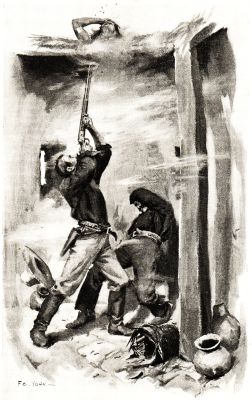
The declining shadows marked about the hour of four as Lawson drew back suddenly from his loophole and cast a searching glance upward at the low-hanging roof. In a moment a suspicious noise which had caught his ear was renewed. It was the grating sound again, as of crackling adobe, but nearer; and there could be no mistaking its ominous meaning. Suddenly Green touched his partner, and pointed up to the thatch, where a few fragments of adobe, dislodged by the jar outside, were falling over their very heads, showing that the enemy were at work in the dead angle where there were no loopholes. The Indians had discovered the weak point in their scheme of flank defence, and the garrison was now absolutely at their mercy. The exact purpose of the enemy was not yet quite plain. If it were another endeavor to burn the roof, there was still a shadow of hope. If the Indians were going to attempt to breach the walls, or, worse, moisten them with water from the creek and saw them down with a horsehair lariat, then the end was indeed near. Meantime the noise increased; there was a scraping of feet on the dry thatch on the top of the wall, then a shot, and Green, with a bullet through his brain, fell dead at his comrade's feet. Almost instantly Lawson fired upward at random, and a heavy thud on the ground outside evidenced the success of his endeavor to avenge his comrade, and the temporary failure of the enemy's new plan of assault.
HE NO LONGER HOPED NOR FEARED.
Alone with his dead, Lawson now stoically awaited the end. The Indians were maddened at their losses; darkness was still some hours away, and death by torture or, at the last extremity, by his own hand seemed to the exhausted survivor a question of but a few moments' time. Having solved the mystery of the dead angle, a dozen warriors could now climb the tower, or if their next attempt were as original in its conception as the last, a single Apache, from the top of the pole, could hold his rifle over the roof and riddle the interior with perfect safety. To add to his peril, the afternoon breeze from the north had sprung up, and the gate was beginning to swing slowly back and forth; the least stiffening, and the gate would be blown open and the whole interior exposed to view.
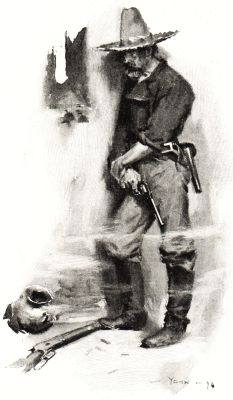
Still the silence continued, and Lawson stood by his dead partner and mechanically turned the cylinder of his revolver as he speculated idly whether the last cartridge, which he had reserved for himself, would miss fire when the awful emergency came. They had missed so often—for it was in the early days of metallic ammunition, and pistol cartridges were notoriously unreliable. If it did fail, they would give him no chance to try again. He no longer hoped nor feared; his past was an eventless, uninteresting blank, which he had neither will nor power to recall. Dazed at the happenings of the day, his busy brain ceased to plan; he leaned on his rifle and strove to breathe in the stifling atmosphere, and waited for what the next instant was to bring. How long this continued he could never tell. He could only remember how his heart started to beat as he heard, through the northern loophole, the faint tinkling of a distant bell. Could it be so? Again he strained his ear to listen, and again came the harsh tinkling. There could be no doubt of it; it was relief at last, unexpected and unhoped-for, and seemed to have come to him from the blazing skies. A train of freight-wagons, heavily manned, which he had supposed to be still on the Yuma desert, had left Tucson at dawn of day, and was now slowly making its way through the swamp, intending to make camp at the Cienega ere the sun went down. The Indians had accurately measured its strength, and recognizing their utter inability to cope with twenty well armed teamsters, had decamped as quietly and silently as they had come, and the siege was over.