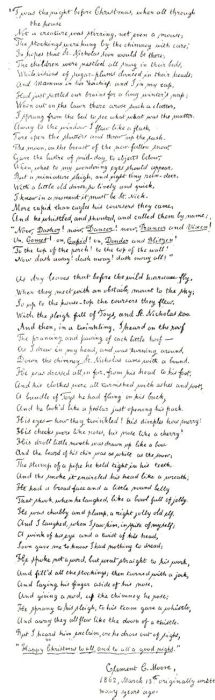
"THE NIGHT BEFORE CHRISTMAS."
Reading edition
CLEMENT C. MOORE.
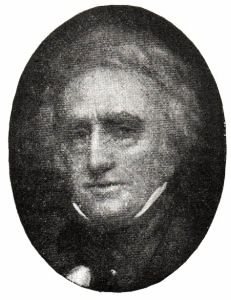
The author of the famous poem that recounts in such graphic language "The Visit of St. Nicholas" was born in the city of New York, July 15, 1779. His boyhood was passed at the country-seat of his father, called Chelsea, then far remote from the city, but now a very thickly settled portion of it, and embracing a large tract in the vicinity of Ninth Avenue and Twenty-third Street.
Dr. Moore received his early education in Latin and Greek from his father, the venerable Bishop of New York, and in 1798 he graduated from Columbia College. He devoted himself to the study of the Hebrew language, and the result of his labors appeared in the form of a Hebrew and English Lexicon, which was published in 1809, and he was thus the pioneer in the work of Hebrew lexicography. In 1821 Dr. Moore was made Professor of Biblical Learning in the General Theological Seminary of the Episcopal Church. From his magnificent estate he donated to the Episcopal Church the tract on Ninth Avenue between Twentieth and Twenty-first streets, and the Theological Seminary there erected is a lasting monument to his liberality and devotion to the sacred cause.
In the intervals between the time devoted to more serious studies his principal amusement was writing short poems for the amusement of his children, and among them was "The Visit of St. Nicholas," which was written for them as a Christmas gift about 1840. The idea, he states, was derived from an ancient legend, which was related to him by an old Dutchman who lived near his father's home, and told him the story when a boy.
In those days every young lady was supposed to have an "album," and a relative who was visiting the family quickly transferred the verses to hers. They were first published, much to the surprise of the author, in a newspaper printed in Troy. They attracted immediate attention, and were copied and recopied in newspapers and periodicals all over the country. An illustrated edition, in book form, was published about 1850, and since then School Readers have made them familiar to generation after generation of children. They have been translated into foreign languages, and a learned editor informed us of his delight and surprise when travelling in Germany to hear them recited by a little girl in her own native tongue.
After a long life of honor and usefulness, Dr. Moore died, at his summer residence in New York, July 10, 1863. For him may be claimed the peculiar distinction of being the author of the two extremes of literature—learned works on ancient languages for profound scholars, and Christmas verses for little children. The learned works, upon which he spent years of constant labor, have been superseded by works of still greater research, but the man is yet to be born who can write anything to supersede the little poem that has made Santa Claus and his tiny reindeer a living reality to thousands of children throughout our broad land.
REDUCED FAC-SIMILE OF THE MANUSCRIPT OF DR. MOORE'S FAMOUS POEM.