POSTER CALENDAR. 1897
Reading edition
By Edward Penfield. Price 50c.
Published by R. H. Russell & Son, New York.
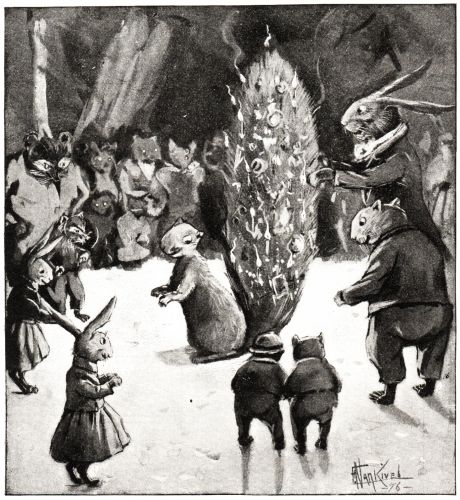
THE ANIMALS ENJOY A NOVEL CHRISTMAS TREE BY COURTESY OF THE SQUIRREL.
A BRAVE LITTLE GIRL.
Just one more kiss for good-night, mamma, Just one more kiss for good-night; And then you may go to my dear papa, And—yes—you may put out the light; For I'll promise you truly I won't be afraid, As I was last night; you'll see, 'Cause I'm going to be papa's brave little maid, As he told me I ought to be. But the shadows won't seem so dark, mamma, If you'll kiss me a little bit more; And you know I can listen, and hear where you are, If you only won't—shut the door. For if I can hear you talking, I think It will make me so sleepy, maybe, That I'll go to sleep just as quick as a wink, And forget to—to cry like a baby. You needn't be laughing, my mamma dear, While you're hugging me up so tight; You think I am trying to keep you here, You, and—I guess—the light. Please kiss me good-night once more, mamma; I could surely my promise keep If you'd only stay with me just as you are, And kiss me till—I go to sleep.
ONE GOOD REASON.
Bettie Witless. "Why does that little boy always go barefooted?"
Sallie Knowall. "Why, because he has more feet than shoes."
Abraham Lincoln was fond of a good story, and it is a well-known fact that he often illustrated an important point in the business at hand by resorting to his favorite pastime. Probably one of the best he ever told he related of himself when he was a lawyer in Illinois. One day Lincoln and a certain judge, who was an intimate friend of his, were bantering each other about horses, a favorite topic of theirs. Finally Lincoln said:
"Well, look here, judge. I'll tell you what I'll do. I'll make a horse-trade with you, only it must be upon these stipulations: Neither party shall see the other's horse until it is produced here in the court-yard of the hotel, and both parties must trade horses. If either party backs out of the agreement, he does so under a forfeiture of twenty-five dollars."
"Agreed," cried the judge, and both he and Lincoln went in quest of their respective animals.
A crowd gathered, anticipating some fun, and when the judge returned first, the laugh was uproarious. He led, or rather dragged, at the end of a halter the meanest, boniest, rib-staring quadruped—blind in both eyes—that ever pressed turf. But presently Lincoln came along carrying over his shoulder a carpenter's horse. Then the mirth of the crowd was furious. Lincoln solemnly set his horse down, and silently surveyed the judge's animal with a comical look of infinite disgust.
"Well, judge," he finally said, "this is the first time I ever got the worst of it in a horse-trade."
NEW VARIETY OF COOKING.
Mother. "Freddie, pass the bread."
Freddie (who has been studying about minerals at school). "Do you want aluminum bread, or the other kind?"
Mother. "What do you mean?"
Freddie. "One is very light and the other isn't."
SOME NATURAL HISTORY.
Tripsey. "I wonder does the catamaran feed on mice?"
Fripsey. "Yes; and the dromedary maid gives him cheese that she makes. The tomahawk catches young chickens for food, the wanderoo eats nothing on a journey, the spinning-jenny lives on cotton, the monkey-wrench apes the saw horse, and lives on wood; while the gunwale eats nothing, the toad-eater diets on favors, and the Welsh rabbit feeds everybody but himself. Animals are queer things, Trip."
NEAR NEIGHBORS.
Professor Snibley. "The os humeris is the shoulder-blade, is it?"
Student. "I'm not sure, sir; but it's somewhere near the funny-bone."