VIII Cambrian Cottages
Reading edition
In the “Dream of Rhonabwy,” from the “Mabinogion,” one of the great books of the imaginative literature of the world, it is not a very pleasant picture which we get of a Welsh home. Yet the Welsh cottage home of to-day is a treasure of beauty and orderliness. Doubtless this picture from the “Dream of Rhonabwy,” in its realistic detail, making allowances for certain Norman influences at work upon the various stories of the “Mabinogion,” is a true one. The strength and rustiness of the colouring of the house of Heilyn Goch, the blackness of the old hall, the upright gable out of the door of which poured the household smoke, the floor inside full of puddles and slippery with the mire of cattle, the boughs of holly spread on the floor, and at one side of the hall an old hag making a fire, the yellow calf-skin it was a privilege for any one to get upon, the barley bread and cheese and milk which, after the people of the house had entered,—a ruddy, curly-headed man with faggots on his back, and a pale slender woman,—they were given to eat;—all, I say, forms a picture rude, coarse, strong in its primitive detail of twelfth-century Cymric household life. Something more, too, it suggests. As Matthew Arnold says, “The very first thing that strikes one, in reading the ‘Mabinogion,’ is how evidently the mediæval story-teller is pillaging an antiquity of which he does not fully possess the secret; he is like a peasant building his hut on the side of Halicarnassus or Ephesus; he builds, but what he builds is full of materials of which he knows not the history, or knows by a glimmering tradition merely.”
There are other pictures, too, in the “Mabinogion” of early Welsh household life, pictures which one must question because of their luxury and general magnificence, features evidently due to the strong Norman influence one finds at work almost throughout these stories. No picture could be more rich and more beautiful than that in the “Dream of Maxen Wledig,” where Helen is found by the Emperor’s messenger sitting in the old castle hall at Carnarvon. These are the tales of the splendid, barbaric youth of a people, filled with the vividness, the crowding, the vitality of youth, and touched to an even more magnificent beauty by another hand which was deliberate and Norman—stories divinely disregardful of what might have been intelligible; in their mystery and wonder full of the life of the young. Barbaric touches, magic, fantastic elements, crude life, gorgeous colouring,—all this and thrice more than this does one find in the “Mabinogion.”
At first dreaming,—for dream one must over the cottages of Wales if one is ever truly to enter them,—these homes of a more recent time would seem to have suffered a loss in vividness, in interest, so immeasurable that there could be no gain to balance against it. Gone are the mystery and the semblance of splendour; the sense of adventure and the strong, wild life of these earlier centuries are forever vanished. Yes, gone they are, and gone they were before ever a rédacteur took down one of the tales of the “Mabinogion” from report that was already becoming but tradition. Purposely did I select the “Dream of Rhonabwy,” for not only in closeness to human reality, but also in architectural detail, do I believe it to be an exact picture of early Welsh home life. After the sordid picture of the hall, the description of the rainstorm comes but as a reinforcing touch of truthfulness: “And there arose a storm of wind and rain, so that it was hardly possible to go forth with safety. And being weary with their journey, they laid themselves down and sought sleep. And when they looked at the couch, it seemed to be made but of a little coarse straw … with the stems of boughs sticking therethrough, for the cattle had eaten all the straw that was placed at the head and at the foot. And upon it was stretched an old russet-coloured rug, threadbare and ragged; and a coarse sheet, full of slits, was upon the rug, and an ill-stuffed pillow, and a worn-out cover upon the sheet. And after much suffering from … the discomfort of their couch, a heavy sleep fell on Rhonabwy’s companion. But Rhonabwy, not being able either to sleep or to rest, thought he should suffer less if he went to lie upon the yellow calf-skin that was stretched out on the floor. And there he slept.” Undoubtedly here even the slit sheet is a touch of Norman elegance.
In the “Dream of Rhonabwy,” not in the far more beautiful “Dream of Maxen Wledig,” with its elaborate interior descriptions, do we find something like prototype for the Welsh cottage of to-day: the fire made against the gable end, even as it is now in the cottages, the sleeping accommodations at the opposite ends. This is the arrangement still of the vast majority of the cottages. Originally probably there were no windows other than, it may be, little slits—“wind-eyes” they were called with that relevant quaintness characteristic of early speech—such as we see to this day in old Welsh barns. In the “Mabinogion” story of Geraint, with its white stag, its divergent sense of the forest and of a bustling town life and the beautiful Gwenhwyvar, there is reference to glass windows: “And one morning in the summer time they were upon their couch, and Geraint lay upon the edge of it. And Enid was without sleep in the apartment, which had windows of glass. And the sun shone upon the couch. And the clothes had slipped from off his arms and his breast, and he was asleep. Then she gazed upon the marvellous beauty of his appearance, and she said, ‘Alas, and I am the cause that these arms and this breast have lost their glory and the war-like fame which they once so richly enjoyed.’” Are any lines in Tennyson’s “Enid” taken from this “Mabinogion” tale, that story upon which Tennyson’s widest popularity was founded, more vivid than this beautiful romantic touch? Undoubtedly these glass windows which revealed the manly beauty of Geraint in overthrow were glass lattices. They could not have been very common, and considerably later they were followed by wooden lattices in general use in the Welsh cottage, and still occasionally to be found to-day. I have found them several times in the dairy-rooms of old cottages in North Wales. Norman influence was at work in this story of the late twelfth or early thirteenth century from the “Mabinogion.” Sometime in the fourteenth or fifteenth century it was that the lattice window of the cottage came in, nor did it go out of use until the end of the seventeenth century. The window was a double frame—just as it is most frequently now—filled with woven diamond lattice. Within were wooden shutters opening inwards. A distant view or sketch of the leaded panes of to-day or of the diamond lattice of a long ago yesterday reveals no difference between the two, so closely has the type of window been kept, as, for example, the little, old-style windows of Beddgelert and Carnarvon.
And the beauty out upon which these old windows look is ever the same—Eryri, Eagle’s Eyrie, is this land of North Wales. Peak, precipice, lake, rushing stream, valley, forest lie always before one, sometimes shrouded for a while by the mist, again pricked out in indescribable altitude of mountain or whiteness of falling water before eyes that cannot fail to wonder at their beauty. In the fourteenth book of the “Prelude,” Wordsworth writes of the ascent which he and his Welsh friend made of Snowdon from Beddgelert at dawn, and we may, if we have not been in that mountain-cupped heart of Wales to hear it for ourselves, hear with Wordsworth the mounting
“roar of waters, torrents, streams, Innumerable, roaring with one voice!”
And with the poet, too, behold an
“Emblem of a mind That feeds upon infinity.”
The majestic beauty of these little Alps of Wales seems but to emphasize the cheerfulness and cosiness of the life man has made for himself. Indeed, nowhere are valleys greener, more sheltering, more homelike, more cosey. And the cottages, with their ascending spirals of peat smoke, the sweet fragrance of their homely life, speak a language of welcome no one can mistake. Gone are the old barbaric days, with their rough, strong life, their adventure; gone are the days of chivalry, with their bright pageant, their luxury, their courtly ways. Here we may turn a stone of those mediæval days, there touch a fretted memorial of still earlier times, even before Arthur had come to wake the world to a new romance and a new and selfless endeavour. Lessened, cheaper may this humble cottage heritage of the present seem than those times which have gone their “journey of all days” into the past. But not so does this sweet homeliness seem to me. Life is gentler, life is better, perhaps even kindlier within them by the bright hearth where, for the asking, any one may sit welcomed and at ease. Their purple roofs are but modest regal seal upon the happiness within. One feels singularly close to that great mother of us all in these tiny Welsh cottages, near to what is essential, what is real. Mortals who have not been dissevered from their proper feeling for houses will realize that these little homes have sprung, as it were, from the soil, that the cord binding them to the earth has never been cut.
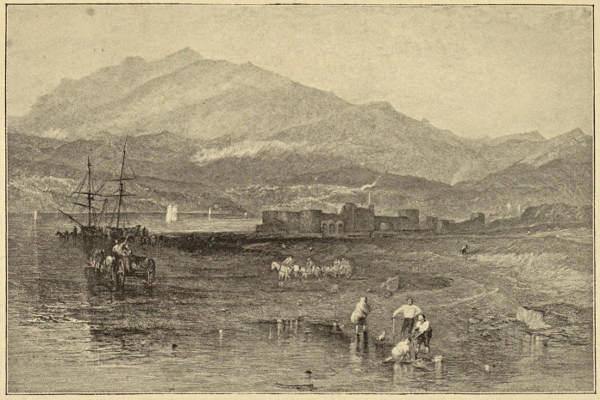
BEAUMARIS
From a proof before letters by Turner
The “Cyttiau Gwyddelod” or circular huts were the earliest forms of dwellings of which there are still remains. One finds them in various places on the meadows lying between and in front of Pen-y-Pass and Pen-y-Gwyrd where Charles Kingsley loved to stop. There are many other places, too, one not far out of Barmouth where Tennyson stayed and where some of the stanzas from “In Memoriam” were written; and some near Bettws-y-Coed, one of whose valleys, the Lledr, Ruskin called the most beautiful in the world. The little circular rings of foundation stones are curiously disappointing, scarcely worth the seeing, except that, in touching them, it may be one presses a hand’s breadth nearer to a vanished past. These circular huts lasted through a Roman-British period, and looked, probably, much like a wigwam, with a circular foundation wall of stone, wood, or wattle, from four to six feet high, capped with woven boughs of thatch, and within, a floor diameter from twelve to twenty-four feet. Gradually the circular hut gave place to the rectangular, at first with slight improvement in comfort, as I think the picture of “Rhonabwy” suggests. There was still no chimney or ingle and the smoke poured out of the open doorway. Yet in the arrangement described in “Rhonabwy” we have embryonically the arrangement of to-day. The subdivision of the interior space was still to come.
The earliest examples extant of the rectangular type are of the fourteenth and fifteenth centuries. Up till three years ago, when it was destroyed to make room for an extension of the Calvinistic Methodist Chapel, such a little cottage there still was in Beddgelert, Ty Ucha. Such a cot there still is in Bettws-y-Coed, Dol y Waenydd; also Tyddyn Cynal, near Aber Conway, as well as Old Plas, Llanfair Fechan, to give but a few examples which any lover of Welsh life may consult for himself. These little cottages are to be distinguished by their roof principals, which start from the floor, heavy curved pieces of oak meeting at the ridge in the roof. No doubt the earliest churches were built in this fashion and the cottages were copied from them. The churches of old foundation which survive, however, are, as I have said in the chapter on the little churches of Wales, in the style the Latin monks dictated and Llewelyn the Great introduced into Wales,—twelfth-century churches such as those at Llanrhychwyn, Gyffin, and Caerhûn. Beyond question, Welsh cottages represent a native influence which antedates that of the oldest churches now extant in Wales.
In the Welsh women who sit by the ingle fire of this cottage life one feels an age-old continuity of home, of the heart of things, of association, of service, of beauty; the pale slender woman of the “Dream of Rhonabwy” who entered the hall with the ruddy man; the maiden with “yellow curling hair” whom, in the “Lady of the Fountain,” Owain sees through an aperture in the gate, a row of houses on either side of the maiden; and others who kindle fires and perform the household tasks, who accoutre the knights, who embroider with gold upon yellow satin. Much of the colour of that mediæval world is a thing of the past, but not its women: they are essentially the same, though of a democratic to-day, simple as Enid in her worn habiliments when Arthur asked her what expedition this was and she replied, “I know not, lord, save that it behoves me to journey by the same road that he journeys.” The woman of to-day knows now what that journey of her mate is, and still she goes with him, not driven before him, but by his side.
It was on the road that, as I studied these little cottages from week to week, I encountered the Welshwoman of both an olden romance and a present world of fact. Very humble little pilgrimages were these of mine, not made without their diverse experiences of joy and fatigue. Sometimes it was a little lane I travelled on foot, off the highroad and through the heart of a farmland, the hedges eight feet high with honeysuckle and heaven-deep with fragrance; again I dropped down a hill, heather and foxglove making a royal display in bare places, and in the distance the bells of Llanycil ringing; or I climbed a hill on the way to Llangynog, a ridge which seemed the top and the edge of the world, treeless upland pastures like deep agate rich with ruby, lavender, brown and freaked with emerald green, purple and pink, and all opalescent with sunshine, dotted with black sheep and white sheep and little lambs, some straddling with surprise as they rose stretching and curling their tails with the delicious energy of awakening. Or, like Moses, I came down from Nebo, only it was a Welsh Nebo and my hands were full of peppermints bought for twopence, and children, rosy-cheeked youngsters in a frenzy of joy, were running about me. Into strange places may even a cottage gleam lead. Once it took me to that most primitive of all shelters, a cromlech, where gorse made sunshine on the hill and heather made a glory, and in a near-by oat-field pansies bloomed, and, above, a crown of pines sung in the ever-blowing winds. Or the gleam led me beside some tiny stream, almost invisible, that found its way like a thread downhill.
“Down from the mountain And over the level, And streaming and shining on Silent river, Silvery willow, Pasture and plowland, Innocent maidens, Garrulous children, Homestead and harvest, Reaper and gleaner, And rough-ruddy faces Of lowly labour I followed the gleam.”
A gleam that led me on and on was this bright-shining, fragrant, humble cottage life of Wales, with its much-needed assurance, amidst the sorrows of our present times, that some magic of a life still full of faith is lived among these solitary hillsides, among busy towns and in sheltered Welsh valleys. Into human difficulties, too, did my gleam lead me, as gleams have a way of doing. My first adventure was to find a cottage called “Buarthau” (pronounced Bee-ar-thai). I knew that it was on the hillside beyond Hendra Farm outside of Dolwyddelan, at the head of that valley, the Lledr, which Ruskin has called the most beautiful in the world. A child who spoke very little English summoned her mother, a pale, slender woman with a baby in her arms, to point out the cottage to me. The little girl led me and we climbed the steep hillside. Beside it were wild roses, cool in pink and green; beyond us was a magnificent view of Siabod, Snowdon, Aran, and Moel Hebog, becoming with every upward-mounting step more grand. The old roof of the sixteenth or seventeenth century which I had come to see was partly destroyed, the large curved principals which came almost to the ground had been well rubbed and gnawed by the teeth of kine. Under a tree near a little cottage we ate our luncheon, a tree which accommodatingly turned itself into a harp. Then we came down, across the Lledr River, and turned and entered the village where the heart of the place is St. Gwyddelan’s Church, built about 1500 A.D., with a rood screen removed from some earlier church, a knocker to claim sanctuary still upon the door, and warm hay piled high and spread in the sun over the old graves.
There was another day when I was in search of an old house still habitable, but of the same date of building as Buarthau. From Bettws-y-Coed I followed slowly up a long hill, from which I looked down into an ever-deepening valley, where lay the road leading up past the Conway and the Lledr to Dolwyddelan. After I passed Pentrevoelas, I picked up a little fellow carrying a school-bag. We passed a big empty graveyard place where five new graves were crowded against the wall,—the living were planning well for the jostling of the dead who were to come,—then I put the little fellow down by the chapel where his mother lived. The road to Giler grew more and more difficult. At last I came to a beautiful old house with a fortified gate and high surrounding walls. Outside the walls, mother and daughter, farmer and farm hands, were all milking the cows. They courteously led me through the ancient gateway, a friendly place within, for not only did the cats run to meet us, but also the pigs. I ascended the outside steps of the fortified gateway into a room where was the Pryce coat of arms and the date 1623 upon the walls. Then we went into the farmhouse through an old doorway that would be the joy of any antiquary who might behold it. Even this was fortified. Within, the oak panelling, the oak partitions, the seats around the walls, the deep, small-paned, narrow windows, the kitchen, the storeroom, the dairy, the mill—all were as they had been four hundred years ago—a little the worse for wear, but still staunch, still comely, still generous and hospitable. One fireplace I stood before was twelve feet long and four or five feet deep. On the way home I saw a flock of lapwings in the meadow. I passed the chapel corner where the little fellow was; I saw two rabbits rubbing noses in the field; and then, facing toward the sun, which was setting over Siabod and the Ogwen Valley, I followed home.
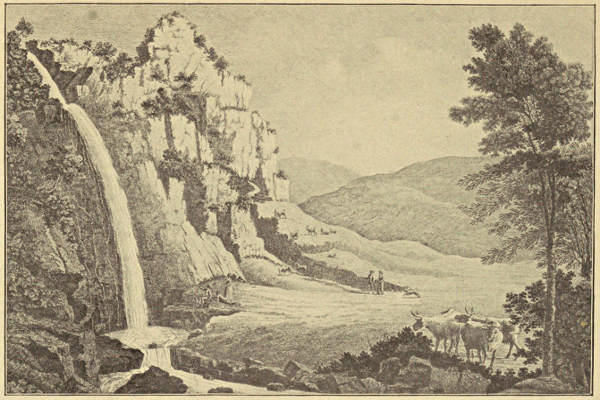
A WELSH WATERFALL NEAR PENMAEN-MAWR
From an engraving by Boydell, 1750
These Welsh cottages and granges are like a well-made person or a well-made life: they have nothing to conceal. They reveal their construction, and their beauty inheres in this revelation of what they really are. Instead of being all daubed over with plaster and smeared with unattractive paper, their joists and beams, their panelled oak partitions, the ingle-heart of the house, the warm, brown oaken dressers and tridarn, the grandfather clock and settles, the three-legged tables and three-legged chairs form a picture of simple harmony, which at its best it would be hard to rival either in dignity or homely beauty. I am not referring to the Welsh lodging-house which is all many an Englishman or American knows in Wales. The floor of the cottage may be but of beaten clay, neatly whitewashed around the edge. This, however, is surely a more attractive floor covering than many which cost, even before they leave the carpet factory, a good deal more. Beautiful rooms are these where, from the lustre-ware, the pewter, the copper and brass and latticed windows, many a lesson is still to be learned by some of us who think it impossible that we should be able to take anything from so humble a place. In these Welsh cottages life has continued more or less unchanged in a beautiful simplicity. It is not merely the simplicity imposed by poverty,—although that does exist to a depressing extent in Wales,—it is rather their sense of fitness, their love of what is beautiful, that innate instinct of theirs, not only for the right word, but also for the right beauty of a room, even of a kitchen. When they would imitate under the pressure of modern fussiness and vulgarities, something still holds them back. The lodging-house in Wales represents a concession to modernity, their mistaken and delicate tribute to the visitor. It is the Welsh farmhouse kitchen in all its dignity of use and beauty which represents the true life of the Cymri, the ineradicable æsthetic fineness of Gwalia. In Wales, and at a time when the world pays it but scant respect, poetry dwells everywhere and is at home. The grimiest coal centre, the dustiest slate quarry eating into the very bowels of the earth and the skin of the people, cannot drive poetry and music away from Wales. They dwell by the doorway of the whitewashed cottage in that group of oaks, or under that sheltering sycamore and the cottage roof of flowering thatch, in the water-split stains of the slates upon the roofs, in the gleam of the doorsill over which one steps. Here in these Welsh cottages is simplicity as compelling, because more human and not less unself-conscious, as that of the palace.
Practically every characteristic possessed by the Welsh makes for love of home. Their very shyness drives them through the house door to the fireside, before all that is best can be revealed. Sensitive, full of feeling, gay and melancholy by turns, they are like their own hills, now sombre and now bright. It is temperament that makes the music of the Welsh cottage, its picturesqueness, its romance. Without the Cymric temperament there could have been no Welsh revivals, no invincible Lloyd George, no Eisteddfodau. The delicacy of the woman, who is always the home-maker, inheres in the Celt. He feels the significance of the home with such yearning and such passion that it is almost incomprehensible to his fellows of coarser fibre. It was that feminine love of home which made Celtic chivalry what it was. And I dare to say that it is still that element which makes the humble Welsh cottage what it is to-day.
Those qualities which caused the Cymri to reverence their bards and esteem learning are the qualities at work in their lives now. The passionate admiration which in olden times made them follow a leader like Llewelyn the Great or a lost cause, is what makes them shout by the tens of thousands for Lloyd George to-day and a winning cause. Their low, quiet voices, their gentle ways, their spiritual intensity, all throw a glamour about the lives they lead. One does not expect to find a sage in yon little cottage where the village bread is baked. Yet he is there, his books two deep on every shelf of his little room, his lamp burning far into the night. Nor does one expect to find a Welsh Jenny Lind in this cot whose brass doorsill we have just left; but, busy about her work, a voice the world might well run to listen to follows us down these Welsh upland meadows. And behind that counter, over which we buy sweets for the children, is an historian and antiquary; in yon post-office a bard,—even the very farmer spends his leisure not as other farmers do; and nothing is as many, in their commonplaceness, their German Gemeinheit, expect and demand that it shall be.
It is a far cry, some may think, from the “Mabinogion,” one of the possessions of all the world, to a little Welsh cottage. No, it is not a far cry; it is a history, interrupted here and there by haunting words, broken by words not to be recovered, but still a history from those first (?) “cyttiau gwyddelod,” with their rude music of harp and their tales read from a revolving wooden book, down to this cot whose shelter we have sought in a valley or upland meadow, even as Wordsworth some one hundred years ago or Shelley sought such shelter at the base of Snowdon. It is a far cry, some may think, from that smoke curling out of the gable end of the hall in the “Dream of Rhonabwy” to this ingle by which we have sat. No, it is a development, a continuance marked only by the steps of man’s desire to strengthen and make more perfect his home here, forgetting that Chaucer has told us in his poem “Truth”;
“Her nis non hom, her nis but wildernesse: Forth, pilgrim, forth! Forth, beste, out of thy stal!”
For the gray of a gray day outside, here by this hearth is the rose of fire, the tongue of flame by which we warm ourselves, the fluttering of those dreams beneath which we hide ourselves as under a sheltering wing. The passionate heart of a passionately sensitive people is this hearth and flame of a Welsh cottage. To have lived by it is to have lost the need to hear those tonic words of Matthew Arnold, for here, indeed, the Celt may still, in his dreams, his love, his song, react against the despotism of fact. And outside is a world of magic, sometimes hostile but more often friendly, a world of beauty and of enchantment. From the “Dream of Rhonabwy,” its women, its homes, its organized life, its beauty, down to the castle and cottage in Carnarvon or Conway, it is but one history, however many stages that history may have passed through; and until the traveller or the alien in Wales realizes this fact, he passes blindfold through its valleys and over its mountains and in and out of its cottage doors.