II A Village in Eryri
Reading edition
“Curates mind the parish, Sweepers mind the court, We’ll away to Snowdon, For our ten days’ sport.” Kingsley’s Letter to Tom Hughes.
At the centre of a wide meadow with valleys running in towards the centre from east and south and west lies a little village of North Wales. All the cottages are gray, gray as the stones of St. John’s, but they are of the crisp, compact gray of slate, and not the crumbling, fretted stone of Oxford. Occasionally some cottage nestling to the craggy side of one of the valley roads is whitewashed with white or pink, or fitted so neatly into the jutting rocks of the mountain-side that only the humble façade, a screen of blooming roses, is visible. Whitewash, roses, gleam of copper doorsills, running water, flash gaily in the midst of the gray of Beddgelert. Above the houses is the blue roadway of sky walled in by craggy mountain-summits, the sides of the mountains carpeted with myriad tufts of heather, lavender or purple or pink, and in autumn with the vivid yellow of the prickly gorse. Bees desert tiny gardens of well-hedged roses for this wide principality of bracken and heather, where around tufted blossoms they hum to the tossing of some stream casting itself down the hills. Up the rocks clamber ivy and sheep; about the moist edges of the pools and over the cushions of damp moss, black and brown watered-silk snails measure leisurely in well-fed content; and in little terraced glens of thick sod and along the roadways grow bluebells and columbine and foxglove and elfin white birches. But above these troops of upland bluebells and slender, swaying birches hang rocks, wild, rugged, whipped bare even of heather. And from the rough spine of Craig-y-Llan stretches away towards Snowdon and Pen-y-Pass, a wilderness of naked rocks, weird, jagged, shining gray and black in utter desolation.
At the meeting of the Colwyn and Gwynen rivers, with the hollow sound of rushing water in its village lanes and the tinkling of sheep bells scattering from the overhanging hills, the meadow strips lie beside the valley roads, deep green with abundant grass or yellow with grain. Life, however, has been strenuous in this village of fourscore mountain huts, and many fathers and sons have had to labour to clear the grassy fields. For these honest, independent, thrifty Welshmen, slate and sheep are the chief means of support. The rivers yield, too, a fair quantity of salmon as pink as some of the mountain huts, salmon weighing from one to eighteen pounds. In a flood, although the torrent sometimes reduces the number of inhabitants, the catch of salmon is greater, and the villagers face the delicate task of balancing an all-wise but unscrupulous Providence.
The way to a Welshman’s heart, nevertheless, is not through his stomach; the Welsh think but little of what they eat. Before English tourists came to the village the inns of the place, Ty Ucha—now the Saracen’s Head—and Ty Isaf, provided a bill of fare consisting of oat and barley bread, ale, porter, and eggs. English and Americans, unlike the Welsh, do not go lightly on a holiday without consideration of what there will be to eat. And our lodging-table, set by as kindly and generous a hostess as three wanderers ever found, bore slender chickens whose proportions suggested mountain climbing, mutton tender as the ivy the poor sheep had been nibbling, salmon trout fresh as the stream pouring by the corner of our cottage, Glan Afon, pound-cake filled with plums, and tawny mountain honey. And, too, there were vegetables for whose mere names we felt a careless indifference. Even the loaf of bread Baucis and Philemon set before their wanderers was no better, I am certain, than the bread of Beddgelert, light, sweet, with crackly golden-brown crust. Often have we done nothing but watch—and joy enough it was—the mammoth loaves coming home from the village bakery across the village bridge, little children staggering under them, small boys bearing them jauntily, mothers grasping them firmly under one arm, a baby tucked away under the other.
At the inns, of which the Royal Goat is most pretentious,—it has a piano,—there is much quiet holiday life led by quiet holiday people. The simple folk who come to stay are for the most part the Welsh people themselves, for whom Beddgelert is in the nature of a shrine, a place canonized by the brave deed of one of their own Welsh greyhounds, Prince Llewelyn’s Gelert. The visitors who travel through the valley during the holiday month of August are English and Welsh tourists on the coaches driving over Llanberis Pass, said to be the highest coach drive in the world, and going to Carnarvon, the ancient Roman city of Segontium, fourteen miles distant from Beddgelert.
In the last hundred years the village has harboured many a distinguished man who, giving thanks for his undiscovered seclusion, has come and gone unknown. Wordsworth came there with his friend, Robert Jones; Shelley, living at Tan yr Allt, a few miles out of Beddgelert, must often have passed through its lanes, his ragged brown hair whipped by the valley wind, his great eyes blue as the roadway of sky overhead; Kingsley, with a quick smile for the jolly little urchins perched venturesomely on the sharp slate coping of the bridge, Frederic Temple, Derwent Coleridge, J. A. Froude, Professor F. W. Newman, Huxley, Tyndall, all found holiday rest in this quiet meadow sheltered by its rampart of mountains. Gladstone came there, too. A village cow with an eye for distinction endeavoured to hook the Prime Minister and had afterwards the satisfaction of being sold for a large sum of money. There also in the valley was born “Golden Rule” Jones, of Toledo fame, a good man, and but one of many good men who have gone forth from this fastness of peace to dream ever afterwards of a return to its gray houses, its streams, its hills and heather and wilderness of crags.
Ty Isaf and Ty Ucha are the oldest inns of the village. Ty Isaf is at the entrance of the lane leading to the church, and it was there, not so many years ago, that the minister was still expected to drink a cup or two of ale before entering the pulpit or fail in due prelusive inspiration. At Ty Isaf was kept the Large Pint of Beddgelert (“Hen Beint Mawr Bedd Gelert”), a pewter mug which held two quarts of old beer. Any man who could drink this quantity at a breath might charge the amount to the lord of the manor; if he failed, he paid for it himself. But so often was the heroic deed accomplished by capacious Welshmen that it is recorded the tenants paid but half their rent in money. It would be interesting to know for how many goblins, fairies, “Lantern Jacks,” flickering “Candles of the Dead,” Hen Beint Mawr was responsible! Now over every little inn is the sign “Temperance,” for Welsh revivals have played havoc with these noble drinking-feats. One signboard, I can never pass without a smile, has gone so far as rather to insist upon the temperance issue in the words, “Rooms and Temperance.” Incidentally, the rector of the Episcopal Church has given up his potation, and next door the Welsh Calvinistic Methodist minister, also unsupported by home-brewed beer, wrestles with his flock. Beddgelert Sabbath-keeping has all the force of an unbroken tradition. A gentleman riding a-hunting on Sunday was confronted by an old woman who shook her Welsh Bible at him and showered vindictive Welsh l’s on his worldly head. Nor was our own experience much happier. Our drinking-water was fetched from Ty Ucha, and we had good reason to believe it was responsible for wretched feelings. One Sunday morning I consulted our Welsh hostess, explained to her what we thought of the water, and asked whether we might have some brought from another spring. We were told that it could not be drawn on the Sabbath, but would be brought to us on Monday morning! In every cottage there is a mammoth Welsh Bible, and groups of smaller Bibles both Welsh and English. We went into one deserted mountain hut to take pictures of the interior; inside, together with an old trunk, a rusty fluting-iron, kettles, pans, a portion of the woven couch strung over the wide fireplace, and old clothes, we found two Welsh Bibles, one English Bible, and a torn portion of “Pilgrim’s Progress.”
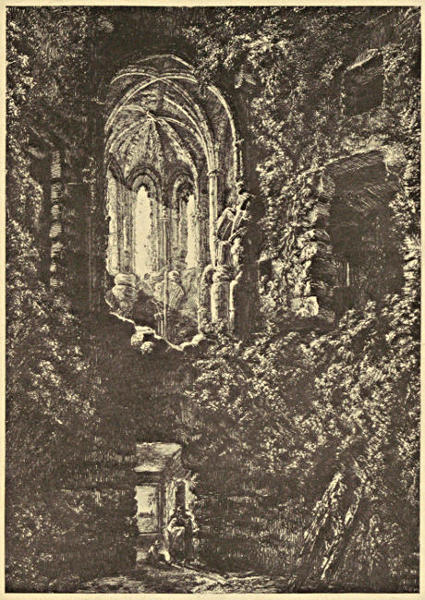
THE QUEEN’S TOWER, CONWAY CASTLE
From an engraving by Cuitt, 1817
Indeed, the religious spirit of the place is a tradition but infrequently broken in the past thousand years. Edward I had burned the priory (now St. Mary’s Church), which was erected as a hospitium in connexion with a small chapel and schoolhouse in the second half of the sixth century; Henry VIII endeavoured to crush its power, and then in 1830 the good villagers themselves entered upon the pious task of renovation. In order to make the renovation as thorough as possible, they tore down all the rare wood-carving, using it for kindling-wood, and in some instances making pieces of household furniture from it; they put in a false ceiling of clapboards hiding the fine Gothic arch of the roof; the ceiling, together with the walls, they whitewashed, and completed their pious task by boarding up several exquisitely shaped lancet windows. Fortunately the renovation has been followed by a restoration, and now the priory may be seen in some of its ancient beauty, with the old yew tree spreading low over the gravestones and the Gwynen pouring by its northern walls, singing the same mountain song it sang when the canons regular of St. Augustine, barefooted, gray-habited, with crucifix and rosary, marched solemnly from chapel to hospitium.
The name Beddgelert, the Grave of Gelert (?), brings hundreds of Welsh people to see this town each year. It is not an uncommon spectacle to see a man, as he stands by the dog’s grave, brushing away tears, or a little child crying bitterly. The story is of Prince Llewelyn’s greyhound, who saved his master’s baby by killing a fierce wolf, and then was slain by his master’s sword, for the Prince, entering, saw the cradle overturned and the greyhound’s mouth covered with blood. The name of the place, however, has nothing to do with the myth of Gelert; the little hill on which the grave stands had for hundreds of years been called “Bryn-y-Bedd,” the “Hill of the Grave,” a mound where the Irish chief Celert, a far earlier hero than the dog, may have been buried. There are parallels in other folk-lore for this tale, and one even in the Sanscrit has been discovered in which, in place of Northern wolf, a snake is the evil agent. There is an unmistakable twinkle in a Beddgelert eye whenever the story is told. Alas! that the greyhound buried there was not presented to Prince Llewelyn by his father-in-law, King John, in the year 1205, but, the petted possession of two Beddgelert spinsters, was presented by them at the beginning of the nineteenth century to the sagacious David Prichard, the first owner of the Royal Goat Hotel, and promptly interred by him in the famous mound.
Every one of the three valley roads of Beddgelert is filled with incidents of Welsh legend and folk-lore. Even in our materialistic age the credulous spirit abides here in this mountain-bred people, quick, lively, romantic. The village is filled with lovely legend and quaint lore; in the farmhouses among the hills heroic stories are still told about Arthur and songs sung to Welsh melodies. There are tales of ghosts, and of goblins, brown road goblins, and gray goblins of the mist; of water sprites in the mountain torrents, now a beautiful, half-naked maiden, now a fleshless old man; of the “Candle of the Dead” with its clear white flame; of the little red-eyed, red-eared “Hounds of Hell” flocking like sheep down some mountain-path; of the pranks of “Lantern Jack” on dark winter nights; of the fairies living in the summer among the bracken, in winter among heather and gorse, coming out of their haunts to dive thievishly into the farmers’ pockets, or to steal butter and milk and cheese from the careful housewives. There are stories, too, of amiable, kindly fairies who carol and dance nightly.
Driving up from Tremadoc past Tan yr Allt, where Shelley lived for a year, one comes to the bridge at the mouth of the pass. This bridge is said to have been built by no less a person than the Devil, who for his trouble got nothing in toll but a poor little dog that was first to scamper over it. Down the Nant Gwynen Valley, a narrow river valley running east out of Beddgelert, is Dinas Emrys, the home of the magician Merlin and at many times the abiding place of King Arthur. Merlin’s well, on the very summit of Dinas Emrys, is still a discoverable well. There, too, surrounding the crown of this singular hill, are traces and remains of the walls of an old Roman fortress; and the entrance over the narrow ridge to the crown of Dinas Emrys bears marks of stone hewn hundreds of years ago. Not more than three miles further in the same valley is a precipitous pass leading up towards Lliwedd by Snowdon, where some legends say Arthur fell and lies buried. Up this valley road over Pen y Pass, in a wilderness of boulders and crags tumbled hither and thither, is an interesting specimen of cromlech, and near by some gigantic rocks so fitted together that they form a hut in which an old woman is said to have lived many, many years. I hope life was pleasanter to her during all those years than it was for us during even the few minutes we were within the strange enclosure.
The third valley running out of Beddgelert is the valley of the Colwyn. This leads past Moel Hebog—in a cave on whose perpendicular side Owen Glendwr lay in hiding for months—towards Carnarvon, a city of a castle with casements:—
“Charm’d magic casements, opening on the foam Of perilous seas, in faery lands forlorn.”
There lying before one over the summer sea is the rim of Anglesey, quiet in its mirage of white sand and the green land stretching away into gray distance. Still many portions of the old Roman road connecting Segontium and Heriri Mons may be seen in this valley, bridle-paths the Welsh call “Ffyrdd Elen,” “Elen’s Roads.” Towering above, Snowdon looks down, untroubled, from its splendid reach, upon these paths, from which, in sunshine and in mist, Druid and Roman, henchman of Edward and John, prince and poet and painter, have made the steep ascent and seen swimming before them, like the sea of time, a hundred hills; beyond, the wide glimmer of the ocean; and heard rising through the air the roar of torrent and stream. Halfway up Snowdon are the remains of a druidical temple. There, kneeling on some of the stones, I listened to the song of wind and sea, the Harp of Eryri, and tried to catch a little of the vast panorama, which was, somehow, strangely, mournfully human, holding in sky-line and sea-line dim shadow of the hearts which had knelt here before—the immemorial worshippers of untold beauty.