IX Castles and Abbeys in North Wales
Reading edition
Old Time … gentlest among the Thralls Of Destiny, upon these wounds hath laid His lenient touches, soft as light that falls, From the wan Moon, upon the towers and walls, Light deepening the profoundest sleep of shade Wordsworth, “Ruins of a Castle in North Wales.”
The more one lives in Wales the more one recognizes the need for nonconformity. The Established Church has frequently conformed too much, certainly to the bars found in all public inns, and probably to the “jorum” measure set by castle life and even by the abbey life that is now no more. No doubt, if there were less poverty, there might be less drinking; on the other hand, if there were less drinking, there would certainly be less poverty. Even now, as I write in the most respectable old inn in Denbigh,—the place where all the gentry go,—for an inn sign I am looking out on three liquor kegs crossed one above another with a bunch of grapes pendant.
But the hill on which this quaint, small, prosperous town of Denbigh is built does the best it can by its steepness to keep the people in good condition. In Welsh Denbigh Castle is called “Castell Caledfryn-yn-Rhos,” the “Castle of the Craggy Hill in Rhos.” From the “bottom,” as the natives call the foot of the town and hill,—they are identical,—it is a sheer climb to the top where the castle is situated, and in that climb one has traversed the entire village. Close by the castle is the Church of St. Hilary, more or less falling to pieces now, where once masses were said for the soul of Henry de Lacy. Within the castle enclosure, in a tiny cottage, John Henry Rowlands, or Stanley, the African explorer, was born. Very eager is Denbigh to claim this distinguished man, and but little can you get them to say about the brutal treatment which drove him away from home and made him a wanderer upon the face of the earth. Denbigh claims Twm o’r Nant also,—he is buried at the bottom of the town in Whitchurch,—but not content with claiming him, they canonize him with the absurd name of “Welsh Shakespeare.” Born in 1739, he developed, without any educational advantages whatsoever, remarkable skill in the writing of interludes, which for many years he himself played up and down the country, and by which, because he championed the cause of the people “against the evils of the day,” he got the ear of his popular audiences. Denbigh claims Dr. Samuel Johnson, too, and exaggerates his brief visit to Middleton at Gwaenynog. They have even photographed one cottage and called it Johnson’s.
A few miles west from Denbigh, at Rhuddlan, they have made the most of their history, but it is not recent; rather it is standardized and dignified by an antiquity which antedates even the ivy-covered ruins of the castle. There starlings flutter in and out,—perhaps a descendant of that starling which Branwen had taught to speak and who carried across the sea to Carnarvon, to her brother, Bendigeid Vran, the tale of her sufferings. There, too, are the fireplaces of an ample hospitality which is no more. I thought of the promise Edward had made in Rhuddlan that he would give the people a prince born in Wales and who could speak no English. I thought of that battle between Saxon and Welsh, in 769, on Morfa (marsh) Rhuddlan, which, before our eyes, stretched gently and mysteriously away to the sea, and of the song that had commemorated it and of the defeat of the Cymru:—
“Calm the sun sets o’er the hills of Carnarvon, Deep fall the shadows on valley and lea, Scarce a breath ripples the breast of old ocean, Faint on the ear falls the roll of the sea.”
Also in the old song is heard again the din of weapons, the hissing of arrows, and the cries of those who fought and those who fell. Even in its English translation it is still a stirring old song.
On the coast, a few miles north of Rhuddlan, is one of the most famous castles in British history, Flint Castle; but a dolorous, sorrowful old place it is now, set down in the midst of belching smokestacks and a sooty modern life that cares nothing for it. At Flint the dismantling of Richard II was performed. Froissart, the chronicler, speaking of Richard’s departure from Flint Castle in the custody of the Duke of Lancaster, tells us a strange story. King Richard had a beautiful greyhound who loved him beyond measure. As the Duke and the King were conversing in the court of the castle, the greyhound was loosed and immediately ran to the Duke, paying him all the attentions he had always given to the King. The Duke asked what was the meaning of this fondness. “Cousin,” replied the King, “it means a great deal for you and very little for me.”
Above Flint, on the River Dee, is Hawarden Castle, the new residence and the old ruin made famous to us in recent years by the fact that William Ewart Gladstone lived there. And there, centuries ago, Llewelyn, the great Welsh prince, first saw his Eleanor. The people in this vicinity are called “Harden Jews.” In this connection an interesting story from legendary history is told. It was in the year 946 that Cynan ap Ellis ap Anarawd was king of North Wales and a Christian church stood there. In this church was a roodloft surmounted by a figure of the Virgin bearing a holy cross in her hands. The summer had been hot and dry and the people began to pray for rain. Lady Trawst, wife of Sytsylt, governor of the castle, was one of those who prayed most often to the image. One day while she was on her knees the cross fell and killed her. The weather continued hot and the indignant people decided to bring the rood to trial for the murder of Lady Trawst. This was done and the Virgin and cross sentenced to be hanged, but Spar of Mancot, one of the jury, thought drowning would be better. Finally the judgment was partially amended and the image was laid upon the beach and the tide did the rest. It was carried up to the walls of Chester, and the citizens of that town, ancient even in 946, reverently took it up and buried it, setting above it a monument with this inscription upon it:—
“The Jews their God did crucify, The Hardeners theirs did drown, Because their wants she’d not supply, And lies under this cold stone.”
And from this time forth the river, which had been called the Usk, was called Rood Die or Dee.
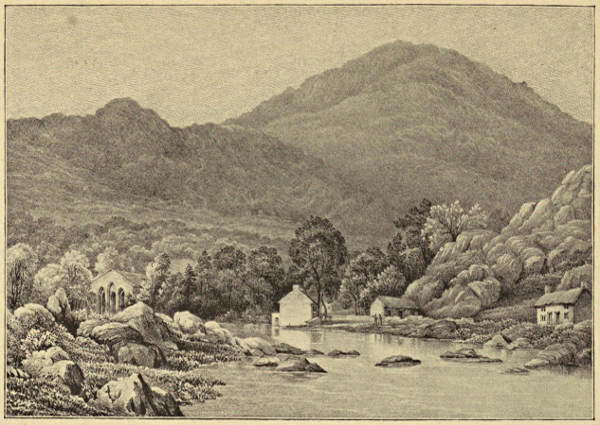
BEDDGELERT, A VALLEY-SHELTERED HOME
From an old print
It is not possible to re-create that olden castle life in Wales. A fragment here and a fragment there one finds, and when the broken life has been put together again, as in the “Mabinogion,” the Norman influence is more than a varnish to its ancient surface,—it is often colour, with occasionally an entirely new figure painted in. Glimpses of the palace life do we get, of the sleeping-rooms and halls and chambers, of beautiful buildings, of youths and pages, of vestures of silk and gold and yellow robes of shining satin. Pictures of maidens, too, there are, who live for us still as if they had not vanished from within walls which Time has partially destroyed. One maiden there was who was made from the blossoms of the oak and of the broom and of the yellow meadow sweet, and whom they called Blodeuwedd or Flower-face. Another, not Blodwen, but Olwen, she who was clothed in a “robe of flame-coloured silk … more yellow was her head than the flower of the broom, and her skin was whiter than the foam of the wave, and fairer were her hands and her fingers than the blossoms of the wood anemone amidst the spray of the meadow fountain.… Four white trefoils sprung up wherever she trod. And therefore was she called Olwen.” Pictures, too, there are in the “Mabinogion” and elsewhere of the castles in which these maidens embroidered, sitting in golden chairs and clad in yellow satin. One description there is in “The Lady of the Fountain,” which is a vivid picture of a Welsh castle: “And at length it chanced that I came to the fairest valley in the world, wherein were trees of equal growth; and a river ran through the valley, and a path was by the side of the river. And I followed the path until midday, and I continued my journey along the remainder of the valley until the evening: and at the extremity of a plain I came to a large and lustrous castle, at the foot of which was a torrent.” The fair valley, the path by the riverside, the lustrous castle, the torrent—all are still a part of the life of Wales to-day. Again, for the mere opening of a book, we may see knights in their encounters as of old: the horse that pricks forward, the furious blows upon the faces of the shields, the broken armour and bursting girths, and then the battle on foot, their arms striking sparks, and blood and sweat filling their eyes. Nowhere in all literature is there a more beautiful picture of a horse than in Kilhwch and Olwen: “And the youth pricked forth upon a steed with head dappled gray, of four winters old, firm of limb, with shell-formed hoofs, having a bridle of linked gold on his head, and upon him a saddle of costly gold. And in the youth’s hand were two spears of silver, sharp, well-tempered, headed with steel, three ells in length, of an edge to wound the wind, and cause blood to flow, and swifter than the fall of the dewdrop from the blade of reed-grass upon the earth when the dew of June is at the heaviest. A gold-hilted sword was upon his thigh, the blade of which was of gold, bearing a cross of inlaid gold of the hue of the lightning of heaven; his war-horn was of ivory. Before him were two brindled, white-breasted greyhounds, having strong collars of rubies about their necks, reaching from the shoulder to the ear. And the one that was on the left side bounded across to the right side, and the one on the right to the left, and like two sea-swallows sported around him. And his courser cast up four sods with his four hoofs, like four swallows in the air, about his head, now above, now below. About him was a four-cornered cloth of purple, and an apple of gold was at each corner, and every one of the apples was of the value of an hundred kine. And there was precious gold of the value of three hundred kine upon his shoes, and upon his stirrups, from his knee to the tip of his toe. And the blade of grass bent not beneath him, so light was his courser’s tread as he journeyed towards the gate of Arthur’s Palace.”
Charming pictures of friendship there are, too, lived within castle and abbey; and descriptions of the love of birds and journeys taken upon sea and land; and harsh and barbaric touches to remind us of a past still more ancient and of a cruelty still more primitive. Possible flashes do we get of the humour of this olden life: the refreshing gentleman in Branwen, the daughter of Llyr, whom no house could ever contain; Bendigeid Vran, the brother of Branwen, that good brother who sat upon the rock of Harlech looking over the sea, and all unconsciously welcoming those who were to break the heart of the sister he loved. Poetry and wisdom also there are in this ancient life: the Coranians, who, however low words might be spoken, if the wind met that speech, it was made known to them; and Arthur granting a boon in words which are a poem in themselves,—“as far as the wind dries, and the rain moistens, and the sun revolves, and the sea encircles, and the earth extends.” “There is no remedy for that which is past, be it as it may,” said Luned. And in the “Mabinogion,” as in every life, there was one door which when those who were bearing the head of Bendigeid Vran to London opened and looked through, “they were as conscious of all the evils they had ever sustained, and of all the friends and companions they had lost, and of all the misery that had befallen them, as if it had all happened in that very spot.”
South from Flint and south from Hawarden, yet near the windings of the river Dee, is Castle Dinas Bran, “Crow Castle,” as the English call it, mistakenly turning “Bran,” a word whose actual meaning is unknown, into “Crow.” Scarcely a stone of this very famous and ancient old castle situated on a high hill is left intact. The very rubble of its walls is exposed. Of the castle there is not enough left to repay any one for a visit, except a lover of desolation. Here, in another land, are walls like those of Balclutha, and desolate are they. Here the fox looks out of the window and the rank grass waves about its head, and here on the wind the song of mourning lifts itself bewailing the days that are gone. Yet from the valley below, with its quaint old town of Llangollen, its wonderful Abbey of Valle Crucis, and the shimmering of the running waters of the river Dee, the present is a reassuring one. Smoke curls up cheerfully from scores of household chimneys. The sun shines down upon the abbey walls, upon the chapter house, still intact, and upon the broken walls of the church itself.
“Ivy’d Valle Crucis; time decay’d Dim on the brink of Deva’s wandering floods, Your ivy’d arch glittering through the tangled shade, Your gray hills towering o’er your night of woods; Deep in the vale recesses as you stand, And, desolately great.”
Inseparable from and a part of the spiritual beauty of this scene is the thought of the old blind rector, who is now custodian of the abbey and who still speaks lovingly of the beauty of the things he can no longer see. He has been there twenty-nine years, and through many of those years he has been going blind. Yet he told us cheerfully that he was greatly encouraged by our interest. “I never destroy anything that is old,” he said; “I stick to the old.” As we stood there talking, the lovely little white English daisies looking up from the grass at us, the venerable old man told us something of his work. He was much discouraged because people were not interested, and even as he leaned on his stick, doubtless hoping for other visitors, his ear-sight quickened by the eye-sight he had lost, people were passing by outside walking toward the Pillar of Eliseg and a wooded vale beyond.
In Llangollen, the village near the abbey, lived and died the ladies of Llangollen, two dear, quaint, sentimental souls, with personalities sufficiently marked and fearless so that they were unafraid to be themselves. Louisa Costello, in her account of a Welsh tour, gives them rather sharp treatment. She says that they were foolish, condescending, proud, vain, and pompous, yet she admits that they were charitable and considerate of their neighbours. Of their friendship she has nothing good to say. In a word, they were a couple of eccentric sentimentalists and both frightfully ugly. With the larger charity of the man, Wordsworth, who paid them a visit and wrote them a sonnet, described their appearance in the following words, “So oddly was one of these ladies attired that we took her, at a little distance, for a Roman Catholic priest, with a crucifix and relics hung at his neck. They were without caps, their hair, bushy and white as snow, which contributed to the mistake.” In the sonnet addressed to them there are, among others, two lines of pure tribute:—
“The Vale of Friendship, let this spot Be named; there, faithful to a low roofed Cot, On Deva’s banks, ye have abode so long; Sisters in love, a love allowed to climb, Even on this earth, above the reach of Time.”
Lady Eleanor Butler was the daughter of the Earl of Ormond. She was born in Dublin and was both wealthy and beautiful. The Honourable Miss Ponsonby, a member of an ancient family, was an early friend of Lady Eleanor. She, too, was born in Dublin, and both lost their parents at the same time. They loved independence and did not love their suitors. Many things drew them together and, as Wordsworth aptly phrases it, they retired into notice in the Vale of Llangollen. Now they lie buried there, their faithful servant, Mrs. Mary Carryll, lying in an equal grave beside them.
In this neighbourhood are many castles, among them Chirk the property of Lord Howard de Walden, and Ruthin Castle which is not very interesting. About northwest from Llangollen lies the old town of Conway, with its castle and its rare old Plas Mawr. Suetonius says that the chief motive assigned by the Romans for the invasion of Britain was that they might obtain possession of the Conway pearl fisheries. One of the Conway pearls, now no longer much thought of, was placed in the regal crown and presented by Sir R. Wynne to Richard II. The picturesqueness of Conway streets is greater than that of any other North Walian town. Little gable ends look out and down upon the streets like curious eyes. The houses are irregular and there are odd turns and twistings of the streets; cobblestones and old flagstones and an occasional black-and-white house; and everywhere glimpses through castle gate or over castle wall. The exterior of the castle is still singularly perfect; only one part of it seems to be falling, that nearest the river and looking out upon the sea. Overlooking the town, upon the river, is Queen Eleanor’s oratory:—
“In her oryall then she was Closyd well with royall glas: Fulfullyd it was with ymagery, Every windowe by and by, On each side had ther a gynne Sperde with manie a dyvers pynne.”
It matters not now whether this was a place of prayer or place in which the Queen arrayed herself. Pennant, when he made his famous “Tour in Wales,” described Conway as castle of matchless magnificence, and a matchlessly magnificent Castle it still is.
It takes but a single effort of the imagination to see again the life within that ancient harp-shaped town as it must have been even so recently as seventy-five years ago: the varying colours of the peasants’ dresses, their large market-baskets and umbrellas, their bright handkerchiefs, the tall North Walian beaver hats and frilled caps peeping out beneath, the bright cheeks and even brighter pink cotton jackets worn by the girls. Healthy, well-made peasants those, neat of garb and gay of heart, good-looking, both men and women. Again the old market-place, beyond Plas Mawr and the church, rings with their laughter and their lively barter, and the clatter of their ponies’ hoofs; again the soft voices of the women are heard and the heavier voices of the men; again they mount their horses, sometimes double, and ride away out of the lively town to the silent hills beyond, through Gyffin, where the colours in the old barrel vault of the church must have been even brighter than they are now; perhaps they go as far as some hillside like that on which Llangelynin still keeps its gray sanctuary. Again down upon the old town settles a double silence. The day’s work is done; twilight has come, and over all reigns a stillness which is as that of a Welsh Sabbath.
Through the Vale of Conway, past Trevriw and Llanrwst with its Gwyder Castle, past beautiful Bettws-y-Coed and Capel Curig, and on to the Pass of Llanberis, a walk of unrivalled beauty, there appears at last, as one travels down to Pen-y-Pass (the head of the pass), the single tower of the ruined castle of Dolbadarn. A Welsh triad says there are three primary requisites for poetry: an eye that can see nature, a heart that can feel nature, and a resolution that dares follow nature. No one can come down from this road over the towering summits of Snowdon to the little green valley in which Dolbadarn lies without, for the time, becoming a poet, even to the resolution that dares follow the spiritual counsels which come from sky and mountain and rushing stream and the very rocks that fill this valley. “Nature has here,” says Camden, “reared huge groups of mountains, as if she intended to bind the island fast to the bowels of the earth, and make a safe retreat for Britons in the time of war. For here are so many crags and rocks, so many wooded valleys, rendered impassable by so many lakes, that the lightest troops, much less an army, could never find their way among them. These mountains may be truly called the British Alps; for, besides that they are the highest in the whole island, they are, like the Alps, bespread with broken crags on every side, all surrounding one which, towering in the centre, far above the rest, lifts its head so loftily, as if it meant not only to threaten, but to thrust it into the sky.”
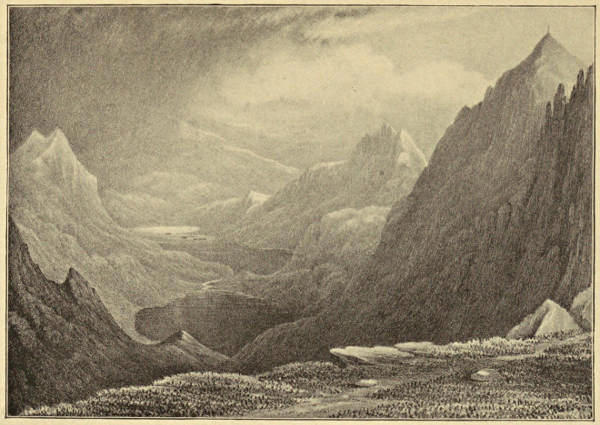
THE SUMMIT OF SNOWDON
From an old print
The better one comes to know the castles of North Wales, the more is one impressed with the extraordinary ability shown in fortifying every access into the country. Dolbadarn itself is ancient; whether it dates from before or after the Roman Conquest is doubtful; it was with the thought of Llanberis Pass in mind that Tennyson wrote his “Golden Year”; it was there that he heard
“the great echo flap And buffet round the hill from bluff to bluff.”
Here in this castle Owen Goch was imprisoned by his brother Llewelyn. To this prisoner a bard, Howel Voel ap Griffi ap Pwyll Gwyddel, composed his Welsh awdl, or ode, called “The Captive of Dolbadarn.” The feeling in this poem is still quick even after all the changes of the centuries and even with all the loss from translation:—
“His palace gates no more unclose, No harp is heard within his hall, His friends are vassals to his foes, Grief and despair have vanquished all. He, the defender,—he, the good and just,— Is gone; his name, his honour, in the dust! “He prized but treasures to bestow, He cherish’d state but to be free; None from his walls unsped might go, To all he gave, but most to me! “Ruddy his cheeks as morning’s light, His ready lance was firm and bright, The crimson stains that on it glow Tell of the Saxon’s overthrow. “Shame, that a prince like this should lie An outcast, in captivity. And oh! what years of ceaseless shame, Should cloud the Lord of Snowdon’s name!”
Professor O. M. Edwards, in his book called “Wales,” describes Dolbadarn as the last home of Welsh independence.
Hundreds of years before the sad, peace-loving life of Llewelyn had played its great part in Welsh history, in the valley that runs from the head of the pass along the low margin of beautiful Gwynant Lake, by a little river that talks gayly in all weathers but most gayly in the stormiest, past Llyn (lake) Dinas to Beddgelert,—in this valley is situated on Dinas Emrys some fragments and traces of one of the oldest and most important strongholds in Great Britain. This was the fort of Merlin who “called up spirits from the vasty deep.” There is melancholy and romantic interest to be found on the summit of Dinas Emrys, tracing what still remains. Something there is, perhaps enough for the archæologist to re-create all that has been lost. On this same road, some thirteen miles beyond, lies Carnarvon Castle, of whose history and beauty I have written in “The City of the Prince of Wales.”
In the “Mabinogion” there are wild-wood touches showing aspects of the life the Cymru had lived. The redactor of the old story of Branwen says: “Then they went on to Harlech … and there came three birds and began singing unto them a certain song, and all the songs they had ever heard were unpleasant compared thereto; and the birds seemed to them to be at a great distance from them over the sea, yet they appeared as distinct as if they were close by.” And again, “In Harlech you will be feasting seven years, the birds of Rhiannon singing unto you the while.” Just as the “Dream of Maxen Wledig” is in a sense the story of Carnarvon Castle, so is this tale of Branwen, the “fair-bosomed,” full of pictures and suggestions of Harlech Castle, Bendigeid Vran (the blessed) sitting on a rock and looking out to sea,—across that enchanted bay, on the other side of which lies Criccieth Castle, while the King of Ireland, Matholwch, his ships flying pennants of satin, comes wooing the sister of Branwen. A strange story this which has come out of that old castle stronghold, its royal Irish lover, its good Bendigeid Vran, its beautiful Branwen, the tame starlings and the singing-birds of Rhiannon, and that cry of Branwen, “Alas, woe is me that I was ever born”; and after that cry, the heart that broke and was buried in the four-sided grave on the banks of the Alaw.
Harlech Castle was probably originally built about the middle of the sixth century by a British prince. Edward I constructed the present castle on the ruins of the former one. It was finished in the thirteenth century and became the seat of many conflicts between Owen Glendwr and the English. Thither heroic Margaret of Anjou fled, following the battle of Northampton. It was the last of the castles to hold out for Charles. The whole life of this stronghold has been heroic, stupendous in size, gallant in its human figures, impressive in its human sorrows, indomitable in its human courage. Here, and in the other castles of North Wales, many of those strange prophecies of Taliessin have been fulfilled or in part fulfilled, something at least of
“All the angels’ words As to peace and war.”
THE END
Appendix