I Welsh Wales
Reading edition
It is a vanished past that haunts the imagination in Wales, so that forever after in thoughts of that country one goes spellbound. It is the beautiful present, the cry of the sheep upon the mountain-sides, the church bells ringing from their little bell-cots and sounding sweetly in valleys and on highland meadows, the very flowers of the roadsides,—foxglove, bluebell, heather,—that keep one lingering in Wales or draw one back to that land again. There are little churches of twelfth-century foundation, gray or washed white,—their golden glowing saffron wash of long ago unrenewed by the Welsh of to-day. There are little cottages, white or yellow or pink, with their bright doorsills of copper, their clean, shining flagstones, their latticed windows, and all the homely and dignified tranquillity within. There, towering above, are bare rock-strewn summits upon which the yew still stands, and, by its side, springing from the tuft of grass which the wind has not swept away, grows the white harebell; the yew monument to a thousand years, the harebell a fragile thing of yesterday. And above these church-crowned hills are mountain summits, gray and craggy, stripped of everything verdant, places where there are “shapes that haunt thought’s wilderness,” and suggestions of an endless, unending journey.
It was Bishop Baldwin, I think, accompanied on his famous twelfth-century journey through Cambria by Gerald of Wales, who said, getting his breath with difficulty as he surmounted a Welsh hill, “The nightingale followed wise counsel and never came into Wales.” Were this true, the reply might be that Wales has no need of nightingales, so many and so beautiful are the wind-played songs over the rocks, and so incomparably lovely are the voices of the Welsh people themselves. In any event, had the nightingales come into Wales, a plump one—as it seems Bishop Baldwin himself must have been—would never have remained long in the mountain fastnesses of northern Wales,—at least not in the neighbourhood of Snowdon or Nant Francon or Twll Ddu,—the “black hole” of Wales. Neither, if Bishop Baldwin ever climbed to a Welsh mountain-top, would this princely prelate have liked the views there. A comfortable, fat living in some Welsh community like Valle Crucis Abbey, near the river Dee, by Llangollen, would probably have been far more to his liking. Even now these mountain inns are not of the accepted kind, but merely a cromlech over which the wind still plays its devil tunes, a cave or the ridgepole of a long sharp mountain crest, broken by crags down to the very edge of the sea.
Wales is a land of mountains, of little alpine heights ranged on the western coast of Great Britain. Set between plain and sea, full of hill fastnesses, its turbulent history is partly explained by the topography of Gwalia. Independence, lack of unity,—these words summarize most of the early history of Wales. To the different parts of Cambria, alpine Snowdonia, the pasture lands of Berwyn, the moorlands and vast coal-fields of the south, came two races: one short and dark, the Iberian; the other tall and fair, the Celtic. These are still the two peoples of Wales. And after them came Rome; but Rome is gone, has vanished, except for her walls and foundations and roads, and these dark and fair races are still there, mingled, their racial traits still impregnable, still intact.
When you add to what might be called the natural and inherent difficulties of the necessary mountain climbing in Wales, those of the Welsh language, you have a combination that is beyond words to describe. Even the veriest tyro a-visiting Wales will tell you that the language defies all description and the most conscientious efforts to master it.
One warm day we were making a melancholy progress up a mountain-side when steps passed swiftly and a voice said in Welsh, “Stepping upwards?” The young man, an itinerant Welsh minister, was travelling in the same direction with us and it did not seem polite to say “Goodbye,” although I could think of no other Welsh words. Finally two inept ones came to me, “Da iawn” (very good), and I spoke them. But then, not content to let well enough alone, something more had to be said and I kept on repeating those words like a parrot. The Welshman looked around doubtfully, as if he wondered what the “Very good” was all about, and I heard him murmuring to himself and saw him hasten upwards a little faster.
“Say something else,” my companion whispered.
“I am going to if you will just give me time,” I snapped back.
But I didn’t say anything else; I couldn’t, for not another thing would come. If any one feels disposed to criticize an alien because he is unable to speak Welsh, then let him go test its difficulties for himself, its long words, its savage consonants, its poor little vowels lost like some bleating lamb upon rocky mountain-sides. You just get it satisfactorily settled in your own mind that “Dad” means father,—very natural and proper,—when suddenly you discover that “Tad” and “Nhad” and “Thad” also mean father and are one and the same word. With mother or “Mam” you suffer a similar though not the same fate. To begin with, the Cymric alphabet differs from ours: it consists of thirty-one letters, some of which, “mh,” “ch,” “dd,” “ff,” “ng,” “ngh,” “ll,” “nh,” “ph,” “rh,” “th,” never occur in the English alphabet as letters per se. Your honest grammarian will tell you flatly that in the case of “ll” there is no sound in any language corresponding to it. Most like it are the Spanish “ll” and the Italian “gl.” Then what to do? Do as you would have to do in rope skipping: watch the rope, run and jump in if you can. The “c” is hard in Welsh, never soft like “c” in “city”; “ch” is like the guttural German “ch”; the “dd” sometimes like “eth”; “f” like “v”; “ff” like “f”; “g” is never soft as in “giant,” but like “g” in “get”; “i,” both long and short, as “i” in “pin” and “ee” in “fleet”; “o” is short like “o” in “got” or long like “o” in “note”; “p” as in English; “s” is like “s” in “sin”; “u” is sometimes like “i” and sometimes not; the “w” is like “u”; “y” has two sounds, first like “u” in “fur,” second like the Welsh “u.” A few words will illustrate Welsh pronunciation. “Cymru” is pronounced, as nearly as one can suggest its pronunciation, as if spelled “Kumree”; “Gwalia” as if “Gooalia”; “Mawddwy” as if “Mauthooy”; “Wnion” as if “Oonion”; “Pwllheli” as if “Pooltheli”; “Dolgelley” as if “Dolgethley.”
I have had some experiences with my “small” Welsh which I would not exchange for those of “big” German in the past, or of any other language in which I have been trained to read or speak. I remember one experience that happened when we were in search of a certain little church of ancient foundation, set upon a hilltop. In Wales there are many of these little churches on the hilltops, like Llanrychwyn and Llangelynin, and also little churches by the sea, like Llandanwg, almost at the foot of Harlech. Within their mediæval lychgates and high stone walls the dead are crowded close in their last sleep. Sweet places are those old churches, with the yew standing sentinel near them, and about them the shelter of the valley or the wide sweep of the hilltop view. This time it was a hilltop church for which we were searching. Again it was “Da iawn” which graced the conversation, but in how different a manner!
We were in need of tea, and at the cottage next to the church, the only cottage upon that summit, I rapped with my stick and said to the old woman who came, “Dyma le da i gael te” (this is a good place to have tea).
“Yiss,” was her reply, her face brightening; “Te?”
“Yes,” said I; “tea and bread-and-butter.”
“Jam?” asked she, remembering what I had forgotten.
“Yes,” I answered.
She spread the cover in the place on the turf to which we pointed and smiled brightly at me, as if she, too, appreciated the beauty of that place with its wide mountain and valley landscape, the trustful sheep browsing near me, and down at our feet the magnificent pile of Harlech Castle looking across the wide flat marsh at its feet and over the sea toward the palace of King Mark.
“Da iawn” (very good), said I emphatically.
And her answering smile told me that we understood each other, even if we could not speak each other’s language very well.
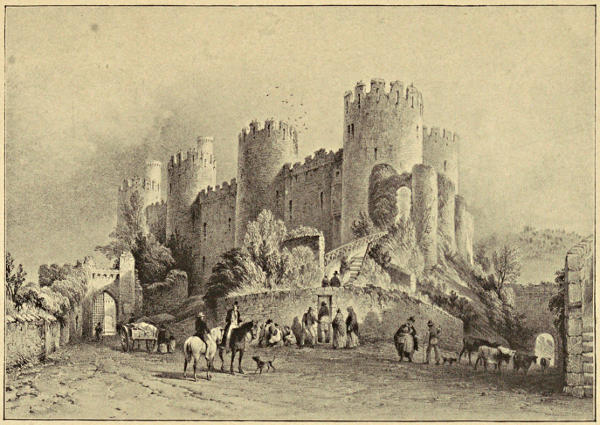
CONWAY CASTLE
From an old print
Changeling Welsh words are begot of elves and fairies. Even as those words are full of poetry, of romance, of a wild emotionalism,—the “Scream of the Celt” it has been called, but in Wales it is a subdued scream,—so, still, are the superstitions about fairies and elves living among these Welsh hills and valleys. Childish tales they may seem to you, if you are fortunate enough to be told anything about them at all by the Welsh peasants, who are both suspicious and shy of the “foreigner.” The tales one may hear even now in Wales are full of a haunting race life. The Welsh speak of the fairies as the “little folk” or the “fair folk” or “family”—“y Tylwyth Teg.” And well do these little creatures deserve the name, for they are friendly in Wales. Ghosts there are, too, and the death portents, the old hag of the mist and others that groan or moan or sing or stamp with their feet. And there are “Corpse Candles” and “Goblin Funerals.” Shakespeare knew a deal about Welsh folk-lore, but where he got it from no one has yet discovered. With Shakespeare “mab” meant a little thing, just as in any Welsh village to-day “mabcath” means a kitten.
No matter where I have been I have found the Welsh conscious of the beauty and significance of their land, its legendary lore, its history, its marvellous natural attraction. They have always been eager to give me information about some landmark, some incident about which I might be inquiring. Over their shop counters, across the doorsills of the humblest of Welsh cottages, by some kitchen fire where the brass tea-kettle sang and glowed in the subdued light of the ingle, they have poured forth titles of books and data,—things for which I was searching, or needed to know. One old man, eighty-six years old and bedridden, held my hand in an eager, childish clasp, while he tried to tell me something about a church, the poor tired mind working like a rundown clock, the half-sightless eyes looking at me in petition to help him recall the days that had slipped so far away. He asked me about friends of his,—people who had died before I had thought of being born. He corrected my few words of Welsh, a ghost of a smile about the old mouth, but he could not recollect what I wanted to know. Without the information I was seeking, I went away saying “Nos da” to him, which was, indeed, good night.
When Dr. Samuel Johnson made his memorable tour of Wales, he wrote, “Wales is so little different from England that it offers nothing to the speculations of the traveller.” He seemed wholly oblivious to the strong racial difference between Welsh and English, which alters not only the visage of the people, but also the visage of the very country. He was so indifferent to the grandeur of Snowdon scenery that, going around the base of that mountain of eagles in a chaise, he spent his time keeping account of the number of sheep for “Miss Thrale,”—his little favourite “Queenie.” I do not believe that Johnson’s disgust would have been the least appeased by knowing that in the years to come other great people were to go and go again to Wales, as to a beloved lap of rest: Wordsworth, Shelley, Kingsley, Froude, Newman, Huxley, Tyndall, Tennyson, Arnold, Tom Taylor, John Bright, Carmen Sylva, and many another. The good Doctor scorned Welsh rivers, called them brooks and offered to jump over them. He would have despised such a cottage kitchen as I have lingered in many a time impressed by its beautiful and dignified simplicity. Sweet places are these old kitchens, hospitable, warm, cheerful. Sunlight or firelight, one or the other, you may have always in them. Bright they are with fuchsias and little gleaming leaded window-panes, with polished oak and polished brass and copper, with the shining face of a grandfather clock, with pewter, with lustre pitchers and creamers, with gleaming pots and kettles, and the salt glistening on bacons and hams hanging from the blackened oak rafters. Gay are they, too, with the life and laughter of children, with the good cheer of contented older people, with the purr of the house cat and the bubbling of the tea-kettle. More homelike, more motherly, more charming old kitchens, it has never been my good fortune to see.
There was only one thing in Wales which profoundly satisfied the great Doctor and that was its castles, Harlech and Conway, and Carnarvon Castle most of all. Almost every Welsh town has its historical traditions of importance, but Carnarvon, the city of the Prince of Wales, even more than others. There Elen, the Great Welsh road-maker, was sought and won by the Emperor Maximus. Of that little city, once the Roman city of Segontium, there is a description in the “Mabinogion,” the classic of Welsh literature and one of the classics of the world. The Roman Emperor saw in his dream but what we see now, a fair and mighty castle, rocks, precipices, mountains of great height. The Prince of Wales was born, according to legend, in Carnarvon Castle, and there investiture ceremonies are still held. But veracious history assures us that he was born in the town, outside the castle of which he himself had built the very tower where he was supposed to have been born. Tumultuous, confused, legendary is Welsh history, full of the more or less mythical deeds of their great King Arthur, their brave Prince Llewelyn, the fate that overtook the hopes and ideals of this prince, their last fight for independence and their loss of it; their submission to the yoke of conquerors and the history of English princes who were put over them. It is a wild, sad, eventful history whose sorrows and tragedies seem only to have bitten all that is most Cymric in Welsh Wales deeper into Welsh lives and hearts, so that to-day, despite all that conqueror or civilization can do, their language, their lives, are still separate.
And the Welsh Eisteddfod, a festival of song and poetry, is a revelation of the unique national Welsh spirit. From every hamlet in Wales, even those reached only by Welsh ponies, visitors travel on foot or by train to this feast of song and to witness the Gorsedd, a druidical ceremony old as the Eye of Light itself. “Gallant little Wales” shows itself to the least and last participant in the Eisteddfod as Welsh Wales. Educationally this Eisteddfod ceremony is of great value to Wales, democratic, representative, instructive; and nowhere could the fact that Welsh educational ideals are quite different from those of England—popular and progressive, with something of the so-called American spirit in them—reveal itself more completely than in this assembly of the people. Wales is essentially a democracy—a democracy of song, a democracy of poetry, a democracy of education and religion, and the Eisteddfod is the popular university of the people. To comprehend what is deepest and best in Welsh Wales one must go to the Eisteddfod and hear the Welsh, sensitive, capable of the “Hwyl,” imaginative, passionate, fervidly patriotic, sing,—
HEN WLAD FY NHADAU (OLD LAND OF MY FATHERS) “Old mountain-built Cymru, the bard’s Paradise, The farm in the cwm, the wild crag in the skies, The river that winds, have entwined tenderly With a love spell my spirit in me.” Chorus: Land, Land, Too fondly I love thee, dear Land, Till warring sea and shore be gone, Pray God let the old tongue live on.”