VI The City of the Prince of Wales
Reading edition
From the heart of Snowdon, some thirteen miles or more, on roads gray with altitudes of rock, green with shining hillside pastures dotted with white sheep, and crossed by rushing streams, we walked down to Carnarvon. From the rocky heights behind it, this city of the Prince of Wales—the great castle pile, the castle walls enclosing the roofs of many buildings—extends to the edge of the sea, where the boom of a sailing-vessel swinging around might easily touch the castle wall. And beyond are the ships, the Island of Anglesey, Mona, beloved in all Welsh hearts, peaceful and fertile, with the clouds above.
It was tranquil, luxuriant, established, unshaken by anything that Time had been able to do. There still were the walls strong to defend; the ships from the sea, and cottage chimneys symbol of many an ingle nook, of quiet firesides, of homely comforts, of beloved household faces, of young joy and ancient peace.
“Caer Seint yn Arfon!” “Caer ar Fon,” Carnarvon, meaning the stronghold opposite Mona or Anglesey. “Caer,” the fortress, the station, where in Welsh legend, Elen, the great Welsh road-maker, was sought and won by the Emperor Maximus,—history this, or tradition, which makes the thirteenth century and its Edwards and its castles seem but as the children of yesterday. I thought of the description of the old city in the “Dream of Maxen Wledig,” the dream of Maximus, the tyrant, in the “Mabinogion,” one of the classics of the world and the classic of Welsh literature. In that dream what did that Roman Emperor see but what we now saw? “Valleys he saw, and steeps, and rocks of wondrous height, and rugged precipices, never yet saw he the like. And thence he beheld an island in the sea facing this rugged land. And between him and this land was a country of which the plain was as large as the sea, the mountain as vast as the wood. And from the mountain he saw a river that flowed through the land and fell into the sea. And at the mouth of the river he beheld a castle, the fairest that man ever saw, and the gate of the castle was open, and he went into the castle.”
Probably “Helen of the Roads” is the legendary form which the power of Rome has taken in Wales. On either side of the mountains two roads run their straight course from south to north, roads that were marked by camps in strategic places and by Roman houses of stone in the sunshiny reaches of the hillsides. Rome is still everywhere in Wales: the way it thinks in politics, its speech, its literature,—and nowhere more beautifully than in the “Dream of Maxen Wledig.” The Britons were in the sorry plight of having to choose between enemies; and of the two, Roman or heathen invader, the Romans were the more friendly and beneficent, for the wild birds of the heathen carried only fire on their wings, and alighted on the ripe grain to burn it, but the Romans maintained order and conferred power. There in this most ancient city of Segontium are still the walls of the Roman town as well as the more recent walls of the castle town, and a remain which suggests a Roman hypocaust; there coins and other fragments of this ancient empire are constantly being found. There the body of the father of Constantine, the first Christian Emperor, was discovered in the reign of Edward I. And Edward, brutal and practical though he was, had it interred with pomp and honour in the church.
The very size and strength of Carnarvon Castle as it still stands shows how important strategically Edward thought the town. That Roman stronghold which was there before the present castle must have been beautiful, too, if in the legend of “Maxen Wledig” we have recollection of what it was like. Both in the dream and with the messengers whom the Emperor sent, they traversed the land until they came to Snowdon. “Behold,” said the messengers, “the rugged land that our master saw.” And then they went forward until they saw Anglesey, and Aber Sain, and a castle at the mouth of the river. “And in the castle he saw a fair hall, of which the roof seemed to be all gold, the walls of the hall seemed to be entirely of glittering precious gems, the doors all seemed to be of gold. Golden seats he saw in the hall, and silver tables. And on a seat opposite to him he beheld two auburn-haired youths playing at chess. He saw a silver board for the chess, and golden pieces thereon. The garments of the youths were of jet black satin, and chaplets of ruddy gold bound their hair, whereon were sparkling jewels of great price, rubies and gems, alternating with imperial stones.… And beside a pillar in the hall he saw a hoary-headed man, in a chair of ivory, with the figures of two eagles in ruddy gold thereon. Bracelets of gold were upon his arms, many rings were on his hands and a gold torque about his neck; and his hair was bound with a golden diadem. He was of powerful aspect. A chessboard of gold was before him, and a rod of gold, and a steel file in his hand. And he was carving out chessmen. And he saw a maiden sitting before him in a chair of ruddy gold. Not more easy than to gaze upon the sun when brightest, was it to look upon her by reason of her beauty. A vest of white silk was upon the maiden, with clasps of ruddy gold at the breast, and a surcoat of gold tissue upon her, and a frontlet of ruddy gold upon her head, and rubies and gems were in the frontlet, alternating with pearls and imperial stones. And a girdle of ruddy gold was around her. She was the fairest sight that man ever beheld.” What more beautiful in any castle to be, in any modern royal pageant of to-day or to-morrow, could there be than this Helen of Wales of whom the Emperor dreamed and whom he sought and found? Unlike the other Grecian Helen, she left, not records of war and strife behind to attest her beauty, but serviceable roads over many of which we may still travel to-day.
With the exception of Alnwick, Carnarvon Castle is the finest in Great Britain. It is a wonderful creation of man, a thing of strength and beauty, of might and grace; its decorated castellated architecture, facing two ways towards the sea, giving it a visionary appearance of charm wholly lacking in the bulky massiveness of Conway and Harlech,—magic casements, these, as I said before,—
“opening on the foam Of perilous seas, in faery lands forlorn.”
Its thirteen towers, pentagonal, hexagonal, octagonal, perfect in their slender grace from walls ten feet thick. About one hundred and fifty years ago, Pennant wrote: “This town is justly the boast of North Wales, for the beauty of situation, goodness of the buildings, regularity of the plan, and, above all, the grandeur of the castle, the most magnificent badge of our subjection.”
It was in the Eagle Tower in which Edward II, the first Prince of Wales,—though why they should forget their own valiant Gruffyd ap Llewelyn is more than the writer can see,—is supposed to have been born. The ivy clings now everywhere upon its castellated summits. Probably the famous tower was so called because of the bird carved upon its walls. “Within a little dark room of this tower,” says Pennant, “not twelve feet long, nor eight in breadth, was born Edward II; so little, in those days, did a royal consort consult either pomp or conveniency.” Alas, the Prince was not born in that little tower as records well show! The Welsh refused to acknowledge the English king unless he would dwell in Wales. This was impossible; so their demands were modified to the requirement that the prince placed over them must be of their own nation and language and of an unblamable life. Queen Eleanor was about to be confined, and, although it was midwinter and harsh weather, the king sent for her and she was brought to Carnarvon where the first English Prince of Wales was born. As soon as Edward heard that the child was born he called the Welsh nobility together at Rhuddlan, ostensibly to consult about the public good and safety of all Wales. Once there, he told them that in case he had to leave the country he would appoint in his place a prince who would fulfil the conditions they had given, provided they would obey him, naming one who had been “born in Wales, could speak no English, and whose life and conversation nobody could stain,” and then named his own son just born in Carnarvon. In his seventeenth year, 1301, this Prince of Wales was formally invested, even as in 1911 another Prince of Wales was endued, “with a chaplet of gold round his head, a golden ring on his finger, and a silver sceptre in his hand.” The title is never inherited, but is conferred by special creation and investiture.
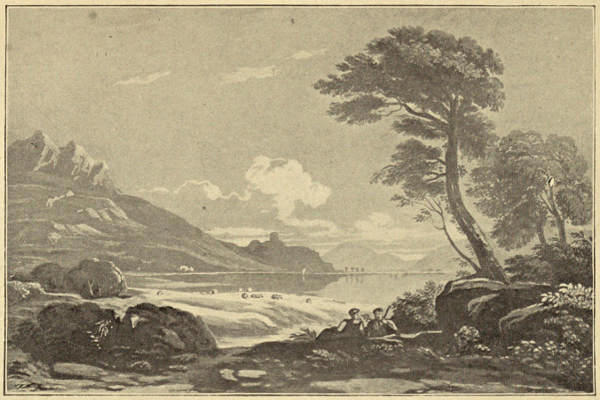
THE TOWER OF DOLBADARN ON LLANBERIS LAKE
Unfortunate for romantic tradition is it that Edward II built the Eagle Tower and was not born in it. But these are the facts of the case, and the people of Carnarvon know them perfectly well. Undoubtedly, however, this prince was born in the town. One feels indignant sometimes, perhaps often, in Wales at the value set upon celebrity, the celebrity which “pays”; at Denbigh the proud claiming of Stanley, the explorer, where the poor lad was knocked about and abused worse than some cur of the streets; the exploitation of Dr. Johnson, who happened to be with Mrs. Piozzi in the vicinity of Denbigh for a few days; and then this English Prince of Wales whom the Welsh insist upon having born in the tower which he himself built! Ah, well,—
“Why should not gallant Taffy Have his relics and his bones, Llewelyns and Cadwallos, And Griffyevanjones?”
And we must just be willing to let this cherished Eagle Tower be an indispensable Welsh bone—or relic of contention.
The gateway of Carnarvon Castle is very impressive, of great size and strength, as are most of these North Wales castles, but, as is not the case with most of them, with romantic grace added. Vines clamber up it and over it, cracks etch the portions of the walls which are bare. Above the gateway, in its niche high out of reach of destructive enemies, is the figure of Edward II; and to the right and to the left graceful turrets rise above the walls. Low on the face of the gateway tower are slits for defence, above them at a safe altitude are windows with part of the tracery still intact. This entrance was besieged by Glendower in the fifteenth century and by a Parliamentary army in the seventeenth. Bitter battles were fought about the old gate and in the town beyond. One day at Carnarvon, when the peasant folk were holding a fair, one Madoc, who claimed to be the son of Llewelyn, burst into the market square, stormed the castle, and left the town a smouldering ruin.
But distant, far, far distant are those ancient days of primitive strife. And as I turned off my Snowdon road to enter by this castle gateway I had still in mind the peaceful, prosperous town through which I had come and the ships on the sea beyond and the shining island shore of Mona, mother of Wales. We paid our entrance fee and, as I was doing that, my eye caught sight of an old table there under the arch, littered with books for sale. I looked at the shimmering green grass beyond in the castle courtyard down upon which the sun was flooding. We were in no haste. I wanted to dally, and dally I did by the bookstall, my hand falling upon a first edition of Goldsmith’s “Bee”, to be sold at sixpence! We paid for it, and I could hear my friend saying, “Do you suppose it really is a first edition?”
My fingers between the leaves of this book, I turned to and opened “A City Night-Peace,” reading, “There may come a time when this temporary solitude may be made continual, and the city itself, like its inhabitants, fade away, and leave a desert in its room.” Then we went through into the sunshine in the courtyard beyond, the book clasped tightly in my hand, and the hours passed as in a dream. There was the touch of time made visible, there was life carried forward even in the busy chirping of the birds upon the vine-covered walls, there was sunshine as it had been in those olden but not more golden days than this, there was the sound of voices, voices beloved so long, long ago, and speaking again; there was joy, and sorrow, living again for me and in me; there once more was all that eager, ardent, daily commonplace of human lives, that daily friendliness of little things which makes life so worth the living. I felt it in all about us, woven into everything, the cheerful noise of birds, the voices from beyond the castle walls, the sunshine, the colour; and more and more the spirit of the place took possession of me.
Again as in a dream within a dream we passed through the castle gateway out into the town with its simple old houses, its little shops with their signboards and gay windows, its inns and lodgings, past the Welsh children playing in the streets and their elders going gravely to and fro about their business, and the sleek horses and whirling motors, up the hill past Llanbeblig Church, the churchyard Watts-Dunton has used as part of the setting of his story “Aylwin,” and on to the country road which, with thirteen miles’ walking, would bring us home—to our Welsh home at the foot of Snowdon, Eryri, the home of eagles. Behind us, as we turned, the ships had become but white moths on a vast sea, Anglesey was growing dimmer, the cows pastured on the plain about the old town were but specks, the coast-line was merging into the water. But still the castle dominated everything, and I thought of Dr. Samuel Johnson’s delight in that vast pile and his naïve record in the Cambrian journal: “I did not think there had been such buildings; it surpassed my ideas.”