III Hilltop Churches
Reading edition
“Ah,” said Bishop Baldwin, recovering his breath, “the nightingale followed wise counsel and never came into Wales.” So, jocund as the most unordained, Baldwin’s holy company of the twelfth century moved on its way, gathering ever more and more to it cloaks signed with the crusading cross of red. To mind come other figures and to mind come other pictures—wild, powerful, beautiful, pathetic—of a past that is a thousand or two thousand years old. In some rock-strewn valley, bleak and barren as the uttermost parts of the earth or terrible as the valley of the shadow of death, rises the cry of human sacrifice. Hundreds of years later, down a roadway bordered then as now with foxglove and bluebells and heather, rides a gallant company, gentle-mannered, on pleasure bent. Or by the walls of Conway Castle, Edward I bears the body of his Eleanor to its far resting-place in Westminster Abbey, where the stones are still fresh from the chisels of the builders. Here is “the unimaginable touch of Time,” a Past that as it slips away joins the mystery of a Future even at this instant in retreat.
But the traveller does not go on foot week after week many scores of miles, with these thoughts always present, like Christian with a pack upon his back, and meeting as did Christian many difficulties. True, a good heart faces the open road expecting many obstacles, and can find its wonder-ways even if it loses a night’s rest. Giraldus Cambrensis, on the forward march with the Bishop through Wales, could vouch for an island in which no one dies, for a wandering bell, for a whale with three golden teeth, for grasshoppers that sing better when their heads are cut off. He tells the story of a lad, Sisillus Long Leg by name, who suffered a violent persecution from toads that in the end consumed the young man to the very bones. And like most ecclesiastics, Giraldus allows himself the relaxation of a good fish story.
This credulity, charming as it is and panacea for the physical tedium of the open road, is the faculty of which the pedestrian of to-day must strip himself. No other pilgrimages of which I know have been made to these little churches, except by Mr. Herbert North, of Wales,—who has studied the old churches of Arllechwyd simply, and to whose architectural insight I am greatly indebted,—and by myself. During many weeks my journey took me from hillside to hillside and mountain-top to mountain-top, studying these ancient foundations. My work was grounded upon incredulity; everything was recorded, nothing concluded. As a motto the remark of the only thoughtful sexton I have met out of literature might have been taken. Contemplating an old stone at St. Mary, Conway, inscribed “Y 1066,” he said, “Hit wants a wise ’ead to find hit out.” At Gyffin beyond Conway we pointed to one object after another in the church with the single question—an American question:—
“How old is it?”
“It’s very old, mum,” came the reply.
“How old?”
“Oh, very old, mum,” in an impressive voice.
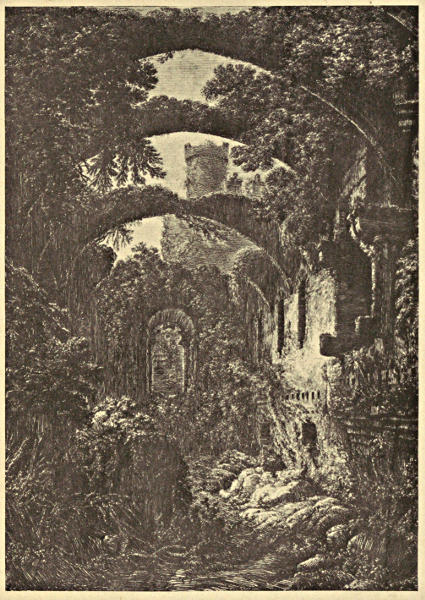
THE GREAT HALL AT CONWAY CASTLE
From an engraving by Cuitt
Having tested barrel vault, paintings, chancel, windows, rood screen, roof, walls, doors, in this fashion, we had worked ourselves out of the church, so to speak, and I pointed up to a shiny tin rooster crowing upon the bell-cot.
“How old is it, the rooster?” I said.
“Oh, very old, mum,” came the solemn reply.
At another place we were told that the bell swinging in the cot, and sounding sweetly after the long journey uphill, dated from the fourth century. It was useless to inform the poor soul that there were none but hand-bells then in North Wales, and that she was in this case only a little matter of one thousand years out of the way. After a mount up to Llangelynin, taken hastily, and much investigation of objects genuinely ancient, the woman who had us in thrall said, pointing to a dark recess under a narrow, fixed pew, black as darkness, and not more than one foot from the pew in front of it, “There’s a very old tablet there, mum, my son says.” Perhaps she had calculated the discrepancy between the width of the pew and myself; however, I got through to the floor, wiped off the dust with a handkerchief, and out blinked, as sleepily as if it were the very Rip Van Winkle of stones, the young date 1874! Wild steeple chases there were in plenty, with minor fatalities to limb and courage. It is useless, when one mountain-top has been achieved, to find that after all there is nothing left except the inconsiderable mountain itself,—it is useless then to discover upon an opposite summit, whose peak could be reached by a well-modulated voice, an extant church of indubitable antiquity, for to meet with that church would require an all-day’s walk. There was one steeple chase without even the comfort of another church in view.
Once reconciled to these surprises, for which no one can be held accountable, and to the ineffectiveness of the sextons whom no one must suppose responsible, there are no chances for disappointments except such as are self-created. The attendants in most cases are women, and wretched creatures some of them are. In one place a woman with a goitre, and one eye gone, kept the keys. She was admirably proud of her son because he did know something, but as the son spent all his days in a mine we were not in a way to inherit his wisdom. Another woman was deaf and dumb and foolish. A lad who took us through a church of considerable importance, if antiquity can make these deserted churches important, was so stupid he received a lecture upon his ignorance. His unanswerable sectarian reply was that he did not belong to that church anyway. We met with some smart young girls who, with their twenty years of wisdom, were above knowledge concerning anything so rusty and tumble-down as the church by means of which they hoped to win sixpences for ribbons. There were two or three apple-cheeked old women clad in caps and bobbing their curtsies. To one, a sweet old soul, I was explaining that a certain door could not be very ancient and have the big nails it had in it. “Uch,” she replied, in distress. “Well, indeed, mum, perhaps they were put in later to hold it together.” It may be said, I think, that the keys are kept as far away as possible, why I cannot say. So is the vicar kept as far away as possible: even the curates get the habit and stay away when they can. As a rule, the churches are not set down in the midst of habitable villages, but most often upon remote hillsides or hilltops. There is another difficulty to be encountered also, in the person of the kindly individual who could show you what you wish, but wishes to show you something else. One old woman—the Ancient Mariner himself could not have been more irresistible—detained us endlessly while she searched for and displayed the Duchess of Westminster’s photograph.
These are some of the troubles in a progress otherwise enchanting; once realized, it is well to forget them, together with the feet that were sometimes too weary to travel five miles further and the shoulder that ached under the strap. With its ache of all the ages the dream of ancient beauty has no place in it for an hour’s weariness. As if the riddle of existence could be explained by a wall rain-washed and worn, upon which grow lichen, moss, rustling grass, and even trees, and by lintels tipping earthward, golden flowers blowing upon them! The eye travels thirstily from stone to stone, or to some peaceful bell-cot pointing the bare ridge of a bleak, sheep-covered hill, or to the far-away hills and gray sky and solemn, dreary places. Spiritually it is easy to understand why these churches are on the hills, and the controversy about their position seems a matter of no further moment. There are other pictures, too, of churches by the sea, in the main not as old as those upon the mountains, enclosures where even the tombstones are crowded together in their last sleep. Beyond these churchyards lies the encircling shore with ever the white lip of the sea at its edge; above, low-lying regiments of clouds march Snowdon-wards. Upon one eminence is the church, upon another, nearer the water, a castle, and in the valley between these crumbling sanctities of power and spirit is the little town, busy still, its roofs making a joyous show of colour beneath the blue sky. Within these churches by the sea there is ever the tideless roar of the waters ringing upon the shores, and from these church doorways the eye dreams upon the castle wasting with the land at its feet, or the “llys” of King Mark, or upon the faint blue rim of some island, holy as the mother of good men. Along the road on one side is the sea; on the other, green hills rise into the blue of the sky, their slopes a mosaic of gray sheep walls. And here out of the village at the end of a grass-grown road, by the sea, lies a little church, around which the sands have blown through so many centuries that the windows show just the caps looking like sleepy eyes out of the huddled graves. One minute time rolls like a chariot wheel crushing all things, another moment and it is a mystic circle without beginning and without end. The graves upon the hillsides, young in their hundreds of years, look down upon the mounds of the British undisturbed in a millennial repose, and upon a stone lying as hands two thousand years ago placed it. And past the ears rush the centuries of all eternity, as in the travelling of a mighty wind.
Seeing with the eye of visions it is not hard to re-create a vanished past, to construct again the primitive British church of wood and wattle, with its beauty of oaken rafter and carved wood which stone now encloses. There is still an ancient wooden church in Greenstead, Essex, in plan much like little churches of North Wales,—the walls six feet high made of half trees side by side, the roof a tie beam, with struts, less than six feet from the floor. This parallelogram follows out the double square of what was undoubtedly the plan of the ancient British church, something that was still geometrically the square sanctuary with its square altar typifying the heavenly Jerusalem. Bede, in his “Ecclesiastical History,” speaks of “a church fit for an Episcopal See; which, however, after the manner of the Scots, he [Finan] did not erect of stone, but of sawn timber, covering it with reeds.” It is worth remembering that the little churches being discussed are unique examples of a national type based, not upon the Roman basilica, but upon the Temple, with its square Holy of Holies, and illustrating certain features; a square east end with east window, an altar concealed behind screens, and a south door instead of a western portal. The wood and wattle churches have disappeared, but upon the foundation lines have arisen the present stone churches of North Wales, dating back in general to the eleventh and twelfth centuries. Their walls of stone are daubed at the joints with mud, similar to the treatment the wattle buildings had received, and the whole whitewashed inside and out. The roof, later covered with oaken shingles and now with soft-coloured slates, was in the Middle Ages thatched deeply with reed or straw. At the east end was the small slit window, and at the south end a door so low that even a short person must stoop to enter it. Originally there were no bell turrets or porches, and at the eastern gable merely a wooden cross. Inside, a screen divided the building in half, the squints covered by veils, and several doors opening into the altar space. Probably the screen was decorated with painting as the barrel vaults came to be. Within and without, the sanctuary gleamed pure white. The Saxons learned the use of whitewash from the British, and St. Wilfrid gloried in having washed the York Minster of his day “whiter than snow.”
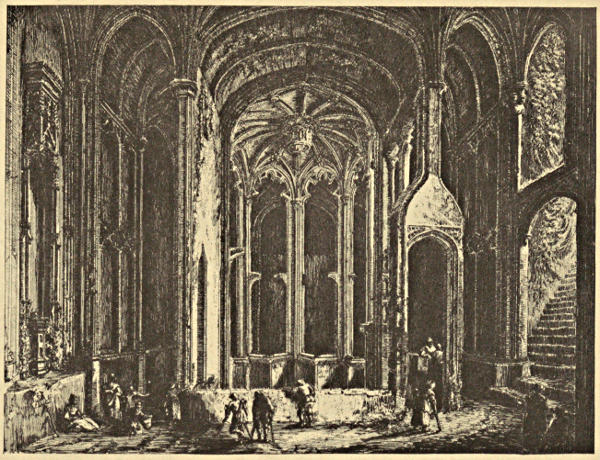
ST. WINIFRED’S WELL, HOLYHEAD
From an engraving by Cuitt, 1813
As the cottages, coloured white or yellow or pink, are seen nestling against the hills of Wales, one regrets that the church no longer receives as in olden days the same treatment. With the wash worn from the churches and never renewed, the country has lost in picturesque beauty. How pretty these buildings must have looked, with their steep thatched roofs and white bell-cots gleaming in the midst of dark yews, or perhaps some golden-tinted church glowing like a crocus in the midst of pines. Not only have the colours faded, as if the land were some bright missal turning gray, but the odd circular huts with their conical thatched roofs, in which the natives once lived, have tumbled down. In those days was a beautiful hospitality, the host and hostess serving until all were served, and in these rude dwellings the ancient harp was played; and from the wooden book, its revolving square crossbars inscribed with letters or notes of music, were read the ancient song and poetry of Wales. When the rectangular cottage came in it did not differ greatly from the circular hut. There were windows—“wind-eyes”—covered with a wooden lattice and shutter, the walls smoothly plastered, and the interior made less primitive by the use of three-legged tables and chairs. Still later, in the seventeenth and eighteenth centuries, the one space was divided off into kitchen, chamber, and loft, the kitchen open to the roof and airy, healthful, and clean. Hospitality was sacred then; any man might enter a dwelling, and delivering up his arms stay as long as he would.
The church was but another sanctuary in olden days where men could take refuge from sin or foe. The “llan,” which is the prefix to fully eight tenths of all the names of ancient churches in North Wales, means “enclosure.” Probably in these places were the earliest monastic settlements, at a time when the “llan,” as the Irish “rath,” enclosed habitation as well as sanctuary. But as the years brought about greater specification in the functions of church and state the term narrowed itself down and was applied solely to the church. The old churchyard walls are still more or less circular like British fort walls. Llangelynin has an enclosure that undoubtedly follows the old lines. The walls of the churchyard near Holyhead are extremely ancient, seventeen feet high and six feet thick. This masonry, from the presence of certain round towers and the particular plastering used, is known to be Roman. Set away from the world that is “too much with us,” these enclosures are charming old spaces, habitable in a sweet sense. The grass looks peace into tired eyes, and to eyes eager with plans rest here is merely an emphasis upon the joy of living. And here, as the stiles into the close show, the children play and have played from generation to generation. Here they climbed upon the roof, and here against the north and west walls, where burials are never made, they played ball and scratched upon the stone their scoring-marks.
At Llangelynin there are no yew trees; that windy height is too bleak for even the sturdy yew. Only white harebells and hardy grass blow about on its bare rock-strewn summit. But in most of the enclosures the yew still stands as the one enduring monument of a past whose very rocks have been covered by the silt of over a thousand years. Many of these trees date from a British period and remain emblematic to-day as they were then. Sometimes it is a single yew by the lychgate which one sees, or an alley of the deathless green, or perhaps yew branches completely veil a gable end of the little church. At Beddgelert, the oldest foundation in all Wales, the yew stands to-day as it stood some two thousand years ago; about its base have rushed the floods of wild mountain torrents, from its feet the graves of centuries have been washed away down to the all-embracing sea. Like children of yesterday are the mediæval lychgates through which one passes into the church enclosure and through which is often caught the first glimpse of the church bell-cot. At Caerhûn (the ancient Canovium), where the yew spreads over the gate is a double bell-cot, which, as it has the traditional straight ridge and gable in the middle, is amongst the oldest in Wales, of the fourteenth or fifteenth century, for the cots as well as the lychgates are “recent” in the life of these churches. The little crucifixes with their straight arms are also of this date. Before this time the local churches had nothing but hand-bells, which were held in great reverence. One of them may be seen in the stone coffin of Llewelyn the Great at Llanrwst. It is about ten inches high and cast on an oblong plan. Gildas gave such a bell to St. David. Six hundred years later, in the twelfth century, Giraldus Cambrensis tells the story of a portable bell called “Bangu” which, when a certain woman carried it to a castle where her husband was wrongfully imprisoned, caused the destruction of the whole town except the church walls. The campanology of North Wales is a romance in itself, a collection of odd, interesting, pathetic tales of past miracles, past friendships, past enmities.
The original buildings not only did not have lychgates and bell-cots, they also did not have porches, and some to-day do not have them. But they are being added from time to time, and fearful are some of them to behold. At St. Mary’s, Llanfwrog Church, just across the bridge from quaint Ruthin, where the Duchess of Westminster has lived and is of vastly more interest to the people than gable ends and oaken rafters and other such stuff, fit only for the attics of men’s minds, is a bit of “restoration” suitable for display in the windows of a carriage-shop. The chancel railing is bright green, red, and black, the pews black and red,—a foretaste possibly of the landscape into which some of their occupants will one day take a dip,—and the stained glass vies with a refracted solar ray in yellows and oranges and reds and blues and greens. From this “restored” edifice drops a long flight of steps past the windows and signboard of an ancient hostelry, “Ye Labour in Vain Inn.” One cannot help wishing that the white gentleman upon the signboard, who is scrubbing a black man in a tub of water, would take his scrubbing-brush up to the church. Often, after all else has been hopelessly restored and all vestiges of harmonious beauty have disappeared, the old doorway remains, witness of an instinctive reverence for a threshold. Many of the circular-headed doorways, now hooded with porches, date from the eleventh and twelfth centuries and even earlier, and through them one passes over a mere sill into the sacred enclosure.
A few points, simple and easy to remember as well as easy to discover, give an added intelligent pleasure in the study of these churches. The oldest churches are generally from twelve feet six inches to fourteen feet wide; the early walls from three feet to three feet six inches thick. Sixteenth-century walls rarely exceed two feet and a half in thickness. The old wattle buildings were daubed with a mixture of clay and cow dung; these church walls are built with earth and rendered on the face with lime and mortar. Buttresses are sometimes found, but they do not belong to early local work. The roofs are easy to examine and often of an enchanting beauty. At Llangelynin is a roof which is probably the original twelfth-century covering. The roof at Llanrhychwyn is also of the close couple type; here the struts are straight, but carved, and there are two ties across the nave. In some of these roofs are intermediary rafters, added when the thatch was replaced by slate.
The earliest mention of a chancel of which I know is that in the poems of Cynddelw, who lived in the twelfth century, in his ode to Tysilio, when he speaks of a certain church as the “light or shining church” with a chancel for mass. We cannot assume that even in the twelfth century chancels were by any means common in North Wales. At Mallwyd Church there was, not so long ago, a communion table in the centre of the building, and there is no question but that holy ceremonies were performed originally, instead of at a chancel end, in the midst of this rectangular Holy of Holies. At Bardsey, Pennant found an insulated stone altar rather nearer the east end than the centre. The rough, uneven slate paving in these churches is comparatively modern, and it might be added comparatively luxurious. The first paving was mud and sometimes flat stones. Formerly the windows were covered by wooden shutters or lattices; that was the usage in all conventual buildings. Now the windows are either well or illy filled with coloured glass. In many of the churches falling into great dilapidation the windows have been stuffed with stone and mortar, or rudely boarded over. Some of the stained glass is genuinely ugly and some of it genuinely and anciently lovely. That at Llanrhychwyn, coloured in brown line and yellow stain and representing the Virgin and Child and the Holy Trinity, is of the fifteenth century and still beautiful. Probably the use of glass was not introduced into Wales till the thirteenth century. West windows were unknown in local Welsh work. Where a window with such an exposure is found, the opening did not belong to the early church. There are windows of great antiquity in these churches. Look at the lintelled window in the passageway into St. Beuno’s Chapel. Courage hesitates at assigning a date to this bit of work. There are windows far more elaborate of a comparatively early date, but they are the work of Latin monks and do not follow the straight lines of the native British architecture. An exquisite example of early Latin work is that of the Gilbertine monks upon the Beddgelert triplet.
The barrel vaults in these churches are curious concave coverings over the chancel end, ark-like in form and supposed type of the ancient church. These oaken canopies have been elaborately painted in the past; now they are to be seen in every stage of dilapidation, provoking the eye by their interrupted pictures or faint lines of red and blue. They are approximately of the same date, although not in the same condition, for their destruction is due to leaky roofs and not to age. The ground colour was the green-blue the Middle Ages loved so well, and the other colours red, yellow, and white. At Llandanwg, where the sea would flow into the western door were it not for a big embankment, there is a barrel vault with faint traces of painting upon it. An old man whose father and mother were the last people to be married there told us he took an interest in it, it was the only church in Harlech Parish fifty years ago, and “the only service held there then was when the parson and the clerk used to go over and enjoy drinking their beer on the gravestones.” English came stiff to his tongue, but he described the fearful condition of the church, and the way the people took off the seats for firewood and the children made a playhouse of the abandoned structure. In one corner of the barrel vault was a picture of the Devil prodding people down into hell. The children threw things at these paintings, mud and other articles, till the pictures were completely destroyed. Whatever the subject, it is pleasant to recall the colouring of the barrel vaults, for, executed five or six hundred years ago, they must have been brightly beautiful like the margins of an illuminated book, radiant with something of the blue and gold of very heaven itself. Of the rood screens and lofts that veiled the chancel space, there are but few left intact; of the sacred rood itself, no vestige except the socket on the candlebeam into which its pedestal slipped. Fanaticism has swept this feature away. In Beddgelert their rood-screen carving was converted into chairs for household use or fuel for warmth. Strangely enough, Queen Elizabeth was the last defender of the screen’s mystical beauty of carven wood and the silent admonishing figure stretched upon its façade. At Llanengan there is a screen of rare delicacy, stolen, together with some elbow stalls and silver bells, from Bardsey, that resting-place of saints which seems to have been to the ecclesiastical world what Fuseli said Blake was to the art world, “good to steal from.” Chests, worm-eaten and with rusty bolts, are often among the church treasures. St. Beuno’s chest at Clynnog is as old as the saint himself. And at Clynnog, too, are dog tongs, or lazy tongs as they were sometimes called, in each paddle four sharpened nails which must have seemed bitter to any doggie’s sides, lean or fat, as he was lifted ignominiously out of the sanctuary. And, oh, woe if it caught him by the tail or foot! There are different types of fonts in these churches: small square fonts like the earliest of Palestine, Asia Minor, Egypt; extremely small fonts of various shapes dating from the eleventh to the fourteenth century; large fonts used for immersion, and belonging to the fifteenth and sixteenth centuries. At Llanderfel near Corwen is a wooden image, never, I imagine, satisfactorily accounted for. It is a horse, though curiously like a deer in appearance. This figure was the standard for the image that rested upon it and which went, several hundred years ago, to help in the burning of poor Friar Forest at Smithfield, to whom, while the fire crackled about his feet, Latimer preached a sermon. Now even the brass tablet on the standard has been sent to the British Museum, and the standard itself, till within the last few years, used for a pig-trough.
Apparently London thought a Welshman who denied the supremacy of the king worth burning, difficult to be rid of. Well might Englishmen consider such a man’s forebears in saintship. The Latins tried to rid the Western world of these anomalies in spiritual heritage—in vain! The Reformation burnt them. In vain, too, for the Welshman to-day, nonconformist and conformist alike, is as tenacious of the lists of his hagiology as ever he was a thousand years ago. To the ancient Celt there were three free dignitaries: church, land, and poet. To-day these remain the revered dignitaries to the Welshman. In the past these offices had been closely united, for to a Welshman saintship came by birth, celebrity depended afterwards upon how he acted. There is an odd title to a Welsh catalogue of saints: “Bonedd Saint ynys Prydain,”—the Gentility of the Saints of the Isle of Britain. An old Irish song says of St. Patrick that he “was a gentleman and came of decent people,” a fact which to us does not seem prerequisite for saintdom. Not so to the Celt; and it is best to keep this essential difference in mind, or one might be puzzled by running across the annals, some day, of a saint in so cheery a state that he fell into his own holy well and escaped drowning only because of the good luck universally known to attend people in a similar condition. The object of the Celtic saint, till he became Latinized, was to serve his tribe by increasing its riches and enlarging its boundaries. It was not necessary for him, as it was for his brother Latin, to receive any papal sanction for his sainthood or to work any miracles. His carte to sanctity was membership in a certain family or monastery. The Latin Christian world, establishing its supremacy by degrees, could not fail to scoff at the temporal emphasis of Welsh saintdom. Even Giraldus, a Welshman, comments mildly upon the vindictiveness of certain saints, of whom he often knew more than he cared to tell. Gradually, by ridicule chiefly, the lists of Celtic holy men were closed. Even Bardsey, the Insula Sanctorum of the Welsh, does not escape a laugh from many critics, one of whom observes that “It would be more facile to find graves in Bardsey for so many saints than saints for so many graves”; a remark grudging and ungracious, for the world has condescended to steal everything from Bardsey and might leave it at least the glory of claiming as many dead saints as it pleases.
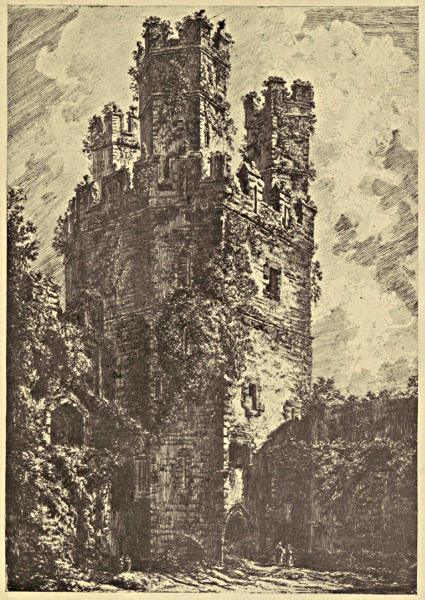
THE EAGLE TOWER OF CARNARVON CASTLE
From an engraving by Cuitt
The tales, fabulous and odd, told of Welsh saints, Welsh relics, and holy wells, are particularly charming because they are not marred by over-didacticism. Tydecho was an illustrious saint who lived in the time of King Arthur. Retiring from the world, he led a life of mingled austerity in penance and of useful hours of ploughing. One day a youth seized his oxen, but the next day wild stags were drawing the plough, and a wolf harrowing after them. Furious, the youth brought his dogs to chase away Tydecho’s wild friends. While enjoying this diversion he seated himself upon a stone; attempting to rise he found himself fixed to the rock. Truly a humiliating position for a proud-spirited youth who enjoys taunting an old man! Friendship between man and beast is woven into these tales like the bright colours threading the letters of an ancient bestiary. St. Monacella protected hares from Brochwel Yscythrog, who was hunting them. She hid the trembling little beasts under her robe and, praying devoutly, faced the dogs. The dogs ceased their running, and even when the horn was blown as a command to them to follow the hare, they stole away howling and the horn stuck to the huntsman’s lips. After Brochwel had listened to Monacella’s plea, the little creatures were released, and to this day no one in the parish will hunt one of Monacella’s lambs.
Many and attractively full of poetry are the superstitions that still live in the solitudes of northern Wales. “Bees were created in paradise,” say the “Leges Wallicæ,” “and no light save beeswax is to be used at mass.” When on the fall of man they left paradise, God Himself is said to have blessed them. They produced, too, the nectarious “medd” of which the ancient Britons thought so much. One day we encountered a hillside woman in great distress, breathless and flapping her apron; her bees were running away and apparently the worldly creature had no intention of letting them run back to paradise. Bent pins are still to be found at the bottom of the sacred well within the church close, pins dropped in before bathing to cure warts. Woe to the bather who failed to drop in the propitiatory pin, for he promptly caught the warts of which others had got rid. And in these holy wells the clothes of sick children were washed, with happy auguries if the little garments floated, with fell portent if they sank. At Llangelynin, where the well is still in excellent condition, an old woman told me that to cure a sick child a stranger to the family must dip the child in after sundown. Spitting upon hearing the name of the Devil may not be polite, but it is a simple way of expressing contempt, and so, too, is smiting the breast in self-condemnatory woe at the name of Judas. Some of their superstitions and customs, despite the smack of folly, are wise in their emphasis upon the power of the imagination.
There are, too, some wholesome customs of precedence. The parson always used to go out of chapel first,—in some places he does so still,—and the parishioner who disputed this order of rank might have his ears boxed for his trouble. After the baptism of a little child old women wash their failing eyes in the font with pathetic faith in the virtue of new, God-given life. There used to be some sweet customs, not entirely lost yet, connected with burial. As the coffin rested on the bier outside the door, the next of kin among the women gave to the poorest persons in the parish, over the body of the dead, a great dish filled with white bread. Then a cup of drink was handed across the bier to the same poor and all knelt to repeat the Lord’s Prayer. At every crossroad between the house and church they knelt again to pray, the sexton’s hand-bell quiet only when all knees were on the earth.
On the way from church to church many tablets arrest the eye, kneeling fathers and mothers with processions of kneeling children in a line behind them. The viva voce history of these reliefs suggests the less quaint and more beautiful and enduring relievo of sepulchral urns. At Clynnog I counted thirteen children in happy procession after one father. At Conway I might have counted twenty-nine if I had wished to, but I had no such wish. At Corwen we found knee-holes in both footstones and headstones to make comfortable the knees of friends while they prayed,—or meditated, as I confess I did, upon the hideousness of most sepulchral carving and inscription. There was one part of these records which, with even the best traditions behind me, could not be undertaken—the epitaph or similar memento. Early in the journey this inscription was encountered:
Heare lyeth the body of John, ap Robert, ap Porth, ap David, ap Griffith, ap David Vauchan, ap Blethyn, ap Griffith, ap Meredith, ap Jerworth, ap Llewelyn, ap Jerorh, ap Heilin, ap Cowryd, ap Cadvan, ap Alawgwa, ap Cadell, the King of Powys, who departed this life the XX day of March, in the Year of our Lord God 1642, and of his age XCV.
Now it was plain that this was one of the results of the saints’ unsaintly emphasis upon a family-tree. Certainly a man has a right to as many ancestors as he can compass. But thereafter, when I saw the usual clusters of “aps” and “Griffyevanjoneses,” I experienced a reluctant and fluttering sensation within accompanied by external haste to get elsewhere. Just one other epitaph, by reason of its brevity, caught my pencil:—
Here lies John Shore, I say no more; Who was alive In sixty-five.