VII The Eisteddfod
Reading edition
It was the first morning of my first Welsh National Eisteddfod, and I sat by the window working, and glancing away from my work to a hillside up which led narrow steps to the summits above, among which were hidden away some half a dozen tiny villages. Colwyn Bay, where the Eisteddfod was to be held, was—as the crow does not fly—about forty miles distant. It was a glorious morning of sunshine in which gleamed the river, glossy beeches and pines, and little whitewashed Welsh cottages. As I looked, there began to emerge from the steps a stream of people; down and down they flowed, bright in their pretty dresses or shining in their black Sunday-best broadcloth. All those mountain hamlets up above, reached by roads passable only for mountain ponies, were sending their men, women, and children to the Welsh festival of song and poetry.
Talking and excited about who would be chaired as bard, who would be crowned, what female choir would win in the choral contests, what male choir, and discussing a thousand little competitions, even to a set of insertions for sheets, shams, and towels, we were borne on the train from Bettws-y-Coed swiftly through the Vale of Conway, beside the river, past Caerhûn, the once ancient city of Canovium, past Conway Castle, with its harp-shaped walls still encircling the town, and so to Colwyn Bay.
Then all these enthusiastic people who had climbed down a hill to take the train, climbed up another to see the first Gorsedd ceremony. As we passed, from one of the cottages was heard the voice of a woman screaming in great excitement, “Mrs. Jones, Mrs. Jones, come to the front door quickly. There’s some people going by; they’re dressed in blue and white. Dear me, Mrs. Jones, they’re MEN!” The procession, fully aware that Mrs. Jones, and all the little Joneses and all the big and middling Joneses, too, had come, went on gravely up, up, up the hill to “Y Fanerig” (the Flagstaff), where stood the “Maen Llog of the Gorsedd” and its encircling stones. The paths were steep, and even bards and druids are subject to embonpoint. Old Eos Dar, who can sing penillion with never a pause for breath, lost his “wind,” and the “Bearer of the Great Sword of the Gorsedd” was no more to be found. A boy scout, perhaps thinking of Scott’s minstrel, who said,—
“The way was long, the wind was cold, The minstrel was infirm and old,”
was despatched downhill after him, and found him and the sword, arm in arm, lagging comfortably behind. Druidical deportment is astonishingly human at times. But the hilltop achieved and wind recovered, the bards soberly made their way into the druidical circle of stones that surround the great Gorsedd stone. Nowhere, as the Archdruid remarked, had the Bardic Brotherhood been brought nearer heaven.
From the summit, north, east, south, west, the soft valleys, the towering mountains, the secluded villages, the shining rivers, and the great sea were visible. And there on this hilltop the bards, druids, and ovates dressed in blue and white and green robes, celebrated rites only less old than the Eye of Light itself. After the sounding of the trumpet (“Corn Gwlad”), the Gorsedd prayer was recited in Welsh,—
“Grant, O God, Thy Protection; And in Protection, Strength; And in Strength, Understanding; And in Understanding, Knowledge; And in Knowledge, the Knowledge of Justice; And in the Knowledge of Justice, the Love of it; And in that Love, the Love of all Existence; And in the Love of all Existence, the Love of God. God and all Goodness.”
Then the Archdruid, Dyfed, standing upon the Gorsedd stone and facing the east, unsheathed the great sword, crying out thrice, “Aoes Heddwch?” (Is it peace?) and the bards and ovates replied “Heddwch!” (Peace.)
There are some scholars who question the “identity of the Bardic Gorsedd with the druidic system.” The Welsh Gorsedd, this side of the controversial point, is forty centuries old, and in all conscience that is old enough. Diodorus, the Cicilian, wrote, “There are, among the Gauls, makers of verses, whom they name bards. There are also certain philosophers and theologists, exceedingly esteemed, whom they call Druids.” Strabo, the geographer, says, “Amongst the whole of the Gauls three classes are especially held in distinguished honour—the bards, the prophets, and the druids. The bards are singers and poets, the prophets are sacrificers and philosophers, but the druids, besides physiology, practised ethical philosophy.” As far back as we can look in the life of the Cymru, poetry, song, and theology have been inextricably woven together. The Gorsedd was then, formally, for the Welsh people what it still is informally: a popular university, a law court, a parliament. The modern Gorsedd, with its twelve stones, is supposed to represent the signs of the zodiac through which the sun passes, with a central stone, called the “Maen Llog,” in the position of the sacrificial fire in the druidical temple. A close reverence for nature, a certain pantheism in the cult of the druids, shows itself in various ways,—in the belief that the oak tree was the home of the god of lightning, that mistletoe, which usually grows upon the oak, was a mark of divine favour. The most prominent symbol of the Gorsedd is the “Broad Arrow” or “mystic mark,” supposed to represent the rays of light which the druids worshipped. Even the colours of the robes of the druids, ovates, and bards are full of characteristic worship of nature; the druids in white symbolical of the purity of truth and light, the ovates in green like the life and growth of nature, the bards in blue, the hue of the sky and in token of the loftiness of their calling.
Up there on the hilltop, with its vast panorama of hill and valley, sea and sky, time became as nothing. The Gorsedd became again the democratic Witenagemot of the Welsh, and there still were represented the mountain shepherd, the pale collier, the lusty townsman, the gentle knight, the expounder of law, the teacher and the priest. But if upon the hill time was as nothing, down below in the gigantic Eisteddfod pavilion some ten thousand people were waiting. “Gallant little Wales,” which has certainly awakened from its long sleep, was past the period of rubbing its eyes. It was shouting and calling for the Eisteddfod ceremonies to begin, perhaps as the folk in Caerwys had called impatiently in the days of the twelfth century, or again in that old town in the days of Elizabeth, the last that memorable Eisteddfod when a commission was appointed by Elizabeth herself to check the bad habits of a crowd of lazy illiterate bards who went about the country begging.
That great Eisteddfodic pavilion, where the people were waiting good-naturedly but impatiently, is primarily a place of music. Even as in the world, so in Wales music comes first in the hearts of mankind and poetry second. And it may be, since music is more social and democratic, that the popular preference is as it should be. The human element in all that happens at a Welsh Eisteddfod is robust and teeming with enthusiasm. It is true that prize-taking socks, shawls, pillow shams, and such homely articles no longer hang in festoons above the platform as they did some twenty or thirty years ago. Now the walls are gaily decorated with banners bearing thousands of spiteful-looking dragons, and pennants inscribed with the names of scores of famous Welshmen, and with such mottoes as “Y Gwir yn Erbyn y Byd” (the truth against the world), “Gwlad y Mabinogion” (the land of the Mabinogion), “Calon wrth Galon” (heart with heart), and others.
After the procession of dignitaries was seated upon the platform, a worried-looking bard began to call out prizes for every conceivably useful thing under the sun, among them a clock tower which he seemed to be in need of himself as a rostrum for his throat-splitting yells. During these announcements the choirs were filing in, a pretty child with a ’cello much larger than herself was taking off her hat and coat, a stiff, self-conscious young man was bustling about with an air of importance, and in the front, just below the platform, sat newspaper reporters, from all over the United Kingdom, busy at their work. Among them were the gray, the young, the weary, the dusty, the smart, the shabby, and one who wore a wig, but made up in roses in his buttonhole for what he lacked in hair. There were occasional cheers as some local prima donna entered the choir seats, and many jokes from the anxious-looking master of ceremonies.
At last the first choir was assembled, and a little lady, somebody’s good mother, mounted upon a chair. The choir began to sing,—
“Come, sisters, come, Where light and shadows mingle, And elves and fairies dance and sing, Upon the meadow land.”
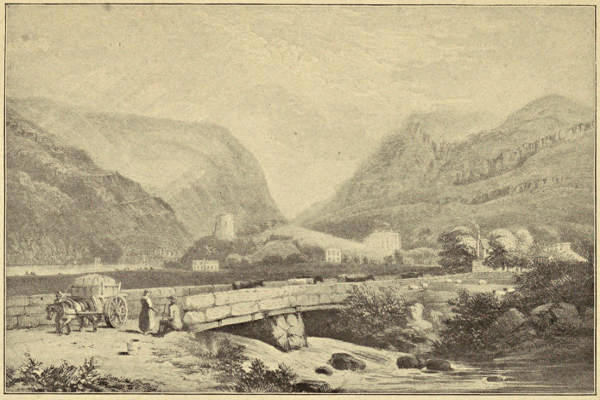
LLANBERIS
From an old print
The little lady never worked harder, her baton, her hands, her head, her lips, her eyes were all busy. Was it the Celtic spirit that made those elves and fairies seem to dance upon the meadows or did they really dance? The next choir was composed of younger women, among them many a beauty-loving face, alas! too pale and telling of the hard life of the hills or of the harder life of some mining-town. Of the third choir the leader was a merry little man, scarcely as high as the leader’s stand, with a wild look in his twinkling eyes as he waved a baton and the choir began,—
“Far beneath the stars we lie, Far from gaze of mortal eye, Far beneath the ocean swell, Here we merry mermaids dwell.”
He believed not only in his choir, but also in those mermaidens, and so did the little lad, not much bigger than Hofmann when he first began to tour, who played the accompaniment. When that choir went out, a fourth came in, still inviting the sisters to come. At last the sisters not only came, but also decided to stay, and another choir lured the sailor successfully to his doom, and all was over, for even in choir tragedies there must be an end to the song. The gallant little mother had won the first prize. It takes the mothers to win prizes, and the audience thought so, too. The crowd yelled and stamped with delight.
When one asks one’s self whether Surrey, for example, or such a state as Massachusetts in America, could be brought to send its people from every farm, every valley, every hilltop, to a festival thousands strong, day after day for a whole week, one realizes how tremendous a thing this Welsh national enthusiasm is. Educationally nothing could be a greater movement for Wales. To the Welsh the beauty of worship, of music, of poetry are inseparable. Only so can this passion for beauty, which brings multitudes together to take part in all that is noblest and best in Welsh life, be explained. Only so can you understand why some young collier, pale and work-worn, sings with his whole soul and shakes with the song within him even as a bird shakes with the notes that are too great for its body. These Welsh sing as if music were all the world to them, and in it they forget the world. Behind the passion of their song lies a devout religious conviction, and their song sweeps up in praise and petition to an Almighty God, who listens to Shelley’s “Ode to the West Wind” as well as to some great hymn. To hear ten thousand Welsh people singing “Land of my Fathers,” each taking naturally one of the four parts and all singing in perfect harmony, is to have one of the great experiences of life. To hear Shelley’s “Ode” set to Elgar’s music and sung by several choirs, to hear that wild, far-travelling wind sweep along in a tumult of harmonies, to know that every heart there was as a lyre even to the least breath of that wind, to hear that last cry,—
“Oh, wind, If winter comes, can spring be far behind?”—
to listen again to those choirs late in the evening on the station platform with the sea dim and vast and muting the song to its own greater music, is to have felt in the Welsh spirit what no tongue can describe,—it is to understand the meaning of the word “hwyl,” that untranslatable word of a passionate emotionalism.
All that went on behind the scenes the audience could not know. They saw only those considered by the adjudicators fit to survive. They did not see the six blind people, for even the blind have their place in this great festival, who entered the little school-room off Abergele Road to take the preliminary tests, the girl who played “The Harmonious Blacksmith,” and, shaking from excitement and holding on to her guide, was led away unsuccessful. They did not see the lad who played “Men of Harlech” crudely, his anxious ageing, work-worn mother sitting beside him, holding his stick and nodding her head in approval. All they heard were a selected two who were considered by the judges fit to play, a man both blind and deaf who performed a scherzo of Brahms and a Carnarvon sea-captain, now blind, who played on the violin. The quiet of the one-time sea-captain’s face laid against the violin, the peace and pleasure in the lines about the sightless eyes, would have repaid the whole audience—even if the violinist had not been an exceptionally good player—for listening.
One of the inspiring and amusing events of the week was the discovery of a marvellous contralto. A young girl, shabbily dressed and ill at ease, came out to sing. Everything was being pressed forward towards the crowning of the bard, one of the great events of the Eisteddfod. People were impatient, and somewhat noisy. But as the girl began to sing they quieted down, then they listened with wonder, and in a minute you could have heard a pin drop in that throng of ten thousand. Before she had finished singing, “Jesu, Lover of my Soul,” the audience knew that it had listened to one of the great singers of the world. When she had finished her song and unclasped her hands, she became again nothing more than an awkward, silly, giggling child whom Llew Tegid had to hold by the arm.
The audience shouted, “What’s her name?”
“Maggie Jones,” he replied; “that begins well.”
“Where does she come from?” demanded the crowd.
“Police station,” answered Llew Tegid lugubriously.
The audience roared with laughter and demanded the name of the town. Maggie Jones is the daughter of Police Superintendent Jones of Pwllheli. Perhaps in the years to come the world will hear her name again.
There are children at these Eisteddfodau whose little feet can scarce reach the pedals of a harp. Even the robins singing up in the high pavilion roof who had joined in the music from time to time, trilling joyously to Handel’s “Oh, had I Jubal’s Lyre,” twittered with surprise that anything so small could play anything so large. But no one of the thousands there, even the children, grew tired for an instant, unless it was these same robins, who were weary at times because of the cheerless character of some of the sacred music sung in competition and themselves started up singing blithely and gladly as God meant that birds and men should sing. The robins twittered madly when some sturdy little Welshman stepped into the penillion singing, accompanied by the harp, no more to be daunted than a child stepping into rope skipping. When the grown-ups had finished, two little children came forward and sang their songs, North Wales style.
The afternoon was growing later and later; it was high time for the name of the bard of the crown poem to be announced. At last, with due pomp, the name of the young bard was announced. Every one looked to see where he might be sitting. He was found sitting modestly in the rear of the big pavilion, and there were shouts of “Dyma fo!” (here he is). Two bards came down and escorted him to the platform, where all the druids, ovates, and bards were awaiting him. The band, the trumpeter, the harp, and the sword now all performed their service, the sun slanting down through the western windows on to this bardic pageant. The sparrows flew in and out of the sunlight, unafraid of the dragons that waved about them and the bands that played beneath them, and the great sword held sheathed over the young bard’s head. The sword was bared three times and sheathed again as all shouted “Heddwch!” The bard was crowned and the whole audience rose to the Welsh national song.
What is the meaning of this unique festival of poetry and song? Mr. Lloyd George, who had escaped from the din of battle outside, and the jeers of the Goths and Vandals who couldn’t or wouldn’t understand the Fourth Form, said, amidst laughter, that there was no budget to raise taxes for the upkeep of the Eisteddfod. Then he continued, “The bards are not compelled by law to fill up forms. There is no conscription to raise an army from the ranks of the people to defend the Eisteddfod’s empire in the heart of the nation. And yet, after the lapse of generations, the Eisteddfod is more alive than ever. Well, of what good is she? I will tell you one thing—she demonstrates what the democracy of Wales can do at its best. The democracy has kept her alive; the democracy has filled her chairs; the sons of the democracy compete for her honours. I shall never forget my visit to the Llangollen Eisteddfod two years ago. When crossing the hills between Flintshire and the valley of the Dee, I saw their slopes darkened with the streams of shepherds and cottagers and their families going towards the town. What did they go to see? To see a man of their nation honoured for a piece of poetry.… And the people were as quick to appreciate the points as any expert of the Gorsedd, and wonderfully responsive to every lofty thought.” Yes, unlike any other gathering in the world, the Eisteddfod is all that. Long ago in the latter half of the eighteenth century Iolo Morganwg stated the objects of Welsh bardism,—“to reform the morals and customs; to secure peace; to praise (or encourage) all that is good or excellent.” This national festival is the popular university of the people, it is the centre of Welsh nationalism, the feast of Welsh brotherhood. Only listened to in this spirit can one understand what it means when an Eisteddfodic throng, after the crowning of the bard, rises to sing “Hen Wlad fy Nhadau,”—
“Old land that our fathers before us held dear.”