PART VI. VEGETABLES, CONDIMENTS, FRUITS. (continued 3)
Reading edition
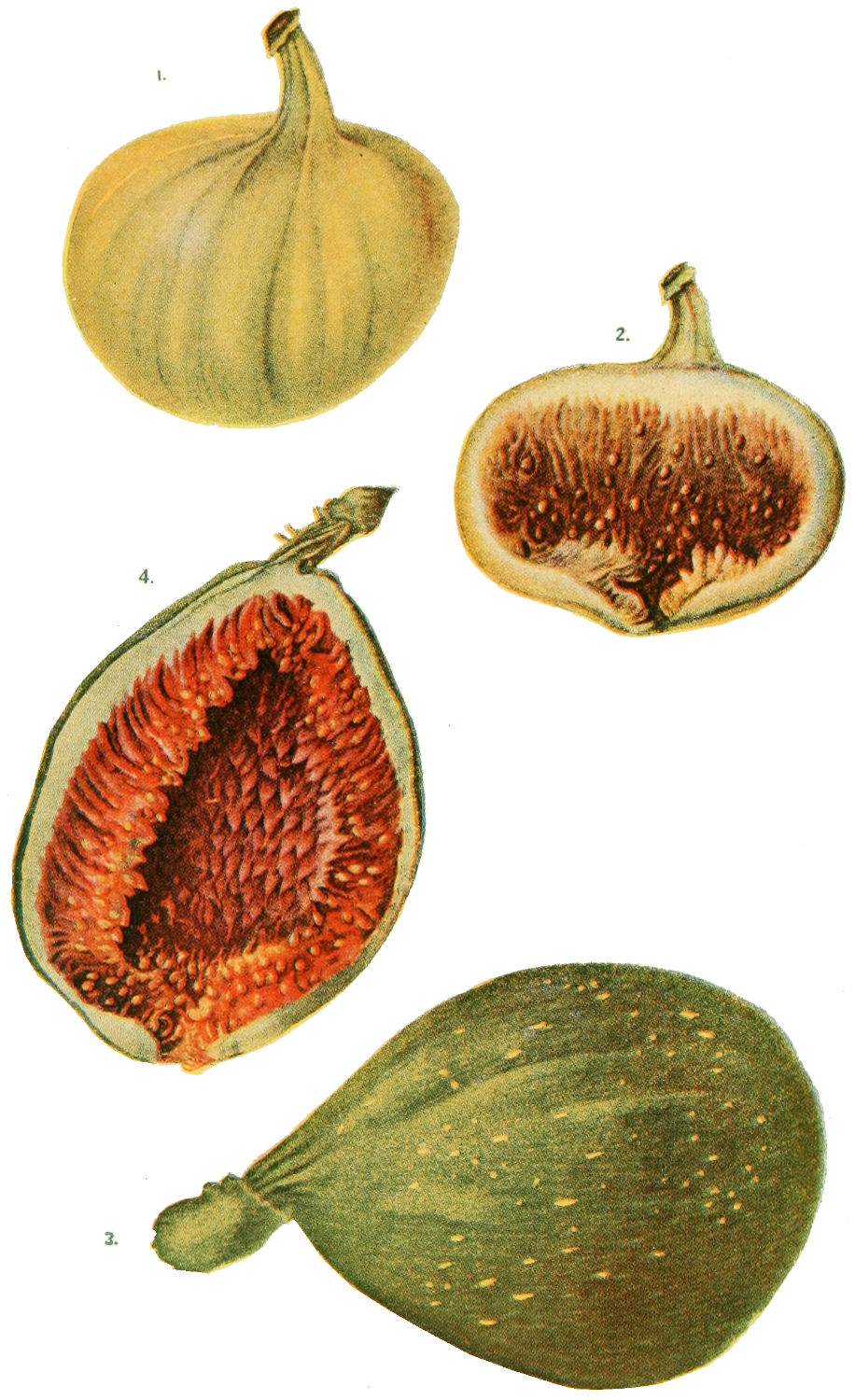
Drying Figs
1. SMYRNA
2. SMYRNA SECTION
3. ADRIATIC
4. ADRIATIC SECTION
From Yearbook, U. S. Dept. of Agriculture, 1897
Figs (Ficus carica L.).
—The fig is a fruit which is well known in biblical and profane history. Together with the grape it is the fruit which is most often mentioned in the Bible.
The importance of the fig as a fruit and food is recognized in all the earlier writings, both sacred and profane. When dried and pressed into convenient forms it is a food which can be easily transported, and makes a ration well suited to supply heat and energy, although deficient in nitrogen in so far as a complete ration is concerned. The fig tree is extensively cultivated in all localities where the temperature permits its growth. It grows in the open in the whole southern part of the United States, and I have seen fig trees of large size grow in the yard as far north as Washington.
The fig tree grows luxuriantly and to a great size in California, and the fruit, both fresh and dried, is of superior excellence. A typical illustration of a California fig tree is shown in Fig. 51.
The Smyrna fig has lately been introduced into the southern and western part of the United States with great success. It grows especially well in the southern part of California and Arizona. The Smyrna fig is one of the varieties which requires fertilization of the flower through the mediation of an insect. This process is called caprification. Although this variety of fig has only been introduced into California to any extent in the last five or six years, the growth of this most highly esteemed variety has so increased that at the present time the output of California alone amounts to about twelve million pounds per annum. The Smyrna and Adriatic figs, used largely for drying and preserving purposes, are seen in their natural colors in the appended colored plate.
Composition of Fresh Figs (Edible Portion).—
Water, 79.11 percent
Protein, 1.52 „
Sugar, 15.53 „
Pure ash, .58 „
Fat, fiber, etc., 3.26 „
Composition of Dried Figs.—
Water, 28.78 percent
Total sugar, 51.43 „
Acid as malic, .71 „
Protein, 3.58 „
Ether extract, 1.27 „
Cellulose, etc., 5.29 „
Crude fiber, 6.19 „
Ash, 2.75 „
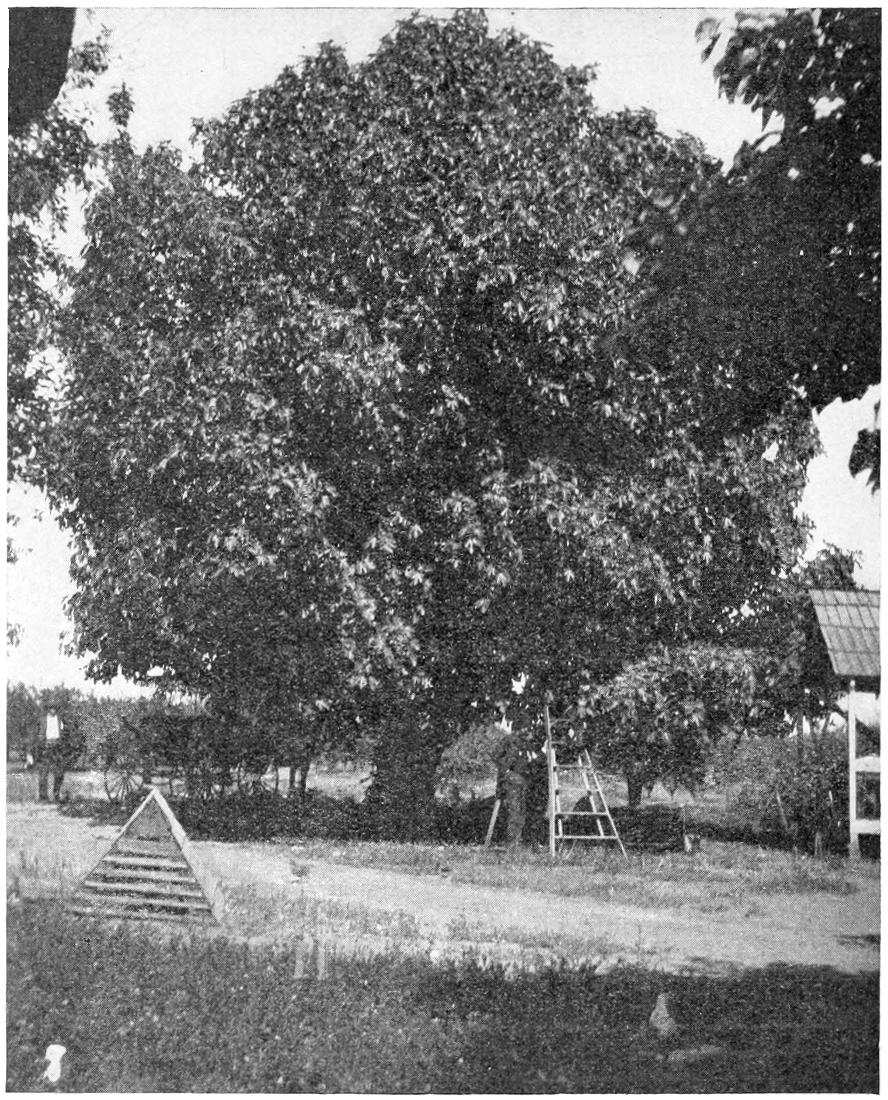
Fig. 51.—Fig Tree Thirty Feet High near Yuba, California.—(Photograph by H. W. Wiley.)
The interesting process of caprification is thus described by Professor Hugh N. Starnes of the Georgia Experiment Station:
“In the base or false ovary of the gall flowers, which are merely degenerate pistillates, the egg of the Blastophaga grossorum or fig wasp—a minute insect—is deposited and develops to maturity. The wingless males emerge first and, with their powerful mandibles, cut into the flowers containing the female wasps, partially release them, and impregnate them. The gravid females shortly complete the liberating process and, being winged, at once seek to escape for the instinctive purpose of laying their eggs. They emerge from the eye of the caprifig, after squeezing through the mass of pollen-covered anthers protecting the exit, and seek other fruit in which to lay their eggs. Naturally they would enter the nearest caprifig in the proper stage of development. But, meanwhile, if the caprifig containing the colony has been plucked from its stem and suspended in the branches of an adjacent Smyrna tree, the female on emerging forces her way in a fruit of the latter class, losing her wings in the process, and at once begins a frantic scramble around the interior, searching for the anticipated gall flowers in which to deposit her eggs. Failing, necessarily, to find them, and incapable of again taking flight, she finally curls up and dies heartbroken, but not until she and her companions have between them pollinated every female flower in the cavity with the plentiful store of pollen conveyed from the caprifig—thereby insuring the development of the fruit.”
Grape Fruit (Pomelo) (Citrus decumana).
—The so-called grape fruit or pomelo is one of the biggest products of the citrus family and also possesses properties which may be regarded as a cross between the lemon and the orange. It is more acid than the orange and more sweet than the lemon. This fruit is perhaps more highly esteemed than any other citrus variety for direct edible purposes, forming a breakfast dish which is eaten very extensively throughout all parts of the United States by those who are able to afford the luxury, for so it still is by reason of the high price of the product. Grape fruit grows to a large extent in the United States, and its culture is confined to the same region as that where the orange and lemon are grown.
Composition of Grape Fruit (Pomelo).
—The composition of the pomelo as given for the California product (Station Report, 1892, p. 256) shows this fruit to have the following composition:
Average weight, 357.00 grams
Rind, 23.50 percent
Seeds, 3.70 „
Edible portion, 72.80 „
Composition of the juice from the edible portion:
Total solids, 13.20 percent
Total sugars, 9.50 „
Acids (as citric), 2.70 „
Professor Colby says in discussing these analyses that the proportion of acid is larger in these samples than the general taste demands.
Cuban Grape Fruit.
—The grape fruit which is grown in Cuba has quite a different character. Its flavor is mild, and it is almost devoid of the bitter taste which is found in the American product, and which adds greatly to its palatable properties when the consumer becomes accustomed to it.
A marmalade is made from the grape fruit similar in all respects, except the peculiar flavor given by the raw material, to that made from oranges. It is evident from its high palatable properties and its wholesomeness that grape fruit will become more and more an article of value and be consumed in large quantities throughout the country.
Guava (Psidium Guajava).
—This fruit is grown very extensively in both California and Florida, also in Cuba, where a number of varieties grow wild. The white guava is a small, round fruit, grayish-white or yellow in color, and having an average weight of 1.5 ounces. The pear-shaped fruit, the guava of Peru, is about twice the size of the white variety, but otherwise resembles it very closely. Both varieties contain large numbers of small seeds scattered throughout the yellowish-white pulp. As a rule the guava is not eaten raw, but it is a fruit from which some of the most highly prized jelly pastes and preserves are made.
Composition of the Guava.
—The guava contains, in its fresh state, an average of a little less than 80 percent of water and a little more than 20 percent of solid matter. The solid materials in guavas are quite insoluble in water, more than one-half of them not passing into solution. The chief part of the soluble constituents of guavas are the sugars, and these exist chiefly in the invert state. The total percentage of sugar in guavas in the fresh state averages about six, the protein amounts to about one percent, and the ash to a little over one-half of one percent. The value of the guava, therefore, is more condimental than nutritive, and for this reason it is seen why it is not a valuable food product eaten in the raw state.
Guava Preserves.
—A large number of preserves are made from the guava, and these products are well known and relished throughout the country. The preserves are in various forms, being chiefly pastes, marmalades, and jellies. These preparations contain the aromas and flavoring qualities of the fruit, and when pure contain no added product save sugar. They contain from 60 to 75 percent of added sugar. The preserved products of the guava are generally packed in wooden boxes, lined with paper, though some are packed in glass. The crystallized guava, the guava cream, and the pastes contain large quantities of added sugar, namely, about 80 percent. These preserves naturally have a very low acid content by reason of the quantity of sugar which has been added in their preparation. In this country often the whole fruits are preserved in sugar sirup.
Hicaco (Chrysobalanus icaco).
—The fruit of the hicaco is small and round, varying from one to three inches in diameter. The average weight of each fruit is about 1⁄4 oz. The skin is thin and green in color, shading to red on the side exposed to the sun. It grows on a small shrub and is sometimes called the cocoa plum. The surface is somewhat shrivelled and wrinkled, and the seed weighs almost half as much as the whole fruit. The fruit is not eaten in a fresh state, but is used for making preserves. It is sweet to the taste and has a low acid content. The composition of the fresh fruit is shown by the following table:
Composition of Edible Portion
—68.9 percent.—
Total solids, 14.29 percent
Total sugar, 5.18 „
Protein, .46 „
Acidity, .10 „
Ash, .96 „
These data show that the hicaco is a fruit low in nutritive value, in so far as sugar is concerned, of a low content of protein and very slight acidity.
Hicaco Preserves.
—A sample of hicaco preserves was found to have the following composition:
Total solids, 65.07 percent
Sugar, 60.08 „
Protein, .12 „
Ash, .14 „
Acidity, .05 „
The above data indicate only the change in composition which would come from adding the sugar in the process of manufacture. By reason of the low acidity of the fruit the sugar in the preserves would, theoretically, be largely cane sugar. In the case mentioned, however, one-third of the sugar was inverted. Whether this was accomplished by the action of the acid on the sugar during the process of manufacture or whether by the use of molasses instead of sugar in the preserves does not appear. More likely it is due to the latter.
Kumquat (Citrus japonica).
—The kumquat is one of the smallest of citrus fruits. It stands as one extreme of that important family of which the grape fruit or pomelo represents the other. The fruit is oval in shape, about one inch in diameter, and is one and one-half inches long. It may be regarded as a dwarf orange, and was brought into the United States from Japan, although it is a native of China. The name—kumquat—is of Chinese origin and is intended to mean “Gold Orange.” The kumquat tree, under favorable circumstances, reaches a height of 10 or 12 feet and forms a compact, symmetrical, and handsome head. The pulp of the fruit is very tender and agreeably acid and the rind is spicy, as is the case with most of the acid fruits. It is not only valued as a fruit, but the tree is also highly prized as an ornament. Its beautifully colored fruit, in contrast with its green leaves, presents a most agreeable spectacle. It is grown in the United States principally in Florida. The composition of the kumquat is practically that of the orange.
Lemons.
—The citrus fruit, next in importance to the orange, if not more important, is the lemon (Citrus limonum). This fruit is grown extensively in the United States in the same localities that produce the orange, that is, chiefly in Florida and southern California. Its method of cultivation, general treatment, time of ripening and harvesting are the same as that of the orange. Its principal difference from the orange is in its greater acidity and in certain peculiarities of its aromatic and oily substances. From the rind is produced an essential oil which, while resembling that of the orange in general character, has distinct properties which easily discriminate it from the orange product. The lemon also has a correspondingly less proportion of sugar than the orange. In 22 analyses of California lemons they were found to contain 5.26 percent of acid and only 2.33 percent of sugar. The distinct feature of the lemon, therefore, is its acidity. The principal acid present in lemons is citric acid, though other organic acids are also found. The acids are either free or in combination with a base, the principal base being potash. On account of its high acidity and low sugar content the lemon is used more as a relish and in the manufacture of acid beverages than directly as a food. There are some varieties known as sweet lemons which are eaten as oranges or used directly for food purposes, but generally the lemon is too sour and acid for consumption in this manner.
Lime.
—A species of citrus fruit which is even more acid than the lemon is known as the lime (Citrus hysrix acida).
Limes are not eaten directly as food on account of their high acidity, but their expressed juice is sold throughout the world for beverages and medicinal purposes. The lime also yields an essential oil, which is very similar in character to that derived from lemons. In fact the lime may be regarded as a very sour lemon, just as the orange may be regarded as a very sweet one.
Adulteration of Lime Juice.
—Unfortunately lime juice is offered on the market often in entirely spurious forms, that is, a mixture made up with flavoring of an acid character resembling that of the natural juice. The natural juice is also frequently adulterated by the addition of preservatives. Among these, sulfurous and salicylic acids are perhaps the most frequent. Lime juice can be perfectly preserved by sterilization, and there is no necessity for the use of preservatives therein.
In the tropics there is also found a lime of a saccharine character known as the sweet lime, but this fruit does not have a very great vogue.
Mamey Colorado.
—This is a tropical fruit which is very extensively grown in Cuba, and derives its local name from a very slight outward resemblance to the mammee (Mammea americana). These two fruits, however, have no botanical or other relation to each other, nor do they have any internal resemblance. The mamey colorado is chocolate brown in color, oval or round in shape, and its average weight is about 1.5 pounds. The skin is thick and coarse. The pulp has a yellowish color, varying to a deep scarlet, and is slightly fibrous and firm, but mealy and rather dry. It has a sweetish taste with very little acid flavor. It is eaten chiefly in the fresh state and is also stewed with sugar. The fruit usually contains but one seed, though as many as four are sometimes found. The seeds are imbedded in a soft core and are irregularly oval. The natural season is from December to August. These fruits are very largely used for making preserves.
The composition of the mamey colorado is as follows:
Composition of Edible Portion
—86.10 percent.—
Solids, 34.01 percent
Total ash, .80 „
Acid, .10 „
Total sugar, 22.05 „
The analysis shows that the mamey colorado is a fruit which in its edible properties and nutritive value very closely resembles the banana.
Mamey de Santo Domingo (Mammea americana).
—This is a fruit extensively used in Cuba and other tropical countries. It is of a light brown color, from three to ten inches in diameter, and weighs sometimes as much as 11⁄2 pounds. The skin is thick and fibrous, the outer surface being tough and covered with small brown spots. The pulp is dark yellow in color, firm, and very juicy. It has a sweet characteristic flavor and a pleasant aromatic odor. The seeds sometimes measure three inches in diameter and cling tenaciously to the pulp. It is very commonly eaten raw and is highly esteemed for preserving purposes.
The composition of the mamey de Santo Domingo is shown in the following table:
Composition of Edible Portion
—60.70 percent.—
Solids, 14.12 percent
Total ash, .31 „
Acids, .42 „
Protein, .49 „
Total sugar, 9.47 „
The above data show that this fruit is very much less sweet and very much more acid than the mamey colorado and for nutritive purposes is of much less value, but by reason of its greater acidity and higher flavoring it is more suitable for the manufacture of preserves than the fruit resembling it in external appearances and name. It is used extensively in the manufacture of preserves and marmalades which are so similar in composition as not to be distinguished from each other by their chemical analyses.
The compositions of a preserve known as mamey en almibar and a marmalade known as mermelade de mamey are shown in the following table:
Solids. Total Ash. Acids. Protein. Total Sugars.
Percent. Percent. Percent. Percent. Percent.
Mamey en almibar, 60.05 .154 .194 .363 57.45
Mermelade de mamey, 69.74 .149 .123 .269 62.68
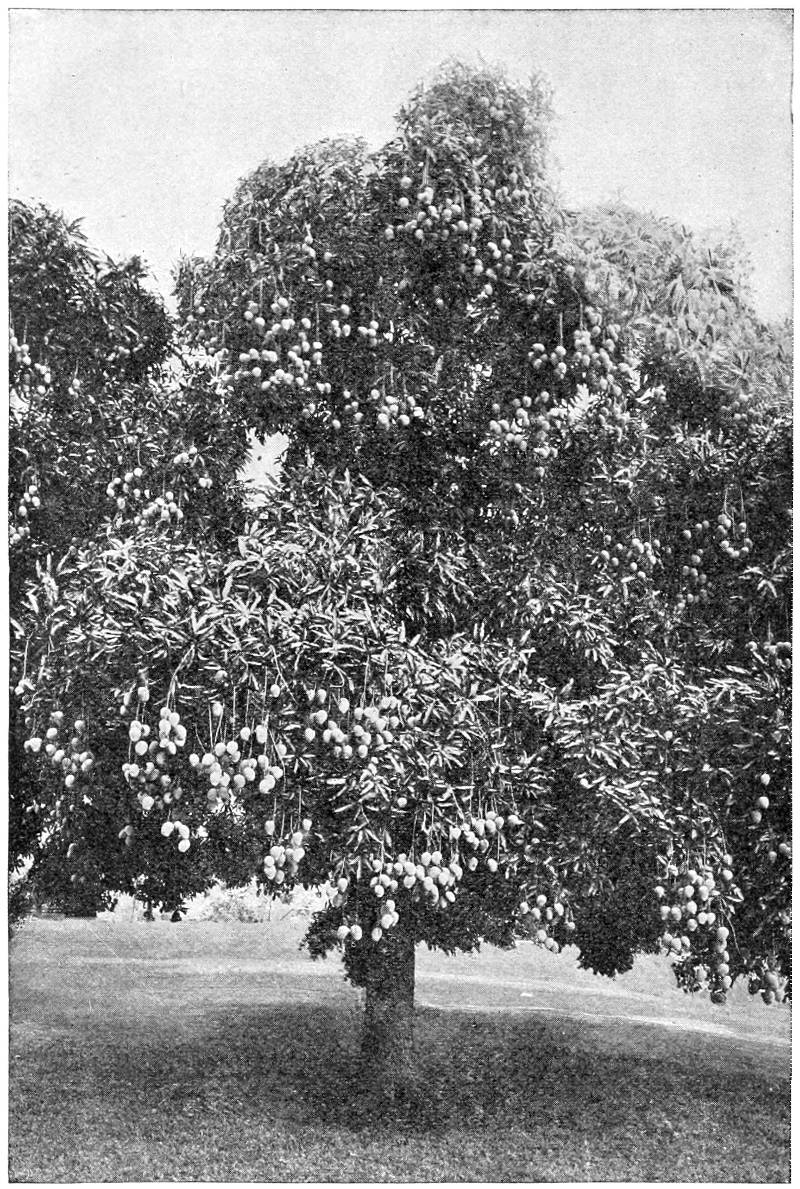
Fig. 52.—Jamaica Mango Tree.—(By permission American Nut and Fruit Co.)
Mango (Magnifera indica L.).
—The mango is a fruit which is highly prized throughout the world. It is a native of southern Asia, where it has been known from earliest times. In the United States the mango is chiefly grown in Florida as a horticultural crop. The mango is a tree peculiarly sensitive to frost, and therefore does not grow as far north as oranges. Its profitable cultivation at present is confined to the extreme southern part of the Florida peninsula.
The mango is an evergreen tree. In Florida, under favorable conditions of growth, it reaches as high as 40 or 50 feet. It makes a tree of graceful appearance with a dense, dome-shaped top. The color of the mango fruit is varied; it may be red, green, or yellow, or a mixture of these colors. The tree and fruit both possess an agreeable odor, and every part of the tree, almost, can be of some economic value. The ripe fruit is a delicious dessert and is wholesome. It is often recommended for its medicinal properties. The rind and fiber, as well as the unripe fruit, are acid and full of tannin, which makes them astringent to the taste. Mangos may be eaten in the raw state, and they are also valued for making preserves, pickles, marmalades, and jelly. A very popular sauce known as mango chutney is prepared from the mango and is largely used in the United States and England, being mostly imported from India. The appearance of the tree is shown in Fig. 52.
Oranges (Citrus aurantium).
—This fruit is characterized by its delightful flavor and by the distribution of certain aromatic oils, especially in the rind, which give it a peculiar aroma and flavor. The orange has a thick yellow rind which, while edible, is not usually eaten, but is the source of valuable essential oils. A large part of the orange, as far as weight is concerned, is not usually eaten; usually from 25 to 40 percent of the weight is in the rind or some inedible portion. The ash of the orange is usually less than one-half of one percent. The predominant organic acid of the orange is citric, although other organic acids are present. The quantity of protein present in an orange is very small, usually not exceeding very much a half of one percent. The quantity of sugar varies greatly in different samples. It is present both as cane sugar or sucrose and as reducing or invert sugar. In the very sweet orange the quantity reaches as high as 10 percent or even greater, while in the sour orange it is less. The principal food value of the orange, as far as nutriment is concerned, is its sugar. The orange, however, has other valuable properties, especially from a hygienic standpoint, aside from its nutriment. The organic salts which it contains, the organic acids, and other condimental material make the orange an exceptionally wholesome fruit, exercising a beneficial effect upon the digestive process and especially aiding in the passage of the undigested food through the alimentary canal. The orange is a fruit which has lasting keeping qualities. It is not unusual to see ripe oranges which are edible hanging on the same tree with the blossoms which are blooming for the next year’s crop. In California and Florida the oranges begin to ripen in November and may be continuously harvested until the following April, if it be advisable to leave them on the tree for that length of time. Owing to the thick and resistant skin of the orange, it can be kept for a long time without material deterioration after harvesting, if care be taken to avoid bruising or injuring the fruit in any way while handling. Oranges thus harvested and wrapped in paper and kept at a low temperature will keep for weeks and even months, and still be edible and nourishing. This property of the orange makes it possible to supply the markets of the world practically throughout the entire year with one of the most delicious and nutritious of fruits. In former years the orange was regarded as a luxury, but at the present time it is a staple article of diet even for people in moderate circumstances, and is often eaten by those who are poor. In Fig. 53 is given a typical illustration of a California orange grove.
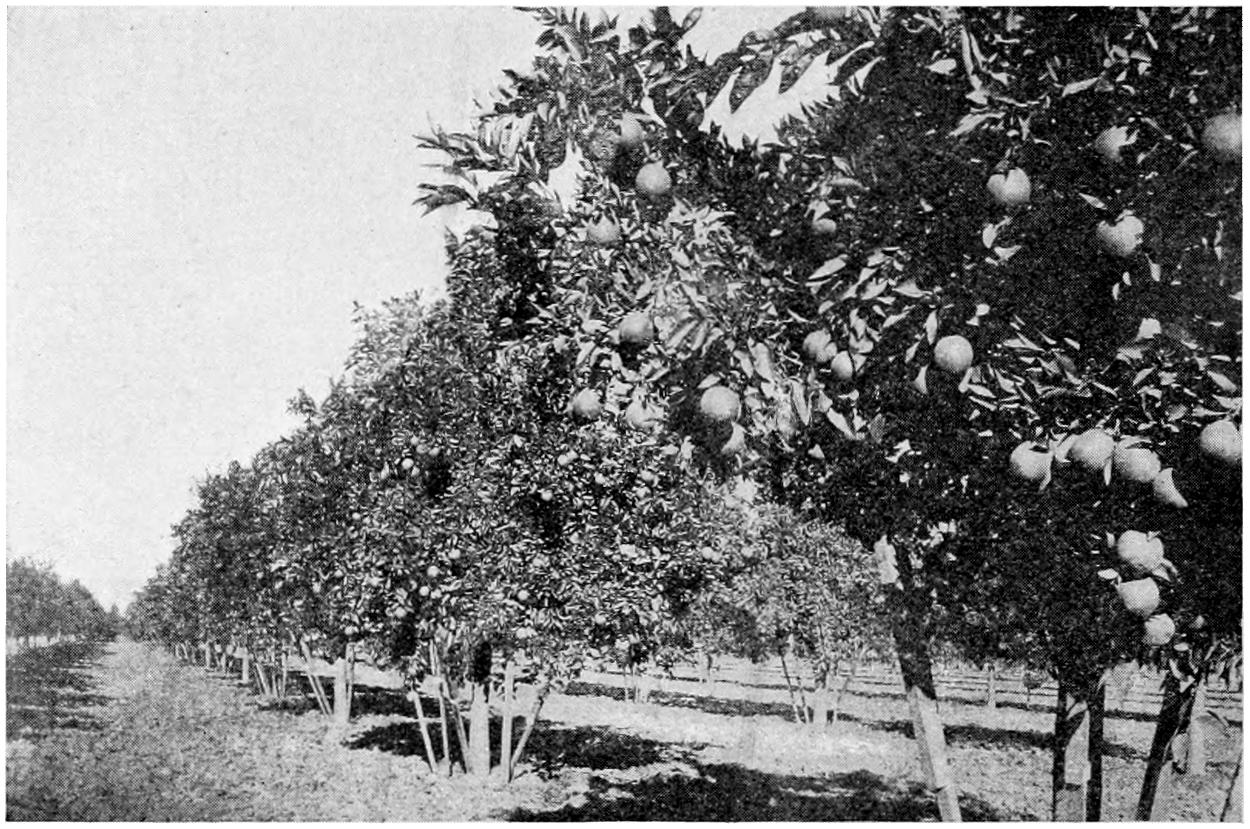
Fig. 53.—An Edge of a California Orange Grove.—(Bureau of Plant Industry.)
The culture of the orange has demanded the highest agricultural and scientific skill, and perhaps there is no crop produced to which greater attention has been paid. In Florida, especially, the oranges are grown on soil which is not much more than poor sand, and hence the scientific feeding of the trees, that is, the fertilization of the soil in which they grow, is necessary to success. As a result of this application of science luxuriant crops of oranges are found growing upon sandy soil which without scientific treatment would be almost barren. The soils in southern California, on the other hand, are very rich in natural plant food, but this does not obviate the necessity of scientific manuring. Oranges grow throughout the year in tropical and semi-tropical regions. It is considered by connoisseurs, however, that the oranges grown in the semi-tropical regions, that is far enough north for a little frost to come during the winter, but without a sufficient degree of cold to injure the trees, are of better quality than those grown in tropical regions where frost is unknown.
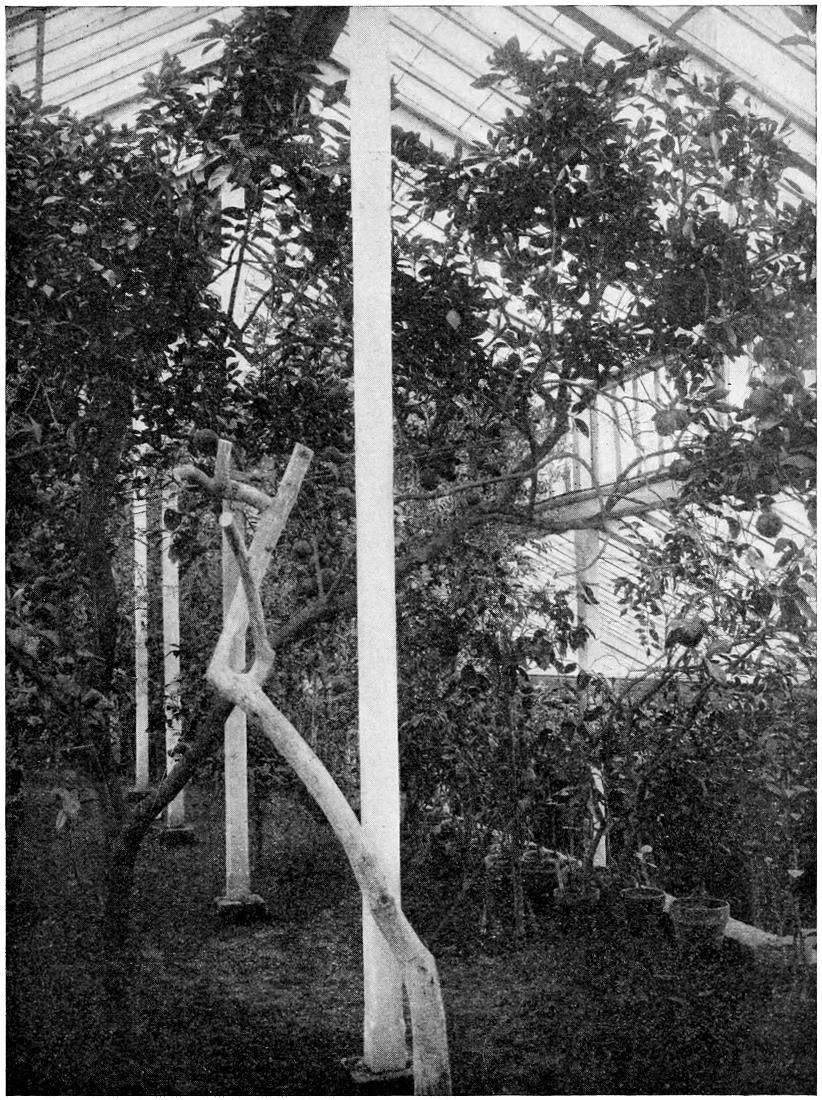
Fig. 54.—The Original Seedless Orange Tree.—(Courtesy Bureau of Plant Industry.)
The Seedless Orange.
—The variety of orange which contains no seed has been widely cultivated in the United States, and by reason of the absence of seeds is more highly prized by many than the ordinary orange for edible purposes. Since the orange tree has been cultivated by grafting rather than by direct production of the different varieties from the natural seed, it has been possible to secure a fruit without seeds. Whether such an unnatural product will continue to maintain its high rank as an edible product remains to be seen. The seedless orange tree, from which are descended the greater part of these trees in the United States, was secured by Mr. William Sanders from Bahia. Its present appearance in the greenhouse of the Department of Agriculture is shown in Fig. 54. The naval orange is exceedingly beautiful as it grows upon the tree. A bunch of these oranges growing on the parent tree in Washington is shown in Fig. 55.
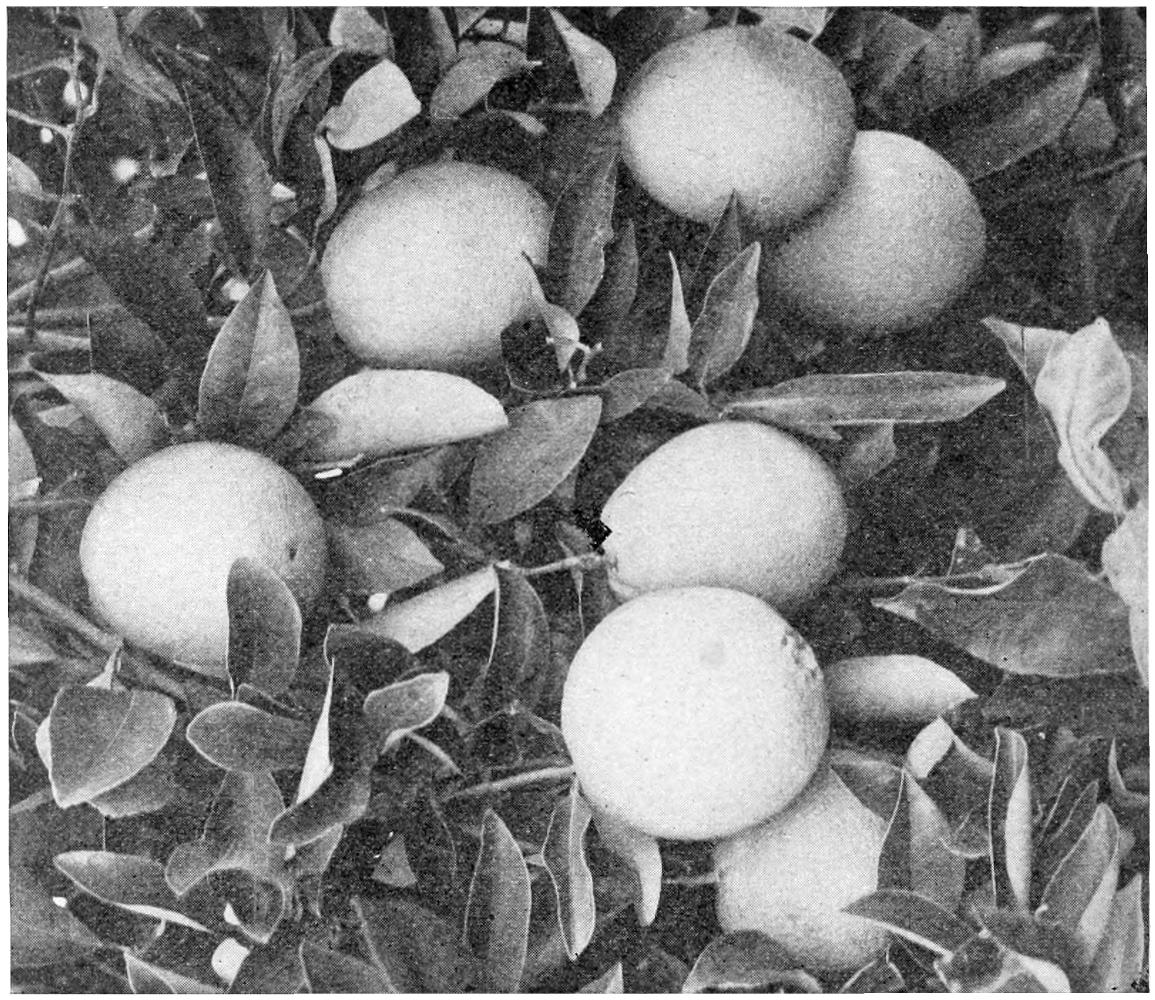
Fig. 55.—A Group of the Washington Navel Orange on the Tree.—(Courtesy Bureau of Plant Industry.)
Pineapple.
—The pineapple is a fruit grown very extensively in tropical and also subtropical countries. It is a crop of great importance in Florida. The flavor and aroma of the pineapple grown in subtropical countries is often preferred to that of the tropical grown fruit. Pineapples grow best when sheltered to some extent from the direct rays of the sun. In Florida it is planted near live oaks, where a partial shade is secured. It is often artificially covered by means of narrow boards placed near together and yet leaving abundant space for the sunlight. Sometimes these covered fields are two or three acres in extent. In Fig. 56 is given a representation of the pineapple growing under a covering of this kind in Florida at the Agricultural Experiment Station, Lake City.
Formerly pineapples were regarded as great luxuries, and often were set up in the center of the table as an ornament rather than as a dessert. They have now become very common and are frequently used as a dessert, for flavoring ice cream, for preserving, and for general use as a fruit.
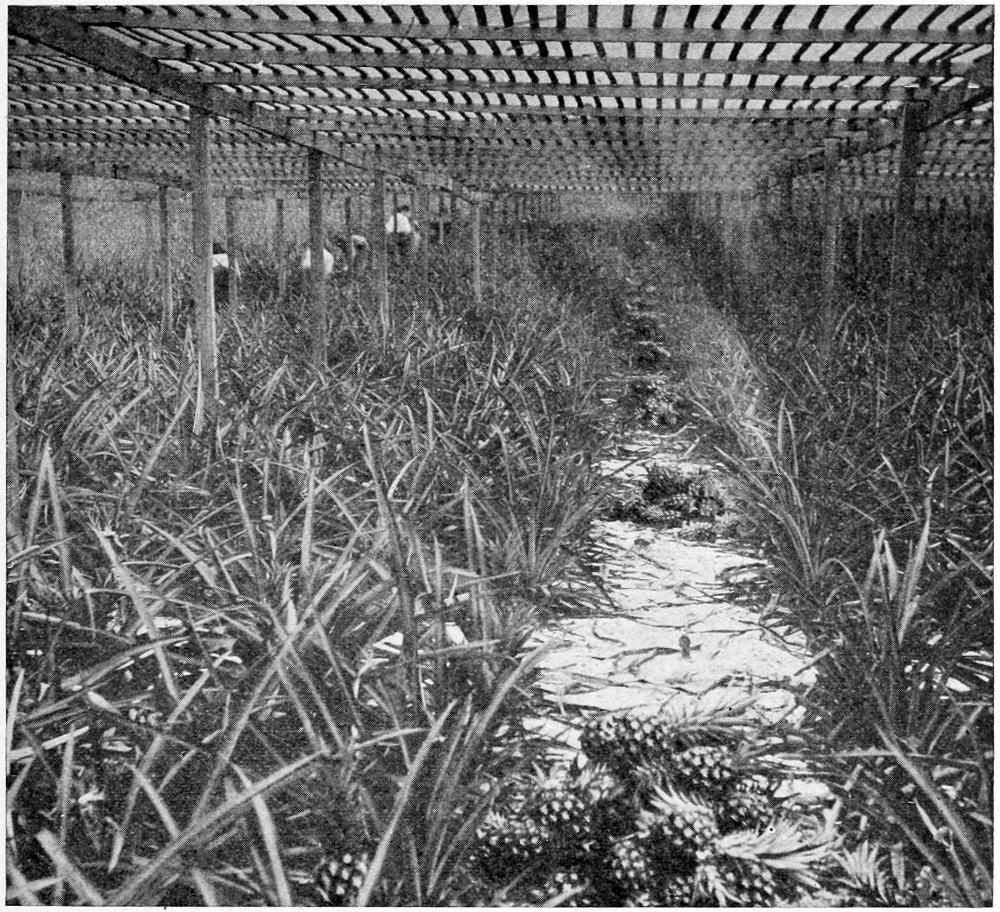
Fig. 56.—Covered Pineapple.—(Courtesy of Florida Experiment Station.)
Adulteration of Pineapples.
—The only adulterations which are found in pineapples are of course in the canned product. Investigations in the Bureau of Chemistry show that adulteration is not extensively practiced, unless the addition of cane sugar without notice can be so regarded.
From the point of view of the collection of duties, the addition of cane sugar without notice is an adulteration, since under provision of law pineapples canned in their own juice pay one rate of duty and when preserved with sugar pay another. Inasmuch as the label of a food product should tell the whole truth concerning it, the addition of cane sugar, without notice to that effect upon the label, is calculated to deceive and should not be practiced. There is no objection of any kind to the use of cane sugar in the canning of pineapples if the label indicates that this has been done. On the other hand there is no reason why the addition of sugar should be practiced. The pineapples are bought and consumed for their natural flavor, and not on account of the added sugar which they may contain. In the canning of pineapples it is just as easy to secure complete sterilization in their own juice as it is to secure it with the added sirup. In practice, however, it is more convenient after filling the cans with the pieces of pines to add a sugar sirup to fill up the spaces than to secure sterilization by the application of heat alone, which would not cause a sufficient quantity of juice to exude to fill up the interstices of the cans, and they, therefore, would be partially empty.
Canned Pineapples.
—There is a very large trade in this country in canned pineapples imported from Singapore and the Straits Settlements and the Bahamas. The pines are usually canned with the addition of sugar, and those that come to our ports are as a rule sweetened only with cane sugar.
A large number of analyses has been made of these canned pineapples in the Bureau of Chemistry and the general data which were secured are presented below:
Canned pineapples from Singapore, average, maximum, and minimum composition:
Solids. Sugar. Protein. Ash. Acidity.
Percent. Percent. Percent. Percent. Percent.
Average, 20.15 17.90 .46 .28 .30
Maximum, 25.30 25.10 .60 .36 .43
Minimum, 18.18 14.87 .39 .21 .16
The above data show that it is possible to compute the average quantity of sugar which is added in the preparation of the sample. If we assume in round numbers that the natural pine contains 12 percent of sugar, we find that approximately eight pounds per hundred of fruit have been added in the preparation of the pines from Singapore.
Below is found the average, maximum, and minimum composition of ten samples of canned pineapples from the Straits Settlements:
Solids. Sugar. Protein. Ash. Acidity.
Percent. Percent. Percent. Percent. Percent.
Average, 21.04 18.45 .47 .26 .26
Maximum, 24.28 21.94 .57 .32 .32
Minimum, 17.32 14.54 .39 .22 .17
These data show that the preparation of the pines in the Straits Settlements for shipment in cans is the same as that in Singapore. The average amount of sugar added appears to be about one percent greater.
Average composition of canned pineapples from the Bahamas:
Solids. Sugar. Protein. Ash. Acidity.
Percent. Percent. Percent. Percent. Percent.
Average, 13.78 10.69 .34 .38 .57
Maximum, 26.78 22.43 .46 .50 1.18
Minimum, 8.54 6.33 .20 .22 .22
The above data show that nearly all the canned pineapples coming from the Bahamas must be regarded as canned in their natural juice without the addition of sugar. Of the whole number of samples examined, only four gave any indication of containing added sugar.
Composition of the Pineapple.
—The average composition of twenty-two samples of fresh pineapple grown in Florida, as determined in the Bureau of Chemistry, is as follows:
Total solids, 13.85 percent
Total sugar, 11.69 „
Protein, .40 „
Ash, .42 „
Acidity, .52 „
Of the sugars 4.44 percent existed in the form of invert or reducing sugar and 6.88 percent as cane sugar. These data show that the value of a pineapple as a food product lies chiefly in the sugar which it contains. The ethereal and aromatic properties of the pineapple give to it its chief value as a food, since it is the flavor and aroma rather than the nutriment in the fruit which make it valued as a food. These flavors and aromas are due to essential oils and ethers or compound ethers, and they exist in such minute quantities as to escape ordinary chemical investigation. A study of the details of analyses show that there is a wide variation in the percentage of sugar. In two instances the total sugar fell below eight percent, but those evidently were green and imperfect samples and were not included in the general average.
The highest quantity of sugar found in any case of a Florida pineapple was 15.28 percent.
The data show that in general it may be said that the Florida pineapple contains nearly 12 percent of its weight of sugar.
Average Composition of Cuban Pineapples.
—The average composition of 10 samples of Cuban pineapples examined in the Bureau of Chemistry is shown in the following data:
Total solids, 14.52 percent
Sugars, 11.87 „
Protein, .40 „
Ash, .35 „
Acidity, .56 „
These data show that the Cuban pineapple is only a trifle sweeter than that grown in Florida and has in general the same composition.
The Florida pineapples when placed on the market have qualities which are by most connoisseurs judged to be superior to those of Cuban origin, although these qualities are not indicated by any marked difference in the analytical results.
The average composition of Bahama pineapples, examined in the Bureau of Chemistry, is given in the following table:
Total solids, 14.81 percent
Sugar, 12.22 „
Protein, .48 „
Ash, .40 „
Acidity, .77 „
The Bahama pineapple, as is seen by the above data, is somewhat sweeter than the Florida or Cuban grown fruit and also has a higher acidity.
Average Composition of Porto Rican Pineapples.
—Two samples of Porto Rican pines, examined in the Bureau of Chemistry, had the following composition:
Total solids, 15.91 percent
Total sugar, 15.36 „
Protein, .48 „
Ash, .37 „
Acidity, .72 „
The other samples of pines coming from Porto Rico were so immature that it was found they contained only about one-half the percentage of sugar and one-half the total solids of the ripened fruits. They were probably harvested in an immature state in order to withstand the vicissitudes of transportation. The above data show that the ripe pines of Porto Rico are even richer than those of the Bahamas in sugar and nutritive value.
The average, maximum, and minimum of all samples of the fresh pine from all countries examined in the Bureau of Chemistry show the following composition:
Solids. Sugar. Protein. Ash. Acidity.
Percent. Percent. Percent. Percent. Percent.
Average, 14.17 11.90 .42 .40 .60
Maximum, 18.86 15.28 .57 .55 .85
Minimum, 10.78 8.20 .21 .27 .30
In order that some idea might be obtained of the composition of the pines grown at Singapore and Nassau, the consuls in those localities were requested to secure the preservation of the pines by sterilization without the addition of any substance, that is, their preservation in their natural juice. In this condition the fruit of the pine, naturally preserved, was sent to the Bureau of Chemistry and subjected to analysis with the following average results:
Average Composition
(ten samples from Singapore).—
Solids, 13.39 percent
Sugars, 11.73 „
Protein, .48 „
Ash, .38 „
Acidity, .39 „
Average Composition
(two samples from Nassau).—
Solids, 13.18 percent
Sugars, 10.86 „
Protein, .40 „
Ash, .41 „
Acidity, .58 „
The above data show that the pineapples grown in Singapore and Nassau are not notably different in composition from those grown in Florida, Cuba, and Jamaica. All the data indicate that the pineapples grown in different parts of the world have practically the same composition at the same state of maturity.
Sapota (Sapodilla) (Sapota zapotilla (Jacq.) Coville).
—This is a tropical fruit which is grown in large quantities in Cuba, where two varieties are known, differing only in shape, one being round and the other oval. In the Havana markets the latter variety is incorrectly known as the nispero. This name, however, is properly applied to the fruit loquat (Eriobotrya japonica). The fruit is small, weighing usually under two ounces, has a brown or brownish-green color and in general appearance resembles a smooth, dark potato. The skin is thick and coarse in texture, the pulp is yellowish-brown in color, granular in texture, and rich in juice. The odor is characteristic, and the taste is quite sweet. The seeds number from one to five and are contained in a soft open core,—they are of a brownish-black color with a single white stripe. They measure from three-quarters to one inch in length. The fruit comes into use about the first of April and lasts until the end of summer. It is a very popular fruit in summer and deserves more attention in the various markets than it has yet received. The sap of the sapota tree and juice of the green fruit when concentrated furnish the material known as chicle, from which chewing-gum is made. The compositions of the round and long sapota and the natural preserved pulp of the sapota are given in the following table:
Composition of Edible Portion.—
Edible Portion. Composition of Edible Portion.
Solids. Total ash. Acids. Protein. Total sugar.
Percent. Percent. Percent. Percent. Percent. Percent.
Round sapota, 76.40 23.07 0.384 0.132 0.350 10.85
Long sapota, 80.90 21.01 .555 .162 .650 12.76
Natural sapota preserves, .... 22.95 .399 .086 .231 11.30
The sapota is also used in the manufacture of preserves by boiling it with sugar in the usual way. The analyses show that the sapota is a fruit which is principally valuable as a carbohydrate food. It has, however, very little acid, and is a much sweeter fruit than the anona and, therefore, more pleasant to the taste.
Star-apple (Cainito) (Chrysophyllum cainito).
—The star-apple is one of the less important fruits which abound in Cuba. It is not very extensively used, but medicinal properties are attributed to it. Three different varieties are sold in the Havana markets,—one of a white color and two purple. The first attains the size of a small apple, approaching about seven ounces in weight. There are two kinds of meat in the pulp; the outer portion is a white, gelatinous matter which contains the small black seed and is really the edible portion, and constitutes about one-third the weight of the fruit. The outer fibrous and purple portion of the flesh is inedible. The inner pulp has a sweet characteristic flavor and is eaten raw. No preserves were found made of this in Cuban markets. The composition of the white star-apple is shown in the following table:
Composition of Edible Portion
—41.80 percent.—
Solids, 14.23 percent
Sugar, 7.91 „
Protein, .67 „
Ash, .35 „
Acidity, .05 „
These data show that the fruit is not of a very high nutritive order, and on account of its low acidity it is not suitable for the making of preserves.
Tamarind (Tamarindus Indica).
—This fruit belongs to the leguminous family and forms a dark brown pod from one to six inches in length and from three-fourths of an inch to one inch in width. The rind is thin and very brittle. Within the pod is found a dark-colored pasty material, closely attached to the seed sacks and joined to the stem of the pod by coarse fibers. This pasty material constitutes the edible portion of the fruit and has a very sour taste which serves to mask the large amount of sugar, sometimes as much as 30 percent, which it contains. The tamarind is remarkable as having the highest content both of acid and sugar of any of the edible fruits which are in common use. It contains more acid, for instance, than the sourest lime and more sugar than the sweetest fruit. The tamarind is not very largely used directly for edible purposes but is a component of many refreshing summer beverages and is used for flavoring other products. It has mild purgative properties, and hence its intermittent use in small quantities tends to keep in proper regulation the mechanical movements which are so necessary to normal digestion.
Composition of the Tamarind.—
Water, 47.47 percent
Acid, 6.03 „
Sugar, 31.43 „
Protein, 1.36 „
Ash, 1.56 „
The above data show that the tamarind is essentially of a carbohydrate nature, its chief food value being in the sugar which it contains. On account of its high acidity very little of the sugar which is present is in the form of sucrose or cane sugar, but is mostly in an invert condition.
Preparation of Tamarinds.
—Tamarinds are not only used directly but most extensively in the form of tamarind paste which is made up chiefly by the addition of cane sugar to the pulp; as much as 75 percent of sugar is often added to the making of paste. Another form of preparation is called tamarind pulp, which has practically the same composition as the paste. These two bodies may be called tamarind preserves. The proportion of pulp to added sugar is about as 20 to 80.
Mineral Constituents of Tropical Fruits.
—The mineral content of the edible portions of fruits is important, both from a dietetic and chemical point of view.
The mineral substances in fruits not only add to their palatability but also have important functions in digestion and assimilation. The lime and phosphoric acid which the ash of fruits contain are foods that nourish certain tissues of the body, such as the bones. The other mineral ingredients of fruits take an active part in the circulation of the fluids of the body. Since the modern development of physiological chemistry, what is known as osmotic force, or the power that causes solutions to pass through membranes, is believed to be due largely to the mineral constituents of the juices of the body. These mineral constituents are therefore necessary in the food. The following table gives the total quantity of ash in the edible portion of the tropical fruits named, together with the composition of the ash in respect of its most important constituents (Bulletin 87, Bureau of Chemistry):
ANALYSES OF THE ASH OF THE EDIBLE PORTION OF THE SEVERAL FRUITS.
Description of Sample. Total Ash. Silica (SiO2). Potash (K2O). Lime (CaO). Mag- nesia (MgO). Ferric Oxid (Fe2O3). Phos- phoric Acid (P2O5). Sul- furic Acid (SO3). Chlo- rin (Cl).
Per- cent. Per- cent. Per- cent. Per- cent. Per- cent. Per- cent. Per- cent. Per- cent. Per- cent.
Orange (china), 0.52 1.01 40.66 10.26 5.27 1.09 8.56 2.84 2.44
Orange (rough skin), .55 .. 49.15 2.62 1.41 4.51 7.42 3.42 1.50
Orange (sour), .57 .. 45.09 7.95 2.17 2.40 8.70 2.72 .98
Grape fruit, .39 .. 44.19 7.34 3.92 1.28 11.09 3.39 1.38
Lime, .98 .. 43.01 7.84 2.36 .. 8.45 2.62 4.07
Sweet lemon, .98 .. 54.35 4.29 1.08 .. 9.83 4.09 1.32
Tamarind, 1.56 15.57 [34] .. .68 2.19 .. 4.99 1.40 .48
Guava, .84 1.13 55.00 2.48 1.64 .. 8.29 3.58 5.33
Banana (niño), .70 .. 46.46 .95 .42 .. 10.36 2.36 6.59
Banana (oronoco), 1.08 .. 52.41 1.02 1.90 .. 5.16 3.32 8.48
Banana (colorado), .83 .. 51.47 .37 .65 .. 3.25 2.77 7.63
Mango (French), .53 .. 47.37 6.38 1.62 .. 6.49 3.67 3.88
Mango (Filipino), .41 1.75 51.79 1.74 3.25 .. 9.04 4.88 1.56
Manga, .78 2.14 49.37 2.38 .. .. 5.57 3.84 4.20
Guanabana, .86 1.48 48.93 .44 2.17 .. 9.15 4.54 3.40
Anona, .80 .63 47.27 .81 2.07 .. 13.63 3.19 3.51
Chirimoya, 1.04 .. 49.73 2.21 .66 .. 6.57 4.49 7.40
Sapota, .50 .. 43.13 7.49 2.83 .. 2.74 4.55 17.41
Mamey (colorado), .80 .. 50.57 1.38 1.36 .. 4.90 3.54 17.34
Do., .89 .. 48.20 1.73 3.35 .. 9.66 3.80 16.00
Hicaco, .91 .. 35.15 5.84 4.51 .. 3.09 4.77 18.62
Cainito, .35 .. 54.75 1.31 .. .. 11.00 5.50 9.46
Pineapple, .. .. 59.18 9.44 5.52 .. 6.51 3.04 3.22
Do., .. .. 57.13 4.80 3.44 .. 4.29 3.65 4.08
The above data show that the percentage of ash in the edible portion of tropical fruits is never very high. In only three instances in the above table does it exceed one percent and in two of those only slightly. The principal mineral constituent is potash, which in round numbers may be said to constitute one-half of the total ash. Of the acid constituents phosphoric acid is the most important. In four cases the amount of phosphoric acid is greater than 10 percent of the total weight of the ash. The proportion of sulfuric acid in the ash is quite constant, while the amount of chlorin varies from less than one-half of one percent to more than 18 percent.
In this case of high ash there is a low content of phosphoric acid, which leads to the supposition that the chlorin is partially or wholly combined with sodium and potassium. In addition to the elements mentioned above the ash of edible fruits often contains notable quantities of silica and sometimes considerable quantities of sand, added accidentally or by the collection of dust. The ash of fruit also quite universally contains iron. In some cases the quantity of iron amounts to as much as four percent of the total weight of the ash. The data in the above table are calculated on the percentage of total ash and not on the percentage of pure ash, that is, ash deprived of its carbon, sand, and carbonic acid.
There are some peculiarities in the composition of the ash of tropical fruits to which attention may be called. The citrus fruits contain somewhat larger amounts of lime and iron than ordinary fruits. The ash of the tamarind contains large quantities of silica. The ash of the banana has a low content of lime and magnesia and a high content of chlorin. Attention is also called to the fact that in the ordinary combustion of an organic substance to secure the mineral matter notable quantities of the phosphoric acid and chlorin contained may be lost. Therefore, the data for phosphoric acid and for chlorin are probably lower than would be the case if all of these substances present in the fruit had been secured in the ash. The ash of pineapples is not peculiar in any respect, nor does it contain any marked amount of a constituent by which it can be identified. The pineapple, as is seen, contains slightly more potash than the other tropical fruits.
Sugar and Acid in Fruit.
The palatable quality of fruit depends largely upon the aromatic substances which they contain in the form of essential oils, esters, and ethers, and especially upon their sugar and acid content. The sweet taste of sugar in fruits and also often in nuts is modified and relieved by the acid or astringent materials, chiefly tannin, with which it is associated. In the analyses indicating the composition of fruits and of nuts and also of vegetables the sugar has not always been given separately, but as one member of a group consisting of sugar, starch, and cellulose materials soluble in weak acid and alkalies, and for this reason deemed to be digestible. It seems advisable to supplement this information with a special table giving the average quantity of sugar and acid found in some of the principal fruits. It must not be forgotten that in individual cases the quantity of sugar and acid may vary largely from the average, but the following data may be regarded as expressing very accurately the average content of sugar and acid in the common fruits.
Sugar. Percent. Acid. Percent.
Apples, Rhode Island Greening, 10.95 .70 as malic
Apples, Winesap, 11.95 .50 „ „
Apples, Northern Spy, 11.80 .70 „ „
Apricots, fresh, 11.01 1.15 „ „
Apricots, dried, 29.59 2.52 „ „
Bananas, 20.28 .30 „ sulfuric
Blackberries, 5.78 .77 „ malic
Cranberries, 1.52 2.34 „ „
Currants, 6.70 2.24 „ „
Grapes, 7.90 -26.40 .59 „ tartaric
Lemons, .37 5.39 „ citric
Oranges, 5.65 1.35 „ „
Peaches, 7.88 .56 „ sulfuric
Pears, 9.11 .19 „ malic
Pineapples, 11.50 .60 „ sulfuric
Plums, 14.71 .77 „ malic
Prunes, 16.11 .32 „ „
Raspberries, 5.33 1.48 „ „
Strawberries, 6.24 1.10 „ „
In the above data the acidity is determined as malic acid in apples, blackberries, and strawberries, in which the predominant acid is malic. In cranberries one of the acids is benzoic, amounting sometimes to as much as 0.05 percent, in grapes tartaric, in lemons and oranges citric. In the other fruits where the character of the organic acid is not distinctly of one kind, the total organic acid is estimated as sulfuric acid (SO3), not meaning by that, however, that the acids are present in the form of sulfuric acid but merely that their quantity was measured in terms of sulfuric acid.
Canned Fruits.
The industry devoted to canning fruits is of less importance in the United States than that identified with canned vegetables. Practically, nevertheless, every fruit which has been produced in this country has become a commercial article in the form of canned goods. With the exception of the method of preparation, the process of canning and other treatments are essentially the same as that of vegetables and therefore does not warrant any further description.
In the following data are found a brief description and the composition of the leading varieties of canned fruit:
Canned Cherries.
—Cherries are one of the fruits which are valued for canning purposes. The pits may or may not be removed, according to the desire of the manufacturer and the demand of the consumer. The galvanic action which the cherry juice sets up on the tin plate tends to bleach the natural color of the cherry, and this action can be avoided by coating the interior of the can with a gum or some similar substance which entirely protects the metallic surface from contact with the juice of the fruit. When treated in this way the natural color of the cherry is preserved for a reasonable length of time.
Adulteration of Canned Cherries.
—The only adulteration of canned cherries which is of any consequence is that which relates to artificial coloring. By reason of the tendency to bleach the color, mentioned above, it has been quite customary to add an artificial color to the cherry so that the red color may be preserved. Coal tar dyes, under various names, and an animal dye, cochineal, have been used for this purpose. The practice of artificial coloring is reprehensible and may, in the case of some colors, be harmful to health. By observing the precautions already mentioned, the natural color of the cherry may be preserved without artificial color, and in general this is desirable. The consumer should at all times demand canned cherries which have not been artificially colored.
Maraschino Cherries.
—A very common method of treating cherries is to bleach them in a brine of common salt and sulfurous acid until all the natural color has disappeared. The cherries are then thoroughly washed for the removal of the salt and sulfurous acid and at the same time the juice and soluble portions of the cherry are removed, so that at the end of the washing there is little left but the cellular structure. The cherries are then saturated with sugar or sugar and glucose and colored a deep artificial red by coal tar dye or cochineal. If the natural flavor of cherries has been destroyed by the bleaching an artificial flavor is often added. The product is a cherry of an even deep red tint, more or less sweet, according to the use of greater or less quantities of sugar or glucose, and having a flavor of almond oil. When cherries of this kind are preserved in a solution of alcohol, flavored or unflavored, they are called maraschino cherries. The name is taken from a kind of cherry first used in making the product. They are used to a very large extent with certain beverages such as cocktails, soda water, mint juleps, etc., and also in ice cream and other preparations for the table. Little can be said in praise either of the taste or wholesomeness of these preparations and they are valuable chiefly for their supposed attractive appearance. The offense which is committed against the æsthetic taste of the individual in the preparation of such a product probably offsets any good effect which comes from attractiveness or ornamentation. The product cannot be regarded in any sense as resembling even in color the natural fruit, since practically the whole of the natural fruit, except its cellular structure, has been withdrawn and artificial substances substituted in place thereof.
Canned Peaches.
—A great industry in this country is the canning of peaches. Some of the finest and most perfect varieties are used for this purpose. Peaches may be canned whole or by slicing in half or quarters and removing the pit. The principles of sterilization are not different from those which have already been described. Since the peach is a fruit which decays easily and is thus difficult of transportation, the establishment of canning factories in the vicinity of large peach orchards renders it possible to preserve this delicate fruit in a condition practically as good as that of the natural article, and thus makes it accessible to the people in all parts of the country at all seasons of the year.
Adulteration of Canned Peaches.
—Fortunately in this case there is no record of adulterations which is of any consequence. The perfection of the method of sterilization has rendered it unnecessary to make further use of antiseptics for canned peaches. The use of the artificial sweetening agent, saccharin, is almost unknown and is about the only adulteration which at the present time can be practiced without easy detection. It may be confidently stated that the consumer can rely, with a fair degree of assurance, upon the purity of the product which is taken from the can. The only real danger is in the action of the fruit juice upon the imperfect tin plate, and this is a danger which probably will soon pass away, since there is a tendency manifested now to so protect the tin by a varnish of some kind as to render it impossible for any electric action to take place which impairs the color or flavor of the fruit and also to exclude the poisonous salts of tin and lead from the contents of the can.
Adulteration of Canned Fruit.
—Artificial coloring: The principal adulteration of canned fruit is that due to artificial coloring. There is, perhaps, no other form of adulteration which has so little excuse. It only needs a cursory observation of the fruits of Nature to show that even in the same varieties they differ to a vast degree in natural tint. Bright colors are especially prized in fruits. For instance, the yellow of the peach, the red of the cherry, the purple of the plum, etc. The object of artificial coloring is to make all kinds and varieties of these fruits imitate those of naturally rich color. Its sole purpose is deception, since it can add nothing whatever to the nutritive value. The claim that it adds to the dietetic value of the fruit, as in other cases of the same kind of argument, is plainly fallacious. The very moment the consumer realizes he is eating an artificially tinted fruit, if his temperament be as artistic as should always be the case, he becomes sensitive to the effort made to deceive him. Such artificially colored foods, thus, instead of tasting better than they otherwise would, have a worse taste due to the feeling of antipathy excited by their presence. Hence there can be no excuse, under any circumstances, for the addition of artificial colors to food products of this kind, or in fact, of any kind except those which are purely synthetic and have no relation in composition or in quality to a natural product. With the exception of cherries and berries, the addition of artificial color to canned fruits is not common.
Another form of adulteration, which fortunately is seldom practiced in fruit, is one which has already been described in sufficient detail, that is, the addition of saccharin, a substance which has even less place in fruits than in vegetables. The addition of a non-sugar, such as saccharin, with an intensely sweet taste for the purpose of inducing the consumer to believe that the article is a natural sweet product, is an adulteration of the most reprehensible type, to say nothing of the evil effects of the adulterant employed upon health. The addition of spices and other condimental substances to fruit products cannot be regarded as an adulteration, because they reveal their own presence and are not added for the purpose of imitation or deception. As has been mentioned above, the manufacturer would save all criticism in such cases by a plain statement upon the label of the nature of the substance added.
Canned fruits properly preserved retain their natural aroma and flavor better than any other form of canned food and deserve the high estimation in which they are held by the consumer. The time is now rapidly approaching when all such goods will be free of any imitation or adulteration, and this will add greatly to their value in the markets of the country. The consumer will then only need to have the date of preservation marked on the can to be fully protected.
Fruit Sirups.
The expressed juice of fruits mixed with the proper proportion of sugar produces an important article of commerce known as fruit sirup. These fruit sirups are used principally in the preparation of cooling, non-alcoholic beverages such as are drunk at the “soda fountains” so-called in the United States. In the preparation of fruit sirups only the choicest and best fruits are to be used. The juice, after expression, is properly freed from suspended matter by filtration or sedimentation and is brought to a proper consistence by mixing at once with pure sugar. When it is used as soon as prepared no further preparation in regard to its preservation is necessary, since juice prepared in this way and kept in an ice-box will keep several days without fermenting. When prepared on a large scale for commercial purposes it becomes necessary to prepare these sirups in some more permanent form. To this end they are subjected to the usual process of pasteurization. On account of their liquid condition, sterilization, that is, the use of a temperature of boiling water, is rarely necessary. If, on pasteurization, a precipitate is formed in these sirups, they should be heated to the temperature of pasteurization previous to the final processing and any deposited matter be separated by filtration or deposit. The sirup thus clarified is placed in bottles or separate containers and subjected to the pasteurizing process for a sufficient length of time, and is then ready for the market. These pasteurized sirups, if stored in a cool place, will keep almost indefinitely. In all cases where pasteurization is practiced at a very low temperature it is necessary to keep the product at a low temperature, since, as is well known, pasteurization does not kill all the spores, but does act with deadly effect upon the yeasts which produce alcoholic fermentation. Fresh sirups thus prepared and pasteurized are wholesome and palatable and are unobjectionable.
Composition of Fruit Sirup.
—Naturally the principal constituent of fruit sirup is the added sugar. The other constituents correspond to those of the juice from which the sirup is made. As one of the principal constituents of fruit juice is sugar, it is seen that the natural sugar plus the addition makes up practically the total solid components in articles of this kind.
Adulteration of Fruit Sirup.
—Fruit sirups have been extensively and unnecessarily adulterated. The principal adulteration is the omission of the pasteurization process and the preserving of the fruit juice by means of an antiseptic. The two antiseptics which have been most commonly employed for this purpose are salicylic and benzoic acids. At the present time, by reason of prohibitive legislation in respect of salicylic acid, benzoic acid or its compounds are quite universally employed. These antiseptics are injurious to health and even in small quantities cannot fail to have some deleterious effect upon the system. As they are not necessary in the preservation of fruit sirups, they should be rigidly excluded therefrom. In justice to those who use antiseptics of this kind it is said that, as a rule, they frankly admit that these sirups can be preserved by sterilization, but that when consumed they are used only in small quantities, and when the air has access to the remaining portion fermentation is set up. To this the answer may be made that if unstoppered and used under proper conditions to avoid the admission of germs, and if kept on ice or in a cool place, fermentation will not set up for several days, during which time opportunity will be had for disposing of the contents of the bottle. It does not appear that there is any convincing reason to warrant the continuance of the use of preservatives in this kind of products.
Imitation Fruit Sirups.
—By far the most general adulteration of fruit sirups is that of the imitations thereof, pure and simple, by synthetic products. The flavors which give to fruits their character and aroma are chemical compounds produced by Nature and are chiefly of the nature of a volatile oil or compound ether. Of these flavors, the compound ethers especially are readily produced by purely synthetic processes. It is possible, therefore, for the chemist to make an approximate imitation of the natural fruit flavor. No difference how great his skill, however, or the skill of the mixer, there is always a gustatory and hygienic difference between the synthetic and the natural product, and the natural product always has the advantage of the difference. While I do not go so far as to say that synthetic flavors or sirups should be excluded in the preparation of non-alcoholic beverages, I do say with emphasis that they should never be used, except with notification to the consumer, and never, under any circumstance, if they contain any ingredient which is prejudicial to health.
One of the principal arguments which has been made against the enactment of the pure food bill has been that it would exclude from the market these synthetic products. At least let them be sold under their proper designations. A law which requires plain and honest branding can hardly be objected to on any ground whatever.
Jams, Jellies, and Preserves.
The preparation of various fruits or fruit juices with sugar is an important industry both for domestic purposes and for commerce in the United States. When the fleshy portion of the fruit is treated with sugar sirup and boiled, it produces the product known as preserves. When a fruit is reduced to a pulp and treated with sugar sirup and boiled, it makes a product known as jam. When the fruit juice itself is treated with sugar and boiled, it forms a product known as jelly. The above are general definitions of three important classes of fruit products, though it is not intended by any means in the definitions to describe the details of preparation. These vary greatly in respect of the method of preparation, the fruit, the quantity of sugar used, the length of time the boiling is continued, and the consistency of the final product. These definitions merely outline the three distinct classes of products which are made from fruits.
Selection of the Fruit.
—In the selection of the fruit for making these sweet products it is highly important that only the very best quality should be used. The fruit should be of a proper degree of maturity, and yet not overripe. The practice of using immature, waste, or partially deformed or decayed fruit for the purposes named cannot be too strongly condemned. The great advantage of preparing these products at the home consists in the fact that the character of the material used is under the immediate supervision of the housewife. In large factories where no official inspection is exercised it is possible that any kind of fruit or any portion of the fruit may be devoted to the purpose. All deteriorated raw material should be rigidly excluded from the factory. Various fruits are utilized in different manners in the preparation of the above-named products. Large fruits with tough skins, such as apples, peaches, and pears, are pared, the cores removed, and all decayed or infected portions cut away, and the clean, fresh, fleshy portion of the fruit used for manufacturing purposes. Small fruits, such as berries, after the exclusion of all dirt, immature or imperfect samples, and the removal of the stem, are used in the whole state for the purposes named.
It would be manifestly impracticable, as a rule, to remove even the seeds of small fruits, except where jelly is to be manufactured. The fruits, having been properly prepared, are mixed with sugar or thick sugar sirup and subjected to heat for two purposes. The first purpose of heat is to sterilize completely the material so that no bacteria, germs, or spores may be left alive in the finished product. The second purpose of heating is to concentrate the material to a proper consistence and to thoroughly saturate all portions with sugar sirup. Incidentally, the heating also by the combined action of temperature and free acids in the fruit inverts a large quantity of the cane sugar that is used and thus prevents the finished product from granulating. The crystallization of the sugar in these bodies renders them very much less desirable and suitable for consumption. For this reason, among others, the precaution above mentioned, namely, that the fruit should not be overripe, should be observed. It has been seen that overripe fruit diminishes in acidity, and hence it is less suitable for converting the cane sugar than fruit just short of complete maturity. For this reason, too, the more strongly acid fruits are better suited for making these sweetened products than those in which the acidity is less strongly developed.
Jams.
—As has already been said, jams differ from jellies in that they contain not only the juice of the fruit but the whole pulp of the fruit or the whole fruit. The methods of preparation in effect produce the same changes upon the sugars that are produced by the fruit juice. The fruit after proper comminution is boiled with large quantities of sugar a sufficient length of time to reduce the fruit flesh to a pulp and to invert more or less of the sugar which is used. The insoluble matter which jam contains consists chiefly of the cellulose and pectose matter in the fruit, together with the seeds of the small fruit. The various solids are made up of the solid bodies in the fruits, including the sugars which are added. The character of the ash of the jams is a good indication whether or not they are pure, that is, made out of sugar and fruit only. While it is true that the ash of fruit varies, it is also true that the real ash of fruit has certain characteristics in regard to alkalinity which are not possessed by the ash of adulterated fruit products. For the sake of convenience and reference it is seen advisable to append a table showing the composition of the ash of some of the fresh fruits (Bulletin 66, Bureau of Chemistry).
Fruit. Pure Ash. K2O. Potash. Na2O. Soda. Lime. P2O5. Phos- phoric Acid. SO3. Sul- furic Acid. Cl. Chlorin.
Percent. Percent. Percent. Percent. Percent. Percent. Percent.
Apple, 0.264 55.21 11.69 4.79 12.83 4.62 0.83
Apricots, .508 59.36 10.26 3.17 13.09 2.63 .45
Banana, 1.078 63.06 2.34 .86 1.62 2.32 26.93
Cherries, 0.440 57.67 6.80 4.20 15.11 5.83 1.83
Figs, .682 57.16 2.38 10.90 12.76 3.90 2.05
Grapes, .500 50.95 6.32 4.96 21.27 4.28 1.54
Lemons, .526 48.26 1.76 24.87 11.09 2.84 .39
Oranges, .432 48.94 2.50 22.71 12.37 5.25 .92
Prunes, .486 63.83 2.65 4.66 14.08 2.68 .34
From the above table it is seen that there is not a very large percentage of sulfuric acid in the natural ash in fruits, and very little chlorin, with the exception of the banana, in which the ash is principally potassium chlorid. Since the ash of glucose, as it is made at the present time, consists almost entirely of sulfates and chlorids, any considerable increase of these ingredients of an ash over the normal may be regarded as an indication that the fruit product from which the ash is obtained contains added glucose. Inasmuch as there are chemical and physical methods of detecting glucose which are entirely reliable, the utility of the composition of ash for this purpose is rather confirmatory than otherwise. Since the added sugar is the chief constituent of jams there is little difference in other respects in the composition of jams made from different fruits, as will be seen by the table of analysis given below:
Description. Total Solids. Acidity. Reducing Sugar. Cane Sugar. Total Sugar.
Jams. Percent. Percent. Percent. Percent. Percent.
Apple, 63.22 0.282 25.52 29.11 54.63
Blackberry, 55.42 .851 18.77 29.00 47.77
Grape, 56.64 .744 33.44 11.33 44.77
Orange, 80.52 .433 13.61 54.23 67.84
Pear, 61.52 .163 13.20 33.74 46.94
Peach, 65.65 .500 36.48 23.16 59.64
Pineapple, 73.92 .314 14.05 46.40 60.45
Plum, 50.43 1.012 28.29 9.70 37.99
The characteristics of fruit which give the special flavors to the jams are imparted by constituents such as ethers, essential oils, and other aromatic substances, together with the free acids which are present in such quantities as not to be susceptible of easy quantitative determination by chemical means. The relation which exists between the cane sugar and the invert sugar is not a safe index of the method of preparation, but is rather an indication of the excess or deficiency of the acid in the fruit employed. The greater the quantity of active acids, other things being equal, the larger the quantity of inverted sugar and the smaller the quantity of cane sugar in the finished product.
In the following table is given the composition of a number of jams made in the laboratory of the Bureau of Chemistry. These analyses are selected from a great many which are available because the character and amount of sugar in the composition of the jam were carefully controlled, and thus the chemical data afford a base of direct composition.
Se- rial Num- ber. Descrip- tion of Sample. Total Solids. Ash. Total Acids Ex- pressed as H2SO4. Pro- teids (N × 6.25). Sugars. Polarizations.
Re- ducing sugar. Cane sugar added. Cane sugar found. Cane sugar inverted. Direct at 18° C. Invert at 18° C. Invert at 86° C.
P. ct. P. ct. P. ct. P. ct. P. ct. P. ct. P. ct. P. ct. °V. °V. °V.
20446 Apple (fall pippin) 63.22 0.20 0.282 0.175 25.52 51.31 29.11 43.22 + 26.3 - 13.0 + 4.8
20414 Blackberry 55.42 .48 .851 .737 18.77 43.99 29.00 34.08 + 24.6 - 14.6 + 1.6
20445 Grape (fox) 61.80 .19 .698 .200 50.06 54.21 3.70 92.96 - 9.0 - 14.0 + 2.2
20416 Grape (Ives seedling) 56.64 .48 .744 .525 33.44 42.45 11.33 73.38 + 3.5 - 11.8 0
20443 Orange (Florida navel) 80.52 .44 .433 .944 13.61 69.13 54.23 21.55 + 55.9 - 17.5 + 2.0
20448 Pear (Bartlett) 61.52 .28 .163 .312 13.20 46.52 33.74 18.87 + 32.3 - 13.2 + 1.0
20442 Pineapple 73.92 .30 .315 .312 14.05 60.20 46.40 22.90 + 52.3 - 10.3 + 6.2
20421 Plum (damson) 50.43 .54 1.102 .525 28.29 37.75 9.70 74.42 + 3.1 - 10.0 + 1.2
20423 Plum (wild fox) 62.10 .46 1.355 .212 28.78 47.86 23.26 53.43 + 13.9 - 17.5 0
The following table represents the data relating to the composition of jams from samples purchased in the open market, free from glucose and apparently pure:
Description. Total Solids. Acidity. Reducing Sugar. Cane Sugar. Total Sugar.
Percent. Percent. Percent. Percent. Percent.
Apricots, 70.15 .407 38.96 26.00 64.96
Currants, 66.32 1.117 52.45 1.64 54.09
Figs, 69.89 .744 .... 45.92 ....
Grape fruit, 69.20 .387 27.00 35.51 62.51
Guava, 82.46 .299 25.14 52.73 77.87
Peach, 65.65 .500 36.48 23.16 59.64
Strawberries, 75.83 .480 37.15 31.43 68.58
The average composition of a large number of pure jams, some of which were made in the laboratory and some purchased in the open market, is as follows:
Total Solids. Acidity. Reducing Sugar. Cane Sugar. Total Sugar.
Percent. Percent. Percent. Percent. Percent.
Average, 65.98 .536 36.41 22.15 58.56
Maximum, 82.46 1.355 61.02 54.23 ....
Minimum, 50.43 .163 13.20 .30 ....
The analytical data show that the jams, in so far as active food constituents are concerned, are composed chiefly of sugar. These sugars include both that natural to the fruit and that which has been added. The average content of sugar in round numbers is 58.5 percent, while in round numbers the average content of solids, not sugar, is 7.5 percent. It is thus seen that the amount of sugar present in round numbers is eight times as great as that of the other solids. It is also noticed that the percentage of reducing sugar is about one-third greater than the cane sugar, indicating that the inversion of the sugar, when the real fruits have been used in the manufacture, has been carried to such an extent as to avoid any danger of crystallization. These data are all in complete refutation of the claims made by many manufacturers that it is necessary to add glucose in the manufacture of complex products of this kind in order to prevent crystallization. If the real fruit is used in the proper quantity and the manufacture conducted according to the approved method, there is no danger of crystallization except in those rare cases where the fruits used have little or no acid.
Adulteration of Jams.
—The adulterations of jams are practically the same as those which are practiced with jellies. Artificial colors have been very extensively used together with the artificial flavors resembling the fruits, the names of which appear erroneously upon the packages. Glucose is used to a large extent in these adulterated goods. In the adulterated articles a preservative is nearly always present. Starch is used but very rarely for adulterating articles of this kind.
Fifty-eight samples of jams which proved to be adulterated were bought on the open market by the Bureau of Chemistry, none of which bore any label or description indicating that it was an adulterated article. The character of the principal adulterant (glucose) in each case is revealed at once by the polarization, which is always strongly right-handed, and also by other chemical tests for glucose. The quantity of sulfate and chlorid in the ash of these samples is always very considerably increased over that of the natural product. The quantity of glucose in some of the samples is so great as to indicate that practically the whole of the solid matter is composed of this substance. In two samples the alleged jam contained no fruit product whatever. In many cases more than 70 percent of glucose is found and in one instance as high as 76 percent. In a great majority of the cases the glucose is approximately one-half of the whole weight of the jam. In a great many cases the glucose was present in quantities which indicated the utilization of some fruit product. There were a few cases where the amount of glucose fell below 10 percent. Artificial coloring matter was present in almost every case, and in the great majority of cases either benzoic acid or salicylic acid is present as a preservative. The colors used are coal tar dyes and cochineal.
It is evident that articles of food adulterated in this manner should not be permitted to bear the name of the natural product, and in many of the states the local laws forbid the use of a misleading name. The national law, which was approved on the 30th of June, 1906, also forbids misbranding of this description.
In addition to the jams which on their labels bore no indication of the adulterations, a number of samples of jam were purchased labeled “Compound,” or in some way indicating that they were not the pure article. Thirteen samples of this kind were examined in the Bureau of Chemistry and all of them had very large quantities of glucose, the largest amount present in any one case being 37 percent. They were all artificially colored, and ten of them contained preservatives, either benzoic or salicylic acid.
Jellies.
—In addition to the jellies which were made in the laboratory of the Bureau of Chemistry for the purpose of controlling the manufacture, 44 samples of jelly were bought upon the open market. Of these commercial samples 19 contained no glucose, 13 of them contained glucose, but were not so labeled, and 12 were labeled as compound or adulterated articles. Nearly all of the commercial jellies were made with apple jelly as the base. The apple jelly and glucose made up practically the total solids, no matter what name was applied. The flavors were artificial, and a very large number of the samples contained preservatives. The samples of jelly which contained no glucose were evidently made of the natural fruit,—they contained no artificial coloring matter and in only a few instances did they contain preservatives. On the other hand the jellies which were made of glucose were uniformly colored and contained preservatives.
It is of interest here to say a few words about the very cheapest of adulterated jellies which are found upon the market. These jellies were made with some apple juice, but chiefly of glucose. They contained large quantities of preservatives, and the ash was rich in sulfates and chlorids except in two instances. In these cases it is possible that the glucose which was used was manufactured by some special process not involving the use of either sulfuric or hydrochloric acid.
Adulteration of Jelly.
—Jellies are of the class of fruit products which have been extensively adulterated. The markets of the country have been flooded for years with so-called “compound jellies” or imitations of jelly. The chief forms of adulteration are the following: The use of apple stock for making all kinds of jelly. Attention has already been called to the fact that apples contain a large number of pectose bodies which favor jellification. A common method of manufacturing jelly has been to use a stock of apple juice or cider or a preparation made from the cores, skins, and rejected portions of the apple at evaporating factories or from whole rejected apples. This stock is used as a common base for the manufacture of jellies of different kinds. Whenever apple juice enters into the composition of a jelly made from any other fruit than the apple it becomes an adulteration. Apple juice is not an adulteration in the sense of being an injury to health, but in the sense of being substituted for other fruit juices.
Artificial Coloring.
—In as much as each kind of fruit tends to give to a jelly a particular color, it is evident that if apple stock is used the natural colors of the other fruits must be imitated.
To this end coal tar dyes have been generally employed, and sometimes vegetable or animal coloring matter to imitate the color of the fruit whose name is given to the product.
Artificial Flavors.
—Since when apple stock is used as a base of manufacture it imparts to the finished product only the flavor of apples, artificial chemical flavors resembling other fruits are employed. Thus the jellies which, presumably, are made from other fruits, have the particular flavor of those fruits imitated in a wholly artificial way.
Composition of Jelly.
—The properties of a jelly, in respect of its distinct character, are due solely to the fruit from which it is made. Each one of the fruits contains essential oils, ethereal substances, acids, etc., which give to it a distinct character. These bodies are carried with the fruit juice into the finished product and give to it its distinct characteristics. The sugar, of course, in all these products is the same. In the following table are found the data showing the composition of jellies made from different fruits in the Bureau of Chemistry.
COMPOSITION OF JELLY.
Se- rial Num- ber. Descrip- tion of Sample. Total Solids. Ash. Total Acids Ex- pressed as H2SO4. Pro- teids (N × 6.25). Sugars. Polarizations.
Re- ducing Sugars. Cane sugar added. Cane sugar found. Cane sugar inverted. Direct at 18° C. Invert at 18° C. Invert at 86° C.
P. ct. P. ct. P. ct. P. ct. P. ct. P. ct. P. ct. P. ct. °V. °V. °V.
20408 Apple (fall pippin) 59.18 0.22 0.279 0.175 20.78 51.76 33.04 36.17 + 24.0 - 20.6 - 1.2
20405 Blackberry 59.63 .33 .475 .243 12.51 54.89 44.90 18.20 + 47.0 - 20.1 0
20410 Crab apple 63.28 .11 .171 .137 34.93 57.61 23.68 58.88 + 13.0 - 19.0 0
20405 Grape (Ives seedling) 63.66 .45 .524 .175 32.29 60.29 30.52 49.33 + 22.3 - 18.9 + .2
20412 Huckleberry 63.02 .28 .245 .069 24.27 53.39 32.74 37.54 + 24.1 - 20.1 - .4
20435 Orange (Florida navel) 68.56 .30 .171 .418 3.95 65.59 62.52 4.91 + 61.3 - 23.1 - .2
20437 Peach 69.98 .21 .245 .175 8.75 63.70 56.59 11.16 + 53.4 - 23.0 - .6
20434 Pear (Bartlett) 69.12 .34 .181 .156 6.58 63.09 58.46 7.33 + 52.7 - 26.2 - 1.8
20436 Pineapple 80.28 .43 .328 .387 22.13 72.98 56.70 28.45 + 50.4 - 26.1 0
20433 Pineapple husk 76.34 .73 .352 .350 7.40 70.22 65.22 7.12 + 63.7 - 24.3 - .6
20404 Plum (damson) 45.56 .68 1.127 .350 19.18 38.00 22.67 40.38 + 17.8 - 12.8 0
20409 Plum (wild fox) 54.49 .40 1.029 .138 24.00 48.05 25.48 46.97 + 16.7 - 17.8 0
20411 Plum (wild fox), boiled down 73.01 .65 1.529 .175 44.22 64.66 22.37 66.18 + 7.6 - 22.6 - .6
20407 Mixed fruit 66.58 .21 .367 .069 39.70 59.72 24.22 40.38 + 14.8 - 17.9 + 2.2
As is to be expected the chief constituent of these jellies is the sugar which is derived both from the sugar present in the natural juice and from that added in the manufacture. The data show that the quantity of cane sugar inverted varies greatly with the different fruits. Some of the fruit juices appear to have little or no effect whatever in the inversion of sugar. This is particularly true of the orange, the pear, and the jelly made from the husks of pineapples.
Manufacture of Jellies.
—In the manufacture of jellies the fruit juices are separated from the pulpy mass of the fruit, and these alone are used in the process. The most common method of procedure is to boil the fruit with more or less water until the juices are more or less separated and then to remove them by straining or pressure. The fruits are heated for this purpose with sufficient water to prevent scorching until they are thoroughly softened and then reduced to a pulp. The best jellies are made from juices which are obtained by simply allowing the pulpy mass to drain through cloth. The juices thus obtained are clear and free of any suspended matter. When pressure is used the juices are less clear and contain more or less suspended solid matter. In the preparation of jellies approximately equal portions of pure cane sugar and the strained juices are used, and the mixture is heated to the boiling point. It is evident that in the manufacture of jelly where boiling is not continued for any length of time the amount of sugar inverted is less than in the manufacture of jams and preserves where the boiling is continued for a greater length of time.
The quantity of non-crystallizing material in the juices from which the jellies are made, namely, the pectose bodies in fruits, is sufficient in most cases to prevent the crystallization of the cane sugar in the jelly. The jelly is formed by these pectose bodies being present in the juice in sufficient quantities to become semi-solid on cooling after manufacture. The solidifying may take place in a short time or only after several hours. The juice at the time of completion of the boiling is thoroughly sterilized, and in this hot condition should be placed in sterilized vessels and covered before setting away with sterilized parchment paper or a thin film of sterilized paraffine. The covering of the surface will prevent the deposition of the seed of moulds and bacteria which often infect the top layer of jellies or other fruit products prepared in a similar manner whose surface is not properly protected.
Preservatives.
—Since the care which is necessary to prepare a jelly in a thoroughly sterilized condition and to protect the exposed surface so that infection thereof cannot take place is a matter of expense and requires great attention to details, it has been sought to avoid these by the use of chemical preservatives. Salicylic acid and benzoic acid or benzoate of soda have been the principal preservatives employed, and until state and municipal laws introduced a proper inspection or analysis of these products the use of these chemical preservatives was very common. In later years their use has been gradually diminished, owing to the objections on the part of the laws and the public to the presence of these bodies in the finished products. There are, however, still on the market many products which are preserved by salicylic acid, benzoic acid, or benzoate of soda or some similar active agent.
From the above résumé it is seen that the consumer who buys in the open market is not quite certain that he is getting the product for which he pays. This condition of affairs will doubtless pass away with the advent of the proper inspection of fruits which are used in manufacturing on a large scale and a proper supervision of the manufacturing establishments, together with a rigid execution of the national and state food laws. Under such conditions the adulterations will either disappear from the market or be so labeled as to practically inform the purchaser of their character.
Marmalade.
—The term “marmalade” is applied to a special character of fruit product prepared in the same manner as jam in which the fruit is not so thoroughly pulped. The orange is a fruit which is used very extensively for making marmalade,—an orange marmalade, in other words, is only a fruit product of the character of jam and made after the same manner. This class of fruit products is so nearly the same as jam as not to need any special description.
Adulteration.
—The adulterations to which the marmalades are subjected are practically the same as for jams. In the study of marmalade in the Bureau of Chemistry 96 samples were examined. Of this number 86 were commercial products and 10 were prepared in the laboratory of the Bureau. Of the commercial articles 18 samples, somewhat less than 20 percent, contained no glucose. Fifty-three contained glucose, but were not so labeled, and 15 were labeled as compound or artificial. The percentage of solids in these products varied within a wide limit. The maximum percentage of solids found was 82.46 and the minimum 53.43. The average percentage of ash in the marmalade not containing glucose was 0.32, and the average alkalinity of the ash as measured by a standard acid was 0.26. In the adulterated marmalade containing glucose the average percentage of ash was 0.59, almost as great as in the pure article, and the average alkalinity was 0.29, somewhat greater than in the pure article.
Compound Jams and Jellies.
—A word should be said respecting the meaning of the word “compound” as attached to fruit products, especially jams and jellies, since it is a word which has been selected as somewhat more euphonious than the term “adulterated” or “misbranded.” So true is this that the word “compound” when placed upon a food product indicates at once to the purchaser that the article is a mixture or substitute. The term, therefore, indicates the character of sophistication. To such an extent may this be practiced that the actual material named in connection with the word “compound” may be absent from the mixture altogether. The term arose first on account of the desire of the manufacturer to leave off of the labels a statement of the exact composition of the contents of the package and to substitute a word of less significance, and at the same time to comply with certain state laws which require that all fruit products containing glucose be labeled with the word “compound” or some similar term. A much simpler and more direct method would be to make the label a truthful one, indicating, as nearly as possible, the character of the product. A compound generally means a jelly or jam made without the fruit named, that is, largely of glucose. It also indicates, as a rule, that the product is artificially colored and artificially flavored. In these cases the word “imitation” is to be preferred, inasmuch as the mixtures bearing the word “compound” can only be regarded in reality as a mixture of unlike substances.
General Conclusions.
—In regard to fruit products made by boiling with sugar, the general statement that they should be true to name and free from artificial colors, preservatives, or other adulterations apparently covers the whole ground. If it is desired to make a cheaper article for the benefit of consumers of small means, the principles which should guide the manufacturers are plain. The materials which are added should be wholesome and free of deleterious or injurious matter. The poor man, while entitled to get a cheaper article, is likewise entitled, as well as the rich man, to protection against deleterious substances. In the present state of our knowledge, glucose is not regarded by the majority of hygienists as a substance injurious to health. If it be injurious it is due more to a lack of care in manufacture than to any inherent properties. Pure glucose, being simply a hydrolyzed production of starch, cannot be regarded as a substance injurious to health. The objections to glucose which have been legitimately made are due to the fact that the acids which have been used in converting the starch and also the sulfurous acid which has been used in bleaching the product have not been entirely removed. It appears that the glucose used for food purposes can be freed from all objection by inverting the starch with which it is made with diastase and avoiding the use of all bleaching reagents. The glucose thus made would not be water-white, nor is it desirable for edible purposes that it be so, since it is always, except, perhaps, in the manufacture of certain candies, used in connection with naturally colored food products. There is no reason to believe that a glucose made as above and possessing, as it naturally would, an amber or reddish color would be made less desirable than a product which is absolutely colorless. This suggestion, therefore, is made to the manufacturer of glucose for edible purposes in the interest of public health and to avoid any possible condemnation of the glucose by reason of the method of manufacture, namely, that the use of acid in the manufacture of glucose be discontinued, that malt or some other form of diastase be substituted and that bleaching, except by passing through animal charcoal, be entirely omitted. The product made in this way would be free from the objections which have been, and may in the future still be, urged with reason against the use of the article at the present time.
Preserves.
—The term “preserves” is a general one which is applied in common language to a preparation of fruit preserved by boiling with sugar until complete sterilization is accomplished. The term in its general application includes the different varieties of preserves which have already been mentioned, namely, jams, marmalades, etc. It must also be extended to include the class of fruit products known as jellies, though, as a rule, it is not made so comprehensive in meaning, inasmuch as the jelly does not contain any of the solid particles of fruit. Perhaps there is no other part of the food-manufacturing industry which is so universally practiced in the household as the manufacture of preserves. Not only is this true of farm life in the country but also of those living in the city. The sterilization of fresh fruit without the use of sugar is not nearly so common as the making of the domestic supply of preserved fruits in the sense above mentioned. There is only one sufficient reason for the preparation of such foods, namely, the suspicion which attaches to the manufactured article appearing upon the market. So universal has been the custom of artificially coloring the product, and of the use of glucose and preservatives, as to create a general impression among consumers that the articles thus purchased in the open market are adulterated and misbranded. When these preparations are made in the household we are at least assured of the genuineness of the product. It must be admitted that the art and technique of manufacture cannot possibly be so perfect in the home as in the large factories. It follows as a necessary consequence that such goods as those indicated ought to be better and cheaper and more readily preserved if made in large manufacturing centers than when made at home. Even those who make the genuine product suffer in common with those who make adulterated articles, since the suspicion of adulteration attaches to the whole output. The practice of domestic manufacture will undoubtedly continue until the public is fully convinced that better and cheaper articles can be purchased in the open market.
Peach Preserves.
—A common practice among the housewives throughout the United States is to boil peaches with sugar or sugar sirup, forming the well known product, peach preserves. Preserves of this kind are considered a delicacy, and, as they are easily made and kept, they are a very common article of diet throughout all parts of the country where peaches are grown.
Fruit Butter.
—There are several preparations of fruit which differ in some respect from those just mentioned, to which the term “butter” has been applied, such as apple butter, peach butter, etc., and these are common articles of domestic manufacture. This type of article is illustrated by a description of apple butter.
Apple butter is made by boiling comminuted, sound, carefully selected apples of a proper degree of maturity with cider until the whole mass forms a bulk of the proper consistence. The preparation thus made is treated with certain spices according to the desire of the manufacturer and the taste of the consumer. There is quite a quantity of material insoluble in water in genuine fruit butter. The rest consists of water, the added sugar, if any, and the fruit juice with which the butter is made.
Adulteration of Fruit Butter.
—Very extensive adulterations are practiced with fruit butter offered in the open market. In the Bureau of Chemistry as high as 30 percent of glucose has been found as an added product. The addition of cane sugar cannot be regarded as an adulteration but the best fruit butters are made without it. Artificial colors are sometimes used, and preservatives, especially benzoic acid, are quite common in the commercial article.
Brandied Fruit.
—The use of brandy in common with sugar in the preservation of fruit is widely practiced. Sometimes alcohol alone is relied upon as a preserving agent. At other times greater or less quantities of cane sugar are used. Usually heat is employed in addition to the other preserving agents to complete sterilization. Nearly all forms of fruit may be preserved in this way. Brandied cherries and peaches are perhaps the most abundant. The quantity of alcohol employed varies between 15 and 20 percent of the total weight of the goods. The quantity of cane sugar used has been found to range from six to 20 percent of the weight of the fruit. Fruit preserved in this way cannot be regarded in the light of food solely, but only as a condimental substance. The eating of any large quantity of food containing that percentage of alcohol could not be accomplished without danger of intoxication. The utilization of such foods upon the table should be of a restricted character, and, especially, they should not be used with children or very young people where the danger from the direct effects of the alcohol is magnified and the possibility of forming the alcohol habit is also present.
Adulteration of Brandied Fruits.
—The principal adulteration of brandied fruit is in the use of alcohol which is not genuine brandy. It is well known that much of the brandy offered in commerce is fictitious, that is, is not the pure distilled alcoholic product from sound wine properly aged in wood before using. When brandy is purchased for preserved fruit, unless special care is taken to secure the genuine article the imitation article may be supplied. Instead of the real brandy the manufacturers may use an article which is entirely devoid of any product of the distillation of wine or containing only a small amount thereof. The term “brandy” used with the fruit in such a case is a misnomer and the article would be deemed misbranded under the provisions of the law. The manufacturer can assure himself of the purity of the brandy by obtaining it from a bonded warehouse, since it is made under the supervision of the officials of the internal revenue and kept under such supervision until delivered to the consumer. Inasmuch as preparations of this kind are regarded as delicacies and the cost of the product does not enter materially into consideration it is highly advisable that only genuine brandy, distilled from sound wine and aged in wood for a period of not less than four years, be employed in the manufacture.
Importance of the Canning and Preserving Industries.
—The statistics for the canning and preserving industries for the calendar year ending December 31, 1904, form a part of the census of manufactures, which is made in conformity with the act of Congress of March 6, 1902, and are compared with similar statistics for the census of 1900, which covered the fiscal year ending May 31st.
There has been a large increase in those industries. The slight decrease in the average number of wage-earners is more apparent than real, and is due largely to the fact that a considerable number were employed in fish canneries under a contract system. The contractor furnishes the laborers and is paid for an agreed quantity of product. The establishment reporting has no record of the number employed by the contractors, and they were not included in the number reported, the amount paid for such contract work being included in the item of miscellaneous expenses. Fishermen were not included in the census, and it is possible that a larger proportion of the salted fish was prepared in connection with the actual catch than at the census of 1900, thus accounting in part, at least, for the decrease in the quantity.