PART I. MEATS.
Reading edition
One great division of human food is meat. Technically, perhaps, the edible flesh of every animal used for human food might be described as meat. In this manual, however, preference is given to the common meaning of the term.
The flesh of animals is by common consent divided into three principal classes, namely, the flesh of terrestrial mammals, or animals not provided with wings; second, aerial animals, or animals provided with wings, and, third, aquatic animals. A very common classification of these three kinds of food is flesh, fowl, and fish. There are animals, the flesh of which is eaten by many, which are not exactly included in this classification; for instance, animals of an amphibious nature, living partly on land and partly on sea. Also many of the animals classed as aerial live chiefly upon the earth; although having wings they do not use them, such as domesticated fowls. This classification, however, is sufficiently exact for the practical purposes of a food manual and, therefore, under the head of meat is included the edible flesh of mammals living on the land.
Animals Whose Flesh is Edible.
—Probably the only complete classification of this kind would be to include every animal living on the face of the earth since, perhaps, the flesh of every animal living has been more or less eaten by man. In a civilized community, however, except in times of disaster and dire necessity, certain classes of animals only furnish the principal meat food. Nearly all the meat food consumed in the United States is derived from cattle, sheep, and swine. Goat flesh is eaten only to a limited extent and horse meat scarcely at all, and the only other meats of importance are those of wild animals. The principal wild animals used for food are the deer, bear, rabbit, and squirrel. Many other wild animals, however, are eaten and in some cases highly prized. In this manual only the principal meat foods both of domesticated and wild animals will be mentioned.
Classification of Meat Food as Respects Age.
—The edible flesh of domesticated animals as well as of wild animals is eaten both in the young and full-grown state. Common names, however, designate these different classes. For instance, veal in the growing and beef for the full-grown animal, lamb for the young and mutton for the full-grown sheep, pig in the younger and pork in the full-grown swine, etc. There is no legal limit of age for such a distinction, but as long as the animal is not fully grown it may be classified under the name representing the young animal. There is a common understanding, however, that in the case of veal and lamb the animal must be under one year of age and usually not under two nor more than eight months of age. A classification of this kind is so indefinite, however, that no strict definition can be given other than that founded on the general principles above outlined.
Preparation of Animals.
—The proper sanitary conditions attending the fattening of animals intended for slaughter are of great importance to the consumer. It is a common understanding that animals intended for slaughter should be plump and healthy. Poor animals, either those which are meager from lack of food or from disease, are to be rigidly excluded from the slaughter pen. Animals intended for slaughter should be fattened under sanitary conditions with plenty of fresh water and fresh air as well as good food. The stalls in which they are fattened should be clean and well ventilated, and the sanitary conditions surrounding them should be such as to exclude contagious and epidemic diseases and provide the most favorable environment for growth and preparation for the market.
It is evident that all these conditions are to be secured by proper inspection of the animals while preparing for the market. The time will, doubtless, soon arrive in this country when the supervision of the preparation of animals for the market, the sanitary conditions under which they live, and the general environment which surrounds them shall be subjects of local, municipal, and state inspection. Since the power of the general government cannot extend to states and municipalities, these corporate bodies should take uniform and scientific action concerning all these matters. National and state conventions of municipal and state sanitary authorities should decide upon uniform systems of inspection and sanitation to which all state and municipal authorities must agree, so that a uniform and effective method of inspection and sanitation will be secured throughout the country.
When animals are transported before slaughter from one state to another the national government is then entitled to inspect and certify respecting the condition of the animal thus to be transported from state to state. By thus combining municipal, state, and national inspection the rights of the consumer may be conserved, and this is the only means by which they can be kept inviolate.
It is assumed, therefore, that the animal which has been brought for slaughter has been fattened under proper sanitary conditions, has not been exposed to epidemic or contagious diseases, and outwardly is not afflicted with any disease of its own. Such a healthy animal may then be certified as fattened for slaughter.
Inspection after Slaughter.
—The inspection after slaughter is of the utmost importance, not even second to that of the proper inspection during fattening and before slaughter. The veterinarian, skilled in his science, can tell by the inspection of the vital organs of the slaughtered animal whether it is affected with any organic disease. Among cattle the most frequent organic diseases are lumpy jaw and tuberculosis. In the case of swine one of the most common of diseases is trichinosis. In the latter case an inspection of the vital organs of the animal is not sufficient. The muscles of the swine, first and most commonly affected by trichinosis, must be examined microscopically in order to eliminate the possibility of the flesh of such animals going into commerce untagged or unnoticed.
If the flesh of the swine impregnated with trichinosis be thoroughly cooked practically all of the danger to man is eliminated. The consumer, however, should not be subjected to the chance of imperfect cooking. A swine affected with trichinosis should either be refused admission into consumption or should be so tagged that the consumer should know the danger to which he is exposed in order to take the necessary precaution to safeguard his health.
Tuberculosis.
—There is a difference of opinion among veterinary and hygienic experts respecting the disposition which is to be made of carcasses affected with tuberculosis. It is claimed by some that if the tuberculosis is local, that is, does not extend beyond the lungs, there is no reason why the flesh of the animal should be refused to the consumer. The basis of this contention is founded upon the opinion of some of the most eminent veterinarians that bovine tuberculosis and human tuberculosis are entirely distinct diseases and cannot be transmitted either from the cow to man or vice versâ. It is not the province of this manual to decide this controversy, although it is only right that the consumer should be given the benefit of the doubt. Therefore, if the carcass of an animal affected with local tuberculosis is to be passed into consumption it should be plainly marked as the flesh of a tuberculosed animal,—not only the carcass as a whole, but every piece thereof that is introduced into consumption directly or after canning or mincing. The consumer is thus left free to choose for himself whether to eat such meat or not. There is a universal agreement among hygienists and veterinarians that where tuberculosis is generalized, that is, has affected practically all the organs of the body, the carcasses should be condemned. No one will take exceptions to this ruling, though it does not appear very plain to the ordinary consumer why a little tuberculosis is not a bad thing if a great deal of it is a very bad thing. There is an unfortunate tendency in many quarters to neglect minute effects and only pay attention to mass action. This does not seem to be a reasonable or desirable method of procedure.
The Right of the Consumer.
—In all these cases of post mortem inspection it is the right of the consumer to be informed respecting the condition of the animal admitted to slaughter. Only the undoubtedly sound and healthy carcass should be given a free certificate. The badly diseased carcass should be condemned and refused admission to consumption. If the partially diseased carcass is to be consumed, it should be done under such a system of tagging as will absolutely protect any consumer against the use of the partially diseased carcass without his knowledge.
Summary.
—The general conclusion reached is that the consumer has the right to protection in the character of food which comes upon his table. This protection begins at the time the animals are being fed for slaughter. It continues during the time the animals are slaughtered and afterwards in the preparation of their carcasses for consumption. It does not end until the meat is delivered to the consumer properly certified as being sound and wholesome and warranted to be free from deleterious coloring matter and preservatives. The consumers of this country can have this protection if they demand it. They outnumber the makers of meat products to such an overwhelming extent as to be able to secure proper legislation, because the manufacturers themselves, as consumers, are equally interested with others in this most important point, and should themselves receive for their families the same protection that the consumer who has nothing to do with the preparation of meat products is entitled to.
Since the above paragraph was written the Congress has provided for a complete inspection of meats as outlined therein.
Slaughter and Preparation of Carcasses.
—It is not the purpose of this manual to enter into any discussion of the technique of slaughter and preparation of animals whose meat is intended to be eaten. It is believed that in this country the mechanism of this process is very near perfection, and especially so in the larger establishments where the highest skill is employed. In small slaughtering establishments and in farm slaughter there are found many points of technique which should be greatly improved. The principal thing to be considered is, first, a sudden and in so far as possible a painless death of the animal; second, the immediate withdrawal of the blood of the slaughtered animal if slaughtered otherwise than by opening the principal artery; third, the removal of the intestines and hair or hide of the animal; fourth, immediate cooling at a moderately low temperature until the animal heat is entirely radiated; fifth, the cutting of the carcass into the usual form for consumption and the removal and utilization of the débris for food or other purposes; sixth, the delivery of the meat, if to be eaten in a fresh state, in a condition secured from contamination and decay until it is in the hands of the consumer; seventh, the curing of the meat in a proper manner by salt, sugar, vinegar, and wood smoke, and the delivery thereof in an uncontaminated form to the consumer.
Natural Appearance of Cuts of Healthy Beef
Beef is the most important of any of the meat or flesh foods. To be able to judge of its freshness and freedom from disease is of great practical value. The following colored plates show the appearance of some of the principal cuts of beef in the proper condition for cooking. By comparing the appearance of the beef bought in all markets with these plates it is possible to form a sound judgment of their suitability for consumption.
These seven Plates are reproduced by courtesy of Armour & Co., Chicago
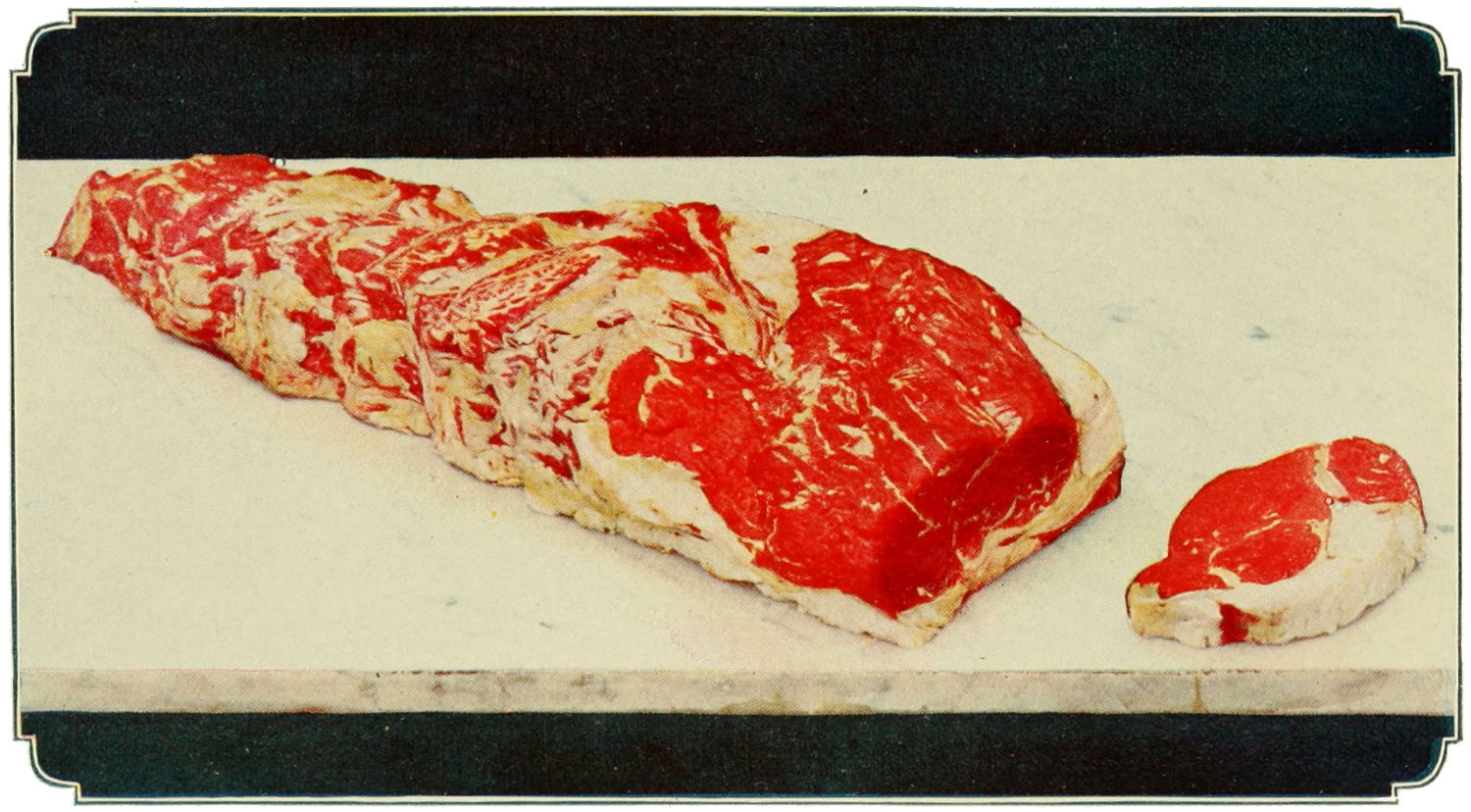
Beef Tenderloin
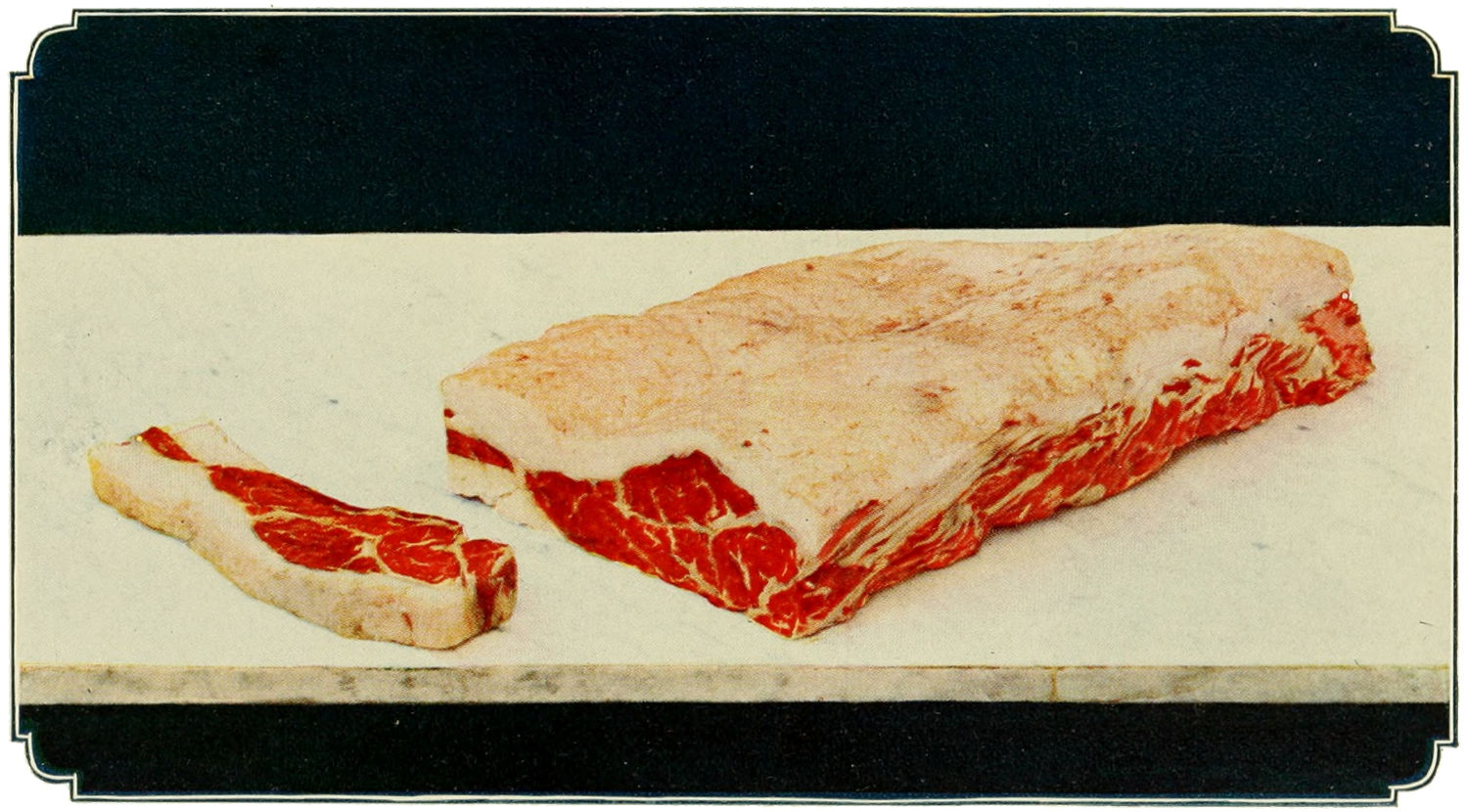
Beef Sirloin
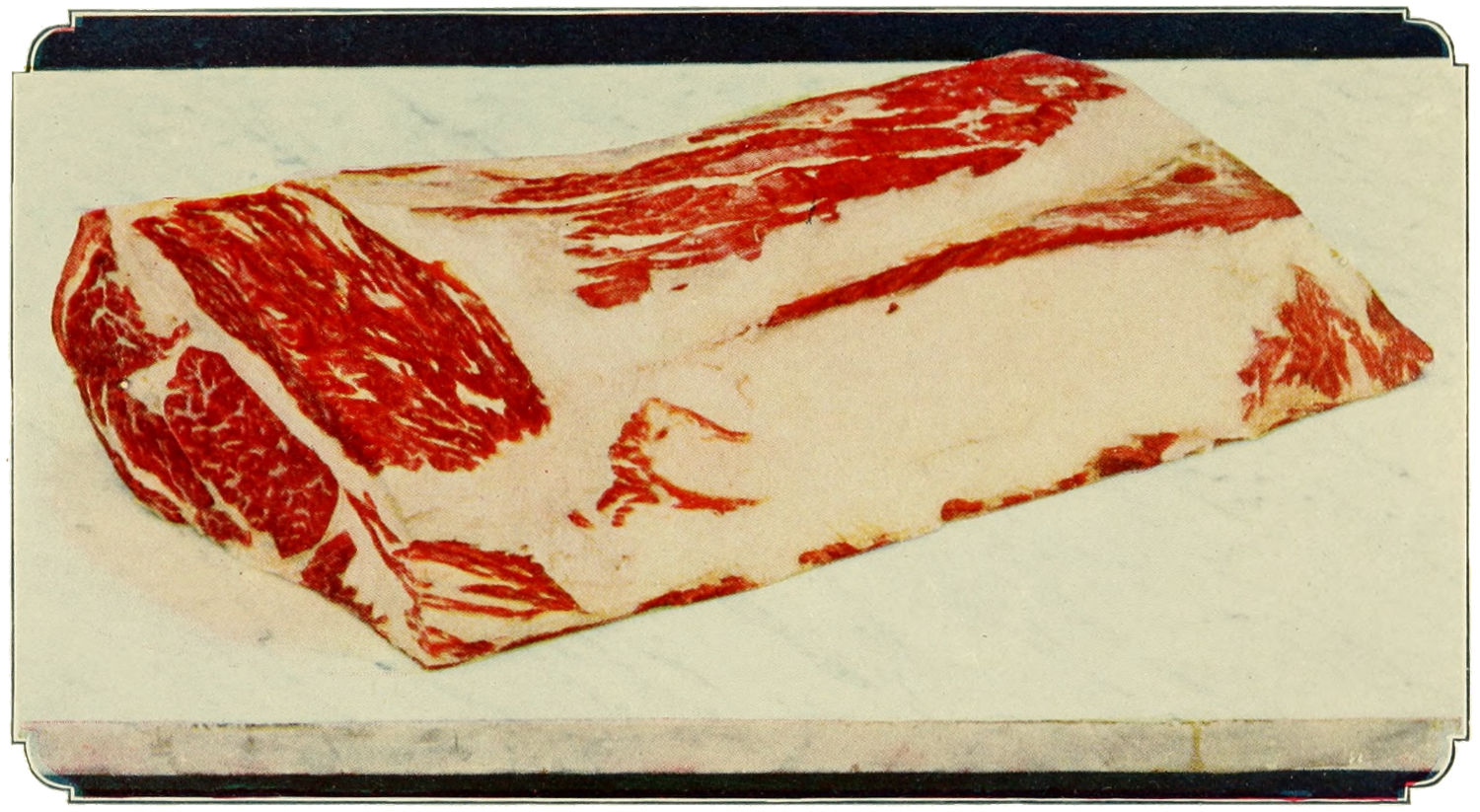
Beef Ribs—Regular Cut
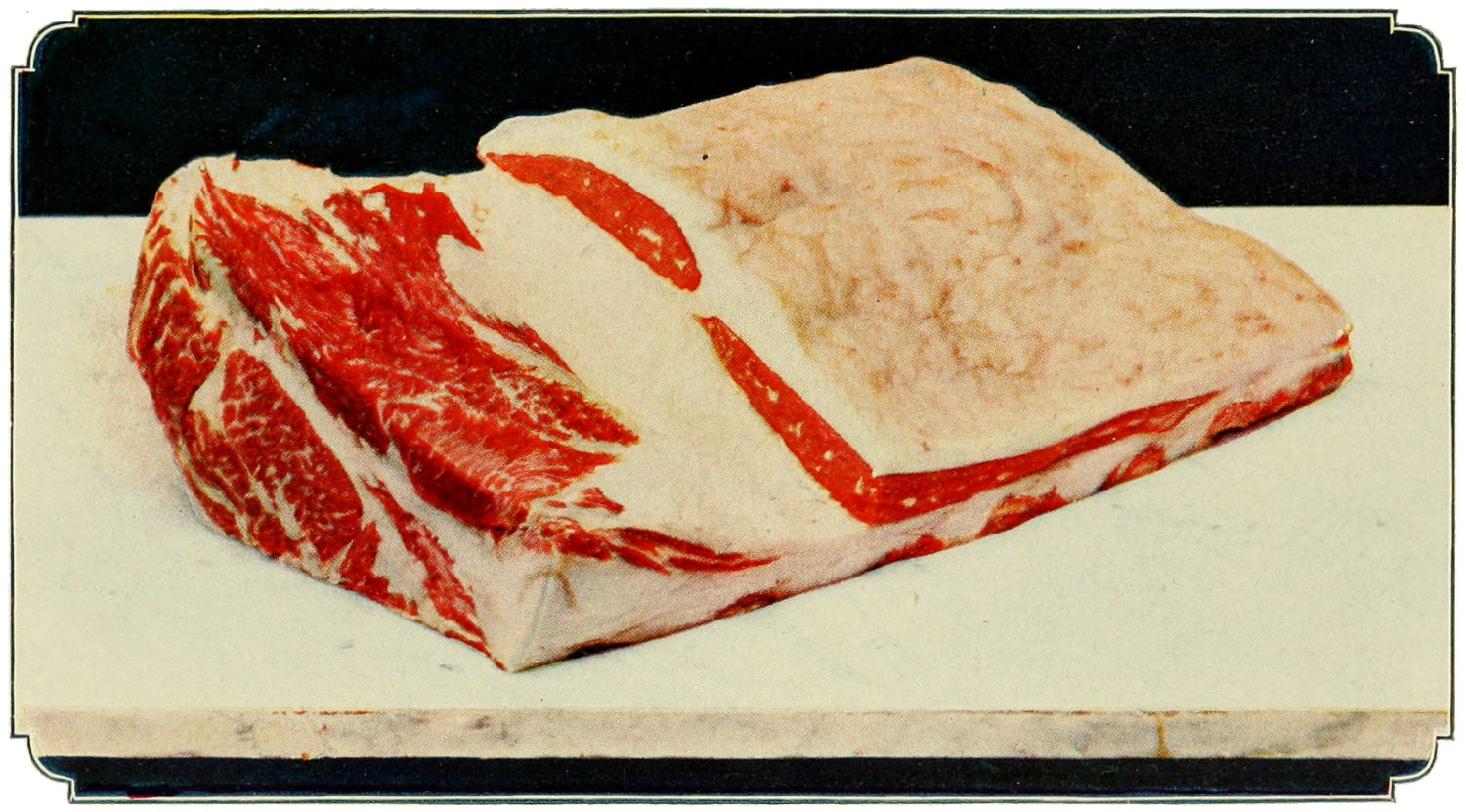
Beef Ribs—Spencer Cut
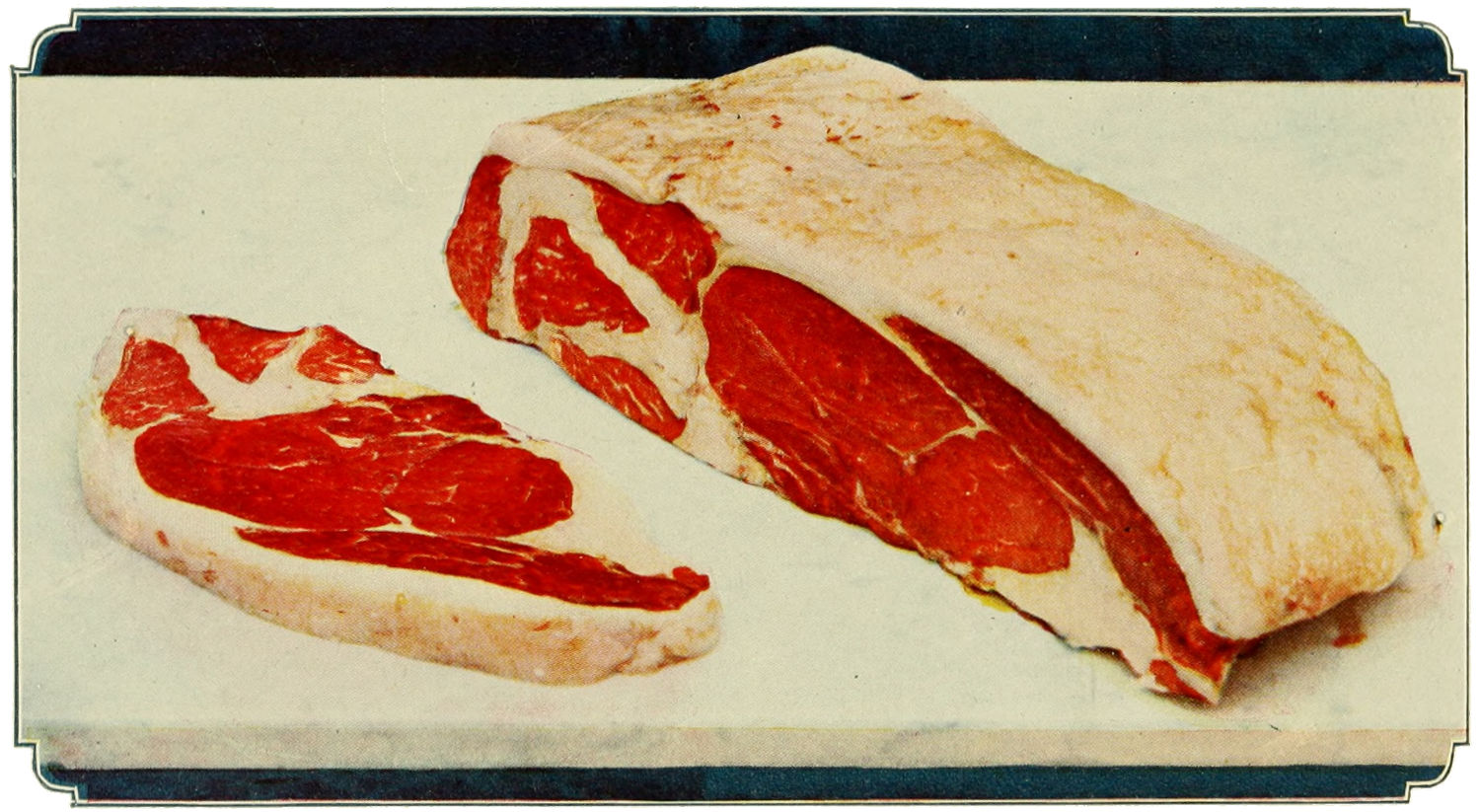
Sirloin Butts
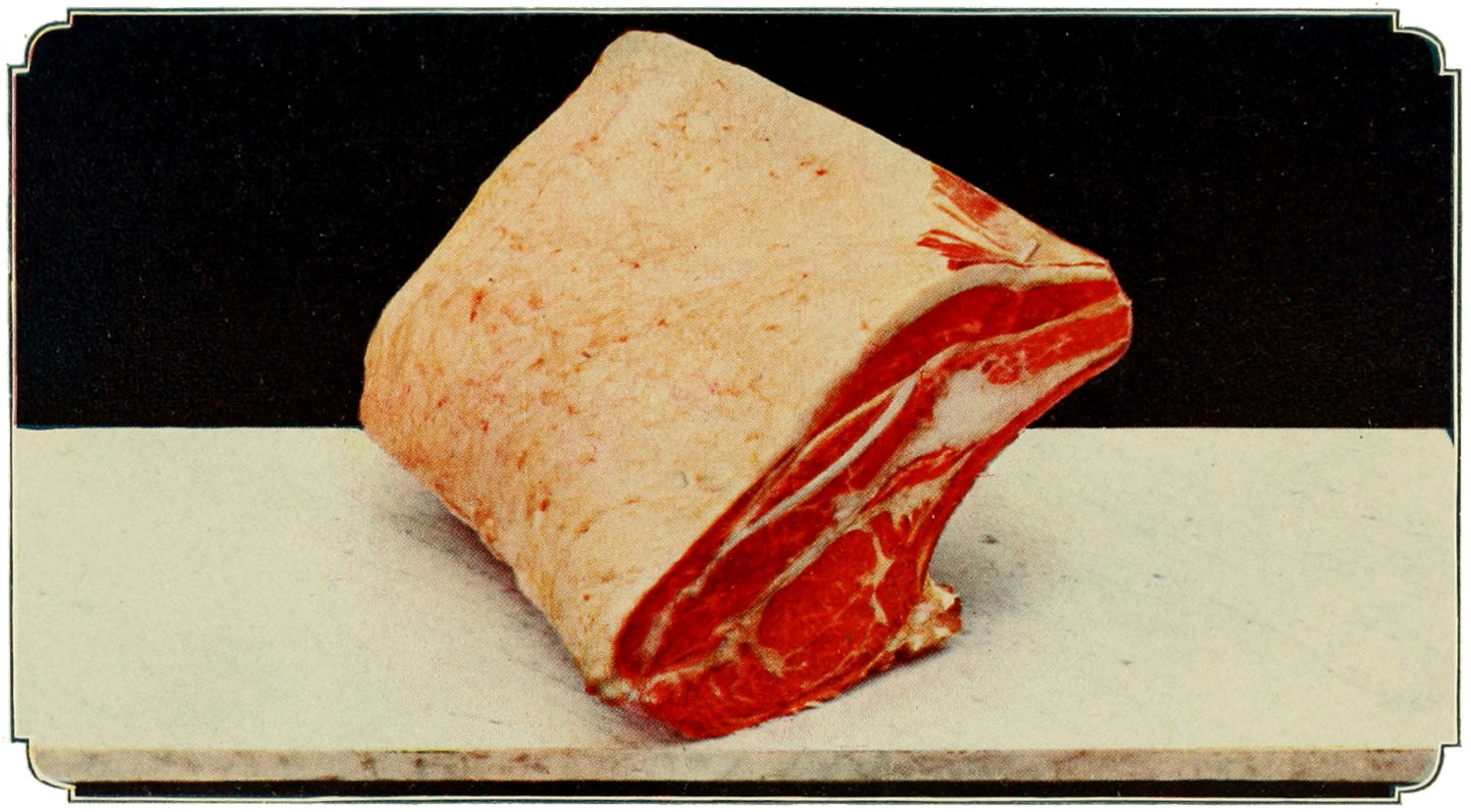
Beef Rib
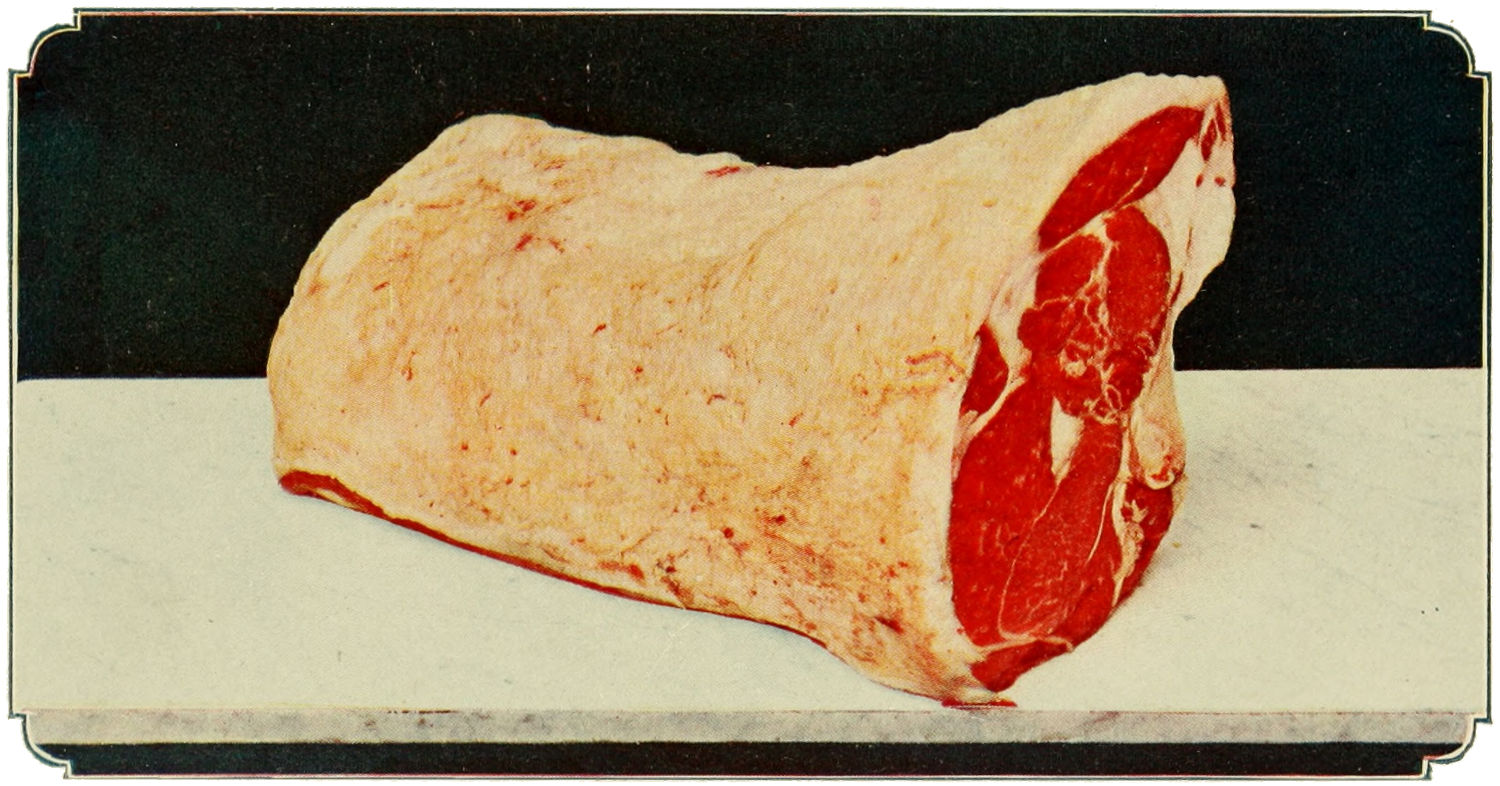
Beef Loin
It is not established that any further manipulation than that above outlined is desirable or necessary. The use of any kind of dye or coloring matter directly or indirectly, of any so-called preservative substance other than those of a condimental nature already mentioned, or any further manipulation save that to secure low temperature and freedom from infection is not useful, necessary, nor desirable. The sooner the manufacturer of these products understands the rights of the consumer in this respect and recognizes the fundamental verity of the above postulates the better it will be for all parties. When these conditions are met all of the many and just objections which have been made to the meats of this country will pass away and they will assume in the markets of the world that position to which their natural merits, when not interfered with by maltreating during curing, entitle them.
Names Applied to the Different Pieces of Edible Animals.
—In the preparation of animals for the market experience has shown that they are best cut in certain pieces of a shape determined by the race of the animal itself and to these pieces or cuts certain definite names have been applied. The method of making these cuts is not the same in all parts of this country and various parts of different countries. In the United States the most common cuts are illustrated in the accompanying figures, with the names which are attached thereto.
The analyses here reported apply to cuts as indicated by the following diagrams. These show the positions of the different cuts, both in the live animal and in the dressed carcass as found in the markets. The lines of division between the different cuts will vary slightly, according to the usage of the local market, even where the general method of cutting is as here indicated. The names of the same cuts likewise vary in different parts of the country.
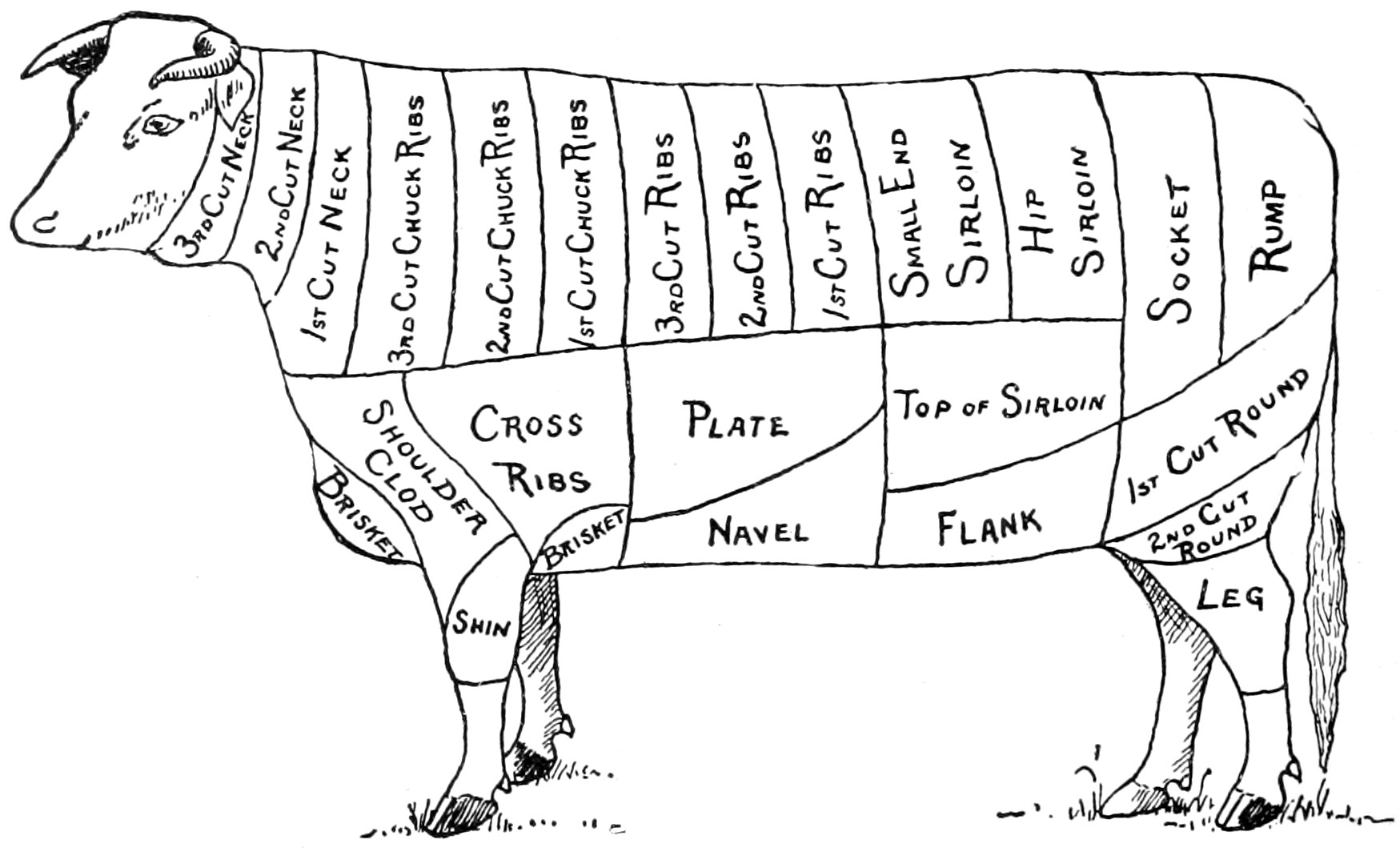
Fig. 1.—Cuts of Beef.—(Nutrition Bulletins, Office of Experiment Stations.)
The Cuts of Beef.
—The general method of cutting up a side of beef is illustrated in Fig. 1, which shows the relative position of the cuts in the animal and in a dressed side. The neck piece is frequently cut so as to include more of the chuck than is represented by the diagram. The shoulder clod is usually cut without bone, while the shoulder (not indicated in diagram) would include more or less of the shoulder blade and of the upper end of the fore shank. Shoulder steak is cut from the chuck. In many localities the plate is made to include all the parts of the fore quarter designated on the diagrams as brisket, cross ribs, plate, and navel, and different portions of the plate, as thus cut, are spoken of as the “brisket end of plate” and “navel end of plate.” This part of the animal is largely used for corning. The ribs are frequently divided into first, second, and third cuts, the latter lying nearest the chuck and being slightly less desirable than the former. The chuck is sometimes subdivided in a similar manner, the third cut of the chuck being nearest the neck. The names applied to different portions of the loin vary considerably in different localities. The part nearest the ribs is frequently called “small end of loin” or “short steak.” The other end of the loin is called “hip sirloin” or “sirloin.” Between the short and the sirloin is a portion quite generally called the “tenderloin,” for the reason that the real tenderloin, the very tender strip of meat lying inside the loin, is found most fully developed in this cut. Porterhouse steak is a term most frequently applied to either the short steak or the tenderloin. It is not uncommon to find the flank cut so as to include more of the loin than is indicated in the figures, in which case the upper portion is called “flank steak.” The larger part of the flank is, however, very frequently corned, as is also the case with the rump. In some markets the rump is cut so as to include a portion of the loin, which is then sold as “rump steak.” The portion of the round on the outside of the leg is regarded as more tender than that on the inside, and is frequently preferred to the latter. As the leg lies upon the butcher’s table this outside of the round is usually on the upper, or top, side, and is therefore called “top round.” Occasionally the plate is called the “rattle.”
In Fig. 2 is shown a side of beef with the various cuts indicated as used for commercial designation.
1. Shank 5. Rib 9. Clod
2. Round 6. Flank 10. Neck
3. Rump 7. Plate
4. Loin 8. Chuck
Tenderloins, Sirloin Butts and Strips cut from No. 4.
Rib Rolls cut from No. 5.
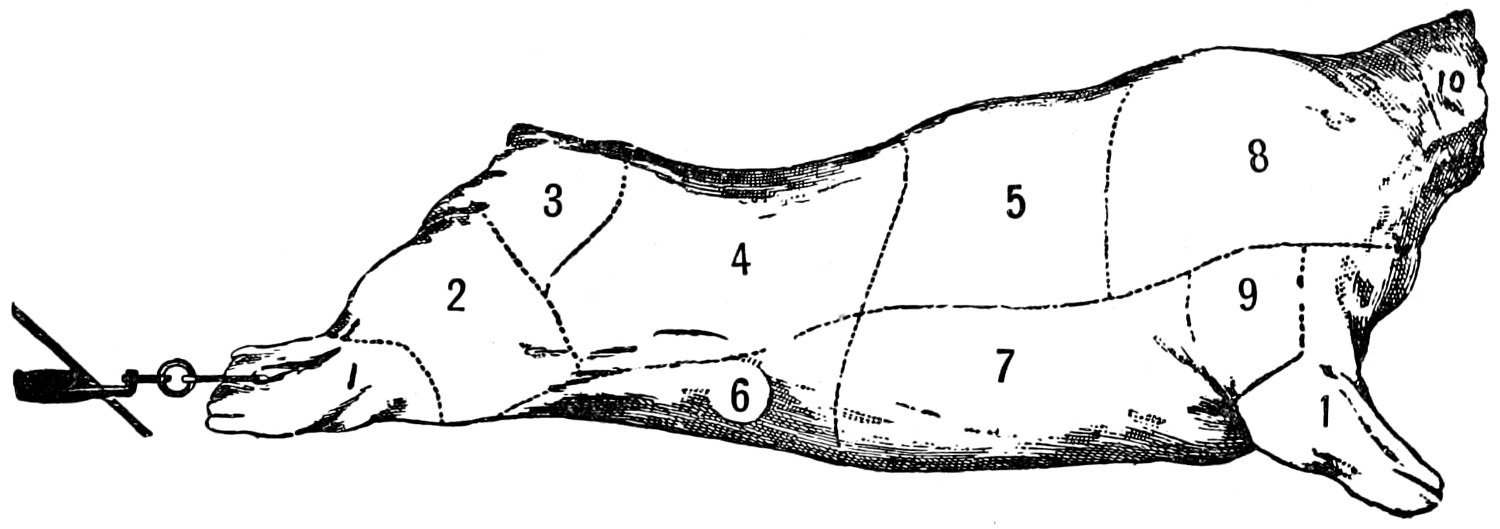
Fig. 2.—Commercial Cuts of Beef.—(Courtesy of Armour & Co.)
In Fig. 6 (page 20) is shown the interior view of a hog carcass with the cuts indicated as known to the trade.
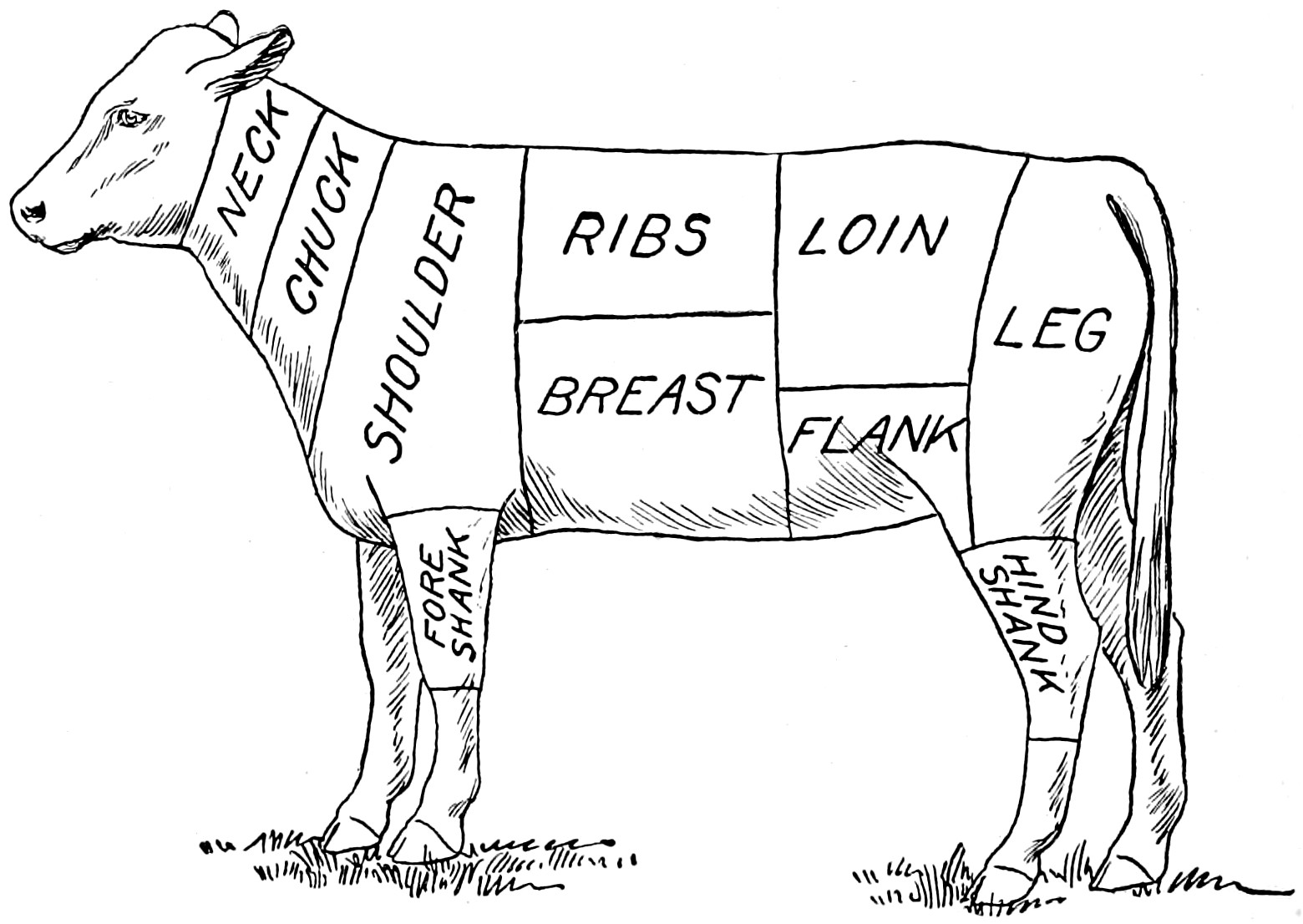
Fig. 3.—Diagram of Cuts of Veal.—(Nutrition Bulletins, Office of Experiment Stations.)
The Cuts of Veal.
—The method of cutting up a side of veal differs considerably from that employed with beef. This is illustrated by Fig. 3, which shows the relative position of the cuts in the animal and in a dressed side. The chuck is much smaller in proportion, and frequently no distinction is made between the chuck and the neck. The chuck is often cut so as to include a considerable of the portion here designated as shoulder, following more nearly the method adopted for subdividing beef. The shoulder of veal as here indicated includes, besides the portion corresponding to the shoulder in beef, the larger part of what is here classed as chuck in the adult animal. The under part of the fore quarter, corresponding to the plate in the beef, is often designated as breast in the veal. The part of the veal corresponding to the rump of beef is here included with the loin, but is often cut to form part of the leg. In many localities the fore and hind shanks of veal are called the “knuckles.”
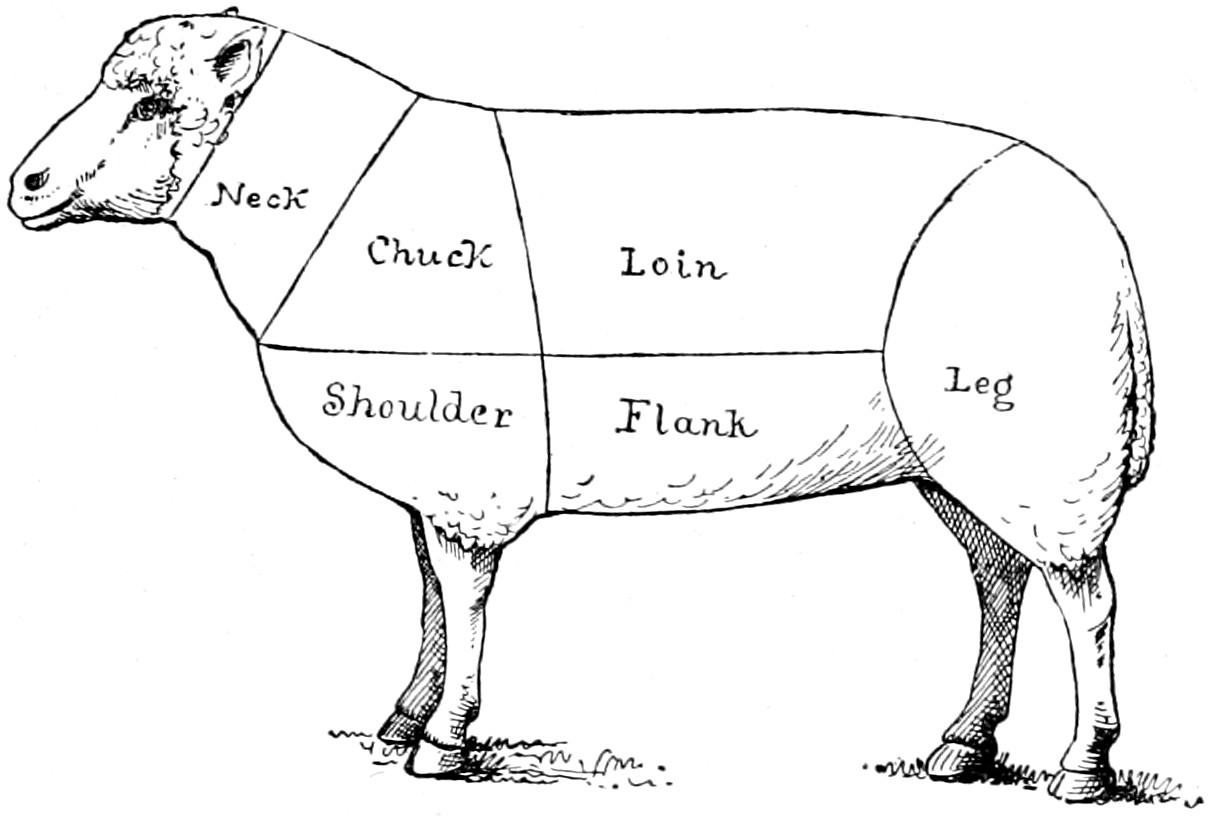
Fig. 4.—Diagram of Cuts of Lamb and Mutton.—(Nutrition Bulletins, Office of Experiment Stations.)
The Cuts of Lamb and Mutton.
—Fig. 4 shows the relative position of the cuts in a dressed side of mutton or lamb and in a live animal. The cuts in a side of lamb and mutton number but six, three in each quarter. The chuck includes the ribs as far as the end of the shoulder blades, beyond which comes the loin. The flank is made to include all the under side of the animal. Some butchers, however, make a larger number of cuts in the fore quarter, including a portion of the cuts marked “loin” and “chuck” in Fig. 4, to make a cut designated as “rib,” and a portion of the “flank” and “shoulder” to make a cut designated as “brisket.” The term “chops” is ordinarily used to designate portions of either the loin, ribs, chuck, or shoulder, which are either cut or “chopped” by the butcher into pieces suitable for frying or broiling. The chuck and ribs are sometimes called the “rack.”
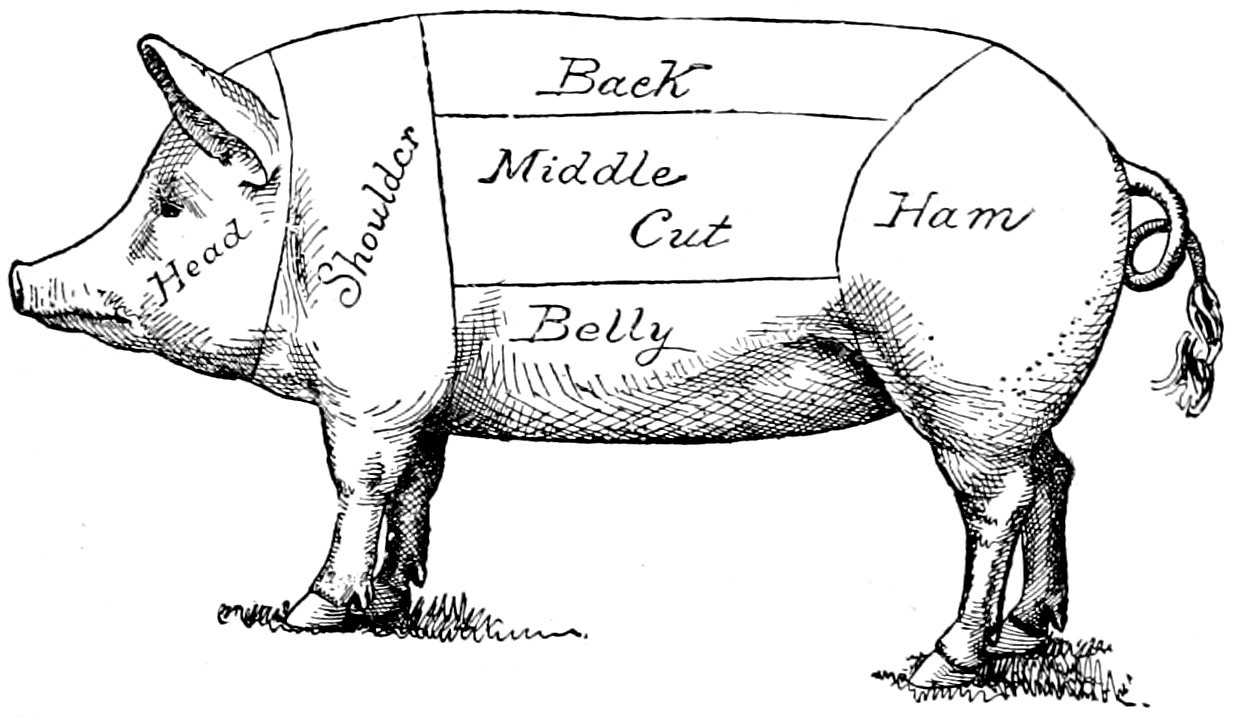
Fig. 5.—Diagram of Cuts of Pork.—(Nutrition Bulletins, Office of Experiment Stations.)
The Cuts of Pork.
—The method of cutting up a side of pork differs considerably from that employed with other meats. A large portion of the carcass of a dressed pig consists of almost clear fat. This furnishes the cuts which are used for “salt pork” and bacon. Fig. 5 illustrates a common method of cutting up pork, showing the relative position of the cuts in the animal and in the dressed side. The cut designated as “back cut” is almost clear fat and is used for salting and pickling. The “middle cut” is the portion quite generally used for bacon and for “lean ends” salt pork. The belly is salted or pickled, or may be made into sausages.
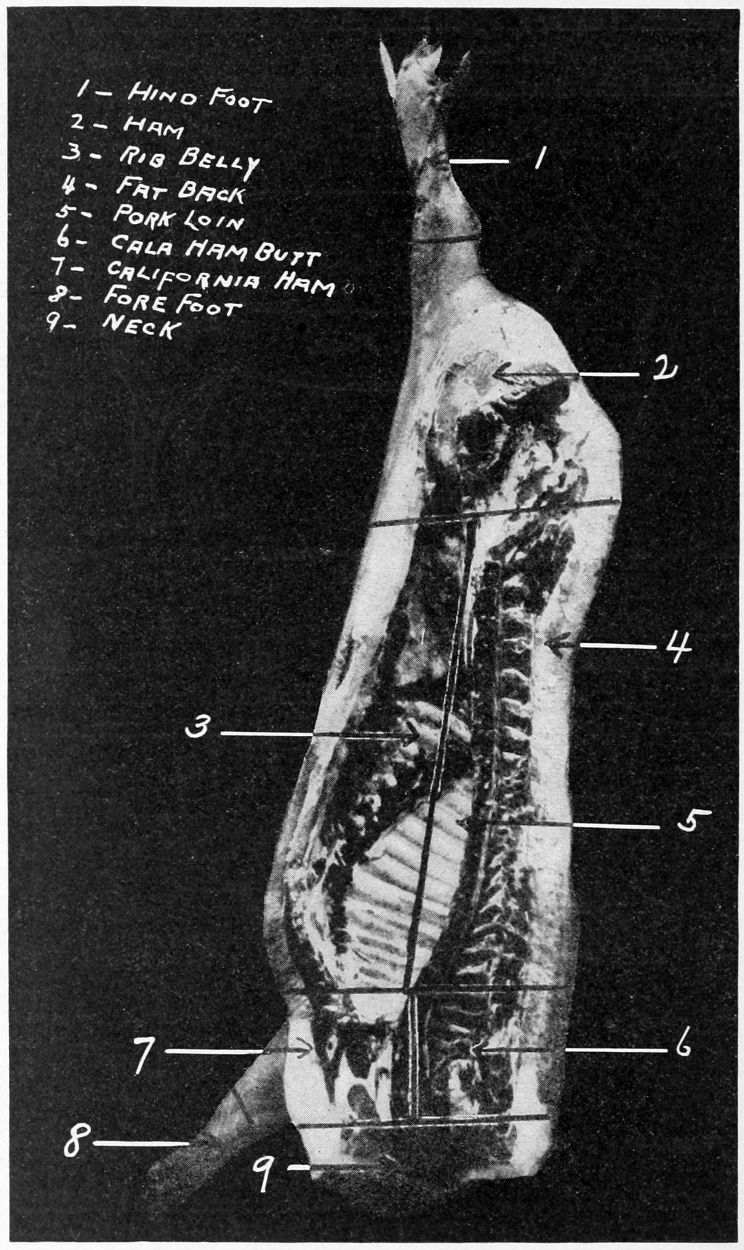
Fig. 6.—Commercial Cuts of Pork.—(Courtesy of Armour & Co.)
1—Hind Foot 2—Ham 3—Rib Belly 4—Fat Back 5—Pork Loin 6—Cala Ham Butt 7—California Ham 8—Fore Foot 9—Neck
Beneath the “back cut” are the ribs and loin, from which are obtained “spareribs,” “chops,” and roasting pieces, not designated in the figure. The hams and shoulders are more frequently cured, but are also sold fresh as pork “steak.” The tenderloin proper is a comparatively lean and very small strip of meat lying under the bones of the loin and usually weighing a fraction of a pound. Some fat is usually trimmed off from the hams and shoulders which is called “ham and shoulder fat” and is often used for sausages, etc. What is called “leaf lard,” at least in some localities, comes from the inside of the back. It is the kidney fat.
As stated above, cuts as shown in the diagrams herewith correspond to those of which analyses are reported in the table beyond, but do not attempt to show the different methods of cutting followed in markets in different parts of the United States.
Delivery of Fresh Meat to Consumers.
—Perhaps the most important aid to the manufacturer, as well as a protection to the consumer, which modern science has offered to the public is the possibility of delivering fresh meats to consumers at a low temperature. A well equipped abattoir is provided with apparatus by means of which a constantly low temperature may be maintained in the room where the fresh meat is kept after the preparation described above. When the meats are to be distributed over long distances refrigerator cars or boats are provided where low temperature may be maintained.
Roast Beef.
—The parts of the beef which are used for roasting are shown in the diagram, comprising a considerable portion of the hind quarter of the beef and part of the ribs. The roast is perhaps the most important of the parts of the beef for edible purposes. The average composition of the edible part of roast beef (before cooking) is given below:
Water, 60.14 percent
Solids, 39.86 „
Nitrogen, 4.47 „
Phosphoric acid, .54 „
Sulfur, .26 „
Fat, 10.48 „
Ash, 1.30 „
Protein, 27.95 „
Beefsteak.
—The most important parts of the beef next to the roast are the parts used for steak. Beefsteaks have different names, such as tenderloin and sirloin, and when the latter two are joined together by the bone the whole is called porterhouse. There are also round steaks and rump steaks which are less highly prized portions of the meat, but in nutritive value are probably quite as valuable as the others mentioned. The average composition of the edible part of a large number of samples of beefsteak is given in the following table:[1]
Water, 63.95 percent
Solids, 36.05 „
Nitrogen, 4.54 „
Phosphoric acid, .59 „
Sulfur, .27 „
Fat, 5.93 „
Ash, 1.48 „
Protein, 28.37 „
It is seen that the roast beef contains less water, less protein, and decidedly more fat than the steak.
Roast Lamb.
—The parts of the lamb which are used for roasting are usually the hind quarters, although all of the parts are roasted at times. The average composition of a number of samples of lamb roast is given in the following table:[2]
Water, 58.56 percent
Solids, 41.44 „
Nitrogen, 4.91 „
Phosphoric acid, .61 „
Sulfur, .28 „
Fat, 9.12 „
Ash, 1.30 „
Protein, 30.71 „
Lamb chops
or mutton chops are the short ribs with attached flesh of lamb or young sheep. They are considered to be the most desirable part of the young sheep or lamb for edible purposes. The average composition of the edible portion of a number of samples of lamb chops is given in the following table:
Water, 63.98 percent
Solids, 36.02 „
Nitrogen, 4.35 „
Phosphoric acid, .61 „
Sulfur, .24 „
Fat, 7.09 „
Ash, 1.49 „
Protein, 27.18 „
Roast lamb, as shown by the above data, has less water, more fat, and more protein than lamb chops.
Preservation of Fresh Meats.
—After delivery the meats are at once consigned to refrigerator departments in the markets, where they are preserved until they pass into the consumer’s hands. Thus, a properly fattened, properly slaughtered, and properly dressed piece of fresh meat may be brought into the consumer’s hands in a manner at once unobjectionable and at the same time one which secures it admirably from contamination of any kind. So perfect are these means of transportation that fresh meat may be sent not only from city to city but across the sea, and reach the consumer as near perfection as human ingenuity can devise.
Length of Storage.
—The question of how long meat can be safely kept in cold storage of this kind is one which has not been decided. It may be said, however, that the period should not be extended any longer than is necessary and that the consumers of meat should be provided in ordinary times, if transportation is undisturbed, with practically fresh meat. It is evident that if the principal meat-packing centers are Chicago, Omaha, and Kansas City the cities and parts of the country remote from these localities must have meat somewhat older than those which are near by. If we pass to distant countries, as for instance, Europe, where fresh meats are received from the United States or even from Australia, the time elapsing between slaughter and consumption must necessarily be long. Thus the length of time in which meat should be left in cold storage after it is properly matured depends upon its geographic distribution and is not a matter to be decided arbitrarily.
When meats are not only kept in cold storage for transportation but are actually frozen, as is often the case, they can, of course, be kept for a much longer time than when subjected merely to a low temperature at or slightly above the freezing point. For this reason meats that are to be carried to a long distance and not to be consumed for a long time after preparation are usually frozen and kept so during transport.
Effect of Low Temperature on Enzymic Action.
—Attention has been called to the fact that low temperature does not inhibit enzymic action, and, therefore, it must be admitted that this continued activity must gradually deteriorate the quality of the product. The question, therefore, which is the most important is not how long can meat be kept in a frozen condition but how short a time must it be kept. In all cases, therefore, of this kind the consumer is entitled to know the length of time during which his meat has been kept frozen, and this desirable condition of affairs is easily secured by the necessary local, state, and national inspection already mentioned.
Disposition of Fragments Arising From the Dressing of Beef.
—It is evident that the fragments of sound, wholesome meat which is dressed for delivery to commerce are themselves edible and hence there can be no hygienic or other objection to preparations made from these fragments, such as sausage and other minced and comminuted meats which appear upon the market. In other words, the consumer is entitled to know that because a piece of meat is comminuted is no reason for supposing that it is not edible.
Sausage, mince meat, comminuted meat, potted, canned, and other meats or preparations from these sound, clean, edible fragments, necessarily rejected in the process of preparing fresh meats for curing and for consumption, are entitled to the same consideration and may be looked upon with the same certainty of purity by the consumer when properly inspected and prepared as the larger pieces.
The possibility of detecting any effects of disease in meats by inspection at the time of or after delivery is very remote and therefore the inspection before killing and during the process of manufacture should be a most rigid one in the case of these fragments. Such inspection and certification would restore public confidence in the purity and hygienic properties of these meats which not only are nutritious but by the spicing and condimental treatment which they receive are rendered highly palatable and desirable.
DETECTION OF DIFFERENT KINDS OF MEAT.
When meats are in large pieces they may be recognized by their anatomical characteristics. In order that this may be done, however, the piece of meat must either be of a sufficient size to be recognized by its shape and general appearance or must have a bone of sufficient size to indicate its anatomical character.
According to the German law pieces of meat of less than eight pounds in weight are not supposed to be large enough to be recognized anatomically or otherwise with certainty. This, however, is a matter which pertains more to the meat of animals from which the bone is taken rather than to its actual size. It requires some little expert knowledge of the anatomy of animals in order to distinguish these pieces, but one who is in the habit of purchasing or cutting meats acquires this knowledge without any special study.
Odor and Taste.
—Each kind of meat may also be detected both by its odor and taste, as well as by its physical appearance and shape. Beef, mutton, pork, and other meats in a proper state of preparation and preservation have characteristic odors and flavors by which they are easily detected. One of the common faults of cooking is the putting together of meats of various kinds in the same oven, by means of which the odors become so intermingled that in small pieces even the experienced taster may not always be able to discriminate between them.
Detection of Meat by Microscopic Appearance.
—Meats are so nearly related histologically that the microscope is not a certain means of detecting the different varieties. Were this the case it would be easy to identify the different kinds of meat which may be found in a finely comminuted mixture. The expert microscopist may have difficulty in discriminating between different microscopic portions of meat, but the microscope is of practically no advantage to any but an expert and not a very great advantage to him. The fibers of some animals vary in size, coarseness or fineness of texture, and other characteristics as much as fibers do from different animals.
Detection by Chemical Examination.
—The most satisfactory method of detecting meats is by means of their chemical examination. There are two distinct points which are kept in view in a chemical examination. One is the presence of glycogen, which in quantities of more than one percent is characteristic of horse meat. Unfortunately, this test can only be applied to a meat in practically a fresh state, as the glycogen is rapidly changed into other forms of carbohydrate substances which make it difficult to identify. The chemical examination, therefore, which is of the most value is that which is performed upon the fat. The fat of different animals has different physical and chemical characteristics. The fats crystallize in different forms and have different melting points,—also the fatty acids derived therefrom. They absorb different quantities of iodin and bromin, and have other physical and chemical properties which are peculiar to each variety.
A careful examination of the fat, therefore, will lead to an approximate degree of knowledge concerning the character of the flesh from which it has been derived. For instance, lard and beef fat are easily distinguished from each other. In case a minced meat is made wholly of one kind of flesh or of one kind of animal the chemical examination of the fat will, with a considerable degree of certainty, lead to its identification. In the same manner, if a minced meat be made up of equal parts of two different kinds of animals the characteristics of the fats will lead to the identification of the two sources of meat. If, however, one kind of meat be mixed in only a small proportion, say 10 or 15 percent, of another, the chemical methods of separation are not to be relied upon. None of these chemical or physical methods, unfortunately, is of value in the hands of any but an expert, and, therefore, cannot be regarded as a common means of identification. For this reason the only common manner of identification of the kinds of meats which are sent out to the consumer at large must consist in the general knowledge of their anatomical, physical, palatable, and gustatory properties outlined above.
In all cases the consumer must eventually rely upon the official inspection and the label which accompanies the meat or which should accompany it.
Dried Meat.
—A very effective method of preserving meat is practiced in certain of the arid regions of the country by exposing it to the dry air and sunlight. Meats prepared in this way are often called “jerked” meats. The small amount of aqueous vapor in the air is not sufficient to maintain the life of the ordinary fermentative germs, and they are, therefore, destroyed by desiccation. Meat which is exposed under such circumstances does not become infected with any fermentative germ, and the moisture which it contains is rapidly given off in the dry air surrounding it. For this purpose the meat is cut into thin strips and suspended by appropriate means in the air and exposed to the direct sunlight. In a short time the moisture disappears, and the hard dry pieces keep indefinitely in certain arid regions of this country. The meat also maintains a fair degree of palatability and practically all of its nutrient properties, so that when properly cooked it is a palatable and nutritious dish. Probably of all the methods of preserving meat this one is the least open to objection, since not even spices or condimental substances are necessary in order to preserve the meat from decay. By reason of the change in its physical appearance, however, which makes it less attractive, this method is not likely to come into general use in the ordinary preservation of meat.
Dried beef is also prepared by preserving the meat by condimental substances and, instead of placing it in brine, drying it artificially. Chipped or dried beef is a common article of commerce and is prepared in the manner described above. This meat, however, has already been treated with condimental substances, and hence the drying is only one of the means of preservation. Dried or chipped meats are often smoked also as well as desiccated, so that in their preparation more than one method of preservation is employed.
Pickled Meats.
—The method of preserving meats in a liquid environment is sometimes called pickling. All kinds of meat are pickled in this way, but pork especially. The pickling brine may be simply made of common salt, though other substances, such as sugar, vinegar, and spices, are used. The brine also sometimes contains a chemical preservative which is highly objectionable on the general ground of the harmfulness of these substances. The preservative commonly used is either sulfite of soda or boric acid. The making of a pickled meat of this kind should be discouraged. The vinegar which is employed or acetic acid may be injected into the carcass before it is cut up. When the arteries or veins are filled with vinegar in this way it rapidly permeates to all parts of the meat and acts as an excellent and unobjectionable preservative in all cases where an acid taste is desired. It is claimed that carcasses which have been injected with vinegar in this way are easily preserved, and require far less salt and other condimental substances than when not so treated. As vinegar is a condimental substance used everywhere, and one which promotes digestion when used in proper quantities, the preservation of meats or the pickling of meats by a previous injection of vinegar is not objectionable.
COMPOSITION OF THE FLESH OF PIGS.
Extensive investigation of the composition of the flesh of pigs has been made in the Bureau of Chemistry (Bulletin 53). The pigs upon which these examinations were made were specially bred and fattened at the Agricultural Experiment Station of Iowa, and were prepared for the market by the most approved modern style of feeding. They were slaughtered according to the approved method and immediately, after proper preparation, the carcasses were placed in cold storage, where they were kept until removal for the purpose of dissection and preparation of the samples for analyses. Expert butchers from Washington were secured for the dissecting and dressing of the pigs in the manner in which it would be done for the best market. The pigs were of different varieties, namely, Berkshire, No. 1; Tamworth, No. 2; Chester White, No. 3; Poland China, No. 4; Duroc Jersey, No. 5, No. 6, No. 7; Yorkshire, No. 8.
TABLE A.—WEIGHTS OF WHOLE CUTS AND DATA RELATING TO THE PREPARATION OF AIR-DRY SAMPLES. PIG No. 1.—BERKSHIRE.
Names of Cuts. Weights of Whole Cuts. Direct Determinations on Original Material. Preparation of Air-dry Samples.
Chicago. Washington. Weight of fresh sample. Air-dry sample of original material. Weight of air-dry sample after extraction. Weight of fat. Air-dry sample plus fat. Weight of water removed. Removed in preparation of sample.
Water. Fat. Water. Fat.
Lbs. Oz. Grams. Lbs. Oz. Grams. Per ct. Per ct. Grams. Per ct. Grams. Grams. Grams. Grams. Per ct. Per ct.
Two American clear backs, 35 1⁄2 0 16,102.8 34 6 15,592.5 .. .. .. .. .. .. .. .. .. ..
Meat, .. .. .. .. 31.33 58.21 833.0 13.16 109.6 458.0 567.6 265.4 31.86 54.98
Two clear bellies, 19 1⁄2 0 8,845.2 19 4 8,731.8 .. .. .. .. .. .. .. .. .. ..
Meat, .. .. .. .. 36.09 52.69 741.2 14.33 106.2 362.1 468.3 272.9 36.82 48.84
Two short-cut hams, 23 1⁄2 0 10,659.6 23 5 10,574.6 .. .. .. .. .. .. .. .. .. ..
Meat, .. .. .. .. 60.29 22.19 532.5 22.95 122.2 88.3 210.5 322.0 60.47 16.58
Two New York shoulders, 20 1⁄2 0 9,298.8 20 10 9,395.5 .. .. .. .. .. .. .. .. .. ..
Meat, .. .. .. .. 54.97 29.01 532.5 17.65 94.0 152.9 246.9 285.6 53.64 28.71
Meat, .. .. .. .. 59.78 17.04 221.1 25.10 55.5 33.7 89.2 131.9 59.66 15.24
Spareribs, 5 0 2,268.0 .. 2,212.0 .. .. .. .. .. .. .. .. .. ..
Meat, .. .. .. .. 50.33 30.05 359.9 20.81 74.9 98.6 173.5 186.4 51.78 27.39
Tenderloins, 1 0 453.6 .. 470.8 67.14 9.14 427.9 27.11 116.0 26.6 142.6 285.3 66.67 6.21
Neck bones, 2 0 907.2 .. 842.5 .. .. .. .. .. .. .. .. .. ..
Meat, .. .. .. .. 53.82 28.72 390.6 20.02 78.2 100.5 178.7 211.9 54.25 25.73
Backbones, 3 1⁄2 0 1,587.6 .. 1,580.0 .. .. .. .. .. .. .. .. .. ..
Meat, .. .. .. .. 51.89 27.16 397.5 22.24 88.4 102.1 190.5 207.0 52.08 25.69
Trimmings, 18 0 8,164.8 16 9 7,512.8 .. .. .. .. .. .. .. .. .. ..
Meat, .. .. .. .. 29.68 62.00 783.7 9.72 76.3 479.2 555.5 228.2 29.11 61.17
Tail, 1⁄4 0 113.4 .. 363.0 .. .. .. .. .. .. .. .. .. ..
Meat, .. .. .. .. 23.99 69.25 199.2 8.73 17.4 134.7 152.1 47.1 23.64 67.62
Total, 132 1⁄4 0 59,995.2 .. 58,789.6 .. .. .. .. .. .. .. .. .. ..
Preparation of Samples for Analyses.
—The meat obtained from all of the cuts of the same kind in each sample was passed through a meat chopper two or three times in order to get an even, finely divided condition. A portion of known weight was then placed in a dish and dried in a steam oven at a temperature of boiling water or slightly above and heated until the fat had well separated so that it could be poured off into a flask, with care not to remove any of the water which may have separated with it. Small samples were removed before drying for the determination of the exact quantity of fat and water therein, and the results of these analyses were used for calculating the relative portion of the large samples. Samples of skin, bones, marrow, spinal cord, tendons, hoofs, and other parts of the animal were also carefully secured and subjected to analyses. In this way the whole animal was subjected to examination for analytical data, and at the same time each particular part of it, in so far as its relation to the market is concerned, was kept separated. In Table A are found the weight of the whole cut and the data relative to the preparation of the air-dried sample.
The data show that there was a slight loss of water during the transit from Chicago to Washington. The part of the pig which has the largest percentage of fat is the meat of the tail, while the smallest percentage is found in the tenderloins. The largest percentage of water in any part of the meat is in the tenderloins and the smallest in the meat of the tail.
TABLE B.—WEIGHTS OF PARTS FROM EACH CUT AND DATA RELATING TO THE PREPARATION OF AIR-DRY SAMPLES. PIG No. 1.—BERKSHIRE.
Names of Parts and Cuts. Weights of Parts.
From each cut. Total. Of entire pig.
Meat (fat and lean): Grams. Grams. Percent.
Backs, 14,767.9 .. ..
Bellies, 8,230.6 .. ..
Hams, 9,407.9 .. ..
Shoulders, 8,448.2 .. ..
Feet, 325.3 .. ..
Spareribs, 1,683.8 .. ..
Tenderloins, 470.8 .. ..
Neck bones, 493.2 .. ..
Backbones, 704.0 .. ..
Trimmings, 7,021.5 .. ..
Tail, 291.7 .. ..
51,844.9 88.19
Bones:
Backs, 191.1 .. ..
Bellies, 81.4 .. ..
Hams, 879.6 .. ..
Shoulders, 693.8 .. ..
Feet, 802.6 .. ..
Spareribs, 528.2 .. ..
Neck bones, 336.1 .. ..
Backbones, 833.5 .. ..
Trimmings, 71.0 .. ..
Tail, 27.1 .. ..
Total, .. 4,444.4 ..
Marrow, 69.7 69.7 0.12
Total bones less marrow, .. 4,374.7 7.44
TABLE C.—ANALYTICAL DATA FOR MEATS. PIG No. 1.—BERKSHIRE.
Names of Cuts. Air-dry sample: Percent of orig- inal mate- rial. Percent Air-dry Material. Percent Original Material.
Water. Fat. Nitrogen. Leci- thin. Ash. Water. Fat. Leci- thin. Nitrogen. Nitrogenous substances. Ash. Total.[5]
Total. Of pro- teids insol- uble in hot water. Precip- itated by bromin. Of flesh bases. In pre- paring sample. In steam- dry mate- rial. Total. In pre- paring sample. In steam- dry mate- rial. Total. Total. Of pro- teids insol- uble in hot water. Precip- itated by bromin. Of flesh bases. Pro- teids insol- uble in hot water. Gelati- noids. Flesh bases. Total.
Two American backs, 13.16 3.14 20.55 11.32 8.51 0.62 2.19 1.16 3.89 31.86 0.41 32.27 54.98 2.71 57.69 0.15 1.49 1.12 0.08 0.29 7.00 0.50 0.91 8.41 0.51 - 98.46 98.88
Two clear bellies, 14.33 3.14 21.59 11.15 7.78 0.65 2.72 0.99 3.85 36.82 0.45 37.27 48.84 3.09 51.93 0.14 1.60 1.12 0.09 0.39 7.00 0.56 1.22 8.78 0.55 - 98.11 98.53
Two short-cut hams, 22.95 4.14 15.43 11.85 9.77 0.48 1.60 1.10 4.18 60.47 0.95 61.42 16.58 3.54 20.12 0.25 2.72 2.24 0.11 0.37 14.00 0.69 1.15 15.84 0.96 - 99.28 98.34
(Fat extracted with ether), 16.58 .. .. 0.22 .. .. .. 2.43 .. .. .. .. .. .. .. 0.40 0.04 .. .. .. .. .. .. .. ..
0.65
Two New York shoulders, 17.65 2.31 2.10 13.76 10.22 0.73 2.81 0.85 5.03 53.64 0.41 54.04 28.71 0.37 29.08 0.15 2.43 1.80 0.13 0.50 11.25 0.81 1.56 13.62 0.89 - 98.49 97.63
Four feet, 25.10 6.46 6.32 13.73 7.75 3.00 2.98 0.75 3.28 59.66 1.62 61.28 15.24 1.59 16.83 0.20 3.45 1.95 0.75 0.75 12.19 4.69 2.34 19.22 0.82 - 96.86 98.15
(Fat extracted with ether), 15.20 .. .. 0.13 .. .. .. 2.68 .. .. .. .. .. .. .. 0.41 0.02 .. .. .. .. .. .. .. ..
0.61
Spareribs, 20.81 3.66 8.23 13.03 10.31 0.89 1.83 1.68 4.80 51.78 0.76 52.54 27.39 1.71 29.10 0.35 2.71 2.15 0.18 0.38 13.44 1.13 1.19 15.76 1.00 - 97.14 98.40
Tenderloins, 27.11 5.14 9.47 12.50 10.95 0.28 1.27 1.82 4.30 66.67 1.39 68.06 6.21 2.57 8.78 0.49 3.39 2.97 0.08 0.34 18.56 0.50 1.06 20.12 1.17 - 97.57 98.13
Neck bones, 20.02 7.23 10.93 12.25 9.97 0.59 1.69 1.33 4.02 54.25 1.45 55.70 25.73 2.19 27.92 0.27 2.45 1.99 0.12 0.34 12.44 0.75 1.06 14.25 0.81 - 97.60 98.68
(Fat extracted with ether), 18.69 .. .. 0.21 .. .. .. 2.17 .. .. .. .. .. .. .. 0.41 0.04 .. .. .. .. .. .. .. ..
0.68
Backbones, 22.24 3.36 6.88 13.03 10.36 0.62 2.05 1.20 5.59 52.08 0.75 52.83 25.69 1.53 27.22 0.26 2.90 2.30 0.14 0.46 14.38 0.87 1.44 16.69 1.24 - 96.98 97.98
Trimmings, 9.72 3.69 8.34 13.09 8.54 1.11 3.44 1.16 4.23 29.11 0.36 29.47 61.17 0.81 61.98 0.11 1.27 0.83 0.11 0.33 5.19 0.69 1.03 6.91 0.41 - 99.00 98.77
Tail, 8.73 4.30 6.97 13.45 10.56 0.98 1.91 1.98 4.41 23.64 0.38 24.02 67.62 0.61 68.23 0.17 1.17 0.92 0.09 0.16 5.75 0.56 0.50 6.81 0.39 - 100.44 99.45
TABLE D.—ANALYTICAL DATA FOR BONES, MARROW, SKIN, SPINAL CORD, TENDONS, AND HOOFS. PIG No. 1.—BERKSHIRE.
Names of Parts. Air-dry sample, percent of orig- inal mate- rial. Percent Air-dry Material. Percent Original Material.
Water. Fat. Nitrogen. Leci- thin. Ash. Water. Fat. Leci- thin. Nitrogen. Nitrogenous substances. Ash. Total.
Total. Of pro- teids insol- uble in hot water. Precip- itated by bromin. Of flesh bases. In pre- paring sample. In resid- ual mate- rial. Total. In pre- paring sample. In resid- ual mate- rial. Total. Total. Of pro- teids insol- uble in hot water. Precip- itated by bromin. Of flesh bases. Pro- teids insol- uble in hot water. Gelati- noids. Flesh bases. Total.
Bones, 52.67 5.72 0.52 6.18 5.32 0.11 0.75 0.84 49.59 35.93 3.01 38.94 11.40 0.27 11.67 0.44 3.26 2.80 0.06 0.40 17.50 0.38 1.25 19.13 26.12 95.86
(Fat extracted with ether), 11.40 (.61) .. 0.29 .. .. .. .. (.28) .. (.07) .. .. .. .. .. 0.03 .. .. .. .. .. .. .. (.03) ..
Marrow, 4.44 6.68 0.19 8.31 7.08 0.65 0.48 .. .. 14.06 0.30 14.36 81.50 0.01 81.51 .. 0.37 0.32 0.03 0.02 2.00 0.19 0.06 2.25 .. 98.12
(Fat extracted with ether), 17.36 .. .. 0.07 .. .. .. 2.64 .. .. .. .. .. .. .. 0.46 0.01 .. .. .. .. .. .. .. .. ..
Skin, 36.93 8.31 3.28 15.02 10.95 2.89 1.18 0.33 1.70 47.17 3.07 50.24 15.90 1.21 17.11 0.12 5.55 4.04 1.07 0.44 25.25 6.69 1.37 33.31 0.63 - 108.44 101.89
(Fat extracted with ether), 15.90 .. .. 0.15 .. .. .. 1.85 .. .. .. .. .. .. .. 0.29 0.024 .. .. .. .. .. .. .. .. ..
0.41
Spinal cord, 8.80 6.01 8.28 8.85 7.02 1.26 0.57 .. .. 65.17 0.53 65.70 26.03 0.73 26.76 .. 0.78 0.62 0.11 0.05 3.88 0.69 0.16 4.73 .. 97.19
Tendons, 31.93 10.23 1.53 14.10 11.26 2.22 0.62 0.39 3.71 55.16 3.27 58.43 12.91 0.49 13.40 0.13 4.50 3.59 0.71 0.20 22.44 4.44 0.62 27.50 1.18 100.51
(Fat extracted with ether), 4.81 .. .. 0.23 .. .. .. 6.65 .. .. .. .. .. .. .. 0.32 0.01 .. .. .. .. .. .. .. .. ..
0.45
Hoofs, 63.44 7.14 1.35 14.63 .. .. .. .. 1.46 36.56 4.53 41.09 .. .. 0.86 .. 9.28 .. .. .. .. .. .. 58.00 0.93 100.88
Similar data were obtained for all of the other samples used, but the chemical composition is so nearly the same that it is not advisable to repeat the data for the other varieties. The Berkshire for which the data are given may be taken as a fair representative of the composition of the varied parts of the meat of pigs. The comparative weights of various parts of the Berkshire pig are given in Table B.
The data show that 88.19 percent of the weight of the carcass, after dressing, is composed of meat, fat, and lean, and 7.56 percent of bone. The complete data for the variety of Berkshire pig may be taken as a type for the other varieties and is given in Table C.
The composition of the bone, marrow, skin, spinal cord, tendons, and hoofs of the Berkshire pig is shown in Table D.
The percentages of the various parts of the original material of the Berkshire pig are found in Table E.
TABLE E.—REVISED ANALYTICAL DATA. PIG No. 1.—BERKSHIRE.
[Percents original material.]
Names of Cuts and Parts. Water. Fat. Nitrogenous Substances. Leci- thin.[6] Ash. Total.
Pro- teids, insol- uble in hot water. Gelati- noids. Flesh bases. Total.
Meat:
American backs, 32.27 57.69 7.00 0.50 0.91 8.41 0.15 0.51 99.03
American bellies, 37.27 51.93 7.00 0.56 1.22 8.78 0.14 0.55 98.67
Short-cut hams, 60.29 [7] 22.19 14.00 0.69 1.15 15.84 0.65 0.96 99.93
New York shoulders, 54.97 [7] 29.01 11.25 0.81 1.56 13.62 0.15 0.89 98.64
Four feet, 61.28 16.83 12.19 4.69 2.34 19.22 0.61 0.82 98.76
Spareribs, 52.54 29.10 13.44 1.13 1.19 15.76 0.35 1.00 98.75
Tenderloins, 68.06 8.78 18.56 0.50 1.06 20.12 0.49 1.17 98.62
Neck bones, 55.70 27.92 12.44 0.75 1.06 14.25 0.68 0.81 99.36
Backbones, 52.83 27.22 14.38 0.87 1.44 16.69 0.26 1.24 98.24
Trimmings, 29.68 [7] 62.00 5.19 0.69 1.03 6.91 0.11 0.41 99.11
Tail, 24.02 68.23 5.75 0.56 0.50 6.81 0.17 0.39 99.62
Bones, 38.94 11.67 17.50 0.38 1.25 19.13 0.44 26.12 96.30
Marrow, 14.36 81.51 2.00 0.19 0.06 2.25 0.46 [8] .. 98.58
Skin, 50.24 17.11 25.25 6.69 1.37 33.31 0.41 0.63 101.70
Tendons, 58.43 13.40 22.44 4.44 0.62 27.50 0.45 1.18 100.96
Hoofs, 41.09 0.86 .. .. .. 58.00 .. 0.93 100.88
TABLE F.—DATA FOR THE ENTIRE DRESSED ANIMAL; THE HEAD, LEAF LARD, AND KIDNEYS HAVING BEEN REMOVED. PIG NO. 1.—BERKSHIRE.
Names of Parts. Weight of Parts— Of Entire Pig. Weight of Each Constituent.
From each cut. Total. Water. Fat. Nitrogenous substances. Leci- thin. Ash.
Pro- teids, insol- uble in hot water. Gelati- noids. Flesh bases. Total.
Meat (fat and lean): Grams. Grams. Percent. Grams. Grams. Grams. Grams. Grams. Grams. Grams. Grams.
Backs, 14,767.9 .. .. 4,765.6 8,519.6 1,033.8 73.8 134.4 1,242.0 22.15 75.3
Bellies, 8,230.6 .. .. 3,067.5 4,274.2 576.1 46.1 100.4 722.6 11.52 45.3
Hams, 9,407.9 .. .. 5,672.9 2,087.6 1,317.2 64.9 108.2 1,490.3 61.15 90.3
Shoulders, 8,448.2 .. .. 4,644.2 2,450.6 950.4 68.4 131.8 1,150.6 12.67 75.2
Feet, 325.3 .. .. 199.3 54.7 39.6 15.3 7.6 62.5 1.98 2.7
Spareribs, 1,683.8 .. .. 884.7 490.0 226.4 19.0 20.0 265.4 5.89 16.8
Tenderloins, 470.8 .. .. 320.4 41.3 87.4 2.3 5.0 94.7 2.31 5.5
Neck bones, 493.2 .. .. 274.7 137.7 61.4 3.7 5.2 70.3 3.35 4.0
Backbones, 704.0 .. .. 371.9 191.7 101.3 6.1 10.1 117.5 1.83 8.7
Trimmings, 7,021.5 .. .. 2,084.0 4,353.1 364.4 48.4 72.3 485.1 7.72 28.8
Tail, 291.7 .. .. 70.1 199.1 16.8 1.6 1.5 19.9 0.50 1.1
Total for meats, .. 51,844.9 88.19 22,354.4 22,799.6 4,774.8 349.6 596.5 5,720.9 131.07 353.7
Bones (less marrow), .. 4,374.7 7.44 1,703.6 510.6 765.6 16.6 54.7 836.9 19.25 1,142.6
Marrow, .. 69.7 0.12 10.0 56.8 1.4 0.2 0.1 1.7 0.32 [11] ..
Skin, .. 2,232.5 3.80 1,121.6 381.9 563.7 149.4 30.6 743.7 9.15 14.1
Tendons, .. 159.5 0.27 93.2 21.4 35.8 7.1 1.0 43.9 0.72 1.9
Hoofs, .. 52.6 0.09 21.6 0.4 .. .. .. 30.5 .. 0.5
Total weights, .. 58,789.6 .. 25,341.0 23,785.6 6,143.5 523.3 683.0 7,654.9 161.33 151.3
Total percents of original material, .. .. .. 43.10 40.46 10.45 0.89 1.16 13.02 0.27 2.57
The data for the entire dressed animal after the removal of the head, hoofs, lard, and kidneys are shown in Table F.
General Conclusions.
—The composition of the flesh of pigs has been given in detail for two reasons. First, because the data relative to this point are much more complete than those of any other flesh product and were obtained in a more systematic way. In the second place, pork is one of the chief meat products of the United States,—the industry being one of great magnitude, and pork being a common article of diet among all classes of people. Further than this, the data indicate the general character of fresh meat, and illustrate as well as that of any of the typical animals the nutritive value and properties of flesh. The study of pork, therefore, may be regarded as a typical study of meat products. It is quite as important that all people should be informed respecting the nature of the wholesome meat which they consume and its value as a diet as it is that they should be certain these meats be procured from healthy animals and in a sanitary way. These two classes of knowledge together give a complete scheme of information which the consumers in this and other countries are entitled to have.
Pork, by many hygienists, is regarded as the least desirable of meat products, and it is not the purpose here to combat that idea. Granting, however, for the sake of argument, that pork is a less desirable meat food than those derived from cattle or sheep, that is all the more reason for knowing particularly everything connected with it. Modern investigations have appeared to establish the fact that swine are less subject to those forms of disease, with the exception of trichinosis, which tend to infect the meat and make it unfit for consumption than cattle or sheep. The diseases to which swine are usually subject act quickly, as a rule, and are speedily fatal, as in the case of hog cholera, whereas the diseases most to be feared in cattle and sheep are those of slow activity and those of a nature which is often not revealed until slaughter, namely, tubercular diseases. In so far, therefore, as infection from disease is concerned, previous to slaughter, it appears that the flesh of swine is less objectionable and less open to suspicion than that of cattle or sheep. One of the chief objections to the use of pork in any form, whether fresh or cured, has been based upon the unsanitary habits of the animals themselves. With the modern methods of cleanliness and care, however, the conditions under which the pigs grow and fatten are, or should be, quite as sanitary as those surrounding cattle and sheep. The consumer, of course, has the right to insist upon such sanitary conditions and these, under present laws or those which are to be enacted, will doubtless be supplied. It is believed that in this country sanitary environments and a sanitary method of feeding will develop types of animals superior to those grown in other countries, where the population is denser and where the facilities for the proper growth and fattening of the animal are less abundant. It is hoped that the general diffusion of knowledge respecting all food products among our people will aid greatly in securing these very desirable results.
PRESERVED MEATS.
Meats which cannot be eaten at the time of or soon after slaughter are necessarily preserved until the time of consumption. It is difficult to draw a definite line between a preserved and a fresh meat. A general distinction is the following: Fresh meat is meat which is prepared for consumption without the use of any condiment or preservative, without sterilization, and with none of the artificial methods of keeping, except cleanliness and a low temperature.
The above definition, as will be seen, covers meat placed in cold storage. A special distinction, however, must be made in this case between meat placed in cold storage for the purpose of transportation only and meat placed in cold storage to be kept for an indefinite time. Where meats are prepared for consumption by slaughter and appropriate dressing and shipped long distances to the consumer the cold storage car, ship, and warehouse become a necessity. There is some reasonable limit for keeping such products, beyond which they should be differentiated from fresh meats. Whenever meats are kept in cold storage so long as to afford the opportunity for the growth of a mould, or undergo other changes of a chemical or physical character which distinguish them from the fresh products, they should be placed in a different class. Fresh meats may, therefore, be divided as follows:
Class I. Meats intended for immediate consumption and passed to the consumer within, at the most, one week after slaughter. Class II. Cold storage meats, which are placed in refrigerators, frozen, and kept for a longer period than one week. There is evidently also a limit to the length of time which meat should remain in cold storage, no matter how low the temperature may be, since the action of organisms which produce decay cannot be entirely overcome. The exact limit at which frozen meats can be kept without becoming inedible has not been determined. Without this determination, however, it is advisable that such limit should not be approached. Inasmuch as the supply of fresh meat is practically uniform, or can be made so by the dealer therein, there seems no good reason for the storage of meat in refrigerator compartments for a longer time than is necessary for transportation and a reasonable time thereafter for passing into consumption, except in cases of emergency. It might be safe to say that no meat should be kept in a cold storage warehouse longer than a month after its reception. Numerous instances might be cited in which meat may be kept for a much longer time, but the question for the consumer is not how long a while meats can be kept but how soon they can be placed in his hands. In this connection it should not be forgotten that it is the opinion of perhaps the majority of hygienists and connoisseurs that fresh meat, especially beef, improves for a certain length of time in cold storage. It is probable that the fresh beef which is served to the people of the United States is on an average a month old, and is said to be improved by keeping this length of time. This is a question, however, which is still undetermined, and it deserves a further investigation. Under present conditions it is well to know the truth respecting these matters and to realize that the fresh meat we get, such as beef and mutton, is not direct from the shambles but has been kept for at least four weeks in cold storage.
Effect of Long Cold Storage.
—It has been stated in semi-scientific publications that the flesh of a mammoth incrusted in polar ice and presumably thousands of years old has been found to be intact and edible. This story, lacking corroboration, is hardly in harmony with known facts. The author had the opportunity of examining a quarter of beef which had been kept frozen in a warehouse for more than eleven years. This meat was found to be wholly inedible. It had an unpleasant and mummy-like odor, was light in fiber and color, having evidently lost a large part of its weight, and was of a character wholly unsuitable for consumption. This fact appears to show that eleven years is too long a time in which to keep meat frozen. In fact, it is scarcely worth while, from a practical point of view, to discuss so long a limit. Only the necessary time for the preparation and transportation of the meat is to be considered, and the sanitary laws of the nation, states, and municipalities should undoubtedly regulate the time of cold storage and see that all packages of meat exposed for sale are plainly tagged as to the date of slaughter, in order that the consumer may know.
In the consideration of the subject of preserved meats there are excluded all meats delivered in the fresh state for consumption and meats kept in cold storage in a fresh state during the necessary time of preparation and transportation say, on the whole, from four to eight weeks. Meats kept longer than this may generally be considered as preserved meats, even when cold is the only factor active in their preservation.
Method of Preserving Meats.
—Aside from cold storage there are four methods in vogue for preserving meats. These may be classified as follows: (1) Curing with the aid of condimental substances; (2) treatment with chemical and non-condimental preservatives; (3) sterilization with heat; (4) drying. These all except the second may be regarded as legitimate means of preserving meats.
Curing with Condimental Substances.
—This method of preserving meat has been practiced from the remotest antiquity. The chief condimental substances employed are salt, sugar, vinegar, and wood smoke. With the proper technical skill and knowledge of the process, meats can be preserved in this way, and at the same time aromas and flavors developed which are considered most agreeable by the consumer and which give an additional value to the product. It is not to be claimed in any case that condimental preservatives add anything to the nutritive value of the product, except in so far as condiments themselves aid the digestion by exciting in a perfectly proper way the activity of the glands which secrete the digestive ferments.
It is not the purpose here to describe the technical processes used. In general it may be said that the application of salt is the first process, and this is done as soon after the slaughter as possible to secure the proper cooling of the carcass, usually from twenty-four to forty-eight hours. The meat, properly cut into the forms known to commerce, is carefully packed and heavily salted, and allowed to remain for some time in contact with the salt or with the brine which is produced therefrom. The salt penetrates to the interior of the flesh and hardens, to some extent, the tissues, abstracting water therefrom, and, without being wholly germicidal in character, prevents the introduction of eggs of insects and the development of ordinary germ life. The salt, however, does not entirely inhibit the enzymic action which tends to ripen the meat and make it more palatable. It naturally gives to the meat the salty flavor which is demanded by the taste in a preparation of this kind.
Sugar is used, if at all, always in connection with salt as a preservative for meats. It may be employed in the pure state, but is usually the yellow or low-grade sugar or molasses. It gives to the preserved meat, especially ham, a flavor and quality much appreciated by the consumer.
The application of wood smoke is usually the last process after the meats are properly cured in salt and sugar. The pieces are suspended in a convenient room and underneath is built a fire of hard wood, which is kept smouldering as much as possible in order to produce the maximum of smoke and minimum of heat. Oak, maple, and hickory woods are most highly prized for this purpose, since they develop on burning a rich aroma which imparts to the flesh a delicate flavor.
The object of curing the meat is, first, to prevent decay; second, to impart the flavor of the well known condiments mentioned above, and third, to favor the development of the enzymic action which has the property not only to make the meat more aromatic than it otherwise would be, but also more pleasant to the taste.
The curing of meat in this respect may be compared to the development of a cheese, except that the enzymic action in the case of meat is one of minimum extent, while in the case of cheese it is one of maximum intensity. In addition to the condimental substances above mentioned spices of different kinds are sometimes added. Vinegar is also used at times as a condimental substance and is, to a certain extent, also a preservative substance, but vinegar is chiefly used in the preservation of vegetable substances rather than meats in bulk. For meats which are spiced as well as preserved as above, vinegar is often used as one of the ingredients, intended as a condimental substance. No other substances than those mentioned above are necessary to the proper curing of meat, but convenience of application and certain other considerations have led packers of meats, when not prevented by law, to abandon the old methods to a certain extent and substitute what is known as the quick-aging process described below.
Preservation by Means of Non-condimental Chemical Preservatives.
—The use of non-condimental chemicals in the preservation of meat is practically an industry of the last quarter of a century. Up to that time the use of non-condimental chemicals was practically unknown in the meat industry. The chemicals employed are those known as germicides. In the quantities used they neither impart a taste nor odor to a preserved meat, but by their germicidal properties prevent the development of organic ferments and thus make the preservation of meat far more certain and very much less expensive. By the use of some chemicals the salting, sugaring, and smoking of preserved meats may be done with very much less care, in a very much shorter time, and at a very greatly reduced expense. For this reason the practice has gained a great vogue, not as a means of benefiting the consumers, but rather as a means of enriching the packer and dealer. Chemical preservatives are also highly objectionable because they keep meats apparently fresh, while in reality changes of the most dangerous character may be going on. They thus prevent the display of the red light danger signal.
Preservatives Used.
—The principal chemical preservatives used in the curing of meats are borax and boric acid and sulfite of soda. There are many other chemical preservatives which have been employed, but these are by far the most useful, the most certain, and the most widely employed. Borax and boric acid, of the two classes, are by far the more common. Sulfite of soda is used more as a preservative of color, and is probably found more frequently on fresh than on preserved meats. Borax has the property of paralyzing fermentative action and thus securing immunity from decay. Its use, however, tends to diminish the palatability of the meat because of its restraining influence upon the condimental method of preservation described above. The meats are more quickly preserved, require less condimental substances, and the borax probably inhibits, to a certain degree, the enzymic action of a favorable kind, described above.
The use of any kind of a chemical preserving agent on meat is most reprehensible, no matter what they may be. Unfortunately, experts differ respecting the influence of these chemical preservatives upon health. The users of chemical preservatives have employed experts of known fame and distinction to testify in favor of these products, while the consumer, perhaps, is not able to go to the expense of securing expert testimony, and, therefore, as respects numbers of witnesses, at least, chemical preservatives have an advantage. In a case of this kind the accused must be considered guilty until proven innocent. It is not sufficient to prove in a given case that borax is not injurious. If it be proven that it is injurious in a single case conviction must ensue. There is no doubt of the fact that the injurious character of borax, even in small quantities, has been fully established, and therefore any amount of testimony to the effect that in individual cases it has not produced injurious results is of no value whatever. If a citizen be robbed and in the course of the prosecution it be shown that there are a million citizens who have not been robbed by this criminal the evidence would be of no value. If it has been shown that the individual citizen has been robbed the prisoner is convicted. No expert would testify that borax has never been injurious,—even those who appear in its favor admit that, but plead that it is generally used in small quantities, and, therefore, cannot be harmful.
The Argument of Small Quantities.
—The fallacy of the argument for small quantities is so evident that it needs only to be presented in brief form to show the intelligent and thinking people of this country the fallacy of the claims of experts in favor of chemical preservatives.
The arguments which have been advanced in excuse of the use of preservatives when used in minute quantities have, perhaps, been more vigorously urged for salicylic acid than for almost any other substance. This argument has been urged with such vigor and such ingenuity that a further reference may not be out of place here. The principle which is laid down is that a substance which is injurious to health when added to foods, if not a natural constituent thereof, or if not added for condimental purposes, does not lose its power of injury to health because it is diluted or given in small quantities. The only change which is made is to mask the injurious effects produced—to make them more difficult of ascertainment and impossible of measurement. The fallacy of the argument that small quantities of an injurious substance are not injurious may, perhaps, be best represented graphically. The accompanying chart (Fig. 7) shows theoretically the normal and lethal dose of a food and a drug or, as in this case, a chemical preservative. The chart shows two curves, one representing a chemical preservative and one representing a food. The normal dose of a food is that quantity of food which maintains a healthy adult body in equilibrium. It is represented in the chart on the right by the number 100. If the quantity of food necessary to maintain the equilibrium in a healthy adult body is slightly diminished, no apparent change is at first experienced and possibly even no discomfort. If, however, the quantity of food be still further diminished progressively, as indicated by following the curve down to the left, the point is finally reached when no food is given at all and death ensues, represented by 0 on the left hand of the diagram designated “Lethal dose.” As the curve begins to deviate from the perpendicular on the right the degree of injury is very readily noticed and starvation or symptoms of starvation are set up. Thus if you follow the perpendicular on the right downward to the point 80 the divergence of the corresponding point of the curve is already measurable. As you descend to 0 the magnitude of the measurement increases. It requires but very little further illustration to show how easily the effect of diminishing the normal dose of a food can be measured immediately after the curve begins to vary appreciably from the perpendicular on the right.
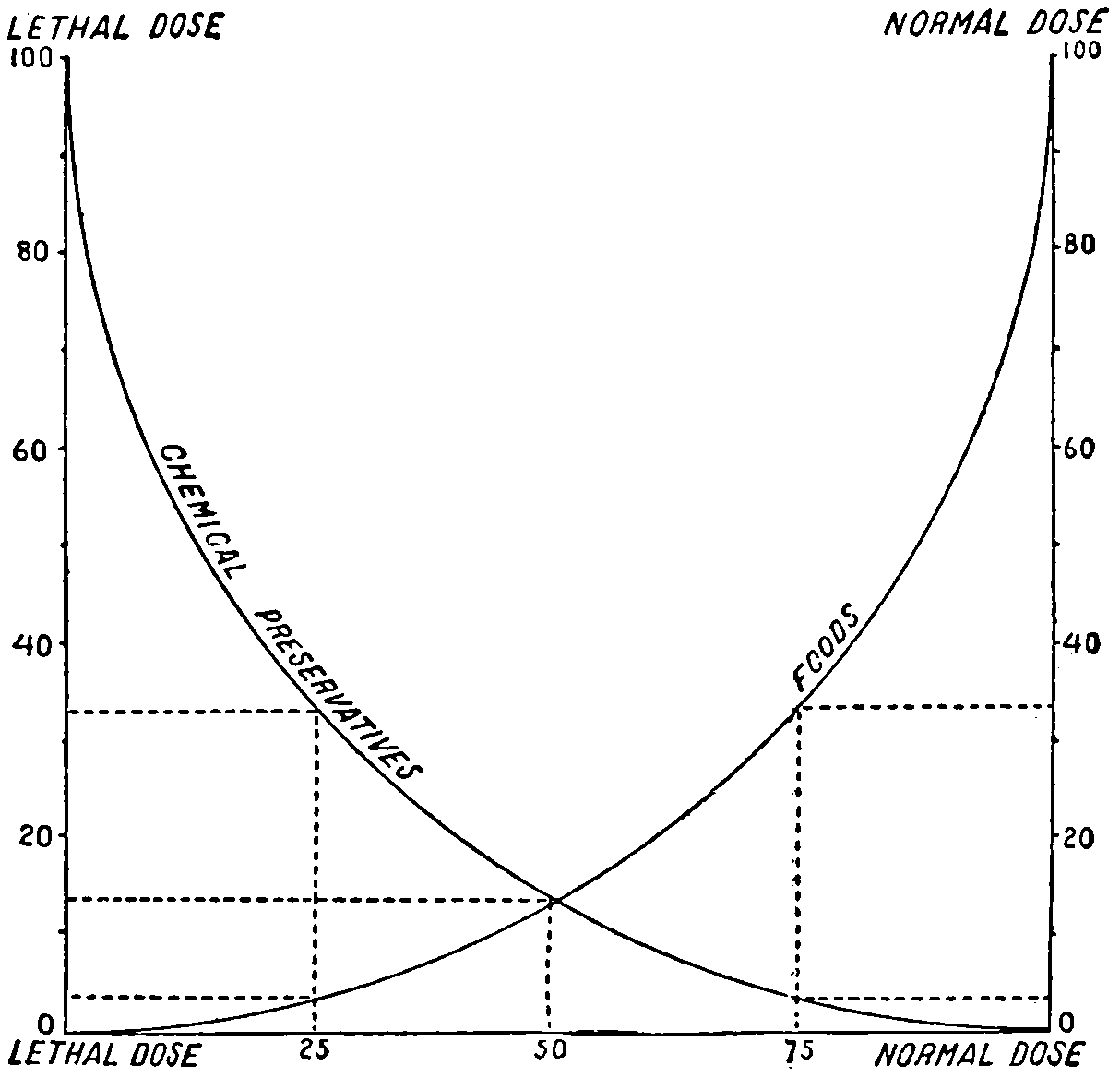
Fig. 7.—Graphic Chart Representing the Comparative Influences of Foods And Preservatives.
Let us now consider the perpendicular on the left, which is marked at the top under the term “Lethal dose,” namely, a quantity of the added preservative sufficient to destroy life. The normal dose of such an added chemical preservative is 0 and is shown at the base line to the right, marked “Normal dose.” If you add a very minute quantity of a chemical preservative, the curve representing it varies so slightly from the horizontal base as to be impossible of measurement by ordinary means. If we follow along to the number 75 on the horizontal base we see the deviation of the curve is sufficiently great to measure. At 50 it is still greater, at 25 still greater, while at the left of the basic line it is a maximum extending from 0 to 100, or the lethal dose. It is easy to show by mathematical data that no matter how small the quantity of an injurious substance or preservative it will still produce an injurious effect which may be infinitely small if the dose be infinitely small. It follows, then, as a mathematical demonstration that any quantity of an injurious substance added to a food product must of necessity be injurious, provided it is in the nature of a drug and the body is in a perfectly healthy, normal condition.
Hence the argument which has been so persistently urged in favor of a chemical preservative, that if in small quantities it is harmless, is shown to be wholly untenable. While there is no necessity for the addition of a harmful substance, where no particular benefit is secured thereby, and where there is no disturbance of the normal state of health, there can be no possible excuse of a valid nature to offer for the exhibition of even minute quantities. That these minute quantities would not be dangerous in so far as producing any fatal effect is concerned is conceded, but that in the end they do not produce an injury even in these small quantities is certainly to be denied. The course of safety, therefore, in all these cases is to guard the opening of the door. If the admission of small quantities is permitted, then there can never be any agreement among experts or others respecting the magnitude of the small quantity, and continued litigation and disagreement must follow. On the other hand, when the harmfulness of any substance which it is proposed to add to food is established and no reason for its use can be given other than the convenience, carelessness, or indifference of the manufacturer, the exclusion of such bodies entirely from food products follows as a logical sequence and a hygienic necessity.
The third method of preparing or preserving meat is by sterilization. Of all the various methods which have been proposed there is probably none which is, theoretically, so free of objections as the preservation of meat by sterilization, in other words, as canned meats. The only important thing is that the raw material used in canning must itself be meat free of disease, obtained under sanitary conditions, and subjected to sterilization before any fermentation or decay takes place. Pure, wholesome meat thus prepared and thoroughly sterilized will remain in an edible condition for a reasonable length of time. Unfortunately, as has been shown in the testimony respecting the packing industry of the country, canned meats have not always been selected solely for freedom from disease and for palatability. The question of diseased meat is discussed in another part of this book and, therefore, may not be taken up here. There have been used for canning purposes the fragments and, perhaps, inedible portions of carcasses, and this practice cannot be too severely condemned. This does not mean that these fragments and portions of carcasses are not fit for food, but they should be collected, prepared, and sold as such with plain notices to the consumers of their origin. A cheaper supply of beef would thus be furnished for those in humbler circumstances, and no imposition of any kind would be practiced because the nature of the meat would be fully understood.
Preparation of Meat for Canning.
—In the following description it is understood that the ordinary processes of canning sound, properly prepared beef are described. The question of the canning of improper samples is reserved for the remarks on adulterations.
There is no uniform practice followed, as has been carefully ascertained by a study of the different packing houses and processes for selecting and preparing meats for canning. The exigencies of trade determine this to a greater or less extent. When there is a demand in the fresh state for all the beef which can be supplied the canning industry will necessarily suffer. When there is a surplus of beef offered for sale or in case of war, where the army contracts for large quantities of canned meat, the opposite conditions probably prevail, and the best meats are used for canning purposes and those of a less desirable quality offered for sale in the fresh state. The portions of the carcass used, as described in Bulletin 13, Part 10, Bureau of Chemistry, depend, to some extent, upon the market of fresh beef. All of the meat on the fore quarter, except the shank and the “third rib,” is usually canned, and in some cases those portions are not reserved. The cheaper cuts from the hind quarter are also used for preserving purposes. Very fat, and therefore easily marketed, carcasses are not used for canning purposes except in case of unusual demand as above stated. There are two reasons for this, one of which has already been outlined, namely, that such meat brings a better price in the fresh state, and, in the second place, lean meat has a better appearance in the canned state than the fat meat. For these reasons, in the proper preparation of the meat for canning, the more fatty portions, together with the gristle, are removed and sent to other parts of the factory for making up into other kinds of food.
The meat having been selected, it is cut into pieces of approximately from one to four pounds in weight, according to the size of the tins in which it is to be placed. It is important, for the purpose of appearances, that the size of the pieces of meat in each tin be approximately the same. Also for the process of sterilization the pieces of meat should be practically the same size, so that they can all be thoroughly sterilized at the same time. If the pieces be of different sizes the small ones would become thoroughly cooked and disintegrated before the large ones became thoroughly sterilized, and thus the mass which would be presented to the view on opening the can would be unpleasant to the sight.
Parboiling.
—After the pieces have been selected and dressed they are parboiled before being sterilized. The time of parboiling varies in different packing establishments from eight to twenty minutes, according to the size of the pieces of meat. In some cases a uniform time for parboiling is prescribed, irrespective of the size of the pieces. One of the principal reasons for parboiling the meat is to secure the shrinkage, which always takes place on heating, before the meat is placed in the tins.
The experiments have shown that meats when put in tins in a fresh state and sterilized shrink to about two-thirds of their original volume. Parboiling is, in the essence, a process of shrinking. When the meat is put at once into boiling water there is less loss of protein matter than when the meat is placed in cold water and heated gradually. The substances removed in parboiling are water, fat, soluble mineral matter, and the meat bases. The fat is removed by becoming rendered, and rises to the surface where it can be skimmed off. A little over one percent of the protein content of meat is lost by parboiling while the total meat bases lost amount to almost one-third of the total quantity contained in the meat. Of mineral matter in the meat as high as 50 percent is lost in parboiling.
By shrinking, parboiling tends to make a more concentrated article and thus favors transportation. Practically the nutritive value of a pound of properly canned beef is about one-third greater than that of one pound of the fresh beef of the same kind. Hence parboiling may be regarded as a perfectly legitimate and desirable process without which the beef could not be properly prepared for canning.
Tinning.
—After the meat is properly parboiled it is placed in the tins either by machinery or by hand. To each tin is added a small quantity of a liquid preparation made by the canners and known as soup liquor. This liquor generally contains salt, and sometimes a little sugar or molasses. The composition of soup liquor is as follows:
Solids, .92 percent
Protein, .09 „
Meat bases, .23 „
Ash, .28 „
Salt, .11 „
Water, 98.37 „
This soup liquor may be regarded as a thin soup. The origin of the liquid analyzed above was not disclosed, and, therefore, no expression can be made of the way in which it was formed. It was probably made from soup stock, namely, the waste meat and bones of the factory. There is no objection to a soup liquor of this kind provided it is made from sound, clean, and wholesome material. There are two reasons for adding this liquid, namely, to fill up the space which would otherwise exist between the pieces of meat and thus aid in the preservation of the material, and, second, to add a condimental substance which makes the contents of the tin more palatable.
Sterilization.
—After the cans are filled in this way and closed by soldering or otherwise they are placed in retorts which are composed of strong iron or steel boilers, properly covered and secured, and when these boilers are full they are subjected to the action of steam heat under pressure. Usually a small hole is left in the can through which any gas, air or other kind, is expelled from the can. As soon as everything is complete the retorts are opened and the cans are sealed.
In all cases, however, after sealing the cans they are subjected to a second heating at a temperature of from 225 to 250 degrees F. The time of heating varies from one to two hours. After removal from the retorts the cans are washed with a spray of cold water for several hours, and they are then dried, painted, and labeled.
The above is a general description of the process employed which, however, is varied to some extent in different packing houses.
A modification of the above method consists in exhausting the cans in vacuo and automatically sealing them in the exhausted state, thus removing all air and other gases therefrom. The cans are then placed upon an endless conveyor and dipped into an oil bath at a temperature of 240 degrees, the speed of the conveyer being so regulated that the cans remain in the bath a sufficient length of time to complete sterilization before being carried out at the opposite end. After passing through this bath they are carried automatically into another bath consisting of a solution of carbonate of soda and, finally, into a bath of pure water. The cans are then painted and labeled as originally described.
SPECIAL STUDIES OF METHODS OF CANNING BEEF MADE IN BUREAU OF CHEMISTRY.
Composition of Beef Used for Canning.
—Samples of fresh beef intended for canning purposes, and examined in the Bureau of Chemistry, have the following composition:
Water, 71.17 percent
Insoluble protein, 13.87 „
Globulins, 1.38 „
Proteoses, peptones, and gelatin, 1.31 „
Meat bases, 1.09 „
Fat, 9.89 „
Ash, .96 „
Salt, .04 „
Undetermined, .33 „
The sample, of which the above data are representative, was secured from a mass of meat weighing 356 pounds, after passing through a sausage grinder and being thoroughly mixed. The above data may therefore be regarded as the representative constituents of the usual grade, most carefully selected canning beef.
Effect of Parboiling.
—A similar lot of meat secured in the same way and from the same carcass weighed 358 pounds and was parboiled as follows: The meat was placed in water in a steam-jacketed tank, the temperature of which stood at 196 degrees F. The reduction in the temperature caused by the meat was restored by heating the contents of the retort, and it was kept at 196 degrees F. for 15 minutes. It is thus seen that this parboiling was accomplished at a temperature below the boiling point of water. After the parboiling was completed it was found that the meat weighed 235 pounds, showing a net shrinkage in weight of 123 pounds. This sample of meat was then tinned in two-pound cans with the addition to each can of two ounces of canning jelly of the following composition:
Water, 95.18 percent
Protein, 1.75 „
Common salt, 2.85 „
Ash, .22 „
After sterilizing, the cans were opened and the contents subjected to analysis. The data obtained are as follows:
Water, 62.47 percent
Total protein, 24.88 „
Insoluble protein, 22.25 „
Proteoses, peptones, and gelatin, 2.63 „
Meat bases, 1.15 „
Fat, 9.87 „
Ash, .91 „
Salt, .19 „
Composition of Parboiling Water.
—The liquor, after parboiling the above sample, weighed 280 pounds and had the following composition:
Water, 99.12 percent
Protein, .06 „
Meat bases, .25 „
Ash, .25 „
Salt, .05 „
The above data show that the general effect of parboiling upon the canned meat is to diminish its content of water. Only a small quantity of the soluble proteids is found in the liquor, and the other principal constituents removed, aside from water, are the meat bases and mineral content or ash. The fat in the soup liquor was not determined because it rises to the surface and is not in any sense a constituent of the liquor itself. Considerable quantities of fat were removed in parboiling, the amount depending largely upon the temperature. At a low temperature of parboiling, such as described, the amount of fat secured is far less than when the temperature of parboiling is higher.
Table Showing the Comparative Effect of Parboiling and Sterilizing upon the Fresh Beef.
Constituents. Fresh Beef. Extracted by Boiling. Added in Canning. Composition of Canned Beef as Determined by Analysis.
Lbs. Lbs. Lbs. Lbs.
Water, 254.8 122.1 14.1 146.8
Protein, 59.3 .1 .1 58.5
Meat bases, 3.9 .7 .0 2.7
Fat, 35.4 12.2 .... 23.2
Ash, 3.4 .7 .2 2.1
Salt, .1 .1 .2 .4
Undetermined, 1.2 .... .... 1.7
Total, 358.1 .... .... 235.4
Preparation of Canned Beef with More Intensive Parboiling.
—In another experiment, determining the effect of the changes produced upon the fresh meat, more vigorous preparatory operations were performed. Samples were secured from eight healthy carcasses for use in this determination. Half of the sample was reduced to sausage and secured for analysis as described, and the other submitted to parboiling, sterilizing, and analysis.
Composition of the Sample of Fresh Meat.
Water, 69.33 percent
Total protein, 16.81 „
Insoluble protein, 12.69 „
Globulins, 3.06 „
Proteoses, peptones, and gelatin, 1.06 „
Meat bases, 1.12 „
Fat, 10.68 „
Ash, 1.13 „
Salt, .24 „
The original sample represented over a thousand pounds. The opposite sides of the carcasses were prepared for canning and produced the following amount of articles as sold on the market:
Total weight of half carcasses, 1,761 pounds
3 ribs, 53 „
5 rolls, 43 „
5 loins, 166 „
3 tenderloins, 13 „
3 sirloin butts, 28 „
3 boneless strips, 24 „
8 rump butts, 36 „
8 flank steaks, 8 „
8 kidneys, 9 „
24 beef hams, 261 „
Shank meat, 85 „
Soft bones, 198 „
Shank bones, 107 „
Tank tallow, 132 „
Canning meat, 598 „
The above data show that only about one-third of the whole carcass is suitable for canning purposes. The best and juiciest pieces, it is noticed, are cut away and sold for other purposes. In explanation of the above data it should be stated that only the fore-quarters of the carcass were used and not the whole carcass.
In the preparation of the sample for analysis, the same selection was made as for canning, and only the canning meat was used in the preparation of the sample.
Parboiling.
—The parboiling of this sample was accomplished in the following manner: The meat was first placed in cold water, 50 degrees F., and heated by means of injected steam. In five minutes the temperature had reached 122 degrees F., and at the end of eleven minutes the boiling temperature was reached and continued for one hour. The soup liquor resulting from the parboiling weighed 1,500 pounds and had the following composition:
Water, 99.08 percent
Protein, .09 „
Meat bases, .23 „
Ash, .28 „
Salt, .11 „
These data show that, as in the other cases, the chief extraction from the meat during parboiling is water and the next most important removal is of meat bases and mineral matter or ash. After sterilization in the usual way the cans were opened and the canned beef subjected to analysis. The composition of the canned beef was as follows:
Water, 56.18 percent
Total protein, 31.57 „
Insoluble protein, 27.94 „
Proteoses, peptones, and gelatin, 3.63 „
Meat bases, 1.44 „
Fat, 7.72 „
Ash, .82 „
Common salt, .04 „
Composition of the Fresh and Canned Meat.
—Below is found a table similar to that already given for the other sample, showing the composition of fresh beef and the resulting canned beef.
Constituents. Fresh Beef. Extracted by Boiling. Added in Canning. Composition of Canned Beef as Determined by Analysis.
Lbs. Lbs. Lbs. Lbs.
Water, 414.6 243.2 12.9 184.3
Proteins, 100.5 1.3 .... 101
Meat bases, 6.7 3.4 .... 4.6
Fat, 63.9 39.2 .... 24.7
Ash, 6.8 4.2 .... 2.6
Undetermined, 5.5 .... .... 2.8
Total, 598 .... .... 320
From the above table it is seen that the shrinkage during parboiling amounts to 46.49 percent of the weight of the fresh meat. Of this shrinkage 82.85 percent is water, 14.11 percent is fat, 1.51 percent ash, and 0.82 percent meat bases. It is noticed that more than half of the water originally found in the meat is extracted by parboiling.
It seems rather anomalous that boiling a substance with water would extract water from it, but in the case of meats it is seen that half the water, or even more, which a meat contains is extracted from it by boiling in water.
The two samples given are extreme cases in the method of preparing meats for canning. In the first instance the meat is placed at once into hot water just below the boiling point and kept there for only a short time. In the second case the meat is placed in cold water and is brought to the boiling point and maintained there for one hour. In the last case the low temperature of the water in which the meat was originally placed favors the extraction of a portion of the soluble protein matter, namely, albumins, globulins, etc., while, on the other hand, the long-continued boiling to which it was subjected tends to decompose the connective tissues of the meat and causes the loss of small particles of the insoluble protein thus separated by disintegration. Although in the last case the shrinkage was much greater than in the preceding experiment, practically no insoluble protein matter was extracted, mechanically or otherwise.
Canning of Beef without Parboiling.
—To determine the amount of shrinkage which takes place and the general effect which is produced by canning meats without parboiling, samples were prepared, sterilized, and canned in the usual way, with the exception of the omission of parboiling. On opening the cans it was found in each case that the meat had shrunk to about two-thirds of its former volume and that the place was occupied by a liquid containing a number of particles of solid matter. The appearance of the sample was much less inviting than that of meat canned after parboiling.
An analysis of the sample was made, with the following results: Total weight of sample, 31 ounces; weight of canned meat, 21 ounces.
Water, 63.83 percent
Protein, 27.25 „
Meat bases, 1.09 „
Fat, 4.62 „
Ash, 1.01 „
Salt, .04 „
Undetermined, 1.20 „
Composition of Liquid.
—The liquid in the can was examined with the following result: Weight of liquor, 10 ounces.
Solids, 6.93 percent
Protein and gelatin, 1.94 „
Meat bases, 1.84 „
Ash, 1.22 „
Salt, 1.15 „
The above data show that the beef lost 32.06 percent of its weight in the canning, a little over half of which is water.
It appears that less protein matter is extracted when the meat is parboiled by being plunged into boiling water than when it is packed in a can without parboiling and subsequently subjected to the temperature of sterilization. In the former case the soluble proteins in meat near the surface are coagulated before they can diffuse into the surrounding water. In the other case, owing to the low conductivity of meat, the temperature at the surface of the can penetrates slowly to the interior and the juices which are extracted from the meat carry with them protein matter in solution which is afterwards precipitated by heat and remains in the liquid as matter coagulated at the temperature of sterilization.
It is seen that parboiling has many advantages. It extracts less of the valuable matter from the meat, it shrinks the meat before packing so that the tins contain more nutrient matter, and it improves the appearance of the meat to the consumer when opened.
Relation of Canned to Fresh Meat.
—In the following table is given the number of ounces of canned meat in a number of cans compared with the equivalent amount of fresh beef used in filling them:
No. of Can. Canned Beef, Equivalent to Fresh Beef.
Ounces. Ounces.
1, 29 44.2
2, 29.9 42.6
3, 28.5 38.7
4, 12.6 19
5, 30.5 57
6, 30.6 50.9
Means, 26.9 42.1
It thus appears that a can of 26.9 ounces of beef contains, as an average content, an amount of meat equivalent to 42.1 ounces of fresh beef, and retains practically all of the nutrient value of the larger quantity of fresh beef.
Canned Ham and Bacon.
—It seems unnecessary, as a rule, to can ham and bacon properly cured and transported in a suitable manner. There are occasions justifying the use of these products in tropical countries and in other places far remote from the sources of manufacture, and where the preservation of them, by reason of the character of the climate, is difficult.
The proper preparation of these articles, packing in tins and sterilizing, makes it possible to send them to the most distant points and to have them consumed in the most unfavorable climatic conditions. Canned ham, as it is found upon the market, has a higher percentage of fat and a consequently lower percentage of protein than canned beef. The ham is packed closely and the smaller pieces added for the purpose of filling up interstices between the larger pieces of meat and keeping the can full. It is reasonable to infer that the added meat is pork, although very probably it may not always be so.
Composition of Canned Ham and Bacon.
—The character of the canned ham and bacon upon the market may be illustrated by the composition of the following samples (these samples were purchased in the open market and are presumably representative of the products as commonly sold in the shops):
COMPOSITION OF CANNED HAM AND BACON.
Description. Composition of Original Material. Composition of Dry Material.
Water. Water in fat- free sub- stance. Fat. Nitrogen. Nitrogenous substances. Ash. Sodi- um chlo- rid. Total. Pro- tein (N × 6.25). Fat. Ash. Sodi- um chlo- rid.
Total. Co- agu- lated pro- teids. Precip- itated by bromin. Meat bases. Pro- tein (N × 6.25). Co- agu- lated pro- teids. Gelati- noids and pro- teids precip- itated by bromin. Meat bases.
P. ct. P. ct. P. ct. P. ct. P. ct. P. ct. P. ct. P. ct. P. ct. P. ct. P. ct. P. ct. P. ct. P. ct. P. ct. P. ct. P. ct. P. ct.
Sliced Star ham, 43.80 71.84 38.22 2.07 1.62 0.06 0.39 12.94 10.12 0.38 1.22 3.86 3.29 97.60 23.00 68.01 6.87 5.85