SNAPDRAGON FAMILY
Reading edition
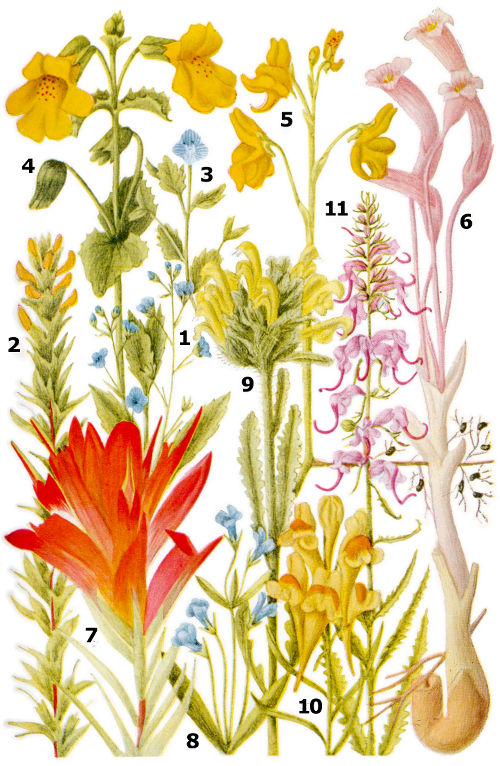
Speedwell Veronica americana
Plate 22, fig. 1
The Speedwell is a water-plant and its blue or white, purple-striped flowers may be found in wet meadows and about ponds at 4000-12000 ft. The stems grow 4 in.-2 ft. tall and the flowers bloom throughout the summer.
Gold Tongue Orthocarpus luteus
Plate 22, fig. 2
The common name is suggested by the appearance of the yellow flowers. These occur in stiff spikes on stems 4-16 in. tall and bloom all summer. They may be found on plains and in foothills and meadows at 4000-10000 ft.
31
Eyebright Veronica Buxbaumii
Plate 22, fig. 3
The Eyebright is a very close relative of the Speedwell. Some twenty of the species of Veronica have been used as drugs. The flowers are blue with darker stripes and bloom from early spring through the summer and fall. The stems are 6-16 in. tall and are found in waste places at 5000-8000 ft.
Monkey Flower Mimulus Langsdorfii
Plate 22, fig. 4
The yellow Monkey flowers grow on stems 6 in.-2 ft. high and are found in swamps and along streams, especially in muddy places, at 8000-12000 ft. They bloom in spring and summer. The Greek name of the genus means “comic actor” and refers to the grinning corolla, which also gives point to the common name.
Indian Paintbrush, Painter’s Brush Castilleia miniata
Plate 22, fig. 7
The brilliant red color of the Indian Paintbrush is furnished mainly by the upper leaves. The corollas are enfolded in the brightly colored bracts, which, clustered together at the end of the stem, give the effect of a gorgeous blossom. The plants are partial parasites and obtain their food ready-made from their neighbors. They grow 1-3 ft. tall and occur in foothills, mountains and forests at 6000-11000 ft. The flowers bloom all summer.
Blue-eyed Mary Collinsia parviflora
Plate 22, fig. 8
The blue or blue and white flowers of this plant grow on spreading stems 2-6 in. high. They occur on shaded hillsides at 5000-9000 ft. and bloom in spring and early summer.
32
Plate 22
SNAPDRAGON FAMILY
1 Speedwell: Veronica americana 2 Gold Tongue: Orthocarpus luteus 3 Eyebright: Veronica Buxbaumii 4 Monkey Flower: Mimulus Langsdorfii 7 Indian Paintbrush, Painter’s Brush: Castilleia miniata 8 Blue-eyed-Mary: Collinsia parviflora 9 Lousewort, Turtle Head: Pedicularis canadensis 10 Butter-and-eggs: Linaria vulgaris 11 Little Elephant: Elephantella groenlandica
BLADDERWORT FAMILY
5 Bladderwort: Utricularia vulgaris
BROOM-RAPE FAMILY
6 Broom-rape: Thalesia uniflora
33
Lousewort, Turtle Head Pedicularis canadensis
Plate 22, fig. 9
The flowers of this Lousewort are yellowish and occur in crowded heads on low spreading stems, 4-6 in. high. They occur in mountain meadows at 6000-9000 ft. and bloom in spring and early summer. The name Lousewort is derived from the Latin one which was bestowed upon it, because once upon a time farmers believed that when their flocks fed upon the flowers the sheep were liable to be attacked by certain tiny lice or “pediculi.” The name Turtle Head is from a fancied resemblance of the flower to the protruded head of a turtle. The plants are supposed to be poisonous to sheep.
Butter-and-Eggs Linaria vulgaris
Plate 22, fig. 10
The flowers of Butter-and-Eggs are yellow and orange, and the common name refers to these two shades of yellow. They bloom throughout the summer and fall and are common in waste places and fields at 3000-7000 ft. The plants are persistent deep-rooted perennial weeds, 8-20 in. tall, and may be eradicated whenever desired by short rotation of crops and thorough cultivation in spring and fall. They are regarded with suspicion as being poisonous and the juice mingled with milk constitutes a fly poison. At one time, however, the plants yielded what was considered a valuable skin lotion.
Little Elephant Elephantella groenlandica
Plate 22, fig. 11
The flowers of the Little Elephant are pinkish-purple, and the elongated curved tube of the upper petal has a comical resemblance to an elephant’s trunk. The stems grow 4-24 in. tall and are found in swamps and wet meadows at 8000-12000 ft. The flowers are arranged in open spikes and bloom all summer long.
34