LILY FAMILY
Reading edition
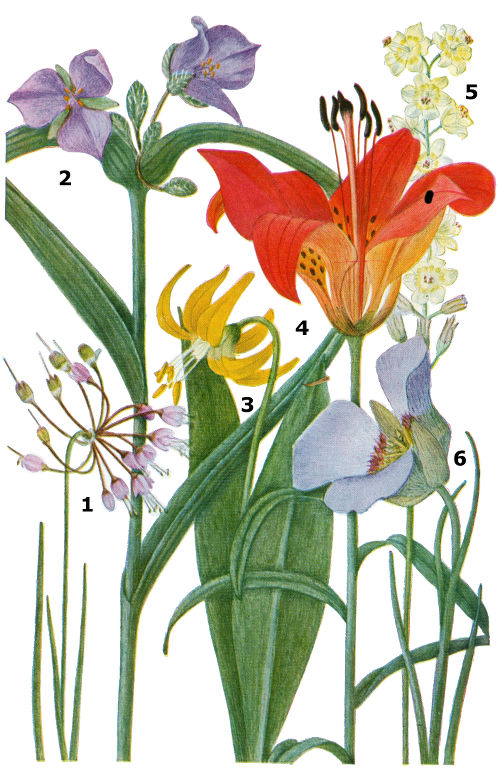
Wild Onion Allium cernuum
Plate 42, fig. 1
The Wild Onion bears open clusters of rose-purple flowers that droop in the bud, but rise gradually as they bloom, until the fruits are erect. They blossom in midsummer and are found in foothills, meadows, and aspen and spruce woods at 5000-10000 ft. The plants grow 1-2 ft. tall, and the bruised foliage and bulbs have the characteristic onion odor. The genus is widely cultivated and furnishes several varieties of onion, chives, leek, garlic and shallot.
Spring Lily Erythronium parviflorum
Plate 42, fig. 3
The yellow flower of the Spring Lily droops from a slender stem, 6-15 in. tall and blooms in the spring. The plant consists merely of two broad but pointed leaves, besides the flowering-stalk, and is found in meadows and spruce woods at 8000-12000 ft. It certainly deserves a place among cultivated plants.
Red Lily Lilium philadelphicum
Plate 42, fig. 4
The scarlet petals of the Red Lily are ornamented at their bases with dark reddish-brown spots that serve to direct visiting insects to the honey. The blossoms are large and conspicuous and occur singly at the tips of stiff stems, 2-4 ft. tall. They come into bloom in early summer and midsummer, and are found in bogs and along brook-banks at 7000-11000 ft. The Red Lily is very like the Tiger Lily of the garden and should be given a place there also, though it is not as yet widely cultivated.
74
Plate 42
LILY FAMILY
1 Wild Onion: Allium cernuum 3 Spring Lily: Erythronium parviflorum 4 Red Lily: Lilium philadelphicum 5 Wand Lily: Zygadenus elegans 6 Mariposa Lily: Calochortus Gunnisonii
SPIDERWORT FAMILY
2 Spider Lily: Tradescantia virginiana
75
Wand Lily Zygadenus elegans
Plate 42, fig. 5
The cream-colored blossoms of the Wand Lily are grouped in open spikes on straight slender stems 4 in.-2-1/2 ft. tall. They bloom in midsummer in meadows and spruce and aspen woods at 7000-12000 ft. The Wand Lily is related to the poisonous Death Camas, and is probably poisonous also.
Mariposa Lily Calochortus Gunnisonii
Plate 42, fig. 6
This Mariposa Lily is usually white, though delicate lilac blossoms are sometimes found. The petals are ornamented with various markings which give point to the common name of the genus which means “butterfly.” The plants grow 1-4 ft. tall in foothills, meadows and aspen forests at 4000-11000 ft. and bear flowers all summer long. The genus is widely distributed and contains many beautiful species and varieties of striking colors, which should be more generally cultivated.