ASTER FAMILY
Reading edition
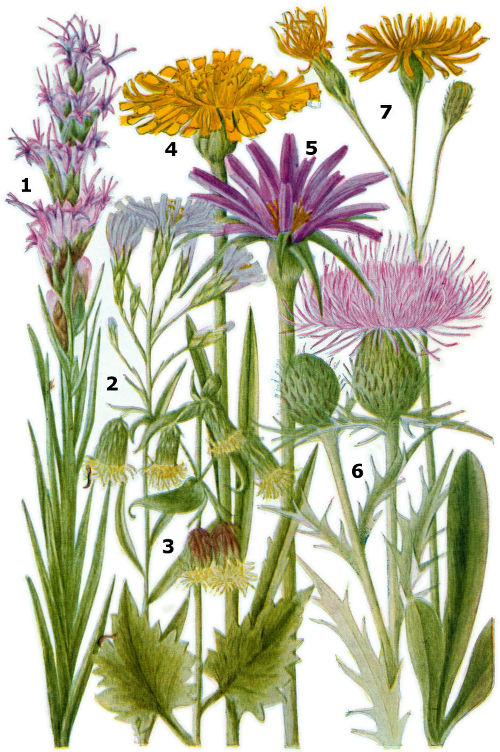
Blazing Star Laciniaria punctata
Plate 37, fig. 1
The Blazing Star receives its name from the dense spikes of brilliant red-purple blossoms. These bloom in late summer and autumn and are found on prairies, plains and foothills at 3000-6000 ft. The plants are unbranched and grow 6-18 in. tall. This species is the least beautiful of several native blazing stars that deserve a place in the wild garden.
59
Blue Lettuce Lactuca pulchella
Plate 37, fig. 2
The pale blue-lavender flowers of the Blue Lettuce grow in clusters on plants 3-6 ft. high. They bloom in midsummer and are found along roadsides and in meadows at 3000-6000 ft. Several varieties of lettuce have narcotic properties, while the value of the garden lettuce is too well-known to need comment.
Sheath Flower Coleanthus grandiflorus
Plate 37, fig. 3
The pale yellow blossoms of the Sheath Flower hang from their stalks like inverted thimbles and bloom in midsummer. The name refers to the tiny bracts that sheathe the flower-heads closely and turn reddish brown with age. The plants are much branched, 1-4 ft. tall, and occur in meadows and thickets at 5000-9000 ft.
False Dandelion Agoseris glauca
Plate 37, fig. 4
The golden-yellow heads of the False Dandelion look very like those of its namesake. They bloom in midsummer and are found on plants 1-3 ft. tall, in mountain meadows and along brook-banks at 8000-11000 ft.
Goatsbeard, Salsify Tragopogon porrifolius
Plate 37, fig. 5
The Goatsbeard or Salsify bears large purple flower-heads with yellow centers at the tips of stiff, straight stems, 2-4 ft. tall. The plants have escaped from cultivation and may be found blooming all summer, along roadsides and in meadows at 4000-7000 ft. The roots of the Salsify are edible and are marketed under the name of “Oyster Plant.” The name “Goatsbeard” refer to the clusters of stiff hairy fruits.
60
Plate 37
ASTER FAMILY
1 Blazing Star: Laciniaria punctata 2 Blue Lettuce: Lactuca pulchella 3 Sheath Flower: Coleanthus grandiflorus 4 False Dandelion: Agoseris glauca 5 Goatsbeard, Salsify: Tragopogon porrifolius 6 Rose Thistle: Carduus undulatus 7 Hawksbeard: Crepis runcinata
61
Rose Thistle Carduus undulatus
Plate 37, fig. 6
The Rose Thistle is so named on account of the bright rose-purple flower-heads, which bloom in summer and autumn. The plants are 2-5 ft. tall and grow on plains, prairies and foothills at 5000-7000 ft. The gray-green foliage is very spiny, but when bruised to destroy the spines forms good food for cattle. Donkeys eat the plants, spines and all, and seem to relish them. The Thistle is the badge of Scotland.
Hawksbeard Crepis runcinata
Plate 37, fig. 7
The Hawksbeard has dandelion-like flower-heads of a golden yellow, which bloom in midsummer. The plants grow 1-2 ft. tall in mountain meadows and bogs at 8000-11000 ft.
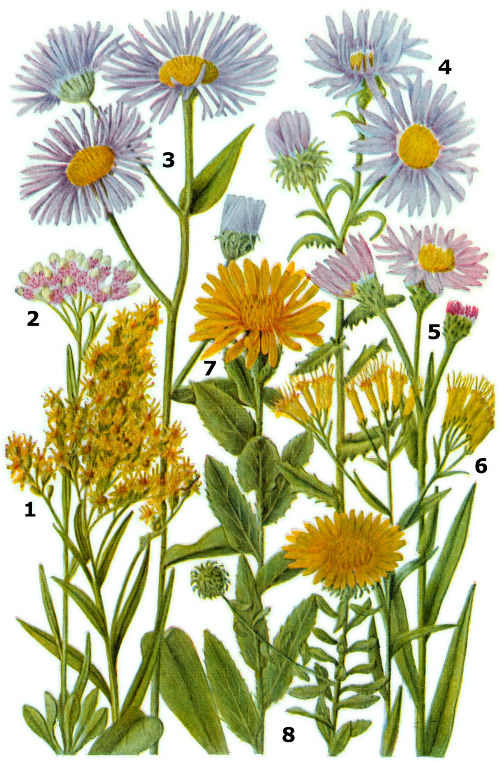
Prairie Goldenrod Solidago missouriensis
Plate 38, fig. 1
The flower clusters of the goldenrods vary from rather slender, stiff spikes, which give the name to the group, to large, spreading, feathery panicles. The Prairie Goldenrod belongs to the latter class and is only medium-sized, both as to flower-clusters and plants, which are 8 in.-2 ft. tall. It blooms from midsummer to autumn and is most at home on the prairies, though it also occurs in meadows and on gravel-slides at 3000-10000 ft. The Goldenrod is the state flower of Nebraska. The botanical name for the genus comes from the Greek “to make whole” which refers to the healing properties formerly attributed to the plant.
62
Plate 38
ASTER FAMILY
1 Prairie Goldenrod: Solidago missouriensis 2 Pussy’s Toes: Antennaria dioeca 3 Daisy: Erigeron macranthus 4 Purple Aster: Machaeranthera Bigelovii 5 Leafy Aster: Aster foliaceus 6 Gold-top: Gutierrezia sarothrae 7 Golden Eye: Chrysopsis villosa 8 Gum Weed: Grindelia squarrosa
63
Pussy’s Toes Antennaria dioeca
Plate 38, fig. 2
The soft fuzzy balls that give this plant its name are the pistillate or seed-bearing flowers, while the staminate or pollen-bearing ones grow in heads on other stems. The botanical name for the genus refers to the fact that the protruded brown anthers of the staminate heads sometimes resemble the antennae of insects. The heads are creamy white with rose-colored bracts enclosing them at the base, and bloom in spring and early summer. The plants are 2-15 in. tall and grow on prairies and in meadows and aspen woodland at 3000-10000 ft. The leaves are gray from the white woolly hairs covering them, and grow in clusters at the base of the flowering stems. These clusters usually form dense mats, the leaves of which are sometimes chewed by children as Indian Tobacco or Ladies’ Tobacco.
Daisy Erigeron macranthus
Plate 38, fig. 3
This Daisy has yellow disks surrounded by blue-purple rays. The name is a corruption of Day’s Eye which refers to the resemblance of the yellow center and its rays to the sun and its rays. The plants grow 1-3 ft. tall in meadows, fir forests, aspen woodlands and on gravel-slides at 5000-10000 ft. and bloom in midsummer. They are beautiful enough to be given a place in the garden.
Purple Aster Machaeranthera Bigelovii
Plate 38, fig. 4
The Aster differs from the Daisy in having fewer and broader ray-flowers. This Aster has purple rays and yellow disks. It grows 1-4 ft. tall in meadows and on gravel-slides at 6000-10000 ft. and blooms in midsummer.
Leafy Aster Aster foliaceus
Plate 38, fig. 5
The heads of the Leafy Aster have yellow disk-flowers and red-purple rays. They bloom from midsummer to autumn. The plants grow 6 in.-2 ft. tall in meadows and aspen woodlands at 7000-11000 ft. 64 The word “aster” comes from the Latin for “star” and refers to the rays surrounding the yellow center.
Gold-top Gutierrezia sarothrae
Plate 38, fig. 6
The slender yellow heads of Gold-top grow in dense clusters on plants 1-3 ft. high. They bloom from midsummer to autumn and may be found on prairies and plains at 3000-8000 ft. They are especially typical of pastures and over-grazed areas.
Golden Eye Chrysopsis villosa
Plate 38, fig. 7
The name “Golden Eye” is a direct translation of the scientific name of the genus. The flower-heads are entirely golden-yellow, ray-flowers as well as disk-flowers, and they bloom in midsummer. The plants are low-growing, 1-2 ft. high, and occur on prairies and gravel-slides and in aspen woodlands at 3000-10000 ft.
Gum Weed Grindella squarrosa
Plate 38, fig. 8
The foliage of the Gum Weed oozes a sticky substance that gives the plant its name. The flower-heads are golden-yellow and bloom from midsummer to autumn. The plants are branched and grow 2-4 ft. tall, along roadsides and in pastures at 3000-7000 ft. The entire plant is used in medicine for certain lung troubles, and a salve is made from it that is helpful in poison-ivy poisoning.
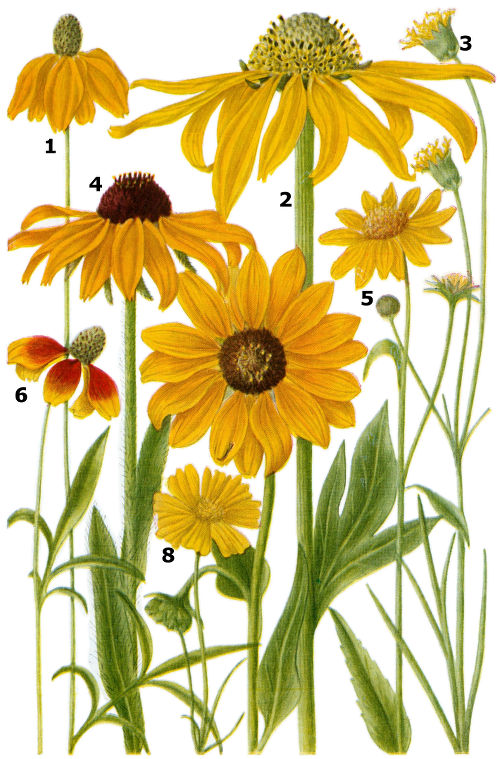
Cone Flower Ratibida columnaris
Plate 39, figs. 1, 6
The fertile flowers of the Cone Flower are grouped in cone-shaped heads, which give the plant its name. The broad ray-flowers vary 65 in color through shades of pure yellow to brilliant orange-red, and this form is sometimes cultivated in home gardens. The plants grow 1-3 ft. tall on prairies and plains at 3000-7000 ft., and bear flowers all summer.
Golden Glow Rudbeckia laciniata
Plate 39, fig. 2
The native Golden Glow is related to the popular Golden Glow of the garden. It is a striking plant, 3-6 ft. tall and bears many large flower-heads with long, spreading or drooping yellow rays. They bloom in midsummer and are found in meadows and along brook-banks in aspen and fir forests at 5000-8000 ft.
Black-eyed Susan Rudbeckia hirta
Plate 39, fig. 4
Black-eyed Susan, unlike its near relative Golden Glow, has a reddish-brown, almost black, center and orange-yellow rays. It is cultivated also, but occurs naturally in meadows and bogs and along brook-banks at 5000-11000 ft. The plants are 1-4 ft. tall and bloom all summer.
Rayless Thelesperma Thelesperma gracile
Plate 39, fig. 3
As the name indicates, the Rayless Thelesperma has heads of fertile flowers only, ray-flowers being lacking. The heads are grouped in graceful clusters on slender stems, 2-4 ft. tall, and bloom all summer. The plants occur on prairies and plains at 3000-8000 ft.
Rayed Thelesperma Thelesperma trifidum
Plate 39, fig. 8
The Rayed Thelesperma, in contrast to the one above, has broad yellow ray-flowers around a yellow center. It is a relative of Coreopsis and should also be cultivated in home gardens. The plants are 1-3 ft. tall and are found along roadsides and in pastures and fields at 3000-7000 ft., blooming all summer.
66
Plate 39
ASTER FAMILY
1, 6 Cone Flower: Ratibida columnaris 2 Golden Glow: Rudbeckia laciniata 3 Rayless Thelesperma: Thelesperma gracile 4 Black-eyed Susan: Rudbeckia hirta 5 Sun Spots: Gymnolomia multiflora 7 Sunflower: Helianthus petiolaris 8 Rayed Thelesperma: Thelesperma trifidum
67
Sun Spots Gymnolomia multiflora
Plate 39, fig. 5
The heads of Sun Spots are yellow throughout and bloom all summer. The plants are 2-5 ft. tall and grow on prairies and foothills at 5000-7000 ft.
Sunflower Helianthus petiolaris
Plate 39, fig. 7
One scarcely needs an introduction to the cheery Sunflower which overruns roadsides and fallow fields everywhere at 3000-8000 ft. The plants are 2-5 ft. tall and bear flowers all summer. This species is the western form of the common sunflower, Helianthus annuus. The latter was held in high veneration by the ancient Peruvians and Mexicans, being used by them as a sacred and artistic emblem. It also figures in Greek mythology. The farmer of today, however, regards it quite otherwise when it invades his cultivated fields. It is, nevertheless, the state flower of Kansas. The name Sunflower was given this plant under the impression that the heads turn their faces always towards the sun and follow it in its daily course. This is not the case, however, for though the heads of a field of sunflowers are usually turned in the same direction, this is due to the effect of the prevailing wind rather than to sunlight.
The common sunflower is cultivated for the sake of the honey and wax which are obtained from the flowers by the bees, and also for its seeds which are used in various ways. They furnish feed for domestic and farm animals, or are ground and made into cakes, or roasted and used as coffee. In Russia they are sold in the streets and eaten as nuts. An oil also is obtained from them that is said to be equal to olive oil.
68
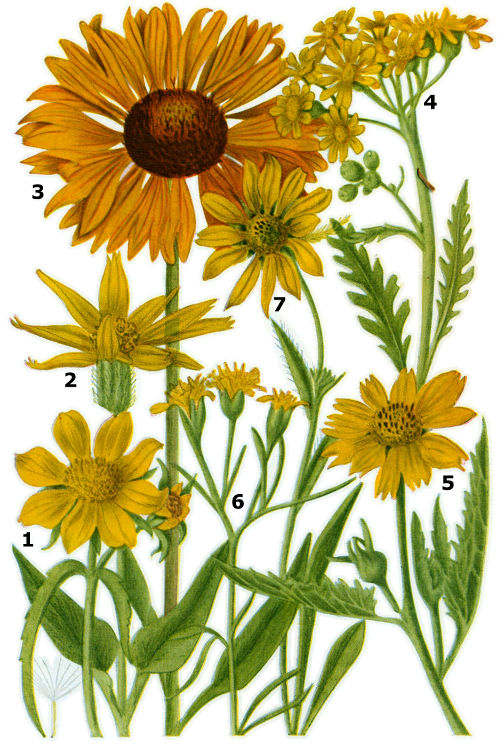
Plate 40
ASTER FAMILY
1 Bur Marigold: Bidens levis 2 Mountain Arnica: Arnica cordifolia 3 Gaillardia: Gaillardia aristata 4 Butterweed: Senecio Fendleri 5 Goldweed: Ximenesia encelioides 6 Actinella: Actinella Richardsonii 7 Dwarf Sunflower: Helianthella Parryi
69
Bur Marigold Bidens levis
Plate 40, fig. 1
The bright yellow heads of the Bur Marigold may be found blooming all summer in marshes and ditches at 3000-6000 ft. The plants are 1-4 ft. tall. The names, both common and botanical, refer to the tooth-like spines on the end of the seed-like fruits.
Mountain Arnica Arnica cordifolia
Plate 40, fig. 2
This native Arnica is a close relative of Arnica montana, which furnishes the well-known tincture that is applied to bruises and sprains. It has been employed as a stimulant in low fevers, but does not appear to have any value when used internally. The Mountain Arnica occurs in fir, spruce and aspen forests at 7000-12000 ft. The heads are yellow-centered and yellow-rayed, and bloom all summer on plants 1-2 ft. high.
Gaillardia Gaillardia aristata
Plate 40, fig. 3
Gaillardia bears very large heads with reddish-brown centers and many yellow or orange rays. They bloom all summer. The plants grow 1-3 ft. tall and may be found on prairies, and in meadows and aspen woodlands at 7000-10000 ft. The Gaillardias are frequently cultivated in gardens.
Butterweed Senecio Fendleri
Plate 40, fig. 4
The yellow heads of the Butterweed are quite small but are grouped in large clusters on stems 6 in.-2 ft. tall. They bloom in midsummer and are found on foothills and gravel-slides at 7000-10000 ft.
70
Goldweed Ximenesia encelioides
Plate 40, fig. 5
The heads of the Goldweed have yellow centers and yellow, toothed rays, and they bloom all summer. The plants are 2-5 ft. tall, growing along roadsides and in fallow fields at 3000-7000 ft.
Actinella Actinella Richardsonii
Plate 40, fig. 6
The yellow heads of Actinella are small and grouped in open clusters on stems 6 in.-2 ft. tall. They bloom in early and midsummer and are found on plains and foothills at 5000-8000 ft. This species of Actinella is sometimes called the “Colorado Rubber Plant,” but it does not produce rubber in sufficient quantities to be commercially valuable.
Dwarf Sunflower Helianthella Parryi
Plate 40, fig. 7
The heads of the Dwarf Sunflower are entirely yellow. They are borne on slender stems 1-3 ft. tall and bloom in midsummer. They may be found in spruce and aspen forests at 7000-10000 ft.
Bahia Bahia dissecta
Plate 41, fig. 1
The heads of Bahia have large yellow centers and very short yellow rays. They grow on branching stems 1-4 ft. high and bloom in midsummer. The plants may be found on foothills and gravel-slides at 5000-9000 ft.
Actinella Actinella acaulis
Plate 41, fig. 2
Actinella, like Bahia, has large yellow centers and short yellow rays. The plants are unbranched and grow 6-18 in. tall. They bear 71 flowers in early summer and occur on prairies, plains and foothills at 3000-8000 ft.
Sneezeweed Helenium Hoopesii
Plate 41, fig. 3
The heads of the Sneezeweed are large and orange-yellow. They grow on stiff stems 2-6 ft. tall and bloom all summer. The plants are found in spruce forests, aspen woodlands and subalpine meadows at 9000-12000 ft. They are poisonous to stock. The common name has reference to the effect that the strong odor of the flowers have on some people.
Cream Tips Hymenopappus tenuifolius
Plate 41, fig. 4
The yellow heads of the Cream Tips are without ray-flowers. They grow on slender stems 1-4 ft. tall and bloom in spring and midsummer. The plants have very finely cut leaves and are found on prairies, plains and foothills at 3000-7000 ft.
Taper Leaf Pericome caudata
Plate 41, fig. 5
The Taper Leaf is a bushy ornamental plant covered in midsummer and autumn with open clusters of fragment yellow flower-heads. The tips of the leaves are narrowed to a long, slender point and this character is expressed in both the botanical and common names. The bushes grow 3-6 ft. high, and 3-8 ft. wide and occur on foothills and gravel-slides at 6000-8000 ft.
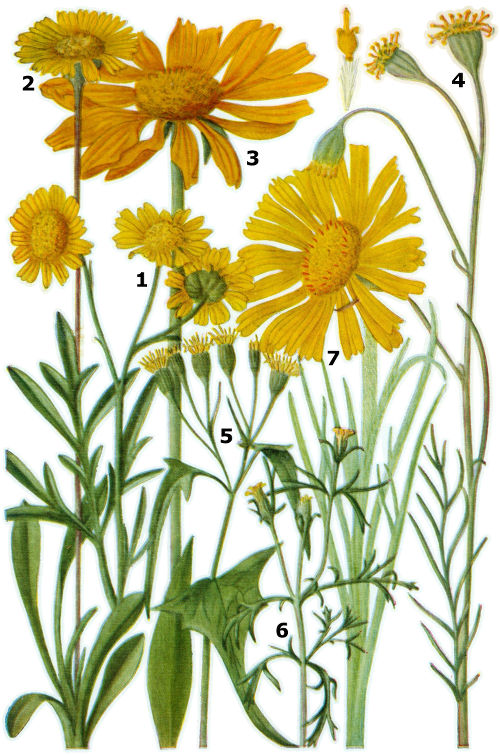
Marigold Dysodia papposa
Plate 41, fig. 6
The wild Marigold looks like a tiny form of the garden Marigold and has a similar spicy fragrance. It grows 1 in.-l ft. tall and is abundant along roadsides and in fallow fields and pastures at 3000-8000 ft.
72
Plate 41
ASTER FAMILY
1 Bahia: Bahia dissecta 2 Actinella: Actinella acaulis 3 Sneezeweed: Helenium Hoopesii 4 Cream Tips: Hymenopappus tenuifolius 5 Taper Leaf: Pericome caudata 6 Marigold: Dysodia papposa 7 Alpine Kobold: Rydbergia grandiflora
73
Alpine Kobold Rydbergia grandiflora
Plate 41, fig. 7
This shaggy, gray-green little plant with its huge, hanging yellow head, often as broad as the stem is tall, is weirdly suggestive of fairy-folk. The stems grow 2-15 in. tall and bear flowers in midsummer. They are to be found only in alpine meadows at 10000-14000 ft.