MINT FAMILY
Reading edition
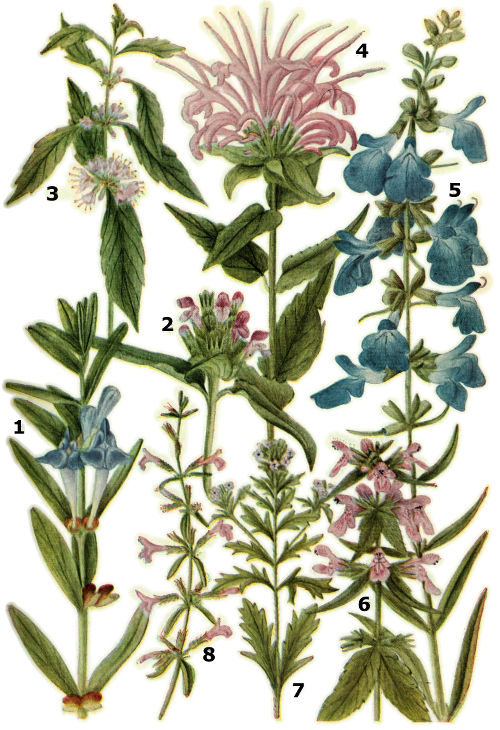
Skull Cap Scutellaria resinosa
Plate 24, fig. 1
The blue flowers of the Skull Cap grow in pairs on leafy stems 4-15 in. high. They bloom in early summer and in fruit the reddish-brown calyx resembles a jockey’s cap rather more than a skull cap. The plants occur on plains, foothills and gravel slides at 5000-10000 ft.
Heal-all Prunella vulgaris
Plate 24, fig. 2
The flowers of the Heal-all are purple or white and bloom from early spring throughout the summer and fall. The stems are decumbent-ascending, 4-12 in. high, and are widely distributed in woods, along roadsides and in wet places at 4000-9000 ft. The Heal-all has a bitter and astringent taste and is somewhat used in medicine.
Brook Mint Mentha canadensis
Plate 24, fig. 3
The tiny pink or lavender flowers of the Brook Mint are clustered in the axils of the paired leaves, and bloom throughout the summer. The plants grow 4-12 in. tall and are widely distributed as a common weed in low ground and wet places, at 4000-8000 ft. Where troublesome as a weed, the Brook Mint can be readily exterminated by thorough cultivation and dragging the soil. It is used to some extent in medicine, and the Klamath Indians make a tea from the leaves. Other mints, such as Peppermint, Spearmint, etc., are among the most highly valued aromatics.
38
Plate 24
MINT FAMILY
1 Skull Cap: Scutellaria resinosa 2 Heal-all: Prunella vulgaris 3 Brook Mint: Mentha canadensis 4 Horse Mint: Monarda fistulosa 5 Blue Sage: Salvia Pitcheri 6 Marsh Mint: Stachys palustris 8 Pennyroyal: Hedeoma Drummondii
VERBENA FAMILY
7 Verbena, Vervain: Verbena bracteosa
39
Horse Mint Monarda fistulosa
Plate 24, fig. 4
The pink to rose-purple flowers of the Horse Mint form roundish heads at the tips of stiff stems 3-4 ft. tall. The plants grow in dense clusters in grassy meadows, thickets and on mountain-sides at 3000-9000 ft. The flowers bloom in midsummer and are worth cultivating in the garden. The common name refers to the tall or coarse stems.
Blue Sage Salvia Pitcheri
Plate 24, fig. 5
The slender stems of the Blue Sage grow 2-6 ft. tall and bear blue or bluish blossoms in terminal spikes. They bloom from midsummer to fall on prairies at 3000-7000 ft. The Red Sage of gardens is a near relative of the Blue Sage, which well deserves cultivation also. Some of the sages are used for making a tea or tonic.
Marsh Mint Stachys palustris
Plate 24, fig. 6
The purplish or reddish blossoms of the Marsh Mint are clustered in the axils of leaves on stems 1-3 ft. high. They bloom in midsummer and are found on moist banks across the continent at 4000-8500 ft. The Marsh Mint is sometimes called “Woundwort” on account of its formerly great reputation for healing wounds. Its surgical value may be doubted, though it certainly is somewhat astringent. It is useful, however, because of its edible roots. These are tuberous and 40 when boiled form a wholesome and nutritious food of rather agreeable flavor. The young shoots of the plant may likewise be eaten, being cooked like asparagus, but though pleasant to the taste they have a strong and disagreeable smell.
Pennyroyal Hedeoma Drummondii
Plate 24, fig. 8
The tiny blue, pink or purple flowers of the Pennyroyal occur in open spikes on stems 4-8 in. high. They bloom in early and midsummer on dry plains and hills at 5000-7000 ft. The name Pennyroyal has no significance, as it is a corruption of an older name.