PEA FAMILY
Reading edition
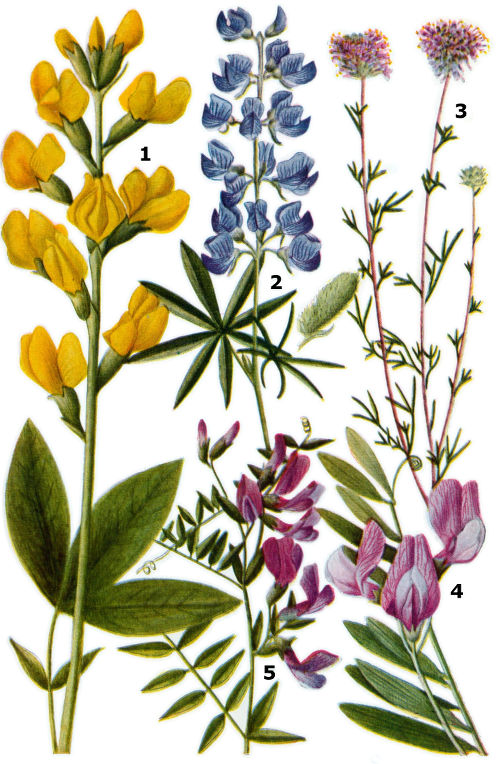
Golden Banner Thermopsis montana
Plate 27, fig. 1
The bright yellow flowers of the Golden Banner occur in open spikes on plants 1-3 ft. high, and bloom in late spring. They may be found in meadows at 3000-11000 ft. The plants are supposed to poison stock, and several cases of the poisoning of children who have eaten the seeds are also reported.
Silvery Lupine Lupinus argenteus
Plate 27, fig. 2
The Silvery Lupine, so named on account of the foliage, has blue to purple flowers arranged in open spikes which bloom in early summer. The plants are somewhat spreading and bush-like and grow 1-3 ft. high on prairies and in meadows at 5000-9000 ft.
Prairie Clover Petalostemon purpureus
Plate 27, fig. 3
The Prairie Clover bears tiny rose-pink to purple blossoms in small but crowded heads. An albino form is occasionally found. The stems grow 6 in.-3 ft. tall on plains and prairies at 4000-7000 ft. and the flowers bloom all summer.
44
Plate 27
PEA FAMILY
1 Golden Banner: Thermopsis montana 2 Silvery Lupine: Lupinus argenteus 3 Prairie Clover: Petalostemon purpureus 4 Wild Sweet Pea: Lathyrus ornatus 5 Purple Vetch: Vicia americana
45
Wild Sweet Pea Lathyrus ornatus
Plate 27, fig. 4
The flowers of the Wild Sweet Pea are purple and white and blossom in the spring and early summer. The stems are low, 4-12 in., and occur on plains and prairies at 4000-8000 ft.
Purple Vetch Vicia americana
Plate 27, fig. 5
The Purple Vetch bears blue to purple flowers in loose clusters on climbing or scrambling stems 1-1/2-3-1/2 ft. long. They bloom in spring and early summer and may be found on prairies and in rich river valleys at 4000-10000 ft.
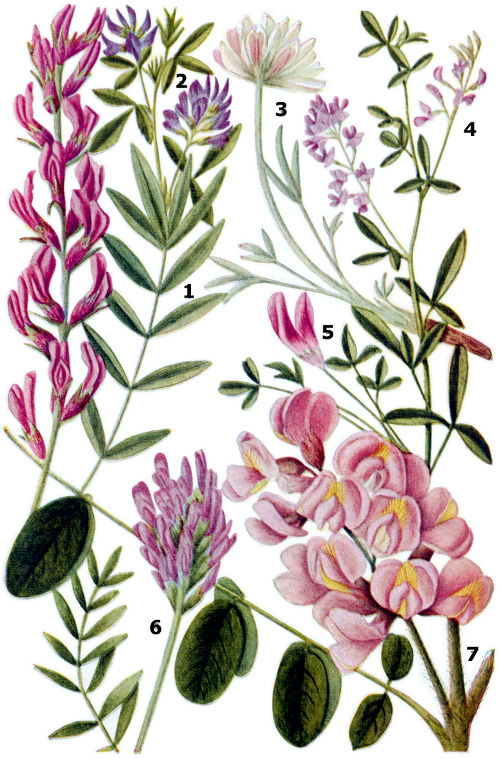
Loco Aragalus Lamberti
Plate 28, fig. 1
The flowers of the Loco are deep red-purple or white, often turning blue with age. They occur in open spikes on stems 4-12 in. tall and bloom in spring and summer. The plants occur on plains, prairies, hills and table-lands at 4000-9000 ft. The Loco is very poisonous to stock. After acquiring a taste for the plant they will eat nothing else and die from the effects in a few months or one or two years. In this way, millions of dollars of stock are lost annually. A cure for the disease has been found recently.
Alfalfa Medicago sativa
Plate 28, fig. 2
The small blue to purple blossoms of Alfalfa grow in loose, small heads on branching plants that attain a height of 1-2 ft. They bloom all summer long. The plant has escaped from cultivation and grows thriftily at 5000-6000 ft. Alfalfa forms a most nourishing fodder for horses and cattle and has been cultivated for ages in Southern Europe. When sown in deep, rich soils, few plants yield so heavy a crop. During the World War, meal was made from the dried and ground plants and used as a substitute for flour.
46
Plate 28
PEA FAMILY
1 Loco: Aragalus Lamberti 2 Alfalfa: Medicago sativa 3 Alpine Clover: Trifolium dasyphyllum 4 Psoralea: Psoralea tenuiflora 5 Dwarf Clover: Trifolium nanum 6 Prairie Pea: Astragalus hypoglottis 7 Rose Locust: Robinia neo-mexicana
47
Alpine Clover Trifolium dasyphyllum
Plate 28, fig. 3
The flowers of the Alpine Clover have a cream-white standard and rose-purple wings and keel. They are clustered in heads on stemless plants which form mats or cushions 4-20 in. across and grow only on alpine peaks at 12000-14000 ft. They bloom in midsummer. The name “Clover” comes from the Latin word meaning “club” and refers to the resemblance between the leaf and the 3-headed club of Hercules. The clubs of playing-cards are also no doubt an imitation of the cloverleaf. The 3-parted leaves of the clovers fold together and “sleep” at night. The cultivated clovers are valuable as fodder and the white-flowered species makes beautiful lawns.
Psoralea Psoralea tenuiflora
Plate 28, fig. 4
Psoralea bears its small blue to purplish flowers in open spikes on branching plants 1-4 ft. tall. They bloom in early summer and are found on dry plains and hills at 4000-8000 ft. Some species of this genus are used in medicine and one, Psoralea esculenta, has a tuberous root that is edible.
Dwarf Clover Trifolium nanum
Plate 28, fig. 5
The pink to rose-purple flowers of the Dwarf Clover occur usually in pairs on prostrate or spreading stems in the high mountains. They bloom in midsummer and are found only at 9000-14000 ft. The Latin name for the genus means “three-leaves,” and the 3-parted leaf is characteristic of practically all clovers.
48
Prairie Pea Astragalus hypoglottis
Plate 28, fig. 6
The flowers of the Prairie Pea are usually blue to purple, rarely whitish or yellowish. They occur in dense heads on procumbent or ascending stems 4-8 in. long and bloom in midsummer. The plants are found in meadows and river valleys at 4000-9000 ft.
Rose Locust Robinia neo-mexicana
Plate 28, fig. 7
The Rose Locust is a shrub or tree 3-15 ft. tall, which grows along streams at 4000-7000 ft. The flowers are white to rose-colored with a touch of yellow on the standard and keel, and their large showy clusters come into bloom in spring and early summer. It is the handsomest of the locusts, and should be cultivated wherever winters are not too severe.