BUTTERCUP FAMILY
Reading edition
Monkshood, Aconite Aconitum columbianum
Plate 1, fig. 1
The flowers of the Monkshood are usually deep purple-blue, but yellowish white ones are often found. The tall plants, 4-8 ft. high, grow in mountain meadows and along streams at 6000-12000 ft., and bloom from early July to late August. The Aconite disguises its relation to the buttercups by having irregular sepals, developed by insect visitors in search of nectar. The two nectaries are underneath and at the base of the cowl-shaped upper sepal which gives the plant its name. In seeking nectar, the bees crawl over the group of stamens and stigmas and in so doing either collect or deposit the pollen which clings to their legs and abdomens. The Monkshood is frequently cultivated in gardens and some of the species furnish a powerful drug, aconite, used in medicine. All are poisonous and often produce fatal results among stock when feed is scarce.
Blue Columbine Aquilegia coerulea
Plate 1, fig. 2
This Columbine varies in color through several shades of blue and may rarely be white. It is the state flower of Colorado, growing in spruce and aspen woods, or in mountain meadows at 6500-12000 ft. It is usually 2-3 ft. high and blossoms from early summer to midsummer. Like the Monkshood and Larkspur, the columbines also belong to the group of irregular buttercups. The nectar is contained in the swollen tips of the petals. Pollination is effected by long-nosed bees which cling to the petals while inserting the proboscis up the spur and at the same time touch the group of pendant stamens with the underside of 2 the body. Short-nosed bees are unable to get at the nectar in this way and steal the honey by biting holes in the tips of the spurs. The columbines make beautiful garden plants and the Blue Columbine as well as one or two other native species is cultivated. The ordinary columbine of the garden, however, belongs to the European Aquilegia vulgaris. The name “Aquilegia” is derived from the Latin “aquila,” eagle, and probably refers to the resemblance of the spurred petals to eagles’ talons.
Red Columbine Aquilegia canadensis
Plate 1, fig. 3
The blossoms of this plant are bright red, usually more or less tinged with yellow. It is 1-2 ft. tall, grows on wooded mountain-sides at 7500-11000 ft. and blooms in July and August. The mountain form has smaller, more brightly colored flowers than the eastern plant.
Blue Larkspur Delphinium scopulorum
Plate 1, fig. 4
The Larkspur, like the Monkshood, has developed oddly shaped sepals, but the upper one, instead of resembling a cowl, is more like the spur of a bird. The common name refers to this resemblance. The plants grow as tall as 6-8 ft. and are found on foothills and mountain-sides at 5000-10000 ft. They bloom in midsummer and the flowers vary from pale blue to deep purple-blue. The Blue Larkspur, like many other species of larkspur, is poisonous to stock.
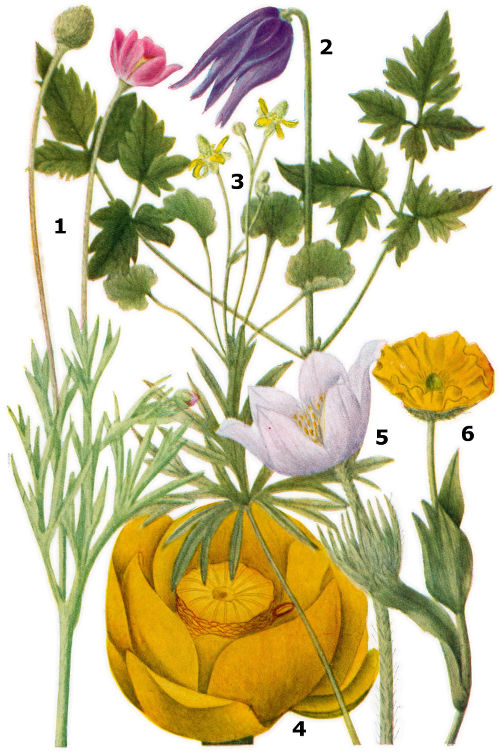
Anemone, Wind Flower Anemone multifida
Plate 3, fig. 1
This Anemone is usually white, but it varies through pink to deep rose-red. It is 1-2 ft. tall, grows in meadows and on hillsides at 7000-12000 ft. and blooms throughout the summer. Most anemones 3 have an acrid juice which irritates the skin and is poisonous if taken internally. They make very attractive garden plants, though the native species are little cultivated as yet.
Alpine Clematis Clematis alpina
Plate 3, fig. 2
The Alpine Clematis differs from the cultivated species in climbing but rarely. The plants are usually but a few inches high and bear very ornamental lavender or purple-blue flowers. Under favorable conditions they may clamber over shrubs for a few feet. They are found in open forest and woodland at 7000-10000 ft. The flowers open in spring and early summer and are visited by insects for the plentiful pollen, though they contain no honey. Like the cultivated species, the seed-like fruits have long feathery styles which form silvery clusters.
Alpine Buttercup Ranunculus Macauleyi
Plate 3, fig. 6
The Alpine Buttercup has bright yellow, cup-like flowers that fit our ideas of a buttercup much better than do those of the Trailing Buttercup described below. It is more rarely found, since it grows only on alpine peaks at 10000-14000 ft. It prefers wet places among the rocks and near snow-banks and blooms in midsummer. Many species of buttercup possess a more or less acrid juice. For this reason, they are little eaten by cattle and hence the notion that the deep color of butter in early spring is due to the buttercup is, of course, without foundation.
Trailing Buttercup Ranunculus cymbalaria
Plate 3, fig. 3
The flowers of this little trailing plant are lemon-yellow, and rather inconspicuous, blooming from June throughout the summer. The plants are only a few inches tall and grow in wet or alkaline soil at 3000-10000 ft.
4
Plate 3
BUTTERCUP FAMILY
1 Anemone, Wind Flower: Anemone multifida 2 Alpine Clematis: Clematis alpina 3 Trailing Buttercup: Ranunculus cymbalaria 5 Pasque Flower: Pulsatilla hirsutissima 6 Alpine Buttercup: Ranunculus Macauleyi
WATER LILY FAMILY
4 Yellow Water Lily: Nymphaea polysepala
5
Pasque Flower Pulsatilla hirsutissima
Plate 3, fig. 5
The Pasque Flower is one of the earliest spring blossoms, as is indicated by the name which is from the French for Easter. The word “Pulsatilla” means wind flower and indicates its relationship to the anemones. The color of the flower ranges from whitish through pale blue or pink to purple. By the end of spring, the flowers have all developed into beautiful feathery clusters of fruits, very like those of the Clematis. The plants are 6-15 in. high and densely covered with fuzzy white hairs. They occur abundantly on plains and foothills and in mountain meadows at 4000-10000 ft. The Pasque Flower is the state flower of South Dakota and is sometimes cultivated in gardens.