BORAGE FAMILY
Reading edition
Chiming Bells Mertensia sibirica
Plate 21, fig. 1
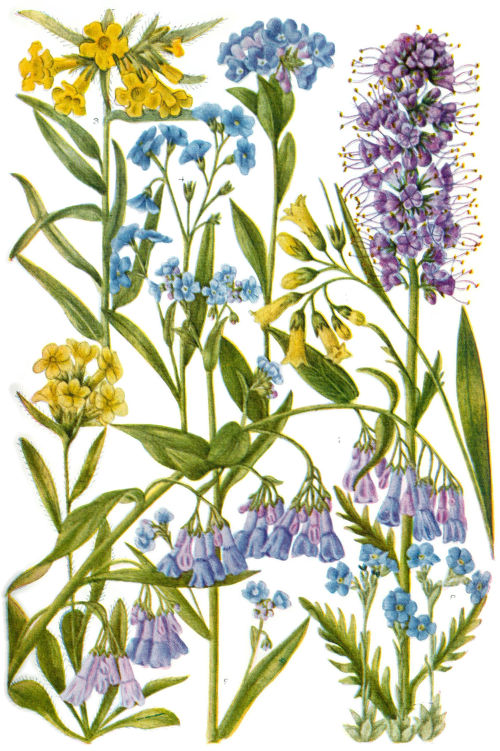
The very graceful drooping clusters of Chiming Bells vary through delicate shades of blue and pink. The plants grow 2-5 ft. tall and are found blooming all summer long in fir and spruce forests and along shady streams at 6000-13000 ft.
Golden Borage Krynitzkia leucophaea
Plate 21, fig. 2
The yellow or yellowish flowers of the Golden Borage are clustered at the ends of stems 4-10 in. high. They bloom in spring and early summer and are found on hills at 3000-7000 ft.
Puccoon Lithospermum multiflorum
Plate 21, fig. 3
The bright yellow flowers of the Puccoon hang in dense clusters from tips of stems 1-3 ft. high. They occur on hills and mountains and in canyons at 6000-10000 ft. and bloom in spring and early summer. The botanical name means “stone seed” and refers to the mature seeds which are hard, white and shining. The French call this plant the “Plante aux Perles” since the ripe seeds resemble pearls.
Forget-me-not Myosotis alpestris
Plate 21, fig. 4
This rare little flower is the true Forget-me-not and is widely cultivated in gardens. The blossoms are blue, pink or white and grow in clusters on stems 4-10 in. high, in mountain meadows at 9000-12000 ft. They are very fragrant and bloom from spring throughout the summer.
28
Plate 21
BORAGE FAMILY
1 Chiming bells: Mertensia sibirica 2 Golden Borage: Krynitzkia leucophaea 3 Puccoon: Lithospermum multiflorum 4 Forget-me-not: Myosotis alpestris 5 Alpine Forget-me-not: Mertensia alpina 7 Comfrey: Symphytum officinale 8 Dwarf Forget-me-not: Eritrichium argenteum 9 Stickseed: Lappula floribunda
WATERLEAF FAMILY
6 Purple Fringe: Phacelia sericea
29
Alpine Forget-me-not Mertensia alpina
Plate 21, fig. 5
The Alpine Forget-me-not is not a true Forget-me-not, but is universally called such in the Rocky Mountains, where it is very abundant on the highest peaks of Colorado at 10000-14000 ft. The flowers are blue or pink and are very fragrant. They grow in dense clusters on stems 2-16 in. high and bloom in early summer. This flower would well repay cultivation at lower altitudes.
Comfrey Symphytum officinale
Plate 21, fig. 7
The yellowish or purplish flowers of the Comfrey occur on stems 2-3 ft. tall along roadsides in Colorado at 5000 ft. They come into bloom in early summer and continue throughout the summer. The plant is medicinal, yielding an astringent as well as an emollient. The leaves when young form a good green vegetable and are not infrequently eaten by country people where the plant abounds. They are also sometimes used to flavor cakes and other articles of food, but when fully grown they become coarse and unpleasant to the taste.
Dwarf Forget-me-not Eritrichium argenteum
Plate 21, fig. 8
The Dwarf Forget-me-not receives its name from its resemblance to the true Forget-me-not, Myosotis. The flowers are white, pale blue or deep blue with some yellow in the throat and are clustered on tiny stems, 1-3 in. high. They grow only on alpine peaks at 11000-14400 ft. and bloom all summer long. The flowers are fragrant and the foliage silvery-green because of the presence of many white hairs.
Stickseed Lappula floribunda
Plate 21, fig. 9
The Stickseed receives its name from the bur-like fruits covered with tiny hooks which cling tenaciously to objects that touch them. 30 These fruits are somewhat injurious to animals that eat the plants. The tiny flowers are blue or white and are clustered on graceful stems 2-4 ft. high. They bloom all summer on hillsides and among bushes at 5000-10000 ft.