PART V. Miscellaneous: (continued 4)
Reading edition
We will suppose, then, that you have selected your little bit of ground. The next thing to do is to prepare it thoroughly. Now, in ordinary cases this is not half done. We are going to recommend you to plant permanent things, plants which will not require removal for many years, and you will not have a thorough opportunity of preparing the ground after you once plant. Therefore, the preparation of the ground is of tenfold greater importance in your case than in that of the ordinary gardener, whose beds of geraniums, or suchlike, are empty in winter, so that he has an opportunity of dressing and digging them every year.
Before marking the walks or anything of the kind, when, in fact, your little piece of ground comes into your hands at first, remove all matters from its surface, add manure to it in abundance, and have the whole dug as deep as you can go, without bringing up the bad subsoil at the bottom. If the ground be sandy, so much the better; then all you have do is to give it plenty of cow, or any other rich manure that comes to hand. If, on the other hand, it be of a clayey, stiff, tenacious nature, like much of the ground to the north side of London, you must act quite differently. Most pretty border plants like a light, warm, free or sandy soil, and abhor a heavy, wet one. The way to cure, if we may so speak, or, in other words, improve the very stiff soil, is to add plenty of sand, leaf-mould, horse manure, or gritty scrapings from roads, or any other loosening material of this kind that you can obtain. Dig it in deep, and dig the ground over again, so that it may be thoroughly incorporated with the soil. All this should be done in autumn, if you have the time—in early autumn, if possible. When well done, and the ground levelled, then you may mark your little walks—with a line—and your central bed; and if in this operation you can get the gardener to assist you, do so by all means. In many cases the gardener gets ready the boys’ garden, and presents it to him ready for planting, and that is the best way; for the planting and attention required afterwards will be as much as you can do, if you do it well. A word or two as to edgings for the borders and the bed. Don’t have anything to do with those nasty stone edgings, so much advertised of late, as they look very ugly and out of place in a garden. The neat little edging of box is, perhaps, the prettiest as well as the oldest in existence. But we are inclined to think that little edgings of plants that flower are the best for your case. Try to be original with your edging as with everything else, if possible, and whatever may be used as an edging near your garden, avoid, and have something distinct. We know of about one hundred pretty plants for making edgings, but can only mention such here as you are likely to be able to obtain without difficulty. The best are the rosy thrift (Armeria vulgaris rubra), a lovely spring plant; the pretty little white and blue campanula pumila, and its white variety; the large blue gentian of the Alps (G. aculis), this is plentiful in Scotland, but not about London; the pretty little blue aubrietia, to be obtained everywhere; the variegated cocksfoot grass (Dactylis glomerata variegata;—what a pity it is that we are obliged to use such names); and the double daisy in various colours. Should you make a box edging, use the dwarfest and best kind; and if you happen to notice any other dwarf hardy plants that make tasteful edgings, use any you fancy, by all means. The more variety we have the better, and the only thing that it is particularly desirable you should avoid is any forms of those crockery wares, or artificial stone edgings, as they are all as bad and ugly as need be.
We will now follow with a list of the most suitable plants for your garden. To each plant a figure will be attached, to indicate the position it should occupy in your beds or borders. We will, for convenience sake, throw the various heights of the plants used into three classes—1, for the smallest plants, or those fitted for the front of the border; 2, for the medium-sized, or those suitable for the middle parts; and finally, 3, for the taller kinds, which require to be placed at the back, or near the back of the border. Doubtless you will make a point of growing the rose; that is deservedly everybody’s favourite. You may plant the rose either in the back part of your border, as a standard in the middle, as a dwarf bush, or on the front edge, pegged down close to the earth—not a bad way of growing it, by the way. But avoid the standard rose, if you can; it is ugly, awkward, and by no means so satisfactory as a rose “growing upon its own roots:” that means, a kind not grafted upon another, but quite on its own resources. Roses generally are grafted upon free growing common kinds, known as stocks. The most pleasing in the end, and by far the most satisfactory, are the roses upon their own roots. They make dwarf but long-lived and vigorous bushes—the very best things you can employ in the middle parts of your borders. If there be sufficient room, have a dozen kinds of roses, each different. Every spring, from deaths during the winter, and changes of one kind or another, you will have to look over your borders to fill up vacancies. It is best done about the end of May, when you may exactly see the state of the plants in the border, by filling up the majority of these vacancies with the better kinds of bedding plants, &c. By doing so you may enjoy both phases of gardening—the beautiful and interesting hardy flowers, to be presently named, and the brilliant and common flowers of the summer parterre, the pretty kinds of verbenas, the dwarf and neat lobelias, the variegated and other geraniums, and in fact, any kind of bedding plant that comes to hand.
Next, for the selection of the more valuable and more uncommon hardy flowers, leaving out all such as are difficult to obtain. Among all the flowers of spring, few are better known than some of the anemones—apennina (1), fulgens (1), coronata (1), sylvestris (1), and Honorine Iobert (2), are the very best. Among them we have the sweetest blue, the brightest scarlet, and the purest white. Of the columbines (Aquilegias), the best for your purposes are the common border varieties. They are mostly fitted for the central line of the border. Of the magnificent delphiniums, so richly blue, tall, and stately, there are many beautiful new kinds—so many that I need not enumerate them, but most nurserymen are pretty sure to have varieties of them. Being tall, they are mostly suited for the back, or nearly the back portions of the borders: if you have a central bed, they will also look very well towards the middle of it. By the way, the middle of such bed might well be devoted to a choice shrub or two, say a good rhododendron or kalmia—that is, if the soil would suit such. The peony is almost too big for such little gardens; but a plant or two may be ventured in some unimportant spot. The yellow bachelor’s button (Ranunculus acris, fl. pl. 2), is very pretty, and so exceedingly is Dielytra spectabilis (2). Baptisia australis (3). Coronilla varia (2). Galega officinalis alba (3). Lathyrus grandiflorus (3), a climbing plant, very fine for going up a low trellis. The white and red everlasting peas (3), also climbers. Orobus vernus (2). The perennial Lupin (3). Achillea ægyptiacum (2), A. aurea (1), A. Eupatorium (3), and A. millefolium roseum (2)—all fine and free. Of Michaelmas daisies (Asters), A. versicolor (1), elegans (3), turbinellus (2), Amellus (2), will be found highly beautiful. The Pyrethum in fine variety of beautiful colour and size: they have been raised of late years in great quantity by Mr. Salter of the Hammersmith nurseries, and are admirably suited to the middle line of borders, therefore the figure 2 will indicate their position to a T; their colour is rich and distinct in the extreme. The fine autumnal flowering Phlox (3) is also sold in great and beautiful variety, and should have a place in every good collection. Six or eight of the best kinds should be in the boy’s garden. Nearly every nurseryman supplies them cheap. In the harebell family (Campanulas) we will find some very fine, particularly pumila (1), carpatica (1), persicifolia (3), and P. alba (3), grandis (2), macrantha (3), rotundifolia (2). The fleur-de-lis, or Iris, has some beautiful varieties, of which the best are germanica (2), florentina (2), pallida (2), De Bergii (2), pumila (1). Tritoma grandis (3), and glaucescens (3), are noble things for the back of a border. The double wallflowers (2), the alpine wallflower (1) (Cheiranthus alpinus). The Potentillas (2). Veronica amethystina (2), and corymbosa (2). The Virginian tradescantia (2); the crimson loose-strife (3); Lythrum roseum superbum. I give you the hard names so that you may have the less difficulty in procuring the plants, for many may know them by their Latin name, who would not know them by their common one, and vice versâ. The American cowslip (1): this being a very chaste and pretty plant, have as much as you can of it. Salvia argentea (2). This plant has grand silvery leaves, and should be in every collection. Perennial candy tuft, 1 (Iberis). There are three kinds of this—corræafolia, saxatilis, and Garrexiana, all good, hardy, and beautiful. Arabis alpina (1); Aubrietia purpurea (1); Alyssum saxatile (1): all three very easy to grow, and very common. The beautiful little Hepaticas in various colours, blue, white, and red. You must secure a stock of these, above all things; they are among the prettiest of spring flowers, and will “set off” charmingly the front parts of your borders. There is a fine new kind of hepatica (H. angulosa), a noble kind, which you will also do well to obtain: give it a rather shady position in light soil. One or two tufts of the Christmas rose will be quite enough. When this begins to show its flowers, a few weeks before Christmas, you will do well to cover the plant with a hand-glass, leaving a little air at the top. This will prevent the flowers from being injured or hurt by rain; they will grow very much larger and whiter than if left exposed. Of Pentstemons (2), a good variety should be grown, especially if the soil be light and good, such as they delight in. Sedum fabaria (2), is a fine autumnal flowering plant, which must not be forgotten. Rudbeckia Newmannii (3), a very fine autumnal bloomer. Lithospermum fruticosum (1), a wonderfully pretty plant for the fronts of borders. Any kind of pink (1) that you can conveniently obtain, should be grown; they are sweet, hardy, neat, and, in a word, perfect for your purposes. They are considerably varied of late years, and highly useful for cutting for bouquets, &c. The front of the border is the best place for them. Immediately behind them, and scarcely so far back as the line of the second row, is the place for the carnations and picotees, which of course you will be sure to cultivate. There is nothing more beautiful in our gardens than many of these, so beautifully and richly coloured, and so delicately and exquisitely margined and striped. Linum narbonense (2), and Perenne album (2), noble kinds of hardy flax, are also good. The Œnothera tribe will furnish some beauty: notably the sweetly coloured Œ. acaulis (1), which opens its very large flowers in the evening, and keeps them open till nearly breakfast-time in the morning; the noble yellow macrocarpa; and the large evening primrose (Œ. Lamarkiana). Some dwarf tiny shrubs, that flower freely, will look beautiful in your border, and of such you cannot find one more beautiful than the early spring flowering heath, 1 (Erica carnea); it is a mass of handsome bloom, and very hardy and neat in habit. Other capital little shrubs are Daphne Cneorum, sweet and pretty—various dwarf kinds of native heaths, and Genista tinctoria (1), and sagittalis (1).
In addition to the above, it need hardly be added, that such universally esteemed plants as the lily of the valley (1), the primrose (1), and the polyanthus, should be well represented. Latterly there have been raised considerably varied kinds of primrose and polyanthus, and nothing can be more charming than mixed masses of such. From a packet of seed of each (ask for that of the ordinary mixed kinds), you may raise a considerable variety of beautiful kinds. Double daisies (1), too, in various colours, will be found very pretty in the spring, as will the numerous kinds of pansy (1), the gentian, and the forget-me-not. By the way, you must not forget some tufts of the common forget-me-not; it does very well as a border plant in all but the driest soils. At Trentham it is tastefully employed to form a margin round some pretty little gardens, dedicated to the various younger members of the family; and we have known people to be so full of gratitude to a departed dog, as to plant a ring of it round the little monumental slab which indicated his place of burial in the garden border. The various pretty and very dwarf kinds of saxifrage (1), and Sedum (1), too, you will find neat and distinct for the very front of your border, in which you will of course arrange the dwarfest plants.
One word more. It would be a pity to confine you to this or any other selection. The more varied your garden is, and the more distinct from that of your friends or neighbours, the better. The selection above given is as good as can be made, and may save you from getting a lot of ugly weeds in your garden, under the name of flowers; but in addition to these, you would do well to add any other pretty plant met with in your rambles, and which seems to you worthy of a place; while with friends who cultivate plants, you may exchange any that you have plenty of, for new varieties, or anything that you may fancy.
THE BOY’S FRUIT GARDEN.
There are few boys who cannot appreciate the virtues of a delicious melting pear or good apple; and our object in writing this paper is to tell them how to grow such in a comparatively short space of time. In old times, and, indeed, generally at present, people plant for those who come after them—“plant for their heirs,” in fact,—plant trees that will come into bearing in twelve years or so; and therefore some may say, why offer the boys such a far-off treat? But times change, and the system which produces the finest fruits now in our markets, happens to be exactly suited to the boy’s garden. Large and beautiful apples have been sold in Paris during the past spring for as much as three francs a-piece! These were in many, or in nearly all cases, grown upon little trees not more than a foot from the ground, and several of them not more than two or three years old! The French are the best growers of apples and pears in existence; and in France originated this dwarf method of growing them. The way they do it is as follows:—The best kinds of apples are grafted on a variety known as the Paradise, which induces a very dwarf growth and early fertility in the kinds grown upon it. We have seen these fruiting, this year, at two years of age, bearing fine fruit, much better than you see on trees developed to full size. They are grown in two ways, generally as cordons, and occasionally as little standards. The “cordon” is simply a single plant of apple, trained along a wire, supported about a foot from the ground. The little standard, or bush, is simply a diminutive Lilliputian kind of tree—just such as a boy would wish for in his garden. Not taller, if as tall as himself, he can shorten the shoots and gather the fruit with the greatest ease. The culture of these little trees is so simple that no boy need fail with them. A sunny spot should in the first instance be chosen, that is, if the young gardener can get it; and it is not often that he is allowed any but a bye nook of some kind or other; and no wonder, because hitherto boys’ gardens have simply been short-lived little exhibitions of untidiness, never yielding any result and very little beauty. But the young gardener who manages well his fairy part of fruit garden, will soon produce a little feature that any place might be proud of. Next, as to how to do it.
Very little ground is required. A small patch will afford space for a great number of little trees. A sunny open spot should be selected, where the trees will have all the advantages of sun and air to perfect their fruit, and render their shoots short, firm, and fertile, instead of sappy, gross, and useless. The soil should be of a slightly sandy or loamy nature, and not wet. If the ground be badly drained, and water lies in it much, it is almost hopeless to attempt fruit-growing, and the little gardener had in that case better turn his attention to something with which his soil and circumstances are likely to agree. One of the chief points in gardening is to choose the course most suited for your own soil, climate, and position. Thus the boy who lives in a great city, or the suburb of one, and who has to contend with the smoke and other evils incident to such, must pursue a very different plan of gardening to the boy who lives in the country, and has all the advantages of pure, sweet air for his plants. The best of all soils for our little fruit-trees, is one moderately sandy, yet not too loose and free, with what we may term a free bottom, that is, a sandy or other subsoil beneath, which will permit the water to pass off freely from the fertile or upper earth. But although this is the best soil, there are few others that we need reject—the worst, perhaps, being deep, stiff, soap-like clay. The best time to plant is in the autumn. Be sure you ask for the young apple-trees grafted on the “Paradise,” and the pears on the Quince stock. Both apples and pears may be grown as little standard trees or as cordons. In planting, do not put the roots deep, and spread them out even, forming first a rather firm and slightly convex surface, on which to place the little plant. This will be found to suit very much better than making a loose sort of hole into which to put the roots.
It should be borne in mind that when fruit-trees send their roots deep into rich or cold ground, they produce a lot of coarse, useless wood, barren of fruit, or nearly so. To counteract this tendency, what is called root-pruning has been resorted to. It simply consists in taking up the trees once in two years or so, and replanting them—at least, this is the way with our little trees. It may not be necessary on many soils; but where it is, it may be readily done during pleasant dry weather in autumn. The check given to the tree by the disturbance, causes it to form fertile buds and a stubby habit. It is well that the young amateur gardener should know this, so that he may apply a remedy if his fruit-trees grow too strong and prove barren. But generally they are fertile enough, and even sometimes produce a successful crop the first year after planting; the second year they should bear well. The accident of a severe frost while the trees are in flower, will of course always do mischief, and may ruin a crop; but all are liable to this, as well as our Lilliputians. It is best to plant the erect little trees in a small square—pears and apples separate, for uniformity sake—and to place the cordons around this, just as the French make a sort of edging of them in their gardens. Indeed, if the boy cannot obtain a neat little sunny square for his tiny trees, he will hardly fail to succeed in getting permission to arrange a few in cordon fashion along the edge of some border. It is simply done by either driving down a strong wooden post, or an iron one, so as to support a wire at about ten inches or a foot from the ground. Beneath that, the trees are to be planted, say at a distance of six or eight feet, and tied along the wire. When once this is done there is no further trouble, except to pinch back the shoots in summer so as to keep them close and compact. This operation requires a little attention. The main stem, which is of course tied carefully but not too tightly to the wire sends out side shoots in the summer. When these are about four, or say from three to five inches long, they are to be pinched back, or in other words, nipped off, within about an inch of the base of the young shoot, in the case of apple-trees—in the case of pear-trees it should be left somewhat longer. This is for the summer pruning; in winter it may be necessary to go over the trees with a knife, and remove or shorten awkward spurs, or cut out dead bits here and there; but the summer pinching is the chief thing to be done in the matter. When the trees produce too plentiful a crop of fruit, these should be thinned when very young, so that those left may assume the splendid flavour and size which makes fruit grown in this way superior to that grown in the old and large tree system. I will now give you a list of the best kinds to use in this way, and which can be bought in any respectable nursery. Of apples the very best are Colville Blanche and Reinette de Canada, Cox’s orange pippin, Hawthornden, Herefordshire Pearmain, Greaves’ pippin, or any other first-class kind of apple. Of pears, Marie Louise, Winter Nelis, Beurré Diel, Jargonelle, Beurré d’Amanlis, and Joséphine de Malines, will be found very suitable for the dwarf bush or cordon style, as will most first-class pears.
Cropping the Ground.
DIGGING.
When land is first brought under the spade it should be well dug, and it ought to be trenched up; that is, a full spit or spadeful should be taken and thrown somewhat higher than the general level of the ground, and turned, so that the under part of the soil is brought to the surface; in doing this effectually a sort of trench will be left at the part where the spade goes in, and at the end of digging a piece of ground in this manner this trench will be required to be filled up. It is usual for gardeners to provide for this at the onset by bringing a barrow full of the mould from the part at which the spade is first put in, and filling up the trench so left at the end of the process. Common digging, when the ground is not to be trenched, consists in turning it over regularly and evenly with the spade. When manure is necessary, it is either hoed over the ground and dug in as the digger proceeds, or in trenching it may be laid in each successive trench as it is made, which will of course be covered by the next line of digging. Flower-beds are best turned up with a small three-pronged spade-fork; and it is often necessary to use the same instrument when digging between strawberry and other roots, which is technically called forking. The earth in this process is not turned over, but only broken up and loosened, and the handle of the fork not turned in the process, but drawn gently backwards with a kind of knock, which can be easily acquired by practice.
HOEING.
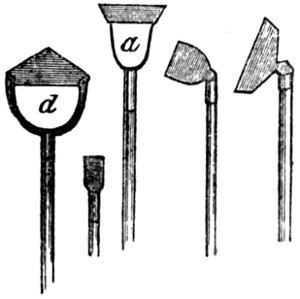
The hoe is of very great use in a garden. There are generally three kinds of hoes: 1st, the narrow; 2d, the broad; and 3d, the Dutch hoe. The small hoe is used for hoeing in flower-beds; the broad one for earthing up peas, potatoes, &c., and the Dutch hoe is of service in dry weather in clearing the ground quickly of weeds. The two former hoes are used by drawing the handle to you, and hence called draw hoes; but the Dutch hoe is used by thrusting forward, when the weeds cut up by it fall through the hollow portion at (a) clear of the operation. In hoeing the hoer should be particularly careful to go quite to the roots of the weeds, and clear of the roots of the plants. In hoeing up peas he should be careful to draw the earth nicely among the haulms; and in hoeing up cabbages not to sprinkle the dirt among the tender leaves forming the heart of the plant.
RAKING.
There are two kinds of rakes,—the broad and narrow. The broad rake is for raking over seed beds, and the narrow one for raking borders among flowers, &c. In the use of the rake the gardener should first lightly drag off all the weeds and stones from the soil. In holding the handle of the rake high, all the loose stones, weeds, &c., will be easily drawn from the ground without the mould; when the handle is held low, the teeth of the rake enter the ground and scratch it up, which is sometimes necessary to be done; but the little gardener should be careful not to rake away his soil; and the little hard balls of earth that come over with the stones, &c. should be pulverised by the back of the rake.
WEEDING.
The garden should always be kept perfectly clear of weeds; a weed in a garden is a disgrace to the gardener, and unless a young person makes up his mind to be very particular in this he had better never think of gardening. Chickweed, dandelion, plantain, bindweed, and every other description of extraneous growth should be quickly removed, and that worst of all weeds, called the gardener’s plague, “couchgrass,” should be extirpated entirely, as should all suckers from the roots of trees. Weeds, if not in seed, should be thrown into the manure pit, but sticks or stones should never be mixed with them.
DIBBER.
SOWING SEEDS.
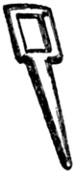
The ground having been dug and raked, and otherwise prepared, is fit for the reception of the seed. Radishes, carrots, parsnips, are sown by the hand broadcast; the way of sowing carrot seed is to mix it with the earth in a large flower-pot, and then to scatter it very thinly over the bed: at least, that way is suited to the boy’s garden; in the open garden and the field they sow carrots and parsnips in drills. Peas are sown in drills about three inches deep and four feet apart. Broad beans are put in with a dibber in straight lines about five inches apart, the rows being four feet from each other. French beans are sown thinly in drills about four feet apart. Scarlet runners are put in by the dibber singly about three inches apart, and should have bean sticks placed near them as soon as they appear, upon which to climb. Cabbage-plants should be put in by the dibber about nine inches apart, in rows about four feet distant from each other. Cauliflowers should be planted eighteen inches apart either way, as should Scotch kale and sprouting brocoli. Spinach may be sown thinly in drills three feet apart, or broadcast in beds. Lettuce-seed, cabbage-seed, cauliflower-seed, and all kinds of flower-seeds should be first sown in warm situations in good mould very thinly, and then the plants should be transplanted as they grow of sufficient size. Potatoes should be planted with the dibber nine inches apart, in rows three feet apart, as should Jerusalem artichokes. Onions should be sown broadcast, in beds about six feet wide and fifteen or twenty long. The beds for parsnips and carrots may be six feet wide and thirty long.
TRANSPLANTING.
TROWEL.
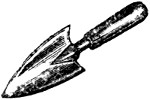
This is a most important operation, and is indispensable in the art of gardening. A vast number of seeds must be sown in beds, and afterwards transplanted into their final situations; this is particularly the case with regard to flowers. The instrument with which transplanting is performed is called a trowel, of which there are both small and large. In using it the principal thing to be attended to, is to take the best and most vigorous of the plants raised in the seedbed, without injuring their roots, and with the earth around them, and placing them, with as little disturbance of their roots as possible, in their new situations. In transplanting shrubs, &c. from pots, the planter should very slightly break the earth round the roots of the plant, so that its fibres may have free play in the new earth. In transplanting shrubs, &c. particular care should be taken in digging them up, so that the young fibres of the roots are not injured. When shrubs, &c. are first transplanted, they should be moderately watered, and of course it is bad management to plant shrubs at a time when they are likely to suffer from sun. The right time to transplant is in the autumn and spring, when the ground is nice and dry, and “in good working order,” as gardeners term it.
WATERING.
Nature is the best waterer of plants, and it is good policy to leave the matter as much as possible in her hands; but we must assist her now and then by applying it ourselves. In watering, pond water is much better than pump water; and in warm weather, if no pond water can be procured, it is well to pump the water into some large tank or tub, and let it stand for some hours exposed to the sun and air before using it. Morning and evening are the proper times for watering; the middle of the day, or during a hot sunshine, is a very improper time for using the watering-pot in summer-time, although it is the best time for using it in the winter. In watering plants in flower-pots the finger should be first passed round the pot where the mould joins the sides of the pot, so as to close up the little crack or crevice between them, otherwise the water will pass down this crack, and go out at the hole at the bottom of the pot without affording it any benefit. In watering, never let the water pass from the watering-pot close to the stem, but rather turn up the earth in a little circular space for a few inches round the plant, so that the water may soak down to the extremities of the roots, where the spongelets are which draw up the nutriment from the earth to support the plant. When you water, water well and thoroughly, and then there will be little need to do it often. To water frequently, and give a little at a time, is very bad gardening.
VARIOUS MODES OF PROPAGATION.
Plants are reproduced or propagated in various ways; some by seeds, some by offsets, as tulips and hyacinths; some by dividing the root, some by layers, some by cuttings. Currant and gooseberry-trees, as well as rose-trees, and also the vine, are propagated by cuttings; i. e. pieces of the young last-year branches are cut off about six inches in length, and, the top being taken off, are placed with the thickest end in the ground. Strawberries are reproduced by dividing the root, or by taking the runner which the plant has itself fixed in the ground as the nucleus of a new plant, and putting it in a proper situation. Raspberries give out suckers from the parent root, which may be taken off and replanted, like the lilac, the rose, and many other plants; but in taking them off, which is generally done by a spade, they should be taken pretty near to the parent stem, and should have fibrous roots attached. In taking offsets, such as those of bulbous roots, it is only necessary to take those which nature herself separates from the parent bulb; in tubers, such as the artichoke and potato, the tubers of middle size are to be taken and planted; or in regard to the latter root, the eyes or shoots only are sometimes planted, the root being cut into various portions.
LAYERS.
If we observe the strawberry plant, we find that at a certain season of the year it throws out offsets, and at certain distances a knob or knot arises, from which roots shoot into the earth, while from its upper centre a bud appears, and then a new plant is formed. The process of layering is to artificially produce this, and similar operations of nature. Some plants throw out roots whenever their stump or branches come in contact with the soil, but others require the assistance of art. The art of layering, therefore, consists in taking the shoot of a growing plant as near the root as possible; this is first to be cut half through, and then a slit is made in an upward direction, and, a piece of twig being placed in the divided part, the shoot is pegged down with the joint buried in the ground. After a time this joint begins to throw out roots, and when these are firmly established and begin to draw nutriment from the earth, the shoot may be detached from its parent stem, and it then becomes a new plant. Layers may be made in the spring months, and also in the month of July.
PIPINGS
Are cuttings of carnations, pinks, &c. They are tubular stems, having joints at certain distances, and they are pulled asunder by the fingers at these joints; the lower leaves are then pulled off, and the pipe is placed in some nicely prepared soil, leaving its upper portion, consisting of the sprouting leaf bud, to grow, while the lower pipe shoots into a root.
GRAFTING.
Grafting, inarching, and budding, are generally performed in the month of March. The operation of inarching is sometimes performed by nature. When two branches of a tree lie in contact, the rough winds of winter often cause them to rub against each other, so that a wound is produced in one or both, and the juices that flow from the wounded parts gradually cause an incorporation of the substances, so that the two branches become united into one. This is not to be wondered at in branches of the same tree, or in those of the same kind, but it is a matter of some surprise to find that a tree bearing small and unpalatable fruit may be cut down, and the remaining part grafted with a scion from a species bearing large and delicious fruit, instead of the small sour fruit of the stalk. Thus it is then that by grafting, we preserve and multiply a favoured variety of trees which could not be propagated from seeds with any certainty of success.
In order to the full success of this operation, grafting must be performed according to the rules that experience has laid down. The first is to graft or unite only such species as have a relationship subsisting between them. The operation never succeeds unless this union of nature is attended to, and the plants belong to the same genus. The next rule requires that the inner bark of the scion, and the inner bark of the stalk, be exactly united together, in order to facilitate the free course of the sap.
The most common method of grafting is whip-grafting, or tongue-grafting. The name of whip-grafting is given from the method of cutting the stock and the scion sloping on one side so as to fit each other, and then tying them together in the manner of a whip-thong to the shaft or handle. The scion and stock are cut obliquely, and as nearly as possible at corresponding angles. The top of the stock is then cut off nearly horizontally, and a slit is made near the centre of it downwards, and a similar one in the scion upwards. The tongue, or wedge-like process forming the upper part of the sloping face of the scion, is then inserted downwards in the cleft of the stock, the inner barks being brought closely to unite on one side so as not to be displaced by tying, which ought to be done immediately with a riband, or matting, or bass, brought in a neat manner several times round the stock. The next operation is to clay the whole over an inch thick all round, for about half an inch or more below the bottom of the graft to an inch over the top of the stock, finishing the coat of clay in a kind of oval form, closing it effectually, so that no light, wet, nor wind, may penetrate.
TONGUE-GRAFTING.
Tongue-grafting is not very different to whip-grafting, and is performed as follows. The stock being ready, cut it off at three or four inches from the ground, and, with a very sharp, straight, and narrow-bladed knife, cut a thin slip of wood and bark upwards from about two inches below the top of the shortened stock. Make this cut at one pull of the knife, inserting the edge rather horizontally, and when it has gone through the bark and into the wood a little short of the middle, pull straight upwards. Then at less than half-way down this cut a thin tongue, not more than three-eighths of an inch long. Proceed in the same way with the thick part of the scion, making a sloping cut of about the same length as the cut of the stock, and make a tongue to correspond with that in the stock. Bring the four edges of the bark, that is, the two edges of the cut in the top of the stock and the two corresponding edges of the cut in the bottom of the scion, to meet precisely, which can never be the case unless the first cut in the stock and that in the scion is even as a die, and performed with a knife as sharp as a razor. The two parts thus formed, the tongues and the stock clasping one another must be bound up as before.
BUDDING.
Budding is the art of taking a bud from one tree and making it grow on another. A bud can only be planted upon a tree of the same kind as itself, and the operation is generally performed in the month of August. The bud should be taken from a shoot of the same year’s growth, and, in taking it, should be neatly cut out by incisions made above it, below it, and longitudinally on either side, and the piece taken should include the bud, without injury to the bark, and a small piece of wood of an oblong form pointed at its extremity. A place is now cut to receive the bud in the shoot of a stock, and the best place is near the fork of a branch; the method of cutting is similar to that adopted for taking out the bud, and the bark is open on both sides of the slit, and the piece of bark to which the bud is attached is then filled in, and the bark of the stock closed over it; the two parts are then bound together with strips of fresh matting tied in bows and ends, for the purpose of being easily loosened as the bud increases in growth. The operation of budding requires the aid of a budding-knife, which may be readily purchased, and the success of the operation depends upon the care and nicety with which it is performed.
INARCHING.
We have already mentioned how nature performs what is called inarching. The gardener’s art consists simply in bending a branch partly cut through, and inserting the belt thus formed into a slit made downwards in the stock to receive it. The parts being nicely fitted are bound with matting. In five or six months the head of the stock may be cut off, and the plant removed.
GRAFTING-CLAY.
Most of the operations of grafting require clay to be put round the parts. This is made of three parts of stiff yellow clay to one of horse-dung fresh as it falls, with a little cut hay, well mixed together; another kind of clay is made of a pound of pitch and a pound of yellow wax, mixed with two pounds of cow-dung. The use of them in covering the grafting posts is to keep them moist and cool till a proper union has taken place.
PRUNING.
The proper time for pruning trees is in December or January, for then the sap is down, and no injury can be done; and the art in pruning consists in cutting away the “water shoots,” or non-bearing wood, “dead wood,” and “superfluous wood.” The water shoots, as they are called, appear to be strong growing branches, but generally produce neither flowers nor fruit; the superfluous wood are those shoots which grow in the way of each other, or cross each other, which should always be removed. The great principle in pruning a fruit tree is to leave all the tree free and open, so that the air and sunshine may pass through it, and to preserve the buds of the bearing wood. The shoots should be cut off as near to the stem or branch as possible, and all growths or suckers which appear below the crown of the tree should be taken off. The present practice of thumb-pruning is very excellent; by this means the superfluous shoots, &c., are removed by the thumb nail as soon as they appear, and thus the tree does not exhaust itself by the growth of useless wood. The young pruner should be very careful in cutting away, and recollect that what he cuts off he cannot put on again.
TRAINING.
The training of trees applies principally to those that are fastened to wooden trellises, to poles, or to walls. The principle of the art is to extend the bearing branches of a tree or plant, so as to improve its growth, its beauty, and its produce. Peaches, nectarines, apricots, vines, &c., are trained against walls by shreds of cloth being placed round the branches, and the two ends nailed to the wall. In doing this, care should be taken to give the branch room to play, and yet to confine it, not to hurt the tender fruit-shoots in the operation, and to let all the branches be free of each other. Roses and jasmines are often trained round verandahs by their different parts being tied with ropes’ end or tarred twine to different parts of the trelliswork. Sometimes flowers are trained by being tied to stakes or long poles, and others are brought to pass through the round of an ornamental ladder, or through the meshes of wirework of different forms. But in every kind of training the principle is the same, namely that of keeping the branches clear of each other, and of preserving the flowering and bearing shoots. Neatness and taste are also indispensable requisites to the training and management of trees and flowers, whether for use or ornament.
INSECTS AND DEPREDATORS.
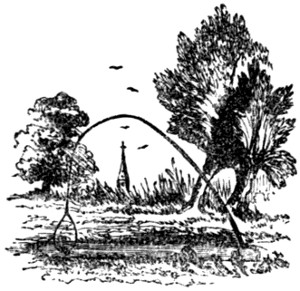
There are various kinds of depredators which find their way into gardens;—worms, slugs, caterpillars, moles, ants, birds, butterflies, snails, &c. These must be got rid of, or kept down, otherwise the gardening labours are soon at an end. In wild nature all the above “vermin,” as some people designate them, are of the greatest service in some way or other; even worms and moles, which are very destructive in gardens, are of great service on commons, and therefore in destroying them we should always do so with as little pain as possible to the individuals; and, as prevention is better than cure, the young gardener should look out in winter for the eggs of various moths and butterflies, which may be often seen encircling the twigs of trees, or under the eaves of paling, &c., and destroy them. Caterpillars are best got rid of by picking them from the plants; and slugs, and snails, and worms, are often eradicated by turning a brood of young ducks into the ground for a short time, where they can do no injury to the beds. They may also be entrapped by laying cabbage leaves in different parts of the garden, under which they will creep in the night time. Moles must be caught with a mole-trap set in the line of their march. It consists simply of a bent stick, and a wire formed into a noose, slightly attached to the neck of a peg, into which the animal runs his head and gets strangled, by the elasticity of the rod drawing up the noose when the peg is disturbed. Ants are best got rid of by destroying their nest and eggs, the latter of which are excellent food for young chickens, pheasants, &c. The most destructive insect is the aphis, which attacks the rose, and this is best destroyed by the fumigation of tobacco-smoke, either through a pair of common bellows, or by means of the whirl-fumigator, which may be purchased for a few shillings; but the most certain mode of destruction is to obtain a few “golden beetles,” and put near the plants infected by aphides; these are their natural enemies, and where they are placed the aphides will soon become extinct.
PROTECTION FROM FROST.
The common trees and fruits of the garden require but little care as regards frost in our comparatively mild winters, but many plants, trees, and shrubs, coming originally from warmer climates, require much attention during winter to keep them alive. It is useless to attempt preserving geraniums, myrtles, and a great many of our common summer plants, without keeping them through the winter in a greenhouse of some kind or other. A small greenhouse may now be cheaply erected, but for the preservation of a small number of plants the greenhouse pit is the cheapest and most convenient substitute. It consists only of a hole twelve feet by four dug in the ground to the depth of six feet, having at the top a skylight. It should if possible be dug in a sheltered situation, open to the south and well backed behind, and the glass-top, which should merely consist of one frame laid in a slanting position to the south over the top of the hole, the back of which is raised to support it, the front being slightly lowered. The entrance to the pit is at the side, to which a stout wooden door nailed over with straw bands should be attached, and two or three steps should lead to the interior of the pit, where a few shelves may be arranged upon which to place the flowers, &c. In this pit flowers, cuttings, bulbs, and a variety of other things, may be preserved through the winter, with very little cost or trouble, and it will be of a great deal of use in many other respects.
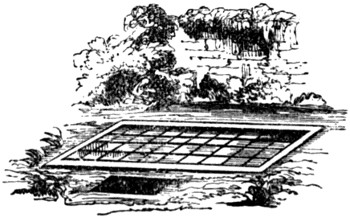
THE YOUNG GARDENER’S CALENDAR FOR THE WORK TO BE DONE IN ALL THE MONTHS OF THE YEAR.
JANUARY.
In January, if the weather will permit, manure the ground, and dig the manure in. Plant out some strong early cabbage in warm situations: plant early kinds of Windsor beans. Sow peas, early Warwick, in drills two feet and a-half asunder; sow a first early crop of spinach; sow early radishes, and cover them with straw two inches thick, then uncover every mild day, and cover again in the evening. Plant in the flower border the various bulbs, such as snowdrops, crocuses, daffodils, jonquils, &c., and also their offsets. Plant also the hardy herbaceous plants, such as asters, golden rods, campanulas, Canterbury bells, &c. Keep gravel walks clean.
FEBRUARY.
Peas, beans, spinach, lettuce, carrots, parsnips, beet, &c., may now be sown; and in hotbeds cucumbers, small salading, melons, lettuce, &c. Give air to plants under frames in the natural ground. Dig and prepare the compartments of beds and borders; sow many sorts of hardy annual flower seeds; the tender sorts in hotbeds, such as larkspurs, candy-tuft, yellow lupines, pansies, virgin stock, sweet scabious mignonette, ten-weeks stock, &c. And for edgings of border, plant box, thrift, daisies, parsley, strawberries, &c.
MARCH.
Still continue to prepare an appropriate ground by digging and manuring, sow again peas, beans, &c., if necessary, and especially a bed of turnips. Now is the time also to sow small herbs, as thyme, savory; you may also now plant various slips or cuttings of rosemary, rue, wormwood, and lavender. These should be the outward shoots produced last year, five or six inches long, and should be planted in a shady border, six inches apart. Now also may be sown nasturtiums, which may be sown in patches, dibbed in six inches apart, or in drills, near a rail or running fence. Potatoes may also be now planted in open weather. In planting them, take care to get the best sorts, and pick out some of the finest of a moderately large size, and then divide the tubers into two or three parts, leaving an eye or two to each; plant the pieces in rows about eighteen inches from each other, and about four inches deep. Now also is the time for pruning the various fruit trees, planting fresh sets of raspberries, strawberries, &c. In the flower garden the tender annuals are to be sown in hotbeds, such as cockscomb, balsam, china-aster, tobacco, convolvulus, &c. Ranunculuses, anemones, and the hardy annuals, may be sown in the open ground, and transplanting of all kinds of plants, shrubs, &c., may now be performed.
APRIL.
This is a transplanting month, particularly for cabbages and cauliflowers, all which should be now taken and put out for summer use. Celery should also now be pricked out. Continue to plant, if necessary, pot herbs and sweet herbs, such as rooted slips of balm, penny royal, and camomile. It is a good time also to plant out slips of mint from the roots; other crops of peas may also now be sown, as also a late crop of beans. Now also you may sow gourds and pumpkins in a frame. All pruning must be finished. Insects must be looked after on fruit trees. Vines may be laid down in layers; wall-fruit thinned; strawberry beds weeded, and kept very clean; new-budded and new-grafted trees well examined to see if the clay keeps close to the grafts. In the flower garden or borders some of the tender annuals may now be pricked out, and some of the others sown in the frame, such as Prince’s feather, capsicum, love-apples, Indian corn, gourds, sweet balsam, marvel of Peru; stocks, and the hardy annuals, may now be sown in the open ground, as Adonis poppy, sweet peas, catch-fly, annual sunflower, larkspur, lupines, Venus’s looking-glass. The best way to sow sweet peas is in pots, and protect them well from the birds, who will otherwise not leave one. Inarching may now be performed on evergreens and other plants, which you may wish to propagate this way.
MAY.
Lettuces will now want tying up. Peas will require sticking. Do not tie your lettuces up too tightly, and when you stick your peas put in the stick in a slanting direction. Clear and thin carrots and parsnips, leaving the largest plants at least four inches from each other; thin also onions; plant out cauliflowers. Sow brocoli seeds for the crop to come in on the following winter and early spring. Sow and plant savoys; top the broad beans that are now in blossom, which will make the pods set sooner and swell faster. Plant the various kinds of French beans, such as the white speckled, in drills about three feet apart, and sow them thin. Prick out and plant celery; continue to sow radishes and small salading for daily use. Water new planted crops, and now let more than common care be taken to destroy weeds amongst crops of every kind; and now is the time for using your Dutch hoe freely among the rows of peas, beans, and spinach; but do not leave your weeds about in the drills or borders; clear all carefully away, and keep the garden clean and neat.
JUNE.
Look after your melons, pumpkins, gourds, and cucumbers, in frames; let them be well supplied with fresh air and water. To save cauliflower seed, mark some of the best and earliest plants, with the largest and whitest and closest flower heads, which should not be cut, but left to run to seed. Peas may still be sown, and French beans also, as may cabbage and colewort seed. Gather mint, balm, and other aromatic herbs, towards the end of this month, for drying. Examine any new planted trees, see that they are not too dry, and that they are well secured. Water should be given to those that show any symptoms of flagging; water them well, but not frequently. Take care that your strawberry beds are also well watered. Hang up nets before early cherry-trees against walls, and over small trees, to protect them from the birds. Most of the tender annuals may be now finally planted out, and now is the time to take up the roots of tulips, crown imperials, jonquils, &c., and to take away the offsets. Continue to support with sticks all the tall growing flowering plants. Cut box-edgings, and regulate your flower borders, keeping your plants well watered if the weather should be very dry.
JULY.
You may now sow a batch of turnips for winter or autumn use, and also some carrot seed to raise young carrots for use later in the autumn. Celery may be transplanted, winter spinach may be sown, lettuces may be planted out, coleworts may be sown. Gather your cucumbers as they appear, and gather all sorts of seeds as they ripen in dry weather, pulling up the stems with the seed where it can be done. Bring out the cockscombs, double balsams, and all other curious annuals kept till this time in frames. Transplant annuals into the borders. Lay carnations and sweetwilliams; propagate pinks by pipings; transplant perennial plants. Take up bulbous roots, cut box-edgings, regulate your flower borders. Plant cuttings and slips of succulent plants; shift geraniums and other plants into larger pots, if necessary.
AUGUST.
Cauliflower seed must be sown between the 18th and the 24th. Celery should now be transplanted into trenches, and lettuce planted out. In the end of the month the dry flower stems of aromatic plants, such as hyssop, sage, lavender, should be cut down. Now look well out for various seeds as they ripen, which gather by cutting or pulling off the seed-stalks, then place them in the full sun against a hedge or wall to get them thoroughly dry. All flowers should now be carefully attended, and watered when necessary. The pink pipings should now be planted out in beds, and the seeds of many bulbous flowers, such as tulips, hyacinths, lilies, may be sown to obtain new varieties. Flower borders should occasionally be gone over with a sharp hoe, after which they should be raked over neatly, and all weeds and litter cleared away.
SEPTEMBER.
Lettuces may now be planted in frames, or in very warm borders, for winter use. Brocoli, cabbage and savoy plants may also be planted out, and young plants pricked out into nursery beds. Celery should be earthed up, and you should tie up the leaves of endive to blanch the plants white. The spinach sown in August should be thinned and cleared out, and small salading should be sown once a-week or fortnight. Gather ripe seeds as before, and see that the birds do not devour them. Now is a good time to plant the strong runner plants into separate beds, and at about fifteen inches asunder either way. Towards the end of the month hyacinth and tulip roots may be planted, as well as any other bulbous root. Anemone and ranunculus seed may be sown, and perennial plants transplanted. Continue to keep the flower borders always very clean, and begin digging vacant beds and borders for future planting.
OCTOBER.
Now the apples and pears begin to ripen. Seeds are still to be looked for and preserved, vacant spaces of ground are to be dug up and manured. Fruit trees may now be transplanted, and currant and gooseberry-trees may be planted. Recollect that the currant-trees may be cut close down to the fruit buds, but the gooseberry only half way down the last year’s wood. Cut out irregular growths and suckers, and keep them trained to a single stem below. Strawberry beds should this month have their winter dressing of manure, and all the runners cleared away close to the head of the main plants. Raspberry plants may be pruned, the old stems cut away, and the last year’s suckers’ stems selected for the next year’s bearings, and each of them shortened one-third in height. In the flower-garden the borders should be nicely dressed, and all kinds of plants may be transplanted, or their roots divided, and bulbs not yet planted may be put into the earth. Plant all kinds of shrubs and evergreen trees.
NOVEMBER.
Now is the time for digging up potatoes, and taking up carrots, parsnips, onions, &c., and storing them for winter use. Winter spinach should be weeded, and the red beet-root dug up. Onions may be pricked out to come in early in the spring. Trees may be pruned; all sorts of fruit trees and bulbous roots planted. Now tender plants should be removed to the pit or greenhouse.
DECEMBER.
Peas may be sown in a warm sheltered spot to come in early in the spring, as may Windsor and broad beans. Celery should be well earthed up, and all vacant ground manured, dug, or trenched. Secure the roots of newly planted trees from the frost by laying dungy litter round them, and the same may be done to the spots in which hyacinths, tulips, anemones, and ranunculuses are planted. Small young tender seedling flower plants also require care at this season. The borders may now be finally cleared and laid nice and smooth, the remainder of pot plants removed to the greenhouse or pit, which should be closed during the night, and only opened in fine mild weather; as the frost comes on place mats above the glass during the night, which should be removed in the morning. All leaves from trees, &c., should be collected in a pit for manure, free from sticks or stones, and the whole garden put into order for the frost.
MIMICRY AND VENTRILOQUISM.
“How can I become a ventriloquist?” is the frequent thought of a boy; and he is told, probably, that it is an exceptional faculty, and cannot possibly be acquired. This is not so; perseverance and practice are alone necessary to produce those wonderful results which never fail to captivate the public, if the student has a fair musical ear, and a talent for imitation which few boys are without. The deceptive nature of the sounds are the result of certain natural principles, which are called in to aid the experimenter. Those who have seen any professors of the ventriloquial art now living must have been struck by the apparent ease with which the effects are produced. This is not only the result of practice, but the careful attention to certain acoustic principles which regulate the direction of sounds. A sudden change in the direction of sound is oftentimes very perplexing to the ear, even when the eye can assist the other organs. The change of direction of the sound of a peal of bells, which is often interrupted by intervening buildings, is a familiar instance of this, their sound appearing to come from different places as the hearer changes his position. We can easily imagine that when the hearer is still, and the source of the sound moves, the deception becomes much greater, if skilfully applied to the purpose.
The first great secret is to take a full and deep inspiration, so that the lungs may be well filled, to be used as a Highlander uses the windbag of his bagpipes, as required. If we remember that the larynx, which is the cavity in the throat behind the tongue, is capable of considerable flexibility, as well as the trachea or windpipe, we have good materials for ventriloquial effect; thus the mouth and tongue have really, but not apparently, a great deal to do with the modifications of the assumed voice. A clever ventriloquist recommends the mouth to be kept closed, and the tongue rolled back, so as to regulate, as it were, the sound which is formed in the larynx. This may be done by strengthening the abdominal muscles; and it is probably from this being so frequently done, that the name of “belly-speaking” arose. The highest perfection of ventriloquism is speaking with the lips closed, and apparently without an effort of any kind. Some old and some modern professors had this marvellous power in perfection.
It has been recently observed that by constant practice the veil of the palate can be so exercised that it can be raised or depressed at will, so as to dilate or contract the inner nostrils. The effect of this contraction is the same as Mr. Hardy’s rolled tongue; it muffles, as it were, the sound, renders it weak and dull, as if coming from a distance. On the other hand, if the nostrils are dilated to any extent, the sound gradually becomes apparently closer and closer, because it is more distinct.
The uncertainty of the direction of sound greatly aids the ventriloquist. If a man and a woman are placed at either end of a tolerably large room, and each imitates with tolerable success the voice of the other, the confusion between the eye and the ear is so great that it becomes next to impossible to know which it was that spoke. It is thus necessary that the ventriloquist should either by word or gesture direct the attention of his hearers to the spot from whence they expect the sound to proceed. Really, in practice, there is little difference between the sound of a muffled voice, whether it is outside the door, above the ceiling, or down in the cellar. It is possible to acquire such a knowledge of the modifications of sound by distance, obstructions, or other causes, as to imitate them with wonderful accuracy. The late Mr. Love used to carry on a dialogue with a person in a box, and by a masterly modulation of his voice he gave it a muffled tone when he sat upon the box, and different degrees of sharpness as he gradually opened the lid.
The best practice is to begin with imitations only of different voices, until some progress is made. Then commence to practise the muffled voice until the audience are satisfied that it is done tolerably well, for the operator cannot judge of the effect it is producing save by experience. The voice may now be changed until the second voice is marked by some distinguishing characteristic, such as bass, alto, gruff, or speaking. Then the distant voice may be tried, to be modulated as before as success is attained.
A well-known ventriloquist used to make some excellent effects by speaking with a closed mouth when drawing an inspiration, instead of the usual method of speaking during the expiration of the breath.
We will suppose a ventriloquist about to give an illustration of his art. He first takes care that none of his audience are between the line of his mouth and the spot from which the sound appears to proceed. Thus the simplest cause of ventriloquial effect is produced by standing with your back to the audience and your face to the door. With closed jaws you direct a muffled voice against the door. The sound which reaches the ears of the audience is a voice apparently outside the door, but in reality it is an echo of the artificial voice only. Take a simple example. You knock at the door, and in your natural voice you inquire if anyone is there. Assuming the muffled tone, you say that “it’s a friend,” and then inquire his name and business. The answers being given, you slightly open the door and the corner of your lips at the same time, and then the voice loses its muffled tone, and appears more distinct as it comes closer. The deception is more difficult to maintain, and the ventriloquist suddenly turns round and shows that the voice is in reality a mere shade.
If we try the ceiling voice, or the familiar “man on the roof,” we should use the upper notes, and reserve the lower notes for the “man in the cellar.” In either of these illusions the lips should not be opened at all. The modulation of tones should be managed in the larynx, by the action of the tongue only, unless the voice is supposed to come down the chimney into the room. In either case the mouth should be turned to the place from whence the sound is supposed to proceed; and when speaking in his natural tones, the performer should address himself directly to the audience; always using appropriate gestures to signify the ascent or descent of the owner of the fictitious voice.
These two voices are in reality the only true ventriloquial voices. The variation of tone and accent depends more on the organs of imitation than on true ventriloquism, though when both arts are combined the effect is so much enhanced as to become perfectly marvellous. One of the simplest sounds to produce is that of the humming-bee, wasp, or bluebottle fly. The first sound is produced in the chest, the latter by the lips. It is always well to attempt to catch the insect after it has indicated its presence. This enables the sound to be raised in tone, and occasionally muffled when the offending suppositious insect is inclosed in the handkerchief.
The imitation of a knife-grinder is easily done, the grinding being produced by a sharp hissing sound through the teeth, and the “buffing” or polishing, by gently closing the lips and drawing the breath through them until they vibrate—a not uncommon schoolboy accomplishment. The sawing of wood, the frying of a pancake, the uncorking of a bottle, and the gurgling noise of pouring out the liquid, may all be successfully imitated; but these are much less striking and ingenious than true ventriloquism.

PUZZLES.
1. THE DIVIDED GARDEN.
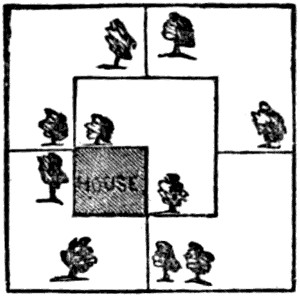
A person let his house to several inmates, who occupied different floors, and having a garden attached to the house, he was desirous of dividing it among them. There were ten trees in the garden, and he was desirous of dividing it so that each of the five inmates should have an equal share of garden and two trees. How did he do it?
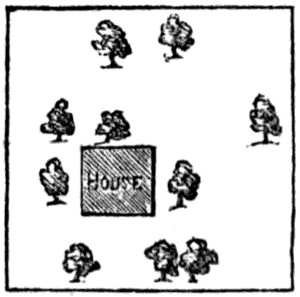
2. THE VERTICAL LINE PUZZLE.
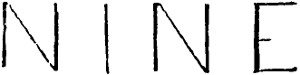
Draw six vertical lines, as below, and, by adding five other lines to them, let the whole form nine.
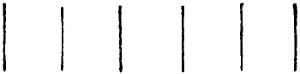
3. THE CARDBOARD PUZZLE.
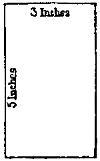
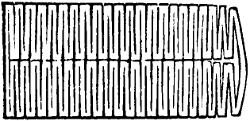
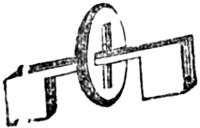
Take a piece of cardboard or leather, of the shape and measurement indicated by the diagram, cut it in such a manner that you yourself may pass through it, still keeping it in one piece.
4. THE BUTTON PUZZLE.
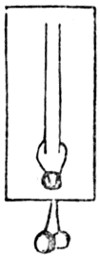
In the centre of a piece of leather make two parallel cuts with a penknife, and just below a small hole of the same width; then pass a piece of string under the slit and through the hole, as in the figure, and tie two buttons much larger than the hole to the ends of the string. The puzzle is, to get the string out again without taking off the buttons.
5. THE CIRCLE PUZZLE.
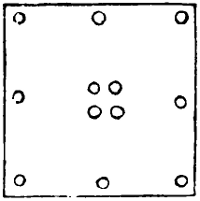
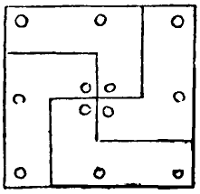
Get a piece of cardboard, the size and shape of the diagram, and punch in it twelve circles or holes in the position shown. The puzzle is, to cut the cardboard into four pieces of equal size, each piece to be of the same shape, and to contain three circles, without cutting into any of them.
6. THE CROSS PUZZLE.
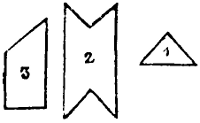
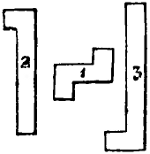
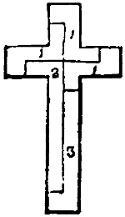
Cut three pieces of paper to the shape of No. 1, one to the shape of No. 2, and one to that of No. 3. Let them be of proportional sizes. Then place the pieces together so as to form a cross.
7. THREE-SQUARE PUZZLE.
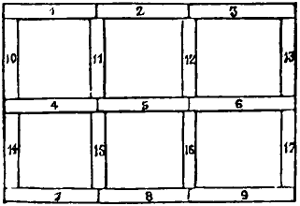
Cut seventeen slips of cardboard of equal lengths, and place them on a table to form six squares, as in the diagram. It is now required to take away five of the pieces, yet to leave but three perfect squares.
8. CYLINDER PUZZLE.
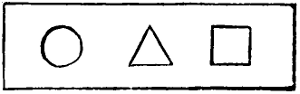
Cut a piece of cardboard about four inches long, of the shape of the diagram, and make three holes in it as represented. The puzzle is, to make one piece of wood pass through, and also exactly to fill, each of the three holes.
9. THE NUNS.
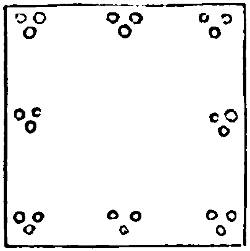
Twenty-four nuns were arranged in a convent by night by a sister, to count nine each way, as in the diagram. Four of them went out for a walk by moonlight. How were the remainder placed in the square so as still to count nine each way? The four who went out returned, bringing with them four friends; how were they all placed still to count nine each way, and thus to deceive the sister, as to whether there were 20, 24, 28, or 32, in the square?
10. THE DOG PUZZLE.
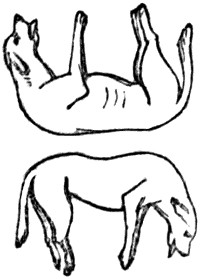
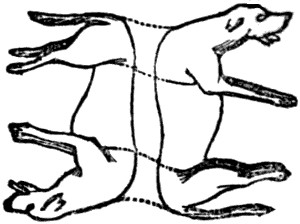
The dogs are, by placing two lines upon them, to be suddenly aroused to life and made to run. Query, How and where should these lines be placed, and what should be the forms of them?
11. CUTTING OUT A CROSS.
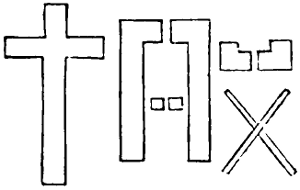
How can be cut out of a single piece of paper, and with one cut of the scissors, a perfect cross, and all the other forms as shown in the cuts?
12. ANOTHER CROSS PUZZLE.
With three pieces of cardboard of the shape and size of No. 1, and one each of No. 2 and 3, to form a cross.
13. THE FOUNTAIN PUZZLE.
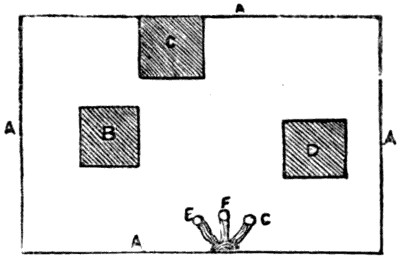
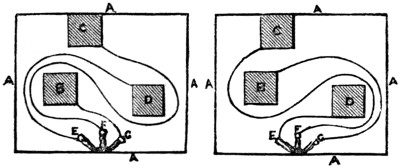
A is a wall, B C D three houses, and E F G three fountains or canals It is required to bring the water from E to D, from G to B, and from F to C, without one crossing the other, or passing outside of the wall A.
14. THE CABINET-MAKER’S PUZZLE.
A cabinet-maker had a circular piece of veneering, with which he has to veneer the tops of two oval stools; but it so happens that the area of the stools, exclusive of the hand-holes in the centre, and the circular piece, are the same, (as that of the circle.) How must he cut his stuff so as to be exactly sufficient for his purpose?
15. THE STRING AND BALLS PUZZLE.
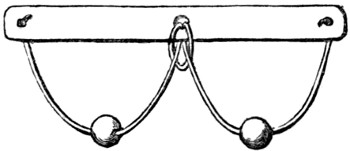
Get an oblong strip of wood or ivory, and bore three holes in it, as shown in the cut. Then take a piece of twine, passing the two ends through the holes at the extremities, fastening them with a knot, and thread upon it two beads or rings, as depicted above. The puzzle is to get both beads on the same side, without removing the string from the holes, or untying the knots.
16. THE DOUBLE-HEADED PUZZLE.
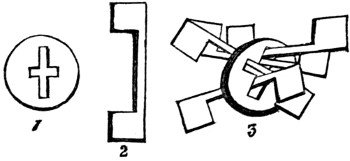
Cut a circular piece of wood as in the cut No. 1, and four others, like No. 2. The puzzle consists in getting them all into the cross-shaped slit, until they look like Fig. 3.
17. THE ROW OF HALFPENCE.
Place ten halfpence in a row on the table. Then take up one of them and place it on another, never in any case passing over more than a penny (that is to say, two halfpence). Repeat the operation until no halfpenny remains by itself in the row.
18. TYPOGRAPHICAL ADVICE.
You are to read the following directions:—
If your B m t put :
When your IS . putting :
19. THE LANDLORD MADE TO PAY.
A well-known miser once invited his tenants to dinner at an inn, and to the surprise of the landlord, asked him to join the party. When the bill was brought in, the miser proposed that they should cast lots who should pay the whole score for the twenty-one persons who had dined. It was agreed that they should be counted by the days of the week, and that every time the counter called “Saturday,” the person so named should leave the room until there was only one man left, and he should be paymaster. How did the miser contrive to throw the expense on the landlord?
20. FATHER AND SON.
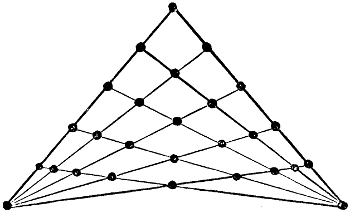
An old country squire planted a number of oaks when his son was born, and on the twenty-seventh birthday of the young man there was a tree for every year, and yet though there were only 27 trees, there were ten rows and six trees in each row, which made sixty, the age of the squire himself. How did he manage it?
ANSWERS TO PUZZLES.
1. THE DIVIDED GARDEN ANSWER.
2. ANSWER TO VERTICAL LINE PUZZLE.
3. ANSWER TO CUT CARD PUZZLE.
Double the cardboard or leather lengthways down the middle, and then cut first to the right, nearly to the end (the narrow way), and then to the left, and so on to the end of the card; then open it and cut down the middle, except the two ends. The diagram shows the proper cuttings. By opening the card or leather, a person may pass through it. A laurel leaf may be treated in the same manner.
4. ANSWER TO THE BUTTON PUZZLE.
Draw the narrow slip of the leather through the hole, and the string and buttons may be easily released.
5. ANSWER TO THE CIRCLE PUZZLE.
6. ANSWER TO THE CROSS PUZZLE.
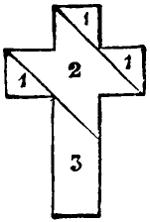
7. ANSWER TO THE THREE-SQUARE PUZZLE.
Take away the pieces numbered 8, 10, 1, 3, 13, and three squares only will remain.
ANSWER TO NO. 8.
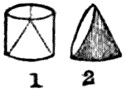
Take a round cylinder of the diameter of the circular hole, and of the height of the square hole. Having drawn a straight line across the end, dividing it into two equal parts, cut an equal section from either side to the edge of the circular base, a figure like that represented by the woodcut in the margin would then be produced, which would fulfil the required conditions.
9. ANSWER TO THE NUNS’ PUZZLE.
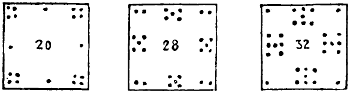
10. THE DOGS’ PUZZLE ANSWERED, SEE DOTTED LINES
11. ANSWER TO CUTTING OUT A CROSS PUZZLE.
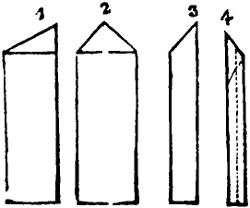
Take a piece of writing paper about three times as long as it is broad, say six inches long and two wide. Fold the upper corner down, as shown in Fig. 1; then fold the other upper corner over the first, and it will appear as in Fig. 2; you next fold the paper in half lengthwise, and it will appear as in Fig. 3. Then the last fold is made lengthwise also, in the middle of the paper, and it will exhibit the form of Fig. 4, which, when cut through with the scissors in the direction of the dotted line, will give all the forms mentioned.
12. ANSWER TO ANOTHER CROSS PUZZLE.
13. ANSWER TO THE FOUNTAIN PUZZLE.
14. ANSWER TO THE CABINET-MAKER’S PUZZLE.
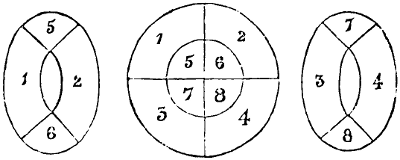
The cabinet-maker must find the centre of the circle, and strike another circle, half the diameter of the first, and having the same centre. Then cut the whole into four parts, by means of two lines drawn at right angles to each other, then cut along the inner circle, and put the pieces together as in the above diagram.
15. ANSWER TO THE STRING AND BALLS PUZZLE.
Draw the loop well down, slipping either ball through it. Push it through the hole at the extremities, pass it over the knot, and draw it through again. The same process must be repeated with the other ball; the loop can then be drawn through the hole in the centre, and the ball will slide along the cord until it reaches the other side. The string is then replaced, having both balls on the same side.
This plan of passing the loop over the knot is a key to all the puzzles of this nature.
There is another and perhaps a neater way of performing this trick. Draw the loop through the central hole, and bring it through far enough to pass one of the balls through. Having done this, draw the string back, and both balls will be found on the same side.
16. ANSWER TO THE DOUBLE-HEADED PUZZLE.
Arrange them side by side in the short arms of the cross, draw out the centre piece, and the rest will follow easily. The reversal of the same process will put them back again.
17. THE ROW OF HALFPENCE.
To perform this trick successfully, you must place the fourth on the first, seventh on the third, fifth upon the ninth, the second upon the sixth, and the eighth upon the tenth.
18. TYPOGRAPHICAL PUZZLE.
This puzzle should be read thus:—
If your grate be (great B) empty, put coal on.
When your grate is (great IS) full, stop putting coal on.
19. THE LANDLORD MADE TO PAY.
The counting, which stopped at every seventh man, was made to begin at the sixth from the landlord, who sat at the end of the table.
20. FATHER AND SON.
The trees were planted in this form:—
SHOWS.
Under this head we describe those shows which may be exhibited by any ingenious youth for the amusement of a large circle of friends. Parents frequently employ the itinerant Punch-and-Judy man to astonish and delight a juvenile party with his comical puppets; and we are convinced that they act wisely, as children of all ages enjoy nothing so much as a good show. The reader, by following our directions, may exhibit the freaks of Punch and Judy, the dancing figures of the Fantoccini, the grotesque shadows of the Gallanty Show; in fine, he may become quite an expert showman.
PUNCH & JUDY
By following our directions, the reader may, with comparatively little trouble, construct some comical puppets, and acquire sufficient skill in working them, to give private representations of the celebrated drama of “Punch and Judy,” which never fails to excite the laughter of old and young.
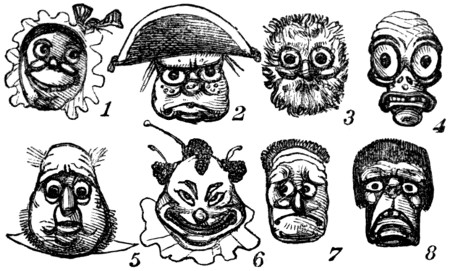
In carving the heads of the puppets, the ingenuity of the reader will be most severely taxed. Each head must be fashioned out of a piece of soft wood, with a sharp penknife, and then painted with oil colours. An old wooden doll will be a capital model for the reader to work from, only he must cut much deeper, in order to make the features of his puppets sufficiently prominent. Punch’s nose and chin may be formed of separate pieces of wood, and then fastened on to the face with a little glue. Our artist has drawn a full-length figure of Punch (see next page), and the faces of the other characters in the drama—namely, 1. Judy; 2. Beadle; 3. Foreigner; 4. Ghost; 5. Doctor; 6. Clown; 7. Jones; 8. Hangman. The carver should study these illustrations attentively, and endeavour to imitate them. The eyes of the Ghost are two black beads, which may be fixed by pins, or loosely attached by short pieces of thread, so that they may roll about in their saucer-like sockets. The eyes of the other puppets may be formed of white beads, fixed by black-headed pins in small cavities made to receive them. The hair and beard of the Foreigner, and the Clown’s three tufts, may be made of any kind of fur; the Hangman’s wig, and the Doctor’s scanty locks, of worsted. Each head should be about the size of an ordinary hen’s egg, and should have a hole made at the bottom, large enough to receive the tip of the showman’s finger.
Punch is the only puppet that exhibits his legs to the audience, and therefore the only one requiring lower limbs; these legs, as well as the hands of all the characters, are to be cut out of wood and painted.
The cloth figures of the puppets must be so constructed, that the exhibitor can easily slip them over his hand and wrist; to these hollow bodies the heads and hands are to be securely fastened with a little glue, or some small tacks. Punch’s figure may be formed of red merino, or any other gay-coloured stuff; the “goodly hunch” and prominent stomach must not be forgotten; these important appendages may be stuffed with cotton or tow. Judy’s dress may be made of cotton print; the Beadle’s, of blue cloth, edged with gold lace; the Foreigner’s, of almost any kind of stuff; the Doctor’s, of black cloth; and the dresses of Jones and the Hangman, of any sober-coloured stuffs. The Ghost must be enveloped in a long white linen gown; and the popular favourite, the Clown, must be arrayed in the true pantomimic style. In constructing the dresses, the reader will have his patience sorely tried, unless he can persuade a few young ladies to aid him with their nimble fingers.
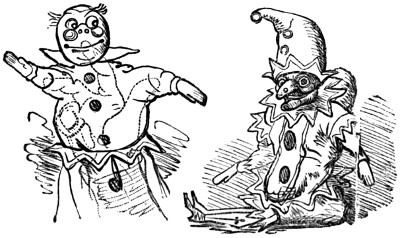
Motion is given to each of the puppets by the showman’s hand, the forefinger of which moves the head, while the thumb and second finger work the two arms; the annexed engraving will elucidate this operation.
We have not yet alluded to two important characters in the drama—namely, the Baby and the eccentric dog Toby. Any little doll may be dressed in long-clothes to represent the Baby, so the reader may be spared the trouble of carving another head. The part of Toby is generally filled by a living performer, but as we do not suppose the reader to be the owner of a properly-trained cur, we recommend him to procure one of those barking or squeaking dogs which are sold at the toy-shops; with such a Toby, the fun of the piece will be increased rather than diminished.
Punch’s stick must be about a foot long, and quite half an inch thick; it must be formed of tough wood, as some rough work is performed with it during the progress of the drama. The gallows must be of the letter F form, and must have two holes bored through the end of the projecting beam; the cord having been knotted at one end, is to be passed through each hole.
Having described the puppets, we will now say a few words about the show in which they are to be exhibited. The dingy curtains which conceal the street performer of Punch, are supported by a tall rectangular frame of wood, which the reader could not imitate without considerable labour and some knowledge of carpentry. The show we recommend is simply a box about three feet square, open in front and at bottom; this is hung upon nails against the wall, above the head of the amateur showman, who is hidden from view by curtains which reach from the box to the floor. The box may be a large tea-chest inverted, with the lid and one of its sides removed. The inside of the box should be hung with green-baize, or any other dark-coloured stuff. A proscenium cut out of pasteboard, and tastefully painted, should be fastened in front of the box, so as to conceal the unsightly edges of the wood. A shelf of wood about four inches wide should project beyond the proscenium, so as to form a little stage upon which Punch may drum his legs, lay down his stick, and place the dead bodies of his victims; this shelf may be fixed by screws passing through the two sides of the box.
During the performance the puppets must be kept in an open box hanging against the wall within reach of the showman.
The reader having prepared everything, should learn the drama, and practise the different voices which he intends to give to the different characters. He will probably be some time before he can acquire the peculiar squeak of Punch, which is generally supposed to be produced by an instrument called a “squeaker.” With none of squeakers we have seen could any distinct words be uttered, and we therefore recommend the reader to trust to his own powers of mimicry. With regard to the musical accompaniments, the amateur showman should get some kind sister or cousin to sit at the piano, the notes of which are much more pleasing than those of the Pandean pipes and drum.
FANTOCCINI
About sixty years ago, a puppet-show was exhibited at the west-end of London, with the Italian title of Fantoccini, which greatly attracted the notice of the public, and was spoken of as an extraordinary performance; it was, however, nothing more than a revival of the old puppet-show, which drew crowded and fashionable audiences during the reign of Queen Anne, and rivalled the more pompous exhibitions of the larger theatres. In the present day Fantoccini are exhibited in the open streets by the itinerant showman, whose ragged coat and battered hat show how puppets have fallen in the estimation of the fashionable public.
Any ingenious youth may amuse and astonish a large circle of friends with an exhibition of dancing puppets, as the different figures are not difficult to construct, and their motions are very easily managed. The puppets may be common wooden dolls dressed up in appropriate costumes. The arms and legs are to be loosely attached to the bodies, so that they may be moved about in any direction by threads fastened to their extremities. These threads may be formed of black sewing-silk, or strong black cotton. All the threads proceeding from the different limbs and joints of a puppet are to be attached to a stick in such a manner as to allow the figure to stand in a natural attitude; the annexed engraving shows two puppets thus supported.
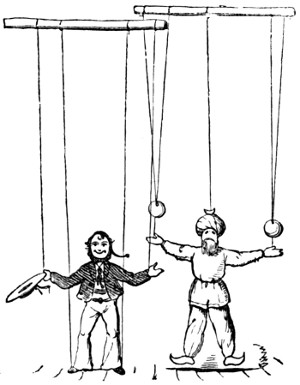
The puppet-show may be formed in the following simple manner:—Take a tall, three-sided clothes-horse, and place its outer edges against the wall so that it may inclose a square space; then hang curtains or shawls over the horse, leaving no part uncovered except a rectangular space close to the floor in front; to this opening you may, if you think proper, fix a painted proscenium. Now place a small towel-horse, hung with black stuff, at the distance of a foot behind the proscenium, to serve as a background to the stage, and to conceal your legs while you are engaged in working the puppets: having done this, lay down a little green-baize carpet on that part of the floor which represents the stage, and your puppet-show will be complete. The puppets may be illuminated by candles placed on the floor in front of the proscenium. The spectators are to be stationed as far from the show as possible, so that they may not perceive the threads.
The performer takes his seat behind the small horse, and holding the stick to which the threads are fastened in his left hand, he manages the motions of the puppet with the fingers of his right hand. When the motions are very complicated, the showman may attach the stick to a string hanging from a rod placed across the top of the show, and employ the fingers of both hands in working the figure. With very little practice the amateur puppet-man may acquire great proficiency in the art of giving lifelike movements to the dolls.
The reader may dress up his puppets in any fancy costumes, but he must endeavour to give to each its appropriate action. The following characters may perhaps be allowed to figure in his Fantoccini:—
THE SAILOR.
This puppet, which is represented in our illustration, is a popular favourite. The doll should have whiskers of Berlin wool glued on its cheeks, and a trim black silk pigtail attached to the back of the head. It is to be dressed in the conventional naval costume, namely, a blue jacket, loose white trousers, and a straw hat. On its entrance it should be made to bow to the audience in a characteristic manner, by inclining its body and kicking one leg behind it. The Sailor’s Hornpipe is then to be struck up by the pianist, and the puppet made to dance to the music. If the showman can manage six strings at once, two threads, not shown in our illustration, may be attached to the knees.
THE JUGGLER
May be dressed in a fanciful Eastern costume; a string is to be attached to the head, and another to each of the hands. A gilded ball, having a hole pierced through it, is strung on each hand-thread, and to each ball a fine silken thread is attached. Our illustration shows how the five threads are to be attached to the supporting-stick. A little practice will enable the showman to work this puppet so dexterously that the spectators will be fairly puzzled to tell how the rapid tossing and catching of the balls is managed.
THE HEADLESS MAN.
This puppet may be dressed according to the reader’s fancy; its head is not fastened to the body, but is strung on a thread attached to the neck. When the showman has made the doll dance for a short time, he pulls the head from the body by means of a thread fastened to it, and makes the headless puppet dance on as if nothing had happened.
THE MILKWOMAN.
A puppet, dressed like a woman with a yoke of milkcans, makes its appearance and performs a country jig. Before the dance is concluded a little white doll jumps out of each can. The milkwoman tries to catch the dolls, but they fly out of sight. The trick is easily managed; to the head of each little doll is fastened a thread, which the showman pulls at the proper time. The yoke may be cut out of a piece of soft deal, and the cans may be made of pasteboard covered with tinfoil.
POSTAGE STAMP COLLECTING, OR PHILATELY.
Our young readers may vainly turn over the pages of any existing dictionary to find the scientific alias of the heading of this article. We trust the omission will be soon supplied, Philately, or Postage Stamp Collecting, having reached the dignity of a recognised science.
The word is the English rendering of the French term Philatélie, bestowed by a distinguished Parisian amateur in substitution for what was called timbromania, the latter portion of which word caused an unpleasant association of ideas, and gave rise to many a sneer from the wiseacres who had not sense enough to understand the real utility of the pastime. It is derived from the Greek φίλος and ὰτέλεια, the nearest equivalent traceable in classical lore to a modern postage stamp.
To schoolboys in general be ascribed the honour of introducing the elegant and instructive fancy forming the subject of our dissertation. The young students of the college of Louvain in particular claim to have been the earliest collectors: thence the fancy spread over France and Germany, inoculating many an English pupil in continental seminaries, by whom it was transmitted home. Some Louvain scholars informed us last year that it had been long prohibited by the professors, as tending to induce inattention to their regular tasks! We think this a mistaken notion; convinced that a knowledge of geography, history, and the values of foreign coins is materially facilitated by the study of postage stamps; which, moreover, induces neatness, regularity, and a sure refuge from ennui on a rainy day. Before the reign of postage stamps, who ever heard of the obscure city whence emanates that unit of a strange set of five, engraved at page 759, or the equally mysterious Thurn and Taxis?
What can give a better idea of the chances and changes fewer than ten years have produced in the vast tract of land known as the Danubian Principalities, whose stamps are representatives of Moldavia alone, of Moldo-Wallachia united, and of the same countries resuming their ancient denomination of Roumania, first under Prince Couza, now under Prince Charles of Hohenzollern?
At the head of this paper is a reprint of an engraving taken from an old work on ancient and modern posts, printed at Paris in 1708. It portrays the various methods of transmitting news in use before the present almost universal system. The left-hand tower bears a lighted beacon; on the top of the right and central towers are men supposed to be shouting messages to be passed onwards from place to place, in the way some of our young classical scholars will remember is mentioned by Cæsar, book vii. chapter 3. The carrier pigeon above, and the dog in the foreground, represent other well-known modes. The former was, and still is, common in the East, and by no means disused here in the case of races, prize-fights, &c.; the latter was employed by the Portuguese during their East Indian conquests, and has been used until a late period by the Peruvians and other Americans.
An early anticipation of the modern post-paid envelope is still in existence, appropriately addressed to the celebrated authoress of “Cyrus the Great,” the originator of ἄγγαρα (angara), or posting-stations; but, strange to say, Persia, the earliest postal pioneer, has not yet adopted the stamp system, though essays have been submitted to the State.
The Californian Pony Expresses, and the earliest emission of Buenos Aires, are exemplars of this primitive way of communication. The last-named stamp has been supposed merely an essay; but we have seen it post-marked. A modification of the same is the Humboldt Express of Langton and Co. and a sort of travestie, the United States local of D. O. Blood.
Other methods of transmitting correspondence, &c. are typified by the sailing vessels of British Guiana, the steamers on the extinct stamps of Buenos Aires, and the Pacific Steam Navigation Company; those of La Guaira and the Russian for the Levant sea-ports. An American idea, even too go-ahead for the reckless Yankees, for we cannot hear that it was ever put in practice, is also here embodied.