PART I. (continued 3)
Reading edition
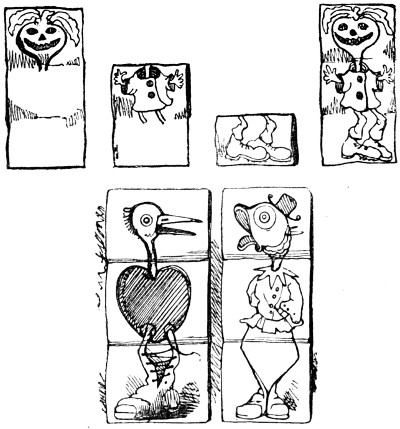
KNUCKLE-BONES.
This game is played with five little bones from a sheep’s trotter. One player tosses up the knuckle-bones, sometimes one at a time, sometimes all together, and catches them either in the palm or on the back of his hand, according to certain rules. Should he fail to perform one of the tricks properly, he must hand the bones to his opponent, who attempts to go through the same series of manœuvres with them. When the first player regains the bones through the unskilful play of his adversary, he once more attempts the feat he failed to accomplish before, and if he succeeds he tries to pass through the subsequent stages of the game. The player who first arrives at the end of the regulated series of tricks wins the game. It would be impossible to give the reader a clear idea of the manner of performing each trick without the aid of diagrams. In almost every school may be found an experienced player at knuckle-bones, whose directions will be of more value than any remarks we can make, though we were to devote a couple of pages to this pastime. In some parts of England a similar game, called “Jackstones,” is played with small round pebbles.
MERELLES, OR NINE MEN’S MORRIS.
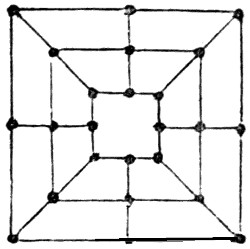
This is an ancient English game, and ought not to be laid aside; so we resuscitate it for the benefit of young England. It used to be played in England on the ground with stones, but may be played best on a table indoors. The form of the merelle-table, and the lines upon it, as it appeared in the fourteenth century, are here represented. These lines are still the same. The black spots at every angle and intersection of the lines are the places for the men to be laid upon. The men are different in form and colour, for distinction sake. The manner of playing is briefly thus: Two persons, having each of them nine pieces, or men, lay them down alternately, one by one, upon the spots; and the business of either party is to prevent his antagonist from placing three of his pieces so as to form a row of three without the intervention of an opposing piece. If a row be formed, he that made it is at liberty to take up one of his competitor’s pieces from any part he thinks most to his advantage; excepting he has made a row, which must not be touched if he have another piece upon the board that is not a component part of that row. When all the pieces are laid down, they are played backwards and forwards in any direction that the lines run, but can only move from one spot to another at one time. He that takes all his antagonist’s pieces, is the conqueror.
PAPER DART.
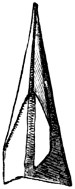
To form this dart you must take an oblong piece of paper, and fold it down the middle lengthwise; then double each of the lower corners up to the middle crease, and fold the doubled paper over to the same mark; you must now turn each folded side outwards, and your dart will resemble the annexed figure. The paper dart, when thrown from the hand, rarely hits the object aimed at, as it generally makes a graceful curve in passing through the air. Boys sometimes amuse themselves by fighting sham battles with these harmless weapons.
THE POPGUN.

The best Popguns are made of a strong straight piece of elder-tree, which ought to be cut from an inner branch, and should be about six inches long. The pith of this should be pierced out by an iron ramrod fitting the hole; and when the inside is made thoroughly smooth by rubbing the rod up and down, it is ready for use. The pellets are made with moistened tow—brown paper is a nasty thing to put into the mouth, and we shall never advise the use of it. When the pellet is prepared, it should be laid over the mouth of the gun in such a quantity as to require squeezing and plugging in. The first pellet should be driven through the gun to its other end; the second pellet is to be driven in, in a similar manner to the first, and then it is forced through the gun: the air between the pellets being incompressible beyond a certain point, forces out the lower pellet with a loud “pop;” hence the the term “Popgun,” which has been applied to them. Popgun-playing is not a very healthy exercise, the pressing of the rammer against the pit of the stomach frequently leading to derangement of that organ. To prevent this, the lad who plays at popgun should have a small round board slung over his neck by a string, hanging as low as the pit of his stomach, like a “conductor’s ticket,” against which he should press the handle of his ramrod when he fires off his popgun.
PUSH-PIN.
This trifling game is usually played by two boys. Each player places a pin on the table, and then endeavours to push one pin across the other with his finger-nail; should he succeed, both pins become his property. At starting, the pins must be placed head to head, and the players push alternately. Sometimes each player puts down two, three, or even more pins.
SCHIMMEL.
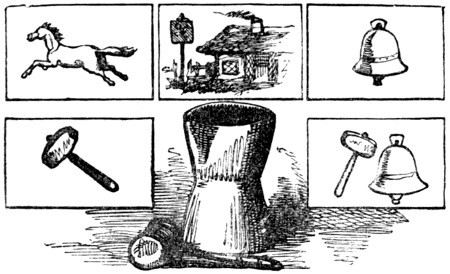
To play this amusing game, which is of German origin, it is necessary to be furnished with five cards, on which are painted the figures of a white horse, an inn, a bell, a hammer, and a bell and hammer; with eight little ivory cubes marked on one side only, six numbered 1, 2, 3, 4, 5, 6, and the other two marked, one with a bell and the other with a hammer; with a box for throwing the dice, a hammer for disposing of the cards by auction, and a proportionate quantity of counters for the players. The cards, dice-box, and auctioneer’s hammer, are shown in the annexed illustration. Any youth who can draw may easily prepare the cards; the cubes may be procured from an ivory-worker’s and may be marked with ink. The game can be played by as many persons as are present. The counters are to be distributed by one of the players who holds the office of cashier, their value having been previously determined upon by the players. This being done, twelve are to be deposited by each player in the pool. The cashier then disposes of the five cards separately to the highest bidders, the produce of which is also to be placed in the pool. The white horse is by far the most valuable card, and therefore fetches the highest price in counters. The inn ranks next, and is usually purchased by the most speculative player, as its value depends upon circumstances. The bell and the hammer generally fetch the same number of counters, these cards being equally valuable, and the card upon which both bell and hammer are painted fetches about half the number that is given for one of the single figures. The bidders are not bound to confine themselves to the number of counters dealt out to them at the beginning of the game; should they exceed it, they may pay the remainder of the debt by instalments out of their receipts in the course of the game.
Each person is at liberty to purchase as many cards as he may think proper.
The dice are then to be thrown by the players alternately, beginning with the holder of the white horse, any one being allowed to dispose of his throw to the highest bidder. When all blanks are thrown, each of the players pays one to the holder of the white horse, and he pays one to the inn. If with the blanks the bell, or hammer, or the bell and hammer together are thrown, the possessor of the card so thrown pays one to the white horse.
When numbers accompany the bell, hammer, or bell and hammer, the cashier is to pay the counters, to the amount of numbers thrown, to the holder of such card, from the pool; but if numbers are thrown unaccompanied, the cashier then pays to the thrower.
When the pool is nearly empty there arises an advantage to the inn, for if a player throws a figure greater than the quantity contained in the pool he pays the overplus to the inn; thus: suppose 4 are in the pool, if the players throws 10, he is to pay 6 to the inn; and if 2 are thrown, those 2 are paid to him from the pool, and so on till a figure is thrown which clears the pool, and so concludes the game.
If all blanks are thrown after the inn begins to receive, the players pay nothing, but the owner of the white horse pays one to the inn; and should the bell, &c. be thrown with the blanks, the holder of that card pays one to the inn; and if numbers accompany the bell, &c. the holder of that card must pay to the inn the number thrown above those remaining in the pool. Nuts are sometimes used as counters, and the players keep their winnings. Sometimes the cashier receives a halfpenny or a penny a dozen for the counters, and when the game is finished the receipts are divided among the players according to their winnings. Those who do not hold cards frequently find themselves richer at the close of the game than their speculative companions, whose winnings do not always exceed the price paid for their cards.
SPELICANS.
Spelicans are made of thin pieces of ivory cut into different forms, some being like spears, others saws, bearded hooks, &c.; of some of the patterns there are duplicates, whilst of others only one. Each pattern has a value assigned to it, the lowest being five, and the highest forty; the numbers do not run in regular succession—as five, six, seven, eight—but irregularly, as five, sixteen, twenty-five. Hooks, made of bone, are used pointers.
The game is played as follows:—One player should take up all the spelicans in a bundle, and holding them at a little height from the table, let them fall down in a confused heap on it; each player must then try alternately to take away a spelican from the heap without moving any of the others, and this it is generally very easy to accomplish at the first, for the top ones are mostly unconnected with the rest, but as the players proceed it requires some tact to jerk them out, with the help of the hook, made pointed for that purpose. The player who, at the entire removal of the heap, has the greatest number of spelicans, wins the game. Should any of the spelicans, while being removed shake the others, they must be put back into the heap again. It is usual in some places, instead of each player removing a spelican alternately, for one to continue lifting up the spelicans until he happens to shake one, when another player takes his turn until he in like manner fails, when another tries his fortune; and so the game continues, until all the spelicans are withdrawn.