PART I. (continued 2)
Reading edition
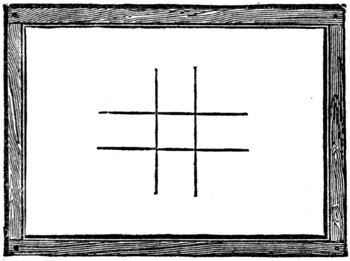
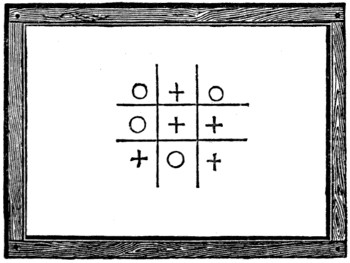
Noughts and Crosses.—This is a capital game, and one which every school-boy truly enjoys. A figure is drawn as follows, and the object of the one player is to draw three crosses in a line before the other can draw three noughts. Thus A begins by drawing a + in the centre division; B follows with a nought in the top right-hand corner. A then draws a + in the bottom right-hand corner, because by this means he gets two crosses in a line, and spoils one of B’s chances. B in a hurry instantly places a 0 in the top left-hand corner, and A follows by placing his + between the two 0’s. B then, seeing that in the centre line A already has two crosses, places a 0 in the third vacant space of the line; while A, as a last resource, plants his + in the second space of the left-hand line. Then when B puts a 0 in the centre space at the left-hand, A places a + in the bottom left-hand corner, and the game is drawn, the plan standing as above.
TRADES.
Every player, except one who holds the office of reader, selects a trade or profession, which he must retain throughout the game. When all have chosen their trades, the reader opens a book at random, and reads a passage from it aloud; but when he comes to any common noun, he looks at one of the tradesmen, who must instantly name some article that he is supposed to have for sale, or some implement connected with the exercise of his craft. By this substitution of one noun for another, the most pathetic passage is converted into an indescribable jumble of absurdities. In the following burlesqued extract from an Eastern tale, the words in italics are supposed to be supplied by the different tradesmen, in place of the nouns omitted by the reader:—
“One offered the prince a bucket of the most precious mutton chops of Golconda; another a curious piece of a Wellington boot, made by a European artist; another a piece of the richest plum-pudding from the looms of China; another a gridiron, said to be a sovereign remedy against all poisons and infectious diseases; another a choice piece of the most fragrant Turkey rhubarb, in a warming-pan, inlaid with acid drops; another a coffin full of genuine treacle; another a rocking-horse of the purest breed of Arabia; and another a Flanders brick of exquisite beauty. The whole court of the palace was overspread with gingerbread-nuts; and long rows of slaves were continually passing loaded with corn-plasters, tenpenny-nails, bees’-wax, and other articles of high price.”
TRUSSED FOWLS.
Two boys having seated themselves on the floor, are trussed by their playmates; that is to say, each boy has his wrists tied together with a handkerchief, and his legs secured just above the ancles with another; his arms are then passed over his knees, and a broomstick is pushed over one arm, under both knees, and out again over the other arm. The “trussed fowls” are now carried into the centre of room and placed opposite each other, with their toes just touching. The fun now begins; as each fowl endeavours, with the aid of his toes, to turn his antagonist over on his back or side, and the one who can succeed in doing this wins the game. It frequently happens that both players turn over together, to the great amusement of the spectators. On board ship these comical encounters frequently take place between the boys, who are trussed by their elder shipmates.
THE TWO HATS.
This game, although only two persons are engaged in it at a time, furnishes much amusement, from the contradictory nature of its words and actions. The rules relative to it are as follow:—If three mistakes are made by the person who responds to the inquiries of the player who brings the hats round, and whom for distinction’s sake we will call the questioner, he must pay three forfeits, and is out of the game; when the questioner desires the respondent to be seated, the latter must stand up; when he begs him to put his hat on, he must take it off; when he requests him to stand, he must sit; and in every point, the respondent must take special care to do always the very reverse of what the questioner wishes him. The questioner may sit down, stand up, put his hat on, or take it off, without desiring the respondent to do so, or giving him the least intimation of his intention; the latter must, therefore, be always on his guard, so as to act in a contrary way in an instant, else he incurs a forfeit. These rules being settled, the game is simply this: one player places a hat on his head, takes another in his hand, and gives it to one of the company; he then begins conversing with him, endeavouring both by words and actions to puzzle him as much as he can, so as to cause him to pay a forfeit. We will give a slight specimen of a dialogue, describing the accompanying movements of the hats, in which A is the questioner, B the respondent:
A. (taking his hat off.) A very beautiful evening, sir.
B. (putting his hat on.) Yes, indeed, a most lovely one.
A. (putting his hat on, and sitting down, B. instantly taking his off and getting up.) Pray be seated, sir; I really cannot think of sitting while you stand (gets up, and B. sits down). Have you been out of town this year? (takes off his hat.)
B. (putting his on.) I have not yet, but I think I shall, before (A. sits down, B. gets up) the beauty of the season has entirely passed away, venture a few miles out of town.
A. (putting his hat on.) I beg ten thousand pardons, you are standing while I am sitting; pardon me, your hat is on—you must pay a forfeit.
It generally happens, that before the dialogue has been carried thus far the respondent has incurred three forfeits, and is, of course, out; the questioner then goes in succession to the others, and the same scene is repeated by each: the conversation, it is almost needless to add, should be varied as much as possible, and the more nonsensical it is the better.
WHAT IS MY THOUGHT LIKE?
The leader of the game commences it by asking each of his companions in turn, “What is my thought like?” to which they reply at hazard, by mentioning anything that first comes into their thoughts, of course avoiding naming the same thing twice over, as that incurs the penalty of a forfeit. The leader carefully notes down all the answers he receives, and then revealing his thought, desires to know what the thing thought of resembles in what it has been compared to.
John.—Charles, what is my thought like?
Charles.—A young girl.
John.—James?
James.—A queen.
John.—Now, Harry?
Harry.—A lion.
John.—Tom?
Tom.—Beauty.
John.—You, William?
William.—An oak-tree.
John.—Alfred, it is your turn.
Alfred.—A beautiful woman.
John.—Andrew?
Andrew.—Hope.
John.—Arthur?
Arthur.—A hedgehog.
John.—Ben?
Ben.—A rose.
John.—And you, Cecil?
Cecil.—A vine.
John.—My thought was a rose; so now, Charles, tell me why a rose is like a young girl.
Charles.—Because it is loveliest when only half-blown.
John.—And why a queen?
James.—Because the rose is the queen of all flowers.
John.—Harry, why is a rose like a lion?
Harry.—Because it is one of the emblems of England.
John.—And why, Tom, is it like beauty?
Tom.—Because it soon fades.
John.—William, why is it like an oak?
William.—Because both spring from the earth.
John.—And you, Alfred; why is a rose like a beautiful woman?
Alfred.—Because its fragrance often remains after the charms are faded.
John.—Andrew, why is a rose like hope?
Andrew.—Because in returning sunshine it forgets the past storm.
John.—Arthur, why is a rose like a hedgehog?
Arthur.—Because its thorns defend it from a rough grasp.
John.—You, Ben, having fixed upon the same thing as myself, must pay a forfeit. Cecil, why is a rose like a vine?
Cecil.—Because in old times they were both considered essential to a banquet. I can think of nothing better.
EASY GAMES WITH TOYS, OUTDOOR.
EASY GAMES WITH TOYS.
OUTDOOR.
BALLS
CATCH BALL.
This is very simple play. The ball is thrown into the air by one player, the others standing round him. He calls out the name of the player, for whom the ball is thrown. If it be caught by the player so called, before the ball reaches the ground twice, he scores a point; if any of the other players catch it, they score a point, and the other loses one.
DOUTEE-STOOL.
This is a variety of the above game. A certain number of stools are set up in a circular form, and at a distance from each other, and every one is occupied by a single player; when the ball is struck, which is done, as before, by the hand, every one of them is obliged to alter his situation, running in succession from stool to stool; and if he who threw the ball can regain it in time to strike any of the players before he reaches the stool to which he is running, he takes his place, and the person touched must throw the ball, until he can in like manner return to the circle.
EGG-HAT.
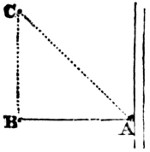
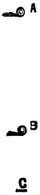
All the players engaged in this favourite pastime must place their caps on the ground, close to the wall, in such a manner that a ball may be easily pitched into them. A line being marked on the ground about fifteen feet from the wall, one of the players takes his station at it, and begins the game by throwing the ball into one of the caps; the moment this is done all the boys run away, excepting the one into whose cap the ball is thrown, who immediately runs to take it out, and endeavours to strike one of the fugitives by throwing the ball at him; if he can do so, the one struck has a small stone, called “an egg,” placed in his cap, and has to take his turn at pitching the ball. Should the thrower fail to hit one of the boys as they are running away, an “egg” is put into his cap, and he has to pitch the ball into the caps again. If a player fails to throw the ball into a cap, he earns an “egg,” but continues throwing until he succeeds. When a player gets three “eggs” in his cap, he is out. When all the players but one have been struck out, he is considered the winner, and the punishment of the losers then commences; one of them standing near the wall bounces the ball at it with all his force, and next stands with his back to the wall, stretching out his right arm, and placing the back of his hand quite close to the wall, while the winner, standing where the ball fell, takes aim, and throws the ball at the said loser’s hand three times: each of the losers likewise receives the same punishment from him. In some places it is usual, when one boy gets out, for him to bounce the ball against the wall, and all the other players, standing at the spot where the ball first touched the ground, to have their three balls at his back, as he stands with his face to the wall. Should the ball in rebounding swerve either to the right or left, a line must be drawn, from the spot where it falls, to a place directly in a straight line from the boy at the wall; thus, suppose A is the boy who has just bounced the ball, which instead of going direct to B, has deviated from the straight line A B to C, a line should be drawn from C to B, and the winner should stand at the latter.
FEEDER.
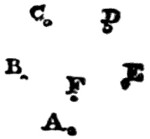
In this game four or five stones or marks must be placed on the ground, as in the annexed figure, A, B, C, D, E, about twelve or fifteen yards asunder; these marks are called bases, and one of them, as A, is styled “home.” The players next toss up for the office of “feeder,” who takes his place about two yards in front of “home,” as at F, and the rest of the players stand at and round the home. The feeder then calls out “Play!” and pitches the ball to the first player, who endeavours to strike it with a bat, as far as he possibly can; should he succeed in hitting the ball, he immediately drops the bat, and runs to the first base on his right hand, as E, while the feeder is going after the ball: but if he can run all the bases and then home, before the ball is in hand, so much the better. If, however, the feeder obtains the ball soon enough to throw it at, and strike him with it as he is running from base to base, the player is out; he is also out if the feeder catches the ball: in either case the player becomes feeder, and the latter runs home to join his playmates. Should any of the other players be out at the bases, when one is caught or struck out, they also must run home. If the first player could only reach the base E, after striking the ball, he should, when the second player strikes it, run to the base D, as it is not allowable for two persons to be at one base at one and the same minute; he proceeds in the same manner to the third and fourth bases, until he arrives home again, thus enabling the others to get to their bases and home in their respective turns. The player with the bat is not obliged to take every ball the feeder chooses to give him; if he does not like a throw, he catches the ball and throws it back again. He is not allowed to make more than three “offers” at the ball; if he does so he is out, and must be feeder.
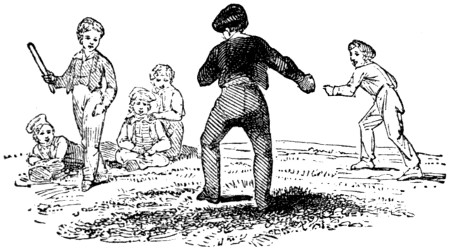
MONDAY, TUESDAY.
This game, which takes its title from the names assumed by the players, is played by seven boys, each of whom calls himself after one of the days of the week. To show the manner of playing the game, we will suppose that some boys are playing at it, and that the ball is taken by “Wednesday;” he throws it up against a wall, calling out at the same time the assumed name of any one of the other players, who should be standing around—we will suppose, for instance, “Friday!” All the boys but Friday run away, and he endeavours to catch it ere it falls to the ground; if he can do so, he throws it up again, calling out another boy’s name—say “Sunday!” Should the ball touch the ground before he can catch it, he must pick it up and throw it at the retreating party; and if he succeeds in hitting one of them, the boy struck has to throw the ball up the next time; but if he cannot strike one he loses a point, as in Egg-hat; indeed, in the rules respecting the punishment of the losers, and the number of points each player is restricted to, it resembles that game.
NINE-HOLES.
Dig near a wall nine holes, of about six inches in diameter, and three deep. Let each player have one of these, according to his number, which must be determined by lot. At about six yards from the holes draw a line, and from this, as a fielding place, one player pitches the ball into one of the holes. The boy to whom this hole is assigned immediately runs to it, while all the other players run off in different directions. The player snatches the ball from the hole, and throws it at one of the “runners;” if he hits him, the one so hit becomes “pitcher,” and the one that struck him marks one. Should he not hit him, the player who throws the ball loses a point, and bowls. The player who misses his aim at throwing the ball at his partners a second time becomes a “Tenner.” If he loses a third hit, he is a “Fifteener;” if the fourth, he stands out and can play no more. When all the players are thus out, the last player remaining in wins the game, and he can compel each of the losers to stand with their hands open against the wall, for him to throw at, and give what is called the “Brandy Ball.” If the ball be a soft one, this conclusion of the game is all very well; but if a hard ball be used, it ought to be omitted, or the “Brandy” may be too strong.
NORTHERN SPELL.
This game is played with a trap and ball, which is struck with a bat or bludgeon at the pleasure of the players; but the latter is most commonly used. The performance of this game does not require the attendance of either of the parties in the field to catch or stop the ball, for the contest between them is simply who shall strike it the greatest distance in a given number of strokes; the length of each stroke is measured before the ball is returned, by means of a cord made fast at one end near the trap, the other being stretched into the field by a person stationed there for that purpose, who adjusts it to the ball, wherever it may be.
The cord is divided into yards, which are properly numbered upon in it in succession, so that the person at the bottom of the ground can easily ascertain the distance of each stroke by the number of the yards, which he calls to the players to place to their account, and the ball is thrown back.
ROUNDERS.
This is a most excellent game, and very popular in some of our English counties. It is played with a moderate-sized ball and a hand-bat, i. e. a bat that can be held in one hand, and which is about two feet in length, smooth, and round. Two parties play at the game, and there ought not to be less than five on a side; and the first innings is decided by throwing up the ball, the party catching it being allowed to go in first.
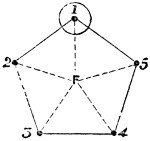
In playing the game, five stones, or stakes (called bases), or, if these be not convenient, as many holes may be made, at about sixteen yards apart, forming the five parts of a pentagon, as in the diagram. At the centre of this figure is a station called the feeder’s place, being the spot at which one of the out party stands to give the ball to the batsman, or to “feed” him, as it is technically termed. The out party are distributed over the field, except the feeder, who takes his station at F to deliver the balls, while one of the in party takes the bat and places himself at Fig. 1, which is enclosed within a circle, and called the Home, and where all the rest of the in party stand. The feeder then says “Play,” and delivers his ball to the batsman, who immediately strikes it as far as he can. As soon as he has done so, he drops his bat, and runs to as many of the stations as he can; but he must touch at all, or he will be out. If while he is running to the second, or between any of the bases, the returned ball is sent up and strikes him, he is out, and the next of the in party takes up the bat. If he is not struck while he runs, as soon as he reaches one of the stations the next of the in party takes up the bat, another ball is given by the feeder, and he runs to the first, or as many other of the stations as he can; the first batsman does the same, so as to go the whole round of the bases to the home at No. 1. The in player is also out if he tips the ball behind him, or if he misses striking it when delivered. The in players as they arrive at home take the bat again, till they are got out, according to the rules of the game just given. When it happens that all are out but two, the best of the two may, with the consent of the other, call for “three fair hits for the rounder.” Standing at the home, the feeder then gives him in succession three balls. He may decline as many balls as he pleases, if they do not suit him; but if he strikes at the ball, he is only allowed to do so twice without running. On the delivery of the third ball, he must run the entire course, touching with his bat at every one of the five points. If, during his progress, he be touched by the ball, or it be grounded at the home while he is absent, he is declared out, and the opposite side go in and take their places. If, on the contrary, he reaches home without being struck or the ball grounded, his side go in again, and continue the game as before. Should he miss the ball when striking at it the third time, the rounder is lost. In the play the feeder is allowed to make feint or pretence of throwing the ball, in order to tempt a player to run from his base, so as to get a chance of hitting him. It is usual also for the out party to place a player behind the home, so that when a batsman makes a tip on the side of the home, he may seize the ball and strike him out before he reaches the first base.
SEVENS.
This game is very like Catch-ball. The object is to catch a ball seven times in a particular fashion; hence the name. The player begins by throwing the ball in the air and catching it seven times with both hands. Then he catches it seven times with the right hand, next seven times with the left. Then he throws the ball up, claps his hand while it is in the air, and catches it seven times with both hands, then with the right, and then with the left. The players are allowed to make as many more variations as they please; and he who goes through the series first wins the game.
STOOL-BALL.
This is an old English sport, mentioned by Gower and Chaucer, and was at one period common to women as well as men. In the northern parts of England, particularly in Yorkshire, it is practised in the following manner:—A stool being set upon the ground, one of the players takes his place before it, while his antagonist, standing at a distance, tosses a ball, with the intention of striking the stool. It is the former player’s business to prevent this, by breaking it away with the hand, reckoning one to the game for every stroke of the ball; if, on the contrary, it should be missed by the hand, and touch the stool, the players change places. The conqueror of the game is he who strikes the ball most times before it touches the stool.
TRAP, BAT, AND BALL.
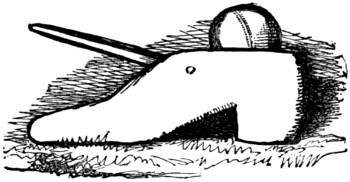
This game is so called from the trap used to elevate the ball when it is to be struck by the batsman. It is one of the earliest games played with the trap and ball, and we can trace it to the commencement of the fourteenth century. The manner in which it was then played was somewhat different to the style at the present day. As now played, the trap is no longer elevated, but set on the ground, and is generally made in the form of a shoe, the heel part being hollowed out for the reception of the ball: but some boys, when they cannot get a trap, make a hole in the ground, and having obtained the crochet bone of an ox, place it in a slanting position, one end being in the hole and the other out of it. The elevated end is then sharply struck with the bat, which causes the ball to rise to a considerable height, and then all the purposes of a trap are answered, especially if the ground be hard and dry.
It is usual in the present game of Trap and Ball to place two boundaries, at a given distance from the trap, between which it is necessary for the ball to fall when struck by the batsman, for if it falls outside of either, he gives up his bat and is out. He is also out if he strikes the ball into the air, so that it is caught by an opposite player; and, again, if the ball when returned by an adversary touches the trap, or rests within one bat’s length of it. Every stroke tells for one towards the striker’s game.
There are some variations in the play of the game in different counties. In Essex and Suffolk, for instance, the game is played with a cudgel instead of a bat, which would seem to be a preferable weapon, as those who strike with it rarely miss their blow, but frequently send it to an astonishing distance, no boundaries being set.
The ball being stopped by one of the opposing party, the striker forms his judgment of the ability of the person who is to throw it back, and calls in consequence for any number of scores towards the game that he thinks proper. It is then returned, and if it appears to his antagonist to rest at a sufficient distance to justify the striker’s call, he obtains his number; but when a contrary opinion is held, a measurement takes place, and if the scores demanded exceed in number the length of the cudgel from the trap to the ball, he loses the whole, and is out; while, on the other hand, if the lengths of the bat are more than the scores called for, the matter terminates in the striker’s favour, and they are set up to his account.
HOOPS
Trundling the hoop is a pastime of uncertain origin, but it has long contributed to the health and amusement of the youth of Great Britain. Iron hoops have almost superseded the old-fashioned wooden ones, and instead of being trundled with a stick, they are usually guided by an iron hook shaped like the annexed figure. On a cold frosty morning the hoop is an invaluable companion to a boy, as he is enabled by its aid to defy the weather, and dispense with overcoats, comforters, and all such devices for keeping out the wintry wind. Often have we envied our juvenile friends, as they have rushed past us with their hoops, and lamented that custom should prevent grown-up people indulging in the same healthful recreation.

THE HOOP.
The proper and legitimate hoop, however, should be made of a stout ashen lath, round on the outside and flat on the inside, and should be well fastened at its point of juncture; it should be in height so as to reach midway between the youngster’s elbow and shoulder, so that he may not have to stoop while striking it. The stick should be about sixteen inches long, and made of tough ash; and, in bowling the hoop, the bowler should strike it vigorously in the centre, and in a direction horizontal with the ground. Such hoop exercise is exceedingly good, and a good run with such a hoop will warm the youth in the very coldest weather.
The games, properly so called, that can be played with the hoop are very few, and not generally known.
ENCOUNTERS.
Two boys start at different ends of the playground with their hoops, and, meeting in the middle, each endeavours to knock down the hoop of his antagonist, while his own remains upright.
There is no small skill required in this game, for it is not always easy to make the hoops touch each other at all. Then a light hoop has little chance against a heavy one, unless it can strike it sideways, for if it were struck directly in front, it would be certainly upset.
Also, a ready hand at recovering a falling or tottering hoop wins many a game that appears to be hopelessly lost.
Wooden hoops, also, give due exercise to the arm; and there is some tact required in knowing exactly where to strike a hoop, so as to propel it with the greatest force.
This cannot well be done with iron hoops, and forms one of the objections to them. Moreover, boys always complain that they soon lose their round form, and are awkward to bowl. Still, there is something cheering in the ringing sound of an iron hoop, as it rushes along under the pressure of the curved iron rod that is used instead of a hoop-stick; and as long as boys don’t drive them against the legs of unwary passengers, they are very well in their way.
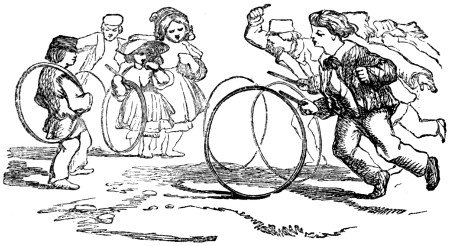
HOOP RACE.
Any number of boys can join in this exciting sport, but they ought all to be provided with hoops as nearly equal in size as possible. At a given signal the players all start together, and each endeavours to reach the winning post (which may be any distant object) before his companions. He who arrives at the winning-post last is generally received with groans, hisses, and other vocal signs of disapprobation.
POSTING.
Bases, called posting-stations, are formed at regular distances, in a large circle or ellipse, and at each base a player is stationed. Every player, except the hoop-driver, has charge of a base. Let us suppose that there are seven players—A, B, C, D, E, F, and G, and that the latter holds the hoop: the other six players having taken possession of their stations, G now starts from the station belonging to F, and drives the hoop towards A, who waits, with hoop-stick in hand, ready to relieve G of his charge. G stops at the posting-station, while A trundles the hoop to B, who takes charge of it, and delivers it to C. C trundles the hoop to D; D transfers it to E; E delivers it to F; and F conveys it in safety to the first player, G. In this way the game continues, until all the players have worked round the circle five or six times. It is considered very disgraceful to touch the hoop with the hand, or to allow it to fall after it has been started on its journey. The game is rendered much more lively by increasing the number of players, and having two or three hoop-drivers to follow each other from base to base.
TOURNAMENT.
This game is almost the same as Encounters. Two boys drive their hoops one against the other, and he whose hoop falls in the encounter is conquered. With eight players this game may be rendered very exciting. Four of the players stand in a row, about six feet apart, and, at a considerable distance, the other four take their stand, facing them. At a given signal each player dashes towards his opponent, and strives to overturn his hoop. The four victors now pair off, and charge two against two. The conquerors then urge their hoops one against the other, and he who succeeds in overturning the hoop of his antagonist wins the game. Wooden hoops are more suitable for Tournament than iron ones, though the game is usually played with the latter.
TURNPIKE.
Five or six boys can play at this game, though only one hoop is required. Chance decides which of the players shall first take the hoop. The other players become turnpike-keepers. Each turnpike is formed of two bricks or stones, placed on the ground, and separated by about three fingers’ breadths. These turnpikes are fixed at regular distances, and their number is regulated by the number of keepers. When all is ready, the first player starts his hoop, and endeavours to drive it through all the turnpikes; should he succeed in this, he turns the hoop, drives it back again, and retains it until it touches one of the turnpikes, the keeper of which now becomes hoop-driver. When a player touches the hoop with his hand, or allows it to fall, he must deliver it up to the nearest turnpike-keeper. Each keeper must stand on that side of his turnpike which is towards the right hand of the hoop-driver, and it therefore follows that he must alter his position when the hoop-driver returns. Should a keeper stand on his wrong side, the driver need not send the hoop through his turnpike. When the players are numerous, there may be two or more hoops driven at once.
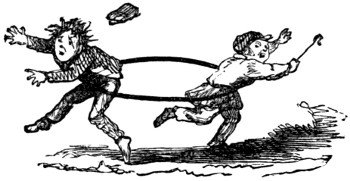
HOOP STICKS.
KITES
The form of the kite and manner of flying it must be familiar to all our readers. This favourite toy probably received its denomination from having originally been made in the shape of the bird called the kite. The flying of paper kites is a favourite pastime among the Chinese. On a certain day they hold a sort of kite festival, and then people of all ages hasten to the hills to fly their kites, the fantastic shapes and gaudy colours of which produce an extraordinary effect. Philosophers have occasionally taken the kite out of the hands of the schoolboy, and have applied it to useful and curious purposes. By means of a kite formed of a silk handkerchief stretched over a wooden frame, Dr. Franklin drew down lightning from the clouds, and demonstrated its identity with electricity. Many years ago Mr. Pocock, of Bristol, travelled on the road between Bath and London in a carriage drawn by two paper kites, supported at a moderate elevation, and impelled by the wind. The paper kite has also been employed to convey a line over the capital of Pompey’s Pillar. We do not expect our readers to perform any electrical or locomotive experiments with their kites; but we are quite sure that they may derive great amusement from these little aërial machines, especially if they manufacture them with their own hands. We know of no pleasanter occupation for a summer’s day than watching the graceful flight of a well-made kite.
HOW TO MAKE A KITE.
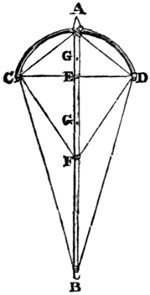
For the upright get a good straight lath, as A B, in the annexed figure, and next procure half of a thin hoop or cane for the bow C D, and then tie the hoop to the upright at A, and take care to have as much on one side of the upright as on the other; otherwise your kite will be sure to fall on one side when flying. Notch the two ends of the bow C D, and tie a long piece of string to D; pass it round the upright at E, and then fasten it at C; next carry the string to A, pass it down to D, and tie it there: from thence it is to be continued to B, passed round a notch there, and carried up again to C, then down the upright at F, and up to D, where it is to be finally fastened off. The skeleton being thus finished, the next thing to be done is to paste several sheets of paper so as to form a surface large enough to cover the kite and allow of a little turn over to fasten the outer edges; after you have pasted the paper on to the skeleton, you must make two holes, in the upright, as at G, G, through which the belly-band is to be passed, knotting the two ends of the string to keep it from slipping through the holes. The wings are to be made of several sheets of paper, cut into slips, rolled close up, so as to bear some resemblance to a tassel, and tied to the sides of the kite at C, D. The tail, which should be about fifteen times the length of the kite, is made by folding a number of pieces of paper so as to be about an inch in breadth, and four inches in length, and afterwards tying them on a string at intervals of three inches, and is finished by affixing to the end of the string a large tassel made in the same manner as the wings. Tie the string with which you intend to fly the kite to the belly-band, and your kite is complete and ready for service.
FLYING THE KITE.
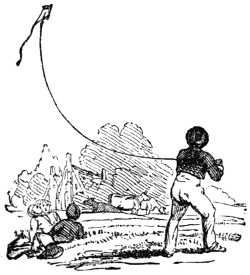
We need not enter very minutely into the rules to be observed in flying a kite, as every boy is acquainted with them. Unless there be a nice breeze stirring, the kite-flyer need not expect to have much sport, as nothing can be more vexatious than attempting to fly a kite when there is not sufficient wind for the purpose. To raise the kite in the first instance, the flyer will require the aid of another boy. The owner of the kite having unwound a considerable length of string, now turns his face towards the wind and prepares for a run, while his assistant holds the kite by its lower extremity as high as he can from the ground. At a given signal the assistant lets the kite go, and if all circumstances be favourable it will soar upwards with great rapidity. With a well-constructed kite, in a good breeze the flyer need not trouble himself to run very fast nor very far, as his kite will soon find its balance, and float quite steadily on the wind. The kite-flyer should be careful not to let out string too fast. When a kite pitches, it is a sign that it is built lop-side, or that its tail is not long enough.
MESSENGERS.
Some boys amuse themselves by sending messengers up to their kites when they have let out all their string. A messenger is formed of a piece of paper three or four inches square, in the centre of which a hole is made. The end of the string is passed through the hole, and the wind quickly drives the messenger up to the kite. The kite-flyer should be careful not to send up too many messengers, lest they weigh down the kite.
CALICO KITES.
Calico has many advantages over paper as a covering for kites; it is not so liable to be torn, is not damaged by wet, and may be sewn on the framework much more neatly than paper can be pasted. Being much heavier than paper, it is, however, only suited for large kites. A portable calico kite may now be procured at most of the toy-shops. The framework of this kite is formed of two slender pieces of wood, which turn on a common centre in such a manner that they can either be shut up, so that one piece lies flat upon the other, or opened out into the form of a cross. The calico covering is attached to this cross by means of tapes. This portable kite can be rolled up and carried to the field without inconvenience.
FANCY KITES.
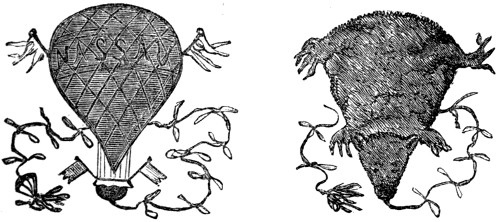
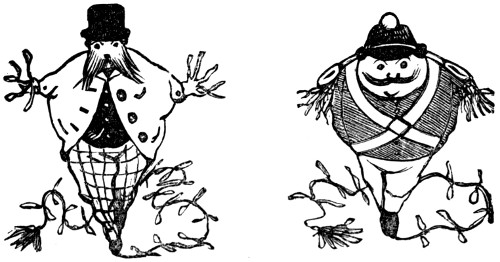
Ingenious boys now and then take a hint from the Chinese, and so shape and paint their kites that they resemble different animate and inanimate objects. The “officer kite,” which has the figure of a soldier painted on it, and the “hawk kite,” which rudely represents a flying hawk, are common forms of fancy kites. A very funny effect may be produced by painting a kite like a sailor, and attaching moveable arms, instead of the ordinary tassel wings, to the shoulders. We present our readers with a few suggestive forms, which are quite novel. All fancy kites should be painted with the most glaring colours, and the figures on them drawn as coarsely as possible, as they are intended to be seen at a great distance.
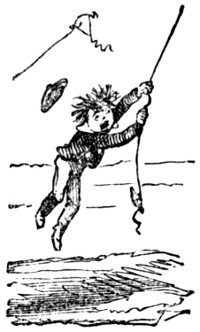
A HIGH FLYER.
MARBLES
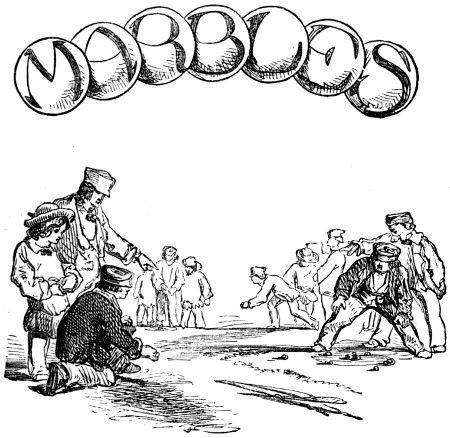
In ancient times, when we were boys, and indulged in the luxury of marbles, they were very different from their present form. They were made of stone, nicely polished, and some of them, called “alleys,” of the purest marble. Many of the stone marbles were beautifully variegated, and now and then a fancy pet was treasured under the name of “taw,” which had somewhat the virtues of a talisman, for to “lose it or to give it” were “such perdition,” as Othello says, as could never be exceeded. Of late years, marbles, like all other matters, have undergone considerable change. Foreign marbles have been introduced, prodigiously cheaper, it is true, than our old English marbles, but infinitely worse; and various kinds of “patent marbles” have had their day. Some of these go by the name of Dutchmen, others are called Frenchmen, and others again Chinamen, while it is not quite impossible to procure some right old English marbles, which, if they can be procured, are still the best. We would advise all marble players to procure these, if they can, as “marbles” is a royal game, and ought to be duly honoured.
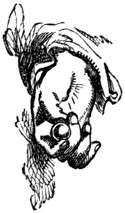
HOW TO HOLD YOUR TAW.
How to Shoot your Marble.—The art of holding a marble to shoot it properly seems to be lost among our London boys, who are generally content to throw one marble at another, or if they shoot it to hold it in the turn of the fore-finger, forcing it out by the thumb, which is placed behind it. This, in our boyish days, was held to be a very illegitimate way of proceeding, derogatory to the true marble-player, and bore the dishonourable appellation of “fulking,” and any one who made it his rule to hold a marble in such a manner was looked upon as a charlatan, or almost a cheat. The true way to hold your taw is to place it between the point of the forefinger and the first joint of the thumb, and to propel it from the nail of the thumb with strong muscular force; and so great was the skill attained by many boys, that they would sometimes strike a marble at five yards’ distance, and frequently shoot one to six or seven.
BOUNCE EYE.
This game is played by several players, each of whom puts down a marble in a small ring. One player then stands in a perpendicular position over the cluster of marbles, and, taking his own bounce in his hand, lets it fall from his eye on to the heap, and those forced out of the ring by this method are considered won. If he does not succeed in this, and his marble falls within the ring, it belongs to the common stock, and is there impounded.
CONQUEROR.
There is a game called “Conqueror,” which is extensively played in some places. A piece of hard ground, and free from stones, is chosen for the spot. The first player lays his marble on the ground, and the second throws his own at it with all his force, and endeavours to break it. If he succeeds, his marble counts one, and the vanquished player lays down another marble. If two players have marbles that have already vanquished others, the “Conqueror” counts all the conquered of the other party in addition to his own. For example, suppose A, being conqueror of twenty, breaks B, also a conqueror of twenty, A counts forty-one, i. e. twenty of his own, twenty for the vanquished belonging to B, and one for B itself.
Nuts, chestnuts, and other similar objects are also employed in this game, only they are fastened to a string, and swung against the opponent, instead of being thrown.
DIE SHOT.
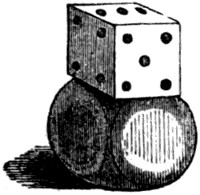
This is a very good game, and requires both skill and caution. It is played by elevating a die upon a marble, whose sides are slightly ground down, so that it will stand firmly, and firing at it from an offing, which is generally at a distance of about four feet from it. The die-keeper undertakes to pay to the shooter who knocks down the die the number which falls uppermost, receiving one marble from each player as he shoots.
EGGS IN THE BUSH.
This game is a great improvement upon odd or even. Dick asks Tom to guess the number of “eggs in the bush”—that is, the number of marbles in his closed hand. If Tom can guess the right number, he takes all; but if he is out in his reckoning, he pays Dick as many marbles as will make up or leave the exact number. Suppose Dick has six marbles in his hand; now, if Tom should guess either four or eight, he would have to forfeit two marbles to Dick, because four is two less, and eight is two more, than the exact number. The players hold the “eggs in the bush” alternately.
INCREASE POUND.
In most respects resembles Ring taw, the variations being, that if before a marble is shot out of the ring one player’s taw is struck by another’s (excepting his partner’s), or if his taw remains within the ring, he puts a shot in the pound, continues in the game, and shoots again from the offing before any of his companions. If his taw is struck after one or more marbles have been driven out of the ring, if he has taken any shots himself, he gives them to the player who struck him, puts a taw in the ring, and shoots from the offing, as before. If, however, he has not won any marbles during the game, before his taw is struck, he is “killed” and put out of the game; he is likewise out if, after any shots have been struck out, his taw gets within the pound—if it remains on the line it is nothing. He then puts the marbles (if he has won any) into the circle, adding one to them for the taw struck, and shoots again from the offing. In case he cannot gain any shots after his taw gets “fat,” as remaining in the ring is termed, he is killed, and out for the rest of the game. When only one marble remains in the ring, the taw may continue inside it without being “fat.” Each player seldom puts more than one marble in the ring at the beginning or a game.
KNOCK OUT, OR LAG OUT.
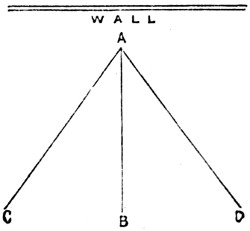
This game is played by knocking marbles against a wall, or perpendicular board set up for the purpose; and the skill displayed in it depends upon the player’s attention to what is called in mechanics the resolution of forces: for instance, if an object be struck against the wall at A from the mark at B, it will return again to B in a straight line; if it be sent from C to A, it will, instead of returning to C, pass off aslant to D, and its course will form the angle C A D; the angle of incidence being equal to the angle of reflection.
The game is played by any number of players: the first player throws his marble against the wall, so that it may rebound and fall about a yard distant from it; the other players then, in succession, throw their marbles against the wall, in such a way as to cause them to strike any of those already lagged out, and the marble struck is considered won by the owner of the taw that strikes it, in addition to which the winner has another throw. When only two boys play, each successively throws out till one of the “laggers” is struck, and he who strikes takes up all.
LONG TAW.
Long taw is played by two persons in the following manner. One boy places his marble on the ground at A, the other at B; then both retire to the spot C. The first boy now shoots at B from a line marked at C. If he strikes it, he takes it and shoots at A; if he strikes A, he then wins the game. If, however, he misses B, the second boy then shoots at B; if he strikes it, he can then either shoot at the first boy’s taw at the place at which it lies, or he can shoot at A. If he hits his opponent’s taw, he is said to kill him, and wins the game, or if he shoots at A, and hits it. The boy who hits the last shot has the privilege of shooting at the taw of the other, provided it has not already been killed. If he hits it, the taw is taken, or the owner must pay one, and the game ends; and if he misses it, the game is then at an end also. Long taw is a game seldom played by London boys, but is very common in the different English counties.
NINE-HOLES, OR BRIDGE BOARD.
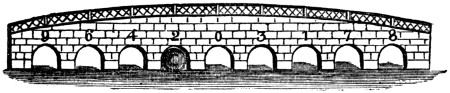
This game is played by means of a piece of board cut into the form of a bridge, having nine arches, and just large enough to let the marbles pass through, as in the subjoined diagram. One of the players undertakes to be “bridge-keeper,” and the stipulation usually made is, that he should receive one for every unsuccessful shot, and pay to those who shoot their marbles through the arches the numbers standing over them. The place from which the players shoot their marbles is generally about four feet from the bridge.
ODD OR EVEN.
One player extends his closed hand containing some marbles, and asks his opponent to guess whether their number is odd or even. Should he guess wrong, he forfeits a marble, and his questioner tries him with another lot; but should he guess right, the first player must pay him a marble, and take a turn at guessing.
PICKING THE PLUMS.
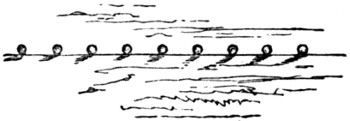
This game consists in each player placing a marble on a line drawn upon the ground thus, and the whole shooting at them in succession from a mark about four feet off. The order of the shots is determined beforehand, by pitching at a marble from a six-feet offing, those nearest being first, second, third, and fourth in order, as the marbles lie. The marbles knocked off the line are won by the respective shooters.
THE PYRAMID.
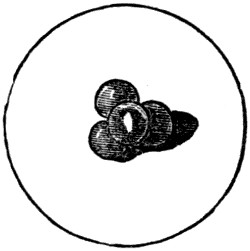
In this game a boy generally sits upon the ground, with his legs open wide, and, making a small circle, places in it three marbles at the three points of a triangle, and the fourth on the top of them, so as to form a small pyramid. A distance of about four feet is then chosen as the point to shoot from, and the other players shoot at the pyramid. Those that strike it have all the marbles they knock out of the ring; but if they miss, they lose their shots.
RING TAW.
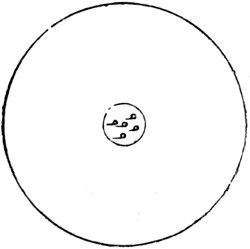
Ring taw is a game requiring skill and judgment, and is a most excellent game. It is played as follows. Two rings are drawn upon the ground, a small one, six inches in diameter, enclosed by a larger one, six feet in diameter. Into the small ring each player puts a marble, called “shot.” The players then proceed to any part of the large ring, and from thence, as an offing, shoot at the marbles in the centre. If a player knocks a marble out of the ring he wins it, and he is entitled to shoot again before his companions can have a shot. When all the players have shot their marbles, they shoot from the places at which their marbles rested at the last shot. If the shooter’s taw remain in the small circle, he is out, and has to drop a marble in the ring, and he must put in besides all the marbles he had previously won in that game. It is a rule, also, that when one player shoots at and strikes another’s taw, the taw so struck is considered dead, and its owner must give up to the striker of the taw all the marbles he may have previously won during the game. The game is concluded when all the marbles are shot out of the ring, or all the taws are killed.
SPANS AND SNOPS, AND BOUNCE ABOUT.
This consists of one boy laying down his taw, and, giving a distance, his antagonist shoots at it; if he misses, the first boy shoots at the taw of the second, till one is struck, which the striker claims. Bounce About is the same game played by throwing large marbles instead of shooting smaller ones, he who strikes the other’s bounce being the winner.
TEETOTUM SHOT.
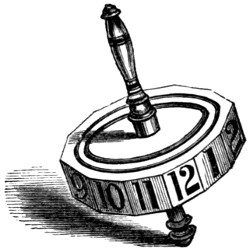
This is played on the same conditions as Die Shot. A teetotum is set spinning by the keeper, and, when in motion, any player is allowed to shoot at it, upon the payment of one marble, receiving, if he strikes, turns over, and stops the teetotum, as many marbles as are indicated on the side that falls uppermost. This is a very skilful game, and requires good shots.
THREE-HOLES.
This game is played by making three holes in the ground, about a yard and a half or two yards asunder. About two yards from the first hole a line is drawn. The right to shoot first is decided by chance. The first shooter now knuckles down at the line, and endeavours to shoot into the first hole. If he does this he proceeds to the second, then to the third, and wins the game; but this rarely occurs. If he misses the first hole, the other players shoot their taws, and if neither of them enter the hole, the first shot immediately does so; and then he has the privilege either of proceeding to the second hole, or of killing the other men by shooting at and hitting them, when they must either give up their taws or drop one. Sometimes a player will kill all his antagonists in succession without proceeding to any hole except the first, and thus wins the game; at other times the game may be won by any of the players killing their antagonists during any period of the game. It is a rule that no one can “kill a taw” till he has been in the first hole.
TIPSHARES, OR HANDERS.
This game is played by two or more players. To play it, a hole, of the diameter of three inches, is first made on a smooth or level piece of ground, and a line is marked at about seven feet from it. Each boy puts down two, three, or four marbles, as may be agreed upon, and then the whole party bowl for their throws, by retiring to three times the distance already marked from the hole, and bowling one marble to it; the order of throws being determined by the nearness that each boy’s marble approaches the hole. When this is settled, the first thrower takes all the marbles in his hand, and throws them in a cluster towards the hole. If an even number falls in, such as 2, 4, 6, 8, 10, he wins all; but if an odd number falls in, he loses all.
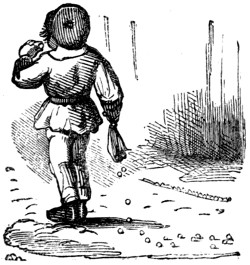
“MARBLES ARE OUT”
TOPS
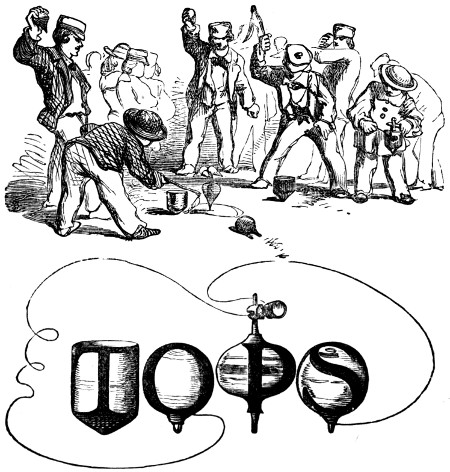
The peg-top appears to be a modern invention, but the whip-top is of great antiquity, it having been used in remote times by the Grecian boys; it was well known at Rome in the days of Virgil, and in England as early at least as the fourteenth century, when its form was the same as it is now. Strutt, in his “Sports and Pastimes of the People of England,” relates the following amusing anecdote of Prince Henry, the eldest son of James I., which he met with in an old manuscript at the British Museum: “The first time that the prince went to the town of Stirling to meet the king, seeing a little without the gate of the town a stack of corn in proportion not unlike to a top wherewith he used to play, he said to some that were with him, ‘Lo, there is a goodly top!’ Whereupon one of them saying, ‘Why do you not play with it then?’ he answered, ‘Set you it up for me and I will play with it.’”
THE HUMMING-TOP.
These cannot easily be made, but can very easily be purchased by those who are so lucky as to have the money. They are made hollow, having at their crown a peg, round which is wound a string; this, being pulled through a kind of fork, gives motion to the top, and sets it spinning—the fork and the string being left in the spinner’s hand. In spinning the top, care should be taken to wind the string firmly and evenly on the peg; and when it is pulled out, neither too much nor too little force should be used, and a firm and steady hand should be employed, while the top should be held in a perpendicular position. The string should be drawn with a steadily increasing force, or the top will not hum properly.
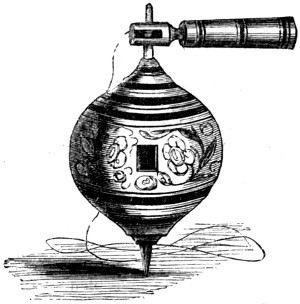
PEG-TOP.
There are various kinds of Peg-tops, and they also vary in shape, some being much rounder than others. Those are the best which are shaped like a pear. There is also great variety as regards the shape and size of the peg, which in some tops is short and thick, in others long and tapering. Again, tops are made of different kinds of wood, some being made of deal, others of elm, some of yew-tree, and others of boxwood. These last are the Boxers so highly prized. Some of the very best tops are made of lignum vitæ, with long, handsome pegs.
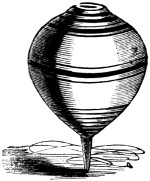
SPANISH PEG-TOP.
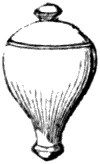
The Spanish peg-top is made of mahogany. It is shaped somewhat like a pear; instead of a sharp iron peg, it has a small rounded knob at the end. As it spins for a much longer time than the English peg-top, and does not require to be thrown with any degree of force in order to set it up, it is extremely well adapted for playing on flooring or pavement.
THE WHIP-TOP.
Whip-top is a capital sport when played by two persons; and is played by first whirling the top into motion by turning it sharply with both hands, and then by flogging it till its motion becomes very rapid. When two persons play whip-top, the object should be for each to whip his top to a certain goal, he who reaches it first being the victor.
CHIP-STONE.
This game is played by two boys, in the following manner: Two lines, about six feet apart, are marked upon the ground, which ought to be smooth and hard. Some small stones are then procured and placed midway between the lines; they should not be larger than a small bean, and the black and polished ones are the most sought after. The tops are now set up spinning on the ground, and the players, being each provided with a small wooden spoon, dexterously introduce them under the pegs of the spinning tops, and then, with the top still spinning in the spoon, throw the point of the peg against the stone, so as to chip it out of bounds; he who does this the soonest being the victor. While the top continues to spin, he may take it up with the spoon as many times as he can, and when it spins out he must again wind up, pursuing the same plan till he “chips out.”
Directions.—In winding up the top do not wet the end of the line too much, and take care to lay it closely and evenly within the grooves. In throwing the top from you, the line must be pulled in with a peculiar jerk of the hand, which practice alone can give. The string button should be held close in the hand, between the last two fingers of the hand. There is what is called an “underhand” way of spinning a top, i. e. by holding it peg downwards, throwing it in a straight line forward, and withdrawing the string; but as we dislike everything underhand, we shall not recommend this practice any more than we shall the Spanish tops, which are spun after this method.
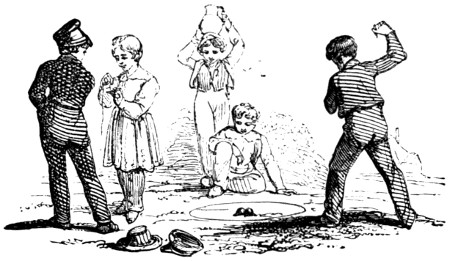
PEG-IN-THE-RING.
This game may be played by any number of boys. A ring about a yard in diameter is first marked on the ground, and another ring surrounding the first, and at a yard’s distance from it, is also marked. The players must stand on this ring, and from it throw their tops. One player begins by throwing his top spinning into the ring, and while it is there spinning the other players are at liberty to peg at it as quickly as they can. If none of them hit it while it is spinning, and if it rolls out of the ring, the owner is allowed to take it up, and having wound it, to peg at the others which may be still spinning in the circle. Should any of the tops, when they cease spinning, fall within the ring, they are considered dead, and are placed in the centre of the circle for the others to peg at. The player who succeeds in striking any of the tops out of the circle claims those so struck out. In some places each player may ransom his top with a marble.
Sleeping tops are exposed to much danger in the play, for they offer a fair mark to the “pegger,” and often get split, when the “peg” is taken by the splitter as his trophy. Long-pegged tops are the best for the game, for they lie more upon their sides after their fall, and, before the spinning entirely ceases, are the more likely to spin out of the ring.
There is a way of making the top spring out of the ring directly it has touched the ground. Only long-pegged tops will execute this feat. It is done by drawing the hand sharply towards the body just as the top leaves the string. When the manœuvre is well executed, the top will drive any opponent that it strikes entirely out of the ring, while it does not remain within the dangerous circle itself for more than a few seconds.
“TOPS ARE IN.”
MISCELLANEOUS TOYS
There are some out-door games played with toys which do not fall under any of our previous headings. These games we now lay before our reader, together with a description of the toys in common use.
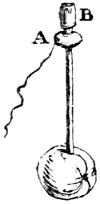
THE APPLE MILL.
The Apple Mill is made by boring a hole in a nut, just large enough to pass a thin skewer through; the kernel should then be extracted, and another hole bored in the side of the nut, as A in the annexed figure. A skewer should next be cut or thinned, leaving it large enough at the top to form a head, as shown in the cut. A piece of string is then to be tied to the skewer, and passed through the hole in the side of the nut at A, and an apple stuck on the end of the skewer. The mill being now complete in all its works, it should be twirled round in the same manner as the humming top to wind up the string, holding the nut stationary between the forefinger and thumb of the left hand; when this is done, the string must be pulled out quickly, and the mill will immediately spin round. When an apple cannot be procured, a small potato will serve equally well.
AUNT SALLY.
This amusing game is of a very simple character, consisting essentially in throwing at a small object. Aunt Sally herself is composed of a head and bust cut out of a solid block of wood, and generally carved with negro features, and painted black. In the middle of her nose, or between her lips, a hole is bored, into which is stuck a short pipe. To break it is the object of the game. An iron rod serves to support the wooden figure at a proper elevation from the ground; and when in gala costume, Aunt Sally is usually arrayed in a mob cap and a petticoat. The mode of playing the game is as follows:—
The iron rod is stuck in the ground, a pipe put into the old lady’s mouth, and a line drawn upon the ground, at twelve, sixteen, or more paces. At this line the players stand, and each is furnished with three short cudgels, about eighteen inches in length, which they hurl at Aunt Sally’s head, in hopes of hitting the pipe. The best plan is to throw the cudgels underhand, giving them a rapid rotatory movement at the same time. Some persons insert an additional pipe into each ear; but this is an innovation, and leads to careless throwing. It is better to hang a sheet, net, or large cloth behind Aunt Sally, in order to catch the sticks, and save the trouble of continually fetching them from a distance. Within doors, the iron rod is furnished with a loaded pedestal.
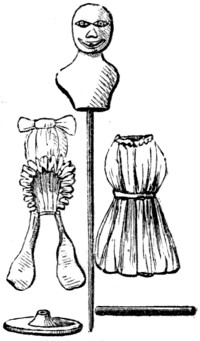
BATON,
Or, “Throwing Sticks.” This very popular game among the Greeks was by them called Kyndalismos. It was played with short batons, and required considerable strength and quickness of eye. With us the game is played in much the same manner as the Greeks played it. A stick is fixed in a kind of cup or hole, about six inches deep, in a loose moist soil, and the players consist of the Keeper and Throwers. The Keeper places on the top of the stick some article, such as an apple or orange, and the Throwers endeavour to knock it off, by throwing at it with short thick sticks, or batons; whoever succeeds in doing this claims the prize, whenever it falls without the hole. The Thrower will soon find in his play, that to hit the stick is of little importance, as from the perpendicular line of gravity which the apple or orange will take in its descent, it is almost certain to fall into the hole. The aim, therefore, should be to strike the object from the stick. This game is very common at fairs and similar places, and three sticks, with articles upon them, are usually set up, but which offer no advantage to the throwers.
CAT.
Tip Cat, although not altogether a nice pastime, ought to be noticed here. It is a dangerous game, and should be played with great caution on the part of the players. It is a rustic game, well known, and generally goes by the name of Cat. It is played with a cudgel or bludgeon, resembling that used for trap-ball. Its name is derived from a piece of wood called a “Cat,” of about six inches in length, and an inch and half, or two, in diameter, diminished from the middle to both the ends, being of the shape of a spindle or double cone; by this contrivance the places of the trap and ball are at once supplied, for when the Cat is laid upon the ground, the player with his stick tips it at one end by a smart stroke, which causes it to rise in the air with a rotatory motion, high enough for him to strike it as it falls, in the same manner as he would a ball.
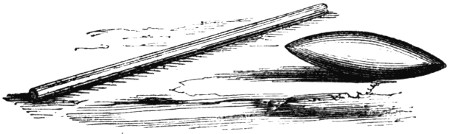
There are various methods of playing the game of Cat. The first is exceedingly simple, and consists in making a large ring upon the ground, in the middle of which the striker takes his station. His business is to beat the Cat over the ring; if he fails in so doing he is out, and another player takes his place; if he is successful, he judges with his eye the distance the Cat is driven from the centre of the ring, and calls for a number at pleasure to be scored for the game: if the number demanded be found, upon measurement, to exceed the same number of lengths of the bludgeon, he is out; on the contrary, if it does not, he obtains his call.
The second method of playing Cat is to make four, six, or eight holes in the ground, in a circular direction, and as nearly as possible at equal distances from each other, and at every hole is placed a player with his bludgeon. One of the opposite party who stands in the field tosses the Cat to the batsman who is nearest him, and every time the Cat is struck the players are obliged to change their situations, and run once from one hole to another in succession. If the Cat be driven to any very great distance, they continue to run in the same order, and claim a score of one towards the game every time they quit one hole and run to another. But if the Cat be stopped by their opponents, and thrown across between any two of the holes, before the player, who has quitted one of them, can reach the other, he is out.
CAT AND MOUSE.
This sport, which is of French origin, is for two players only. Both being blindfolded, they are tied to the ends of a long string, which is fastened by a loose knot in the middle to a post, and, as the knot is very slightly tied, the players are enabled to move about with facility. The player who takes the part of the “mouse” scrapes two pieces of wood together, so as to make a grating noise, and for which purpose the edges of one of the pieces of wood are notched: the sound attracts the other player, who represents the “cat,” and he immediately uses his utmost efforts to catch his prey, by following the noise as well as he can, the “mouse” at the same time struggling about, in order to escape being caught.
KNOCK-’EM-DOWN,
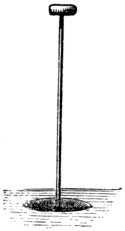
A similar game to Aunt Sally, but a simpler one, is made by scooping a hole in the ground, and placing in it an upright stick; on the top of it is placed a stone, or similar substance. The player then retires to a distance, and flings at the stone with cudgels or balls, the latter being preferable. If the stone falls into the hole, the player only counts one towards the game; but if it falls outside the hole, he counts two. This is a capital game for the seaside, and can be played upon the sands. This game is almost similar to Baton.
PEA-SHOOTERS.
The pea-shooter is a tube of metal, through which a pea may be propelled with great force by a puff of air from the mouth. The ordinary tin pea-shooters sold in the shops are comparatively worthless. We should advise the reader to procure a straight piece of brass tube from two to four feet long, and get a brazier to tin one end of it, so that the brass may not corrode when placed in the mouth. With such a tube peas, pellets of clay, and other projectiles may be shot with great precision to a considerable distance. The game of puff and dart is played with a long brass tube, and a small dart having a needle point. The dart is blown through the tube at a target, on which there are divisions bearing different numbers.
QUOITS.
The game of Quoits is very excellent. It seems to have derived its name from the ancient discus, and with us in the present day is a circular plate of iron perforated in the middle, not always of one size, but larger or smaller to suit the strength or convenience of the several candidates.
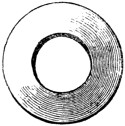
To play at Quoits an iron pin called a hob is driven into the ground within a few inches of the top, and at the distance of eighteen or twenty yards, as may be agreed upon, a second pin of iron is also fixed. The players are generally divided into parties, and the players pitch the quoits from hob to hob; those who pitch the nearest reckoning towards the game. But the determination is discriminately made; for instance, if a quoit belonging to A lies nearest to the hob, and a quoit belonging to B the second, A can claim but one towards the game, though all his other quoits be nearer to the hob than all the other quoits of B, because one quoit of B being the second nearest to the hob, cuts out, as it is called, all behind it. If no such quoit had interfered, then A would have reckoned all his as one each. Having all cast their quoits, the players walk to the opposite side, and determine the state of the play. Then taking their stand there, throw their quoits back again, and continue to do so alternately, till the end of the game. A quoit that falls with its flat side upward does not count.

NINE-PINS.
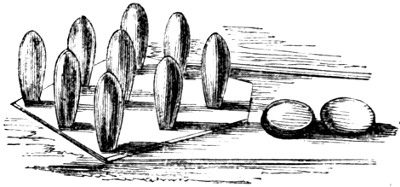
This game, as its name denotes, is played by means of nine pins, which are set up in a regular order, the aim of the players being to throw down as many as possible in the fewest attempts. Each player is permitted to throw three times at the pins, and if he can knock them all down in two throws, it is called a “single,” and they are again set up for his last throw; or, if he can knock them down in one throw, it is called a “double,” and they are set up. A heavy wooden ball, called a “bowl,” is used to throw at the pins.
SKITTLES.
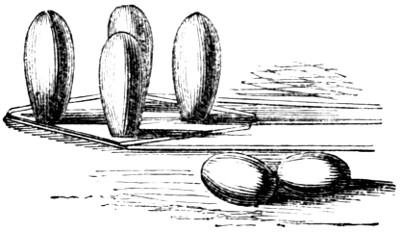
Skittles is played in a manner somewhat similar to the preceding game, but the number of pins is only four. These are very large, and are arranged on a square framework, so as to present one of the angles to the player. The bowl used for playing this game is of the shape of a cheese, and is usually made of lignum vitæ, as being very heavy and hard wood. The game requires more bodily strength than nine-pins, as the bowl must be thrown upon the skittles, and not rolled up to them.
The best play is to throw the bowl with a round-handed swing of the arm, so as to strike the nearest skittle at the right of its upper third. The ball then springs to the second skittle, and from this generally twists to the third, while the fourth skittle is sent down by the roll of the one first struck. It is very difficult to make this throw successfully, and many players prefer driving down the first and third skittles with a straightforward shoot, and then making their second ball spring across from the second to the fourth. This latter stroke appears very difficult, but is soon learnt; the great point being to throw the bowl high, so that it may drop as perpendicularly as possible on the left of the upper third of the second skittle. In the long run, the constant repetition of this practice will overbalance occasional brilliancy of play.
DUTCH-PINS.
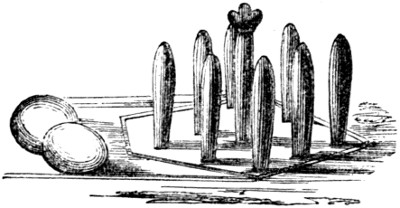
This game is nothing more than a modification of nine-pins; the pins being higher, and the centre one bearing the name of king, and a crown upon its head. The great point in this game is to strike the king out of the board without knocking down any of the subjects. If this can be done, the game is won. In all other cases, the king counts for no more than any of his subjects.
THROWING THE HAMMER.
This is a good athletic sport, but the Hammer can scarcely be called a toy. The hammer used by rustics is generally the sledge-hammer of the blacksmith, with a head weighing some twelve or fourteen pounds. The players are all single and do not join in parties, and the prize is given to him who makes the greatest number of long throws in a dozen. It does not merely require strength to throw the sledge-hammer, but a nice calculation of the area which the Hammer has to pass over in its flight, combined with the strength of the thrower.
THE BOOMERANG.[1]
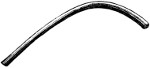
This instrument is a curved piece of wood, flat on one side, and slightly rounded on the other. It is used by the natives of New South Wales, who can throw it so dexterously as to kill a man behind a tree, where he may have fled for safety. It should be held horizontally in throwing it, and cast by bringing the arm backwards, and after making a variety of curves it will come back again to the person who send it. If skilfully thrown, it may be made to go in almost any direction the thrower pleases.
THE SKIP-JACK, OR JUMP-JACK.
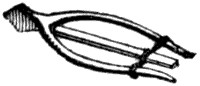
The skip-jack is manufactured out of the merry-thought of a goose, which must, of course, be well cleaned before it is used. A strong doubled string must be tied at the two ends of the bone, and a piece of wood about three inches long put between the strings, as shown in the marginal illustration, and twisted round until the string acquires the force of a spring. A bit of shoemaker’s wax should then be put in the hollow of the bone at the spot where the end of the piece of wood touches, and when the wood is pressed slightly on the wax the jack is set; it adheres but a very short time, and then springs forcibly up. The skip-jack is placed on the ground with the wax downwards, and in some parts of the country it is usual to call out, “Up, Jack!” or “Jump, Jack!” just before it springs.
THE SLING.
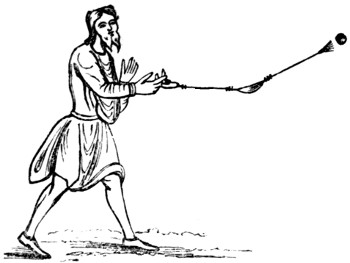
The art of slinging, or of casting stones with a sling, is of very high antiquity. We see it represented on the Nimroud monuments, and the feat of the divine youth, David, is familiar to every one. In the earliest times there were bands of slingers, and probably whole regiments of them, and there is little doubt that the art of slinging preceded that of archery. The former seemed, however, to belong to the Asiatic, as the latter did to the European nations. Our Saxon ancestors, also, seem to have been skilful in their manner of holding the sling. Its form is preserved in several of their paintings, and the manner in which it was used by them, as far back as the eighth century, may be seen in the annexed cut. We have also sufficient testimony to prove, that men armed with slings formed part of the Anglo-Norman soldiery.
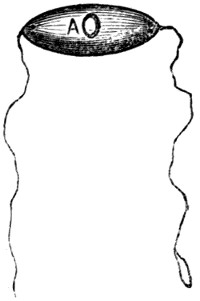
In country districts, slinging of stones is a common sport; and the sling so used consists simply of a piece of leather cut into the subjoined form, to which are affixed two cords, one having a loop. In using it, leather is suffered to hang from the strong downwards; the slinger places his little finger in the loop, and holds the other end in his hand, and then putting the stone in the hole of the sling at A, which prevents its falling, whirls the whole round for three or four times, to obtain a strong centrifugal force, and suddenly letting go of that part of the sling held in his hand, the stone flies forward with inconceivable rapidity, making a twanging sound in the ear as it flies. Slinging is a very good exercise for imparting strength to the arm, but young slingers should be very careful where they send their stones, or they may do much damage.
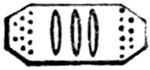
If any of my readers may wish to construct a better kind of sling, they may do it in the following manner:—Get a currier to cut a piece of very strong buckskin leather in this shape, the centre being cut into bars. Two long strips of the same leather are then cut of this shape,

two cuts being made along them, so as to leave three leather cords. These are plaited together, and the flat ends firmly sewn to the centrepiece. The shape will then be this:

A sling made on this principle will carry a stone of a pound weight. The loop and point should be whipped with silk. The accuracy that can be obtained with such a weapon is astonishing, only the missiles should always be leaden bullets of the same weight—two or three ounces being the best average weight. At the school where my boyhood was spent, we used to send such bullets just over the weather-cock of one of the loftiest spires in England, and stripped a chestnut-tree of its blossoms. One year there was a solitary blossom on the top of the tree, which defied our efforts for many days. The blossoms were soon knocked off, but the green stalk resisted the blows for a long time. It was battered to pieces, but bent to the strokes, and had to be knocked off in fragments. I mention this to show the accuracy of aim that can be attained by practice.
WALKING ON STILTS.
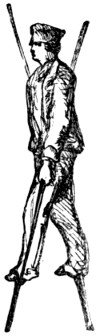
Among the Swiss, and in several districts in the South of France, walking on stilts is not only an amusing, but a useful, practice, as by means of these crane-like legs men and women transform themselves into the order of “Waders,” emulating the long-legged storks and herons, and can cross over marshes and flooded grounds without wetting their feet. Stilts are easily made, being nothing but a pair of poles, with a wooden step at the sides for the feet to stand on. The poles are kept in their proper place by the hands. A little practice will soon render a youth “easy on his stilts,” and they may be made an amusing and healthy exercise.
THE SUCKER.
The sucker is a toy of the simplest construction imaginable; it is made by merely cutting a circular piece out of some tolerably stout leather, boring a hole in its centre, and then passing a string through the hole, taking the precaution to make a large knot at the end of the string, to prevent its being drawn completely through the hole. Before using the sucker, it must be steeped in water until it becomes quite soft and pliable. If its smooth, moist surface be now pressed so closely against the flat side of a stone or other body, that the air cannot enter between them, the weight of the atmosphere pressing on the upper surface of the leather will cause it to adhere so strongly, that the stone, if its weight be proportioned to the extent of the disc of leather, may be raised by lifting the string. If the sucker could act with full effect, every square inch of its surface would support about the weight of fourteen pounds. The feet of the common house-fly are provided with minute natural suckers, by aid of which the insect is enabled to run up a smooth pane of glass and walk along the ceiling.
Our young readers will in all probability remark that we have laid but little stress on games with toys, and that comparatively few toys have been mentioned. We have done so intentionally, because the book is written expressly for boys, and those, English boys. Now an English boy always likes a toy that will do something. For example, he cares not one farthing for all the elegant imitations of guns in the world, as long as he can have his pea-shooter; and the walnut stock, the glittering decorations, and the burnished but useless barrel of the toy gun, are nothing in his eyes, when compared with the plain tin barrel of his beloved pea-shooter, which will throw a missile with rifle-like accuracy of aim.
For these reasons, we have mentioned but very few toys, looking with contempt upon those innumerable fabrications that find their place in the windows of toy-shops, and in ninety-nine cases out of a hundred are only purchased for the immediate gratification of spoilt children, who unconsciously illustrate the real objects of toys, by pulling them to pieces, and converting the fragments to unexpected uses.
END OF TOYS.
EASY GAMES WITH TOYS.
INDOOR.
There are many elaborate toys which are not included under this head, as they are always sold with printed directions for using them. The games which follow are played with toys of the simplest construction, many of which may be easily manufactured by the reader.
BATTLEDORE AND SHUTTLECOCK.
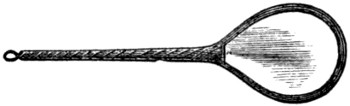
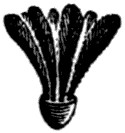
This game is so well known as to require but little remark. The Battledores may be purchased at the toy-shops, as may also be the Cocks; but many of our young friends who know anything about carpentry may easily make both for themselves. The Battledores can be cut out with a key-hole saw into the subjoined shape. They should be about a quarter of an inch thick, the handles about six inches long, and the “spades” of about five inches long, and five broad. The Shuttlecock may be made by cutting a piece of cork into the following form, and placing a small brass nail at its lower end. The top should be plumed with five feathers standing outwards from the rim, being fastened by a little gum into small holes cut therein. The practice of the game is for two players to beat the Cock backwards and forwards from one to the other, and the one that lets it fall, by failing to strike it with his bat, is to give to the other a pea, bead, pin, or some other small article. Some foreigners, particularly the Chinese, play at this game with the toes, hands, elbows, and other parts of the body, and will keep the Cocks up in a most amusing manner, in the midst of many grotesque gestures.
BANDILOR.
This toy is simply a wheel or pulley of hard wood, having a very deep groove, round which a strong but fine cord is wound. The player holds the free end of the cord between his finger and thumb, gives a rapid rotatory motion to the bandilor, by allowing it to fall towards the ground; by a sudden jerk he now tightens the cord in the groove, and the toy rises towards his hand. A little practice will enable any one to keep the bandilor in motion for a considerable time by causing it to rise and fall alternately.
CUP AND BALL.
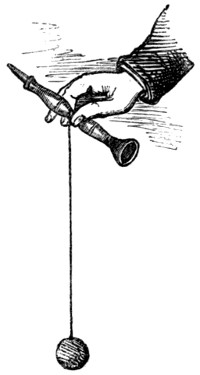
A ball of ivory or hard wood is attached to a stem of the same substance, having a shallow cup at one end and a point at the other. The player holds the stem in his right hand, as shown in the figure; and, having caused the ball to revolve by twirling it between the finger and thumb of his left, he jerks it up and catches it either in the cup, or upon the spike, to receive which a hole is made in the ball. We need scarcely say that the latter feat can only be performed by a skilful player. Cup and Ball was the favourite pastime at the court of Henry III. of France.
THE CUTWATER.
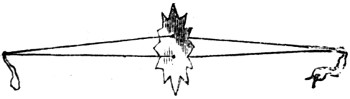
The Cutwater is a circular piece of sheet lead, notched like a saw round the edge, and having two holes pierced in it at some distance from each other, through which is passed a piece of string, the two ends being afterwards tied together. The annexed figure shows this toy, and the way it is to be held by the player. To set the Cutwater in action, the double string must be alternately pulled and slackened. Every time the string is relaxed the disc revolves, in consequence of the impetus it has acquired from the previous pull; and every time the string is tightened, it whirls round in an opposite direction, as the double string is then untwisted. If the edge of this toy be dipped in water, it may be made to sprinkle the bystanders and the player; hence its title of “Cutwater.”
FOX AND GEESE.
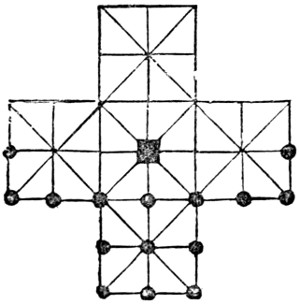
Fifteen ordinary draughtsmen compose the flock of geese. The fox may either be two draughtsmen placed one upon another, or any small object which may be at hand. The game is played on a board marked as shown in the annexed engraving. The fox is placed in the middle of the board, and the geese on the points on one side of it, as shown in the illustration. The game is to confine the fox to some spot on the board, so that there shall be either the edge of the board or else two rows of men round him. When the fox cannot escape, the game is done, and the player of the geese wins; but when one of the geese is left on a point next to that occupied by the fox, and is not supported by another goose behind, or by the edge of the board, the fox can take it, and by jumping over its head to the next space, he may, perhaps, escape the persecutions of some of the others, as all the geese are compelled to move forwards towards the end of the board that was unoccupied at the commencement of the game. The fox is allowed to move either backwards or forwards. Neither fox nor goose must be moved more than one space at a time. If the fox neglects to take when he has a chance, he is huffed, and one of the captured geese is restored to the back of the board. The fox should avoid getting into the lower square of the board if possible, as he will find it difficult to extricate himself from a position which can be so easily blockaded.
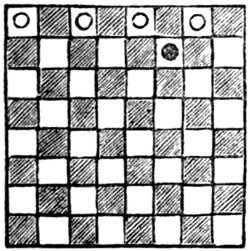
There is another method of playing fox and geese on a chessboard; namely, with four white men, representing the geese, and one black one, representing the fox.
The geese are ranged on the four white squares nearest one player, and the fox may be placed where his owner pleases. The best place for him is that marked in the diagram, as he can manœuvre in a very puzzling way.
The geese can only move forward, and the fox moves either way. The object of the geese is to pen up the fox so that he cannot move, and the fox has to break through.
If the game is properly played, the geese must win, the secret being to keep them all in line as much as possible. The fox tries to prevent this plan from being followed up; and if he can succeed in doubling the geese, or getting one to stand before another, he is nearly sure to pass through them.
GOOSE.
To play at Goose a board must be made containing sixty-three circles, placed so as to form some resemblance to the shape of a goose, and numbered consecutively. Two dice and a box, and as many counters as there are players, are required. Each player in turn throws the dice, and according to the number he throws, so he reckons, counting from No. 1, and placing his counter on the number he obtains. The player who first reaches sixty-three wins the game. But mark; he must throw sixty-three exactly, or else he has to count the surplus number back from sixty-three. For instance, suppose when at sixty he throws eight, this makes sixty-eight, five over sixty-three. The player must, therefore, take five back from sixty-three, and leave his counter at fifty-eight. The game is called Goose from the fact that a goose is usually drawn on every fourth and fifth ring; and the player who lands on one of these, scores double the number he has just thrown. Several obstacles occur, however, on the journey. On one ring is drawn a bridge, to pass which a toll of one counter must be paid. A little farther on is an inn, where the player halts for two turns and pays two to the pool; but if he fall into the pond, the unfortunate wight has to stay there until another player tumbles in too, when he is allowed to proceed on his journey. The last hindrance is a gloomy prison, in which the same rule holds good, except that the relieving party, instead of going on as in the case of the pond, remains in durance vile until somebody else enters the prison-house. Other obstacles may be inserted at the players’ option.
HEAD, BODY, AND LEGS.
One player takes an oblong piece of paper, and having divided it into three equal parts by folding, he sketches a comic head, either with pen or pencil, in the upper space; he then doubles the paper over, and hands it to another, who draws a body in the middle compartment, folds the paper over once more, and passes it to a third, who completes the figure by drawing a pair of legs in the lower space. The player who draws the head, must continue the neck a little way into the middle space, and he who sketches the body must just commence the legs in the lower compartment; this arrangement insures the connexion of head, body, and legs. Our first illustration shows how the paper is to be folded over for drawing the different parts of a figure. Each player should be provided with a pen or pencil, and a few pieces of paper; having drawn a head, he should fold his sketch in a proper manner and pass it to his right-hand neighbour; in this way a number of figures may be finished simultaneously. A knowledge of drawing is not expected of any player, as the crudest notion of a head, a body, or a pair of legs, will fully meet the requirements of the game. Those who have never played at Head, Body, and Legs, can have no idea of the absurd combinations that spring from the independent labours of the different players; thus, a man’s body will sometimes get joined to a donkey’s head, and be supported by the legs of an ostrich.