PART IV. Domestic Pets.
Reading edition
BEES.
CANARIES.
DOGS.
GOLD FISH.
GUINEA PIGS.
HEDGEHOGS.
JACKDAWS.
JAYS.
MAGPIES.
OWLS.
PARROTS.
PIGEONS.
POULTRY.
RABBITS.
RAVENS.
SILKWORMS.
SQUIRRELS.
WHITE MICE.
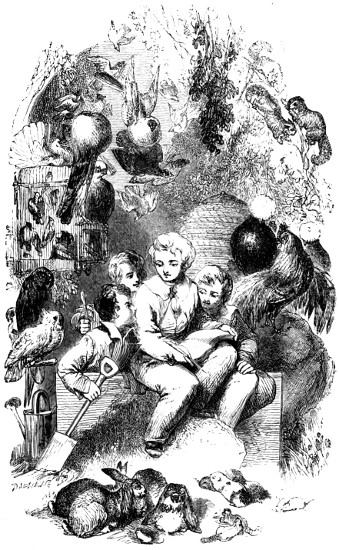
OUR DOMESTIC PETS.
BEES AND BEE-KEEPING.
In treating of that useful insect the honey-bee, we will first explain briefly the domestic economy of the hive, and the distinction between the different individuals composing the entire colony, and then pass on to the more practical details of bee-keeping.
A beehive contains three kinds of individuals—a queen, drones, and workers. The queen is a female, and is the mother of the community. The drones are males, and the working bees neuters, being neither males nor females. During the warmer part of the year the queen seems to be incessantly employed in laying eggs. She is slow and majestic in her motions, and differs from the workers in having a larger and longer body, shorter wings, and a curved sting.
The drones are males; though much more bulky, they are not so long as the queen, but much larger than the working bees. They live on honey, but bring none home. When the season for swarming has passed, the workers expel them from the hive, and none make their appearance till the following spring.
The working bees are the smallest in the hive and by far the most numerous; and they do the entire work of the community—they build the cells, guard the hive and the queen, collect and store the honey, elaborate the wax, feed the young, and expel the drones. The average number of these three kinds of bees in a hive is one queen, two thousand drones, and ten to twenty thousand workers, the numbers varying with the strength of the hive and the season.
For the greater part of the year the queen lays only workers’ eggs; but during the spring she also lays those which produce drones. As soon as this takes place, the workers begin to construct royal cells, in which, without discontinuing to lay the drone eggs, the queen deposits eggs which are destined to produce queens.
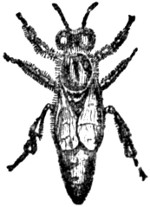
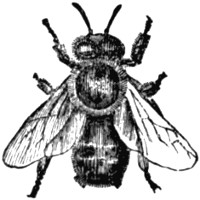
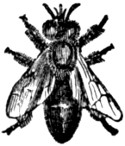
QUEEN BEE. THE DRONE. WORKING BEE.
QUEEN BEE.
THE DRONE.
WORKING BEE.
The workers’ eggs hatch in a few days, and produce little white maggots, which immediately open their mouths to be fed; these the workers attend to with the greatest care. In six days each maggot fills up its cell; it is then roofed in by the workers, spins a silken cocoon and becomes a chrysalis, and on the twenty-first day it comes forth a perfect bee. The drones emerge on the twenty-fifth day, and the queens on the sixteenth.
The combs of a beehive comprise a number of hexagonal cells, built by the bees as receptacles for honey and for the nurseries of their young. Each comb in a hive is composed of two ranges of cells, backed against each other. There is a continued series of these double cells in every well-filled hive, the spaces between them being just sufficient to allow two bees, one on the surface of each comb, to pass without touching. Each cell is six-sided, the six sides being perfectly equal. This is one of the geometrical figures that ensures the greatest economy of material and the largest space. The construction of several combs is usually going on at the same time, until the hive is filled. The cells of the drones are larger than those designed for the workers; and those designed for the hatching of the young queens pear-shaped, with the small end downwards. The finest honey is stored in new cells constructed for the purpose of receiving it.
The usual modes of establishing an apiary are, either by the purchase of stock or of swarms. When intending to purchase a stock, do not buy upon recommendation, but learn to judge for yourself. If you observe the bees crowding in and out of the hive during the middle of the day, a considerable number of them having little yellow pellets or balls on their hinder legs, a very favourable opinion may be formed of the health and condition of the interior, and especially of the prolific state of the queen. If the bees appear savage, and bold in their attacks, it is a good sign.
In the purchase of swarms the young bee-keeper must beware of imposition; for it very often happens that, instead of having the first swarm, he is cheated by having a second thrust upon him. This is seldom so large; but it has the advantage of a young queen, as the old queen always goes off with the first swarm. A good swarm generally numbers about twenty thousand bees, and may in country places be obtained for from half-a-guinea to a guinea.
There are several distinct systems of bee-keeping, each of which requires a short notice. First, the old-fashioned plan of keeping the bees in a common bell-shaped straw hive, or skep. When this method is followed, the hives are usually allowed to stand for two summers; at the end of the second season the bees are destroyed by the fumes of burning sulphur, and the honey taken. The plan is a very bad one, as the honey obtained is mixed with bee bread, is rank in flavour, and dark in colour, and is never worth more than about sixpence per pound.
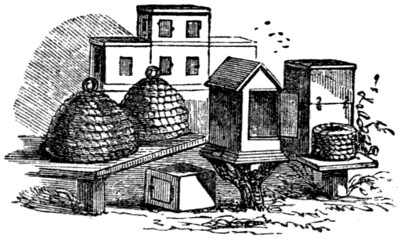
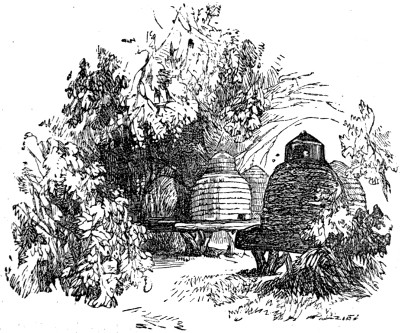
A great improvement is to have the hives made with flat tops, like the straw hive shown at the right hand of the engraving. When the bees are first hived, this is closed by a straw mat. In the spring of next year, when the bees become numerous and cluster round the entrance, this mat is removed, and a small hive, termed a “super,” or a box or glass, neatly furnished with a piece or two of clear empty comb, is put over; the bees ascend into this, build combs, which they store with pure virgin honey, without brood or bee bread; and this, when full, is removed, leaving the stock below undisturbed for the next season. In our engraving the artist has drawn this hive too small; it should have been as large as the common skeps which are shown on the left-hand side.
Flat-topped hives, that are able to be supered, may be made of wood, like a common box. One of these is shown on the ground, and two, placed one over the other, are shown behind the flat-topped straw hive. In Ayrshire, where they are very skilled in bee-management, they use eight-sided boxes, with narrow slides to close the openings in the top. These boxes are placed one over the other, and large tops of pure virgin honey, twenty to thirty pounds in weight, are not unfrequently taken off. The back hive in our group is one with side boxes, or, as it is sometimes called, a collateral hive. These are the most expensive in first cost, and the least productive of all the varieties. The cottage hives, with three little glasses, instead of one large one, are only playthings, and not at all productive.
Frame hives, in which each comb is placed in a separate frame, so that it can be taken out and examined, are very useful for making observations on the natural history of the bees, but are not so well suited for profitable purposes as the hives that we have described that are arranged in storey or with large supers.
In removing a super of honey, it should be first loosened from the hive by drawing a thin string between the two; and then, when the bees have become quiet, taken quietly away, and covered over, until those remaining in it have discovered that they are away from the queen, when they will rapidly fly back to the hive, on being uncovered. But the honey must not be left exposed, or it would attract all the bees in the neighbourhood, and would rapidly be stored up in the hives.
In taking off the supers, it is best to be protected from the stings of the bees. This is readily done by making a bag of leno, open at top and bottom; in use, the top is tied round the hat, the bag encircles the head and face, and the bottom is tucked under the collar of the coat, which is buttoned closely round the neck. In this manner the face is perfectly protected from stings; but with the knowledge, quietness, and confidence acquired by practice, almost anything can be done to bees by a skilled bee-master, even without a veil.
THE CANARY.
The canary is a justly favoured pet among boys, for it is a hardy bird that requires a very small amount of trouble. It is a pleasant, fascinating little being, full of quaint ways and sprightly attitudes, and, better than all, the cage is its native element.
Though an ardent admirer of all birds, and indeed of everything which draws the breath of life, we can never pass the cage wherein is confined a lark, a nightingale, a bullfinch, or any other of our indigenous birds, without a feeling of sadness and regret.
They are not cage birds, and never ought to be confined within the narrow limits of wood and wire. Their attitudes show their uneasiness. The mellow, exultant tone of the skylark sounds as joyously when the bird is imprisoned within a cage as when it soars high in air, its wings quivering in the breeze, its frame rejoicing in the glory of the sunbeams, and its ken surveying the wide panorama which lies spread beneath its gaze. But the gestures of the bird are full of eloquent misery, and speak volumes to him who will stop and look with his eyes as well as listen with his ears.
See how the bird flings itself upwards from the little patch of turf, which is but a shallow mockery of the green sward to which the skylark is accustomed—how it dashes itself against the roof of green baize, which represents so feebly the expanse of azure sky—and how it learns at last the lessons of experience, and stands helplessly in the bay window of the cage, its wings shivering restlessly, and its feet trampling impatiently, in lieu of the the upward leap and soaring flight which it longs to undertake, but which it will never more be permitted to experience. No more will it roam through the wide expanse of air, no more will it seek for its mate, and know all the joys of nest and children. Henceforth it is but a prisoner in solitary confinement, without hope of escape, and its very individuality destroyed by surrounding circumstances.
So with the generality of our cage birds. The man who would imprison the nightingale, who would limit to one spot the bird that loves to wander, and who would condemn to solitary confinement the creature which is peculiarly destined for conjugal affection, which finds expression in liquid melody, ought to be imprisoned for a month or two, just to see how he likes it. “I can’t get out,” is the lament uttered in silent gesture by all birds that ought to roam in wild freedom, and have been imprisoned in a cage. We always wish to open the cage door, and set free the prisoner; at all events, to remove it to some spot where it might be liberated without danger to itself.
But with the canary the case is different. The pretty little bird never has known wider freedom than that of the cage, and a humane bird-keeper will endow it with increased freedom by enlarging the size of its dwelling. The free use of wings has never been known to the bird, nor even to its parents; and the perch is to the canary more familiar than the bough. Release an imprisoned lark, and after the first few moments of surprise it will speed away exulting in its freedom. Release a nightingale or a thrush, and it will dart swiftly to the well-known shelter of the woods. But release a canary, and you have committed an act of positive cruelty. The poor bird knows not where to go or how to procure its food. Throughout all its little life it has been accustomed to reside within the narrow limits of its cage, and to find its food and water prepared without any expenditure of labour. Consequently, it has no idea of searching for food, but sits bewildered on a branch of some tree, and would perish with hunger simply because it does not know how to procure food.
Ignorance is ever the parent of fear, and a canary-bird has been known to perish of hunger when removed to a large from a small cage, simply because it dared not fly down from the comparatively lofty perch on which it had settled when first introduced, and to which it clung with the tenacity of fear. Even the genuine British soldier can hardly be more helpless when deprived of ordinary military routine than is a canary-bird when set free and forced to fly alone into the world.
The very colour of the bird prevents it from obtaining food like others of the same tribe. All the small birds are absurdly jealous of novelty, and will mob and worry any feathered being to which they are not accustomed. You may assemble a crowd of them at any time by fixing a comb of scarlet cloth on the head of a sparrow, and glueing a few scarlet hackles into its tail. The little birds will always gather round an owl that has made its appearance in the daytime, and will scold the intruder until one would think that their throats would be hoarse. Their anger towards the owl is, however, mitigated by a wholesome dread of its beak and talons, and it may therefore be imagined that when they find a little yellow bird sitting all alone on a branch, and looking bewildered at the position in which it finds itself, they are not very likely to lose so excellent an opportunity of bullying a foreigner without danger to themselves. Successive generations of captivity have rendered the canary unfit for freedom, and therefore the young naturalist need not think himself cruel because he keeps the bird in a cage.
As to cages, the simple form which has already been described in vol. i. p. 21 of “Every Boy’s Magazine” will be found amply sufficient for all purposes. The wires, however, should be closer together than is required for squirrels, so that the cat may not be able to dart her lithe paw between them and hook out the inmates. The size of the cage is of little consequence, except that you can never make it too large. If a whole room can be given up to the birds, the better they will be pleased and the brighter they will look; and, if possible, it should be lighted from above.
Wherever the birds may be placed, ventilation is of the greatest consequence. We remember being once summoned to give our opinion upon the continued illness of some canaries of which every care was taken. They had fresh water daily, were plentifully supplied with sand, and were fed with the proper seeds, and cresses, groundsel, and other green meat, and yet they drooped and moped, and never seemed well. No fault could be found with the arrangements, and therefore we looked for the cause of illness in another direction. The air of the room seemed very close when I entered it, and on examination we found that there was no outlet whatever, the chimney having been blocked up and the windows carefully shut, in order to prevent the birds from escaping. We at once recommended that a pane of glass should be removed at the top of the window, and a piece of perforated zinc inserted instead; and when this was done the birds recovered themselves, and resumed their normal aspect.
The two secrets—if secrets they can be called—in bird-keeping are a good supply of fresh food and water and perfect cleanliness. The former necessaries can be easily insured in a very simple manner, and should be made after the pattern of the accompanying figures. Both are founded on the same principle—namely, that of self-feeding from a reservoir.
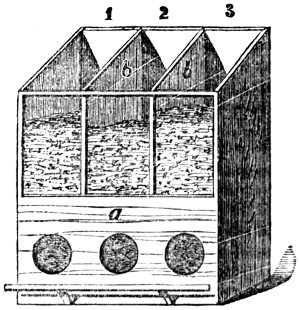
Fig. 1.
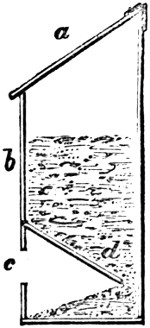
Fig. 2.
Fig. 1.
Fig. 2.
The seed-box is thus constructed. Get an old cigar-box, from which the aroma of tobacco has been removed by long airing, and take off the lid and the whole of one side; cut off two-thirds of the lid-piece, bore three holes in it, and fix it where the lid was, as at a; cut the rest of the lid in two, and fix the pieces in the box, so as to separate it into three compartments, fixing them with glue and a few very tiny brads. You should use pieces of slender brass wire for the purpose. If you left the box in this condition all the seed would run out at the round holes, and you must therefore correct that error.
How this is done will be seen in fig. 2, which gives a section of the seed-box.
Cut a squared piece of wood, which will just slide into the partition, so as to make a flat flooring to it. But, instead of laying it flat, place it in a sloping direction, as seen at d, so that a small space is left between the end of the floor and the back of the box. The reader will see that when the seed is poured into the partition it will drop through the open space at the back, and fall into the bottom of the box. The birds put their heads through the holes to eat the seeds, and as fast as they peck them away below, more fall from above and supply the deficiency.
In the front, and above the holes, fix a piece of glass, which is represented by b in fig. 2, and which is seen in its place in fig. 1. The object of the glass is to permit the bird-keeper to see when there is a sufficiency of seed. The sloping top is also of glass, which is fixed by a strip of American leather, acting as a hinge. It is made of glass, and set at a sharp angle, in order to prevent the birds from perching on it, which they are certain to do if they can find the least foothold. It will be found that the best cement wherewith to fix the glass is gold-size, and that a coat or two of black sealing-wax varnish makes a nice finish to the job.
The holes through which the birds feed should not be much larger than the size of their heads. The reason of this arrangement is that the canaries are apt to shell the seeds while their heads are over the vessel in which the food is contained, so that the husks fall among the seed, and it is not easy to discover when the supply is exhausted. But no diurnal bird will feed in the dark, and as the canary effectually darkens each hole by introducing its head, it will not crack and eat the seed until it has withdrawn its head and restored itself to light.
The object of the partitions is that the birds can be supplied with different kinds of seed, each of which can be restricted to its own division. The receptacles should be of different sizes—the largest for canary-seed, the next in size for rape, and the least for millet, among which a little hemp may be shaken. In front of the holes, and about three-quarters of an inch from them, should be fixed a perch, upon which the birds can sit while they feed.
At the back of the seed-box are fastened a couple of stout hooks—those which milliners call “stay-hooks” answer admirably—so that the box may be hung on the wires at any convenient height. It should not be placed on the ground, because in that case the canaries will stuff all the refuse stems of the green-meat into the feeding-holes, and will probably mix sand and husks with the seeds. They are as mischievous as monkeys, and quite as ready at discovering and taking advantage of the slightest opportunities of doing something which they know is forbidden.
The “fountain” from which they drink is made on a similar principle. Fountains can be purchased at any bird-dealer’s; but as it is preferable that boys should use their hands rather than drain their pockets, we offer simple directions for making a fountain as efficacious, though not quite so elegant, as those which are purchased in the shops.
The materials required for the purpose are very simple, and consist of some wire, both stout and fine, of an empty Florence-oil flask, a saucer, and some wood. The mode of employing them is shown by the illustration (fig. 3).
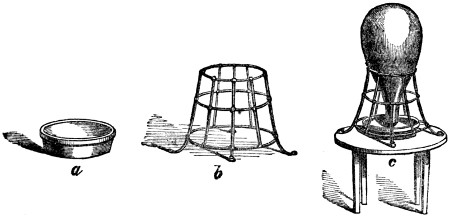
Fig. 3
Make three rings of stout wire, each diminishing in diameter, and arrange them as seen at b, the smallest being uppermost. Four pieces of stout wire are then firmly attached, so as to make a kind of conical stand. Were not the birds so mischievous, this would be sufficient for all purposes; but as they are sure to go and bathe in the water, they must be kept out by intermediate wires, so as to make a kind of cage, through which the birds can put their heads, but which will not permit the passage of their bodies.
Then take your oil-flask, strip off all the rushen covering, and wash the interior with strong soda until every trace of the oil is removed. Place it in the wire frame, as shown at c, and try whether it stands upright. If the wire ring should be too large, and allow of its slipping through too far, cut a round hole of the proper size in a piece of pasteboard or very thin wood, lay it on the ring, and then introduce the flask.
Make a round stool or table, such as is seen in the illustration, and fix the turned-up ends of the wires to it with small staples. If the fountain were on the ground, the birds would fill the saucer with sand and husks; and if it were not firmly fastened, it would be knocked over by the fluttering wings of a passing bird. The stool must be wide and strong, or the whole affair will be upset.
The mode of preparing the fountain is very simple. Fill the flask with water, and stop up the mouth with a shallow cork. Place a saucer (like a) under the wire frame, insert the flask, hold its mouth in the saucer with one hand, and remove the cork with the other. The water will immediately rush into the saucer, and will half fill it, but owing to the pressure of the atmosphere no more water will descend. When, however, the birds have drunk enough to bring the level of the water below the mouth of the flask, air immediately rushes up in great bubbles, down comes a corresponding amount of water, and a fresh supply is thus afforded.
In canary-keeping much depends upon the kind of bird. We presume that a good singer will be required, as well as a strong and healthy bird. If you are not learned in canary lore, try to induce an experienced friend to choose a bird for you; but if you are not fortunate enough to possess such assistance, the following concise directions may aid you. Look at the birds for sale, and note those that stand straightest on their perches, and that hop quickly and smartly about the little apologies for cages in which they are mostly confined. Next hear them sing before deciding on your purchase, and select the one that possesses the sweetest and fullest tone. The dealer can always make the bird sing when he likes, and if any bird refuses to sing, do not buy it, however handsome it may look. If possible, procure one that possesses the nightingale’s song; you will have to pay rather heavily for it, but any one who can afford such a bird will be amply repaid by the very great superiority of the song, which is divested of that ear-piercing shrillness so unpleasant in most canaries.
When you are satisfied with the song, look the bird well over to see that it has no defects; and if you prefer the variegated breed, take care of three principal points—namely, the top of the head, technically called the “cap;” the markings on the back, called “spangles;” and the number of quill feathers in the wings and tail. The cap must be uniform and rich in colour, the spangles bold and well defined, and the quill feathers not less than eighteen in each wing and twelve in the tail. Imperfect or damaged feathers can easily be replaced by pulling them out, for their places will soon be filled with new and perfect feathers.
Some persons prefer the yellow varieties, and many are fond of the crested canaries.
We intentionally omit all mention of “fancy” canaries, for the fashion changes with them as fast as it does with tulips or dress. The fashion in canaries seldom outlives a year, and the prize bird of one year will possibly be despised in the next season. Do not, therefore, be persuaded to attempt the purchase of costly fancy canaries. They may certainly be of great value when you happen to buy them, but in a few years no one will think anything of them. Choose strong, sweet-voiced, and healthy birds, with colours that please your eye, and leave the fancy canaries to professional breeders.
As to the general management of the canary, it may be summed up by saying that it chiefly consists in judiciously letting alone. Don’t meddle with the birds more than is absolutely needed, and do not worry them with medicines whenever they seem to be unwell. As, however, all canaries are liable to certain ailments, in which a knowledge of the proper treatment is highly useful, we will just give a few plain directions.
One pest is vigorous throughout the year, and always ready to seize on the birds, and that is the “red-mite,” a parasite known to all bird-keepers.
If you find your birds restless, especially at night, and see them continually pecking among the roots of the feathers, and especially if they lose appetite, and become fretful and ill-tempered to their companions, look out for the red-mite. You can always detect the tiny but formidable foe by placing the bird in a dark room, and, after a few hours, holding a bright lamp close by the cage. If there are any mites about, you will soon see them crawling upon the perches, the wires, and even showing themselves among the feathers. They are not larger than the dot over the letter i, but their numbers are often very considerable, and the injury they inflict is great.
Let not one escape, for it may be the parent of hundreds more. When the red-mites have once obtained possession of a cage, their extirpation is a task of very great difficulty to those who do not understand the constitution of the creatures. So difficult, indeed, is the business, that many fanciers will not even attempt it, but burn the cage and buy another. The metal cages, which are now so common, are preferable to those made of wood and wire, inasmuch as they present very few spots wherein the red-mite can find a hiding-place, and for that reason metal is to be preferred to wood. Even if they have gained admission to an ordinary cage, they can be extirpated without very much trouble. We have succeeded in doing so in several instances, and think that in a fortnight any cage can be freed of its troublesome parasites.
First place the cage in the sun for a short time, so as to induce the light-hating mites to leave the bird and hide themselves in the crevices of the cage. Remove the bird, and transfer it to another cage, or even a box, and let it wait. Take the cage and examine it well, introducing a heated needle or thin blade of iron into every crevice. Next take some insect-destroying powder, force it into a hollow paper cylinder, light the paper, put it into the cage, and envelop the whole in a newspaper. Leave it there for an hour, and when you remove it you will see dozens of the red-mites, of all sizes, lying dead on the floor, or clinging half-stupefied by the fumes of the powder. Scrape them all into boiling water, and dust the whole of the cage with the powder.
By this time every mite will be dead; but there is a goodly store of eggs which will be hatched in due time, and infest the cage anew. These are destroyed by means of oil. Take a camel’s hair brush and some salad-oil, and with the brush apply the oil to every crevice. If there should be the tiniest scratch on the wood, touch it with the oil. Let oil be applied to every spot where the wires enter the wood, where they cross each other, and where the hinges of the door are fixed. Every egg will thus be destroyed, and the cage freed.
About half an hour before you restore the bird to the cage hold it in the left hand, and dust it well with the powder, blowing up the feathers, so as to get it well to the roots. Scatter some of the powder upon a piece of soft rag, and roll the bird in it, carefully binding down its legs and wings, under each of which a pinch of powder must be sprinkled. You can now attend to the head, which requires rather neat handling, as the powder is very apt to settle upon the eyes and to worry the bird. Let your feathered pet lie for half an hour in this beneficial bondage, and then replace it in the cage, scattering some powder upon the floor. The bird will shake its plumage sharply, and send a cloud of dust flying, and in a minute or two will begin to peck among the feathers and settle the plumage. The different aspect of the bird is then quite remarkable, for it exchanges the fussy, anxious, fretful moments for quiet ease, and even when it does peck among the feathers, it does so gently and deliberately, and seems quite another bird.
Moulting is a disorder to which the canary is annually subject, and which requires some little attention. Some time in the autumn all the canaries exchange the feathers which have endured the wear and tear of a twelvemonth for a completely new suit. Feathers are subject to damage in many ways, and just before the moult takes place the bird is quite ragged and disreputable in dress. Meanwhile the germs of new feathers have been growing in the sockets which held the old suit, and in the course of a few weeks all the feathers are shed and replaced by others. It may easily be imagined that such an operation is not achieved without much physical disturbance, and it is accordingly found that all birds are more or less indisposed during the time of the moult.
Scarcely any two birds are affected in precisely the same manner, and the “moulting sickness” tells with especial severity upon the young. Quiet and nourishing food are the best remedies for the curious mixture of languor and fever which is always visible among the birds; and the most accomplished canary-breeders are in the habit of giving the yolk of hard-boiled eggs, and even a little raw meat, scraped and cut very fine. Sometimes, in their desire for animal food, the birds pluck the newly-formed feathers from the bodies of their companions, and nibble the still vascular and bleeding ends. Wine is recommended by some fanciers, but we cannot agree with them. The moult is a natural ailment, and the remedies which are best calculated to modify its effects upon the health are those to which the natural instincts of the birds would lead them.
Frequently the claws and bill of the canary become overgrown, and produce very unpleasant results; the latter causing much difficulty in taking food, and the former entangling the foot in the wires of the cage. The remedy in either case is the same. Take the bird in the left hand, and hold it against the light; the overgrown portions of the claws will then be easily distinguished, inasmuch as a delicate scarlet line runs along the centre of each claw and nearly reaches its extremity. Taking this line as your guide, you carefully cut off the overgrown parts with a sharp pair of scissors, and cause thereby immediate relief to your feathered patient. The bill must be cut in the same way, but requires a little more care and some neatness in trimming. No pain is given to the bird when the operation is rightly conducted, for neither bill nor claw possesses sensation.
Dysentery and diarrhœa are very common among cage birds, and should be treated, the former with a drop or two of castor-oil, and the latter with a lump of chalk to peck at, and a rusty nail in the water.
Sometimes the bird loses the feathers of the head and neck, and presents a most ungainly appearance. In such cases rub the head with almond-oil, and feed the bird for a few days on a mixture of lettuce, scalded bread, olive-oil, and a sprinkling of maw seed. Health will soon return, and at the next moult the bird will recover its lost plumage.
Broken legs are of frequent occurrence, and mostly happen by the bird entangling itself in the wires and then struggling to free itself. Overgrown claws are a fertile cause of this misfortune. Do not try to bandage or in any way to meddle with the leg; but put the bird in a separate cage, take away the perches, place the food and water within reach, so that the patient may partake of them without needing to stand, and wait until the limb is healed. The bones unite very rapidly, and in a week or ten days the limb will be nearly as strong as before the accident, and will betray no sign of the recent misfortune.
DOGS.
It is to be supposed that each reader of these pages is either the possessor of a dog, or desires to obtain that privilege, and that he will wish to learn in a few lines the best way of managing and training his favourite.
There are many works which treat of the Dog; but all those which are trustworthy are of very large dimensions, necessarily costly, and contain a vast amount of information which is very valuable to the owner of hounds, to the sportsman, or to the game-keeper, but is not required by the generality of those to whom these words are addressed. We have, therefore, endeavoured to condense into the few pages which can be allotted to a single subject all the information which is absolutely needed by those who keep dogs merely for amusement and the love of their society.
Firstly, we may answer here a question that is often asked—namely, which is the best breed of dogs for ordinary purposes? We of course exclude all the strictly sporting dogs, such as the foxhound and harrier, the greyhound, and perhaps the bull-dog, though there is something to be said in favour of the last-mentioned, and somewhat maligned, animal.
The tasks that we wish to impose on the dog are light and simple. We want him to be watchful at night, to alarm the house at the sound of a strange step on the premises; if possible, we want him to be courageous enough to attack an intruder. We want him to be a pleasant companion in our daily walks, to hunt after anything at which we may set him, to swim after any object that we may point out, and to retrieve anything for which we may send him. At the same time, we want him to be completely under command, and to be obedient at the least word or sign.
Lastly, we want him to be cleanly and comfortable in the house, to know how to keep out of the way when he is not wanted, and to be sufficiently clever to learn all kinds of amusing performances.
Where, then, shall we find an animal that is capable of fulfilling all these conditions?
There are several varieties of dogs which are well suited for general purposes. There is the spaniel for example, faithful, affectionate, clever, and docile. There is the poodle, perhaps the best “trick” dog in the world, with his funny curly coat and his soft brown eye, full of intelligence almost human. There is the Newfoundland dog, who is perhaps almost too big to be a dweller within the house. There is the terrier, an amusing, bright-eyed, agile-limbed, fussy animal. There is the Italian greyhound, one of the most beautiful animals in the world, but too delicate to please the taste of a boy. There is the Scotch terrier, that odd, wiry-haired, clever creature, which has so often been immortalised by affectionate owners.
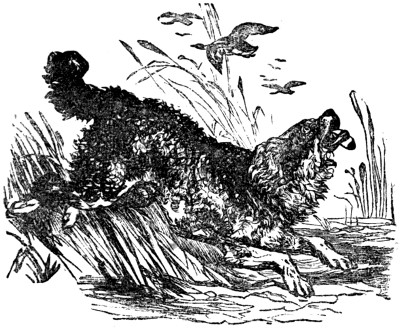
THE SPANIEL.
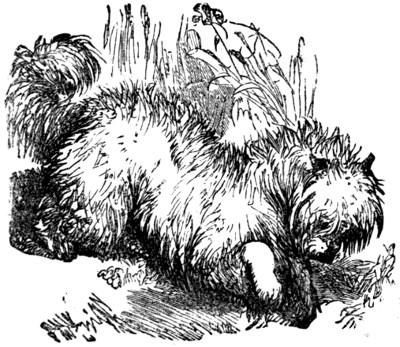
THE TERRIER.
All these varieties are delightful animals, and we like them all. But had we the choice of a dog, we should take neither of them, preferring a mixture between the terrier and the bull-dog, provided, of course, that each were of good breed. Many people fancy that a bull-terrier is a dangerous dog to have about the house, and imagine that it is given to biting without due cause, and is too savage to be turned into a pet.
But much of this misapprehension may be traced to the long-established and popular error regarding the bull-dog. It is seldom that a favourable account of this animal is given, and it is thought to be brutal, stupid, vindictive, and irreclaimably ferocious. It is impossible to deny that too many bull-dogs agree with this description; but it is equally impossible to deny that whenever they possess such bad characters the fault lies almost entirely with their master. “Like master, like dog,” is an old and true saying, which has been based on the experience of many years.
If the bull-dog is properly treated, if the owner makes the animal his companion, and if he carefully studies its character, as every pet owner ought to do, encouraging the good qualities, and gently reproving the bad, it will be as gentle and much more quiet than a King Charles or a toy terrier. Looks are certainly against the animal. There is, perhaps, no creature with a more fell aspect than a thorough-bred bull-dog. Its underhung jaw, its glittering teeth, its sunken eyes, its tremendous chest, and lowering countenance are calculated to inspire terror rather than interest.
Yet, when a bull-dog is managed with a due appreciation of canine nature, its aspect thoroughly belies its true nature. We know a thorough-bred bull-dog belonging to a friend, one of the fiercest and most sullen-looking beasts imaginable. Every one gives the animal a very wide berth; and we confess that when we first saw it we thought that its owner was not acting very wisely in permitting it to walk about unmuzzled. Yet this creature is playful and harmless as a kitten. Its great jaws look positively awful as it opens its mouth, and until its real qualities are known, it requires some little presence of mind to withstand its playful rush.
For a pet, however, the bull-dog is scarcely suited, not being sufficiently active or lively. The purely-bred English terrier, on the other hand, is as mercurial a beast as one can wish to see; but it has little steadiness of purpose, is apt to run riot, and is a rank coward, not daring to face a rat, and having serious doubts before it can make up its mind to attack a mouse; therefore the skilful dog-fancier contrives a judicious mixture of the two breeds, and engrafts the tenacity, endurance, and dauntless courage of the bull-dog upon the more agile and frivolous terrier. Thus he obtains a dog that can do almost anything, and though perhaps it may not surpass, it certainly rivals, almost every other variety of the canine species in its accomplishments. In the capacity for learning tricks it scarcely yields, if it does yield at all, to the poodle. It can retrieve as well as the dog which is especially bred for that purpose. It can hunt the fox with the regular hounds. It can swim and dive as well as the Newfoundland dog. In the house it is one of the wariest and most intelligent of dogs, permitting no unaccustomed footstep to enter the domain without giving warning. It will chase rabbits, weasels, rats, or, indeed, any game, with unextinguishable ardour, and will fight any foe at which its master may set it.
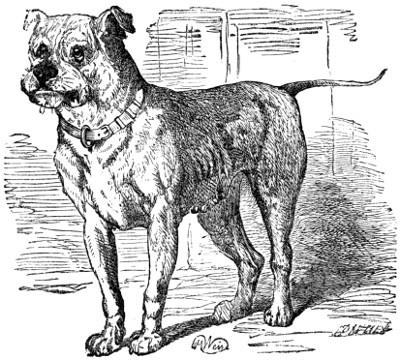
THE BULL DOG.
One fault indeed it has. It is just a trifle too quarrelsome with other dogs, and when it meets a strange individual of its own species, and has gone through all the preliminaries of back-arching, bristle-setting, sotto voce growling, and the various performances with which two strange dogs greet each other, it is a little too apt to cut matters short by challenging the other to instant combat. Even this fault, however, is easily overcome by a kind but firm master, who can impress upon his pupil that it is not to fight anything at which he has not set it.
And here let us make a few remarks upon the management of dogs.
Severity is not at all needed, but firmness of purpose is indispensable. Patience and good temper are also two requisites, without which no one should attempt to manage a dog. The animal must be made to feel that when an order is given it has to obey at once, and not even the very slightest act of disobedience should be passed unnoticed. He will soon learn that lesson, and the rest is easy.
If you can procure a dog in his early puppyhood, it is certainly the very best method, and you will not require a whip; but should the animal have attained maturity, you may employ this instrument, but must use it with the greatest discretion. If the dog is worthy of the name, you can punish him in a far more effectual way by appealing to his sense of shame than by flogging him; but if you once lose your temper, and begin to inflict a beating on the animal, half your influence will vanish.
If the dog wilfully disobeys you, as will often be the case when he is full-grown and is trying your mettle, take him by the neck, tell him how wicked he has been, and give him one very sharp blow; not more than one,—because if you do so he gets so frightened that he forgets all about the scolding. Then let him have another chance, repeat the order, and if he disobeys again, inflict another stroke. He is not likely to offend a third time; and when he obeys the order, speak kindly to him, praise him, and make much of him,—for you can do more with a dog by praise than by rating.
With a dog which you have possessed from puppyhood there is seldom the least necessity for severity. The creature is so accustomed to do what his master desires, that he hardly conceives the possibility of disobedience. Gentle firmness is all that is necessary in such a case; indeed, we are always opposed to the infliction of pain, except in rare instances, where it is the only means by which the animal can be taught the necessity for obedience.
We cannot bear to see a dog look up to its master with the half-frightened, half-shrinking expression which is observable in one that has been accustomed to the whip. The animal ought to consider its master as its best friend, and to run to him when it is in distress, rather than to fear his presence and tremble at his voice.
The Rev. J. G. Wood, writing on this subject, says:—
“My dear old Rory used to be most abjectly miserable when he had offended me. His frisky tail and pretentious ears would droop on such occasions, his easy assured carriage would sink into a listless, spiritless gait, he would hide his head like a naughty child, he would not leave or enter the room openly, but would make the transit of the apartment by slinking under the chairs and tables, so as to keep himself out of sight as much as possible. He would crawl under my chair, and after waiting some time in hopes that I should notice him, would just push his nose against my heel, and then retreat again to his hiding-place. He would not eat, nor drink, nor sleep, nor be comforted by any one until I had spoken the desired words of forgiveness.
“And then, when the first words of reconciliation were spoken, how he would advance with hope beaming in his countenance, still mixed with diffidence, lest he should have mistaken the tone of voice. And when he was quite certain that he was pardoned, when he felt my hand upon his head, how wild he was with delight! How he would jump about, and run from one person to another on his hind legs, and roll over on his back, and pretend to bite every one in turn, and knock the cat over, and bark until he had to be turned out of the room for the sake of preserving the drums of our ears.
“Then how he would get out of the house, dash down the street at full speed, come pelting back again, jump on the window sill, bang with his tail for admission, and then walk quite soberly to his usual place, and lie on the hearthrug just as if nothing had happened.
“There certainly are dogs whose feelings are quite beyond the reach of human sympathies; but it is more than probable that their callousness is attributable to the bad treatment of their owner, and not to any inherent defect in the animal’s nature. In my little book, ‘Glimpses into Petland,’ the reader may see an account of a ridiculous dog who fairly got the better of me by simple vacuity and selfishness. I never saw such a dog in my life, and I really do not want to see such another.
“Nothing could be made of him. He did not care for kindness; he could not be influenced by the whip; he never thought of obeying orders; he got into every scrape in which a dog could by any possibility fall; and was altogether a hopeless subject. Had I been a novice in the management of animals, I should have thought myself in fault; but being tolerably experienced in such matters, I was at no loss to set the failure down to its right source.
“Just before commencing this account, I received a letter from a correspondent who had read the account of ‘Roughie,’ and wrote a vindication of the Skye terrier, to which variety the dog belonged. My correspondent stated that if the Skye terrier were obtained when young, and well treated, it was one of the most affectionate and faithful animals that could be found; but that if it were bandied about from one master to another, it lost all its loving qualities, and became a reckless, selfish beast. Such had evidently been the case with ‘Roughie,’ and thus his peculiar disposition was accounted for.”
We will now just run through the list of the dogs which are best suited for pets. Of the bull-dog we have already spoken, as also of the terrier, which, as we have said, should be, if possible, a mixture of the two varieties. If you can secure a good healthy puppy from well-bred parents, think yourself fortunate, and make much of the dog.
Do not crop his ears. If you have any sporting friends, they will advise you to do so, tell you that it spoils the dog, and give you all kinds of advice about it. Now, in the first place, it is reasonable to think that the dog’s Maker knows best the kind of ear that is most suitable for the dog, and frames it accordingly. If the short, cropped form had really been the best, it would have been made after that pattern, and not left to the scissors of the dog-doctor to complete the work.
So we say to our readers, defy the ridiculous prevailing fashion, and oppose common sense to it. In a few more years this cropping process will be pronounced obsolete and unnatural; so be amongst those who lead opinion, and save your dogs the pain of that cruel and unnecessary process. Not long ago worming was all the fashion. No dog was considered safe unless it had been wormed; that is, unless the under side of the tongue had been cut open, and the central tendon pulled out. Of course, when a tendon is drawn from the living body and laid in the cold air, it contracts and twists about. Therefore it was held to be a worm, and everywhere believed to be the cause of hydrophobia.
Horses, again, were cropped in a most atrocious manner. Their ears were clipped close to their head, and their tails were cut quite short, leaving only a few inches of hair on the stump; so that the French satirist was quite justified in his sneer against the English as a people, who, he said, cut off the tails of their horses and the heads of their kings. The French did both afterwards, with the addition of a queen and a few princes. Nor was this all. The under side of the tail was cut across in several places—nicking, the operation was called—and then the tail was forcibly bent upwards, and tied in that position until the wounds healed, and the member left immovable. Fancy the torture the poor animals must have undergone, the fresh wounds being torn open and exposed to the air!
Mr. Waterton, the venerable naturalist, remarks that in former days he tried to aid the cause of humanity by his example, and rode a horse with a proper allowance of tail and with uncropped ears. The experiment failed. The “arbitrium popularis auræ” was pleased to declare itself against ears and tails. There was such a commotion whenever the humane rider ventured to show himself abroad on a horse which possessed the abominations of ears and a tail—he was so mobbed, and his horse was so reft of his tail by the urchins who wanted fishing-lines—that, for the sake of the beast as well as himself, Mr. Waterton was obliged to conform to the popular verdict, and dock the tail of his horse as a compromise for his ears.
Now, however, the verdict of popular opinion has undergone a change, and horses are permitted to wear their ears and tails; and the time will come before very long when a dog will be thought as much disfigured by having cropped ears as he is now thought to be when he is allowed to wear those members in their natural proportions.
The only rational excuse that can be put forward for adopting such a practice is that which is employed by the owners of game-cocks, when they clip the combs of their feathered protégés. It is, that the length of the ear affords a hold for an antagonist. But as it is not to be supposed that any of my readers are likely to belong to that brutal class of human beings who keep dogs for the purpose of making them fight each other, we may pronounce that not one single valid reason can be urged for depriving a dog of his ears.
There is the poodle, a delightful dog for a pet. They are docile in no ordinary degree, and can learn all kinds of tricks without seeming to take much trouble. Performing dogs mostly belong to this variety, and very amusing are the tricks which they will learn. They will dance a polka with easy skill. They will imitate a ball-room company with such ludicrous burlesque that no one can resist the temptation of laughing. They will walk about on their hind legs, on their fore legs, and have even been seen to walk with the two legs of one side, the other legs being held up in the air.
It was difficult to imagine how they could have been taught such a feat; but it had been done by setting a board on edge, hitching the two legs of the left side over the board, and making the dog walk along in this attitude. After passing along the board three or four times, the dogs found that they could lighten the labour by holding their upper legs clear of the board, and so they soon learned to dispense with its presence.
If you do have a poodle, you must wash him often and carefully, because these long, curly-headed dogs are apt to give out a disagreeable odour unless they are kept very clean. But do not on any account clip his hair in the stupid and ugly fashion that is so often adopted, and which was first imported from France.
In that country they shave all kinds of dogs in the same manner, leaving only a ruff round the neck, a tuft on each leg, and a tuft on the end of the tail. There are men and women who make the clipping of dogs a profession. They have carts with pictures of dogs undergoing the process, and they perambulate the streets in search of patients, just as knife-grinders do in search of work.
When they have collected a goodly assemblage of dogs, they set off to the river side, and take up their station under one of the bridges. The poor dogs, which have been trailing behind the cart at the end of cords, are now bound and muzzled, and miserable objects they look as they lie on their sides awaiting the shears of the operator. The hair that is removed is put into sacks, and sold, it is said, for manure; and the dogs are returned to their owners, metamorphosed out of all knowledge, and shivering at the slightest breeze.
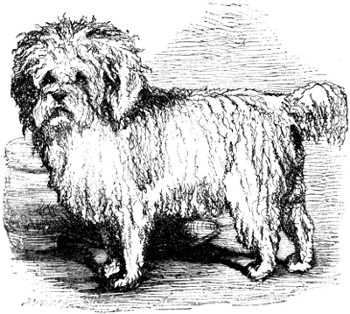
THE POODLE.
If your dog should be ever troubled with ticks and fleas, you may free him from his foes in ten minutes. First tie up his mouth with a piece of broad tape, to prevent him from licking off the substance which is to be applied; and if he is not very well under command, tie his legs also. Then lay him on a cloth, sprinkle him over with the insect-powder, which may be procured in small quantities at No. 33, Newgate Street, and rub the powder well into his fur from his nose to the tip of his tail. When you have done this, roll the cloth round him, and pin it well together, so as to envelop him entirely in its folds.
You may let him lie as long as you like, but ten minutes will mostly be sufficient; then with a hard brush go all over him, and brush out all the powder into the cloth. You will be surprised at the multitude of parasites which will be lying dead and dying in the cloth. The powder, insects, and all should be carefully shot into the fire, and your doggie will be grateful to you for the relief which you have afforded him.
Perhaps next to the bull-terrier ought to come the Scotch terrier, a dog that will hunt anything, and is always a quaint, independent beast, with something of the lawless Highlander about him, but a capital companion for any one who values dogs and knows how to treat them. Spaniels are all beautiful creatures, very affectionate, and often very clever; but their long, silky hair gets sadly bedabbled with mud and wet, and they cannot be admitted into the house until they have undergone a careful purification.
Whatever dog you may have, do not tie him up in a kennel, or, at all events, allow the animal to enjoy human society for some hours daily. Dogs are made savage by this too frequent procedure, especially those whose blood is purest and whose spirits are highest. A dog that is chained to one spot is sure to be irritable and captious, just as would be the case with a man who is tied to one spot. Even the kingly spirit of Napoleon lost its grandeur and became peevish and fretful when that restless and ambitious nature was confined within the narrow limits of a rocky island; and we cannot expect that the mind of a dog should be superior to that of an autocrat.
As to the food of the dog, there is one simple rule,—do not overfeed him; and, above all, never let him have scraps at meal times. It is a very tempting practice, for the dog is so insinuating in the manner of his request, and his thanks are expressed so warmly, that some little strength of mind is required to refuse his demands. Still it is one of the occasions on which the dog’s owner must show his firmness, for there are few more miserable beings than a fat, over-fed dog. His life is a positive burden to him, and the only remedy is to starve him down to his proper dimensions. Give the animal but little meat and plenty of biscuit, feed it once only per diem, and you will be repaid by the healthy and active condition of your pet.
Lastly, as it is likely that the dog may fall into one of those canine ailments which are to dogs what measles and chicken-pox and whooping-cough are to children, we will just give a brief piece of advice.
Distemper is the most common and most annoying of those ailments; and if the services of a professional dog-doctor can be had, let the animal be placed under his care. If no such assistance can be obtained, the best plan is to give the dog no solid food, but to administer gruel or weak broth, to prohibit every kind of exercise, and see that the ventilation and cleanliness of his house are as perfect as possible. Leave the rest to nature; and when the patient is recovering, let it be led about to exercise, so as to avoid over-fatigue, which would, as a matter of course, throw him back again.
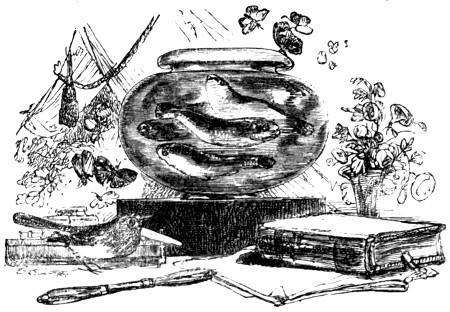
GOLD AND SILVER FISH.
These are of the carp family, and have been known in this country from the year 1691. They abound in the fresh-water ponds, lakes, and rivers of China; nor are they, indeed, at the present time quite uncommon in our own climate, being now naturalised in ponds, and breeding freely in pure waters. At Hampton Court are to be seen some of the finest specimens of the family, originally placed there by Mr. Jesse, to whom the frequenters of that place of public resort are so much indebted. They have increased to several hundreds, and many of them are of prodigious size and very fat, being to fish what royal porters are to men.
The colours of gold-fish are liable to the greatest variation: some are nearly all gold, mingled with red; some are marked with a fine blue, brown, or bright silver hue; but the usually predominant colour is that of a brilliant gold. As an article of food, they are not used; and are only valued for their beauty and gentleness. It is a curious fact in the history of the gold-fish, that it will bear without injury the extremes of heat and cold; as it will live equally well in a tank, in a glass vase, and in a pond in the open air. Instances have been known of gold-fish having been frozen hard and stiff in the water, but yet, upon being gradually thawed, becoming perfectly healthy and well.
Although many preserves of gold and silver fish exist in this country, the supply was principally from Portugal, where they abound. They are brought over in large numbers about spring time; and then numerous perambulatory gentlemen, having purchased a few small glasses of the most inferior description, and fish at twopence each, very moderately ask, and often receive, for a couple of fish, glass, and water the sum of five shillings; but our young friends must beware of such persons, for the fish they sell usually die in a few days or weeks.
The silver-fish differs from the gold-fish only in colour, which is similar to silver tissue: it generally has scarlet fins, and is curiously marked in different parts of the body. Both varieties are also subject to variations in the fins, which are occasionally double; and specimens have been seen with triple tails.
GLASSES.
The glasses, or globes, should be moderately large, with wide mouths, and three-fourths filled with water. For two fish the globe should be at least a foot in diameter; and for three or four fish, sixteen inches. They should be kept in a cool place—never exposed to a burning sun, or the heat of a fire. Too many should never be crowded into one glass. A few branches of box should be kept in the globe, for them to rub against, which should be changed once a week.
FEEDING.
Some persons fancy that gold and silver fish need no food. It is true that they will subsist for a long time with nothing but water, when it is pure and frequently changed. They are best pleased with such jejune diet as bread or biscuit; but these should be given sparingly, lest, turning sour, they corrupt the water. They will also feed on the aquatic plant called lemna, or duck’s-weed, and also on small fry. Hawkins, the editor of Walton, says that fine gravel should be strewed at the bottom of the vessel that contains the fish; and he directs them to be fed on bread and gentles, and to have their water frequently changed.
DISEASES.
You can easily tell when a fish is falling off in his health by observing him frequently coming up to the surface of the water for air. This shows he has not sufficient power in his gills to extract the air from the water. He also looks dull, and his motions are languid; a hazy or cobwebby appearance likewise seems to envelop his body, and perhaps some of the scales will drop off. When a fish gets into this unhealthy state, he should be immediately removed from the others, who should have fresh water given them several days in succession. The best remedy for diseased fish is to put them into a pond for a few weeks; and it is especially necessary for female fish, which, if not so treated, frequently die for want of spawning. A fish is sometimes saved by being placed in a little artificial dam, made from some running stream in a garden, for two or three days; but their diseases are at all times very difficult to remedy. The best way is to prevent them by the precautionary measures—plenty of room and pure water.
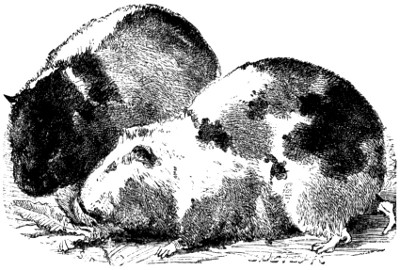
THE GUINEA-PIG.
The guinea-pig, or restless cavy, is a prettily-marked, stupid, little animal, which came originally from South America, and has long been a favourite with most little boys, for when a boy becomes a youth he aspires to keeping something more interesting than these senseless little squeakers. Still it is a pretty sight to see the old ones followed by two or three litters, and to watch their antics when pleased, which consist of a squeak and a peculiar sharp turn, as if they tried to jump out of their skins, but could not, for they are fitted in too tightly for that. As for the use they are, why, they eat and sleep—
“Just do nothing all the day, And soundly sleep the night away.”
It is, however, a pretty, harmless, little animal; but as a pet is far inferior to others that are more commonly kept. Though gentle and inoffensive in its manners, it seems incapable of feeling the slightest attachment for those who feed and caress it—even for its own offspring it evinces little or no affection: it will not only suffer them to be destroyed before its face, without making the smallest efforts to defend them, but will even at times devour them itself. For all useful purposes guinea-pigs are utterly valueless, though their flesh is used as an article of food in their native country; and their skins, notwithstanding the beautiful sleekness of their appearance, have as yet been turned to no account by the furrier. Their only recommendations, therefore, are the gentleness of their disposition, the cleanliness of their habits, and the beautiful colouring of their coats. In this latter respect they are very varied; black, white, bright reddish brown, and a mixture of the three, called tortoiseshell, being the principal varieties. The latter are the most prized, particularly where the dark colours predominate.
In their native country they are generally of a pure white, with pink eyes, and it is nothing unusual to have one out of a litter white with pink eyes in this country.
Rats are supposed by many people to have a great antipathy to guinea-pigs, carefully avoiding the place where they are confined. Under this impression—which, however, is an erroneous one—they are frequently kept by fanciers in their rabbit-houses and pigeon-lofts, as a means of protecting their stock against the depredations of those rapacious vermin. They are allowed to run almost anywhere, and to shift for themselves: no attention whatever need be paid to the feeding of them, the mere refuse scattered about the floor being sufficient for their subsistence.
When, however, they are kept for amusement, their cages are generally made precisely similar to the rabbit’s hutch, only of rather smaller dimensions: their treatment, too, in most respects, is much the same as that pursued with regard to that animal. Their ordinary food should be oats given twice a day, and not too many at a time. They are also very fond of bran, which is a cheap diet; and they will fatten upon it, and keep healthy, if allowed plenty of exercise. Green meat should also form a portion of their usual diet, particularly the wild sorts, such as dandelions, sowthistle, plantain, &c.; tea-leaves they are remarkably fond of, but these should only be given them now and then by way of a treat; bread, also, they are very partial to, dipped in milk or water.
They are sold by all bird-fanciers; the prices varying from sixpence to half-a-crown, according to their age, colour, &c.: as before remarked, the dark rich-coloured tortoiseshell ones are considered the most valuable.
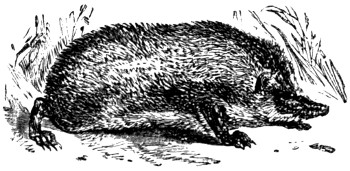
THE HEDGEHOG.
This, though a rough and prickly customer to handle, is a clean little animal, and a great pet with country boys. If you have ever seen one—and they are commonly sold at the shops kept by men who call themselves bird-fanciers, or even hawked about the streets of London by countrymen—if you have seen one, you are aware that, saving the belly, they are covered with sharp spikes, and that when alarmed, or whenever they please, they have the power of rolling themselves up into a tight round ball, which shows nothing but spikes, and may be rolled along, like a cricket-ball, without causing the little animal to uncoil itself, while every spike is firm and erect as a needle, and almost as sharp. While in this shape very few dogs can worry the hedgehog; and as for the fox, who is rather partial to him, true to his wily nature, he rolls the poor hedgehog along with his paws until he comes to a pool of water, when the hedgehog unrolls himself, exclaiming, no doubt, “Hey! why, what’s this? I can’t breathe!” and trying to peep about and see what’s the matter, the fox, on the look-out, seizes him by the belly, and eats him all up, saving the spines. Were you to thrust a dozen pins with large heads through a piece of parchment, you would have an exact representation of the spines of the hedgehog, every one of which is retained inside the skin by the large pin-like head.
Some say that it sucks the cows, and draws off their milk; but this is absurd, as its mouth is not adapted for sucking. Its favourite food are insects and snails: it also feeds on frogs and mice, and will even kill a snake, and eat it all up, beginning at the tail. The way it kills a snake is very curious. It gives the snake a bite on the back, then rolls itself up like a ball, remaining still as a stone for some time, while the snake lashes and writhes about in agony; as soon as the snake is a little quiet the hedgehog gives him another sharp bite on the spine, and so continues until the snake is killed; then he begins at the tail, as the Rev. J. G. Wood tells us in his “Illustrated Natural History,” and eats him up “as one would a radish.” In a natural state it sleeps all the winter, rolled up in a hole which it has filled with grass, moss, or leaves; and when domesticated, it will hide itself in some dark corner for weeks, and never once make its appearance, unless it chances to awake and feel hungry; then some day you will see it come creeping towards the fire, and be very glad to see it too. Hedgehogs are great destroyers of beetles, eating them up as quickly as you would a handful of raisins, and seeming fond of them. They need no looking after at all, but will take care of themselves, though it is as well to have a little hutch to put them into now and then. Their feeding-time is in the night; and if there are black-beetles in the kitchen, the best plan is to leave the hedgehog there, and let him devour all he can catch. They have four or five young ones at a litter, which are born blind. It is no uncommon sight to see a countryman with both old and young ones to sell. You can buy a young hedgehog for sixpence, and an old one for a shilling, or less than that even. We know of no animal that is less trouble to keep, and in time it becomes so tame as to come out of its hiding-place when called.
THE JACKDAW.
To procure a raven, an order to a dealer is almost necessary; but every boy should be ashamed if he cannot catch a young jackdaw for himself. These quaint birds make their nests in all kinds of places, especially affecting old buildings, such as church towers, ruins, or colleges. There is hardly an ancient church throughout the kingdom where a basketful of young jackdaws could not be obtained within half an hour, and old ruins positively swarm with them. It is curious to see how birds of such different habits as jackdaws, owls, pigeons, and starlings will roost amicably in the same locality, not appearing to have the least distrust of each other, or making half the fuss about their dwelling-places that is created nightly by the sparrows when settling to rest.
Failing ruins and towers, he will take possession of deserted rook-nests; and in cases of great distress, when the country is wide, where men will not build towers, where rooks and crows will not build nests, he is forced to fly for succour to the sea-shore and the warren, and make his home with the gannets and the rabbits.
Many a person has been surprised, on looking into a deserted rabbit burrow, to find it choked up with a strange mass of sticks and twigs, and still more surprised when he has brought to view a couple of jackdaw’s eggs, or hears the hungry cries of the young birds. This seeming alliance of the rabbit and the jackdaw is not unique, for it is observed in the Coquimbo owl, or burrowing owl, as it is sometimes called, and the prairie dog of North America, both of which reside within the same warren, and seem perfectly satisfied with each other’s company.
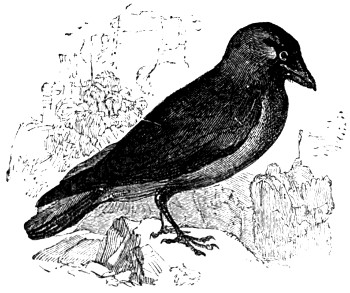
The sea-birds, too, receive the jackdaw into alliance, and whole colonies of these grey-hooded birds may be seen hovering about the lofty cliffs that bound our coasts, crying “Jack! Jack!” in inharmonious chorus with the sea-birds’ wail.
Sometimes a young and too artless bird leaves its nest before it is rightly able to use its wings, and is unable to ascend to the summit of the cliffs, flapping idly about the shore, driven nearer and nearer to the rocks by the advancing tide. The whole colony is roused by the misfortune. They wheel about in the air over the unfortunate bird with cries of distress; they do their best to encourage it to ascend; but their endeavours are all in vain. Time after time it aims at gaining the summit of the cliff, but strikes against the rock, and falls again to the sands.
In some spots it contrives to gain an elevated perch, and then waits the ebb of the tide; but in those places where the rocks afford no resting-place within a moderate distance of the water’s edge the fate of the poor bird is sealed.
Jackdaws are very easily tamed, and become very talkative, after their fashion. Their vocabulary is, however, limited, and is mostly restricted to the word “Jack,” which is uttered on every imaginable occasion. If the bird sees its master coming, it calls “Jack!” in order to express its joy; if it does not see him, it calls “Jack!” in order to induce him to come. If it hears a strange noise, it uses the same remark by way of giving notice; and if it hears its own name, it thinks itself bound to repeat the word as a polite recognition.
It is a very vigilant bird, and is quite as useful as a watch-dog to those who wish to gain early intelligence of strange visitors. It is not nearly so mischievous as many of its compeers, but sits for the greater part of the day on some chosen perch, and thence surveys the objects around. A passing bee or beetle, however, immediately arouses its energies: it pounces on them with unfailing certainty, batters them to a shapeless pulp against a stone, and swallows them leisurely. It will also catch mice, kill them by severe blows of the beak upon the head, pull them to pieces, and eat them systematically, rejecting the skin as indigestible and unsavoury.
As a general rule, it should be left out of the way of water; for it is a positive slave to the bath, and would bathe so frequently that it would not even give itself time to become dry. It may be fed on bread and milk, oats, mice, small birds, insects, meat, or, indeed, upon almost anything that can be eaten by the rapacious or frugivorous birds. It is of an affectionate nature, and will attach itself firmly to those who extend their sympathy towards it.
THE JAY.
The jay is a truly handsome bird, and will bear comparison with any of the exotic species of the same genus. Although it does not possess the exuberance of plumage nor the vivid brilliancy of colour that distinguish many of the jays which inhabit the hotter parts of the world, there is great beauty in the softly-toned hues of the general plumage and the boldly-contrasted bars of azure and black upon the wings. The moveable crest upon the head imparts a wonderful intelligence to the expression, and when the bird ruffles up and displays these ornamental plumes, a fresh charm is added to its appearance.
The jay is not nearly so common a pet as the magpie or jackdaw, probably because it is a rare bird, and seems yearly to be diminishing in numbers. It is not so impatient of captivity as the magpie, and will bear confinement in a large cage with tolerable hardiness.
In its native state the jay seems to be rather more of a vegetarian than the previously mentioned examples of the corvine birds. Still it will eat meat, small birds, mice, insects, worms, &c., and has been known to attack and devastate the nests of the thrush and other birds, and devour the half-fledged young. But if any proprietor of a jay is desirous of giving his pet an especial treat, he should supply him with a fresh egg. Any egg will answer the purpose, but if the jay seems to have a preference, the gaily-coloured egg of the thrush, perhaps, is most attractive.
Like the magpie, he will soon learn to talk, and displays powers of imitation scarcely, if at all, inferior to those enjoyed by that lively bird. Even such sounds as the lowing of cattle, the grunting of pigs, the bleating of sheep, or the neighing of horses, are reproduced with marvellous fidelity by the jay, although its ordinary note is a soft and rather pleasing cry.
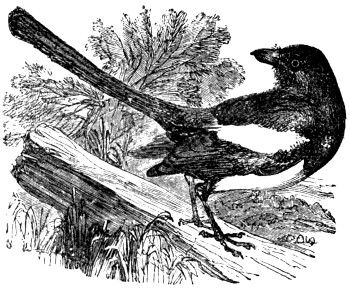
THE MAGPIE.
But what are we to say of the magpie, the very Mercury of the feathered tribes,—light, active, eloquent, and the most accomplished thief in the world? He wears all his bad qualities in the face, is not the least of a hypocrite, and carries off his delinquencies with so impudent an air that no one can help admiring him, however they may object to his principles.
Not being so plentiful in England as the jackdaw, and building his nest on the summits of lofty trees, he is not so readily procured as that bird. He is, however, so extremely amusing in his manners, that most persons would rather expend a little more money in procuring a healthy magpie than give a much less sum for the more phlegmatic jackdaw. His mischievous propensities are proverbial, and anybody who keeps one of these birds must be prepared for the commission of every imaginable delinquency. Nor must he blame the bird if it should happen to steal his watch-chain, peck a hole through his best boots, fill his bed with sticks and pebbles, upset his ink-bottle, tear his papers, put his kid gloves into the dirtiest procurable puddle, or play practical jokes of a similar kind; he has only himself to thank for his carelessness in allowing it access to his domains.
But if he makes up his mind that under such provoking circumstances the blame rests with himself, and that he will not be angry with the bird for following the dictates of its instinct, he will find his magpie a most entertaining companion, as full of odd tricks as a monkey, and as playful as a kitten. It requires very little attention, and provided that he be regularly fed, and furnished with a shelter in case of inclement weather, he will live to a venerable old age.
The fertility of invention that characterises a magpie’s mind is perfectly astonishing, and the anecdotes that are related by every one who has watched his habits are as varied as they are wonderful. There is an amount of self-reliance in the creature which betrays itself in every gesture, as well as in the knowing twist of the head; and the triumphant “carrack” that accompanies a successful piece of mischief and the impudent flirt of the tail afford unmistakeable evidence of the bird’s true character.
None of the corvine birds should be kept in cages. The jackdaw perhaps suffers least from such captivity, and the magpie perhaps the most. It has such a restless nature, that it is ever on the move, and if confined, in a cage, may be seen hopping from perch to floor, and from floor to perch, in miserable monotony of movement. Moreover, his beautiful tail always suffers severely from contact with the bars of the cage; and even if it is not rubbed down to a mere stump, as is frequently the case, it is always rendered ragged and disreputable at the tip.
As a general fact, the ordinary wicker cages are of small use. A lively, active magpie, with all its senses developed, will make little of such a cage. Sometimes he will direct his attention to the door, and never rest until he has pulled it off the hinges. Sometimes he will set deliberately to work, and peck so fiercely and continuously at the bars, that he will break them away in splinters, and make his way out. However, the best plan is to avoid cages; or if the bird really must be placed in confinement, let the cage be roomy, and made of wire.
Perhaps the chief charm of the magpie is his great capability for learning to talk, and his exceeding readiness to display that accomplishment. Some individuals are more eloquent than others, have a clearer articulation and a better memory,—just as is the case among human beings. But though all magpies may not be peculiarly excellent in their powers of conversation, they can all be taught to talk after a fashion, and are seldom chary of exhibiting their powers.
A magpie has been known to imitate the human voice so perfectly that he has induced his dupe to answer his queries, believing them to have been made by the lad whose peculiar voice was so well simulated. Very little trouble is needful to teach a magpie to talk, for his imitative instincts are very largely developed, and he is sure to reproduce with marvellous fidelity the various sounds which he may hear. He can bark like a dog, mew like a cat, cry like a child, scream like a costermonger, and occasionally swear like a trooper. But he means no harm, and may be pardoned for the unrefined language he is sometimes in the habit of using.
Magpies require plenty of water—not so much for drinking, although they are always thirsty birds, but for washing. They are extremely fond of bathing, and a plentiful supply of water is needful to keep their beautiful plumage in proper condition. The food of the magpie is the same as that of the jackdaw.
OWLS.
There are worse pets to be found than owls. They are not so immediately engaging as many creatures that have already been mentioned, but by proper management they can be made into very companionable birds, quaint, grotesque, and affectionate withal.
The chief drawback to the owl as a pet is its nocturnal habits, which cause the bird to sleep during the day and to be awake during the night. To a certain degree this custom may be corrected. The chief reason why the owl wakes at night is, that it preys upon mice and other nocturnal creatures, whether mammals or insects, and must in consequence be able to pounce upon them as they rove abroad.
Now, although at first to wake the owl will be found rather a tedious business, and to keep it awake still more difficult, a present of a mouse, or a small bird, or a large beetle, will generally rouse it, and cause it to remain awake for some little time.
To change the creature into a wholly diurnal bird is impossible, inasmuch as the entire bodily structure, as well as the temperament, is that of a nocturnal being. The eyes, for example, are formed for vision in a very dim light, being of very great size, and with pupils so large that the ordinary light of day is painful to the bird, and dazzles it so much that it cannot see sufficiently to direct its flight. Exceptional cases have occurred, in which owls have been seen abroad in the daytime, and been observed in the act of catching mice at mid-day; but such an event occurs very seldom.
Even when the bird is placed in a comparatively dark room, where the rays of the sun cannot beat upon it, the eyes are continually blinking as long as they are open, and the large nictitating membrane is ever and anon drawn over them. It may here be mentioned that the nictitating membrane is a kind of inner eyelid, made of very elastic membrane, which is gathered up in one corner of the socket, can be drawn over the eye by means of special muscles, and returns by its own elasticity when the tension is removed. It is peculiarly strong in birds of prey, and the best examples of this curious structure are to be found in the owls.
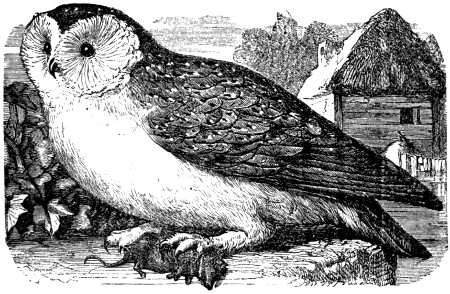
WHITE, OR BARN, OWL
In general, the owl sits, or rather stands, during the daytime, fast asleep, having a very quaint aspect, the eyes being reduced to a mere pair of lines, sloping towards the bill, and surrounded by the round discs of stiff feathers which form a “splayed” window in the dense plumage, and allow the bird a wider scope of vision than it would enjoy if the aperture in the feathers were no larger than the eye itself. Altogether the bird looks wonderfully like a Chinese mandarin of very high rank, and consequently of great obesity; the sloping linear eyelids being just as oblique as those of the Chinamen, and the two feather discs representing the huge round spectacles with which the Chinese are accustomed to aid their vision.
The position of the owl when at rest is rather curious. Instead of sitting with its head reposing on the shoulder, its legs bent, and its claws firmly grasping the perch, the bird stands stiffly upright, with its legs perfectly straight and its head upright. Here we ought to mention the popular error that birds sleep with their heads under their wings. Not only is this mistake impressed upon the young, and fostered by such familiar nursery-rhymes as that of “The north wind doth blow,” but it is in force even among educated persons, who have learned to observe as well as to think. In a recent controversy about fresh air and human lungs some of the advocates for stuffiness and closed windows employed as an argument the imagined fact that, when birds go to sleep, they exclude fresh air by tucking their heads under their wings. The force of their arguments and the accuracy of their facts were about on a par. Many birds compose themselves to sleep, but no one ever yet saw a bird put its head under its wing when going to roost. The real process is simple enough, as any one can prove who will take the trouble to watch a parrot or canary. The bird first settles itself in a comfortable attitude, which varies according to the species, and then turns its head round, and puts its beak among the loose feathers of the shoulder, the wings being kept closed and held firmly against the body.
Owls may be procured in various methods. If the reader should happen to possess proper premises, he will find that to attract owls will be as easy as to buy them, and will give him better opportunities of studying their habits. All that is required is the command of a retired spot, where the birds will not be annoyed. A little ingenuity and the expenditure of a few shillings will do the rest.
It is impossible to have a better or more complete plan of attracting the owls than that which is employed by Mr. Waterton at Walton Hall. He can, and does, attract all kinds of birds to his domain by the simple plan of affording them a secure shelter and the prospect of food. In the case of the owls the first precaution is the only one that is needful, the birds being perfectly capable of finding food for themselves. Possibly a few mice thrown on the ground might assist in attracting the birds; but as they will come when no such precaution is taken, such bait may be omitted.
There is a popular idea that neither the lion, the eagle, or the owl will eat game which they have not killed. Nothing can be more opposed to fact than such a notion: for the lion is generally killed by laying in his haunts a dead animal, which he is sure to eat; the eagle is only too glad to pick up a dead lamb; and the owl will carry off almost any number of dead mice that are placed in its way.
If the reader wishes to attract owls to his premises, he must prepare habitations for them. Knowing that the common barn owl, or white owl, as it is sometimes called, is fond of resting in buildings, Mr. Waterton has taken great pains to erect certain domiciles of which the owls are likely to approve. A large hole made in an old ruin is sure to attract the barn owl, especially if it be well sheltered with ivy, and a stout perch across the cavity may be useful. There are owl-houses in different parts of the domain, all tenanted by some bird, and most of them by the inhabitant for whose use they were made.
The jackdaw is the most pertinacious usurper that can be imagined. Any house that will suit an owl will suit a jackdaw, and the daw is so keen at discovery and so quick at utilizing his faculties, that he takes possession, and fills the hole with sticks, before the owls have a chance of securing their home.
If the brown owl is wanted, there are few places like a hollow tree, an article which can often be purchased very cheaply, set up in the grounds, and its interior arranged for the reception of the birds.
A writer in the Field newspaper has mentioned that he has been very successful in attracting the brown owl by means of an empty eighteen-gallon cask, made very clean, and fastened in a tree. A perch was placed inside, a convenient entrance-hole cut, and a quantity of very dry touchwood placed within. On this touchwood much of the success seemed to depend, for wherever it was omitted the owls declined to take possession of the cask. In order to fit it for its purpose, it was carefully dried in an oven. The exterior of the cask was painted so as to harmonize with the colours of the tree.
Should the reader be unable to fit up such a residence, he may always purchase young owls at a cheap rate, and can train them after his own fashion. In order to show how much amusement may be given by so despised a bird as the owl, the following extract from a private letter is interesting:—
“I saw a curious sight yesterday, which I think quite worth communicating to you. Some folks about us have got a young owl just fledged, and one of the boys had given him for his supper a dead swift, rather high and gamey. While he was enjoying this dainty, a young tabby kitten, æt. about eight weeks, came on the scene, and walking up to the owl, deliberately invited herself to a share in the repast. Mr. Owl did not express any objection, save by expanding his wings over his food, more suo, whereupon pussy crept under the outstretched wing, and went in for her share. It was droll enough to see the two going halves, especially as every now and then the owl got pussy’s ear by mistake, and she in like manner began gnawing at his claw.
“But the scene reached its climax by the appearance of five young ducklings hatched on Thursday last” (the date of the letter shows that it was written on Friday, and consequently that the ducklings in question were just eight days old), “who surrounded the group, and did what they could to help. The smell of the dead bird attracted, as I suppose, many small flies, which hovered about and settled, now on the owl, now on the cat, and now on the unfortunate swift. They had better have stayed away, however, for the ducklings snapped them up as fast as they alighted, while both the owl and the cat seemed quite to disregard the pokes and pecks which their bodies received from the sturdy bills of the ducklings.”
If the reader should keep owls in confinement, where they cannot procure food for themselves, he must remember that they are hungry beings, and give them plenty of food. They will eat almost any kind of meat, but are very fond of mice and small birds, the latter of which they will mostly contrive to swallow entire. There is no doubt that all the British owls feed upon small birds when they can procure them. They have been observed in the act of robbing the nests, in spite of the screams and attacks of the angry parents, and the skulls, feathers, and bones of the murdered birds have been seen in the pellets which all owls disgorge.
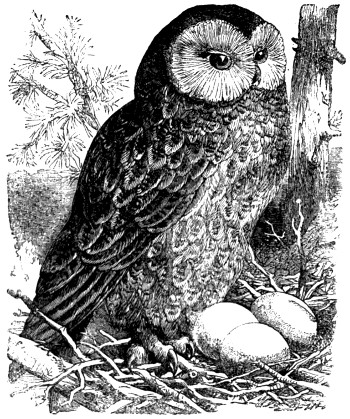
BROWN OWL.
In common with most raptorial birds, the owls disgorge the indigestible parts of their food, such as the bones, the feathers, and the skin; and as the owl eats its prey entire, the amount of such substances is remarkable. They are formed into egg-shaped masses, and may be found in plenty in the nest or on the ground near the nest. In some parts of the country these castings are called “quids.” When they are first ejected, they are wet and rather tenacious; but they rapidly become dry, and can then be crumbled down into a soft flock-like substance, which forms the bed on which the eggs repose.
These eggs can easily be recognised by their peculiar shape and texture. In form they are very globular, their shells are very thin, and the surface is rough and chalk-like, as if some one had ground a piece of chalk into coarse powder, mixed it with gum, and painted the egg with the mixture. Any one who is experienced in such matters knows an owl’s egg as soon as he handles it, even though he cannot see the object which he touches.
Their method of eating mice is very curious, and that the owl should derive any gratification from the process seems to be rather remarkable. The owl catches the mouse with its foot—a member that is wonderfully fitted for the purpose—and then shifts the mouse to its beak; in this respect differing from the hawks, which hold the prey with the foot, and only use the beak for the purpose of tearing it to pieces. At the Zoological Gardens the falcons may be seen at feeding-time with the meat in their claws, never taking it in the beak when they move, but hobbling about with a lump of raw meat hanging to one foot, and presenting a very absurd spectacle.