PART II. Athletic Sports and Manly Exercises: (continued 5)
Reading edition
As a general rule, a good player seldom if ever strikes the ball with any violence, but keeps it well in hand, trundling it along rather than knocking it forcibly, and endeavouring, if he finds it likely to pass out of his control, to strike it gently towards another of his own side, who may keep it in its course towards the enemy’s goal.
A bad player, on the contrary, rushes about without any definite purpose, shouts continually at the top of his voice, brandishes his stick to the danger of other persons’ eyes and the detriment of his own hands, which are sure to be painfully blistered in half an hour, and exhausts his strength and breath so early in the game, that he fails just at the critical moment, and sees the ball driven past him without being able to check it.
As a parting word of advice, let us recommend to our readers to play this game as quietly as they can contrive to do, and as a golden rule, always to keep the head of the hockey-stick close to the ground.
Above all, keep your temper intact, and don’t lose it even if one of your own side should make some stupid mistake, and lose you a winning game. Take especial care to keep strictly to the rules, and if your opponent should break them and render himself liable to the penalty, be merciful to his shins, and inflict the punishment as a warning to deter from future transgression, and not as a spiteful opportunity for giving a blow which cannot be returned.
RACKETS.
This game is not easily played without what is called a racket ground, which consists of a large space of ground, a parallelogram, of not less than fifty yards long, by twenty-five broad. Where such an advantage presents itself, the game may be easily attempted. Sometimes the high dead wall of a garden may be made into a racket wall, by fixing up some boards and net-work along the top, supposing there is space enough below, when the game may be played in a small way. The wall should be painted black, and the ground be divided into four equal divisions, which should be distinctly marked either by chipping a groove in it by a spade, or by chalk. It is very essential, however, that the flooring of the court should be paved. These divisions are, two close to the wall, as A and B, and two in front of them, as C and D, which divisions are occupied by those who play the game. The wall should be marked by a broad line of white paint at forty-two inches from the ground, and above this line every ball must strike. The ball is, according to law, only to weigh one ounce, and is either white, or made so from time to time by dipping into a bag of chalk, that it may be the better seen against the black wall by the players. The ball is made of pure white and tightly-sewn leather. The bat used to propel the ball is of a legal make, and its lower end of a spoon form, over which is placed a strong net-work of silk-wire, or catgut. The bat is called a racket.
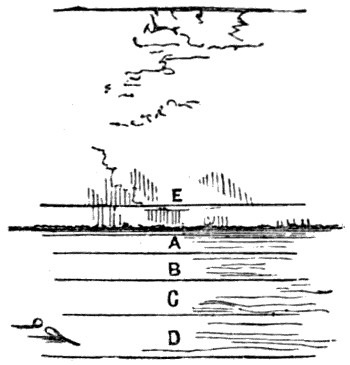
How the game is played.—Rackets is a very simple game, and may be played either by two or more players. When it is played by four persons, one stands in each of the compartments, A, B, C, D; those near the wall being called in-hand, and those furthest from it out-hand players. When two play, each player takes two of the divisions, and the one who takes the A first from the wall is called in-hand player, and the other out-hand player. Having determined by lot who is to begin the game, the in-hand player nearest the wall strikes his ball against it; if it strikes under the line, goes over the wall, does not rebound into the out-hand spaces, or goes beyond the racket ground, the striker is out, and the out-hand player takes his place; but if the player is more successful, and the ball rebounds into the out-hand spaces, and hopping from the ground is sent back to the wall again, to rebound into one of the in spaces, the game goes on. In a close-court game the “server” who serves the ball properly above the line but not accurately into his adversary’s court is allowed three trials before his “hand” is out. The play of the game is, that the in-player should send the ball in such a manner against the wall that, on its rebound, the opposite party, or player, shall be able to pick it up or hit it. Whenever this happens, he who struck the ball counts one point, or an ace, and the play is continued until one player or party scores eleven, or, as is sometimes and now more frequently played, fifteen.
This capital game, so conducive to health and affording such excellent exercise, may be played either in an open court—that is, a court with only one wall, against which the game is played—or in a closed court which is surrounded by four walls. Sometimes a compromise is made by the employment of the ordinary high front wall, and a smaller back wall, omitting the side walls altogether. The closed court game is the best and far the most scientific, but the great expense necessary for erecting a proper court compels many to content themselves with an ordinary old-fashioned open court game, for there seems little doubt that the open court game is the oldest and the one which in old days was held in highest favour.
RIDING.
“Fleet as the wind, he shoots along the plain, And knows no check, nor heeds the curbing rein; His fiery eyeballs, formidably bright, Dart a fierce glory, and a glowing light; Proud with excess of life he paws the ground, Tears up the turf, and spurns the sand around.”—Blacklock.
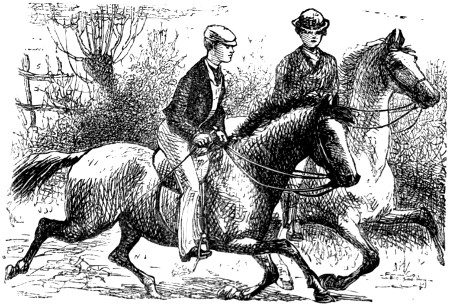
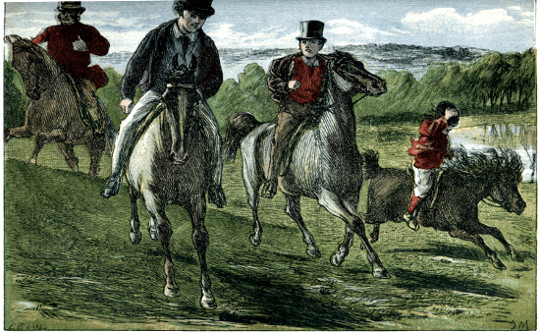
A boy on horseback is a king on his throne; he feels more than “boy” the moment he gets astride of anything in the shape of a nag. Boys have an instinct for riding, an impulse they cannot resist, like the instinct for eating, breathing or moving. In his earliest days, in the very “boyhood of being,” “Ride a-cock horse to Banbury Cross” is a ditty of infinite delight, and long before the days of corderoys the equestrian exercise of “Grandfather’s Stick” affords him “joy ineffable.” Then comes the noble game of Hippas, or the wooden “Bucephalus,” on which he feels greater than Alexander; and last, though very little, yet still not least, the “pet Shetland,” which adds to the bliss of being mounted, a positive progressive locomotion, and the “greater than Alexander” is made greater still. Considering, therefore, that all boys love riding, it is for us to tell them how they may “mount the fiery Pegasus,” and ride with elegance and safety,
“To witch the world with noble horsemanship.”
RIDING.
THE HORSE.
The horse is one of the most beautiful and graceful animals in nature, and perhaps the most useful to man, though in this respect it would be difficult to say which of the four or five domesticated quadrupeds bears the palm. During life, the horse and the dog would each contest the point; while in relative value after death, the bullock, sheep, and swine, are fairly entitled to an equal share with them. But there is something very captivating in the appearance of the horse, whether used for the purposes of war, or for racing, or for hunting, or road-work; and in all these several capacities the readers of this book may possibly admire him, though it is chiefly as the riding-horse, or hack, that he usually attracts their notice.
In the animal kingdom, the horse belongs to the division Vertebrata, and class Mammalia, he having a back-bone composed of vertebræ, and his young being suckled. His broad and undivided hoof places him among the ungulata; and lastly, his teeth are as follows, viz. six front teeth, above and below, called “nippers;” two canine in each jaw, called “tusks;” and the remainder, consisting of grinders, having flat surfaces opposed to each other, with rough ridges on them, by which the grass, hay, and corn are rubbed or ground down to a fine pulp, adapted to the stomach. These teeth are moved or rolled on each other by a peculiar action of the muscles of the jaw, so as to aid the process.
THE MARKS OF AGE IN THE HORSE.
By means of the gradual wearing down of the front teeth, or nippers, the age of the horse may be known. Each of the nippers has a hollow in its upper surface, which is very deep and black when the tooth first rises above the gum, and is gradually effaced by the friction caused by the cropping of the grass, or by biting at the manger, or other kinds of rubbing; but as these vary a good deal according to circumstances, so the precise degree of wearing away will also be liable to fluctuations; and the rules laid down only approximate to the truth, without positive accuracy as to a few months. There are also two sets of teeth; a milk set, which first rise, beginning at once after birth, and a permanent set, which replace the milk-teeth as they fall out. The milk-teeth come up two at a time, but all are up by the end of the first year. The permanent teeth, also, make their appearance by twos, the first pair showing themselves in the place of the two middle milk-teeth in the third year, and being generally level with the other milk-teeth by the end of the fourth year, by which time the next pair have fallen out, and the permanent teeth have shown themselves in their places. At five years of age the horse has lost all his nippers, and his corner permanent teeth have nearly completed their growth. The tusks are also above the gums. The centre nippers are now much worn, and the next are becoming slightly so. At six years old the “mark” in the centre nippers is quite gone; at seven years of age this disappears from the next pair, and at eight from the corner nippers; after which, none but a professed judge is likely to make out the age of the horse by an inspection of his mouth; and, indeed, at all times the tyro is liable to be deceived by the frauds of the low horse-dealer, who cuts off the top of the teeth, and then scoops out a hollow with a gouge; after which a hot iron gives the black surface which in the natural state is presented to the eye. This trick is called “bishoping.”
THE PACES OF THE HORSE.
The natural paces of the horse are the walk, trot, and the gallop; to them are added by man the canter, and sometimes the amble and the run. In the walk, each leg is taken up and put down separately, one after the other, the print of the hind foot in good walkers generally extending a few inches beyond that of the fore foot. The order in which the feet touch the ground is as follows: 1st, the off fore foot; 2d, the near hind foot; 3d, the near fore foot; and 4th, the off hind foot.
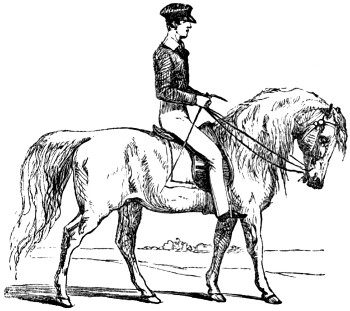
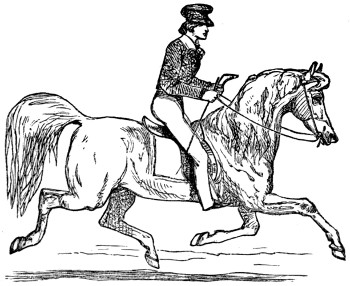
The gallop consists of a succession of leaps, during a great part of which all the feet are off the ground. As the feet come to the ground they strike it in regular succession; but the exact order will depend upon the lead, which may be either with the off or near fore leg. When in action and the horse is leading with the off fore foot (which if well broken he would do), the off hind and near fore feet touch the ground simultaneously next the near hind foot, and lastly, the off fore foot which he leads with. In the trot, the two legs of opposite sides are moved exactly together, and touch the ground at the same moment; whilst in the amble the two legs of each side move together, and the horse is supported for the instant upon the half of his usual and regular foundation. To counteract this deficiency in the centre of gravity, the body is balanced from side to side in a waddling manner.
TERMS USED BY HORSEMEN.
The left side is called the “near side,” the right the “off.” Four inches make “a hand.” The upper part of the horse’s neck is called his “crest;” the bony ridge in front of the saddle the “withers,” the part between the saddle and the tail the “croup;” the bony points, one on each side the bosom, the “shoulder points;” and the line between these and the back of the withers, corresponding with the shoulder blade, is the “line of the shoulder.” The body between the hip and shoulder line is called the “middle piece.” In the fore legs, the two divisions are called the “arm” and “cannon;” above which is the “elbow-joint,” and between them the “knee-joint.” In the hind leg, the two parts are called the “thigh” and “cannon;” and the joints are the “stifle” and “hock.” Below these, in both the hind and fore legs, are the upper and lower “pasterns,” then the “coronet,” or ring between the leg and foot, and lastly, “the hoof.”
FORM OF THE HORSE.
It is a common observation of the horseman that the horse can go in all forms; and this is borne out by the fact, that he does occasionally do so; but nevertheless, it is well known, that among a large number it will be found that those whose form is most in accordance with the shape considered the best by good judges, will turn out the best movers. In technical language, the horse whose “points” are the best will be the best horse. These points are considered to be: a neat head well set on a lean wiry neck, the latter with a very gentle curve, whose convexity looks upwards (the opposite form to this makes the “ewe neck”); moderately high withers; a sloping shoulder, wide in the blade, which should be well furnished with muscles; strong muscular loins; a croup not too straight nor too drooping, with the tail set on with an elegant sweep; ribs well rounded, and carried back near to the hips, so as to make the horse what is called “well ribbed;” circumference or girth of good dimensions, indicating plenty of “bellows’ room;” thighs and arms muscular; hocks and knees bony and large, without being diseased; cannon bones large and flat, with the suspensory ligament and tendon large, strong, and clearly defined; fetlock joints strong, but not round and inflamed. The eye should be full, clear, and free from specks; and the ears should be moderately small and erect; the feet should be round, and not contracted at the heels, with a well-formed frog.
VARIETIES OF THE HORSE SUITABLE FOR BOYS.
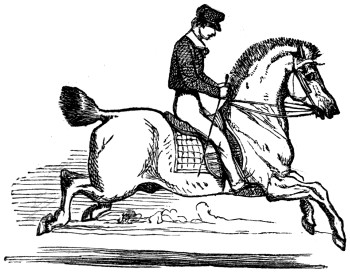
Besides the several kinds of horses suitable for grown people, those for boys are the galloway, the cob, and the pony. The first of these may be considered either a small horse or a large pony, and is usually about fourteen hands high; and though strong and capable of carrying weight, yet of a moderately light and active make. He is so called from the district where he was originally bred in large numbers. The cob is a thick and very strong pony, or galloway, frequently made to look still more so by cutting his tail and mane short, called “hogging” them, thus—
Correctly speaking, a pony is understood to be under thirteen hands in height, a galloway between thirteen and fourteen and a half, anything over that a horse.
Many ponies are now bred almost of pure Arabian blood, and they are well suited for lads who have mastered the early difficulties connected with keeping the seat under all ordinary circumstances; but as they are generally very high-spirited, they are scarcely suited for the beginner, and he had better content himself with an animal of more plebeian pedigree and sluggish temperament.
THE ACCOUTREMENTS AND AIDS
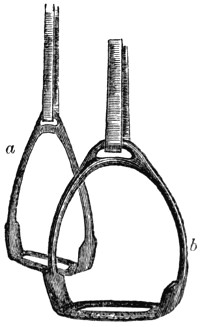
Required by the young amateur, are either a pad or saddle, according to his age, together with a bridle and a whip or stick. Spurs are seldom desirable for any but the accomplished rider, as they are apt to irritate the pony if not used with discretion, and it is rather difficult to put an old head upon young shoulders. If the learner is very young, a pad which is made without any tree affords a better hold for the knees than a regular saddle, and will also enable him to ride without stirrups, which feat he will hardly manage on an ordinary smooth saddle. The stirrups are of the following form, but are often, for boys, made much lighter. They ought always to be used with strong stirrup leathers, and these should be attached to the saddle by spring-bars, which release the stirrups in case of the leg being entangled in them after a fall. The groom should always remove the leathers after the ride, and replace them on the opposite side of the saddle, by which means their tendency to hang as shown at (a), is rectified, and they assume the position indicated by the one marked (b), both representing the left, or near, side.
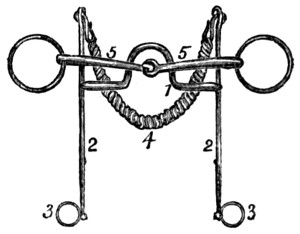
The bridle is either a single or a double-reined one, according to the mouth of the pony ridden. A single-reined bridle is usually a snaffle, it being very improper to allow any one to ride with a curb alone, unless he has very steady and light hands. The snaffle bit is merely a jointed bar of iron (5 5) in the accompanying sketch, but when used alone it has a light cross-bar as well as the ring there shown, in order to prevent the bit being pulled through the mouth. This, however, in the double-reined bridle is omitted, since it would interfere with the action of the curb. Snaffles are either smooth or twisted, and are made of all sizes, the smallest being only adapted for occasional use, and not for the hands of the learner, who should have a large smooth one. The curb-bit consists of three parts; the mouthpiece (1), which usually has a bend in it called the port, for the purpose of pressing against the roof of the mouth; secondly, of the cheek-piece (2), which has a ring (3) at the lower end for the attachment of the rein, and another at the upper end for the head-piece of the bridle; and thirdly, the curb-chain (4). This chain is pressed against the outside of the lower jaw, by the upper arm of the curb used as a lever, and it should be hooked up sufficiently tight to act upon it by pulling the rein, whilst at the same time it should be loose enough to prevent its fretting the jaw. This delicacy of adjustment requires some little practice, and the young rider should always ask his teacher to show him the proper mode of applying the curb-chain. Sometimes a martingale is needed, in order to keep the pony’s head down, but generally the young rider is better without it, if he will keep his hands well down, and avoid all jerking of the mouth.
MOUNTING.
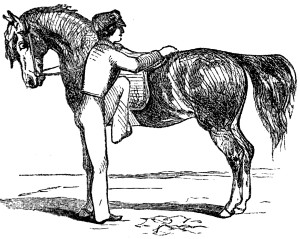
The rider, even at the earliest age, should first examine the girths and the bridle, and see if they are properly adjusted; for though when leaving home he may be able to depend upon a steady and experienced groom, yet, after putting up at strange stables, he is liable to be led into an accident by careless servants, and therefore it is better to get into the habit of always inspecting these essentials to safety and comfort. If there is an attendant groom, he should hold the rein with his right hand, standing by the off shoulder of the horse, so as with his left hand to hold the stirrup iron for the rider’s right foot as he throws it over the horse’s back. The next thing to be done is for the rider to stand at the shoulder of the pony with his left side towards that part. He then lays hold of the reins with his left hand, drawing them up so short as to feel the mouth, and at the same time twisting a lock of the mane in his fingers so as to steady the hand. Next, the left foot is placed in the stirrup when the accompanying attitude is presented, exactly as here shown. At this moment a spring is given from the right foot, the right hand reaches the cantle of the saddle, and the body is raised till the right leg is brought up to the level of the left, when the slightest imaginable pause is made, and then the right leg is thrown over the back of the pony, keeping the toe down and heel elevated, or with the spur on mischief may happen, while the right hand leaves its hold, and the body falls into its position in the centre of the saddle; after which, the right foot has only to be placed in the stirrup to complete the act of mounting.
DISMOUNTING
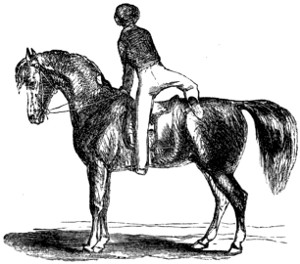
Is exactly the reverse of the last process, and requires, first, the reins to be shortened and held in the left hand with a lock of the mane; secondly, the right leg is taken out of the stirrup, and is thrown over the back of the horse until it is brought down to the level of the other leg. After this, if the pony is of a small size, suitable to that of the rider, the body is gently lowered to the ground, and the left leg is liberated from the stirrup; but if the horse is too high for this, the foot is taken out of the stirrup by raising the body by means of the hands on the pommel and cantle of the saddle, and then the body is lowered to the ground by their assistance.
THE MANAGEMENT OF THE REINS
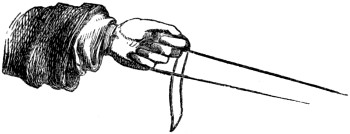
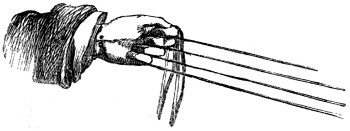
Is of great importance to the comfort of the rider, and also to his appearance, for unless they are held properly, the body is sure to be awkwardly balanced. When the single rein is used, the best position is to place the middle, ring, and little fingers between the two reins, and then to turn both over the fore-finger, where they are tightly held by the thumb. In all cases the thumb ought to point towards the horse’s ears, by which the elbow is sure to be kept in its place close to the side, and a good command of the reins is insured. If a double-reined bridle is employed, the middle finger separates the two snaffle reins, and the little one those attached to the curb, all being turned over the fore-finger, and firmly held by the thumb. In both cases the ends of the reins are turned over the left, or near, side of the pony’s shoulder. When it is intended to turn the horse to the left, it is only necessary to raise the thumb towards the chest of the rider; and on the contrary, when the desire is to turn him to the right, the little finger is turned downwards and backwards towards the fork. In many well-broken ponies the mere moving of the whole hand to the right or left is sufficient, which, by pressing the reins against the neck, indicates the wish of the rider, and is promptly responded to by the handy pony. This action, however, is objected to by some good horsemen, though, in my opinion, most erroneously, as it is capable of being made highly effective in practice.
THE SEAT
Should always be square to the front, without either shoulder being in advance; the loins moderately arched inwards without stiffness; the elbows close to the side, but held easily; the knees placed upon the padded part of the flat in front of the stirrup-leathers; toes turned very slightly outwards, and the foot resting on the stirrup, the inside of which should be opposite the ball of the great toe, and the outside corresponding with the little toe. In hunting, however, it may be placed “home,” that is, with the stirrup close to the instep. The heel should be well lowered as far as possible beneath the level of the toe, which gives a firm seat. But the great point is to obtain a good grasp of the saddle by the knees, which should be always ready to lay hold like a vice, without however constantly tiring the muscles by such an effort. The left hand is now to be held very slightly above the pommel of the saddle, and the right easily by the side of it, with the whip held in a slanting position, as at page 273, in which however both hands are much too high above the withers. In order to show the effect of an incorrect mode of holding the reins, the rider has only to place his hands with the knuckles in a horizontal position, and the elbow is sure to be turned out in a most awkward manner.
THE CONTROL OF THE HORSE
Is effected by the reins, heels, voice, and whip, variously used according to his disposition and temper. Some require only the most gentle usage, which in fact is almost always the most efficacious, especially by young people, for whom the horse and dog seem to have an especial affection, and to be always more ready to obey them than might be expected, when their want of strength to enforce their wishes is considered. The young rider will therefore generally find it to his own interest, as well as that of the noble animal he bestrides, to use his whip and heel as little as possible, and to effect his object solely by his voice and the gentlest pressure of the bit. In this way the most high-couraged horses are kept in order by young lads in the racing stables, and the amateur will do well to follow their example. It is astonishing how fond horses and dogs are of being talked to by their juvenile masters, and it is right to gratify their love of society by so doing on all occasions. The reins serve, as already explained, to turn to the right or left, or by drawing tight to stop the horse, and on the contrary, by relaxing them to cause him to proceed, aided if necessary by the voice, heel, or whip. When it is desired that the right leg should lead in the canter or gallop, the left rein is pulled and the left leg pressed against the flank, by which means the body of the pony is made to present the right side obliquely forwards, and by consequence the right leg leads off. On the other hand, if it is wished to lead with the left leg, or to change from the right, the right rein is pulled, the right leg pressed to the side, and then the left shoulder looks forwards and the left leg leads off.
MANAGEMENT OF THE WALK.
When it is wished to make the pony walk, he must be quieted down by soothing him with the voice if he has been excited by the gallop or trot; and then, by sitting very quietly in the saddle, and loosing the reins as much as will allow the head to nod in unison with the action of the body and legs, the walk is generally at once fallen into, and there is no farther difficulty except to prevent a stumble. A tight rein is not desirable in this pace, since it prevents that liberty of action which is required, and leads to a short walk, or very often a jog-trot; and yet there should be such a gentle hold, or preparation for a hold rather, as will suffice to check the mouth in case of a mistake. This is a very difficult art to acquire, and is only learnt by long practice; but as few ponies fall at this pace, great liberty may generally be allowed to their mouths. Besides this, little is necessary, more than to sit steadily, but not stiffly, in the saddle, and not to sway about more than is sufficient to avoid the appearance of having swallowed a poker.
THE TROT AND CANTER
Are effected by rather different methods, but both require a very steady hand, and a quiet treatment. In order to cause the pony to trot, the reins are taken rather short in the hand, and the mouth is held somewhat firmly, but taking great care not to jerk it. The animal is then slightly stimulated by the voice, and the body, if necessary, rises from the saddle, as in the trot, so as to indicate what is wanted. This seldom fails to effect the purpose, and the horse at once breaks into a trot; or, if very irritable, he may be compelled to do so by laying hold of an ear and twisting it, to avoid which he drops his head, and trots as a natural consequence. The canter is also an acquired pace, and for its due performance a curb-bridle is required. In order to make the pony begin this pace, the left rein is pulled, and the rider’s left leg pressed against the side, by which the horse’s right leg is made to lead off, this being the most usual, and certainly the most comfortable “lead” for the rider. The hands must make a very gentle and steady pull on the curb-rein, and the body generally must be very quiet in the saddle, whilst, at the same time, a very gentle stimulus is given by the voice, which must be repeated at short intervals, or the canter will be changed to a trot, or walk, both of which are preferred to it by most ponies and horses. Young riders should avoid cantering long upon one leg, as it leads to inflammation of the joints, and they should either change the lead or alter the pace to a trot or walk.
THE MANAGEMENT OF THE GALLOP
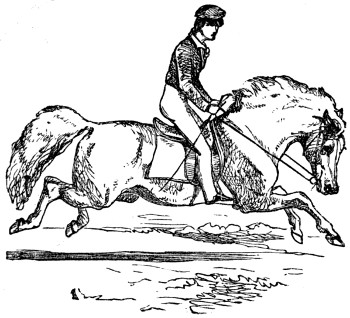
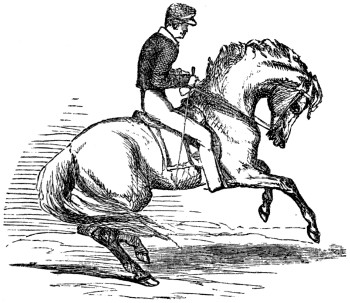
Requires little instruction, practice being the main agent in effecting a good seat during this pace. The seat is either close to the saddle, with the body inclining backwards (p. 275), or standing in the stirrups, in which position the knees and calves only touch the saddle, and the body is bent forwards over the withers (p. 273). It should be the endeavour of the rider, while he bends his shoulders forwards, to throw his loins well back, so as to avoid straining the horse’s fore-quarters, by bearing too much weight upon them. This is done by the hold of the knees on the saddle, and by keeping the feet back, also by rounding the loins backwards, and thus throwing the centre of gravity as far as possible behind the stirrup leathers. The object of standing in the stirrups is to save the horse when at his full gallop, as in racing, or in hunting, when he is going over ploughed ground or up hill. In either of these cases, this attitude allows the horse to exert himself without feeling the weight of the rider impede his movements more than can be avoided.
LEAPING
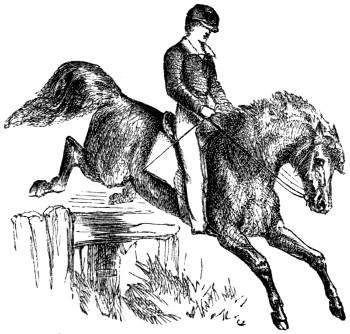
Is only an extra exertion added to the ordinary spring of the gallop, the attitude being exactly the same. It is best learnt by beginning with small ditches, which the rider is soon able to clear without difficulty. He may next try sheep-hurdles, or very low stiles; but the latter being strong and firmly fixed, are dangerous to the rider, unless the pony is very sure of clearing them. A leaping-bar, if procurable, should always be adopted in preference to either, as a fall over it is not attended with any bad consequences. The groom should place it at the lowest notch, and the pony then may be suffered to clear it at a moderate gallop; after which, if the young rider is able to sit pretty closely, he may be indulged with a higher notch, and gradually it may be raised until the limits of the pony’s powers are reached. In riding at a bar, the learner should lay hold of a snaffle-rein in each hand, taking care to keep them close together, by the right rein being held also in the left hand. The pony is then to be urged to a smart canter or hand gallop, and held straight to the bar in this way, so that he is obliged to leap; or if disliking the act, being urged by the whip down the shoulder, or the spur, or the groom’s voice and whip behind. Young riders, however, should never be put upon a bad or reluctant leaper, but should be taught upon one which is fond of the amusement. At the moment of rising into the air for the leap the reins are relaxed, but should not be left quite loose; while the pony is in the air the body becomes upright, and as he descends it leans well back, until, after a high leap, it almost touches the croup. During this period the reins should be suffered to remain nearly loose, the hand barely feeling the mouth; but as the pony reaches the ground a stronger hold is taken, in order to guard against a mistake, which might require the aid of the rider to prevent a fall. It is not that he can keep the animal up, but that he checks him, and makes him exert himself in a double degree. There are various kinds of leaping; as the flying leap, the standing leap, the leap in hand, &c. The flying leap is merely one taken at a fast pace, and when the rider can maintain a good seat in the gallop, it is the easiest of all to sit. The standing leap is effected from a state of quiescence, and is much more difficult to sit, because the horse rises and falls more suddenly and abruptly. Between the two is the slow or steady leap, which is only effected safely by the clever hunter or well-broken pony; but when perfect it is almost as smooth as a rocking-horse. This is the mode in which the young rider should be taught to leap. Leaping in hand is necessary for most ponies in the hunting field, which would otherwise never be able to compete with full-sized hunters in the way they do. The young hunter, when he meets with a gate or other strong fence, which he knows is too much for the powers of his pony, at once gets off and leads him over by the rein; and when well taught, these little creatures will often tilt themselves over high timber, &c. in a marvellously clever manner, so that I have known them in this way obtain a good place in long and severe runs. If, therefore, my readers are allowed to partake in this exciting sport during their Christmas holidays, they should teach their ponies to leap in hand, or they will be sure to be thrown out.
TREATMENT OF VICES.
The chief vices which are met with among ponies are—1st, Obstinate Stopping; 2d, Stumbling from Carelessness; 3d, Rearing; 4th, Kicking; 5th, Shying; and 6th, Running Away.
Obstinate Stopping, which in its worst forms is called “jibbing,” is a very troublesome vice, and even in the saddle is sometimes attended with danger, whilst in driving it is so to a dreadful degree.
The rider should never attempt to force his pony forward with the whip or spur, which only aggravates the bad-tempered brute; but should patiently sit quiet in the saddle, and keep his temper, until the pony chooses to move forward again. In this way sometimes very vicious animals are cured when they find that their stable is not the sooner reached by their device; on the other hand, if the whip is used, the pony, especially if of Welsh breed, is very apt to lie down and roll his rider in the dirt, or even sometimes to bolt into a river, or pond, and leave him in danger of his life. My young friends will therefore remember my advice when being mounted upon an obstinate pony, and having lost their tempers, they have proceeded to use their whips, and are bemired or half drowned in consequence.
Stumbling is more a defect of conformation than a vice; but nevertheless, it greatly depends upon a want of spirit to keep up a steady action of the fore legs. It often happens that a pony trots along for a mile or two safely enough; but after going that distance he becomes lazy and careless, and trips with one foot and then with the other, a sure prelude to such a fall as the following, which would be a very bad one, and sufficient to cut both knees to the bone, and to cause serious damage to the rider. The only way to avoid such accidents is to keep the pony at a steady pace, fast enough to keep him alive, but not enough so to tire him. Loose stones and broken ground should be avoided, and a careful hold should be kept upon the mouth, without being so tight as to gag it. When a stumble actually takes place, the body should be well thrown back and the mouth forcibly jerked, so as to make the pony exert himself to keep his legs. An unsafe animal of this kind is, however, wholly unfit for young riders, and they should never be allowed to ride one.
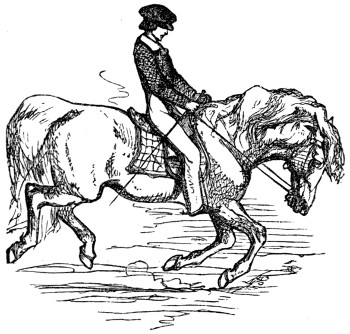
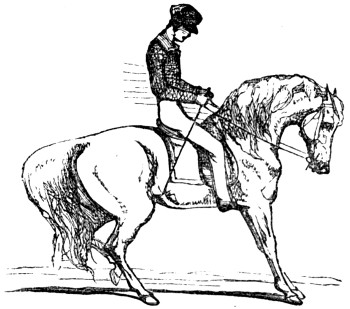
Rearing is a very dangerous vice, and not very common among ponies after they are once broken in. If the rider should, however, be placed upon a rearer, he should be careful to avoid hanging upon the bit when he rises in the air, but on the contrary should loose the reins entirely, and clasp the neck, if the pony should rise very high in the air. The accompanying sketch shows this vice in a very trifling degree, and in such a case the seat thus represented is sufficiently forward to prevent accidents.
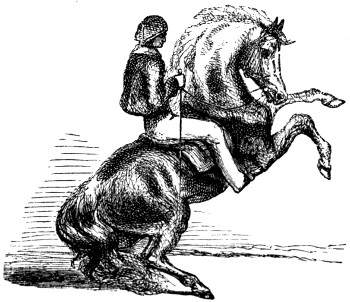
The rider will, however, observe that the reins are quite loose. It often happens that this vice is produced by too tight and severe a curb in a tender mouth, and that upon changing the bit, or letting out the curb chain, the tendency to rise is entirely gone. Whenever, therefore, the young rider finds his pony inclined to rear, let him look well to his bit, and at once drop the curb rein if he has one. If, however, he has only a snaffle, he may rest assured that it is a regular habit, and at once make up his mind either to battle with it or to change his pony.
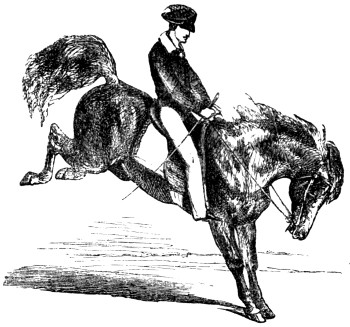
Kicking is much more common among ponies than rearing, and very many of these little animals are given to practise it. It is perhaps partly owing to the teasing of their young masters that it is so common; but whatever the cause, there can be no doubt that it is too prevalent among them. Sometimes it exists as a regular attempt to unhorse the rider, which is a very troublesome habit, and one very difficult to break, because it so often succeeds that the pony is tempted to try again. When this vice is met with, the rider should do all in his power to keep his pony’s head up, by jerking the bit, and at the same time he should sit well back, with his feet well forwards, with heels down, and trust to his knees in holding on. When kicking is only the result of high spirits and “freshness,” the best remedy is a smart gallop, which soon stops all these pranks, and makes the most riotous animal quiet.
Shying is also very common among ponies, and in them is often the result of cunning, which leads them to pretend a greater degree of shyness than they really possess. The best mode of treatment is to take as little notice as possible of the shying, but carefully to make the pony pass the object at which he is looking, without regarding how this is effected. The whip should seldom be used at all, and never after the object is passed.
Bolting, or Running Away, is often the result of want of exercise, but sometimes it is a systematic vice. A powerful bit and a steady seat, with good hands, are the best means of grappling with this habit, which is sometimes a very dangerous one. If the pony really runs away, the rider should not pull dead at his mouth, but should relax his hold for a short time, and then take a sharp pull, which is often effectual. A good gallop until he is tired will often cure a runaway for the rest of his life. There are a variety of bits intended expressly to counteract this vice, such as the Hanoverian Pelham, the curb with a high port, &c.; but nothing is perfectly effectual where there is a determination to run away. A nose-band has lately been invented for the purpose, which answers better than anything hitherto brought out; it consists of a long nose-band which crosses behind the jaw and then hooks on to the bit in the same way as the ordinary curb-chain. When the rein is pulled hard, this nose-band is drawn tight round the jaw, by which the mouth is closed, and the port is pressed strongly against the roof of the mouth, causing a great degree of pain, sufficient to stop most horses. This powerful remedy, which has been named the Bucephalus nose-band, should not lightly be used; but in the case of a runaway horse, or pony, it is the only really efficacious one.
ROWING.
“A boat, a boat, is the toy for me, To rollic about in on river and sea; To be a child of the breeze and the gale, And like a wild bird on the deep to sail, This is the life for me!”—Procter.
HISTORICAL MEMORANDA.
The sea service is the glory of Old England, notwithstanding all the glorious land service of ancient and modern days. A country having nearly ten thousand miles of sea-coast, with numerous ports, harbours, estuaries, river mouths, and capacious bays, must ever be a maritime nation, and look for its supremacy to the sea—to her sons being amphibious; and nothing is better calculated to develop the inherent instinct for sea duties than the amusements of boating, of rowing, of sailing, and other aquatic sports. Every young gentleman in England should know how to manage a boat, and to sail a cutter; and it will be our duty to initiate him into the methods of doing so.
The origin of ships must be traced to the ark of Noah; but this was not a sailing or a rowing vessel, but simply a large floating house or receptacle for Noah and his family, and the various types of animated nature. The first navigators were the Phœnicians, who sailed in various seas. They were succeeded by the ships of Carthage, Egypt, Venice, Genoa, Holland, and Portugal. The Saxons under Alfred, and the Danes under Canute, had formidable navies. Alfred, who ascended the throne in 872, commenced the first English fleet in person, and is said to have suggested a variety of improvements in the structure, as well as greatly to have increased the size of the vessels, some of the largest of which carried sixty oars. After the death of Alfred, the naval power of England seems to have lain dormant; and this, no doubt, tempted the Norman invasion in 1066, under William the Bastard, who sailed for the coast of England with a fleet of 900 vessels; and so sensible was he of the importance of the naval service, that he gave certain privileges to certain towns on the sea-coast, which were from their number called the Cinque Ports. Richard I. fitted out large fleets; and his successor, John, asserted the exclusive right of the English nation to the dominion of the seas. The reign of Edward I. was also distinguished for successes at sea. Henry VII., on gaining the throne, in 1485, put the navy into a respectable condition; and a large ship, called the “Great Harry,” which may properly be termed the first ship of the British navy, was built at a cost of 14,000l. The discovery of America, about the period of the accession of Henry VIII., gave a new stimulus to our navy, and many ships were then built of large tonnage, some of a thousand tons. But Queen Elizabeth, deeply impressed with the maxim, that “whosoever commands the sea, commands the trade of the world,” and that “whosoever commands the trade, commands the riches of the world,” and consequently the world itself, so encouraged and restored the marine, that she may be called the “Restorer of the naval power of England;” and, in a few years after, the invasion of the Spanish Armada put our naval power to the proof. Charles I., the great and courageous Cromwell, and even the pleasure-loving Charles II., were all impressed with the great advantages of a formidable navy; and in the reign of Anne, fifty-two French ships, containing more than 3,000 guns, were captured. And during the reign of George III. the naval superiority was placed by a series of glorious successes beyond all dispute; and it is to be hoped that the reign of our beloved Queen Victoria, who is herself a sailor, and full of every generous aspiration that belongs to a British Tar, will, notwithstanding the “mistakes of the Admiralty,” prove that England still retains the sovereignty of the ocean, and on that element she will defy the world.
CONSTRUCTION OF ANCIENT SHIPS AND GALLEYS.
The Egyptian vessels are the earliest of which any well-authenticated graphic illustration has been preserved. We here give a view of one of their earliest sailing vessels. The celebrated Egyptian vessel called the “Isis” is said to have been in length 180 feet, in breadth 45 feet, and in height, from the upper edge of the deck to the bottom of the well, 43 feet. The well-known ship of Hiero, king of Syracuse, was nearly 400 tons burden.
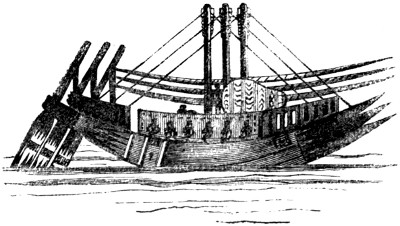
ROMAN GALLEYS, SHIPS, ETC.
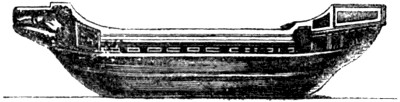
They were in length about 125 feet, and in breadth 10 feet. Their first requisite was swiftness, and no part of the side was left vacant where an oar could be put out; hence they had often three banks of oars, one above the other. In most ancient ships, there was placed at the prow an image called “the sign.” The part of the vessel that cut the water was called the “goose.” At the stern, which generally resembled a shield, was set or some way delineated a representation of the deity to whose tutelary favour the ship was committed, and to which daily prayer and sacrifice were offered. War ships were chiefly rowed with oars, that they might be able to tack about. The first long ships were rowed with fifty oars, but afterwards a larger number was used. In the more perfect condition of ancient navigation, there were some ships that had as many as five tiers of oars, and three hundred rowers. Two large holes at the prow of the vessel, occasionally used for oars, were called the ship’s “eyes;” and a wooden projection at the prow, covered with brass, was called a “beak;” and pieces of wood placed on each side of the prow of a vessel, to ward off the force of the enemy’s beak, were called the ship’s “ears.” Over these vessels were certain raised platforms, and on their forecastles were towers on which the soldiers stood, whose shields were usually hung upon the railings which begirt the ship. The sides of the prow were called “cheeks.” The anchors at first used were often large stones, or even bags of sand; afterwards, however, the ancient ships carried anchors with one, two, and four flukes. The larger anchor was called the “sacred anchor,” and reserved for the most trying occasions. Among the ancients, ships were usually termed “horses,” which explains many ancient fables. The elder Pliny, for instance, tells us of a boy who was carried by water some miles every day on the back of a dolphin to school; the vessel, in all probability, having a dolphin at the prow. Arion, the famous musician of Lesbos, having made great wealth in foreign parts by his profession, was returning home by ship, when the sailors resolved to kill him, and seize upon his riches. Playing once again, at his last request, a favourite tune, he leaped into the sea. A dolphin, attracted by his melody, received him safely on its back, and carried him again to the coast where Periander lived. Arion, doubtless, escaped by a boat, the fore-part of which consisted of a dolphin.
Having thus given the young reader a notion of ancient boats and ships, we shall now proceed to make him acquainted with the modern practices of rowing, boating, sailing, &c.
OF BOATS.
A Boat is properly a vessel propelled by oars. In a more extensive sense the word is applied to other small vessels, which differ in construction and name, according to the services in which they are employed. Thus they are light or strong, sharp or flat-bottomed, open or decked, according as they are intended for swiftness or burden, deep or shallow water, &c.
The Barge is a long, light, narrow boat, employed in harbours, and unfit for sea. The Long Boat is the largest boat belonging to a ship, generally furnished with two sails, and is employed for cruising short distances, bringing the cargo and bales on board, &c.
The Launch is more flat-bottomed than the long boat, which it has generally superseded. The Pinnace resembles the barge, but is smaller. The Cutters of a ship are broader and deeper than the barge or pinnace, and are employed in carrying light articles, single passengers, &c. on board.
Yawls are used for similar purposes to the barge and pinnace. A Gig is a long, narrow boat, used for expedition, and rowed with six or eight oars. The Jolly Boat is smaller than a yawl, and is used for going on shore. A merchant ship seldom has more than two boats,—a long boat and a yawl.
A Wherry is a light, sharp boat, used in a river or harbour for transporting passengers. A Punt is a flat-bottomed boat, chiefly used for fishing on a fresh water river. A Skiff is a small sharp-nosed boat, used in rivers. A Dingy is a very small stiff boat used by yachts. A Yacht is a pleasure sailing-boat. A Lugger is a boat which is furnished with sails of a peculiar cut. A Funny is a small light boat used in river rowing, and made with her bow and stern nearly alike.
THE COMPONENT PARTS OF BOATS.
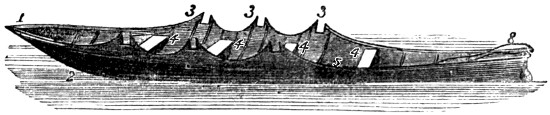
Rowing boats consist of the bows (1); the stem, or entrance (2); the stern (8), where are the rudder and the lines for steering; the rowlocks (3), for giving purchase to the oars; and the thwarts, or seats (4). At the bottom are the foot-boards (5), which are easily removed, in order to bail out any water which may leak into the boat. Besides these parts there is a board placed across the boat for the feet of the rower, called a stretcher. The whole boat is composed of one or more planks, called streaks, nailed upon a light oak framework, called the timbers, or ribs; and the upper streak, upon which the rowlocks are placed, is called the wale-streak. Boats with two rowlocks opposite each other are called sculling boats, and are propelled by a pair of light oars called sculls, the art being called “sculling.” When a boat is fitted with a pair of rowlocks not opposite each other, it is called a pair-oared boat. If with two in the middle opposite each other, and two others, one before and the other behind, but not opposite each other, it is called a randan. When a boat has four rowlocks, none of which are opposite one another, it is called a four-oared boat, and so on up to ten oars, which is the utmost limit in common use for any kind of boat but the pleasure barge, which sometimes has twenty-four oars, as in the City barges of London. The rowlock nearest the bow is called the bow rowlock, or No. 1; the next No. 2, and so on; and the oars used in them receive the same number, the one nearest the stern being called the “stroke oar.” The rowlocks in river and sea boats are somewhat different in shape though identical in principle, both consisting of a square space of about the breadth of a man’s hand, and both lying on the wale-streak; but in river boats being generally bounded before and behind by a flat piece of oak or ash called, respectively, the thowl-pin and stopper; whilst in sea boats they are merely common round wooden pins dropped into holes made in the wale-streak, but still receiving the same names. The thowl-pin is for the purpose of pulling the oar against, whilst the stopper prevents the oar from slipping forwards when the rower is pushing it in that direction after the stroke.
THE OARS AND SCULLS.
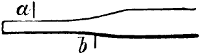
A scull is a small oar used with one hand, and requiring a pair, as in the case of oars, one being placed in the rowlock on each side the boat, and the pair being used by one person with his right and left hands. Oars are used by both hands, and a pair-oared boat consequently requires two oarsmen; a four-oared boat four, and so on. Both sculls and oars consist of the same parts, except that the handle of the oar is made long enough for both hands, as at (b). In every case there is a rounded handle (a b), a loom, square in form, and extending from the handle to the button, or about one-third of the length of the oar; and beyond the button is the blade, which is first nearly round, and then gradually widens, until it assumes the form best adapted for laying hold of the water, which is now found to be broad rather than long, as was formerly thought to be desirable. The button is a piece of leather nailed on to prevent the oar from slipping through the rowlock, but only used in river rowing, as it is not adapted for the rough work which is often met with in sea rowing.
SEA ROWING.
This is necessarily less elegant than river rowing, because of the rough nature of the element on which the exercise is pursued. The oar must be held firmly in the hands, the inside hand being placed at (b), and the outside at (a), and both hands grasping the oar between the thumbs and fingers. The whole art consists in the crew moving backwards and forwards together, called “swinging,” and laying hold of the water as well as they can, taking care to avoid pulling in the air with great force when there is a trough or interval between two waves, and on the other hand equally avoiding a heavy wave, which has a tendency to dash the oar out of the hand. All this requires practice in the rowers, and also in the steersman, called the coxswain, who should watch for the high waves, and warn his men when a heavy one is coming. He should also take care to cross the roll of the sea as much as possible, so as to avoid being struck on the side of the boat called “the counter,” which would either swamp her, or else knock the oars out of the rowlocks. In this kind of rowing, the “feathering” of the oar, to be presently described, is not attempted, on account of the roughness of the water, but it merely is pulled steadily, but strongly, backwards, and is then pushed forwards in the rowlocks.
RIVER ROWING.
The art of river rowing is capable of a high degree of elegance, and few sights are more pleasing to a lover of graceful forms than that of a crew of fine lads, or young men, rowing well together and in good style. To do this requires great practice, and attention to a few essential points, which I will here endeavour to describe.
MANAGEMENT OF THE OAR.
The rower should, as far as possible, take some good oarsman for his model, and endeavour to imitate him in every respect, which is the only mode of acquiring a good style. Description is useful in putting the learner in the way of acquiring what is to be taught, but it is not all-sufficient for the purpose. In the first place, the learner should place himself square on the seat, with his feet straight before him, and the toes slightly turned out. The knees may either be kept together, in the Newcastle or Clasper style, or separated considerably, as practised generally in England, the latter being in my opinion the better mode, as it allows the body to come more forward over the knees. The feet are to be placed firmly against the stretcher, which is to be let out or shortened, to suit the length of the individual; and one foot may be placed in the strap which is generally attached to the stretcher in modern boats. The oar is then taken in hand, raising it by the handle, and then either at once placing it in the rowlock, or else first dropping it flat on the water, and then raising the handle it may gently be lowered to its place. The outside hand is placed upon the handle at (a), with the thumb as well as the fingers above it, while the other hand firmly grasps it lower down at (b), keeping the nut towards the person. The arms are now quickly thrust forward till they are quite straight at the elbows, after which the back follows them by bending forward at the hips, carefully avoiding any roundness of the shoulders. When the hands have reached their full stretch they are raised, and the blade quietly and neatly dropped into the water; immediately after which, and with the water just covering the blade, the body is brought back with a graceful yet powerful action, till it reaches a part a little behind the perpendicular of the back of the seat, when the hands are brought back to the ribs, the elbows gliding close by the hips; and at the last moment, as the hand touches the rib, the wrist of the inside hand is depressed, the knuckles being at the same time brought against the chest, and the oar is made to rotate in the rowlock, which is called “feathering” it, and by which it is brought cleanly out of the water. The next action is to push the oar rapidly forward again, first however restoring it to its original position in the rowlock, which is effected by raising the wrist, and then darting the arms forward till the elbows are quite straight, which brings the rower to where we started from in the description. In “backing water” the reverse of these actions takes place. The oar is first reversed in the rowlock, and then it is pushed through the water with as much power as is needed, and pulled through the air. When the oars on one side are pulled, and those on the other are backed, the boat is made to turn on its own water. “Holding water” is effected by the oars being held in the position of backing without moving them.
THE ESSENTIAL POINTS IN ROWING.
1st. To straighten the arms before bending the body forward; 2d, to drop the oar cleanly into the water; 3d, to draw it straight through at the same depth; 4th, to feather neatly, and without bringing the oar out before doing so; 5th, to use the back and shoulders freely, keeping the arms as straight as possible; and 6th, to keep the eyes fixed upon the rower before them, avoiding looking out of the boat, by which means the body is almost sure to swing backwards and forwards in a straight line.
MANAGEMENT OF THE BOAT.
Every boat without a rudder is manœuvred in the water, either by pulling both sides alike, in which case it progresses in a straight line, or by reversing the action of the oars, equally on both sides, pushing them through the water instead of pulling them, and called backing water, when the boat recedes; or by pulling one side only, on which the boat describes a segment of a circle, which is made smaller by pulling one oar, and backing the other. By means of a rudder the boat is made to take a certain course, independent of the rowers, called “steering,” the chief art in which consists in keeping the rudder as still as possible, by holding the lines “taut,” and avoiding pulling them from one side to the other more than is absolutely necessary. Some steersmen think it necessary to swing backwards and forwards with a great effort, but this is quite useless, and the more still they keep the better. Every coxswain should know the course of the stream or tide; and when meeting other boats he should, if he is going down stream, give them the side nearest the shore, so as to allow them the advantage of the slack water, which is quite prejudicial to him. When a crew are steered by a competent coxswain, they ought to be perfectly obedient to his commands, rowing exactly as he tells them. His orders are communicated by the following words, viz. when desiring his crew to row he says, “Pull all;” or if wishing any one oar to be pulled, he says “Pull bow,” or “Pull, No. 3,” or 4, &c. as the case may be. If they are to stop rowing, he says “Easy all,” or for any one oar, “Easy bow,” or No. 2. The same kind of order is conveyed when “backing” or “holding water” is desired; the only variation, as before, being between confining his order to any one or more oars, or extending it to all. In this way all the evolutions practicable on the water are managed, and the coxswain has complete control over the boat, being able to cause her to be rowed slowly or quickly, or to be stopped, backed, or turned on her own centre.
ROWING TOGETHER
Is of the utmost importance to the success of a boat when she is manned by a crew; and they should all endeavour to attain the same style as the “stroke-oar,” who should be the best in the boat, and as free from faults as possible. In a four or eight-oared boat, every one of the crew would do well to imitate his stroke by rowing with him occasionally in a pair-oared boat, or else, if this is not practicable, by pulling behind a waterman who rows in the same style as the stroke-oar. In this way an uniform kind of rowing is attained, and the boat is propelled equally by all at the same time. The great object is for all to lay hold of the water at the same moment, and pull their oars through it and out with the same power and at the same time; this is called “keeping stroke.” “Keeping time” means, all “feathering” the oar together, by which the peculiar click of the oars in the rowlocks is made exactly at the same instant. When this is not done precisely together, the “time” is defective, and the ear at once detects the error; but even when the “time” is ever so good, the want of keeping stroke is fatal to the speed of any boat, however good the individuals may be.
CAUTIONS TO YOUNG ROWERS.
Do not be over anxious to avoid “catching crabs,” which is an event likely to occur in early practice; and should it happen, throw the oar quickly upwards out of the rowlock, and no mischief will ensue. The young rower should be at once shown how to free his oar in this way, and then he may pull with that freedom from restraint which is necessary to produce a good style. Do not stand on the seats, or lean out of the boat, and never attempt any practical jokes on the water, as it is a dangerous element to trifle with.
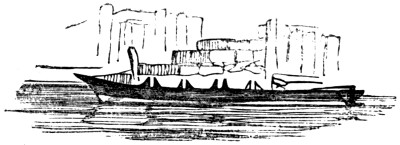
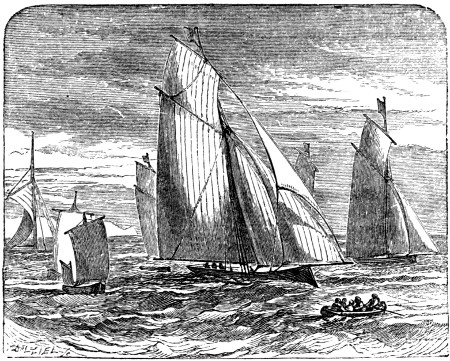
SAILING.
“The tar’s a jolly tar, that can hand, reef and steer, That can nimbly cast-off and belay; Who in darkest of nights finds each halliard and gear, And dead reckoning knows well, and leeway: But the tar to please me must more jolly be, He must laugh at the waves as they roar.”—Dibdin.
It would be very difficult to trace to its origin the art of sailing. Perhaps the curled leaf passing over the water, with one end erect, might have given to observant man the first notion of a sail. It has been supposed that the Nautila, Argonaut, or sailor-fish, was suggestive of the first sailing-vessel; but long before the Argonaut had been noticed, sails of some kind or other had no doubt been common. A man could not stand in the simplest boat without perceiving that the wind exerted a power upon him and his boat; and therefore the idea of a sail must have been identical with the first launching of the rudest boat. The science of sailing, however, has grown up gradually through a succession of ages, and has now reached a perfection of which the ancients had no idea.
We will first speak of the various kinds of vessels, which are distinguished principally by the number of masts, and the number and shape of their sails.
A Sloop is properly a vessel with one mast, having her sails, with the exception of her topsails, set in the plane of her length, which is technically called “set fore and aft.” Her topsail is a square sail, rigged at right angles to the plane of her length. The bowsprit is generally elevated from the bows, inclining slightly to the deck. The term “sloop” is now usually applied to a man-of-war, ship-rigged, and carrying less than 18 guns.
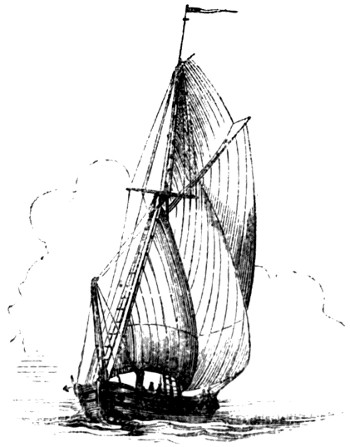
A Cutter differs from a sloop in being without a square sail, and in having her bowsprit horizontal; her mast at the same time “raking” aft. Her topsail is fore and aft, and triangular in shape.
A Brig is a square-rigged vessel, with two masts.
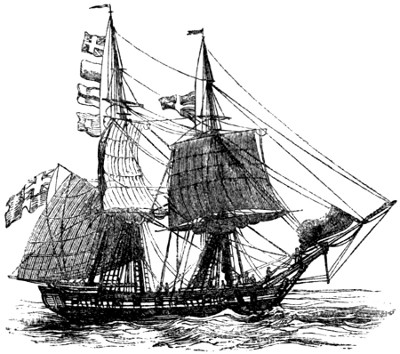
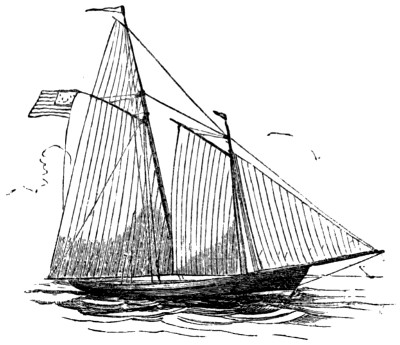
A Schooner is a two-masted vessel, with fore and aft topsails, which are called gaff-topsails. Sometimes she has a square fore-topsail and top-gallantsail.
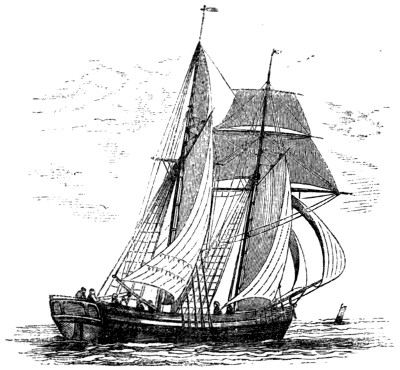
A Brigantine is something between a schooner and a brig, and is worked either with oars (called sweeps) or sails.
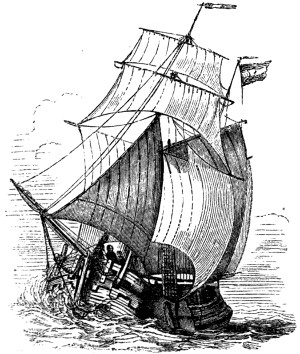
DUTCH GALLEOT.
A Dutch Galleot is rigged like a schooner, but of a broader and more Chinese build, her bottom being nearly flat.
A Billy-boy is rigged sometimes like a sloop, and sometimes like a schooner; but her bottom is nearly flat, and she draws but little water.
A Smack is a small vessel with one mast like a cutter, used principally for fishing.
A Canoe is a boat used by savages, usually made of a trunk of a tree, hollowed.
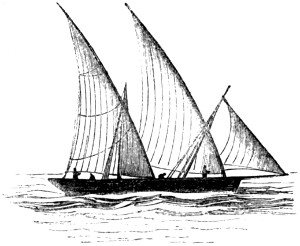
A Felucca has two triangular sails, is used in the Mediterranean, and is particularly swift. It can also use oars in calm weather.
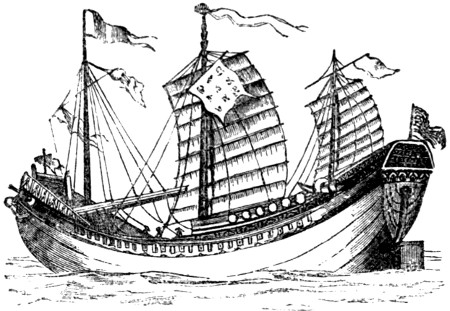
A Junk is a Chinese vessel, used either for war or merchandise, is built very heavily.
A Proa is used by the natives of the Ladrone Islands, and is remarkable for its swiftness and sailing close to the wind. The lee-side is quite straight, and the weather-side is convex, like a common boat. Both head and stern are equally sharp; and in working her there is no necessity to tack or turn at any time. Besides this peculiarity of construction, the proa has on her lee-side what is called an “out-rigger,” which is made of two poles, extending about 10 feet from her side, having at their extremity a piece of solid wood. This prevents her from having any lee-way. She will sail with a good wind twenty miles an hour.
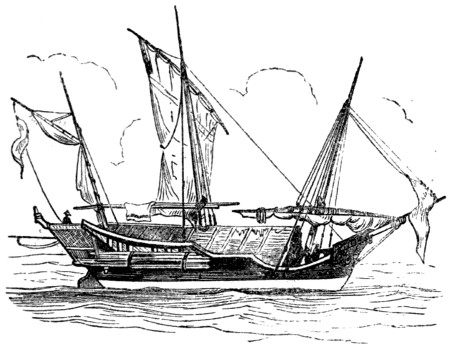
The natives of the Society Islands use a canoe, averaging in length from ten to forty feet. It is made of a trunk of a tree, hollowed out; and is just wide enough for a person to sit down. It will carry from one to as many as thirty persons. It also has an outrigger, like a proa. When a native leaves one island to go to another, he joins two large canoes together, and builds on them a small hut, which will hold all his family. This is the most convenient way to travel in a canoe, for it is difficult to see anything but one’s knees when sitting down in the ordinary manner. These canoes carry a square sail in the fore-part.
We will now speak of the vessels we have most to do with—viz. yachts.
CHARACTERS OF A YACHT.
Speed, safety, and accommodation are the three first qualities of a yacht. She ought to be pleasing to the eye when afloat, of such a breadth as to carry her canvass with ease, and at the same time so sharp in her bow and well-shapen astern as to displace her weight of water smoothly and gradually, while she leaves it in the same way.
VARIOUS KINDS OF YACHTS.
Yachts are of various kinds, according to their size. If more than eighty tons burden, the schooner is most suitable; for, as the spars are more numerous, they are proportionally lighter. The schooner, as has been before observed, has two masts—the foremast and mainmast; the one bearing the sail called the boom-foresail, and the other a mainsail. She has two or more headsails, called staysail, fore-staysail, and jib. Her topsails are either square or fore and aft.
The Cutter has one mast and four sails—viz. mainsail, maintopsail, foresail, and jib. Some smaller craft have larger jibs, and no foresail.
The Dandy-rigged Yacht differs from a cutter, in having no boom for her mainsail, which can consequently be brailed up by a rope passing round it. She has a mizen-mast standing in the stern, which sets a sail called a mizen, and which is stretched on a horizontal spar, projecting over the stern. This style of rig is more safe for a yacht, as the boom in ordinary cutters is liable to sweep persons overboard; and the sail can be taken in quicker by brailing it up than by lowering it down.
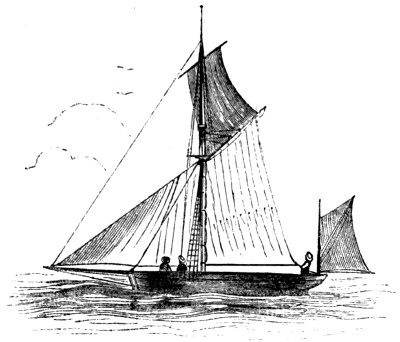
The Hatteener has only two sails, a fore and a main sail, of a triangular shape. Each has a spar standing from the deck to the peak of the sail, and a boom at the bottom, like a cutter. This rig, from setting more canvass abaft, is well adapted for narrow waters.
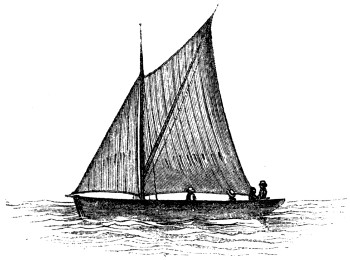

One of the most handy rigs for a young sailor is a triangular mainsail and foresail rig, on a good-sized open boat. She should be at least twenty feet long, and five feet on her beam. The foresail is carried over the stem for about a foot, by means of an iron bowsprit, which ships and unships on the nose of the boat. Her mainsail has a spar reaching from the lower part of the mast to the upper corner of the sail; a rope is fastened in the middle of this spar, and passes through a block on the mast, by which the sail is hoisted. The advantages of this rig are, that it can be easily managed, while under it the boat is much safer than under most other kinds of rig; for, should a squall arise, the yachtsman has only to let fly his foresheet and put his helm alee, and the boat will right immediately. With this rig, a boat stands very well to windward, and may be easily brought about.
DESCRIPTION OF THE CUTTER YACHT.
But the vessel with which we have most to do in our directions for sailing is the Cutter Yacht, which stands closer to the wind than any other kind of European boat; and of which we propose, in the first instance, to give a general description.
CONSTRUCTION OF THE HULL.
The first step in the construction of the hull is laying down the keel or backbone of the vessel; which is done by fixing a strong piece of wood, generally oak, upon blocks, that the rest of the timber may be securely added; the stem is then joined to the fore-post, nearly at right angles, slanting a little forward as it ascends; and the stern-post to its after or hinder part, sloping upwards and backwards. The timbers and ribs are next cut out of solid wood, and placed transversely on the keel, their width varying according to the lines of a plan previously drawn out,—being, of course, farthest apart at the beam; these, as well as the planks of larger craft, are made to bend into the required shape by being steamed and bolted in while hot. The skeleton being completed, her planks are then secured by copper or iron nails to the timbers, and riveted. The deck is made of narrow planks, running fore and aft. From the level of the deck, her sides are raised by upright timbers, called “stancheons,” cased over by the bulwarks, and surmounted by a rail called the “gunwale.” Some yachts are only half-decked, the after-part being left open and fitted with seats; but, in order to prevent the water from getting in, a portion of deck, called water-ways, is left at each side; which opposes a further barrier by its terminating on the inner edge in a high crest or combing. The stepping the mast requires great care, since the good or bad sailing of the boat depends very greatly upon it. If we divide the length of a good yacht into three parts, the point at which the foremost part joins the middle part will be the widest part, and there will be nearly the place for the cutter’s mast. But the American builders have departed from this rule in the construction of their celebrated yacht, “The America,” whose model, after all the study and ingenuity that have been applied to yacht-building, seems to resemble the simple yet beautiful model which nature has given us in the duck. The bow of this vessel rises very gradually for some distance along the keel, like the breast of the duck; and, further imitating the same model, her beam or widest part is abaft, or further back than the centre. This superior vessel will sail nearly four points off the wind, and will probably work an entire change in the present style of yacht-building. We have now glanced at all the principal parts of the hull, except that all-important part, the rudder; which swings by a hinge from the stern-post, and is moved by a handle fixed to its upper part, bearing the name of “a tiller,” and which is used to steer the boat. Before proceeding with our instructions for sailing a yacht, it will be necessary to describe the action of the rudder; as the art of steering is the nicest and most important branch of seamanship.
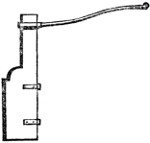
The rudder is a flat board, with a pole rising up on the side, which is fastened to the vessel; on the top of which is fixed the tiller. In large vessels, there are two ropes fastened to the tiller, which are carried through blocks on each side of the vessel; then brought back through blocks fastened on the mizenmast, and passed round a wheel, by which means a greater command is obtained over the rudder. When the tiller is moved to the right (starboard), the rudder, of course, is forced in the water to the left (port). As the vessel moves on, the water presses against the rudder on the port side, and thus forces her stern to the starboard side, and her bow to the port. When the tiller is moved to the left, it of course produces a contrary effect. If the ship is moving backwards, then, by moving the tiller to the right, the bow is also turned to the right; for the water presses against the rudder behind it on the left side, and thus pushes the stern to the left. In steering, care must be taken not to steer too much,—that is, not to move the rudder too violently or more than is necessary,—as this materially stops her way.
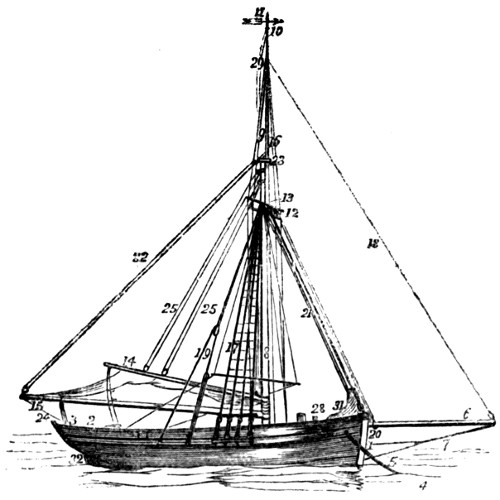
CUTTER AT ANCHOR.
We here present the young yachtsman with a cutter at anchor, with her ropes and spars numbered; and which ought to be thoroughly known, as well as the uses to which they are applied in sailing a yacht:—
1. Stem
2. Stern
3. Tiller
4. Anchor
5. Cable
6. Bowsprit
7. Bobstay
8. Mast
9. Topmast
10. Truck
11. Vane and Spindle
12. Cross-trees
13. Trussle-trees
14. Gaff
15. Boom
16. Topmast-shroud
17. Topmast-backstay
18. Topmast-stay
19. Runner and Tackle
20. Traveller for Jib
21. Forestay
22. Topping Lift
23. Lift Blocks
24. Mainsheet
25. Peak Halliards
28. Foresheet
29. Signal Halliards
30. Companion
31. Forecastle
32. Rudder
SOMETHING ABOUT THE MASTS, SPARS, ROPES, ETC.
The Mast (8) is a spar set nearly upright, inclining a little aft, to support yards and sails. In a yacht, it is kept in its place by two shrouds on each side, made of strong rope, and fastened to the sides of the vessel.
The Bowsprit (6) is a spar carried out from the forepart of a yacht, secured at its inner end between two strong posts piercing the deck, called “the bitts.” It is kept in its place by the bobstay (7), which is fastened to the stem, and by a shroud on each side secured to the bow.
The Boom (15) is that spar which sets out the mainsail below, and is attached at one end to the mast by a swivel cable, called the “goose-neck,” and is eased off or hauled in at the other by the mainsheet (24), which is a rope passing from the end of the boom through a block on the side of the vessel.
The Gaff (14) sets out the mainsail above, and slides up and down the mast by means of a crescent end, which embraces it. The sides of this curve are called “horns.”
The Topmast (9) stands above the mast, and is made to slide up and down. On it a topsail (i. e. a gaff-topsail) is set in light winds; but both sail and mast are generally lowered in squally weather. It is kept steady by a backstay (17) on each side of the foretopmast-stay. The latter is brought down to the bowsprit.
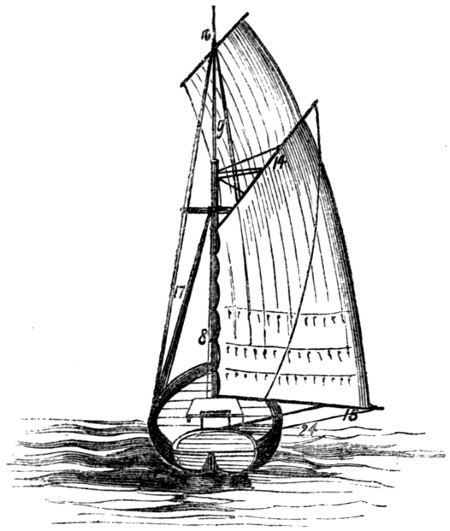
CUTTER BEFORE THE WIND.
Ropes.—There are various ropes to hoist and lower sails, called haulyards (pronounced halliards). There are also other ropes of great importance, especially those called the sheets, which are to haul in the sails, and make them stand to the wind. In a yacht, the mainsail has sometimes a sheet each side; and sometimes only one sheet reeved through double blocks, which travel on an iron rod, called “a horse,” from side to side. The jib has two sheets, the starboard and port (right and left). The foresail has the same, except in some instances, when it has but one sheet working on a traveller, like the mainsail. The topsail has only one, which is rove through a sheave at the end of the gaff and a block at the throat of the gaff, and then down to a cleat or fastening place on the deck. Signal haulyards are for hauling up the colours, and pass through a small sheave, in the truck (10), at the end of the topmast. The ensign haulyards are reeved through a small block at the peak end, and lead down to the boom. The other ropes on board a yacht are for the support of the spars, and are called “standing rigging,” while those used for the sails are called “running rigging.”
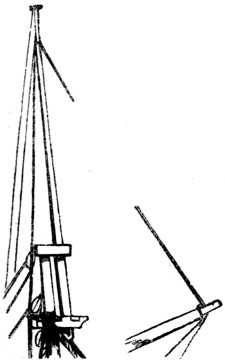
TOPMAST AND FORETOPMAST STAY.
SAILING A YACHT.
If the reader has paid attention to our instructions, he ought now to be pretty well conversant with build, rigging, spars, and sails of a yacht; the next thing, therefore, is to explain the actual practical sailing of a yacht. The number of hands must depend on the tonnage of the boat and the number of sails. It is best to have a steersman, and one hand for each sail. Our yacht is now lying at anchor, or moorings, which consists of a chain and buoy, fastened to a heavy anchor sunk in the bed of the river. Having got on board, by means of the little boat called a “dingy,” we first unloose the fore and mainsail, and forestaysail; haul out the jib on the bowsprit, ready for hoisting; hoist the colours, with the name of the yacht or club to which she belongs, to the gaff-end; and stand by to hoist the canvass. We will suppose it just past high water, the yacht swinging ebb, and the wind up stream; we shall, therefore, have tide with us, and the wind against us. We now hoist the throat and peak halliards, till the former is well up block to block; then, by hauling at the peak-halliards till the after part of the sail is taut (tight), the mainsail is set, and she swings head to wind. The next thing is to hoist the forestaysail and the jib, which must be well purchased up, and the sheet well hauled in, before we can get her on the wind, i. e. sail close up to the wind. The ropes must now be coiled up, and hung on the cleat belonging to each. Our canvass being now up, we may cast off, slack out the mainsail, haul in jibsheet on the contrary tack to which we intend to sail, and we are under weigh.
We have already told the reader that “starboard” means right, and “port” means left. Formerly, the word “larboard” was used for left; but, owing to the similarity between the two words starboard and larboard, the word port was substituted for the latter. A boat is said to be on the starboard tack, when the wind is blowing from the starboard side; the port side is then called the lee side, and the starboard the weather side. She is on the port tack when the wind blows from the port side, which is then called the weather side, and the starboard the lee side. When in steering she is brought nearer the wind, she is said to “luff;” and when further from it, to “bear away.” When the helm is put so as to cause the boat to luff, the helm is “put up;” when it causes the boat to bear away, it is “put down,” or a-lee.
Proceeding to our cruise, we must haul the jib-sheet well in, put the helm up, and sail close to the wind; as, the wind being against us, we shall have to “beat up,” that is, sail in a zigzag direction. In sailing close to the wind, we must always take care not to sail too close, but always keep the canvass quite full. Upon the skill of the steersman, mainly depend the motions of the boat; he must endeavour to attain the happy medium of keeping the boat close to the wind, and yet not allowing the canvass to shake. The practised yachtsman feels with his helm every variation of the wind, and meets it with a turn to port or starboard; but the young sailor would do well to watch the colour at the masthead, and, by keeping it in a line with the gaff, he will not steer very wildly. We are now getting near the opposite bank from whence we started, and must therefore tack. If the boat is quick in stays (i. e. will go round quickly), and the bottom is not muddy, and is deep enough for the boat, we may go pretty close to the bank before we tack; but if she is a slow tub, we must begin in good time. First, we must see that all the canvass is quite full; then the mainsail must be hauled to the middle of the boat, or amidships, and the helm put gradually down. When she is head to wind, let fly the jibsheet; if she is on the starboard tack, haul in the port foresheet taut, which is called backing the foresail; the wind, by blowing on the foresail, assists the boat round. When she begins to fill on the other tack, cast off the port (now the weather) foresheet, and haul in the leesheet and also the jibsheet, and trim the mainsail (i. e. let go, or haul in, the mainsheet), according to the direction of the wind. If when the boat is in stays, or head to wind, she moves neither way, put the helm amidships; if she moves back, put the helm the contrary way to what you had it before, resuming its former position when she moves on again. When the wind gets more on our beam (i. e. blows directly across us), we may slack out the canvass a little; the more aft it blows, so much more we must square our sails. There is a heavy cloud in the wind’s eye, that admonishes us that a squall is brewing, and the dark ripple of the water to windward tells us that it will soon be here. Keep her well full, that as the squall strikes her she may have good way on; and luff into the wind as soon as the squall begins: and if she does not right at once, let go jib and foresheets; if that fails, cast off the mainsheet, and send a hand to stand by the fore and jib halliards, which must be let go when the squall becomes violent. We must now reef the mainsail; to effect this, allow plenty of room for driving to leeward; set taut the “topping-lift,” a rope which hoists up the end of the boom; lower the halliards; hook at the end of the boom an earring which is higher up in the sail, and tie up the reef-points; then, having set up our mainsail, hoisted a smaller jib, and drawn in the foresheet, we are under sail again.
We must take care always to observe the rules of sailing, when meeting with another yacht. Whichever boat is running free must make way for one close hauled; for a boat when close hauled cannot conveniently alter her course, but when she is running free she is always able to move to which side she pleases. As we get into wider water, we shall find more swell, that impedes the boat to windward; but, if the waves be long enough, there is a way of easing her over them, by putting down the helm slightly, just before the highest of them strikes her bow; thus, by stopping the boat’s way, she strikes the sea with less violence.
BRINGING UP.
Our destination outward bound being in sight, we must prepare to bring up. The anchor must be got on deck; the cable passed through the hawsehole, and shackled or fastened to the anchor, with its stock made ready and secured; then suspended over the bowsprit shrouds, and made ready to let go. Lower the head-sails, put down the helm till she is head to wind, and when she is fairly stopped we may drop the anchor.
MAKING SNUG.
The mainsail may now be triced up, with the peak lowered, and with the helm to one quarter or the other, according as the tide sets; we may then hope to lie securely as long as we choose.
GOING BACK.
In getting under weigh once more, first haul the cable short; get all the canvass ready to set up; weigh anchor, and, as the wind is fair, set the head sails first and the mainsail afterwards; the peak should not be too high in running, nor the back of the mainsail fast, but raised slightly to let the wind into the head sails. The tide is now against us; we must, therefore, keep out of the strength of it as much as possible.
JIBING.
In rounding the next point we shall jib, or jibe, one of the most difficult manœuvres in sailing; for in doing so there is danger of broaching-to, so as to run on shore; of being swept overboard by the boom as it passes from side to side; and of carrying away or snapping the boom itself. To avoid these mischances, give the shore a wide berth; take in the mainsheet, keeping its coils clear for running out; trice up the tack of the mainsail, and if the breeze is strong, lower the peak; you may then put your helm to the opposite side to which the boom swings, and, on the instant the mainsail has traversed to the other side, change your helm to the reverse and meet her;—this prevents the broaching-to which would otherwise occur.
BRINGING UP AT MOORINGS.
We are still against the tide, and our moorings are in sight. To bring her up handsomely calls for more skill than even handling her well. Our object now must be to lay her still at the moorings from whence we started, and at the same time to have enough way to reach them. In our present case it will be best to round her to about an hundred yards short of the moorings, and, when head to wind, lower the mainsail, leaving the head sails standing—this with putting up the helm will bring her head round again—then take in the jib, and, if she has way enough, the foresail also; and with the opposing tide we may steer our craft so steadily to the buoy as to take it on board with ease.
Having informed the young sailor of what is necessary to be done on board, we will now impress on his mind a few useful nautical terms and maxims, which may lead to the preservation of life and limb.
OF THE MARINERS’ COMPASS, AND VARIOUS NAUTICAL TERMS.
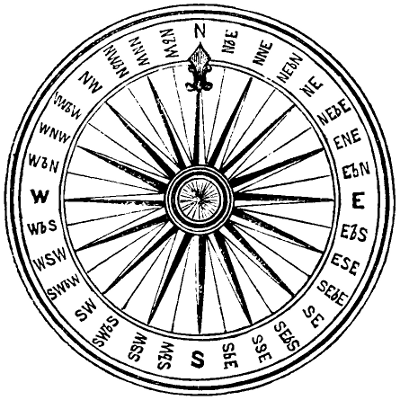
The ancients, whose only guides over the trackless waters were the heavenly bodies, so often obscured by clouds, could not venture far from shore. It is the compass which has enabled us to steer boldly across the deep. The directive power of the loadstone has been long known to the Chinese, and it was brought over to Europe about the year 1260. The communication of the magnetic power to steel and suspending it on a pivot, is undoubtedly an European invention. The compass is composed of a magnetic needle suspended freely on a pivot, and supporting a card marked with the thirty-two points of direction into which the horizon is divided, and which are thence called the points of the compass. The needle always points nearly north, and the direction of the boat may be easily seen by looking at the card. The whole apparatus on board a ship is enclosed in a box with a glass cover, to allow the card to be seen without being disturbed by the wind. This box is also sometimes suspended, to prevent the needle being affected by the motion of the vessel. The whole is then placed at the binnacle, in sight of the helmsman. In the inside of that part of the compass-box which is directly in a line with the bow, is a clear black stroke, called the lubber line, which the helmsman uses to keep his course; that is, he must always keep the point of the card which indicates her course pointing at the lubber line. Every young yachtsman must learn to box the compass; that is, to repeat all its points in order.
CAUTIONS AND DIRECTIONS.
1. Never leave anything in the gangway, and keep the decks clear.
2. Coil up all ropes; and have a place for everything, and everything in its place.
3. Take care that in tacking or jibing the boom does not knock you overboard.
4. Stand clear of ropes’ ends and blocks flying about, when you are tacking, and the sails shaking.
5. Keep a good look out ahead, and also for squalls, which may generally be observed to windward.
6. Always obey the orders of the steersman promptly.
7. Keep all your standing rigging taut.
8. When the boat is on the wind, sit on the weather side.
9. Should the boat capsize, keep yourself clear of the rigging, and swim ashore.
The young yachtsman should on no account attempt to take command of a boat till he is thoroughly experienced, and should never go in one without having at least one experienced hand on board; he should also always have his eyes open to what is going on, and be ever ready to lend assistance with the greatest promptitude. Quickness and agility are the characteristics of a sailor; without these, numerous would be the losses at sea. The casting off or belaying a rope quickly, is often attended with the most important consequences, in which the losing or saving of life may be concerned; and we would therefore advise all who are emulous of being sailors, to be attentive to their duties, quick in their evolutions, and steady in all their doings.
NAUTICAL TERMS.
Aback, the situation of the sails when the wind presses their surfaces against the mast.
Abaft, towards the stern; e.g., abaft the mainmast, behind the mainmast.
About, on the other tack; going about, tacking.
Abreast, alongside of.
Adrift, broken from moorings.
Afloat, on the surface of the water.
Ahead, in the direction of the vessel’s head.
Amidships, in the middle of the vessel.
Apeak, when the cable is hove taut, so as to bring the vessel nearly over the anchor.
Astern, in the direction of her stern.
Avast, an order to stop.
Athwart, across—as “thwart hawse.”
Backstays, ropes running from topmast and top-gallantmast to her sides.
Ballast, heavy materials placed in the bottom of the boat, to bring her low in the water.