PART III. Scientific Pursuits: (continued 2)
Reading edition
2. Fill a Florence flask up to the neck with a strong solution of sulphate of soda, or Glauber’s salt, boil it, and tie the mouth over with a piece of moistened bladder while boiling, and set it by in a place where it cannot be disturbed. After twenty-four hours it will probably still remain fluid. Pierce the bladder covering with a penknife, and the entrance of the air will cause the whole mass instantly to crystallize, and the flask will become quite warm from the latent caloric, of which we have spoken before, given out by the salt in passing from the fluid to the solid state. It is better to prepare two or three flasks at the same time, to provide against accidents, for the least shake will often cause crystallization to take place before the proper time.
CHANGES OF COLOUR PRODUCED BY COLOURLESS LIQUIDS.
Make a strong infusion of the leaves of the red cabbage, which will be of a beautiful blue colour; drop into it a few drops of dilute sulphuric acid, and the colour will change to a bright red; add some solution of carbonate of potash, or soda, and the red colour will gradually give way to the original blue; continue adding the alkaline solution, and the fluid will assume a bright green colour. Now resume the acid, and as it is dropped in, the colour will again change from green to blue, and from blue to red. Now this simple experiment illustrates three points: first, that acids change the colour of most vegetable blues and greens to red; second, that alkalies change most blues and reds to green; and third, that when the acid and alkali are united together, they both lose their property of changing colour, and become what is called a neutral salt, i. e. a compound possessing the properties of neither of its constituents.
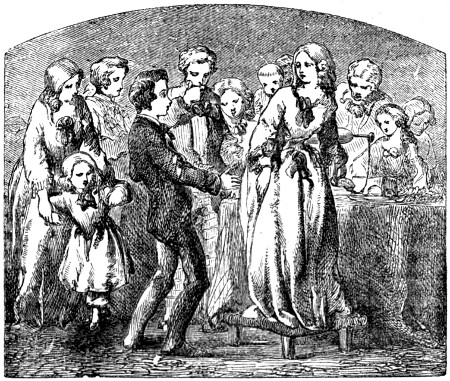
ELECTRICITY.
No branch of science is more capable of affording amusement, combined with instruction, than electricity, and there are few sciences in which the experiments are more easily performed. We would therefore especially recommend it to our young friends.
The term electricity is derived from the Greek word electron, signifying amber, because electrical attraction was first discovered from its being noticed that when amber was rubbed into a certain degree of warmth, it had the power of attracting small bodies to itself.
Electricity therefore primarily treats of the phenomena and effects produced by the friction or rubbing together of certain bodies called electrics. These consist of glass, amber, resinous matters, silks, hair, wool, feathers, various vegetable substances, and atmospheric air, and the electricity so obtained is usually called Frictional Electricity, to distinguish it from that produced by chemical action, and called Voltaic Electricity.
SIMPLE MEANS OF PRODUCING ELECTRICITY.
To show the nature of electrical action, rub a piece of sealing-wax or amber upon the coat-sleeve, and it will attract light bodies, such as straws or small pieces of paper. If a clean glass tube be rubbed several times through a silken or leather cloth, and presented to any small substances, it will immediately attract and then repel them; and if a poker suspended by a dry silk string be presented to its upper end, then the lower end of the poker will exhibit the same phenomena as the tube itself, which shows that the opposite electrical condition may be induced upon other bodies by the mere neighbourhood and approach of another electrified body, and the effect so produced is called induced electricity.
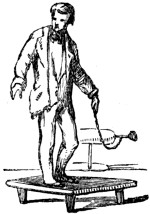
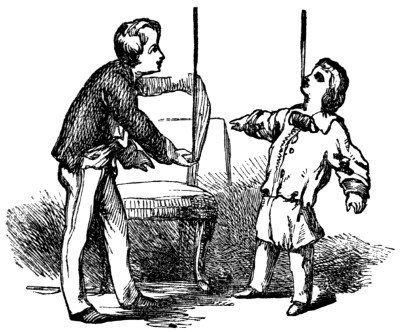
When an electrified conductor is supported by non-conductors, so that the electric fluid cannot pass from the conductor to the earth, it is said to be insulated: thus the human body is a conductor of electricity—but if a person standing on a glass stool (as represented in the drawing) be charged with electricity, the electric fluid cannot pass from him to the earth, and he is said to be insulated; and if he be touched by another person standing on the ground, sparks will be exhibited at the point of contact, where also the person touching will feel a pricking sensation.
ATTRACTION AND REPULSION EXHIBITED.
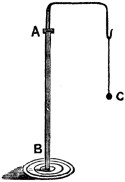
In order to illustrate certain remarkable facts in this science of an amusing character, attention must be directed to the figure A B, which is a metal stand; C is a small piece of cork or pith, which is suspended from the hook by a dry silken thread. Having rubbed an electric, as a dry rod of glass, and presented it to C, the ball will be instantaneously attracted to the glass and will adhere to it. After they remain in contact for a few seconds, if the glass be withdrawn without being touched by the fingers, and again presented to the ball, the latter will be repelled instead of attracted, as in the first instance. By being touched with the finger, the ball can be deprived of its electricity, and if after this has been done we present a piece of sealing-wax in the place of the glass formerly employed, the very same phenomena will take place. On the first application the ball will be attracted, and on the second repelled.[8]
Before the young reader can perform any very important experiments with electricity, he must become possessed of an ELECTRICAL MACHINE, which is an instrument contrived for the purpose of rubbing together the surfaces of glass and leather. They generally consist of a cylinder, or plate of glass, and a piece of silk or leather for it to rub against, covered with an amalgam, the method of preparing which we shall hereafter describe.
HOW TO MAKE AN ELECTRICAL MACHINE.
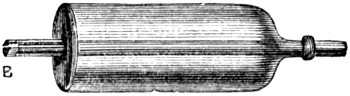
It is very easy to make a glass machine of the cylindrical form, if the maker cannot afford to buy one. First procure a common wine bottle of good dimensions, and thickish glass. Drill a hole through its bottom, with a file moistened with dilute sulphuric acid. A blacksmith, if supplied with the acid, would undertake to do this part of the work. Through this hole and the mouth pass a spindle, as represented in the cut. The end of B should be squared to fix a handle on, and the spindle should be fixed firmly in the bottle. The bottle is then to be fixed in a frame in the following manner: the end of the spindle C passes through a hole at B; and the other end at C has the handle for turning the machine.
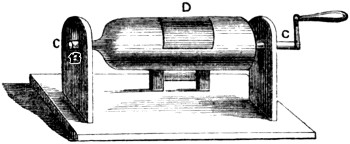
Next make a cushion of wash-leather stuffed with wool, and fastened to the top of a frame of the following figure. This frame is to be of such a height that the cushion shall press against the sides of the bottle, and a piece of black silk is sewn on to the top of the cushion, and hangs over the bottle D. The cushion should be smeared with an amalgam, formed by melting together in the bowl of a tobacco-pipe one part of tin with two of zinc; to which, while fluid, should be added six parts of mercury. These should be stirred about till quite cold, and then reduced to a fine powder in a mortar, and mixed with a sufficient quantity of lard to form a thickish paste. When all is done, the machine is complete.
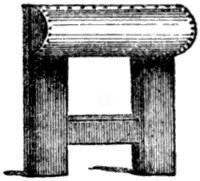
CUSHION.
THE CONDUCTOR.
The electricity being generated by the friction produced between the rubber and the bottle from the motion imparted by the handle, it is necessary to draw it off for use. This is performed by what is called a conductor. This is made by covering a cylinder of turned wood six inches long and two and a half inches in diameter, and nicely rounded at the ends, with tinfoil, which is then mounted on a stand on a glass rod. When used, it is to be placed in the direction of the length. In it some pins are inserted, with the points outside, in a line even with, and about half an inch from, the bottle, and it should be of such a height as to come just below the silk apron. When it is wished to charge a Leyden jar, it is to be placed at the round end of the conductor. By these simple means a great variety of pleasing experiments may be performed; but to show the various phenomena connected with this interesting study, we shall now describe an electrical machine of the newest construction, and perform our experiments with it.
THE PLATE ELECTRICAL MACHINE.
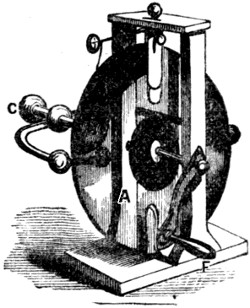
Formerly the electrical machine was made in the form of a cylinder, but now it consists of a plate A, as seen in the engraving. The plate is turned by the handle F through the rubber B B, which diffuses the excitement over the glass. The points or balls at each side of the plate carry off a constant stream of positive electricity to the prime conductor C. Negative electricity is generated by insulating the conductor to which the cushion is attached, and continuing the prime conductor with the ground, so as to carry off the fluid collected from the plate.
HOW TO DRAW SPARKS FROM THE TIP OF THE NOSE.
If the person who works the machine be supported on a stool having glass legs, and connected with the conductor by means of a glass rod, the electricity will pass from the conductor to him, and as it cannot get away, owing to the glass on which he stands being a non-conductor, any person on touching him can draw the electricity from him, which will exhibit itself in small sparks as it passes to the person who touches him. If touched on the nose, sparks of fire will issue from it.
HOW TO CHARGE A LEYDEN JAR.
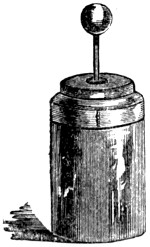
A most useful piece of electrical apparatus is called the Leyden jar, here represented. It is employed for the purpose of obtaining a quantity of electricity, which may be applied to any substance. It consists of a glass jar, coated both inside and without, four-fifths of the way up, with tinfoil. A knob rises through a wooden top communicating with the inside of the jar. When it is wished to charge the jar, this knob is applied to the prime conductor of the electrical machine when in action, and a quantity of electricity being given off, the jar will remain charged with it till a connexion is made, by some good conductor of electricity, between the knob and the outside tinfoil. A piece of brass chain must hang from the stem that carries the knob, and connect it with the interior of the jar.
THE ELECTRICAL BATTERY.
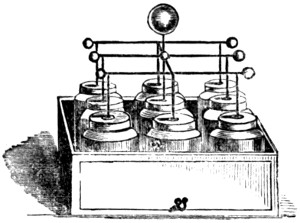
If several of these jars be united, a large quantity of electricity can be collected; but, in arranging them, all the interior coatings must be made to communicate by metallic rods, and a similar union must be effected among the exterior coatings. When thus arranged, the whole series may be charged as if they formed but one jar.
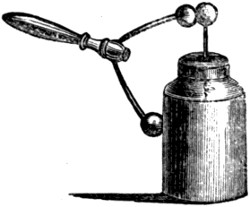
For the purpose of making a direct communication between the inner or outer coatings of a jar or battery, by which a discharge is effected, an instrument called a discharging rod is employed. It consists of two bent metallic rods, terminating at one end by brass balls, and connected at another by a joint which is fixed to the end of a glass handle, and which, acting like a pair of compasses, allows of the balls being separated at certain distances. When opened to the proper degree, one of the balls is made to touch the exterior coating, and the other ball is then brought into contact with the knob of the jar, when a discharge is effected; while the glass handle secures the person holding it from the effects of the shock.
DANCING BALLS AND DOLLS.
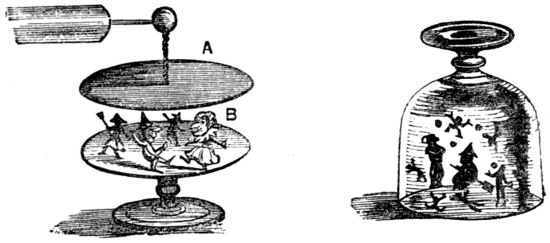
Get two round pieces of wood, A B, and coat them with tinfoil; or two pieces of metal plate; attach one of them to the prime conductor by a chain, and let it hang about two or three inches from the knob. Place some pith-balls upon the bottom piece of wood B, and bring it under the other. Immediately this is done, and the upper piece is charged with electricity from the machine, the pith-balls will jump up and down, and from one to the other with great rapidity. If some of the pith be formed into little figures, they will also dance and leap about in the most grotesque manner. The same may be made to dance by merely holding the inside of a dry glass tumbler to the prime conductor for a few minutes, while the machine is in action, and then if this be placed over them they will jump about, to the astonishment of the spectators, as the cause of their motions is not quite so apparent.
THE ELECTRICAL KISS.
This amusing experiment is performed by means of the electrical stool. Let any lady challenge a gentleman not acquainted with the experiment to favour her with a salute. The lady thereupon mounts the glass stool, and takes hold of a chain connected with the prime conductor. The machine being then put in motion the gentleman approaches the lady, and immediately he attempts to imprint the seal of soft affection upon her coral lips, a spark will fly in his face, which generally deters him from his rash and wicked intention.
RINGING BELLS.
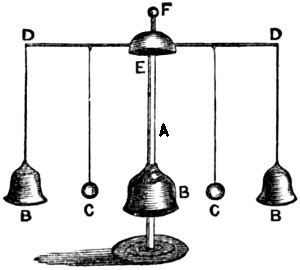
Bells may be made to ring by electricity in the following manner. Let three small bells be suspended from a brass wire, D D, and supported by a glass pillar A, passing through bell B to the bell E. The electrical apparatus being attached to the knob F, the electricity passes down the wires D D to the bells, which are then positively electrified and attract the clappers C C, that are negatively so, in consequence of being insulated by the silken strings, which are not conductors. The bells therefore attract the clappers till they are charged, when they strike against the centre bell to discharge themselves, and thus a peal is rung on the bells until the electricity is driven off.
WORKING POWER OF ELECTRICITY.
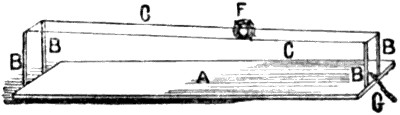
This may be shown in a variety of ways. The subjoined machine will exhibit the principle upon which many ingenious toys may be made by the young philosopher. In the figure A is a wooden board or stand, B B B B, four pillars of glass, gutta-percha, or sealing-wax, having fine wires, C C, stretched above. On these rest the rotatory wire or wheel F, having its points turned the reverse ways. By means of a chain attached to the conductor, and to the instrument at B, the electricity passes over the pillar B, up the wire C into the wheel, and off at the points, which causes it to be turned round on an inclined plane till it reaches the top.
THE ELECTRIFIED WIG.
While a person is on the electrical stool, if he be charged with much electricity,
“Each hair will stand on end, Like quills upon the fretful porcupine.”
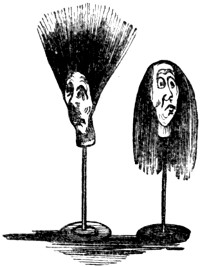
A wooden head—not your own, but a real wooden head—with a wig of streaming hair, and a handsome face to correspond, may be made in the following form, with a wire in the neck to support it by, and fixed in the conductor of an electrical machine. When this is put in motion the hair will rise up, as in the figure, in a manner to astonish even the “big-wigs.”
IMITATION THUNDERCLOUDS.
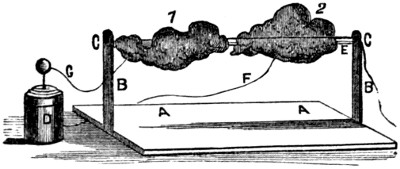
To show the manner in which thunderclouds perform their operations in the air, A A is a wooden stand, on which are erected two uprights, B B; C C are two small pulleys, over which a silken cord can pull easily; E is another silken line stretched across from one upright to another; on these silken cords two pieces of thin cardboard covered with tinfoil, and cut so as to represent clouds, are to be fixed horizontally, and made to communicate, by means of thin wires F and G, one with the inside, and the other with the outside, of a charged jar, D. Now, by pulling the loop of the silk line, the clouds will be brought near the cloud 2; continue this slowly, until the clouds (which are furnished with two small brass balls) are within an inch of each other, when a beautiful flash, strongly resembling lightning in miniature, will pass from one cloud to the other, restoring electrical equilibrium.
THE LIGHTNING STROKE IMITATED.
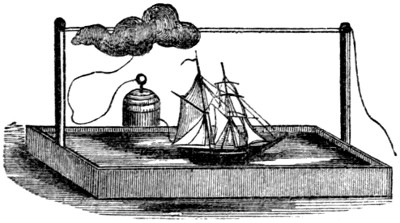
If the jar D be put behind the stand, and the cloud 2 removed, a vessel communicating by means of a wire with the outside of the jar may be swum in water under the remaining cloud; the mast being made of two pieces, and but slightly joined together, with a hollow space in one half of the mast, into which the ends of the conductor pass, but do not touch, leaving an interval of about a quarter of an inch between them. The hollow is then filled with gun-cotton, and closed with cork. When the cloud is passed over the vessel, the mast will be struck and shattered to pieces. A strip of tinfoil, arranged with pins over the hollow part of the mast, will show how a continuous conductor will convey the discharge safely away.
THE SPORTSMAN.
This apparatus is capable of affording much amusement. A is a stand of wood, B is a common Leyden jar, out of which proceed the wires H H—one terminating in ball F, the other in the ball D—to which are attached a number of pith birds by silken strings; E is a shelf for the birds to rest upon; C is the sportsman; G his gun.
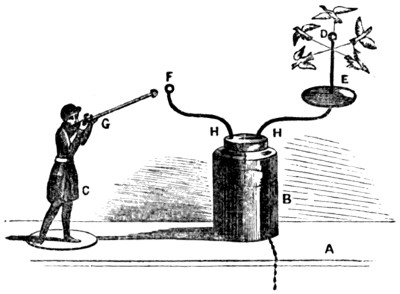
To put this operation in motion the Leyden jar is to be charged with electricity by affixing a chain to the bottom part of it, and connecting it with an electrical machine in the usual manner, or by applying it to a prime conductor, when the birds will fly off the knob to which they are fixed in consequence of their being repelled. If the sportsman and gun be then turned, so that the end of his gun shall touch the knob F, an electric spark will pass from one to the other, a report will be heard, and the birds will fall down as if shot, in consequence of the electricity having been taken from the Leyden jar. There should be a communication between the sportsman and the jar formed of tinfoil, or some metal, as shown by the dotted line on the stand.
Such are a few of many numerous experiments which may be made by the young experimenter, who is fond of science and has any ingenuity; but should he like to amuse himself with an electrifying machine of little cost, he may warm a sheet of brown paper, and then rub it briskly on a teatray with india-rubber; on raising the paper in a dark room, he will see many pretty electrical sparks.
The back of a black tom cat is sometimes recommended as a cheap electrical machine; but as the wishes of the animal have to be consulted, perhaps it is wiser to leave the cat alone.
GALVANISM, OR VOLTAIC ELECTRICITY.
“To play with fire They say is dangerous; what is it then To shake hands with the lightning, and to sport With thunder?”—Tyler.
Galvanism, or electricity of quantity, in contradistinction to frictional electricity, called electricity of intensity, owes its name to the experiments on animal irritability made in 1790 by M. Galvani, a professor of anatomy at Bologna. These experiments were suggested by the following circumstances.
ORIGIN OF GALVANISM.
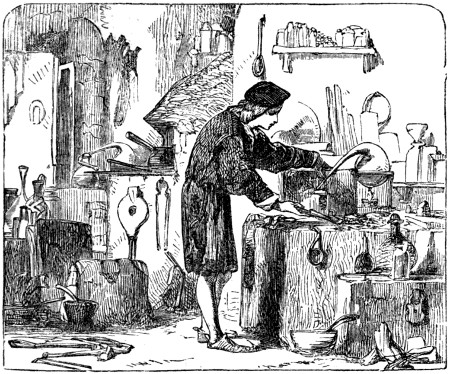
It happened that the wife of Galvani, who was consumptive, was advised to take as an article of food some soup made of the flesh of frogs. Several of these creatures were killed and skinned, and were lying on the table in the laboratory close to an electrical machine, with which a pupil of the professor was making experiments. While the machine was in action, he chanced to touch the bare nerve of the leg of one of the frogs with the blade of the knife that he had in his hand, when suddenly the whole limb was thrown into violent convulsions. Galvani was not present when this occurred; but being informed of it, he immediately set himself to investigate the cause. He found that it was only when a spark was drawn from the prime conductor, and when the knife or any other good conductor was in contact with the nerve, that the contracting took place; and after a time he discovered that the effect was independent of the electrical machine, and might be equally well produced by making a metallic communication between the outside muscle and the crural nerve.
SIMPLE EXPERIMENT TO EXCITE GALVANIC ACTION.
If the young experimenter will obtain a piece of zinc of the size of half a crown and place it on the top of his tongue, and place a half-crown underneath it, and bring the edges of the half-crown and zinc in contact in front of his tongue, he will notice a peculiar sensation in the nerves of this organ, and some taste will be imparted to his mouth at the moment of contact.
WITH METAL PLATES IN WATER.
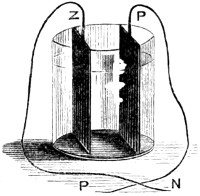
If we take two plates of different kinds of metal, platinum (or copper) and zinc, for example, and immerse them in pure water, having wires attached to them above, then if the wire of each is brought into contact in another vessel of water, a galvanic circle will be formed, the water will be slowly decomposed, its oxygen will be fixed on the zinc wire, and at the same time a current of electricity will be transmitted through the liquid to the platina or copper wire, on the end of which the other element of water, namely, the hydrogen, will make its appearance in the form of minute gas bubbles. The electrical current passes back again into the zinc at the points of its contact with the platina, and thus a continued current is kept up, and hence it is called a galvanic circle. The moment the circuit is broken by separating the wires the current ceases, but is again renewed by making them touch either in or out of the water. If a small quantity of sulphuric acid be added to the water, the phenomenon will be more apparent. The end of the wire attached to the piece of platinum or copper is called the positive pole of the battery, and that of the wire attached to the zinc the negative pole.
The current of electricity here generated will be extremely feeble; but this can be easily increased by multiplying the glasses and the number of the pieces of metal. If we take six such glasses instead of one, partially fill them with dilute sulphuric acid, and put a piece of zinc and copper into each, connecting them by means of copper wire from glass to glass through the whole series, a stronger current of electricity will be the result. The experimenter must be careful not to let the wire and zinc touch each other at the bottom of the tumblers, and must also remember that the copper of glass 1 is connected with the zinc of glass 2, and so on.

TO MAKE A MAGNET BY THE VOLTAIC CURRENT.
To effect this, make a connexion between the poles of the above or any excited battery with the two ends of a wire formed into a spiral coil, by bending common bonnet-wire closely round a cylinder, or tube, of about an inch in diameter; into this coil introduce a needle or piece of steel wire, laying it lengthways down the circles of the coil. In a few minutes after the electric fluid has passed through the spiral wire, and consequently round the needle or wire, the latter will be found to be strongly magnetized, and to possess all the properties of a magnet.
EFFECTS OF GALVANISM ON A MAGNET.
If a galvanic current, or any electric current, be made to pass along a wire under which, and in a line with it, a compass is placed, it will be found that the needle will no longer point north and south, but will take a direction nearly across the current, and point almost east and west.
CHANGE OF COLOUR BY GALVANISM.
Put a teaspoonful of sulphate of soda into a cup, and dissolve it in hot water; pour a little cabbage blue into the solution, and put a portion into two glasses, connecting them by a piece of linen or cotton cloth previously moistened in the same solution. On putting one of the wires of the galvanic pole into each glass, the acid accumulates in the one, turning the blue to a red, and the alkali in the other, rendering it green. If the wires be now reversed, the acid accumulates eventually in the glass where the alkali appeared, while the alkali passes to the glass where the acid was.
THE GALVANIC SHOCK.
If the ends of the wires of a small galvanic battery are connected with a proper electro-magnetic coil, which may now be purchased at a very cheap rate, and the wires from the coil be placed in separate basins of water, then, on dipping the fingers of each hand in the basin, a smart shock will be felt, with a particular aching accompanied with trembling. With a strong battery and larger coil this effect is felt as high as the shoulders. The shock will also be felt by simply holding the wires of a powerful galvanic battery, one in each hand, provided the hands be moistened with salt and water. Several persons may receive the shock from the battery and coil together by joining hands.
THE ELECTROTYPE.
The electro-galvanic current has in no case been more interestingly employed than in the process of electrotyping. It consists of a mode of obtaining the copy of coins, medals, engraved plates, and other objects, which may be easily illustrated.
HOW TO MAKE AN ELECTROTYPE APPARATUS.
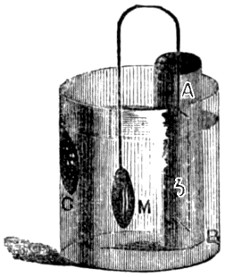
Take an earthen jar and a porous tube; fill the tube with ten parts of water and one of sulphuric acid; put it into the jar, into which pour as much of a solution of sulphate of copper (blue vitriol) as will fill three parts of it; place in the tube a piece of zinc, to which a copper wire is soldered and bent round, so that one end be immersed in the sulphate of copper; and a deposit of the copper will be immediately formed upon the wire. If there be plenty of acid and water, so as to allow of the action enduring for a long time, this process will go on till it has deposited all the copper. This is the principle upon which electrotyping proceeds,—a principle referable to electro-chemical decomposition.
The diagram represents an outer vessel of wood, glass, or earthenware, capable of holding a pint of liquid, within which there is suspended a short lamp-glass A, the one end being open, and the other, B, closed with a diaphragm of plaster of Paris; C is a small bag of crystals of sulphate of copper, to keep up the strength of the solution; Z is the zinc, and M the metal.
TO OBTAIN THE COPY OF A COIN OR MEDAL.
Never place the original medal in the apparatus, or the deposited copper may adhere so tightly to it that the removal destroys the beauty of the medal. Having taken an impression in sealing-wax, cover the latter with black-lead, and attach a wire so that it is in contact with the black-lead. To the wire and cast thus arranged a piece of sheet or cast zinc, amalgamated with mercury, must be attached, and we are at once furnished with the materials for the battery, as the object to be copied supplies the place of the copper. The medal must always be placed horizontally. Now let the apparatus be charged with the solution, by pouring into the outer vessel a portion of the coppery solution, so that it will stand about an inch above the medal; then pour in the glass the dilute acid to the same height as the former; now introduce the zinc into the acid, and the object to be copied into the solution of copper, which will immediately be deposited on the medal, and when of a sufficient thickness may be taken off.
HEAT.
HEAT, OR CALORIC.
The chief agent in causing the repulsion or separation of the particles of bodies from each other is heat, or more correctly caloric, by which is understood the unknown cause of the effect called heat. Philosophers are not agreed upon the nature of this wonderful agent. It pervades all nature, is the cause of nearly all the changes that take place both in organic and inorganic matter, and has great influence in the meteorological phenomena which we observe in the atmosphere that surrounds our planet. It appears to be intimately connected with light, electricity, and magnetism,—subjects which the genius of Faraday and others have investigated, and by their discoveries brought us nearer to the knowledge of the real nature of these most wonderful forces.
Caloric, then, exists in all bodies, and has a constant tendency to equalize itself, as far at least as its outward manifestation, called temperature, is concerned; for if a hot body be brought near colder ones, it will give up heat to them, until by its loss and their gain they all become of the same temperature; and this proceeds more or less rapidly, according as the original difference of temperature was greater or less. Some other circumstances also influence this equalization. The converse will take place on introducing a cold body among warmer ones, when heat will be abstracted from all the bodies within reach of its influence, until it has absorbed sufficient caloric to bring its own temperature to an equality with theirs. This is the true explanation of the apparent production of cold. When, for instance, an iceberg comes across a ship’s course, it appears to give out cold, whereas, it has abstracted the heat from the air and sea in its neighbourhood, and they in turn act upon the ship and everything in it, until one common temperature is produced in all the neighbouring bodies.
It does not follow that the bodies thus equalized in temperature contain equal quantities of caloric; far from it. Each body requires a particular quantity of caloric to raise its temperature through a certain number of degrees; and such quantity is called its specific caloric. A pound of water, for instance, will take just twice as much caloric as a pound of olive oil, to raise its temperature through the same number of degrees; the specific caloric of water is therefore double that of oil. Mix any quantity of oil at 60° of temperature with an equal weight of water at 90°, and you will find the temperature of the mixture to be nearly 80°, instead of only 74° or 75°, showing that while the water has lost only 10° of caloric, the mixture has risen 20°. If the oil be at 90°, and the water at 60°, the resulting temperature will be only 70°, or thereabouts, instead of 75°, the mean; thus, here the hot oil has lost 20°, while the mixture has risen only 10°; the water, then, contains at the same temperature twice as much caloric as the oil; its specific caloric is double that of the oil. This mean temperature does result when equal weights of the same body at different temperatures are mixed together.
The sensations called heat and cold are by no means accurate measures of the real temperature of any substances, for many causes influence these sensations, some belonging to the substances themselves, others to the state of our organs at the time. Every one has remarked that metals in a warm room feel warmer, and in a cold room colder than wooden articles, and these again than woollen or cotton articles of dress or furniture; this arises from metals being what is termed better conductors of heat than wood, and this better than wool, &c., that is, they give out or absorb caloric more rapidly than these last. Some philosophers, wishing to ascertain how much heat the human body could endure, had a room heated with stoves, every crevice being carefully stopped, until the temperature rose so high that a beefsteak placed on the table was sufficiently cooked to be eaten. They were dressed in flannel, and could with impunity touch the carpets, curtains, &c., in the room; but the iron handles, fire-irons, and all metallic substances, burnt their fingers; and one who wore silver spectacles was obliged to remove them to save his nose. The fallacy of our sensations may be easily shown by taking two basins, placing in one some water at 100°, in another some water at as low a temperature as can easily be procured—hold the right hand in one, the left in the other, for a few minutes, and then mix them, and place both hands in the mixture; it will feel quite cold to the hand that had been in the hotter water, and hot to the other.
In order to arrive at a correct estimate of the temperature of bodies, instruments are made use of called thermometers, or measurers of heat, which show increase or diminution of temperature by the rising or falling of a column of some fluid in a tube of glass, one end of which is expanded into a bulb, and the other hermetically sealed. This effect is produced by the expansion or swelling of the fluid as caloric is added to, and its contraction when caloric is abstracted from it. Coloured spirits of wine, or quicksilver, are the most usual thermometric fluids, and the tube containing them is fixed to a wooden or metallic frame, on which certain divisions are marked, called degrees.
That in general use in England is called Fahrenheit’s, from the name of the person who first introduced that particular scale. In this thermometer, the point at which the mercury in the tube stands when plunged into melting ice, is marked 32°, and the distance between that point, and the point to which the mercury rises in boiling water, is divided into 180 equal parts, called degrees; so that water is said to boil at 212° = 180° + 32°. There are two other scales of temperature used in different parts of the world, but it is not worth while to notice them here.
Not only do different bodies at the same degree of temperature contain very different quantities of caloric, but this also is the case with the same body in different forms. Ice, water, and steam, are three forms of the same body, but ice at 32° contains much less caloric than water at the same temperature, and water at 212° contains much less caloric than steam (or water in a state of vapour) at that temperature.
Place in a jar any given quantity of snow, or small pieces of ice, at 32°, and in another the same weight of water at 32°, pour on each an equal weight of water at 172°, and you will find that in the first case the ice will be melted, but the temperature will remain at 32° or thereabouts, while the temperature of the water in the other vessel will have risen to 100° or thereabouts, being as near as possible the half of the excess of the temperature of the hot water, 140° over that of the cold, namely 70° added to 32°, the original temperature. Now, what has become of the heat which was added to the ice, and is apparently lost?—it is absorbed by the ice in its passage to the fluid state; so that water may be said to be a compound of ice and caloric.
Again, take 10 ounces of water at about 50°, and add 1 oz. of water at 212°, and the temperature of the mixture will be about 66°; then condense some steam at 212°, into another 10 oz. of water until it has become 11 oz., and you will find the temperature will be nearly 212°. Why does the ounce of steam at 212° raise the temperature of the water so much higher than the ounce of water at the same temperature? Obviously because it contains hidden in its substance a vast quantity of caloric, not to be detected by the thermometer; in fact, that steam is a compound of water and caloric, as water is a compound of ice and caloric; and this caloric which exists, more or less, in all bodies without producing any obvious effect, is called latent caloric, from the Latin verb lateo, to lie hid. The quantity of caloric thus absorbed as it were by various bodies, differs for each body, and for the same body in different forms, as mentioned above.
EXPANSION.
As a general rule, all bodies, whether solid, liquid, or gaseous, are expanded by caloric. This may be shown by experiments in each form of matter.
Have a small iron rod made, which when cold just passes through a hole in a plate of metal; heat it, and it will no longer pass; after a time the rod will return to its former temperature, and then will go through the hole as before. The rod increases in length as well as width; if you have a gauge divided into 1/100 of an inch, and place the rod in it when cold, noting its position, on heating it will extend to a greater length in the gauge, returning to its former place when cool.
The effect of caloric in causing fluids to expand is actually employed as a measure of quantity in the thermometer, the rise of the fluid in the tube when heated depending on the increased bulk of the fluid occasioned by the addition of caloric. The same fact is to be noticed every day when the cook fills the kettle, and places it on the fire. As the water becomes warmer it expands, that is, takes up more room than it did before, and the water escapes by slow degrees, increasing as the heat increases, up to the point of boiling, when a sudden commotion takes place from the condensation of a portion of the water into steam.
But it is in the form of vapour or gas, (which by the bye is not the same thing,[9]) that the expansive force of caloric is most obvious. The gigantic powers of the steam-engine depend entirely on the tendency of vapour to expand on the addition of caloric; and this force of expansion appears to have no limit; boilers made of iron plates an inch or even more in thickness, and the buildings or ships containing them, having been torn to pieces and scattered in all directions by the expansive power of steam. Take a bladder, and fill it about half full of air, and tie the neck securely; upon holding it to the fire it will swell out, and become quite tense from the expansion of the contained air.
The principal source of caloric is the sun, whose beams, diffused through all nature by the refractive property of the atmosphere, are the source of vitality both to vegetables and animals, and when concentrated by a large convex lens, produce the most intense heat, sufficient to light a piece of diamond, and melt platinum. Caloric is also produced or evolved by combustion, by friction, percussion, chemical combination, electricity, and galvanism.
The evolution of heat by friction may be witnessed daily in a thousand instances. Lucifer matches are lighted by rubbing the highly inflammable substances with which they are tipped against a piece of sand-paper. Nearly all savage people procure fire by rubbing a piece of hard wood violently against a softer piece. The axle-trees of steam-engines, and even of carriages, have been known to be so heated by friction as to endanger burning the carriage; and it is very usual to be obliged to pour a quantity of cold water on the iron axle of the carriages of an express train after an hour of constant and rapid work. If you merely rub the blade of a knife rapidly on a piece of wood, it will become hot enough to burn your hand.
Percussion is merely a more energetic kind of friction, and is often resorted to by the blacksmith to light his furnace. He places a nail or other piece of soft iron on his anvil, and beats it rapidly with the hammer, when it becomes actually red hot. The production of sparks by striking flint against steel, or two pieces of flint one against the other, are familiar instances of heat produced by percussion.
One of the most powerful means of producing heat is the process of combustion.
Combustion, as the word imports, is the burning together of two or more substances, a chemical union of oxygen generally with carbon and hydrogen in some shape or other. In our ordinary fires we burn coal, a hydro-carbon as it is called; and the gas which is now so universally used for the purpose of illumination, is a compound of the same bodies—so wax, tallow, oil of various kinds, both of animal and vegetable origin, are all hydro-carbons.
On the application of a sufficient heat, and a free access of atmospheric air, or of some other gas containing oxygen in a certain state of combination, these bodies take fire, and continue to burn either with flame, or a red or even white heat without flame, until they are consumed; that is, until they have entered into new combinations with the oxygen, and are converted into carbonic acid and water, the carbon forming the first product, the hydrogen the other.
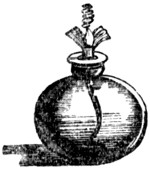
The following experiment shows the production of heat by chemical action alone. Bruise some fresh prepared crystals of nitrate of copper, spread them over a piece of tin-foil, sprinkle them with a little water; then fold up the foil tightly as rapidly as possible, and in a minute or two it will become red-hot, the tin apparently burning away. This heat is produced by the energetic action of the tin on the nitrate of copper, taking away its oxygen in order to unite with the nitric acid, for which, as well as for the oxygen, the tin has a much greater affinity than the copper has.
Combustion without flame may be shown in a very elegant and agreeable manner, by making a coil of platinum wire by twisting it round the stem of a tobacco-pipe, or any cylindrical body, for a dozen times or so, leaving about an inch straight, which should be inserted into the wick of a spirit-lamp; light the lamp, and after it has burnt for a minute or two extinguish the flame quickly; the wire will soon become red hot, and, if kept from draughts of air, will continue to burn until all the spirit is consumed. Spongy platinum, as it is called, answers rather better than wire, and has been employed in the formation of fumigators for the drawing-room, in which, instead of pure spirit, some perfume, such as lavender water, is used; by its combustion an agreeable odour is diffused through the apartment. These little lamps were much in vogue a few years ago, but are now nearly out of fashion.
Experiments on combustion might be multiplied almost to any amount, but the above will be sufficient for the present. When we come to treat of the properties of the gases and some other substances, we shall have occasion to recur to this subject.
The production of caloric by chemical combination may be exhibited by mixing carefully one part of oil of vitriol with two of water, when sufficient heat will be produced to boil some water in a thin and narrow tube, which may be used as a rod to stir the mixture.
The production of heat by electric and galvanic agency belongs to another subject. I will content myself with saying here, that these forces afford the most powerful aid in decomposing and uniting various bodies, and that it was by the immense power of a battery of 2,000 pairs of plates, belonging to the Royal Institution in London, that Sir H. Davy discovered the metallic bases of the alkalies and earths.
HYDRAULICS.
The science of Hydraulics comprehends the laws which regulate non-elastic fluids in motion, and especially water, &c.
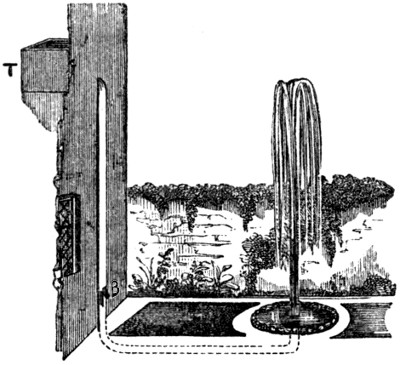
Water can only be set in motion by two causes—the pressure of the atmosphere, or its own gravity. The principal law concerning fluids is, that they always preserve their own level. Hence water can be distributed over a town from any reservoir that is higher than the houses to be supplied; and the same principle will enable us to form fountains in a garden, or other place. Should any of our young friends wish to form a fountain, or jet d’eau, they may, by bringing a pipe from T, a water-tank, which should be at the upper part of the house, convey the water down to the garden. Then by leading it through the earth, underneath the path or grass-plot, and turning it to a perpendicular position, the water will spring out, and rise nearly as high as the level of that in the tank. The part of the pipe at B should have a turnkey, so that the water may be let on or shut off at pleasure.
THE SYPHON.
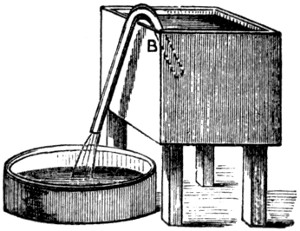
The syphon B is a bent tube, having one leg shorter than the other. It acts by the pressure of the atmosphere. In order to make a syphon act, it is necessary first to fill both legs quite full of the fluid; and then the shorter leg must be placed in the vessel to be emptied. Immediately upon withdrawing the finger from the longer leg, the liquor will flow. Any young person may form a syphon by a small piece of leaden pipe, bent into the form above.
THE PUMP.
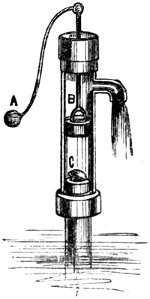
The action of the common pump is as follows: When the handle A is raised, the piston-rod B descends, and brings the piston-valve, called the sucker, or bucket, to another valve, C, which is fixed, and opens inwards towards the piston. When the handle is drawn down, the piston is raised, and, as it is air-tight, a vacuum is produced between the two valves; the air in the barrel of the pump, betwixt the lower valve and the water, then forces open the lower valve, and rushes through to fill up this vacuum; and the air in the pump being less dense than the external atmosphere, the water is forced a short way up the barrel. When the piston again descends to the lower valve, the air between them is again forced out by forcing open the upper valve; and when the piston is raised, a vacuum is again produced, and the air below the lower valve rushes up, and the water in consequence is again raised a little further. This operation continues until the water rises above the lower valve; at every stroke afterwards, the water passes through the valve of the descending piston, and is raised by it, on its ascent, until it issues out of the spout.
THE HYDRAULIC DANCER.
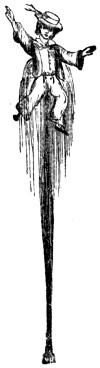
Make a little figure of cork, in the shape of a dancing mountebank, sailor, &c. In this figure place a small hollow cone, made of thin leaf brass. When this figure is placed upon any jet d’eau, such as that of the fountain recommended to be constructed, it will be suspended on the top of the water, and perform a great variety of amusing motions. If a hollow ball of very thin copper, of an inch in diameter, be placed on a similar jet, it will remain suspended, turning round and spreading the water all about it.
THE WATER SNAIL, OR ARCHIMEDEAN SCREW,
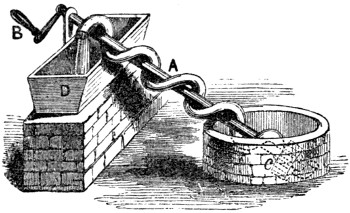
may easily be constructed. Purchase a yard of small leaden pipe, and twist it round a pole, as in the following figure, A; place a handle at its upper end, B, and let its lower end rest in the water. Between the last turn of the pipe and the orifice place a paddle-wheel, C. Now, should the water be that of a running stream, the force of the stream will turn the pipe, and the water will rise in it till it empties itself into the trough at D. Should the water have no motion, the turning of the handle at B will elevate the water from the lower to the higher level.
MAGNETISM.
The attractive power of the loadstone has been known from a very remote period. The natural magnet appears native in a grey iron ore in octahedral crystals, composed of 168 parts of iron, and 64 parts of oxygen, Fe3O4. Its properties seem to have been studied in Europe during the dark ages, and a directive power is alluded to by Cardinal James de Vitri, who flourished about the year 1200, who observed, that it was indispensable to those who travel much by sea.
In modern times, the history as well as the nature of the magnet has engaged remarkable attention; and it has been determined beyond all dispute that the magnet was used by the Chinese under the name of the tche-chy (directing-stone) about 2604 years before Christ. It passed from them to the Arabs, and was first used in Europe after the Crusades; and Ludi Vestomanus asserts, that about the year 1500 he saw a pilot in the East Indies direct his course by a magnetic needle like those now in use.
RELATION OF MAGNETISM TO ELECTRICITY.
The most remarkable theories have been invented to account for the phenomena of magnetism. Halley imagined magnetic globes to be moving to and fro in the interior of the earth. Barlow’s theory, which refers the whole to electrical currents, is the most rational. Dr. Faraday, for whose kindness to us in early days we always feel grateful, in a series of very curious experiments, has succeeded in identifying magnetism with galvanism, by directing galvanic currents at right angles to the direction of powerful magnets. And its connexion with this and the common species of electricity has deprived it of all its conjuring powers, and reduced it to the well-defined action of electrical bodies.
It is not for us to write either a history of this interesting subject, or to treat it as a science to be acquired; but as it embodies a great number of most instructive and amusing experiments, we think it proper to introduce it here.
TO MAKE ARTIFICIAL MAGNETS.
This may be done by stroking a piece of hard steel with a natural or artificial magnet. Take a common sewing-needle and pass the north pole of a magnet from the eye to the point, pressing it gently in so doing. After reaching the end of the needle the magnet must not be passed back again towards the eye, but must be lifted up and applied again to that end, the friction being always in the same direction. After repeating this for a few times the needle will become magnetised, and attract iron filings, &c.
HOW TO MAGNETISE A POKER.
Hold it in the left hand in a position slightly inclined from the perpendicular, the lower end pointing to the north, and then strike it smartly several times with a large iron hammer, and it will be found to possess the powers of a magnet, although but slightly.
TO SHOW MAGNETIC REPULSION AND ATTRACTION.
Suspend two short pieces of iron wire, N S, N S, so that they will hang in contact in a vertical position. If the north pole of a magnet N be now brought to a moderate distance between the wires, they will recede from each other, as in figure 1.
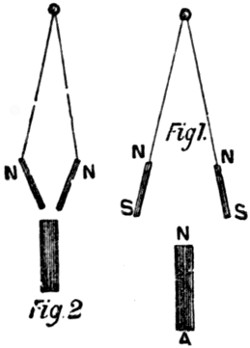
The ends S S being made south poles by induction from the north pole N, will repel each other, and so will the north poles N N. This separation of the wires will increase as the magnet approaches them, but there will be a particular distance at which the attractive force of N overcomes the repulsive force of the poles S S, and causes the wires to converge, as in figure 2; the north poles N N still exhibiting their mutual repulsion.
NORTH AND SOUTH POLES OF THE MAGNET.
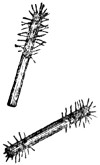
Each magnet has its poles, north and south—the north or south poles of one magnet, repel the north and south pole of another. If a magnet, as in the following figure, be dipped in some iron filings, they will be immediately attracted to one end. Supposing this to be the north pole, each of the ends of the filings, not in contact with the magnet, will become north poles, while the ends in contact will by induction become south poles. Both will have a tendency to repel each other, and the filings will stand on the magnet as in the figure.
POLARITY OF THE MAGNET.
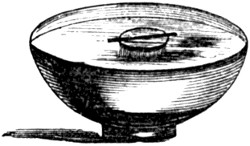
The best method of proving this is to take a magnet or a piece of steel rendered magnetic, and to place it on a piece of cork by laying it in a groove cut to receive it. If the cork be placed in the centre of a basin of water, and allowed to swim freely on its surface, so that it is not attracted by the sides of the basin, it will be found to turn its north pole to the north, and its south pole to the south, the same as the mariner’s compass. If you fix two magnets in two pieces of cork, and place them also in a basin of water, and they are in a parallel position with the same poles together, that is, north to north, and south to south, they will mutually repel each other; but if the contrary poles point to one another, as north to south, they will be attracted.
THE MAGNETIC FISH.
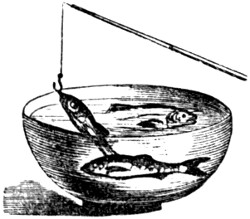
Fish are to be purchased at the toy-shops, by which the young “magnétique” may perform this experiment; they are made hollow, and will float on the water. In the mouth of each should be inserted a piece of magnetic wire. The angling rod is like any other rod, and has a silken thread for a line, and an iron hook also strongly magnetised. To catch the fish it is only necessary to put the hook in contact with the noses of the fish, and they will be taken without any of the baits mentioned in the former part of this work.
THE MAGNETIC SWAN.
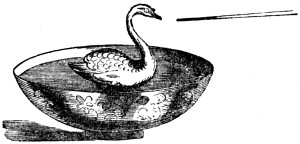
The figure of a swan should be cut in cork, and within its beak a small strongly magnetised piece of steel should be placed. The swan should then be covered with a coating of white wax, and fashioned further into the shape of a swan, and glass beads may be placed in its head for eyes. This should be placed in a small tub or large basin of water, and to make it swim about, you should place in a white stick about nine inches long a magnetic bar, on which the north and south poles are marked. If you wish to bring the swan towards you, present to him the north pole of the wand, if you wish it to retire, present the south pole, and thus you may direct the swan to any part you desire.
TO SUSPEND A NEEDLE IN THE AIR BY MAGNETISM.
Place a magnet on a stand to raise it a little above the table; then bring a small sewing-needle containing a thread, within a little of the magnet, keeping hold of the thread to prevent the needle from attaching itself to the magnet. The needle in endeavouring to fly to the magnet, and being prevented by the thread, will remain curiously suspended in the air, reminding us of the fable of Mahomed’s coffin.
TO MAKE ARTIFICIAL MAGNETS WITHOUT THE AID EITHER OF NATURAL LOADSTONES OR ARTIFICIAL MAGNETS.
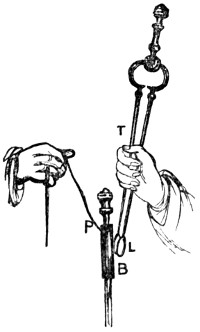
Take an iron poker and tongs, or two bars of iron, the larger and the older the better, and fixing the poker upright, hold to it with the left hand near the top P by a silk thread, a bar of soft steel about three inches long, one fourth of an inch broad, and one twentieth thick; mark one end, and let this end be downwards. Then grasping the tongs T with the right hand a little below the middle, and keeping them nearly in a vertical line, let the bar B be rubbed with the lower end L of the tongs, from the marked end of the bar to its upper end about ten times of each side of it. By this means the bar B will receive as much magnetism as will enable it to lift a small key at the marked end; and this end of the bar being suspended by its middle, or made to rest on a joint, will turn to the north, and is called its north pole, the unmarked end being the south pole. This is the method recommended by Mr. Caxton, in his process, which he regarded superior to those in former use, and of which a more detailed account will be found in his interesting volume.
HORSE-SHOE MAGNETS.
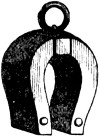
The form of a horse-shoe is generally given to magnetised bars, when both poles are wanted to act together, which frequently happens in various experiments, such as for lifting weights by the force of magnetic attraction, and for magnetising steel bars by the process of double touch, for which they are exceedingly convenient. The following is the method of making a powerful magnetic battery of the horse-shoe form. Twelve bars or plates of steel are to be taken, and having been previously bent to the required form, that is, the horse-shoe shape, they are then bound together by means of rivets at their ends; before being finally fastened they are each separately magnetised, and afterwards finally united.
Horse-shoe magnets should have a short bar of soft iron adapted to connect the two poles, and should never be laid by without such a piece of iron adhering to them. Bar magnets should be kept in pairs with their poles turned in contrary directions, and they should be kept from rust. Both kinds of magnets have their power not only preserved but increased, by keeping them surrounded with a mass of dry filings of soft iron, each particle of which will re-act by its induced magnetism upon the point of the magnet to which it adheres, and maintain in that point its primitive magnetic state.
EXPERIMENT TO SHOW THAT SOFT IRON POSSESSES MAGNETIC PROPERTIES WHILE IT REMAINS IN THE VICINITY OF A MAGNET.
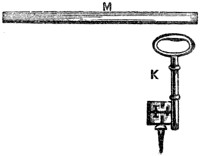
Let M be a magnet and K a key, held horizontally near one of its poles, or near its lower edge. Then if another piece of iron, such as a small nail, be applied to the other end of the key, the nail will hang from the key, and will continue to do so while the magnet is slowly withdrawn; but when it has been removed beyond a certain distance, the nail will drop from the key, because the magnetism induced in the key becomes at that distance too weak to support the weight of the nail. That this is the real cause of its falling off may be proved by taking a still lighter fragment of iron, such as a piece of very slender wire, and applying it to the key. The magnetism of the key will still be sufficiently strong to support the wire, though it cannot the nail, and it will continue to support it even when the magnet is yet further removed; at length, however, it drops off.
ELECTRO-MAGNETISM.
The identity of magnetism with electricity alluded to in a former paragraph, has led to the formation of a new science under the above name, and to some of the interesting experiments connected with it, we shall briefly allude for the amusement of the young reader.
POWER OF THE ELECTRO-MAGNET.
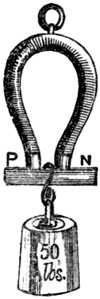
The same influence which affects the magnetic needle already described, will also communicate magnetism to soft iron. If a bar of that metal bent, as in the drawing, be surrounded with a common bonnet wire, or a copper wire prevented from touching the iron by a winding of cotton or thread, and then if a current of voltaic electricity be sent through the wire, the bar becomes a powerful magnet, and will continue so as long as the connexion with the battery is preserved. On breaking the contact, the magnetism disappears. This experiment may be easily made by the young reader with a horse-shoe magnet, surrounded by several coils of wire. P is the positive, and N the negative pole.
THE MARINER’S COMPASS AND EXPERIMENTS WITH A POCKET COMPASS.
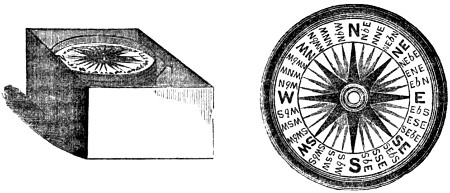
The mariner’s compass is an artificial magnet fitted in a proper box, and consists of three parts—1, the box; 2, the card or fly; and 3, the needle. The box is suspended in a square wooden case, by means of two concentric brass circles called gimbals, so fixed by brazen axes to the two boxes, that the inner one, or compass-box, retains a horizontal position in all motions of the ship. The card is a circular piece of paper which is fastened upon the needle, and moves with it. The outer edge of the card is divided into thirty-two points, as shown in the engraving, called points of the compass. The needle is a slender bar of hardened steel, having a hollow agate cup in the centre, which moves upon the point of a pivot made of brass.
VARIATION OF THE NEEDLE.
The magnetic needle does not point exactly north and south, but the north pole of the needle takes a direction to the west of the true north. It is constantly changing, and varies at different parts of the earth, and at different times of the day.
DIP OF THE NEEDLE.
Another remarkable and evident manifestation of the influence of the magnetism of the earth upon the needle is the inclination or dip of the latter, which is a deviation from its horizontal place in a downward direction in northern regions of its north, and in southern regions of its south pole. In balancing the needle on the card, on account of this dipping, a small weight or moveable piece of brass is placed on one end of the needle, by the shifting of which either nearer to or further from the centre, the needle will always be balanced.
USEFUL AMUSEMENT WITH THE POCKET COMPASS.
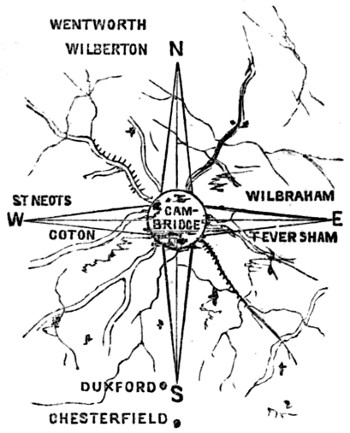
Pocket compasses are to be bought for five or six shillings, and may be used in many ways. In travelling over mountains or a wide extended moor, they are indispensably necessary; and no one should go a tour into Wales, Scotland, or the lakes without such a companion, and it will be a very useful and amusing exercise for any young person to take the bearings of his own or some particular locality, and make out what may be called a bearing card. This he may easily do in the following manner. Supposing he wishes, for instance, to take the bearings of his own house, he has nothing to do but to set his pocket compass upon a map of the district,—a county map will do very well, unless his house stands on the verge of a county, then two county maps will be necessary. He must make the north of the map exactly coincide with the north, as indicated by his compass, and having fixed his map in this situation, he should take a ruler and piece of paper, and dot down the exact bearings of each important town, or place, or village, around him. Let him suppose himself, for instance, in the town of Cambridge, and laying down his map as indicated by the compass, north to north and south to south, he will find the following places due north, Wilberton, Wentworth; Little Wilbraham, Teversham, due east; Duxford and Chesterfield, south; Coton and St. Neots in Huntingdonshire, west. The other points of the compass may be filled up in the same manner. Should therefore our young friend be upon any elevated situation near his own dwelling, or upon any other elevated spot from which the bearings have been taken, he will be able to inform his young friends that such and such a place lies in such a direction, that this place lies due north, the other north-west, a third south-east, the fourth south-west, &c. &c.
INTERESTING PARTICULARS CONCERNING THE MAGNET.
Fire-irons which have rested in an upright position in a room during the summer months are often highly magnetic.
Iron bars standing erect, such as the gratings of a prison cell, or the iron railings before houses, are often magnetic.
The great iron-clad ships, which have now replaced the wooden walls of Old England, are powerfully magnetic, and therefore affect the compass by which the vessel is steered; ingenious arrangements are therefore made to correct the effect of the local attraction, so that the man-of-war may be steered correctly.
Magnetism may be made to pass through a deal board; to exhibit which, lay a needle on the smooth part above, and run a magnet along the under side, and the needle will be found to follow the course of the magnet. A magnet dipped into boiling water loses part of its magnetism, which however returns upon its cooling.
A sudden blow given to a magnet often destroys its magnetic power.
MECHANICS.
“These are machinations comical.”—Ford.
There is no subject of such importance as Mechanics, as its principles are founded upon the properties of matter and the laws of motion; and in knowing something of these, the tyro will lay the foundation of all substantial knowledge.
The properties of matter are the following: Solidity (or Impenetrability), Divisibility, Mobility, Elasticity, Brittleness, Malleability, Ductility, and Tenacity.
The laws of motion are as follow:—
1. Every body continues in a state of rest or of uniform rectilineal motion, unless affected by some extraneous force.
2. The change of motion is always proportionate to the impelling force.
3. Action and reaction are always equal and contrary.
EXPERIMENT OF THE LAW OF MOTION.
In shooting at “taw,” if the marble be struck “plump,” as it is called, it moves forward exactly in the same line of direction; but if struck sideways, it will move in an oblique direction, and its course will be in a line situated between the direction of its former motion and that of the force impressed. This is called the resolution of forces.
BALANCING.
The centre of gravity in a body is that part about which all the other parts equally balance each other. In balancing a stick upon the finger, or upon the chin, it is necessary only to keep the chin or finger exactly under the point which is called the centre of gravity.
THE PRANCING HORSE.
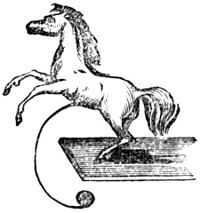
Cut out the figure of a horse, and having fixed a curved iron wire to the under part of its body, place a small ball of lead upon it. Place the hind legs of the horse on the table, and it will rock to and fro. If the ball be removed, the horse would immediately tumble, because unsupported, the centre of gravity being in the front of the prop; but upon the ball being replaced, the centre of gravity immediately changes its position, and is brought under the prop, and the horse is again in equilibrio.
TO CONSTRUCT A FIGURE, WHICH, BEING PLACED UPON A CURVED SURFACE, AND INCLINED IN ANY POSITION, SHALL, WHEN LEFT TO ITSELF, RETURN TO ITS FORMER POSITION.
The feet of the figure rest on a curved pivot, which is sustained by two loaded balls below; for the weight of these balls being much greater than that of the figure, their effect is to bring the centre of gravity of the whole beneath the point on which it rests; consequently the equilibrium will resist any slight force to disturb it.
TO MAKE A CARRIAGE RUN IN AN INVERTED POSITION WITHOUT FALLING.
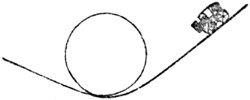
It is pretty well known to most boys, that if a tumbler of water be placed within a broad wooden hoop, the whole may be whirled round without falling, owing to the centrifugal force. On the same principle, if a small carriage be placed on an iron band or rail, it will ascend the curve, become inverted, and descend again, without falling.
TO CAUSE A CYLINDER TO ROLL BY ITS OWN WEIGHT UP-HILL.
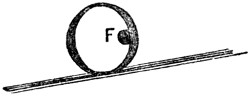
Procure a coffee-canister, and loading it at F with a piece of lead, which may be fixed in with solder, the position of the centre of gravity is thus altered. If a cylinder so constructed be placed on an inclined plane, and the loaded part above, it will roll up-hill without assistance.
THE BALANCED STICK.
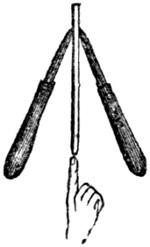
Procure a piece of wood, about nine inches in length and about half an inch in thickness, and thrust into its upper end the blades of two penknives, on either side one. Place the other end upon the tip of the fore-finger, and it will keep its place without falling.
THE CHINESE MANDARIN.
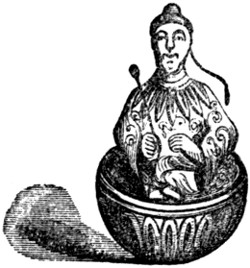
Construct out of the pith of the elder a little mandarin; then provide a base for it to sit in, like a kettle-drum. Into this put some heavy substance, such as half a leaden bullet; fasten the figure to this, and in whatever position it may be placed, it will, when left to itself, immediately return to its upright position.
TO MAKE A SHILLING TURN ON ITS EDGE ON THE POINT OF A NEEDLE.
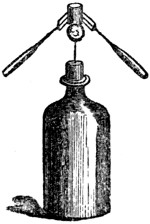
Take a bottle, with a cork in its neck, and place in it, in a perpendicular position, a middle-sized needle. Fix a shilling into another cork, by cutting a nick in it; and stick into the same cork two small table-forks, opposite each other, with the handles inclining outwards and downwards. If the rim of the shilling be now poised on the point of the needle, it may easily be made to spin round without falling, as the centre of gravity is below the centre of suspension.
THE DANCING PEA.
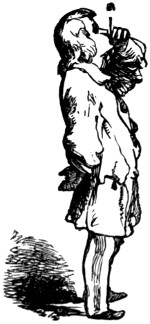
If you stick through a pea, or small ball of pith, two pins at right angles, and defend the points with pieces of sealingwax, it may be kept in equilibrio at a short distance from the end of a straight tube, by means of a current of breath from the mouth, which imparts a rotatory motion to the pea.[10]
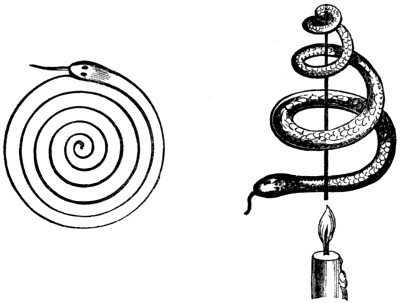
OBLIQUITY OF MOTION.
Cut a piece of pasteboard into the following shape, and describe on it a spiral line; cut this out with a penknife, and then suspend it on a large skewer or pin, as seen in the engraving. If the whole be now placed on a warm stove, or over the flame of a candle or lamp, it will revolve with considerable velocity. The card, after being cut into the spiral, may be made to represent a snake or dragon, and when in motion will produce a very pleasing effect.
THE BRIDGE OF KNIVES.
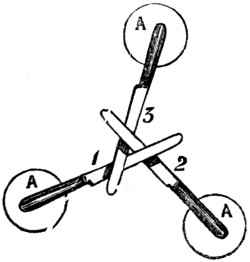
Place three glasses, A A A, in the form of a triangle, and arrange three knives upon them, as shown in the figure,—the blade of No. 1 over that of No. 2, and that over No. 3, which rests on No. 1. The bridge so made will be self-supported.
THE TOPER’S TRIPOD.
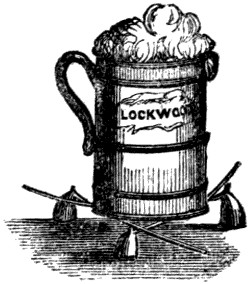
Place three tobacco-pipes in the position shown in the engraving, the mouth of the bowls downwards, and the lower end of the stems upon the stem just by the bowls. This tripod, if carefully put together, will support considerably more than a pot of “Lockwood’s home-brewed,” equally celebrated with the trick.
THE MICROSCOPE.
At any time of the year or hour of the day there are few pursuits more interesting, and at the same time instructive, than the study of Nature by means of the microscope.
This instrument has revolutionized science, solved many problems that had wearied the souls of older naturalists, and even in its simplest form is beyond all value to those who love Nature and the objects which they see around them. The microscope opens a new world to us. When the first telescope was directed to the heavens, and unlocked the mysteries of the skies, when it crumbled into dust all the theories of the past centuries, and told mankind that the planets were not merely instruments of fortune-telling, whose voices were intelligible to a chosen few, but orbs far vaster than our own; even then the new world of thought into which man entered was no wider than that which is displayed by the poorest lens that possesses the power of magnifying.
All of us must admire the more than awful grandeur of that universe whereof we form so infinitesimal a part, wherein the stars are scattered as the sand on the sea-shore, and every star a sun, the centre of a system of orbs too distant for the eye of man to perceive. Looking at our nearest planet, and observing on her face vast mountain-chains, ravines into which the light of the sun can never penetrate, and volcanoes whose craters are so wide that they would take in the whole of London, the whole of Birmingham, and all the country between them, we can judge by analogy of the unseen wonders which must exist in the world beyond our ken.
But to him who can read Nature rightly, the microscope is a teacher as grand as its sister instrument, and the awful magnificence of Nature is as evident in a midge’s wing as in the more patent glories of the sun, moon, and stars. In the following pages we hope to put the readers of this book in the way to read their microscope rightly—possibly to make it—and to show that much can be done with small means when “there’s a will,” and to indicate to them that objects of no small interest can be found without stirring from the room in which we sit, or even from the table on which our microscope is placed.
Some of our readers may say, when they read the heading of this paper, that they should like a microscope very much, but that they have no money to buy it, and that their parents cannot afford one.
This is just the feeling which we used to have when a boy, for in those days microscopes were microscopes indeed, and you had your choice between a little instrument, with a series of brass cups, having glasses in them, which magnified slightly but defined clearly, or a great composition of brass and iron, looking like a rocket-tube, with an eye-piece at one end and a glass shot at the other. In was very costly, very imposing, and magnified very highly; but it strained the eyes painfully, had no defining capacities, and made all the objects look as if they were seen through a thick fog. Practically, therefore, the former was the only instrument that was available.
A still more useful instrument, however, was that which can always be obtained for a few shillings, and which is now made wonderfully cheap and wonderfully good; we mean the double or treble pocket-lens. So we say, if you cannot afford a really good microscope, do not waste your money upon inferior and pretentious instruments, but get a sound pocket-lens.
It has a thousand advantages. It is portable, and is even more useful in the fields than in the house. It defines very clearly, and needs little trouble in manipulation. We need not say how difficult is the task of getting a complicated instrument to define properly, how impossible with a bad one. The object and the glass can be held in any light,—a matter of no small consideration when examining anything new, and trying to make out its structure. It is not easily put out of order, and if treated with the most ordinary care, will last for a lifetime.
You can push it under water, and it will magnify as well as in the air; and if you are wandering on the river-side, you can lie down on the bank, dip the upper part of your head into the water, together with the glass, and watch carefully the subaquatic objects without removing them. The water will not hurt the eye in the least, though a non-swimmer may perhaps find a little difficulty in his first attempt. It makes a good burning-glass, should fire be needed, and no other means of procuring a spark be at hand. It can be used so as to show the principle of a camera obscura, and to illustrate the manner in which photographic portraits are taken. It can be made into an admirable dissecting microscope, and needs scarcely any practice in the manipulation. These are some of its advantages, and there are many others which need not be mentioned.
Even if you should be able to procure a good microscope, get a pocket-lens as well, for you will want them both, and we may say that the most practised microscopists, and those who are possessors of the most elaborate instruments, are the very men who are most certain to have a pocket-lens about them, and to use it most frequently. Practise well with the pocket-lens before you meddle with the compound microscope. You will waste no time, but will rather gain by it; for you will be learning the rudiments of a new science, and laying a solid foundation on which to build. Whenever we see a lad take out his pocket-lens in a business-like way, use it skilfully, and put it back with a mechanical facility that tells of constant practice, we know that there is a lad who has learned the chief lesson of a naturalist,—namely, the art of observing. We speak highly of the pocket-lens, because we think highly of it and owe much to it.
One or two practical remarks on the proper handling of the pocket-lens may be of use. Do not always employ the same eye in looking through the lens, but use the eyes alternately. There is always a temptation to employ the same eye, which thus receives a kind of training in vision; but it is a temptation always to be resisted. With some persons the right eye is most in favour, and with others the left; and when the favourite eye gets all the work, it too frequently suffers. Whether you look with the right or the left eye, keep both eyes open.
It is a pitiful sight to see a human face all screwed up into a corner, the lids of the unused eye convulsively squeezed together, and the mouth slanting upwards, as if in sympathy with the eye. Not only does the human face become repulsively mean and portentously ugly by such action, but the sight of the eye is seriously strained, and sometimes impaired for life. At first the beginner will find a little difficulty in restricting his vision to one eye while the other remains open, just as a beginner on the pianoforte feels himself puzzled when he tries to make his right hand go one way and his left hand another; but in either case a little practice and plenty of perseverance are sure to overcome all obstacles, and in a wonderfully short time the difficulty will not only be overcome, but forgotten.
We speak here with some feeling, because, while engaged on a work on the microscope, we were necessarily obliged to work much at night, and inadvertently employed the left eye more than the right; the consequence of which imprudence was that we have been obliged ever since that time to give the left eye perfect rest, as far as artificial vision goes, and, except when looking through a binocular instrument, we have not ventured to use it either to a microscope or telescope. The vision accommodates itself to circumstances with wonderful ease, and the observer learns the curious art of cutting off all communication between the unused eye and the brain; so that, although the objects around may imprint themselves upon the retina, the mind is as totally unconscious of them as if they had no existence.
If possible, always examine an object without removing it, as thereby you see it as it is, without altering any of the conditions with which it is surrounded. Should this not be practicable, take the object to be viewed in the left hand and the lens in the right. Place the wrists of the two hands together, and then you will find that one supports the other, and that the lens can be held in the proper focus without the least difficulty. After you have used the lens for some little time, you will learn to hit upon the right focus almost to a hair’s breadth,—so as to lose no time, a matter of some importance when a living creature is to be examined, especially if it be in motion.
As to the selection of objects, none is necessary. Look at everything; and the uglier and more unpromising it is, let it be the closer examined. We do not merely use our aids to vision for the sake of seeing beautiful things, though the microscopist sees more beauty in a day than others will see in a year. We want to see how the world and its constituent parts are made; and though admiration will not be wanting, yet it does not, or ought not, to hold the first place. Always have a motive for looking at every object, and if you have none, try to make one. One of our friends, known by name at least to most of my readers, struck out, some years ago, a most curious train of thought while looking at an object which is seen daily by thousands of human beings, and will probably soon give the public the benefit of it. We have seen the object hundreds of times, but the ideas which it suggested did not happen to occur to us.
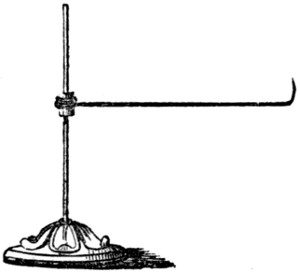
We are now about to suggest a very simple piece of mechanism, by which the pocket-lens can be converted into a microscope that will serve for dissection and many other purposes. The accompanying sketch is taken from an instrument of our own manufacture. It is of very rough make, and by an old Indian officer would be contemptuously termed “cutcha.” Measured, however, by its performance, it is quite as satisfactory as those instruments which are made by professed opticians, and which the same old Indian would class under the honoured title of “pucka.”
Melt three or four pounds of lead in an iron ladle, and make a mould, consisting of a hollow hemisphere of paper or cardboard, through the centre of which an iron rod has been passed. The hollow of the paper should resemble an ordinary saucer. Pour the lead into the saucer, and let it cool. The paper mould will be scorched by the heat and rendered useless, but an outer coating of lead will be cool and hard before the paper is quite destroyed. The rod and leaden stand will now appear as in the illustration. Next take a piece of stout brass wire and a wine-cork; twist the wire round the cork several times; cut off one end close to the cork; sharpen the other, and turn it up as seen in the engraving.
Bore a hole through the cork, just large enough to allow the upright rod to slip through it, and there is the “stand” of your microscope. Now take your pocket-lens, and get an optician to bore a hole through one end of it, just large enough to receive the upturned end of the wire; slip the lens on the wire, and the microscope is complete.
The cork, though grasping the upright stem with tolerable firmness, can be slid up and down so as to insure the correct focus, and can be pushed aside whenever the object has to be viewed with the naked eye and must not be removed from its place. This instrument is a capital one for dissecting purposes, and will answer quite as well as those expensive affairs that are to be purchased in the shops. If, however, our readers would like to possess a real and well-made instrument, he cannot do better than get one of Ross’s Dissecting Microscopes, which are very steady, and, as may be seen, can be adjusted to almost any position. A rack-and-pinion movement for elevating or lowering the sliding pillar would be useful.
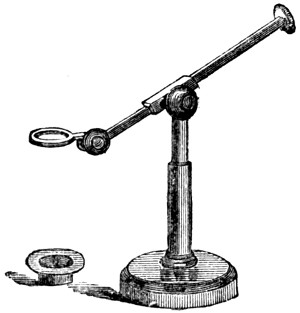
ROSS’S DISSECTING MICROSCOPE.
If the object be transparent, and requires to be seen by transmitted light, the following plan will answer:—Take a thin piece of wood, cut or punch a round hole out of the middle, and support it on four legs. Wires or wooden pegs fixed in corks will answer the purpose well, and if the corks be glued to the corners of the board, the legs can be inserted or removed at pleasure. The wood of which cigar-boxes are made will answer the purpose very well. Its dimensions should be about three inches in length by two in width. Now buy one of the doll’s looking-glasses that are sold for a penny, and put it under the stand. Lay a flat piece of glass over the hole, place the object upon it, and direct the light through it by means of the mirror below. If such a mirror cannot be obtained, it is easy enough to make one, by mounting a piece of looking-glass in a cork frame, and making it swing on pivots, like the glasses of our dressing-rooms.
The young microscopist must remember that when he is examining any object by transmitted light, he must arrange it as flatly as possible on the glass. In many cases, a still neater manipulation is required,—as, for example, when the petals of flowers are under examination. Thin glass is to be purchased at any optician’s, and if cut in squares, instead of circles, is very much cheaper, and quite as useful for all practical purposes. Lay the petal on the glass plate, place a piece of the thin glass upon it, and press it gently while examining it. If it still remains thick and dull, put a drop of pure water on the petal, and replace the thin glass, when the structure will almost invariably be detected.
Everything depends on the proper management of the object and the arrangement of the light. Some opaque objects can be seen best by direct light, and others by transmitted light. If a leaf be examined, particularly if it be a thick and heavy one, like that of the ivy, the upper and lower membranes must be stripped apart,—a task which is easily performed by tearing a small slit, and then ripping it smartly across. A pair of forceps will be required for this and other delicate work, and may be obtained at a cheap rate. Care must be taken to keep the points exactly even, and if at any time one of them appears to be shorter than the other, they should be rubbed on a hone until they are brought perfectly level.

These should be made of steel; but the young microscopist will find that a second pair made of brass, and much rougher in finish, are invaluable aids as he takes his walks into the country. By their aid he can pick up minute objects, draw insects out of crevices without damaging them, and pluck the tiniest flowers without harming their petals. They can be carried in the waistcoat pocket, and the cost is sixpence. Any lad who knows how to handle solder can make a pair for himself in a few minutes.
A penknife with one blade kept scrupulously sharp is essential, and we have found an old lancet of the greatest service. Lancets have gone so much out of fashion, that the second-hand instrument shops abound with them. We did not allow our own lancet to be shut up, but removed the blade from the tortoise-shell handle, and fixed it upon a wooden handle, about four inches in length, so that it looked very clumsy, but was extremely useful.
Two pairs of scissors are needful,—one very fine, and the other moderately strong. Both pairs, however, must have very short blades and very long handles, and the scissors such as ladies use are of very little use, the short handles causing the fingers of the right hand to shade the object. As to the fine pair, it is hardly possible to have the handles too long or the blades too short; for if the points can be separated a quarter of an inch, nothing more is needed. If a pair of bent scissors can also be obtained, they are extremely pleasant to work with, and save much trouble.
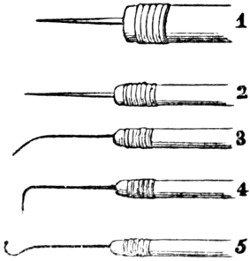
For arranging the objects under the microscope, there are no instruments equal to those which are here engraved. They are nothing more than ordinary needles stuck into the handles of camel’s-hair brushes. The uppermost is made of the largest-sized darning-needle, and is useful for making little holes, and similar purposes. The two next instruments are the most generally useful, and several of each should be always at hand. Nos. 4 and 5 are for special purposes; the former for holding tissues aside, and the latter for lifting them up. The needles must not be longer than those in the illustration, as they would otherwise be too springy, and apt to tear the object instead of pulling or pushing it.
The bending is readily done in the flame of a spirit-lamp, or even of a common candle; but in the latter case the needle is always covered with soot, which must be wiped off before its shape can be seen. The elasticity of the needles is lost by the operation, but is easily restored by heating them red-hot, and plunging them immediately into cold water. The end of the handle should be wrapped with thread, in order to prevent it from splitting.
Pill-boxes of various sizes are of very great service to the microscopist. We always have them arranged in “nests,” i. e. six or seven inside each other, so that space is greatly economized, as long as they are not in absolute use. All delicate objects should be placed in separate boxes, and the predaceous insects must be treated in the same manner, or they will certainly destroy one another, or, at all events, inflict such injuries as will make them useless for microscopic purposes.
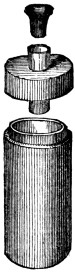
When the insects are to be killed on the spot, we employ another and a very simple plan.
We take one of the old-fashioned wooden lucifer-match boxes, bore a hole in the lid, and push through the hole a swan-quill or the barrel of one of the swan-quill steel pens. A glass tube is still better, but is too fragile. Beeswax is tightly worked into the junction of the tube with the wood, so as to make it as nearly air-tight as possible. A cork stopper is then cut to fit the tube. The accompanying illustration will show the box completed. When this is finished, we take the smallest-sized pill-box, bore a number of holes in it with a red-hot needle, place a little piece of solid ammonia within it, and inclose it in the lucifer-box. Its effects are almost instantaneous; for scarcely has the insect touched the bottom of the box before it is helpless, and in a very few moments it is quite dead, so powerful is ammonia towards insects. The reader will of course understand that the pill-boxes must never have been used for pills, and that the match-box must be carefully cleaned before employing it in the microscopic service. Moreover, any boxes that have been used for lepidopterous insects become useless, inasmuch as the scales always fall from the wings, and cling to the sides of the box, so as to mix with succeeding objects, and very much puzzle the observer.
Aquatic and marine objects require bottles, and, as a general rule, these bottles ought always to have wide mouths. Indeed, if there be no shoulder at all, their purpose will be better served, as a small object is very apt to be caught under the shoulder, and to give much trouble before it can be removed without injury. Wide and short test-tubes answer admirably for collecting; and it will always be advisable to have a few small test-tubes ready fitted with corks, for the purpose of isolating those specimens which might receive or cause injury by being mixed with others.
To remove minute objects from one vessel into another is a very easy process. Take a glass tube, mark off a portion about eight inches in length, cut a little notch with a file, and bend it smartly, when it will break neatly across, without leaving points or having the regularity of its ends injured by gaps. Turn each end round and round in the flame of the spirit-lamp, and you have an ordinary “pipette.” The object of placing the ends of the tube in the flame is to render the edges quite smooth and rounded.
Now mark off the same length of tube, and place the marked portion in the flame, taking care to warm it well first, lest the sudden heat should crack the glass. Keep it continually turning between the fingers, and when it is quite soft, and of a fine red heat, draw the hands smartly apart, and you will produce a couple of tubes tapering to very fine points. Break off the tapering portions at any convenient point, round the edges as before, and you will then have pipettes suitable for small objects. As there are many specimens, especially the smaller animalculæ, which have a habit of retiring into the remotest corner, it is necessary to bend another pipette, so as to follow them. For our own part, we prefer the pipette to be bent nearly to a right angle.