PART V. Miscellaneous: (continued 5)
Reading edition

Nearly two centuries after the plan was broached in Paris appeared the well-known absurd Mulready envelope, an extraordinary evidence of official vagaries, that such an abortion should have received preference over hundreds of essays, of which the cut pictures by no means the best!

The current envelopes for Great Britain, simple and compound, comprising every value from one penny to one shilling and sixpence, excepting only elevenpence and one shilling and fivepence, are certainly perfection; but are so little known or used that few are aware of other than the penny ones. We think our undeservedly vaunted penny label far surpassed in its own style by that of the islands of Antigua or St. Vincent, and the St. Kitt’s essay here given.

In the third year after the introduction of postal labels in Great Britain, the canton of Zurich would appear to have entertained the idea of imitating our example, the wonderfully rare if not unique pair of essays bearing the date of 1843 testifying visibly to that intention. Brazil, however, in the same year actually produced its first set, and is entitled to all the merit of seconding this marvellously successful move of ours. This was the large figure series, continued in the same style till those lately superseded, of which the red 280 and the yellow 430 reis alone remain in use.
Although the Zurich above alluded to was never in circulation, a pair something like it was so, either in the same or following year. The canton of Geneva next followed the lead. One of its stamps is unique on account of the custom of dividing it when but half value was needed.
The canton of Basle next joined the philatelic ranks, followed after three years’ interval by Vaud and Neufchatel. A twelvemonth previously our transatlantic brethren in the United States started the 5 cents bronze bearing the head of Franklin, and the large 10 cents with that of Washington.
In the same year (1847) a decree for the adoption of postage stamps in Belgium was made, which was carried into effect a year and a half afterwards. Six months in advance appeared the beautifully engraved effigies of the French Republic; during the course of twenty years followed the counterfeit presentments of the Presidency, the uncircled, and the laurelled heads of the Emperor Napoleon.
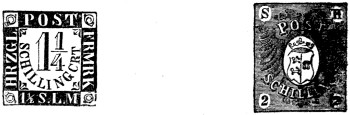
The ensuing year witnessed emanations from Austria, Bavaria, Lombardo-Venetia, Prussia, Saxony, Sardinia, and the first of the interminable issues of Spain: also the long solitary pair recording the abortive insurrection of Schleswig Holstein in 1848-50. The postal representatives of Schleswig, of Holstein, and of the two States in combination, now number two dozen!
This succession of stamps will ever possess a strong historical interest in consequence of their country’s connexion with the startling events attendant on the continental convulsions of 1866. A similar value in relation to European annals, entitling them to the style and title of Paper Medals, must be laid on the now extinct hosts of Hanoverian labels and envelopes, with those of the defunct office of Thurn and Taxis, overwhelmed by the needle-guns of Prussia, after an existence of more than three hundred years.
An approximate idea of the number of postage stamps, current and extinct, may be obtained from the latest edition of any good catalogue. That of Oppen’s Album (10th edition) contains about 2,800 distinct individual stamps, but includes no varieties of colour other than those recognised by the most fastidiously disposed collectors, such as the light and dark blues of Thurn and Taxis, first issue; neither does it take much note of proofs or essays, or any of railway or local British labels, or of differences in watermark or mode of perforation; which latter variations are now considered important by the higher order of philatelists.
The stamp-issuing localities amount at present to 122, 51 being in Europe; of these no fewer than seven have enlisted within the past twelvemonths, viz. Servia, the Virgin Islands, Guatemala, Salvador (see p. 758), Heligoland, Breslau, and Turk’s Island. The latter is exquisitely engraved, but with the exception of the pink, the colours are execrable. The first two, and the Breslau local are appended.
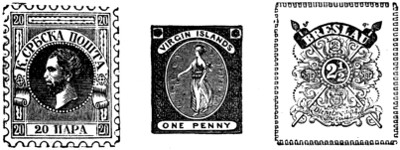
Excluding the United States locals, whose name is legion, as well as those of Hamburg, most of which are spurious, the emissions of Spain count the highest. They amount to nearly ninety impressions for general postal purposes, besides several telegraphic and exclusively official issues. The later portraitures of Her Catholic Majesty, if correct, prove how very well she carries her age, with the assistance, perhaps, of some Spanish Madame Rachel. Compare one of the current set with those depicted at pages 759 and 767 and note the dates.
The United States of North America, and those of Colombia, or the Granadine Confederation, afford us each the liberal allowance of between fifty and sixty varieties in colour, device, or value: the stamps of the former country, which are usually models of choice engraving, bear almost invariably the heads of their worthies, such as the late President Lincoln, and General Thomas (Stonewall) Jackson.

The memory of the great Confederate struggle will be ever preserved by the postage stamps issued from various cities in the revolting States; such as Memphis, Baton Rouge, Mobile, Charleston, New Orleans, &c. These had fancy devices, but the features of Jefferson Davis and J. C. Calhoun will reach posterity on two of the Confederate issues. On one of them also figures “Hickory” Jackson, a hero of the war in 1812.
It is a singular fact that the illustrated postage stamp magazines, &c. are purchased by non-philatelic collectors for the purpose of cutting out the miniature portraits of celebrities, whose effigies are otherwise less conveniently attainable.
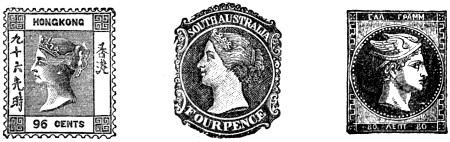
The palm of beauty will be assigned nem. con. to the current pair of Nova Scotia types. There are three of each, one representing the full front bust of our gracious Queen in state attire; the other Her Majesty’s profile: the former in scarlet, green, and black; the latter in lilac, blue, and black. Of these the pair of black are by far the most effective. One of them is more or less perfectly rendered by the Newfoundland 12 cents, and the South Australian two shilling, and fourpenny stamps; the other by the 24 cents of the former colony.
There are numerous other exquisite specimens of the engraver’s art to be found in a collection of postage stamps. The French republics, the Greek Mercuries, the Russian and Polish adhesives, and the Hong Kongs are admirable.
The current Saxons, Bavarians, all the Portuguese, and the lately emitted Heligolands are the best examples of the relief or cameo style: engravings of these give but a poor idea of the original. The same method of type is much less effective in the Prussians, Oldenburgs, Schleswigs and Holsteins; but radiates in full effulgence in the faultless envelopes of our own country, in those of Baden, Hanover, and the extinct Saxons and Prussians; with our colonials of Ceylon and the Mauritius.
The American Bank Note Company, we must perforce, most unpatriotically, admit to be unrivalled in plain engraving; of which the Nova Scotias, and some others noted above are instances: the trio of large newspaper and periodical labels issued last year in the United States, which bear the profiles of Washington, Franklin, and Lincoln respectively, and the Central-Fair locals too, are wellnigh perfection. The symbolical Newfoundlands are equally noteworthy.
To the same, or a branch firm, we believe ourselves indebted for the lovely landscapes of Guatemala, Nicaragua, Costa Rica, and Salvador.
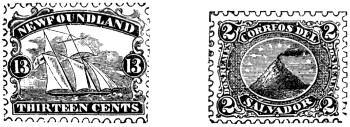
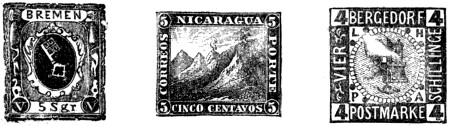
The swans of Western Australia, repeated in such variety of colour, ever attract attention; as do the keys of Bremen, the castles of Hamburg, the compounds of mysterious Bergedorf, the eagles of Lubeck, the quaint emissions of the Argentine Confederation, and the crossed keys and tiara of the Papal States, after the eye is wearied by the incessant array of heads and armorial bearings exhibited by the majority of stamp-emitting countries.
The adhesives of the kingdoms once composing the Two Sicilies are both equally remarkable; that of Naples for its singularity, that of Sicily from its peculiar boldness of design and rich colouring.
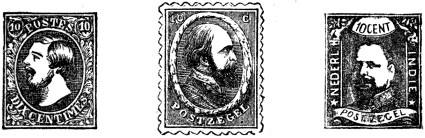
The first stamps of Luxembourg, those of the Dutch East Indies, and Holland, exhibit marvellous variations in the portraiture of one and the same individual sovereign.
The marketable value of a postage stamp for collections does not, however, by any means, depend upon its beauty or deformity. The greater portion of the more attractive in appearance are purchasable at a very low figure: the most beautiful of all, the Nova Scotian black profile, can be had at its natal place for one cent, or an English halfpenny. The circular specimen of meagre ugliness below may be worth a couple of sovereigns, even when cancelled; a moderately well-stored juvenile album could be purchased for the price of an unused specimen, were such existing, which we strongly doubt. That of Romagna and the early Van Diemen’s Land are little better.
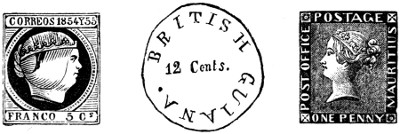
Some of the frightful libels on the august countenances of the Emperor Napoleon, the Queen of Spain, and our own Sovereign, fetch also exorbitant fancy prices. The French affair goes by the name of the Cayenne essay; possibly because its concoctor was, or at least, deserved to be, transported thither for his impudence. The Queens’ profiles on their colonial stamps for the Philippines and the Mauritius are mere caricatures.
Slight improvement on the British Guiana stamp is made by some of the Honolulu emissions; also the local Bavarian; the Bollo Straordinario of Tuscany; the 10 and 15 centimes à percevoir of France; and the Land Post trio of Baden. The latter have the advantage of being printed on yellow paper.
Some of the Sandwich Islands stamps, nevertheless, far outstrip the productions of some countries that were highly civilized long ere the full dress of one of their natives consisted of aught save a few beads. Portraits of the great, the late, and the regnant kings bearing the joint name of Kamehameha exist on stamps: the one given does but scant justice to its chastely designed original.
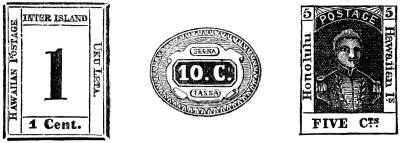
The French labels just alluded to are placed by the postal authorities on insufficiently paid letters. They are only surreptitiously purchasable at the post-offices, not being for public use; but this bit of red-tapeism is easily evaded for a con-sid-er-ation. Of similar character are the Bavarian before-mentioned, and the Italian segnatassa, figured above. A collector in Leghorn, unable to procure one of these latter, wrote a letter to himself without stamping it, expecting one of the then new labels to be affixed before delivery. Such was the case; but the letter lying on the hall-table, a friend of ours innocently abstracted the stamp and inclosed it to ourselves as the last new postal curiosity.
Besides such slightly abnormal deviations from the general run of postage stamps, may be enumerated the “too late” label formerly used by the colony of Victoria, now particularly recherché by philatelists, especially in an uncancelled state. This individual is unique in its application; but there are several impressions exclusively devoted to the registration of letters. Those of Victoria, New South Wales, and Queensland (like the cut, but the word “registered” substituted for the value) are well known; and the recently emitted Prussians, one of which is given on the next page, are of somewhat kindred nature.
The quaint centre device is an offshoot from that fertile field for philatelists, New Granada, alias the United States of Columbia; the R standing for registrados (registered).
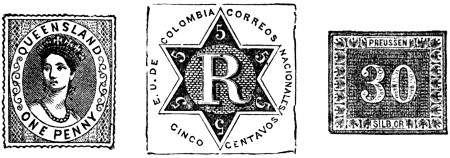
Besides strictly governmental issues, many private firms and individuals have been tacitly allowed to issue postage stamps, more or less partaking of the character of regular official emanations. Such are those of the United States, amounting to upwards of five hundred; some of which, though catalogued, never did duty, and were only concocted for sale. They are now, we believe, all extinct. Some of them are represented on previous pages. The City of Hamburg has produced upwards of a hundred, of which the greater part are impostors. An unimpeached one will be found depicted farther on.
The pages devoted to the U. S. locals by those who collect them, present a most varied and extraordinary appearance, from the endless varieties of device and colour employed. Profiles, busts, figures of men and animals, numerals, plain inscriptions, symbolical and allegorical representations meet the eye, varied with all the colours in and out of the rainbow.
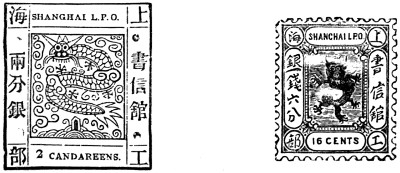
Dresden, Breslau, Montreal, Shanghai, Constantinople, Edinburgh, Glasgow, and London, also contribute their quota towards the ranks of locals. These are all emissions of private firms: those of the third place mentioned are more than doubtful; the latter are now prohibited by law.
To these may be added those of Throndhjems (Drontheim), Tammerfors, Helsingfors, with the Levant, Danubian, and Pacific Steam Companies. The legally authorised issues of Malta, the Danish West Indies, &c. and the very low values of continental stamps, may be likewise termed locals; not being available out of their own birthplace. The La Guairas, one of which is figured at page 754, must not be omitted from the list.

Still farther than the unaccredited locals from a strictly legitimate postal collection are the numerous labels issued by the several railroads. They amount to a considerable number altogether, ranging in value from one farthing to five shillings.
Many of the foreign telegraph stamps are extremely tasty, especially the Belgian and Spanish: these, however, are not usually admitted into collections. Still less are our own now disused “Customs” labels, which far exceed the postals in beauty; as do our receipt, bill, and legal adhesives, some of which are as high as 5l. or more in value.
The “needle-gun” war of 1866 introduced quite a novel genus of postage envelopes. They were employed in Prussia, Saxony, &c.; some for the use of civilians writing to their friends or relatives at camp; others for the exclusive service of the military. Some Brazilian youths, of more ingenuity than probity, concocted an imitation of these, and passed them off at a price among dealers and amateurs, as being employed for a similar purpose in the conflict between the Brazilians and Paraguayans.
The highest priced postage stamps were the once rare Pony Expresses (see page 753), one of which cost 4 dollars (16s. 8d.) The 2 dollar one ranks next; then the five shilling of New South Wales, the Mauritius, and our own; the 96 cents of Hong Kong, the 8 reales of Mexico, the 90 cents of the United States, the 1 scudo of Rome, and the 25 piastres of Turkey. The Ceylons are the most numerous in varieties of value, having no fewer than thirteen, from one halfpenny to two shillings. From four to six is the average number of monetary denominations for the same country. Some have more, as Hong Kong, which counts ten. The United States have the same number, besides four additional values in envelopes. New South Wales has eight, and Victoria nine values. France has nine at present, but a higher priced stamp is announced. Liberia, Turk’s Island, and British Honduras have only three; Grenada, Nicaragua, British Columbia, and Antigua, issue but two; and Vancouver’s Island, Malta, Sierra Leone, and Corrientes, only one. The last-named locality, being a small province of the Argentine Republic, has issued the same die for two several values. It was originally marked un real, but this was subsequently erased, no designation of value appearing. Three centavos was then its price. It is impressed in black, on blue, as well as green paper. Like the New Caledonian, it was printed in sheets from a single block, each impression slightly differing.
This is one of the few exceptions to the rule of postage stamps bearing a facial value. The earlier issues of the Mauritius, Trinidad, and Barbadoes partake of the same defect, being distinguishable by colour only. The Ionian Islanders were in a like category: but the sole existing specimens of this inconvenience are the halfpenny and penny Barbadians, and the whole set of St. Lucias.
The result of this is, that the values of more than one of the early stamps of the Mauritius are still a subject of debate among some erudite philatelists. One of these stamps is sometimes found endorsed with “eightpence” in black letters, another with “fourpence.” This clumsy method is even yet being adopted in a few instances, we suppose to save the expense of a new plate. The original sixpenny of St. Helena is printed in three different colours besides its own blue, and does duty in green, carmine, and red, cruelly tattooed with printed characters according to the stated value. The ninepenny of South Australia, doffing its modest hue for a bright orange, hand-stamped with black, is worth a penny more than heretofore. In like manner, the Italian government, wishing to put the screw on its faithful subjects, raised the tariff on home letters from 15 to 20 centesimi, and barred out the original value. The provisional East Indian may be joined to this uncomely group of disfigured identities, as also the newly emitted set for Singapore.

The impressions of Nevis; those now current of the Cape of Good Hope; and what are termed the Sydney stamps of New South Wales, are elegantly symbolical of their respective localities.
The adhesives of British Columbia, Sierra Leone, and British Honduras, claim a very high rank for elegance of design and correctness of execution among our colonials. The extinct shilling stamp of Victoria may worthily dispute with its lately superseded sixpenny the unenviable distinction of ugliness.
Excluding the railway stamps, and the United States newspaper labels, Liberia produces the largest stamps; Mecklenberg Schwerin and Brunswick the smallest. The latter two countries present the singularity of allowing the four small stamps to be used singly or in combination.
The inscriptions on stamps being of course in the language of their native country, many impressions necessarily bear a particularly quaint appearance; as those of Egypt, Turkey, Cashmeer, Shanghai, Poland, Moldavia (see page 765), and Servia (see p. 756). The early emission of the Argentine Confederation is also an oddity.
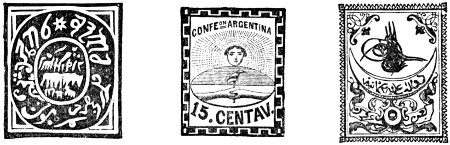
The shapes of postage stamps present but little variation; a very large majority being more or less unequally sided rectangles. Few are perfectly square. The set of Bergedorf, and the disused Danish and Thurn and Taxis adhesives are instances, the former showing the further peculiarity of different sizes in regular gradation according to value. The impressions run sometimes on upright, sometimes on oblong rectangles. The narrowest of the latter is one of those of Wells, Fargo, and Co.; of the former, a very rare English essay, too elaborate for description.

Some few are octagonal, more or less irregular; some oval; some perfectly round; some indescribable, as the one-and-ninepenny Ceylon; and the ninepenny envelope of the Mauritius. The earlier emissions of Nova Scotia and New Brunswick were printed in such a way as to render the stamp lozenge-shaped.

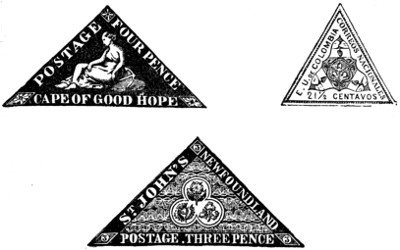
A small minority are triangular; the superseded stamps of the Cape of Good Hope, a solitary type of Newfoundland, and one of New Granada, are the only ones we can recollect ever seeing, except a black Austrian newspaper adhesive. The Langton local is unique in form.
Many stamps have been issued exclusively for newspapers, feuilletons, and printed matter in general, such as some Austrian and Venetian impressions. The B. G. and tassa gazzette of Modena, the 6 c. and 9 centesimi of Parma, and others, were of like nature; as are the lower priced French, Italians, and Belgians. That of Frankfort is not adhesive, but hand-stamped, like those on our own newspapers, and is by some considered inadmissible in strictly postal collections.
The returned letter stamps must not pass unmentioned. That of Wurtemberg was long “alone in its glory;” but Munich, Augsburg, Nuremberg, and other Bavarian cities, have lately adopted them. Those forming the seal on returned letters in our own country are collected by some amateurs.

The enormous accumulation of proofs and essays, all which are ignored by many philatelists, are not to be lightly rejected. The former are certainly articles de luxe or fantaisie, being simply veritable stamps printed in abnormal colours, as some of the United States, &c. Of the latter are three sorts—those by authorisation; those proposed by enterprising individuals to various governments; and those invented for sale to entrap the unwary.
The best, as in the case of England, were not always chosen: look at the essay of Pellas the Genoese, and admire Italian discrimination—if you can. The Sicilian, on the other hand, is indubitably inferior to the adopted design. In the centre lies the audacious offspring of the Fenian rebellion.

Several essays proposed for Governments which have not yet instituted the postage stamp system, are surpassingly beautiful in device and execution. Those by M. Riester, of Paris, are particularly elegant, Bolivia for example. The Poisson d’Avril (April Fool) stamp is a curiosity in philatelic lore; it was gravely chronicled as emanating from Moresnet, and deceived the very knowing ones. (See cut at foot of next page.)
The longest reign in postal annals is twelve years; the defunct Dutch having lasted that period. Of the Spanish sets only two have outlived a twelvemonth unchanged. The 1 franc of the French empire, and the first issue of Schleswig-Holstein (see p. 755), were current rather more, the 25 centimes of the Empire and the Italian (represented below) less than a year. The 1⁄2 tornese, Neapolitan arms, and the same transmogrified into the Cross of Savoy, endured each about a month. The 1⁄2 schilling violet, and 3 sch. rose of Bergedorf, were a nine days’ wonder.

Among the notabilities of a choice postage-stamp collection may be chronicled the Connel essay. A New Brunswick postmaster of that name took the liberty of having his own physiognomy transferred to a sheet of postage stamps;—the result was his resignation. The tenpenny above depicted is unique, and was long supposed to be from Van Diemen’s Land; but we rather believe it an English essay.
The space allowed us compels an abrupt conclusion. We had intended touching on the eight various distinct modes of perforation, besides variations; and the distinguishing watermarks of various issues. We should also have liked to describe the amusing and exciting humours of ‘Change, which many of our readers may remember witnessing in Lombard Street and its neighbourhood, or in the gardens of the Luxembourg and the Tuileries in Paris, during the early days of stamp-collecting; but we trust enough has been written to excite the interest of many who have purchased this volume on other accounts, yet may thus be induced to become votaries to the interesting and instructive pursuit of Philately.

TINSELLING.
Should the reader feel inclined to try his hand at tinselling, he must procure one of those full-length theatrical portraits that are sold at the shops for a penny each. He ought to select one of the best-known figures, as he will then have no difficulty in procuring the embossed gold and silver work with which it is to be adorned. The whole figure must be carefully painted with water-colours, and the artist should take pains with those parts which are not intended to be covered or cut away. Having finished the preliminary operation of colouring, the artist should neatly cut away those parts of the engraving which represent drapery, and place under the spaces thus formed, satin, silk, or velvet of the proper colour, which may be secured to the back of the picture with a little gum.
Many tinsellers employ regular print-colourers to shade their silks and satins, but we strongly advise the reader to trust to his own abilities, and boldly set work to indicate the folds of the drapery by proper shadows. The pieces cut out of the engraving will show him where the different shadows ought to fall, and as for the colours to be used, we may state as a general rule that silk, satin, or velvet of a certain colour ought to be shaded with darker tints of the same colour. Gum-water should be mixed with the colours used in shading, to prevent them running when applied to the woven fabric.
The artist may now proceed to the work of tinselling, which consists in gumming little spangles and embossed ornaments over certain parts of the picture. Every piece of armour, every button, every jewel, and every weapon, should be represented in embossed work. All the pieces required for tinselling a figure may be purchased at the proper shops. In the figure of the warrior, the breastplate, shield, sword, and jewels would have to be formed of pieces of gilt or silver paper cut and stamped into proper shapes and patterns. The price of each piece of embossed work depends of course upon its size or elaborateness. When the picture is finished, it should be mounted on fine card-board, and placed in a neat frame.
THE AMERICAN GAME OF BASE-BALL.
The national game of ball of the American people, though having its origin in the English game of rounders, nevertheless possesses sufficiently marked features to entitle it to the distinction claimed for it. Unlike the schoolboy pastime from which it originated, it requires manly qualities in a high degree to excel in it. In fact, the difference between base-ball as played in America, and rounders as played in England, is as great as the contrast between the graceful and daring movements of an accomplished skater of the present time, and those of the skaters who, with pieces of ivory fastened to their feet, used to strive to glide over the ice in the year 1600. In base-ball, as in rounders, you use a bat and a ball and run round bases; but there all resemblance ceases.
The American game of base-ball, as now played, is not more than ten years old, for its date only extends back to the period just previous to the organization of the National Association of Base-Ball Players, which Association formed the present code of rules, and is the only authorized body having any supervisory power over the game. In fact, the history of the game commences with the formation of the National Association, inasmuch as the rules previously in vogue were crude and irregular, and different in one locality from what they were in another. Since the organization of the National Association and the meeting of the first annual convention, however, the game has spread throughout the country, and entirely superseded every other game of ball as a national pastime. At first the Association consisted of delegates from clubs, but now it is composed of a congregation of representatives from State base-ball associations, governed by the National Association proper, each State association having immediate control of the affairs of its own clubs, and possessing its own judiciary committee to settle disputes, but no supervisory control over the playing rules of the game, that matter being placed in the hands of a committee of rules of the parent Association, to which is also attached a judiciary committee, forming a court of appeal from the decisions of State judiciary committees, and also a court to adjudicate upon disputes between clubs of two States.
At the last convention of the “National Association of Base-Ball Players,” which was held in Philadelphia, Dec. 11, 1867, and in which clubs from all sections of the country, from Maine to Iowa, and Michigan to Kentucky, were represented, the following code of rules was adopted to govern the play during the season of 1868:—
RULES AND REGULATIONS ADOPTED BY THE NATIONAL ASSOCIATION OF BASE-BALL PLAYERS.
Rule I.—The Ball, Bat, and Bases.
Sec. 1. The ball must weigh not less than five, nor more than five and one-quarter, ounces avoirdupois. It must measure not less than nine and one-quarter, nor more than nine and one-half, inches in circumference. It must be composed of india-rubber and yarn, and covered with leather, and, in all match games, shall be furnished by the challenging club, and become the property of the winning club as a trophy of victory.
Sec. 2. The bat must be round, and must not exceed two and a half inches in diameter in the thickest part. It must be made of wood, and shall not exceed forty-two inches in length.
Sec. 3. The bases must be four in number, placed at equal distances from each other, and securely fastened upon each corner of a square whose sides are respectively thirty yards. They must be so constructed and placed as to be distinctly seen by the umpire, and must cover a space equal to one square foot of surface. The first, second, and third bases shall be canvas-bags, painted white, and filled with some soft material; the home base and pitcher’s points to be each marked by a flat plate, painted white.
Sec. 4. The base from which the ball is struck shall be designated the home base, and must be directly opposite to the second base; the first base must always be that upon the right-hand side, and the third base that upon the left-hand side of the striker, when occupying his position at the home base. And in all match games a line connecting the home and first base, and the home and third base, shall be marked by the use of chalk, or other suitable material, so as to be distinctly seen by the umpire. The base-bag shall be considered the base, and not the post to which it is, or should be, fastened.
Rule II.—The Pitching Department.
Sec. 1. The pitcher’s position shall be designated by two lines two yards in length, drawn at right angles to the line from the home to the second base, having their centres upon that line at two fixed iron plates, placed at points fifteen and sixteen and one-third yards distant from the home-base. The pitcher must stand within these lines, and must deliver the ball as near as possible over the centre of the home base, and fairly for the striker.
Sec. 2. Should the pitcher repeatedly fail to deliver to the striker fair balls, for the apparent purpose of delaying the game, or for any cause, the umpire, after warning him, shall call one ball, and if the pitcher persists in such action, two, and three balls; when three balls shall have been called, the striker shall take the first base; and should any base be occupied at that time each player occupying it or them shall take one base without being put out. All balls delivered by the pitcher, striking the ground in front of the home base, or pitched over the head of the batsman, or pitched to the side opposite to that which the batsman strikes from, shall be considered unfair balls.
Sec. 3. The ball must be pitched, not jerked or thrown, to the bat; and whenever the pitcher moves with the apparent purpose or pretension to deliver the ball, he shall so deliver it, and must have neither foot in advance of the front line at the time of delivering the ball; and if he fails in either of these particulars, then it shall be declared a balk. The ball shall be considered jerked, in the meaning of the rule, if the pitcher’s arm touches his person when the arm is swung forward to deliver the ball; and it shall be regarded as a throw, if the arm be bent at the elbow, at an angle from the body, or horizontally from the shoulder, when it is swung forward to deliver the ball.
Sec. 4. No player shall be put out on any hit ball on which a balk or a ball has been called; and neither shall a strike or a foul ball be called, or a base run on such a hit ball. But bases can be taken on third-“called” balls, and on “balked” balls, in accordance with Section 2 of Rule II.
Rule III.—The Batting Department.
Sec. 1. The striker, when about to strike the ball, must stand astride of a line drawn through the centre of the home base, not exceeding three feet from either side thereof, and parallel with the front line of the pitcher’s position, and he must not take any backward step when striking at the ball. The penalty for an infringement of this rule shall be the calling of one strike; and when three such strikes have been called, the striker shall be declared out. If a ball on which such a strike is called be hit and caught, either fair or foul, the striker shall be declared out. No base shall be run on any such called strike, and any player running the bases shall be allowed to return to the base he has left, without being put out. As soon as the striker has struck a fair ball, he shall be considered “a player running the bases.”
Sec. 2. Players must strike in regular rotation, and, after the first innings is played, the turn commences with the player who stands on the list next to the one who was the third player out.
Sec. 3. Should a striker stand at the bat without striking at fair balls, for the apparent purpose of delaying the game, or of giving advantage to a player, the umpire, after warning him, shall call one strike, and, if he persists in such action, two, and three strikes. When three strikes are called, and the ball be caught, either before touching the ground or upon the first bound, the striker shall be declared out, provided the balls struck at are not those on which balls or balks have been called, or not those struck at for the purpose of wilfully striking out. If three balls are struck at and missed, and the last one is not caught, either flying or upon the first bound, the striker must attempt to make his run, and he can be put out on the bases in the same manner as if he had struck a fair ball.
Sec. 4. The striker is out if a foul ball is caught, either before touching the ground or upon the first bound; or if a fair ball is struck, and the ball be held before touching the ground; or if a fair ball is struck, and the ball be held by an adversary on first base, before the striker touches that base.
Rule IV.—Running the Bases.
Sec. 1. Players must make their bases in the order of striking; and when a fair ball is struck, and not caught flying, the first base must be vacated, as also the second and third bases, if they are occupied at the same time. Players may be put out on any base, under these circumstances, in the same manner as when running to the first base.
Sec. 2. Any player running the bases is out, if at any time he is touched by the ball, while in play, in the hands of an adversary, without some part of his person being on the base.
Sec. 3. No run or base can be made upon a foul ball. Such a ball shall be considered dead, and not in play, until it shall first have been settled in the hands of the pitcher. In such cases players running bases shall return to them, and may be put out in so returning, in the same manner as when running to first base. Neither can a run or base be made when a fair ball has been caught without having touched the ground; but such a ball shall be considered alive and in play. In such cases, also, players running bases shall return to them, and may be put out in so returning, in the same manner as when running to first base; but players, when balls are so caught, may run their bases immediately after the ball has been settled in the hands of the player catching it.
Sec. 4. When a balk is made by the pitcher, every player running the bases is entitled to one base, without being put out.
Sec. 5. A player making the home base shall be entitled to score one run.
Sec. 6. If two hands are already out, no player running home at the time the ball is struck can make a run to count in the score of the game, if the striker is put out.
Sec. 7. Players running bases must touch them, and, so far as possible, keep upon the direct line between them, and must touch them in the following order—first, second, third, and home; and if returning, must reverse this order; and should any player run three feet out of this line, for the purpose of avoiding the ball in the hands of an adversary, he shall be declared out; or if he fail to touch each base he runs to he shall be declared out, unless he return to such base before the ball be held on it.
Sec. 8. If the player is prevented from making a base by the intentional obstruction of an adversary, he shall be entitled to that base, and shall not he put out. Any obstruction that could readily have been avoided shall be considered as intentional.
Rule V.—The Game.
Sec. 1. The game shall consist of nine innings to each side, when, should the number of runs be equal, the play shall be continued until a majority of runs, upon an equal number of innings, shall be declared, which shall conclude the game. An innings must be concluded at the time the third hand is put out.
Sec. 2. In playing all matches, nine players from each club shall constitute a full field; and they shall be members of the club which they represent. They also must not have been members of any other club, either in or out of the National Association, for thirty days immediately prior to the match. Positions of players and choice of innings shall be determined by captains previously appointed for that purpose by the respective clubs. Every player taking part in a regular match game, no matter what number of innings are played, shall be, in the meaning of this section of the rules, considered a member of the club he plays with.
Sec. 3. When a club sends a challenge to play a first-nine match game of base-ball, and the same is accepted, the first game shall be played upon the grounds of the challenging club, within fifteen days from the date of the acceptance of the challenge; the second game shall be played upon the grounds of the challenged club within fifteen days thereafter; and if a third game be necessary, it shall be played upon grounds to be mutually agreed upon, within fifteen days from the date of the second game; provided: that the above arrangement may be varied by mutual consent. And when a first-nine match game is to be played, the contestants shall present on the field their recognized first-nines, as far as practicable.
Sec. 4. Whenever a match shall have been determined upon between two clubs, play shall be called at the exact hour appointed; and should either party fail to produce their players within thirty minutes thereafter, the party so failing shall admit a defeat, and shall deliver the ball before leaving the ground, which ball shall be received by the club who are ready to play, and the same shall be considered as won, and so counted in the list of matches played; and the winning club shall be entitled to a score of nine runs for any game so forfeited, unless the delinquent side fail to play on account of the recent death of one of its members, and sufficient time has not elapsed to enable them to give their opponents due notice before arriving on the ground.
Sec. 5. No person who shall be in arrears to any other club than the one he plays with, shall be competent to take part in any match game.
Sec. 6. No player, not in the nine taking their positions on the field in the third innings of a game, shall be substituted for a player, except for reason of illness or injury.
Sec. 7. No match game shall be commenced when rain is falling; and neither shall any such game be continued after rain has fallen for five minutes. No match game shall be postponed unless by the mutual consent of the contesting clubs.
Sec. 8. Every match game shall be decided by the best two games out of three, unless a single game shall be mutually agreed upon by the contesting clubs; and all matches shall terminate before the close of the season.
Sec. 9. No person who shall be in arrears to any other club, or who shall at any time receive compensation for his services as a player, shall be competent to play in any match. No players, who play base-ball for money, shall take part in any match game; and any club giving any compensation to a player, or having, to their knowledge, a player in their nine playing in a match for compensation, shall be debarred from membership in the National Association; and they shall not be considered by any club belonging to this Association as a proper club to engage in a match with; and should any club so engage with them, they shall forfeit membership.
Rule VI.—Miscellaneous.
Sec. 1. If an adversary stops the ball with his hat or cap, or if a ball be stopped by any person or persons not engaged in the game, no player running the bases can be put out unless the ball shall first have been settled in the hands of the pitcher while he stands in the line of his position.
Sec. 2. Any player who shall intentionally prevent an adversary from catching or fielding the ball, shall be declared out; or if any player be prevented from making a base by the intentional obstruction of an adversary, he shall be entitled to that base, and shall not be declared out, even if touched with the ball.
Sec. 3. If a fair ball be held by a player before touching the ground, after rebounding from the hands or person of a player, it shall be considered a fair catch. And if a foul ball be similarly held after touching the ground but once, it shall be considered a fair catch.
Sec. 4. If the ball, from the stroke of a bat, first touches the ground, the person of a player, or any other object, behind the line or range of home and the first base, or home and the third base, it shall be termed foul, and must be so declared by the umpire, unasked. If the ball first touches the ground either upon or in front of the line or range of those bases, it shall be considered fair.
Sec. 5. Clubs may adopt such rules respecting balls knocked beyond or outside of the bounds of the field, as the circumstances of the ground may demand; and these rules shall govern all matches played upon the ground, provided that they are distinctly made known to the umpire previous to the commencement of the game.
Sec. 6. The captains of each nine shall alone be allowed to appeal for the reversal of a decision of the umpire.
Sec. 7. No base can be run, or player be put out, on a dead ball.
Rule VII.—Duties of the Umpire.
Sec. 1. The umpire shall take care that the regulations respecting the ball, bats, bases, and the pitcher’s and striker’s positions, are strictly observed, and he shall require the challenging club to furnish a ball, on which the size, weight, and the name of the manufacturer shall be stamped. He shall be the sole judge of fair and unfair play, and shall determine all disputes and differences which may occur during the game. He shall take special care to declare all foul balls and balks, immediately upon their occurrence, in a distinct and audible manner. He shall, in every instance, before leaving the ground, declare the winning club, and shall record his decision in the books of the scorers. The umpire shall also require that the game be recorded by a scorer for each of the contesting clubs. In all matches the umpire shall be selected by the captains of the respective sides, and shall perform all duties above enumerated.
Sec. 2. The umpire in any match shall determine when play shall be suspended; and, if the game cannot be fairly concluded, it shall be decided by the last equal innings, provided five innings have been played; and the party having the greatest number of runs shall be declared the winner.
Sec. 3. When the umpire calls “play,” the game must at once be proceeded with; and the party failing to take their appointed positions in the game within five minutes thereafter shall forfeit the game. When the umpire calls “time,” play shall be suspended until he calls “play” again.
Sec. 4. When the umpire “calls” a game, it shall end; but when he merely suspends play for any stated period, it may be resumed at the point at which it was suspended, provided such suspension does not extend beyond the day of the match.
Sec. 5. No person engaged in a match, either as umpire, scorer, or player, shall be either directly or indirectly interested in any bet upon the game. Nor shall any person be permitted to act as umpire or scorer in any match unless he shall be a member of the National Association, or of a State branch thereof. Neither shall the umpire or scorer be changed during a match, unless with the consent of both parties, except for reason of illness or injury, or for a violation of the above rules.
Sec. 6. No decision given by the umpire shall be reversed upon the testimony of any player; and no decision whatever shall be reversed, except for a palpable infringement of the rules, and then only on an appeal by the captain.
Sec. 7. No person shall be permitted to approach or to speak with the umpire, scorers, or players, or in any manner to interrupt or interfere during the progress of the game, unless by special request of the umpire. Any match game played by any club in contravention to the rules adopted by the National Association, shall be considered null and void, and shall not be counted in the list of match games won and lost.
For the information of clubs desirous of joining the National Association, or of organising a State branch thereof, we give below those portions of the constitution of the Association bearing upon the subject:—
Article 3, Section 1. This Association shall be composed of delegates from the several State base-ball associations which have been duly admitted to a representation in the convention forming this constitution, or which may be admitted to a representation in the manner hereinafter provided. Each State association shall be entitled to one delegate for every ten clubs, or fractional part of ten clubs, belonging to such association. No individual club shall be entitled to representation in this Association unless located in a state, territory, or district, where there are not sufficient clubs to form a State association. Each delegate shall be entitled to one vote, and no vote by proxy shall be allowed.
Sec. 2. Any State base-ball association desiring to be represented in this Association shall present to the recording secretary, at least thirty days previous to the annual meeting of this Association, a written official certificate, signed by the president and secretary of the State association they represent, giving the names and number of the clubs composing said association, date of their organization, names of their officers, and number of members belonging to each club; also the date of organization of the State association, and the names of their delegates. Territories and the district of Columbia shall be considered as states within the meaning of this section.
Sec. 3. All applications shall be immediately submitted to the committee on nominations; but no such application shall be received by said secretary unless presented thirty days previous to the annual meeting. Said committee shall thereupon ascertain the condition, character, and standing of such State base-ball association, and report the same at the annual meeting, with the said application and their opinion thereon; and a ballot shall thereupon be had at such meeting, upon the admission of such State base-ball association, when, if two-thirds of the members present vote in favour thereof, such State base-ball association shall be declared duly entitled to representation in this Association. Any informality or irregularity in the form or substance of the application may be waived by a two thirds vote of the members present at the annual meeting.
Sec. 4. No State association shall be represented in the Association unless composed of ten clubs, numbering at least eighteen active members each, or by any delegate under twenty-one years of age; nor shall any State base-ball association be so represented until its delegates have paid a fee hereinafter designated.
Sec. 5. Any State association organized after the adjournment of the annual meeting of this Association, may be elected probationary members thereof, after conforming to the requirements of sections second, third, and fourth, by the nominating committee. They shall be liable to the payment of dues and assessments, and be eligible to all the privileges of regular members of the Association until the next annual meeting, at which time they must be duly elected in the same manner as all regular members.
THE GAME OF BASE-BALL.
As before asserted, the American game of base-ball requires a high degree of physical ability, and the possession of manly characteristics to excel in it; for although in theory a schoolboy could easily comprehend the system, in practice an amount of manly vigour, courage, and physical endurance is requisite, surprising to those who regard the game in the light only of an improved edition of the old English school-game of rounders.
The theory of base-ball is as simple as that of any field sport in vogue, and therein lies one of its attractive features. But yet to play the game up to its highest point of excellence requires as great a degree of mental ability, and the possession of as many manly physical attributes, as any known game of ball. The theory of base-ball is as follows:—In the first place, a level field for play is selected, about three hundred feet wide and five hundred long. A space of ground is then marked out in the form of a square, with one corner as the position of the home base, and the other corners for the first, second, and third bases, the first base being on the right of the batsman, as he stands at home base, and the third base on the left. The contestants in a game consist of nine players on each side, and these nine players occupy the following positions: catcher, pitcher, first, second, and third basemen, short-stop, and left, centre, and right fielders. The first six players above-named form the “in-fielders,” and the last three the “out-fielders,” the nine taking the field being known as the “out-hand,” or “field.” After the parties toss for the innings, the losing side go to the bat, and the winning party to the field, and each man to his position. The pitcher then delivers the ball to the batsman of the opposite nine, who endeavours to send it out of reach of the opposing field party, and far enough into the field to admit of his running round the four bases, in which case he scores one run, provided he is not put out in the interim. He is followed by his companions, one after the other in regular rotation, until three of the batting side are put out, when the field side take the bat and have their innings. Nine innings constitute a full game, and no game is considered as played unless five full innings have been completed. The ball—the only trophy in a match—goes to the party making the most runs in a full game, or in any number of even innings played not less than five.
In case of a tie at the close of the ninth innings, the game, unless by mutual consent, must be prolonged innings after innings, until one or other of the contesting sides obtains the most runs. And if anything occur to interrupt or put a stop to the game before five innings on each side have been played, the game must be drawn. The rules and regulations of the game define all further particulars in reference to it.
HOW TO PLAY EACH POSITION.
GENERAL RULES.
There are nine positions in a base-ball field, two less than in a field of cricketers in a match. The catcher plays behind the batsman to receive the ball from the pitcher. The pitcher stands near the centre of the in-field, forty-five feet from home base, and he is allowed only to “pitch” the ball to the bat, not to throw it, jerk it, or bowl it. The first base man attends to balls fielded to him on the base, his principal duty being to hold the ball, while having one foot on the base, before the batsman reaches it. The second and third basemen have not only to hold the ball, but also to touch players running to the bases before they can touch the bases. The short-stop attends to the duties of backing up the pitcher and basemen generally, and of stopping balls from the bat, and sending them to the bases, when the ball happens to come within reach. The principal duties of the three out-fielders are to catch long high balls, and to return in ground balls sent to their positions. But the following are special instructions to occupants of each position in the nine:—
THE CATCHER.
This player is expected to catch or stop all balls pitched or thrown to the home base. He must be fully prepared to catch all foul balls, especially “tips,” and be able to throw the ball accurately and swiftly to the bases, and also to keep a bright look-out over the whole field. “Foul balls” are those high balls which are hit so as to fall to the ground back of the line of the bases, from home to first base and home to third. “Tips” are also foul balls, coming sharply from the bat to the catcher.
When a player has made his first base, the catcher should take a position nearer the striker, in order to take the ball from the pitcher before it bounds; and the moment the ball is delivered by the pitcher, and the player runs from the first to the second base, the catcher should take the ball before bounding, and send it to the second base as swiftly as possible, in time to cut off the player before he can touch the base. In throwing to the base it would be as well, in the majority of cases, to send the ball a little to the right of the base. The same advice holds good in reference to a player running from the second base to the third.
The catcher should have a thorough understanding with the pitcher in regard to a code of signals by means of which he can not only direct the pitcher to throw to a base to catch a player napping off the base—as a wicket-keeper does the batsman when out of his ground in cricket—but also so as to direct him where to send a ball to the bat, high or low, in or out, as the peculiarity of the batsman’s play may require. The catcher needs to be a swift and accurate thrower to the bases, a plucky player in facing and stopping swiftly-pitched balls, and a patient player in his efforts to prevent passed balls from inaccurate pitching. When facing a swift pitcher, his aim should be to stop the ball, and to be on the qui vive for sharp “tips.” Off slow pitching more activity is required, as the chances offered for difficult catches from foul balls are greater.
As the position occupied by the catcher affords him the best view of the field, the person filling it is generally chosen captain, although the pitcher is sometimes selected for that position. We would suggest, however, that some other player than the pitcher be chosen for captain, from the fact that the physical labour attached to that position tends to increase the player’s excitement, especially if the contest is a close one, and it is requisite that the captain should be as cool and collected as possible. The catcher, whenever he sees two or more fielders running to catch a ball, should designate by name the one he deems most likely to catch it, in which case the others should refrain from the attempt to catch the ball on the fly, and strive only to catch it in case of its being otherwise missed.
THE PITCHER.
More skill and judgment is requisite in this position than in any other in the game. In fact, half the battle almost in a contest depends upon the ability of the pitcher; and yet the best man in the position is comparatively useless in a nine unless he be well supported in the field. In cricket a bowler can take wickets when unassisted by a good field party, but in base-ball a pitcher’s skill is entirely thrown away unless well supported in the field, especially by the in-field portion of the nine.
The pitcher’s position is within the lines of a space of ground six feet by four in extent, located on the line between home and second base, the front line of the position being distant forty-five feet from the home base. The pitcher, in delivering the ball to the bat, is prohibited from either throwing, jerking, or bowling the ball, and he is also prohibited from making any motion in his delivery which will admit of a ball being thrown, such as bending his arm outward at the elbow, &c. And if he makes any one of the series of motions he uses in delivering the ball, and fails to deliver it, then he incurs the penalty of a “balk,” in which case players running the bases, but not the striker, are allowed to take one base. The rules governing the delivery of the ball also require the pitcher to deliver the ball over the home base—which is sixteen inches in width—and “fairly for the striker,” viz. within the legitimate reach of the bat, and as near as possible to the point indicated by the batsman, the boundary line in question extending from within a foot of the ground to the height of the batsman’s head. The pitcher in his style of delivery, may adopt any movement he likes, provided he moves to deliver while standing within the lines of his position. It is regarded as throwing the ball, however, if it be delivered in any way except by a straight arm, swinging perpendicularly with the body; and it is considered as “jerked,” if the arm touches the side of the body in delivery. He should remember that the rules define unfairly-pitched balls to be those pitched over the head of the batsman; to the side opposite to that he strikes from; on the ground before reaching the home base, or pitched so as to hit the batsman when he is standing in his legitimate position—viz. astride the line of the home base, and distant one foot from it. The pitcher should be exceedingly cautious, and on the alert in watching the bases when the players are attempting to run, and in such cases should endeavour his utmost to throw a swift and true ball to the basemen. When a player attempts to run in to the home base while he is pitching, he should follow the ball to the home base as soon as it leaves his hand, and be ready at the base to take it from the catcher. The pitcher will frequently have to occupy a base on occasions when the proper guardian has left it to field the ball. And in cases where a foul ball has been struck, and the player running a base endeavours to return to the one he has left, he should be ready to receive the ball at the point nearest the base in question, in order to comply with that section of the rules wherein in such cases it is required that the ball be settled in the hands of the pitcher before it is in play. The pitcher has to face the most dangerous balls sent from the bat, and therefore he requires to be a plucky, courageous fellow, not afraid of being hurt. He should also be an accurate thrower at short distances, and a sure catch. But the most important requisite in the position, next to the ability to pitch the ball accurately, is good judgment in pitching according to the skill and peculiarities of his opponents at the bat.
THE BASE PLAYERS.
THE FIRST BASEMAN.
The principal duty of this fielder is to hold the ball in hand, with some part of his person touching the first base, before the batsman reaches it. If held simultaneously with the base runner’s touching the base, the latter is not out. The first baseman’s position, in the beginning of an innings, is about twenty feet back of his base and towards second base, but not too far away from the foul ball line or from his base, as the majority of balls, which come anywhere near enough for him to field, are hit within twenty feet of his base. The moment the ball is struck, and he finds that it does not come near him, he should promptly return to his base, and stand in readiness, with one foot on the base, to receive the ball from any player who may have fielded it. As we said before, the striker can be put out at this base without being touched by the ball, provided the fielder, with the ball in hand, touches the base with any part of his person before the striker reaches it. The player will find it good practice to stand with one foot on the base, and see how far he can reach and take the ball from the fielder; this practice will prepare him for balls that are thrown short of the base. In the same manner he should learn to jump up and take high balls. This position requires the player filling it to be the very best of catchers, as he will be required to hold very swiftly-thrown balls. The moment he has held the ball, he should promptly return it to the pitcher, or to either of the other bases a player is running to, as in some instances two, and sometimes three, players are put out by promptitude in this respect.
THE SECOND BASEMAN.
This position requires its occupant to be a very active fielder indeed, and especially a good judge of fly balls, and a sure catch. He should also be a swift and accurate thrower at short distances. His position, in the beginning of an innings, is at “right short,” that is, about twenty or thirty feet back of his position and towards the foul ball line, in fact nearly opposite the short-stop’s position on the other side. But he should take his position according to the known peculiarities of the batsman he faces. He should back up the pitcher well, allowing no balls to pass both that player and himself too. When the striker reaches the first base, the second baseman should immediately return to his base and stand prepared to receive the ball from the catcher, and put out his opponent by touching him with the ball, which it is requisite to do on this base as well as on the third and home bases, except in the cases of balls caught on the fly, or foul balls, in both of which instances a player can be put out in returning to the base he has left, in the same manner as when running to the first base, viz. by the ball being held by the baseman, with some part of his person on the base, before the base runner reaches it. When the catcher fails to throw the ball with accuracy to the second baseman, the latter should by all means manage to stop the ball, if he cannot catch it in time to put out his opponent. He should also promptly return the ball to the pitcher. He should be especially on the look-out for a double play when a base runner is on first base, in which case all that the baseman has to do, to put two players out, is to field the ball from the bat sharply, or receive it from short-stop or the third baseman, and first touching second base with ball in hand, to send the ball to first base in time to cut off the player running there. When a base runner, too, is on first base, and a high ball is hit for the second baseman to catch, if he sees the base runner standing near his first base ready to run back on the catch being made, he should manage to let the ball pass through his hands, partly checked in its progress, but not held, in which case the base runner being thereby forced from his first base can be easily captured at second. Should the second baseman, however, see the base runner trying to get to second, he should hold the fly ball, and return it promptly to first base, thereby putting two players out on a double play—one on the catch, and the other on returning to his base on the catch, as base runners have to do in such cases.
THE THIRD BASEMAN.
This position is the most difficult one, to play skilfully, of any of the three bases, as the throwing to first base from this position requires a stronger arm than that from short-stop or second base, while the third baseman has the most difficult catches to make on foul balls of any in-fielder except the catcher. Besides which, errors in the way of failures to stop balls thrown or batted to this position are more important in their results than at any other base, as an error at third base gives a run, while at first or second only a lost base is the result. The third baseman, after fielding a ball from the bat, has to throw it generally from a hundred and twenty-five to a hundred and fifty feet to the first base, while the short-stop has not to throw it a hundred, and the second base player generally not more than about eighty or ninety. A good third base player can readily play at first or second with comparative ease, but skilful players on the first and second bases cannot as readily play third base. In fact, it is a position requiring more practice to excel in it than that of either of the other bases. This position is no place for a left-handed man, first base being the only suitable place in the infield for such a player. When three men are on the bases, the third baseman frequently has a fine opportunity afforded him for double plays. Suppose, for instance, that each base is occupied, and a ball is sent direct to the third baseman, his point of play is to throw the ball to the pitcher or catcher at home base, and for the player receiving it to return it promptly to third base, and if this is done sharply two players can be readily put out on the one ball. The rule for all basemen is to cut off the player nearest to home base. For instance, if three men are on the bases, and a ball is hit to the first baseman, the latter, instead of putting the striker out, should throw the ball home, unless there was no fielder near enough to take it. So in the case of a ball hit to short-stop, under similar circumstances, unless two men are out, in which case the surest play should be selected.
THE SHORT-STOP.
This is the position in the field for the most active of the six in-fielders. Of course, like all in-fielders, his duties include the stopping of hot ground-balls, and in throwing the same accurately to the base the striker of the ball happens to be running to, generally the first base. But his principal work is to back up all the in-fielders. He should be on the alert the moment the ball is hit, and if it does not come within his reach, he should be ready to get on a base to receive it, or to back up the fielder it is thrown in to; in fact, the short-stop should be the “general utility” man of the nine, and especially active in saving the pitcher from over work in fielding. The short-stop should be a fearless fielder, and one ready and able to stop a swift ground-ball; and if he can throw swiftly and accurately, it would be as well to be a little deliberate in sending the ball to the first base, as it is better to be sure and just in time, than to risk a wild throw by being in too great a hurry. His position is generally in the centre of the triangle formed by the second and third bases and the pitcher’s position, but he should change it according to his knowledge of the striker’s style of batting. He must be on the alert to take foul balls on the bound, that are missed on the fly by either the third baseman or pitcher, or indeed any other player he can get near enough to be of assistance to in this respect. In doing this, however, he should be careful not to interfere with the fielder who is about catching the ball so as to prevent him doing so. An effective short-stop and a good first base player, especially if they are familiar with each other’s play, will materially contribute to the successful issue of a well-contested game.
THE OUT-FIELDERS.
A great deal depends upon the skill of the three out-fielders of a nine, when the pitching is of medium pace, and plenty of chances for catches are offered off the pitching. The principal qualifications of out-fielders are: the power to throw a ball in well nearly a hundred yards, and the ability to judge high fly balls and to catch surely. The three positions require equally good fielders, though, if the nature of the ground requires one man better than another, the best judge of a ball should be placed in the difficult position. Out-fielders should watch the batsman closely, and either lay out well for the heavy hitters, or get closer in for those who strive to hit “safe” balls just over the heads and out of reach of the in-fielders. After the ball has been either caught or stopped, the out-fielder should promptly return it, either to the base requiring it, or to the pitcher. Out-fielders should never hold the ball a moment longer than is necessary to throw it. Another point of their fielding should be to start the moment the ball is hit, and try their utmost to take it on the fly, and not wait until it is about touching the ground. Bear in mind that it is easier to run forward to take a ball than, by being too eager, to try and take it by running backward; remember, however, that a ball hit high to long field invariably appears to be coming further than it really does.
THE BATSMAN.
The position of the batsman is expressly defined by the rules, which require that the striker, when about to strike the ball, must stand astride the line of the home base. This line is six feet in length, running through the centre of the home base, and parallel with the front line of the pitcher’s position. He can take a step forward, but he is prohibited from taking any backward step. The batsman is known as the “striker,” and so considered in the rules, until he has struck a fair ball, when he immediately becomes “a player running the bases,” and ceases to be the “striker.” When the batsman takes his position at the home base, viz. standing astride the line of the base, and not less than one foot to the left of it, the umpire asks him where he wants a ball, and the batsman responds by saying “knee high,” or “waist high,” or by naming the character of the call he wants pitched to him, the pitcher being required by the rules to deliver to the batsman a ball within the legitimate reach of his bat, and as near the place indicated as he can, and also to pitch over the home base; and if he fails to do this twice, the umpire, after first warning him of the penalty he incurs, is required to call a ball for every unfair ball delivered after the warning has been given, and when three such balls have been called the batsman drops his bat and goes to first base.
In striking at the ball it must be hit fairly to entitle the batsman to run for his first base, and it is only hit “fairly” when sent to the field in front of the lines of the bases reaching from home to first base and home to third base. If the ball from the bat first touches the ground back of these lines, it is considered “foul,” and in that case, though the batsman can be caught out, he cannot run to his base. The moment the batsman hits a fair ball, therefore, he drops his bat and runs to first base, and if he reaches it before the ball is held by the baseman while touching the base, the striker escapes being put out; but if the ball be held by the baseman, while on his base, before the batsman reaches it, the latter is out. The batsman is liable to be put out in the following manner. If the ball he hits “fair” should be caught by any of the fielders before touching the ground; or if a ball he hits “foul” should be caught by any of the fielders either “on the fly” or on the first bound; or if he strikes at the ball three times and fails to hit it each time, and the ball, on the third strike, be held on the bound, or, if not so held, it be held on the first base before the striker reaches it, the batsman is out; and lastly, he is out if he takes a step backward three times when striking at a ball. These are the various ways in which the batsman or striker can be put out. After making his first base, and thereby becoming a “base runner,” he is liable to be put out as follows. If he be touched by any fielder with the ball in hand and in play, when he is off a base, he is out; also, if when running to a base on a foul ball, he fail to get back to the base before the ball, in play, is held by the baseman; or, if in running to a base on a fair fly ball, he be similarly off his base when the ball is held by the base player after being caught; also, if he fail to reach the next base to the one he occupies when a fair ball is hit, and not caught, and the ball be held on the base he is running to before he reaches it, he is out.
BASE-RUNNING.
The moment the striker hits a fair ball he ceases to be the “striker,” and becomes at once “a player running the bases,” and he then becomes liable to be put out in the several ways alluded to under the head of “The Batsman,” viz. by being “forced off” his base; by being “run out;” and by being put out in returning on a fly or foul ball. We will now illustrate more particularly the manner in which the base-runner can be thus put out. When, as above referred to, the striker has made his first base, and become a “base-runner,” and he is occupying the first base when a fair ball is hit, the moment such a ball be struck that moment he ceases to have any right to occupy the first base, he being what is termed “forced off” by the batsman. In such case he must try and make his second base before the ball is held by a fielder on the base. If he fails to do this he is out. When occupying the first base, too, when a fair ball is hit and is held on the fly, he is required to return and touch the base before he can legally run for the next base; but the moment he has touched the base, after the catch has been made, he can then run for the next base. If, however, the ball that is hit be a foul ball, then he must not only return to the base he left when the ball was struck, but he must remain on it until the ball has been settled in the hands of the pitcher before he can again attempt to run to the next base. If at any time, too, when the ball is in play, he be caught off a base, and be touched by the ball in the hands of any fielder, he is also out. If, too, in running round the bases at any time he should fail to touch any of the bases, he must return and touch the base he failed to touch when first running round, and in such case, if the ball be held on the base before he can touch it, he is out; and he must also return to touch the base, in such case, the same way as he ran round, he not being allowed to cross over from home base to second, or from third to first. Base-runners should, however, remember that they have a right to return to the base they have left—except when “forced off” by the batsman—until they touch the next base; and no base-runner, occupying a base, can force another off the next base, unless he himself be forced off by the batsman, or by a base-runner who is forced off by the batsman. That is, a player occupying the second base, when there is no one on the first base, cannot force a base-runner off the third. When all the bases are occupied, and the batsman hits a fair ball which is not caught, then each base-runner is obliged to vacate the base he occupies and run to the next, and in this case all that is necessary to put either base-runner out, is simply for any fielder to hold the ball on the base the base-runner is trying to reach before the latter reaches it. It should be borne in mind that the moment the batsman is put out by a fair fly catch, or put out at first base, that moment the base-runners preceding him cease to be “forced” to leave their bases, and in this case they must be touched by the ball, in the hands of a fielder, before they can be put out. Base-runners, too, when high balls are hit into the outer field, and in such way as to make a catch apparently certain, should stand on their bases in readiness to run to the next base the moment the ball is held by the out-fielder. When a base-runner is on the first base, and a high ball is “popped up,” which looks as if it would surely be caught by the short-stop or pitcher, or indeed by any in-fielder, the base-runner has a double difficulty to escape from, inasmuch as, if the ball is caught on the fly, he has to return to the base he left when the ball was hit; but should the ball, instead, be purposely dropped before being held, he then becomes obliged to run for his second base, and is in such case liable to be easily put out from being forced off his first base. Either horn of the dilemma is bad, but the safest way generally is to anticipate the ball being caught, and to stand ready to get back to first base easily, as the effort to drop the ball for a double play is one not often successful. A base-runner, when on first base at a time when another is on the third, can safely run down to second, except where two hands are out, as the catcher in the former case sacrifices the one base to prevent the player on the third from getting a chance to run home. When two hands are out, however, it does not matter so much, as the catcher can far easier put the third hand out by a throw to second than can the base-runner at the third get home before the third hand be put out. In the position in a game when two hands are out and a base-runner is running home, the run he would otherwise make does not count, if the batsman be put out before he makes his first base; and neither does it count in such case, if the base-runner in question fails to touch the home base before the third hand is put out. Players who desire to become expert as base-runners should not only familiarise themselves with the theory of base-running by attentive study of the rules, but they must realize by practical experience all the points of play above alluded to before they can successfully exemplify their theoretical knowledge, or derive any advantage from it. It is one thing to be thoroughly acquainted with the manner in which any special object in view should be attained, but it is altogether a more difficult matter to practically illustrate your theory; and an afternoon’s experience in running bases against a field of practical experts would soon show you the fallacy of trusting to thorough theoretical knowledge for success.
ON FIELDING GENERALLY.
Skill in fielding is the first requisite of an expert base-ball player. What is called a “muffin” player is one who is a mere tyro in handling the ball. Muffins can bat well, and yet not be anything but “muffins.” Occasionally, too, we find an effective pitcher who is a “muffin” in fielding. But a player who can field well, though he may not be a skilled batsman, or even able to pitch effectively, is nevertheless eligible to a position in the first nine of a club, when a good batsman who is not a good fielder would be very properly ruled out. Among the requisites of a first-class fielder are: first, the moral qualifications of courage, nerve, control of temper and coolness of judgment in emergencies, together with perseverance in the face of difficulties and in contending manfully against large odds. The physical ability necessary consists of the strength to throw a ball a hundred yards; the agility to catch a flying ball close to the ground, or two or three feet above your head; the activity to pick up a ball while running; the quickness of the eye to judge the fall of a high ball, or the rebound of a foul one; and the endurance to stand the fatigue of a long game.
Among the general rules worthy the attention of fielders are the following:—
The most important rule is the one which commands obedience to the directions of the captain of the nine. Fielders should also bear in mind that the captain of the nine is alone the spokesman of the party and the commander of the field.
Secondly. No out-fielder should hold a ball a moment longer than it is necessary for him to handle it in throwing. In the in-field, however, a ball can be sometimes held by the fielder with safety and advantage.
Thirdly. Never stand still in your position simply because the ball happens to go in another direction than the position you occupy, but always be on the move to aid the other fielders or to back them up. Activity in the field, and judgment in being prompt in support, is one of the important requisites of a first-class fielder.
Fourthly. Play earnestly at all times, whether in an ordinary practice game or in a match. Get into the habit of doing your best on all occasions. It is invariably the mark of a vain and conceited ball player to walk on the field and play in a game as if he was conferring a favour by participating in the contest; and players who play with an air of indifference as to the result of the game, or who become despondent when the odds are against them, are no players for a first class nine.
Fifthly. Next to seeing a man field well, the most attractive thing is to see a player take things easily and good-naturedly. If you miss a fly ball, allow an important ball to pass you, or fail to handle a ball in time on a base, nothing is more boyish than to vent your ill-temper on some one who may have balked you in catching it, or thrown it to you badly. Control yourself and take it smilingly, or if you lack the moral courage to do that, keep your tongue still at least. Your good-natured fellows, who play their best all the time, and yet take everything bad or good with a good-natured smile, are as desirable as companions on a ball field as your growlers are to be detested.
Sixthly. When an error of play is committed, do your best at once to remedy the evil by using your best efforts to get at the ball either after “muffing” it, letting it pass you, or failing to hold it. Some players after missing a ball will walk after it like an ill-tempered, sulky ten-year old.
Seventhly. There is no habit fielders have that is more characteristic of school-boys, or which leads to more unpleasantness and ill-feeling in a match, than that of finding fault with those who commit errors of play in the field. Every man in the field tries to do his best for his own credit sake, and if he fails censure but adds to his chagrin without in the least improving his play; on the contrary, fault-finding is only calculated to make him play worse. In no game are the amenities of social life more necessary to a full enjoyment of the pastime than in base-ball. Particularly acceptable are words of commendation for good play and remarks calculated to remove the annoyance arising from errors in the field, to young ball players, and these form some of the strongest incentives to extra exertion on their part, besides promoting kindly feelings on the field and during the game. The fact is, such men as your constitutional grumblers are the nuisances of a ball field, and destroy all the pleasure which would otherwise result from the game. Every manly player will keep silent when he sees an error committed, or if he makes any remark at all, will apologize for it in some way. Those who find fault and growl at errors of play are of the class who prefer to gratify their malice and ill-temper at the expense of the unlucky fielder who happens to “muff” a ball or two in a game.
Lastly. Remember that the winning of the trophy is one of the main objects in view, and as it is not the most important thing in life to win it, or a very great disaster to lose it, the less you act as if it was, the less likelihood of the spectators suspecting you of having some ulterior object in view, such as the winning of a sum of money, for instance. To conclude, however, let it be remembered by every player in a match that a creditable victory abides only with that party who, in winning the match, have marked their play as much by their courtesy of demeanour, liberality of action, and the good-nature they have displayed in the contest, as by their skill in the several departments of the game.
THE UMPIRE AND HIS DUTIES.
The position of an umpire in a base-ball match is one marked by onerous and important duties. Before proceeding to comment on what these duties are particularly, we will first give the rules of the game applicable to the position which are included in Rule VII. of the code of rules and regulations:—
Sec. 1. The umpire shall take care that the regulations respecting the ball, bats, bases, and the pitcher’s and striker’s positions, are strictly observed, and he shall require the challenging club to furnish a ball, on which the size, weight, and the name of the manufacturer shall be stamped. He shall be the sole judge of fair and unfair play, and shall determine all disputes and differences which may occur during the game. He shall take special care to declare all foul balls and balks immediately upon their occurrence, in a distinct and audible manner. He shall, in every instance, before leaving the ground, declare the winning club, and shall record his decision in the books of the scorers. The umpire shall also require that the game be recorded by a scorer for each of the contesting clubs. In all matches the umpire shall be selected by the captains of the respective sides, and shall perform all the duties above enumerated.
Sec. 2. The umpire in any match shall determine when play shall be suspended; and if the game cannot be fairly concluded, it shall be decided by the last equal innings, provided five innings have been played, and the party having the greatest number of runs shall be declared the winner.
Sec. 3. When the umpire calls “play,” the game must at once be proceeded with; and the party failing to take their appointed positions in the game within five minutes thereafter shall forfeit the game. When the umpire calls “time,” play shall be suspended until he calls “play” again.
Sec. 4. When the umpire “calls” a game, it shall end; but when he merely suspends play for any stated period, it may be resumed at the point at which it was suspended, provided such suspension does not extend beyond the day of the match.
Sec. 5. No person engaged in a match, either as umpire, scorer, or player, shall be either directly or indirectly interested in any bet upon the game. Nor shall any person be permitted to act as umpire or scorer in any match unless he shall be a member of the National Association, or of a State branch thereof. Neither shall the umpire or scorer be changed during a match, unless with the consent of both parties, except for reason of illness or injury, or for a violation of the above rules.
Sec. 6. No decision given by the umpire shall be reversed upon the testimony of any player; and no decision whatever shall be reversed, except for a palpable infringement of the rules, and then only on an appeal by the captain.
Sec. 7. No person shall be permitted to approach or to speak with the umpire, scorers, or players, or in any manner to interrupt or interfere during the progress of the game, unless by special request of the umpire. Any match game played by any club in contravention to the rules adopted by the National Association shall be considered null and void, and shall not be counted in the list of match games won and lost.
It will be seen by the above rules, that among the most important are those requiring each player first, to be a member of a club belonging to the National Association, or a State branch thereof. Secondly, that he is to be considered the sole judge of fair and unfair play, and one from whose decision there is no appeal, except in certain instances where the rules are grossly misinterpreted, in which case the injured parties can appeal for redress to the judiciary committee of their State association. Also, that from the time “play” is called until the period the umpire either suspends play by calling “time,” or closes the game by “calling” it, the game must be proceeded with, or otherwise the party failing to play forfeits the ball. Also that the umpire is required to see that the ball played with is one having the maker’s name stamped on it, and likewise the figures indicating the size and weight of the ball.
HINTS TO UMPIRES.
The umpire should invariably render his decision in accordance with the first impressions of the point of play made on his mind. If he hesitates at all, the influence of any particular bias he may have will affect his judgment, and very likely make his decision a partial one. Be prompt, therefore, to decide according to the very first impression made. Promptness in deciding is strong testimony in favour of impartial judgment, and is always satisfactory to contestants. He should also see that the foul ball posts are in position, and especially that the rule requiring chalk lines from home to first base, and home to third, be complied with. He should keep silent when a fair ball is struck, but if asked if it be a fair ball, he can of course say so; but he is not required to call fair balls.
The umpire, before calling “play,” should see that the captains of the contesting sides are mutually agreed upon what the rules of the ground are for the match. Thus, for instance, that a ball going over a fence shall give but one base, or that a ball taken on the fly from a tree, or the roof of a house, or the side of a fence, shall be regarded as a bound catch, and only legitimate in the case of a foul ball; or that a ball passing the catcher, and being stopped by a fence too close to the home base, shall give one base, &c.
One of his most difficult duties is that of calling balls for unfair delivery in pitching, and also in calling strikes on the batsmen for not hitting at fair balls.
The umpire should first instruct himself in regard to the definition of unfair balls, and the following rules will give him the required information:—
Firstly. A ball that strikes the ground in front of the home base is not a fair ball; as, in the first place, by striking the ground before reaching the baseman, it becomes a “bowled” ball, and secondly, because it is not pitched “over the home base,” and “fairly for the striker;” for unless it goes over the home base before touching the ground, it is not “pitched,” but “bowled” over, and unless so pitched, it cannot be “fairly for the striker.”