PART V. Miscellaneous: (continued 3)
Reading edition
If you prefer, you can draw the thread yourself, by having a kind of pedal under your table, to which the other end of the string is attached, instead of being fastened to the weight B. If you prefer the weight, you must have a small shelf for the weight to rest upon, when it has descended sufficiently low, or the cards will be forced entirely out by the thread. C is a representation of one of the divisions, showing the semi-circular cut that is made in them for the convenience of taking out the cards.
21. THE METAMORPHOSIS.
In this most excellent trick you choose from the pack the four eights and the two of diamonds; you put the four eights in the left hand and the two on the table; you take in the two, placing an eight on the table, and they are all two’s. You exchange the two for the eight, and they all become black cards; you again exchange the eight for the two, and they all turn red; and after again exchanging, you have, as before, the four eights and the two of diamonds.
The method of accomplishing this trick is as follows: Get three plain white cards, exactly like playing cards, and paint them as in the engraving. Mix them with an ordinary pack, and when you are searching for the four eights, with which you say you are going to perform a trick, take them from the pack, and with them an ordinary eight of clubs and a two of diamonds.
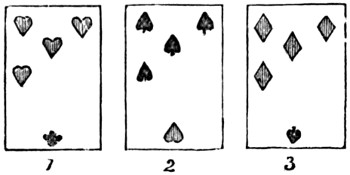
Fig. 1
Show the cards as in Fig. 2, making the spectators observe that there are the four eights. Put the two of diamonds behind the eight of clubs, and lay the eight on the table. The two must be inserted before the eight is removed, or the mystery of the marking will be apparent. Close the cards, turn them over, and spread them out, when they will appear as in Fig. 3. Take in the eight and lay the two on the table; close the cards, and while shuffling them, turn card No. 2 the other way upwards. The cards will then all appear black, as in Fig. 4. Take in the two and remove the eight, turn them over, and spread them out, when they will appear all red, as in Fig 5. Finally, take in the eight, replacing the two on the table, reverse No. 2, and you will have the four eights and the two of diamonds just as they were at first. You must invent plenty of talk during your changes. If the spectators say that the cards are double, spread them out, and hold them up to the light, (for the light cannot penetrate through the places where the cards are placed over each other,) and if they are still sceptical, hand them the two of diamonds to look at, and in a moment or two hand them the eight of clubs, asking them whether they would like to examine a black card also. This will effectually disarm suspicion.
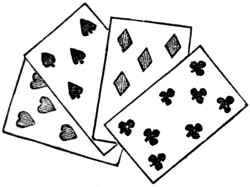
Fig. 2
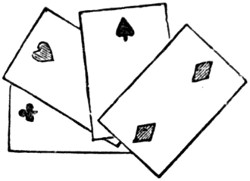
Fig. 3
Fig. 2
Fig. 3
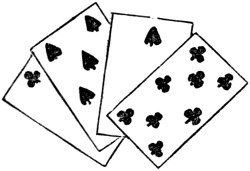
Fig. 4
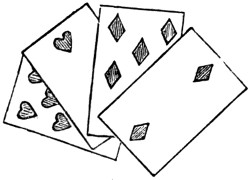
Fig. 5
Fig. 4
Fig. 5
22. TO CHANGE A CARD IN A PERSON’S HAND.
Cut very neatly the spots from a three of spades. Lay the pierced card on an ace of diamonds, and rub pomatum on the ace of diamonds through the places which the spades occupied. Remove the pierced card, and sprinkle the ace of diamonds with jet powder, which adhering to the pomatum, will transform the card into a three of spades.
Place the transformed card at the bottom of the pack, and show a person what card it is. Make him declare it that every one may hear, then place it on the table, face downwards, and push it over the cloth to the spectator, which action will rub off all the jet powder. Tell him to place his hand on the card. Let a three of spades be at the top of the pack, and an ace of diamonds the second from the bottom. Show another person the ace of diamonds, and ask him to tell the name of the card openly. Put the pack down, face downwards, And in so doing, make the pass, and bring the three of spades to the bottom.
Tap the hand of the person who is guarding the card, and then tell him to take up the card and show it to the spectators, when it will be seen to be the ace of diamonds. Simultaneously, you take up the pack, and show the three of spades at the bottom.
CRYPTOGRAPHY.
The meaning of the word “Cryptography” is, as is well known, “hidden or secret writings,” and was used in ancient times, when conspiracies were common, and murders an every-day occurrence, as the means of communicating from one person to another in such a manner that it could not be read by any one save those who were admitted into the secret of its construction.
A widespread conspiracy, or, as it would be more properly termed, rebellion, could not be carried on between persons at a distance from each other unless they resorted to cryptography; in fact, the means of correspondence was in those times of so slow and dangerous a nature, that without the utmost care and secrecy in the arrangement of the cipher it would certainly have been discovered, and then death would be the consequence.
In order to mature their designs in safety, and to throw off all suspicion, men were obliged to put their wits to work and invent some way of informing each other of everything that did transpire, so that no one else should be the wiser for it: thus was cryptography discovered; and wonderful cunning and ingenuity were displayed in its construction, as will be seen by the examples that are given.
It was also used in former times in transacting affairs of state, in communicating messages from one general to another in time of war, and in many other ways of a more innocent nature, too numerous to mention.
Now, at the present time, when all is peace and prosperity, and news is brought to our very doors by post and telegraph, cryptography is only interesting as a curious study, or to amuse ourselves in an idle hour by finding out its hidden mysteries.
The first and most common form of cryptograph we read of was by the transposition of letters, and is, as we may see, capable of great improvement; indeed, it is the basis on which most of the letter ciphers are formed at the present day.
We give the following as an example:—
For— a b c d e f g h i j k l m n o p q r s t u v w x y z.
Use— d e f g h i j k l m n o p q r s t u v w x y z a b c.
The sentence, “We meet to-night,” in this cipher would become, “Zh phhw wr-qljkw.”
The next is formed on the principle of the above, but is rather more intricate: for instance, if we wanted to inform some one that, “All going on well, send supplies as soon as possible,” we should put it down in the following order:—
a g s p s o
l o e l o s
l n n i o s
g w d e n i
o e s s a b
i l u a s l
n l p s p e
You must read it down the first perpendicular column, then down the second, and so on. You must then form the letters in the horizontal columns into imaginary words, and place them down on paper as you would a common sentence, thus:—“Ag spso loelos lnn iosgwden ioes sab iluas lnlp spe.”
You must arrange with your correspondent beforehand that the width of the horizontal column should consist of six letters (or more, if you like); so by placing the letters six in a line, one under the other, without regard to words, the puzzle is easy to solve.
Another good cipher is by using the figures 1 and 2 differently arranged for every letter in the alphabet, as will be seen by the following key:—
a b c d e f g h i
11111 11112 11121 11122 11211 11212 11221 11222 12111
j k l m n o p q r
12112 12122 12211 12212 12221 12222 21111 21112 21121
s t u v w x y z
21122 21211 21212 21221 22222 22212 22221 22122
Now if we wanted to write the words “Come now,” we should do it in this way, knowing that there are five figures to every letter, and when a word is formed there is a comma:—
11121122221221211211, 122211222222222.
The next was a favourite of that unfortunate king, Charles I.:—
a b c d e f g h i & j k


l m n o p q r s t u & v


w x y z


The next is rather good and somewhat difficult:—
Divide a piece of cardboard into twenty-six departments, and in each place a letter; then take another piece (small enough that the letters on the first piece can be seen), and fit it into the centre of the first, dividing this into the same number of departments; then put a piece of thread through the centre of both, so that you can turn the smallest card round, filling the spaces up with letters in any way you like. Thus:
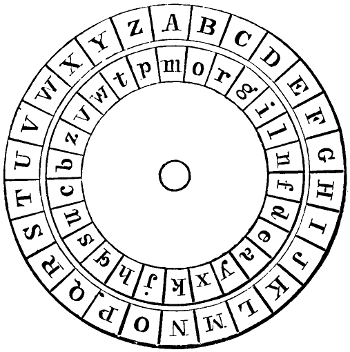
In using the dial, turn it round until, say, the letter m in the middle card comes under the letter A in the outer circle; next take what you want to write, and find it letter by letter in the outer circle, putting down on paper what appears directly under it in the inner circle.
Now if you want to write “I shall come soon,” first write the letters A m, so as to enable your correspondent to fix his dial like your own, as the A is in the outer circle and the m under it in the inner—“Am d ufmyy rjxi ujjk.”
You may arrange your dial in any way you like, but must be sure to place what letter is under the A at the beginning of your cipher.
The next is something like the last:—
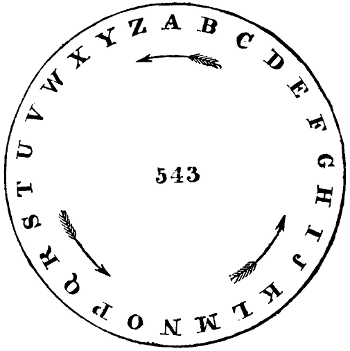
Now if you want to tell some one that “They are all coming over,” you must write it down and place the figures 5, 4, 3 over every letter in succession. Thus:—
5 4 3 5 4 3 5 4 3 5 4 3 5 4 3 5 4 3 5 4.
T h e y a r e a l l c o m i n g o v e r.
Then look for the letter T in the dial; the figure 5 being over it, you must look for the fifth letter from it, which is O: put it down, and go on to the next letter in the message, H; find H in the circle, and as 4 is over it, put down the fourth letter from it, D: for E, with the 3 over it, we must write down the third letter from E; and for the next letter, Y, 5 being over it, the fifth letter; and so on, always counting in the direction of the arrows. The cipher will run eventually: “Odbt woz wig ylhekb kszn.”
The way to read this cipher is to put 543 down the same as before, and to count them on the circle in the opposite way to which the arrows are pointing.
The most famous and complex cipher perhaps ever written was by Lord Bacon. It was arranged in the following manner:—
aaaaa stands for a
aaaab „ b
aaaba „ c
aaabb „ d
aabaa „ e
aabab „ f
aabba „ g
aabbb „ h
abaaa „ i & j
abaab „ k
ababa „ l
ababb „ m
abbaa „ n
abbab „ o
abbba „ p
abbbb „ q
baaaa „ r
baaab „ s
baaba „ t
baabb „ u & v
babaa „ w
babab „ x
babba „ y
babbb „ z
Now, suppose you want to inform some one that “All is well;” first place down the letters separately according to the above alphabet—
aaaaa ababa ababa abaaa baaab babaa aabaa ababa ababa.
Then take a sentence five times the length in letters of “All is well,”—say it is, “We were sorry to have heard that you have been so unwell.”
Then fit this sentence to the cipher shown above, like this—
a a a a a a b a b a a b a b a a b a a a b a a a b b a b a
W e w e r e s o r r y t o h a v e h e a r d t h a t y o u
a a a b a a a b a b a a b a b a.
h a v e b e e n s o u n w e l l.
Marking with a dash every letter that comes under a B. Then put the sentence down on your paper, printing all marked letters in italics, and the others in the ordinary way, thus—
“We were sorry to have heard that you have been so unwell.”
The person who receives the cipher puts it down and writes an A under every letter except those in italics; these he puts a B under; he then divides the cipher obtained into periods of five letters, looks at his alphabet, and finds the meaning to be, “All is well.”
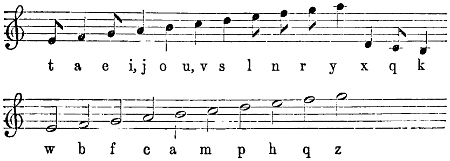
Here is a specimen of a music cryptograph:—
The next is good, but rather lengthy:—
a b c d e f g h
. : . . . : . . . : . : : . . . . . : . . . . . : . : . : : . . : . . : . . . .
i j k l m n o p
: : . . . . . : : . . : . : . : . : . . . . . : : . . : . : : : : . . . : : : .
q r s t u v w x
: : : : : : : . : : : . : . : : : . . : : . : : . : : : : . . : : : : : : : . :
y z
: . : : : . : : . :
Here is the key of another:—
1 2 3 4 5
a b e d e—1
f g h i k—2
l m n o p—3
q r s t u—4
v w x y z—5
In picking out the letter you want, you must see under what number it stands, then see what number is at the end of the line, then put those two figures together, and they will represent the letter: thus, 15 represents V; 23, M; 43, O; and 55, Z.
The sentence, “We meet to-night,” would be—2551, 23515144, 4443, 3342223244.
The next is a very difficult and complex cryptograph to decipher.
Draw a table of four columns, like the figure below. In the first column place the six different arrangements of the figures 1, 2, 3, and number the other columns 1st, 2d, and 3d respectively:—
1st. 2d. 3d.
123 t y c n h r e m e a o i
132 b e f s y h i s g t r t
213 e r e e t m x w a e n t
231 e r m c k m a r a h h y
321 l m r t i c i h l o e g
You must agree with your correspondent how many letters wide each of the three columns shall be—we will say four. Then take your sentence—say it is, “They are coming by the first steamer next week from America; we hope they will come right.” You must then place every letter down separately, writing the figures in the first column in succession over them, thus—
1 2 3 1 3 2 2 1 3 2 3 1 3 1 2 3 2 1 1 2 3 1 3 2 2 1 3 2
T h e y a r e c o m i n g b y t h e f i r s t s t e a m
3 1 3 1 2 3 2 1 1 2 3 1 3 2 2 1 3 2 3 1 3 1 2 3 2 1 1 2 3 1
e r n e x t w e e k f r o m A m e r i c a w e h o p e t h e
3 2 2 1 3 2 3 1 3 1 2 3 2 1.
y w i l l c o m e r i g h t.
Over the first letter, “t,” stands “1,” therefore write “t” in the column marked first; over “h” is “2,” therefore write “h” in the second column; over “e” is “3,” then put “e” in the third column, and so on; but when four letters are written abreast you must begin a new line.
After doing the above, you must take the letters in each column separately (beginning with the first), and form them into imaginary words, putting a dot under the last letter of each column to show your correspondent that the column ends there; thus—
Tycnb efse ree ermc w pee lmrt hrem yhistmx wk mar eot wi ciheaoi gtrtae ntfoei ah hyl oegg. Tycnb efse ree ermc w pee lmr• hrem yhistmx wk mar eot wi ci•eaoi gtrtae ntfoei ah hyl oeg•
The person receiving the message knows the width of the column (four letters), the arrangement of the figures 1, 2, 3, and the use of the dots, and reconstructs his table directly; he then puts the letters in order by a backward process to the one we have gone through, and reads the message.
The next is a cipher of a different kind:—
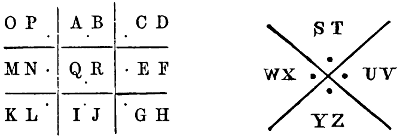
The dots stand for the last letter in each square: thus O would be , and P the same with a dot put in the middle, thus • . A and B •
The sentence, “Routledge’s Magazine for Boys,” would be

In finding out the meaning of a cryptograph, you must first settle in your mind to what class of cipher it belongs, whether it is written by means of letters, figures, or signs; having done so, you must go to work with patience, and try to find out, by means of perseverance and study, what each figure, sign, or letter represents; as even the above specimens of cryptography can be so altered and improved upon, yet continuing in their original form to some extent, that it would be impossible to give positive rules to enable any one to decipher any kind of cryptograph; in fact, it can only be done by those who have made it their study for years, and consequently have had great experience in the matter.
Most of the examples given will only enable one to decipher the most simple kinds, such as are generally found in magazines, &c.; for if that intricate cipher of Lord Bacon’s were put in a book for boys, it would be a waste of paper, as we will venture to say that not one in a thousand would be able to find it out.
There is another class of cryptographs which we have not yet noticed, and which are done by means of sympathetic inks, a list of which will consequently be interesting.
Inks which appear when heated, and become invisible when cooled:— Solution of nitro-muriate of cobalt; when heated turns green. Solution of acetate of cobalt, with a little nitre; rose-colour when warm.
Inks which remain visible when heated, but do not disappear when cooled:— Onion-juice, yellow; equal parts of copper and sal-ammoniac in water, yellow; aquafortis, spirits of salt, oil of vitriol, and salt and water, yellow or brown.
Inks which appear when exposed to light:— Diluted solution of nitrate of silver. Diluted solution of terchloride of gold.
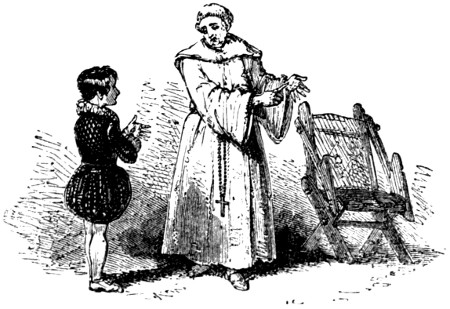
PETER POUNCE, THE FIRST TEACHER OF THE DEAF AND DUMB, INSTRUCTING A BOY.
THE DEAF AND DUMB ALPHABET.
Amongst the many useful inventions which have been planned for the solace of individuals deprived of some portion of their senses, the art by which deaf and dumb persons are taught to express their own thoughts, and to comprehend those of others, is one of the most noble. The earliest attempt at a method of teaching the deaf and dumb was made in Spain, towards the end of the sixteenth century, by a Benedictine monk named Peter Pounce; and without doubt he must have formed his idea from observing the natural propensity of the dumb to supply the want of the organs of speech by making signs. After the essay of Peter Pounce many successful trials were made, and in 1692 John Conrad Amman, a Swiss physician, reduced the plans to a fixed method, or art, and published the scheme of it at Amstelod. The first asylum for the deaf and dumb in London was founded in the year 1792.
THE ALPHABET.
A B C
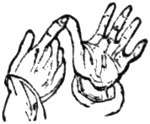
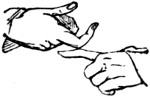
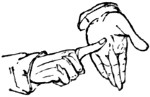
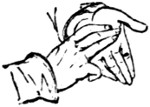
A is expressed by touching the top of the thumb of the left hand with the forefinger of the right.
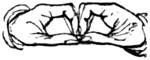
B. Join the forefinger and thumb of each hand, and place the backs of the forefinger nails together.
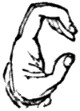
C. Bend the fingers and thumb of the left hand, so as to form three parts of a circle.
D E F G
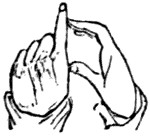
D. Bend the fingers and thumb of the right hand into a semicircle, and then join them to the forefinger of the left, which keep in a straight line.
E. Touch the top of the forefinger of the left hand with the forefinger of the right.
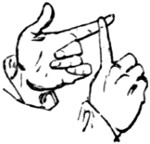
F. Place the forefinger of the right hand across the backs of the first and second fingers of the left.
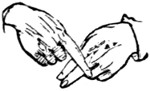
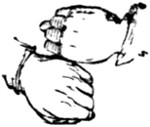
G. Clench both hands, and put one fist upon the other.
H I J
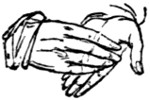
H. Pass the palm of the right hand across that of the left, sweeping it along to the tips of the fingers, as if brushing something off.
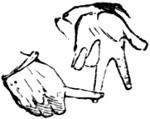
I. Touch the top of the second finger of the left hand with the forefinger of the right.
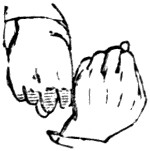
J. Clench the hands together, as directed for the letter G.
K L M
K. Form a semicircle with the thumb and forefinger of the right hand, and join it to the forefinger of the left, which must be kept straight out; both forefingers must meet at the second joints.
L. Place the forefinger of the right hand across the centre of the palm of the left, so that the top of the finger may be exactly in the middle of the palm.
M. Place three fingers of the right hand flat upon the palm of the left.
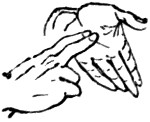
N. Place two fingers of the right hand flat upon the palm of the left.
O. Touch the top of the third finger of the left hand with the forefinger of the right.
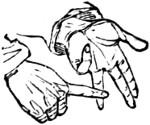
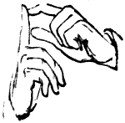
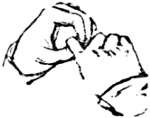
N O P Q
P. Place the tips of the forefinger and thumb of the left hand in a semicircular form against the first and second joints of the forefinger of the right, which should be kept straight.
Q. Form a circle with the forefinger and thumb of the left hand, and then curve the forefinger of the right into the shape of a hook, and place it exactly where the other fingers join.
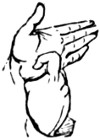
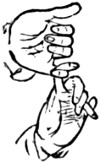
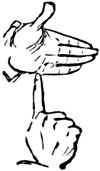
R S T
R. Bend the forefinger of the right hand and rest it on the palm of the left.
S. Bend the little finger of each hand and lock them together.
T. Fix the tip of the forefinger of the right hand against the middle of the lower edge of the left.
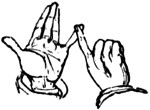
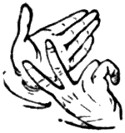
U V W
X Y Z
U. Touch the top of the little finger of the left hand with the forefinger of the right.
V. Place the first and second fingers of the right hand, apart, upon the palm of the left.
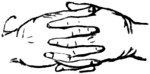
W. Lock the fingers of one hand between those of the other.
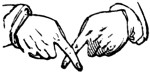
X. Cross the forefingers at the second joints.
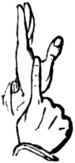
Y. Extend the thumb and forefinger of the left hand, and at the lower part of the fork so made place the forefinger of the right hand.
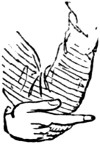
Z. Elevate one hand towards the face, and rest the elbow upon the palm of the other.
The end of every sentence is indicated by snapping the second finger and thumb of the right hand. This result is requisite to avoid the confusion which might result from running the sentences into each other.
THE NUMBERS
Are denoted by holding up one finger to signify 1, two fingers for 2, the open hand for 5, both hands for 10, and so on.
DOMINOES.
There was a time when dominoes was a much more favourite game than at present. In many old houses beautifully finished sets of dominoes are yet kept, a memento of the favour in which the game was once, and still deserves to be, held. For boys it is second to none, as it improves their power of calculation, exercises their judgment, and leads them to acquire a habit of estimating chances in connexion with numbers, which is exceedingly useful in after-life.
The ordinary game of dominoes is played with twenty-eight pieces, which include every combination of numbers, from double-blank to double-6; but boxes of dominoes are not uncommon which have fifty-two pieces, or even eighty-five pieces, one including double-9’s, and the latter double-12’s. These are more used in the north than the south. The dominoes are usually made of oblong pieces of ivory, frequently cemented to an ebony back; whilst on the front they are divided into two parts by a fine line across the middle, and marked with round black spots. These are 1 and 1, 1 and 2, and so on to 6; then 2 and blank, 2 and 1, and so on. Where a set of dominoes is not handy, a pack of what printers call third-large cards may be made available, if they are marked with a pen, and the backs kept perfectly clean. These may be shuffled and dealt in a similar manner to playing cards; but the dominoes must be placed face downwards on the table and “shuffled” by being well mixed together.
The turn to commence is called “the pose,” and is the same in all games of dominoes. After the players have drawn from the bulk the number of dominoes each requires, double-6 is called for, and he who has it plays first. If it is not in hand, then the highest double plays; if no doubles are out, then the call is from the highest domino to the lowest, as 6—5, 6—4, and so on.
THE ORDINARY BOY’S GAME
Is played in two modes. The first is called the French game. After the dominoes are well shuffled, each player (usually two) draws from the bulk the number of dominoes agreed upon. Seven is the common number, and this leaves fourteen dominoes on the table. The dominoes are either held in the hand, or set on their sides on the table, so that the pips are visible to the player only. In the north of England a small tin, angular frame is used to hold the dominoes. The player holding the highest double then plays first, and then each plays in turn by placing a domino of the same number of pips to the domino played at either end when you both have played. If your opponent cannot do this it is called “a go,” and you can then play for him, until he can play. If you can play to both ends, do not do so until you have exhausted your hand at one end, and be sure to get out your doubles at the earliest opportunity, unless by so doing you close both ends against yourself. By pursuing this plan you can, when pressed, play at the ends closed against your adversary the domino you have reserved for that purpose. When you have played all your dominoes out, you win the game; or when neither can play, he that has the lowest number of pips, not pieces, wins the game. It is best, however, to play a definite number up, such as 30, 50, or 100. In these cases the game is better played by the
Second mode, which is commenced in the same manner; but when you play a double, and it is your turn, you can play it out and still keep your turn. When your adversary cannot play, you play for him, and for yourself too, before he can play again. The game is counted thus:—When one has played all his dominoes out, he counts the number of pips in his adversary’s hand, and scores them in his favour; if neither can play, the one who has the fewest left counts the other’s numbers, and subtracts the number of his own, and scores the balance in his own favour. Formerly the whole number was scored, but this is dispiriting to the loser. In this game it is better to try to play so that neither can go on again than to play out all the dominoes. By a little practice it will be seen that heavy dominoes do not always lose, or light ones win. In playing these and any game at dominoes it should be understood that a domino once played should not be recalled, as it frequently destroys all interest in the game. Sometimes it is understood that if the domino is not placed on the table you may recall it; but it is better to play it at once, as a skilful player can easily calculate the chances in his favour.
There are two or three variations on the first method. In one the winner of the game scores all the points left in his own hand (if any), as well as those in his opponent’s. Another method is, when one player cannot go, the other is not bound to proceed, even if able, but can at once shut the game and count, if he likes to do so. Another variation is to permit the second player, if he chooses, to take all the dominoes but two left on the board. If he does not choose, the next player may draw as many as he chooses (always excepting two); and if one cannot play, he must draw until he can do so. The pose in this game is alternate, or is taken by the winner.
ALL FIVES
Is a game played by four persons, two against two, each player taking five dominoes. It may, however, be played by two persons only, when seven dominoes are given to each, and none are afterwards added. The score seldom exceeds 31, or any smaller number, and is marked on a cribbage-board. The object of this game is to play so that the two ends of the dominoes, after you have played, are a multiple of five. Thus the first player endeavours to make a point by putting down a 5 and blank, 4 and 1, 3 and 2, each of which counts 5: if he has the double-5 it counts 2. The other players follow on in the same way, endeavouring to make 5, 10, 15, or 20, for which they score 1, 2, 3, or 4 respectively. This game requires great caution, so as to prevent your opponent from scoring, if you cannot do so yourself. 20 is the largest number that can be made: thus, if there is a 4 at one end and a 6 at the other end, the next player, having the double-6, plays it to the 6, and the following player, having the double-4, plays it to the 4; doubles in this, as in all other games of dominoes, being laid across, there are 12 at one end and 8 at the other, making 20, or four fives. When one hand is played out, or neither can go, the lowest number counts one towards game. This is peculiarly a game of stratagems, and when one holds the double-5, he generally tries to keep it until there is a 5 at each end, when he plays it and scores 3, and generally, in that case, 1 for game as well.
THE MATADORE GAME
Is on an entirely different principle. You do not fit the same numbers together, as in other games at dominoes, but you must add a number which, when joined to one already there, makes seven. The double-blank, the 4—3, 6—1, and 5—2, are termed matadores, and can be played at any stage, and either end turned outward at will, for your opponent to play to. Three dominoes only are taken at the outset, and if one of the players cannot “go,” he must draw until he can do so, unless the number of dominoes left on the board is reduced to two. The game is played 30, 50, or 100 up, and the winner counts to his score his opponent’s pips.
ALL THREES
Is a capital game for boys, and exercises the players in the four rules of arithmetic. It is played similarly to the All Fives, only 3 is the multiple instead of 5: thus, 3, 6, 9, 12, 15, and 18 points count 1, 2, 3, 4, 5, and 6, respectively.
TIDLEY-WINK
Is a good round game. Any number can play, so long as there are two or more dominoes left on the board, after three dominoes each have been taken. The pose is settled as before; but the leader has the privilege of playing to his double, if he can do so, and any person having a double in his turn can play to it, if he can. The game runs round, and the first person who plays out pronounces himself “Tidley-Wink,” and is the winner.
THE FORTRESS.
When four persons are playing, this will be found one of the most amusing of games. It is sometimes called “Sebastopol.” All the dominoes are divided equally amongst the players. The double-6 is played first, and then every person must play a 6 to the double, and thus form a cross. The person who has not a 6 loses his turn. The play then proceeds in the usual way, only that the player can choose which corner he likes to play at. The result is a curious irregular figure resembling the ground-plan of a fortress, with bastions, &c.; hence its name.
WHIST DOMINOES
Is also played by four persons, seven dominoes being given to each. The persons in this case are partners, and sit opposite to each other. This game is led off as all others, but requires considerable powers of memory to play it properly, for it is necessary to remember not only the numbers played, but who played it, and under what circumstances, so as to help your partner’s hand and checkmate your opponent’s. Several other games of dominoes may be played; but the foregoing, with their numberless variations, will enable any one to master the principles of any other introduced.
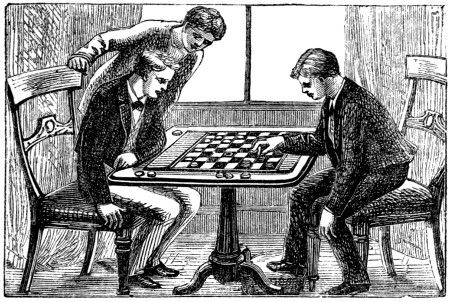
DRAUGHTS.
“White to black and black to white. Now give the challenge—wage the fight.”—Clarkson.
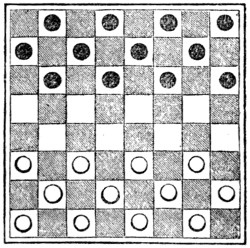
Draughts is a modern invention, and is a good preliminary to chess. It is not so intricate a game, for the pieces are of equal value till they become kings, and can only move one way; but like chess, success depends entirely upon skill, and one false move frequently occasions the loss of the game. Draughts seems to have come into vogue in Europe about the middle of the fourteenth century, and for a long time there were two methods of playing it; the one commonly used in England being the French game, which is played upon a chess-board, and the other the Polish game, which requires a board with ten squares or chequers in each row, and twenty men. The men in the Polish game can only move forwards as they do in the French game, but they have the privilege of taking backwards and forwards, and the king, when made, if not opposed by two men close together, can move from one corner of the board to the other The Polish game admits of most variety, and is in our opinion infinitely the best, but it is little played in this country, except by foreigners, many of whom during the Great Exhibition year proved themselves adepts at the game.
HOW TO PLAY THE GAME.
The draughtboard consists of sixty-four squares, black and white, and there are twelve men, or pieces, of a white colour, and twelve of a black colour to be used. The board should be placed with an upper white corner towards the right hand. The players select each twelve men of the colour they prefer. The pieces, or men, are to be thus placed on the board: the black pieces on the first twelve white squares, and the white on the last twelve white squares. When they are thus placed the game begins.
THE MOVES.
The pieces move forward diagonally, and it is the object of the players to take all each other’s men; the player who has the black pieces taking the white, and the player who has the white men taking the black. The first player—say Black—moves his piece angularly to the first white square, and then, if nothing intervenes between his piece and that of his opponent, and there is a vacant square in his line left behind him, the white can pass his piece over him to the space so unoccupied, and take his man, which is withdrawn from the board. The same may be repeated by the adversary; and thus the players go on taking each other’s pieces till one or the other cannot move, or all the pieces are taken. When a piece, however, arrives at the last row of the enemy’s ground, it becomes what is called a king, and is crowned by another piece being placed on it. It may then be moved backwards and forwards at pleasure, and can take both ways. When a player neglects to take a piece, he is what is called huffed, that is, he loses the piece that ought to have been moved.
LAWS OF THE GAME.
1. The moves are alternate, the first move being determined by lot.
2. The choice of men to be also decided by lot, but they should be changed every three games.
3. Whichever piece is touched must be played.
4. No player can remain more than five minutes without playing. He may be warned at the end of five minutes.
5. Neither player must leave the room without permission of his adversary.
6. In case of huff, the opponent, in lieu of taking a piece for the omission, can insist on his being taken.
7. Each party must sit free so as not to obstruct a view of the board, and no pointing at pieces is allowed.
8. When a false move is made, the piece must be moved to whatever square the opponent dictates.
9. All disputes between players to be referred to a third party.
10. Bystanders must make no remarks during the game.
GAMES FOR PRACTICE.
Playing draughts is a game which is best learned by experience and repeated defeats. It requires circumspection and caution, and especially demands calculation of the effects of the different moves upon the fortune of the game. The moves should be calculated mentally. The men should be kept as much in the centre of the board as possible; and the gentlemanly player will consider all drawn games as won by his opponent, and never triumph over the vanquished. The following games will give the young player a good general idea of draughts, but his success as a player will depend entirely upon his own application and habit of thought:—
Game I.
No. Colour. from to
1. B. 11 15
2. W. 22 18
3. B. 15 22
4. W. 25 18
5. B. 8 11
6. W. 29 25
7. B. 4 8
8. W. 25 22
9. B. 12 16
10. W. 24 20
11. B. 10 15
12. W. 27 24
13. B. 16 19
14. W. 23 16
15. B. 15 19
16. W. 24 15
17. B. 9 14
18. W. 18 9
19. B. 11 25
20. W. 32 27
21. B. 5 14
22. W. 27 23
23. B. 6 10
24. W. 16 12
25. B. 8 11
26. W. 28 24
27. B. 25 29
28. W. 30 25
29. B. 29 22
30. W. 26 17
31. B. 11 15
32. W. 20 16
33. B. 15 18
34. W. 24 20
35. B. 18 27
36. W. 31 24
37. B. 14 18
38. W. 16 11
39. B. 7 16
40. W. 20 11
41. B. 18 23
42. W. 11 8
43. B. 23 27
44. W. 8 4
45. B. 27 31
46. W. 4 8
47. B. 31 27
48. W. 24 20
49. B. 27 23
50. W. 8 11
51. B. 23 18
52. W. 11 8
53. B. 18 15
&c.
White loses.
Game II.
No. Colour. from to
1. B. 11 15
2. W. 22 18
3. B. 15 22
4. W. 25 18
5. B. 8 11
6. W. 29 25
7. B. 4 8
8. W. 25 22
9. B. 12 16
10. W. 24 20
11. B. 10 15
12. W. 21 17
13. B. 7 10
14. W. 27 24
15. B. 8 12
16. W. 17 13
17. B. 9 14
18. W. 18 9
19. B. 5 14
20. W. 24 19
21. B. 15 24
22. W. 28 19
23. B. 14 17
24. W. 32 27
25. B. 10 14
26. W. 27 24
27. B. 3 7
28. W. 30 25
29. B. 6 9
30. W. 13 6
31. B. 1 10
32. W. 22 13
33. B. 14 18
34. W. 23 14
35. B. 16 30
36. W. 25 21
37. B. 10 17
38. W. 21 14
39. B. 30 25
40. W. 14 9
41. B. 11 15
42. W. 9 6
43. B. 2 9
44. W. 13 6
45. B. 15 18
46. W. 6 2
47. B. 7 10
48. W. 2 6
49. B. 10 14
50. W. 6 9
51. B. 25 21
52. W. 31 26
53. B. 14 17
&c.
Drawn.
FIREWORKS.
Our book is intended for the gratification of boys. We know full well the intense delight taken by boys in risking their limbs or their lives, especially when such risk is accompanied with noise. Boys always have done so, and always will do so in spite of the very best of advice or precautions. As, therefore, it is impossible to keep them from making noises and endangering themselves, we have in the following pages endeavoured to show them how to make as much noise as possible with as little danger as possible.
What is there that makes the most noise and is most dangerous? Gunpowder, of course. Therefore, we have given descriptions of the best methods of employing this material, feeling quite sure that of accidents with gunpowder nine out of every ten are caused by ignorance. We knew a boy who lost the use of a thumb, and took all the skin off the palm of his right hand, by ignorant management of powder. He had read of blasting rocks, and nothing would satisfy him but blasting a bank. So he bored a deep hole in it with a stick, filled the hole with gunpowder, and then poked a lighted lucifer into the powder. The consequence was, that his face was so scorched as not to be recognised, all his eyebrows and eyelashes and most of his hair were burned off, while his right hand was injured as has been already mentioned. Now that boy had been studiously kept out of the way of powder by female relatives, and was naturally profoundly ignorant of its effects. Had he been taught to handle it, he would not now be forced to keep his right hand closed, or to write by holding the pen between the fingers of his clenched hand.
GUNPOWDER.
It will not be very advisable for the firework boy to make his own powder, but still it will not be amiss that he should know how it is prepared. Pulverise separately 5 drams of nitrate of potass, 1 dram of sulphur, and 1 dram of newly burnt charcoal, mix them together in a mortar with a little water, so as to make the compound into a dough, which roll out into round pieces of the thickness of a pin upon a slab. This must be done by moving a board backwards and forwards until the dough is of a proper size. When three or four of these pieces are ready put them together thus,—
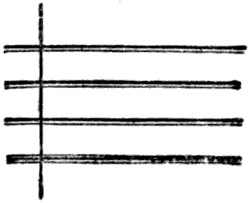
and cut them off into small grains. Place these grains on a sheet of paper in a warm place where they will soon dry, but away from a fire. During granulation the dough must be prevented from sticking by using a little of the dry compound powder. This mode of granulation, though tedious, is the only one to be used for so small a quantity for the sake of experiment. In making powder in a large way it is granulated by passing the composition through sieves.
HOW TO MAKE TOUCH-PAPER.
Dissolve in a little spirits of wine or vinegar a little saltpetre, then take some purple or blue paper, and wet it with the above liquor and it will be fit for use. When pasting paper on any of the following works take care that the paste does not touch that part which is to burn. The method of using this paper is to cut it into slips long enough to go once round the mouth of a serpent, cracker, &c.
CASES FOR SQUIBS, FLOWER-POTS, ROCKETS, ROMAN CANDLES, ETC.
Procure a hard wooden cylinder, or, if possible, one made of metal, whose diameter corresponds with that of the interior of the proposed case. Roll round it several folds of cartridge paper, and paste the edges well, so that it may be held securely. Tie it round until dry.

TO CHOKE THE CASES.
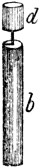
When the cases are thus made they will require to be tied at the lower end. This is called choking them, and as much force is required it is necessary. Fix a wire into a small solid cylinder (d). Take another short piece (b) an inch or two long, with a hole up it to admit the other end of the wire, fit it on and pass it up the case. Then having fastened a piece of whipcord to a post, wind it round the part left hollow by the wire, which should be about half an inch from the end; pull it tight with the right hand and work the case round with the left. Cut out a piece of touch paper two inches long and an inch and a half broad, wind it round the choke, and tie it on with a piece of fine string—twist it to a point. The cases are best choked while damp.
COMPOSITION FOR SQUIBS, ETC.
Gunpowder half a pound, charcoal 1 ounce, brimstone 1 ounce, or in like proportion; grind them in a muller or pound them in a mortar. Or you may take 1 part steel filings, 1 charcoal, 1 sulphur, and 4 powder, which is a very good mixture, and can be rubbed together in a mortar.
HOW TO FILL THE CASES.
Your cases must be very dry when ready, and should be put into an iron or wooden mould; first put in a thimble full of your powder, and ram it down very hard with your ruler, then put in a little more till the case is full, ramming it down hard every time. If you have no mould, hold the case in your left hand with the twisted touch-paper downwards, and fill it after the same manner. When you have filled within an inch of the top, fill up this with loose powder not rammed, for a bang, and fold in the ends; after filling a dozen or two melt some pitch in a small ladle, and smear the ends of the case with it by means of a small brush.
TO MAKE CRACKERS.
Cut some stout cartridge-paper into pieces three inches and a half broad and one foot long, fold down one edge of these pieces lengthwise about three quarters of an inch broad, then fold the double edge down a quarter of an inch, and turn the single edge back half over the double fold. Open it, and lay all along the channel which is formed by the folding of the paper some meal powder, then fold it over and over till the paper is doubled up, rubbing it down at every turn; this being done bend it backwards and forwards two inches and a half, or thereabouts, at a time, as often as the paper will allow. Hold all these folds flat and close, and with a small pinching cord give one turn round the middle of the cracker and pinch it close; bind it with packthread as tight as you can, then in the place where it was pinched prime one end and cap it with touch-paper.
When these crackers are fired they will give a loud report at every turn of the paper; if you want a great number of these, you have only to cut the paper longer, or join it on to a greater length; but if they are made very long you must have a piece of wood with a groove in it deep enough to let in half the cracker, which will hold it straight while you are pinching it.
ROMAN CANDLES AND STARS.
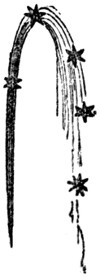
These are best made with the following ingredients: 1 ounce of powder, 1 ounce of sulphur, and 2 ounces of nitre. Some persons, however, prefer 1 part sulphur, 1 charcoal, 1 iron filings, 4 of powder, and 8 of nitre. The composition being made, in filling the cases fill the contrary way to a squib—stop up the choke by driving down a piece of paper. Put in 1 quill of gunpowder loose and 1 star made in the following manner: 1 ounce of camphor, 1 of sulphur, 2 of meal powder, 1 ounce of the coloured fires, moisten them with oil of turpentine, and work them into little round balls. Having placed a star within the case, put in above it 3 quills of the composition, ram down, then powder, star, and composition alternately, till the case is full. Paste touch-paper round the top and twist to a point.
ROCKETS.

There are several recipes for making rockets, the best of which is 3 ounces of charcoal, 6 of sulphur, 8 of nitre, 32 of meal powder. Another very good one is, 3 ounces of iron filings, 4 of powdered charcoal, 8 of sulphur, 16 of nitre, and 64 of meal powder. If a smaller quantity is wanted divide each proportion by 2, if a still smaller divide by 4. In this cut s is the loose gunpowder with eight or ten stars upon it; c is that part of the rocket in which the composition is to be rammed hard, p the priming or quick match, t the touch paper. The cases are to be put into a mould and the composition must be well rammed. The cases should be four times the thickness of those for squibs.
RAINS.
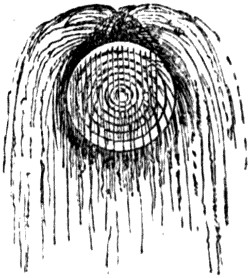
Sometimes gold or silver rains are added to rockets, which give them a very beautiful appearance. A gold rain is made of 2 parts sawdust, 4 sulphur, 4 meal powder, 6 glass dust, 16 nitre, in all 32 parts. A silver rain may be made of 2 parts salt prunella, 8 sulphuret of antimony, 8 sulphur, 8 meal powder, and 14 nitre, in all 32 parts.
CATHERINE WHEELS.
These are very pretty fireworks, and are made to turn on a pivot. There are many recipes for the composition of which they are formed; 1 part camphor, 1 sulphur, 1 nitre, 2 meal powder. Another is, 3 parts iron filings, 4 sulphur, 12 nitre, 16 meal powder. This composition is to be rammed into small cases, and bound round a small wheel, having a hole for a pivot in the centre.
VARIOUS COLOURED FIRES.
The following recipes will give the young firework maker a great variety of the most beautiful fires. They should never be fired in a room, however, and always away from a dwelling.
CRIMSON FIRE.
The principal ingredient in this is nitrate of strontium, of which 40 parts are taken, with 13 of sulphur, 15 of chlorate of potass, 4 of sulphuret of antimony, and 2 of lamp-black. These, as all the ingredients for the other fires, should be rubbed in a ladle, and they may be used in a ladle or iron dish set on the ground.
BLUE FIRE.
The ingredients of blue fire are 20 parts; 12 of nitre, 4 of sulphur, 2 of sulphuret of antimony, and 2 of lamp-black.
GREEN FIRE.
The ingredients for green fire are in 54 parts; 42 of nitrate of barytes, 8 of sulphur, 3 of chlorate of potass, and 1 of lamp-black.
PURPLE FIRE.
The best recipe for purple fire is of 60 parts; 25 of nitre, 25 of nitrate of strontium, 7 of sulphur, 2 of realgor, and 1 of lamp-black.
WHITE FIRE.
The best and purest white fire is made of 24 parts of nitre, 7 of sulphur, 2 of red arsenic, and 1 of lamp-black.
SPUR FIRE.
9 parts of nitre, 4 of sulphur, and 3 of lamp-black, well rubbed together.
BLUE LIGHTS.
These are made of 4 parts of sulphur, 2 of nitre, and 1 of powder, and are rammed into squib-cases the contrary way.
PORT OR WILDFIRES.
Saltpetre 4 parts, meal powder 6 parts, and sulphur 3 parts. The composition to be moistened with linseed oil.
SLOW FIRE FOR WHEELS.
Saltpetre 4 parts, sulphur 2 parts, and meal powder 2 parts.
DEAD FIRE FOR WHEELS.
Saltpetre 5 parts, sulphur 1 part, lapis calaminaris 1 part, and antimony 1 part.
CAUTIONS.
Such are the principles and methods by which fireworks may be made; but we would advise our young friends to be very cautious, and never to attempt making any fireworks by candle-light; always to select some outhouse for their operations; to see that no iron or steel implements are about the place in which their fireworks are being manufactured, or they may go off before they wish it; to use wooden or brass implements in the bruising, grinding, and sifting of their mixtures; and never to bring the fireworks, or any of their ingredients, into the dwelling-house, or they may suddenly receive a
“Heavy blow and great discouragement.”
TO MAKE AN ILLUMINATED SPIRAL WHEEL.
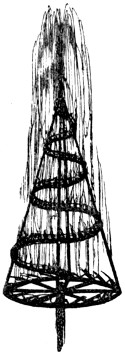
Procure a circular horizontal wheel two feet in diameter with a hole quite through the nave, then take four thin pieces of deal three feet long each, and three-quarters of an inch broad each. One end of each of these pieces is to be nailed to the felloe of the wheel at an equal distance from one another; and the other end nailed to a block with a hole in its bottom, which must be perpendicular with that in the block of the wheel, but not so large. The wheel being thus made, a hoop planed down very thin must be nailed to the felloe of the wheel, and wound round the four sticks in a spiral line from the wheel to the block at the top; on the top of this block a case of Chinese fire must be fixed, and on the wheel any number of cases, which must incline downwards and burn two at a time. The axis of the wheel must be a little longer than the cone, and made very smooth at the top, on which the upper block is to turn and the whole weight of the wheel to rest. The entire framing of the wheel, with its connecting tubes, is shown in the above cut.
THE GRAND VOLUTE.
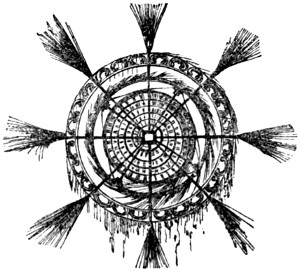
Should my young friends wish to prepare a grand volute illuminated with a revolving wheel; the first step is to procure a large circular wheel, and on its rim lay as many four-ounce cases as will complete the circle, only allowing a sufficient distance between the cases that the fire may pass free, which may be done by cutting the upper part of the end of each a little shelving. On each spoke fix a four-ounce case about three inches from the rim of the wheel. These cases are to burn one at a time. On the front of the wheel form a spiral line with strong wire, on which tie port-fires, placing them on a slant with their mouths to face the same way as the cases on the wheel; all these port fires must be fired with the second cases of the wheel. Let there be a series of wooden spokes all made to screw into a block into the centre. When the large wheel begins to discharge the fireworks, the spiral wheel will of course revolve and produce a very beautiful illuminated cone.
A BRILLIANT YEW-TREE.
To prepare a brilliant yew-tree, a frame like the one represented in the drawing must be firmly attached to the ground. When the branches are fixed, place illuminating port-fires on the top of each, as many as is convenient; behind the top of the stem fasten a gerb or white fountain, which must be fired at the beginning of the illumination on the tree. A series of these, varying in the angular directions taken by the boughs, produce a very fine effect.
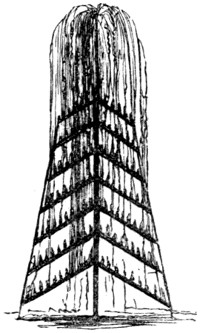
Such are a few general directions respecting the making of fireworks; but we have again to advise our young friends to be cautious of the gunpowder, and to keep away from the fire, or from a light, or from flames, steel, iron, or any other matter likely to cause a spark.
GARDENING.
“’Tis a delightful task To rear the tender flower, to see the bud Put forth its bloom, the little seedling sprout From its dark grove, to meet the sunbeams, and To drink the gracious rain. Here Innocence May well amuse herself, and blithe Industry Make mate with ants, and bees, and busy things, From morn to evening daily.”—Martin.
Gardening is one of the most delightful occupations for young persons. It combines innocent amusement, exercise of the healthiest kind, skill, forethought, method, taste, and is full of instruction,—leading the mind, not only to the wonderful operations of nature, but to the great Originator and Preserver of all things.
Gardening was the first of the arts. Before man had fallen from his “high estate,” and lost his heirship of heaven, he was placed by his Creator in a garden, and ordered to dress it and to keep it. The sustenance of man in all countries is derived, directly or indirectly, from the vegetable kingdom: it is supposed that he first made his appearance in that fertile and fruitful land from whence we get our best grasses. It was natural, then, that some rude kind of gardening should first occupy the attention of primitive man. In a savage state, now, in many countries, plants supply all the wants of man to an extent greater even than we are apt to suppose, from the necessity and possibility of a greater variety of animal food in our own climate.
MISCELLANEOUS.—GARDENING, FENCING, ETC.
From the earliest times of profane history, gardens are alluded to. The gardens of the Hesperides abounded with fruit of the most delicious kind, and the hanging gardens of Babylon were among the wonders of the world. The gardens of the Persians are called by Xenophon, “delightful places, fertile and beautiful;” and the gardens of Alcinous abounded with fruits, grapes, and various horticultural wonders. The philosophers of Athens walked in ornamental gardens, among shady groves, statues, and fountains.
There are many so-called styles of gardening, but these are readily divisable into two varieties—the geometrical and natural style. In the first may be comprised all gardens laid out with straight or geometrical lines. In the second, which is often called the English style, we include gardens and parks where the irregularity that we observe in pretty wild places, or in Nature’s own gardens, are preserved more or less judiciously and tastefully. On the one hand, we take Nature for a model; on the other, we merely apply geometrical lines to the garden and its contents. As the geometrical garden is merely a thing of straight lines, it is very much easier to dispose than the natural, with which a great many people make sad mistakes, and then blame the style instead of their own taste. It is very much easier to make straight walks, and circles, and figures of all kinds in a garden, than to imitate on a small scale the variety, and indefinite, ever-pleasing character exhibited by Nature where she most attracts us with floral beauty.
However, to see some specimens of the various styles of gardens will give a better idea of their worth, and main features, than any reading. We will indicate a few of the places where good examples are to be seen. The Crystal Palace is perhaps the best place to observe their differences, particularly as most boys visit that attractive place. The great terraces and fountains are, of course, in the geometrical style; while the more remote, or outer parts of the grounds, are a good example of the natural or English style of laying out grounds. The irregular “lakes,” surrounded by vegetation, the rock cropping out here and there, the natural-looking grouping of fine trees, and the freely rolling beautiful green grass mounds, &c. are, though perhaps not the most frequented, certainly among the best features of the Crystal Palace. The Royal Botanic Gardens in the Regent’s Park is also a good, a very good example of the best method of laying out gardens in the English style. It is disfigured, however, by a small, mean kind of geometrical garden, which we must not be supposed to praise. On the other hand, the garden of the Royal Horticultural Society at South Kensington is a capital example of a completely opposite style—the Italian and geometrical; and once having seen these, any boy can at once distinguish between the two, and probably say which he most admires.
In France, during the reign of Louis XV., the bad and artificial method was carried to excess;—clipped hedges, always laid out in straight lines—flower-beds tortured into fantastic shapes—trees cut into the form of pyramid haystacks, animals, &c. The gardens were like the manners and dress of that period, in which scarcely anything natural was left. The Dutch imitated the French: and this kind of gardening continued to prevail till attacked by Addison, in the “Spectator,” and Pope, in his Fourth Moral Epistle.
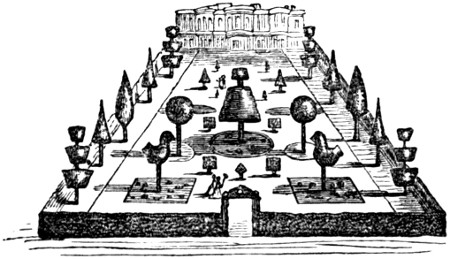
A GARDEN IN THE TIME OF LOUIS XV.
However, the boy’s garden is so small as a rule, that to attempt any kind of ambitious “laying out” would be nonsense; and having thus explained what is meant by different “styles” in gardening, we proceed to show how the boy’s garden should be laid out.
ON LAYING OUT A SMALL GARDEN.
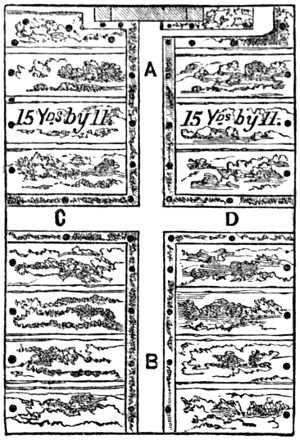
The size of a piece of ground which we should recommend to the young gardener ought to be about 33 yards long, and about 25 broad. It should be divided into four portions, as in the diagram. A B C D are four paths, 5 feet wide, which might be gravelled, and the edges should be planted with box, or some neat and tiny flowering plant. The borders should be about 2 feet in width; and this, with the breadth of the path, will take 9 feet, or 3 yards, from the 25 yards of width; which will leave 11 yards, or 11 yards broad, for each of the four compartments. The length of the four compartments—reduced by 9 feet, or 3 yards, as before, for the cross-path and two borders—will allow each of the four compartments to be 15 yards in length; so that each quarter of the garden would contain 15 yards multiplied by 11 yards, and would equal 165 square yards, which again multiplied by 4, would give 660 square yards of surface, which would be amply sufficient for a young person to obtain something like an idea of gardening, and at the same time be a profitable advantage. This will be found too large, however, except for those who wish to work at gardening in earnest, and have, moreover, plenty of time and thought to give to the matter. One half the size will be found to suit a greater number. In such, the same plan and proportioning may be carried out.
PLANTING THE GROUND WITH TREES, FLOWERS, ETC.
In the foregoing diagram, the borders are for flowers, and the other parts of the compartments for the raising of vegetables; but here and there a space should be left for the planting of fruit-trees, rose-trees, currants, gooseberries, raspberries, &c. The places marked by dots (*) are where fruit-trees may be planted, which should consist of some of the best sorts of apple, cherry, pear, and plum-trees, which ought to be planted from four to five yards apart. In the borders, rose-trees, both of the standard and common kind, might be planted, as indicated by the dots (*); and at the four corners, where the paths intersect, climbing-roses should be placed, having strong poles upon which their tendrils and branches may run. The spaces in the border may be appropriated to the various kinds of flowers, at the choice of the young gardener.
THE NOBLEST KIND OF GARDENING FOR BOYS.
There is one kind of gardening the results of which will afford a higher satisfaction to boys, when they become men, than any other pastime or exercise they can possibly engage in, and that is the planting of fine hardy trees. These will not require much attention, or any beyond the planting. They will grow freely and vigorously when you are at school or asleep, soon find their own supply of moisture by striking their roots deeply into the ground, and are able to withstand our cold and cloudy climate at all seasons. Nearly all intelligent and educated men are admirers of fine trees. Many who care nothing about our ordinary low-lying plants, take the highest interest in fine hardy trees—the late Prince Consort and the present Emperor of the French, for instance. Generally we display this interest in trees by planting them extensively when we come to be men; but how much would many lovers of trees not give to have commenced their tree-planting at an early age, so that they might walk under giant groves of their own planting! The Indian says, “He has not lived in vain who has planted a tree;” and certainly it is a noble thing to embellish the earth with its finest ornaments, and plant tiny shoots that will in time become great trees, and shed leaves over the graves of our children for ages. And it is well to observe in the beginning, that a tree of thoroughly hardy and vigorous disposition is one of the most lasting things on earth. Though a living thing, susceptible, like ourselves, of almost every change of atmosphere, cold or heat, it often survives great monuments of stone, and may live and see extinguished not only many generations of men but even the lives of nations.
The age of many trees has been computed upon fair proof to be greater than that of the Pyramids of Egypt. There are trees in America which were of colossal development ere that country was discovered, so that the growth of a mighty nation may require but little time compared to that witnessed by the giant Wellingtonia, whose bark you may have seen at the Crystal Palace. In our own country the age of many oaks and yews is proverbial. But apart altogether from the mighty age which our finest trees attain, let us venerate them for their beauty, dignity, and utility. What so full of life and change, so inexhaustive in their well-built and subtle ramifications, as the branches and branchlets of a fine tree! “The pillars of the valleys, the fringes of the hills,” as an eloquent writer calls them, “so stately, so eternal” are, while the most useful of all things to man, at the same time the most beautiful natural objects which he can contemplate. Nothing adds so much to the beauty of park, pleasure ground, or garden, as the planting of handsome and suitable trees: in fact, they are the only true and pleasing ornaments of such. What constitutes the difference between the aspect of naked, blast-swept, and desolate-looking heaths, or lowland—monotonous ground of any kind, in fact—and one of those grand parks of old England, say Goodwood, or Richmond, or indeed any pleasure ground such as you may see in almost every parish, with every shady ferny corner, or lane opening, or tree-fringed sloping grass mound, a picture of fresh and changeful loveliness? Why, simply the presence of trees. With them you may impart every charm to the wildest heath or flattest prairie—with them the highest and grandest beauty may be imparted to the charmingly undulated surface of a great part of the British Isles.
So much for the trees and their attractions. What is next to be done? It is to be hoped that every boy fond of gardening has already made up his mind to plant a tree, or several. We have seen a great many little boys’ gardens, but it was the fate of most of them to become disused and neglected, dug up or forgotten, when the little gardeners had arrived at the “big boy,” or manhood stage. The inmates being small and fleeting, of course every trace soon departed. But by adopting the kind of gardening here recommended, a pleasing and stately souvenir of pleasant early days will be the result. It must not, however, be attempted in the ordinary little boy’s garden, which is usually a small patch under a wall, or in some obscure spot totally unfit for trees. If you once make up your mind to plant a tree, the first thing to do is to choose a good position for it. It should be one in which it will grow well, and in which the tree will not be in the way of anything else. This will save it from being disturbed after it gets to some size, and your hopes from being disappointed in a way you least expected. And lastly, it will be very desirable to so place the tree that its effect when grown up may be a good and beautiful one. It is, for instance, very bad management to plant the noble Wellingtonia, or Cedar of Lebanon, near a house. This is very often done in suburban and villa gardens, but if the trees attain their natural size they spoil the house, or must be cut down. The finest cedar of Lebanon we know of is planted within twenty feet of a house, and completely overshadows it; yet so noble is the tree that the owner would not touch it on any account: he would give a great deal, however, to have it in a proper position. The planting of a large kind of tree where it may, when grown up, stop a pleasant view, is also a great mistake.
From these instances it will be seen that the position is a subject of the highest importance in tree-planting. Now, as of course every boy cannot be a judge of tree-planting, it will be found the best plan to consult papa or the gardener about it. They will be so well pleased at the idea of your planting a tree instead of a geranium or a wallflower, that you are sure to be encouraged with advice and assistance. To plant it in the ordinary boys’ garden would be a great mistake. It should be at once put in a position in which it might flourish undisturbed for ages. Generally, hardy trees are not fastidious as to soil. Mere planting is all the noble hardy ash, the graceful birch—the lady of the woods—the spreading beech, and others of our native trees require. But when we come to plant the grandest of all trees—the Wellingtonia and the Cedar of Lebanon, with many of the nobler pines of North America—if the soil be not naturally very good, we must make a preparation for the young plant. This is to be done by digging out a hole and taking the bad soil out at the bottom, leaving the top spit at one side, and then filling in the opening, say six feet wide or so, with good soil taken from a pasture and chopped up with a spade. This should be raised above the surface to allow for subsequent sinking, and also to keep the neck of the young tree a little above the level ground. The part meant by the neck, is the base of the stem, or, in other words, the part where root begins and stem terminates.
As most gardens or pleasure grounds are well drained, the little planter is not likely to have much to contend with on that score, but where the bottom or lower soil is of a disagreeable nature, gardeners very often place a quantity of broken bricks or rough stones in the bottom of the hole, and over them place turf to prevent the top soil from falling down.
The best time for planting is in the autumn—say September, October, or November; but any time through the autumn, winter, or early spring will do, provided the ground be not saturated with rain, and all other circumstances be favourable. The choosing of a good young tree is an important point. Do not have anything to do with those grown in pots; the roots of such are usually contorted round the ball, and in a very bad condition to make good trees. Nice symmetrical plants growing in a nursery, say at about from two to four feet high, are the best. The price of even the best of such will not amount to more than that of an ordinary toy, while in the case of the common native trees, and such things as the willows, that grow freely from a sucker, it is a mere trifle. Indeed, in the case of boys who live where there is anything like an extensive garden or grounds, most probably good young trees will be at hand ready to plant. It will be well to have the assistance of the gardener in planting a rare thing like the Wellingtonia, though after a little practice an intelligent boy can do it easily. The main points are, to place the roots of the tree on soil made pretty firm, to spread the roots out carefully before covering them, and finally, if the weather or soil should happen to be very dry, to give the ground a thorough soaking of water. This will refresh the little root fibres, make them “take kindly to the earth,” and, in short, put the little tree in a fair way for its long life. And as boys may frequently have occasion to water their gardens, as well as other people, we may assure them that one thorough good watering is better than a dozen bad ones. A bad watering is one in which the surface of the soil is merely wetted, and if you poke down a little way you find the soil quite dry: a good watering is one in which the water descends deep and far into the soil, as deep or deeper than the roots go, in fact. The dragging about of water in pots is a very laborious and awkward affair. If the little gardener can secure the loan of the water-barrel on wheels, and have it filled quite full, and the contents gently supplied to the root of his tree, he will save himself much trouble, and probably have no further attention to pay to it in that way during the course of his life. By the way, have you ever heard the little story about the famous Jean Jacques Rousseau and his little tree? If not, here it is.
When he was a little pupil about ten years of age, his master planted a walnut-tree to give a grateful shade to a place immediately outside the house. The planting of this walnut-tree was attended with some ceremony, little Rousseau and his friend, a fellow-boarder, acting as godfathers, singing songs of triumph around it. The master and his assistants formed a kind of basin around the tree, or, in other words, made a little embankment of earth around it, so that the water could not escape. Jean Jacques and his companion saw and were much interested in all this, made up their minds that it was a nobler thing to plant trees than to plant colours on a breach, and at once became very anxious to plant. This they soon did by cutting a slip of willow, and planting it with due ceremony on the terrace near the august walnut-tree that had been planted by the master. They made a basin of earth round it in imitation of the bigger one, and then came their grand difficulty—how to water it. They were not permitted to fetch any, or they would have gladly done so, though it was at a distance. The tree was safe for a short time from some cause or other, and began to put forth a few leaves, which they hoped would in due time afford them shelter and shade; but hot days came, and it was apparent that unless the little tree had water it would surely die. What was to be done? Well, it is pretty evident that either of them could think a little, even at that age, for the little rogues made up their minds to make a tiny grass-covered canal between the large basin and their little one, so that when the master came to water his big tree, the water might run from his basin to theirs! Their first essay failed; the earth fell in, and they were miserable for a moment, but soon set to work again. This time they cut an old box into narrow planks, and lined the furrow with them, made the slope so that the water would be sure to run as desired, and covered the trench over so that nobody could see it, putting a grating of twigs over the upper end, so as to hide appearances and keep out rubbish, and waited in hope and fear for the result. The master and his men came and poured in the water, which soon ran through the furrow to the little tree. This was too much for our otherwise sagacious little gardeners. They roared with delight at the success of their plan, and betrayed it to the master, who immediately sent for a pick-axe, and cut up their little trench, shouting at the same time, “An aqueduct! an aqueduct!” They were of course sorry, but soon took heart, and planted another tree, which lived to be a big one. To have set this slip in competition with a large one, Rousseau tells, gave him a degree of glory he had not known before, and says that he had a juster idea of it at that age than Cæsar had at thirty.
We will next turn to the selection of trees, and to the various wants of those who are likely to plant. The most popular trees in England at present are those noble evergreen pines. They are not all suited for town gardening, but very much so for most parts of the country. Around the beautiful mausoleum raised to contain the remains of the late Prince Consort at Frogmore, there is a row of these trees, mostly tapering and slender in habit, and very dark green. They have been planted by the various members of the Royal family in memoriam. The late Prince was very fond of these pine-trees, and many country gentlemen take the greatest interest in their planting. We merely tell you this to point out that the planting of trees is an object of ambition with many of the best and the highest in the land. When Her Majesty, and many other distinguished persons, visit a nobleman’s place or a public park, one of the most graceful acts they can do is to plant a tree; and the custom is very general. Let us hope, then, that many boys will imitate the example of Rousseau, and say, why should not we too plant trees? But to return to our pines, or conifers, as they are called. The race is a wonderfully beautiful one—so much so, that you must take care, or you may plant things that will do very well for a few years, perhaps, but get quite killed by the first very severe frost. It is a sad sight to see a tree which has perhaps grown to considerable size and beauty killed to the very ground by a frost such as we had in January, 1866—some of our noblest pines perished then; and therefore a list of the most thoroughly hardy kinds must prove useful. The giant Wellingtonia of California is fortunately hardy in all parts of these islands. So is the great arbor-vitæ of Nootka Sound (Thuja gigantea), a specimen of which obtained the first prize for trees of this kind at the great Paris Exhibition. One of the most beautiful of all pines, one which has its “leaves,” or little branchlets rather, as graceful as those of a fern, is Thujiopsis borealis, and it too is perfectly hardy. We regret that hard names must be used, but then, as thousands of our plants are not natives of England, they have of course no recognised English name, and to translate the scientific one would simply produce an awkward barbarism. In addition to the above, the following trees of this fine family may be planted with the confidence that we shall not see them perish in the vigour and beauty of youth:—Lawson’s cypress (we give you the English name where possible). Nearly all kinds of juniper. Picea Pinsapo, nobilis, and Nordmanniana, all noble trees—also amabilis and cephalonica. Abies Albertii, Morinda, Menziesii, the Cedar of Lebanon, and the Deodar cedar—these are hurt now and then, but on the whole are hardy enough generally. The common spruce fir; the Scotch fir, always a picturesque tree. The deciduous cypress, a fine tree for the margins of water, where after a time its roots send up most curious knobs, in many cases nearly as big as a beehive, above the ground. It is quite extraordinary to see the specimens of this noble tree in the pleasure grounds at Syon, the Duke of Northumberland’s fine place near Brentford. The new Japanese larch (L. Kæmpferi), the Austrian pine, the Swiss nut pine (P. Cembra), the Corsican pine. The youthful gardener, who lives near a large nursery, park, or place like Kew, Glasnevin Botanic Gardens, near Dublin, the Botanic Gardens at Edinburgh, the gardens of the Crystal Palace, at Sydenham, or many places of this kind, would do well to examine specimens of the kinds named, or indeed any others, so that he may take his choice; making sure to inquire, however, that the particular kind he selects is perfectly hardy: a tree may be quite hardy in one part of the country, and quite tender in another. The curious and fine monkey puzzle (Araucaria imbricata), for instance, has been killed in some parts by severe frosts, in others it has always escaped with impunity. It is always easy to ascertain facts of this kind in a neighbourhood, and of course we should make a point of cultivating the things that are best suited to our climate and soil.
So much for coniferous trees. We will next turn to a far nobler group, so far as regards our wants—deciduous trees, or those that lose their leaves in winter. These are generally quite hardy, and make large and long-lived trees. They may be grown in many places where the pines would not live, and are therefore admirably suited for places in and near towns. They should be preferred by all boys who live in suburban gardens, as in such the leaves of pines and evergreens are sure to be soiled and disfigured, if not half-killed, by smut. Many of these deciduous trees flower beautifully, and in not a few the leaves, even in our dull clime, assume rich and varied tints in autumn. The following list includes the noblest, best, and hardiest known:—The great Columbian maple, the silvery maple (A. eriocarpum), the red maple (A. colchicum rubrum), the Norway maple, the purple-leaved sycamore, and the variegated negundo; the double horse chesnut (the flower of this lasts very much longer than the single kind), the red chesnut, the Hungarian lime-tree, and the Mississippi lime, the tree of heaven (Ailanthus glandulosa), the tulip-tree, the Japanese sophora (a noble tree, fine for dry soils), the Kentucky coffee-tree (not a large tree, but with very graceful leaves), the hawthorns in variety, both red and white. Some of the hawthorns bear handsome fruit, and of such the most distinct is Aronia, Layi, Celsiana and Douglasii. The flowering ash, the showy Chinese Pyrus spectabilis, the American ash, the Canadian ash or lancewood; the Cornish, Chichester, and Irish elms (the last being a tree of large growth) and also most particularly the weeping variety of the wych elm; the black walnut, and the yellow-twigged willow; the silver-leaved poplar, the Carolina poplar, and of course the Lombardy poplar; the splendid western plane, which does so well in towns, the Eastern plane, and the Spanish plane. Lastly, we will name the noble oaks, both the American and our own. The American oaks are among the finest trees of the world. The best of them are Q. ambigua, Prinus, the champion oak, the scarlet oak, the black oak, and the willow oak. Any of these will form long-lived and noble trees.
The preceding remarks and instructions generally apply to the wants of boys whose parents have gardens of some size. But a very large class are not so fortunate—have not sufficient space to develop a good tree, and perhaps live in or near towns, where it may be difficult to grow a good one. For convenience sake, we will divide these into two classes—those who have small gardens in the country, and those who have small gardens in or near towns or cities. In the former, it will be better to pay full attention to subjects of a comparatively dwarf though hardy and long-lived habit, and to fine hardy shrubs like the hollies, &c. Except on the very margins of a small country place, it is a mistake to plant great trees, as at some time they are pretty sure to become an overshadowing nuisance, too near the house to be seen to advantage, and also too near to be agreeable or healthful. Of beautiful dwarf evergreen trees suited for such, there is nothing better than the comparatively new Retinosporas, which are at once graceful, hardy, and beautiful. They are natives of Japan, and in any large nursery various handsome and comparatively dwarf pines may be selected suitable for the same purpose. For the town or suburban garden the best things are decidedly beautiful dwarf and free-flowering deciduous trees, like the almond, the various finely coloured double peaches, the beautiful double cherries, the Chinese crab, the silvery eleagnus, the better kinds of hawthorn, and if there be room for a large tree, the plane is the best. Of course there is great difference in the climate and atmosphere of what are called suburbs. Thus, in many of the suburbs of London it is nearly impossible to get a pine-tree to live, while in the suburbs of many other towns and cities the choicest trees flourish freely. But ten or twelve years’ increase of smoke and increase of houses may make a sad difference to the pleasantest of suburbs, and things that flourished healthfully at one time may gradually perish from increasing smut and vileness of atmosphere. The best trees of the pine tribe for town planting are the dwarf and beautiful Thuja aurea, well suited, from its dwarf size, for the pleasure ground or flower garden; the Austrian pine, the common arbor-vitæ, and perhaps a few others; but as a rule, it is better not to plant pines where they will be exposed to the evil effects of a city atmosphere. On the other hand, all trees that lose their leaves in winter are likely to do well in such places, because they are leafless and quite at rest in the winter, when every chimney is vomiting forth poison, and the air is thick with filth. Then, when the atmosphere begins to clear, and the spring returns, they put forth their leaves and expose them during the best of the year, while the poor pine or evergreen has to stand exposed at all seasons.
THE BOY’S FLOWER GARDEN.
Of course every boy who cares about gardening will have a little flower garden. That is the first thing he is likely to attempt, and, perhaps, on the whole, that which he may attempt with the greatest certainty of success. A nice little varied flower garden is a source of interest and pleasant exercise for a boy nine months out of twelve. But it is not by imitating the common style of flower garden that a boy can make his little piece pretty and interesting for the length of time we have named. Nothing can be more bald and awkward-looking, more miserable in aspect, than most flower gardens he is likely to see at the present day; and therefore he must not attempt to imitate them, but follow the instructions to be presently given. The reason why the greater number of flower gardens of the present time are bad and miserably vulgar-looking, is that those who arrange them simply use a few sorts of plants, and many of them in great excess, so that an oppressive kind of monotony is produced, which is anything but agreeable in the flower garden; and, besides, nearly every flower garden you enter is very like every other—no life or interest to be seen in them as a rule; but, on the other hand, a great deal of mere gaudiness.
In addition to these demerits, the ordinary type of flower garden is usually filled with tender plants—plants which must be put out in the ground when the frosts are quite gone, in the beginning of June, and taken up again as soon as they reappear in autumn—leaving the ground bare for the winter and long spring. Now, even if this were the most beautiful way of managing a flower garden, it would not suit the boy gardener. He has, as a rule, no time to attend to tender plants, and if he once plants his garden, keeps it clean, and adds a new member to it now and then, it is perhaps as much as can be expected, considering how many other things he has to do. Besides, he goes away to school now and then, and what is to become of his tender plants then? Most boys will be proud to take care of their own things, and will be much better satisfied with a hardy little plant, which cannot suffer when they go away for six weeks at a time, than with one that may go off with the first frost. Clearly the best thing for the young gardener to do is to cultivate the most interesting and pretty of the hardy flowers of all seasons. Usually these are infinitely more interesting than the tender exotics of the grand flower garden. Many of them are English plants, notably the beautiful lily of the valley, the pink, the carnation, the graceful Solomon’s seal, the various lovely primroses and polyanthuses, and a host of others. Yes, you will do most wisely by adopting all those charming old inmates of our gardens, which, independently of their associations, are not to be surpassed for their beauty by any tenderlings. It will be our pleasant duty to point out to you the kind that you may grow with the greatest ease, and pick out for you the most beautiful kinds known. It is most essential to be very careful about the plants you put in your little flower garden, for your space is generally small, and there is in consequence the greater necessity to take care that every spot of it is occupied with a “good thing,” as gardeners are wont to say. There are hundreds of plants mentioned in garden books, and sold in nurseries, that are little better than weeds, and which would, therefore, sadly disfigure your garden. Presently we shall write you a list, which may be implicitly depended upon—every plant being beautiful, hardy, and in all respects suited to your wants.
As boys are usually allotted but a small portion of border for their flower garden, it is better to adopt the mixed border system, that is, a mixture of different kinds, tastefully arranged, and have nothing to do with what is called “bedding-out,” or planting great masses of one thing. By the mixed system, you will be enabled to enjoy a little of everything, and at all seasons, from the time that the crocus opens its brightly-burnished golden blossoms in early spring, till the Christmas rose ventures to show its large white flowers in the depth of winter. Do you like exquisitely coloured little flowers in the dawn of spring—little brightly blue things that “come before the swallow dares?” You can grow such without expense or trouble in your little parterre. The charming bushes of dwarf shrubs, and large border flowers, which bloom in May, must have charms for you as for all of us, and these too you may have in perfection; while the roses of June and July, the lilies of August, and the grand gladiolus of the autumn, will all be perfectly at home in your borders, as will every good and beautiful flower garden plant. In laying out your small patch of flower garden, it is best to confine yourself to a central bed (which may be square, round, or oval), and borders around that, and not to attempt anything elaborate in the way of laying. Attempts to lay out small bits of ground in a geometrically elaborate or Lilliputian imitation of the natural style, is almost sure to end in the production of something ridiculous or cockneyfied. Confine your attention chiefly to the plants, laying out the ground in a convenient manner. Let the design be subordinate altogether to the plants. All trivial artificial ornaments, in the way of shells, coloured gravel, statuettes, sundials, &c. should be left out of the plan altogether. The most beautiful gardens are those in which plant-beauty, and that alone, is conspicuous. If you can make the visitor forget all about design—forget everything but the fact that he is in a beautiful and varied garden, with nature’s own gems, free and healthy, on every side, you will attain the highest success of which the ancient art of gardening is capable.