PART V. Miscellaneous: (continued 2)
Reading edition
We cannot quit the subject without alluding to a defence lately introduced by Messrs. Kling and Horwitz, which consists in Black’s playing Q. to K’s 2d at his 5th move, instead of taking the Kt. With all deference and respect for the wonderful and almost inexhaustible power of analysis displayed by these two eminent players, we must confess that we have our doubts as to the soundness of the move in question. The young players, however, will find it full analysed in Kling and Horwitz’s “Chess Studies,” one of the most valuable and interesting works on Chess of modern days, which needs not our recommendation to find its way to the book-shelf of every lover of Chess.
Game I.—The Allgaier Gambit.
This opening, the invention of which is erroneously ascribed to Allgaier, has of late years become a favourite with all classes of players, though we agree with Mr. Boden in considering that its resources have been considerably overrated, although not perhaps from the same reason as adduced in his “Popular Introduction.”
WHITE. BLACK.
1. P. to K’s 4th. 1. P. to K’s 4th.
2. P. to K. B’s 4th. 2. P. takes P.
3. K’s Kt. to B’s 3d. 3. P. to K. Kt.’s 4th.
4. P. to K. R’s 4th. 4. P. to K. Kt.’s 5th.
You may here play your Kt. to K’s 5th, or to K. Kt.’s 5th. Modern authorities agree in recommending the former, as giving a more lasting attack. As, however, some very embarrassing positions may arise from playing the Kt. to his 5th, we will examine the consequences resulting from it at present, leaving the move of 5. Kt. to K’s 5th for after examination, (Game II.).
5. Kt. to Kt.’s 5th. 5. P. to K. R’s 3d. (best.)
6. Kt. takes K. B’s P. 6. K. takes Kt.
7. B. to Q. B’s 4th. (ch.) 7. P. to Q’s 4th.
Your 7th move gives a far more embarrassing attack than the old move of Q. takes K. Kt.’s P., to which Black replies, K’s Kt. to B’s 3d. with a winning position.
In the present game Black’s reply of P. to Q’s 4th is his only move. If he retire K. to Kt.’s sq., you must gain some advantage by Q. takes K. Kt.’s P., &c.
8. B. takes P. (ch.) 8. K. to K’s sq.
In our opinion the move of K. to K’s sq. is preferable to K. to Kt.’s 2d. At all events the defence seems much simpler, and at least as satisfactory.
9. P. to Q’s 4th. 9. P. to K. B’s 6th. (best.)
10. P. takes P. 10. B. to K’s 2d.
With a winning game.
Game II.
WHITE. BLACK.
1. P. to K’s 4th. 1. P. to K’s 4th.
2. P. to K. B’s 4th. 2. P. takes P.
3. K. Kt.’s to B’s 3d. 3. P. to K. Kt.’s 4th.
4. P. to K. R’s 4th. 4. P. to K. Kt.’s 5th.
6. Kt. to K’s 5th. 5. P. to K. R’s 4th.
Black’s 5th move has been recommended by almost all the authorities as the correct reply; although the moves 5. P. to Q’s 3d; 5. B. to K’s 2d; or 5. K’s Kt. to B’s 3d, seem, to say the least, equally advantageous for the second player.
6. B. to Q. B’s 4th. 6. Kt. to K. R’s 3d.
7. P. to Q’s 4th. 7. P. to K. B’s 6th.
8. P. takes P. (best.) 8. P. to Q’s 3d.
9. Kt. to Q’s 3d. 9. B. to K’s 2d.
10. B. to K’s 3d.
This is the move given by the “books;” B. to K. B’s 4th, however, appears at least as good.
10. B. takes K. R’s P. (ch.)
11. K. to Q’s 2d. 11. P. takes P.
12. Q. takes P. 12. B. to K. Kt.’s 5th.
13. Q. to K. B’s 4th. 13. Q’s Kt. to B’s 3d.
One of the advantages of the move 10. B. to K. B’s 4th, as suggested above, seems to be that the White Q. could not be played to K’s 3d, instead of the more assailable part of K. B’s 4th.
14. Q’s Kt. to B’s 3d.
And the game, in spite of the formidable appearance of the adverse Bishops, seems in White’s favour, from the disposition of his forces, so well calculated for a vigorous assault.
N.B.—It would be very unadvisable for Black to reply to White’s move of Kt. to Q. B’s 3d. with Kt. takes Q’s P.
14. Kt. takes Q’s P.
15. B. takes Kt. 15. B. to K. Kt.’s 4th.
16. B. takes K’s R. 16. B. takes Q. (ch.)
17. Kt. takes B.
And White has a more than ample equivalent for his lost Queen, and a considerable superiority of position.
Game I.—The Bishop’s Gambit.
WHITE. BLACK.
1. P. to K’s 4th. 1. P. to K’s 4th.
2. P. to K. B’s 4th. 2. P. takes P.
3. B. to Q. B’s 4th. 3. Q. to K. R’s 5th. (ch.)
Black’s 3d move is the one generally recommended at this point. He has, however, the option of several other moves, the most important of which seems to be P. to Q’s 4th. (See Game II.)
4. K. to B’s sq. 4. P. to K. Kt.’s 4th. (best.)
If Black, instead of the move in the text, play B. to Q. B’s 4th, a move frequently adopted by young players, you reply with P. to Q.’s 4th and K’s Kt. to B’s 3d, with a fine position.
5. Q’s Kt. to B’s 3d. 5. B. to K. Kt.’s 2d. (best.)
6. P. to Q’s 4th. 6. P. to Q’s 3d.
7. K’s Kt. to B’s 3d. 7. Q. to K. R’s 4th.
8. P. to K. R’s 4th. 8. P. to K. R’s 3d.
9. P. to K’s 5th. 9. P. takes P.
Major Jaenisch, to whom we owe almost all our knowledge of this fine opening, at one time we believe recommended 9. B. to K. Kt.’s 5th for Black, instead of P. takes P., but has we believe qualified his opinion in favour of the move in the text.
10. Q’s Kt. to Q’s 5th. 10. K. to Q’s sq.
11. P. takes P. 11. B. to Q’s 2d.
12. K. to Kt.’s sq. 12. Q. to K. Kt.’s 3d.
13. P. takes P. 13. P. takes P.
14. R. takes R. 14. B. takes R.
15. K’s Kt. takes P. 15. Q. takes K’s Kt.
This sacrifice is the invention of Petroff, the great Russian master; and without the greatest care in the defence, will give you an overpowering attack.
16. Q’s B. takes P. 16. Q. to K. Kt.’s 3d. (best.)
17. P. to K’s 6th. 17. P. takes P.
18. Kt. takes Q. B’s P. 18. P. to K’s 4th.
19. Kt. to K’s 6th. (ch.)
Game II.
WHITE. BLACK.
1. P. to K’s 4th. 1. P. to K’s 4th.
2. P. to K. B’s 4th. 2. P. takes P.
3. B. to Q. B’s 4th. 3. P. to Q’s 4th.
We would recommend this defence to the young player, (especially when receiving the odds of a piece,) as it leads at once to at least an even game, and avoids an intricate and difficult series of moves, the least error in which would be fatal.
4. B. takes P. 4. K’s Kt. to B’s 3d.
5. Q. to K’s 2d. 5. Kt. takes B.
This is probably your best move, though Kt. to Q. B’s 3d, may be played without danger.
6. P. takes Kt. (dis. ch.) 6. B. to K’s 2d.
7. Q. to K. B’s 3d. (best.) 7. B. to K. R’s 5th. (ch.)
8. P. to K. Kt’s 3d. 8. P. takes P.
9. P. takes P. 9. B. to K. Kt.’s 4th.
10. Q’s Kt. to B’s 3d.
The game is about even.
Instead of Black’s 8th move of P. takes P., Mr. Staunton suggests the highly ingenious move of castling; and the game would probably be continued thus:—
8. Castles.
9. Kt. to K’s 2d. (best.) 9. R. to K’s sq.
This is your best reply, if you capture either B. or P. you lose in a few moves. (See the “Handbook,” p. 335.)
10. Q’s Kt. to B’s 3d. 10. B. to K. B’s 3d.
We do not see that Black has anything better.
11. Q’s Kt. to K’s 4th.
And White has some little advantage. It is worth while remarking, that if Black now adopt the tempting move of B. to K. Kt.’s 5th, White will win at least a pawn. We leave the “modus operandi” for the investigation of the young player.
We cannot take our leave of this inexhaustible opening, without once more recommending the amateur who is ambitious of becoming initiated into the mysteries of the Bishop’s Gambit, to study the admirable articles on this début, published by Major Jaenisch, in the late volumes of the “Chess-Player’s Chronicle,” which exhibit, perhaps, the most patient and profound analysis the annals of Chess have ever produced.
The Gambit Refused.
The refusal of the gambit, though it may be done with perfect safety, generally leads to a dull and uninteresting game; we would therefore advise the young player to accept the proffered pawn, more especially when receiving the odds of a piece, as he will gain more knowledge of the game by observing the manner in which a fine player pursues his attack, than can be obtained from all the works that have ever been written on the subject.
Game I.
WHITE. BLACK.
1. P. to K’s 4th. 1. P. to K’s 4th.
2. P. to K. B’s 4th. 2. B. to Q. B’s 4th.
This has usually been received as the best method of declining the gambit, though a preference has sprung up lately in favour of P. to Q’s 4th (See Game II.). Major Jaenisch recommends K’s Kt. to B’s 3d, to which you reply with P. takes P.; and upon his taking K’s P. with Kt., you play K’s Kt. to B’s 3d.
3. K’s Kt. to B’s 3d. 3. P. to Q’s 3d.
4. P. to Q. B’s 3d. 4. B. to K. Kt.’s 5th.
5. P. to K. R’s 3d. 5. B. takes Kt.
We believe your 5th move is now more generally preferred to B. to K’s 2d. You may also play 5. P. to Q’s 4th., though it is somewhat hazardous.
6. Q. takes B. 6. Q’s Kt. to B’s 3d.
7. B. to Q. B’s 4th, or Kt.’s 5th.
And the game is about even.
Game II.
WHITE. BLACK.
1. P. to K’s 4th. 1. P. to K’s 4th.
2. P. to K. B’s 4th 2. P. to Q’s 4th.
3. P. takes Q’s P. 3. P. to K’s 5th. (best.)
You may also play 3. K’s Kt. to B’s 3d., apparently without danger.
4. P. to Q’s 4th. 4. Q. takes Q’s P.
Your 4th move seems far stronger than the usually received play of B. to Q. Kt.’s 5th. (ch.)
5. P. to Q. B’s 4th. 5. Q. to Q’s sq.
6. B. to Q. B’s 4th.
You have the better game.
THE CENTRE GAMBIT.
This opening, though passed over by many of the books, frequently gives birth to many beautiful and critical positions, and unless properly opposed, is very embarrassing.
Game I.
WHITE. BLACK.
1. P. to K’s 4th. 1. P. to K’s 4th.
2. P. to Q’s 4th. 2. P. takes P.
3. B. to Q. B’s 4th. 3. K’s Kt. to B’s 3d.
You may also play here P. to K. B’s 4th, a move as yet, we believe, unanalysed. (See Game II.) Black’s reply is the correct one, whereby he reduces the game to a position similar to one in the K. Kt.’s defence to the King’s Bishop’s game. (For B. to Q. Kt.’s 5th. (ch.) see Variation A.)
4. P. to K’s 5th. 4. P. to Q’s 4th.
5. B. to Q. Kt.’s 3d. 5. Kt. to K’s 5th.
Retiring the Bishop thus is far better than taking the Kt. with K’s P. (See the Giuoco Piano for a similar position.)
6. K’s Kt. to K’s 2d. 6. P. to Q. B’s 4th.
If you play 6. K’s Kt. to B’s 3d., Black will gain some advantage by B. to Q. Kt.’s 5th. (ch.)
7. P. to K. B’s 3d. 7. Kt. to K. Kt.’s 4th.
8. Kt. to K. B’s 4th. 8. P. to Q. B’s 5th.
9. B. to Q. R’s 4th. (ch.) 9. Kt. to Q. B’s 3d.
10. B. takes Kt. (ch.) 10. P. takes B.
11. Q. takes P.
Even game.
These are the moves given by Jaenisch, who seems to consider the position in Black’s favour.
Variation A. on Black’s 3d Move.
WHITE. BLACK.
1. P. to K’s 4th. 1. P. to K’s 4th.
2. P. to Q’s 4th. 2. P. takes P.
3. B. to Q. B’s 4th. 3. B. to Q. Kt’s 5th. (ch.)
4. P. to Q. B’s 3d. 4. P. takes P.
5. P. takes P. 5. Q. to K. B’s 3d.
6. P. takes B. 6. Q. takes Q’s R.
Perhaps your soundest move at this point is 6. Q. to Q. Kt.’s 3d, as recommended in the German Handbook, although, by the mode of play in the text, you get an attack that amply compensates for the loss of the “exchange.”
7. Q. to Q. Kt’s 3d. 7. Q. to K. B’s 3d.
8. Q’s Kt. to B’s 3d.
Afterwards playing Kt. to K’s 2d, with a fine position.
Game II.
WHITE. BLACK.
1. P. to K’s 4th. 1. P. to K’s 4th.
2. P. to Q’s 4th. 2. P. takes P.
3. P. to K. B’s 4th. 3. B. to Q. B’s 4th.
This appears to be his best reply.
4. B. to Q. B’s 4th. 4. P. to Q’s 3d.
By your last move you threatened to take his K. B’s P. (checking) and if he took your Bishop with King, to play Q. to K. R’s 5th. (ch.) &c. If Black, instead of P. to Q’s 3d, play K’s Kt. to B’s 3d, you reply with P. to K’s 5th; and upon his playing P. to Q’s 4th, you must gain some advantage by capturing his Kt. with K’s P.—a mode of play not feasible in a similar position in the Giuoco Piano.
5. K’s Kt. to B’s 3d. 5. Q’s Kt. to B’s 3d.
If he play B. to K. Kt.’s 5th, you reply with P. to K’s 5th, and should he take P. with P. you get a winning position by B. takes K. B’s P. (ch.)
6. Castles. 6. P. to Q’s 6th.
7. K. to R’s sq. 7. P. takes P. (dis. ch.)
8. Q. takes P.
And though minus a pawn, you have an ample equivalent in the attack. It is highly probable that many moves, both of attack and defence, in this somewhat novel variation may be improved upon. I only regret that I am precluded, both by want of time and space, from going further into the variations.
THE QUEEN’S GAMBIT.
Game I.
WHITE. BLACK.
1. P. to Q’s 4th. 1. P. to Q’s 4th.
2. P. to Q. B’s 4th. 2. P. takes P.
It is considered more advisable to decline the gambit. (See Game II.) By taking the Pawn, Black generally subjects himself to some slight inferiority of position.
3. P. to K’s 3d. 3. P. to K’s 4th.
Your move of P. to K’s 3d, appears somewhat preferable to P. to K’s 4th, as recommended by the “classical” writers on Chess, to which Black would equally reply with P. to K’s 4th, with an even game. It is worth while remarking, that if he attempt to sustain the gambit pawn by P. to Q. Kt.’s 4th, you gain the advantage. (See Variation A.)
4. K’s B. takes P. 4. P. takes Q’s P.
5. P. takes P. 5. K’s Kt. to B’s 3d.
6. Q’s Kt. to B’s 3d. 6. B. to Q’s 3d.
7. K’s Kt. to B’s 3d. 7. Q’s Kt. to B’s 3d.
8. Castles. 8. Castles.
9. P. to K. R’s 3d. 9. P. to K. R’s 3d.
White has perhaps a slightly better position.
Variation A. on Black’s 3d Move.
WHITE. BLACK.
1. P. to Q’s 4th. 1. P. to Q’s 4th.
2. P. to Q. B’s 4th. 2. P. takes P.
3. P. to K’s 3d. 3. P. to Q. Kt.’s 4th.
4. P. to Q. R’s 4th. 4. B. to Q’s 2d.
If he play P. to Q. B’s 3d, you take Pawn with Pawn, and on his retaking, win a piece by Q. to K. B’s 3d.
5. P. takes P. 5. B. takes P.
6. P. to Q. Kt.’s 3d. 6. Q. to Q’s 4th.
7. P. takes P. 7. B. takes P.
8. Q. to Q. R’s 4th. (ch.) winning a piece.
These moves are from Mr. Staunton’s Handbook.
Game II.
WHITE. BLACK.
1. P. to Q’s 4th. 1. P. to Q’s 4th.
1. P. to Q. B’s 4th. 2. P. to K’s 3d.
This is now acknowledged to be his best method of declining the gambit.
3. Q’s Kt. to B’s 3d. 3. K’s Kt. to B’s 3d.
4. P. to K’s 3d. 4. P. to Q. B’s 4th.
Your 4th move is the one given by all “the books.” In the late match between Messrs. Löwenthal and Harrwitz, the latter several times adopted the move of 4. Q’s B. to K. B’s 4th, at this juncture, with advantage, a sortie hitherto denounced by most of the modern writers on Chess.
5. K’s Kt. to B’s 3d. 5. Q’s Kt. to B’s 3d.
6. P. to Q. R’s 3d. 6. P. to Q. R’s 3d.
There is no advantage on either side.
We will now briefly examine those other methods of opening a game, which either player may adopt in lieu of 1. P. to K’s 4th, or 1. P. to Q’s 4th.
The most important of these the second player has at his command to reply to 1. P. to K’s 4th, are, 1. P. to Q. B’s 4th, and 1. P. to K’s 3d. It is true there are other moves, such as 1. P. to Q’s 4th; 1. P. to K. Kt.’s 3d.; 1. P. to Q. Kt.’s 3d.; 1. P. to Q’s 3d.; but they are of so rare occurrence in actual play, we shall hardly be justified in our narrow limits for entering into an analysis of them.
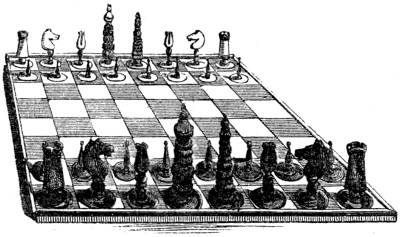
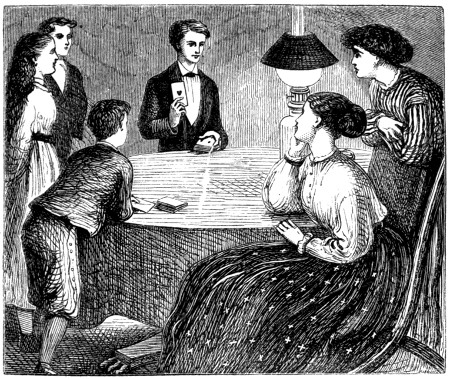
THE YOUNG CONJUROR INCLUDING SLEIGHT OF HAND WITH OBJECTS OR CARDS, WITH AND WITHOUT APPARATUS.
From the very early ages of the world the art of legerdemain, commonly called conjuring, has been known and practised. In some of the old heathen ceremonies the priests made use of skilful deceptions, in order to impose upon the people; and in ancient Egypt, in Greece, and in Rome, the worship of the gods was frequently associated with mere tricks, which were used for the purpose of obtaining an influence by a pretence of extraordinary and supernatural powers. Among the Eastern nations juggling was a profession, and to this day the jugglers of Hindustan and other Oriental nations are so skilful that they are able to deceive even the most acute observers. In our own country, after the Norman Conquest, the juggler (who was called jongleur, or joculator) was a minstrel as well as a conjurer, a reader of the stars or astrologer, and at the same time a jester, a merry-andrew, and a teller of droll stories. These jongleurs travelled from place to place, and exhibited at fairs, feasts, and merrymakings, as well as in the houses of noblemen, where they diverted the company in the great halls. In the fourteenth century they gave more attention to tricks and feats of skill, and became known as tregetours. The performances of some of these gentry were so marvellous, that the common people believed them to be the result of witchcraft, and classed the tregetour with the warlock and the sorcerer. Chaucer, who no doubt had frequently an opportunity of seeing the tricks exhibited by the tregetours of his time, says, “There I sawe playenge jogelours, magyciens, tragetours, phetonysses, charmeresses, old witches, and sorceresses;” and the old poet goes on to say of them, “Sometimes they will bring on the similitude of a grim lion, or make flowers spring up as in a meadow; sometimes they cause a vine to flourish, bearing white and red grapes, or show a castle built with stone, and when they please they cause the whole to disappear:” and in another part of his works he says:—
“There saw I Coll Tregetour Upon a table of sycamour Play an uncouthe thynge to tell; I sawe hym cary a wyndemell Under a walnot shale.”—House of Fame, book iii.
Our learned monarch James I. was perfectly convinced that these and other inferior feats exhibited by the tregetours of his day could only be performed by diabolical agency. The profession had already fallen very low, and at the close of the reign of Queen Elizabeth the performers were ranked by the moral writers of that time not only with ruffians, blasphemers, thieves, and vagabonds, but also with Jews, Turks, heretics, pagans, and sorcerers; and in more modern times, by way of derision, the juggler was called a mocus-pocus, or hokus-pokus, a term applicable to a pickpocket or a common cheat.
The following pages are not intended to make the young reader either a cheat or a trickster; there is nothing perhaps so utterly contemptible in every-day life as trickery and deceit, and we would caution our young friends not to cultivate a love of deception, which is only allowable in such feats of amusement, because it is in fact not deception at all, when everybody expects to be puzzled, and is only left to find out the mystery the best way he can.
With this sage advice we shall present a collection of amusing conjuring tricks, premising that a considerable number of tricks usually embodied in this division will be found in that part of our work relating to Scientific Experiments and Amusements, as they more properly belong to “Natural Magic,” and are to be referred to the various operations of nature in the several departments of art, science, and philosophy.
SLEIGHT OF HAND.
It is intended in the following pages to lay more stress upon those tricks which require no apparatus than upon those for which special apparatus or the assistance of a confederate is required. No one is nearly so well pleased by a trick whose essence evidently lies in the machinery, while every one feels pleasure at seeing a sleight of hand trick neatly executed. The audience often despise all the numerous boxes, bottles, variegated covers, and other gimcracks which are generally seen on a conjuror’s table; and are seldom so pleased with any performer as with one who does not even require a table, but presses into his service articles borrowed from his audience. The spectators should never be able to say, “Ah! the trick lies in the box: he dares not show it to us!”
The following tricks have almost all been successfully performed, and have caused some reputation in the magic art. Some of them are the invention of one of the most eminent “conjurors” of modern times.
1. THE FLYING SHILLING.
This trick must be frequently practised before it is produced in public.
Borrow two coloured silk handkerchiefs from the company, and have three shillings in your hand, but only show two, keeping the other one firmly fixed against the first joint of the second and third fingers. You must also have a fine needle and thread stuck inside the cuff of your coat. Then take one of the handkerchiefs, and put in both shillings, but pretend that only one is in the handkerchief; then put the handkerchief into a hat, leaving one corner hanging out. Now hold up the third shilling (which the spectators imagine is the second), and ask one of the company to lay the second handkerchief over it. You then ask him to hold the shilling tight between his finger and thumb, while you twist up the handkerchief. While doing so, with both hands concealed under the handkerchief, you pass a few stitches under the shilling, and replace the needle. This being done, spread one corner of the handkerchief over the hand of the person who is still holding the shilling, and, taking hold of another corner, tell him to drop the shilling when you have counted three. At the word “three” he lets go the shilling, and you whisk the handkerchief into the air, when the shilling appears to have vanished, but is really held in the handkerchief. You then tell the astonished individual to draw the other handkerchief out of the hat by the corner that is hanging out. The two shillings are heard to fall into the hat, and every one is persuaded that you have conjured one of the shillings out of the person’s hand, and sent it into the hat.
2. ANOTHER METHOD.
Perhaps the spectators may ask to see it again, or demand to mark the shilling. In this case, vary it as follows. Ask some one (always choose the most incredulous of the party) to mark a shilling of his own and give it you. Take the same handkerchief and give him the shilling to hold that is already enclosed in it, as in the last trick, dropping the marked shilling into the palm of your hand. Twist it up as before, and then leave it entirely in his hands. Direct him to place it on a table, and cover it with a basin or saucer. Ask him to give you a cup or tumbler, and hold it under the table, beneath the place where the saucer is. Then tell him to knock three times on the saucer, and at the third knock let the marked shilling fall into the tumbler. Hand him the tumbler, and while he is examining the shilling to see if it is the same one that he marked, take up the saucer, and shake out the handkerchief that is lying under it, as in the last trick. You must then return the handkerchief, and while you pretend to be searching for the marks, draw out the thread that held the shilling and drop the coin into the palm of your hand, taking care to rub between your finger and thumb the spot where the threads had been, in order to eradicate the marks. This variation seldom fails to confuse the company.
You must remember to keep talking the whole time, and always try to make a joke, or otherwise to distract the attention of the audience, while you are executing the necessary changes.
3. THE BEADS AND STRINGS.
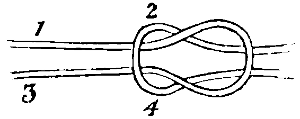
Ask some lady to lend you the beads off her bracelet, or have by you five or six beads, which you may hand round for examination. Then get some one to cut two pieces of thin string of equal length, and twist them about your fingers, appearing to lay them side by side, but in reality placing them as in the figure, and then, by twisting them together with apparent carelessness, the manner in which they are arranged will not be seen, particularly if you keep the point of junction hidden either by a finger, or by throwing the shade of your hand upon it.
When the beads are returned, thread them all, taking care to pass the centre bead over the point of juncture. You then bring the ends of the string 1 and 2 together and tie them so, doing the same with 3 and 4. Now give the tied ends to two persons, directing them to hold them tight. You need not fear that the beads will come off, even if they pull hard. Then grasp the beads with both hands, directing the holders to slacken the strings. You then, under cover of the left hand, which is placed above the beads, slip the centre bead to one side, and draw out the two loops which have been hidden in it. The beads will then easily come off into your right hand. Tell the holders to pull hard, which they will do, and the same moment remove your hands, showing the empty strings and all the beads in your right hand. Then hand round the beads and strings as before. Remember to rub out the marks in the strings caused by the loops before you remove your hands.
4. TO GET A RING OUT OF A HANDKERCHIEF.
Bend a piece of gold wire into the form of a ring, having previously sharpened both ends. You have a real ring made of the same piece of wire, and concealing the false ring in the palm of your hand, offer the real one to be inspected. When it is returned, borrow a handkerchief, and, while taking it from the lender, slip the real ring into your left hand, and take the false one at its point of junction. Throw the handkerchief over the ring, and give it to some one to hold between his finger and thumb. Let the handkerchief fall over it, and give a piece of string to a second spectator, directing him to tie it round the handkerchief, about two inches below the ring, so as to enclose it in a bag, and tell him to do so as tightly as he can. While he is doing this, take up your conjuring wand, a rod of some hard wood, about eighteen inches long, and when the knot is tied, step forward, passing the rod into your left hand, taking care to slip over it the real ring, which has lain concealed there. Slip your left hand to the centre of the rod, and direct each of the two persons to hold one end of it in his right hand. Then tell the one who has the ring and handkerchief, to lay them on your left hand, which you immediately cover with your right. Then tell them to spread another handkerchief over your hands, and to say after you any nonsense that you like to invent.
While they are so doing, unbend the false ring, and draw it through the handkerchief by one of its points, carefully rubbing between the thumb and finger the place where it came through. Hang the empty handkerchief over the ring which is on the rod, and take away your hands, which you exhibit empty, as you have stuck the false ring inside your cuff. Take away the upper handkerchief, and let a third person come to examine, when he will find the ring gone out of the handkerchief, and hung upon the rod.
5. TO TIE A KNOT IN A HANDKERCHIEF WHICH CANNOT BE DRAWN TIGHT.
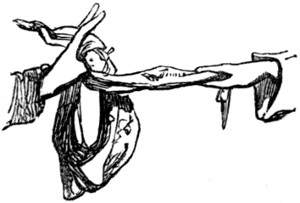
Cast an ordinary knot on a handkerchief, and give the end out of your right hand to some spectator, and tell him to pull hard and sharp when you count three. Just as he pulls, slip your left thumb under the handkerchief, as drawn in the cut, and it will be pulled out quite straight without any knot at all. You must let go the end that hangs over the left hand, and grasp the handkerchief between the thumb and forefinger.
6. THE THREE CUPS.
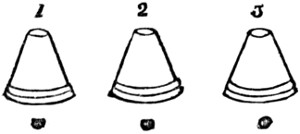
This is an admirable delusion, but requires very careful management, and should be practised repeatedly before it is exhibited publicly. You get three tin cups, of the shape shown in the cut. They should have two or three ridges running round them at the mouth, in order to give a better hold. Four balls should now be made of cork, and carefully blackened. One of the balls is held concealed between the roots of the third and fourth fingers, while the other three are handed round for examination, together with the cups. When they are returned, the young conjuror begins by placing each ball under a cup, or, if he chooses, asks one of the spectators to do so for him. While this is being done, he slips the fourth ball to the tips of the second and third fingers. He then lifts up cup No. 1, replacing it on the table a few inches from its first position, and at the same time slips the fourth ball under it. He takes up ball No. 1, and pretends to throw it away, but in reality he slips it into the place which the fourth ball had occupied. He does the same with the three cups, and then commences a sham search after the lost balls, in which he accidentally (!) knocks over one of the cups, and, to his pretended astonishment, finds a ball under it. He then knocks over both the other cups, and finds in them the two missing balls.
He again places the balls under the cups, taking care to slip the fourth ball under cup No. 3. He then takes up cup No. 1 and pretends to throw the ball into No. 3, but hides it as before. As there are already two balls in No. 3, the spectators imagine that he really has thrown the ball into it. He replaces cup No. 3 over both balls, and slips among them ball No. 1. He then takes up cup No. 2, and goes through the same process, and on knocking over cup No. 3, all three balls are found together under it, and while the spectators are being astonished, ball No. 2 can be quickly got rid of.
A rather startling termination to this trick can be managed by taking up one of the cups with its mouth upwards, holding the finger and thumb close to its mouth. Then by throwing another cup into it, letting go the first and catching the second, you appear to have thrown the second cup through the first.
7. TO TIE A HANDKERCHIEF ROUND YOUR LEG, AND GET IT OFF WITHOUT UNTYING THE KNOT.
Hold the handkerchief by both ends, lay the centre of the handkerchief on your knee, and pass the two ends below, appearing to cross them, but in reality hitching them within each other, as represented in the engraving, which shows the manner in which this is managed. Draw this loop tight, and bring back the ends to the same side on which they were originally, and tie them above. If the loop is properly made, it will stand a good pull. Then, after showing the spectators how firmly it is tied, put your hand under the knot, and by giving it a sharp pull, it will come off.
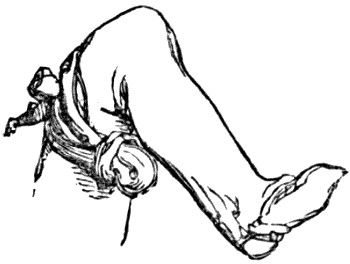
The engraving represents the manner in which the loop is made, but it must be made considerably smaller than it is shown, or it will be seen. In fact, it ought not to be a loop at all, as it should be almost concealed under the fold of the handkerchief. Do not show this in public until you can tie it with rapidity and precision.
8. THE MAGIC BOND.
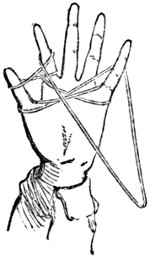
Take a piece of string, and tie the two ends together with a weaver’s knot, as that holds the best, and arrange it over the fingers as represented in the engraving. Having done so, let the long loop hang loose, lift both loops off the thumb, draw them forward until the string is quite tight, and then put them behind the hand, by passing them between the second and third fingers. Then pull the part of the string that is across the roots of the fingers, and the whole affair will come off.
9. THE OLD MAN AND HIS CHAIR.
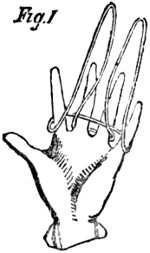
Take the same piece of string as in the last trick, hold your left hand with the palm uppermost, and hang the string over the palm. Spread all the fingers, and with the right hand bring forward the loop that hangs behind, by passing it over the second and third fingers. Loose the loop, take hold of the part of the string that crosses the hand, and pull it forwards. When tight, pass it to the back of the hand, the reversal of the movement that brought it forwards. Loose the loop, insert the fore-finger and little finger of the right hand under the string that encircles the left fore-finger and little-finger, and pass the two loops to the back of the hand, as shown in the cut, Fig. 1. Tuck both loops under the cross-string at the back, and your preliminaries are completed. Then begin your story: “There was once upon a time an old man, who stole a pound of candles. Here they are.” You then hold your left hand as at the commencement, hook the right fore-finger under the cross-piece at the back, and draw it downward until it is long enough to be passed over the second and third fingers to the front. Pass it over, and draw it slowly upwards, when the similitude of a pound of candles hanging by their string will be seen. (See Fig. 2.) “The old man, being tired, hung up his candles,” you then hang the long loop over your thumb, “and sat down in his high-backed chair, which you see here.” You then hitch the right fore-finger and middle finger under the two loops that will be found hanging behind the left hand, bring them to the front, raise them perpendicularly, and the chair will be seen as in Fig. 3. The thumb must be raised perpendicularly, and brought as much as possible into the centre of the hand, or the chair will be all aside.
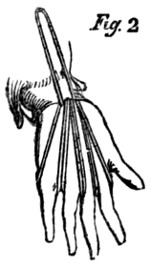
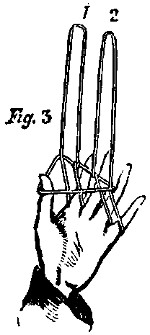
1. Right fore-finger. 2. Right middle-finger.
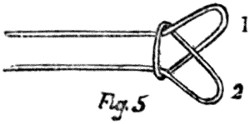
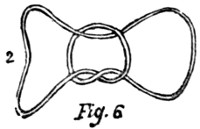
“When the old man was rested, it began to become dark, and he took a pair of scissors to cut down a candle for himself. Here are the scissors.” While you are saying this, you slip the loop off the thumb, and you get Fig. 4. Move the blades and handles of the scissors, as if cutting something with them. “Just as he had lighted it, in came a policeman, and produced his staff, with the Queen’s crown at the top.” Now let go the little finger of the left hand, and the loop will run up the string towards the right hand, producing Fig. 5. “The old man in vain tried to resist, for the policeman called a comrade to his assistance, and they tied a cord round the old man’s arms in a tight knot, like this,”—slip the right middle-finger out of its loop, and you will obtain Fig. 6,—“and carried him off to prison.”
1. Fore-finger of left hand. 2. Little finger of left hand. 3. Fore-finger of right hand. 4. Middle finger of right hand.
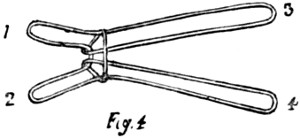
1. Right middle-finger. 2. Right fore-finger.
1. Right fore-finger. 2. Left hand.
10. TO TIE A KNOT ON THE LEFT WRIST, WITHOUT LETTING THE RIGHT HAND APPROACH IT.
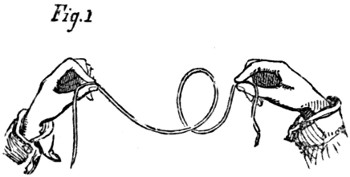
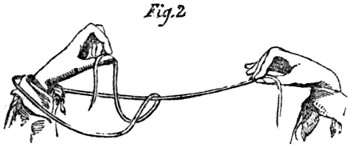
Take a piece of thick pliant string by each end, and with a quick jerk of the right hand cast a loop on it as in Fig. 1. The jerk must be given upwards and towards the left hand, and its impetus will cause the loop to run up the string until it falls over the left wrist, as in Fig. 2. The moment that the forward jerk is given the right hand should be drawn back, so that the loop is drawn tight directly it has settled on the wrist. Both ends should be let fall when the knot is firm. This is a very nice little sleight of hand to practice in the intervals between more showy tricks, and, although rather difficult to learn, is soon acquired.
11. THE HANDCUFFS.
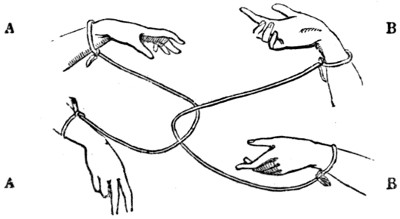
Let two persons, A and B, have their hands tied together with string, so that the strings cross, as represented in the engraving. The object is, to free themselves from each other without untying the knot. It is executed in the following manner.
Let B gather up the string that joins his hands, pass the loop under the string that binds either of A’s wrists, slip it over A’s hand, and both will be free. By a reversal of the same process, the string may be replaced.
12. TO PULL A STRING THROUGH YOUR BUTTON-HOLE.
Take a piece of string about two feet in length, and tie the ends together. Pass it through a button-hole of your coat; hitch one thumb at each end, hook the little fingers into the upper strings of the opposite hand. Then draw the hands well outward, and the string will look very complicated, as in the engraving.
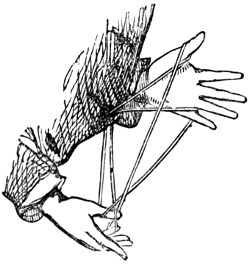
To get out the string, loose the hold of the right thumb and left little finger, and separate the hands smartly, when the string will appear to have been pulled out through the substance of your coat.
It is an improvement of the trick, if, immediately on loosing the hold of the right thumb, you change the string from the right little finger on to the thumb.
13. THE CUT STRING RESTORED.
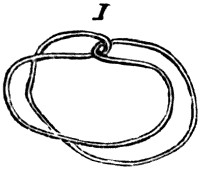
1. The twisted string.
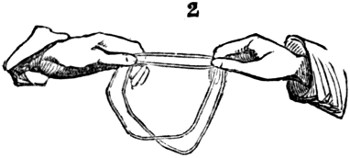
2. The manner of holding it.
1. The twisted string.
2. The manner of holding it.
Tie together the ends of a piece of string, pass one hand through each end, twist it once round, and put both ends into the left hand. Draw the right hand rapidly along the double strings until you come to the place where the strings have crossed each other, as seen in the engraving. Conceal the junction with the thumb and finger of the right hand; hold the strings in a similar manner with the left hand, and tell some one to cut the string between them. You show that the string has been divided into two pieces, and say that you will join them with your teeth. Put all four ends into your mouth, and remove with your tongue the little loop that has been cut off. When you take the string out of your mouth, the spectators will not notice the absence of so small a portion of its length, and will fancy that you really have joined them.
14. THE GORDIAN KNOT.
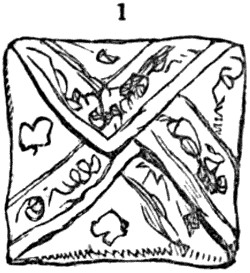
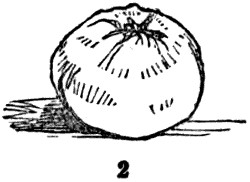
Take a silk handkerchief, and lay it on a table. Take each of the corners, and lay them across each other in the middle of the handkerchief, which will then be square, as in the cut, Fig. 1. Do the same with the new corners, and go on until the handkerchief is reduced to the size of your hand. Then with your left finger and thumb take hold of the centre, taking care to grasp all the four corners that lie there, and with the right finger and thumb take hold of the outer layer of silk, and pull it towards you as far as it will come. Then turn it a little on your left hand, and repeat the operation until it is all screwed up into a tight ball, as is represented in the engraving, Fig. 2. No ends will be then perceptible, and a person who is unacquainted with the mode will never be able to untie it. Of course you must prepare it previously. When the person to whom you give it has failed to untie it, you take the ball in your hand, and holding it behind your back, you reverse the method by which it was tied, and when it is loose a good shake will release it.
15. THE KNOT LOOSENED.
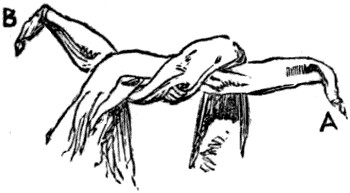
This is a very amusing deception. You ask any one for a handkerchief, and tie the ends firmly together in a double knot, allowing him to feel it, or pull the ends as tight as he pleases. You then throw the centre of the handkerchief over the knot, and ask the person to hold it tight between his finger and thumb. You ask him if the knot is still there, to which he will answer in the affirmative. You then take hold of any part of the handkerchief, and direct the holder to drop the handkerchief at the word “three.” You count, “one, two, three,” at which word he looses his hold of the handkerchief, and there is no vestige left of the knot.
The method of managing this trick is as follows:—Take the handkerchief and tie the ends in a simple knot, keeping one end tight, and the other end loose. We will call the tight end A, and the loose one B. Keep A always in the right hand, and on the stretch horizontally, and the handkerchief will look as in the cut. Do this when you tie it the second time, and draw B tight, which will then form a double tie round A, but will not hold it firm. When you throw the handkerchief over the knot, you draw out A with the finger and thumb of the left hand, and the knot will apparently remain firm, although in reality it is nothing but a double twist of silk, which of course falls loose when the handkerchief is dropped.
16. TO PUT NUTS INTO YOUR EAR.
Take three nuts in the left hand, show them, and take out one of them between your right finger and thumb, and another between the first and third finger. This latter is not seen by the company. You then put one of them in your mouth and retain it there, unknown to the spectators, while you exhibit the second as the one that you put into your mouth. This second one you carry to your ear, as if you meant to insert it there, and on replacing it in your left hand, only two nuts will be left instead of three, the third of which appears to have gone into your ear.
17. TO CRACK WALNUTS IN YOUR ELBOW.
Conceal a very strong walnut in your right hand, and take two other walnuts out of the dish. Place one of them on the joint of your arm, and say that you are going to break it by the power of your muscles. You will now have one walnut in your arm and two in your right hand. Close your left arm, and strike it an apparently violent blow with the right hand, at the same time clenching the right hand violently, which will smash the second walnut in it, and the spectators hearing the crash will be sure to fancy that it is caused by the demolition of the walnut in your arm. Then open you arm very gently (for fear of dropping any of the fragments, you must say), and, when pretending to take out the walnut which you had placed there, you substitute for it the broken one from your right hand.
18. TO TAKE FEATHERS OUT OF AN EMPTY HANDKERCHIEF.
Procure at the military clothier’s four or five large plumes, such as are worn by officers. Take off your coat, and lay the plumes along your arms, the stem being toward your hand. Now put on your coat again, and the feathers will lie quite smoothly and unsuspected. Borrow a handkerchief from one of the spectators, and wave it about to show that it is empty. Throw it over your left hand, and with the right draw out one of the plumes from up the coat-sleeve, at the same time giving it a flourish in the air, which will loosen all the fibres of the feather, and make it appear much too large to have been concealed about the person. Wave the handkerchief again, and repeat the operation until all the plumes are gone. You can carry enough plumes under the sleeve to cover a table with, and if you prepare a board or an ornamental vase full of holes, you can place the plumes upright as you take them out.
TRICKS REQUIRING SPECIAL APPARATUS.
None of the following tricks are wholly managed by the apparatus, as such performances are unworthy of notice. Therefore, every trick mentioned in the following pages must be carefully practised in private before it is produced in public. The apparatus, of course, cannot be inspected by the audience, and for that reason it is better to mix them with those tricks which have been already mentioned, in order that suspicious persons may be quieted by an occasional permission to inspect the objects used in the performances.
The young conjuror should always vary the mode of performance in the non-essentials, and should study combinations of one trick with another, by which means he will produce more astonishing results than if he restricted himself to the methods mentioned in this work. He should also invariably make a little speech, acknowledging that he is only deceiving the eye and not the mind, and should therefore request the company not to ask any questions, or to demand inspection of any of his apparatus.
19. THE DIE TRICK.
Get a wooden die about two inches and a half square (1), and a hollow tin die exactly the size of the wooden one, but without one of the sides (2). Then paint them both exactly alike, as in the engraving. It will be better to let an accidental flaw appear on the same side of each. Then get a tin cover (4) that exactly fits the dies. Now for the trick itself.
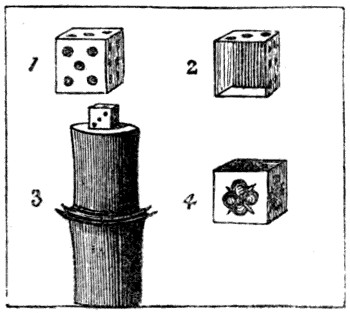
Borrow two hats, and while you turn your back upon the audience as you go to your table, slip into one of them the false die. Place both hats on the table, and send round the real die and cover for inspection. When they are returned, say, “Now, ladies and gentlemen, it is my intention to place these hats one above another, thus.” You then place the two hats as in No. 3, the hollow die being in the bottom hat. “I shall then cover the die thus,” which you do, “and after I have knocked on the cover, I shall take it off, and you will find that the die is not under the cover, as it is now,” taking it off, “but inside the hat, like this.” You then put the real die into the hat. “You do not believe me, ladies and gentlemen, but I will soon convince you.” You then take out the false die, and replacing the upper hat, put the die on the upper hat (of course, with the open side downward) and place the cover over it. Pick up your conjuring wand, give it a few flourishes, and bring it down on the cover. Grasp the cover tightly near the bottom, when both cover and false die will come up together; put the end of your wand into them, and give them a good rattle. Then knock off the upper hat with a blow of the wand, and push the lower one off the table, so that the die tumbles out of it. Always use plenty of gesture about your tricks.
20. THE PENETRATIVE PENCE.
Get a brazier to cut out all the interior of five pence, only leaving the rims. He must then bore out nearly all the interior of a sixth penny, merely leaving a shell of copper at the top. A long rivet must then be let into the rim as shown in Fig. 1, No. 2, and a hole must be drilled in each of the five rings, as in No. 3. The rivet is to be passed through the holes in the rings, and fastened below, so that all the rings can play easily upon it. Fig. 1, No. 1, is a section of the entire apparatus, the dotted lines representing the rivet. They can then be placed as shown in Fig. 2, No. 1, and no one will imagine that they are only shams, as you can rattle them or move them about upon each other. A leathern cover, Fig. 2, No. 2, is then made, which passes easily over the heap of pence, but being pliable, is capable of picking up the hollow pence with it, when it is held firmly. To the under surface of the table you fasten a little shelf, Fig. 2, No. 3, which moves on a hinge, and is let fall by placing the foot on the pedal, Fig. 2, No. 4, which draws the catch.
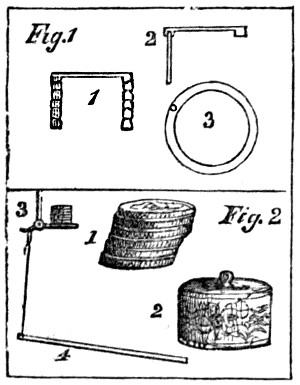
To perform the trick, place six real pence on the little shelf, and have the sham pence on the table. Take them up and rattle them, and put them down as in Fig. 2, No. 1. Keep a sixpence in the palm of your hand, pick up the sham pence, and as you put them down, slip the sixpence under them, as you do the ball in trick 6. Take the cover, and put it over the sham pence, make a short speech, and knock the cover with your wand, at the same time pressing the pedal with your foot, which will cause all the six real pence to tumble down with a great crash. Take up the cover and false pence together, put the end of your wand into them and hold them up triumphantly, showing the spectators that the six pence have been replaced by a silver sixpence. While you are picking up the pence, slip the sham ones out of the cover into your left hand, and take some opportunity of letting the empty cover roll towards the audience, one of whom you ask to pick it up and bring it you. This manœuvre generally disarms all suspicion, for the picker-up is sure to examine it very closely.
I have only given mere outlines of this really excellent trick, which may be varied in a hundred ways, and is capable of combination with other tricks to a large extent. It will add to its complicity, if a set of six half-pence is also made like the pence. For the pedal may be substituted a lever running immediately under the surface of the table, if the performer prefers to have a short cloth on it. There should be always two cloths on the table,—the lower one thick and soft, to prevent jingling of objects, and the upper one white, as it displays everything better than a coloured one. The ingenuity of the young conjuror will easily find methods of varying this trick.
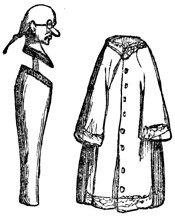
21. THE DOLL TRICK.
Get a comical looking doll, and cut off his head diagonally, taking care to do it very neatly. Drive a peg into the neck, and bore a hole in the body, into which the peg fits, as in the cut. Paint his body and head carefully, and if you put a gold chain or two round his neck, it will conceal the line of junction. Make also a coat of silk, and sew a pocket inside the edge of the skirt.
Take up the doll, and say, “Now, ladies and gentlemen, here is a very learned man. Observe the development of his forehead, the sagacity of his nose, the eloquence of his lips, the dignity of his spectacles, and the philosophy of his pigtail. He is professor of astronomy at Timbuctoo, and here is his gown of office. See how handsome he looks in it. He is going to Amsterdam to see the eclipse of the last new comet. He has the honour to wish you all farewell before starting on his journey. Now, professor, we are waiting to see you go. Oh! you want funds, do you? I beg your pardon; here is a shilling for you.” So saying, you take your right hand from under the gown, taking with it the body, and put the body into your pocket, while you jingle some silver. The head is now supported by your left hand. Pretend to give him some money, and then say, “What! you won’t go unless you have more! Get along!” Hit the head a hard rap with your right hand, which drives it into the pocket, which you hold open for it with your left thumb and little finger. “Oh dear! the doctor is dead, and cannot be found.” Saying this, you grasp the gown by the place where the head is, and shake it about to show that it is empty. If you like, you can make another oration and hold a dialogue, making the doctor resuscitate himself, which is of course done by taking the head out of the pocket with the left hand, and working it about by the peg.
22. THE FLYING COINS.
Take two sovereigns, or rather brass imitations, and grind them down until they are reduced to half their thickness. Do the same with two shillings, and fasten them accurately together, so that you will have two coins, each having one silver face, and one brass face. Take one of them in each hand, showing the silver side of one and the brass side of another, and offer to change them without moving your arms. Shut your hands, and the coins will turn over. Then, on opening them again, they will appear to have changed from one hand into the other.
23. THE VANISHED GROAT.
Put a little wax on the nail of the middle finger of the right hand, and take a fourpenny piece into the palm of the same hand. Close the hand, pressing the wax on the coin. Then rapidly open it, and the silver piece will adhere to the wax, and be quite concealed behind the finger when you hold your hand up.
24. THE RESTORED DOCUMENT.
Make a memorandum book, and line the cover with paper which has been previously rubbed with a mixture of lamp-black and oil. The paper must be loosely affixed, so that it can be raised up, and a leaf from the memorandum book placed under it. You must also make a flat box, having a double opening.
You now take a leaf out of the memorandum book, and ask some one to write a sentence, at the same time offering him the book to write upon. The pencil with which you furnish him is very hard, and he is forced to press upon the paper in order to mark. In so doing, the black is transferred by the pressure of the pencil from the blackened paper to the white leaf that has been placed under it, and of course makes an exact copy of the writing. You then give the man his document, put the memorandum book in your pocket, and go out of the room to fetch your box, which you have forgotten. While you are out of the room, you take out the leaf from under the black paper, and put it into one side of the flat box, and shut down the cover that hides it. You bring in the box, apologising for your absence, and give the box, open at the other side, into the writer’s hands. Tell him to burn his writing in a candle, and to place the ashes in the box. He does so, and closing the box, returns it to you. You then flourish about a little with the box, wave it in the air, bring it down with a bang on the table, strike it with your wand, and then, opening it as at first, you produce the duplicate leaf, which the writer acknowledges to be his own hand-writing. If the lamp-black should have come off and smeared the paper, you can account for it by observing that it is very difficult to get rid of all traces of the burning.
25. THE MAGIC RINGS.
Get a blacksmith to make a number of rings, about six or seven inches in diameter, as in the cut. A is made with a spring opening on one side, B is a set of two rings forged permanently within each other, C is a set of three rings formed in the same manner, and D D are two simple rings. The rings should be about the thickness of a rather large blacklead pencil.
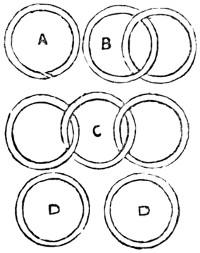
Lay the rings on one another, and they will all appear to be separate and distinct; D D should be the uppermost rings, then B, then A, and then C. Hand round D for inspection, and if any more are desired, hand round the other D. When returned, you hang them over your left arm, or grasp them in your hand, and tell the company that you are going to weave all the rings together. You clash them together, and after going through some complicated movements, bring out B, which the spectators will think you have just fastened together. Hand them round. When they are returned, mix them all up, and bring out C. Then take A in your hand, and passing one of the outer rings of C through the opening, you have four rings together. Then add D and you have five. Take off D and substitute B, which will give you six. So you go on, weaving them into all kinds of fantastic shapes. You must always conceal the joint in A with your thumb, and contrive as often as you can to have one at least of the rings D at liberty. This is a capital trick, and may be diversified to any extent, especially if the number of rings is increased.
26. THE FISH AND INK TRICK.
This is really a first-rate delusion. You bring before the spectators a glass vase, full of ink. You dip a ladle into it, and pour out some of the ink upon a plate, in order to convince the audience that the substance in the vase is really ink. You then throw a handkerchief over the vase and instantly withdraw it, when the vase is found to be filled with pure water, in which a couple of gold fish are swimming.
This apparent impossibility is performed as follows. To the interior of the vessel is fitted a black silk lining, which adheres closely to the sides when pressed by the water, and which is withdrawn inside the handkerchief during the performance of the trick. The ladle has a hollow handle with an opening into the bowl. In the handle is a spoonful or so of ink, which runs into the bowl when it is held downwards during the act of dipping it into the vase.
27. THE CANNON BALLS.
The performer of this trick borrows a number of hats, and places them on the table. He then returns each person his hat, and on turning it over, a thirty-two pounder cannon ball rolls out.
The method of performing this delusion is as follows. Get a turner to make a number of wooden balls, each the size of a thirty-two pounder cannon ball, and let a hole be bored in each which will admit the middle finger. The balls are arranged hole upwards on a shelf on your table on the side opposite to the audience, so that the balls are nearly level with the top of the table. When you take a hat off the table, you slip your fore or middle finger into the ball just as you would into a thimble, and by bending the finger, bring the ball into the hat.
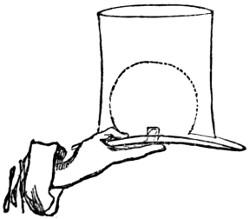
Any object may be brought into a hat in this manner, a great cabbage, for instance, having a hole cut in the stalk.
28. THE SHILLING IN THE BALL OF COTTON.
Get a tinman to make a flat tin tube, which will just allow a shilling to pass through it. Wind a quantity of worsted round it, so as to make it into a ball.
These preliminaries having been accomplished, perform any trick that will get a shilling out of sight, such as No. 1 or 2. Then tell the spectators that you will bring the marked shilling into the middle of a ball of worsted. Take down the ball from the place where it is lying, drop the shilling into the tube, and withdraw the tube, leaving the shilling in the ball. A good squeeze or two will hold it tight, and obliterate every mark of the tube. Place the ball in a tumbler, take the end of the worsted, and give it to some one to unwind. This being done, the shilling will be found in the very centre of the ball, with the end of the worsted wrapped tightly round it.
29. THE EGG AND BAG TRICK.
Get a chintz or cloth bag made double, and between the two bags make six or seven pockets, each of which will hold an egg, and having an opening into the bag. Fill the pockets with eggs, and you are ready for the performance.
Hold the bag by the place where the eggs are, shake it, turn it inside out and show that there is nothing in it. Then tell the spectators that you are sure that there is a hen in the bag. Put your head near the mouth of the bag, and make a clucking like a hen. You then say, “I knew I was right, and she has laid an egg.” So saying, you put your hand into the bag and take out one of the eggs, taking care to pretend to grope in one of the corners for it.
This is repeated until all the eggs but one are gone. You then, after taking out the last egg, say that some people think that the eggs are not real, but you will convince them by ocular inspection. Saying this, you break the egg in a saucer with your right hand, and while the people are occupied with it, you drop the bag behind your table, or hang it on a hook out of sight, and take up another exactly like it, into which you have put a hen. “These are real eggs,” you then say, “and if any one doubts their reality, they cannot doubt that this is a real hen.” You then turn the bag upside down, and shake out the hen. If any one wishes to inspect that bag, he can do so without being much wiser for it.
30. THE DANCING EGG.
Send for some eggs, and take care to place among them one which has been emptied of its contents, and to which is fastened a long hair, at the other end of which is tied a crooked pin. Borrow a small stick from one of the spectators, and as you go behind your table contrive to hook the bent pin into your coat, passing it over the stick. Then place the egg on an inverted hat, and ask for some music, and directly it begins to sound, a slight and imperceptible depression or elevation of the stick will cause the egg to twist and roll about upon it as if it had life. You must be careful to turn gently round now and then, so as apparently to vary the distance of the egg from the body.
31. BELL AND SHOT.
Get a wooden bell made, so thick that there is a considerable space between the outer and inner surfaces, especially on the upper part of the bell. A hollow must be cut in this, and the handle so made, that when it is at rest, it is forced upwards by a spring, and draws up the round piece of wood to which the clapper chain is attached, and closes the aperture, as shown in the engraving.
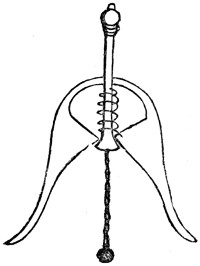
You have a cardboard measure, which is of precisely the same capacity as the cavity in the bell, and just wide enough to hold a farthing. Into this you privately put a farthing, and then fill up the measure with shot, heaping it a little, to compensate for the farthing. You make up a tale about a man going out shooting, and ringing the bell of the gunmaker’s shop. (You then ring your wooden bell.) How the man bought a measure full of shot for a farthing, (you pour the shot into the bell and back again two or three times,) but was so long haggling over three shots, that the gunmaker took away the shot, (here you again pour the shot into the bell, and by pressing on the handle, allow them all to run into the hollow,) and kept the farthing for his trouble. The man went out of the shop, but soon came in again, and rang furiously. (Here you again ring the bell, which is now apparently empty, and invert the measure on the table. The farthing not being held by the finger and thumb will now fall on the tablecloth.) Then finish the story with an account of the manner in which the man got back his farthing. When you have finished, invert the bell over the empty measure, and on pressing the handle, the shots will refill it. Do not touch, it until you have done another trick or two, and then, when you put the bell aside, ring it again, and remark that the purchaser was a silly fellow after all, for here are his shots in his measure.
32. THE BURNED HANDKERCHIEF RESTORED.
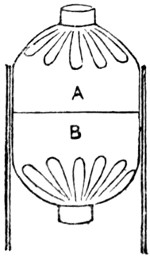
Get a tinman to make a double canister, such as is shown in the cut, with an opening at each end. This must so slide within a tin tube, that either end can be concealed within it alternately, as seen in the engraving, where the end A is shown, and B is concealed. In this position it looks like an ordinary canister. The interior is divided into two parts. Into B put a piece of cambric made to look like a handkerchief.
Borrow a cambric handkerchief, and say, “Now, ladies and gentlemen, I shall burn this handkerchief to ashes, place them in this canister” (so saying, you put it into A), “and when I have uttered a spell, it will be restored perfectly whole. Will the owner say what mark it has?” While the audience are looking towards the owner, you turn the canister over, and push up the canister until the shoulder of B is on a level with the top of the tube. When the mark has been declared, you open B, take out the cambric, and pretend to verify the mark. You then put it into a candle flame, and when it has burnt entirely to ashes, put the ashes into B, shut it up, and rapidly reverse it as you turn round to your audience, so that A is uppermost again. Then, utter any nonsense you like, open A and take out the handkerchief uninjured. It rather adds to the trick if you drop a little eau de cologne into A before commencing.
33. THE FIRE-EATER.
If the young conjuror is desirous of appearing in the character of a fire-eater, it is very easily managed. He must prepare a piece of thick string, by soaking it in a solution of nitre, and then drying it. He cuts off a piece about an inch in length, lights one end, and wraps it up in a piece of tow which he holds in his left hand. The trifling smoke will be concealed by a huge bundle of loose tow also carried in the left hand.
He takes a handful of tow in his right hand, puts it into his mouth, chews it up, and appears to swallow it. He then takes another handful, and with it the piece in which is the string. As he puts this into his mouth, he takes out the piece which he has already chewed. By taking breath through the nostrils, and breathing it out through the mouth, smoke begins to issue forth, and the whole interior of the mouth is soon lighted up with a glow. When the mouth is shut, and the tow pressed together, the fire goes out, except the piece of prepared string. More tow is then taken into the mouth, and treated in the same manner.
In this short account of conjuring, I have purposely avoided such tricks as require expensive apparatus. Such apparatus is either entirely beyond a boy’s reach, or at all events he ought not to be encouraged in the notion of spending much money on objects of no real use. A boy of any ingenuity will make the greater part of the apparatus himself, or at least he can do the painting and polishing of his machinery. I have mentioned no machinery that need cost more than two or three shillings at the outside, and not that, if a boy is acquainted with the use of tools.
TRICKS WITH CARDS.
In accordance with the previous rule, the principal stress is laid on card tricks that require no apparatus, and may be performed with ordinary cards.
1. TO MAKE THE PASS.
This is a necessary beginning for card tricks. “Making the pass” is the technical term for shifting either the top or the bottom card to any place in the pack that you like. It is almost impossible to describe it, and I can only say that it will be learnt better in five minutes from a friend, than in as many hours from a book. As, however, a friend is not always to be found who can perform the pass, I will endeavour to describe it.
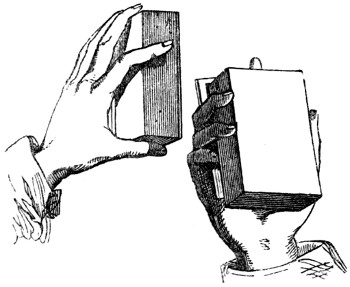
The cards are held in both hands, right hand underneath and left above, as in the engraving, where, as the bottom card is to be raised to the top, the little finger is seen between that card and those above it. By a quick movement of the right hand, the bottom card is slipped away towards the left, and is placed upon the top card, under shadow of the left hand, which is raised for the moment to allow of its passage.
This movement must be assiduously practised before it is exhibited in public, as nothing looks more awkward than to see it clumsily performed, in which case two or three cards generally tumble on the floor.
2. TO TELL A CARD BY ITS BACK.
While shuffling the pack, cast a glance at the bottom card, make the pass, and bring it to the top. Continue to shuffle, and lay upon it by degrees as many cards as you like, say six. Then lay the pack on the table, face downwards, and divide it into seven heaps, beginning at the bottom, and leave the seventh heap larger than any of the others.
When you have done this, take one card from the top of the seventh heap, appear to calculate, and lay it, face upwards, on one of the other heaps. Do so with five more cards, thus leaving your slipped card at the top of the seventh heap. You then announce that by the aid of the six cards you will name the seventh. You name it accordingly, after carefully studying the other cards, and on asking a spectator to take it up, it will be seen that you are right.
If you place five cards above the slipped card, you will lay out six heaps, and if eight cards, there will of course be nine heaps.
3. THE CARD NAMED WITHOUT BEING SEEN.
As in the last trick, cast a glance at the bottom card, say the ace of spades. Lay out the pack in as many heaps as you like, noting where that one is laid which contains that bottom card. Ask any one to take up the top card of any heap, look at it, and replace it. You then gather up the heaps apparently by chance, but you take care to put the heap containing the bottom card upon the card which has been chosen. You then give any one the cards to cut, and on counting them over, the card that immediately follows the ace of spades is the card chosen.
If by any accident the two cards should be separated when cut, the upper card of the pack is the chosen one, and can be picked out with seeming care.
4. THE CARD TOLD BY THE OPERA GLASS.
Make out a table, such as is given on the next page, Fig. 1, and place it in an opera-glass, so that the figures will be visible when you look through it. For convenience, I have made mine as seen in Fig. 2, the numbers 1, 2, 3 in each series being understood. The best plan is to write the numbers, or cut them out of a book, and paste them on a circular piece of cardboard, which must then be soaked in oil, so as to make it semi-transparent. The light will then easily pierce through it, and the figures will be better visible than if it were opaque.
It will be seen that Fig. 2 contains as much matter as Fig. 1, and that two-thirds of the figures are saved by it.
1. 131. 10. 132. 19. 133.
2. 231. 11. 232. 20. 233.
3. 331. 18. 332. 21. 333.
4. 121. 13. 122. 22. 123.
5. 221. 14. 222. 23. 223.
6. 321. 15. 322. 24. 323.
7. 111. 16. 112. 25. 113.
8. 211. 17. 212. 26. 213.
9. 311. 18. 312. 27. 313.
Fig. 1.
1. 31. 10. 32.
4. 21. 13. 22.
7. 11. 16. 12.
19. 33.
22. 23.
25. 13.
Fig. 2.
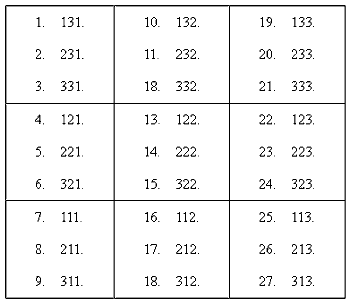
Fig. 1.
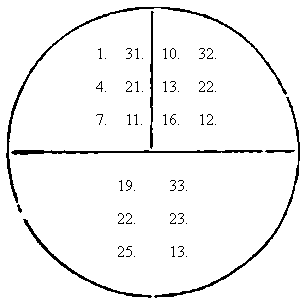
Fig. 2.
These preliminaries being arranged, tell any one to take any twenty-seven cards out of a pack, and to think of any one of them. Deal them into three heaps, and ask him in which heap it is, and what number from the top he would like it to come after the third deal. Suppose he chooses it to be the twenty-sixth card, you take up your opera-glass, and look for the number 26. This you will find last but one, arranged thus,—26. 213. The meaning is, that if the chosen card is to be the twenty-sixth, the heap in which it was found must be for the first time placed second, the second time first, and the last time third. So you pick up the cards, taking care to keep that heap number two. You again deal them in three heaps, and this time you place the heap in which is the chosen card at the top, being number one. Deal them a third time, and on gathering up the heaps, place it at the bottom.
Then, on counting from the top, the chosen card will be found to be the twenty-sixth.
5. THE FOUR KINGS.
Take the four kings out of a pack of cards, and also two other court cards, which are not to be shown. Spread out the kings before the spectators, but conceal the two court cards between the third and fourth kings. Lay the cards face downwards on the table. Take off the bottom card, which is of course one of the kings; show it as if by accident, and place it on the top. Take the next card, (which is one of the court cards,) and place that in the middle of the pack. Take the third card, (i. e. the second court card,) and place that also near the middle of the pack. There will then be one king at the top and three at the bottom. Ask any one to cut the cards, and to examine them when he will find all four kings together in the middle of the pack.
It is better to use court cards to place between the third and fourth kings, because if the cards should slip aside, they would not be so readily distinguished as common cards.
AUDACITY.
Several tricks may be successfully played by sheer audacity. A whole party has been astonished by the performer holding a pack of cards over his head, and naming each. The fact was, that he was standing exactly opposite a large mirror, in which the cards were reflected, while the spectators, having their backs to the mirror, suspected nothing.
Here are one or two tricks that depend on audacity for success.
6. THE CARD FOUND AT THE SECOND GUESS.
Offer the cards to any one, and let him draw one. You then hold the cards behind your back, and tell him to place his card on the top. Pretend to make a great shuffling, but only turn that card with its back to the others, still keeping it at the top. Then hold up the cards with their faces towards the spectator, and ask him if the bottom card is his. While doing so, you inspect his card at your leisure. He of course denies it, and you begin shuffling again furiously. “Let me do that,” he will probably say; so, as you are perfectly acquainted with his card, you let him shuffle as much as he likes, and then, when you get the cards back again, shuffle until his card is at the bottom. Then pass them behind your back, make a ruffling noise with them, and show him his own card at the bottom.
7. THE CARD FOUND UNDER THE HAT.
Have a needle stuck just inside your sleeve. Hand the cards, &c. just as in the preceding trick, and tell the taker to put the card on the top. Take out the needle, and prick a hole nearly through the top left-hand corner. Replace the needle, shuffle the cards, or let any one shuffle them. Place the pack on the table, cover them with a hat, and the marked card will be known by a little raised knob on the right-hand top corner. Draw out card by card, saying whether it is that card or not, until you come to the marked one, which you throw on the table carelessly, and when you are about taking out another card, stop suddenly, and pretend to find, by some magic process, that it is the chosen card.
8. TO CALL THE CARDS OUT OF THE PACK.
Tell the spectators that you will call six cards out of the pack. Secure a card,—say the ace of spades,—in the palm of your hand. Throw the pack on the table, face downwards, spread out the cards, give one of the spectators your conjuring wand, and tell him, when you name a card, to touch one, which you will take up.
First name the ace of spades. He touches a card, which you take up without showing the face of it. This card may be, say the eight of diamonds. Put it into your left hand, and place it upon the ace of spades which is already there, so that the two look like one card. Then call for the eight of diamonds. Another card is touched, say the queen of clubs. This you put with the others, and, after pretending to calculate, call for the queen of clubs.
Proceed in this manner until six cards have been drawn. Then substitute the last card drawn (which is of course a wrong one) for the ace of spades, and conceal it in the palm of your hand. Then strew the others on the table, and while the eyes of the spectators are fixed upon them, get rid of the card in your left hand.
It is a good plan to ask some one to write down the names of the cards as they are called, and then to have the list called over, in order that every one may see that there has been no mistake.
9. HEADS AND TAILS.
While you are shuffling the cards, contrive to arrange quietly all their heads one way, or as many as possible, rejecting all the diamonds except the king, queen, knave, and seven, and passing them to the bottom. Put the pack upon the table, take off a number of the upper cards, and offer them for some one to choose a card from. While he is looking at it, turn the cards round, and offer them to him, in order that he may replace it. Shuffle the cards, and on looking them over, the chosen card will be standing with its head one way, while the others are reversed.
10. THE SURPRISE.
When you have discovered a card, the following plan will make a striking termination to the trick. Get the card to the bottom of the pack, and tell one of the spectators to hold the cards by one corner as tightly as he can. Give them a sharp rap with your finger,—not with your hand,—and all the cards will be struck out of his hold, and fall on the floor, except the bottom card, which will remain between his finger and thumb. It has a rather more dashing effect, if you put the chosen card at the top, and strike them upwards, when the whole pack will fly about the room, like a flock of butterflies, only leaving the top card in the person’s grasp.
11. THE REVOLUTION.
Another neat way of finishing a trick is as follows. Get the card to the top of the pack; and taking care that all the cards are even, drop the pack on the floor, taking care just as you let go, to slip the top card a little off the rest of the pack. In falling, the resistance of the air will turn the card over, and it will rest with its face upwards on the top of the pack.
12. THE SLIPPED CARD.
Ascertain the bottom card of the pack; hold the cards in your left hand, with their faces downwards. Place your right hand upon them, and with your right fore-finger slide them slowly over each other, asking some one to stop any card he chooses, by putting his finger upon it. When he has done so, open the pack at that card, but while opening it, make the pass, and bring the bottom card under the one touched. Hold up the cards, and ask the chooser to be sure of his card; hand all the cards to him, and let him shuffle as much as he chooses. Afterwards discover the card in any manner that you prefer. The following is a good plan.
13. THE NAILED CARD.
Take a flat-headed nail, and file it down until its point is as sharp as a needle, and the head quite flat. The nail should be about half an inch long, or even shorter if anything. Pass the nail through the centre of any card,—say the ace of spades,—and conceal it in your left hand.
Take another pack of cards, get the ace of spades to the bottom, and perform the preceding trick. When the cards are returned, shuffle them about, and exchange the pierced card for the other. Put the pierced card at the bottom of the pack, and throw the cards violently against a door, when the nail will be driven in by the pressure of the other cards against its head, and the chosen card will be seen nailed to the door. The nail should be put through the face of card, so that when the others fall on the floor, it remains facing the spectators.
14. TO ASCERTAIN THE NUMBER OF POINTS ON THREE UNSEEN CARDS.
In this amusement the ace counts eleven, the court cards ten each, and the others according to the number of their spots.
Ask any one to choose any three cards, and lay them on the table, with their faces downwards. On each of these he must place as many as with the number of the card will make fifteen. He gives you the remaining cards, and when you have them in your hand, you count them over on the pretence of shuffling them, and by adding sixteen, you will have the number of points on the three cards.
For example, the spectator chooses a four, an eight, and a king. On the four he places eleven cards, on the eight seven, and on the king five. There will be then six cards left. Add to these six sixteen, and the result will be twenty-two, which is the number of points on the three cards, the king counting ten, added to the eight and the four.
15. TO TELL THE NUMBERS ON TWO UNSEEN CARDS.
As in the preceding trick, the ace counts eleven, and the court cards ten each. Let the person who chooses the two cards lay them on the table with their faces downward, and place on each as many as will make their number twenty-five.
Take the remaining cards and count them, when they will be found to be just as many as the points in the two cards. For example, take an ace and a queen, i. e. eleven and ten, and lay them on the table. On the ace you must put fourteen cards, and on the queen fifteen. There will be then fifteen cards in one heap and sixteen in the other: these added together make thirty-one cards: these subtracted from the number of cards in the pack, i. e. fifty-two, leave twenty-one, the joint number of the ace and the queen.
16. THE PAIRS RE-PAIRED.
Tell out twenty cards in pairs, and ask ten people to take a pair each, and remember them. Take up the pairs in their order, and lay them on the table in order, according to the accompanying table, which forms a memoria technica, and may be construed. Mutus gave a name to the Coci, (a people who have yet to be discovered.)
M U T U S[14]
1 2 3 2 4
D E D I T
5 6 5 7 3
N O M E N
8 9 1 6 8
C O C I S
10 9 10 7 4
Arranging these words in your mind on the table, take the first card of the first pair, lay it on M in Mutus, and the second on the M in Nomen. The next pair goes entirely in Mutus, being two U’s. The first card of the second pair goes on T in Mutus, and the second on T in Dedit; and so on until all the cards are laid in their places.
Ask each person in succession in which rows his cards are, and you can immediately point them out. For example, if he says the second and third row, you point out the second and fourth cards in those rows, because they both represent the letter E. If another says the first and last rows, you point out the last card in each, because the cards represent S in Mutus and S in Cocis. It will be seen that the whole table consists of ten letters, each repeated.
17. THE QUEEN DIGGING FOR DIAMONDS.
Select from a pack the aces, kings, queens, and knaves, together with four common cards of each suit. Lay down the four queens in a row, and say, “Here are four queens going to dig for diamonds. (Lay a common diamond over each queen.) They each took a spade with them (place a common spade on each diamond) and dug until they were nearly tired. Their four kings, thinking that they might be attacked by robbers, sent four soldiers to keep guard. (Lay an ace on each spade.) Evening came, and the queens had not returned, so the kings, fearing that they might have come to harm, became uneasy and set off themselves. (Place a king on each ace.) They were only just in time, for as they came along, they met their queens being carried off by four villains (lay a knave on each king), who, although only armed with clubs (place a common club on each knave), had overpowered the guards and driven them off. But the four kings, being possessed of bold hearts (lay a common heart over each king), soon vanquished the villains, and bound them.” Gather up the cards, place the heaps upon each other and direct some one to cut them. Have them cut four or five times, and continue to do so until a common heart appears at the bottom. Then continue the tale, and say, “The party then returned home in the following order. First the queen (lay down the top card) with the diamonds which she had found (lay down the second card, which will be a diamond) in one hand, and her spade (the third card will be a spade) in the other, &c. &c.” You continue dealing out the cards in that manner, and it will be found that they will be in precisely the same order as when they were taken up.
18. THE TRIPLE DEAL.
Take any twenty-one cards, and ask some to choose one from them. Lay them out in three heaps, and ask the person who took the card in which heap it is. You may turn your back while he searches. Gather them up and put that heap between the other two. Do this twice more, and the chosen card will always be the eleventh from the top.
19. THE QUADRUPLE DEAL.
This is a variation of the preceding. Take twenty-four cards, and lay them in four heaps. Act as in No. 18, putting the heap in which is the chosen card second. The tenth card will be the one thought of.
TRICKS WITH CARDS, THAT REQUIRE APPARATUS.
One or two of these tricks must suffice, because, in general, the apparatus required for cards is exceedingly expensive. Those that are here given require but little apparatus, and any boy with the use of his hands can make it.
20. THE CARDS IN THE VASE.
Make a vase with five divisions, two of which hold an entire pack of cards, and the remaining three are only large enough just to admit one card each, as in the figure. A strong silk thread is fastened at A, passes over the three little compartments, through the bottom of the vase, and running over two pulleys, terminates in the weight at B.
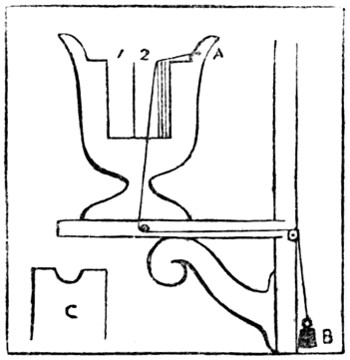
Take three cards, say the ace of spades, the ten of diamonds, and the king of hearts, out of a pack of cards, and put one into each of the little divisions, pressing the thread down into the bottom of each division. If the cards are left, the weight will descend, and the string being tightened, will push the cards upwards. So a kind of trigger shelf is made, on which the weight rests. The remainder of the pack you put into division 2.
When you show the trick, you take another pack of cards exactly like that which is already in the vase, and handing it to three persons successively, compel them to choose the ace of spades, the ten of diamonds, and the king of hearts.[15] Let some one shuffle the cards, and when this is done, put the pack into division 1. Tell the spectators that when you have struck three times on the table, the cards will come out of the vase. At the third stroke, loosen the catch on which the weight stands, by means of a string that communicates with your table, and the three cards will rise slowly up. In order to show that the cards have really vanished from the pack, take the pack out of division 2 and let any one examine it.