PART IV. Domestic Pets. (continued 2)
Reading edition
When the owl has settled itself into a comfortable position, it gives a kind of snap and a gulp, and in a moment the head of the mouse is in its throat. Another gulp and a shake of the head, and the mouse has disappeared, with the exception of the tail, which hangs on one side of the beak. This part of the process seems to afford the owl the greatest satisfaction, for the bird remains for some time in this attitude, standing perfectly still, but giving the tail an occasional roll in the beak. Suddenly the head goes back with a jerk, the eyes close, there is a mighty gulp, and the tail has followed the mouse into the bird’s stomach. The whole process of swallowing the prey is very much like that which may be observed in the toad, the gulping effort to swallow appearing to be equally great in either case.
All owls can be treated in a similar manner, so that there is no need of mentioning them individually. If, however, either of the eared owls can be obtained, the young naturalist should not fail to do so. Owls kept in captivity should not be placed in cages, provided that other accommodation can be furnished, but should have a dark recess in which they can sit during the day, and where they can always be found. They are not easily seen by inexperienced eyes, as they have a habit of choosing perches in spots where their colour harmonizes with that of the locality. When properly treated, the owl can be made quite tame; but unless it be taken when young, it is rather uncertain in temper, biting very sharply. If any one approaches the owl, and hears a quick, snapping sound, as if an elastic piece of wood were “flicked” against a table, he may take it as a warning that the bird does not approve of him, and that he had better not trust his hands too near the owl.
Any one can see how cat-like are the owls in their general physiognomy, as well as in their nocturnal and mouse-loving habits; and they even carry their feline propensities into peculiarities of diet. No animals are less aquatic than the cat, and yet none are more fond of fish. Even the best bred and most carefully-trained cat finds a difficulty in resisting her appetite when she sees fish on the table, and she can hardly have a greater treat than an occasional sprat, herring, or plaice. Angler-cats are not uncommon: several that were accustomed to haunt the water side have been known to catch the fish in shallow water, and would even plunge into deep water for their prey. In like manner the owl is a great fish-lover, and has been seen in the act of dropping into the water, and rising again in the air with a fish in its claws. Now it is an invariable rule with animals of all kinds, that these little aberrations, if we may so term them, are conducive to health: a very familiar instance is the occasional grass-eating propensities of the dog and cat. The young naturalist will therefore consult the health of his owl pets by giving them a fish now and then, as well as a few large insects, in addition to their ordinary diet.
THE PARROT.
Among the vast multitude of birds which inhabit all parts of the earth, or even among the many species which are found in our own country, it is no easy matter to make a first choice. We will, however, commence with the parrot; and before proceeding to describe the several species which are generally in vogue among English fanciers, we may remark that the parrots, paroquets, macaws, and cockatoos are found in almost every warm portion of the globe. Many of the largest and most magnificent species inhabit South America, while Australia is remarkable for possessing several examples of this beautiful group of bird that are most interesting to the young naturalist on account of their form, colour, and habits.
One species, the Long-billed Parrot, or Nestor, scientifically called Nestor productus, is now, as is feared, totally extinct, the last known specimen having been shot some years ago. This curious bird was notable for a wonderfully long upper mandible, very like a pickaxe in shape, and employed in much the same service, being used for digging out of the ground the roots and other vegetable substances on which the bird was accustomed to feed. It is rather remarkable that, although this strange land is very rich in the parrot tribe, none of them except the cockatoo can be taught to speak, being apparently incapable of any imitation of the human voice, and rarely uttering any sound except a scream or a chuckle. Asia also possesses some very elegant species.
All the birds belonging to this tribe are furnished with rather big heads, very large and curved beaks, with the upper mandible hooked well over the lower, which is short and stout; and their toes are so formed that they are divided into two opposable sets, so as to permit the bird to grasp an object in its claws almost as if they were hands. In climbing, an exercise of which the parrots are very fond, the young naturalist will probably observe that the bird makes nearly as much use of its beak as of its feet; and even when tame and accustomed to perch on the hand of its owner, it aids itself in its movements by taking hold of the fingers with its beak, although too gently to cause any injury.
The species which is most celebrated for talking is the Grey Parrot, a well-known bird, living, when wild, in Western Africa, and being at once identified by its grey plumage and short red tail. There are several modes of obtaining this bird, such as requesting a naval friend to bring one home on his return, or going and fetching one for yourself. But as there are few who are so happy as to have an accommodating nautical friend or relative, and still fewer who are able to undergo the perils and hardships of a sea voyage, the best way is to go to a respectable dealer, and give him an order for a young healthy bird. We say a young bird, because the purchaser will then be able to teach it every word that it speaks, and will find his feathered pet become far more familiar than if it entered his possession when aged and with fixed habits. Moreover, an older bird is very apt to pick up all kinds of phrases employed by the sailors on board the ship in which it made its voyage; and although such a vocabulary excites no particular surprise at sea, it is rather too forcible and idiomatic for society.
The worst of the matter is, that the parrot is possessed of an iron memory, and never seems to forget anything it has once learned, however its acquirements may have been overlaid with fresh teachings. It has often happened that a parrot which has behaved for a long time in the most exemplary manner, and employed none but the most refined language, has suddenly met with a sound which recalled all its old associations, and induced the bird to pour forth a copious volley of language too loud to be disregarded, and too plain to be misunderstood.
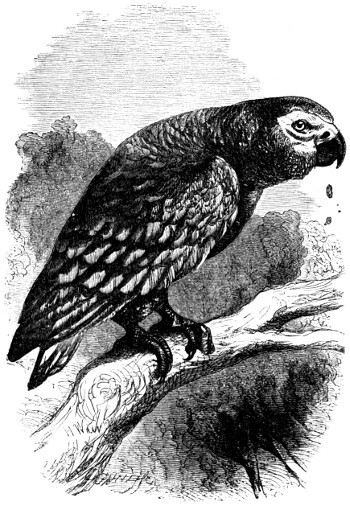
THE GREY PARROT.
And parrots are just like children in their propensities for saying the most dreadful things exactly at the most inconvenient times and to the most fastidious persons, always choosing a dead silence for making some deeply reprehensible remark, and invariably addressing their observations to some lady or some staid ecclesiastical dignitary.
Parrots are marvellously nervous birds, and while young will often throw themselves into such paroxysms of fear at the mere sight of a stranger, that they will even endanger their lives. They have an odd and unpleasant habit of scolding on such occasions, uttering loud, rough, grating cries, as piercing to the ear as the sound of a file or a saw, and stretching out their necks with ruffled feathers and agitated gestures. Some birds retain this extreme timidity for a very long time, in spite of all attempts to conciliate them.
As the management of the different species is nearly, if not quite, identical, it is unnecessary to trouble the reader with a detailed description of each kind of parrot and the mode of treating it; it will be sufficient to tell him how to manage these birds generally, and give a brief account of the country, form, and colour of those species which are most commonly brought to this country. There are, indeed, so many, that it is impossible to mention more than five or six sorts; but if the reader desires to learn more about the parrot tribe, let him refer to the Rev. J. G. Wood’s “Illustrated Natural History,” vol. ii., where he will find the subject treated at length, and with large figures of all the most remarkable species.
The Amazon, or Green Parrot, is so called from its colour, which is mostly bright green, with some yellow and purple tints here and there. This species is brought to England under the title of the Green Parrot, the second species being more properly called the Festive Parrot. It is much larger than the common species, being about fifteen or sixteen inches in length, and having the feathers of the lower part of the back of a deep vermilion.
Teaching this bird to talk is by no means a difficult task,—not nearly so difficult, indeed, as hindering it from learning accomplishments which it is not desired to possess, or inducing it to refrain from producing objectionable sounds, whether articulate or otherwise.
In order to teach the parrot to imitate sounds, the best and simplest mode is to take the bird into a perfectly quiet room, where it can hear and see no one but the instructor, and will not have its attention distracted by surrounding objects.
Then, after taking every care to render the feathered pet familiar, speak the words, or produce the sounds, which the bird is required to imitate, and be careful to avoid varying them even by the fraction of a tone. You will soon see the pupil taking notice of the oft-repeated sound, and it will presently hold its head aside, as if to catch the tones more clearly. After a while it will try to imitate them, and as soon as it makes an attempt, however imperfect, make much of the bird, and give it a small morsel of some special dainty.
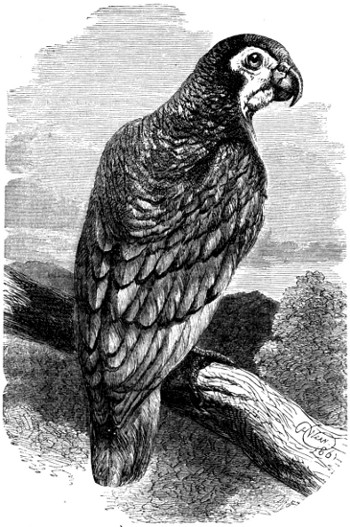
THE GREEN PARROT.
Parrots are largely gifted with the faculty called by phrenologists “love of praise,” and are in no slight degree incited by self-esteem; so that it is possible to induce the bird to perform the oddest feats by carefully working on these two propensities. They have an almost morbid love of being noticed, and crave for words of praise with as much appreciation as if they could understand their import. You can throw one parrot into a very passion of jealousy by pretending not to hear it, and talking to another bird.
One difficulty in the management of these birds is, that when you have taught them to exercise their powers of imitation, they are apt to pick up a kind of chance-medley of every sound they hear, instead of adhering to one lesson and learning it thoroughly before they begin another. Breaking them of the habit is a difficult task, but can be achieved with ordinary care.
The simplest plan is to pounce at once on the obnoxious sound, and, by never letting it pass unnoticed, give Polly an idea that it is not to be uttered. If she persist in her delinquency, the best way is to scold her, and put her at once into a dark closet, or throw a thick shawl over the cage, so as to exclude the light. Parrots detest being left in the dark, and it is surprising how soon the bird finds that her utterance of the forbidden sound is sure to be followed by condign punishment, and therefore ceases to be guilty of the offence.
Wherein shall our parrot live? This is a natural and a needful question, and requires a few lines in reply.
Assuming that, in any case, the bird is to have plenty of room, as is needful for a creature so restless and active, a cage is to be recommended, unless the parrot is very tame, and there is no fear of strange cats; we say strange cats, because Polly will generally contract an alliance with the cat and dog of the household, and be on the most friendly terms with them.
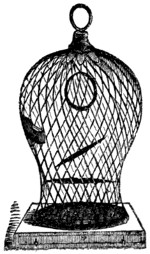
A good form of cage is here given. As the reader will observe, it is much wider across the top than is usually the case. This is to give the bird room to traverse the cage, or luxuriate in its swing, without the danger of rubbing its tail into a shabby and ragged condition. There is a metal hoop suspended by a chain, and it is found that parrots are very fond of getting into this hoop, and swinging about. The cage should be made of galvanized iron wire, very strong, and at least five feet high. We desire to dissuade our readers, in the strongest terms, from purchasing cages made of brass wire for their parrot, or indeed for any other bird. Brass is terribly apt to produce verdigris, especially in London or in any other large town, and where gas is much used; and as birds, and parrots especially, are fond of nibbling the wires, they may be poisoned, and die a painful death.
Should, however, the bird be trustworthy, we would recommend one of the common crutch perches, to which the bird is secured by a chain, having one end fastened to a ring on its foot, and the other end affixed to the crutch. If the room in which the bird is kept will permit the arrangement, by far the best plan is to add a strong twisted wire to the crutch, and carry it to the ceiling, as is done in the Crystal Palace. The chain, instead of being fastened to the crutch, terminates in a ring, which slides upon the upright wire, and permits the bird to mount or descend at will.
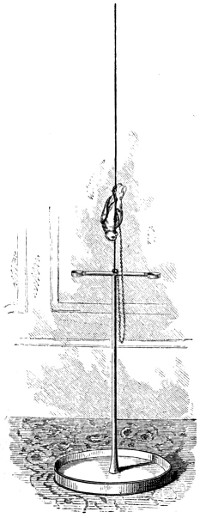
Polly will be charmed with this addition to her range of locomotion, and the sight of his pet bird enjoying herself cannot fail to repay the owner for the slight extra trouble he has taken.
Parrots are very fond of exercising their strong beaks, and are apt to gnaw their perches so incessantly, that they cut them in two, despite the hardness of the material. Prevention, they say, is better than cure; and if the young parrot-owner will take care to give his bird now and then a stout piece of elm wood, with the bark not removed, he will find that Polly will prefer to tear and rasp away at the elm board to biting her hard perch, where there is no bark to be stripped off.
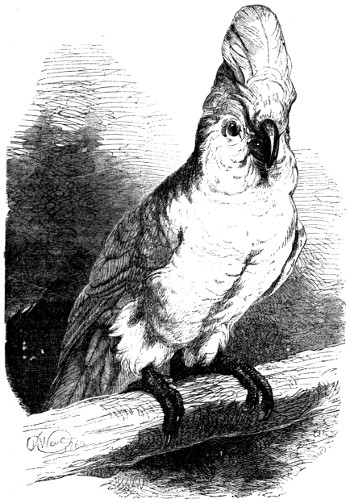
THE COCKATOO.
The pretty Cockatoos are always great favourites, their form being very elegant, their colour delicate, and their talkative powers very great. These birds are natives of Australia and the Indian Islands, and derive their name from the peculiar cry of some members of their kind, which exactly resembles the word cockatoo.
The two species generally found in captivity are the great Wide-crested Cockatoo, known by the crest of broad and slightly-hollowed feathers which decorate the head, and which can be raised and even thrown forward when the bird is excited with pleasure or anger. The colour of this bird is white, and the under surface of the crest is tinged with red. It comes from the Moluccas, and is deservedly in favour as a pet, being docile, affectionate, and very quaint in its habits.
The other species is the Lesser, or Sulphur-crested, Cockatoo, also from the Moluccas and Indian Islands. It is easily known by the pointed sulphur-yellow crest, which is continually being raised and thrown forward. Both kinds can learn to talk to some extent, though they are not such admirable linguists as their kinsmen the parrots.
The pretty Ring Paroquet is a native of the East Indies, and is a very familiar inhabitant of our aviaries and cages. It is a gentle creature, and most affectionate to a kind owner. It is mightily fond of walnuts, and the bird can be kept in a state of great good-humour for an hour or more by giving it half a one, and telling it to pick out the contents with its hooked bill. The bird seems perfectly happy, holding the nut in one claw, shifting it with great dexterity, so as to get it into the best position for extracting the kernel, and uttering the while a little, low chuckle of gratification. The colloquial powers of this bird are moderate; but it does not learn so readily, nor repeat so accurately, as the grey or green parrot.
The Macaws are notable for their very long tails, very big beaks, and very brilliant colouring. The two species usually seen in England are the Scarlet and the Blue-and-Yellow Macaw. They come from Southern America, and have a most magnificent appearance while flying from tree to tree, with the sunbeams flashing from their gorgeous plumage.
As a pet, the macaw is rather too noisy, and has a horribly loud and dissonant yell by way of a cry. It is, however, a magnificent bird, often measuring more than a yard in length. The colour of the plumage is almost entirely of a rich glowing scarlet, relieved here and there by a little blue, yellow, and green.
The Blue-and-Yellow Macaw is another native of tropical America, and though not so gorgeously resplendent a bird as its scarlet relation, is yet a remarkably handsome creature. As may be surmised from its popular appellation, the colour is chiefly of the two tints blue and yellow, mixing occasionally so as to produce green.
Without going too deeply into minute details, it will suffice to say that the upper part of the back, the wings, and the tail are azure blue, and the under part king’s yellow. On the forehead is a patch of green, the chin is black, and the cheeks are white and naked, with the exception of three narrow bands of very tiny feathers drawn successively beneath the eyes.
The parrot tribe may be fed upon various vegetable substances, such as grain of different kinds, seeds, nuts, Indian corn, and biscuits. The stones of peaches are great favourites with these birds, who derive much amusement from picking with their scoop-like tongues the soft fruit from the interstices of the rough stone.
They ought not to have any kind of animal food, not even milk, which is frequently recommended for their use, as their systems are apt to become heated, and then they pull away their feathers in their attempts to alleviate the irritation. Sometimes a parrot will pluck itself bare in every part where its bill can reach, and so injure itself materially. A capsicum pod now and then is, however, a treat, and may be given sparingly. Be careful to use glass or earthenware pans for their food, and see every morning that the cage and pans are quite clean and bright.
PIGEONS.
The practice of rearing pigeons for fancy or amusement has been for a long time prevalent in England. In ancient times the “dove-cote” was a general appendix to the family hall or farmer’s homestead; and at the present time it may still occasionally be observed peering above the trees in country districts; while in London the pigeon-loft, with its “dormers,” “area,” “traps,” and other appliances, may be frequently seen on the house-tops, more especially in the districts inhabited by the working classes.
Pigeons live together in pairs; and when a cock and hen once form an attachment, the union generally lasts during their lives. The pigeon in a wild state breeds only twice or thrice in the season, but the domestic birds will breed every six weeks, or during the greater part of the year.
Whatever number of broods a pair of pigeons may bring up in a year, the hen never lays but two eggs before she sits. She incubates for eighteen days after the laying of the second egg. Both the cock and hen assist in the hatching: the hen usually sits from the afternoon till about eleven o’clock on the following morning; the cock then takes her place, and sits while she goes out to feed and exercise herself, and generally keeps on the nest until two or three o’clock in the afternoon.
When first hatched, the young are fed for about eight days with a milky secretion prepared in the crop of the parents, and regurgitated into the mouth of the young, and afterwards with grain and seeds the old ones have picked up in the fields and treasured in their crops. In this mode of supplying the young with food from the crop birds of the pigeon kind differ from those of any other family.
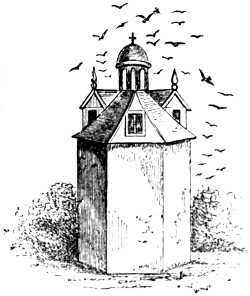
Formerly it was common to erect buildings as dove-cotes in the neighbourhood of great country mansions: many of these were of considerable size and elevation, as shown in the engraving. The custom, however, has fallen into disuse, and pigeon-houses of more moderate sizes are now generally employed.
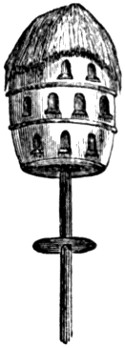
A small one is very often formed from a wine-cask, which has holes cut in its sides, and a small platform made before each, to form a resting-place in front for the birds to alight upon. The interior is divided into chambers by the carpenter, or any boy of common carpentering ingenuity may readily do it himself. The cask is then elevated on a stout thick scaffolding pole or the trunk of a straight tree, and made perfectly secure. In arranging the internal chambers for the birds care should be taken that they are large enough for them to turn round in with ease. The cote should be fixed in a warmish spot, and not exposed to cold easterly and northerly winds. The top of the cask should be thatched or boarded, and this protection should come well over the holes and sides of the cote, so as to protect it from the heat of the sun in summer and the drifting of the rain in unseasonable weather.
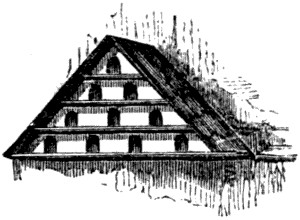
The young fancier may employ one after the fashion shown on the following page: this, with its compartments, may be fixed up against the south or south-west side of a stable, barn, or out-house. The outside should be well painted, and the alighting places slightly slanted, so that the water or rain may not lodge on them, but run off to the ground outside. The whole should be so placed that it can be approached by a ladder, which ought not to be permanently attached to the cote, or it may be a means for the intrusion of cats and vermin.
It sometimes happens that a spare loft or room presents itself to the young pigeon-fancier, which may be made use of for a pigeon-house. When this is the case, it can easily be filled up with pigeon-boxes, which may be arranged round the sides, while holes are made on the outside of the building for the pigeons to fly in and out at. Broad flat perches may also be placed across the room, upon which the birds may rest. The boxes for the nests should be at least a foot square.
It is far more advantageous and profitable to keep pigeons in a spare room than to employ the dove-cotes on a pole, or those fixed against the side of a house, as double the number of young birds may be reared, the nests being sheltered from the inclemency of the weather.
As to the compartments, or nests, every one should be furnished with an earthenware nest-pan, of a size adapted to the pigeons for which they are intended. Sand or gravel should be sprinkled over the shelves and on the floor, as the small stones with which it abounds are useful to the birds in helping them to digest their food, and a little old mortar-rubbish or pounded burnt oyster-shells should be given, to supply the lime necessary for the shells of the eggs. Everything about them should be kept very clean, and the whole apparatus, of whatever kind it may be, should undergo a frequent and thorough purification, while the nest-pans or boxes should be well cleaned after every hatching.
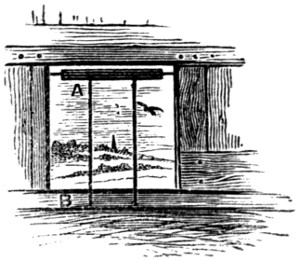
There is a contrivance of great use which is employed for letting into the loft those birds who may not happen to come home before the areas are closed for the night. The object of this door, which is called the “bolting wire,” is to let the birds in without letting those in the loft pass out. It is made by placing before a square aperture cut in the pigeon-house a couple of wires about three inches apart from each other (as seen in the drawing): these swing loosely upon a piece of wood, which turns on a wire, and their lower ends come over the lower ledge on the inside. By this arrangement, when a bird outside presses against the bars and tries to get in, the whole opens inwards, and he easily enters; but if one from within tries to get out, the wires press against the ledge at the bottom, and effectually prevent his egress.
Within the pigeon-house should be placed boxes for the grain, pulse, and beans that the birds feed upon.
Pigeons are great devourers of food, and will eat any kind of grain, such as wheat, barley, oats, peas, beans, vetches, Indian corn, tares, &c. Small beans, called pigeon’s beans, are the best general food for all pigeons. If possible, the peas, beans, or tares given to the birds should be old, as new pulse is apt to disagree, and purge them. Hempseed is very stimulating, and although pigeons are very fond of it, it should be sparingly given.
Pigeons are very fond of lime and salt, and to supply themselves peck out the mortar from between the tiles. To prevent this, it is best to make them what is called a “cat,” which will be exceedingly grateful to them, as it will tend to keep them in good health. This is done in the following manner:—
Mix some sifted gravel or earth with old mortar-rubbish, or pounded burnt shells, if this cannot be obtained; add a few handfuls of salt; and make the whole into a mass with water. Portions of this may be put into flower-pots, and placed in situations where the birds can get at them easily.
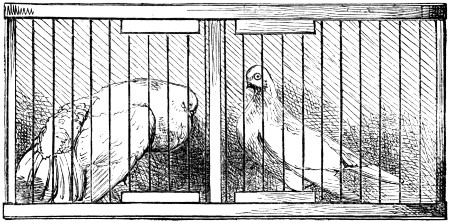
MATING CAGE.
Pigeons are often sadly annoyed by vermin. To prevent the increase of these intruders, the most scrupulous attention should be paid to cleanliness in every part of the houses, nests, and places of resort, and the birds should be provided with shallow pans of water to wash in.
Sometimes there is a little trouble attending the mating of pigeons, and it is of great importance that they should be properly matched, or the young will not be purely bred. The mating coops should have a thin lattice-work partition between them, so that the birds may make acquaintance with each other, and match together, when they may be placed in one pen. When they are properly mated, they may be left at liberty to arrange and build their nests, which they will do very readily. The illustration on the preceding page shows the construction of the mating cage.
VARIETIES OF PIGEONS.
The Columbidæ, or family of pigeons, are one of the most numerous and most widely distributed families of birds. They are all vegetable feeders; and many congregate in flocks. But notwithstanding their numbers, general distribution, and beauty, only two, out of a great number of species, have been brought into subjection by man: these are the common pigeon, or house pigeon, known as the Rock pigeon when in the wild state, and abundant in several parts of the cliffy and caverned shores of the British Islands, and the Collared, or Cream-coloured dove, with a narrow black collar round the neck. This latter is frequently kept in confinement: it breeds freely if in very large cages, and it may be reared in the open air in this country if protected during severe winters.
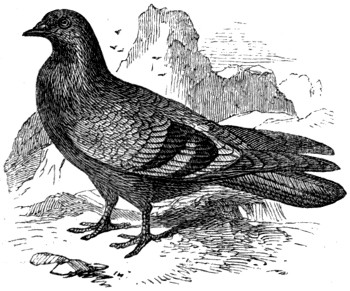
BLUE ROCK DOVE.
The Blue Rock dove is the undoubted origin of all the different varieties of domestic pigeons. It is a most beautiful bird; its general colour is blue, with two black bars across the wings. In some few of the large dove-cotes blue rocks still exist; but the pure race, uncontaminated by intermixture with any of the numerous varieties of domestic pigeons, is scarcely to be obtained except in the distant islands of the Hebrides, or in remote districts unfrequented by man. It is a swift flyer, a good forager, and a prolific bird; but its comparative wildness renders it ill adapted for a domestic pet.
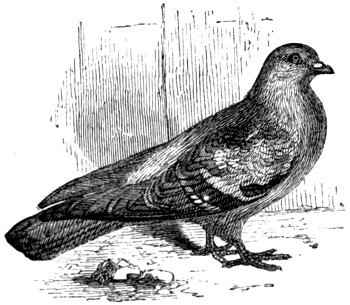
THE ANTWERP, OR SMERLE.
Smerles are the Flying Pigeons of Belgium. These extraordinary birds, that perform races of 500 miles, returning home to Brussels and the adjacent towns from the south of France, and even from Spain, closely resemble the blue rock in general form; but, as shown in the engraving, the feathers of the wings are rather broader, and the head and beak thicker and shorter. They are of various colours, as blue, checquered, red, mealy, &c. Their desire to return home is so great that it is useless to attempt to establish a stud of them, by liberating old birds, however long they may be shut up; the only plan is to rear young from them whilst confined in a room or loft, or to obtain young birds that have never flown at the place of their birth. These, from the peculiar noise they make, are termed “squeakers.”
We do not know any more delightful fancy for boys than Antwerps, as they are strong, hardy, fertile, and require no special trouble; good water and a little care in cleaning is all they ask; and they reward their owners by being always ready to convey to their home messages from any distance which they may have been trained to fly. The training is thus accomplished: the young birds, when they can fly round with the others, and dash about in the air in that vigorous style that characterises the breed, are taken a short distance from home and set free. They rise, and circling round and round, descry their home, and make straight for it.
Their next journey is longer, and so on; the distances are gradually increased, until the birds will return even for several hundred miles. When these birds are used to convey messages, the paper must be so attached as not to impede their flight. The proper mode of doing this is to write upon a strip of thin soft paper, about half an inch broad by three or four inches long: this is rolled round the leg, and secured by a thread. An ordinary letter, tied to the bird in the manner that is often represented in engravings, would entirely prevent its flight.
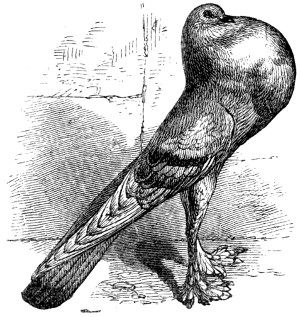
THE POUTER.
The breeds of pigeons that are most valued by fanciers are those that differ in the greatest degree from the blue rock doves and the common mongrel dove-house pigeons. Of these the Pouters, Carriers, and Tumblers are the most esteemed. The pouter is a remarkable bird, distinguished by the extraordinary power it possesses of inflating or blowing out the neck: it is also characterised by the extreme length of its legs, which should be feathered to the toes, and the length of the feathers of the wings and tail. Pouters are of various colours: some are purely white, but in general they are blue, or black, marked or pied with white upon the crop, and with white flight feathers in the wings; there are also red and yellow pied birds.
The properties for which a pouter is valued are usually stated as being five in number; viz. length of leg, length of feathers, slenderness of body, size of crop, and colour. Pouters possessing all these properties of the breed in a very perfect degree are rare, and consequently very valuable. Ten, or even twenty, pounds is no uncommon price for a pair of birds sufficiently good to win prizes in the competitions at the exhibitions of poultry and pigeons; but very fair specimens may be bought at the dealer’s for a few shillings per pair.
Pouters are not such good nurses as many other pigeons, often neglecting their young before they can feed themselves, when they die, unless fed by being crammed with beans at least twice a day. For this reason we would not recommend the young fancier to begin with this breed.
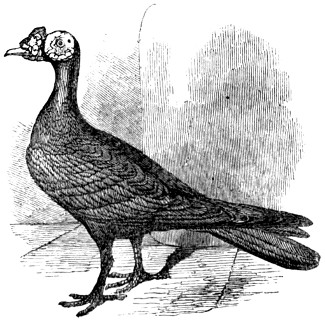
THE CARRIER.
The Carrier of the present day is not, as its name might seem to imply, ever used to carry messages, but is a high-class fancy variety, valued in proportion to the perfection of its properties. In a good carrier the beak is long, thick, and straight; the beak-wattle, or membrane at its base, well developed, and standing well up from the head. The eye-wattle, or membrane round the eye, should be large, flat, and circular; the skull narrow and long; the neck very slender and long; the plumage firm and glossy, the tail and flight feathers being long. The colour most valued in carriers is a brilliant jet black: many first-rate birds are what are called duns, a variety of brown. There are also white and blue carriers, and occasionally pied birds are seen. The blacks and duns are, however, the most perfect in properties; and they may be mated together without risk, as they will always produce either black or dun young birds, and not, as might be expected, a mixture of these colours, or a bird intermediate in colour between the two.
Carriers are very fair sitters and nurses, but they are subject to diseases of the eyes, and are not as well suited to young fanciers as some of the other breeds.
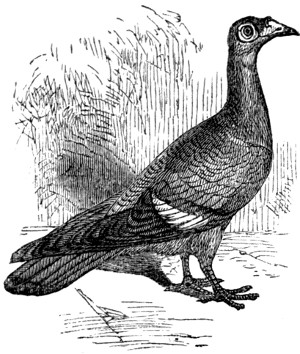
THE DRAGON.
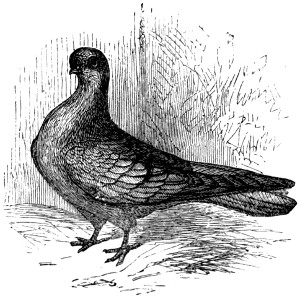
For grace, style, and beauty there are no pigeons superior to Dragons. They are almost everything a young fancier could desire—good homing birds, able to do 50 or 100 miles with ease; active on the wing, close sitters, good nurses, fertile breeders, requiring no special care; full-sized birds, good in a pie, and not expensive in first cost. Their general form is somewhat like that of the carrier, but they are much more active, and far quicker in flight. Some of the best dragons are blue; others are white, red, yellow, and black. They differ from the carrier in the size of the eye and beak-wattle, and in the beak.
THE TUMBLER.
The Tumblers are the very opposite of the breeds last described. Small birds, with rounded heads, short beaks, and pretty little red prancing feet, they are the very pets of the pigeon fancy. In colour the tumblers vary very much. There are blues, blacks, and other self colours; then some have white heads—these are termed bald heads; others have a white mark below the under bill—so they are termed beards; but the variety most valued is that termed the almond tumbler. In this breed every feather of the plumage is variegated with black, yellow, and white, the yellow forming the ground colour. These almond birds are reared by experienced fanciers with beaks so short that they are hardly able to bring up their own young, and others have to be employed for the purpose. Birds of this extreme character are not suited to young fanciers; but the ordinary flying tumblers, which can be bought at any dealer’s for a few shillings per pair, are most pleasant pets—good breeders, active and joyous on the wing, constantly turning somersaults in the air, good in a pie, and able to fly home, if trained, some thirty or forty miles with ease.
THE BARB.
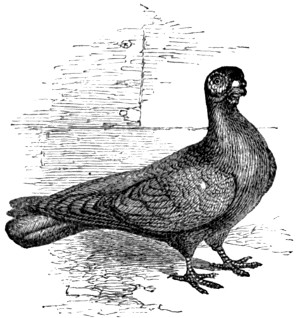
The Barb, or, as it used formerly to be called, the Barbary pigeon, from the country from where it was originally obtained, is regarded with great esteem by fanciers, and very good specimens cannot be obtained except at high prices. In size the barb is rather a small bird. The colours are usually black, dun, red, yellow, or white; blue barbs, strange to say, are not known. The eye of the barb is surrounded by a naked skin or wattle of a red colour; this should be circular in form, and the larger it is the more the bird is valued: the skull should be broad, and the beak short and stout. Barbs are good sitters, and bring up their young ones very well. They are also striking in appearance, the red eye-wattle contrasting well with the colours of the plumage.
THE OWL.
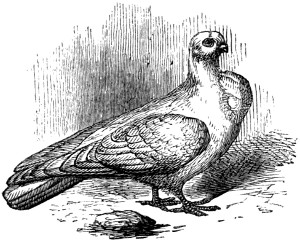
Like the barbs, the best Owl pigeons also come from the north of Africa. Formerly there was very common in this country an elegant, short-beaked bird of a beautiful blue or silvery colour, known as the owl: this was of medium size, and possessed rapid powers of flight. Beautiful as the breed was, it has almost entirely been superseded at the pigeon shows by a very petite, delicate, white breed, the first specimens of which were brought to this country from Tunis about a dozen years since. A very good specimen of this charming little variety is represented in our engraving. Since that true blue and black owls of the small size have also been introduced. The great drawback to this fairy-like little breed is its delicacy. The young fancier would do well to choose for his first favourites a hardier variety.
THE TURBIT.
The Turbit is a pigeon somewhat resembling the owl, but its head is flatter, and it has a turned crown of feathers at the back of the neck. In colour it is peculiar. The wings, with the exception of the larger flight-feathers, are coloured, and the remainder of the body should be white. There are turbits of all varieties of colour, or, as they are termed, blue, black, red, yellow, and silver turbits.
THE FANTAIL.
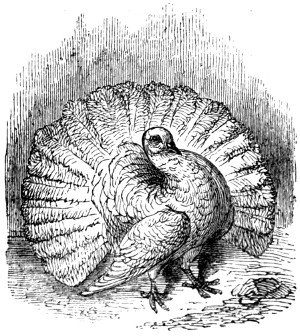
There are a number of pigeons which are strikingly distinguished by remarkable peculiarities in the form of the plumage; such are the Fantail, the Trumpeter, and the Jacobin. The fantail is perhaps the best known of these. The number of feathers in the tail of an ordinary pigeon is fourteen, but in this breed it is greatly increased; in some specimens even to three times that number, and thirty feathers are not uncommon in good birds.
The carriage of the tail is also greatly changed; instead of being borne behind, like that of an ordinary pigeon, it is held aloft, like the expanded tail of a peacock.
The engraving represents one of the best white fantails, the tail full, carried well over the back, and the long swan-like neck thrown back so as to touch the tail. Fantails are good hardy birds, and as they can be bought at all prices, very well suit the young fancier. Moreover, they soon become very tame, and may be reared almost everywhere.
THE TRUMPETER.
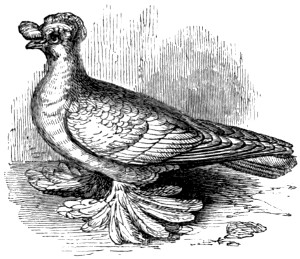
The Trumpeter is not as common a variety as the fan-tail, but is fully as remarkable. It derives its name from its peculiar voice, which is quite unlike the ordinary coo, coo, of a common pigeon; and it is also distinguished by the singular arrangement of the feathers on its head and feet: the latter are feathered to so great an extent that the bird appears to have four wings. Many of the larger quills on the feet of a good trumpeter will exceed four inches in length if unbroken. Trumpeters have a tuft over the beak and a turn of feathers at the back of the head. They require to be kept most scrupulously clean; otherwise the elegant appendages on the feet become clogged with dirt, and the birds lose all their attractiveness and beauty.
THE JACOBIN.
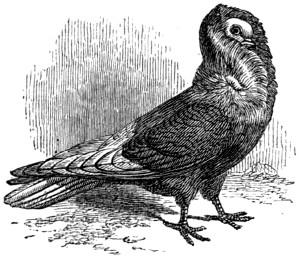
No variety of pigeon excels the little Jacobin in its quaint prettiness. The tiny little head is half concealed in a recurved cowl of feathers which runs down at the sides of the neck, and nearly meets in front.
The head, the flight feathers of the jacobin, and those of the tail, should be purely white, those of the rest of the plumage coloured. The most common colours are red or yellow; but there are also black jacks, as they are sometimes called for shortness, and also blues, and some that are entirely white. Jacks breed very freely, and we cannot recommend a prettier pigeon, or one better adapted to the juvenile fancier.
The foregoing breeds include all the best known varieties. It is true there are many others described in the works on pigeons, but none better fitted for the young and inexperienced fancier.
The breed known as Runts are characterised by their enormous size, sometimes weighing even as much as four pounds or even four and a half pounds a pair. But they do not fly well, and are more suited for pigeon pies than for a fancier’s loft.
There are also the breeds known as Nuns, Spots, and Helmets, which are white with more or less colour on the head, &c.; but for beauty of marking none surpass those blue breeds that possess the arrangement of colours in the plumage that characterises the original wild rock dove.
POULTRY.
FOWLS.
There are few occupations more attractive than the care and charge of domestic poultry. It is most interesting to behold a hen with her family, and to mark her care and tenderness for them; while to see the little chicks themselves, picking and scratching about, basking in the sun, or running hither and thither after the hen, or nestling under her wings, is a very pleasant sight.
Like the pigeons, fowls are all descended from a single species of wild bird, the common wild jungle fowl of India. This has been domesticated from a very early period, and carried to all habitable parts of the globe. A large number of different varieties exist in a domestic state, none of which are known in the wild condition. The chief breeds known in England at the present time are the Dorkings, Game, Spanish, Hamburghs, Polish, Cochins, Brahmas, Malays, Bantams, Silky fowls, and the common barn-door fowl, which is a very mongrel breed. The best known French varieties are very valuable for economical purposes: they are Houdans, Crève Cœurs, and the La Flèche breeds.
Fowls require both animal and vegetable food. When allowed to range at large their great search is for worms and insects, which they obtain for themselves. They must be supplied with grain, such as barley, oats, tail wheat, &c.; and they should also be well furnished with raw vegetables, grass, cabbage or lettuce leaves, unless they have a free range over the fields. Boiled potatoes and other vegetables are also very serviceable to them. The staple food should, however, be grain, and this may be mixed with boiled potatoes. The quantity of barley for each fowl is about a quart a week, if they are entirely fed by hand; but in barn or stable yards they require much less. They should also always have a plentiful supply of pure and clean water.
All fowls dependent upon man for food should be fed regularly twice or thrice a day in the same place. The food should be given to them at nearly the same hour—eight o’clock in the morning and four in the afternoon, as in the spring and autumn birds retire early to roost, and it is very bad management to call them from their perches for feeding. Young chickens should be fed much more frequently if it is wished that they should grow into fine, handsome birds.
FATTENING.
When fowls are to be fattened for the table, they must be fed oftener, and with different descriptions of food, than when they are simply kept for rearing stock or laying eggs. They then require ground barley or oatmeal, which fattens them much quicker if mixed with milk. Indian corn is also a capital fattener, and, as it is now cheap, may be used. Gross food, made up of impure fat, grease, and flesh-food is very bad for fowls. When fattening for the table, they should have their food three times a day, at morning, noon, and evening; and they should be kept warm and comfortable during the night.
Fowl houses should be warm and dry, and have compact earthen floors, well raised, and littered down with gravel, from which the large stones have been taken and the small ones left.
LAYING.
Nests (baskets or boxes) must be made for the hen, in which a chalk egg or two should be put. The nests may be made of short straw. Some hens will lay one egg every day, and others one every other day.
The eggs ought to be taken from the nest every afternoon, when no more may be expected to be laid; for if left in the nest the heat of the hens, when laying the next day, will render them less fit for domestic use.
HATCHING.
When the hen has laid her number of eggs, nature has provided for their being hatched by giving the bird an instinct to sit or incubate. This instinct is made known by a particular sort of cluck, and by the hen sitting steadily on the nest in which she has been in the habit of laying.
In selecting the eggs to be sat upon by the hen, choose such as have been recently laid, and not those of angular shape or extra size: the latter are often double yolked, and rarely produce chickens.
The number of eggs to be hatched by the hen must in some degree depend upon her size. A moderate-sized hen will very nicely cover eight or nine eggs in the cold spring months, and twelve or thirteen in April or May. An odd number is often chosen; but there is no advantage in so doing. The hen having received her eggs may be then left to herself; she should have water placed at a convenient distance, and her food may be given to her near the place of sitting.
The hen sits on her eggs twenty-one days, during which period she seems in a dozy state, and seems to require but little food or exercise. Some hens will feed every day; but others will go for several days without leaving the nest, or taking nourishment: these should be lifted off the nest, and fed daily.
When chickens are hatching, which usually takes place twenty-one days after the eggs are placed under the hen, it is best to leave them entirely to themselves.
As soon as the hen becomes a mother, a great change is seen in her character—all her former habits give way to maternal solicitude. A good hen attends to her brood with the most persevering fondness; she will attack the fiercest animal who dares to molest her progeny.
REARING OF CHICKENS.
When the chickens are hatched, they require no food till the following day, when they may be fed with crumbs of bread slightly moistened with milk, and egg beaten up with an equal quantity of milk, and then heated so as to form a soft custard: this is the best food that can be given them. They should also have a few grits, and after a few days some small wheat.
If the weather is dry and warm, it is best not to coop the hens, as by scratching they obtain a supply of insect food and worms for the chicks, which is better than anything else that can be given them; but they should not be let out in damp weather in long grass before the dew has dried up. If cooped, the coop and hen should be placed in some nice dry and sunny spot in the lawn or garden, within sight of the dwelling-house, and where no cats are likely to prowl about. There should be a little pan of water set within reach of the hen, near the bars of the coop, and stones should be placed in it to prevent the young brood from drowning themselves, and this water should be frequently changed.
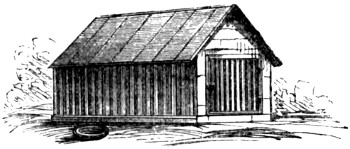
The changes of weather should be watched, and when it sets in wet or cold the young brood should be carefully protected by the removal of the coop into some warm sheltered place, such as a stable, coach-house, or outhouse; and so with care continue to be nursed, guarded, watched, and attended to, till they are about seven weeks old, when they will of themselves separate from their parent hen, take to the roost, and act independently.
There is a great choice of breeds in the different varieties, and we will state the advantages of each.
Dorkings are large heavy fowls, first-rate for the table, good sitters and mothers: but rather delicate, require a good grass range, and do not do well on damp soils.
Spanish are handsome fowls, lay numerous large eggs, do not sit; are not so good for the table as the Dorkings, being longer in the limbs, and not so fleshy.
Cochins and Brahmas are large domesticated fowls, very hardy; can be kept in by a low fence; they are good layers, good sitters, good mothers, and useful family fowls on the table.
Hamburghs are pretty, light, active, roaming fowls; they are called everlasting layers, as they never wish to sit, but lay on incessantly, except at moulting-time. They do not bear close confinement well, and are difficult to keep in enclosed places, as they fly like pheasants, and know not bounds.
The crested Polish, black, white, and spangled, are also non-sitters and good layers; but they are not so hardy as the spangled Hamburghs.
Game are hardy, very fair layers, good sitters, the best of mothers; plump on the table, though not very large; well able to take care both of themselves and their chickens.
Bantams are pretty little pets, that may be suffered to roam about a garden without doing any injury.
The French breeds—Houdans, Crève Cœurs, and La Flèche—are remarkable for their good qualities as table fowls.
The White Silky fowls are a very singular breed, with divided feathers, like wool or silk, black skins, and black bones. They have their good points, however: they are admirable sitters and nurses, and bring up young partridges and pheasants better than any other fowls. They are also very good to eat, though their black skin renders them rather unsightly on the table.
These varieties offer sufficient choice even to the most particular amateur, who should make his selection in accordance with his wants and his locality—according as he requires egg-producers or chickens for the table, and whether he can afford his fowls the advantages of a free range over green fields, or has to keep them in a confined space, near a suburban residence.
THE PINTADO, OR GUINEA FOWL.
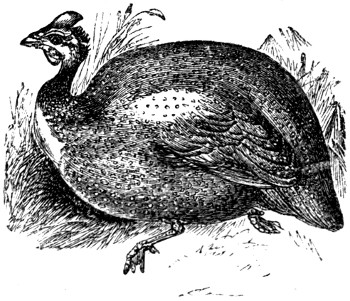
Guinea fowls associate readily with the common fowls in a poultry-yard; but they have this peculiarity, that the cocks and hens are so nearly alike that it is difficult to distinguish them, except by the voice, the hens only uttering the constantly-reiterated cry of “Go back! Go back!” The head is covered with a kind of casque, with wattles under the bill, and the whole plumage is either black or dark grey sprinkled with regular and uniform white spots. The pintado is a native of Africa.
These birds lay plenty of eggs, rather smaller than those of the common hen, and speckled. They may be reared by placing the eggs under a hen; but the chicks are extremely tender, and very often a sudden change of the wind in March will sweep off a whole brood in a few hours. The young should be fed with custard, &c., as ordered for fowls.
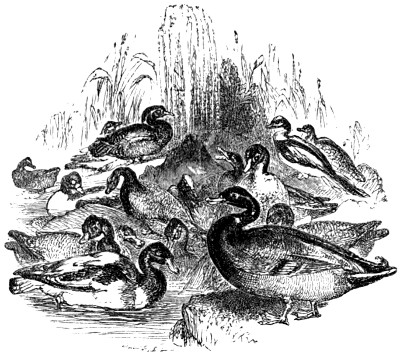
DUCKS.
The common wild duck, or mallard, is the original stock of the domesticated duck, and appears to have been reclaimed at a very early period. The mallards come from the north of Europe, at the end of autumn, and, migrating southward, arrive at the beginning of winter, in large flocks, and spread themselves over all the loughs and marshy waters in the British Isles.
The tame duck is a larger bird, and varies greatly in colour. Tame ducks are easily reared: the best way to get them is to place duck’s eggs under a hen, for the tame duck is often a careless mother; the hen, on the contrary, generally hatches a duckling from every egg with which she is entrusted. She does not conduct her young to the water, and generally exhibits much anxiety when the young brood take to it; but she watches over them, and is ever ready to defend them from danger. “The village schoolboy,” as old Bewick says, “witnesses with delight the antic movements of the little brood under the charge of a foster-mother, who with anxious fears paddles upon the brink and utters her unavailing cries or calls, while the ducklings, regardless of her warnings, and rejoicing in the element so well adapted to their nature, are splashing over each other beneath the pendant foliage, and diving their heads beneath the water.”
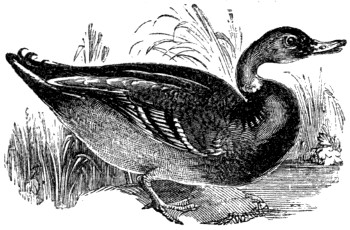
There are many varieties of the tame duck. One of those most in request is the dark-coloured Rouen, which is very prolific in eggs. The Aylesbury, or white variety, is large and profitable. The Muscovy duck is a distinct species, and not a mere variety, much larger than the common duck, and distinguished by a membrane of a red colour, covering the cheeks and extending behind the eyes. There are also several other foreign species, as the Mandarin and Carolina ducks, which are kept rather for ornament than use.
Ducks sit for thirty days. They begin to lay in February, and when not watched will lay abroad and conceal their eggs. They generally lay at night, or very early in the morning. While sitting, the duck requires a secluded and soft place. On hatching, she should be taken, with her brood, and put under a coop; a shallow pan of water should be placed near her for her drink and for that of the young ones, but it should be very shallow. In a few days she may be let loose, when, with her brood, she will immediately take to the water.
Young ducks should be fed upon oatmeal or barleymeal, and kept in a warm place at night time, and not let out early in the morning. They should at first be kept from water to swim in, as it always does them harm. When the ducks grow large, they may be fed upon oats thrown into a pan of water.
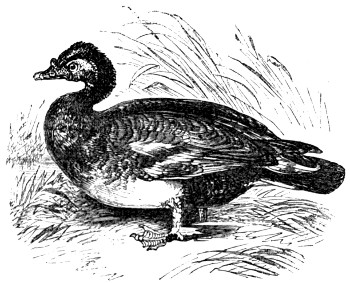
MUSCOVY DRAKE.
THE RABBIT.
Of all domesticated animals dear to the British schoolboy’s heart the rabbit is, perhaps, the most general favourite.
Rabbits may be kept simply as pets or curiosities, or as a commercial speculation, and in either or all of these conditions they are sure to answer the expectations of the owner, provided only that ordinary pains be taken with them. As pets, they can be made tame, affectionate, and playful; as curiosities, they can be modified, by careful breeding, into the oddest shapes and most eccentric colouring; while, as a commercial speculation, they can, with proper care and forethought, be rendered extremely profitable, and will pay a heavy percentage on the original outlay.
As an example of this fact we may mention the case of a young carpenter, one of those steady, hardworking, intelligent men who are sure to get on in the world, simply because they keep their eyes open to all that passes, always watch for opportunities, and always seize them when found. This man used to make a considerable addition to his income by his rabbits, fattening and selling a large number annually, besides steadily increasing his stock. He was ever watchful on their account, and never went to a house where he was employed in his trade without asking for the waste potatoes, crusts of bread, and similar substances, which he used to take home and convert, by judicious mixture, into nutritive diet for the rabbits.
As, however, there are but few boys who keep rabbits for the purpose of making money by them, we will treat at greater length on their general management than on the method of feeding them at the least cost and selling them at the highest price.
Before rabbit-keeping is attempted it is necessary to prepare, very carefully, a habitation for the future pet, and in the following pages will be found full instructions for that task. It is hardly possible to take too much trouble about the rabbit-house, and any abatement in this respect is sure to prove the truth of the old proverb, that penny wisdom is pound foolishness.
Two objects are to be considered in this matter; the first and most important being the comfort and happiness of the creature who is intended to live in the house, and the second the waste of time, money, and patience, which the constant sickness and ultimate death of the rabbit is sure to inflict upon a neglectful owner. So we advise the intending rabbit-keeper to expend plenty of trouble upon his house or hutch, and assure him that the healthy and thriving condition of his pets will more than repay the trouble, and their rapidly-increasing numbers more than defray the expenses originally incurred.
Should a single rabbit be at first kept—a good method, by the way, of experimenting before undertaking the more arduous and responsible task of setting up a regular establishment—a house or hutch like that which is represented in the accompanying illustration will be all that is needed.
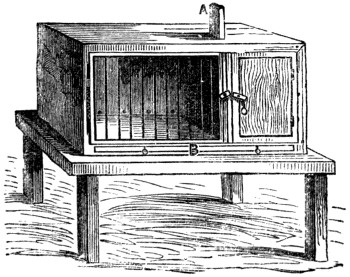
Such a one as this may be easily made by any boy of ordinary ingenuity, as no great neatness in joints is needed, and the only requisites are strength and compactness. Should not the young carpenter possess the wood and tools needed for the entire construction of the hutch, his best plan will be to purchase an old tea-chest or egg-box from the grocer’s, and modify it into the necessary form. The box will cost about fourpence, or sixpence at the most; the wire will cost a penny, and the nails another penny.
If no tools can be borrowed, a boy can set himself up for ordinary work at a very cheap rate, the following being all that is really needed:—
Saw, one shilling; hammer, eightpence; half-inch chisel, with handle, sixpence; small three-cornered file, twopence; two bradawls, one large, and the other rather small, twopence,—these will be without handles, and the best way is to drive the “tang” of the bradawl into the end of a stick of firewood, then cut the stick into a handle, shape it with a knife, and bind the end with string or wire to prevent it from splitting. These handles are just as useful as those which are purchased, and have the advantage of costing nothing but a few minutes’ labour. The whole set of tools need not cost more than half-a-crown or, at the most, three shillings.
As will be seen from the illustration, the hutch is divided into two portions, that on the left hand being much the larger, and employed by the rabbit as a day-room. That on the right is small, and is used as a sleeping apartment. These two chambers are separated by a partition of board, in which is cut a hole, through which the inmate can pass backwards and forwards.
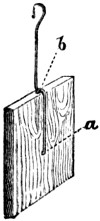
As it is often necessary to confine the rabbit in either compartment while the other is being cleansed, the aperture must be closed by means of a sliding door drawn up and down through the roof, as seen at A. We have found by experience that the purpose was fully answered by substituting a strong iron wire for the wooden handle, and letting it pass through the hole bored in the roof. We mention this, because it is always best to know the simplest and easiest plan of proceeding. The wire is firmly secured, as seen in the engraving. After cutting the sliding door to the proper shape, bore a hole at a with the little bradawl. Sharpen one end of an iron wire (the same as that of which the open front is made) and push it firmly into the hole. Now bend the wire upwards, until it lies flat upon the wood, and then bend it over the edge, as seen at b. Cut off an inch of wire, sharpen both ends, bend them so as to form a staple, and drive the staple over the wire at b, so as to hold it firmly in its place. Two small holes should be made with the little bradawl in the proper direction, and the hammer must do the rest. Bend up the wire again, cut it off to the proper length, and all is ready for fixing, which is done as follows:—
Take the board which is to form the partition, and which is easiest made from the lid of the box, and cut out a round, arched, or square hole near the bottom, the hole being about an inch narrower every way than the sliding door. Lay the door over the hole, and place on each side of it a strip of wood a trifle thicker than the door. These slips are technically called guides, because they guide the door in the right direction: try whether the door will slide easily up and down them, and, if so, nail them firmly in their places. Then get a second pair of wooden slips, not so thick, but about half an inch wider than the first pair; lay them on the guides so that they overlap the door, and then nail them down. The door will then slide up and down when pulled or pushed by the wire.
To make this part of the proceedings quite clear a section of the door and slide is given below: g represents the guides; f the board and their slips which overlap the door; and the door itself is shown by the dotted lines b*. When fitted together the partition-board, with its door and slides, is shown in the engraving. a, a, a represents the board itself; b is the sliding door, and c the wire by which it is worked; d is the hole of communication, which is opened or closed as the door is moved up or down; which is here shown as half closed.
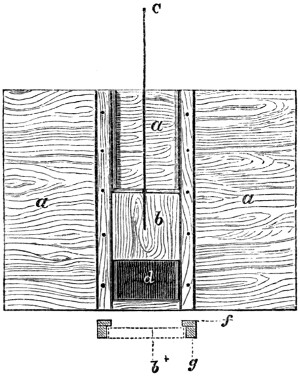
The dividing-board being thus completed, mark the place where the wire c is to come through the roof, and bore a hole about half as large again as the wire, so as to allow it to play freely. By the simple plan of making a large nail or waste bit of wire red hot, and charring this hole, the swelling by damp and consequent sticking of the wire will be prevented.
All being ready, slip the dividing-board into the box, taking care to insinuate the wire into its proper place, get it quite upright and square, make sure that the sliding door plays without hitching, and then nail it all tight. Bend the top of the wire into a loop, and the most troublesome part of the business is over. The young carpenter must remember that the dividing-board, with its sliding door, must be made and fixed before anything else is done, as it not only strengthens the box and keeps it in shape, but would demand twice as much trouble after the door and front have been made.
We now come to an easier and more ornamental part of the work.
In the engraving both doors open from the front, the one being wired and the other plain wood; but it is best to have the larger door open from behind, as the wire-work is then twice as strong, and all the trouble of making a hinged frame is dispensed with.
Put the box on the ground, and draw a line from one end to the other, just half an inch from the edge. Mark the line off in half-inches, and bore holes quite through the wood, one hole coming at every half-inch. Repeat the same process immediately below, but be careful only to bore the holes half through the wood, or the wire will of course fall through.
Then cut your wire into lengths, measuring them by the depth of the box, and cutting them about one-third of an inch shorter than the total depth. Laying them against the end is a simple method of getting the precise length. Sharpen one end of each piece of wire, push the sharpened end through the hole at the top, draw the wire down, insinuate the point into the hole below, and then, holding the middle of the wire with the fingers of the left hand, in order to keep it from bending, drive it down with the hammer until quite level with the top of the box. When all the wires are thus driven home, nail a strip of wood over them at the top, and they can never come out again.
It will be better to strengthen it further by passing a similar wire horizontally across the others, driving each end into the wood, and binding all together with fine wire. This will be a protection through which not even a rat could crawl, and which no cat could tear away with her hooked claws.
The door of the sleeping apartment is easily made of a single piece of board, cut to the requisite shape, affixed by leathern or metal hinges, and fastened by a simple hasp. The door of the day-room is made in a similar manner, but opens from behind. A row of deep notches should be cut at the bottom of this door, and corresponding holes bored through the back of the sleeping-room floor, in order to let all the wet drain away and keep the rabbit dry. The hutch should be made to slant a little backwards so as to aid in the drainage.
Slate floors have been suggested, in order to prevent the ill-drained moisture from soaking into the substance—a result which is sure to take place, sooner or later, with a wooden floor. Slate, however, is rather expensive, but it is easily cleaned, and can be thoroughly washed; so that the suggestion is worthy of notice.
Having completed the hutch, we must next see about a feeding-trough. The ordinary troughs are nothing more than long wooden boxes; those who use them generally find that the food is much wasted by being scraped out with the fore feet, and that the rabbit contracts a habit of sitting in the trough, which, in course of time, renders it very offensive, and makes the food unwholesome. But by a little exercise of ingenuity both these annoyances can be prevented.
To check the scratching out of the food, run a strong wire from one end of the trough to the other, about half an inch below the edge, and one inch from the side. When the rabbit begins to scratch, the paws come against the wire, and get so jarred that the creature soon relinquishes the bad habit.
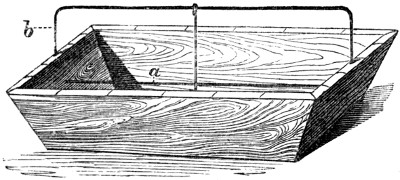
The habit of squatting in the trough is easily prevented by a very simple plan. A strong wire, about three or four inches long, according to the depth of the trough, is set upright in the centre. Another wire is arranged as seen in the illustration, the ends being driven firmly into the wood of the trough, and the middle passing through a loop at the end of the central wire. In the engraving, a represents the wire which prevents the animal from scratching, and b that which keeps it from getting into the trough. The edges, whether of the trough, the sliding door, or the guides, must be either bound with tin or edged with zinc wire, the latter being rather preferable.
The reader will observe that in the engraving of the hutch it is shown standing on a table, the top of which projects far beyond the legs. The object of this precaution is to keep off rats, which are the bane of all rabbit-owners, and can climb up almost anything. They, cannot, however, walk like a fly, in a reversed position, on a flat surface, and in consequence, a projecting board of five or six inches in width is an effectual protection against these pests.
The hutch is easily kept clean by attending to each apartment separately. First close the sliding door, so as to confine the rabbit in the apartment in which it happens to be, and with a hoe or similar implement scrape the floor quite clean, afterwards rubbing it with a wisp of straw. Take care that every scrap of refuse food has been removed. Then close the outer door, open the slide, drive the rabbit into the clean apartment, close the slide, and scrape and rub the second chamber.
The trough should be removed when the day-room is cleaned, and carefully examined before it is replaced. The hutch being clean, the slide may be opened, and the animal allowed to run about. The hutch should be cleansed at least every day, and if a second cleaning be added it will not come amiss. This continual cleaning will involve some trouble; but no one ought to keep a rabbit who neglects this essential duty, or to undertake the charge of an animal unless he intends to make it as happy as it can be in a state of imprisonment. A supply of straw should be placed in the sleeping-room for a bed, and should be changed daily.
If possible, the rabbit should be allowed to take a half-hour’s run every day; but precautions must be taken against its burrowing habits and the chance of finding and eating something poisonous. In the wild state, a rabbit never eats anything that is injurious, but when domesticated many of its instincts are in abeyance, and it will eat many substances which it would reject when wild.
The best defence against burrowing is to have a brick floor for the animal to run about on. There is also a substance called, I believe, Parker’s cement, which, when laid down, becomes rapidly dry, and is so hard that not even the teeth of a rat, much less the claws of a rabbit, can work their way through it. This cement is mixed with water and sand to the consistency of thick cream, and while settling is “flatted” with boards, and makes an admirable level flooring, easily washed and as hard as stone. On this substance the rabbit can be allowed to amuse itself without danger, and when its time of recreation has expired it should be caught and replaced in its hutch.
We may here mention that the proper method of taking up a rabbit is to hold it by the ears with the right hand, and to support the body by placing the left hand under it.
Should a number of rabbits be kept, it is as well to allow each family to have a run in succession. It is very pretty to see the playful antics of the young rabbits, the races they run with each other, the scufflings they have in the corners, and the staid manner in which the mother sits and looks on, and when they become too noisy silences them by a stamp of her foot.
This gesture is used either as a signal of alarm or defiance, and the force of the rabbit’s hind foot is really astonishing. We have known a buck rabbit vanquish a large cat in a fair fight simply by jumping over her back and kicking fiercely as he passed. He struck out whole bunches of pussy’s fur, and the cat, unaccustomed to such treatment, ran away and left her antagonist victorious and triumphant.
It is necessary to separate the rabbits in their exercise, and not to permit two families to occupy the same ground at the same time, as they are very quarrelsome animals, and will fight desperately among themselves. In any case the buck rabbits should not be allowed to mix with the others, for they are terrible bullies, and will assault and kill even their own children, without the least remorse. When properly tended, the rabbit becomes quite tame and familiar, and will come to its owner at the sound of its name.
The food of rabbits is easily obtained, and consists of bran, pollard, grain, and various vegetables. Parsley is an especial favourite, but cabbage leaves should be avoided as far as possible, as they are apt to have a bloating and puffy effect, and are often injurious, especially to young rabbits, giving them the disorder that is well known under the expressive term of “potbelly.”
The following is a list of vegetables which rabbits can always eat in safety:—
Grasses of the finer sorts—the coarse, large-bladed grasses are not to a rabbit’s taste—lettuce, parsley, carrots and their green tops, turnip-tops, green ears of corn, sow or milk thistles, clover, tares, vetches, beet-root and leaves, vine leaves occasionally, green furze tops, potatoes, and Jerusalem artichokes. Cow-parsley, as it is popularly called (Myrrhis temulenta), is a very favourite vegetable with the rabbit: but unless the gatherer is perfectly acquainted with its form and leafage, he will be wise to leave it standing; for it marvellously resembles the common hemlock (Conium maculatum), which is extremely poisonous; and unless the two plants be thoroughly known, the rabbit may be poisoned through the mistaken kindness of the owner.
As this plant is a really valuable one, we will give a few simple and plain directions for distinguishing it from hemlock.
Cow-parsley is about three feet in height, the leaves are greatly branched, and the stem is ribbed, spotted with purple, and covered with numerous short hairs slightly bent downwards. The hemlock in general shape resembles the cow-parsley, but it may be known by the smooth reddish purple spots and its unpleasant smell when the leaves are grasped in the hand.
Various dry grains, such as barley, oats, and Indian corn, are useful to the rabbit; and dry peas are also beneficial if sparingly given when the creature has been partaking largely of green food. Very little water is needed; but it is better to put into the hutch a small pan with a few spoonfuls of water in it. A very little oil-cake is useful in the winter. At first the rabbits do not like it, but they soon become accustomed to its taste, and are then very fond of it.
Before proceeding to the mode of breeding rabbits, we will glance at the varieties into which these creatures are modified by careful management.
The three chief points in a “fancy” rabbit are the ears, the dewlap, and the curve of the back.
The ears must in every case be exceedingly long, and must never stand upright, as in the common rabbit of the warren. The most perfect and valuable form is the Full, Flat, or Perfect Lop. In this variety the ears lie as if hinged to the head at their bases, and bent downward, so that when the animal is reposing the tips should quite or nearly touch the ground. The convex part of the ear must be upwards, or the value of the creature is deteriorated.
The next valuable variety is termed the Oar-Lop, because the ears spread horizontally from the head, like the oars of a waterman’s boat. A really good Oar-Lop rabbit is seldom seen, and when found is thought by some to be equal to the Perfect Lop, of which, indeed, it seems to be the preliminary stage. In all cases the measurement across the ears from tip to tip ought never to be less than sixteen inches; the more they exceed that measurement, the more valuable is the animal.
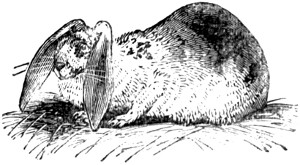
PERFECT-LOP RABBIT.
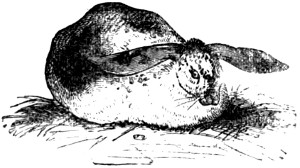
OAR-LOP RABBIT.
PERFECT-LOP RABBIT.
OAR-LOP RABBIT.
The Horn-Lop is another very curious variety, deriving its name from the position of the ears, which fall completely over the face, with their points directed to the front. In some specimens they fall so completely over the face that the edges pass over the eyes, and must act as a partial barrier to perfect sight, like the leather blinkers that are so absurdly attached to draught horses.
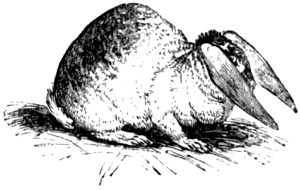
HORN RABBIT.
The lopped ears do not show themselves when the rabbit is young, and for the first month or two it is not easy to decide whether the little creatures belong to the straight or the lop-eared variety. Moreover, it often happens that one or two of each family retain the upright ears throughout their whole existence; and it is of not unfrequent occurrence that the “lop” is delayed for a very long time, and then suddenly makes its appearance. Sometimes one ear will exhibit the lop most perfectly, while the other remains upright or very slightly bent. Some fanciers attach a piece of lead to the recusant ear in order to make it coincide with the other, but we do not agree with the practice. The ear never looks quite natural, and as the rabbit will have or, as the phrase is, throw young ones with perfect lops, it may be kept for breeding if a doe; if a buck, it can be fattened for the table.
The second point of interest is the dewlap, the large double pouch which is seen under the chin and throat, and which is peculiar to the fancy rabbit. If the dewlap be not large and full, with its two lobes well developed, and sufficiently firm to form a cushion for the head while the animal reclines, the rabbit will be thought worthless by fanciers.
The shape of the fancy rabbit is very different from that of the common variety. It is altogether on a larger scale, and the back rises so much, that its summit ought to be two inches higher than the top of the head.
The colour, again, is very important. It may be white, black, mottled, tortoiseshell, blue, and in fact any colour except the plain grey. Whatever it be, it must be arranged after a special position. On each side of the nose must be a patch of the darker colour of the body, forming what is called the “butterfly smut.” A large patch on the back is called the “saddle,” and a row of spots termed the “chain” is drawn in front of the body and seems to hang over the shoulder. The legs must be white, and the tail and snout of the same colour.
Very few rabbits possess all these qualities; but even the combined excellences of smut, chain, and saddle will fail to gain a high rank for any rabbit which does not possess a good “carriage,” i. e. whose back is not at least two inches above its head, and whose nose and ear-tips do not nearly touch the ground. Some writers say that the fancy rabbits are more delicate of health and less easy to rear than the common variety; but we have bred many families of them, and never found any difficulty in rearing them. Their superior size renders them valuable for culinary purposes, and, as out of every family the greater number are deficient in the requisite marks of a fancy rabbit, the table can be well supplied with these fat and well-flavoured creatures.
The last variety we shall mention is the beautiful Angola rabbit, remarkable for its long silken hair, a speaking likeness of which may be seen in Landseer’s wonderful picture of Titania.
We will now devote a few words to the breeding of rabbits.
The rabbit will breed at a very early age, i. e. from eight months upwards; but those who want healthy young ought not to allow the rabbits to breed before they are one year old, or after they have completed their fourth year. The buck and doe should be always kept in different hutches, out of each other’s sight, and only allowed to remain together for a very short time. The rabbit usually breeds four times in the year, or even oftener; but as a general rule it is not advisable to allow more than three breeds in the year.
When the doe rabbit feels the time approaching for her young to be born, she begins to bite in little pieces the hay of her bed, and when she does so a supply of very fine soft hay should be placed within her reach. She then pulls this together in her sleeping-chamber, and mixes it with downy fur plucked from her own body, ready for the reception of the expected family.
It is as well to put a pan of water within reach, as the animal generally thirsts after the young are born, and unless she can get at water, is apt to eat the young merely on account of the moisture. One of my own rabbits acted in a very odd manner. She called to one of her family, telling it to come to her. The disobedient child refused, and the mother accordingly seized it by one ear and dragged it along. Unfortunately, she pulled so hard in one direction, and the young one pulled so hard in the other, that the ear was fairly dragged from the head. The mother treated the matter very easily, ate the severed ear, caught hold of the other, and succeeded in reducing her offspring to obedience.
While engaged in maturing her young, the mother requires a very ample supply of food, eating nearly twice as much as at other times. She must have plenty of green food, and a mash of barley meal and milk will be found beneficial. For the first week or ten days the door of the sleeping-room should not be opened, as the mother-rabbit is very jealous of her young, and if they are handled, or even looked at, will sometimes eat them. This is a terrible habit, and if a rabbit once act in that manner, provided that she is well supplied with food and drink, the best plan is to fatten her for the table.
The young are suckled for about five weeks, when the mother weans them, and they learn to eat tender grass-blades, and other green food. If the family be very large, there is sure to be at least one small and weakly among the number. This should be removed and destroyed, so as to ensure that only the strong and healthy are reared.
There are several diseases to which domestic rabbits are liable, but these ailments are nearly all caused through negligence; and in a really well-appointed and carefully-tended rabbitry a sickly animal is hardly ever seen.
Except in the case of valuable fancy animals, the trouble and expense of attempting the cure of a diseased rabbit are so great, that few will find themselves repaid, even by the recovery of the invalid. Recovery, however, is so very dubious, that in almost every case it is cheaper and more humane to kill the animal at once, which is performed instantaneously and painlessly by holding the creature up by the hind legs, and with the edge of the right hand striking it a sharp blow behind the ears. Let the young rabbit-keeper rest assured, that if one of his pets should fall ill, the sickness will in ninety-nine cases out of a hundred be chargeable to some negligence of his own.
THE RAVEN.
All the members of the Crow tribe have a decided family likeness; and, as a general fact, the relationship can be recognised as long as they belong to the British species. But as there are several foreign birds which bear a decided resemblance to this tribe, though really belonging to other families, it is needful to give a few hints as to the method by which these may be distinguished. The young observer must look first at the beak, then at the wings, and lastly at the legs. In all these birds the beak is strong and conical, arched on the keel, i. e. the ridge along the upper surface, with the sides rather flattened as far as the tip. The nostrils are set at the base of the beak, and hidden by plumes. The wings are never very large, and mostly pointed. The tarsi, i. e. the long, straight leg-bones, are of moderate length, and covered with strong, shield-like scales.
The British representatives of this large family are the carrion crow, the rook, the Royston or hooded or grey crow, the chough, the raven, the jackdaw, the jay, and the magpie.
The Raven, once so plentiful over England, is now nearly extinct, except in some of the wild uncultivated districts, where it still lingers, uttering its hoarse, loud cry, flapping its broad wings, and committing no small havoc among the young or feeble animals that have the misfortune to dwell in its neighbourhood.
To procure a raven is now a difficult task, and can seldom be accomplished except by giving an order to the regular dealers. We do not advise any of our young readers to possess themselves of a raven unless they have ample space for the bird, and are quite certain that it cannot get into any mischief. Either a magpie, a jay, or a jackdaw, seems to be possessed with an incessant spirit of mischief, but the raven seems to have enough for the three, and as it possesses enormous muscular power and irrepressible audacity, it is a peculiarly unsafe inmate of a house or garden.
For our own part, we have been for some months undecided whether we shall have a raven or not. We should greatly like to possess one of these birds, but then we know that he would pull up all our newly-sown seeds, bully our cat, peck the servants’ heels, get into the milk-pail, tear our papers to pieces, and, in short, spoil everything within his reach. We could, of course, chain him up, and clip his wings, or put him into a metal cage, but we think all such proceedings to be needlessly cruel, especially in the case of a bird like the raven, whose instinct teaches it to roam far and wide, and whose opportunities of exercise ought never to be confined to the limited space comprehended by a chain or a cage.
When treated properly, the raven possesses a very mine of amusing and companionable qualities, at all events to those who treat it kindly, and whom it does not suspect of any intention to injure. It is a capital talker, equalling the parrot in that respect, except that the voice is very gruff and low, as if spoken from under a feather bed.
The raven is not long in taking the measure of its companions, and has a supreme contempt for those who display weakness of mind or resources. Nothing seems to make a raven so happy as frightening somebody. He likes to come quietly behind a nervous person, deliver a heavy dab at the ankle with his iron bill, and then walk away as if he knew nothing about the assault. He will frighten dogs half out of their senses, chase the cats, drive the fowls about, and as to the horses, he mostly takes a fancy to them, sitting on their backs, or walking calmly and deliberately among their legs. Indeed the raven always has a great affection for stable life. He likes to saunter in and out of the stalls, to flap his way from one horse to another, to peck at strangers, to patronise the helpers, to be on speaking terms with the grooms, and, we regret to say, has a strange talent for picking up all the evil language which is too often found in and about the stable-yard.
He encourages the presence of dogs and cats, because he always steals their dinners; and if he can find an opportunity of making a sly raid upon the luncheon of a groom, he is sure to seize it. He becomes the patriarch of the yard, and stands by his dignity as such. He won’t die, but lives on, year after year; sees successive generations of horses, grooms, and proprietors pass away, and seems to despise them for not living as long as himself. Time seems to have little power with him. His feathers take a greyer hue when he is a century or two old, but in disposition he remains ever young, malicious, crafty, active, quaint, and voracious.
He will eat anything, and can be taught to devour the most remarkable substances, provided that he thinks them very valuable, and not intended for food. Raw meat is perhaps his favourite diet, and he is greatly pleased with rats, mice, small birds, fat beetles, big grubs or worms, and similar delicacies. But he will eat bread when he cannot get meat; and if he can only be got to believe that the article is extremely valuable, he will make a breakfast on a newspaper or a shirt-collar.
He can be easily induced to swallow even a black-lead pencil or a pocket-handkerchief, by a very simple process. Drop the article as if accidentally, search for it anxiously, go away without seeming to see it, and hardly will your back be turned when the raven will have snatched up the missing article and conveyed it to his storehouse.
If watched from a spot where the observer cannot be seen, he will be noticed to proceed in a very methodical manner. He will first pick up his prize, and walk about solemnly with it in his beak, as if displaying a captured trophy of war. He will then put his foot on it, seize one corner of the paper or handkerchief in his beak, and deliberately tear it into strips, which he will probably swallow. As to the pencil, he pegs at it with the point of his beak at a wonderful pace, making the splinters fly in all directions, and ever and anon looking round, to see that no one is watching him.
Clever as is the raven, and intelligent beyond the wont of birds, his very superiority in this respect often has the effect of rendering him a victim to superior powers. There is scarcely any bird that can be hoaxed more readily than a raven, or that can be “drawn out” with greater ease. Those who humour his ways can make a perfect puppet of him, and induce him to play most undignified antics, without giving him the least idea how thoroughly he is being imposed upon.
Our last advice is that, unless the reader can afford plentiful space for his bird, and assure it a kind treatment, he will act wisely not to attempt to procure a raven. Should, however, he be able to afford it these necessaries of existence, by all means let him procure one of these most amusing birds.
Ravens require scarcely any trouble, and when they have fairly established themselves, will not desert their homes under any circumstances. They ought to be fed once, and once only, per diem, for they will find plenty of insects, worms, and other little delicacies, without giving any trouble. They should always be furnished with a place of retreat into which they can retire whenever they feel tired of the world, and they like the hermitage to be deep, dark, and warm, sheltered from wind and rain, and out of the way of inquisitive eyes.
Finally, a raven is an excellent judge of character, and if he is really appreciated, he will become a firm and faithful friend.
SILKWORMS.
“The proudest king May thank the silkworm for his robe of state.”—Akenside.
The rearing and management of silkworms is an innocent and agreeable pastime both to boys and girls, and it is very interesting in many points of view. One fact is, that while the caterpillars of all the other tribes of moths and butterflies, when they have arrived at a certain state of maturity, show a restless disposition, and wander about and hide themselves in a variety of places in order to spin their cocoons, the silkworm, on the contrary, is content to remain stationary in the open tray or box in which it may be placed. After consuming its immediate supply of mulberry leaves, it waits for a further quantity, and when the period arrives for spinning its cocoon, instead of showing any migratory disposition, it seems to place itself with confidence under the care of man to provide it with a suitable place for its convenience and protection.
The silkworm is systematically known under the name of the Bombyx Mori of Linnæus, or the Mulberry-tree Moth, which in the winged state is of a cream colour, with several transparent bands of a darker colour across the anterior wings and a crescent-shaped central mark. The caterpillar when full grown is nearly three inches in length, and is too well known to our young friends to need any particular description. The eggs when good are of a pale slate or dark lilac colour; they may be purchased in Covent Garden market for about ten shillings per ounce; and care should be taken to obtain them of a proper colour, because those that are of a pale yellow are imperfect.
The silkworm when first hatched is black, and does not exceed in length one-fourth of an inch. The desire for food is the first symptom it exhibits of life, and at this period it is more active than at any other. When about eight days have elapsed after its hatching, its head becomes considerably enlarged, and it turns sick, refuses food, and remains in a state of lethargy for about three days. This sickness would appear to arise from the pressure of the animal’s skin, which has become too tight for the increased bulk of its body. Indeed, the very great difference in the size of the worm from the beginning to the end of the caterpillar state is so great, that Nature has furnished it with several skins, each of which it casts in succession.
The body of the caterpillar is begirt by twelve rings, which approach to or recede from each other according to its motion; there are nine breathing-holes on each side of the body, seven eyes on each side of the head, and two small orifices below the jaws, through which the worm ejects its silken filament.
The art of using this filamentous substance seems to have originated with the Chinese, and to have been discovered at a very early period, and the raw material was purchased by the Persians, Tyrians, and Indians for a long time before it was introduced into Europe. For many ages silk bore an enormous price at Rome, but about the middle of the sixth century two monks arrived at Constantinople from India, bringing with them the white mulberry and the eggs of the silkworm, which have since been reared in Italy, Spain, France, and other parts of Europe.