PART III. Scientific Pursuits: (continued 4)
Reading edition
It would be very difficult, and would require geometrical reasoning of a lengthened kind, to show why this particular form of construction should lead to such results.
THE COSMORAMA.
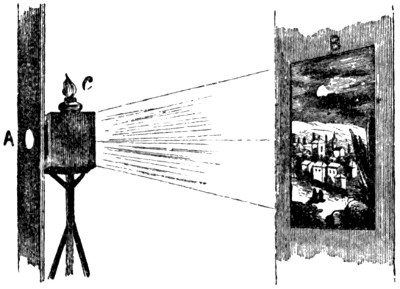
The principle upon which the cosmorama is formed is so simple, that any person may easily fit up one in a small summer house, &c. Nothing more is necessary than to fix in a hole a double convex lens of about three feet focus, A, and at rather less than this distance a picture, B, is to be hung. To absorb all the rays of light but those necessary for seeing the picture, a squared frame of wood blackened on the inside is placed between the lens and the picture. The picture may be hung in a large box having a light coming in upon it from above, or in a small closet illuminated in the same manner. Should it be wished to show it by candle-light, a lamp, c, may be placed on the top of the wooden frame, and if the light of this be converged by a lens to a moderate radius, it will be more effective.
DISTORTED LANDSCAPES.
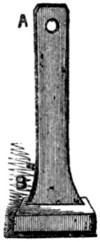
Landscapes or other matters may be drawn so as to produce curious optical illusions by the following method. Take a piece of smooth white pasteboard and sketch the design upon it. Prick the outlines in every part with a fine pin or needle, then place the pricked drawing in a perpendicular position, and put a lighted candle behind it. Place before it another piece of pasteboard, and follow with a pencil the lines given by the light, and you have produced a distorted landscape. Now take away the candle and the pricked drawing, and place your eye where the light was, and the drawing will assume the regular form. To get your eye in the proper position, it will be advisable to cut out a piece of card according to the accompanying pattern, and raising it on its base, B, look through the hole at A, when the object will appear in its proper proportions.
PHOTOGRAPHY.
“Come like shadows, but not so depart.”—Shakspeare.
Associated with the use of iodine and bromine is an art which every intelligent boy may practise, if he will attend to the following precise details kindly furnished by Mr. Richard Thomas, of 10, Pall Mall, who has devoted many years to the careful study of all the processes connected with it, and from whom all the best apparatus and purest chemicals required may be obtained.
HOW TO MAKE THE NEGATIVE ON GLASS, USING COLLODION BROMO-IODIZED FOR IRON DEVELOPMENT.
1. The edges of the glass should be ground all round, also slightly on the surface of the edges. This prevents contraction of the film, enabling it to resist the action of a heavy stream of water. Mark one side in the corner with a diamond, and upon this side bestow the greatest care.
2. To clean the glass, if new.—Make a mixture of spirits of wine and solution of ammonia, equal parts; render it as thick as cream with tripoli; with a piece of cotton-wool kept for this purpose rub a small quantity over that side marked as described, wash well under a tap of water, and wipe dry with a piece of old linen, washed without soap, and kept scrupulously clean for this purpose. Plates should not, however, be cleaned in the operating room with the above mixture; the vapour of ammonia might prove injurious to the chemicals.
3. Now polish with an old white silk handkerchief. If this latter precaution be not taken, small particles of linen will be left upon the plate: these are perhaps only seen when draining off the collodion; they form nuclei and eddies, checking the collodion in its course. Some of these minute fibres are washed off, and contaminate the next picture. To all lovers of clean pictures our advice therefore is, having well dried the plate with old linen, lay it, clean side upwards, upon a few sheets of common glazed demy paper (not blotting), and rub it hard with the silk until sensibly warm: this has the double advantage of dispersing fibres and moisture, for all glass plates are slightly in a hygrometric condition. Double the silk rubber up to form a pad, and with this the glass must be firmly dusted down just before pouring on the collodion, which will then run most evenly: if the coated plate is now viewed by transmitted light, not a speck or blemish will be seen upon it. When a plate cleaned as above described is breathed upon, the moisture does not evaporate slowly, but flies off. Do not be afraid of putting the glass into an electrical condition with the silk rubber: on this account objections have been raised to the use of silk: practically, however, I find it a most valuable auxiliary in this starting-point of the process, the perfect manipulation of which makes an important difference in the value of the finished picture. What can be more inartistic and annoying to an educated eye than spots, patches, stars, and sky rockets, the forms and shapes of which rival, in numberless variety, a display of fireworks? Let us not, therefore, be contented with pictures, however good in other respects, presenting these deformities—so many blots on the photographic escutcheon.
To clean a glass after having used it, when not varnished.—Wash off the collodion film with water, then clean the marked side with plain tripoli and water, and dry as above.
To coat the plate.—First remove all the particles of dried collodion from the mouth of the bottle. Now pour upon the centre of the cleaned glass as much collodion as it will hold. Do not perform this operation hurriedly, take time, and systematically incline the plate in such a manner that the collodion may run into each corner in succession; when perfectly covered, pour off gently the excess into the bottle at one of the corners nearest to you: with observation and practice dexterity is easily acquired. There are many ways of coating the plate; each person will adopt that which practice teaches him is best. The pneumatic plate-holder is a convenient little instrument to use for holding the plate whilst pouring on the collodion: it may be used for both small and large plates.
Keep the corner of the glass plate in contact with the neck of the bottle whilst pouring off the collodion; otherwise the film will be wavy in places.
4. As soon as the collodion ceases to run, plunge the prepared glass gently, without stopping, into the nitrate of silver bath, which is prepared as follows. Into a 20-oz. stoppered bottle put nitrate of silver, 11⁄4 ozs.; distilled water, 4 ozs.: dissolve. To this solution add iodide of potassium, 4 grs., dissolved in 1 drachm of distilled water. Mix these two solutions: the precipitate (iodide of silver) thus formed is by shaking entirely dissolved. Add 16 ozs. of distilled water, when the excess of iodide of silver is again thrown down, but in such a finely divided state as to render the saturation of the bath with iodide of silver perfect. Now drop in sufficient of the oxide of silver to turn the turbid yellow solution a dirty brown colour; so long as this effect is produced the quantity of oxide of silver, however much in excess, is of no consequence; shake the bottle well for ten minutes or so at intervals; then add alcohol, 30 minims, and filter; to the filtered solution add dilute nitric acid of the strength stated, 5 minims. The bath is now ready for use, and should be quite neutral.
5. Allow the prepared glass to remain in this bath from five to ten minutes, according to the temperature. Move it up and down three or four times whilst in the bath, in order to get rid of the greasy appearance on the surface: drain it, but not too closely. When in the frame, place upon the back a piece of common blotting-paper, to absorb moisture, and the two lower silver wires should also be covered with slips of blotting-paper; after which the sooner it is placed in the camera the better.
6. The time of exposure can only be ascertained by practice—no rules can be laid down; and I am unacquainted with any royal road, but that of experience, leading to constant success in this most important point.
7. The plate having been taken from the camera, and placed upon a levelled stand, or held in the hand, develop immediately the latent image with the following solution:—
Iron developing solution.—Protosulphate of iron, 1⁄4 oz.; glacial acetic acid, 1⁄4 oz.; spirits of wine, 1⁄2 oz.; distilled water, 8 ozs.: mix. Pour on of this solution only enough to cover the plate easily, commencing at that edge of the negative which stood uppermost in the camera; move the solution to and fro until it has become intimately mixed with the silver on the plate; then pour off into the developing glass, and at once return it on to the plate. When as much intensity has been obtained as possible with the iron developer, it should be thoroughly removed by washing with water. Any intensity may be obtained afterwards by using either of the following solutions:—
8. Intensifying solution.—Pyrogallic acid, 6 grs.; glacial acetic acid, 1⁄4 oz.; distilled water, 6 ozs.: mix. A few drops of a 30-gr. solution of nitrate of silver, the quantity to be regulated according to the intensity required, to be added, at the moment of using, to as much of the pyrogallic solution as may be necessary.
Intensifying solution (another form).—1. Pyrogallic acid, 8 grs.; citric acid, 20 grs.; distilled water, 2 ozs. 2. Nitrate of silver, 8 grs.; distilled water, 2 ozs. Mix small quantities of the solutions 1 and 2, in equal portions, the moment before using.
The pyrogallic solution, made with good acetic acid, may be kept for a month or more in a cool place. Nevertheless, if the conditions of light and situation are unfavourable, I should prefer this solution just made. The iron solutions act best when freshly prepared.
It is supposed by some that a prolonged action of the iron developer produces fogginess. This may be the case when impure or improperly prepared collodion is used, but certainly not when the preparation is pure and of the proper quality.
When the image is sufficiently intense, wash freely with common filtered water; then pour on a saturated solution of hyposulphate of soda, which should immediately remove the iodide of silver: wash again well with water; allow as much as the plate will hold to soak in for at least a quarter of an hour, changing the water occasionally, to remove all traces of hyposulphate; lastly, wash the plate with a little distilled water, stand up to dry, and, if required, varnish either with spirit or amber varnish.
The following solution is also very commonly used for fixing the negative:—Cyanide of potassium, 1⁄4 oz.; water, 12 ozs.
Attention to the following rules and cautions will assist the operator in the production of perfect pictures:—
1. Do not disturb the deposit which will occasionally be found at the bottom of the bottle containing the collodion.
2. Remove all particles of dried film from the neck of the bottle before pouring the collodion on the plate.
3. Never use damp cloths, leathers, or buffs, for giving the final polish to the plate. Negatives with an indistinct and muddy surface are frequently produced from this cause.
4. Let the film set properly before immersion in the nitrate of silver bath: its condition can be ascertained by gently touching the lower part of the coated plate with the end of the finger.
5. Never omit to pass a broad camel-hair brush over the plate just before pouring on the collodion.
6. Bear in mind that, as light is the producing agent, so will it prove a destructive one: not less than four folds of yellow calico should be used to obstruct white light; and in that case the aperture covered should be no larger than is necessary to admit sufficient light for working by. Examine occasionally the yellow calico: when this material is used to exclude white light, it becomes bleached by constant exposure. Do not trust alone to any coloured glass; no glass yet made is anti-actinic under all aspects of light and conditions of exposure.
7. When the negative requires intensifying, carefully wash off all traces of the first developing solution before proceeding to intensify. This operation may be performed either before or after the iodide is removed by fixing.
8. Glass baths are preferable to porcelain, ebonite, or gutta-percha baths for solution of nitrate of silver.
9. In using either spirit or amber varnish, before pouring it off, keep the plate horizontal a few seconds. This gives time for soaking in, and prevents the formation of a dull surface arising from too thin a coating.
10. Rub the lenses occasionally with a soft and clean wash-leather; the rapidity of action is much influenced by the brightness of the lenses: their surfaces are constantly affected by moisture in the atmosphere, which condensing, destroys the brilliancy of the image.
11. The white blotting-paper used for some photographic purposes is not suitable for filtering solutions; that only should be employed which is made for this purpose, and is sold under the name of filtering-paper.
12. Hyposulphate of soda.—A great deal of rubbish is sold under the name of this salt. As a test of its quality, 11⁄2 drachms should entirely dissolve in 1 drachm of water, and this solution should dissolve rather more than 41⁄2 grains of iodide of silver.
13. Chemicals.—The purity of photographic chemicals cannot be too strongly urged; the cheapest are not always the most economical. The commercial preparations are generally not to be depended upon, as these, though perhaps unadulterated, are, strictly speaking, not chemically pure. It is best to procure them from well-known chemists, who understand the purpose for which they are intended, and make the preparation of these substances peculiarly a branch of their business.
14. Never leave chemical solutions exposed in dishes: when done with, pour them back into glass-stoppered bottles, and decant for use from any deposit, or filter if necessary.
15. In all photographic processes it is absolutely necessary to be chemically clean; and this sometimes is not easy. As a rule, never be satisfied with cleanly appearances only, but take such measures as shall insure the absence of all extraneous matter in preparing the solutions, cleaning the glasses, dishes, &c.
16. All stains on the hands, linen, &c. may be removed by means of cyanogen soap or cyanide of potassium, which should be applied without water at first, then thoroughly washed off. To assist the operation, the hands may be now gently rubbed with a fine piece of pumice-stone, when the stains quickly disappear.
For more perfect and complete directions the reader is referred to a most excellent work, “The Modern Practice of Photography,” by R. W. Thomas, F.C.S.
PNEUMATICS.
“There is a tricksy spirit in the air That plays sad gambols.”—Ben Jonson.
The branch of the physical sciences which relates to the air and its various phenomena is called Pneumatics. By it we learn many curious particulars. By it we find that the air has weight and pressure, colour, density, elasticity, compressibility, and some other properties with which we shall endeavour to make the young reader acquainted by many pleasing experiments, earnestly impressing upon him to lose no opportunity of making physical science his study.
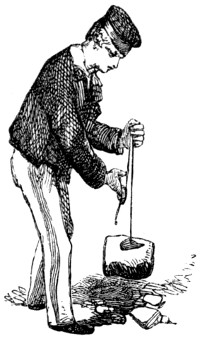
The common leather sucker by which boys raise stones will show the pressure of the atmosphere. It consists of a piece of soft but firm leather, having a piece of string drawn through its centre. The leather is made quite wet and pliable, and then its under part is placed on the stone and stamped down by the foot. This pressing excludes the air from between the leather and the stone, and by pulling the string a vacuum is left underneath its centre; consequently the leather is firmly attached to the stone, which enables you to lift it.
WEIGHT OF THE AIR PROVED BY A PAIR OF BELLOWS.
Shut the nozzle and valve-hole of a pair of bellows, and after having squeezed the air out of them, if they are perfectly air-tight, we shall find that a very great force, even some hundreds of pounds, is necessary for separating the boards. They are kept together by the weight of the air which surrounds them in the same manner as if they were surrounded by water.
THE PRESSURE OF THE AIR SHOWN BY A WINE-GLASS.
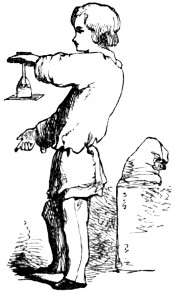
Place a card on a wine-glass filled with water, then invert the glass: the water will not escape, the pressure of the atmosphere on the outside of the card being sufficient to support the water.
ANOTHER.
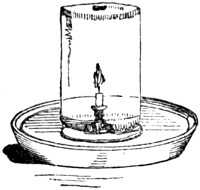
Invert a tall glass jar in a dish of water, and place a lighted taper under it; as the taper consumes the air in the jar, the water, from the pressure without, rises up to supply the place of the oxygen removed by the combustion. In the operation of cupping the operator holds the flame of a lamp under a bell-shaped glass. The air within this being rarefied and expanded, a considerable portion is given off. In this state the glass is placed upon the flesh, and as the air within it cools it contracts, and the glass adheres to the flesh by the difference of the pressure of the internal and external air.
ELASTICITY OF THE AIR.
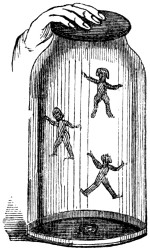
This can be shown by a beautiful philosophical toy, which may easily be constructed. Procure a glass jar such as is here represented, and put water into it. Then mould three or four little figures in wax, and make them hollow within, and having each a minute opening at the heel, by which water may pass in and out. Place them in the jar, as seen in the figure, and adjust them by the quantity of water admitted to them, so that in specific gravity they differ a little from each other. The mouth of the jar should now be covered with a piece of skin or india-rubber, and then, if the hand be pressed upon the top or mouth of the jar, the figures will be seen to rise or descend as the pressure is gentle or heavy; rising and falling, or standing still, according to the pressure made.
REASON FOR THIS.
The reason of this is, that the pressure on the top of the jar condenses the air between the cover and the water surface; this condensation then presses on the water below, and influences it through its whole extent, compressing also the air in the figures, forcing as much more water into them as to render them heavier than water, and therefore heavy enough to sink.
THE AIR-PUMP.
The time was, and that not very long ago, when the air-pump was only obtainable by the philosophical professor or by persons of enlarged means. But now, owing to our “cheap way of doing things,” a small air-pump may be obtained for about a guinea, and we would strongly advise our young friends to procure one, as it will be a source of endless amusement to them; and, supposing that they take our advice, we suggest the following experiments.
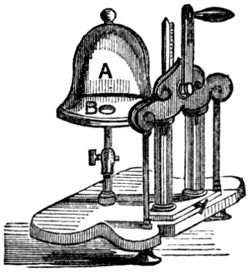
The air-pump consists of a bell glass, called the receiver, A, and a stand, upon which is a perforated plate, B. The hole in this plate is connected with two pistons, the rods of which are moved by a wheel handle backwards and forwards, and thus pump the air out of the receiver. When the air is thus taken out, a stop-cock is turned, and then the experiments may be performed.
Under the receiver of an air-pump, when the air has been thoroughly exhausted, light and heavy bodies fall with the same swiftness. Animals quickly die for want of air, combustion ceases, a bell sounds faint, and water and other fluids change to vapour.
TO PROVE THAT AIR HAS WEIGHT.
Take a florence flask, fitted up with a screw and fine oiled silk valve. Screw the flask on the plate of the air-pump, exhaust the air, take it off the plate, and weigh it. Then let in the air, and again weigh the whole, and it will be found to have increased by several grains.
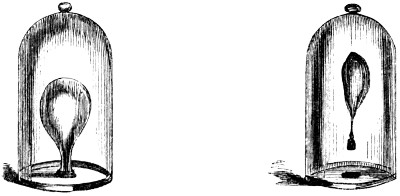
TO PROVE AIR ELASTIC.
Place a bladder out of which all the air has apparently been squeezed under the receiver, upon it lay a weight, exhaust the air, and it will be seen that the small quantity of air left within the bladder will so expand itself as to lift the weight. Put a corked bottle into the receiver, exhaust the air, and the cork will fly out.
SOVEREIGN AND FEATHER.
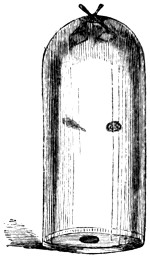
Place a nicely-adjusted pair of forceps at the top of the receiver, communicating with the top of the outside through a hole, so that they may be opened by the fingers. Then place on each of the little plates a sovereign and a feather. Exhaust the air from the receiver; and having done so, detach the objects, so that they may fall. In the open air the sovereign will fall long before the feather, but in vacuo, as in the receiver now exhausted of its air, they will fall both together, and reach the bottom of the glass at the same instant.
AIR IN THE EGG.
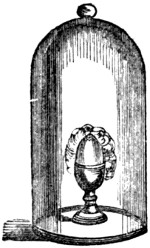
Take a fresh egg, and cut off a little of the shell and film from its smaller end; then put the egg under a receiver, and pump out the air; upon which all the contents of the egg will be forced out by the expansion of the small bubble of air contained in the great end between the shell and the film.
THE DESCENDING SMOKE.
Set a lighted candle on the plate, and cover it with a tall receiver. The candle will continue to burn while the air remains, but when exhausted will go out, and the smoke from the wick, instead of rising, will descend in dense clouds towards the bottom of the glass, because the air which would have supported it has been withdrawn.
AIR IN THE EGG.
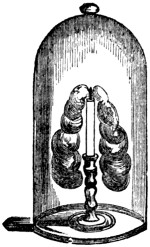
DESCENDING SMOKE.
AIR IN THE EGG.
DESCENDING SMOKE.
THE SOUNDLESS BELL.
Set a bell on the pump-plate, having a contrivance so as to ring it at pleasure, and cover it with a receiver; then make the clapper sound against the bell, and it will be heard to sound very well; now exhaust the receiver of air, and then when the clapper strikes against the sides of the bell the sound can be scarcely heard.
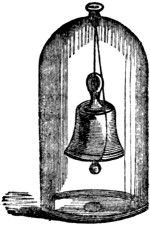
SOUNDLESS BELL.
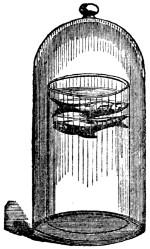
FLOATING FISH.
SOUNDLESS BELL.
FLOATING FISH.
THE FLOATING FISH.
If a glass vessel containing water, in which a couple of fish are put, be placed under the receiver, upon exhausting the air the fish will be unable to keep at the bottom of the glass, owing to the expansion of the air within their bodies, contained in the air bladder. They will consequently rise and float, belly upwards, upon the surface of the water.
THE DIVING BELL.
The diving bell is a pneumatic engine, by means of which persons can descend to great depths in the sea, and recover from it valuable portions of wrecks and other things. Its principle may be well illustrated by the following experiment. Take a glass tumbler, and plunge it into the water with the mouth downwards, and it will be found that the water will not rise much more than half way in the tumbler. This may be made very evident if a piece of cork be suffered to float inside the glass on the surface of the water. The air within the tumbler does not entirely exclude the water, because air is elastic, and consequently compressible, and hence the air in the tumbler is what is called condensed. The diving bell is formed upon the above principle; but instead of being of glass, it is a wooden or metal vessel, of very large dimensions, so as to hold three or four persons, who are supplied with air from above by means of powerful pumps, whilst the excess of air escapes at the bottom of the bell, as may be seen any day at the Royal Polytechnic Institution.
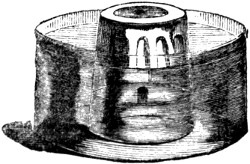
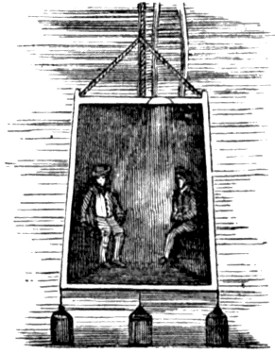
EXPERIMENTS.
1. Place a cylinder of strong glass, open at both ends, on the plate of the air-pump, and put your hand on the other end, and you will of course be able to remove it at pleasure. Now exhaust the air from the interior of the cylinder, and at each stroke of the pump you will feel your hand pressed tighter and tighter on the cylinder, until you will not be able to remove it: as soon as the air is again admitted to the interior of the cylinder, the pressure within will be restored, and the hand again be at liberty.
2. Tie a piece of moistened bladder very firmly over one end of a similar glass cylinder, and place the open end on the plate of the pump. As soon as you begin to exhaust the air from the interior, the bladder, which was previously quite horizontal, will begin to bulge inwards, the concavity increasing as the exhaustion proceeds, until the bladder, no longer able to bear the weight of the superincumbent air, breaks with a loud report.
3. The elasticity of air, or indeed of any gaseous body, may be shown by introducing under the air-pump receiver a bladder containing a very small quantity of air, its mouth being closely tied. As you exhaust the air from the receiver, that portion contained in the bladder being no longer pressed upon by the atmosphere, will gradually expand, distending the bladder until it appears nearly full: on readmitting the air into the receiver, the bladder will at once shrink to its former dimensions.
A shrivelled apple placed under the same conditions will appear plump when the air is removed from the receiver, and resume its former appearance on the readmission of the air.
4. There is a very pretty apparatus made for the purpose of showing the pressure of the atmosphere, consisting of a hollow globe of brass, about three inches in diameter, divided into two equal parts, which fit very accurately together. It is furnished with two handles; one of them screwed into a hollow stem, communicating with the interior of the globe, and fitting on to the air-pump: the other is attached to a short stem on the opposite side of the globe. In the natural state the globe may easily be separated into its two hemispheres by one person pulling the handles, but after the air has been exhausted from the interior it requires two very strong men to separate the parts, and they will often fail to do so. By turning the stopcock, and readmitting the air into the interior of the globe, it will come asunder as easily as at first.
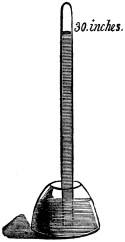
We are indebted to the weight of the atmosphere for the power we possess of raising water by the common pump; for the piston of the pump withdrawing the air from the interior of the pipe, which terminates in water, the pressure of the atmosphere forces the water up the pipe to supply the place of the air withdrawn. It was soon found, however, that when the column of water in the pipe was more than thirty feet high, the pump became useless, for the water refused to rise higher. Why? It was found that a column of water about thirty feet high exerted a pressure equal to the weight of the atmosphere, thus establishing an equilibrium between the water in the pipe and the atmospheric pressure.
This is the principle on which the barometer, or measurer of weight, as its name imports, is constructed. The metal Mercury is about thirteen and a half times heavier than water; consequently, if a column of water thirty feet high balances the pressure of the atmosphere, a column of mercury thirty inches high ought to do so also—and this is in fact the case. If you take a glass tube nearly three feet long, and closed at one end, and fill it with mercury; then, placing your finger on the open end, invert the tube into a basin or saucer containing some of the same metal; upon removing your finger (which must be done carefully, while the mouth of the tube is completely covered by the mercury,) it will be seen that the fluid will fall a few inches, leaving the upper part of the tube empty. Such a tube with a graduated scale attached is in truth a barometer, and as the weight of the atmosphere increases or decreases, so the mercury rises or falls in the tube. This instrument is of the greatest value to the seaman, for a sudden fall of the barometer will often give notice of an impending storm when all is fine and calm, and thus enable the mariner to make the preparations necessary to meet the danger.
It was discovered by an Italian philosopher named Torricelli, and from him the vacuum formed in the upper end of the tube above the surface of the mercury has been called the Torricellian vacuum. It is by far the most perfect vacuum that can be obtained, containing necessarily nothing but a minute quantity of the vapour of mercury.
EXPERIMENT.
Pass a little ether through the mercury in the tube, and as soon as it reaches the empty space it will boil violently, depressing the mercury, until the pressure of its own vapour is sufficient to prevent its ebullition. If you now cool the upper part of the tube, so as to condense the vapour, the pressure being thus removed, the ether will again begin to boil, and so alternately, as often as you please, in order to show this fact with effect, the bore of the tube should not be less than half an inch in diameter.
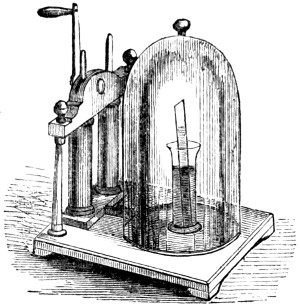
EXPERIMENT.
To show that the heat abstracted by the boiling of one liquid will freeze another, fill a tall narrow glass about half full of cold water (the colder the better), and place in it a thin glass tube containing some ether. Put them under the receiver of an air-pump. As you exhaust the air, the ether will begin to boil, until at length, by continuing the exhaustion, the water immediately surrounding the tube of ether will freeze, and a tolerably large piece of ice may thus be obtained.
Ether evaporates so rapidly even under the pressure of the atmosphere, that a small animal, such as a mouse, may be actually frozen to death by constantly dropping ether upon it. If poured on the hand, it produces a degree of cold that soon becomes, to say the least, unpleasant.
EXPERIMENT.
Place a flat saucer containing about a pound of oil of vitriol under the receiver of the air-pump, and set in it a watch glass containing a little water, supported on a stand with glass legs. Exhaust the receiver, when the water will evaporate, but without boiling; and the vapour being absorbed as it forms by the oil of vitriol, the vacuum is preserved, and the evaporation continues, until the vapour has abstracted so much caloric from the remainder of the water that it is all at once converted into ice.
In most elementary works on chemistry may be found a long table of freezing mixtures, as they are called, some with and others without ice or snow. We have selected a few from each division.
WITH ICE OR SNOW.
- Snow or powdered ice 2 parts.
Powdered common salt 1 „
- Snow 5 „
Powdered common salt 2 „
Powdered sal ammoniac 1 „
- Snow 3 „
Dilute sulphuric acid 2 „
- Snow 2 „
Crystallized muriate of lime 3 „
WITHOUT SNOW OR ICE.
- Sulphate of soda 3 parts.
Dilute nitric acid 2 „
- Nitrate of ammonia 1 „
Water 1 „
- Phosphate of soda 2 „
Dilute nitric acid 1 „
- Sulphate of soda 2 „
Muriatic acid 1 „
The effects of most of these mixtures may be considerably increased by previously cooling the ingredients separately in other freezing mixtures.
In connexion with this branch of science, and especially with chemistry, the youthful philosopher should practise the art of decanting air from one jar to another standing over water, beginning by passing it from a small to a larger jar, then with two of equal size; and when he can accomplish the transfer without permitting even one bubble to escape, he may essay the much more difficult task of transferring the air from a large to a smaller jar.
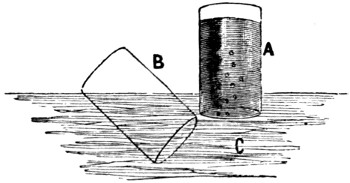
He should also practise using the blowpipe until he can keep up a steady and uninterrupted flame for ten minutes or a quarter of an hour, without stopping for breath. It is quite possible to replenish wind in the mouth, which alone ought to be used, without interrupting the breathing for an instant, but it requires some practice.

(1) Box blowpipe, A, the stem; B, the mouthpiece; C, the box, in which is placed a piece of sponge to absorb the moisture of the breath; D, the extremity (this is moveable, and each blowpipe has several, with different apertures); E, the hollow pivot, in which the extremity and its arm turn. The box is opened by the milled ring seen at the bottom.
SPECTRUM ANALYSIS.
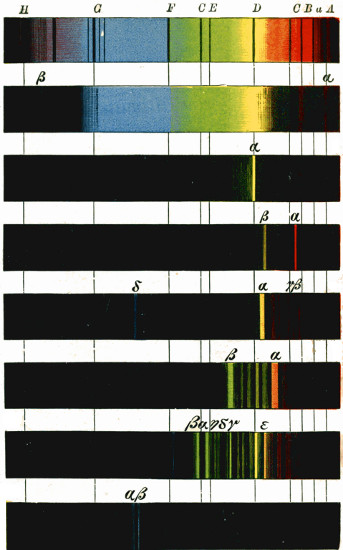
If the youthful student wishes to occupy his leisure in a most amusing and instructive manner, and at the same time to acquire a ready method of testing for the presence of the various metals, he cannot do better than purchase from Mr. John Browning, of 111, Minories, the Amateur’s Spectroscope, price two guineas; or, if sufficiently ingenious, a prism and lenses may be purchased for sixteen shillings, and fitted up in paper tubes. Indeed, it is always better to buy some complete set or portion of a set of apparatus, instead of the trashy so-called “Boys’ Cabinets,” which contain very much that is useless and very little for instructive experiments. The instrument enables the observer to examine the properties of metallic salts when in the state of a glowing or incandescent gas. Common light affords a continuous spectrum or band of colours, red at one end and violet at the other, the intermediate colours being orange, yellow, green, blue, and indigo. The spectra of the metals in the state of luminous vapour are not continuous, but are represented by distinct bands or lines of light.
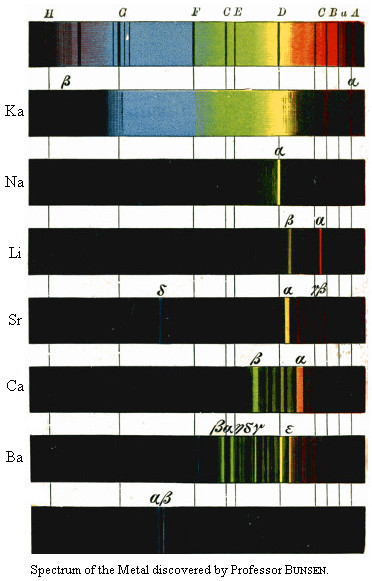
Solar Spectrum, and Spectra of the Alkanes and Alkaline Earths. Copied from the Original Drawings of G. Kirchhoff and R. Bunsen.
Ka
Na
Li
Sr
Ca
Ba
Spectrum of the Metal discovered by Professor Bunsen.
Solar Spectrum, and Spectra of the Alkanes and Alkaline Earths. Copied from the Original Drawings of G. Kirchhoff and R. Bunsen.
Every element, metallic or otherwise, when converted into a luminous gas, produces lines which are always found in the same part of the spectrum, and are therefore unalterable in position. The instrument (Fig. 1) is called the Spectroscope.
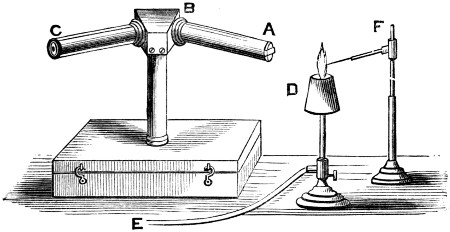
Fig. 1.—THE AMATEUR’S SPECTROSCOPE.
A, Tube with knife edges; B, the prism; C, the telescope; D, the lamp, supplied with gas by pipe E; F, stand carrying the platinum wire. The wire may be held in the hand, but is more convenient when attached to a stand.
The instrument (Fig. 2) will exhibit the dark fixed lines in the solar spectrum, and also the bright lines in the spectra of incandescent metals.
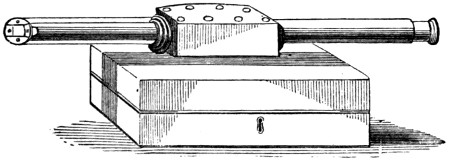
Fig. 2.—THE HERSCHEL-BROWNING DIRECT VISION SPECTROSCOPE.
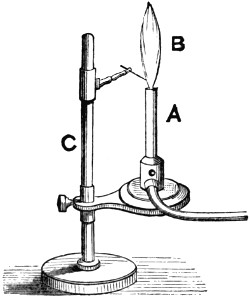
Fig. 3.
A, another form of gas lamp; B, the flame; C, adjusting stand to carry the platinum wire and the lamp.
HOW TO USE THE SPECTROSCOPE.
Screw the tube carrying the knife edges at the small end into the prism bore, and the telescope into its proper ring. Now place any common bright light exactly in front of the knife edges, and while looking through the telescope arrange the knife edges until a bright and continuous spectrum is visible.
TO OBTAIN THE BRIGHT LINES IN THE SPECTRUM GIVEN BY ANY SUBSTANCE.
Remove the bright flame from the front of the knife edges, and substitute in its place the flame of a common spirit lamp or, still better, a gas-jet known as a Bunsen’s Burner. Take a piece of platinum wire about the substance of a fine sewing needle; bend the end into a small loop about the eighth of an inch in diameter; fuse a small bead of the substance, or salt, to be experimented on into the loop of the platinum wire, and attaching it to any sort of light stand or support, bring the bead into the front edge of the flame, a little below the level of the knife edges. If the flame be opposite the knife edges, on looking through the eye-piece of the telescope the fixed lines due to the substance will be plainly visible. When minute quantities have to be examined, the substance should be dissolved, and a drop of the solution, instead of a solid bead, be used on the platinum wire.
The delicacy of this method of analysis is very great. Swan found, in 1857 (Ed. Phil. Trans., vol. xxi. p. 411), that the lines of sodium are visible when a quantity of solution is employed which does not contain more than 1⁄2,500,000 of a grain of sodium.
To view Fraunhofer’s lines on the solar spectrum it is only necessary to turn the knife edges towards a white cloud, and make the slit formed by the knife edges very narrow by turning the screw at the side of them. In every instance the focus of the telescope must be adjusted in the ordinary way, by sliding the draw tube until it suits the observer’s sight, and distinct vision is obtained.
It should be noted that lines at various parts of the spectrum require a different adjustment in focussing the telescope.
The small prism turning on a joint in front of the knife edges is for the purpose of showing two spectra in the field of view at the same time. To do this it must be brought close to the front of the knife edges. Then one flame must be placed in the position in which the flame of the candle is shown in the small figure, and the other directly in front of the slit. On looking through the telescope, as before described, the spectra due to the two substances will be seen one above the other.
When the slit is turned towards a bright cloud, and a light is used in the position of the candle flame, the spectrum of any substance may be seen compared with the solar spectrum. In this manner Kirchhoff determined in the solar spectrum the presence of the lines of the greater number of the elements which are believed to exist in the sun.
PROFESSOR STOKES’ ABSORPTION BANDS.
This instrument is expressly adapted to the prismatic analysis of organic bodies, according to the method recommended by Professor Stokes in his lecture at the Chemical Society, printed in the Chemical News.
To observe these bands it is only necessary to place a very dilute solution of the substance in a test-tube, then fix the test-tube in the small clip attached to a ring which slips on in front of the knife edges. Upon bringing any bright light in front of the tube, on looking through the telescope, if the instrument has been properly adjusted, a bright spectrum will be seen, interrupted by the dark bands due to the substance in solution.
One of the simplest and most interesting experiments of this kind can be made by preparing dilute solutions of madder, port wine, and blood.
In these very dilute solutions no difference can be detected by the unassisted eye, but on submitting them in the manner already described to the test of spectrum analysis, very different appearances will be presented.
The absorption bands may, however, be most conveniently examined and accurately investigated by means of Sorby and Browning’s new Micro-Spectroscope.
TO MAP OUT ANY SPECTRUM.
Place the eye-piece with cross wires in the telescope, with the cross in the shape of an X. Then move the telescope so that the point where the wires cross comes successively in contact with the various lines, noting the readings of the nonius on the arc. From these readings, by the help of any mechanical scale of equal parts, a map may be easily constructed.
By the assistance of spectrum analysis four new metals have been discovered, viz. Cæsium, Rubidium, Thallium, Norium. It is often a cause of grumbling with young beginners in chemistry that there is so much washing of glasses and slopping required to obtain proper results from tests; but here is a most refined mode of testing, which may be carried on in the drawing-room, and so delicate that a portion of sodium salt even less than 1⁄180,000,000th part of a grain can be easily detected.
Formerly the metal Lithium was considered to be a very rare one, but since the use of the spectroscope, quantities less than the 1⁄6,000,000th of a grain have been detected; it now appears that lithium is a very common metal, and exists in the human body, the sea, and may be obtained from many other common sources. Lithium has been found in the ashes of marine plants, the ashes of tobacco—in milk, coffee, tea, human blood, and in muscular tissue; it has also been found in meteoric stones.
The coloured plate is a faithful copy of Kirchhoff’s Diagram, and shows the solar spectrum, also the spectra of potassium, sodium, lithium, strontium, calcium, barium, rubidium.