PART II. Athletic Sports and Manly Exercises: (continued 6)
Reading edition
Beacon, a post or buoy placed over a shallow bank, to warn vessels.
Bearings, the widest part of the vessel below the upper deck. The bearings of an object is its direction according to the points of the compass.
Belay, to; to make a rope fast.
Bend, to; is to make a sail fast to the yard, or a cable to the anchor.
Berth, the place where the vessel lies; a man’s sleeping place on board.
Bulwarks, the woodworks of a vessel above deck; also the wooden partition between cabins.
Bunting, the woollen stuff of which ships’ colours are made.
Buoy, a floating cask or piece of wood.
Cabin, the after part of the vessel in which the officers live.
Capstan, a machine placed perpendicularly on deck, round which the cable is passed, in order to hoist the anchor. It is moved round with bars of wood stuck into it, which are called handspikes or capstanbars.
Cathead, large pieces of wood over the bow, having sheaves within them, by which the anchor is hoisted or lowered.
Cleat, pieces of wood on which ropes are belayed.
Combings, raised woodwork round the hatches, to prevent the water going down to the hold.
Companion, ladder leading down to the state cabins.
Davits, rods of timber or iron, with sheaves or blocks at their ends, projecting over a vessel’s side or stern, to hoist boats up to.
Draught, the depth of water which a vessel requires to float her.
Feather, to; to lift the blade of the oar horizontally as it comes out of the water.
Fenders, pieces of wood or rope hanging over the side of a boat, to keep it from chafing.
Fathom, six feet.
Flat, a sheet is said to be hauled flat, when it is hauled down close.
Fore and Aft, lengthwise with the vessel.
Forecastle, the part of the vessel before the foremast.
Foul Anchor, when the cable has a turn round the anchor.
Gaff, a spar to which the head of a fore and aft sail is bent.
Gage, depth of water in a vessel—this water is called “bilge water.”
Gangway, that part of a vessel’s side through which people pass in and out of the vessel.
Gaskets, pieces of rope or plaited stuff, used to fasten the sail to the yard when it is furled.
Give way, to; to row more forcibly.
Grapnel, a small anchor with several claws, generally four, used to secure boats.
Gunwale, (pron. Gun’el,) the upper rail of a boat or vessel.
Gybe, or Jibe, to; to shift over the boom of a fore-and-aft sail.
Halliards, ropes used for hoisting or lowering yards and sails.
Hatchway, an opening of the deck.
Hatches, the coverings of hatchways.
Hawser, a large rope.
Helm, the steering apparatus.
Hold water, to; to stop the progress of a boat, by keeping the oars in the water.
Jib, a triangular headsail.
Jib-boom, a spar rigged out beyond the bowsprit.
Jurymast, a temporary mast rigged in the place of a lost one.
Lee Board, a board fitted to the lee side of flat-bottomed boats, to prevent their drifting to leeward.
Log, a journal of the proceedings of a vessel; also a line with a triangular piece of board, called the log ship, which is cast overboard to ascertain the ship’s rate of sailing.
Luff, to; to steer the boat nearer the wind.
Lurch, the sudden rolling of a vessel to one side.
Marling-spike, an iron pin sharpened at one end, to separate the strands of a rope.
Martingale, or Dolphin-striker, a short perpendicular spar under the bowsprit’s end.
Miss stays, to fail going about.
Oakum, pieces of yarn picked to pieces, used for caulking.
Overhaul, to; when a rope is passed through two blocks, in order to make a tackle, the rope which is hauled on is called the fall; if one of the blocks gets loose, the act of hauling on the rope between the blocks, in order to separate them, is called overhauling.
Painter, a rope attached to the bow of a boat.
Pendant, a long narrow flag at the mast-head.
Quarter, that part of the vessel between the stern and the main chains.
Ratlines (pron. Rat’lin’s,) ropes fastened across the shrouds, like the steps of a ladder.
Scud, to; to drive along before a gale with no sail, or only enough to keep her ahead of the sea. Also, low thin clouds flying swiftly before the wind.
Spanker, or Driver, the after sail of a ship or bark. It is fore and aft sail set with a boom and gaff.
Splice, to; to join two ropes together by entwining their strands; a rope is generally formed of three strands twisted together.
Spring, to; to split a mast.
Stays, large ropes leading from the masthead forward.
Staysail, a sail hoisted on a stay.
Steerage, the part of the between decks just before the after cabin.
Stretcher, pieces of wood placed across a boat’s bottom for the rowers to put their feet against.
Surge, large swelling waves breaking over rocks.
Taut, tight.
Throat, the inner edge of the gaff which embraces the mast.
Unbend, to; to untie.
Unmoor, to; to heave up one anchor, or to unfasten the ship from her moorings.
Vane, a piece of bunting flying at the masthead to show the direction of the wind.
Waist, the part of the upper deck between the quarterdeck and forecastle.
Wake, the path that a ship leaves behind her in the water.
Wear, to; to come round on the other side of the wind without backing.
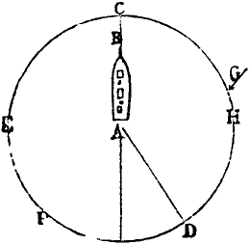
Let A B be the vessel, G the direction of the wind; A B is sailing in the direction B C, and wants to change her course to A D; if she tacks, she traverses the direction C H D; if she wears, she goes off from the wind in the direction C E D.
SKATING.
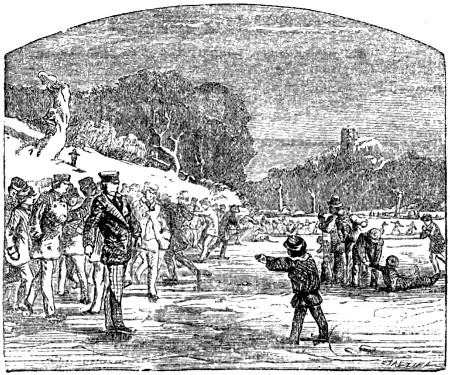
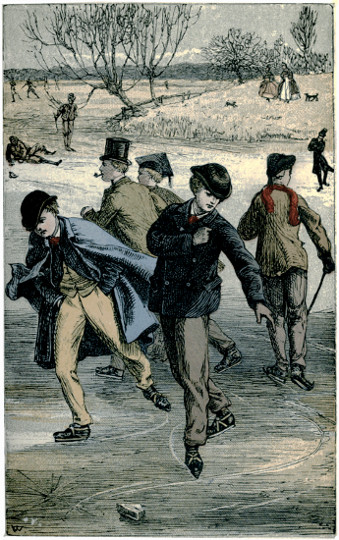
Skating is one of the finest gymnastic exercises, by which man, as Klopstock says, “like the Homeric gods, strides with winged feet over the sea transmuted into solid ground.” It is one of the healthiest exercises, bringing the body into action by a great variety of motions. The art is mentioned in the Edda, written eight hundred years ago, in which the god Uller is represented as distinguished by beauty, arrows, and skates.
SKATING.
It is not known at what period skating was introduced into England, but there are indications of it in the thirteenth century, for Fitz Stephen, in his History of London, says, that it was in that time customary, when the ice was sufficiently strong, for the young citizens of London to fasten the leg-bones of animals under the soles of the feet by tying them round the ancles, and then taking a pole shod with iron into their hands, they pushed themselves forward by striking it against the ice, and moved with a celerity equal to a bird flying through the air or an arrow from a cross-bow.
Fitz Stephen describes another kind of diversion on the ice in these words, which may be acceptable to the young reader. He says: “Others make a seat of ice as large as a millstone, and having placed one of their companions on it, they draw him along, when it sometimes happens that moving in slippery places they all fall down together, which is rare sport, provided no harm be engendered.” Ibral mentions, that in his time it was customary to use sledges, which being extended from the centre by means of a strong rope, those who are seated on them are moved round with great rapidity.
The use of the modern skate is supposed to have been brought from Holland, and for many years skating has been exercised with much elegance in England and in Scotland. Somehow or other, we do not of late years have those severe frosts which enable the skater to practise his art with vigour; but there is now a skating club in London who anticipate trips to Holland during the winter months, where the art may be practised in all its perfection.
In early days we were “prodigiously,” as Dominie Sampson would say, fond of the sport. Our first attempts were made during the great frost in 1813-14, which lasted eleven weeks, and during which time there was a fair on the Thames, and skating was practised in a most delightful manner. One of the finest and most beautiful skaters of that period was Robert Fergusson, a Scotchman, who had been a “gentleman of means,” in the early part of his life, but having shot, horsed, tandem’d, dog’d, and skated away his substance, was so reduced as to become a teacher of his favourite art, and near the water works of old London Bridge, on the west side, he pitched his tent during the frost, inviting “gentlemen,” who could afford a “crown” to become his pupils in the art of “Land flying,” as he termed it. He boasted of having taught the Prince of Wales, and he sported the three ostrich feathers and “Ich dien” over his canvas. To him in youthful ardour we repaired, and the substance of his teachings we subjoin for the special benefit of our young friends.
The first maxim of Fergusson to his pupils was, “Throw fear to the dogs;” the next, “Put on your skates securely;” and the third, “Keep your balance:” and premising this as a “start,” I shall now describe the various kinds of skates, and the methods of using them.
THE SKATE.
There are various kinds of skates. Some, such as the Dutch skates, are very large and somewhat cumbersome, but very safe for those who skate with heavy loads on their shoulders, as they do in Holland, Denmark, and Russia. In these the iron often projects above six inches from the wood, and curls up towards the shin-bone above a foot, that the skater may glide the more easily over the hillocks of snow common to large expanses of ice.
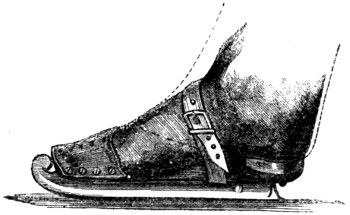
Some skates are what are called fluted, that is, they have a groove running along the centre of the iron, which are the best for beginners, as they take a better hold of the ice. The plain skates have no such groove, and are better adapted for those who have partially acquired the art, as with them the utmost velocity and elegance of movement may be performed.[4]
The iron of the skate, which lies under the foot, is called its blade; this varies in different kinds of skates, and the practised professor of skating will choose a high or a low bladed skate, according to the nature of the ice; but the beginner should never use a skate whose blade is more than three quarters of an inch in depth and a quarter of an inch in breadth, for when the blades are deeper than this, the balance of the body is not so easily preserved, and the ancles are liable to be sprained or twisted.
PUTTING ON THE SKATES.
In putting on the skate, the “youngster” should kneel on one knee and fasten the skate on the foot of the other leg. If he should have a high laced boot, called in the eastern counties a “high-low,” he will find such an excellent support to the whole machinery. Or if he can provide himself with a “skate boot,” in which the skate and shoe are all of a piece, he will do better. Such skates were invented in the great frost about seven years ago, but just as they were coming in the frost went out; but they can still be procured. At all events, the skater should bear in mind that the skate must be fastened securely and firmly to the foot, by being well fastened to the heel and sole of the boot by means of the screw and points, and well, but not clumsily, strapped round the ancle, exactly so tight as to confine the foot without hurting it or impeding the motions of the ancle joints. There is a new skate now in use by the London Skating Club, called the elastic skate, or spring skate, in which a spring is introduced at the bottom of the foot, which keeps it fast in every part. Skates are also now made of gutta percha, and these are well worthy the notice of the young skater.
HOW TO START UPON THE INSIDE EDGE.
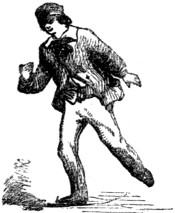
Having risen to the perpendicular, the learner should first ascertain, by moving his feet about on the ice, whether the skates are firmly and comfortably fixed on his feet. He should then walk a little on them, supporting himself by a light pole about six feet in length, having an iron spike at its end. Having in this manner got a little used to the feel of the skate on his foot, he should then endeavour to throw away all fear and strike out slowly with the right foot, leaning on the inside edge of the skate, and making the pressure greatest at that part of the skate opposite the ball of the great toe, at the same time bending slightly forward. When the skate has moved about a yard forward in this manner, the left foot should be brought to the ice in precisely similar manner. The figure represents the skater starting and proceeding on the inside edge.
MOVEMENT ON THE OUTSIDE EDGE.
Having practised on the inside edge for some days, to get used to the skates, the learner may afterwards attempt the “outside edge,” which is nothing more than throwing themselves upon the outer edge of the skate, and making the balance of the body bend to that side which will necessarily enable them to form a semicircle. In this much assistance will be derived by placing a bag of lead shot in the pocket next to the foot employed in making the outside stroke, which will produce an artificial poise of the body at first very useful. At the commencement of the outside stroke the knee of the employed leg should be a little bent, and gradually brought to a rectilineal position when the stroke is completed. The best method of getting to the “outside edge” is to form the circle inwards—say with the right foot and with considerable force; in the course of this, place the left foot down in front of the right, and lean powerfully on the outside of the left heel. A little practice and confidence in his balance will enable the student to lift his right foot, and hang it behind while he proceeds to cut outside with his left foot. Let him then stop, and begin the inward circle with the left foot, and slip down the outer edge of the right heel in the same way.
The young skater has now learned to balance himself, and can venture to strike out at once to the right, on the heel of the right foot, keeping the left suspended behind, with its toe closely pointed to the heel of the right. As he advances, the left must be brought past the inside of the right with a slight jerk; this slight jerk produces an opposing balancing motion of the body; the right foot then quickly poises, first on the outside of the heel, and then on the inside of its toe, and by placing the left foot down before it, and striking outside to the left, giving at the same time a slight push with the inside of the right toe, he passes from right to left. Having learned this much, the skater will proceed to change from left to right, and then from right to left again, without any trouble. To skate “outside edge” properly, the toe of the suspended foot must be pointed close to the ice behind the other, and kept there until the foot be regained, when it must be brought sharply round to the change. The skater must keep himself erect, leaning most on the heel.
This mode of skating having been acquired, an endless variety of figures, devices, and modes of movement may be practised; such as “the roll,” the figure of 3, of 6, or of 8, “the spread-eagle,” “the mercury,” “the backward outside edge,” “the circle,” “the waltz,” “the minuet,” “the pirouette,” “the quadrille,” &c.
The first step towards figure skating is the
FORWARD ROLL,
which is performed in the manner already prescribed in the directions on the “outside edge.” To perform it gracefully, the skater should bring his left shoulder forward, throw his right arm back, look over that shoulder, and boldly incline his body to that side, proceeding alternately, with ease, grace, and deliberation. When he wishes to stop, he should bring both his feet together, and stop gradually; or he may stop suddenly, by pressing on the heels of his skates, taking care not to throw his toes up too much, or he will cut “all-fours.”
THE DUTCH ROLL
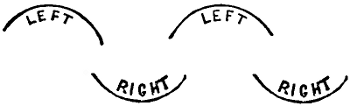
is so called from the motion being used in Holland by the travelling and trading classes in their common avocation. The figures it presents on the ice are small segments of very large circles; which enables the skater to diverge but very slightly from the right line of his course, and consequently accelerates his progress.
THE FIGURE OF EIGHT.
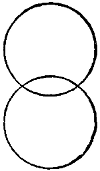
This is composed by merely finishing the great circles, of which the above segments form a part. To produce it, when the skater comes to the finish of the stroke on the right foot, he should throw the left quite across it, which will make him bear hard on the outside of the right skate, from which he must immediately strike. By completing the circle in this manner on each leg, the figure subjoined is performed.
THE FIGURE OF THREE.
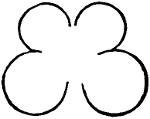
This is performed principally on the inside edge backwards. The head of the 3 is formed of half a small circle on the heel of the outside edge; but when the circle is nearly completed, the skater leans suddenly forward, and rests on the same toe inside, and a backward motion is produced, which develops the tail of the 3. The right legged figure is that of the 3 in its natural position, and the figure made by the left leg is the same figure reversed; as per example. In these evolutions, the motion is not, strictly speaking, backwards, but rather sideways, as his face and body are always in the direction of his motions.
THE BACK ROLL.
By the “back roll,” as it is termed, the skater moves from one foot to the other alternately. His face is turned towards the left shoulder. The inside of the left skate bears on the ice, and the skater immediately strikes from it to the outside back of the other, by pressing it into the ice as forcibly as he can at the toe. The “back cross roll” is performed in a similar manner, the stroke being from the outside, instead of the inside of the skate.
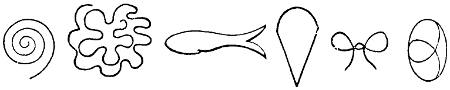
The above motions combine the elements of skating, and having acquired these, the learner may perform an infinite variety of movements, such as “the cornua ammonis,” “the Dutch maze,” “the fish,” “the kite,” “the true lovers’ knot,” &c.; with any other devices his imagination may suggest. He may also engage in the quadrille or waltz, and exhibit his person in every variety of graceful form, at the same time that he exercises every muscle of the body.
GENERAL DIRECTIONS TO BE FOLLOWED BY PERSONS LEARNING TO SKATE.
1. Let your dress fit closely, but at the same time be of sufficient ease to ensure freedom of motion. Neither skirts to coats nor full trowsers should be worn.
2. Let flannel be worn next the skin by the delicate, and an extra under-garment by the robust. Let the chest be well defended against the cold. A piece of brown paper laid between the waistcoat and shirt is one of the best chest protectors.
3. Be careful in venturing upon the ice, unless it be sufficiently strong to bear the weight of the number that flock to it; and watch for the increase of numbers, that you may retire before danger ensues.
4. Avoid rough and very smooth ice, and look carefully out for obstructions thereon; such as small twigs of trees, stones, or “hobbles;” as well as for rotten ice, cracks where the ice has risen higher on one side than the other, or holes. Should you suddenly come upon rotten ice, do not stop, but pass over it as rapidly as possible. Should you fall down upon it, roll lengthwise towards the firmer part, without attempting to stand or walk upon it.
5. Should the skater fall into a hole, he should extend his pole or stick across it, and hold on to it till assistance arrives: should he have no stick, he may extend his arms horizontally across the edges of the ice, till a rope can be thrown to him.
6. After an unlucky immersion in the water, the unfortunate skater should immediately take off his skates, and, if able, run home as quickly as he can. He should then pull off all his wet clothes, take a tablespoonful of brandy in a glass of hot water, rub himself thoroughly with dry towels, and go to bed.
SLIDING.
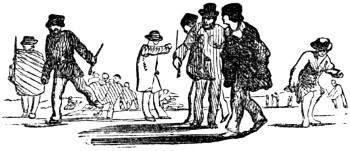
What can be jollier or more enjoyable than sliding for an hour upon a crisp wintry morning, when the snow is lying three inches deep on the ground? You may say what you please about the pleasures of skating, but if you talk for an hour you’ll never convince us that there’s more fun in it than in sliding. We confess we gaze with admiration at a man twisting about on the ice like a teetotum on a ricketty tea-tray, and that when, like a crab, he goes backwards or waltzes round on one foot, while the other is gracefully poised in the air, we feel a pleasure in looking at him; but then, after watching a party of skaters for a short time, we begin to wonder how it is that they all look so solemn, as if each man were engaged on such an important task that he could not speak a word to his neighbour, and then we come to the conclusion that there is more display than real jolly pleasure in skating, and that the highly-trained skater goes through his evolutions rather in the hope of affording satisfaction to the spectators than of deriving enjoyment himself, for we defy any jolly-tempered fellow to feel jovial on a winter morning in company without laughing and shouting with glee at any person he comes across.
Therefore, when on turning from the mystic movements of a troup of skaters to a party of sliders, we hear them laugh and shout at each other, “now, then, keep the pot boiling,” and other choice sentences, and when we see a broad grin of pleasure plainly depicted on their rosy faces, we cannot but think that the enjoyment of sliding shows itself in a far more demonstrative manner than skating, and that more pleasure is derived from looking at a crowd of merry urchins going gaily down a slide than in seeing quadrilles danced, or names cut on the ice, by a band of skilled pâtineurs.
We also like sliding on account of its simplicity. All that its devotees require is a good sharp frost. What care they for ice? The hobnails in London boys’ boots soon produce a shiny slippery surface, and in a short time a respectable slide is made out of the drippings from a water-can, which a servant may have filled at the pump the day before.
There are, we are sure, few English lads who do not know how to slide. It seems to come as a matter of course to most boys; but still, lest there be some benighted youth to whom the pleasures of the slide are still unknown, we must insert a few hints on the subject.
Take a sharp run of about ten yards, and as soon as you feel that you are upon the slide, push the sole of the left foot as far along as you can, making the weight of the body rest almost upon it. You will then slide away, the right foot following without any effort on your part. We say advisedly do not push your foot until you feel well upon the slide, for if you are not very careful about this point you will endeavour to slide on that part of the earth which is not slippery, and although the momentum may impel you as far as the slippery portion, yet your progress will not be very great, as the force which was required to carry you along the whole length of the slide is partly wasted by the resistance which, at the start-off, the hard earth offers to your foot. Then, we have seen many boys in their first attempts to slide, place the heel upon the slide before the toe. The consequence is that they either fall over, or else only slip along a few yards, for a moment’s reflection will show that much greater force can be exerted by pushing the sole along than is exerted when the heel takes its place, and in the latter case, instead of the weight of the body assisting one’s progress, it probably causes the youthful tyro to fall backwards upon Mother Earth, and to wonder how it happens that he does not get on so well at first as other boys.
And now surmising that the slider is proficient in the first rudiments of the art, let us enumerate a few of the feats which a slider may perform while on the glassy track.
Foremost amongst these stands the postman’s knock, in which a boy slides upon one foot only, while with the other he gives double taps quickly upon the ice, in imitation of the noise made by the red-coated messenger at our street doors. This, however, should not be attempted until the performer is well on the slide, or the result will probably be that he’ll measure his length upon the ground. This is also known as “knocking at the cobbler’s door.”
Then comes the “carambole,” which consists in the slider sinking down two or three times during his journey, and rising as he reaches its termination; unless, however, he is very careful the weight of his body will drag him down altogether, and he will continue his journey on another portion of his frame, rather than on his feet. But the best accomplishment to be performed on a slide is the game known as “turnpikes.” Two stones or bricks are placed on the slide, with sufficient distance between them for a boy’s foot to pass through. The turnpike, thus roughly made, is to be kept by one of the party. Off start the sliders, taking care to pass through the pike, without displacing or even touching its walls. Woe betide the unlucky wight whose foot infringes this rule! He is instantly turned off the slide, and has to wait until some other incautious player commits a like offence, and is thus compelled to take his place.
Such are a few of the feats performed by adepts in this graceful art. Most lads, however, will be able to invent many more for themselves, and numerous are the sports that can be indulged in.
SWIMMING
Swimming is the most useful of all athletic accomplishments, as by it human life is frequently saved which might have been sacrificed. It is also useful in the development of muscular strength, as well as highly beneficial to the nervous system, and repairs the vital functions when falling into decline. In places near the sea or rivers, to know how to swim is an indispensable accomplishment. The ancients, particularly the Greeks, held the art in such high estimation as to bestow rewards upon the most perfect swimmers.
From the little familiarity with immersion in water which the inhabitants of our over-grown towns and cities possess, a very great proportion of the English population are but little acquainted with the art of swimming, and with the mode in which they should conduct themselves when risk of drowning presents itself. The English, above all other persons, should be good swimmers, exposed as they are by their insular situation, and commercial pursuits, and disposition to visit other lands, so frequently to perils by sea; yet, while most towns on the Continent abound in baths and swimming-schools, in British towns they are still few in number.
Most animals have a natural aptitude for swimming, not found in man; for they will at once swim when even first thrown into the water; but it must be noticed that the motions they then employ much more resemble their ordinary movements of progression than those made use of by men under similar circumstances.
The children of many uncivilized nations, especially in warm climates, frequent the water from an early age, and seem almost to swim by instinct. The remarkable powers of endurance, agility, and strength manifested while in the water by many individuals of savage tribes are well known,—powers which often enable them to come off victorious in struggles with some of the fiercest inhabitants of those rivers and coasts.
The art of swimming is by no means difficult of attainment, and several authors have supplied directions to facilitate its acquisition. Above all things, self-confidence (not rashness leading into danger) is required; and, when this is possessed, all difficulty soon ceases. Dr. Franklin, himself an expert swimmer, recommends that at first a familiarity with the buoyant power of water should be gained; and to acquire this, he directs the learner, after advancing into the water breast high, to turn round, so as to bring his face to the shore: he is then to let an egg fall in the water, which, being white, will be seen at the bottom. His object must now be, by diving down with his eyes open, to reach and bring up the egg. He will easily perceive that there is no danger in this experiment, as the water gets shallower, of course, towards the shore, and because whenever he likes, by depressing his feet, he can raise his head again above water.
The thing that will most strike beginners will be the great difficulty they experience in forcing themselves through the water to reach the egg, in consequence of the great resistance the water itself offers to their progress: and this is indeed the practical lesson derivable from the experiment; for the learner becomes aware of the very great sustaining or supporting power of water, and hence has confidence. This sustaining power of water is shown under many circumstances: thus, a stone which on land requires two men to remove it, might in water be easily carried by one. A man might walk without harm on broken glass in deep water, because his weight is supported by the water. This knowledge of fluid support constitutes the groundwork of all efforts in swimming, or in self-preservation from drowning.
Should a person accidentally fall into the water, provided he retained his presence of mind, a knowledge of the above facts would save him probably from a “watery grave.” The body being but very slightly heavier than the volume of water it displaces, will, with a very slight motion of the hands under water, float. When the chest is thoroughly inflated with air, it is lighter than water, and floats naturally, having half the head above water; so that the person exposed to danger has only to turn upon his back, in order that that half, consisting of his face, with the mouth and nostrils, be above the water line.
But to float thus upon the water, the greatest care must be taken not to elevate the arms or other parts above its surface; and it is in remembering this caution, that presence of mind in the time of dangers confers so much benefit; for, in the moment of terror, a person thrown into the water almost instinctively stretches out his hands aloft to grasp at some object, thereby depriving himself of a means of proceeding which would frequently keep him afloat until succour arrived. By elevating any part of the body in this way, we remove it from the support afforded by the water, and thus render sinking inevitable.
Dr. Arnot, in allusion to this subject, says that many persons are drowned who might be saved, for the following reasons:—
1. From their believing that their constant exertions are necessary to preserve the body from sinking, and their hence assuming the position of a swimmer, with the face downwards, in which the whole head must be kept out of the water, in order to enable them to breathe; whereas, when lying on the back, only the face need be above the water.
2. From the groundless fear that water entering by the ears may drown as if it entered by the mouth or nose, and their employing exertions to prevent this.
3. The keeping of the hands above water, already alluded to.
4. Neglecting to take the opportunity of the intervals of the waves passing over the head, to renew the air in their chest by an inspiration.
5. Their not knowing the importance of keeping the chest as full of air as possible, which has nearly the same effect as tying a bladder full of air around the neck would have.
But although floating in water is sufficient to preserve from immediate danger, this will not alone enable us to swim. To swim, does not mean simply to float, but to progress; and progression by this means depends, like the flight of birds, upon the law in Mechanics of every action being followed by a corresponding reaction, but in an opposite direction; and thus, as the reaction of the air compressed by the downward action of the bird’s wing, causes it to mount aloft in proportion to the force it communicates by that motion; so the backward stroke communicated by the simultaneous movement of the hands and feet of the swimmer, causes his forward progress in the water. When once familiarised with the support derived from the water itself, he soon learns to make the stroke correctly, especially if aided and supported by some more experienced friend,—a far better assistant than corks and bladders.
PLACES AND TIMES FOR BATHING AND SWIMMING.
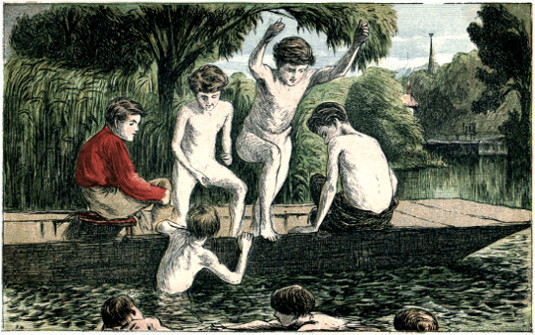
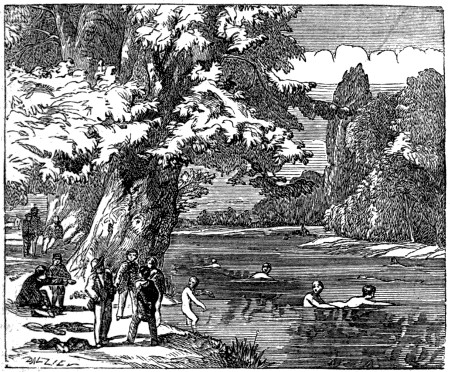
It is presumed that most young lads who go to bathe will take the opportunity of learning to swim. In crowded cities there are but few places in which the youngster can learn the art; but in the country there are many rivers, ponds, canals, or lakes, where both bathing and swimming may be indulged in without annoyance. The best kind of place for bathing is on a shelving gravelly shore, on which the water gradually deepens, and where no awkward sweep of current may take the bather off his legs. The spot should also be free from holes, weeds, and hard stones; and a muddy bottom is to be avoided by all means. Should the banks of such a spot be shaded by a few trees, and should there be close by an open space for a run on the grass after the bathe, so much the better; and the young learner will then have the chief inducement to venture the sudden dip or head-long plunge.
The best time of the day for bathing or swimming is either before breakfast, between the hours of six and eight in the summer-time, or between eleven and twelve o’clock in the forenoon. Delicate persons should not bathe early in the morning; and it would be always well to munch a biscuit before early bathing at all times. No one should ever think of entering the water on a full stomach, or immediately after dinner, and never when over-heated and exhausted by fatigue. He should also avoid entering it when cold, or with a headache. Before bathing, it is best to take a moderate walk of about a mile, and, while the system is in a glow, to undress quickly and plunge in. It is bad to walk till you get hot, then to sit down and cool, and afterwards to enter the water; many have lost their lives by this. It is also very wrong to enter the water during rain, as the clothes are often wetted or damp, which gives the bather cold.
ENTERING THE WATER.
Having stripped the body, the bather should select the best place on the bank for going down to the stream; and then, proceeding cautiously but quickly, wade up to his breasts, turn his head to the shore, and dip. He then technically, as the boys say, gets his pinch over. Should he not be man enough to proceed in this way, he should, as soon as he gets his feet wet, splash some water over his head, and go into the water more gradually, and try the rapid rush and dip when he gets bolder. He must not attempt to swim or strike out till he can master the feat of going into the water up to his arm-pits, and till he feels himself confident and void of timidity.
AIDS TO SWIMMING.
Many aids have been used for the benefit of young swimmers: corks and bladders fastened under the arms are the common ones; but they offer dangerous temptations for bathers to go out of their depth, and then should cramp, cold, or any other accident occur, the event may be fatal. Besides, these aids often slip about from one place to the other. We remember, in our younger days, of the “corks” slipping to the hips, and of seeing a young friend, now an old man, suspended in the water with his head downwards; while collapsing of bladders and of air-jackets is by no means uncommon. The best aid to a young swimmer is a judicious friend, himself a good swimmer, who will hold up his head, when he strikes off, by the “tip of the finger to the tip of the chin,” and who at the same time will show him how to strike off, and how to manage his hands and feet. It is not a bad plan to put out a spar from a boat, to which a rope is attached, which the young learner may make use of by affixing it to a belt round his body under his arms, which will afford him support while he learns to strike his legs in the water. The rope may also be held in the hand of a friend, by the side of the boat, and the learner may strike off hands and feet as the boat proceeds. The plank is a dangerous aid, from its tendency to slip about, and to take the swimmer out of his depth; and, although it has many advantages, is very unsafe. The safest plan of all is, as we have before stated, for the learner to advance gradually up to his arm-pits in the water, and then, turning about, to strike slowly out towards the shore, taking care to keep his legs well up from the bottom. Rigid perseverance in this course will in a very short time enable the youngster to feel himself afloat, and moving at “all fours,”—a delight equal to that experienced by the child who first feels that he can walk from chair to chair.
STRIKING OFF AND SWIMMING.
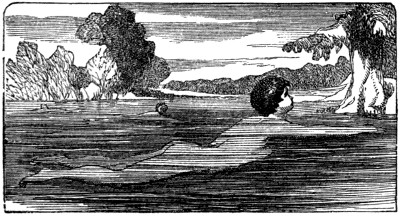
In striking off, the learner, having turned himself to the shore, as before recommended, should fall towards the water gently, keeping his head and neck perfectly upright, his breast advancing forward, his chest inflated; then, withdrawing the legs from the bottom, and stretching them out, strike the arms forward in unison with the legs. The back can scarcely be too much hollowed, or the head too much thrown back, as those who do otherwise will swim with their feet too near the surface, instead of allowing them to be about a foot-and-half deep in the water. The hands should be placed just in front of the breast, the fingers pointing forward and kept close together, with the thumbs to the edge of the fore-fingers: the hands must be made rather concave on the inside, though not so much as to diminish the size. In the stroke of the hands, they should be carried forward to the utmost extent, taking care that they do not touch the surface of the water; they should next be swept to the side, at a distance from, but as low as, the hips; and should then be drawn up again, by bringing the arms towards the side, bending the elbows upwards and the wrists downwards, so as to let the hands hang down while the arms are raising them to the first attitude.
HOW TO MANAGE THE LEGS.
The legs, which should be moved alternately with the hands, must be drawn up with the knees inwards, and the soles of the feet inclined outwards; and they should then be thrown backwards, as widely apart from each other as possible. These motions of the hands and legs may be practised out of the water; and whilst exercising the legs, which can only be done one at a time, the learner may rest one hand on the back of a chair to steady himself, while he moves the opposite leg. When in the water, the learner must take care to draw in his breath at the instant that his hands, descending to his hips, cause his head to rise above the surface of the water; and he should exhale his breath at the moment his body is propelled forward through the action of the legs. If he does not attend precisely to these rules, he must invariably have a downward motion, and, as the boys say, swim furthest where it is deepest.
PLUNGING AND DIVING.
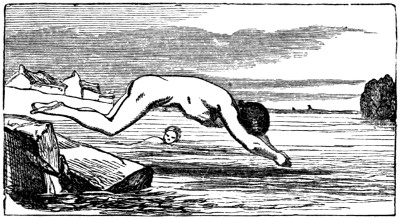
There are two kinds of plunging; that belonging to shallow, and that belonging to deep water. In shallow-water plunging, the learner should fling himself as far forward as possible into the stream at a very oblique angle; and when he touches the water, he should raise his head, keep his back hollow, and stretch his hands forward. In the deep-water plunge, his body is to descend at a greater angle; his arms are to be stretched out, his hands closed and pointed, and his body bent, so that his nose almost touches his toes.
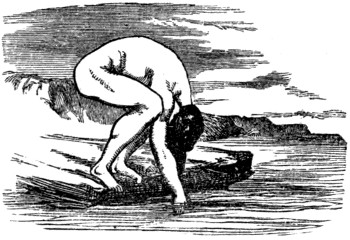
Diving is one of the greatest amusements connected with swimming. There are many kinds; the two most common and easiest and necessary modes of going below the surface, are—
The feet-foremost jump.
The head-foremost jump.
In the first, the legs, arms, and head are to be kept perfectly rigid and stiff. The pupil must not allow fear, or the strange sensation felt in the bowels in leaping from considerable heights, to induce him to spread the arms or legs, or to bend his body.
In the second mode, or head-foremost plunge,—which is the safest mode for persons who are heavily built about the chest and shoulders, if they have to enter the water from heights,—the head is drawn down upon the chest, the arms stretched forward, and hands closed to a point; and as soon as the swimmer feels that he has left the bank, his knees, which till then were bent, are to be stiffened. The diver must avoid striking on the belly—the general consequence of fear; and turning over so as to come down on his back or side—the consequence of pushing with the feet. When he has gone as deep as he wishes, the arms are to be raised and pressed downwards.
SWIMMING UNDER WATER.
When under the water, the swimmer may either move in the usual way, or keep his hands stretched before him, which will enable him to cut the water more easily, and greatly relieve his chest. If he observes that he approaches too near the surface of the water, he must press the palms of his hands upwards. If he wishes to dive to the bottom, he must turn the palms of his hands upwards, striking with them repeatedly and rapidly whilst the feet are reposing; and when he has obtained a perpendicular position, he should stretch out his hands like feelers, and make the usual movement with his feet, then he will descend with great rapidity to the bottom. It is well to accustom the eyes to open themselves under the water, at least in those beds of water that admit the light, as it will enable the swimmer to ascertain the depth of water he is in.
SWIMMING ON THE SIDE.
In this, the body is turned either on the left or right side, while the feet perform their usual motions. The arm from under the shoulder stretches itself out quickly, at the same time that the feet are striking. The other arm strikes at the same time with the impelling of the feet. The hand of the latter arm begins its stroke on a level with the head. While the hand is again brought forward in a flat position, and the feet are contracted, the stretched-out hand is, while working, drawn back towards the breast, but not so much impelling as sustaining. As swimming on the side presents to the water a smaller surface than on the waist, when rapidity is required, the former is often preferable to the latter.
SWIMMING ON THE BACK WITHOUT EMPLOYING THE FEET.
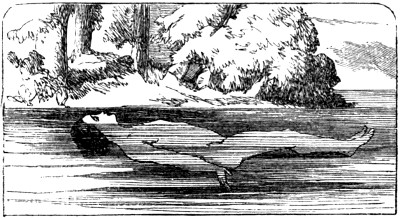
This is twofold: 1. In the direction of the feet. The body is placed in a horizontal position, the feet are stretched out stiffly, and the heels and toes are kept in contact; then the body is to be somewhat curved at the seat, the hands are to be stretched flatly forward over the body, and, slowly striking in small circles, the loins are somewhat drawn up at each stroke. 2. In the direction of the head. The body is placed horizontally, but somewhat curved in the seat, the head in its natural position, the arms are kept close to the body, with the elbows inclined inwards, and the hands describe small circles from the back to the front, at about a foot-and-half from the hips. These modes serve to exercise and strengthen the arms in an extraordinary degree without in the least fatiguing the breast.
FLOATING.
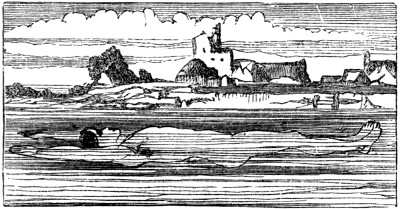
The body is laid horizontally on the back, the head is bent backwards as much as possible, the arms are stretched out over the head in the direction of the body, the feet are left to their natural position; if they sink, the loins must be kept as low as possible. In this position, the person, who is specifically lighter than water, remains, and may float at pleasure. The lungs should be kept inflated, that the breast may be distended and the circumference of the body augmented. In order not to sink while in the act of taking breath, which the greater specific weight of the body would effect, the breath must be quickly expelled, and as quickly drawn in again, and then retained as long as possible; for, as the back is in a flat position, the sinking, on account of the resistance of the water, does not take place so rapidly but the quick respiration will restore the equilibrium before the water reaches the nose.
TREADING WATER.
This is a perpendicular position of the swimmer, and is of great use to enable him to save a person from drowning. It is in general thought to be extremely difficult, but it is very easy. There are two ways of performing the action: in the first the hands are compressed against the hips, and the feet describe their usual circle; the other mode consists in not contracting both legs at the same time, but one after the other, so that while the one remains contracted the other describes a circle. In this mode, however, the legs must not be stretched out, but the thighs are placed in a distended position, and curved as if in a half-sitting posture.
THE FLING.
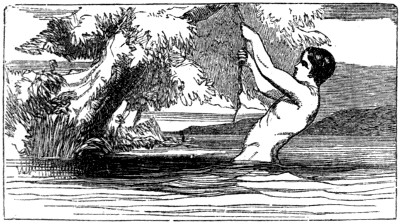
The swimmer lays himself flat upon his waist, draws his feet as close as possible under the body, stretches his hands forwards, and, with both feet and hands beating the water violently at the same time, raises himself out of the water. In this manner one may succeed in throwing oneself out of the water as high as the hips. This exercise is very useful, for saving oneself by catching a rope or any other object that hangs from above the surface of the water, or from any perpendicular height.
SWIMMING ON THE BACK.
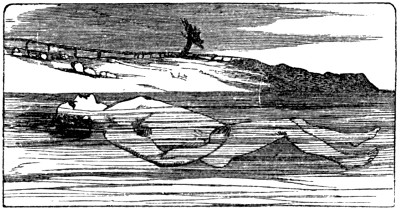
In this the swimmer turns upon his back in the water by the combined motion of the arm and leg, and extending his body, his head being in a line with it, so that the back and upper part of the head may be immersed, while the face and breast are out of the water. The hands should be placed on the thighs straight down, and the legs moved as in forward swimming, taking care that the knees do not rise above the surface in striking them out. Sometimes the hands are used after the motion of a wing or fan, by which a slight progression is also made at the same time that the surface of the body is well lifted out of the water.
THRUSTING.
In the thrust the swimmer lies horizontally upon his waist, and makes the common motions in swimming. He then simply stretches one arm forwards, as in swimming on the side, but remains lying upon the waist, and, in a widely described circle, he carries the other hand, which is working under the breast, towards the hip. As soon as the arm has completed this motion, it is lifted from the water in a stretched position, and thrown forward in the greatest horizontal level, and is then sunk with the hand flat into the water; while the swimmer thus stretches forth the arm, he, with the other hand stretched as wide as possible, describes a small circle in order to sustain the body; after this he brings his hand in a largely described circle rapidly to the hip, lifts the arm out of the water, and thrusts it forward. During the describing of the larger circle the feet make their movements. To make the thrust beautifully, a considerable degree of practice is required. This mode of swimming is useful where a great degree of rapidity is required for a short distance.
THE DOUBLE THRUST.
In the performance of this the arm is thrust forwards, backwards, and again forwards without dipping into the water; in the meantime the stretched-forth arm describes two circles before it begins the larger one.
TO SWIM LIKE A DOG.
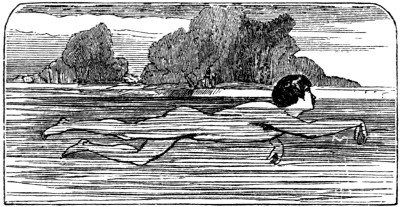
In this motion each hand and foot is used alternately as a dog uses them when swimming, as the term implies. The hands are alternately drawn towards the chin in a compressed form, and then expanded and slightly hollowed, with fingers close, and as they strike the water the feet are likewise drawn towards the belly, and struck backwards with a kind of kick. This mode of swimming is of use to relieve the swimmer from time to time when going a distance.
THE MILL.
The swimmer lays himself on his back and contracts himself so that the knees are brought almost to the chin, and while one of the hands keeps the equilibrium by describing circles, the other continues working. Thus the body is kept turning round more or less rapidly.
THE WHEEL BACKWARDS AND FORWARDS.
In the forward wheel the hands are put as far backwards as possible, and so pressed against the water that the head is impelled under the surface, and the feet, by a pressure of the hands in a contrary direction, are rapidly flung above the head, which in this manner is rapidly brought again to the surface.
In the backward wheel the swimmer lies upon his back, he contracts himself, the hands, stretched forward as far as possible, describe rapidly small circles, the feet rise, and as the point of equilibrium has been brought as near as possible to the feet, the head sinks and the feet are thrown over.
TO SWIM WITH ONE HAND.
The learner to do this swims on one side, keeps his feet somewhat deeply sunk, while the arm which in the meantime ought to work is kept quiet—and might even be taken out of the water. It is a good practice of strength to carry, first under and then over the water, a weight of four or eight pounds.
HAND OVER HAND SWIMMING.
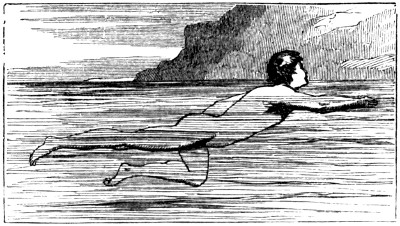
In this process, the right hand is lifted out of the water from behind, swung forwards through the air with a kind of circular sweep to the extent of its reach forward, then dropped into the water edgeways, and immediately turned, with the palm a little hollowed, downwards, the body being at the same time thrown a little on one side, and the right leg struck out backwards to its full extent. The hand descends towards the thigh, and then passes upwards through the water in a kind of curve towards the surface. The left hand and leg perform a similar movement alternately with the right, and the measure of progression attained by these combined similar movements is very considerable.
BALANCING.
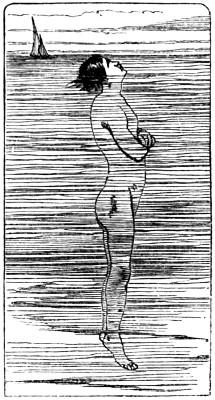
When the swimmer has obtained ease and confidence in the water, he will find many things easy which before he deemed impossible. Balancing is one of these. To perform it he has only, when out of his depth, to fall gently back with his chin elevated to a line passing exactly through the centre of his body from the chin to the toes, then, folding his arms and remaining perfectly motionless, he may suspend himself perpendicularly: but if he should extend his arms backwards, and pass them gradually beyond his head, his toes, tips of his knees, abdomen, and part of his chest, with the whole of his face will appear, and he will be balanced and float horizontally without the slightest motion.
THE CRAMP.
The cramp generally proceeds from acidity of the bowels, arising from a bad state of the stomach, or from the effects of the cold water on the muscular system. Some persons are very subject to it on slight occasions, and such persons will do well never to go out of their depth. But should a tolerable swimmer be seized with the cramp, he should not be frightened, but the moment the cramp is felt in the foot or leg, strike out that foot or leg with the heel elongated, and the toes drawn upwards towards the shin-bone, never minding any little pain it may occasion, as he need not fear breaking a bone, muscle, or tendon. Should this not succeed, he should throw himself on his back, and float quietly, and paddle himself gently to the shore. He may also swim with his hands like a dog, and practise any of the motions of the upper part of the body for keeping his head above water till assistance arrives.
SAVING FROM DANGER.
Above all things the good swimmer should be anxious to save life, and to rescue those who are in danger, without himself becoming the victim, as it often happens. The following rules are highly important to be observed. The swimmer must avoid approaching the drowning person in front, in order that he may not be grasped by him; for whatever a drowning person seizes, he holds with convulsive force, and it is no easy matter to get disentangled from his grasp; therefore he should seize him from behind, and let go of him immediately if the other turns towards him. His best way is to impel him before him to the shore, or to draw him behind; if the space to be passed be too great, he should seize him by the foot and drag him, turning him on his back. If the drowning person should seize him, there is no alternative for the swimmer than to drop him at once to the bottom of the water, and there to wrestle with his antagonist; the drowning man, by a kind of instinct to regain the surface, when drawn down to the bottom, usually quits his prey, particularly if the diver attacks him there with all his power.
For two swimmers the labour is easier, because they can mutually relieve each other. If the drowning person has still some presence of mind remaining, they will then seize him one under one arm, and the other under the other, and without any great effort in treading water, bring him along with his head above water, while they enjoin him to keep himself stretched out and as much as possible without motion.
SPORTS AND FEATS IN SWIMMING.
1. The Float.—In this sport one swimmer lays himself horizontally on the back, with the feet stretched out, the hands pressed close to the body, and the head raised forward. The other swimmer takes hold of him by the extremity of the feet, and, swimming with one hand, impels him forward. The first remains motionless.
2. The Plank.—One swimmer lays himself horizontally as before, another lays hold of him with both his hands, immediately above the ancle, and pulls him obliquely into the water, while he extends himself and impels himself forward; thus both the swimmers drop rapidly the one over the other.
3. The Pickaback Spring.—One swimmer treads the water, the other swims near him behind, places his hands upon the shoulders of the first, and presses him down. He then leaves his hold, and puts his feet upon his shoulders, and, flinging himself out of the water, pushes the first towards the bottom. Now he treads water, and the first performs the part of the second, and so on.
4. The Shove.—Two swimmers place themselves horizontally on their backs, the legs are strongly extended, and the soles of the feet bear against each other; each impels forward with all his power, and he who succeeds in pushing back the other is the conqueror.
5. The Wrestle.—Two swimmers place themselves opposite to each other, tread water and hold their right hands in the air; the question is, who shall first force his opponent under the water by pressure. Only the head of the adversary is to be touched, and that only by pressure.
BERNARDI’S SYSTEM OF UPRIGHT SWIMMING.
This system has been introduced into many of the naval and military colleges on the Continent, and has for its distinguishing characteristic the swimming in an upright position. The first object is to teach the pupil how to float in an upright posture. He is taught the use of his legs and arms for balancing the body in water, and then to imitate as much as possible the movement of the limbs upon land. He then pays great attention to the movements of the head, the smallest inclination of which on either side instantly operates on the whole body. He next learns the method of using his arms and legs; and for this purpose is directed to stretch his arms laterally on each side, and then, by placing one foot forward and the other backward, he is enabled to float easily and progress slowly. The same circular sweep of the hands and the action of the legs are next practised, and the feet should be struck downwards and a little forwards, when the movement of the arms is the reverse of the old methods of swimming. The young swimmer who has gone through the various courses laid down by us, will easily comprehend the principle of Bernardi’s system, and as easily carry it out if he will take the trouble. It is much less fatiguing than the old plan, and can be carried on for a longer period, and is of invaluable service to troops who may have to cross rivers or dykes, and to all who may be exposed to the various accidents of flood and field.
THE PRUSSIAN SYSTEM OF PFUEL.
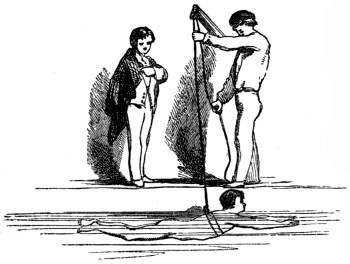
The best of all methods for teaching swimming is that originally introduced by General Pfuel into the Prussian swimming-schools. By this method a person may be made a very good swimmer in a very short time. The apparatus for teaching consists of a hempen girdle five inches in width, of a rope from five to six fathoms in length, of a pole eight feet long, and a horizontal rail fixed about three-and-a-half feet above the platform, on which the teacher stands, to rest the pole on.
The depth of the water in the place chosen for swimming should, if possible, be not less than eight feet, and the clearest and calmest water should be selected. The pupil wears drawers, fastened by a band above the hips and covering about half the thighs. He is now placed near the horizontal rail, his hands resting upon it, while the teacher shows him the motion which he will have to make with his legs in the water. This he does by guiding the motion of one leg while the pupil rests, on the other. This motion we shall explain presently.
The swimming girdle, about five inches wide, is now placed round the pupil’s breast, so that its upper edge rests on the chest, without getting tight. The teacher takes the rope, which is fastened to the ring of the girdle, in his hand, and directs the pupil to leap into the water, keeping the legs straight and close together, and the arms close to the body, and, what is very important, to breathe out through the nose as soon as his head rises above the water, instead of breathing in first, as every man naturally does after a suspension of breath. The object of this is to prevent the water from getting into the throat, which produces an unpleasant feeling of choking and headache. This expiration soon becomes perfectly natural to the swimmers.
The pupil is next invited to leap. He is drawn up immediately by the rope, pulled to the ladder, and allowed to gain confidence gradually. The rope is now fastened by a noose to the end of the pole, the other end of it being kept in the hand of the teacher; the pole is rested on the horizontal rail, and the pupil stretches himself horizontally on the water, where he remains, supported by the pole. Next the arms are extended stiffly forward, the hands clasped, the chin touches the water; the legs are also stiffly stretched out, the heels being together, the feet turned out, and the toes drawn up. This horizontal position is important, and must be executed correctly. No limb is permitted to be relaxed.
The movement of the limbs is now taught; that of the legs is taught first. The teacher first says, loudly and slowly, “One;” when the legs are slowly drawn under the body; at the same time the knees are separated to the greatest possible distance, the spine is bent downwards, and the toe kept outwards. The teacher then says briskly, “Two;” upon which the legs are stiffly stretched out with a moderate degree of quickness, while the heels are separated, and the legs describe the widest possible angle, the toes being contracted and kept outwards. The teacher then says quickly, “Three;” upon which the legs, with the knees held stiffly, are quickly brought together, and thus the original position is again obtained.
The point at which the motions “two” and “three” join are the most important, because it is the object to receive as large and compact a wedge of water between the legs as possible; so that when the legs are brought together their action upon this wedge may urge the body forward. In ordinary cases of swimming, the hands are not used to propel, but merely to assist in keeping on the surface. By degrees, therefore, “two” and “three” are counted in quick succession, and the pupil is taught to extend the legs as widely as possible. After some time, what was done under the heads “two” and “three” is done when “two” is called out. When the teacher sees that the pupil is able to propel himself with ease, which he frequently acquires the power of doing in the first lesson, and that he performs the motions already mentioned with regularity, he teaches the motions of the hands, which must not be allowed to sink, as they are much disposed to do while the motion of the legs is practised.
The motion of the hands consists of two parts. When the teacher says “One,” the hands, which were held with the palms together, are opened, laid horizontally an inch or two under water, and the arms are extended till they form an angle of 90°; then the elbow is bent, and the hands are brought up to the chin, having described an arch downward and upward; the lower part of the thumb touches the chin, the palms being together. When the teacher says “Two,” the arms are quickly stretched forward, and thus the original horizontal position is regained. The legs remain stiffly extended during the motion of the hands. If the motion of the hands is carefully and correctly performed, the legs and arms are moved together; so that while the teacher says “One,” the pupil performs the first motion of the hands and legs; when he says “Two,” the second and third motions of the feet, and the second of the hands.
As soon as the teacher perceives that the pupil begins to support himself, he slackens the rope a little, and instantly straightens it if the pupil is about to sink. When the pupil can swim about ten strokes in succession, he is released from the pole, but not from the rope. When he can swim about fifty strokes, he is released from the rope too; but the teacher remains near him with a long pole until he can swim 150 strokes in succession, so that, should he sink, the pole is immediately held out to him. After this he may swim in the area of the school, under the superintendence of the teacher, until he proves that he can swim half-an-hour in succession, so that, should he sink, the pole is immediately held out to him; he is then considered fit to be left to himself.
Such are the outlines of the German plan of swimming; and, much as we dislike the German educational quackery, we are still obliged to confess that schools for swimming might be, and ought to be, established in this country in unison with the above system. No well-conducted boarding-school ought to be without a swimming-school; and the hints above given will be exceedingly useful to the swimmer who has to teach himself, as well as to the gymnastic tutor who has to teach others the art; and we conclude by earnestly recommending the accomplishment of swimming to our young readers.
TRAINING.
It is impossible that any one can indulge to any extent either in pedestrianism or rowing without going into some sort of training, however slight it may be. Before either can be thoroughly enjoyed, it is essential that the body should be brought into condition, and the constitution prepared for the severe tests to which it is sure to be put. Until this has been satisfactorily accomplished (and it cannot be done without much perseverance and self-denial) success at regattas or in athletic sports is quite out of the question, and the most serious results will attend any attempt to take part in such proceedings. Courage and determination to win a race, whether on land or water, are qualities very much to be admired, yet they are entirely after considerations; the first and chief endeavour must be to reduce the superfluous fat without weakening the system, to secure soundness in wind and limb—in short, thoroughly to prepare the body, so that it may be equal to the emergencies that may hereafter present themselves.
Training should not, however, be begun hastily. Before it is commenced, care should be taken to get the stomach into condition for the dieting it will have to undergo. These preliminary proceedings will be more or less prolonged, according to the habits of life of the patient. If a boy has been given to drinking large quantities of beer, eating indigestible things, or smoking, he does not commence under such favourable circumstances as those who have not so indulged themselves. Probably he has injured his digestion and interfered, however slightly, with his liver; a state of things that he can readily appreciate by the restlessness of his night’s rest, and a furred tongue, and unpleasant taste in his mouth in the morning. The first thing he must do is gradually to lessen his quantity of beer daily, till he can leave it off altogether if necessary, to eschew the pastry-cook’s and fruiterer’s, and consign his pipe to the dust-hole. When once he has made up his mind to go in for a system of training, he should commence by taking a mild aperient dose, such as some salts and senna, or a rhubarb pill, the latter followed in the morning, if necessary, by a black dose. He must avoid going to the extreme, and purging himself too violently—the medicine is solely intended to clear the stomach preparatory to its new treatment—and having gone thus far he may, without any fear, put himself upon the diet which shall presently be set out. He who has been wise enough to satisfy himself with very little beer, and still less of raspberry puff or unripe greengages, and has refrained altogether from tobacco, which to young people is simply poison, may, unless of weak or sickly constitution, begin to train without any preliminary preparations. If his heart and soul are really in the contest for which he desires to get himself into condition, and he possesses a small amount of strength of mind, he will soon become accustomed to the daily routine of food and exercise. It is no use beginning, and then yielding to the temptation for this or that nice thing; when once the ordeal has been commenced, it must be carried out strictly and accurately, or it may as well be abandoned altogether. For the desired state of body can only be arrived at by one means, namely, a large amount of self-denial and close adherence to the prescribed diet.
There is of course some slight difference in the systems of training to be pursued for rowing and pedestrianism; at the same time, in the chief and important points precisely the same course has to be taken. If a boy has a walking or running race in view, he must remember this, that he has to suit his daily exercise according to the distance of the competition in which he is going to take part. For short races he need do little more than keep his digestion and wind in good order, taking care to have say a couple of hours’ good exercise in the course of the day. We would here venture to correct a grave mistake made very often by young runners, who think that by continual practising and “spurting” they learn to improve their pace. They can adopt no better means for defeating their own end than this, as it will tend far more to diminish their pace than to improve it. On the other hand, if they have a long course of several miles to get over, speed is not so much a matter of importance as endurance, and this latter quality can only be obtained by accustoming the body to long and severe exercise. For young persons, however, it is extremely injudicious to attempt too great distances, and we would advise that two miles, and no more, be made the outside limit. Longer spins than this are seldom, if ever, tried in ordinary amateur races.
Accordingly as the match that is to be contested is in running or walking, so must the day’s exercise be regulated. Avoid, if for the former, taking too much running practice, and that never for a greater distance than that of the race in which you are to take part. Good sharp, brisk walking is more serviceable than anything else in getting the body into order. And now, presuming that a boy is in sound health, with good lungs and no unpleasant thumpings about his heart, let us see how he should regulate his training. Six o’clock to get out of bed and commence the day. No one who intends to train himself really seriously will wish to lie longer. Then a cold tub with a big sponge and lots of water, followed by a severe rubbing with a rough Turkish towel, that leaves you all a-glow. Dress as quickly as you can, and go out for half an hour’s walk, or run, as you feel inclined. Be sure, however, not to fatigue yourself, and see that you come in to breakfast, say at half-past seven, with a good appetite. Those who can eat porridge will find it a capital thing to commence breakfast with, followed by the lean portion of a broiled chop or steak, with bread at least two days old. Tea we believe to be undesirable, and a pint of really sound bitter beer will be found to agree much better.
There is no need to bind yourself down to a stipulated quantity of food; eat what you feel to require, and no more. After breakfast get as much rest as you can, say for a couple of hours; then take yourself off for a couple of hours’ walking or running, getting back to dinner by about two o’clock. The programme for this meal is simple enough: a joint of roast meat, either mutton or beef, a potato, and sometimes a little cauliflower, or brocoli, just to make a change, bread as before, and another pint of bitter beer. The liquids are the things in which the strictest care must be taken, and the daily quantity regulated. Poultry is sometimes introduced, but we hardly think it good—in fact, as far as you can, stick to the good plain joint, or chop, or steak, with bread and beer, and you will be astonished how you will find your condition improved. After dinner rest again for two or three hours, and then about six o’clock take yourself off for another hour’s exercise, on your return from which you will no doubt be fully prepared with an appetite for supper. This meal should always be a light one, as it is bad at all times, and especially in training, to go to bed on a full stomach. Unless you feel you absolutely require it, do not take any meat; otherwise, a chop is the least objectionable, and a half-pint of beer. Never, under any circumstances, exceed three pints of beer a day. Butter, spices, peppers, and sauces should on no account be taken, and, as we said before, so we again repeat, smoking must be abjured. If the directions given are followed out, defeat will not be occasioned through any error in the system of preparation.