VOLUME XVII SLICE V Malta to Map, Walter (continued 9)
Reading edition
Most continental armies have, since the great successes of the Germans in 1870, copied more or less their system of military training; hence it is appropriate to consider their methods first. The whole training of the army is based on a yearly programme of gradual progression, from the joining of the recruits in October to the training by squads, companies, battalions and regiments, the latter finishing their field training about the middle of August, when the manœuvre period begins. First of all, the brigades go through five working days of drills on flat ground, to get them under the hand of their commanders and prepare them for manœuvres. Then follow ten working days of manœuvres in new and varied ground, of which four are “brigade,” four “divisional” and two “corps” manœuvres, in each case the unit named being divided into two portions of all arms, which manœuvre against one another. Each year two or more army corps carry out manœuvres before the emperor, working against one another. The chief feature of the German manœuvres is the free hand allowed to leaders of sides. Of course, for reasons of supply and transport, it is necessary to keep the troops within a certain area, but the general and special ideas1 are so framed that, while retaining their own initiative, the leaders of sides have to give such orders as will suit the arrangements made by the director of manœuvres for supply. The faculty of quartering troops on private individuals to any extent, and the fact of the troops being provided with portable tent equipment, give great latitude to the German leaders in their choice of quarters for troops, and so increase the similitude of manœuvres to war. The Austrian and Italian manœuvres are a close copy of the German, but those of the French present the peculiarity of a certain amount of prearrangement, especially at grand manœuvres, when it is frequently laid down beforehand which side is to be victorious. Thus a series of pictures of war is presented, but the manœuvres are hardly a test of the skill of the rival leaders. But, just as in recent years in France this practice has been modified, so also the entire liberty given to commanders in the German manœuvres in 1906-7 had to be curtailed in the following years owing to the strain of forced marches which it entailed on the troops.
In Russia the climatic and social conditions, and the distribution of the army, necessitate a quite peculiar system. The troops leave their barracks and move into standing camps, generally in May, and in these for about three months their training up to that in battalions is carried out on the drill ground. Camps of mixed units are then formed for a month, and from them, but always over the same ground, the manœuvres of regiments, brigades and divisions are performed. Then follow the so-called mobile manœuvres, which last for ten days or a fortnight. Of all European manœuvres these are perhaps the nearest approach to war, for the sides start a great distance apart, and ample time is allowed for cavalry reconnaissance. Besides, the Russian soldier does not require elaborate arrangements for supply; hence the director is not so tied down by consideration of this matter as in other armies. A political colour is sometimes given to such large assemblages of troops, especially when the manœuvres take place in frontier districts.
In England the military authorities have long been hampered in the organization of manœuvres by the necessity of carrying them out on very limited portions of government land or on areas lent as a favour by, or hired from, private individuals. There has been no want of recognition by the military authorities of the necessity for, and value of, manœuvres, and the training at the camps of instruction has been supplemented as far as possible by small manœuvres on such portions of country as could be made available. But, with the exception of spasmodic efforts in 1871 and 1872, it was not until 1897 that the government allowed itself to be convinced by its military advisers, and passed a Military Manœuvres Act, by which certain districts could be “proclaimed” for purposes of manœuvres, and troops in consequence could traverse all ground. In 1898 the first manœuvres under this Act were held in Wilts and Dorset, and were intended to be repeated at fixed intervals in future years. In addition, every effort was made to add to the existing permanent training grounds for troops, and ground was acquired on Salisbury Plain with the intention of developing it into a second Aldershot. But the training on those well-known grounds, excellent as it is in itself as a preparation, is not “manœuvres,” and never can do away with the necessity for them, with a more or less free hand given to the leaders over fresh country.
Much misconception prevails as to the nature and limitation of the military instruction to be imparted at manœuvres. Manœuvres are a school for the leaders, in a less degree for the led, and consequently the minor details of instruction must be completed, and the troops fully trained as units, before they can take part in them with advantage. The time during which large bodies of troops can be kept together for manœuvres is too short, and the expense too great, to justify time being spent on exercises which might as well be carried out in the ordinary stations or at the great training camps. Therefore it may be laid down as a principle that manœuvres, properly so-called, should be begun with units not smaller than a brigade of infantry on each side, with a due proportion of the other arms attached. It is useful if these can precede the manœuvres of larger bodies, as the training is then progressive and the result more satisfactory.2
The choice of ground is of great importance. Its extent should be proportionate to the force to be employed and the nature of the instruction to be imparted. It should not be too hilly nor yet too flat, but both descriptions should be judiciously combined; and regard must be had to the water supply and the road and railway net for the convenience of the supply service. Once the ground has been selected, the general and special ideas must be so framed that the troops are thereby confined to the chosen ground without seeming to tie the hands of the leaders of sides. It is of great advantage if the same idea can be maintained throughout each series of operations, as thereby the interest of all concerned and the likeness to actual warfare are increased; and, if possible, the “state of war” should be continuous also. Within the limits of the special idea, the utmost latitude should be left to leaders; but if the orders of one or both sides seem to render a collision unlikely, the director should so modify the special idea as to compel one or other to re-cast his orders in such a way that contact is brought about. Such interference will scarcely be necessary after the first issues of orders in each series. In war the number of marching days vastly outnumbers those of fighting, but in manœuvres this must not be allowed; tactical instruction is what is desired, and a manœuvre day in which none is imparted is not fully utilized. It is not necessary that all the troops should be engaged, but at least the advanced bodies must come into contact, and the rest must carry out marches as on active service. Each action should be fought to its end, “Cease firing” being sounded when the crisis has been reached; and on a decision being given by the director, one side should retire and the fight be broken off in a proper military manner. The troops should place outposts each day, and act in all respects as if on active service.
The quartering and supply of troops are the chief difficulties in the arrangement of manœuvres, and afford ample opportunity for the practising of the officers and departments responsible for these matters. In England, where in peace it is not possible to billet troops on private individuals, quartering must be replaced by encampments or bivouacs, and the selection of ground for them affords invaluable practice. If possible, their position should be selected to conform to the military situation; but if it is found necessary, for reasons of water or food supply, to withdraw troops to positions other than such as they would occupy in real warfare, time should be allowed them on the following day to regain the positions they would otherwise have occupied. It is next to impossible, for various reasons, financial and other, to organize the food supply in manœuvres as it would be in war. Sufficient transport cadres cannot be kept up in peace, and consequently recourse must be had to hired transport, which cannot be treated as a military body. Again, food cannot be requisitioned, and local purchase at the time cannot be trusted to; so dépôts of supplies must be formed beforehand in the manœuvres area, which more or less tie the hands of the supply service. Still, with a judicious choice of the points at which these are formed, much may be done to approximate to service conditions, and the more nearly these are realized the more instructive for the supply will the manœuvres become.
Finally, a word must be said as to the umpire staff, which represents the bullets. The most careful selection of officers for this important duty is necessary, and they must have sufficient authority and be in sufficient number to make their influence everywhere felt. Their principal object should be to come to a decision quickly, so as to prevent the occurrence of unreal situations; and by constant intercommunication they must ensure uniformity in their decisions, and so maintain continuity of the action all over the manœuvres battlefield.
(J. M. Gr.)
1 The “general idea” is a document, communicated to both sides, containing such general information of the war—the supposed frontiers, previous battles, &c.—as would be matters of common knowledge. The “special idea” of each side comprises the instructions upon which it is acting.
2 Manœuvres incidentally afford an excellent opportunity of testing new patterns of equipment, transport or other matériel under conditions approximating to those of active service.

MANOMETER (Gr. μανός, thin or loose; μέτρον, a measure), an instrument for measuring the pressures exerted by gases or vapours. An alternative name is pressure gauge, but this term may conveniently be restricted to manometers used in connexion with steam-boilers, &c. The principle of hydrostatics suggest the most common forms. Suppose we have a U tube (fig. 1), containing a liquid: if the pressures on the surfaces of the liquid be equal, then the surfaces will be at the same height. If, on the other hand, the pressure in one limb be greater than the pressure in the other, the surfaces will be at different heights, the difference being directly proportional to the difference of pressures and inversely as the specific gravity of the liquid used.
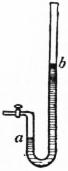

Fig. 1. Fig. 2.
Two forms are in use: (1) the “open-tube,” in which the pressure in one limb is equal to the atmospheric pressure, and (2) the “closed-tube,” in which the experimental pressure is balanced against the liquid column and the air compressed into the upper part of a closed limb of the tube. In the “open tube” form (fig. 1) the pressure on the surface a is equal to the pressure on the surface at b (one atmosphere) plus the hydrostatic pressure exerted by the liquid column of height a b. The liquid commonly used is mercury. If a scale be placed behind the limbs of the tube, so that the difference a b can be directly determined, then the pressure in a is at once expressible as P + a b in millimetres or inches of mercury, where P is the atmospheric pressure, known from an ordinary barometric observation. In the “closed tube” form (fig. 2) the calculation is not so simple, for the variation of pressure on the mercury surface in the closed limb has to be taken into account. Suppose the length of the air column in the closed limb be h when the mercury is at the same height in both tubes. Applying the experimental pressure to the open end, if this be greater than atmospheric pressure the mercury column will rise and the air column diminish in the closed limb. Let the length of the air column be h′, then its pressure is h/h′ atmospheres. The difference in height of the mercury columns in the two limbs is 2(h − h′), and the pressure in the open limb is obviously equal to that of a column of mercury of length 2(h − h′), plus h/h′ atmospheres. These instruments are equally serviceable for determining pressures less than one atmosphere. In laboratory practice, e.g. when it is required to determine the degree of exhaust of a water pump, a common form consists of a vertical glass tube having its lower end immersed in a basin of mercury, and its upper end connected by means of an intermediate vessel to the exhaust. The mercury rises in the tube, and the difference between the barometric height and the length of the mercury column gives the pressure attained.
MANOR. Any definition of a manor, in land tenure, must take note of two elements—economic and political. The manor has an estate for its basis, although it need not coincide with an estate, but may be wider. It is also a political unit, a district formed for purposes of government, although the political functions made over to it may greatly vary. As a lordship based on land tenure, the manor necessarily comprises a ruler and a population dependent on him, and the characteristic trait of such dependence consists not in ownership extending over persons, as in slave-holding communities, nor in contractual arrangements, as in a modern economic organization, but in various forms and degrees of subjection, chiefly regulated by custom. In the sense mentioned the manor is by no means a peculiarly English institution; it occurs in every country where feudalism got a hold. Under other names we find it not only in France, Germany, Italy, Spain, but also, to a certain extent, in the Byzantine Empire, Russia, Japan, &c. It is especially representative of an aristocratic stage in the development of European nations. When tribal notions and arrangements ceased to be sufficient for upholding their commonwealths, when social and political life had to be built up on the basis of land-tenure, the type of manorial organization came forward in natural course. It was closely connected with natural economy, and was suited to a narrow horizon of economic wants and political requirements. At the same time it provided links for a kind of national federation of military estates. We shall only speak of the course of manorial evolution in France and Germany, because this presents the clearest expression of the fundamental principles of manorial life and the best material for comparison with English facts.
One problem common to the entire European world has to be considered from the very beginning. Does the manor date from the Roman Empire, or not? Can its chief features be traced in Roman institutions? There can be no doubt that at the end of the Roman period certain traits are noticeable which might, under favourable conditions, develop into a manorial combination. Great estates with political functions, populations subjected to the political lordship of landowners, appear in the closing centuries of the empire, and have to be reckoned with as precursors of medieval manorial life. The original organization of the ancient world was built up on the self-government of cities and on the sharp distinction between citizens and slaves. Both features were gradually modified by the Roman Empire. Self-government was atrophied by bureaucratic interference; the economy based on the exploitation of slaves began to give way before relations in which the elements of freedom and serfdom were oddly mixed. During the last centuries of its existence the Western Empire became more and more a conglomerate of barbaric and half-civilized populations, and it is not strange that the characteristic germs of feudalism began to show themselves within its territory as well as outside it. As far as political institutions are concerned, we notice that the central power, after claiming an absolute sway over its subjects, is obliged more and more to lean on private forces in order to maintain itself. One of its favourite resources in the 4th and 5th centuries consists in making great landowners responsible for the good behaviour of their tenants and even of their less important neighbours. The saltus, the great domain, is occasionally recognized as a separate district exempt from the ordinary administration of the city, subordinated to its owner in respect of taxes and police. Even in ordinary estates (fundi) there is a tendency to make the landowner responsible for military conscription, for the presentation of criminals to justice. On the other hand the incumbents of ecclesiastical offices are nominated in accordance with the wishes of patrons among the landowners; in the administration of justice the influence of this same class makes itself felt more and more. Nor are signs of a convergent evolution wanting on the economic side. Slaves are used more and more as small householders provided with rural tenements and burdened with rents and services. Free peasant farmers holding by free agreement get more and more reduced to a status of half-free settlers occupying their tenancies on the strength of custom and traditional ascription to the glebe. Eventually this status is recognized as a distinct class by imperial legislation. Ominous symptoms of growing political disruption and of an aristocratic transformation of society were visible everywhere at the close of the empire. Yet there could be no talk of a manorial system as long as the empire and the commercial intercourse protected by it continued to exist.
The fall of the empire hastened the course of evolution. It brought into prominence barbaric tribes who were unable to uphold either the political power or the economic system of the Romans. The Germans had from old certain manorial features in the constitution of their government and husbandry. The owner of a house had always been possessed of a certain political power within its precincts, as well as within the fenced area surrounding it: the peace of the dwelling and the peace of the hedged-in yard were recognized by the legal customs of all the German tribes. The aristocratic superiority of warriors over all classes engaged in base peaceful work was also deeply engraved in the minds of the fighting and conquering tribes. On the other hand the downfall of complicated forms of civilization and civil intercourse rendered necessary a kind of subjection in which tributary labourers were left to a certain extent to manage their own affairs. The Germanic conqueror was unable to move slaves about like draughts: he had no scope for a complicated administration of capital and work. The natural outcome was to have recourse to serfdom with its convenient system of tribute and services.
But, as in the case of the Roman Empire, the formation of regular manors was held back for a time in the early Germanic monarchies by the lingering influence of tribal organization. In the second period of medieval development in continental Europe, in the Carolingian epoch, the features of the estate as a political unit are more sharply marked. Notwithstanding the immense efforts of Charles Martel, Pippin and Charlemagne to strengthen the tottering edifice of the Frankish Empire, public authority had to compromise with aristocratic forces in order to ensure regular government. As regards military organization this is expressed in the recognition of the power of seniores, called upon to lead their vassals in the host; as regards jurisdiction, in the increase of the numbers of commended freemen who seek to interpose the powerful patronage of lay and secular magnates between themselves and the Crown. Great estates arose not only on the lands belonging to the king, but on that of churches and of lay potentates, and the constitution of these estates, as described for instance in the Polyptique of St Germain des Près or in the “Brevium exempla ad describendas res ecclesiasticas et fiscales” (Capitularia, ed. Boretius, i. 250), reminds us forcibly of that of later feudal estates. They contain a home-farm, with a court and a casa indominicata, or manor-house, some holdings (mansi) of free men (ingenuiles), of serfs (serviles), and perhaps of half-free people (lidiles). The rents and services of this dependent population are stated in detail, as in later custumals, and there is information about the agricultural implements, the stores and stock on the home-farm. Thus the economic basis of the manor exists in more or less complete order, but it cannot be said as yet to form the prevailing type of land tenure in the country. Holdings of independent free men and village organizations of ancient type still surround the great estates, and in the case of ecclesiastical possessions we are often in a position to watch their gradual extension at the expense of the neighbouring free settlers, by way of direct encroachment, and by that of surrender and commendation on the part of the weaker citizens. Another factor which plays a great part in the gradual process of infeudation is the rise of private jurisdictions, which falls chiefly into the 10th and 11th centuries. The struggle against Northmen, Magyars and Slavs gave a crowning touch to the process of localization of political life and of the aristocratic constitution of society.
In order to describe the full-grown continental manor of the 11th century it is better to take French examples than German, Italian or Spanish. Feudalism in France attained the greatest extension and utmost regularity, while in other European countries it was hampered and intermixed with other institutional features. The expression best corresponding to the English “manor,” in the sense of an organized district, was seigneurie. Manoir is in use, and is, of course, a French word corresponding to manerium, but it meant strictly “mansion” or chief homestead in France. Baronie is another term which might be employed in some instances as an equivalent of the English manor, but, in a sense, it designates only one species of a larger genus, the estate of a full baron in contrast to a mere knight’s fee, as well as to a principality. Some of the attributes of a baron are, however, typical, as the purest expression of manorial rights, and may be used in a general characterization of the latter.
The seigneurie may be considered from three points of view—as a unit of administration, as an economic unit, and as a union of social classes.
(a) In principle the disruption of political life brought about by feudalism ought to have resulted in the complete administrative independence of the manor. Chaque baron est souverain dans sa baronie is a proverb meant to express this radical view of manorial separatism. As a matter of fact this separatism was never completely realized, and even at the time of the greatest prevalence of feudalism the little sovereigns of France were combined into a loose federation of independent fiefs. Still, the proverb was not a mere play of words, and it took a long time for the kings of France to break in potentates, like the little Sire de Coucy in the immediate vicinity of Paris, who sported in his crest the self-complacent motto: Je ne suis ni comte, ni marquis, je suis le sire de Coucy. The institutional expression of this aspect of feudalism in the life of the seigneurie was the jurisdiction combined with the latter. The principal origin of this jurisdiction was the dismemberment of royal justice, the acquisition by certain landowners of the right of holding royal pleas. The assumption of authority over public tribunals of any kind was naturally considered as equivalent to such a transmission of royal right. But other sources may be noticed also. It was assumed by French feudal law that in all cases when land was granted by a seigneur in subinfeudation the recipients would be bound to appear as members of a court of tenants for the settlement of conflicts in regard to land. A third source may be traced in the extension of the patrimonial justice of a person over his serfs and personal dependents to the classes of free and half-free population connected with the seigneurie in one way or another. There arose in consequence of these assumptions of jurisdiction a most bewildering confusion of tribunals and judicial rights. It happened sometimes that the question as to who should be the judge in some particular contest was decided by matter-of-fact seizure—the holder of pleas who was the first on the spot to proclaim himself judge in a case was deemed entitled to jurisdiction. In other cases one seigneur held the pleas in a certain place for six days in the week, while some competitor of his possessed jurisdiction during the seventh. A certain order was brought into this feudal chaos by the classification of judiciary functions according to the four categories of high, middle, low and tenurial justice. The scope of the first three subdivisions is sufficiently explained by their names; the fourth concerned cases arising from subinfeudation. As a rule the baron or seigneur sat in justice with a court of assessors or peers, but the constitution of such courts varied a great deal. They represented partly the succession of the old popular courts with their scabini, partly courts of vassals and tenants. In strict feudal law an appeal was allowed from a lower to a higher court only in a case of a denial of justice (dénie de justice), not in error or revision of sentence. This rule was, however, very often infringed, and gave way ultimately before the restoration of royal justice.
(b) The economic fabric of the French seigneurie varied greatly, according to localities. In the north of France it was not unlike that of the English manor. The capital messuage, or castle, and the home-farm of the lord, were surrounded by dependent holdings, censives, paying rent, and villein tenements burdened with services. Between these tenancies there were various ties of neighbourhood and economic solidarity recalling the open-field cultivation in England and Germany. When the harvest was removed from the open strips they returned to a state of undivided pasture in which the householders of the village exercised rights of common with their cattle. Wild pasture and woods were used more or less in the same fashion as in England (droit de pacage de vaine pâture). The inhabitants often formed courts and held meetings in order to settle the by-laws, and to adjudicate as to trespasses and encroachments (courts colongères). In the south, individual property was more prevalent and the villagers were not so closely united by ties of neighbourhood. Yet even there the dependent households were arranged into mansi or colonicae, subjected to approximately equal impositions in respect of rents and services. In any case the characteristic dualism of manorial life, the combined working of a central home-farm, and of its economic satellites providing necessary help in the way of services, and contributing towards the formation of manorial stores, is quite as much a feature of French as of English medieval husbandry.
(c) The social relations between the manorial lord and his subjects are marked by various forms of the exploitation of the latter by the former. Apart from jurisdictional profits, rents and agricultural services, dues of all kinds are exacted from the rural population. Some of these dues have to be traced to servile origins, although they were evidently gradually extended to groups of people who were not descended from downright serfs but had lapsed into a state of considerable subjection. The main morte of rustic tenants meant that they had no goods of their own, but held movable property on sufferance without the right of passing it on to their successors. As a matter of fact, sons were admitted to inheritance after their fathers, and sometimes succession was extended to other relatives, but the person taking inheritance paid a heavy fine for entering into possession, or gave up a horse, an ox, or some other especially valuable piece of property. The formariage corresponded to the English merchetum, and was exacted from rustics on the marriage of their daughters. Although this payment assumed very different shapes, and sometimes only appeared in case consorts belonged to different lords, it was considered a badge of serfdom. Chevage (capitagium) might be exacted as a poll-tax from all the unfree inhabitants of a seigneurie, or, more especially, from those who left it to look for sustenance abroad. The power of the lord as a landowner was more particularly expressed in his right of pre-emption (retrait seigneurial), and in taxes on alienation (lods et ventes). As a person wielding political authority, a kind of sovereignty, the lord enjoyed divers rights which are commonly attributed to the state—the right of coining money, of levying direct taxes and toll (tallagium, tolneta) and of instituting monopolies. These latter were of common occurrence, and might take the shape, for instance, of forcing the inhabitants to make use of the lord’s mill (moulin banal), or of his oven (four banal), or of his bull (taureau banal).
In Germany the history of the manorial system is bound up with the evolution of the Grundherrschaft (landlordship) as opposed to Gutsherrschaft (estate-ownership). The latter need not include any elements of public authority and aristocratic supremacy: the former is necessarily connected with public functions and aristocratic standing. The centre of the Grundherrschaft was the Hof, the court or hall of the lord, from which the political and economic rights of the lord radiated. The struggle of the military aristocracy and of ecclesiastical institutions with common freedom was more protracted than in France or England; the lordships very often took the shape of disparate rights over holdings and groups of population scattered over wide tracts of country and intermixed with estates and inhabitants subjected to entirely different authority. Therefore the aspect of German manorialism is more confused and heterogeneous than that of the French or English systems. One remarkable feature of it is the consistent separation of criminal justice from other kinds of jurisdiction on Church property. Episcopal sees and abbeys delegated their share of criminal justice to lay magnates in the neighbourhood (Vogtei), and this division of power became a source of various conflicts and of many entangled relations. The main lines of German manorialism are not radically different from those of France and England. The communal element, the Dorfverband, is usually more strongly developed than in France, and assumes a form more akin to the English township. But there were regions, e.g. Westphalia, where the population had settled in separate farms (Hofsystem), and where the communal solidarity was reduced to a union for administrative purposes and for the use of pasture.
It need hardly be added that every step in the direction of more active economic intercourse and more efficient public authority tended to lessen the influence of the manorial system in so far as the latter was based on the localization of government, natural husbandry and aristocratic authority.
See Fustel de Coulanges, Histoire des institutions de la France, especially the volumes “L’Alleu et le domaine rural” and “L’Invasion germanique”; Beaudouin, “Les Grands domaines dans l’empire romain” (Nouvelle revue de droit français et étranger, 1898); T. Flach, Les Origines de l’ancienne France, I., II., III. (1886); Paul Viollet, Histoire des institutions de la France, I., II. (1890, 1898); A. Luchaire, Manuel des institutions françaises (1892); G. Waitz, Deutsche Verfassungsgeschichte, I.-VIII. (1865-1883); K. T. von Inama-Sternegg, Deutsche Wirtschaftsgeschichte, I., II. (1879-1891); K. Lamprecht, Deutsches Wirtschaftsleben, I.-IV. (1885); A. Meitzen, Ansiedelungen, Wanderungen und Agrarwesen der Völker Europas, I.-IV. (1895 ff.); W. Wittich, Die Grundherrschaft in Nordwestdeutschland (1896); G. F. von Maurer, Geschichte der Mark-, Dorf- und Hofverfassung in Deutschland; and F. Seebohm, The English Village Community (1883).
(P. Vi.)
The Manor in England.—It will be most convenient to describe a typical English manor in its best known period, the 13th century, and to indicate briefly the modifications of the type which varying conditions may produce. Topographically such a manor consisted partly of the houses of the inhabitants more or less closely clustered together, and surrounded by arable land divided into large fields, two or three in number. Each of these fields was divided again into shots or furlongs, and each of the shots was broken up into cultivated strips a pole wide, each containing an acre, separated by narrow balks of turf. There were also certain meadows for supplying hay; and beyond the cultivated land lay the wood and waste of the manor. Portions of arable or meadow land might be found apart from the organization of the remainder; the lord of the manor might have a park, and each householder a garden, but the land of the manor was the open fields, the meadows and the wastes or common. The condition of the inhabitants of such a manor is as complex as its geography. At the head of the society came the lord of Rights of Lord and Tenants. the manor, with his hall, court, or manor-house, and the land immediately about it, and his demesne both in the fields and in the meadow land. The arable demesne consisted of certain of the acre strips lying scattered over the various furlongs; his meadow was a portion assigned to him each year by the custom of the manor. He had also rights over the surrounding waste paramount to those enjoyed by the other inhabitants. Part of his demesne land would be granted out to free tenants to hold at a rent or by military or other service; part would be in the lord’s own hands, and cultivated by him. Each part so granted out will carry with it a share in the meadow land and in the profits of the waste. These rights of the free tenants over the waste limited the lord’s power over it. He could not by enclosure diminish their interest in it. The statute of Merton in 1236 and the second statute of Westminster in 1285 marked the utmost limit of enclosure allowed in the 13th century. Below the lord and the free tenants came the villeins, natives, bondmen, or holders of virgates or yard-lands, each holding a house, a fixed number of acre strips, a share of the meadow and of the profits of the waste. The number of strips so held was usually about thirty; but virgates of fifteen acres or even eighty are not unknown. In any one manor, however, the holdings of all the villeins were equal. Rights of Villeins. Normally the holder of a virgate was unfree; he had no rights in the eye of the law against his lord, who was protected from all suits by the exceptio villenagii; he could not without leave quit the manor, and could be reclaimed by process of law if he did; the strict contention of law deprived him of all right to hold property; and in many cases he was subject to certain degrading incidents, such as merchet (merchetum), a payment due to the lord upon the marriage of a daughter, which was regarded as a special mark of unfree condition. But there are certain limitations to be made. Firstly, all these incidents of tenure, even merchet, might not affect the personal status of the tenant; he might still be free, though holding by an unfree tenure; secondly, even if unfree, he was not exposed to the arbitrary will of his lord but was protected by the custom of the manor as interpreted by the manor court. Moreover, he was not a slave, he was not bought and sold apart from his holding. The hardship of his condition lay in the services due from him. As a rule a villein paid for his holding in money, in labour and in kind. In money he paid, firstly, a small fixed rent called rent of assize; and, secondly, dues under various names, partly in lieu of services commuted into money payments, and partly for the privileges and profits enjoyed by him on the waste of the manor. In labour he paid more heavily. Week by week he had to come with his own plough and oxen to plough the lord’s demesne; when ploughing was done he had to harrow, to reap the crops, to thresh and carry them, or do whatever might be required of him, until his allotted number of days labour in the year was done. Beyond this his lord might request of him extra days in harvest or other seasons of emergency, and these requests could not be denied. Further, all the carriage of the manor was provided by the villeins, even to places as much as a hundred miles away from the manor. The mending of the ploughs, hedging, ditching, sheepshearing and other miscellaneous work also fell upon him, and it is sometimes hard to see what time remained to him to work upon his own holding. In kind he usually rendered honey, eggs, chickens and perhaps a ploughshare, but these payments were almost always small in value. Another class of inhabitants remains to be mentioned—the Cotters. cotters. These are the poor of the manor, who hold a cottage and garden, or perhaps one acre or half an acre in the fields. They were unfree in condition, and in most manors their services were modelled upon those of the villeins. From their ranks were usually drawn the shepherd of the manor, the bee-keeper and other minor officials of the manor.
A complicated organization necessarily involves administrators. Just as the services of the tenants and even their names vary from manor to manor, so does the nature of the staff. Highest in rank came the steward; he was attached to no manor in particular, but controlled a group, travelling from one to another to take accounts, to hold the courts, and generally Staff. represent the lord. Under him are the officers of the several manors. First came the bailiff or beadle, the representative of the lord in the manor; his duty was to collect the rents and services, to gather in the lord’s crops and account for the receipts and expenditure of the manor. Closely connected with him was the “messor” or reaper; in many cases, indeed, “reaper” seems to have been only another name for the bailiff. But the villeins were not without their own officer, the provost or reeve. His duty was to arrange the distribution of the services due from the tenants, and, as their representative, to assist the bailiff in the management of the manor. Sometimes the same man appears to have united both offices, and we find the reeve accounting to the lord for the issues of the manor. To these important officials may be added a number of smaller ones, the shepherd, the swineherd, the bee-keeper, the cowherd, the ploughman and so on, mostly selected from the cotters, and occupying their small holdings by the services expressed in their titles. The number varies with the constitution and needs of each estate, and they are often replaced by hired labour.
The most complicated structure in the system is the manor court. The complication is, indeed, partly the work of lawyers interpreting institutions they did not understand by formulae not adapted to describe them. But beyond Manor Court. this there remain the facts that the court was the meeting-point of the lord and the tenants both free and unfree, that any question touching on the power and constitution of the court was bound to affect the interests of the lord and the tenants, and that there was no external power capable of settling such questions as did arise. Amid this maze a few clear lines can be laid down. In the first place, so far as the 13th century goes, all the discussion that has collected about the terms court leet, court baron and court customary may be put aside; it relates to questions which in the 13th century were only just emerging. The manor court at that date exercised its criminal, civil, or manorial jurisdiction as one court; its names may differ, the parties before it may be free or unfree, but the court is the same. Its president was the lord’s steward; the bailiff was the lord’s representative and the public prosecutor; and the tenants of the manor, both free and unfree, attended at the court and gave judgment in the cases brought before it. To modern ears the constitution sounds unfamiliar. The president of the court settled the procedure of the court, carried it out, and gave the final sentence, but over the law of the court he had no power. All that is comprised in the word “judgment” was settled by the body of tenants present at the court. This attendance was, indeed, compulsory, and absence subjected to a fine any tenant owing and refusing the service known as “suit of court.” It may be asked who in these courts settled questions of fact. The answer must be that disputed questions of fact could only be settled in one way, by ordeal; and that in most manorial courts the method employed was the wager of law. The business of the court may be divided into criminal, manorial and civil. Its powers under the first head depended on the franchises enjoyed by the lord in the particular manor; for the most part only petty offences were triable, such as small thefts, breaches of the assize of bread and ale, assaults, and the like; except under special conditions, the justice of great offences remained in the king. But offences against the custom of the manor, such as bad ploughing, improper taking of wood from the lord’s woods, and the like, were of course the staple criminal business of the court. Under the head of manorial business the court dealt with the choice of the manorial officers, and had some power of making regulations for the management of the manor; but its most important function was the recording of the surrenders and admittances of the villein tenants. Into the history and meaning of this form of land transfer it is not necessary to enter here. But it must be noted that the conveyance of a villein’s holding was effected by the vendor surrendering his land to the lord, who thereupon admitted the purchaser to the holding. The same procedure was employed in all cases of transfer of land, and the transaction was regularly recorded upon the rolls of the court among the records of all the other business transacted there. Finally, the court dealt with all suits as to land within the manor, questions of dower and inheritance, and with civil suits not connected with land. But it need hardly be said that in an ordinary rural manor very few of these would occur.
It will be clear on consideration that the manor court as here described consisted of conflicting elements of very different origin and history. Founded partly on express grants of franchises, partly on the inherent right of a feudal lord to hold a court for his free tenants, partly on the obscure community traceable among the unfree inhabitants of the manor, it is incapable of strict legal definition. All these elements, moreover, contain in themselves reasons for the decay which gradually came over the system. The history of the decay of the manorial jurisdictions in England has not yet been written. On the one hand were the king’s courts, with new and improved processes of law; on the other hand the gradual disintegration which marks the history of the manor during the 14th and 15th centuries. The criminal jurisdiction was the first to disappear, and was closely followed by the civil jurisdiction over the free tenants; and in modern times all that is left is the jurisdiction over the customary tenants and their holdings, and that in an attenuated form.
A few words must be given to the legal theories of the 15th century on the manor court. It would seem to have become the law that to the existence of the manor two courts were necessary—a court customary for customary tenants, and a court baron for free tenants. In the court customary the lord’s steward is the judge; in the court baron the freeholders are the judges. If the freeholders in the manor diminish to less than two in number the court baron cannot be held, and the manor perishes. Nor can it be revived by the grant of new freehold tenures, because under the statute of Quia Emptores such new freeholders would hold not of the lord of the manor, but of his lord. The customary tenants and the court customary may survive, but the manor is only a reputed manor. Of the 13th century all this is untrue, but even at that date the existence of free tenants was in a measure essential to the existence of the manor court. If there were none the jurisdiction of the court over free tenants of course collapsed; but in addition to this the lord also lost his power of exercising the highest criminal franchises, even if he otherwise possessed them; he could, for instance, no longer hang a murderer on his own gallows. Perhaps it may be said that to the exercise of the feudal power and of the royal franchises the presence of free tenants was necessary. But it is clear that no such condition was necessary to the existence of the manor.
Apart from the change in the court of the manor, the most important thread in its history is the process which converted the villein into the copyholder. Here again the subject is imperfectly explored, and part of it is still subject to controversy. In the strict view of contemporary lawyers the holding of the villein tenant of the 13th century was at the will of the lord, and the king’s courts of law would not protect him in his possession. If, however, the villein were a tenant on the king’s ancient demesne his condition was improved. The writs of monstraverunt and the little writ of right close protected him from the improper exaction of services and from ejection by the lord. But in ordinary manors there was no such immunity. That ejection was common cannot be believed, but it was legally possible; and it was not until the well-known decision of Danby, C. J., and Bryan, C. J., in 7 Edw. IV., that the courts of law would entertain an action of trespass brought against his lord by a customary tenant. From that date the courts, both of law and equity, begin to intervene; and the records of the Courts of Star Chamber and Requests show that in the Tudor period equitable suits brought by tenants against their lords are not infrequent. Side by side with the alteration in the legal condition of the manor there went on an economic change. The labour rents and other services slowly disappeared, and were replaced by money payments. The field divisions gave way before inclosures, effected sometimes by the lords and sometimes by the tenants. Change in legal and agricultural practice went on side by side, and finally the manor ceased to be an important social form, and became only a peculiar form of land tenure and the abode of antiquarian curiosities.
See G. L. von Maurer, Einleitung in die Geschichte der Hof-, Mark-, Dorf- und Stadtverfassung in Deutschland (Erlangen, 1856); G. Nasse, Zur Geschichte der mittelälterlichen Feldgemeinschaft in England (Bonn, 1869); H. S. Maine, Village Communities in the East and West (Cambridge, 1872); F. Seebohm, The English Village Community (1883); W. J. Ashley, English Economic History, pts. i. ii. (1888-1893); F. W. Maitland, Select Pleas in Manorial Courts (London, Selden Society, 1888); P. Vinogradoff, Villainage in England (Cambridge, 1892); The Growth of the Manor (1905) and English Society in the 11th Century (1908); A. Meitzen, Siedelung und Agrarwesen der Westgermanen und Ostgermanen (Berlin, 1896); W. Cunningham, Growth of English Industry and Commerce (Cambridge, 1896); F. Pollock and F. W. Maitland, History of English Law (Cambridge, 1896); F. W. Maitland, Doomsday Book and Beyond (Cambridge, 1897); and C. M. Andrews, The Old English Manor (1892).
(C. G. Cr.)
MANOR-HOUSE (Lat. manerium; Fr. manoir), in architecture, the name given to the dwelling-house of the lord of the manor. The manor-house was generally arranged for defence against robbers and thieves and was often surrounded by a moat with drawbridge, but was not provided with a keep or with towers or lofty curtain walls so as to stand a siege. The early buildings were comparatively small, square in plan, comprising a hall with one or two adjacent chambers; at a later period wings were added, thus forming three sides of a quadrangle, like the house designed by John Thorpe as his residence, the plan of which is among his drawings in the Soane Museum. One of the most ancient examples is the manor-house built by Richard Cœur de Lion at Southampton as a rendezvous when he was about to cross into France. This consisted of a hall and chapel on the first floor, with cellars on the ground floor; the walls of this structure, with the chimney-piece, are still in existence. The distinction between the “manor-house” and “castle” is not always very clearly defined; in France such buildings as the castles of Aydon (Northumberland) and of Stokesay (Shropshire) would be regarded as manor-houses in that they were built as country houses and not as fortresses, like Coucy and Pierrefonds; some of the smaller castles in France were, in the 16th century, transformed into manor-houses by the introduction of windows on the second floors of their towers and the partial destruction of their curtain walls, as in the manor-houses of Sedières (Corrèze), Nantouillet and Compiègne; and in the same century, as at Chenonceaux, Blois and Chambord, though angle towers and machicolated parapets still formed part of the design, they were considered to be purely decorative features. The same is found in England; thus in Thornbury and Hurstmonceaux castles, and in Cowdray House, the fortifications were more for show than for use. There is an interesting example of a French manor-house near Dieppe, known as the Manoir-d’Ango, built in 1525, of which a great portion still exists, where the proprietor Ango received François I., so that it must have been of considerable size.
In England the principal examples of which remains exist are the manor-houses of Appleton, Berkshire, with a moat; King John’s house at Warnford (Hampshire); Boothby Ragnell, Lincolnshire, with traces of moat; Godmersham, Kent; Little Wenham Hall, Suffolk, built partly in brick and flint, and one of the earliest in which the bricks, probably imported from Flanders, are found; Charney Hall, Berkshire (T-shaped in plan in two storeys); Longthorpe House, near Peterborough; Stokesay, Shropshire, already referred to; Cottesford, Oxfordshire; Woodcraft, Northamptonshire; Acton Burnell, Shropshire; Old Soar, Plaxtol, Kent, in two storeys, the ground storey vaulted and used as cellar and storehouse, and the upper floor with hall, solar and chapel. The foundation of all these dates from the 13th century. Ightham Mote, Kent, portions of which, with the moat, date from the 14th century, is one of the best preserved manor-houses; then follow Norborough Hall, Northamptonshire; Creslow manor-house, Bucks, with moat; Sutton Courtenay, Berkshire; the Court Lodge, Great Chart, Kent; Stanton St Quentin, Great Chalfield, and South Wraxhall, all in Wilts; Meare manor-house, Somerset; Ockwell, Berks; Kingfield manor-house, Derbyshire; Kirby Muxloe, Leicestershire; Stoke Albany, Northamptonshire; and, in the 16th century, Large Marney Hall, Essex (1520); Sutton Place, Surrey (1530); the Vyne, Hampshire, already influenced by the first Renaissance. In the 17th and 18th centuries the manor-house is generally rectangular in plan, and, though well and solidly built, would seem to have been erected more with a view to internal comfort than to exterior embellishments. There is one other type of manor-house, which partakes of the character of the castle in its design, and takes the form of a tower, rectangular or square, with angle turrets and in several storeys; in France it is represented by the manor-houses of St Medard near Bordeaux and Camarsae (Dordogne), and in England by Tattershall Castle, Lincolnshire and Middleton Tower, Norfolk, both being in brick.
(R. P. S.)
MANRESA, a town of north-eastern Spain, in the province of Barcelona, on the river Cardoner and the Barcelona-Lérida railway. Pop. (1900), 23,252. Manresa is the chief town of the highlands watered by the Cardoner and upper Llobregat, which meet below the town, and are also connected by a canal 18 m. long. Two bridges, one built of stone and dating from the Roman period, the other constructed of iron in 1804, unite the older and larger part of Manresa with the modern suburbs on the right bank of the river. The principal buildings are the collegiate church of Santa Maria de la Séo, the Dominican monastery, and the church of San Ignazio, built over the cavern (cueva santa) where Ignatius de Loyola spent most of the year 1522 in penitentiary exercises and the composition of his Exercitia spiritualia. Santa Maria is a fine example of Spanish Gothic, and consists, like many Catalan churches, of nave and chancel, aisles and ambulatory, without transepts. One of its chief treasures is an exquisite 15th-century Florentine altar-frontal, preserved in the sacristy. The Dominican monastery, adjoining the cueva santa, commands a magnificent view of the Montserrat (q.v.), and is used for the accommodation of the pilgrims who yearly visit the cavern in thousands. Manresa has important iron-foundries and manufactures of woollen, cotton and linen goods, ribbons, hats, paper, soap, chemicals, spirits and flour. Building-stone is quarried near the town.
Manresa is probably the Munorisa of the Romans, which was the capital of the Jacetani or Jaccetani, an important tribe of the south-eastern Pyrenees. A large portion of the town was burned by the French in 1811.
MANRIQUE, GÓMEZ (1412?-1490?), Spanish poet, soldier, politician and dramatist, was born at Amusco. The fifth son of Pedro Manrique, adelantado mayor of León, and nephew of Santillana (q.v.), Gómez Manrique was introduced into public life at an early age, took a prominent part against the constable Álvaro de Luna during the reign of John II., went into opposition against Miguel Lucas de Iranzo in the reign of Henry IV., and declared in favour of the infanta Isabel, whose marriage with Ferdinand he promoted. Besides being a distinguished soldier, he acted as a moderating political influence and, when appointed corregidor of Toledo, was active in protecting the converted Jews from popular resentment. His will was signed on the 31st of May 1490, and he is known to have died before the 16th of February 1491. He inherited the literary taste of his uncle Santillana, and was greatly esteemed in his own age; but his reputation was afterwards eclipsed by that of his nephew Jorge Manrique (q.v.), whose Coplas were continually reproduced. Gómez Manrique’s poems were not printed till 1885, when they were edited by Antonio Paz y Melia. They at once revealed him to be a poet of eminent merit, and it seems certain that his Consejos, addressed to Diego Arias de Avila, inspired the more famous Coplas of his nephew. His didactic verses are modelled upon those of Santillana, and his satires are somewhat coarse in thought and expression; but his place in the history of Spanish literature is secure as the earliest Spanish dramatist whose name has reached posterity. He wrote the Representación del nascimiento de Nuestro Señor, a play on the Passion, and two momos, or interludes, played at court.
MANRIQUE, JORGE (1440?-1478), Spanish poet and soldier, was born probably at Paredes de Nava. The fourth son of Rodrigo Manrique, count de Paredes, he became like the rest of his family a fervent partisan of Queen Isabel, served with great distinction in many engagements, and was made comendador of Montizón in the order of Santiago. He was killed in a skirmish near the fortress of Garci-Muñoz in 1478, and was buried in the church attached to the convent of Uclés. His love-songs, satires, and acrostic verses are merely ingenious compositions in the taste of his age; he owes his imperishable renown to a single poem, the Coplas por la muerte de su padre, an elegy of forty stanzas on the death of his father, which was apparently first printed in the Cancionero llamado de Fray Inigo de Mendoza about the year 1482. There is no foundation for the theory that Manrique drew his inspiration from an Arabic poem by Abu ‘l-Bakā Sālih ar-Rundi; the form of the Coplas is influenced by the Consejos of his uncle, Gómez Manrique, and the matter derives from the Bible, from Boethius and from other sources readily accessible. The great sonorous commonplaces on death are vitalized by the intensely personal grief of the poet, who lent a new solemnity and significance to thoughts which had been for centuries the common property of mankind. It was given to Jorge Manrique to have one single moment of sublime expression, and this isolated achievement has won him a fame undimmed by any change of taste during four centuries.
The best edition of the Coplas is that issued by R. Foulché-Delbosc in the Bibliotheca hispanica; the poem has been admirably translated by Longfellow. Manrique’s other verses were mostly printed in Hernando del Castillo’s Cancionero general (1511).
MANSE (Med. Lat. mansa, mansus or mansum, from manere, to dwell, remain), originally a dwelling-house together with a portion of land sufficient for the support of a family. It is defined by Du Cange (Glossarium, s.v. Mansus) as ... certam agri portionem quae coleretur et in qua coloni aedes esset. The term was particularly applied, in ecclesiastical law, to the house and glebe to which every church was entitled by common right, the rule of canon law being sancitum est ut unicuique ecclesiae unus mansus integer absque ullo servitio tribuatur (Phillimore, Eccles. Law, 1895, ii. 1125). The word is now chiefly used for the residence of a minister of the Established Church of Scotland; to this every minister of a rural parish is entitled, and the landed proprietors must build and keep it up. “Manse” is also loosely used for the residence of a minister of various Free Church denominations (see Glebe).
MANSEL, HENRY LONGUEVILLE (1820-1871), English philosopher, was born at Cosgrove, Northamptonshire (where his father, also Henry Longueville Mansel, fourth son of General John Mansel, was rector), on the 6th of October 1820. He was educated at Merchant Taylors’ School and St John’s College, Oxford. He took a double first in 1843, and became tutor of his college. He was appointed reader in moral and metaphysical philosophy at Magdalen College in 1855, and Waynflete professor in 1859. He was a great opponent of university reform and of the Hegelianism which was then beginning to take root in Oxford. In 1867 he succeeded A. P. Stanley as professor of ecclesiastical history, and in 1868 he was appointed dean of St Paul’s. He died on the 31st of July 1871.
The philosophy of Mansel, like that of Sir William Hamilton, was mainly due to Aristotle, Kant and Reid. Like Hamilton, Mansel maintained the purely formal character of logic, the duality of consciousness as testifying to both self and the external world, and the limitation of knowledge to the finite and “conditioned.” His doctrines were developed in his edition of Aldrich’s Artis logicae rudimenta (1849)—his chief contribution to the reviving study of Aristotle—and in his Prolegomena logica: an Inquiry into the Psychological Character of Logical Processes (1851, 2nd ed. enlarged 1862), in which the limits of logic as the “science of formal thinking” are rigorously determined. In his Bampton lectures on The Limits of Religious Thought (1858, 5th ed. 1867; Danish trans. 1888) he applied to Christian theology the metaphysical agnosticism which seemed to result from Kant’s criticism, and which had been developed in Hamilton’s Philosophy of the Unconditioned. While denying all knowledge of the supersensuous, Mansel deviated from Kant in contending that cognition of the ego as it really is is itself a fact of experience. Consciousness, he held—agreeing thus with the doctrine of “natural realism” which Hamilton developed from Reid—implies knowledge both of self and of the external world. The latter Mansel’s psychology reduces to consciousness of our organism as extended; with the former is given consciousness of free will and moral obligation. A summary of his philosophy is contained in his article “Metaphysics” in the 8th edition of the Encyclopaedia Britannica (separately published, 1860). Mansel wrote also The Philosophy of the Conditioned (1866) in reply to Mill’s criticism of Hamilton; Letters, Lectures, and Reviews (ed. Chandler, 1873), and The Gnostic Heresies (ed. J. B. Lightfoot, 1875, with a biographical sketch by Lord Carnarvon). He wrote a commentary on the first two gospels in the Speaker’s Commentary.
See J. W. Burgon, Lives of Twelve Good Men (1888-1889); James Martineau, Essays, Reviews and Addresses (London, 1891), iii. 117 seq.; A. W. Benn, History of Rationalism (1906), ii. 100-112; Masson, Recent British Philosophy (3rd ed., London, 1877), pp. 252 seq.; Sir Leslie Stephen in Dict. Nat. Biog.
MANSFELD, the name of an old and illustrious German family which took its name from Mansfeld in Saxony, where it was seated from the 11th to the 18th century. One of its earliest members was Hoyer von Mansfeld (d. 1115), a partisan of the emperor Henry V. during his struggles with the Saxons; he fought for Henry at Warnstädt and was killed in his service at Welfesholz. Still more famous was Albert, count of Mansfeld (1480-1560), an intimate friend of Luther and one of the earliest and staunchest supporters of the Reformation. He helped to crush the rising of the peasants under Thomas Munzer in Thuringia in 1525; he was a member of the league of Schmalkalden, and took part in all the movements of the Protestants against Charles V. With Albert was associated his brother Gebhard, and another member of the family was Johann Gebhard, elector of Cologne from 1558 to 1562. A scion of another branch of the Mansfelds was Peter Ernst, Fürst von Mansfeld (1517-1604), governor of Luxemburg, who unlike his kinsmen was loyal to Charles V. He went with the emperor to Tunis and fought for him in France. He was equally loyal to his son, Philip II. of Spain, whom he served at St Quentin and in the Netherlands. He distinguished himself in the field and found time to lead a body of troops to aid the king of France against the Huguenots. In this capacity he was present in 1569 at the battle of Moncontour, where another member of his family, Count Wolrad of Mansfeld (d. 1578) was among the Huguenot leaders. The Mansfeld family became extinct in 1780 on the death of Josef Wenzel Nepomuk, prince of Fondi, the lands being divided between Saxony and Prussia.
See L. F. Niemann, Geschichte der Grafen von Mansfeld (Aschersleben, 1834).
MANSFELD, ERNST, Graf von (c. 1580-1626), German soldier, was an illegitimate son of Peter Ernst, Fürst von Mansfeld, and passed his early years in his father’s palace at Luxemburg. He gained his earliest military experiences in Hungary, where his half-brother Charles (1543-1595,) also a soldier of renown, held a high command in the imperial army. Later he served under the Archduke Leopold, until that prince’s ingratitude, real or fancied, drove him into the arms of the enemies of the house of Habsburg. Although remaining a Roman Catholic he allied himself with the Protestant princes, and during the earlier part of the Thirty Years’ War he was one of their foremost champions. He was despatched by Charles Emmanuel, duke of Savoy, at the head of about 2000 men to aid the revolting Bohemians when war broke out in 1618. He took Pilsen, but in the summer of 1619 he was defeated at Zablat; after this he offered his services to the emperor Ferdinand II. and remained inactive while the titular king of Bohemia, Frederick V., elector palatine of the Rhine, was driven in headlong rout from Prague. Mansfeld, however, was soon appointed by Frederick to command his army in Bohemia, and in 1621 he took up his position in the Upper Palatinate, successfully resisting the efforts made by Tilly to dislodge him. From the Upper he passed into the Rhenish Palatinate. Here he relieved Frankenthal and took Hagenau; then, joined by his master, the elector Frederick, he defeated Tilly at Wiesloch in April 1622 and plundered Alsace and Hesse. But Mansfeld’s ravages were not confined to the lands of his enemies; they were ruinous to the districts he was commissioned to defend. At length Frederick was obliged to dismiss Mansfeld’s troops from his service. Then joining Christian of Brunswick the count led his army through Lorraine, devastating the country as he went, and in August 1622 defeating the Spaniards at Fleurus. He next entered the service of the United Provinces and took up his quarters in East Friesland, capturing fortresses and inflicting great hardships upon the inhabitants. A mercenary and a leader of mercenaries, Mansfeld often interrupted his campaigns by journeys made for the purpose of raising money, or in other words of selling his services to the highest bidder, and in these diplomatic matters he showed considerable skill. About 1624 he paid three visits to London, where he was hailed as a hero by the populace, and at least one to Paris. James I. was anxious to furnish him with men and money for the recovery of the palatinate, but it was not until January 1625 that Mansfeld and his army of “raw and poor rascals” sailed from Dover to the Netherlands. Later in the year, the Thirty Years’ War having been renewed under the leadership of Christian IV., king of Denmark, he re-entered Germany to take part therein. But on the 25th of April 1626 Wallenstein inflicted a severe defeat upon him at the bridge of Dessau. Mansfeld, however, quickly raised another army, with which he intended to attack the hereditary lands of the house of Austria, and pursued by Wallenstein he pressed forward towards Hungary, where he hoped to accomplish his purpose by the aid of Bethlem Gabor, prince of Transylvania. But when Gabor changed his policy and made peace with the emperor, Mansfeld was compelled to disband his troops. He set out for Venice, but when he reached Rakowitza he was taken ill, and here he died on the 29th of November 1626. He was buried at Spalato.
See F. Stieve, Ernst von Mansfeld (Munich, 1890); R. Reuss, Graf Ernst von Mansfeld im böhmischen Kriege (Brunswick, 1865); A. C. de Villermont, Ernest de Mansfeldt (Brussels, 1866); L. Graf Uetterodt zu Schaffenberg, Ernst Graf zu Mansfeld (Gotha, 1867); J. Grossmann, Des Grafen Ernst von Mansfeld letzte Pläne und Thaten (Breslau, 1870); E. Fischer, Des Mansfelders Tod (Berlin, 1873); S. R. Gardiner, History of England, vols. iv. and v. (1901); J. L. Motley, Life and Death of John of Barneveld (ed. 1904; vol. ii.).
MANSFIELD, RICHARD (1857-1907), American actor, was born on the 24th of May 1857, in Berlin, his mother being Madame [Erminia] Rudersdorff (1822-1882), the singer, and his father, Maurice Mansfield (d. 1861), a London wine merchant. He first appeared on the stage at St George’s Hall, London, and then drifted into light opera, playing the Major-General in The Pirates of Penzance, and the Lord High Executioner in The Mikado, both in the English provinces and in America. In 1883 he joined A. M. Palmer’s Union Square theatre company in New York, and made a great hit as Baron Chevrial in A Parisian Romance. He appeared successfully in several plays adapted from well-known stories, and his rendering (1887) of the doubled title-parts in R. L. Stevenson’s Strange Case of Dr Jekyll and Mr Hyde created a profound impression. It was with this play that he made his London reputation during a season (1888) at the Lyceum theatre, by invitation of Henry Irving. He produced Richard III. the next year at the Globe. Among his other chief successes were Prince Karl, Cyrano de Bergerac and Monsieur Beaucaire. He was one of the earliest to produce G. Bernard Shaw’s plays in America, appearing in 1894 as Bluntschli in Arms and the Man, and as Dick Dudgeon in The Devil’s Disciple in 1897. As a manager and producer of plays Mansfield was remarkable for his lavish staging. He died in New London, Connecticut, on the 30th of August 1907.
See the lives by Paul Wilstach (1908) and William Winter (1910).
MANSFIELD, WILLIAM MURRAY, 1st Earl of (1705-1793), English judge, was born at Scone in Perthshire, on the 2nd of March 1705. He was a younger son of David Murray, 5th Viscount Stormont (c. 1665-1731), the dignity having been granted in 1621 by James I. to his friend and helper, Sir David Murray (d. 1631), a Scottish politician of some note. Lord Stormont’s family was Jacobite in its politics, and his second son James (c. 1690-1728), being apparently mixed up in some of the plots of the time, joined the court of the exiled Stuarts and in 1721 was created earl of Dunbar by James Edward, the Old Pretender.
William Murray was educated at Perth grammar school and Westminster School, of which he was a king’s scholar. Entering Christ Church, Oxford, he graduated in 1727. A friend of the family, Lord Foley, provided the funds for his legal training, and he became a member of Lincoln’s Inn on his departure from Oxford, being called to the bar in 1730. He was a good scholar and mixed with the best literary society, being an intimate friend of Alexander Pope. His appearance in some important Scottish appeal cases brought him into notice, and in Scotland at least he acquired an immense reputation by his appearance for the city of Edinburgh when it was threatened with disfranchisement for the affair of the Porteous mob. His English practice had as yet been scanty, but in 1737 a single speech in a jury trial of note placed him at the head of the bar, and from this time he had all he could attend to. In 1738 he married Lady Elizabeth Finch, daughter of the earl of Winchelsea. His political career began in 1742 with his appointment as solicitor-general. During the next fourteen years he was one of the most conspicuous figures in the parliamentary history of the time. By birth a Jacobite, by association a Tory, he was nevertheless a Moderate, and his politics were really dominated by his legal interests. Although holding an office of subordinate rank, he was the chief defender of the government in the House of Commons, and during the time that Pitt was in opposition had to bear the brunt of his attacks. In 1754 he became attorney-general, and for the next two years acted as leader of the House of Commons under the administration of the duke of Newcastle. But in 1756, when the government was evidently approaching its fall, an unexpected vacancy occurred in the chief justiceship of the king’s bench, and he claimed the office, being at the same time raised to the peerage as Baron Mansfield.
From this time the chief interest of his career lies in his judicial work, but he did not wholly dissever himself from politics. He became by a singular arrangement, only repeated in the case of Lord Ellenborough, a member of the cabinet, and remained in that position through various changes of administration for nearly fifteen years, and, although he persistently refused the chancellorship, he acted as Speaker of the House of Lords while the Great Seal was in commission. During the time of Pitt’s ascendancy he took but little part in politics, but while Lord Bute was in power his influence was very considerable, and seems mostly to have been exerted in favour of a more moderate line of policy. He was on the whole a supporter of the prerogative, but within definite limits. Macaulay terms him, justly enough, “the father of modern Toryism, of Toryism modified to suit an order of things in which the House of Commons is the most powerful body in the state.” During the stormy session of 1770 he came into violent collision with Chatham and Camden in the questions that arose out of the Middlesex election and the trials for political libel; and in the subsequent years he was made the subject of the bitter attacks of Junius, in which his early Jacobite connexions, and his apparent leanings to arbitrary power, were used against him with extraordinary ability and virulence. In 1776 he was created earl of Mansfield. In 1783, although he declined to re-enter the cabinet, he acted as Speaker of the House of Lords during the coalition ministry, and with this his political career may be said to have closed. He continued to act as chief justice until his resignation in June 1788, and after five years spent in retirement died on the 20th of March 1793. He left no family, but his title had been re-granted in 1792 with a direct remainder to his nephew David Murray, 7th Viscount Stormont (1727-1796). The 2nd earl was ambassador to Vienna and then to Paris; he was secretary of state for the southern department from 1779 to 1782, and lord president of the council in 1783, and again from 1794 until his death. In 1906 his descendant Alan David Murray (b. 1864) became 6th earl of Mansfield.
Lord Mansfield’s great reputation rests chiefly on his judicial career. The political trials over which he presided, although they gave rise to numerous accusations against him, were conducted with singular fairness and propriety. He was accused with especial bitterness of favouring arbitrary power by the law which he laid down in the trials for libel which arose out of the publications of Junius and Horne Tooke, and which at a later time he reaffirmed in the case of the dean of St Asaph (see Libel). But we must remember that his view of the law was concurred in by the great majority of the judges and lawyers of that time, and was supported by undoubted precedents. In other instances, when the government was equally concerned, he was wholly free from suspicion. He supported Lord Camden’s decision against general warrants, and reversed the outlawry of Wilkes. He was always ready to protect the rights of conscience, whether they were claimed by Dissenters or Catholics, and the popular fury which led to the destruction of his house during the Gordon riots was mainly due to the fact that a Catholic priest, who was accused of saying Mass, had escaped the penal laws by his charge to the jury. His chief celebrity, however, is founded upon the consummate ability with which he discharged the civil duties of his office. He has always been recognized as the founder of English mercantile law. The common law as it existed before his time was wholly inadequate to cope with the new cases and customs which arose with the increasing development of commerce. The facts were left to the jury to decide as best they might, and no principle was ever extracted from them which might serve as a guide in subsequent cases. Mansfield found the law in this chaotic state, and left it in a form that was almost equivalent to a code. He defined almost every principle that governed commercial transactions in such a manner that his successors had only to apply the rules he had laid down. His knowledge of Roman and foreign law, and the general width of his education, freed him from the danger of relying too exclusively upon narrow precedents, and afforded him a storehouse of principles and illustrations, while the grasp and acuteness of his intellect enabled him to put his judgments in a form which almost always commanded assent. A similar influence was exerted by him in other branches of the common law; and although, after his retirement, a reaction took place, and he was regarded for a while as one who had corrupted the ancient principles of English law, these prejudices passed rapidly away, and the value of his work in bringing the older law into harmony with the needs of modern society has long been fully recognized.
See Holliday’s Life (1797); Campbell’s Chief Justices; Foss’s Judges; Greville’s Memoirs, passim; Horace Walpole’s Letters; and other memoirs and works on the period.
MANSFIELD, a market town and municipal borough in the Mansfield parliamentary division of Nottinghamshire, England, on the small river Mann or Maun; the junction of several branches of the Midland railway, by which it is 142 m. N.N.W. from London. Pop. (1891), 13,094; (1901), 15,250. Area, 7068 acres. The church of St Peter is partly Early Norman, and partly Perpendicular. There is a grammar school founded by Queen Elizabeth in 1561, occupying modern buildings. Twelve almshouses were founded by Elizabeth Heath in 1693, and to these six were afterwards added. There are a number of other charities. The industries are the manufacture of lace, thread, boots and machinery, iron-founding and brewing. In the neighbourhood, as at Mansfield Woodhouse to the north, there are quarries of limestone, sandstone and freestone. The town is governed by a mayor, 6 aldermen and 18 councillors. During the heptarchy Mansfield was occasionally the residence of the Mercian kings, and it was afterwards a favourite resort of Norman sovereigns, lying as it does on the western outskirts of Sherwood Forest. By Henry VIII. the manor was granted to the earl of Surrey. Afterwards it went by exchange to the duke of Newcastle, and thence to the Portland family. The town obtained a fair from Richard II. in 1377. It became a municipal borough in 1891.
MANSFIELD, a city and the county-seat of Richland county, Ohio, U.S.A., about 65 m. S.W. of Cleveland. Pop. (1890), 13,473; (1900), 17,640, of whom 1781 were foreign-born; (1910 census), 20,768. It is served by the Pennsylvania (Pittsburg, Ft Wayne & Chicago division), the Erie, and the Baltimore & Ohio railways. It is built on an eminence (1150 ft.), and has two public parks, a substantial court-house, a soldiers’ and sailors’ memorial building, a public library, a hospital and many fine residences. It is the seat of the Ohio state reformatory. Mansfield has an extensive trade with the surrounding agricultural country, but its largest interests are in manufactures. The total factory product in 1905 was valued at $7,353,578. There are natural gas wells in the vicinity. The waterworks and the sewage disposal plant are owned and operated by the municipality. Mansfield was laid out in 1808, and was named in honour of Lieut.-Colonel Jared Mansfield (1759-1830), United States surveyor of Ohio and the North-west Territory in 1803-1812, and professor of natural and experimental philosophy at West Point from 1812 to 1828. Mansfield was incorporated as a village in 1828 and was first chartered as a city in 1857. It was the home of John Sherman from 1840 until his death.
MANSION (through O. Fr. mansion, mod. maison, from Lat. mansio, dwelling-place, stage on a journey; manere, to remain), a term applied in early English use to the principal house of the lord of a manor. By the Settled Land Act 1890, § 10, subsec. 2, repealing § 15 of the act of 1882, “the principal mansion house ... on any settled land shall not be sold or exchanged or leased by the tenant for life without the consent of the trustees of the settlement or an order of the court.” The principles guiding an English court of law for making or refusing such an order are laid down in In re the Marquess of Ailesbury’s Settled Estate (1892), 1 Ch. 506, 546; A.C. 356. In general usage, the term “mansion” is given to any large and important house in town or country; and “mansion house” to the official residence, when provided, of the mayor of a borough, particularly to that of the lord mayors of London and Dublin. From the general meaning of a conspicuously large dwelling-place comes the modern employment of the term “mansions,” in London and elsewhere, for large buildings composed of “flats.”
MANSLAUGHTER (O. Eng., mannslaeht, from mann, man, and slaeht, act of slaying, sleán, to slay, properly to smite; cf. Ger. schlagen, Schlacht, battle), a term in English law signifying “unlawful homicide without malice aforethought” (Stephen, Digest of the Criminal Law, Art. 223). The distinction between manslaughter and murder and other forms of homicide is treated under Homicide.
MANSON, GEORGE (1850-1876), Scottish water-colour painter, was born in Edinburgh on the 3rd of December 1850. When about fifteen he was apprenticed as a woodcutter with W. & R. Chambers, with whom he remained for over five years, diligently employing all his spare time in the study and practice of art, and producing in his morning and evening hours water-colours of much delicacy and beauty. In 1871 he devoted himself exclusively to painting. His subjects were derived from humble Scottish life—especially child-life, varied occasionally by portraiture, by landscape, and by views of picturesque architecture. In 1873 he visited Normandy, Belgium and Holland; in the following year he spent several months in Sark; and in 1875 he resided at St Lô, and in Paris, where he mastered the processes of etching. Meanwhile in his water-colour work he had been adding more of breadth and power to the tenderness and richness of colour which distinguished his early pictures, and he was planning more complex and important subjects. But his health had been gradually failing, and he was ordered to Lympstone in Devonshire, where he died on the 27th of February 1876.
A volume of photographs from his water-colours and sketches, with a memoir by J. M. Gray, was published in 1880. For an account of Manson’s technical method as a wood engraver see P. G. Hamerton’s Graphic Arts, p. 311.
MANṢŪR (Arab. “victorious”), a surname (laqab) assumed by a large number of Mahommedan princes. The best known are: (1) Abū Ja’far ibn Mahommed, second caliph of the Abbasid house, who reigned A.D. 754-775 (see Caliphate: § C, §2); (2) Abū Tāhir Isma’il ibn al-Qāim, the third Fatimite caliph of Africa (946-953) (see Fatimites); (3) Abū Yūsuf Ya ‘qūb ibn Yūsuf, often described as Jacob Almanzor, of the Moorish dynasty of the Almohades, conqueror of Alfonso III. in the battle of Alarcos (1195); (4) Ibn Abī ‘Āmir Mahommed, commonly called Almanzor by European writers, of an ancient but not illustrious Arab family, which had its seat at Torrox near Algeciras. The last-named was born A.D. 939, and began life as a lawyer at Cordova. In 967 he obtained a place at the court of Ḥakam II., the Andalusian caliph, and by an unusual combination of the talents of a courtier with administrative ability rapidly rose to distinction, enjoying the powerful support of Ṣubḥ, the favourite of the caliph and mother of his heir Hishām. The death of Ḥakam (976) and the accession of a minor gave fresh scope to his genius, and in 978 he became chief minister. The weak young caliph was absorbed in exercises of piety, but at first Manṣūr had to share the power with his father-in-law Ghālib, the best general of Andalusia, and with the mother of Hishām. At last a rupture took place between the two ministers. Ghālib professed himself the champion of the caliph and called in the aid of the Christians of Leon; but Manṣūr, anticipating the struggle, had long before remodelled the army and secured its support. Ghālib fell in battle (981); a victorious campaign chastised the Leonese; and on his return to Cordova the victor assumed his regal surname of al-Manṣūr billah, and became practically sovereign of Andalusia. The caliph was a mere prisoner of state, and Manṣūr ultimately assumed the title as well as the prerogatives of king (996). Unscrupulous in the means by which he rose to power, he wielded the sovereignty nobly. His strict justice and enlightened administration were not less notable than the military prowess by which he is best known. His arms were the terror of the Christians, and raised the Moslem power in Spain to a pitch it had never before attained. In Africa his armies were for a time hard pressed by the revolt of Zīrī, viceroy of Mauretania, but before his death this enemy had also fallen. Mansūr died at Medinaceli on the 10th of August 1002, and was succeeded by his son Mozaffar.
MANSURA, the capital of the province of Dakahlia, Lower Egypt, near the west side of Lake Menzala, and on the Cairo-Damietta railway. Pop. (1907), 40,279. It dates from 1221, and is famous as the scene of the battle of Mansura, fought on the 8th of February 1250, between the crusaders commanded by the king of France, St Louis, and the Egyptians. The battle was drawn, but it led to the retreat of the crusaders on Damietta, and to the surrender of St Louis. Mansura has several cotton-ginning, cotton, linen and sail-cloth factories.
MANT, RICHARD (1776-1848), English divine, was born at Southampton on the 12th of February 1776, and was educated at Winchester and Trinity College, Oxford. He was elected fellow of Oriel in 1798, and after taking orders held a curacy at Southampton (1802), and then the vicarage of Coggeshall, Essex (1810). In 1811 he was Bampton lecturer, in 1816 was made rector of St Botolph’s, and in 1820 bishop of Killaloe and Kilfenoragh (Ireland). In 1823 he was translated to Down and Connor, to which Dromore was added in 1842. In connexion with the Rev. George D’Oyly he wrote a commentary on the whole Bible. Other works by him were the Psalms in an English Metrical Version (1842) and a History of the Church of Ireland (1839-1841; 2 vols.).
MANTEGAZZA, PAOLO (1831-1910), Italian physiologist and anthropologist, was born at Monza on the 31st of October 1831. After spending his student-days at the universities of Pisa and Milan, he gained his M.D. degree at Pavia in 1854. After travelling in Europe, India and America, he practised as a doctor in the Argentine Republic and Paraguay. Returning to Italy in 1858 he was appointed surgeon at Milan Hospital and professor of general pathology at Pavia. In 1870 he was nominated professor of anthropology at the Instituto di Studii Superiori, Florence. Here he founded the first Museum of Anthropology and Ethnology in Italy, and later the Italian Anthropological Society. From 1865 to 1876 he was deputy for Monza in the Italian parliament, subsequently being elected to the senate. He became the object of bitter attacks on the ground of the extent to which he carried the practice of vivisection. His published works include Fisiologia del dolore (1880); Fisiologia dell’ amore (1896); Elementi d’ igiene (1875); Fisonomia e mimica (1883); Le Estasi umane (1887).
MANTEGNA, ANDREA (1431-1506), one of the chief heroes in the advance of painting in Italy, was born in Vicenza, of very humble parentage. It is said that in his earliest boyhood Andrea was, like Giotto, put to shepherding or cattle-herding; this is not likely, and can at any rate have lasted only a very short while, as his natural genius for art developed with singular precocity, and excited the attention of Francesco Squarcione, who entered him in the gild of painters before he had completed his eleventh year.
Squarcione, whose original vocation was tailoring, appears to have had a remarkable enthusiasm for ancient art, and a proportionate faculty for acting, with profit to himself and others, as a sort of artistic middleman; his own performances as a painter were merely mediocre. He travelled in Italy, and perhaps in Greece also, collecting antique statues, reliefs, vases, &c., forming the largest collection then extant of such works, making drawings from them himself, and throwing open his stores for others to study from, and then undertaking works on commission for which his pupils no less than himself were made available. As many as one hundred and thirty-seven painters and pictorial students passed through his school, established towards 1440, which became famous all over Italy. Mantegna was, as he deserved to be, Squarcione’s favourite pupil. Squarcione adopted him as his son, and purposed making him the heir of his fortune. Andrea was only seventeen when he painted, in the church of S. Sofia in Padua, a Madonna picture of exceptional and recognized excellence. He was no doubt fully aware of having achieved no common feat, as he marked the work with his name and the date, and the years of his age. This painting was destroyed in the 17th century.
As the youth progressed in his studies, he came under the influence of Jacopo Bellini, a painter considerably superior to Squarcione, father of the celebrated painters Giovanni and Gentile, and of a daughter Nicolosia; and in 1454 Jacopo gave Nicolosia to Andrea in marriage. This connexion of Andrea with the pictorial rival of Squarcione is generally assigned as the reason why the latter became alienated from the son of his adoption, and always afterwards hostile to him. Another suggestion, which rests, however, merely on its own internal probability, is that Squarcione had at the outset used his pupil Andrea as the unavowed executant of certain commissions, but that after a while Andrea began painting on his own account, thus injuring the professional interests of his chief. The remarkably definite and original style formed by Mantegna may be traced out as founded on the study of the antique in Squarcione’s atelier, followed by a diligent application of principles of work exemplified by Paolo Uccello and Donatello, with the practical guidance and example of Jacopo Bellini in the sequel.
Among the other early works of Mantegna are the fresco of two saints over the entrance porch of the church of S. Antonio in Padua, 1452, and an altar-piece of St Luke and other saints for the church of S. Giustina, now in the Brera Gallery in Milan, 1453. It’s probable, however, that before this time some of the pupils of Squarcione, including Mantegna, had already begun that series of frescoes in the chapel of S. Cristoforo, in the church of S. Agostino degli Eremitani, by which the great painter’s reputation was fully confirmed, and which remain to this day conspicuous among his finest achievements.1 The now censorious Squarcione found much to carp at in the earlier works of this series, illustrating the life of St James; he said the figures were like men of stone, and had better have been coloured stone-colour at once. Andrea, conscious as he was of his own great faculty and mastery, seems nevertheless to have felt that there was something in his old preceptor’s strictures; and the later subjects, from the legend of St Christopher, combine with his other excellences more of natural character and vivacity. Trained as he had been to the study of marbles and the severity of the antique, and openly avowing that he considered the antique superior to nature as being more eclectic in form, he now and always affected precision of outline, dignity of idea and of figure, and he thus tended towards rigidity, and to an austere wholeness rather than gracious sensitiveness of expression. His draperies are tight and closely folded, being studied (as it is said) from models draped in paper and woven fabrics gummed. Figures slim, muscular and bony, action impetuous but of arrested energy, tawny landscape, gritty with littering pebbles, mark the athletic hauteur of his style. He never changed, though he developed and perfected, the manner which he had adopted in Padua; his colouring, at first rather neutral and undecided, strengthened and matured. There is throughout his works more balancing of colour than fineness of tone. One of his great aims was optical illusion, carried out by a mastery of perspective which, though not always impeccably correct, nor absolutely superior in principle to the highest contemporary point of attainment, was worked out by himself with strenuous labour, and an effect of actuality astonishing in those times.
Successful and admired though he was in Padua, Mantegna left his native city at an early age, and never afterwards resettled there; the hostility of Squarcione has been assigned as the cause. The rest of his life was passed in Verona, Mantua and Rome—chiefly Mantua; Venice and Florence have also been named, but without confirmation.
It may have been in 1459 that he went to Verona; and he painted, though not on the spot, a grand altar-piece for the church of S. Zeno, a Madonna and angels, with four saints on each side. The Marquis Lodovico Gonzaga of Mantua had for some time been pressing Mantegna to enter his service; and the following year, 1460, was perhaps the one in which he actually established himself at the Mantuan court, residing at first from time to time at Goito, but, from December 1466 onwards, with his family in Mantua itself. His engagement was for a salary of 75 lire (about £30) a month, a sum so large for that period as to mark conspicuously the high regard in which his art was held. He was in fact the first painter of any eminence ever domiciled in Mantua. He built a stately house in the city, and adorned it with a multitude of paintings. The house remains, but the pictures have perished. Some of his early Mantuan works are in that apartment of the Castello which is termed the Camera degli Sposi—full compositions in fresco, including various portraits of the Gonzaga family, and some figures of genii, &c. In 1488 he went to Rome at the request of Pope Innocent VIII., to paint the frescoes in the chapel of the Belvedere in the Vatican; the marquis of Mantua (Federigo) created him a cavaliere before his departure. This series of frescoes, including a noted “Baptism of Christ,” was ruthlessly destroyed by Pius VI. in laying out the Museo Pio-Clementino. The pope treated Mantegna with less liberality than he had been used to at the Mantuan court; but on the whole their connexion, which ceased in 1490, was not unsatisfactory to either party. Mantegna then returned to Mantua, and went on with a series of works—the nine tempera-pictures, each of them 9 ft. square, of the “Triumph of Caesar”—which he had probably begun before his leaving for Rome, and which are now in Hampton Court. These superbly invented and designed compositions, gorgeous with all splendour of subject-matter and accessory, and with the classical learning and enthusiasm of one of the master-spirits of the age, have always been accounted of the first rank among Mantegna’s works. They were sold in 1628 along with the bulk of the Mantuan art treasures, and were not, as is commonly said, plundered in the sack of Mantua in 1630. They are now greatly damaged by patchy repaintings. Another work of Mantegna’s later years was the so-called “Madonna della Vittoria,” now in the Louvre. It was painted in tempera about 1495, in commemoration of the battle of Fornovo, which Gianfrancesco Gonzaga found it convenient to represent to his lieges as an Italian victory, though in fact it had been a French victory; the church which originally housed the picture was built from Mantegna’s own design. The Madonna is here depicted with various saints, the archangel Michael and St Maurice holding her mantle, which is extended over the kneeling Gianfrancesco Gonzaga, amid a profusion of rich festooning and other accessory. Though not in all respects of his highest order of execution, this counts among the most obviously beautiful and attractive of Mantegna’s works—from which the qualities of beauty and attraction are often excluded, in the stringent pursuit of those other excellences more germane to his severe genius, tense energy passing into haggard passion.